
All Topics  
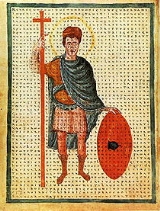
Louis the Pious

 
Louis the Pious

   Email Print
   Bookmark   Link


Louis the Pious


Louis the Pious (778 – 20 June 840
840

Events...
), also called the Fair, and the Debonaire, was the King of Aquitaine from 781 and co-Emperor
Holy Roman Emperor

Image:HRR 14Jh.jpgThe Roman of the Emperor's title was a reflection of the translatio imperii principle that regarded the Holy Roman Emperors as the inheritors of the title of Emperor of the Western Roman Empire, a title left unclaimed in the West after the death of Julius Nepos in 480....
 (as Louis I) and King of the Franks with his father, Charlemagne
Charlemagne

Charlemagne was List of Frankish kings from 768 to his death. He expanded the Franks kingdoms into a Carolingian Empire that incorporated much of Western Europe and Central Europe....
, from 813. As the only surviving adult son of Charlemagne, he became the sole ruler of the Franks after his father's death in 814, a position which he held until his death, save for the period 833–34, during which he was deposed.

During his reign in Aquitaine Louis was charged with the defence of the Empire's southwestern frontier.


Discussion
Ask a question about 'Louis the Pious'
Start a new discussion about 'Louis the Pious'
Answer questions from other users
Full Discussion Forum


Timeline

778   Born

801   Louis the Pious occupies Barcelona.

813   Louis the Pious crowned co-emperor of the Franks with his father Charlemagne.

814   Louis the Pious succeeds Charlemagne as king of the Franks and Emperor.

816   Frankish king Louis the Pious crowned emperor.

817   Louis the Pious divides his empire among his sons. Louis the German becomes king of East Francia, Lothar I becomes co-emperor.

818   Bishop Theodulf of Orléans is deposed and imprisoned after getting involved in a conspiracy of Bernard, king of Italy, against Louis the Pious

819   Louis the Pious marries Judith Welf

825   Emperor Louis the Pious of the Franks wars against the Wends and Sorbs. ''

829   Ansgar is appointed missionary to Sweden by Louis the Pious, at the request of the Swedish king Björn at Hauge.


Encyclopedia


Louis the Pious (778 – 20 June 840
840

Events...
), also called the Fair, and the Debonaire, was the King of Aquitaine from 781 and co-Emperor
Holy Roman Emperor

Image:HRR 14Jh.jpgThe Roman of the Emperor's title was a reflection of the translatio imperii principle that regarded the Holy Roman Emperors as the inheritors of the title of Emperor of the Western Roman Empire, a title left unclaimed in the West after the death of Julius Nepos in 480....
 (as Louis I) and King of the Franks with his father, Charlemagne
Charlemagne

Charlemagne was List of Frankish kings from 768 to his death. He expanded the Franks kingdoms into a Carolingian Empire that incorporated much of Western Europe and Central Europe....
, from 813. As the only surviving adult son of Charlemagne, he became the sole ruler of the Franks after his father's death in 814, a position which he held until his death, save for the period 833–34, during which he was deposed.

During his reign in Aquitaine Louis was charged with the defence of the Empire's southwestern frontier. He reconquered
Reconquista

The Reconquista was a period of 800 years in the Middle Ages during which several Christian kingdoms of the Iberian Peninsula succeeded in retaking the Iberian Peninsula from the Muslims....
 Barcelona
Barcelona

Barcelona is the capital and most populous city of the Autonomous communities of Spain of Catalonia and the second largest city in Spain, with a population of 1,615,908 in 2008, while the population of the Metropolitan Area was 3,161,081....
 from the Muslims in 801 and re-asserted Frankish authority over Pamplona
Pamplona

Pamplona is the capital city of Navarre, Spain and of the former kingdom of Navarre.The city is famous worldwide for the San Ferm?n festival, from July 6 to 14, in which the running of the bulls or encierro is one of the main attractions....
 and the Basques south of the Pyrenees
Pyrenees

The Pyrenees are a mountain range in southwest Europe that form a natural border between France and Spain. They separate the Iberian Peninsula from the rest of continental Europe, and extend for about from the Bay of Biscay to the Mediterranean Sea ....
 in 813. As emperor he included his adult sons—Lothair
Lothair I

Lothair I , king of Italy and crowned Carolingian Empire King of Italy, Emperor of the Romans and was Empire of the Franks .Lothair was the eldest son of the Carolingian emperor Louis the Pious and his wife Ermengarde of Hesbaye, daughter of Ingerman of Hesbaye, duke of Hesbaye....
, Pepin
Pepin I of Aquitaine

File:Pepin_I_Aquitaine_denier_817_838.jpgPepin I was King of Aquitaine. He was the second son of Holy Roman Emperor Louis the Pious and his first wife, Ermengarde of Hesbaye....
, and Louis
Louis the German

Louis the German , was a grandson of Charlemagne and the third son of the succeeding Holy Roman Emperor Louis the Pious and his first wife, Ermengarde of Hesbaye....
—in the government and sought to establish a suitable division of the realm between them. The first decade of his reign was characterised by several tragedies and embarrassments, notably the brutal treatment of his nephew Bernard of Italy
Bernard of Italy

Bernard was the King of Italy from 810 to 818. He plotted against his uncle, Holy Roman Emperor Louis the Pious, when the latter's Ordinatio Imperii made Bernard a vassal of his cousin Lothair I....
, for which Louis atoned in a public act of self-debasement. In the 830s his empire was torn by civil war between his sons, only exacerbated by Louis's attempts to include his son Charles
Charles the Bald

File:Charles le Chauve denier Bourges after 848.jpgCharles the Bald , Holy Roman Emperor and King of West Francia , was the youngest son of the Emperor Louis the Pious by his second wife Judith, daughter of Welf....
 by his second wife in the succession plans. Though his reign ended on a high note, with order largely restored to his empire, it was followed by three years of civil war. Louis is generally compared unfavourably to his father, though the problems he faced were of a distinctly different sort.

Birth and rule in Aquitaine

Louis was born while his father Charlemagne
Charlemagne

Charlemagne was List of Frankish kings from 768 to his death. He expanded the Franks kingdoms into a Carolingian Empire that incorporated much of Western Europe and Central Europe....
 was on campaign in Spain, at the Carolingian villa
Roman villa

A Roman villa is a villa that was built or lived in during the Roman republic and the Roman Empire. A villa was originally a Rome country house built for the upper class....
 of Cassinogilum, according to Einhard
Einhard

Einhard was a Franks courtier, a dedicated servant of Charlemagne, of whom he wrote his famous biography, Vita Karoli Magni, and Louis the Pious....
 and the anonymous chronicler called Astronomus; the place is usually identified with Chasseneuil
Chasseneuil-du-Poitou

Chasseneuil-du-Poitou is a communes of France of the Vienne departments of France, in France....
, near Poitiers. He was the third son of Charlemagne by his wife Hildegard.

Louis was crowned king of Aquitaine as a child in 781 and sent there with regent
Regent

A regent, from the Latin regens "reigning", is a person selected to act as head of state because the ruler is a minor, not present or debilitated....
s and a court. Charlemagne constituted the sub-kingdom in order to secure the border of his kingdom after his devastating defeat at the hands of Basques in Roncesvalles
Roncesvalles

Roncesvalles is a small village and municipality of northern Spain , in the Provinces of Spain of Navarre. It is situated on the small river Urrobi at an altitude of 900 meters among the Pyrenees, and within five miles of the France frontier....
 in (778).

In 794, Charlemagne settled four former Gallo-Roman villas on Louis, in the thought that he would take in each in turn as winter residence: Doué-la-Fontaine
Doué-la-Fontaine

Dou?-la-Fontaine is a Communes of France in the Maine-et-Loire Departments of France in western France.It is located in the heart of Anjou, a few kilometers from the great ch?teaux of the Loire Valley....
 in today's Anjou
Anjou

Anjou is a former county , duchy and Provinces of France centred on the city of Angers in the lower Loire Valley of western France. It corresponds largely to the present-day d?partement in France of Maine-et-Loire....
, Ebreuil
Ébreuil

?breuil is a Communes of the Allier department in the Allier Departments of France in central France....
 in Allier
Allier

Allier is a departments of France in south-central France named after the Allier River....
, Angeac-Charente
Angeac-Charente

Angeac-Charente is a Communes of France in the Charente Departments of France in western France....
, and the disputed Cassinogilum. Charlemagne's intention was to see all his sons brought up as natives of their given territories, wearing the national costume of the region and ruling by the local customs. Thus were the children sent to their respective realms at so young an age. Each kingdom had its importance in keeping some frontier, Louis's was the Spanish March. In 797, Barcelona
Barcelona

Barcelona is the capital and most populous city of the Autonomous communities of Spain of Catalonia and the second largest city in Spain, with a population of 1,615,908 in 2008, while the population of the Metropolitan Area was 3,161,081....
, the greatest city of the Marca, fell to the Franks when Zeid, its governor, rebelled against Córdoba and, failing, handed it to them. The Umayyad authority recaptured it in 799. However, Louis marched the entire army of his kingdom, including Gascons with their duke Sancho I of Gascony
Sancho I of Gascony

Sancho I L?pez or Lupus Sancho was a Duke of Gascony between the years 801 and 812.His parentage is unknown, but onomastics and chronology indicate that he may have been a son of Lupo II of Gascony....
, Provençals
Provence

Provence is a region of southeastern France on the Mediterranean adjacent to Italy. It is part of the administrative regions of France of Provence-Alpes-C?te d'Azur....
 under Leibulf
Leibulf of Provence

Leibulf, Leybulf, or Letibulf was the Count of Provence in the early ninth century. Along with Gaucelm, who ruled Gothia, and Bera, Count of Barcelona, who ruled Catalonia, he was one of the three most important magnates in the south during the early reign of Louis the Pious, during which the Holy Roman Emperor reorganised that te...
, and Goths under Bera
Bera, Count of Barcelona

Bera was the first count of Barcelona from 801 until his deposition in 820.He was also the Count of Girona, Besal?, and Ausona from 812 or 817 and Count of Raz?s and Conflent from 790 until his deposition....
, over the Pyrenees
Pyrenees

The Pyrenees are a mountain range in southwest Europe that form a natural border between France and Spain. They separate the Iberian Peninsula from the rest of continental Europe, and extend for about from the Bay of Biscay to the Mediterranean Sea ....
 and besieged it for two years, wintering there from 800 to 801, when it capitulated. The sons were not given independence from central authority, however, and Charlemagne ingrained in them the concepts of empire and unity by sending them on military expeditions far from their home bases. Louis campaigned in the Italian Mezzogiorno
Mezzogiorno

Southern Italy generally refers to the southern portion of the continental Italian peninsula historically forming the Kingdom of Naples. It encompasses the modern regions of Basilicata, Campania, Calabria, Apulia and Molise, which lie in Italy's south, and Abruzzo which is located in central Italy....
 against the Beneventans
Benevento

Benevento is a town and comune of Campania, Italy, capital of the province of Benevento, 50 km northeast of Naples. It is situated on a hill 130 m above sea-level at the confluence of the Calore Irpino and Sabato....
 at least once.

Louis was one of Charlemagne's three legitimate sons to survive infancy, and, according to Frankish custom, Louis had expected to share his inheritance with his brothers, Charles the Younger, King of Neustria, and Pepin, King of Italy
King of Italy

King of Italy is a title adopted by many rulers of the Italian peninsula after the fall of the Roman Empire. Until 1870, however, no ?King of Italy? ruled the whole peninsula, though some pretended to such authority....
. In the Divisio Regnorum of 806, Charlemagne had slated Charles the Younger as his successor as emperor and chief king, ruling over the Frankish heartland of Neustria
Neustria

The territory of Neustria or Neustrasia, meaning "new [western] land", originated in 511, made up of the regions from Aquitaine to the English Channel, approximating most of the north of present-day France, with Paris and Soissons as its main cities....
 and Austrasia
Austrasia

Austrasia formed the north-eastern portion of the Kingdom of the Merovingian Franks, comprising parts of the territory of present-day eastern France, western Germany, Belgium, Luxembourg and the Netherlands....
, while giving Pepin the Iron Crown of Lombardy
Iron Crown of Lombardy

The Iron Crown of Lombardy is both a relic and one of the most ancient royal insignia of Europe. It is kept in the Monza Cathedral near Milan....
, which Charlemagne possessed by conquest. To Louis's kingdom of Aquitaine, he added Septimania
Septimania

Septimania was the western region of the Roman province of Gallia Narbonensis that passed under the control of the Visigoths in 462, when Septimania was ceded to their king, Theodoric II....
, Provence
Provence

Provence is a region of southeastern France on the Mediterranean adjacent to Italy. It is part of the administrative regions of France of Provence-Alpes-C?te d'Azur....
, and part of Burgundy.

But in the event, Charlemagne's other legitimate sons died — Pepin in 810 and Charles in 811 — and Louis alone remained to be crowned co-emperor with Charlemagne in 813. On his father's death in 814, he inherited the entire Frankish kingdom and all its possessions (with the sole exception of Italy, which remained within Louis's empire, but under the direct rule of Bernard
Bernard of Italy

Bernard was the King of Italy from 810 to 818. He plotted against his uncle, Holy Roman Emperor Louis the Pious, when the latter's Ordinatio Imperii made Bernard a vassal of his cousin Lothair I....
, Pepin's son).

Emperor

He was in his villa of Doué-la-Fontaine
Doué-la-Fontaine

Dou?-la-Fontaine is a Communes of France in the Maine-et-Loire Departments of France in western France.It is located in the heart of Anjou, a few kilometers from the great ch?teaux of the Loire Valley....
, Anjou
Anjou

Anjou is a former county , duchy and Provinces of France centred on the city of Angers in the lower Loire Valley of western France. It corresponds largely to the present-day d?partement in France of Maine-et-Loire....
, when he received news of his father's passing. Hurrying to Aachen
Aachen

is a historic spa town in North Rhine-Westphalia, Germany. It is the westernmost city of Germany, located along its borders with Belgium and the Netherlands, 65 km west of Cologne....
, he crowned himself and was proclaimed by the nobles with shouts of Vivat Imperator Ludovicus.

In his first coinage type, minted from the start of his reign, he imitated his father Charlemagne's portrait coinage, giving an image of imperial power and prestige in an echo of Roman glory . He quickly enacted a "moral purge", in which he sent all of his unmarried sisters to nunneries, forgoing their diplomatic use as hostage brides in favour of the security of avoiding the entanglements that powerful brothers-in-law might bring. He spared his illegitimate half-brothers and tonsured
Tonsure

Tonsure is the practice of some Christianity churches, mystics, Buddhist novices and Bhikkhus, and some Hindu temples of cutting the hair from the scalp of clerics, devotees or holy people as a symbol of their renunciation of worldly fashion and esteem....
 his father's cousins, Adalard and Wala
Wala of Corbie

Wala of Corbie was the son of Bernard, son of Charles Martel, son of Charles Martel, and one of the principal advisers of his cousin Charlemagne, Charlemagne's son Louis the Pious, and his son Lothair I....
, shutting them up in Noirmoutier and Corbie
Corbie

Corbie is a commune in France of the Somme d?partement in France, in northern France....
, respectively, despite the latter's initial loyalty.

His chief councillors were Bernard, margrave of Septimania, and Ebbo, whom, born a serf, Louis would raise to the archbishopric of Rheims but who would ungratefully betray him later. He retained some of his father's ministers, such as Elisachar, abbot of St Maximin near Trier
Trier

Trier is a city in Germany on the banks of the Moselle River. It is the oldest city in Germany, founded in or before 16 BC. Trier is not the only city claiming to be Germany's oldest, but it is the only one that bases this assertion on having the longest history as a city, as opposed to a mere settlement or army camp....
, and Hildebold, Archbishop of Cologne. Later he replaced Elisachar with Hildwin, abbot of many monasteries.

He also used Benedict of Aniane
Benedict of Aniane

Saint Benedict of Aniane , born Witiza and called the Second Benedict, was a Benedictine monk and monastic reformer, who left a large imprint on the religious practice of the Carolingian Empire....
 (the Second Benedict), a Septimanian Visigoth and monastic founder, to help him reform the Frankish church. One of Benedict's primary reforms was to ensure that all religious houses in Louis' realm adhered to the Rule of St Benedict
Rule of St Benedict

The Rule of Saint Benedict is a book of precepts written by Benedict of Nursia for monks living communally under the authority of an abbot. Since about the 7th century it has also been adopted by communities of women....
, named for its creator, the First Benedict, Benedict of Nursia
Benedict of Nursia

Saint Benedict of Nursia was a saint from Italy, the founder of Western Christian monasticism communities, and a rule-giver for cenobite monks....
 (480–550).

In 816, Pope Stephen V
Pope Stephen V

Pope Stephen V, , succeeded Pope Adrian III, and was in turn succeeded by Pope Formosus. In his dealings with Constantinople in the matter of Photios I of Constantinople, as also in his relations with the young Slavonic church, he pursued the policy of Pope Nicholas I....
, who had succeeded Leo III
Pope Leo III

Pope Saint Leo III was Pope from 795 to 816. Protected by Charlemagne from his enemies in Rome, he subsequently strengthened Charlemagne's position by crowning him as Roman Emperor....
, visited Rheims and again crowned Louis. The Emperor thereby strengthened the papacy by recognising the importance of the pope in imperial coronations.

Denier Louis Le Pieux

Ordinatio imperii

On Maundy Thursday
Maundy Thursday

Maundy Thursday is the Christian feast or holy day falling on the Thursday before Easter that commemorates the Last Supper of Jesus Christ with the Apostles....
 817, Louis and his court were crossing a wooden gallery from the cathedral to the palace in Aachen when the gallery collapsed, killing many. Louis, having barely survived and feeling the imminent danger of death, began planning for his succession; three months later he issued an Ordinatio Imperii, an imperial decree that laid out plans for an orderly succession. In 815, he had already given his two eldest sons a share in the government, when he had sent his elder sons Lothair
Lothair I

Lothair I , king of Italy and crowned Carolingian Empire King of Italy, Emperor of the Romans and was Empire of the Franks .Lothair was the eldest son of the Carolingian emperor Louis the Pious and his wife Ermengarde of Hesbaye, daughter of Ingerman of Hesbaye, duke of Hesbaye....
 and Pepin
Pepin I of Aquitaine

File:Pepin_I_Aquitaine_denier_817_838.jpgPepin I was King of Aquitaine. He was the second son of Holy Roman Emperor Louis the Pious and his first wife, Ermengarde of Hesbaye....
 to govern Bavaria
Bavaria

Bavaria , with an area of and almost 12.5 million inhabitants, is a region located in the southeast of Germany and is the largest States of Germany of Germany by area....
 and Aquitaine respectively, though without the royal titles. Now, he proceeded to divide the empire among his three sons and his nephew Bernard of Italy
Bernard of Italy

Bernard was the King of Italy from 810 to 818. He plotted against his uncle, Holy Roman Emperor Louis the Pious, when the latter's Ordinatio Imperii made Bernard a vassal of his cousin Lothair I....
:

  • Lothair was proclaimed and crowned co-emperor in Aix-la-Chapelle by his father. He was promised the succession to most of the Frankish dominions (excluding the exceptions below), and would be the overlord of his brothers and cousin.
  • Bernard, the son of Charlemagne's son Pippin of Italy
    Pippin of Italy

    Pepin was the son of Charlemagne and king of Italy under the authority of his father.Pepin was the third son of Charlemagne, and the second with his wife Hildegard, wife of Charlemagne....
    , was confirmed as King of Italy, a title he had been allowed to inherit from his father by Charlemagne.
  • Pepin was proclaimed King of Aquitaine, his territory including Gascony, the march around Toulouse, and the counties of Carcassonne, Autun, Avallon and Nevers.
  • Louis
    Louis the German

    Louis the German , was a grandson of Charlemagne and the third son of the succeeding Holy Roman Emperor Louis the Pious and his first wife, Ermengarde of Hesbaye....
    , the youngest son, was proclaimed King of Bavaria and the neighbouring marches.


If one of the subordinate kings died, he was to be succeeded by his sons. If he died childless, Lothair would inherit his kingdom. In the event of Lothair dying without sons, one of Louis the Pious' younger sons would be chosen to replace him by "the people". Above all, the Empire would not be divided: the Emperor would rule supreme over the subordinate kings, whose obedience to him was mandatory.

With this settlement, Louis tried to combine his sense for the Empire's unity, supported by the clergy, while at the same time providing positions for all of his sons. Instead of treating his sons equally in status and land, he elevated his first-born son Lothair above his younger brothers and gave him the largest part of the Empire as his share.

Louis the Pious

Bernard's rebellion and Louis's penance

The ordinatio imperii of Aachen left Bernard of Italy in an uncertain and subordinate position as king of Italy, and he began plotting to declare independence upon hearing of it. Louis immediately directed his army towards Italy, and betook himself to Chalon-sur-Saône
Chalon-sur-Saône

Chalon-sur-Sa?ne is a town and communes of France in central France, in the Sa?ne-et-Loire departments of France, of which it is a Subprefectures in France....
. Intimidated by the emperor's swift action, Bernard met his uncle at Chalon, under invitation, and surrendered. He was taken to Aix-la-Chapelle by Louis, who there had him tried and condemned to death for treason. Louis had the sentence commuted to blinding, which was duly carried out; Bernard did not survive the ordeal, however, dying after two days of agony. Others also suffered: Theodulf of Orleans
Theodulf of Orléans

Theodulf of Orl?ans , was the Bishop of Orl?ans during the reign of Charlemagne and Louis the Pious. He was a key member of the Carolingian Renaissance and an important figure during the many reforms of the church under Charlemagne, as well as the author of the Libri Carolini, "much the fullest statement of the Western attitude to re...
, in eclipse since the death of Charlemagne, was accused of having supported the rebellion, and was thrown into a monastic prison, where he died soon after - poisoned, it was rumoured. The fate of his nephew deeply marked Louis's conscience for the rest of his life.

In 822, as a deeply religious man, Louis performed penance for causing Bernard's death, at his palace of Attigny
Attigny, Ardennes

Attigny is a commune in France on the river Aisne in the arrondissement of Vouziers in the D?partements of France of Ardennes in the Champagne-Ardenne r?gion in France in northern France....
 near Vouziers in the Ardennes
Ardennes

The Ardennes is a region of extensive forests, rolling hills and old mountains formed on the Givetian Ardennes mountains, primarily in Belgium and Luxembourg, but stretching into France , and geologically into the Eifel....
, before Pope Paschal I
Pope Paschal I

Pope Paschal I was pope from January 25, 817 to February 11, 824. A native of Rome and son of Bonosus, he was raised to the pontificate by the acclamation of the clergy, shortly after the death of Pope Stephen IV, and before the sanction of the emperor Louis the Pious had been obtained - a circumstance for which it was one of his first cares...
, and a council of ecclesiastics and nobles of the realm that had been convened for the reconciliation of Louis with his three younger half-brothers, Hugo
Hugh, son of Charlemagne

Hugh was the illegitimate son of Charlemagne and his concubine Regina , with whom he had one other son: Bishop Drogo of Metz .Hugh was the abbot of several abbacies: Saint-Quentin , Lobbes Abbey , and Saint-Bertin ....
 whom he soon made abbot of St-Quentin, Drogo
Drogo of Metz

Drogo, also known as Dreux or Drogon was an illegitimate son of Frankish emperor Charlemagne by the concubine Regina .As one of the few children to outlive his father, Drogo's prospects for political power were very favourable....
 whom he soon made Bishop of Metz, and Theodoric. This act of contrition, partly in emulation of Theodosius I
Theodosius I

Flavius Theodosius , also called Theodosius I and Theodosius the Great , was Roman Emperor from 379 to 395. Reuniting the eastern and western portions of the empire, Theodosius was the last emperor of both the Eastern Roman Empire and Western Roman Empire....
, had the effect of greatly reducing his prestige as a Frankish ruler, for he also recited a list of minor offences about which no secular ruler of the time would have taken any notice. He also made the egregious error of releasing Wala and Adalard from their monastic confinements, placing the former in a position of power in the court of Lothair and the latter in a position in his own house.

Frontier wars

At the start of Louis's reign, the many tribes — Danes, Obotrites
Obotrites

The Obotrites , also commonly known as the Obodrites, Abotrites, or Abodrites, were a confederation of medieval West Slavs tribes within the territory of modern Mecklenburg and Holstein in northern Germany ....
, Slovenes, Bretons, Basques — which inhabited his frontierlands were still in awe of the Frankish emperor's power and dared not stir up any trouble. In 816, however, the Sorbs
Sorbs

Sorbs also known as Wends, Lusatian Sorbs or Lusatian Serbs, are a Slavic peoples people settled in Lusatia, a region on the territory of Germany and Poland....
 rebelled and were quickly followed by Slavomir, chief of the Obotrites, who was captured and abandoned by his own people, being replaced by Ceadrag in 818. Soon, Ceadrag too had turned against the Franks and allied with the Danes, who were to become the greatest menace of the Franks in a short time.

A greater Slavic menace was gathering on the southeast. There, Ljudevit Posavski
Ljudevit Posavski

Ljudevit Posavski was a Croat Duke of Pannonian Croatia from 810 to 823. The capital of his realm was in Sisak. As the ruler of the Pannonian Croatia, he led an unsuccessful resistance to Franks domination....
, duke of Pannonia
Pannonia

Pannonia is an ancient province of the Roman Empire bounded north and east by the Danube, coterminous westward with Noricum and upper Italy, and southward with Dalmatia and upper Moesia....
, was harassing the border at the Drava
Drava

Drava or Drave is a river in southern Central Europe, a tributary of the Danube. It begins in Dobbiaco, Italy, and flows east through East Tirol and Carinthia in Austria, into Slovenia , and then southeast, passing through Croatia and forming most of the border between Croatia and Hungary, before it joins the Danube near Osijek....
 and Sava rivers. The margrave of Friuli, Cadolah, was sent out against him, but he died on campaign and, in 820, his margarvate was invaded by Slovenes. In 821, an alliance was made with Borna
Borna

Borna is a town in the Free State of Saxony, Germany, capital of the Leipzig district. It is situated approx. 25 km southeast of Leipzig....
, duke of the Dalmatia
Dalmatia

Dalmatia is a region on the eastern coast of the Adriatic Sea, situated mostly in modern Croatia and spreading between the island of Rab in the northwest and the Bay of Kotor in the southeast....
, and Ljudevit was brought to heel. In 824 several Slav tribes in the north-western parts of Bulgaria
Bulgaria

The state of Bulgaria , Scientific transliteration Balgarija, officially the Republic of Bulgaria has played a significant role in the Balkans in south-eastern Europe for over fourteen centuries....
 acknowledged Louis's suzerainity and after he was reluctant to settle the matter peacefully with the Bulgarian ruler Omurtag
Omurtag of Bulgaria

Omurtag or Omortag was a Great Khan of Bulgaria from 815 to 831. He is known as "the Builder".In the very beginning of his reign he signed a 30-year peace treaty with the Byzantines which remained in force to the end of his life....
, in 827 the Bulgarians attacked the Franks in Pannonia
Pannonia

Pannonia is an ancient province of the Roman Empire bounded north and east by the Danube, coterminous westward with Noricum and upper Italy, and southward with Dalmatia and upper Moesia....
 and regained their lands.

On the far southern edge of his great realm, Louis had to control the Lombard princes of Benevento
List of Dukes and Princes of Benevento

This is a list of the Dukes and Princes of Duchy of Benevento....
 whom Charlemagne had never subjugated. He extracted promises from Princes Grimoald IV
Grimoald IV of Benevento

Grimoald IV , called Falco, was the Lombards Prince of Benevento from 806 until his death. He was a thesaurarius or stolesayz/stoleseyz before becoming prince on the death of Grimoald III of Benevento, over Grimoald's own son, Ilderic, another stoleseyz....
 and Sico, but to no effect.

On the southwestern frontier, problems commenced early when, in 815, Séguin, duke of Gascony
Gascony

Gascony is an area of southwest France that constituted a Provinces of France prior to the French Revolution. In historic references dating from the beginning of the Roman era, it was part of Gaul and became part of the Kingdom of the Franks during the conquests of Clovis I ....
, revolted. He was defeated and replaced by Lupus III, who was dispossessed in 818 by the emperor. In 820 an assembly at Quierzy-sur-Oise
Quierzy-sur-Oise

Quierzy is a Communes of the Aisne department in the Aisne Departments of France in Picardie in northern France, straddling the Oise River between Noyon and Chauny....
 decided to send an expedition against the Cordoban caliphate. The counts in charge of the army, Hugh
Hugh of Tours

Hugh or Hugo was the count of Tours and Count of Sens during the reigns of Charlemagne and Louis the Pious, until his disgrace in February 828....
, count of Tours
Tours

Tours is a city in central France, the capital of the Indre-et-Loire Departments of France.It is located on the lower reaches of the river River Loire, between Orl?ans and the Atlantic Ocean coast....
, and Matfrid
Matfrid of Orléans

Matfrid was Count of Orl?ans in the reign of Emperor Louis the Pious. Historians presume that he was the first of Franks noble clan known as the Matfridings....
, count of Orléans
Orléans

Orl?ans is a city in north-central France, about 130 km southwest of Paris. It is the capital of the Loiret Departments of France and of the Centre R?gion in France....
, were slow in acting and the expedition came to naught.

First civil war

In 818, as Louis was returning from a campaign to Brittany
Brittany

Brittany is a former independent Celtic nations monarchy and duchy, now incorporated into France. It is also, more generally, the name of the cultural area whose limits correspond to the historic province and independent duchy....
, he was greeted by news of the death of his wife, Ermengarde
Ermengarde of Hesbaye

Ermengarde of Hesbaye, or Irmengarde was Queen of the Franks and Holy Roman Empress as the wife of Louis the Pious. She was Franks, the daughter of Ingerman of Hesbaye, count of Hesbaye, and Hedwig of Bavaria....
. Ermengarde was the daughter of Ingerman, the duke of Hesbaye. Louis had been close to his wife, who had been involved in policymaking. It was rumoured that she had played a part in her nephew's death and Louis himself believed her own death was divine retribution for that event. It took many months for his courtiers and advisors to convince him to remarry, but eventually he did, in 820, to Judith
Judith, daughter of Welf

Queen Judith or Iudit , also known as Judith of Bavaria, was the daughter of Count Welf and a Duchy of Saxony noblewoman named Hedwig, Duchess of Bavaria ....
, daughter of Welf
Welf

The House of Welf is a European dynasty that has included many Germany and United Kingdom monarchs from the 11th to 20th century.The House of Welf is the older branch of the House of Este, a dynasty whose oldest known members lived in Lombardy in the 9th century....
, count of Altdorf. In 823 Judith gave birth to a son, who was named Charles
Charles the Bald

File:Charles le Chauve denier Bourges after 848.jpgCharles the Bald , Holy Roman Emperor and King of West Francia , was the youngest son of the Emperor Louis the Pious by his second wife Judith, daughter of Welf....
.

The birth of this son damaged the Partition of Aachen, as Louis's attempts to provide for his fourth son met with stiff resistance from his older sons, and the last two decades of his reign were marked by civil war.

At Worms
Worms, Germany

Worms is a city in Rhineland-Palatinate, Germany, on the Rhine River. At the end of 2004, it had 85,829 inhabitants.Established by the Celts who called it Borbetomagus, Worms today remains embattled with the cities Trier and Cologne over title of "Oldest City in Germany"....
 in 829, Louis gave Charles Alemannia with the title of king or duke (historians differ on this), thus enraging his son and co-emperor Lothair, whose promised share was thereby diminished. An insurrection was soon at hand. With the urging of the vengeful Wala and the cooperation of his brothers, Lothair accused Judith of having committed adultery with Bernard of Septimania, even suggesting Bernard to be the true father of Charles. Ebbo and Hildwin abandoned the emperor at that point, Bernard having risen to greater heights than either of them. Agobard
Agobard

Agobard was a Carolingian prelate and Archbishop of Lyon.We know nothing of his early life nor of his descent. In 813 he became coadjutor to Leidrad, Archbishop of Lyon....
, Archbishop of Lyon, and Jesse, bishop of Amiens, too, opposed the redivision of the empire and lent their episcopal prestige to the rebels.

In 830, at Wala's insistence that Bernard of Septimania was plotting against him, Pepin of Aquitaine led an army of Gascons, with the support of the Neustrian magnates, all the way to Paris
Paris

Paris is the Capital of France and the country's largest city. It is situated on the river Seine, in northern France, at the heart of the ?le-de-France Regions of France ....
. At Verberie
Verberie

Verberie is a Communes of France in the Oise Departments of France in northern France.It lies 7 miles southwest of Compi?gne on the main road to Senlis, Oise and Paris....
, Louis the German joined him. At that time, the emperor returned from another campaign in Brittany to find his empire at war with itself. He marched as far as Compiègne
Compiègne

Compi?gne is a Communes of France in the Oise Departments of France in northern France.The city is located along the Oise River. Its inhabitants are called Compi?gnois....
, an ancient royal town, before being surrounded by Pepin's forces and captured. Judith was incarcerated at Poitiers
Poitiers

Poitiers is a city on the Clain in west central France. It is a commune in France and the capital of the Vienne d?partement in France and of the Poitou-Charentes r?gion in France....
 and Bernard fled to Barcelona.

Then Lothair finally set out with a large Lombard army, but Louis had promised his sons Louis the German and Pepin of Aquitaine greater shares of the inheritance, prompting them to shift loyalties in favour of their father. When Lothair tried to call a general council of the realm in Nijmegen
Nijmegen

Nijmegen is a municipality and a city in the east of the Netherlands, near the Germany border. It is considered to be the oldest city in the Netherlands and celebrated its 2000th year of existence in 2005....
, in the heart of Austrasia
Austrasia

Austrasia formed the north-eastern portion of the Kingdom of the Merovingian Franks, comprising parts of the territory of present-day eastern France, western Germany, Belgium, Luxembourg and the Netherlands....
, the Austrasians and Rhinelanders came with a following of armed retainers, and the disloyal sons were forced to free their father and bow at his feet (831). Lothair was pardoned, but disgraced and banished to Italy. Pepin returned to Aquitaine and Judith - after being forced to humiliate herself with a solemn oath of innocence - to Louis's court. Only Wala was severely dealt with, making his way to a secluded monastery on the shores of Lake Geneva
Lake Geneva

Lake Geneva or Lake L?man is the second largest freshwater lake in Central Europe in terms of surface area . 60% of it comes under the jurisdiction of Switzerland , and 40% under France ....
. Though Hilduin
Hilduin

Hilduin was Bishop of Paris, chaplain to Louis the Pious, reforming Abbot of the Abbey of St. Denis, and a writer.He was from a prominent Frankish family....
, abbot of Saint Denis, was exiled to Paderborn
Paderborn

Paderborn is a city in North Rhine-Westphalia, Germany, capital of the Paderborn . The name of the city derives from the river Pader River, which originates in more than 200 springs near Paderborn Cathedral, where St....
 and Elisachar and Matfrid were deprived of their honours north of the Alps; they did not lose their freedom.

Second civil war

The next revolt occurred a mere two years later (832). The disaffected Pepin was summoned to his father's court, where he was so poorly received he left against his father's orders. Immediately, fearing that Pepin would be stirred up to revolt by his nobles and desiring to reform his morals, Louis the Pious summoned all his forces to meet in Aquitaine in preparation of an uprising, but Louis the German garnered an army of Slav
Slavic peoples

The Slavic Peoples are a linguistic branch of Indo-European peoples, living mainly in eastern Europe. From the early 6th century they spread from their original homeland to inhabit most of eastern Central Europe, Eastern Europe and the Balkans....
 allies and conquered Swabia
Swabia

Swabia, Suabia, or Svebia is both a historic and linguistics region in Germany. Swabia consists of much of the present-day state of Baden-W?rttemberg , as well as the Bavarian Swabia ....
 before the emperor could react. Once again the elder Louis divided his vast realm. At Jonac, he declared Charles king of Aquitaine and deprived Pepin (he was less harsh with the younger Louis), restoring the whole rest of the empire to Lothair, not yet involved in the civil war. Lothair was, however, interested in usurping his father's authority. His ministers had been in contact with Pepin and may have convinced him and Louis the German to rebel, promising him Alemannia, the kingdom of Charles.

Soon Lothair, with the support of Pope Gregory IV
Pope Gregory IV

Gregory IV, pope , was chosen to succeed Pope Valentine in December 827, on which occasion he recognized the supremacy of the Franks emperor Louis the Pious in the most unequivocal manner....
, whom he had confirmed in office without his father's support, joined the revolt in 833. While Louis was at Worms gathering a new force, Lothair marched north. Louis marched south. The armies met on the plains of the Rothfeld. There, Gregory met the emperor and may have tried to sow dissension amongst his ranks. Soon much of Louis's army had evaporated before his eyes, and he ordered his few remaining followers to go, because "it would be a pity if any man lost his life or limb on my account." The resigned emperor was taken to Saint Médard at Soissons
Soissons

Soissons is a Communes of the Aisne department in the Aisne Departments of France in Picardie in northern France, located on the Aisne River, about 100 kilometres northeast of Paris....
, his son Charles to Prüm
Prüm

Art = Stadt|image_photo = AbteikirchePr?m.jpg|imagesize = 180|Wappen = Wappen Pruem.png|lat_deg = 50 |lat_min = 12 |lat_sec = 29...
, and the queen to Tortona
Tortona

*For the medieval scholar, see Marziano da TortonaTortona is a comune of Piemonte, in the Province of Alessandria, Italy. Tortona is sited on the right bank of the Scrivia between the plain of Marengo and the foothills of the Ligurian Apennines....
. The despicable show of disloyalty and disingenuousness earned the site the name Field of Lies, or Lügenfeld, or Campus Mendacii, ubi plurimorum fidelitas exstincta est

On November 13 833
833

Events...
, Ebbo of Rheims presided over a synod in the Church of Saint Mary in Soissons which deposed Louis and forced him to publicly confess many crimes, none of which he had, in fact, committed. In return, Lothair gave Ebbo the Abbey of Saint Vaast. Men like Rabanus Maurus
Rabanus Maurus

Rabanus Maurus Magnentius , also known as Hrabanus or Rhabanus, was a Franks Benedictine monk, the archbishop of Mainz in Germany and a Theology....
, Louis' younger half-brothers Drogo and Hugh, and Emma, Judith's sister and Louis the German's new wife, worked on the younger Louis to make peace with his father, for the sake of unity of the empire. The humiliation to which Louis was then subjected at Notre Dame in Compiègne turned the loyal barons of Austrasia and Saxony
Saxony

The Free State of Saxony is a States of Germany of Germany. Located in the southeastern part of present-day Germany. It is the tenth-largest German state in area and the sixth largest in population , of Germany's sixteen states....
 against Lothair, and the usurper fled to Burgundy, skirmishing with loyalists near Châlons-sur-Saône. Louis was restored the next year, on 1 March 834
834

Events...
.

On Lothair's return to Italy, Wala, Jesse, and Matfrid, formerly count of Orléans, died of a pestilence and, on 2 February 835
835

Events...
, the Synod of Thionville
Synod of Thionville

The Synod of Thionville was an important synod of ecclesiastic dignitaries of the Carolingian Empire in 835.Three years after the sons of the emperor rose in rebellion against their father, Emperor Louis the Pious, in 830, Ebbo, Archbishop of Rheims, had turned against him and on 13 November, 833, presided at the shameful scene enacted in...
 deposed Ebbo, Agobard, Bernard, Bishop of Vienne, and Bartholomew, Archbishop of Narbonne. Lothair himself fell ill; events had turned completely in Louis favour once again.

In 836, however, the family made peace and Louis restored Pepin and Louis, deprived Lothair of all save Italy, and gave it to Charles in a new division, given at the diet of Crémieux
Crémieux

Cr?mieux may refer to:* Adolphe Cr?mieux, French lawyer and statesman* Hector-Jonathan Cr?mieux, French playwright and librettist* The residents of Cr?mieu, a town near Lyon, France, known as Cr?mieux....
. At about that time, the Vikings terrorised and sacked Utrecht
Utrecht (city)

Utrecht city and municipality is the capital and most populous city of the Netherlands province of Utrecht . It is located in the North-Eastern end of the Randstad, and is the fourth largest city of the Netherlands, with a population of 300,030....
 and Antwerp
Antwerp

||-||-||-||}Antwerp is a city and municipality in Belgium and the capital of the Antwerp in Flanders, one of Belgium's three regions....
. In 837, they went up the Rhine
Rhine

File:Swiss Grand Canyon.jpgThe Rhine is one of the longest and most important rivers in Europe, at , with an average discharge of more than ....
 as far as Nijmegen, and their king, Rorik, demanded the wergild of some of his followers killed on previous expeditions before Louis the Pious mustered a massive force and marched against them. They fled, but it would not be the last time they harried the northern coasts. In 838, they even claimed sovereignty over Frisia
Frisia

Frisia is a coastal region along the southeastern corner of the North Sea, i.e. the German Bight. Frisia is the traditional homeland of the Frisians, a Germanic people who speak Frisian languages, a language group closely related to the English language....
, but a treaty was confirmed between them and the Franks in 839. Louis the Pious ordered the construction of a North Sea fleet and the sending of missi dominici
Missus dominicus

A missus dominicus , Latin for "envoy of the lord [ruler]", also known as Sendgraf in German language, Zendgraaf in Dutch language, both meaning "sent Graf", was an official commissioned by the Frankish king or emperor to supervise the administration, mainly of justice, in parts of his dominions....
 into Frisia to establish Frankish sovereignty there.

Third civil war

In 837, Louis crowned Charles king over all of Alemannia and Burgundy and gave him a portion of his brother Louis's land. Louis the German promptly rose in revolt, and the emperor redivided his realm again at Quierzy-sur-Oise
Quierzy-sur-Oise

Quierzy is a Communes of the Aisne department in the Aisne Departments of France in Picardie in northern France, straddling the Oise River between Noyon and Chauny....
, giving all of the young king of Bavaria's lands, save Bavaria itself, to Charles. Emperor Louis did not stop there, however. His devotion to Charles knew no bounds. When Pepin died in 838, Louis declared Charles the new king of Aquitaine. The nobles, however, elected Pepin's son Pepin II
Pepin II of Aquitaine

File:Pepin_II_d_Aquitaine_obole_845_to_848.jpgPepin II, called the Younger , was King of Aquitaine from 838 as the successor upon the death of his father, Pepin I of Aquitaine....
. When Louis threatened invasion, the third great civil war of his reign broke out. In the spring of 839, Louis the German invaded Swabia, Pepin II and his Gascon subjects fought all the way to the Loire
Loire

Loire is an departments of France in the east-central part of France occupying the River Loire's upper reaches....
, and the Danes returned to ravage the Frisia
Frisia

Frisia is a coastal region along the southeastern corner of the North Sea, i.e. the German Bight. Frisia is the traditional homeland of the Frisians, a Germanic people who speak Frisian languages, a language group closely related to the English language....
n coast (sacking Dorstad for a second time).

Lothair, for the first time in a long time, allied with his father and pledged support at Worms in exchange for a redivision of the inheritance. By a final placitum issued there, Louis gave Bavaria to Louis the German and disinherited Pepin II, leaving the entire remainder of the empire to be divided roughly into an eastern part and a western. Lothair was given the choice of which partition he would inherit and he chose the eastern, including Italy, leaving the western for Charles. The emperor quickly subjugated Aquitaine and had Charles recognised by the nobles and clergy at Clermont-en-Auvergne
Clermont-Ferrand

Clermont-Ferrand is a city and commune in France of France, in the Auvergne regions of France, with a population of 140,700 . Its metropolitan area had 409,558 inhabitants at the 1999 census....
 in 840. Louis then, in a final flash of glory, rushed into Bavaria and forced the younger Louis into the Ostmark. The empire now settled as he had declared it at Worms, he returned in July to Frankfurt am Main, where he disbanded the army. The final civil war of his reign was over.

Death

Louis fell ill soon after his final victorious campaigns and went to his summer hunting lodge on an island in the Rhine, by his palace at Ingelheim. On 20 June 840
840

Events...
, he died, in the presence of many bishops and clerics and in the arms of his half-brother Drogo, though Charles and Judith were absent in Poitiers. Soon dispute plunged the surviving brothers into a civil war that was only settled in 843 by the Treaty of Verdun
Treaty of Verdun

In the Treaty of Verdun-sur-Meuse of 843 the three surviving sons of Louis the Pious, Charlemagne's grandsons, divided his territories, the Frankish Empire, into three kingdoms....
, which split the Frankish realm into three parts, to become the kernels of France
France

France , officially the French Republic , is a country whose Metropolitan France is located in Western Europe and that also comprises various Overseas departments and territories of France....
 and Germany
Germany

Germany , officially the Federal Republic of Germany , is a country in Central Europe. It is bordered to the north by the North Sea, Denmark, and the Baltic Sea; to the east by Poland and the Czech Republic; to the south by Austria and Switzerland; and to the west by France, Luxembourg, Belgium, and the Netherlands....
, with Burgundy and the Low Countries
Low Countries

The Low Countries, the historical region of de Nederlanden, are the country on low-lying land around the river delta of the Rhine, Scheldt, and Meuse River rivers....
 between them. The dispute over the kingship of Aquitaine was not fully settled until 860.

Louis the Pious, along with his half-brother Drogo, were buried in Saint Pierre aux Nonnains Basilica in Metz
Metz

Metz is a city in the northeast of France, capital of the Lorraine R?gion in France and prefecture of the Moselle Departments of France.It is located at the confluence of the Moselle River and the Seille rivers....
.

Marriage and issue

By his first wife, Ermengarde of Hesbaye
Ermengarde of Hesbaye

Ermengarde of Hesbaye, or Irmengarde was Queen of the Franks and Holy Roman Empress as the wife of Louis the Pious. She was Franks, the daughter of Ingerman of Hesbaye, count of Hesbaye, and Hedwig of Bavaria....
 (married ca 794-98), he had three sons and three daughters:
  • Lothair
    Lothair I

    Lothair I , king of Italy and crowned Carolingian Empire King of Italy, Emperor of the Romans and was Empire of the Franks .Lothair was the eldest son of the Carolingian emperor Louis the Pious and his wife Ermengarde of Hesbaye, daughter of Ingerman of Hesbaye, duke of Hesbaye....
     (795–855), king of Middle Francia
    Middle Francia

    Middle Francia designates the short-lived realm created for Holy Roman Emperor Lothair I wedged between East Francia and West Francia. A natural outcome of the Franks tradition of treating the res publica as private property, it was created in the partition of Louis the Pious' legacy that was embodied in the 843 Treaty of Verdun....
  • Pepin
    Pepin I of Aquitaine

    File:Pepin_I_Aquitaine_denier_817_838.jpgPepin I was King of Aquitaine. He was the second son of Holy Roman Emperor Louis the Pious and his first wife, Ermengarde of Hesbaye....
     (797–838), king of Aquitaine
    Aquitaine

    Aquitaine , archaic Guyenne/Guienne , is one of the 26 regions of France, in the south-western part of metropolitan France, along the Atlantic Ocean and the Pyrenees mountain range on the border with Spain....
  • Adelaide (b. c. 799), perhaps married Robert the Strong
    Robert the Strong

    Robert IV the Strong , was March of Neustria. His family is named after him and called Robertians. He was first nominated by Charles the Bald missus dominicus in 853....
  • Rotrude (b. 800), married Gerard
    Gerard, Count of Auvergne

    Gerard, Count of AuvergneGerard was Rulers of Auvergne from 839 until his death on 25 June, 841....
  • Hildegard (or Matilda) (b. c. 802), married Gerard
    Gerard, Count of Auvergne

    Gerard, Count of AuvergneGerard was Rulers of Auvergne from 839 until his death on 25 June, 841....
    , Count of Auvergne
  • Louis the German
    Louis the German

    Louis the German , was a grandson of Charlemagne and the third son of the succeeding Holy Roman Emperor Louis the Pious and his first wife, Ermengarde of Hesbaye....
     (c. 805–875), king of East Francia


By his second wife, Judith of Bavaria, he had a daughter and a son:
  • Gisela
    Gisela, daughter of Louis the Pious

    Gisela was the youngest daughter of Louis the Pious and his second wife, Judith of Bavaria . She married the powerful and influential Evrard, List of Dukes and Margraves of Friuli, later Canonization as Saint Evrard, with whom she had several children including Berengar I of Italy, King of Italy and Margrave of Friuli....
    , married Eberhard I of Friuli
  • Charles the Bald
    Charles the Bald

    File:Charles le Chauve denier Bourges after 848.jpgCharles the Bald , Holy Roman Emperor and King of West Francia , was the youngest son of the Emperor Louis the Pious by his second wife Judith, daughter of Welf....
    , king of West Francia


By Theodelinde of Sens, he had two illegitimate children:
  • Arnulf of Sens
  • Alpais


Sources

  • Vita Hludovici Imperatoris
    Vita Hludovici

    Vita Hludovici or Vita Hludovici Imperatoris is a biography of Louis the Pious, Holy Roman Emperor and King of the Franks from 814 to 840....
     
    , the main source for his reign, written c. 840 by an unknown author usually called "the Astronomer"
  • Vita Hludowici Imperatoris by Thegan of Trier
    Thegan of Trier

    Thegan of Trier, or Degan of Treves, was a Germany Roman Catholic prelate and chronicler, the author of Gesta Hludowici imperatoris, a principle source for the life of Louis the Pious....
     
  • Oman, Charles
    Charles Oman

    Sir Charles William Chadwick Oman was a British Military history of the early 20th century. His reconstructions of medieval battles from the fragmentary and distorted accounts left by chroniclers were pioneering....
    . The Dark Ages 476-918. London
    London

    London is the capital of both England and the United Kingdom, and the most populous municipality in the European Union. An important settlement for two millennia, History of London goes back to its founding by the Roman Empire....
    , 1914.
  • Godman, Peter, and Roger Collins (eds.). Charlemagne's Heir. New perspectives on the reign of Louis the Pious (814-840). Oxford and New York: Clarendon Press, 1990.


Further reading

  • Depreux, Philippe. Prosopographie de l'entourage de Louis le Pieux (781-840). Sigmaringen: Thorbecke, 1997. A useful prosopographical overview of Louis' household, court and other subordinates.
  • Ganshof, F.L. The Carolingians and the Frankish Monarchy. 1971.


External links


|- |- |- |-