


Khazars

Encyclopedia
The Khazars were semi-nomad
ic Turkic people who established one of the largest polities of medieval Eurasia, with the capital of Atil
and territory comprising much of modern-day European Russia
, western Kazakhstan
, eastern Ukraine
, Azerbaijan
, large portions of the northern Caucasus
(Circassia
, Dagestan
), parts of Georgia
, the Crimea
, and northeastern Turkey.
A successor state of the Western Turks, Khazaria was a polyethnic state
with a population of Turkic
, Uralic, Slavic
, and Palaeo-Caucasian
peoples. Khazaria was the first feudal state to be established in Eastern Europe
. During the 9th and 10th centuries, Khazaria was one of the major arteries of commerce between northern Europe
and southwestern Asia, as well as a connection to the Silk Road
. The name "Khazar" is found in numerous languages and seems to be tied to a Turkic
verb form meaning "wandering" (Modern Turkish: Gezer). Because of their jurisdiction over the area, the Caspian Sea was named the "Khazar Sea", and even today the Azeri, Turkish, Persian, and Arabic languages designate the Caspian by this term (in Turkish, "Hazar Denizi"; in Arabic, "Bahr-ul-Khazar"; in Persian, "Daryaye Khazar"). Pax Khazarica
is a term used by historians to refer to the period during which the Khazaria dominated the Pontic steppe and the Caucasus Mountains. Khazaria was referred to as Tourkia
in medieval Byzantine sources.
Sabirs and Bulgars
came under Khazar jurisdiction during the 7th century. The Khazars forced some of the Bulgars (led by Asparukh) to move to modern-day Bulgaria
, while other Bulgars fled to the upper Volga River
region where the independent state of Volga Bulgaria
was founded. In addition to their role in indirectly bringing about the creation of the modern Balkan nation of Bulgaria, the Khazars played an even more significant role in European affairs. By acting as a buffer state
between the Muslim world
and the Christian world, Khazaria prevented Islam
from significantly spreading north of the Caucasus Mountains
and Eastern Europe. This was accomplished through a series of wars known as the Khazar–Arab Wars, which took place in the late 7th and early 8th centuries. The wars established the Caucasus and the city of Derbent
as the boundary between the Khazars and the Arabs.
Khazaria had an ongoing entente with Byzantium
. Serving their partner in wars against the Abbasid Caliphate, Khazars aided the Byzantine emperor Heraclius
(reigned 610–641) by sending an army of 40,000 soldiers in their campaign against the Persians. In 775, Leo IV
was crowned as the sole emperor of the Byzantine Empire
. Sarkel
was built in 830s by a joint team of Greek
and Khazar architects to protect the north-western border of the Khazar state. The chief engineer
during the construction of Sarkel was Petronas Kamateros
who later became the governor
of Cherson.
The Khazars had, for years, been venturing forth southward, in their marauding raids on the Muslim countries south of the Caucasus. The major attempt of the Muslim armies to take control of the Transcaucasus came in 622 while Mohammed was still leading Islam. Islamic armies conquered Persia, Syria
, Mesopotamia
, Egypt
, Armenia
, part of Azerbaijan
and surrounded the Byzantine heartland (present-day Turkey
) in a pincer movement which extended from the Mediterranean to the Caucasus and the southern shores of the Caspian. This was the time when the long series of wars called Khazar-Arab wars began. These wars eventually saw the Arabs defeated at every advance with the death of thousands of Arab soldiers including their commander, Abd ar-Rahman ibn Rabiah
, and the Arab armies in complete disarray. The Arab armies' inability to traverse the Caucasus made it logistically impossible for them to besiege the Byzantine capital of Constantinople
. Coupled with the military barrier presented by the Khazars themselves, this prevented Europe from more direct and intensive assaults by the forces of Islam, arguably keeping it from falling to the Muslim armies.
After fighting the Arabs to a standstill in the North Caucasus, Khazars became increasingly interested in replacing their Tengri
shamanism
with a state religion that would give them equal religious standing with their Abrahamic neighbors. During the 8th century, the Khazar royalty and much of the aristocracy converted to Judaism
. Khazar kings tolerated those who had different religions letting Greek Christians, pagan Slavs, and Muslim
Iranians live in their domains. In the capital city, a supreme court was established composed of 7 members, and every religion was represented on this judicial panel. Khazars were judged according to the Torah
, while the other tribes were judged according to their own laws.
Between 965 and 969, Khazar sovereignty was broken by Kievan Rus. Sviatoslav I of Kiev
defeated Khazars in 965 by conquering the Khazar fortress of Sarkel
. Two years later, Rus prince conquered Atil
, after which he campaigned in the Balkans
. Medieval Ruthenian epic poems mention Ruthenian warriors fighting the Jewish Giant (Богатырь Жидовин). Just as the Khazars had left their mark on other peoples, so too did they influence the Rus. The Rus and the Hungarians both adopted the dual-kingship system of the Khazars. The Rus princes even borrowed the title Khagan. Archaeologists recovered a variety of Khazar or Khazar-style objects (including clothing and pottery) from Viking gravesites in Chernigov
, Gnezdovo
, Kiev
, and Birka
(Sweden). The residents of Kievan Rus patterned their legal procedures after the Khazars. Some Khazar words became part of the old East Slavic language; for example, bogatyr
("brave knight") apparently derives from the Khazar word baghatur. Many artifacts from the Khazars, exhibiting their artistic and industrial talents, have survived to the present day.

 The origins of the Khazars are unclear.
of the Khazarian royalty and aristocracy, their descendants began to claim origins in Kozar
, a son of Togarmah
. Togarmah is mentioned in Genesis (Chapter 10 verses 2 & 3) as a grandson of Japheth
. Some scholars in the former USSR considered the Khazars to be an indigenous people of the North Caucasus
, mostly Nakh peoples. They argue that the name khazar comes from the Chechen language, meaning beautiful valley.
.
The only Khazar word written in the original Khazar alphabet that survives is the single word-phrase OKHQURÜM, "I read (this or it); (Modern Turkish: OKURUM)" at the end of the Kievian Letter
. This word is written in Turkic runiform script, suggesting that this script survived the upper class's conversion to Judaism.
n". However, many Turkic nations had a similar (political, not racial) division between a "white" ruling warrior caste and a "black" class of commoners; the consensus among mainstream scholars is that Istakhri was confused by the names given to the two groups.
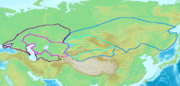
Early Khazar history is intimately tied with that of the Göktürk
Empire, founded when the Ashina
clan overthrew the Juan Juan in 552 CE. It is known that in 515-516 Hunnic-Savirs attacked Armenia. The widow of the Hunnic-Savir prince Bolakh Boariks concluded a peace with Byzantium in 527. In 529, Prince Khosrau I
of the Persian Empire fought the social movement led by the Zoroastrian priest Mazdak
. Numerous Jewish families who supported the movement had to flee the country north of Caucasus Mountains
. In 552, a western-Turkic khaganate is mentioned led by khagan Tumyn (or Tumen) out of the Ashina
clan. There are some speculations that the Western portion of the Göktürk Empire in the West became known as Avars
. During that time, there is mention of Savirs' and Khazars' attacks on Caucasus Albania.
The first significant appearance of the Khazars in history is their aid to the campaign of the Byzantine
emperor Heraclius
against the Sassanid Persia
ns. The Khazar ruler Ziebel (sometimes identified as Tong Yabghu Khagan of the West Turks) aided the Byzantines in overrunning Georgia
. A marriage was even contemplated between Ziebel's son and Heraclius' daughter, but never took place. During these campaigns, the Khazars may have been ruled by Bagha Shad and their forces may have been under the command of his son Buri-shad.
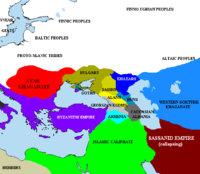 With the collapse of the Göktürk Empire due to internal conflict in the 6th century, the western half of the Turkish empire split into a number of tribal confederations, among whom were the Bulgars
, led by the Dulo clan
, and the Khazars, led by the Ashina
clan, the traditional rulers of the Göktürk Empire. By 670, the Khazars had broken the Bulgar confederation, causing various tribal groups to migrate and leaving two remnants of Bulgar rule - Volga Bulgaria
, and the Bulgaria
n khanate on the Danube
River.
During the 7th and 8th centuries, the Khazar fought a series of wars against the Umayyad Caliphate, which was attempting simultaneously to expand its influence into Transoxiana
and the Caucasus. The first war was fought in the early 650 and ended with the defeat of an Arab force led by Abd ar-Rahman ibn Rabiah
outside the Khazar town of Balanjar
, after a battle in which both sides used siege engine
s on the others' troops.
 A number of Russian sources give the name of a Khazar khagan, Irbis
, from this period, and describe him as a scion of the Göktürk royal house, the Ashina. Whether Irbis ever existed is open to debate, as is the issue of whether he can be identified with one of the many Göktürk rulers of the same name.
Several further conflicts erupted in the decades that followed, with Arab attacks and Khazar raids into Kurdistan and Iran
. There is evidence from the account of al-Tabari that the Khazars formed a united front with the remnants of the Göktürks in Transoxiana.
dates from the late 7th century C.E. In the mid-8th century, the rebellious Crimean Goths
were put down and their city, Doros
(modern Mangup) occupied. A Khazar tudun was resident at Cherson in the 690s, despite the fact that this town was nominally subject to the Byzantine Empire
.
The Khazars are also known to have been allied with the Byzantine Empire during at least part of the 8th century. In 704/705 Justinian II
, exiled in Cherson, escaped into Khazar territory and married Theodora
, the sister of the Khagan Busir
. With the aid of his wife, he escaped from Busir, who was working against him with the usurper Tiberius III, murdering two Khazar officials in the process. He fled to Bulgaria
, whose Khan Tervel helped him regain the throne. The Khazars later provided aid to the rebel general Bardanes, who seized the throne in 711 as Emperor Philippicus.
The Byzantine emperor Leo III
married his son Constantine (later Constantine V
Kopronymous) to the Khazar princess Tzitzak
(Çiçek in Turkish), daughter of the Khagan Bihar
) as part of the alliance between the two empires. Tzitzak, who was baptized as Irene
, became famous for her wedding gown, which started a fashion craze in Constantinople for a type of robe (for men) called tzitzakion. Their son Leo (Leo IV
) would be better known as "Leo the Khazar".
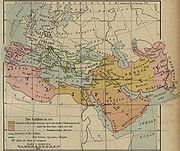 Hostilities broke out again with the Caliphate in the 710s, with raids back and forth across the Caucasus but few decisive battles. The Khazars, led by a prince named Barjik
, invaded northwestern Iran
and defeated the Umayyad
forces at Ardabil
in December 730, killing the Arab warlord al-Djarrah al-Hakami and briefly occupying the town. They were defeated the next year at Mosul
, where Barjik directed Khazar forces from a throne mounted with al-Djarrah's severed head, and Barjik was killed. Arab armies led first by the Arab prince Maslamah ibn Abd al-Malik
and then by Marwan ibn Muhammad (later Caliph Marwan II
) poured across the Caucasus and eventually (in 737) defeated a Khazar army led by Hazer Tarkhan
, briefly occupying Atil
itself and possibly forcing the Khagan to convert to Islam. The instability of the Umayyad regime made a permanent occupation impossible; the Arab armies withdrew and Khazar independence was re-asserted. It has been speculated that the adoption of Judaism
(which in this theory would have taken place around 740) was part of this re-assertion of independence
.
Around 729, Arab sources give the name of the ruler of the Khazars as Parsbit
or Barsbek, a woman who appears to have directed military operations against them. This suggests that women could have very high positions within the Khazar state, possibly even as a stand-in for the khagan.
Although they stopped the Arab
expansion into Eastern Europe
for some time after these wars, the Khazars were forced to withdraw behind the Caucasus. In the ensuing decades they extended their territories from the Caspian Sea
in the east (many cultures still call the Caspian Sea "Khazar Sea"; e.g. "Xəzər dənizi" in Azeri, "Hazar Denizi" in Turkish, "Bahr ul-Khazar" in Arabic, "Darya-ye Khazar" in Persian) to the steppe region north of Black Sea
in the west, as far west at least as the Dnieper River.
In 758, the Abbasid
Caliph
Abdullah al-Mansur
ordered Yazid ibn Usayd al-Sulami, one of his nobles and military governor of Armenia
, to take a royal Khazar bride and make peace. Yazid took home a daughter of Khagan Baghatur
, the Khazar leader. Unfortunately, the girl died inexplicably, possibly in childbirth. Her attendants returned home, convinced that some Arab faction had poisoned her, and her father was enraged. A Khazar general named Ras Tarkhan
invaded what is now northwestern Iran, plundering and raiding for several months. Thereafter relations between the Khazars and the Abbasid Caliphate (whose foreign policies were generally less expansionist than its Umayyad predecessor) became increasingly cordial.
, focused on the sky god
Tengri
, but were heavily influenced by Confucian ideas imported from China
, notably that of the Mandate of Heaven
. The Ashina
clan were considered to be the chosen of Tengri and the kaghan was the incarnation of the favor the sky-god bestowed on the Turks. A kaghan who failed had clearly lost the god's favor and was typically ritually executed
. Historians have sometimes wondered, only half in jest, whether the Khazar tendency to occasionally execute their rulers on religious grounds led those rulers to seek out other religions.
The Khazars revered a number of traditional divinities subordinate to Tengri, including the fertility divinity Umay
, Kuara
, a thunder divinity, and Erlik
, the divinity of underworld.
coast since late classical times. Chersonesos, Sudak
, Kerch
and other Crimean cities sustained Jewish communities, as did Gorgippia
, and Samkarsh / Tmutarakan
was said to have had a Jewish majority as early as the 670s. Jews fled from Byzantium to Khazaria as a consequence of persecution under Heraclius
, Justinian II
, Leo III
, and Romanos I
. These were joined by other Jews fleeing from Sassanid Persia
(particularly during the Mazdak
revolts), and, later, the Islamic world. Jewish merchants such as the Radhanite
s regularly traded in Khazar territory, and may have wielded significant economic and political influence. Though their origins and history are somewhat unclear, the Mountain Jews
also lived in or near Khazar territory and may have been allied with the Khazars, or subject to them; it is conceivable that they, too, played a role in Khazar conversion.
At some point in the last decades of the 8th century or the early 9th century, the Khazar royalty
and nobility
converted to Judaism
, and part of the general population may have followed. The extent of the conversion is debated. The 10th century Persian
historian
Ibn al-Faqih
reported that "all the Khazars are Jews." Notwithstanding this statement, most scholars believe that only the upper classes converted to Judaism; there is some support for this in contemporary Muslim texts.
Essays in the Kuzari
, written by Yehuda Halevi
, detail a moral liturgical reason for the conversion which some consider a moral tale. Some researchers have suggested part of the reason for conversion was political expediency to maintain a degree of neutrality
: the Khazar empire was between growing populations, Muslim
s to the east and Christian
s to the west. Both religions recognized Judaism as a forebearer and worthy of some respect. The exact date of the conversion is hotly contested. It may have occurred as early as 740 or as late as the mid-9th century. Recently discovered numismatic evidence suggests that Judaism was the established state religion by c. 830, and though St. Cyril
(who visited Khazaria in 861) did not identify the Khazars as Jews, the khagan of that period, Zachariah
, had a biblical Hebrew name. Some medieval sources give the name of the rabbi
who oversaw the conversion of the Khazars as Isaac Sangari or Yitzhak ha-Sangari
.
The first Jewish Khazar king was named Bulan
which means "elk
", though some sources give him the Hebrew name Sabriel. A later king, Obadiah
, strengthened Judaism, inviting rabbi
s into the kingdom and built synagogue
s. Jewish figures such as Saadia Gaon
made positive references to the Khazars, and they are excoriated in contemporary Karaite writings as "bastards"; it is therefore unlikely that they adopted Karaism as some (such as Avraham Firkovich) have proposed.
According to the Schechter Letter
, early Khazar Judaism was centered on a tabernacle
similar to that mentioned in the Book of Exodus. Archaeologists at Rostov-on-Don
have tentatively identified a folding altar unearthed at Khumar
as part of such a religious building.
The Khazars enjoyed close relations with the Jews of the Levant
and Persia
. The Persian Jews
, for example, hoped that the Khazars might succeed in conquering the Caliphate. The high esteem in which the Khazars were held among the Jews of the Orient may be seen in the application to them, in an Arabic
commentary on Isaiah
ascribed by some to Saadia Gaon, and by others to Benjamin Nahawandi
, of Isaiah
48:14: "The Lord hath loved him." "This", says the commentary, "refers to the Khazars, who will go and destroy Babel
" (i.e., Babylon
ia), a name used to designate the country of the Arabs. From the Khazar Correspondence
it is apparent that two Spanish Jews, Judah ben Meir ben Nathan and Joseph Gagris, had succeeded in settling in the land of the Khazars. Saadia, who had a fair knowledge of the kingdom of the Khazars, mentions a certain Isaac ben Abraham who had removed from Sura
to Khazaria.
Likewise, the Khazar rulers viewed themselves as the protectors of international Jewry, and corresponded with foreign Jewish leaders. The letters
exchanged between the Khazar ruler Joseph
and the Spanish rabbi Hasdai ibn Shaprut
have been preserved). They were known to retaliate against Muslim or Christian interests in Khazaria for persecution of Jews abroad. Ibn Fadlan relates that around 920 the Khazar ruler received information that Muslims had destroyed a synagogue in the land of Babung
, in Iran
; he gave orders that the minaret
of the mosque
in his capital should be broken off, and the muezzin
executed. He further declared that he would have destroyed the mosque entirely had he not been afraid that the Muslims would in turn destroy all the synagogues in their lands. Similarly, during the persecutions of Byzantine Jews under Romanos I
, the Khazar government retaliated by attacking Byzantine interests in the Crimea.
The theory that the majority of Ashkenazi Jews
are the descendants of the non-Semitic converted Khazars was advocated by various racial theorists and antisemitic sources in the 20th century, especially following the publication of Arthur Koestler's The Thirteenth Tribe
. Despite recent genetic evidence to the contrary, and a lack of any real mainstream scholarly support, this belief is still popular among groups such as the Christian Identity Movement
, Black Hebrews
, British Israelitists
and others (particularly Arabs) who claim that they, rather than Jews, are the true descendants of the Israelites, or who seek to downplay the connection between Ashkenazi Jews and Israel in favor of their own. For more detail on this controversy, see below.
, other religions probably practiced in areas ruled by the Khazars included Greek Orthodox
, Nestorian, and Monophysite Christianity, Zoroastrianism
as well as Norse
, Finnic
, and Slavic
cults. The Khazar government tolerated a wide array of religious practices within the Khaganate. Many Khazars reportedly were converts to Christianity and Islam. (See "Judiciary", below.)
A Greek Orthodox bishop was resident at Atil
and was subject to the authority of the Metropolitan
of Doros
. The "apostle of the Slavs", Saint Cyril
, is said to have attempted the conversion of Khazars without enduring results. Khazaran had a sizable Muslim population and quarter with a number of mosque
s. A Muslim officer, the khazz
, represented the Muslim community in the royal court.
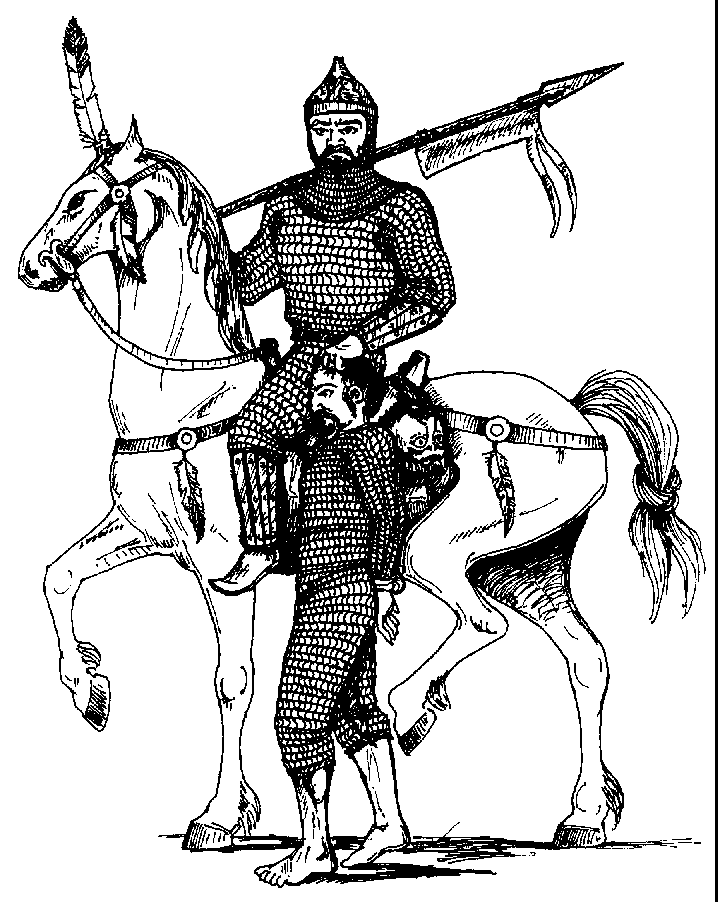
Khazar kingship was divided between the khagan
and the Bek
or Khagan Bek
. Contemporary Arab historians related that the Khagan was purely a spiritual ruler or figurehead with limited powers, while the Bek was responsible for administration and military affairs.
Both the Khagan and the Khagan Bek lived in Itil
. The Khagan's palace, according to Arab sources, was on an island in the Volga River
. He was reported to have 25 wives, each the daughter of a client ruler; this may, however, have been an exaggeration.
In the Khazar Correspondence
, King Joseph
identifies himself as the ruler of the Khazars and makes no reference to a colleague. It has been disputed whether Joseph was a Khagan or a Bek; his description of his military campaigns make the latter probable. However, аccording to the Schechter Letter, king Joseph is identified as not Khagan. A third option is that by the time of the Correspondence (c. 950-960) the Khazars had merged the two positions into a single ruler, or that the Beks had somehow supplanted the Khagans or vice versa.
The Khazar dual kingship may have influenced other people; power was similarly divided among the early Hungarian people between the sacral king, or kende
, and the military king, or gyula. Similarly, according to Ibn Fadlan, the early Oghuz Turks
had a warlord, the Kudarkin
, who was subordinate to the reigning yabghu.
and commanded by subordinate officer
s known as tarkhan
s. A famous tarkhan referred to in Arab
sources as Ras or As Tarkhan
led an invasion of Armenia
in 758. The army included regiments of Muslim
auxiliaries known as Arsiyah
, of Khwarezm
ian or Alan
extraction, who were quite influential. These regiments were exempt from campaigning against their fellow Muslims. Early Rus' sources sometimes referred to the city of Khazaran
(across the Volga River
from Atil
) as Khvalisy
and the Khazar (Caspian
) sea as Khvaliskoye
. According to some scholars such as Omeljan Pritsak
, these terms were East Slavic
versions of "Khwarezmian" and referred to these mercenaries
.
In addition to the Bek's standing army, the Khazars could call upon tribal levies in times of danger and were often joined by auxiliaries
from subject nations.
s. In some cases (such as the Byzantine settlements in southern Crimea
), a tudun would be appointed for a town nominally within another polity's sphere of influence
.
Other officials in the Khazar government included dignitaries referred to by ibn Fadlan as Jawyshyghr
and Kundur
, but their responsibilities are unknown.
, two Christians, two Muslims, and a "heathen" (whether this is a Turkic shaman or a priest of Hungarian or Slavic or Norse religion is unclear), and a citizen had the right to be judged according to the laws of his religion. Some have argued that this configuration is unlikely, as a Beit Din
, or rabbinical court, requires three members. It is therefore possible that as practitioners of the state religion, the Jews had three judges on the Supreme Court rather than two, and that the Muslim sources were attempting to downplay their influence.
nexus. Goods from western Europe travelled east to Central Asia and China and vice versa, and the Muslim world could only interact with northern Europe via Khazar intermediaries. The Radhanites, a guild of medieval Jewish merchants, had a trade route that ran through Khazaria, and may have been instrumental in the Khazars' conversion to Judaism.
No Khazar paid taxes to the central government. Revenue came from a 10% levy on goods transiting through the region, and from tribute paid by subject nations. The Khazars exported honey
, fur
s, wool
, millet
and other cereal
s, fish
, and slaves. D.M. Dunlop and Artamanov asserted that the Khazars produced no material goods themselves, living solely on trade. This theory has been refuted by discoveries over the last half-century, which include pottery and glass factories.
s. Many of these were imitations of Arab dirhems with corrupted Arabic letters. Coins of the Caliphate were in widespread use due to their reliable silver content. Merchants from as far away as China
, England
, and Scandinavia
accepted them regardless of their inability to read the Arab writing. Thus issuing imitation dirhems was a way to ensure acceptance of Khazar coinage in foreign lands.
Some surviving examples bear the legend "Ard al-Khazar" (Arabic for "land of the Khazars"). In 1999 a hoard of silver
coins was discovered on the property of the Spillings farm in the Swedish
island of Gotland
. Among the coins were several dated 837/8 CE and bearing the legend, in Arabic script, "Moses
is the Prophet of God" (a modification of the Muslim coin inscription "Muhammad
is the Prophet of God"). In "Creating Khazar Identity through Coins", Roman Kovalev postulated that these dirhems were a special commemorative
issue celebrating the adoption of Judaism by the Khazar ruler Bulan.
. In addition, from the late 7th century the Khazars controlled most of the Crimea
and the northeast littoral of the Black Sea
. By 800 Khazar holdings included most of the Pontic steppe as far west as the Dneiper and as far east as the Aral Sea (some Turkic history atlases show the Khazar sphere of influence extending well east of the Aral). During the Khazar-Arab war of the early 8th century, some Khazars evacuated to the Ural
foothills, and some settlements may have remained.
 Many nations were tributaries of the Khazars. A client king subject to Khazar overlordship was called an "Elteber
". At various times, Khazar vassals included:
; the Crimean Goths
; the Crimean Huns
(Onogurs
?); the early Magyars
;various Armenia
n principalities; Arran (Azerbaijan)
; the North Caucasian Huns
; Lazica; the Caucasian Avars
; the Kassogs; and the Lezgins
.
; various early Rus' polities
; the Burtas
; various Uralic forest tribes such as the Mordvins and Ob-Ugrians; the Bashkir; the Barsils
, a period of Khazar hegemony
over the Pontic steppe that allowed trade to flourish and facilitated trans-Eurasian contacts. However, in the early 10th century the empire began to decline due to the attacks of both Viking
s from Kievan Rus and various Turkic tribes. It enjoyed a brief revival under the strong rulers Aaron II and Joseph
, who subdued rebellious client states such as the Alans
and led victorious wars against Rus' invaders.
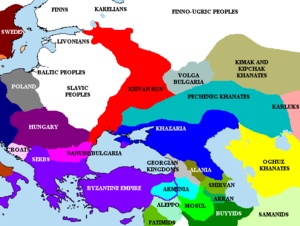
, Omeljan Pritsak
and others have speculated that the revolt had something to do with a rejection of rabbinic Judaism; this is unlikely as it is believed that both the Kabars and mainstream Khazars had pagan, Jewish, Christian, and Muslim members. Pritsak maintained that the Kabars were led by the Khagan Khan-Tuvan Dyggvi in a war against the Bek. In any event Pritsak cited no primary source for his propositions in this matter. The Kabars were defeated and joined a confederacy led by the Magyars. It has been speculated that "Hungarian" derives from the Turkic word "Onogur", or "Ten Arrows", referring to two Uralic tribes and eight Turkic
tribes (composed of Sabirs, Onogurs, and the three tribes of the Kabars).
In the closing years of the 9th century the Khazars and Oghuz allied to attack the Pechenegs, who had been attacking both nations. The Pechenegs were driven westward, where they forced out the Magyars (Hungarians) who had previously inhabited the Don-Dnieper basin in vassalage to Khazaria. Under the leadership of the chieftain Lebedias
and later Árpád
, the Hungarians moved west into modern-day Hungary
. The departure of the Hungarians led to an unstable power vacuum and the loss of Khazar control over the steppes north of the Black Sea.
Porphyrogentius was speculating in De Administrando Imperio
about ways in which the Khazars could be isolated and attacked. The Byzantines during the same period began to attempt alliances with the Pechenegs and the Rus', with varying degrees of success.
From the beginning of the 10th century, the Khazars found themselves fighting on multiple fronts as nomadic incursions were exacerbated by uprisings by former clients and invasions from former allies. According to the Schechter Text, the Khazar ruler Benjamin ben Menahem
fought a war against a coalition of "'SY, TWRQY, 'BM, and PYYNYL," who were instigated and aided by "MQDWN". MQDWN or Macedon
refers to the Byzantine Empire in many medieval Jewish writings; the other entities named have been tenuously identified by scholars including Omeljan Pritsak with the Burtas
, Oghuz Turks
, Volga Bulgars and Pechenegs, respectively. Though Benjamin was victorious, his son Aaron II
had to face another invasion, this time led by the Alans
. Aaron defeated the Alans with Oghuz help, yet within a few years the Oghuz and Khazars were enemies.
Ibn Fadlan reported Oghuz hostility to the Khazars during his journey c. 921. Some sources, discussed by Tamara Rice, claim that Seljuk
, the eponymous progenitor of the Seljuk Turks, began his career as an Oghuz soldier in Khazar service in the early and mid-10th century, rising to high rank before he fell out with the Khazar rulers and departed for Khwarazm.
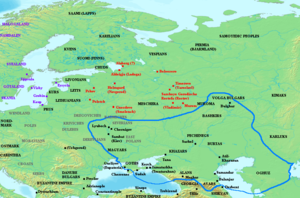
Originally the Khazars were probably allied with various Norse
factions who controlled the region around Novgorod. The Rus' Khaganate
, an early Rus' polity in modern northwestern Russia and Belarus, was probably heavily influenced by the Khazars. The Rus' regularly travelled through Khazar-held territory to attack territories around the Black and Caspian Seas; in one such raid, the Khagan is said to have given his assent on the condition that the Rus' give him half of the booty. In addition, the Khazars allowed the Rus' to use the trade route
along the Volga River. This alliance was apparently fostered by the hostility between the Khazars and Arabs. At a certain point, however, the Khazar connivance to the sacking of the Muslim lands by the Varangians
led to a backlash against the Norsemen from the Muslim population of the Khaganate. The Khazar rulers closed the passage down the Volga for the Rus', sparking a war. In the early 960s, Khazar ruler Joseph
wrote to Hasdai ibn Shaprut
about the deterioration of Khazar relations with the Rus: "I have to wage war with them, for if I would give them any chance at all they would lay waste the whole land of the Muslims as far as Baghdad
."
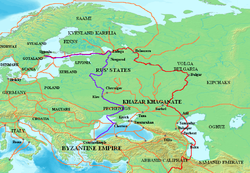 The Rus' warlords Oleg
and Sviatoslav I of Kiev
launched several wars against the Khazar khaganate, often with Byzantine connivance. The Schechter Letter relates the story of a campaign against Khazaria by HLGW (Oleg) around 941 (in which Oleg was defeated by the Khazar general Pesakh
); this calls into question the timeline of the Primary Chronicle
and other related works on the history of the Eastern Slavs.
Sviatoslav finally succeeded in destroying Khazar imperial power in the 960s. The Khazar fortresses of Sarkel
and Tamatarkha
fell to the Rus' in 965, with the capital city of Atil
following circa 968 or 969. A visitor to Atil wrote soon after the sacking of the city: "The Rus' attacked, and no grape or raisin remained, not a leaf on a branch."
and other Islamic states. Documents from medieval Constantinople
attest to a Khazar community mingled with the Jews of the suburb of Pera
. Christian Khazars also lived in Constantinople, and some served in its armies, including, in the 9th and 10th centuries, the imperial Hetaireia
bodyguard, where they formed their own separate company. The Patriarch
Photius I of Constantinople was once angrily referred to by the Emperor as "Khazar-face", though whether this refers to his actual lineage or is a generic insult is unclear.
Abraham ibn Daud
reported Khazar rabbi
nical students, or rabbinical students who were the descendants of Khazars, in 12th century Spain
. Jews from Kiev and elsewhere in Russia, who may or may not have been Khazars, were reported in France, Germany and England.
Polish
legends speak of Jews being present in Poland
before the establishment of the Polish monarchy. Polish coins from the 12th and 13th centuries sometimes bore Slavic inscriptions written in the Hebrew alphabet
though connecting these coins to Khazar influence is purely a matter of speculation.
s (called often Kabars) who settled in Hungary
in the late 9th and early 10th centuries may have included Khazars among their number. According to the archaeologist-historian Gábor Vékony
, the native language of the Khavars was Khazar. According to the Turkologist Prof. András Róna-Tas
part of the Khazars - who rebelled but then were subverted by the Khazar Khagane - joined with the Magyars and then took part with them in the Settlement of Hungary at the end of the 9th century CE.
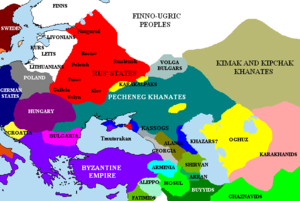 There is debate as to the temporal and geographic extent of Khazar polities following Sviatoslav
's sack of Atil in 968/9, or even whether any such states existed. The Khazars may have retained control over some areas in the Caucasus for another two centuries, but sparse historical records make this difficult to confirm.
The evidence of later Khazar polities includes the fact that Sviatoslav did not occupy the Volga basin after he destroyed Atil, and departed relatively quickly to embark on his campaign in Bulgaria
. The permanent conquest of the Volga basin seems to have been left to later waves of steppe peoples like the Kipchaks
and Cumans.
4746
(985–986) refers to "our lord David, the Khazar prince" who lived in Taman. The letter said that this David was visited by envoys from Kievan Rus' to ask about religious matters — this could be connected to the Vladimir
conversion which took place during the same time period. Taman was a principality of Kievan Rus' around 988, so this successor state (if that is what it was) may have been conquered altogether. The authenticity of this letter, the Mandgelis Document
, has however been questioned by such scholars as D. M. Dunlop.
Abraham ibn Daud, a 12th-century Spanish rabbi, reported meeting Khazar rabbinical students in Toledo
, and that they informed him that the "remnant of them is of the rabbinic faith." This reference indicates that some Khazars maintained ethnic, if not political, autonomy at least two centuries after the sack of Atil.
Petachiah of Ratisbon
, a 13th-century rabbi and traveler, reported traveling through "Khazaria", though he gave few details of its inhabitants except to say that they lived amidst desolation in perpetual mourning.
He further related:
The account of the conversion of the "seven kings of Meshech" is extremely similar to the accounts of the Khazar conversion given in the Kuzari
, and in King Joseph's Reply
. It is possible that Meshech refers to the Khazars, or to some Judaized polity influenced by them. Arguments against this possibility include the reference to "seven kings" (though this, in turn, could refer to seven successor tribes or state micropolities).
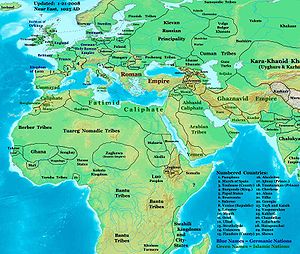 Ibn Hawqal
and al-Muqaddasi
refer to Atil after 969, indicating that it may have been rebuilt. Al-Biruni
(mid-11th century) reported that Atil was in ruins, and did not mention the later city of Saqsin
which was built nearby, so it is possible that this new Atil was only destroyed in the middle of the 11th century. Even assuming al-Biruni's report was not an anachronism, there is no evidence that this "new" Atil was populated by Khazars rather than by Pechenegs or a different tribe.
Ibn al-Athir, who wrote around 1200, described "the raid of Fadhlun the Kurd against the Khazars". Fadhlun the Kurd has been identified as al-Fadhl ibn Muhammad
al-Shaddadi
, who ruled Arran
and other parts of Azerbaijan
in the 1030s. According to the account he attacked the Khazars but had to flee when they ambushed his army and killed 10,000 of his men. Two of the great early 20th century scholars on Eurasian nomads, Marquart and Barthold
, disagreed about this account. Marquart believed that this incident refers to some Khazar remnant that had reverted to paganism and nomadic life. Barthold, (and more recently, Kevin Brook), took a much more skeptical approach and said that ibn al-Athir must have been referring to Georgians or Abkhazians. There is no evidence to decide the issue one way or the other.
, in 986 Khazar Jews were present at Vladimir
's disputation
to decide on the prospective religion of the Kievian Rus'. Whether these were Jews who had settled in Kiev or emissaries from some Jewish Khazar remnant state is unclear. The whole incident is regarded by a few radical scholars as a fabrication, but the reference to Khazar Jews (after the destruction of the Khaganate) is still relevant. Heinrich Graetz
alleged that these were Jewish missionaries from the Crimea, but provided no reference to primary sources for his allegation.
In 1023 the Primary Chronicle
reports that Mstislav
(one of Vladimir's sons) marched against his brother Yaroslav with an army that included "Khazars and Kasogs". Kasogs were an early Circassian people. "Khazars" in this reference is considered by most to be intended in the generic sense, but some have questioned why the reference reads "Khazars and Kasogs", when "Khazars" as a generic would have been sufficient. Even if the reference is to Khazars, of course, it does not follow that there was a Khazar state in this period. They could have been Khazars under the rule of the Rus.
A Kievian prince named Oleg (not to be confused with Oleg of Kiev) was reportedly kidnapped by "Khazars" in 1078 and shipped off to Constantinople
, although most scholars believe that this is a reference to the Kipchaks or other steppe peoples then dominant in the Pontic region. Upon his conquest of Tmutarakan
in the 1080s Oleg gave himself the title "Archon
of Khazaria".
documented a joint attack on the Khazar state in Kerch
, ruled by Georgius Tzul
, by the Byzantines and Russians in 1016. Following 1016, there are more ambiguous references in Eastern Christian sources to Khazars that may or may not be using "Khazars" in a general sense (the Arabs, for example, called all steppe people "Turks
"; the Romans
/Byzantines
called them all "Scythians"). Jewish Khazars were also mentioned in a Georgian chronicle as a group that inhabited Derbent
in the late 12th century.
At least one 12th-century Byzantine source refers to tribes practicing Mosaic
law and living in the Balkans
; see Khalyzians
. The connection between this group and the Khazars is rejected by most modern Khazar scholars.
, gave a list of the nations the Mongols had conquered in his account. One of them, listed among tribes of the Caucasus, Pontic steppe and the Caspian region, was the "Brutakhi
, who are Jews." The identity of the Brutakhi is unclear. Giovanni later refers to the Brutakhi as shaving their heads. Though Giovanni refers to them as Kipchaks, they may have been a remnant of the Khazar people. Alternatively, they may have been Kipchak converts to Judaism (possibly connected to the Krymchaks or the Crimean Karaites
).
, traditionally known as the Hyrcanian Sea
and Mazandaran Sea in Persian
, came to be known to Iran
ians as the Khazar Sea as an alternative name. Many other cultures still call the Caspian Sea "Khazar Sea"; e.g. "Xəzər dənizi" in Azerbaijani, "Hazar Denizi" in Turkish, "Bahr ul-Khazar" in Arabic (although "Bahr Qazween" is becoming more popular now), "Darya-ye Khazar" in Persian. In Hungary, there are villages (and people with family names)
called Kozár and Kazár.
The number of Khazars who converted to Judaism is also hotly contested, with historical accounts ranging from claims that only the King and his retainers had embraced Judaism, to the claim that the majority of the lay population had converted. D.M. Dunlop was of the opinion that only the upper class converted; this was the majority view until relatively recently. Analysis of recent archaeological grave evidence by such scholars as Kevin A. Brook asserts that the sudden shift in burial customs, with the abandonment of pagan-style burial with grave goods and the adoption of simple shroud burials during the mid-9th century suggests a more widespread conversion. A mainstream scholarly consensus does not yet exist regarding the extent of the conversions.
-speaking Karaites (in the Crimean Tatar language
, Qaraylar) have lived in Crimea
for centuries. Their origin is a matter of great controversy. Some regard them as descendants of Karaite Jews who settled in Crimea and adopted a form of the Kypchak tongue (see Karaim language
). Others view them as descendants of Khazar or Kipchak converts to Karaite Judaism. Today many Crimean Karaites deny Israelite origins and consider themselves to be descendants of the Khazars. The consensus view among historians, however, considers that religion form of the Khazars was Talmudic Judaism. Some modern Crimean Karaites seek to distance themselves from being identified as Jews, emphasizing what they view as their Turkic heritage and claiming that they are Turkic practitioners of a "Mosaic religion" separate and distinct from Judaism.
, was centered on Kerch
). It is known that Kipchak converts to Judaism existed, and it is possible that from these converts the Krymchaks adopted their distinctive language. They have historically lived in close proximity to the Crimean Karaites. At first krymchak was a Russian descriptive used to differentiate them from their Ashkenazi coreligionists, as well as other Jewish communities in the former Russian Empire such as the Georgian Jews, but in the second half of the 19th century this name was adopted by the Krymchaks themselves.
on January 27, 1883, titled "Judaism as a Race and as Religion." It was repeated in articles in The Dearborn Independent
in 1923 and 1925, and popularized by racial theorist Lothrop Stoddard
in a 1926 article in the Forum titled "The Pedigree of Judah", where he argued that Ashkenazi Jews were a mix of people, of which the Khazars were a primary element. Stoddard's views were "based on nineteenth and twentieth-century concepts of race, in which small variations on facial features as well as presumed accompanying character traits were deemed to pass from generation to generation, subject only to the corrupting effects of marriage with members of other groups, the result of which would lower the superior stock without raising the inferior partners." This theory was adopted by British Israelites
, who saw it as a means of invalidating the claims of Jews (rather than themselves) to be the true descendants of the ancient Israelites, and was supported by early anti-Zionists.
In 1951 Southern Methodist University
professor John O. Beaty published The Iron Curtain over America, a work which claimed that "Khazar Jews" were "responsible for all of America's — and the world's — ills beginning with World War I
". The book repeated a number of familiar antisemitic claims, placing responsibility for U.S. involvement in World Wars I and II and the Bolshevik revolution on these Khazars, and insisting that Khazar Jews were attempting to subvert Western Christianity and establish communism throughout the world. The American millionaire J. Russell Maguire gave money towards its promotion, and it was met with enthusiasm by hate groups and the extreme right. By the 1960s the Khazar theory had become a "firm article of faith" amongst Christian Identity
groups. In 1971 John Bagot Glubb
(Glubb Pasha) also took up this theme, insisting that Palestinians were more closely related to the ancient Judeans than were Jews. According to Benny Morris
:
The theory gained further support when the novelist Arthur Koestler
devoted his popular book The Thirteenth Tribe
(1976) to the topic. Koestler's historiography has been attacked as highly questionable by many historians; it has also been pointed out that his discussion of theories about Ashkenazi descent is entirely lacking scientific or historiographical support; to the extent that Koestler referred to place-names and documentary evidence his analysis has been described as a mixture of flawed etymologies and misinterpreted primary sources. Commentors have also noted that Koestler mischaracterized the sources he cited, particularly D.M. Dunlop's History of the Jewish Khazars (1954). Dunlop himself stated that the theory that Eastern European Jews were the descendants of the Khazars, "... can be dealt with very shortly, because there is little evidence which bears directly upon it, and it unavoidably retains the character of a mere assumption."
Koestler, an Ashkenazi Jew himself, was pro-Zionist based on secular considerations, and did not see alleged Khazar ancestry as diminishing the claim of Jews to Israel, which he felt was based on the United Nations mandate, and not on Biblical covenants or genetic inheritance. In his view, "The problem of the Khazar infusion a thousand years ago ... is irrelevant to modern Israel". In addition, he was apparently "either unaware of or oblivious to the use anti-Semites had made to the Khazar theory since its introduction at the turn of the century."
's Biblical
promise of Canaan
to the Israelite
s, thus undermining the theological basis of both Jewish religious Zionists
and Christian Zionists
. In the 1970s and 80s the Khazar theory was also advanced by some Russian chauvinist antisemites, particularly the historian Lev Gumilyov, who portrayed "Judeo-Khazars" as having repeatedly sabotaged Russia's development since the 7th century.
Bernard Lewis
stated in 1999:
"The results accord with Jewish history and tradition and refute theories like those holding that Jewish communities consist mostly of converts from other faiths, or that they are descended from the Khazars, a medieval Turkish tribe that adopted Judaism."
A 2010 study on Jewish ancestry by Atzmon et al. says "Two major groups were identified by principal component, phylogenetic, and identity by descent (IBD) analysis: Middle Eastern Jews and European/Syrian Jews. The IBD segment sharing and the proximity of European Jews to each other and to southern European populations suggested similar origins for European Jewry and refuted large-scale genetic contributions of Central and Eastern European and Slavic populations to the formation of Ashkenazi Jewry."
Concerning male-line ancestry, several Y-DNA studies have tested the hypothesis of Khazar ancestry amongst Ashkenazim. In these studies Haplogroup R1a chromosomes (sometimes called Eu 19) have been identified as potential evidence of one line of Eastern European ancestry amongst Ashkenazim, which could possibly be Khazar. One concluded that "neither the NRY haplogroup composition of the majority of Ashkenazi Jews nor the microsatellite haplotype composition of the R1a1 haplogroup within Ashkenazi Levites is consistent with a major Khazar or other European origin" and another that "if the R-M17 chromosomes in Ashkenazi Jews do indeed represent the vestiges of the mysterious Khazars then, according to our data, this contribution was limited to either a single founder or a few closely related men, and does not exceed ~ 12% of the present-day Ashkenazim."
and Georgian Jews
. There is little evidence to support these theories, although it is possible that some Khazar descendants found their way into these communities. Non-Jewish groups who claim at least partial descent from the Khazars include the Kumyks
and Crimean Tatars
; as with the above-mentioned Jewish groups, these claims are subject to a great deal of controversy and debate.
is one of most famous works of the medieval Spanish
Jewish philosopher and poet Rabbi Yehuda Halevi
. Divided into five essays ("ma'amarim" (namely, Articles)), it takes the form of a dialogue between the pagan
king
of the Khazars and a Jew who was invited to instruct him in the tenets of the Jewish religion
. Originally written in Arabic
, the book was translated by numerous scholars (including Judah ibn Tibbon) into Hebrew
and other languages. Though the book is not considered a historical account of the Khazar conversion to Judaism, scholars such as D.M. Dunlop and A.P. Novoseltsev have postulated that Yehuda had access to Khazar documents upon which he loosely based his work. His contemporary Avraham ibn Daud reported meeting Khazar rabbi
nical students in Toledo, Spain
in the mid-12th century. In any case, however, the book is in the main - and clearly intended to be - an exposition of the basic tenets of the Jewish religion, rather than a historical account of the actual conversion of the Khazars to Judaism.
The question of mass religious conversion is a central theme in Milorad Pavić
's international bestselling novel Dictionary of the Khazars
. The novel, however, contained many invented elements and had little to do with actual Khazar history. More recently, several novels, including H.N. Turteltaub's Justinian (about the life of Justinian II) and Marek Halter
's Book of Abraham and Wind of the Khazars have dealt either directly or indirectly with the topic of the Khazars and their role in history.
In 2007, the New York Times Magazine serialized a novel by Michael Chabon
entitled Gentlemen of the Road
which features 10th century Khazar characters.
Norman Golb
and Omeljan Pritsak
, Khazarian Hebrew Documents of the Tenth Century. Ithaca: Cornell Univ. Press, 1982.
Heinrich Graetz
. History of the Jews, Vol. III. Philadelphia: Jewish Publication Society, 1902.
Arthur Koestler
. (1976): The Thirteenth Tribe: The Khazar Empire and Its Heritage. Random House. ISBN 0-394-40284-7
Elli Kohen. History of the Byzantine Jews: A Microcosmos in the Thousand Year Empire. University Press of America
, 2007.
Roman K. Kovalev. "Creating Khazar Identity through Coins: The Special Issue Dirhams of 837/8." East Central and Eastern Europe in the Early Middle Ages, ed. Florin Curta, pp. 220–253. Ann Arbor, MI: University of Michigan Press, 2005.
Habib Levy, et al. Comprehensive History of the Jews of Iran: The Outset of the Diaspora. George W. Maschke, trans. Mazda Publishers, 1999.
Logan, Donald F. (1992). The Vikings in History 2nd ed. Routledge. ISBN 0-415-08396-6
Mango, Cyril (Ed) The Oxford History of Byzantium Oxford University Press
, USA (December 5, 2002).
Timothy S. Miller, "The Legend of Saint Zotikos According to Constantine Akropolites." Analecta Bollandiana vol. 112, 1994, pp. 339–376.
Thomas S. Noonan. "Byzantium and the Khazars: a special relationship?" Byzantine Diplomacy: Papers from the Twenty-fourth Spring Symposium of Byzantine Studies, Cambridge, March 1990, ed. Jonathan Shepard
and Simon Franklin, pp. 109–132. Aldershot, England: Variorium, 1992.
Thomas S. Noonan. "What Can Archaeology Tell Us About the Economy of Khazaria?" The Archaeology of the Steppes: Methods and Strategies - Papers from the International Symposium held in Naples 9–12 November 1992, ed. Bruno Genito, pp. 331–345. Napoli, Italy: Istituto Universitario Orientale, 1994.
Thomas S. Noonan. "The Khazar Economy." Archivum Eurasiae Medii Aevi 9 (1995–1997): 253-318.
Thomas S. Noonan. "The Khazar-Byzantine World of the Crimea in the Early Middle Ages: The Religious Dimension." Archivum Eurasiae Medii Aevi 10 (1998–1999): 207-230.
Thomas S. Noonan. "Les Khazars et le commerce oriental." Les Échanges au Moyen Age: Justinien, Mahomet, Charlemagne: trois empires dans l'économie médiévale, pp. 82–85. Dijon: Editions Faton S.A., 2000.
Thomas S. Noonan. "The Khazar Qaghanate and its Impact on the Early Rus' State: The translatio imperii from Itil to Kiev." Nomads in the Sedentary World, eds. Anatoly Mikhailovich Khazanov
and André Wink, pp. 76–102. Richmond, England: Curzon Press, 2001.
John Julius Norwich. A Short History of Byzantium. Vintage, 1998.
George Ostrogorski. History of the Byzantine State, Rutgers University Press
(July 1986).
Svetlana Pletneva
. Khazary, 2nd ed. Moscow: Nauka, 1986.
Omeljan Pritsak. "The Khazar Kingdom's Conversion to Judaism
." (Journal Article in Harvard Ukrainian Studies, 1978)
Omeljan Pritsak. "The Pre-Ashkenazic Jews of Eastern Europe in Relation to the Khazars, the Rus', and the Lithuanians". Ukrainian-Jewish Relations in HIstorical Perspective, ed. Howard Aster and Peter J. Potichnyj. Edmonton, Alberta: Canadian Institute of Ukrainian Studies Press, 1990. p. 7.
Rossman, Vadim. Russian Intellectual Antisemitism in the Post-Communist Era, University of Nebraska Press, 2002. ISBN 0803239483
Sand, Shlomo
(2009): The Invention of the Jewish People
. Verso. ISBN 978-1-84467-422-0
A. Scharf. Byzantine Jewry: From Justinian to the Fourth Crusade. London, 1971.
Starr, Joshua, The Jews in the Byzantine Empire 641-1204 Burt Franklin (1970).
Tamara Talbot Rice. The Seljuks in Asia Minor
. Thames and Hudson, London, 1961. pp. 18–19.
Vital, David (1999): A People Apart: A History of the Jews in Europe. Oxford University Press. ISBN 0-19-821980-6
Zolitor, Jeff, Wolfe, Peter "The Khazars" Philadelphia: Conference of the Congress of Secular Jewish Organizations, (2002), Canadian Jewish Outlook (Sept/Oct 2002) /www.csjo.org/pages/essays/essaykhazars.htm
Nomad
Nomadic people , commonly known as itinerants in modern-day contexts, are communities of people who move from one place to another, rather than settling permanently in one location. There are an estimated 30-40 million nomads in the world. Many cultures have traditionally been nomadic, but...
ic Turkic people who established one of the largest polities of medieval Eurasia, with the capital of Atil
Atil
Atil , literally meaning "Big River", was the capital of Khazaria from the middle of the 8th century until the end of the 10th century. The word is also a Turkic name for the Volga River.-History:...
and territory comprising much of modern-day European Russia
Russia
Russia or , officially known as both Russia and the Russian Federation , is a country in northern Eurasia. It is a federal semi-presidential republic, comprising 83 federal subjects...
, western Kazakhstan
Kazakhstan
Kazakhstan , officially the Republic of Kazakhstan, is a transcontinental country in Central Asia and Eastern Europe. Ranked as the ninth largest country in the world, it is also the world's largest landlocked country; its territory of is greater than Western Europe...
, eastern Ukraine
Ukraine
Ukraine is a country in Eastern Europe. It has an area of 603,628 km², making it the second largest contiguous country on the European continent, after Russia...
, Azerbaijan
Azerbaijan
Azerbaijan , officially the Republic of Azerbaijan is the largest country in the Caucasus region of Eurasia. Located at the crossroads of Western Asia and Eastern Europe, it is bounded by the Caspian Sea to the east, Russia to the north, Georgia to the northwest, Armenia to the west, and Iran to...
, large portions of the northern Caucasus
Caucasus
The Caucasus, also Caucas or Caucasia , is a geopolitical region at the border of Europe and Asia, and situated between the Black and the Caspian sea...
(Circassia
Circassia
Circassia was an independent mountainous country located in the Caucasus region of Eurasia and was the largest and most important country in the Caucasus. Circassia was located at the crossroads of Western Asia and Eastern Europe between the Black Sea and the Caspian Sea...
, Dagestan
Dagestan
The Republic of Dagestan is a federal subject of Russia, located in the North Caucasus region. Its capital and the largest city is Makhachkala, located at the center of Dagestan on the Caspian Sea...
), parts of Georgia
Georgia (country)
Georgia is a sovereign state in the Caucasus region of Eurasia. Located at the crossroads of Western Asia and Eastern Europe, it is bounded to the west by the Black Sea, to the north by Russia, to the southwest by Turkey, to the south by Armenia, and to the southeast by Azerbaijan. The capital of...
, the Crimea
Crimea
Crimea , or the Autonomous Republic of Crimea , is a sub-national unit, an autonomous republic, of Ukraine. It is located on the northern coast of the Black Sea, occupying a peninsula of the same name...
, and northeastern Turkey.
A successor state of the Western Turks, Khazaria was a polyethnic state
Polyethnicity
Polyethnicity refers to the close proximity of people from different ethnic backgrounds within a country or other specific geographic region. It also relates to the ability and willingness of individuals to identify themselves with multiple ethnicities...
with a population of Turkic
Turkic peoples
The Turkic peoples are peoples residing in northern, central and western Asia, southern Siberia and northwestern China and parts of eastern Europe. They speak languages belonging to the Turkic language family. They share, to varying degrees, certain cultural traits and historical backgrounds...
, Uralic, Slavic
Slavic peoples
The Slavic people are an Indo-European panethnicity living in Eastern Europe, Southeast Europe, North Asia and Central Asia. The term Slavic represents a broad ethno-linguistic group of people, who speak languages belonging to the Slavic language family and share, to varying degrees, certain...
, and Palaeo-Caucasian
Caucasian race
The term Caucasian race has been used to denote the general physical type of some or all of the populations of Europe, North Africa, the Horn of Africa, Western Asia , Central Asia and South Asia...
peoples. Khazaria was the first feudal state to be established in Eastern Europe
Eastern Europe
Eastern Europe is the eastern part of Europe. The term has widely disparate geopolitical, geographical, cultural and socioeconomic readings, which makes it highly context-dependent and even volatile, and there are "almost as many definitions of Eastern Europe as there are scholars of the region"...
. During the 9th and 10th centuries, Khazaria was one of the major arteries of commerce between northern Europe
Northern Europe
Northern Europe is the northern part or region of Europe. Northern Europe typically refers to the seven countries in the northern part of the European subcontinent which includes Denmark, Estonia, Latvia, Lithuania, Norway, Finland and Sweden...
and southwestern Asia, as well as a connection to the Silk Road
Silk Road
The Silk Road or Silk Route refers to a historical network of interlinking trade routes across the Afro-Eurasian landmass that connected East, South, and Western Asia with the Mediterranean and European world, as well as parts of North and East Africa...
. The name "Khazar" is found in numerous languages and seems to be tied to a Turkic
Turkic languages
The Turkic languages constitute a language family of at least thirty five languages, spoken by Turkic peoples across a vast area from Eastern Europe and the Mediterranean to Siberia and Western China, and are considered to be part of the proposed Altaic language family.Turkic languages are spoken...
verb form meaning "wandering" (Modern Turkish: Gezer). Because of their jurisdiction over the area, the Caspian Sea was named the "Khazar Sea", and even today the Azeri, Turkish, Persian, and Arabic languages designate the Caspian by this term (in Turkish, "Hazar Denizi"; in Arabic, "Bahr-ul-Khazar"; in Persian, "Daryaye Khazar"). Pax Khazarica
Pax Khazarica
Pax Khazarica is a term used by historians to refer to the period during which the Khazar Khaganate dominated the Pontic steppe and the Caucasus Mountains...
is a term used by historians to refer to the period during which the Khazaria dominated the Pontic steppe and the Caucasus Mountains. Khazaria was referred to as Tourkia
Tourkia
Tourkia may be:*the modern Greek name of Turkey*in medieval Greek , the name of the Khazar Khaganate and of the Hungary...
in medieval Byzantine sources.
Sabirs and Bulgars
Bulgars
The Bulgars were a semi-nomadic who flourished in the Pontic Steppe and the Volga basin in the 7th century.The Bulgars emerge after the collapse of the Hunnic Empire in the 5th century....
came under Khazar jurisdiction during the 7th century. The Khazars forced some of the Bulgars (led by Asparukh) to move to modern-day Bulgaria
Bulgaria
Bulgaria , officially the Republic of Bulgaria , is a parliamentary democracy within a unitary constitutional republic in Southeast Europe. The country borders Romania to the north, Serbia and Macedonia to the west, Greece and Turkey to the south, as well as the Black Sea to the east...
, while other Bulgars fled to the upper Volga River
Volga River
The Volga is the largest river in Europe in terms of length, discharge, and watershed. It flows through central Russia, and is widely viewed as the national river of Russia. Out of the twenty largest cities of Russia, eleven, including the capital Moscow, are situated in the Volga's drainage...
region where the independent state of Volga Bulgaria
Volga Bulgaria
Volga Bulgaria, or Volga–Kama Bolghar, is a historic Bulgar state that existed between the seventh and thirteenth centuries around the confluence of the Volga and Kama rivers in what is now Russia.-Origin:...
was founded. In addition to their role in indirectly bringing about the creation of the modern Balkan nation of Bulgaria, the Khazars played an even more significant role in European affairs. By acting as a buffer state
Buffer state
A buffer state is a country lying between two rival or potentially hostile greater powers, which by its sheer existence is thought to prevent conflict between them. Buffer states, when authentically independent, typically pursue a neutralist foreign policy, which distinguishes them from satellite...
between the Muslim world
Muslim world
The term Muslim world has several meanings. In a religious sense, it refers to those who adhere to the teachings of Islam, referred to as Muslims. In a cultural sense, it refers to Islamic civilization, inclusive of non-Muslims living in that civilization...
and the Christian world, Khazaria prevented Islam
Islam
Islam . The most common are and . : Arabic pronunciation varies regionally. The first vowel ranges from ~~. The second vowel ranges from ~~~...
from significantly spreading north of the Caucasus Mountains
Caucasus Mountains
The Caucasus Mountains is a mountain system in Eurasia between the Black Sea and the Caspian Sea in the Caucasus region .The Caucasus Mountains includes:* the Greater Caucasus Mountain Range and* the Lesser Caucasus Mountains....
and Eastern Europe. This was accomplished through a series of wars known as the Khazar–Arab Wars, which took place in the late 7th and early 8th centuries. The wars established the Caucasus and the city of Derbent
Derbent
Derbent |Lak]]: Чурул, Churul; Persian: دربند; Judæo-Tat: דארבּאנד/Дэрбэнд/Dərbənd) is a city in the Republic of Dagestan, Russia, close to the Azerbaijani border. It is the southernmost city in Russia, and it is the second most important city of Dagestan...
as the boundary between the Khazars and the Arabs.
Khazaria had an ongoing entente with Byzantium
Byzantium
Byzantium was an ancient Greek city, founded by Greek colonists from Megara in 667 BC and named after their king Byzas . The name Byzantium is a Latinization of the original name Byzantion...
. Serving their partner in wars against the Abbasid Caliphate, Khazars aided the Byzantine emperor Heraclius
Heraclius
Heraclius was Byzantine Emperor from 610 to 641.He was responsible for introducing Greek as the empire's official language. His rise to power began in 608, when he and his father, Heraclius the Elder, the exarch of Africa, successfully led a revolt against the unpopular usurper Phocas.Heraclius'...
(reigned 610–641) by sending an army of 40,000 soldiers in their campaign against the Persians. In 775, Leo IV
Leo IV the Khazar
Leo IV the Khazar was Byzantine Emperor from 775 to 780 CE.Leo was the son of Emperor Constantine V by his first wife, Irene of Khazaria , the daughter of a Khagan of the Khazars...
was crowned as the sole emperor of the Byzantine Empire
Byzantine Empire
The Byzantine Empire was the Eastern Roman Empire during the periods of Late Antiquity and the Middle Ages, centred on the capital of Constantinople. Known simply as the Roman Empire or Romania to its inhabitants and neighbours, the Empire was the direct continuation of the Ancient Roman State...
. Sarkel
Sarkel
Sarkel was a large limestone-and-brick fortress built by the Khazars with Byzantine assistance in the 830s. It was named white-house because of the white limestone bricks they have used to build Sarkel...
was built in 830s by a joint team of Greek
Greeks
The Greeks, also known as the Hellenes , are a nation and ethnic group native to Greece, Cyprus and neighboring regions. They also form a significant diaspora, with Greek communities established around the world....
and Khazar architects to protect the north-western border of the Khazar state. The chief engineer
Chief Engineer
In marine transportation, the chief engineer is a licensed mariner in charge of the engineering department on a merchant vessel. "Chief engineer" is the official title of someone qualified to oversee the entire engine department; the qualification is colloquially called a "chief's...
during the construction of Sarkel was Petronas Kamateros
Kamateros
The Kamateros or Camaterus were a Byzantine family of functionaries from Constantinople that became prominent in the 10th–12th centuries. Several family members were scholars and literary patrons. The feminine form of the name is Kamatera ....
who later became the governor
Tudun
A tudun was a governor resident in a town or other settlement in Ancient Bulgar/Avar/Gokturk empires, particularly those of the Bulgars and the Khazars. In Gothic THIUDNASSAM means 'kingdom'. The tudun was the personal representative of the imperial government and could function both as an...
of Cherson.
The Khazars had, for years, been venturing forth southward, in their marauding raids on the Muslim countries south of the Caucasus. The major attempt of the Muslim armies to take control of the Transcaucasus came in 622 while Mohammed was still leading Islam. Islamic armies conquered Persia, Syria
Syria
Syria , officially the Syrian Arab Republic , is a country in Western Asia, bordering Lebanon and the Mediterranean Sea to the West, Turkey to the north, Iraq to the east, Jordan to the south, and Israel to the southwest....
, Mesopotamia
Mesopotamia
Mesopotamia is a toponym for the area of the Tigris–Euphrates river system, largely corresponding to modern-day Iraq, northeastern Syria, southeastern Turkey and southwestern Iran.Widely considered to be the cradle of civilization, Bronze Age Mesopotamia included Sumer and the...
, Egypt
Egypt
Egypt , officially the Arab Republic of Egypt, Arabic: , is a country mainly in North Africa, with the Sinai Peninsula forming a land bridge in Southwest Asia. Egypt is thus a transcontinental country, and a major power in Africa, the Mediterranean Basin, the Middle East and the Muslim world...
, Armenia
Armenia
Armenia , officially the Republic of Armenia , is a landlocked mountainous country in the Caucasus region of Eurasia...
, part of Azerbaijan
Azerbaijan
Azerbaijan , officially the Republic of Azerbaijan is the largest country in the Caucasus region of Eurasia. Located at the crossroads of Western Asia and Eastern Europe, it is bounded by the Caspian Sea to the east, Russia to the north, Georgia to the northwest, Armenia to the west, and Iran to...
and surrounded the Byzantine heartland (present-day Turkey
Turkey
Turkey , known officially as the Republic of Turkey , is a Eurasian country located in Western Asia and in East Thrace in Southeastern Europe...
) in a pincer movement which extended from the Mediterranean to the Caucasus and the southern shores of the Caspian. This was the time when the long series of wars called Khazar-Arab wars began. These wars eventually saw the Arabs defeated at every advance with the death of thousands of Arab soldiers including their commander, Abd ar-Rahman ibn Rabiah
Abd ar-Rahman ibn Rabiah
Abd ar-Rahman ibn Rabiah was the Arab general of the early Caliphate. He may have been the brother of Salman ibn Rabiah, the military governor of Armenia under Caliph Umar I. He was charged with the task of conquering the Khazars and invaded the northern Caucasus for this purpose in the late 640s...
, and the Arab armies in complete disarray. The Arab armies' inability to traverse the Caucasus made it logistically impossible for them to besiege the Byzantine capital of Constantinople
Constantinople
Constantinople was the capital of the Roman, Eastern Roman, Byzantine, Latin, and Ottoman Empires. Throughout most of the Middle Ages, Constantinople was Europe's largest and wealthiest city.-Names:...
. Coupled with the military barrier presented by the Khazars themselves, this prevented Europe from more direct and intensive assaults by the forces of Islam, arguably keeping it from falling to the Muslim armies.
After fighting the Arabs to a standstill in the North Caucasus, Khazars became increasingly interested in replacing their Tengri
Tengriism
Tengriism is a Central Asian religion that incorporates elements of shamanism, animism, totemism and ancestor worship. Despite still being active in some minorities, it was, in old times, the major belief of Turkic peoples , Bulgars, Hungarians and Mongols...
shamanism
Shamanism
Shamanism is an anthropological term referencing a range of beliefs and practices regarding communication with the spiritual world. To quote Eliade: "A first definition of this complex phenomenon, and perhaps the least hazardous, will be: shamanism = technique of ecstasy." Shamanism encompasses the...
with a state religion that would give them equal religious standing with their Abrahamic neighbors. During the 8th century, the Khazar royalty and much of the aristocracy converted to Judaism
Judaism
Judaism ) is the "religion, philosophy, and way of life" of the Jewish people...
. Khazar kings tolerated those who had different religions letting Greek Christians, pagan Slavs, and Muslim
Muslim
A Muslim, also spelled Moslem, is an adherent of Islam, a monotheistic, Abrahamic religion based on the Quran, which Muslims consider the verbatim word of God as revealed to prophet Muhammad. "Muslim" is the Arabic term for "submitter" .Muslims believe that God is one and incomparable...
Iranians live in their domains. In the capital city, a supreme court was established composed of 7 members, and every religion was represented on this judicial panel. Khazars were judged according to the Torah
Torah
Torah- A scroll containing the first five books of the BibleThe Torah , is name given by Jews to the first five books of the bible—Genesis , Exodus , Leviticus , Numbers and Deuteronomy Torah- A scroll containing the first five books of the BibleThe Torah , is name given by Jews to the first five...
, while the other tribes were judged according to their own laws.
Between 965 and 969, Khazar sovereignty was broken by Kievan Rus. Sviatoslav I of Kiev
Sviatoslav I of Kiev
Sviatoslav I Igorevich ; , also spelled Svyatoslav, was a prince of Rus...
defeated Khazars in 965 by conquering the Khazar fortress of Sarkel
Sarkel
Sarkel was a large limestone-and-brick fortress built by the Khazars with Byzantine assistance in the 830s. It was named white-house because of the white limestone bricks they have used to build Sarkel...
. Two years later, Rus prince conquered Atil
Atil
Atil , literally meaning "Big River", was the capital of Khazaria from the middle of the 8th century until the end of the 10th century. The word is also a Turkic name for the Volga River.-History:...
, after which he campaigned in the Balkans
Balkans
The Balkans is a geopolitical and cultural region of southeastern Europe...
. Medieval Ruthenian epic poems mention Ruthenian warriors fighting the Jewish Giant (Богатырь Жидовин). Just as the Khazars had left their mark on other peoples, so too did they influence the Rus. The Rus and the Hungarians both adopted the dual-kingship system of the Khazars. The Rus princes even borrowed the title Khagan. Archaeologists recovered a variety of Khazar or Khazar-style objects (including clothing and pottery) from Viking gravesites in Chernigov
Chernihiv
Chernihiv or Chernigov is a historic city in northern Ukraine. It is the administrative center of the Chernihiv Oblast , as well as of the surrounding Chernihivskyi Raion within the oblast...
, Gnezdovo
Gnezdovo
Gnezdovo or Gnyozdovo is an archeological site located near the village of Gnyozdovo in Smolensk Oblast, Russia. The site contains extensive remains of a Slavic-Varangian settlement that flourished in the 10th century as a major trade station on the trade route from the Varangians to the...
, Kiev
Kiev
Kiev or Kyiv is the capital and the largest city of Ukraine, located in the north central part of the country on the Dnieper River. The population as of the 2001 census was 2,611,300. However, higher numbers have been cited in the press....
, and Birka
Birka
During the Viking Age, Birka , on the island of Björkö in Sweden, was an important trading center which handled goods from Scandinavia as well as Central and Eastern Europe and the Orient. Björkö is located in Lake Mälaren, 30 kilometers west of contemporary Stockholm, in the municipality of Ekerö...
(Sweden). The residents of Kievan Rus patterned their legal procedures after the Khazars. Some Khazar words became part of the old East Slavic language; for example, bogatyr
Bogatyr
The bogatyr was a medieval heroic warrior of Kievan Rus' and the Novgorodian Republic, akin to a Western European knight errant.- Kievan Rus' :...
("brave knight") apparently derives from the Khazar word baghatur. Many artifacts from the Khazars, exhibiting their artistic and industrial talents, have survived to the present day.
Origins and prehistory
Uyghurs
- Certain scholars, such as D. M. Dunlop and P. B. GoldenPeter Benjamin GoldenPeter Benjamin Golden is Professor of History at Rutgers University. He earned his bachelors degree from CUNY Queens College in 1963 and his M.A. and PhD in History from Columbia University in 1968 and 1970, respectively...
, considered the Khazars to be connected with a UyghurUyghur peopleThe Uyghur are a Turkic ethnic group living in Eastern and Central Asia. Today, Uyghurs live primarily in the Xinjiang Uyghur Autonomous Region in the People's Republic of China...
or TieleDinglingThe Dingling were an ancient Siberian people. They originally lived on the bank of the Lena River in the area west of Lake Baikal, gradually moving southward to Mongolia and northern China...
confederation tribe called He'sanK'o-saThe K'o-sa was a Uyghur tribe mentioned by ancient Chinese texts. D.M. Dunlop believed that they were connected with the Khazars and thus postulated an Uyghur rather than Hunnish origin for that people. The K'o-sa, whose belonged to a Tujue tribe, were first mentioned under Du Huan's accounts on...
in ChineseChinaChinese civilization may refer to:* China for more general discussion of the country.* Chinese culture* Greater China, the transnational community of ethnic Chinese.* History of China* Sinosphere, the area historically affected by Chinese culture...
sources from the 7th-century (Suishu, 84). The Khazar languageKhazar languageKhazar was the language spoken by the Khazars, a semi-nomadic Turkic people from Central Asia. It is also referred to as Khazarian, Khazaric, or Khazari. The language is extinct and written records are almost non-existent....
appears to have been an OghuricOghur languagesThe Oghur or Bulgar , are a separate branch of the Turkic language family. It was historically spoken in Volga Bulgaria...
tongue, similar to that spoken by the early BulgarsBulgarsThe Bulgars were a semi-nomadic who flourished in the Pontic Steppe and the Volga basin in the 7th century.The Bulgars emerge after the collapse of the Hunnic Empire in the 5th century....
and corresponding to the modern day ChuvashChuvash languageChuvash is a Turkic language spoken in central Russia, primarily in the Chuvash Republic and adjacent areas. It is the only surviving member of the Oghur branch of Turkic languages....
dialects. P. B. GoldenPeter Benjamin GoldenPeter Benjamin Golden is Professor of History at Rutgers University. He earned his bachelors degree from CUNY Queens College in 1963 and his M.A. and PhD in History from Columbia University in 1968 and 1970, respectively...
along with M. ArtamonovMikhail ArtamonovMikhail Illarionovich Artamonov Artamonov's scientific career was centered on the Leningrad University, where he was a professor since 1935 and the head of the chair of archeology since 1949. He researched Bronze Age and Iron Age settlements by the Don River, in the North Caucasus and in the Ukraine...
and A. Novoseltsev claimed that the Khazars were a tribal union of UyghurUyghur peopleThe Uyghur are a Turkic ethnic group living in Eastern and Central Asia. Today, Uyghurs live primarily in the Xinjiang Uyghur Autonomous Region in the People's Republic of China...
, Sabir, and some other Altaic Turkic people. That theory is favored among most of the post-Soviet Russian scholars.
Huns
- A HunnishHunsThe Huns were a group of nomadic people who, appearing from east of the Volga River, migrated into Europe c. AD 370 and established the vast Hunnic Empire there. Since de Guignes linked them with the Xiongnu, who had been northern neighbours of China 300 years prior to the emergence of the Huns,...
origin has also been postulated, particularly as an Akatzir tribe, by such scholars as O. PritsakOmeljan PritsakOmeljan Pritsak was the first Mykhailo Hrushevsky Professor of Ukrainian History at Harvard University and the founder and first director of the Harvard Ukrainian Research Institute.-Career:Pritsak began his academic career at the University of Lvov in interwar Poland where he...
and A. Gadlo. Khazars are mentioned after the fall of the Hunnic AttilaAttila the HunAttila , more frequently referred to as Attila the Hun, was the ruler of the Huns from 434 until his death in 453. He was leader of the Hunnic Empire, which stretched from the Ural River to the Rhine River and from the Danube River to the Baltic Sea. During his reign he was one of the most feared...
Empire in 454. Since the Hun empire was not ethnically homogeneous, this proposal is not necessarily in conflict with others. It is likely that the Khazar nation itself was made up of tribes from various ethnic backgrounds, as steppeSteppeIn physical geography, steppe is an ecoregion, in the montane grasslands and shrublands and temperate grasslands, savannas, and shrublands biomes, characterized by grassland plains without trees apart from those near rivers and lakes...
nations traditionally absorbed those they conquered. Their name would accordingly be derived from Turkic *qaz-, meaning "to wander, flee." ArmeniaArmeniaArmenia , officially the Republic of Armenia , is a landlocked mountainous country in the Caucasus region of Eurasia...
n chronicles contain references to the Khazars as early as the late 2nd century. These are generally regarded as anachronismAnachronismAn anachronism—from the Greek ανά and χρόνος — is an inconsistency in some chronological arrangement, especially a chronological misplacing of persons, events, objects, or customs in regard to each other...
s, and most scholars believe that they refer to Sarmatians or Scythians. PriscusPriscusPriscus of Panium was a late Roman diplomat, sophist and historian from Rumelifeneri living in the Roman Empire during the 5th century. He accompanied Maximinus, the ambassador of Theodosius II, to the court of Attila in 448...
stated that one of the nations in the Hunnish confederacy was called AkatziroiAkatziroiOne of the nations in the Hunnish tribal confederacy. The Akatziroi were ruled by a king called Karadach or Karidachus, and appear in the account of Priscus...
. Their king was named KaradachKaradachKaradach was a warlord of the Akatziroi during the reign of Attila. A vassal of the Hunnish king, Karadach was courted by Roman diplomats as a potential ally against the Huns, but to no avail. He was succeeded by Dengizich....
or Karidachus. Some, going on the similarity between Akatziroi and "Ak-Khazar" (see below), have speculated that the Akatziroi were early proto-Khazars.
Transoxiana origin
- Dmitri Vasilyev of Astrakhan State UniversityAstrakhan State UniversityAstrakhan State University is a university located in Astrakhan, Russian Federation. It was founded in 1932....
recently hypothesized that the Khazars moved in to the Pontic steppe region only in the late 6th century, and originally lived in TransoxianaTransoxianaTransoxiana is the ancient name used for the portion of Central Asia corresponding approximately with modern-day Uzbekistan, Tajikistan, southern Kyrgystan and southwest Kazakhstan. Geographically, it is the region between the Amu Darya and Syr Darya rivers...
. According to Vasilyev, Khazar populations remained behind in Transoxiana under Pecheneg and OghuzOghuz TurksThe Turkomen also known as Oghuz Turks were a historical Turkic tribal confederation in Central Asia during the early medieval Turkic expansion....
suzeraintySuzeraintySuzerainty occurs where a region or people is a tributary to a more powerful entity which controls its foreign affairs while allowing the tributary vassal state some limited domestic autonomy. The dominant entity in the suzerainty relationship, or the more powerful entity itself, is called a...
, possibly remaining in contact with the main body of their people. D. Ludwig claims that Khazars were driven out of the region by the rising HephthaliteHephthaliteThe Hephthalites or Hephthalite is a pre-Islamic Greek term for local Abdali Afghans, who's famous ruler was Nazak Abdali . Hephthalites were a Central Asian nomadic confederation of the AD 5th-6th centuries whose precise origins and composition remain obscure...
s. In September 2008, Vasilyev reported findings in SamosdelkaSamosdelkaSamosdelka is a village in southern Russia near which archaeologists reported in September 2008 that they had found the remains of Atil, the capital of the medieval Khazar kingdom....
that he thought represented a medieval Jewish capital. Dr Simon Kraiz, an expert on Eastern European JewryAshkenazi JewsAshkenazi Jews, also known as Ashkenazic Jews or Ashkenazim , are the Jews descended from the medieval Jewish communities along the Rhine in Germany from Alsace in the south to the Rhineland in the north. Ashkenaz is the medieval Hebrew name for this region and thus for Germany...
at the University of HaifaUniversity of HaifaThe University of Haifa is a university in Haifa, Israel.The University of Haifa was founded in 1963 by Haifa mayor Abba Hushi, to operate under the academic auspices of the Hebrew University of Jerusalem....
, pointed out that no Khazar writings have been found: "We know a lot about them, and yet we know almost nothing: Jews wrote about them, and so did Russians, Georgians, and Armenians, to name a few. But from the Khazars themselves, we have nearly nothing."
Others
Following the conversion to JudaismConversion to Judaism
Conversion to Judaism is a formal act undertaken by a non-Jewish person who wishes to be recognised as a full member of the Jewish community. A Jewish conversion is both a religious act and an expression of association with the Jewish people...
of the Khazarian royalty and aristocracy, their descendants began to claim origins in Kozar
Kozar
According to Khazar tradition as related in the Khazar Correspondence, Kozar was the name of the eponymous ancestor of the Khazar people. In King Joseph's Reply to Hasdai ibn Shaprut he is described as one of the sons of Togarmah and the brother of Bulgar, Ujur, Tauris, Avar, Uauz, Bizal, Tarna,...
, a son of Togarmah
Togarmah
Togarmah third son of Gomer, and grandson of Japheth, brother of Ashkenaz and Riphat...
. Togarmah is mentioned in Genesis (Chapter 10 verses 2 & 3) as a grandson of Japheth
Japheth
Japheth is one of the sons of Noah in the Abrahamic tradition...
. Some scholars in the former USSR considered the Khazars to be an indigenous people of the North Caucasus
North Caucasus
The North Caucasus is the northern part of the Caucasus region between the Black and Caspian Seas and within European Russia. The term is also used as a synonym for the North Caucasus economic region of Russia....
, mostly Nakh peoples. They argue that the name khazar comes from the Chechen language, meaning beautiful valley.
Language
The Khazar language spoken by the Khazars is also referred to as Khazarian, Khazaric, or Khazari. The language is extinct and written records are almost non-existent. Few examples of the Khazar language exist today, mostly in names that have survived in historical sources. All of these examples seem to be of the "Lir"-type though. Extant written works are primarily in HebrewHebrew language
Hebrew is a Semitic language of the Afroasiatic language family. Culturally, is it considered by Jews and other religious groups as the language of the Jewish people, though other Jewish languages had originated among diaspora Jews, and the Hebrew language is also used by non-Jewish groups, such...
.
The only Khazar word written in the original Khazar alphabet that survives is the single word-phrase OKHQURÜM, "I read (this or it); (Modern Turkish: OKURUM)" at the end of the Kievian Letter
Kievian Letter
The Kievian Letter is an early 10th century letter written by a Khazarian Jewish community in Kiev. The letter, a Hebrew-language recommendation written on behalf of one member of their community, was part of an enormous collection brought to Cambridge by Solomon Schechter from the Cairo Geniza...
. This word is written in Turkic runiform script, suggesting that this script survived the upper class's conversion to Judaism.
Tribes
The Khazars' tribal structure is not well understood. They were divided between Ak-Khazars ("White Khazars") and Kara-Khazars ("Black Khazars"). The 10th-century Muslim geographer al-Istakhri claimed that the White Khazars were strikingly handsome with reddish hair, white skin and blue eyes while the Black Khazars were swarthy verging on deep black as if they were "some kind of IndiaIndia
India , officially the Republic of India , is a country in South Asia. It is the seventh-largest country by geographical area, the second-most populous country with over 1.2 billion people, and the most populous democracy in the world...
n". However, many Turkic nations had a similar (political, not racial) division between a "white" ruling warrior caste and a "black" class of commoners; the consensus among mainstream scholars is that Istakhri was confused by the names given to the two groups.
Formation of the Khazar state
Early Khazar history is intimately tied with that of the Göktürk
Göktürks
The Göktürks or Kök Türks, were a nomadic confederation of peoples in medieval Inner Asia. Known in Chinese sources as 突厥 , the Göktürks under the leadership of Bumin Qaghan The Göktürks or Kök Türks, (Old Turkic: Türük or Kök Türük or Türük; Celestial Turks) were a nomadic confederation of...
Empire, founded when the Ashina
Ashina
Ashina was a tribe and the ruling dynasty of the ancient Turks who rose to prominence in the mid-6th century when their leader, Bumin Khan, revolted against the Rouran...
clan overthrew the Juan Juan in 552 CE. It is known that in 515-516 Hunnic-Savirs attacked Armenia. The widow of the Hunnic-Savir prince Bolakh Boariks concluded a peace with Byzantium in 527. In 529, Prince Khosrau I
Khosrau I
Khosrau I , also known as Anushiravan the Just or Anushirawan the Just Khosrau I (also called Chosroes I in classical sources, most commonly known in Persian as Anushirvan or Anushirwan, Persian: انوشيروان meaning the immortal soul), also known as Anushiravan the Just or Anushirawan the Just...
of the Persian Empire fought the social movement led by the Zoroastrian priest Mazdak
Mazdak
Mazdak was a proto-socialist Persian reformer and religious activist who gained influence under the reign of the Sassanian Shahanshah Kavadh I...
. Numerous Jewish families who supported the movement had to flee the country north of Caucasus Mountains
Caucasus Mountains
The Caucasus Mountains is a mountain system in Eurasia between the Black Sea and the Caspian Sea in the Caucasus region .The Caucasus Mountains includes:* the Greater Caucasus Mountain Range and* the Lesser Caucasus Mountains....
. In 552, a western-Turkic khaganate is mentioned led by khagan Tumyn (or Tumen) out of the Ashina
Ashina
Ashina was a tribe and the ruling dynasty of the ancient Turks who rose to prominence in the mid-6th century when their leader, Bumin Khan, revolted against the Rouran...
clan. There are some speculations that the Western portion of the Göktürk Empire in the West became known as Avars
Eurasian Avars
The Eurasian Avars or Ancient Avars were a highly organized nomadic confederacy of mixed origins. They were ruled by a khagan, who was surrounded by a tight-knit entourage of nomad warriors, an organization characteristic of Turko-Mongol groups...
. During that time, there is mention of Savirs' and Khazars' attacks on Caucasus Albania.
The first significant appearance of the Khazars in history is their aid to the campaign of the Byzantine
Byzantine Empire
The Byzantine Empire was the Eastern Roman Empire during the periods of Late Antiquity and the Middle Ages, centred on the capital of Constantinople. Known simply as the Roman Empire or Romania to its inhabitants and neighbours, the Empire was the direct continuation of the Ancient Roman State...
emperor Heraclius
Heraclius
Heraclius was Byzantine Emperor from 610 to 641.He was responsible for introducing Greek as the empire's official language. His rise to power began in 608, when he and his father, Heraclius the Elder, the exarch of Africa, successfully led a revolt against the unpopular usurper Phocas.Heraclius'...
against the Sassanid Persia
Iran
Iran , officially the Islamic Republic of Iran , is a country in Southern and Western Asia. The name "Iran" has been in use natively since the Sassanian era and came into use internationally in 1935, before which the country was known to the Western world as Persia...
ns. The Khazar ruler Ziebel (sometimes identified as Tong Yabghu Khagan of the West Turks) aided the Byzantines in overrunning Georgia
Georgia (country)
Georgia is a sovereign state in the Caucasus region of Eurasia. Located at the crossroads of Western Asia and Eastern Europe, it is bounded to the west by the Black Sea, to the north by Russia, to the southwest by Turkey, to the south by Armenia, and to the southeast by Azerbaijan. The capital of...
. A marriage was even contemplated between Ziebel's son and Heraclius' daughter, but never took place. During these campaigns, the Khazars may have been ruled by Bagha Shad and their forces may have been under the command of his son Buri-shad.
Bulgars
The Bulgars were a semi-nomadic who flourished in the Pontic Steppe and the Volga basin in the 7th century.The Bulgars emerge after the collapse of the Hunnic Empire in the 5th century....
, led by the Dulo clan
Dulo clan
The Dulo Clan or the House of Dulo was the name of the ruling dynasty of the early Bulgars.This was the clan of Kubrat who founded Old Great Bulgaria, and his sons Batbayan, Kuber and Asparuh, the latter of which founded Danube Bulgaria....
, and the Khazars, led by the Ashina
Ashina
Ashina was a tribe and the ruling dynasty of the ancient Turks who rose to prominence in the mid-6th century when their leader, Bumin Khan, revolted against the Rouran...
clan, the traditional rulers of the Göktürk Empire. By 670, the Khazars had broken the Bulgar confederation, causing various tribal groups to migrate and leaving two remnants of Bulgar rule - Volga Bulgaria
Volga Bulgaria
Volga Bulgaria, or Volga–Kama Bolghar, is a historic Bulgar state that existed between the seventh and thirteenth centuries around the confluence of the Volga and Kama rivers in what is now Russia.-Origin:...
, and the Bulgaria
Bulgaria
Bulgaria , officially the Republic of Bulgaria , is a parliamentary democracy within a unitary constitutional republic in Southeast Europe. The country borders Romania to the north, Serbia and Macedonia to the west, Greece and Turkey to the south, as well as the Black Sea to the east...
n khanate on the Danube
Danube
The Danube is a river in the Central Europe and the Europe's second longest river after the Volga. It is classified as an international waterway....
River.
During the 7th and 8th centuries, the Khazar fought a series of wars against the Umayyad Caliphate, which was attempting simultaneously to expand its influence into Transoxiana
Transoxiana
Transoxiana is the ancient name used for the portion of Central Asia corresponding approximately with modern-day Uzbekistan, Tajikistan, southern Kyrgystan and southwest Kazakhstan. Geographically, it is the region between the Amu Darya and Syr Darya rivers...
and the Caucasus. The first war was fought in the early 650 and ended with the defeat of an Arab force led by Abd ar-Rahman ibn Rabiah
Abd ar-Rahman ibn Rabiah
Abd ar-Rahman ibn Rabiah was the Arab general of the early Caliphate. He may have been the brother of Salman ibn Rabiah, the military governor of Armenia under Caliph Umar I. He was charged with the task of conquering the Khazars and invaded the northern Caucasus for this purpose in the late 640s...
outside the Khazar town of Balanjar
Balanjar
Balanjar was a medieval city located in the North Caucasus region, between the cities of Derbent and Samandar, probably on the lower Sulak River. It flourished from the seventh to the tenth centuries CE...
, after a battle in which both sides used siege engine
Siege engine
A siege engine is a device that is designed to break or circumvent city walls and other fortifications in siege warfare. Some have been operated close to the fortifications, while others have been used to attack from a distance. From antiquity, siege engines were constructed largely of wood and...
s on the others' troops.
Irbis
Irbis may refer to:*Russian for Snow Leopard*one of the Khazar rulers of the Ashina dynasty*the Kazakh airline Irbis Air...
, from this period, and describe him as a scion of the Göktürk royal house, the Ashina. Whether Irbis ever existed is open to debate, as is the issue of whether he can be identified with one of the many Göktürk rulers of the same name.
Several further conflicts erupted in the decades that followed, with Arab attacks and Khazar raids into Kurdistan and Iran
Iran
Iran , officially the Islamic Republic of Iran , is a country in Southern and Western Asia. The name "Iran" has been in use natively since the Sassanian era and came into use internationally in 1935, before which the country was known to the Western world as Persia...
. There is evidence from the account of al-Tabari that the Khazars formed a united front with the remnants of the Göktürks in Transoxiana.
Khazars and Byzantium
Khazar dominion over most of the CrimeaCrimea
Crimea , or the Autonomous Republic of Crimea , is a sub-national unit, an autonomous republic, of Ukraine. It is located on the northern coast of the Black Sea, occupying a peninsula of the same name...
dates from the late 7th century C.E. In the mid-8th century, the rebellious Crimean Goths
Crimean Goths
Crimean Goths were those Gothic tribes who remained in the lands around the Black Sea, especially in Crimea. They were the least-powerful, least-known, and almost paradoxically, the longest-lasting of the Gothic communities...
were put down and their city, Doros
Doros
Doros can refer to*Doros, Cyprus, a village in Limassol District*Doros, the medieval name for Mangup, Ukraine*Doros , a genus of the fly in family hoverfly...
(modern Mangup) occupied. A Khazar tudun was resident at Cherson in the 690s, despite the fact that this town was nominally subject to the Byzantine Empire
Byzantine Empire
The Byzantine Empire was the Eastern Roman Empire during the periods of Late Antiquity and the Middle Ages, centred on the capital of Constantinople. Known simply as the Roman Empire or Romania to its inhabitants and neighbours, the Empire was the direct continuation of the Ancient Roman State...
.
The Khazars are also known to have been allied with the Byzantine Empire during at least part of the 8th century. In 704/705 Justinian II
Justinian II
Justinian II , surnamed the Rhinotmetos or Rhinotmetus , was the last Byzantine Emperor of the Heraclian Dynasty, reigning from 685 to 695 and again from 705 to 711...
, exiled in Cherson, escaped into Khazar territory and married Theodora
Theodora of Khazaria
Theodora of Khazaria was the second Empress consort of Justinian II of the Byzantine Empire.- Family :She was a sister of Busir, Khagan of Khazars. Their relation to other Khazar rulers such as Bihar, father of Tzitzak, is unknown.- Marriage :...
, the sister of the Khagan Busir
Busir
Busir or Busir Glavan was Khagan of the Khazars in the late 7th century and early 8th century CE.In 704 Justinian II, who had been exiled at Chersones for nine years, arrived at Busir's court...
. With the aid of his wife, he escaped from Busir, who was working against him with the usurper Tiberius III, murdering two Khazar officials in the process. He fled to Bulgaria
Bulgaria
Bulgaria , officially the Republic of Bulgaria , is a parliamentary democracy within a unitary constitutional republic in Southeast Europe. The country borders Romania to the north, Serbia and Macedonia to the west, Greece and Turkey to the south, as well as the Black Sea to the east...
, whose Khan Tervel helped him regain the throne. The Khazars later provided aid to the rebel general Bardanes, who seized the throne in 711 as Emperor Philippicus.
The Byzantine emperor Leo III
Leo III the Isaurian
Leo III the Isaurian or the Syrian , was Byzantine emperor from 717 until his death in 741...
married his son Constantine (later Constantine V
Constantine V
Constantine V was Byzantine emperor from 741 to 775; ); .-Early life:...
Kopronymous) to the Khazar princess Tzitzak
Tzitzak
Tzitzak , baptised Irene , was a Khazar princess, the daughter of khagan Bihar who became the first wife of Byzantine Emperor Constantine V .-Empress:...
(Çiçek in Turkish), daughter of the Khagan Bihar
Bihar (Khazar)
Bihar was a Khagan of the Khazars during the 730s. Bihar was the father of Tzitzak, the Khazar princess who married the son of Byzantine Emperor Leo III who later ruled as Constantine V. He is called Viharos in Armenian sources....
) as part of the alliance between the two empires. Tzitzak, who was baptized as Irene
Irene
Irene is a name derived from the Greek word εἰρήνη meaning "peace". It may also be spelled or transliterated as "Irini", "Eirene", or "Eirini".It may refer to:-Mythical figures:* Eirene , one of the Horae...
, became famous for her wedding gown, which started a fashion craze in Constantinople for a type of robe (for men) called tzitzakion. Their son Leo (Leo IV
Leo IV the Khazar
Leo IV the Khazar was Byzantine Emperor from 775 to 780 CE.Leo was the son of Emperor Constantine V by his first wife, Irene of Khazaria , the daughter of a Khagan of the Khazars...
) would be better known as "Leo the Khazar".
Second Khazar-Arab war
Barjik
Barjik was a Khazar prince who flourished in the late 720s. He is described by al-Tabari as "the son of the Khagan"; his exact status and position is unknown though he may have been the Bek....
, invaded northwestern Iran
Iran
Iran , officially the Islamic Republic of Iran , is a country in Southern and Western Asia. The name "Iran" has been in use natively since the Sassanian era and came into use internationally in 1935, before which the country was known to the Western world as Persia...
and defeated the Umayyad
Umayyad
The Umayyad Caliphate was the second of the four major Arab caliphates established after the death of Muhammad. It was ruled by the Umayyad dynasty, whose name derives from Umayya ibn Abd Shams, the great-grandfather of the first Umayyad caliph. Although the Umayyad family originally came from the...
forces at Ardabil
Ardabil
Ardabil is a historical city in north-western Iran. The name Ardabil probably comes from the Zoroastrian name of "Artavil" which means a holy place. Ardabil is the center of Ardabil Province. At the 2006 census, its population was 412,669, in 102,818 families...
in December 730, killing the Arab warlord al-Djarrah al-Hakami and briefly occupying the town. They were defeated the next year at Mosul
Mosul
Mosul , is a city in northern Iraq and the capital of the Ninawa Governorate, some northwest of Baghdad. The original city stands on the west bank of the Tigris River, opposite the ancient Assyrian city of Nineveh on the east bank, but the metropolitan area has now grown to encompass substantial...
, where Barjik directed Khazar forces from a throne mounted with al-Djarrah's severed head, and Barjik was killed. Arab armies led first by the Arab prince Maslamah ibn Abd al-Malik
Maslamah ibn Abd al-Malik
Maslamah ibn Abd al-Malik was an Umayyad prince and one of the most prominent Arab generals of the early decades of the 8th century, leading several campaigns against the Byzantine Empire and the Khazar Khaganate...
and then by Marwan ibn Muhammad (later Caliph Marwan II
Marwan II
Marwan ibn Muhammad ibn Marwan or Marwan II was an Umayyad caliph who ruled from 744 until 750 when he was killed. He was the last Umayyad ruler to rule from Damascus.In A.H. 114 Caliph Hisham appointed Marwan governor of Armenia and Azerbaijan. In A.H...
) poured across the Caucasus and eventually (in 737) defeated a Khazar army led by Hazer Tarkhan
Hazer Tarkhan
Hazer Tarkhan was a general who led a Khazar army of 40,000 men in the failed defense of Atil in 737 CE. He was ambushed and killed by Kawthar, the lieutenant of Marwan ibn Muhammad . Following his death the Khazars sued for peace.-References:*Peter B. Golden...
, briefly occupying Atil
Atil
Atil , literally meaning "Big River", was the capital of Khazaria from the middle of the 8th century until the end of the 10th century. The word is also a Turkic name for the Volga River.-History:...
itself and possibly forcing the Khagan to convert to Islam. The instability of the Umayyad regime made a permanent occupation impossible; the Arab armies withdrew and Khazar independence was re-asserted. It has been speculated that the adoption of Judaism
Judaism
Judaism ) is the "religion, philosophy, and way of life" of the Jewish people...
(which in this theory would have taken place around 740) was part of this re-assertion of independence
Independence
Independence is a condition of a nation, country, or state in which its residents and population, or some portion thereof, exercise self-government, and usually sovereignty, over its territory....
.
Around 729, Arab sources give the name of the ruler of the Khazars as Parsbit
Parsbit
Parsbit, also known as Prisbit, was a Khazar noblewoman active in the 730s CE. In Muslim sources, Parsbit is called "the mother of the khagan."...
or Barsbek, a woman who appears to have directed military operations against them. This suggests that women could have very high positions within the Khazar state, possibly even as a stand-in for the khagan.
Although they stopped the Arab
Arab
Arab people, also known as Arabs , are a panethnicity primarily living in the Arab world, which is located in Western Asia and North Africa. They are identified as such on one or more of genealogical, linguistic, or cultural grounds, with tribal affiliations, and intra-tribal relationships playing...
expansion into Eastern Europe
Eastern Europe
Eastern Europe is the eastern part of Europe. The term has widely disparate geopolitical, geographical, cultural and socioeconomic readings, which makes it highly context-dependent and even volatile, and there are "almost as many definitions of Eastern Europe as there are scholars of the region"...
for some time after these wars, the Khazars were forced to withdraw behind the Caucasus. In the ensuing decades they extended their territories from the Caspian Sea
Caspian Sea
The Caspian Sea is the largest enclosed body of water on Earth by area, variously classed as the world's largest lake or a full-fledged sea. The sea has a surface area of and a volume of...
in the east (many cultures still call the Caspian Sea "Khazar Sea"; e.g. "Xəzər dənizi" in Azeri, "Hazar Denizi" in Turkish, "Bahr ul-Khazar" in Arabic, "Darya-ye Khazar" in Persian) to the steppe region north of Black Sea
Black Sea
The Black Sea is bounded by Europe, Anatolia and the Caucasus and is ultimately connected to the Atlantic Ocean via the Mediterranean and the Aegean seas and various straits. The Bosphorus strait connects it to the Sea of Marmara, and the strait of the Dardanelles connects that sea to the Aegean...
in the west, as far west at least as the Dnieper River.
In 758, the Abbasid
Abbasid
The Abbasid Caliphate or, more simply, the Abbasids , was the third of the Islamic caliphates. It was ruled by the Abbasid dynasty of caliphs, who built their capital in Baghdad after overthrowing the Umayyad caliphate from all but the al-Andalus region....
Caliph
Caliph
The Caliph is the head of state in a Caliphate, and the title for the ruler of the Islamic Ummah, an Islamic community ruled by the Shari'ah. It is a transcribed version of the Arabic word which means "successor" or "representative"...
Abdullah al-Mansur
Al-Mansur
Al-Mansur, Almanzor or Abu Ja'far Abdallah ibn Muhammad al-Mansur was the second Abbasid Caliph from 136 AH to 158 AH .-Biography:...
ordered Yazid ibn Usayd al-Sulami, one of his nobles and military governor of Armenia
Armenia
Armenia , officially the Republic of Armenia , is a landlocked mountainous country in the Caucasus region of Eurasia...
, to take a royal Khazar bride and make peace. Yazid took home a daughter of Khagan Baghatur
Baghatur
Baghatur is a historical Turco-Mongol honorific title, in origin a term for "hero" or "valiant warrior".The term was first used by the steppe peoples to the north and west of China as early as the 7th century as evidenced in Sui dynasty records...
, the Khazar leader. Unfortunately, the girl died inexplicably, possibly in childbirth. Her attendants returned home, convinced that some Arab faction had poisoned her, and her father was enraged. A Khazar general named Ras Tarkhan
Ras Tarkhan
Khazar general of the mid 700s, sometimes referred to as As Tarkhan, who led an invasion of Abbasid territories in Armenia, Caucasian Albania and northwestern Persia. Scholars have debated over whether Ras Tarkhan is a name or a title...
invaded what is now northwestern Iran, plundering and raiding for several months. Thereafter relations between the Khazars and the Abbasid Caliphate (whose foreign policies were generally less expansionist than its Umayyad predecessor) became increasingly cordial.
Turkic Tengriism
Originally, the Khazars practiced traditional Turkic TengriismTengriism
Tengriism is a Central Asian religion that incorporates elements of shamanism, animism, totemism and ancestor worship. Despite still being active in some minorities, it was, in old times, the major belief of Turkic peoples , Bulgars, Hungarians and Mongols...
, focused on the sky god
Deity
A deity is a recognized preternatural or supernatural immortal being, who may be thought of as holy, divine, or sacred, held in high regard, and respected by believers....
Tengri
Tengri
Tengri or Tengger Tengri or Tengger Tengri or Tengger (Old Turkic: ; Mongolian: Тэнгэр, Tenger; Chinese: 腾格里, Mandarin: Ténggélǐ, Hungarian: Tengri, Turkish: Tanrı, Bulgarian: Tangra (Тангра) is a sky god, formerly the chief deity of the early Turkic peoples, including the Xiongnu, Huns, Bulgars,...
, but were heavily influenced by Confucian ideas imported from China
China
Chinese civilization may refer to:* China for more general discussion of the country.* Chinese culture* Greater China, the transnational community of ethnic Chinese.* History of China* Sinosphere, the area historically affected by Chinese culture...
, notably that of the Mandate of Heaven
Mandate of Heaven
The Mandate of Heaven is a traditional Chinese philosophical concept concerning the legitimacy of rulers. It is similar to the European concept of the divine right of kings, in that both sought to legitimaze rule from divine approval; however, unlike the divine right of kings, the Mandate of...
. The Ashina
Ashina
Ashina was a tribe and the ruling dynasty of the ancient Turks who rose to prominence in the mid-6th century when their leader, Bumin Khan, revolted against the Rouran...
clan were considered to be the chosen of Tengri and the kaghan was the incarnation of the favor the sky-god bestowed on the Turks. A kaghan who failed had clearly lost the god's favor and was typically ritually executed
Human sacrifice
Human sacrifice is the act of killing one or more human beings as part of a religious ritual . Its typology closely parallels the various practices of ritual slaughter of animals and of religious sacrifice in general. Human sacrifice has been practised in various cultures throughout history...
. Historians have sometimes wondered, only half in jest, whether the Khazar tendency to occasionally execute their rulers on religious grounds led those rulers to seek out other religions.
The Khazars revered a number of traditional divinities subordinate to Tengri, including the fertility divinity Umay
Umay
Umay is the goddess of fertility and virginity in Turkic mythology and Tengriism and as such related to women, mothers and children. Umay resembles earth-mother goddesses found in various other world religions. Literally in the Mongolian language, "eje" or "eej" means "mother." In Mongolian "Umai"...
, Kuara
Kuara
In Turkic shamanism, the god of thunder. Also called Kvara. He was held in particular reverence by the early Bulgars....
, a thunder divinity, and Erlik
Erlik
Erlik, or Erlig, is the god of death and underworld in Turkic and Mongolian mythology.According to Siberian mythology, Erlik was the first creation of Tengri or Ulgan, the creator god, but Erlik's pride led to friction between the two, and he was banished to the underworld.In the myths of the...
, the divinity of underworld.
Conversion of the royalty and aristocracy to Judaism
Jewish communities had existed in the Greek cities of the Black SeaBlack Sea
The Black Sea is bounded by Europe, Anatolia and the Caucasus and is ultimately connected to the Atlantic Ocean via the Mediterranean and the Aegean seas and various straits. The Bosphorus strait connects it to the Sea of Marmara, and the strait of the Dardanelles connects that sea to the Aegean...
coast since late classical times. Chersonesos, Sudak
Sudak
Sudak or Sudaq is a small historic town located in Crimea, Ukraine situated to the west of Feodosiya and to the east of Simferopol, the capital of Crimea...
, Kerch
Kerch
Kerch is a city on the Kerch Peninsula of eastern Crimea, an important industrial, transport and tourist centre of Ukraine. Kerch, founded 2600 years ago, is considered as one of the most ancient cities in Ukraine.-Ancient times:...
and other Crimean cities sustained Jewish communities, as did Gorgippia
Anapa
Anapa is a town in Krasnodar Krai, Russia, located on the northern coast of the Black Sea near the Sea of Azov. It was originally a seaport for the Natkhuay tribe of the Adyghe people. Population: The town boasts a number of sanatoria and hotels...
, and Samkarsh / Tmutarakan
Tmutarakan
Tmutarakan was a Mediaeval Russian principality and trading town that controlled the Cimmerian Bosporus, the passage from the Black Sea to the Sea of Azov. Its site was the ancient Greek colony of Hermonassa . It was situated on the Taman peninsula, in the present-day Krasnodar Krai of Russia,...
was said to have had a Jewish majority as early as the 670s. Jews fled from Byzantium to Khazaria as a consequence of persecution under Heraclius
Heraclius
Heraclius was Byzantine Emperor from 610 to 641.He was responsible for introducing Greek as the empire's official language. His rise to power began in 608, when he and his father, Heraclius the Elder, the exarch of Africa, successfully led a revolt against the unpopular usurper Phocas.Heraclius'...
, Justinian II
Justinian II
Justinian II , surnamed the Rhinotmetos or Rhinotmetus , was the last Byzantine Emperor of the Heraclian Dynasty, reigning from 685 to 695 and again from 705 to 711...
, Leo III
Leo III the Isaurian
Leo III the Isaurian or the Syrian , was Byzantine emperor from 717 until his death in 741...
, and Romanos I
Romanos I
Romanos I Lekapenos was Byzantine Emperor from 920 until his deposition on December 16, 944.-Origin:...
. These were joined by other Jews fleeing from Sassanid Persia
Iran
Iran , officially the Islamic Republic of Iran , is a country in Southern and Western Asia. The name "Iran" has been in use natively since the Sassanian era and came into use internationally in 1935, before which the country was known to the Western world as Persia...
(particularly during the Mazdak
Mazdak
Mazdak was a proto-socialist Persian reformer and religious activist who gained influence under the reign of the Sassanian Shahanshah Kavadh I...
revolts), and, later, the Islamic world. Jewish merchants such as the Radhanite
Radhanite
The Radhanites were medieval Jewish merchants. Whether the term, which is used by only a limited number of primary sources, refers to a specific guild, or a clan, or is a generic term for Jewish merchants in the trans-Eurasian trade network is unclear...
s regularly traded in Khazar territory, and may have wielded significant economic and political influence. Though their origins and history are somewhat unclear, the Mountain Jews
Mountain Jews
Highland Jews, Mountain Jews or Kavkazi Jews also known as Juvuro or Juhuro, are Jews of the eastern Caucasus, mainly of Azerbaijan and Dagestan. They are also known as Caucasus Jews, Caucasian Jews, or less commonly East Caucasian Jews, because the majority of these Jews settled the eastern part...
also lived in or near Khazar territory and may have been allied with the Khazars, or subject to them; it is conceivable that they, too, played a role in Khazar conversion.
At some point in the last decades of the 8th century or the early 9th century, the Khazar royalty
Royal family
A royal family is the extended family of a king or queen regnant. The term imperial family appropriately describes the extended family of an emperor or empress, while the terms "ducal family", "grand ducal family" or "princely family" are more appropriate to describe the relatives of a reigning...
and nobility
Nobility
Nobility is a social class which possesses more acknowledged privileges or eminence than members of most other classes in a society, membership therein typically being hereditary. The privileges associated with nobility may constitute substantial advantages over or relative to non-nobles, or may be...
converted to Judaism
Judaism
Judaism ) is the "religion, philosophy, and way of life" of the Jewish people...
, and part of the general population may have followed. The extent of the conversion is debated. The 10th century Persian
Persian people
The Persian people are part of the Iranian peoples who speak the modern Persian language and closely akin Iranian dialects and languages. The origin of the ethnic Iranian/Persian peoples are traced to the Ancient Iranian peoples, who were part of the ancient Indo-Iranians and themselves part of...
historian
Historian
A historian is a person who studies and writes about the past and is regarded as an authority on it. Historians are concerned with the continuous, methodical narrative and research of past events as relating to the human race; as well as the study of all history in time. If the individual is...
Ibn al-Faqih
Ibn al-Faqih
Ibn al-Faqih al-Hamadani was a 10th century Persian historian and geographer, famous for his Mukhtasar Kitab al-Buldan .-References:...
reported that "all the Khazars are Jews." Notwithstanding this statement, most scholars believe that only the upper classes converted to Judaism; there is some support for this in contemporary Muslim texts.
Essays in the Kuzari
Kuzari
The Kitab al Khazari, commonly called the Kuzari, is one of most famous works of the medieval Spanish Jewish philosopher and poet Rabbi Yehuda Halevi, completed around 1140. Its title is an Arabic phrase meaning Book of the Khazars...
, written by Yehuda Halevi
Yehuda Halevi
Judah Halevi was a Spanish Jewish physician, poet and philosopher. He was born in Spain, either in Toledo or Tudela, in 1075 or 1086, and died shortly after arriving in Palestine in 1141...
, detail a moral liturgical reason for the conversion which some consider a moral tale. Some researchers have suggested part of the reason for conversion was political expediency to maintain a degree of neutrality
Neutral country
A neutral power in a particular war is a sovereign state which declares itself to be neutral towards the belligerents. A non-belligerent state does not need to be neutral. The rights and duties of a neutral power are defined in Sections 5 and 13 of the Hague Convention of 1907...
: the Khazar empire was between growing populations, Muslim
Muslim
A Muslim, also spelled Moslem, is an adherent of Islam, a monotheistic, Abrahamic religion based on the Quran, which Muslims consider the verbatim word of God as revealed to prophet Muhammad. "Muslim" is the Arabic term for "submitter" .Muslims believe that God is one and incomparable...
s to the east and Christian
Christianity
Christianity is a monotheistic religion based on the life and teachings of Jesus as presented in canonical gospels and other New Testament writings...
s to the west. Both religions recognized Judaism as a forebearer and worthy of some respect. The exact date of the conversion is hotly contested. It may have occurred as early as 740 or as late as the mid-9th century. Recently discovered numismatic evidence suggests that Judaism was the established state religion by c. 830, and though St. Cyril
Saints Cyril and Methodius
Saints Cyril and Methodius were two Byzantine Greek brothers born in Thessaloniki in the 9th century. They became missionaries of Christianity among the Slavic peoples of Bulgaria, Great Moravia and Pannonia. Through their work they influenced the cultural development of all Slavs, for which they...
(who visited Khazaria in 861) did not identify the Khazars as Jews, the khagan of that period, Zachariah
Zachariah (Khazar)
Zachariah was a Khagan of the Khazars, reported in the account of St. Cyril. The dates of his reign are unknown but he was khagan during Cyril's visit to Khazaria in 861. Although Cyril does not expressly state so, the fact that he had a Hebrew name suggests that the Khazars had already converted...
, had a biblical Hebrew name. Some medieval sources give the name of the rabbi
Rabbi
In Judaism, a rabbi is a teacher of Torah. This title derives from the Hebrew word רבי , meaning "My Master" , which is the way a student would address a master of Torah...
who oversaw the conversion of the Khazars as Isaac Sangari or Yitzhak ha-Sangari
Yitzhak ha-Sangari
Yitzhak ha-Sangari is the name of the rabbi who converted the Khazar royalty to Judaism according to medieval Jewish sources. According to D. M. Dunlop, "the name Isaac Sangari is perhaps not attested before the 13th century, when he is mentioned by Nahmanides."...
.
The first Jewish Khazar king was named Bulan
Bulan (Khazar)
Bulan was a Khazar king who led the conversion of the Khazars to Judaism. His name means "elk" in Old Turkic. The date of his reign is unknown, as the date of the conversion is hotly disputed, though it is certain that Bulan reigned some time between the mid-700s and the mid-800s. Nor is it settled...
which means "elk
Moose
The moose or Eurasian elk is the largest extant species in the deer family. Moose are distinguished by the palmate antlers of the males; other members of the family have antlers with a dendritic configuration...
", though some sources give him the Hebrew name Sabriel. A later king, Obadiah
Obadiah (Khazar)
Obadiah was the name of a Khazar ruler of the late eighth or early ninth century. He is described as coming from among "the sons of the sons" of Bulan, but whether this should be taken literally to mean that he was Bulan's grandson, or figuratively to imply a more remote descent, is unclear...
, strengthened Judaism, inviting rabbi
Rabbi
In Judaism, a rabbi is a teacher of Torah. This title derives from the Hebrew word רבי , meaning "My Master" , which is the way a student would address a master of Torah...
s into the kingdom and built synagogue
Synagogue
A synagogue is a Jewish house of prayer. This use of the Greek term synagogue originates in the Septuagint where it sometimes translates the Hebrew word for assembly, kahal...
s. Jewish figures such as Saadia Gaon
Saadia Gaon
Saʻadiah ben Yosef Gaon was a prominent rabbi, Jewish philosopher, and exegete of the Geonic period.The first important rabbinic figure to write extensively in Arabic, he is considered the founder of Judeo-Arabic literature...
made positive references to the Khazars, and they are excoriated in contemporary Karaite writings as "bastards"; it is therefore unlikely that they adopted Karaism as some (such as Avraham Firkovich) have proposed.
According to the Schechter Letter
Schechter Letter
The "Schechter Letter" was discovered in the Cairo Geniza by Solomon Schechter.-The Letter:The Schechter Letter is a communique from an unnamed Khazar author to an unidentified Jewish dignitary...
, early Khazar Judaism was centered on a tabernacle
Tabernacle
The Tabernacle , according to the Hebrew Torah/Old Testament, was the portable dwelling place for the divine presence from the time of the Exodus from Egypt through the conquering of the land of Canaan. Built to specifications revealed by God to Moses at Mount Sinai, it accompanied the Israelites...
similar to that mentioned in the Book of Exodus. Archaeologists at Rostov-on-Don
Rostov-on-Don
-History:The mouth of the Don River has been of great commercial and cultural importance since the ancient times. It was the site of the Greek colony Tanais, of the Genoese fort Tana, and of the Turkish fortress Azak...
have tentatively identified a folding altar unearthed at Khumar
Khumar
Khumarinskoye gorodishche or Khumar is a ruined medieval fortress on the top of Mount Kalezh above the Kuban Gorge in the Greater Caucasus, Karachay-Cherkessia, Russia....
as part of such a religious building.
The Khazars enjoyed close relations with the Jews of the Levant
Levant
The Levant or ) is the geographic region and culture zone of the "eastern Mediterranean littoral between Anatolia and Egypt" . The Levant includes most of modern Lebanon, Syria, Jordan, Israel, the Palestinian territories, and sometimes parts of Turkey and Iraq, and corresponds roughly to the...
and Persia
Iran
Iran , officially the Islamic Republic of Iran , is a country in Southern and Western Asia. The name "Iran" has been in use natively since the Sassanian era and came into use internationally in 1935, before which the country was known to the Western world as Persia...
. The Persian Jews
Persian Jews
Persian Jews , are Jews historically associated with Iran, traditionally known as Persia in Western sources.Judaism is one of the oldest religions practiced in Iran. The Book of Esther contains some references to the experiences of Jews in Persia...
, for example, hoped that the Khazars might succeed in conquering the Caliphate. The high esteem in which the Khazars were held among the Jews of the Orient may be seen in the application to them, in an Arabic
Arabic language
Arabic is a name applied to the descendants of the Classical Arabic language of the 6th century AD, used most prominently in the Quran, the Islamic Holy Book...
commentary on Isaiah
Isaiah
Isaiah ; Greek: ', Ēsaïās ; "Yahu is salvation") was a prophet in the 8th-century BC Kingdom of Judah.Jews and Christians consider the Book of Isaiah a part of their Biblical canon; he is the first listed of the neviim akharonim, the later prophets. Many of the New Testament teachings of Jesus...
ascribed by some to Saadia Gaon, and by others to Benjamin Nahawandi
Benjamin Nahawandi
Benjamin Nahawandi or Benjamin ben Moses or Benyamin ben Moshe al-Nahawendi was one of the greatest of the Karaite scholars of the early Middle Ages. His influence was so far-reaching that some regard him as the proper originator of Karaism as it has come down through the ages. The Karaite...
, of Isaiah
Isaiah
Isaiah ; Greek: ', Ēsaïās ; "Yahu is salvation") was a prophet in the 8th-century BC Kingdom of Judah.Jews and Christians consider the Book of Isaiah a part of their Biblical canon; he is the first listed of the neviim akharonim, the later prophets. Many of the New Testament teachings of Jesus...
48:14: "The Lord hath loved him." "This", says the commentary, "refers to the Khazars, who will go and destroy Babel
Babylon
Babylon was an Akkadian city-state of ancient Mesopotamia, the remains of which are found in present-day Al Hillah, Babil Province, Iraq, about 85 kilometers south of Baghdad...
" (i.e., Babylon
Babylon
Babylon was an Akkadian city-state of ancient Mesopotamia, the remains of which are found in present-day Al Hillah, Babil Province, Iraq, about 85 kilometers south of Baghdad...
ia), a name used to designate the country of the Arabs. From the Khazar Correspondence
Khazar Correspondence
The Khazar Correspondence was an exchange of letters in the 950s or 960s between Hasdai ibn Shaprut, foreign secretary to the Caliph of Cordoba, and Joseph, Khagan of the Khazars. It is one of the few documents known to have been authored by a Khazar, and one of the very few primary sources on...
it is apparent that two Spanish Jews, Judah ben Meir ben Nathan and Joseph Gagris, had succeeded in settling in the land of the Khazars. Saadia, who had a fair knowledge of the kingdom of the Khazars, mentions a certain Isaac ben Abraham who had removed from Sura
Sura (city)
Sura was a city in the southern part of ancient Babylonia, located west of the Euphrates River. It was well-known for its agricultural produce, which included grapes, wheat, and barley...
to Khazaria.
Likewise, the Khazar rulers viewed themselves as the protectors of international Jewry, and corresponded with foreign Jewish leaders. The letters
Khazar Correspondence
The Khazar Correspondence was an exchange of letters in the 950s or 960s between Hasdai ibn Shaprut, foreign secretary to the Caliph of Cordoba, and Joseph, Khagan of the Khazars. It is one of the few documents known to have been authored by a Khazar, and one of the very few primary sources on...
exchanged between the Khazar ruler Joseph
Joseph (Khazar)
Joseph ben Aaron was king of the Khazars during the 950s and 960s.Joseph was the son of Aaron II, a Khazar ruler who defeated a Byzantine-inspired war against Khazaria on numerous fronts. Joseph's wife was the daughter of the king of the Alans.Whether Joseph was the Khagan or the Bek of the...
and the Spanish rabbi Hasdai ibn Shaprut
Hasdai ibn Shaprut
Hasdai ibn Shaprut born about 915 at Jaén; died about 975 at Córdoba in Spain, was a Jewish scholar, physician, diplomat, and patron of science....
have been preserved). They were known to retaliate against Muslim or Christian interests in Khazaria for persecution of Jews abroad. Ibn Fadlan relates that around 920 the Khazar ruler received information that Muslims had destroyed a synagogue in the land of Babung
Babung
A region referred to by ibn Fadlan, probably in Iran. Its location is unknown....
, in Iran
Iran
Iran , officially the Islamic Republic of Iran , is a country in Southern and Western Asia. The name "Iran" has been in use natively since the Sassanian era and came into use internationally in 1935, before which the country was known to the Western world as Persia...
; he gave orders that the minaret
Minaret
A minaret مناره , sometimes مئذنه) is a distinctive architectural feature of Islamic mosques, generally a tall spire with an onion-shaped or conical crown, usually either free standing or taller than any associated support structure. The basic form of a minaret includes a base, shaft, and gallery....
of the mosque
Mosque
A mosque is a place of worship for followers of Islam. The word is likely to have entered the English language through French , from Portuguese , from Spanish , and from Berber , ultimately originating in — . The Arabic word masjid literally means a place of prostration...
in his capital should be broken off, and the muezzin
Muezzin
A muezzin , or muzim, is the chosen person at a mosque who leads the call to prayer at Friday services and the five daily times for prayer from one of the mosque's minarets; in most modern mosques, electronic amplification aids the muezzin in his task.The professional muezzin is chosen for his...
executed. He further declared that he would have destroyed the mosque entirely had he not been afraid that the Muslims would in turn destroy all the synagogues in their lands. Similarly, during the persecutions of Byzantine Jews under Romanos I
Romanos I
Romanos I Lekapenos was Byzantine Emperor from 920 until his deposition on December 16, 944.-Origin:...
, the Khazar government retaliated by attacking Byzantine interests in the Crimea.
The theory that the majority of Ashkenazi Jews
Ashkenazi Jews
Ashkenazi Jews, also known as Ashkenazic Jews or Ashkenazim , are the Jews descended from the medieval Jewish communities along the Rhine in Germany from Alsace in the south to the Rhineland in the north. Ashkenaz is the medieval Hebrew name for this region and thus for Germany...
are the descendants of the non-Semitic converted Khazars was advocated by various racial theorists and antisemitic sources in the 20th century, especially following the publication of Arthur Koestler's The Thirteenth Tribe
The Thirteenth Tribe
The Thirteenth Tribe is a book by Arthur Koestler, which advances the thesis that Ashkenazi Jews are not descended from the historical Israelites of antiquity, but from Khazars, a Turkic people...
. Despite recent genetic evidence to the contrary, and a lack of any real mainstream scholarly support, this belief is still popular among groups such as the Christian Identity Movement
Christian Identity
Christian Identity is a label applied to a wide variety of loosely affiliated believers and churches with a racialized theology. Many promote a Eurocentric interpretation of Christianity.According to Chester L...
, Black Hebrews
Black Hebrew Israelites
Black Hebrew Israelites are groups of people mostly of Black African ancestry situated mainly in the United States who believe they are descendants of the ancient Israelites. Black Hebrews adhere in varying degrees to the religious beliefs and practices of mainstream Judaism...
, British Israelitists
British Israelism
British Israelism is the belief that people of Western European descent, particularly those in Great Britain, are the direct lineal descendants of the Ten Lost Tribes of Israel. The concept often includes the belief that the British Royal Family is directly descended from the line of King David...
and others (particularly Arabs) who claim that they, rather than Jews, are the true descendants of the Israelites, or who seek to downplay the connection between Ashkenazi Jews and Israel in favor of their own. For more detail on this controversy, see below.
Other religions
Besides JudaismJudaism
Judaism ) is the "religion, philosophy, and way of life" of the Jewish people...
, other religions probably practiced in areas ruled by the Khazars included Greek Orthodox
Eastern Orthodox Church
The Orthodox Church, officially called the Orthodox Catholic Church and commonly referred to as the Eastern Orthodox Church, is the second largest Christian denomination in the world, with an estimated 300 million adherents mainly in the countries of Belarus, Bulgaria, Cyprus, Georgia, Greece,...
, Nestorian, and Monophysite Christianity, Zoroastrianism
Zoroastrianism
Zoroastrianism is a religion and philosophy based on the teachings of prophet Zoroaster and was formerly among the world's largest religions. It was probably founded some time before the 6th century BCE in Greater Iran.In Zoroastrianism, the Creator Ahura Mazda is all good, and no evil...
as well as Norse
Germanic paganism
Germanic paganism refers to the theology and religious practices of the Germanic peoples of north-western Europe from the Iron Age until their Christianization during the Medieval period...
, Finnic
Finnish paganism
Finnish paganism was the indigenous pagan religion in Finland, Estonia and Karelia prior to Christianization. It was a polytheistic religion, worshipping a number of different deities...
, and Slavic
Slavic mythology
Slavic mythology is the mythological aspect of the polytheistic religion that was practised by the Slavs before Christianisation.The religion possesses many common traits with other religions descended from the Proto-Indo-European religion....
cults. The Khazar government tolerated a wide array of religious practices within the Khaganate. Many Khazars reportedly were converts to Christianity and Islam. (See "Judiciary", below.)
A Greek Orthodox bishop was resident at Atil
Atil
Atil , literally meaning "Big River", was the capital of Khazaria from the middle of the 8th century until the end of the 10th century. The word is also a Turkic name for the Volga River.-History:...
and was subject to the authority of the Metropolitan
Metropolitan bishop
In Christian churches with episcopal polity, the rank of metropolitan bishop, or simply metropolitan, pertains to the diocesan bishop or archbishop of a metropolis; that is, the chief city of a historical Roman province, ecclesiastical province, or regional capital.Before the establishment of...
of Doros
Doros
Doros can refer to*Doros, Cyprus, a village in Limassol District*Doros, the medieval name for Mangup, Ukraine*Doros , a genus of the fly in family hoverfly...
. The "apostle of the Slavs", Saint Cyril
Saints Cyril and Methodius
Saints Cyril and Methodius were two Byzantine Greek brothers born in Thessaloniki in the 9th century. They became missionaries of Christianity among the Slavic peoples of Bulgaria, Great Moravia and Pannonia. Through their work they influenced the cultural development of all Slavs, for which they...
, is said to have attempted the conversion of Khazars without enduring results. Khazaran had a sizable Muslim population and quarter with a number of mosque
Mosque
A mosque is a place of worship for followers of Islam. The word is likely to have entered the English language through French , from Portuguese , from Spanish , and from Berber , ultimately originating in — . The Arabic word masjid literally means a place of prostration...
s. A Muslim officer, the khazz
Khazz
Khazz is the ethnarch of the Muslim community in Khazaria. The Khazz resided in the city of Khazaran. He may have had some authority over the division of the army known as the Arsiyah.-References:...
, represented the Muslim community in the royal court.
Khazar kingship
Khazar kingship was divided between the khagan
Khagan
Khagan or qagan , alternatively spelled kagan, khaghan, qaghan, or chagan, is a title of imperial rank in the Mongolian and Turkic languages equal to the status of emperor and someone who rules a khaganate...
and the Bek
Bek
Bek or BEK may refer to:*Bek, an alternative spelling of Bey, master*Khagan Bek, the title of the king of the Khazars*Bek Ohmsford, a character in the Shannara series of books*Bruce Eric Kaplan, a cartoonist for The New Yorker...
or Khagan Bek
Khagan Bek
-History:Khazar kingship was divided between the khagan and the Bek or Khagan Bek. Contemporary Arab historians related that the Khagan was purely a spiritual ruler or figurehead with limited powers, while the Bek was responsible for administration and military affairs.In the Khazar Correspondence,...
. Contemporary Arab historians related that the Khagan was purely a spiritual ruler or figurehead with limited powers, while the Bek was responsible for administration and military affairs.
Both the Khagan and the Khagan Bek lived in Itil
Atil
Atil , literally meaning "Big River", was the capital of Khazaria from the middle of the 8th century until the end of the 10th century. The word is also a Turkic name for the Volga River.-History:...
. The Khagan's palace, according to Arab sources, was on an island in the Volga River
Volga River
The Volga is the largest river in Europe in terms of length, discharge, and watershed. It flows through central Russia, and is widely viewed as the national river of Russia. Out of the twenty largest cities of Russia, eleven, including the capital Moscow, are situated in the Volga's drainage...
. He was reported to have 25 wives, each the daughter of a client ruler; this may, however, have been an exaggeration.
In the Khazar Correspondence
Khazar Correspondence
The Khazar Correspondence was an exchange of letters in the 950s or 960s between Hasdai ibn Shaprut, foreign secretary to the Caliph of Cordoba, and Joseph, Khagan of the Khazars. It is one of the few documents known to have been authored by a Khazar, and one of the very few primary sources on...
, King Joseph
Joseph (Khazar)
Joseph ben Aaron was king of the Khazars during the 950s and 960s.Joseph was the son of Aaron II, a Khazar ruler who defeated a Byzantine-inspired war against Khazaria on numerous fronts. Joseph's wife was the daughter of the king of the Alans.Whether Joseph was the Khagan or the Bek of the...
identifies himself as the ruler of the Khazars and makes no reference to a colleague. It has been disputed whether Joseph was a Khagan or a Bek; his description of his military campaigns make the latter probable. However, аccording to the Schechter Letter, king Joseph is identified as not Khagan. A third option is that by the time of the Correspondence (c. 950-960) the Khazars had merged the two positions into a single ruler, or that the Beks had somehow supplanted the Khagans or vice versa.
The Khazar dual kingship may have influenced other people; power was similarly divided among the early Hungarian people between the sacral king, or kende
Kende
The kende was one of the kings of the dual-monarchy of the early Magyars, along with the gyula or war-chief. The function of the kende is believed to have been a religious one. At the time of the Magyar migration to Pannonia, the Kende was named Kurszán...
, and the military king, or gyula. Similarly, according to Ibn Fadlan, the early Oghuz Turks
Oghuz Turks
The Turkomen also known as Oghuz Turks were a historical Turkic tribal confederation in Central Asia during the early medieval Turkic expansion....
had a warlord, the Kudarkin
Kudarkin
Kudarkin was the title of a high-ranking official among the Oghuz Turks. The title is reported by ibn Fadlan, who passed through Oghuz territory in the early 920s CE. Ibn Fadlan described the Kudarkin as the deputy of the Oghuz yabghu or khan; the position may have been analogous to the Khagan Bek...
, who was subordinate to the reigning yabghu.
Army
Khazar armies were led by the Khagan BekKhagan Bek
-History:Khazar kingship was divided between the khagan and the Bek or Khagan Bek. Contemporary Arab historians related that the Khagan was purely a spiritual ruler or figurehead with limited powers, while the Bek was responsible for administration and military affairs.In the Khazar Correspondence,...
and commanded by subordinate officer
Officer (armed forces)
An officer is a member of an armed force or uniformed service who holds a position of authority. Commissioned officers derive authority directly from a sovereign power and, as such, hold a commission charging them with the duties and responsibilities of a specific office or position...
s known as tarkhan
Tarkhan
Tarkhan is an ancient Central Asian title used by various Indo-European Tarkhan (Old Turkic Tarqan; Mongolian: Darkhan; ; ; ; alternative spellings Tarkan, Tarkhaan, Tarqan, Tarchan, Tarxan, Tarcan or Targan) is an ancient Central Asian title used by various Indo-European Tarkhan (Old Turkic...
s. A famous tarkhan referred to in Arab
Arab
Arab people, also known as Arabs , are a panethnicity primarily living in the Arab world, which is located in Western Asia and North Africa. They are identified as such on one or more of genealogical, linguistic, or cultural grounds, with tribal affiliations, and intra-tribal relationships playing...
sources as Ras or As Tarkhan
Ras Tarkhan
Khazar general of the mid 700s, sometimes referred to as As Tarkhan, who led an invasion of Abbasid territories in Armenia, Caucasian Albania and northwestern Persia. Scholars have debated over whether Ras Tarkhan is a name or a title...
led an invasion of Armenia
Armenia
Armenia , officially the Republic of Armenia , is a landlocked mountainous country in the Caucasus region of Eurasia...
in 758. The army included regiments of Muslim
Muslim
A Muslim, also spelled Moslem, is an adherent of Islam, a monotheistic, Abrahamic religion based on the Quran, which Muslims consider the verbatim word of God as revealed to prophet Muhammad. "Muslim" is the Arabic term for "submitter" .Muslims believe that God is one and incomparable...
auxiliaries known as Arsiyah
Arsiyah
Arsiyah, sometimes referred to as al-Arsiyya or As-yah was the name used for a group of Muslim mercenaries in the service of the Khazar Khaganate. Whether the Arsiyah were a single tribe or composed of Muslims from a number of different tribes is unclear...
, of Khwarezm
Khwarezm
Khwarezm, or Chorasmia, is a large oasis region on the Amu Darya river delta in western Central Asia, which borders to the north the Aral Sea, to the east the Kyzylkum desert, to the south the Karakum desert and to the west the Ustyurt Plateau...
ian or Alan
Alans
The Alans, or the Alani, occasionally termed Alauni or Halani, were a group of Sarmatian tribes, nomadic pastoralists of the 1st millennium AD who spoke an Eastern Iranian language which derived from Scytho-Sarmatian and which in turn evolved into modern Ossetian.-Name:The various forms of Alan —...
extraction, who were quite influential. These regiments were exempt from campaigning against their fellow Muslims. Early Rus' sources sometimes referred to the city of Khazaran
Khazaran
Khazaran was a city in the Khazar kingdom, located on the eastern bank of the lower Volga River. It was connected to Atil by a pontoon bridge.Khazaran was later inhabited primarily by Muslims and featured numerous mosques, minarets, and madrasas...
(across the Volga River
Volga River
The Volga is the largest river in Europe in terms of length, discharge, and watershed. It flows through central Russia, and is widely viewed as the national river of Russia. Out of the twenty largest cities of Russia, eleven, including the capital Moscow, are situated in the Volga's drainage...
from Atil
Atil
Atil , literally meaning "Big River", was the capital of Khazaria from the middle of the 8th century until the end of the 10th century. The word is also a Turkic name for the Volga River.-History:...
) as Khvalisy
Khvalisy
The Khvalisy were a tribe mentioned in old Russian chronicles. August Bielkowski conjectured that Khvalisy referred to the same people called "Khalyzians" by the Byzantine chroniclers....
and the Khazar (Caspian
Caspian Sea
The Caspian Sea is the largest enclosed body of water on Earth by area, variously classed as the world's largest lake or a full-fledged sea. The sea has a surface area of and a volume of...
) sea as Khvaliskoye
Khvaliskoye
The Old Russian name for the Caspian Sea. Some scholars believe that it refers to Khwarazmians who formed a part of the Khazar army ....
. According to some scholars such as Omeljan Pritsak
Omeljan Pritsak
Omeljan Pritsak was the first Mykhailo Hrushevsky Professor of Ukrainian History at Harvard University and the founder and first director of the Harvard Ukrainian Research Institute.-Career:Pritsak began his academic career at the University of Lvov in interwar Poland where he...
, these terms were East Slavic
East Slavic languages
The East Slavic languages constitute one of three regional subgroups of Slavic languages, currently spoken in Eastern Europe. It is the group with the largest numbers of speakers, far out-numbering the Western and Southern Slavic groups. Current East Slavic languages are Belarusian, Russian,...
versions of "Khwarezmian" and referred to these mercenaries
Mercenary
A mercenary, is a person who takes part in an armed conflict based on the promise of material compensation rather than having a direct interest in, or a legal obligation to, the conflict itself. A non-conscript professional member of a regular army is not considered to be a mercenary although he...
.
In addition to the Bek's standing army, the Khazars could call upon tribal levies in times of danger and were often joined by auxiliaries
Auxiliaries
An auxiliary force is a group affiliated with, but not part of, a military or police organization. In some cases, auxiliaries are armed forces operating in the same manner as regular soldiers...
from subject nations.
Other officials
Settlements were governed by administrative officials known as tudunTudun
A tudun was a governor resident in a town or other settlement in Ancient Bulgar/Avar/Gokturk empires, particularly those of the Bulgars and the Khazars. In Gothic THIUDNASSAM means 'kingdom'. The tudun was the personal representative of the imperial government and could function both as an...
s. In some cases (such as the Byzantine settlements in southern Crimea
Crimea
Crimea , or the Autonomous Republic of Crimea , is a sub-national unit, an autonomous republic, of Ukraine. It is located on the northern coast of the Black Sea, occupying a peninsula of the same name...
), a tudun would be appointed for a town nominally within another polity's sphere of influence
Sphere of influence
In the field of international relations, a sphere of influence is a spatial region or conceptual division over which a state or organization has significant cultural, economic, military or political influence....
.
Other officials in the Khazar government included dignitaries referred to by ibn Fadlan as Jawyshyghr
Jawyshyghr
According to ibn Fadlan, the Jawyshyghr was an official in the Khazar government under the command of the Khagan Bek. Ibn Fyadlan did not describe the duties of this officer. Douglas M...
and Kundur
Kundur
Is a hybrid of a sheep and a dog .The name "Kundur" is taken from the first letter in kind "k" and the remaining letters of hundur "undur".There has only been records of one Kundur in the world...
, but their responsibilities are unknown.
Judiciary
Muslim sources report that the Khazar supreme court consisted of two JewsJews
The Jews , also known as the Jewish people, are a nation and ethnoreligious group originating in the Israelites or Hebrews of the Ancient Near East. The Jewish ethnicity, nationality, and religion are strongly interrelated, as Judaism is the traditional faith of the Jewish nation...
, two Christians, two Muslims, and a "heathen" (whether this is a Turkic shaman or a priest of Hungarian or Slavic or Norse religion is unclear), and a citizen had the right to be judged according to the laws of his religion. Some have argued that this configuration is unlikely, as a Beit Din
Beth din
A beth din, bet din, beit din or beis din is a rabbinical court of Judaism. In ancient times, it was the building block of the legal system in the Biblical Land of Israel...
, or rabbinical court, requires three members. It is therefore possible that as practitioners of the state religion, the Jews had three judges on the Supreme Court rather than two, and that the Muslim sources were attempting to downplay their influence.
Trade
The Khazars occupied a prime tradeTrade
Trade is the transfer of ownership of goods and services from one person or entity to another. Trade is sometimes loosely called commerce or financial transaction or barter. A network that allows trade is called a market. The original form of trade was barter, the direct exchange of goods and...
nexus. Goods from western Europe travelled east to Central Asia and China and vice versa, and the Muslim world could only interact with northern Europe via Khazar intermediaries. The Radhanites, a guild of medieval Jewish merchants, had a trade route that ran through Khazaria, and may have been instrumental in the Khazars' conversion to Judaism.
No Khazar paid taxes to the central government. Revenue came from a 10% levy on goods transiting through the region, and from tribute paid by subject nations. The Khazars exported honey
Honey
Honey is a sweet food made by bees using nectar from flowers. The variety produced by honey bees is the one most commonly referred to and is the type of honey collected by beekeepers and consumed by humans...
, fur
Fur
Fur is a synonym for hair, used more in reference to non-human animals, usually mammals; particularly those with extensives body hair coverage. The term is sometimes used to refer to the body hair of an animal as a complete coat, also known as the "pelage". Fur is also used to refer to animal...
s, wool
Wool
Wool is the textile fiber obtained from sheep and certain other animals, including cashmere from goats, mohair from goats, qiviut from muskoxen, vicuña, alpaca, camel from animals in the camel family, and angora from rabbits....
, millet
Millet
The millets are a group of small-seeded species of cereal crops or grains, widely grown around the world for food and fodder. They do not form a taxonomic group, but rather a functional or agronomic one. Their essential similarities are that they are small-seeded grasses grown in difficult...
and other cereal
Cereal
Cereals are grasses cultivated for the edible components of their grain , composed of the endosperm, germ, and bran...
s, fish
Fish
Fish are a paraphyletic group of organisms that consist of all gill-bearing aquatic vertebrate animals that lack limbs with digits. Included in this definition are the living hagfish, lampreys, and cartilaginous and bony fish, as well as various extinct related groups...
, and slaves. D.M. Dunlop and Artamanov asserted that the Khazars produced no material goods themselves, living solely on trade. This theory has been refuted by discoveries over the last half-century, which include pottery and glass factories.
Khazar coinage
The Khazars are known to have minted silver coins, called YarmaqYarmaq
Yarmaqs were silver coins minted in the Khazar Khaganate and other Turkic polities in medieval Eurasia.-Resources:*Roman K. Kovalev. "What Does Historical Numismatics Suggest About the Monetary History of Khazaria in the Ninth Century? – Question Revisited." Archivum Eurasiae Medii Aevi 13 :...
s. Many of these were imitations of Arab dirhems with corrupted Arabic letters. Coins of the Caliphate were in widespread use due to their reliable silver content. Merchants from as far away as China
China
Chinese civilization may refer to:* China for more general discussion of the country.* Chinese culture* Greater China, the transnational community of ethnic Chinese.* History of China* Sinosphere, the area historically affected by Chinese culture...
, England
England
England is a country that is part of the United Kingdom. It shares land borders with Scotland to the north and Wales to the west; the Irish Sea is to the north west, the Celtic Sea to the south west, with the North Sea to the east and the English Channel to the south separating it from continental...
, and Scandinavia
Scandinavia
Scandinavia is a cultural, historical and ethno-linguistic region in northern Europe that includes the three kingdoms of Denmark, Norway and Sweden, characterized by their common ethno-cultural heritage and language. Modern Norway and Sweden proper are situated on the Scandinavian Peninsula,...
accepted them regardless of their inability to read the Arab writing. Thus issuing imitation dirhems was a way to ensure acceptance of Khazar coinage in foreign lands.
Some surviving examples bear the legend "Ard al-Khazar" (Arabic for "land of the Khazars"). In 1999 a hoard of silver
Silver
Silver is a metallic chemical element with the chemical symbol Ag and atomic number 47. A soft, white, lustrous transition metal, it has the highest electrical conductivity of any element and the highest thermal conductivity of any metal...
coins was discovered on the property of the Spillings farm in the Swedish
Sweden
Sweden , officially the Kingdom of Sweden , is a Nordic country on the Scandinavian Peninsula in Northern Europe. Sweden borders with Norway and Finland and is connected to Denmark by a bridge-tunnel across the Öresund....
island of Gotland
Gotland
Gotland is a county, province, municipality and diocese of Sweden; it is Sweden's largest island and the largest island in the Baltic Sea. At 3,140 square kilometers in area, the region makes up less than one percent of Sweden's total land area...
. Among the coins were several dated 837/8 CE and bearing the legend, in Arabic script, "Moses
Moses
Moses was, according to the Hebrew Bible and Qur'an, a religious leader, lawgiver and prophet, to whom the authorship of the Torah is traditionally attributed...
is the Prophet of God" (a modification of the Muslim coin inscription "Muhammad
Muhammad
Muhammad |ligature]] at U+FDF4 ;Arabic pronunciation varies regionally; the first vowel ranges from ~~; the second and the last vowel: ~~~. There are dialects which have no stress. In Egypt, it is pronounced not in religious contexts...
is the Prophet of God"). In "Creating Khazar Identity through Coins", Roman Kovalev postulated that these dirhems were a special commemorative
Commemorative coin
Commemorative coins are coins that were issued to commemorate some particular event or issue. Most world commemorative coins were issued from the 1960s onward, although there are numerous examples of commemorative coins of earlier date. Such coins have a distinct design with reference to the...
issue celebrating the adoption of Judaism by the Khazar ruler Bulan.
Extent of influence
The Khazar Khaganate was, at its height, an immensely powerful state. The Khazar heartland was on the lower Volga and the Caspian coast as far south as DerbentDerbent
Derbent |Lak]]: Чурул, Churul; Persian: دربند; Judæo-Tat: דארבּאנד/Дэрбэнд/Dərbənd) is a city in the Republic of Dagestan, Russia, close to the Azerbaijani border. It is the southernmost city in Russia, and it is the second most important city of Dagestan...
. In addition, from the late 7th century the Khazars controlled most of the Crimea
Crimea
Crimea , or the Autonomous Republic of Crimea , is a sub-national unit, an autonomous republic, of Ukraine. It is located on the northern coast of the Black Sea, occupying a peninsula of the same name...
and the northeast littoral of the Black Sea
Black Sea
The Black Sea is bounded by Europe, Anatolia and the Caucasus and is ultimately connected to the Atlantic Ocean via the Mediterranean and the Aegean seas and various straits. The Bosphorus strait connects it to the Sea of Marmara, and the strait of the Dardanelles connects that sea to the Aegean...
. By 800 Khazar holdings included most of the Pontic steppe as far west as the Dneiper and as far east as the Aral Sea (some Turkic history atlases show the Khazar sphere of influence extending well east of the Aral). During the Khazar-Arab war of the early 8th century, some Khazars evacuated to the Ural
Ural Mountains
The Ural Mountains , or simply the Urals, are a mountain range that runs approximately from north to south through western Russia, from the coast of the Arctic Ocean to the Ural River and northwestern Kazakhstan. Their eastern side is usually considered the natural boundary between Europe and Asia...
foothills, and some settlements may have remained.
Khazar towns
Khazar towns included:- Along the Caspian coast and Volga delta:
- AtilAtilAtil , literally meaning "Big River", was the capital of Khazaria from the middle of the 8th century until the end of the 10th century. The word is also a Turkic name for the Volga River.-History:...
; KhazaranKhazaranKhazaran was a city in the Khazar kingdom, located on the eastern bank of the lower Volga River. It was connected to Atil by a pontoon bridge.Khazaran was later inhabited primarily by Muslims and featured numerous mosques, minarets, and madrasas...
; SamandarSamandar (city)Samandar was a city in Khazaria on the western shore of the Caspian Sea, south of the city of Atil, in the North Caucasus. The exact location of the city is unknown, but most likely, it was situated on the Terek river near the present-day city of Kizlyar, which, like Samandar, is noted for its...
- In the Caucasus:
- BalanjarBalanjarBalanjar was a medieval city located in the North Caucasus region, between the cities of Derbent and Samandar, probably on the lower Sulak River. It flourished from the seventh to the tenth centuries CE...
; KazarkiKazarkiKazarki was a Khazar settlement. It was located west of the Volga River and north of Sarkel, probably in the present-day Penza Oblast. from roughly the 7th through the 10th centuries CE. The area around it was known in early Russian sources as Volost' Kazarskaya, or "Khazar...
; SambalutSambalutSambalut was a Khazar settlement in the north Caucasus from roughly the 7th through the 10th centuries CE....
; SamiranSamiranSamiran was a Khazar settlement in the Caucasus from roughly the 7th through the 10th centuries CE.Samiran is a popular name used in Assamese, Bengali and Oriya languages meaning breeze....
- In CrimeaCrimeaCrimea , or the Autonomous Republic of Crimea , is a sub-national unit, an autonomous republic, of Ukraine. It is located on the northern coast of the Black Sea, occupying a peninsula of the same name...
and Taman region:
- In Crimea
- KerchKerchKerch is a city on the Kerch Peninsula of eastern Crimea, an important industrial, transport and tourist centre of Ukraine. Kerch, founded 2600 years ago, is considered as one of the most ancient cities in Ukraine.-Ancient times:...
(also called Bospor); TheodosiaTheodosiaFeodosiya is a port and resort city in Crimea, Ukraine, on the Black Sea coast. During much of its history the town was known as Caffa or Kaffa .- History :...
; Güzliev (modern EupatoriaEupatoriaYevpatoria or Eupatoria is a city in Crimea, Ukraine.-History:The first recorded settlement in the area, called Kerkinitis , was built by Greek colonists around 500 BC...
); Samkarsh (also called TmutarakanTmutarakanTmutarakan was a Mediaeval Russian principality and trading town that controlled the Cimmerian Bosporus, the passage from the Black Sea to the Sea of Azov. Its site was the ancient Greek colony of Hermonassa . It was situated on the Taman peninsula, in the present-day Krasnodar Krai of Russia,...
, Tamatarkha); SudakSudakSudak or Sudaq is a small historic town located in Crimea, Ukraine situated to the west of Feodosiya and to the east of Simferopol, the capital of Crimea...
(also called Sugdaia)- In the Don valley:
- SarkelSarkelSarkel was a large limestone-and-brick fortress built by the Khazars with Byzantine assistance in the 830s. It was named white-house because of the white limestone bricks they have used to build Sarkel...
- A number of Khazar settlements have been discovered in the Mayaki-Saltovo region. Some scholars suppose, that on the Dnieper, the Khazars founded a settlement called Sambat, which was part of what would become the city of KievKievKiev or Kyiv is the capital and the largest city of Ukraine, located in the north central part of the country on the Dnieper River. The population as of the 2001 census was 2,611,300. However, higher numbers have been cited in the press....
. ChernihivChernihivChernihiv or Chernigov is a historic city in northern Ukraine. It is the administrative center of the Chernihiv Oblast , as well as of the surrounding Chernihivskyi Raion within the oblast...
is also thought to have started as a Khazar settlement.
- A number of Khazar settlements have been discovered in the Mayaki-Saltovo region. Some scholars suppose, that on the Dnieper, the Khazars founded a settlement called Sambat, which was part of what would become the city of Kiev
Tributary and subject nations
Elteber
Elteber was the client king of an autonomous but tributary tribe or polity in the hierarchy of the Turkic khaganates and Khazar Khaganate....
". At various times, Khazar vassals included:
Pontic steppes, Crimea and Turkestan
The Pechenegs; the OghuzOghuz Turks
The Turkomen also known as Oghuz Turks were a historical Turkic tribal confederation in Central Asia during the early medieval Turkic expansion....
; the Crimean Goths
Crimean Goths
Crimean Goths were those Gothic tribes who remained in the lands around the Black Sea, especially in Crimea. They were the least-powerful, least-known, and almost paradoxically, the longest-lasting of the Gothic communities...
; the Crimean Huns
Huns
The Huns were a group of nomadic people who, appearing from east of the Volga River, migrated into Europe c. AD 370 and established the vast Hunnic Empire there. Since de Guignes linked them with the Xiongnu, who had been northern neighbours of China 300 years prior to the emergence of the Huns,...
(Onogurs
Onogurs
The Onogurs, also known as Utigurs, were a horde of equestrian nomads in the North Eurasian steppe east of the Don River during the 5th to 8th centuries. The Onogurs crossed the Volga and entered into Europe around the year 460 within the larger context of the Great Migrations and the Turkic...
?); the early Magyars
Caucasus
GeorgiaGeorgia (country)
Georgia is a sovereign state in the Caucasus region of Eurasia. Located at the crossroads of Western Asia and Eastern Europe, it is bounded to the west by the Black Sea, to the north by Russia, to the southwest by Turkey, to the south by Armenia, and to the southeast by Azerbaijan. The capital of...
;various Armenia
Armenia
Armenia , officially the Republic of Armenia , is a landlocked mountainous country in the Caucasus region of Eurasia...
n principalities; Arran (Azerbaijan)
Arran (Azerbaijan)
Arran , also known as Aran, Ardhan , Al-Ran , Aghvank and Alvank , or Caucasian Albania , was a geographical name used in ancient and medieval times to signify the territory which lies within the triangle of land, lowland in the east and mountainous in the west, formed by the junction of Kura and...
; the North Caucasian Huns
North Caucasian Huns
The North Caucasian Huns were a branch of the Huns that established a polity in Daghestan in the 6th century and 7th century CE. The North Caucasian Huns probably incorporated numerous indigenous Caucasian tribes following their settlement in the area....
; Lazica; the Caucasian Avars
Caucasian Avars
Avars or Caucasian Avars are a modern people of Caucasus, mainly of Dagestan, in which they are the predominant group. The Caucasian Avar language belongs to the Northeast Caucasian language family ....
; the Kassogs; and the Lezgins
Lezgins
The Lezgians are an ethnic group living predominantly in southern Dagestan and northeastern Azerbaijan and who speak the Lezgian language.- Historical concept :While ancient Greek historians, including Herodotus, Strabo, and Pliny the Elder, referred...
.
Upper Don and Dnieper
Various East Slavic tribes such as the Derevlians and the VyatichsVyatichs
The Vyatichi or Viatichi were a tribe of East Slavs who inhabited a part of the Oka basin.The Primary Chronicle names a certain tribal leader Vyatko as the forefather of the tribe, but the modern etymology places the word as a cognate to Veneti and Vandals. The Vyatichi were mainly engaged in...
; various early Rus' polities
Volga
Volga BulgariaVolga Bulgaria
Volga Bulgaria, or Volga–Kama Bolghar, is a historic Bulgar state that existed between the seventh and thirteenth centuries around the confluence of the Volga and Kama rivers in what is now Russia.-Origin:...
; the Burtas
Burtas
Burtas were a tribe of uncertain ethnolinguistic affiliation inhabiting the steppe region north of the Caspian Sea in medieval times...
; various Uralic forest tribes such as the Mordvins and Ob-Ugrians; the Bashkir; the Barsils
Barsils
Barsils / Barsilts, Chinese Baysi, were a semi-nomadic Eurasian tribe of Turkic linguistic affiliation, and possibly identical with the Bagrasik. Barsils are first mentioned in the Chinese annals as the 15th of the 15 TurkicTele tribes. The Chinese records about the Western Turkic Kaganate ca. 630...
Decline and fall
The 9th century is sometimes known as the Pax KhazaricaPax Khazarica
Pax Khazarica is a term used by historians to refer to the period during which the Khazar Khaganate dominated the Pontic steppe and the Caucasus Mountains...
, a period of Khazar hegemony
Hegemony
Hegemony is an indirect form of imperial dominance in which the hegemon rules sub-ordinate states by the implied means of power rather than direct military force. In Ancient Greece , hegemony denoted the politico–military dominance of a city-state over other city-states...
over the Pontic steppe that allowed trade to flourish and facilitated trans-Eurasian contacts. However, in the early 10th century the empire began to decline due to the attacks of both Viking
Viking
The term Viking is customarily used to refer to the Norse explorers, warriors, merchants, and pirates who raided, traded, explored and settled in wide areas of Europe, Asia and the North Atlantic islands from the late 8th to the mid-11th century.These Norsemen used their famed longships to...
s from Kievan Rus and various Turkic tribes. It enjoyed a brief revival under the strong rulers Aaron II and Joseph
Joseph (Khazar)
Joseph ben Aaron was king of the Khazars during the 950s and 960s.Joseph was the son of Aaron II, a Khazar ruler who defeated a Byzantine-inspired war against Khazaria on numerous fronts. Joseph's wife was the daughter of the king of the Alans.Whether Joseph was the Khagan or the Bek of the...
, who subdued rebellious client states such as the Alans
Alans
The Alans, or the Alani, occasionally termed Alauni or Halani, were a group of Sarmatian tribes, nomadic pastoralists of the 1st millennium AD who spoke an Eastern Iranian language which derived from Scytho-Sarmatian and which in turn evolved into modern Ossetian.-Name:The various forms of Alan —...
and led victorious wars against Rus' invaders.
Kabar rebellion and the departure of the Magyars
At some point in the 9th century (as reported by Constantine Porphyrogenitus) a group of three Khazar clans called the Kabars revolted against the Khazar government. Mikhail ArtamonovMikhail Artamonov
Mikhail Illarionovich Artamonov Artamonov's scientific career was centered on the Leningrad University, where he was a professor since 1935 and the head of the chair of archeology since 1949. He researched Bronze Age and Iron Age settlements by the Don River, in the North Caucasus and in the Ukraine...
, Omeljan Pritsak
Omeljan Pritsak
Omeljan Pritsak was the first Mykhailo Hrushevsky Professor of Ukrainian History at Harvard University and the founder and first director of the Harvard Ukrainian Research Institute.-Career:Pritsak began his academic career at the University of Lvov in interwar Poland where he...
and others have speculated that the revolt had something to do with a rejection of rabbinic Judaism; this is unlikely as it is believed that both the Kabars and mainstream Khazars had pagan, Jewish, Christian, and Muslim members. Pritsak maintained that the Kabars were led by the Khagan Khan-Tuvan Dyggvi in a war against the Bek. In any event Pritsak cited no primary source for his propositions in this matter. The Kabars were defeated and joined a confederacy led by the Magyars. It has been speculated that "Hungarian" derives from the Turkic word "Onogur", or "Ten Arrows", referring to two Uralic tribes and eight Turkic
Turkic peoples
The Turkic peoples are peoples residing in northern, central and western Asia, southern Siberia and northwestern China and parts of eastern Europe. They speak languages belonging to the Turkic language family. They share, to varying degrees, certain cultural traits and historical backgrounds...
tribes (composed of Sabirs, Onogurs, and the three tribes of the Kabars).
In the closing years of the 9th century the Khazars and Oghuz allied to attack the Pechenegs, who had been attacking both nations. The Pechenegs were driven westward, where they forced out the Magyars (Hungarians) who had previously inhabited the Don-Dnieper basin in vassalage to Khazaria. Under the leadership of the chieftain Lebedias
Lebedias
Lebedias, also called Leved, Levedias, and Lebedi was a semi-legendary ninth-century chieftain of the Magyars. Lebedias' wife was a Khazar princess, and he was close to the Khazar ruling dynasty. He may himself have been part Khazar...
and later Árpád
Árpád
Árpád was the second Grand Prince of the Hungarians . Under his rule the Hungarian people settled in the Carpathian basin. The dynasty descending from him ruled the Hungarian tribes and later the Kingdom of Hungary until 1301...
, the Hungarians moved west into modern-day Hungary
Hungary
Hungary , officially the Republic of Hungary , is a landlocked country in Central Europe. It is situated in the Carpathian Basin and is bordered by Slovakia to the north, Ukraine and Romania to the east, Serbia and Croatia to the south, Slovenia to the southwest and Austria to the west. The...
. The departure of the Hungarians led to an unstable power vacuum and the loss of Khazar control over the steppes north of the Black Sea.
Diplomatic isolation and military threats
The alliance with the Byzantines began to collapse in the early 10th century. Byzantine and Khazar forces may have clashed in the Crimea, and by the 940s Constantine VIIConstantine VII
Constantine VII Porphyrogennetos or Porphyrogenitus, "the Purple-born" was the fourth Emperor of the Macedonian dynasty of the Byzantine Empire, reigning from 913 to 959...
Porphyrogentius was speculating in De Administrando Imperio
De Administrando Imperio
De Administrando Imperio is the Latin title of a Greek work written by the 10th-century Eastern Roman Emperor Constantine VII. The Greek title of the work is...
about ways in which the Khazars could be isolated and attacked. The Byzantines during the same period began to attempt alliances with the Pechenegs and the Rus', with varying degrees of success.
From the beginning of the 10th century, the Khazars found themselves fighting on multiple fronts as nomadic incursions were exacerbated by uprisings by former clients and invasions from former allies. According to the Schechter Text, the Khazar ruler Benjamin ben Menahem
Benjamin (Khazar)
A Khazar ruler , mentioned in the Schechter Text and the Khazar Correspondence, Benjamin was the son of the Khazar ruler Menahem and probably reigned in the late ninth and early tenth centuries CE....
fought a war against a coalition of "'SY, TWRQY, 'BM, and PYYNYL," who were instigated and aided by "MQDWN". MQDWN or Macedon
Macedon
Macedonia or Macedon was an ancient kingdom, centered in the northeastern part of the Greek peninsula, bordered by Epirus to the west, Paeonia to the north, the region of Thrace to the east and Thessaly to the south....
refers to the Byzantine Empire in many medieval Jewish writings; the other entities named have been tenuously identified by scholars including Omeljan Pritsak with the Burtas
Burtas
Burtas were a tribe of uncertain ethnolinguistic affiliation inhabiting the steppe region north of the Caspian Sea in medieval times...
, Oghuz Turks
Oghuz Turks
The Turkomen also known as Oghuz Turks were a historical Turkic tribal confederation in Central Asia during the early medieval Turkic expansion....
, Volga Bulgars and Pechenegs, respectively. Though Benjamin was victorious, his son Aaron II
Aaron II (Khazar)
A Khazar ruler during the early 10th century CE, Aaron ben Benjamin was the son of the Khazar king Benjamin. Whether Aaron, like the rest of the Bulanids, was a Khagan or a Bek is an unresolved issue....
had to face another invasion, this time led by the Alans
Alans
The Alans, or the Alani, occasionally termed Alauni or Halani, were a group of Sarmatian tribes, nomadic pastoralists of the 1st millennium AD who spoke an Eastern Iranian language which derived from Scytho-Sarmatian and which in turn evolved into modern Ossetian.-Name:The various forms of Alan —...
. Aaron defeated the Alans with Oghuz help, yet within a few years the Oghuz and Khazars were enemies.
Ibn Fadlan reported Oghuz hostility to the Khazars during his journey c. 921. Some sources, discussed by Tamara Rice, claim that Seljuk
Seljuk
Seljuk was the eponymous hero of the Seljuq Turks. He was the son of a certain Duqaq surnamed Timuryaligh and either the chief or an eminent member from the Kınık tribe of the Oghuz Turks...
, the eponymous progenitor of the Seljuk Turks, began his career as an Oghuz soldier in Khazar service in the early and mid-10th century, rising to high rank before he fell out with the Khazar rulers and departed for Khwarazm.
Rise of Rus'
Originally the Khazars were probably allied with various Norse
Norsemen
Norsemen is used to refer to the group of people as a whole who spoke what is now called the Old Norse language belonging to the North Germanic branch of Indo-European languages, especially Norwegian, Icelandic, Faroese, Swedish and Danish in their earlier forms.The meaning of Norseman was "people...
factions who controlled the region around Novgorod. The Rus' Khaganate
Rus' Khaganate
Rus' khaganate is a historiographical term for the formative phase of the Rus state in the 9th century AD....
, an early Rus' polity in modern northwestern Russia and Belarus, was probably heavily influenced by the Khazars. The Rus' regularly travelled through Khazar-held territory to attack territories around the Black and Caspian Seas; in one such raid, the Khagan is said to have given his assent on the condition that the Rus' give him half of the booty. In addition, the Khazars allowed the Rus' to use the trade route
Volga trade route
In the Middle Ages, the Volga trade route connected Northern Europe and Northwestern Russia with the Caspian Sea, via the Volga River. The Rus used this route to trade with Muslim countries on the southern shores of the Caspian Sea, sometimes penetrating as far as Baghdad...
along the Volga River. This alliance was apparently fostered by the hostility between the Khazars and Arabs. At a certain point, however, the Khazar connivance to the sacking of the Muslim lands by the Varangians
Varangians
The Varangians or Varyags , sometimes referred to as Variagians, were people from the Baltic region, most often associated with Vikings, who from the 9th to 11th centuries ventured eastwards and southwards along the rivers of Eastern Europe, through what is now Russia, Belarus and Ukraine.According...
led to a backlash against the Norsemen from the Muslim population of the Khaganate. The Khazar rulers closed the passage down the Volga for the Rus', sparking a war. In the early 960s, Khazar ruler Joseph
Joseph (Khazar)
Joseph ben Aaron was king of the Khazars during the 950s and 960s.Joseph was the son of Aaron II, a Khazar ruler who defeated a Byzantine-inspired war against Khazaria on numerous fronts. Joseph's wife was the daughter of the king of the Alans.Whether Joseph was the Khagan or the Bek of the...
wrote to Hasdai ibn Shaprut
Hasdai ibn Shaprut
Hasdai ibn Shaprut born about 915 at Jaén; died about 975 at Córdoba in Spain, was a Jewish scholar, physician, diplomat, and patron of science....
about the deterioration of Khazar relations with the Rus: "I have to wage war with them, for if I would give them any chance at all they would lay waste the whole land of the Muslims as far as Baghdad
Baghdad
Baghdad is the capital of Iraq, as well as the coterminous Baghdad Governorate. The population of Baghdad in 2011 is approximately 7,216,040...
."
Oleg of Novgorod
Oleg of Novgorod was a Varangian prince who ruled all or part of the Rus' people during the early 10th century....
and Sviatoslav I of Kiev
Sviatoslav I of Kiev
Sviatoslav I Igorevich ; , also spelled Svyatoslav, was a prince of Rus...
launched several wars against the Khazar khaganate, often with Byzantine connivance. The Schechter Letter relates the story of a campaign against Khazaria by HLGW (Oleg) around 941 (in which Oleg was defeated by the Khazar general Pesakh
Pesakh (Khazar)
A Khazar Jewish general mentioned in the Schechter Letter. Pesakh was military commander of the region around the Strait of Kerch who defeated the armies of the Rus' prince "HLGW" around the year 941 in the Taman region...
); this calls into question the timeline of the Primary Chronicle
Primary Chronicle
The Primary Chronicle , Ruthenian Primary Chronicle or Russian Primary Chronicle, is a history of Kievan Rus' from about 850 to 1110, originally compiled in Kiev about 1113.- Three editions :...
and other related works on the history of the Eastern Slavs.
Sviatoslav finally succeeded in destroying Khazar imperial power in the 960s. The Khazar fortresses of Sarkel
Sarkel
Sarkel was a large limestone-and-brick fortress built by the Khazars with Byzantine assistance in the 830s. It was named white-house because of the white limestone bricks they have used to build Sarkel...
and Tamatarkha
Tmutarakan
Tmutarakan was a Mediaeval Russian principality and trading town that controlled the Cimmerian Bosporus, the passage from the Black Sea to the Sea of Azov. Its site was the ancient Greek colony of Hermonassa . It was situated on the Taman peninsula, in the present-day Krasnodar Krai of Russia,...
fell to the Rus' in 965, with the capital city of Atil
Atil
Atil , literally meaning "Big River", was the capital of Khazaria from the middle of the 8th century until the end of the 10th century. The word is also a Turkic name for the Volga River.-History:...
following circa 968 or 969. A visitor to Atil wrote soon after the sacking of the city: "The Rus' attacked, and no grape or raisin remained, not a leaf on a branch."
Khazars outside Khazaria
Khazar communities existed outside those areas under Khazar overlordship. Many Khazar mercenaries served in the armies of the CaliphateCaliphate
The term caliphate, "dominion of a caliph " , refers to the first system of government established in Islam and represented the political unity of the Muslim Ummah...
and other Islamic states. Documents from medieval Constantinople
Constantinople
Constantinople was the capital of the Roman, Eastern Roman, Byzantine, Latin, and Ottoman Empires. Throughout most of the Middle Ages, Constantinople was Europe's largest and wealthiest city.-Names:...
attest to a Khazar community mingled with the Jews of the suburb of Pera
Pera
Pera may refer to:People* Marcus Junius Pera, Roman dictator* Alfredo Le Pera , Brazilian journalist* Marcello Pera , Italian philosopher and politician* Marília Pêra , Brazilian actress* Patrick Péra , French figure skater...
. Christian Khazars also lived in Constantinople, and some served in its armies, including, in the 9th and 10th centuries, the imperial Hetaireia
Hetaireia
The Hetaireia or Hetaeria was a term used to describe a corps of bodyguards of the Byzantine Empire. Its name means "the Company", echoing the ancient Macedonian Companion cavalry. The imperial Hetaireia, composed chiefly of foreigners, formed part of the Byzantine imperial guard alongside the...
bodyguard, where they formed their own separate company. The Patriarch
Patriarch
Originally a patriarch was a man who exercised autocratic authority as a pater familias over an extended family. The system of such rule of families by senior males is called patriarchy. This is a Greek word, a compound of πατριά , "lineage, descent", esp...
Photius I of Constantinople was once angrily referred to by the Emperor as "Khazar-face", though whether this refers to his actual lineage or is a generic insult is unclear.
Abraham ibn Daud
Abraham ibn Daud
Abraham ibn Daud was a Spanish-Jewish astronomer, historian, and philosopher; born at Toledo, Spain about 1110; died, according to common report, a martyr about 1180. He is sometimes known by the abbreviation Rabad I or Ravad I. His mother belonged to a family famed for its learning...
reported Khazar rabbi
Rabbi
In Judaism, a rabbi is a teacher of Torah. This title derives from the Hebrew word רבי , meaning "My Master" , which is the way a student would address a master of Torah...
nical students, or rabbinical students who were the descendants of Khazars, in 12th century Spain
Spain
Spain , officially the Kingdom of Spain languages]] under the European Charter for Regional or Minority Languages. In each of these, Spain's official name is as follows:;;;;;;), is a country and member state of the European Union located in southwestern Europe on the Iberian Peninsula...
. Jews from Kiev and elsewhere in Russia, who may or may not have been Khazars, were reported in France, Germany and England.
Polish
Poles
thumb|right|180px|The state flag of [[Poland]] as used by Polish government and diplomatic authoritiesThe Polish people, or Poles , are a nation indigenous to Poland. They are united by the Polish language, which belongs to the historical Lechitic subgroup of West Slavic languages of Central Europe...
legends speak of Jews being present in Poland
Poland
Poland , officially the Republic of Poland , is a country in Central Europe bordered by Germany to the west; the Czech Republic and Slovakia to the south; Ukraine, Belarus and Lithuania to the east; and the Baltic Sea and Kaliningrad Oblast, a Russian exclave, to the north...
before the establishment of the Polish monarchy. Polish coins from the 12th and 13th centuries sometimes bore Slavic inscriptions written in the Hebrew alphabet
Hebrew alphabet
The Hebrew alphabet , known variously by scholars as the Jewish script, square script, block script, or more historically, the Assyrian script, is used in the writing of the Hebrew language, as well as other Jewish languages, most notably Yiddish, Ladino, and Judeo-Arabic. There have been two...
though connecting these coins to Khazar influence is purely a matter of speculation.
Khavars in Hungary
The KhavarKabar
The Khavars or erroneously Kabars were Khazarians, therefore Turkic people who joined to the Magyars in the 8th century.- History :...
s (called often Kabars) who settled in Hungary
Hungary
Hungary , officially the Republic of Hungary , is a landlocked country in Central Europe. It is situated in the Carpathian Basin and is bordered by Slovakia to the north, Ukraine and Romania to the east, Serbia and Croatia to the south, Slovenia to the southwest and Austria to the west. The...
in the late 9th and early 10th centuries may have included Khazars among their number. According to the archaeologist-historian Gábor Vékony
Gábor Vékony
Gábor Vékony was a Hungarian historian, archaeologist and linguist, associate professor at ELTE, Candidate of Sciences in Historiy. He was an expert of the rovás scripts and a researcher of Hungarian prehistory....
, the native language of the Khavars was Khazar. According to the Turkologist Prof. András Róna-Tas
András Róna-Tas
András Róna-Tas is a Hungarian historian and linguist. He was born in 1931 in Budapest. Róna-Tas studied under such preeminent professors as Gyula Ortutay, István Tálasi, Gyula Németh and Lajos Ligeti and received a degree in folklore and eastern linguistics In 1957 and 1958 he conducted...
part of the Khazars - who rebelled but then were subverted by the Khazar Khagane - joined with the Magyars and then took part with them in the Settlement of Hungary at the end of the 9th century CE.
Late references to the Khazars
Sviatoslav I of Kiev
Sviatoslav I Igorevich ; , also spelled Svyatoslav, was a prince of Rus...
's sack of Atil in 968/9, or even whether any such states existed. The Khazars may have retained control over some areas in the Caucasus for another two centuries, but sparse historical records make this difficult to confirm.
The evidence of later Khazar polities includes the fact that Sviatoslav did not occupy the Volga basin after he destroyed Atil, and departed relatively quickly to embark on his campaign in Bulgaria
Bulgaria
Bulgaria , officially the Republic of Bulgaria , is a parliamentary democracy within a unitary constitutional republic in Southeast Europe. The country borders Romania to the north, Serbia and Macedonia to the west, Greece and Turkey to the south, as well as the Black Sea to the east...
. The permanent conquest of the Volga basin seems to have been left to later waves of steppe peoples like the Kipchaks
Kipchaks
Kipchaks were a Turkic tribal confederation...
and Cumans.
Jewish sources
A letter in Hebrew dated AMAnno Mundi
' , abbreviated as AM or A.M., refers to a Calendar era based on the Biblical creation of the world. Numerous efforts have been made to determine the Biblical date of Creation, yielding varying results. Besides differences in interpretation, which version of the Bible is being referenced also...
4746
Hebrew calendar
The Hebrew calendar , or Jewish calendar, is a lunisolar calendar used today predominantly for Jewish religious observances. It determines the dates for Jewish holidays and the appropriate public reading of Torah portions, yahrzeits , and daily Psalm reading, among many ceremonial uses...
(985–986) refers to "our lord David, the Khazar prince" who lived in Taman. The letter said that this David was visited by envoys from Kievan Rus' to ask about religious matters — this could be connected to the Vladimir
Vladimir I of Kiev
Vladimir Sviatoslavich the Great Old East Slavic: Володимѣръ Свѧтославичь Old Norse as Valdamarr Sveinaldsson, , Vladimir, , Volodymyr, was a grand prince of Kiev, ruler of Kievan Rus' in .Vladimir's father was the prince Sviatoslav of the Rurik dynasty...
conversion which took place during the same time period. Taman was a principality of Kievan Rus' around 988, so this successor state (if that is what it was) may have been conquered altogether. The authenticity of this letter, the Mandgelis Document
Mandgelis Document
The Mandgelis Document or Mandgelis Letter was a letter in Hebrew dated AM 4746 . It refers to "our lord David, the Khazar prince" who lived in Taman. The letter said that this David was visited by envoys from Kievan Rus to ask about religious matters...
, has however been questioned by such scholars as D. M. Dunlop.
Abraham ibn Daud, a 12th-century Spanish rabbi, reported meeting Khazar rabbinical students in Toledo
Toledo, Spain
Toledo's Alcázar became renowned in the 19th and 20th centuries as a military academy. At the outbreak of the Spanish Civil War in 1936 its garrison was famously besieged by Republican forces.-Economy:...
, and that they informed him that the "remnant of them is of the rabbinic faith." This reference indicates that some Khazars maintained ethnic, if not political, autonomy at least two centuries after the sack of Atil.
Petachiah of Ratisbon
Petachiah of Ratisbon
Petachiah of Ratisbon, also known as Petachiah ben Yakov, Moses Petachiah, and Petachiah of Regensburg, was a Bohemian rabbi of the late twelfth and early thirteenth centuries CE. He is best known for his extensive travels throughout Eastern Europe, the Caucasus, and the Middle East.Petachiah was...
, a 13th-century rabbi and traveler, reported traveling through "Khazaria", though he gave few details of its inhabitants except to say that they lived amidst desolation in perpetual mourning.
He further related:
The account of the conversion of the "seven kings of Meshech" is extremely similar to the accounts of the Khazar conversion given in the Kuzari
Kuzari
The Kitab al Khazari, commonly called the Kuzari, is one of most famous works of the medieval Spanish Jewish philosopher and poet Rabbi Yehuda Halevi, completed around 1140. Its title is an Arabic phrase meaning Book of the Khazars...
, and in King Joseph's Reply
Khazar Correspondence
The Khazar Correspondence was an exchange of letters in the 950s or 960s between Hasdai ibn Shaprut, foreign secretary to the Caliph of Cordoba, and Joseph, Khagan of the Khazars. It is one of the few documents known to have been authored by a Khazar, and one of the very few primary sources on...
. It is possible that Meshech refers to the Khazars, or to some Judaized polity influenced by them. Arguments against this possibility include the reference to "seven kings" (though this, in turn, could refer to seven successor tribes or state micropolities).
Arabic and Muslim sources
Ibn Hawqal
Muḥammad Abū’l-Qāsim Ibn Ḥawqal was a 10th century Muslim writer, geographer, and chronicler. His famous work, written in 977, is called Ṣūrat al-’Arḍ ....
and al-Muqaddasi
Al-Muqaddasi
Muhammad ibn Ahmad Shams al-Din Al-Muqaddasi , also transliterated as Al-Maqdisi and el-Mukaddasi, was a medieval Arab geographer, author of Ahsan at-Taqasim fi Ma`rifat il-Aqalim .-Biography:Al-Muqaddasi, "the Hierosolomite" was born in Jerusalem in 946 AD...
refer to Atil after 969, indicating that it may have been rebuilt. Al-Biruni
Al-Biruni
Abū al-Rayḥān Muḥammad ibn Aḥmad al-BīrūnīArabic spelling. . The intermediate form Abū Rayḥān al-Bīrūnī is often used in academic literature...
(mid-11th century) reported that Atil was in ruins, and did not mention the later city of Saqsin
Saqsin
Saqsin was a medieval city that flourished from the eleventh to the thirteenth centuries. It was situated in the Volga Delta , or in the Lower Volga, and was known in pre-Mongol times as Saksin-Bolgar, which in Mongol times became Sarai Batu.It was mentioned by the Arab geographer al-Gharnati and...
which was built nearby, so it is possible that this new Atil was only destroyed in the middle of the 11th century. Even assuming al-Biruni's report was not an anachronism, there is no evidence that this "new" Atil was populated by Khazars rather than by Pechenegs or a different tribe.
Ibn al-Athir, who wrote around 1200, described "the raid of Fadhlun the Kurd against the Khazars". Fadhlun the Kurd has been identified as al-Fadhl ibn Muhammad
Al-Fadhl ibn Muhammad
Al-Fadhl ibn Muhammad al-Shaddadi Al-Fadhl ibn Muhammad al-Shaddadi Al-Fadhl ibn Muhammad al-Shaddadi (also al-Fadl ibn Muhammad, Fadl ibn Muhammad, Fadlun ibn Muhammad, Fadhlun ibn Muhammad, or Fadl I was the Shaddadid emir of Arran from 985-1031. Of Kurdish origin , al-Fadhl was called "Fadhlun...
al-Shaddadi
Shaddadid
The Shaddadids were a Kurdish dynasty who ruled in various parts of Armenia and Arran from 951-1174 AD. They were established in Dvin. Through their long tenure in Armenia, they often intermarried with the Bagratuni royal family of Armenia....
, who ruled Arran
Arran (Azerbaijan)
Arran , also known as Aran, Ardhan , Al-Ran , Aghvank and Alvank , or Caucasian Albania , was a geographical name used in ancient and medieval times to signify the territory which lies within the triangle of land, lowland in the east and mountainous in the west, formed by the junction of Kura and...
and other parts of Azerbaijan
Azerbaijan
Azerbaijan , officially the Republic of Azerbaijan is the largest country in the Caucasus region of Eurasia. Located at the crossroads of Western Asia and Eastern Europe, it is bounded by the Caspian Sea to the east, Russia to the north, Georgia to the northwest, Armenia to the west, and Iran to...
in the 1030s. According to the account he attacked the Khazars but had to flee when they ambushed his army and killed 10,000 of his men. Two of the great early 20th century scholars on Eurasian nomads, Marquart and Barthold
Vasily Bartold
Vasily Vladimirovich Bartold was a Russian and Soviet historian and turcologist.-Biography:Bartold was born in Saint Petersburg.Bartold's lectures at the University of Saint Petersburg were annually interrupted by extended field trips to Muslim countries...
, disagreed about this account. Marquart believed that this incident refers to some Khazar remnant that had reverted to paganism and nomadic life. Barthold, (and more recently, Kevin Brook), took a much more skeptical approach and said that ibn al-Athir must have been referring to Georgians or Abkhazians. There is no evidence to decide the issue one way or the other.
Kievan Rus' sources
According to the Primary ChroniclePrimary Chronicle
The Primary Chronicle , Ruthenian Primary Chronicle or Russian Primary Chronicle, is a history of Kievan Rus' from about 850 to 1110, originally compiled in Kiev about 1113.- Three editions :...
, in 986 Khazar Jews were present at Vladimir
Vladimir I of Kiev
Vladimir Sviatoslavich the Great Old East Slavic: Володимѣръ Свѧтославичь Old Norse as Valdamarr Sveinaldsson, , Vladimir, , Volodymyr, was a grand prince of Kiev, ruler of Kievan Rus' in .Vladimir's father was the prince Sviatoslav of the Rurik dynasty...
's disputation
Disputation
In the scholastic system of education of the Middle Ages, disputations offered a formalized method of debate designed to uncover and establish truths in theology and in sciences...
to decide on the prospective religion of the Kievian Rus'. Whether these were Jews who had settled in Kiev or emissaries from some Jewish Khazar remnant state is unclear. The whole incident is regarded by a few radical scholars as a fabrication, but the reference to Khazar Jews (after the destruction of the Khaganate) is still relevant. Heinrich Graetz
Heinrich Graetz
Heinrich Graetz was amongst the first historians to write a comprehensive history of the Jewish people from a Jewish perspective....
alleged that these were Jewish missionaries from the Crimea, but provided no reference to primary sources for his allegation.
In 1023 the Primary Chronicle
Primary Chronicle
The Primary Chronicle , Ruthenian Primary Chronicle or Russian Primary Chronicle, is a history of Kievan Rus' from about 850 to 1110, originally compiled in Kiev about 1113.- Three editions :...
reports that Mstislav
Mstislav
Mstislav may refer to:* Mstislav , a Slavic origin given name* an alternate spelling of Mstsislaw, a town in Mahilyow Voblast, eastern Belarus...
(one of Vladimir's sons) marched against his brother Yaroslav with an army that included "Khazars and Kasogs". Kasogs were an early Circassian people. "Khazars" in this reference is considered by most to be intended in the generic sense, but some have questioned why the reference reads "Khazars and Kasogs", when "Khazars" as a generic would have been sufficient. Even if the reference is to Khazars, of course, it does not follow that there was a Khazar state in this period. They could have been Khazars under the rule of the Rus.
A Kievian prince named Oleg (not to be confused with Oleg of Kiev) was reportedly kidnapped by "Khazars" in 1078 and shipped off to Constantinople
Constantinople
Constantinople was the capital of the Roman, Eastern Roman, Byzantine, Latin, and Ottoman Empires. Throughout most of the Middle Ages, Constantinople was Europe's largest and wealthiest city.-Names:...
, although most scholars believe that this is a reference to the Kipchaks or other steppe peoples then dominant in the Pontic region. Upon his conquest of Tmutarakan
Tmutarakan
Tmutarakan was a Mediaeval Russian principality and trading town that controlled the Cimmerian Bosporus, the passage from the Black Sea to the Sea of Azov. Its site was the ancient Greek colony of Hermonassa . It was situated on the Taman peninsula, in the present-day Krasnodar Krai of Russia,...
in the 1080s Oleg gave himself the title "Archon
Archon
Archon is a Greek word that means "ruler" or "lord", frequently used as the title of a specific public office. It is the masculine present participle of the verb stem ἀρχ-, meaning "to rule", derived from the same root as monarch, hierarchy, and anarchy.- Ancient Greece :In ancient Greece the...
of Khazaria".
Byzantine, Georgian and Armenian sources
KedrenosKedrenos
George Kedrenos or Cedrenus was a Byzantine historian. In the 1050s he compiled A concise history of the world, which spanned the time from the biblical account of creation to his own day. Kedrenos is one of the few sources that discuss Khazar polities in existence after the sack of Atil in 969...
documented a joint attack on the Khazar state in Kerch
Kerch
Kerch is a city on the Kerch Peninsula of eastern Crimea, an important industrial, transport and tourist centre of Ukraine. Kerch, founded 2600 years ago, is considered as one of the most ancient cities in Ukraine.-Ancient times:...
, ruled by Georgius Tzul
Georgius Tzul
Georgius Tzul was a Khazar warlord against whom the Byzantine Empire and Mstislav of Tmutarakan launched a joint expedition in 1016....
, by the Byzantines and Russians in 1016. Following 1016, there are more ambiguous references in Eastern Christian sources to Khazars that may or may not be using "Khazars" in a general sense (the Arabs, for example, called all steppe people "Turks
Turkic peoples
The Turkic peoples are peoples residing in northern, central and western Asia, southern Siberia and northwestern China and parts of eastern Europe. They speak languages belonging to the Turkic language family. They share, to varying degrees, certain cultural traits and historical backgrounds...
"; the Romans
Ancient Rome
Ancient Rome was a thriving civilization that grew on the Italian Peninsula as early as the 8th century BC. Located along the Mediterranean Sea and centered on the city of Rome, it expanded to one of the largest empires in the ancient world....
/Byzantines
Byzantine Greeks
Byzantine Greeks or Byzantines is a conventional term used by modern historians to refer to the medieval Greek or Hellenised citizens of the Byzantine Empire, centered mainly in Constantinople, the southern Balkans, the Greek islands, Asia Minor , Cyprus and the large urban centres of the Near East...
called them all "Scythians"). Jewish Khazars were also mentioned in a Georgian chronicle as a group that inhabited Derbent
Derbent
Derbent |Lak]]: Чурул, Churul; Persian: دربند; Judæo-Tat: דארבּאנד/Дэрбэнд/Dərbənd) is a city in the Republic of Dagestan, Russia, close to the Azerbaijani border. It is the southernmost city in Russia, and it is the second most important city of Dagestan...
in the late 12th century.
At least one 12th-century Byzantine source refers to tribes practicing Mosaic
Moses
Moses was, according to the Hebrew Bible and Qur'an, a religious leader, lawgiver and prophet, to whom the authorship of the Torah is traditionally attributed...
law and living in the Balkans
Balkans
The Balkans is a geopolitical and cultural region of southeastern Europe...
; see Khalyzians
Khalyzians
The Chalyzians or Khalyzians or Khalis or Khwalis The Chalyzians or Khalyzians or Khalis or Khwalis The Chalyzians or Khalyzians or Khalis or Khwalis (Arabic: Khwarezmian, Byzantine Greek: Χαλίσιοι, Khalisioi, Magyar: Kaliz were a people mentioned by the 12th-century Byzantine historian John...
. The connection between this group and the Khazars is rejected by most modern Khazar scholars.
Western sources
Giovanni di Plano Carpini, a 13th century Papal legate to the court of the Mongol Khan GuyukGüyük Khan
Güyük was the third Great Khan of the Mongol Empire. As the eldest son of Ögedei Khan and a grandson of Genghis Khan, he reigned from 1246 to 1248...
, gave a list of the nations the Mongols had conquered in his account. One of them, listed among tribes of the Caucasus, Pontic steppe and the Caspian region, was the "Brutakhi
Brutakhi
The Brutakhi were a Jewish polity of uncertain location and origin during the early 13th century. Giovanni di Plano Carpini, a 13-century papal legate to the court of the Mongol Khan Guyuk, gave a list of the nations the Mongols had conquered in his account...
, who are Jews." The identity of the Brutakhi is unclear. Giovanni later refers to the Brutakhi as shaving their heads. Though Giovanni refers to them as Kipchaks, they may have been a remnant of the Khazar people. Alternatively, they may have been Kipchak converts to Judaism (possibly connected to the Krymchaks or the Crimean Karaites
Crimean Karaites
The Crimean Karaites , also known as Karaim and Qarays, are a community of ethnic Turkic adherents of Karaite Judaism in Eastern Europe...
).
Khazar place names today
Today, various place names invoking Khazar persist. Indeed, the Caspian SeaCaspian Sea
The Caspian Sea is the largest enclosed body of water on Earth by area, variously classed as the world's largest lake or a full-fledged sea. The sea has a surface area of and a volume of...
, traditionally known as the Hyrcanian Sea
Hyrcania
Hyrcania was the name of a satrapy located in the territories of present day Gilan, Golestan, Mazandaran and part of Turkmenistan, lands south of the Caspian Sea. To the Greeks, the Caspian Sea was the "Hyrcanian Sea".-Etymology:...
and Mazandaran Sea in Persian
Persian language
Persian is an Iranian language within the Indo-Iranian branch of the Indo-European languages. It is primarily spoken in Iran, Afghanistan, Tajikistan and countries which historically came under Persian influence...
, came to be known to Iran
Iran
Iran , officially the Islamic Republic of Iran , is a country in Southern and Western Asia. The name "Iran" has been in use natively since the Sassanian era and came into use internationally in 1935, before which the country was known to the Western world as Persia...
ians as the Khazar Sea as an alternative name. Many other cultures still call the Caspian Sea "Khazar Sea"; e.g. "Xəzər dənizi" in Azerbaijani, "Hazar Denizi" in Turkish, "Bahr ul-Khazar" in Arabic (although "Bahr Qazween" is becoming more popular now), "Darya-ye Khazar" in Persian. In Hungary, there are villages (and people with family names)
called Kozár and Kazár.
Date and extent of the conversion
The date of the conversion of the Khazars to Judaism, and whether it occurred as one event or as a sequence of events over time, is widely disputed. The issues surrounding this controversy are discussed above.The number of Khazars who converted to Judaism is also hotly contested, with historical accounts ranging from claims that only the King and his retainers had embraced Judaism, to the claim that the majority of the lay population had converted. D.M. Dunlop was of the opinion that only the upper class converted; this was the majority view until relatively recently. Analysis of recent archaeological grave evidence by such scholars as Kevin A. Brook asserts that the sudden shift in burial customs, with the abandonment of pagan-style burial with grave goods and the adoption of simple shroud burials during the mid-9th century suggests a more widespread conversion. A mainstream scholarly consensus does not yet exist regarding the extent of the conversions.
Crimean Karaites
TurkicTurkic languages
The Turkic languages constitute a language family of at least thirty five languages, spoken by Turkic peoples across a vast area from Eastern Europe and the Mediterranean to Siberia and Western China, and are considered to be part of the proposed Altaic language family.Turkic languages are spoken...
-speaking Karaites (in the Crimean Tatar language
Crimean Tatar language
The Crimean Tatar language is the language of the Crimean Tatars. It is a Turkic language spoken in Crimea, Central Asia , and the Crimean Tatar diasporas in Turkey, Romania, Bulgaria...
, Qaraylar) have lived in Crimea
Crimea
Crimea , or the Autonomous Republic of Crimea , is a sub-national unit, an autonomous republic, of Ukraine. It is located on the northern coast of the Black Sea, occupying a peninsula of the same name...
for centuries. Their origin is a matter of great controversy. Some regard them as descendants of Karaite Jews who settled in Crimea and adopted a form of the Kypchak tongue (see Karaim language
Karaim language
The Karaim language is a Turkic language with Hebrew influences, in a similar manner to Yiddish or Ladino. It is spoken by Crimean Karaites – ethnic Turkic adherents of Karaite Judaism in Crimea, Lithuania, Poland and western Ukraine...
). Others view them as descendants of Khazar or Kipchak converts to Karaite Judaism. Today many Crimean Karaites deny Israelite origins and consider themselves to be descendants of the Khazars. The consensus view among historians, however, considers that religion form of the Khazars was Talmudic Judaism. Some modern Crimean Karaites seek to distance themselves from being identified as Jews, emphasizing what they view as their Turkic heritage and claiming that they are Turkic practitioners of a "Mosaic religion" separate and distinct from Judaism.
Krymchaks
The Krymchaks are Turkic people, community of Turkic languages and adherents of Rabbinic Judaism living in Crimea. In the late 7th century most of Crimea fell to the Khazars. The extent to which the Krymchaks influenced the ultimate conversion of the Khazars and the development of Khazar Judaism is unknown. During the period of Khazar rule, intermarriage between Crimean Jews and Khazars is likely, and the Krymchaks probably absorbed numerous Khazar refugees during the decline and fall of the Khazar kingdom (a Khazar successor state, ruled by Georgius TzulGeorgius Tzul
Georgius Tzul was a Khazar warlord against whom the Byzantine Empire and Mstislav of Tmutarakan launched a joint expedition in 1016....
, was centered on Kerch
Kerch
Kerch is a city on the Kerch Peninsula of eastern Crimea, an important industrial, transport and tourist centre of Ukraine. Kerch, founded 2600 years ago, is considered as one of the most ancient cities in Ukraine.-Ancient times:...
). It is known that Kipchak converts to Judaism existed, and it is possible that from these converts the Krymchaks adopted their distinctive language. They have historically lived in close proximity to the Crimean Karaites. At first krymchak was a Russian descriptive used to differentiate them from their Ashkenazi coreligionists, as well as other Jewish communities in the former Russian Empire such as the Georgian Jews, but in the second half of the 19th century this name was adopted by the Krymchaks themselves.
Early Khazar theories
The theory that all or most Ashkenazi Jews might be descended from Khazars dates back to the racial studies of late 19th century Europe, and was frequently cited to assert that most modern Jews are not descended from Israelites and/or to refute Israeli claims to Israel. It was first publicly proposed in lecture given by the racial-theorist Ernest RenanErnest Renan
Ernest Renan was a French expert of Middle East ancient languages and civilizations, philosopher and writer, devoted to his native province of Brittany...
on January 27, 1883, titled "Judaism as a Race and as Religion." It was repeated in articles in The Dearborn Independent
The Dearborn Independent
The Dearborn Independent, a/k/a The Ford International Weekly, was a weekly newspaper established in 1901, but published by Henry Ford from 1919 through 1927. It was notorious for its antisemitic content , and its publication in English of the Protocols of the Elders of Zion...
in 1923 and 1925, and popularized by racial theorist Lothrop Stoddard
Lothrop Stoddard
Theodore Lothrop Stoddard was an American historian, journalist, racial anthropologist, eugenicist, political theorist and anti-immigration advocate who wrote a number of books which are cited by historians as prominent examples of early 20th-century scientific racism.- Biography :Stoddard was...
in a 1926 article in the Forum titled "The Pedigree of Judah", where he argued that Ashkenazi Jews were a mix of people, of which the Khazars were a primary element. Stoddard's views were "based on nineteenth and twentieth-century concepts of race, in which small variations on facial features as well as presumed accompanying character traits were deemed to pass from generation to generation, subject only to the corrupting effects of marriage with members of other groups, the result of which would lower the superior stock without raising the inferior partners." This theory was adopted by British Israelites
British Israelism
British Israelism is the belief that people of Western European descent, particularly those in Great Britain, are the direct lineal descendants of the Ten Lost Tribes of Israel. The concept often includes the belief that the British Royal Family is directly descended from the line of King David...
, who saw it as a means of invalidating the claims of Jews (rather than themselves) to be the true descendants of the ancient Israelites, and was supported by early anti-Zionists.
In 1951 Southern Methodist University
Southern Methodist University
Southern Methodist University is a private university in Dallas, Texas, United States. Founded in 1911 by the Methodist Episcopal Church, South, SMU operates campuses in Dallas, Plano, and Taos, New Mexico. SMU is owned by the South Central Jurisdiction of the United Methodist Church...
professor John O. Beaty published The Iron Curtain over America, a work which claimed that "Khazar Jews" were "responsible for all of America's — and the world's — ills beginning with World War I
World War I
World War I , which was predominantly called the World War or the Great War from its occurrence until 1939, and the First World War or World War I thereafter, was a major war centred in Europe that began on 28 July 1914 and lasted until 11 November 1918...
". The book repeated a number of familiar antisemitic claims, placing responsibility for U.S. involvement in World Wars I and II and the Bolshevik revolution on these Khazars, and insisting that Khazar Jews were attempting to subvert Western Christianity and establish communism throughout the world. The American millionaire J. Russell Maguire gave money towards its promotion, and it was met with enthusiasm by hate groups and the extreme right. By the 1960s the Khazar theory had become a "firm article of faith" amongst Christian Identity
Christian Identity
Christian Identity is a label applied to a wide variety of loosely affiliated believers and churches with a racialized theology. Many promote a Eurocentric interpretation of Christianity.According to Chester L...
groups. In 1971 John Bagot Glubb
John Bagot Glubb
Lieutenant-General Sir John Bagot Glubb KCB, CMG, DSO, OBE, MC better known as Glubb Pasha , was a British soldier, scholar and author, best known for leading and training Transjordan's Arab Legion 1939-1956 as its commanding general...
(Glubb Pasha) also took up this theme, insisting that Palestinians were more closely related to the ancient Judeans than were Jews. According to Benny Morris
Benny Morris
Benny Morris is professor of History in the Middle East Studies department of Ben-Gurion University of the Negev in the city of Be'er Sheva, Israel...
:
Of course an anti-Zionist (as well as an anti-Semitic) point is being made here: The Palestinians have a greater political right to Palestine than the Jews do, as they, not the modern-day Jews, are the true descendants of the land's Jewish inhabitants/owners.
The theory gained further support when the novelist Arthur Koestler
Arthur Koestler
Arthur Koestler CBE was a Hungarian author and journalist. Koestler was born in Budapest and, apart from his early school years, was educated in Austria...
devoted his popular book The Thirteenth Tribe
The Thirteenth Tribe
The Thirteenth Tribe is a book by Arthur Koestler, which advances the thesis that Ashkenazi Jews are not descended from the historical Israelites of antiquity, but from Khazars, a Turkic people...
(1976) to the topic. Koestler's historiography has been attacked as highly questionable by many historians; it has also been pointed out that his discussion of theories about Ashkenazi descent is entirely lacking scientific or historiographical support; to the extent that Koestler referred to place-names and documentary evidence his analysis has been described as a mixture of flawed etymologies and misinterpreted primary sources. Commentors have also noted that Koestler mischaracterized the sources he cited, particularly D.M. Dunlop's History of the Jewish Khazars (1954). Dunlop himself stated that the theory that Eastern European Jews were the descendants of the Khazars, "... can be dealt with very shortly, because there is little evidence which bears directly upon it, and it unavoidably retains the character of a mere assumption."
Koestler, an Ashkenazi Jew himself, was pro-Zionist based on secular considerations, and did not see alleged Khazar ancestry as diminishing the claim of Jews to Israel, which he felt was based on the United Nations mandate, and not on Biblical covenants or genetic inheritance. In his view, "The problem of the Khazar infusion a thousand years ago ... is irrelevant to modern Israel". In addition, he was apparently "either unaware of or oblivious to the use anti-Semites had made to the Khazar theory since its introduction at the turn of the century."
Theories linking Jews to Khazars today
Although the Khazar theory is contradicted by genetic evidence and has little support amongst academics, in the Arab world it still enjoys popularity among anti-Zionists and antisemites; Such proponents argue that if Ashkenazi Jews are primarily Khazar and not Semitic in origin, they would have no historical claim to Israel, nor would they be the subject of GodGod
God is the English name given to a singular being in theistic and deistic religions who is either the sole deity in monotheism, or a single deity in polytheism....
's Biblical
Bible
The Bible refers to any one of the collections of the primary religious texts of Judaism and Christianity. There is no common version of the Bible, as the individual books , their contents and their order vary among denominations...
promise of Canaan
Canaan
Canaan is a historical region roughly corresponding to modern-day Israel, Palestine, Lebanon, and the western parts of Jordan...
to the Israelite
Israelite
According to the Bible the Israelites were a Hebrew-speaking people of the Ancient Near East who inhabited the Land of Canaan during the monarchic period .The word "Israelite" derives from the Biblical Hebrew ישראל...
s, thus undermining the theological basis of both Jewish religious Zionists
Religious Zionism
Religious Zionism is an ideology that combines Zionism and Jewish religious faith...
and Christian Zionists
Christian Zionism
Christian Zionism is a belief among some Christians that the return of the Jews to the Holy Land, and the establishment of the State of Israel in 1948, is in accordance with Biblical prophecy. It overlaps with, but is distinct from, the nineteenth century movement for the Restoration of the Jews...
. In the 1970s and 80s the Khazar theory was also advanced by some Russian chauvinist antisemites, particularly the historian Lev Gumilyov, who portrayed "Judeo-Khazars" as having repeatedly sabotaged Russia's development since the 7th century.
Bernard Lewis
Bernard Lewis
Bernard Lewis, FBA is a British-American historian, scholar in Oriental studies, and political commentator. He is the Cleveland E. Dodge Professor Emeritus of Near Eastern Studies at Princeton University...
stated in 1999:
This theory… is supported by no evidence whatsoever. It has long since been abandoned by all serious scholars in the field, including those in Arab countries, where the Khazar theory is little used except in occasional political polemics.
Genetic studies on Ashkenazi Jewry
A 1999 study by Hammer et al., published in the Proceedings of the United States National Academy of Sciences compared the Y chromosomes of Ashkenazi, Roman, North African, Kurdish, Near Eastern, Yemenite, and Ethiopian Jews with 16 non-Jewish groups from similar geographic locations. It found that "Despite their long-term residence in different countries and isolation from one another, most Jewish populations were not significantly different from one another at the genetic level... The results support the hypothesis that the paternal gene pools of Jewish communities from Europe, North Africa, and the Middle East descended from a common Middle Eastern ancestral population, and suggest that most Jewish communities have remained relatively isolated from neighboring non-Jewish communities during and after the Diaspora." According to Nicholas WadeNicholas Wade
Nicholas Wade is a British-born scientific reporter, editor and author who currently writes for the Science Times section of The New York Times.-Biography:Wade was born in Aylesbury, England and educated at Eton College and King's College, Cambridge...
"The results accord with Jewish history and tradition and refute theories like those holding that Jewish communities consist mostly of converts from other faiths, or that they are descended from the Khazars, a medieval Turkish tribe that adopted Judaism."
A 2010 study on Jewish ancestry by Atzmon et al. says "Two major groups were identified by principal component, phylogenetic, and identity by descent (IBD) analysis: Middle Eastern Jews and European/Syrian Jews. The IBD segment sharing and the proximity of European Jews to each other and to southern European populations suggested similar origins for European Jewry and refuted large-scale genetic contributions of Central and Eastern European and Slavic populations to the formation of Ashkenazi Jewry."
Concerning male-line ancestry, several Y-DNA studies have tested the hypothesis of Khazar ancestry amongst Ashkenazim. In these studies Haplogroup R1a chromosomes (sometimes called Eu 19) have been identified as potential evidence of one line of Eastern European ancestry amongst Ashkenazim, which could possibly be Khazar. One concluded that "neither the NRY haplogroup composition of the majority of Ashkenazi Jews nor the microsatellite haplotype composition of the R1a1 haplogroup within Ashkenazi Levites is consistent with a major Khazar or other European origin" and another that "if the R-M17 chromosomes in Ashkenazi Jews do indeed represent the vestiges of the mysterious Khazars then, according to our data, this contribution was limited to either a single founder or a few closely related men, and does not exceed ~ 12% of the present-day Ashkenazim."
Other claims of descent
Others have claimed Khazar origins for such groups as the Mountain JewsMountain Jews
Highland Jews, Mountain Jews or Kavkazi Jews also known as Juvuro or Juhuro, are Jews of the eastern Caucasus, mainly of Azerbaijan and Dagestan. They are also known as Caucasus Jews, Caucasian Jews, or less commonly East Caucasian Jews, because the majority of these Jews settled the eastern part...
and Georgian Jews
Georgian Jews
The Georgian Jews are from the nation of Georgia, in the Caucasus...
. There is little evidence to support these theories, although it is possible that some Khazar descendants found their way into these communities. Non-Jewish groups who claim at least partial descent from the Khazars include the Kumyks
Kumyks
Kumyks are a Turkic people occupying the Kumyk plateau in north Dagestan and south Terek, and the lands bordering the Caspian Sea. They comprise 14% of the population of the Russian republic of Dagestan. They speak the Kumyk language...
and Crimean Tatars
Crimean Tatars
Crimean Tatars or Crimeans are a Turkic ethnic group that originally resided in Crimea. They speak the Crimean Tatar language...
; as with the above-mentioned Jewish groups, these claims are subject to a great deal of controversy and debate.
Fiction
The KuzariKuzari
The Kitab al Khazari, commonly called the Kuzari, is one of most famous works of the medieval Spanish Jewish philosopher and poet Rabbi Yehuda Halevi, completed around 1140. Its title is an Arabic phrase meaning Book of the Khazars...
is one of most famous works of the medieval Spanish
Spain
Spain , officially the Kingdom of Spain languages]] under the European Charter for Regional or Minority Languages. In each of these, Spain's official name is as follows:;;;;;;), is a country and member state of the European Union located in southwestern Europe on the Iberian Peninsula...
Jewish philosopher and poet Rabbi Yehuda Halevi
Yehuda Halevi
Judah Halevi was a Spanish Jewish physician, poet and philosopher. He was born in Spain, either in Toledo or Tudela, in 1075 or 1086, and died shortly after arriving in Palestine in 1141...
. Divided into five essays ("ma'amarim" (namely, Articles)), it takes the form of a dialogue between the pagan
Paganism
Paganism is a blanket term, typically used to refer to non-Abrahamic, indigenous polytheistic religious traditions....
king
Monarch
A monarch is the person who heads a monarchy. This is a form of government in which a state or polity is ruled or controlled by an individual who typically inherits the throne by birth and occasionally rules for life or until abdication...
of the Khazars and a Jew who was invited to instruct him in the tenets of the Jewish religion
Judaism
Judaism ) is the "religion, philosophy, and way of life" of the Jewish people...
. Originally written in Arabic
Arabic language
Arabic is a name applied to the descendants of the Classical Arabic language of the 6th century AD, used most prominently in the Quran, the Islamic Holy Book...
, the book was translated by numerous scholars (including Judah ibn Tibbon) into Hebrew
Hebrew language
Hebrew is a Semitic language of the Afroasiatic language family. Culturally, is it considered by Jews and other religious groups as the language of the Jewish people, though other Jewish languages had originated among diaspora Jews, and the Hebrew language is also used by non-Jewish groups, such...
and other languages. Though the book is not considered a historical account of the Khazar conversion to Judaism, scholars such as D.M. Dunlop and A.P. Novoseltsev have postulated that Yehuda had access to Khazar documents upon which he loosely based his work. His contemporary Avraham ibn Daud reported meeting Khazar rabbi
Rabbi
In Judaism, a rabbi is a teacher of Torah. This title derives from the Hebrew word רבי , meaning "My Master" , which is the way a student would address a master of Torah...
nical students in Toledo, Spain
Toledo, Spain
Toledo's Alcázar became renowned in the 19th and 20th centuries as a military academy. At the outbreak of the Spanish Civil War in 1936 its garrison was famously besieged by Republican forces.-Economy:...
in the mid-12th century. In any case, however, the book is in the main - and clearly intended to be - an exposition of the basic tenets of the Jewish religion, rather than a historical account of the actual conversion of the Khazars to Judaism.
The question of mass religious conversion is a central theme in Milorad Pavić
Milorad Pavic (writer)
Milorad Pavić was a Serbian poet, prose writer, translator, and literary historian. He was also a candidate for Nobel Prize in Literature....
's international bestselling novel Dictionary of the Khazars
Dictionary of the Khazars
Dictionary of the Khazars: A Lexicon Novel is the first novel by Serbian writer Milorad Pavić, published in 1984. Originally written in Serbian, the novel has been translated into many languages...
. The novel, however, contained many invented elements and had little to do with actual Khazar history. More recently, several novels, including H.N. Turteltaub's Justinian (about the life of Justinian II) and Marek Halter
Marek Halter
Marek Halter is a French-Jewish novelist. He was born in Warsaw, Poland in 1936. During World War II, he and his parents escaped from the Warsaw Ghetto and fled to the Soviet Union, spending the remainder of the war in Ukraine, Moscow and later in Kokand, Uzbekistan...
's Book of Abraham and Wind of the Khazars have dealt either directly or indirectly with the topic of the Khazars and their role in history.
In 2007, the New York Times Magazine serialized a novel by Michael Chabon
Michael Chabon
Michael Chabon born May 24, 1963) is an American author and "one of the most celebrated writers of his generation", according to The Virginia Quarterly Review....
entitled Gentlemen of the Road
Gentlemen of the Road
Gentlemen of the Road is a 2007 serial novel by American author Michael Chabon. It is a "swashbuckling adventure" set in the kaganate of Khazaria around AD 950...
which features 10th century Khazar characters.
See also
- Historic states represented in Turkish presidential sealHistoric states represented in Turkish presidential seal16 Great Turkish Empires is a historical discourse that was created in 1969 to explain the meaning of 16 stars of the presidential seal of Turkey. And it was inaugurated in 1985 with the presidential seal today...
- Conversion to JudaismConversion to JudaismConversion to Judaism is a formal act undertaken by a non-Jewish person who wishes to be recognised as a full member of the Jewish community. A Jewish conversion is both a religious act and an expression of association with the Jewish people...
- Gazaria (Genoese colonies)
- History of the Jews in Russia and the Soviet UnionHistory of the Jews in Russia and the Soviet UnionThe vast territories of the Russian Empire at one time hosted the largest populations of Jews in the diaspora. Within these territories the Jewish community flourished and developed many of modern Judaism's most distinctive theological and cultural traditions, while also facing periods of...
- History of KievHistory of KievThe history of Kiev, the largest city and the capital of Ukraine, is documented as going back at least 1400 years. Kiev was founded by three brothers, Kyi, Scheck, and Khoryv, and their sister Lybed. Kiev is named after Kyi, the eldest brother. The exact century of city foundation has not been...
- History of Turkish-Jewish Relations
- Jewish Polish history origins to 1600sJewish Polish history origins to 1600s-Early history:The first Jews arrived in the territory of modern Poland in the 10th century. Travelling along the trade routes leading eastwards to Kiev and Bukhara, the Jewish merchants also crossed the areas of Silesia...
- Khazar CorrespondenceKhazar CorrespondenceThe Khazar Correspondence was an exchange of letters in the 950s or 960s between Hasdai ibn Shaprut, foreign secretary to the Caliph of Cordoba, and Joseph, Khagan of the Khazars. It is one of the few documents known to have been authored by a Khazar, and one of the very few primary sources on...
- Kievian LetterKievian LetterThe Kievian Letter is an early 10th century letter written by a Khazarian Jewish community in Kiev. The letter, a Hebrew-language recommendation written on behalf of one member of their community, was part of an enormous collection brought to Cambridge by Solomon Schechter from the Cairo Geniza...
- KuzariKuzariThe Kitab al Khazari, commonly called the Kuzari, is one of most famous works of the medieval Spanish Jewish philosopher and poet Rabbi Yehuda Halevi, completed around 1140. Its title is an Arabic phrase meaning Book of the Khazars...
- Lev GumilevLev GumilevLev Nikolayevich Gumilev , was a Soviet historian, ethnologist and anthropologist. His unorthodox ideas on the birth and death of ethnic groups have given rise to the political and cultural movement known as "Neo-Eurasianism".-Life:His parents were two prominent poets Nikolay Gumilev and Anna...
- List of Khazar rulers
- Rus' KhaganateRus' KhaganateRus' khaganate is a historiographical term for the formative phase of the Rus state in the 9th century AD....
- Rus'-Byzantine War (860)Rus'-Byzantine War (860)The Rus'–Byzantine War of 860 was the only major military expedition of the Rus' Khaganate recorded in Byzantine and Western European sources. Accounts vary regarding the events that took place, with discrepancies between contemporary and later sources, and the exact outcome is unknown...
- Rus'-Byzantine War (907)Rus'-Byzantine War (907)The Rus'–Byzantine War of 907 is associated in the Primary Chronicle with the name of Oleg of Novgorod. The chronicle implies that it was the most successful military operation of the Kievan Rus' against the Byzantine Empire. Paradoxically, Greek sources do not mention it at all.- Primary Chronicle...
- Rus'-Byzantine War (941)Rus'-Byzantine War (941)The Rus'–Byzantine War of 941 took place during the reign of Igor of Kiev. The Khazar Correspondence reveals that the campaign was instigated by the Khazars, who wished revenge on the Byzantines after the persecutions of the Jews undertaken by Emperor Romanus I Lecapenus.The Rus' and their allies,...
- Rus'-Byzantine War (968-971)
- Schechter LetterSchechter LetterThe "Schechter Letter" was discovered in the Cairo Geniza by Solomon Schechter.-The Letter:The Schechter Letter is a communique from an unnamed Khazar author to an unidentified Jewish dignitary...
- Turkic peoplesTurkic peoplesThe Turkic peoples are peoples residing in northern, central and western Asia, southern Siberia and northwestern China and parts of eastern Europe. They speak languages belonging to the Turkic language family. They share, to varying degrees, certain cultural traits and historical backgrounds...
- Crimean KaraitesCrimean KaraitesThe Crimean Karaites , also known as Karaim and Qarays, are a community of ethnic Turkic adherents of Karaite Judaism in Eastern Europe...
, an ethnic Turkic community practicing Judaism - KrymchaksKrymchaksThe Krymchaks are a Turkic people, community of Turkic languages and adherents of Rabbinic Judaism living in Crimea. They have historically lived in close proximity to the Crimean Karaites...
, an ethnic Turkic community practicing Judaism
- Crimean Karaites
- Khazars in fictionKhazars in fictionThis article discusses the fiction relating to the Khazar people. Such fiction can be used to extend current knowledge of the Kharas whose history is not well documented...
Resources
}}- Barkun, MichaelMichael BarkunMichael Barkun is professor emeritus of political science at the Maxwell School of Citizenship and Public Affairs, Syracuse University, specializing in political extremism and the relationship between religion and violence...
. Religion and the Racist Right: The Origins of the Christian Identity Movement, UNC Press, 1997. ISBN 0807846384 - Vasili Barthold. (1996). "Khazar". Encyclopaedia of IslamEncyclopaedia of IslamThe Encyclopaedia of Islam is an encyclopaedia of the academic discipline of Islamic studies. It embraces articles on distinguished Muslims of every age and land, on tribes and dynasties, on the crafts and sciences, on political and religious institutions, on the geography, ethnography, flora and...
(Brill Online). Eds.: P. Bearman, Th. Bianquis, C.E. Bosworth, E. van Donzel and W.P. Heinrichs. Brill. - Doron M. Behar · Daniel Garrigan · Matthew E. Kaplan · Zahra Mobasher · Dror Rosengarten · Tatiana M. Karafet ·Lluis Quintana-Murci · Harry Ostrer · Karl Skorecki · Michael F. Hammer "Contrasting patterns of Y chromosome variation in Ashkenazi Jewish and host non-Jewish European populations." Hum Genet (2004) 114 : 354–365, March, 2006.
- Bowman, Stephen B., Ankori, Zvi The Jews of Byzantium 1204-1453 Bloch Pub Co (December 2001).
- Kevin Alan Brook. The Jews of Khazaria. 2nd ed. Rowman & Littlefield Publishers, Inc, 2006.
- Kevin Alan Brook. "Are Russian Jews Descended from the Khazars?" Khazaria.com
- Kevin Alan Brook. "Tales about Jewish Khazars in the Byzantine Empire Resolve an Old Debate". Los Muestros, No. 54, p. 27.
- Browning, Robert. The Byzantine Empire. Catholic University of America Press, 1992.
- Cameron, Averil, Byzantines and Jews: some recent work on early Byzantium, Byzantine and Modern Greek Studies 20 (1996): 249-274.
- Cohen, M. R. The Voice of the Poor in the Middle Ages: An Anthology of Documents from the Cairo Geniza, Princeton University PressPrinceton University Press-Further reading:* "". Artforum International, 2005.-External links:* * * * *...
(2005). - Douglas M. Dunlop. The History of the Jewish Khazars, Princeton, N.J.: Princeton University Press, 1954.
- Douglas M. Dunlop. "The Khazars." The Dark Ages: Jews in Christian Europe, 711-1096. 1966.
- Geanakoplos, D. J. Byzantium: Church, Society, and Civilization Seen through Contemporary Eyes University Of Chicago Press; New Ed edition (1986).
- Peter B. Golden. Khazar Studies: An Historio-Philological Inquiry into the Origins of the Khazars. Budapest: Akademia Kiado, 1980.
- Peter B. Golden. "Khazar Turkic Ghulâms in Caliphal Service" (Journal Article in Journal Asiatique, 2004.)
- Peter B. Golden. "Khazar Turkic Ghulâms in Caliphal Service: Onomastic Notes" (Journal Article in Archivum Eurasiae Medii Aevi, 1993.)
- Peter B. Golden. "Khazars" (Book Chapter in Turkish-Jewish Encounters: Studies on Turkish-Jewish Relations through the Ages, 2001.)
- Peter B. Golden, et al., eds. The World of the Khazars: New Perspectives: Selected Papers from the Jerusalem 1999 International Khazar Colloquium(Handbook of Oriental Studies, Section 8 Uralic & Central Asian Studies, vol. 17, 2007). Leiden: Brill; contains, inter alia,
- Peter B. Golden. "The Conversion of the Khazars to Judaism." 'In: Golden
- Marcel ErdalMarcel ErdalMarcel Erdal is a linguist and Turkologist, professor and head of the Turcology department at the Goethe University in Frankfurt.-Publications:* The Turkic Nagy-Szent-Miklos inscription in Greek letters, 1988...
. "The Khazar Language". In: Golden et al. 2007, pp. 75–107.
Norman Golb
Norman Golb is the Ludwig Rosenberger Professor in Jewish History and Civilization at the Oriental Institute of the University of Chicago. He earned his PhD from Johns Hopkins University in 1954. He joined the faculty of the Hebrew Union College, Cincinnati in 1958 before settling at the...
and Omeljan Pritsak
Omeljan Pritsak
Omeljan Pritsak was the first Mykhailo Hrushevsky Professor of Ukrainian History at Harvard University and the founder and first director of the Harvard Ukrainian Research Institute.-Career:Pritsak began his academic career at the University of Lvov in interwar Poland where he...
, Khazarian Hebrew Documents of the Tenth Century. Ithaca: Cornell Univ. Press, 1982.
Heinrich Graetz
Heinrich Graetz was amongst the first historians to write a comprehensive history of the Jewish people from a Jewish perspective....
. History of the Jews, Vol. III. Philadelphia: Jewish Publication Society, 1902.
Arthur Koestler
Arthur Koestler CBE was a Hungarian author and journalist. Koestler was born in Budapest and, apart from his early school years, was educated in Austria...
. (1976): The Thirteenth Tribe: The Khazar Empire and Its Heritage. Random House. ISBN 0-394-40284-7
University Press of America
University Press of America is an academic book publisher based in the United States. Part of the independent Rowman & Littlefield Publishing Group, it was founded in 1975 and boasts of having published "more than 10,000 academic, scholarly, and biographical titles in many disciplines"...
, 2007.
Oxford University Press
Oxford University Press is the largest university press in the world. It is a department of the University of Oxford and is governed by a group of 15 academics appointed by the Vice-Chancellor known as the Delegates of the Press. They are headed by the Secretary to the Delegates, who serves as...
, USA (December 5, 2002).
Jonathan Shepard
Jonathan Shepard is a British historian specializing in early medieval Russia, the Caucasus, and the Byzantine Empire. He is regarded as a leading authority in Byzantine studies and on the Kievan Rus. He specializes in diplomatic and archaeological history of the early Kievan period...
and Simon Franklin, pp. 109–132. Aldershot, England: Variorium, 1992.
Anatoly Khazanov
Anatoly Khazanov is an anthropologist and historian.Born in Moscow, Khazanov attended Moscow State University, where he received a B.A. and M.A.in 1960. He earned a Ph.D. degree in 1966 and Dr.Sc. in 1976 from the USSR Academy of Sciences. Since 1990, he has been Professor of the Anthropology...
and André Wink, pp. 76–102. Richmond, England: Curzon Press, 2001.
Rutgers University Press
Rutgers University Press is a nonprofit academic publishing house, operating in Piscataway, New Jersey under the auspices of Rutgers University.-History:...
(July 1986).
Svetlana Pletneva
Svetlana Alexandrovna Pletneva is a Russian and Soviet archaeologist and historian. Like Lev Gumilev, she was a student of Mikhail Artamonov, although she discarded many of the former's theories as mere speculations...
. Khazary, 2nd ed. Moscow: Nauka, 1986.
Judaism
Judaism ) is the "religion, philosophy, and way of life" of the Jewish people...
." (Journal Article in Harvard Ukrainian Studies, 1978)
Shlomo Sand
Shlomo Sand is professor of history at Tel Aviv University and author of the controversial book The Invention of the Jewish People . His main areas of interest are nationalism, film as history, and French intellectual history.- Biography :Sand was born in Linz, Austria, to Polish Jewish survivors...
(2009): The Invention of the Jewish People
The Invention of the Jewish People
The Invention of the Jewish People is a study of the historiography of the Jewish people by Shlomo Sand, Professor of History at Tel Aviv University. It has generated a heated controversy....
. Verso. ISBN 978-1-84467-422-0
Asia Minor
Asia Minor is a geographical location at the westernmost protrusion of Asia, also called Anatolia, and corresponds to the western two thirds of the Asian part of Turkey...
. Thames and Hudson, London, 1961. pp. 18–19.
Works written before 1915
- Blind, Karl. "A Forgotten Turkish Nation in Europe". The Gentleman's Quarterly. Vol. CCXLI, No. 19. London: Chatto & Windus, 1877. pp. 439–460.
- Itinéraires de la Terre Sainte, Carmody, (Brussels, 1847)
- Sur le Khazars. Vivien St. Martin. (Paris, 1851)
- Ibn Dasta, translated by Daniel Chwolson, (St. Petersburg, 1869)
- Der khazarische Königsbrief, Cassel, (Berlin, 1877)
- Der Ursprung der Magyaren, Vambéry, (Leipzig, 1882)
- Das Buch se-Chazari, Hirschfield, (Breslau, 1885)
- Pre- and Proto-historic Finns, Abercromby, (London, 1898)
- Osteuropäische und Ostasiatische Streifzüge, Marquart, (Leipzig, 1903)
- Jewish Quarterly Review, Volume iii, Pages 181–219, "An Unknown Khazar Document," (n.s., Philadelphia, 1913)
- Accounts of Oriental writers were published at St. Petersburg by Fraehn, (1821), and by Harkavy, (1874 et seq.)
External links
- The Kievan Letter scan in the Cambridge University LibraryCambridge University LibraryThe Cambridge University Library is the centrally-administered library of Cambridge University in England. It comprises five separate libraries:* the University Library main building * the Medical Library...
collection. Golubovsky Peter V. (1888) Bulgarians and Khazars, the eastern neighbors of Russia under Vladimir I of Kiev (Болгары и хазары, восточные соседи Руси при Владимире Святом) at Runivers.ru in DjVuDjVuDjVu is a computer file format designed primarily to store scanned documents, especially those containing a combination of text, line drawings, and photographs. It uses technologies such as image layer separation of text and background/images, progressive loading, arithmetic coding, and lossy...
format - Khazaria.com
- Resources > Medieval Jewish History > The Khazars The Jewish History Resource Center, Project of the Dinur Center for Research in Jewish History, The Hebrew University of Jerusalem
- The Khazars by Yair Davidiy
- German Wikipedia map showing expansion of the Khazar Khaganate
- Khazar enty on Regnal Chronologies
- Khazar Historic Maps
- Norman Finkelshteyn's Jewish Warriors – The Khazar Khaganate
- The Kitab al-Khazari of Judah Hallevi, full English translation at sacred-texts.com
- Khazar and West-Turkish dining habits
- Article on the Khazar military for wargamers
- The Khazar Myth and the New Anti-Semitism by Steven PlautSteven PlautSteven Plaut is an American-born Israeli associate professor of Business Administration at the University of Haifa and a writer. Plaut is a member of the editorial board of the Middle East Quarterly, a publication of the Middle East Forum think tank....
660 лет вместе и 50 лет лжи (660 Years Together and 50 Years of Lies) by Semyon Charny. Lechaim magazine, March 2003. - The Khazar Kingdom: A Jewish Empire in the Middle Ages
- Ancient lost capital of the Khazar kingdom found