
All Topics  
Charlemagne

 
Charlemagne

   Email Print
   Bookmark   Link


Charlemagne


Charlemagne (; , meaning Charles the Great) (2 April 742 – 28 January 814) was King of the Franks
List of Frankish Kings

The Franks were originally led by Dux and Rex . The Salian Franks Merovingian dynasty rose to dominance among the Franks and conquered most of Roman Gaul....
 from 768 to his death. He expanded the Frankish
Franks

The Franks or Frankish people were a West Germanic ethnic group first identified in the 3rd century as living north and east of the Lower Rhine River....
 kingdoms into a Frankish Empire
Carolingian Empire

Carolingian Empire is a historiography term sometimes used to refer to the Francia under the Carolingian dynasty. This dynasty is seen as the founders of France and Germany....
 that incorporated much of Western
Western Europe

Western Europe refers to the countries in the western most half of Europe. This concept has had different meanings, political and cultural as well as geographical issues have influenced the area....
 and Central Europe
Central Europe

Central Europe is the region lying between the variously and vaguely defined areas of Eastern Europe and Western Europe Europe. In addition, Northern Europe, Southern Europe and Southeastern Europe may variously delimit or overlap into Central Europe....
. During his reign, he conquered Italy
Kingdom of Italy (medieval)

The Kingdom of Italy was a creation of the Lombards who invaded the Italian peninsula, following the destruction of the Ostrogothic Kingdom, in 568....
 and was crowned by Pope Leo III
Pope Leo III

Pope Saint Leo III was Pope from 795 to 816. Protected by Charlemagne from his enemies in Rome, he subsequently strengthened Charlemagne's position by crowning him as Roman Emperor....
 on 25 December 800 as a rival of the Byzantine Emperor in Constantinople
Constantinople

Constantinople was the empire capital of the Roman Empire , the Byzantine Empire , the Latin Empire , and the Ottoman Empire . Strategically located between the Golden Horn and the Sea of Marmara at the point where Europe meets Asia, Byzantine Constantinople had been the capital of a Christendom empire, successor to ancient ancient Greece...
. His rule is also associated with the Carolingian Renaissance
Carolingian Renaissance

The Carolingian Renaissance was a period of intellectual and cultural revival occurring in the late Eighth century and Ninth century centuries, with the peak of the activities occurring during the reigns of the Carolingian rulers Charlemagne and Louis the Pious....
, a revival of art, religion, and culture through the medium of the Catholic Church
Roman Catholic Church

The Roman Catholic Church, officially known as the Catholic Church is the world's largest Christianity Ecclesia , representing over half of all Christians and one-sixth of the world population....
.


Discussion
Ask a question about 'Charlemagne'
Start a new discussion about 'Charlemagne'
Answer questions from other users
Full Discussion Forum


Recent Posts


Timeline

742   Born

747   Born

747   Died

768   Charles (Charlemagne) and Carloman divide the Frankish kingdom after the death of their father Pippin the Short.

771   Austrasian King Carloman dies, leaving his brother Charlemagne king of the now complete Frank kingdom (Pope Leo III crowned Charlemagne Emperor of the Franks at Rome on Christmas Day, 800).

772   Adrian I turns to Charlemagne for support against king Desiderius of the Lombards.

772   Charlemagne starts fighting the Saxons.

773   Charlemagne crosses the Alps and invades the kingdom of the Lombards.

774   Charlemagne conquers the kingdom of the Lombards, and takes title King of the Lombards.

775   Charlemagne begins his campaign into Westphalia.


Encyclopedia


Charlemagne (; , meaning Charles the Great) (2 April 742 – 28 January 814) was King of the Franks
List of Frankish Kings

The Franks were originally led by Dux and Rex . The Salian Franks Merovingian dynasty rose to dominance among the Franks and conquered most of Roman Gaul....
 from 768 to his death. He expanded the Frankish
Franks

The Franks or Frankish people were a West Germanic ethnic group first identified in the 3rd century as living north and east of the Lower Rhine River....
 kingdoms into a Frankish Empire
Carolingian Empire

Carolingian Empire is a historiography term sometimes used to refer to the Francia under the Carolingian dynasty. This dynasty is seen as the founders of France and Germany....
 that incorporated much of Western
Western Europe

Western Europe refers to the countries in the western most half of Europe. This concept has had different meanings, political and cultural as well as geographical issues have influenced the area....
 and Central Europe
Central Europe

Central Europe is the region lying between the variously and vaguely defined areas of Eastern Europe and Western Europe Europe. In addition, Northern Europe, Southern Europe and Southeastern Europe may variously delimit or overlap into Central Europe....
. During his reign, he conquered Italy
Kingdom of Italy (medieval)

The Kingdom of Italy was a creation of the Lombards who invaded the Italian peninsula, following the destruction of the Ostrogothic Kingdom, in 568....
 and was crowned by Pope Leo III
Pope Leo III

Pope Saint Leo III was Pope from 795 to 816. Protected by Charlemagne from his enemies in Rome, he subsequently strengthened Charlemagne's position by crowning him as Roman Emperor....
 on 25 December 800 as a rival of the Byzantine Emperor in Constantinople
Constantinople

Constantinople was the empire capital of the Roman Empire , the Byzantine Empire , the Latin Empire , and the Ottoman Empire . Strategically located between the Golden Horn and the Sea of Marmara at the point where Europe meets Asia, Byzantine Constantinople had been the capital of a Christendom empire, successor to ancient ancient Greece...
. His rule is also associated with the Carolingian Renaissance
Carolingian Renaissance

The Carolingian Renaissance was a period of intellectual and cultural revival occurring in the late Eighth century and Ninth century centuries, with the peak of the activities occurring during the reigns of the Carolingian rulers Charlemagne and Louis the Pious....
, a revival of art, religion, and culture through the medium of the Catholic Church
Roman Catholic Church

The Roman Catholic Church, officially known as the Catholic Church is the world's largest Christianity Ecclesia , representing over half of all Christians and one-sixth of the world population....
. Through his foreign conquests and internal reforms, Charlemagne helped define both Western Europe
Western Europe

Western Europe refers to the countries in the western most half of Europe. This concept has had different meanings, political and cultural as well as geographical issues have influenced the area....
 and the Middle Ages. He is numbered as Charles I in the regnal lists of France
List of French monarchs

The monarchs of France ruled, first as kings and later as emperors , from the Middle Ages to 1870. There is some disagreement as to when France came into existence....
, Germany
List of German monarchs

This article lists the German monarchs, ruling over the territory of Germany from the creation of a separate East Francia in 843 until the end of German monarchy in 1918....
, and the Holy Roman Empire.

The son of King Pippin the Short and Bertrada of Laon
Bertrada of Laon

Bertrada of Laon, also called Bertha Broadfoot , was a Franksish queen. She was born in Laon, in today's Aisne, the daughter of Caribert of Laon....
, he succeeded his father and co-ruled with his brother Carloman I. The latter got on badly with Charlemagne, but war was prevented by the sudden death of Carloman in 771. Charlemagne continued the policy of his father towards the papacy and became its protector, removing the Lombards
Lombards

The Lombards were a Germanic peoples originally from Northern Europe who settled in the valley of the Danube and from there invaded Byzantine Italian peninsula in 568 under the leadership of Alboin....
 from power in Italy, and waging war on the Saracens, who menaced his realm from Spain. It was during one of these campaigns that Charlemagne experienced the worst defeat of his life, at the Battle of Roncesvalles (778) memorialised in the Song of Roland. He also campaigned against the peoples to his east, especially the Saxons
Saxons

The Saxons were a confederation of Germanic peoples. Their modern-day descendants in Saxony are considered ethnic Germans; those in the eastern Netherlands are considered to be ethnic Dutch people; those in north eastern Belgium are considered to be ethnic Flemish people; and those in southern England ethnic English people ....
, and after a protracted war subjected them to his rule. By forcibly converting them to Christianity, he integrated them into his realm and thus paved the way for the later Ottonian dynasty.

Today he is regarded not only as the founding father of both French
List of French monarchs

The monarchs of France ruled, first as kings and later as emperors , from the Middle Ages to 1870. There is some disagreement as to when France came into existence....
 and German
List of German monarchs

This article lists the German monarchs, ruling over the territory of Germany from the creation of a separate East Francia in 843 until the end of German monarchy in 1918....
 monarchies, but also as
the father of Europe: his empire united most of Western Europe for the first time since the Romans, and the Carolingian renaissance encouraged the formation of a common European identity.

Background

By the 6th century, the Franks
Franks

The Franks or Frankish people were a West Germanic ethnic group first identified in the 3rd century as living north and east of the Lower Rhine River....
 were Christianised
Germanic Christianity

The Germanic peoples underwent gradual Christianization in the course of Late Antiquity and the Early Middle Ages. By the 8th century, most of Anglo-Saxon England and the Frankish Empire was de jure Christian, and by AD 1100, Germanic paganism had also ceased to have political influence in Scandinavia....
, and Francia ruled by the Merovingians had become the most powerful of the kingdoms which succeeded the Western Roman Empire
Western Roman Empire

The Western Roman Empire refers to the western half of the Roman Empire, from its division by Diocletian in 285; the other half of the Roman Empire was the Eastern Roman Empire, today widely known as the Byzantine Empire....
. But following the Battle of Tertry
Battle of Tertry

The Battle of Tertry was an important engagement in Merovingian Gaul between the forces of Austrasia on one side and those of Neustria and Burgundy on the other....
, the Merovingians declined into a state of powerlessness, for which they have been dubbed do-nothing kings (
rois fainéants). Almost all government powers of any consequence were exercised by their chief officer, the mayor of the palace or major domus.

In 687, Pippin of Herstal
Pippin of Herstal

Pepin of Herstal was the Mayor of the Palace of Austrasia from 680 to his death and of Neustria and Kingdom of Burgundy from 687 to 695....
, mayor of the palace of Austrasia
Austrasia

Austrasia formed the north-eastern portion of the Kingdom of the Merovingian Franks, comprising parts of the territory of present-day eastern France, western Germany, Belgium, Luxembourg and the Netherlands....
, ended the strife between various kings and their mayors with his victory at Tertry and became the sole governor of the entire Frankish kingdom. Pippin himself was the grandson of two most important figures of the Austrasian Kingdom, Saint Arnulf of Metz
Arnulf of Metz

Saint Arnulf of Metz was born of an important Franks family at an uncertain date around 582. In his younger years he was called to the Merovingian court to serve king Theudebert II of Austrasia and as dux at the Schelde....
 and Pippin of Landen
Pippin of Landen

Pepin of Landen , also called the Elder or the Old, was the Mayor of the Palace of Austrasia under the Merovingians king Dagobert I from 623 to 629....
. Pippin the Middle was eventually succeeded by his illegitimate son Charles, later known as Charles Martel
Charles Martel

Charles "The Hammer" Martel was proclaimed Mayor of the Palace and ruled the Franks in the name of a Titular ruler. Late in his reign he proclaimed himself Duke of the Franks and by any name was de facto ruler of the Frankish Realms....
 (the Hammer). After 737, Charles governed the Franks without a king on the throne but desisted from calling himself "king". Charles was succeeded by his sons Carloman
Carloman, son of Charles Martel

Carloman was the eldest son of Charles Martel, major domo or mayor of the palace and duke of the Franks, and his wife Chrotrud. On Charles' death , Carloman and his brother Pippin the Short succeeded to their father's legal positions, Carloman in Austrasia, and Pippin in Neustria....
 and Pippin the Short, the father of Charlemagne. To curb separatism in the periphery of the realm, the brothers placed on the throne Childeric III
Childeric III

Childeric III was the last king of the Franks in the Merovingian dynasty from 743 to his deposition in 751.The throne had been vacant for seven years when the mayor of the Palace, Carloman, son of Charles Martel and Pepin the Short, decided in 743 to recognize Childeric as king....
, who was to be the last Merovingian king.

After Carloman resigned his office, Pippin had Childeric III deposed with Pope Zachary
Pope Zachary

Saint Zachary , pope . He came from a Greek people family of Calabria. Most probably he was a deacon of the Roman Church and as such signed the decrees of the Roman council of 732; and was on intimate terms with Pope Gregory III, whom he succeeded in December 10 741....
's approval. In 751, Pippin was elected and anointed King of the Franks and in 754, Pope Stephen II
Pope Stephen II

Pope Stephen II was a pope of the Roman Catholic Church .The Lombards to the north of Rome had captured Ravenna, former capital of the Byzantine Empire exarchate, in 751, and began to put pressure on Rome....
 again anointed him and his young sons, now heirs to the great realm which already covered most of western and central Europe. Thus was the Merovingian dynasty replaced by the Carolingian
Carolingian

File:Charlemagne denier Mayence 812 814.jpgThe Carolingian dynasty was a Frankish noble family with its origins in the Arnulfing and Pippinid clans of the 7th century....
 dynasty, named after Pippin's father Charles Martel.

Under the new dynasty, the Frankish kingdom spread to encompass an area including most of Western Europe. The division of that kingdom formed France
History of France

The History of France has been divided into a series of separate historical articles navigable through the list to the right. The chronological era articles address broad French historical, cultural and sociological developments....
 and Germany
History of Germany

Despite the lack of a German nation state before 1871, the countrydates back to the era of the Germanic tribes. Following the migration period, the Franks subsequently subdued the West Germanic tribes, who made up for most of East Francia after the Frankish Empire fell apart....
; and the religious
Religion

A religion is an organized approach to human spirituality which usually encompasses a set of myth, symbols, beliefs and practices, often with a supernatural or transcendence quality, that give meaning to the practitioner's experiences of life through reference to a higher power or truth....
, political
Politics

Politics is the process by which groups of people make decisions. The term is generally applied to behaviour within civil governments, but politics has been observed in all human group interactions, including corporation, academia, and religion institutions....
, and art
Art

Art is the process or product of deliberately arranging elements in a way that appeals to the senses or emotions. It encompasses a diverse range of human activities, creations, and modes of expression, including music and literature....
istic evolutions originating from a centrally-positioned Francia made a defining imprint on the whole of Western Europe.

Personal traits


Date and place of birth

Charlemagne is believed to have been born in 742; however, several factors have led to a reconsideration of this date. First, the year 742 was calculated from his age given at death, rather than from attestation in primary sources. Another date is given in the
Annales Petaviani, that of 2 April 747.. In that year, April 2 was at Easter
Easter

Easter is the most important religious feast in the Christianity liturgical year.Christians believe that Jesus was Resurrection of Jesus from the dead three days after his Crucifixion of Jesus, and celebrate this resurrection on Easter Day or Easter Sunday , two days after Good Friday....
. The birth of an emperor at eastertime is a coincidence likely to provoke comment, but there was no such comment documented in 747, leading some to suspect that the Easter birthday was a pious fiction concocted as a way of honoring the Emperor. Other commentators weighing the primary records have suggested that his birth was one year later, in 748. At present, it is impossible to be certain of the date of the birth of Charlemagne. The best guesses include April 1, 747, after April 15, 747, or April 1, 748, in Herstal
Herstal

Herstal is a municipality of Belgium. It lies in the country's Walloon Region and Liege along the Meuse river. Herstal is included in the "Greater Li?ge " agglomeration, which counts about 600,000 inhabitants....
 (where his father was born, a town close to Liège
Liège (city)

Li?ge is a major Walloon Region city and Municipalities in Belgium in Belgium located in the Provinces of Belgium of Li?ge , of which it is the administrative capital....
 in modern day Belgium
Belgium

* A small German-speaking Community of Belgium exists in eastern Wallonia. Belgium's linguistic diversity and related political and cultural conflicts are reflected in the history of Belgium and a complex Communities and regions of Belgium....
), the region from where both the Merovingian and Carolingian families originate. He went to live in his father's villa in Jupille
Jupille

Jupille is a former Belgian municipality. It is now a part of the city of Li?ge .Jupille is the location of the brewery Brasserie Piedboeuf , where Jupiler is made....
 when he was around seven, which caused Jupille to be listed as a possible place of birth in almost every history book. Other cities have been suggested, including, Prüm
Prüm

Art = Stadt|image_photo = AbteikirchePr?m.jpg|imagesize = 180|Wappen = Wappen Pruem.png|lat_deg = 50 |lat_min = 12 |lat_sec = 29...
, Düren
Düren

D?ren is a town in North Rhine-Westphalia, capital of D?ren . It is located between Aachen and Cologne on the river Rur....
, Gauting
Gauting

Gauting is a Municipalities of Germany in the Starnberg , in Bavaria, Germany with a population of approx. 19,000. It is situated on the river W?rm, 17 km southwest of Munich....
 and Aachen
Aachen

is a historic spa town in North Rhine-Westphalia, Germany. It is the westernmost city of Germany, located along its borders with Belgium and the Netherlands, 65 km west of Cologne....
.
Karl Der Grosse   Pippin Der Bucklige
Dubbed
Charles le Magne "Charles the Great", he was named after his grandfather, Charles Martel
Charles Martel

Charles "The Hammer" Martel was proclaimed Mayor of the Palace and ruled the Franks in the name of a Titular ruler. Late in his reign he proclaimed himself Duke of the Franks and by any name was de facto ruler of the Frankish Realms....
. The name derives from Germanic *
karlaz "free man, commoner", which gave German Kerl "man, guy" and English churl
Churl

A churl , in its earliest Old English language meaning, was simply "a man", but the word soon came to mean "a non-servile peasant", still spelt ceorle, and denoting the lowest rank of freemen....
. His name, however, is first attested in its Latin form, "Carolus" or "Karolus".

In many eastern European languages, the very word for "king" derives from Charles' name. (
e.g., , , , , )

Language

Charlemagne's native language is a matter of controversy. It was probably a Germanic
Germanic languages

The Germanic languages are a group of related languages that constitute a branch of the Indo-European languages language family. The common ancestor of all the languages in this branch is Proto-Germanic, spoken in approximately the mid-1st millennium BC in Pre-Roman Iron Age....
 dialect
Dialect

A dialect is a variety of a language that is characteristic of a particular group of the language's speakers. The term is applied most often to regional speech patterns, but a dialect may also be defined by other factors, such as social class....
 of the Ripuarian Franks
Ripuarian Franks

The Ripuarian Franks were Franks that lived in along the Rhine River during the Roman Era....
, but linguists
Linguistics

Linguistics is the science study of natural language. Linguistics encompasses a number of sub-fields. An important topical division is between the study of language structure and the study of Meaning ....
 differ on its identity and chronology. Some linguists go so far as to say that he did not speak Old Frankish as he was born in 742 or 747, by which time Old Frankish had become extinct. Old Frankish is reconstructed from its descendant, Old Low Franconian
Old Dutch

Old Dutch is a linguistic term denoting the forms of West Franconian spoken and written during the early Middle Ages in the Netherlands and the northern part of present-day Belgium....
, and from loanwords in Old French
Old French

Old French was the Romance languages dialect continuum spoken in territories which span roughly the northern half of modern France and parts of modern Belgium and Switzerland from around 1000 to 1300....
. Linguists know very little about Old Frankish, as it is attested mainly as phrases and words in the law codes of the main Frankish tribes (especially those of the Salian and Ripuarian Franks), which are written in Latin interspersed with Germanic elements.

The area of Charlemagne's birth does not make determination of his native language easier. Most historians agree he was born around Liège
Liège (city)

Li?ge is a major Walloon Region city and Municipalities in Belgium in Belgium located in the Provinces of Belgium of Li?ge , of which it is the administrative capital....
, like his father, but some say he was born in or around Aachen
Aachen

is a historic spa town in North Rhine-Westphalia, Germany. It is the westernmost city of Germany, located along its borders with Belgium and the Netherlands, 65 km west of Cologne....
, some 50 km away. At that time, this was an area of great linguistic diversity. If we take Liège (around 750) as the centre, we find:
  • Old East Low Franconian (the forerunner of Limburgish) in the city, north and northwest;
  • the closely related Old Ripuarian Franconian (a central Old High German
    Old High German

    The term Old High German refers to the earliest stage of the German language and it conventionally covers the period from around 500 to 1050. Coherent written texts do not appear until the second half of the 8th century, and some treat the period before 750 as 'prehistoric' and date the start of Old High German proper to 750 for this reason...
     dialect) to the east and in Aachen; and
  • Gallo-Romance (the ancestor of the Walloon
    Walloon language

    Walloon is a Romance language spoken as a second language by some in Wallonia, Belgium. It belongs to the langue d'o?l language family, whose most prominent member is the French language, but should not be considered a French dialect: a French speaking person can only understand Walloon with difficulty, especially in its eastern forms....
     dialect of Old French) in the south and southwest.


Apart from his native language he also spoke Latin "as fluently as his own tongue" and understood a bit of Greek:
Grecam vero melius intellegere quam pronuntiare poterat, "He understood Greek better than he could pronounce it."

Personal appearance

Though no description from Charlemagne's lifetime exists, his personal appearance is known from a good description by Einhard
Einhard

Einhard was a Franks courtier, a dedicated servant of Charlemagne, of whom he wrote his famous biography, Vita Karoli Magni, and Louis the Pious....
, author of the biographical
Vita Caroli Magni. Einhard tells in his twenty-second chapter:

He was heavily built, sturdy, and of considerable stature, although not exceptionally so, given that he stood seven feet tall. He had a round head, large and lively eyes, a slightly larger nose than usual, white but still attractive hair, a bright and cheerful expression, a short and fat neck, and a slightly protruding stomach. His voice was clear, but a little higher than one would have expected for a man of his build. He enjoyed good health, except for the fevers that affected him in the last few years of his life. Toward the end he dragged one leg. Even then, he stubbornly did what he wanted and refused to listen to doctors, indeed he detested them, because they wanted to persuade him to stop eating roast meat, as was his wont, and to be content with boiled meat.


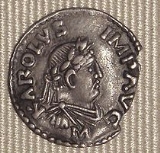
The physical portrait provided by Einhard is confirmed by contemporary depictions of the emperor, such as coins and his 8-inch bronze statue kept in the Louvre
Louvre

The Louvre Museum , located in Paris, is a historic monument, and a national museum of France. It is a central landmark, located on the Rive Droite of the Seine in the 1st arrondissement of Paris ....
. Charles description of Charlemagne's height at 7 feet (6 feet 3 inches, or 190.50 centimeters) was not far off. Though it was Herculean stature, particularly in a period in which people were a little shorter than we are today, archaeology has confirmed his tallness: in 1861, Charlemagne's tomb was opened by scientists who reconstructed his skeleton and found that it indeed measured 74.9 inches (192 centimeters).

Charles is well known to have been fair-haired, tall, and stately, with a disproportionately thick neck. The Roman tradition of realistic personal portraiture was in complete eclipse in his time, where individual traits were submerged in icon
Icon

An 'icon' is a religious work of art, most commonly a painting, from Eastern Christianity. More broadly the term is used in a wide number of contexts for an image, picture, or representation; it is a sign or likeness that stands for an object by signifying or representing it either concretely or by analogy, as in semiotics; by extension, ...
ic typecastings. Charlemagne, as an ideal ruler, ought to be portrayed in the corresponding fashion, any contemporary would have assumed. The images of enthroned Charlemagne, God's representative on Earth, bear more connections to the icons of Christ in majesty than to modern (or antique) conceptions of portraiture. Charlemagne in later imagery (as in the Dürer
Albrecht Dürer

'Albrecht D?rer' was a Germans Painting, printmaker and theorist from Nuremberg. His still-famous works include the Apocalypse woodcuts, commons:Image:Duerer - Ritter, Tod und Teufel .jpg , St....
 portrait) is often portrayed with flowing blond hair, due to a misunderstanding of Einhard, who describes Charlemagne as having
canitie pulchra, or "beautiful white hair", which has been rendered as blonde or fair in many translations.

Dress


Charlemagne wore the traditional, inconspicuous and distinctly non-aristocratic costume of the Frankish people
Early medieval European dress

Early medieval European dress, from about 400 to 1100, changed very gradually. The main feature of the period was the meeting of late Roman costume with that of the Migration period who moved into Europe over this period....
, described by Einhard thus:

He used to wear the national, that is to say, the Frank dress: next to his skin a linen shirt and linen breeches, and above these a tunic fringed with silk; while hose fastened by bands covered his lower limbs, and shoes his feet, and he protected his shoulders and chest in winter by a close-fitting coat of otter or marten skins.


He wore a blue cloak and always carried a sword with him. The typical sword was of a golden or silver hilt. He wore fancy jewelled swords to banquets or ambassadorial receptions. Nevertheless:

He despised foreign costumes, however handsome, and never allowed himself to be robed in them, except twice in Rome, when he donned the Roman tunic, chlamys, and shoes; the first time at the request of Pope Hadrian, the second to gratify Leo, Hadrian's successor.


He could rise to the occasion when necessary. On great feast days, he wore embroidery and jewels on his clothing and shoes. He had a golden buckle for his cloak on such occasions and would appear with his great diadem
Diadem (personal wear)

A diadem is a type of Crown , specifically an ornamental headband worn by Eastern monarchs and others as a badge of royalty. The word derives from the Greek language d??d??a diadema, from d??d?? diadeo to bind round, or fasten....
, but he despised such apparel, according to Einhard, and usually dressed like the common people.

Rise to power


Early life

Charlemagne was the eldest child of Pippin the Short (714 – 24 September 768, reigned from 751) and his wife Bertrada of Laon
Bertrada of Laon

Bertrada of Laon, also called Bertha Broadfoot , was a Franksish queen. She was born in Laon, in today's Aisne, the daughter of Caribert of Laon....
 (720 – 12 July 783), daughter of Caribert of Laon
Caribert of Laon

Caribert , Count of Laon, son of Martin of Laon, was the maternal grandfather of Charlemagne. He was the father of Charles's mother, Bertrada of Laon....
 and Bertrada of Cologne
Bertrada of Cologne

Bertrada of Cologne , the maternal grandmother of Charlemagne, was the Countess of Laon, married to Caribert of Laon, Count of Laon. Their daughter Bertrada of Laon married Pepin the Short, mayor of the palace of Neustria and Burgundy and later the king of the Franks....
. Records name only Carloman, Gisela, and a short-lived child named Pippin as his younger siblings. The semi-mythical Redburga
Redburga

Redburga or Raedburh was the wife of king Egbert of Wessex and may have been the sister-in-law of Charlemagne as the sister of his fourth wife, Luitgard; other sources describe her as his sister or his great-granddaughter or the daughter of his sister-in-law or his niece....
, wife of King Egbert of Wessex
Egbert of Wessex

Egbert was King of Wessex from 802 until 839. His father was Ealhmund of Kent. In the 780s Egbert was forced into exile by Offa of Mercia and Beorhtric of Wessex, but on Beorhtric's death in 802 Egbert returned and took the throne....
, is sometimes claimed to be his sister (or sister-in-law or niece), and the legendary material makes him Roland
Roland

Roland is a character in medieval literature and Renaissance literature, the chief paladin of Charlemagne and a central figure in the Matter of France....
's maternal uncle through a lady Bertha.

Much of what is known of Charlemagne's life comes from his biographer, Einhard
Einhard

Einhard was a Franks courtier, a dedicated servant of Charlemagne, of whom he wrote his famous biography, Vita Karoli Magni, and Louis the Pious....
, who wrote a
Vita Caroli Magni (or Vita Karoli Magni), the Life of Charlemagne. Einhard says of the early life of Charles:

It would be folly, I think, to write a word concerning Charles' birth and infancy, or even his boyhood, for nothing has ever been written on the subject, and there is no one alive now who can give information on it. Accordingly, I determined to pass that by as unknown, and to proceed at once to treat of his character, his deed, and such other facts of his life as are worth telling and setting forth, and shall first give an account of his deed at home and abroad, then of his character and pursuits, and lastly of his administration and death, omitting nothing worth knowing or necessary to know.


On the death of Pippin, the kingdom of the Franks was divided—following tradition—between Charlemagne and Carloman. Charles took the outer parts of the kingdom, bordering on the sea, namely Neustria
Neustria

The territory of Neustria or Neustrasia, meaning "new [western] land", originated in 511, made up of the regions from Aquitaine to the English Channel, approximating most of the north of present-day France, with Paris and Soissons as its main cities....
, western Aquitaine
Aquitaine

Aquitaine , archaic Guyenne/Guienne , is one of the 26 regions of France, in the south-western part of metropolitan France, along the Atlantic Ocean and the Pyrenees mountain range on the border with Spain....
, and the northern parts of Austrasia
Austrasia

Austrasia formed the north-eastern portion of the Kingdom of the Merovingian Franks, comprising parts of the territory of present-day eastern France, western Germany, Belgium, Luxembourg and the Netherlands....
, while Carloman retained the inner parts: southern Austrasia, Septimania
Septimania

Septimania was the western region of the Roman province of Gallia Narbonensis that passed under the control of the Visigoths in 462, when Septimania was ceded to their king, Theodoric II....
, eastern Aquitaine, Burgundy, Provence
Provence

Provence is a region of southeastern France on the Mediterranean adjacent to Italy. It is part of the administrative regions of France of Provence-Alpes-C?te d'Azur....
, and Swabia
Swabia

Swabia, Suabia, or Svebia is both a historic and linguistics region in Germany. Swabia consists of much of the present-day state of Baden-W?rttemberg , as well as the Bavarian Swabia ....
, lands bordering on Italy
Italy

Italy , officially the Italian Republic , is a country located on the Italian Peninsula in Southern Europe and on the two largest islands in the Mediterranean Sea, Sicily and Sardinia....
.

Joint rule

On 9 October, immediately after the funeral of their father, both the kings withdrew from Saint Denis to be proclaimed by their nobles and consecrated by the bishops, Charlemagne in Noyon
Noyon

Noyon is a Communes of France in the Oise Departments of France in northern France.It lies on the Oise Canal, approximately 60 miles north of Paris....
 and Carloman in Soissons
Soissons

Soissons is a Communes of the Aisne department in the Aisne Departments of France in Picardie in northern France, located on the Aisne River, about 100 kilometres northeast of Paris....
.

The first event of the brothers' reign was the rising of the Aquitainians and Gascons, in 769, in that territory split between the two kings. Years before Pippin had suppressed the revolt of Waifer
Waifer of Aquitaine

Waifer was the duke of Aquitaine from 748 to 767, succeeding his newly-monastic father Hunald of Aquitaine.When asked to give up Frankish refugees and stolen church lands in 760, Waifer rebelled....
, Duke of Aquitaine
Duke of Aquitaine

The Duke of Aquitaine ruled the historical region of Aquitaine under the supremacy of the List of Frankish kings and later the List of French monarchs....
. Now, one Hunald (seemingly other than Hunald
Hunald of Aquitaine

Hunald , Duke of Aquitaine , succeeded his father Odo the Great in 735.He refused to recognize the high authority of the Frankish mayor of the palace, Charles Martel, whereupon Charles marched south of the Loire, seized Bordeaux, and Blaye, but eventually allowed Hunald to retain Aquitaine on condition that he should promise fidelity....
 the duke) led the Aquitainians as far north as Angoulême
Angoulême

Angoul?me is a communes of France in western France and capital of the Charente Departments of France....
. Charlemagne met Carloman, but Carloman refused to participate and returned to Burgundy. Charlemagne went to war, leading an army to Bordeaux
Bordeaux

is a Port city on the Garonne in southwest France, with one million inhabitants in its aire urbaine at a 2008 estimate. It is the Capital of the Aquitaine regions of France, as well as the Prefectures in France of the Gironde Departments of France....
, where he set up a camp at Fronsac. Hunold was forced to flee to the court of Duke Lupus II of Gascony
Lop II of Gascony

Lupo II is the third-attested historical duke of Gascony , appearing in history for the first time in 769. His ancestry is subject to scholarly debate....
. Lupus, fearing Charlemagne, turned Hunold over in exchange for peace. He was put in a monastery. Aquitaine was finally fully subdued by the Franks.

The brothers maintained lukewarm relations with the assistance of their mother Bertrada, but in 770 Charlemagne signed a treaty with Duke Tassilo III of Bavaria
Tassilo III of Bavaria

Tassilo III was duke of Bavaria from 748 to 787, the last of the house of the Agilolfings.Tassilo, then still an infant, began his rule as a Frankish ward under the tutelage of the Merovingian Mayor of the Palace Pepin the Short after Tassilo's father, Duke Odilo of Bavaria, had died in 747 and Pepin?s half-brother Grifo had tried to seiz...
 and married a Lombard Princess (commonly known today as Desiderata), the daughter of King Desiderius
Desiderius

Desiderius was the last king of the Lombards of northern Italy . He is chiefly known for his connection to Charlemagne, who married his daughter and conquered his realm....
, in order to surround Carloman with his own allies. Though Pope Stephen III
Pope Stephen III

Pope Stephen III, , pope August 1 or August 7, 768 – January 24, 772, was a native of Sicily.He came to Rome during the pontificate of pope Gregory III and gradually rose to high office in the service of successive popes....
 first opposed the marriage with the Lombard princess, he would soon have little to fear from a Frankish-Lombard alliance.

Less than a year after his marriage, Charlemagne repudiated Desiderata, and quickly remarried to a 13-year-old Swabian named Hildegard. The repudiated Desiderata returned to her father's court at Pavia
Pavia

Pavia , the ancient Ticinum, is a town and comune of south-western Lombardy, northern Italy, 35 km south of Milan on the lower Ticino river near its confluence with the Po River....
. The Lombard's wrath was now aroused and he would gladly have allied with Carloman to defeat Charles. But before war could break out, Carloman died on 5 December 771. Carloman's wife Gerberga fled to Desiderius' court with her sons for protection.

Italian campaigns


Conquest of Lombardy

Charlemagne and Pope Adrian I
At the succession of Pope Hadrian I in 772, he demanded the return of certain cities in the former exarchate of Ravenna
Exarchate of Ravenna

The Exarchate of Ravenna or of Italy was a centre of Byzantine Empire power in Italy, from the end of the 6th century to 751, when the last Exarch was put to death by the Lombards....
 as in accordance with a promise of Desiderius' succession. Desiderius instead took over certain papal cities and invaded the Pentapolis
Pentapolis

A pentapolis, from the Ancient Greek words penta 'five' and polis 'city' is geographic and/or institutional grouping of five cities....
, heading for Rome
Rome

Rome is the capital city of Italy and Lazio, and is Italy's largest and most populous city, with 2,724,347 residents in an urban area of some ....
. Hadrian sent embassies to Charlemagne in autumn requesting he enforce the policies of his father, Pippin. Desiderius sent his own embassies denying the pope's charges. The embassies both met at Thionville
Thionville

Thionville , is a Communes of France in the Moselle Departments of France in Lorraine in northeastern France.The city is located near the Moselle River....
 and Charlemagne upheld the pope's side. Charlemagne promptly demanded what the pope had demanded and Desiderius promptly swore never to comply. Charlemagne and his uncle Bernard crossed the Alps in 773 and chased the Lombards back to Pavia, which they then besieged. Charlemagne temporarily left the siege to deal with Adelchis, son of Desiderius, who was raising an army at Verona
Verona

Verona is a city in Veneto, northern Italy, one of the seven provincial capitals in the region. It is one of the main tourist destinations in north-eastern Italy, thanks to its artistic heritage, several annual fairs, shows and operas, such as the lyrical season in the Arena, the ancient amphitheatre built by the Romans....
. The young prince was chased to the Adriatic littoral and he fled to Constantinople
Constantinople

Constantinople was the empire capital of the Roman Empire , the Byzantine Empire , the Latin Empire , and the Ottoman Empire . Strategically located between the Golden Horn and the Sea of Marmara at the point where Europe meets Asia, Byzantine Constantinople had been the capital of a Christendom empire, successor to ancient ancient Greece...
 to plead for assistance from Constantine V
Constantine V

Constantine V was List of Byzantine Emperors from 741 to 775; ); ....
, who was waging war with Bulgaria
First Bulgarian Empire

The First Bulgarian Empire was a medieval Bulgarian state founded in AD 632 in the lands near the Danube Delta and disintegrated in AD 1018 after its annexation to the Byzantine Empire....
.

The siege lasted until the spring of 774, when Charlemagne visited the pope in Rome. There he confirmed his father's grants of land, with some later chronicles claiming—falsely—that he also expanded them, granting Tuscany
Tuscany

Tuscany is a region in Italy. It has an area of and a population of about 3.6 million inhabitants. The regional capital is Florence.Tuscany is known for its landscapes and its artistic legacy....
, Emilia
Emilia

Emilia may refer to any of the following:*People** Emilia of Gaeta, duchess of Gaeta** Emilia Rydberg, Ethiopian-Swedish pop singer** Emilia Jane Mills Webb , wife of William Frederick Webb...
, Venice
Venice

Venice is a city in northern Italy, the capital city of the Italian regions Veneto, a population of 271,251 . Together with Padua, Italy, the city is included in the Padua-Venice Metropolitan Area ....
, and Corsica
Corsica

Corsica is the Mediterranean islands#By area in the Mediterranean Sea . It is located west of Italy, southeast of the France mainland, and north of the island of Sardinia....
. The pope granted him the title
patrician
Patrician

The term "patrician" originally referred to a group of elitism citizens in ancient Rome, including both their natural and adopted members. In the late Roman empire, the class was broadened to include high council officials, and after the fall of the Western Empire became a term for Byzantine Imperial governors in the West....
. He then returned to Pavia, where the Lombards were on the verge of surrendering.

In return for their lives, the Lombards surrendered and opened the gates in early summer. Desiderius was sent to the abbey
Abbey

An abbey , is a Christianity monastery or convent, under the government of an Abbot or an Abbess, who serves as the spiritual father or mother of the community....
 of Corbie
Corbie

Corbie is a commune in France of the Somme d?partement in France, in northern France....
 and his son Adelchis died in Constantinople a patrician. Charles, unusually, had himself crowned with the Iron Crown
Iron Crown of Lombardy

The Iron Crown of Lombardy is both a relic and one of the most ancient royal insignia of Europe. It is kept in the Monza Cathedral near Milan....
 and made the magnates of Lombardy do homage to him at Pavia. Only Duke Arechis II of Benevento
Arechis II of Benevento

File:Portale e dettagli castello arechi.jpgArechis II was Duke of Benevento of Benevento, in southern Italy, from 758 until his death. Benevento was in effect an independent state and Arechis an independent ruler....
 refused to submit and proclaimed independence. Charlemagne was now master of Italy as king of the Lombards. He left Italy with a garrison in Pavia and few Frankish counts in place that very year.

There was still instability, however, in Italy. In 776, Dukes Hrodgaud of Friuli
Hrodgaud of Friuli

Hrodgaud or Rodgand was the Duke of Friuli from 774 to 776. Probably he was already duke under Desiderius, even if some Frankish sources, such as the Einhard, say that Charlemagne put him in power after the Siege of Pavia....
 and Hildeprand of Spoleto
Hildeprand of Spoleto

Hildeprand was the Duke of Spoleto from 774 to 789.When Theodicius of Spoleto died fighting at the Siege of Pavia in 774, the Lombards of the Duchy of Spoleto elected Hildeprand their duke and quickly submitted to the Franks....
 rebelled. Charlemagne rushed back from Saxony
Saxony

The Free State of Saxony is a States of Germany of Germany. Located in the southeastern part of present-day Germany. It is the tenth-largest German state in area and the sixth largest in population , of Germany's sixteen states....
 and defeated the duke of Friuli in battle. The duke was slain. The duke of Spoleto signed a treaty. Their co-conspirator, Arechis, was not subdued and Adelchis, their candidate in Byzantium
Byzantium

Byzantium was an Ancient Greece city, which was founded by Greeks colonists from Megara in 667 BC and named after their king Byzas or Byzantas ....
, never left that city. Northern Italy was now faithfully his.

Southern Italy

In 787 Charlemagne directed his attention towards Benevento
Benevento

Benevento is a town and comune of Campania, Italy, capital of the province of Benevento, 50 km northeast of Naples. It is situated on a hill 130 m above sea-level at the confluence of the Calore Irpino and Sabato....
, where Arechis was reigning independently. He besieged Salerno
Salerno

Salerno is a town in southern Italy, capital of the Province of Salerno of the same name, in the region of Campania. It is located on the Gulf of Salerno on the Tyrrhenian Sea....
 and Arechis submitted to vassalage. However, with his death in 792, Benevento again proclaimed independence under his son Grimoald III
Grimoald III of Benevento

File:Grimoald Tremissis 788 792 Benevent Italy gold 1270mg.jpgGrimoald III was the Lombards Prince of Benevento from 788 until his own death. He was the second son of Arechis II of Benevento and Adelperga....
. Grimoald was attacked by armies of Charles' or his sons' many times, but Charlemagne himself never returned to the Mezzogiorno
Mezzogiorno

Southern Italy generally refers to the southern portion of the continental Italian peninsula historically forming the Kingdom of Naples. It encompasses the modern regions of Basilicata, Campania, Calabria, Apulia and Molise, which lie in Italy's south, and Abruzzo which is located in central Italy....
 and Grimoald never was forced to surrender to Frankish suzerainty
Suzerainty

Suzerainty is a situation in which a region or nation is a tributary state to a more powerful entity which allows the tributary some limited domestic Wiktionary:autonomy to control its foreign affairs....
.

Charles and his children

During the first peace of any substantial length (780–782), Charles began to appoint his sons to positions of authority within the realm, in the tradition of the kings and mayors of the past. In 781 he made his two younger sons kings, having them crowned by the Pope. The elder of these two, Carloman, was made king of Italy
King of Italy

King of Italy is a title adopted by many rulers of the Italian peninsula after the fall of the Roman Empire. Until 1870, however, no ?King of Italy? ruled the whole peninsula, though some pretended to such authority....
, taking the Iron Crown which his father had first worn in 774, and in the same ceremony was renamed "Pippin". The younger of the two, Louis
Louis the Pious

Louis the Pious , also called the Fair, and the Debonaire, was the King of Aquitaine from 781 and Holy Roman Emperor and King of the Franks with his father, Charlemagne, from 813....
, became king of Aquitaine. Charlemagne ordered Pippin and Louis to be raised in the customs of their kingdoms, and he gave their regents some control of their subkingdoms, but real power was always in his hands, though he intended each to inherit their realm some day. Nor did he tolerate insubordination in his sons: in 792, he banished his eldest, though illegitimate, son, Pippin the Hunchback, to the monastery of Prüm, because the young man had joined a rebellion against him.

The sons fought many wars on behalf of their father when they came of age. Charles was mostly preoccupied with the Bretons, whose border he shared and who insurrected on at least two occasions and were easily put down, but he was also sent against the Saxons on multiple occasions. In 805 and 806, he was sent into the Böhmerwald (modern Bohemia
Bohemia

History...
) to deal with the Slavs living there (Czechs
Czech people

Czechs are a West Slavs people of Central Europe, living predominantly in the Czech Republic. Small populations of Czechs also live in Slovakia, Austria, United States, Brazil, Argentina, Canada, Germany, Russia and other countries....
). He subjected them to Frankish authority and devastated the valley of the Elbe, forcing a tribute on them. Pippin had to hold the Avar
Eurasian Avars

The 'Avars' were a highly organized and powerful Turkic confederation. They were ruled by a khagan, who was surrounded by a tight-knit retinue of nomad warriors, an organization characteristic of Turkic peoples groups....
 and Beneventan borders, but also fought the Slavs to his north. He was uniquely poised to fight the Byzantine Empire
Byzantine Empire

Byzantine Empire and Eastern Roman Empire are conventional names used to describe the Roman Empire during the Middle Ages, centered on its capital of Constantinople....
 when finally that conflict arose after Charlemagne's imperial coronation and a Venetian rebellion. Finally, Louis was in charge of the Spanish March and also went to southern Italy to fight the duke of Benevento on at least one occasion. He took Barcelona in a great siege in the year 797 (see below).

Charlemagne's attitude toward his daughters has been the subject of much discussion. He kept them at home with him, and refused to allow them to contract sacramental marriages
Marriage

Marriage is a social, spirituality, or law union of individuals. This union may also be called matrimony, while the ceremony that marks its beginning is usually called a wedding and the married status created is sometimes called wedlock....
 – possibly to prevent the creation of cadet
Cadet

A cadet may mean a future officer in the military, a junior branch of an important family, or simply a person who is a junior trainee....
 branches of the family to challenge the main line, as had been the case with Tassilo of Bavaria
Tassilo III of Bavaria

Tassilo III was duke of Bavaria from 748 to 787, the last of the house of the Agilolfings.Tassilo, then still an infant, began his rule as a Frankish ward under the tutelage of the Merovingian Mayor of the Palace Pepin the Short after Tassilo's father, Duke Odilo of Bavaria, had died in 747 and Pepin?s half-brother Grifo had tried to seiz...
 – yet he tolerated their extramarital relationships, even rewarding their common-law husbands, and treasured the bastard grandchildren they produced for him. He also, apparently, refused to believe stories of their wild behaviour. After his death the surviving daughters were banished from the court by their brother, the pious Louis, to take up residence in the convents they had been bequeathed by their father. At least one of them, Bertha, had a recognised relationship, if not a marriage, with Angilbert
Angilbert

Saint Angilbert was a Franks who served Charlemagne as a diplomat, abbot, poet and semi-son-in-law. He was of noble Frankish parentage, and educated at the palace school in Aquisgranum under Alcuin....
, a member of Charlemagne's court circle.

Spanish campaigns


Roncesvalles campaign

Rolandfealty
According to the Muslim historian Ibn al-Athir, the Diet of Paderborn had received the representatives of the Muslim
Muslim

:A Muslim , , is an adherent of the religion of Islam. The feminine form is Muslimah . Literally, the word means "one who submits "....
 rulers of Zaragoza
Zaragoza

Zaragoza, also called Saragossa in English language, is the capital city of the Zaragoza and of the Autonomous communities of Spain and former Kingdom of Aragon of Aragon, Spain....
, Gerona
Gerona

Gerona can refer to:* Girona , a city in Catalonia, Spain, also spelt Gerona or Girone ** Province of Girona, is a province of eastern Spain, in the northern part of the autonomous community of Catalonia....
, Barcelona
Barcelona

Barcelona is the capital and most populous city of the Autonomous communities of Spain of Catalonia and the second largest city in Spain, with a population of 1,615,908 in 2008, while the population of the Metropolitan Area was 3,161,081....
, and Huesca
Huesca

Huesca is a city in Aragon, Spain. Huesca is the capital of the Spanish Huesca . In 2006 it had a population of 49,312....
. Their masters had been cornered in the Iberian
Iberian Peninsula

The Iberian Peninsula, or Iberia, is located in the extreme southwest of Europe and includes modern-day Spain, Portugal, Andorra and Gibraltar and a very small area of France....
 peninsula by Abd ar-Rahman I
Abd ar-Rahman I

Abd ar-Rahman I was the founder of the Umayyad Emirate of C?rdoba, Spain, a Muslim dynasty that ruled the greater part of Iberian Peninsula for nearly three centuries ....
, the Umayyad emir of Córdoba. These Moorish or "Saracen" rulers offered their homage to the great king of the Franks in return for military support. Seeing an opportunity to extend Christendom
Christendom

Christendom usually refers to Christianity as a territorial phenomenon. It can also refer to the part of the world in which Christianity prevails....
 and his own power and believing the Saxons to be a fully conquered nation, he agreed to go to Spain
Spain

Spain or the Kingdom of Spain , is a country located in Southern Europe on the Iberian Peninsula.The Spanish constitution does not establish any official denomination of the country, even though Espa?a , Estado espa?ol and Naci?n espa?ola are used interchangeably....
.

In 778, he led the Neustrian army across the Western Pyrenees
Pyrenees

The Pyrenees are a mountain range in southwest Europe that form a natural border between France and Spain. They separate the Iberian Peninsula from the rest of continental Europe, and extend for about from the Bay of Biscay to the Mediterranean Sea ....
, while the Austrasians, Lombards, and Burgundians passed over the Eastern Pyrenees. The armies met at Zaragoza
Zaragoza

Zaragoza, also called Saragossa in English language, is the capital city of the Zaragoza and of the Autonomous communities of Spain and former Kingdom of Aragon of Aragon, Spain....
 and received the homage of Sulayman al-Arabi and Kasmin ibn Yusuf, the foreign rulers. Zaragoza did not fall soon enough for Charlemagne, however. Indeed, Charlemagne was facing the toughest battle of his career and, in fear of losing, he decided to retreat and head home. He could not trust the Moors, nor the Basques, whom he had subdued by conquering Pamplona
Pamplona

Pamplona is the capital city of Navarre, Spain and of the former kingdom of Navarre.The city is famous worldwide for the San Ferm?n festival, from July 6 to 14, in which the running of the bulls or encierro is one of the main attractions....
. He turned to leave Iberia, but as he was passing through the Pass of Roncesvalles
Roncesvalles

Roncesvalles is a small village and municipality of northern Spain , in the Provinces of Spain of Navarre. It is situated on the small river Urrobi at an altitude of 900 meters among the Pyrenees, and within five miles of the France frontier....
 one of the most famous events of his long reign occurred. The Basques fell on his rearguard and baggage train, utterly destroying it. The Battle of Roncevaux Pass
Battle of Roncevaux Pass

The Battle of Roncevaux Pass was a famous battle in 778 in which Roland, prefect of the Brittany Marches and commander of the rear guard of Charlemagne's army, was defeated by the Basque people....
, less a battle than a mere skirmish, left many famous dead: among which were the seneschal
Seneschal

A seneschal was an officer in the houses of important nobles in the Middle Ages. In the French administrative system of the Middle Ages, the s?n?chal was also a royal officer in charge of justice and control of the administration in southern provinces, equivalent to the northern French bailli....
 Eggihard, the count of the palace Anselm, and the warden of the Breton March, Roland
Roland

Roland is a character in medieval literature and Renaissance literature, the chief paladin of Charlemagne and a central figure in the Matter of France....
, inspiring the subsequent creation of the Song of Roland (
Chanson de Roland).

Wars with the Moors

Harun Charlemagne
The conquest of Italy brought Charlemagne in contact with the Saracen
Saracen

Saracen was a term used by Europeans in the Middle Ages for Fatimids at first, then later for all who professed the religion of Islam....
s who, at the time, controlled the Mediterranean
Mediterranean Sea

The Mediterranean Sea is a sea or Ocean off the Atlantic Ocean surrounded by the Mediterranean region and almost completely enclosed by land: on the north by Europe, on the south by Africa, and on the east by Asia....
. Pippin, his son, was much occupied with Saracens in Italy. Charlemagne conquered Corsica
Corsica

Corsica is the Mediterranean islands#By area in the Mediterranean Sea . It is located west of Italy, southeast of the France mainland, and north of the island of Sardinia....
 and Sardinia
Sardinia

Sardinia is the Mediterranean islands#By area island in the Mediterranean Sea . The area of Sardinia is . The island is surrounded by the France island of Corsica, the Italian Peninsula, Tunisia and the Balearic Islands....
 at an unknown date and in 799 the Balearic Islands
Balearic Islands

The Balearic Islands are an archipelago in the western Mediterranean Sea, near the eastern coast of the Iberian Peninsula.The four largest islands are Majorca, Minorca, Ibiza, and Formentera....
. The islands were often attacked by Saracen pirates, but the counts of Genoa
Genoa

Genoa is a city and an important seaport in northern Italy, the capital of the Province of Genoa and of the region of Liguria. The city has a population of about 610,000 and the urban area has a population of about 900,000....
 and Tuscany (Boniface
Boniface I of Tuscany

Boniface II was the count and duke of Lucca and first margrave of Tuscany from about 828. He succeeded his father Boniface I, Count of Lucca in Lucca — in what was an early example of hereditary succession — and extended his power over the region....
) kept them at bay with large fleets until the end of Charlemagne's reign. Charlemagne even had contact with the caliph
Caliph

The Caliph is the head of state in a Caliphate, and the title for the leader of the Islamic Ummah, an Islamic community ruled by the Shari'ah....
al court in Baghdad
Baghdad

Baghdad is the Capital of Iraq and of Baghdad Governorate, with which it is also coterminous. With a municipal population estimated at 6.5 million, it is the largest city in Iraq, and the second largest city in the Arab World....
. In 797 (or possibly 801), the caliph of Baghdad, Harun al-Rashid
Harun al-Rashid

Harun al-Rashid ; also spelled Harun ar-Rashid; , Aaron the Just, or Aaron the Rightly-Guided; March 17, 763 – March 24, 809) was the fifth and most famous Abbasid Caliphate Caliph....
, presented Charlemagne with an Asian elephant
Asian Elephant

The Asian or Asiatic Elephant , sometimes known by the name of one of its subspecies – the Indian Elephant, is one of the three living species of elephant, and the only living species of the genus Elephas....
 named Abul-Abbas
Abul-Abbas

Abul-Abbas was an albino Asian elephant given to Emperor Charlemagne by the caliph of Baghdad, Harun al-Rashid, in 798.Abul-Abbas's journey from the Abbasid empire to Europe started with a crossing of the Mediterranean Sea by ship, which landed at Portovenere in October 801....
 and a mechanical clock, out of which came a mechanical bird to announce the hours.

In Hispania
Hispania

Hispania was the name given by the Ancient Rome to the whole of the Iberian Peninsula . When Rome was a Roman Republic, Hispania was divided into Roman provinces: Hispania Citerior and Hispania Ulterior....
 the struggle against the Moors continued unabated throughout the latter half of his reign. His son Louis was in charge of the Spanish border. In 785, his men captured Gerona permanently and extended Frankish control into the Catalan
Catalonia

Catalonia , is an Autonomous Community in northeast Spain.Catalonia covers an area of 32,114 km? and has an official population of 7,210,508. It borders France and Andorra to the north, Aragon to the west, the Valencian Community to the south, and the Mediterranean Sea to the east ....
 littoral for the duration of Charlemagne's reign (and much longer, it remained nominally Frankish until the Treaty of Corbeil
Treaty of Corbeil (1258)

The Treaty of Corbeil was an agreement signed on May 11, 1258, in Corbeil between Louis IX of France and James I of Aragon.The French king, as the heir of Charlemagne, renounced feudal overlordship over the counties of the Marca Hispanica....
 in 1258). The Muslim chiefs in the northeast of Islamic Spain
Al-Andalus

Al-Andalus was the Arabic name given to the parts of the Iberian Peninsula governed by Arab Muslims, at various times in the period between 711 and 1492....
 were constantly revolting against Córdoban authority and they often turned to the Franks for help. The Frankish border was slowly extended until 795, when Gerona, Cardona
Cardona

Cardona is a town ?n Catalonia, Spain, in the Barcelona ; about 90 km northwest of the city of Barcelona, on a hill almost surrounded by the river Cardoner, a branch of the Llobregat....
, Ausona
Osona

Osona, or Ausona , was one of the Catalan counties of the marca Hispanica in the Early Middle Ages and High Middle Ages. It was based around the capital city of Vic and the corresponding Diocese of Vic, whose territory was roughly the current comarca of Osona ....
, and Urgel were united into the new Spanish March, within the old duchy of Septimania
Septimania

Septimania was the western region of the Roman province of Gallia Narbonensis that passed under the control of the Visigoths in 462, when Septimania was ceded to their king, Theodoric II....
.

In 797 Barcelona
Barcelona

Barcelona is the capital and most populous city of the Autonomous communities of Spain of Catalonia and the second largest city in Spain, with a population of 1,615,908 in 2008, while the population of the Metropolitan Area was 3,161,081....
, the greatest city of the region, fell to the Franks when Zeid, its governor, rebelled against Córdoba and, failing, handed it to them. The Umayyad authority recaptured it in 799. However, Louis of Aquitaine marched the entire army of his kingdom over the Pyrenees
Pyrenees

The Pyrenees are a mountain range in southwest Europe that form a natural border between France and Spain. They separate the Iberian Peninsula from the rest of continental Europe, and extend for about from the Bay of Biscay to the Mediterranean Sea ....
 and besieged it for two years, wintering there from 800 to 801, when it capitulated. The Franks continued to press forwards against the emir
Emir

Emir , is a high Nobility or office, used throughout the Arab World and historically in some Turkic peoples states and Afghanistan. Emirs are usually considered high-ranking sheikhs, but in monarchical states the term is also used for princes, with "Emirate" being analogous to principality in this sense....
. They took Tarragona
Tarragona

Tarragona is a city located in the south of Catalonia and east of Spain, by the Mediterranean Sea. It is the capital of the Spanish Tarragona and the capital of the Catalan comarca Tarragon?s....
 in 809 and Tortosa
Tortosa

Tortosa is the capital of the Catalonia/Comarques of Baix Ebre, in the province of Tarragona, in Catalonia, Spain, located at 12 metres above the sea, by the Ebre river....
 in 811. The last conquest brought them to the mouth of the Ebro
Ebro

The Ebro is Spain's most voluminous river. Its source is in Fontibre . It flows through cities such as Miranda de Ebro, Logro?o, Zaragoza, Flix, Tortosa, and Amposta before discharging in a river delta on the Mediterranean Sea in the province of Tarragona ....
 and gave them raiding access to Valencia
Kingdom of Valencia

The Christian Kingdom of Valencia , located in the Eastern shore of the Iberian Peninsula, was one of the component realms of the Crown of Aragon....
, prompting the Emir al-Hakam I
Al-Hakam I

Al-Hakam Ibn Hisham Ibn Abd-ar-Rahman I was Umayyad Emir of Cordoba from 796 until 822 in the Al-Andalus .During his reign he crushed a rebellion led by clerics in a suburb called al-Ribad on the south bank of the Guadalquivir river....
 to recognise their conquests in 812.

Eastern campaigns


Saxon Wars

Charlemagne was engaged in almost constant battle throughout his reign, often at the head of his elite
scara bodyguard squadrons, with his legendary sword Joyeuse
Joyeuse

Joyeuse was the name of Charlemagne's personal sword. The name translates as "joyful". Some legends claim that it was forged to contain the Holy Lance within its pommel?others state it was supposedly smithed from the same materials as Roland's Durendal and Ogier the Dane's Curtana....
 in hand. After thirty years of war and eighteen battles—the Saxon Wars
Saxon Wars

The Saxon Wars were the campaigns and insurrections of the more than thirty years from 772, when Charlemagne first entered Duchy of Saxony with the intent to conquer, to 804, when the last rebellion of disaffected Germanic peoples was crushed....
—he conquered Saxonia
Saxonia

Saxonia is the Latin name of Saxony.Saxonia may also refer to:* Saxonia , first locomotive built in Germany in 1838* Saxonia , female personification of Saxony...
 and proceeded to convert the conquered to Roman Catholicism, using force where necessary.

The Saxons were divided into four subgroups in four regions. Nearest to Austrasia was Westphalia
Westphalia

Westphalia is a region in Germany, centred on the cities of Bielefeld, Bochum, Dortmund, Gelsenkirchen, M?nster, and Osnabr?ck and included in the states of North Rhine-Westphalia and Lower Saxony....
 and furthest away was Eastphalia
Eastphalia

Eastphalia is a historical region in northern Germany, encompassing the eastern part of the historic Duchy of Saxony, roughly demarcated by the rivers of Leine and Saale....
. In between these two kingdoms was that of Engria and north of these three, at the base of the Jutland
Jutland

File:Jutland peninsula 2.pngJutland , historically also called Cimbria, is a peninsula in Europe. Jutland forms the mainland part of Denmark as well as the northernmost part of Germany....
 peninsula, was Nordalbingia
Nordalbingia

Nordalbingia was one of the four administrative regions of the medieval Duchy of Saxony, the others being Angria, Eastphalia, and Westphalia....
.

In his first campaign, Charlemagne forced the Engrians in 773 to submit and cut down an Irminsul
Irminsul

An Irminsul was a kind of pillar which is attested as playing an important role in the Germanic paganism of the Saxon people. The oldest chronicle describing an Irminsul refers to it as a tree trunk erected in the open air....
 pillar near Paderborn
Paderborn

Paderborn is a city in North Rhine-Westphalia, Germany, capital of the Paderborn . The name of the city derives from the river Pader River, which originates in more than 200 springs near Paderborn Cathedral, where St....
. The campaign was cut short by his first expedition to Italy. He returned in the year 775, marching through Westphalia and conquering the Saxon fort of Sigiburg. He then crossed Engria, where he defeated the Saxons again. Finally, in Eastphalia, he defeated a Saxon force, and its leader Hessi converted to Christianity
Christianity

Christianity is a Monotheistic religion #Christian view religion centered on the life and teachings of Jesus as New Testament view on Jesus' life....
. He returned through Westphalia, leaving encampments at Sigiburg and Eresburg, which had, up until then, been important Saxon bastions. All Saxony but Nordalbingia was under his control, but Saxon resistance had not ended.

Following his campaign in Italy subjugating the dukes of Friuli and Spoleto, Charlemagne returned very rapidly to Saxony in 776, where a rebellion had destroyed his fortress at Eresburg. The Saxons were once again brought to heel, but their main leader, duke Widukind
Widukind

Widukind was a Saxons leader and the chief opponent of Charlemagne during the Saxon Wars. In later times, he became a symbol of Saxon independence and a figure of legend, and was stylized as a prototypical Germanic peoples hero....
, managed to escape to Denmark, home of his wife. Charlemagne built a new camp at Karlstadt
Karlstadt

Karlstadt can refer to places:* Karlstadt am Main, Germany* Karlovac, Croatia * Karlstad, Swedenor to:* Andreas Karlstadt, a contemporary of Martin Luther during the Reformation....
. In 777, he called a national diet at Paderborn to integrate Saxony fully into the Frankish kingdom. Many Saxons were baptised.

In the summer of 779, he again invaded Saxony and reconquered Eastphalia, Engria, and Westphalia. At a diet near Lippe
Lippe

This article is about the district Lippe. For the like-named river see Lippe River. For the historic country see Principality of LippeLippe is a Kreis in the east of North Rhine-Westphalia, Germany....
, he divided the land into missionary districts and himself assisted in several mass baptisms (780). He then returned to Italy and, for the first time, there was no immediate Saxon revolt. In 780 Charlemagne decreed the death penalty for all Saxons who failed to be baptised, who failed to keep Christian festivals, and who cremated their dead. Saxony had peace from 780 to 782.

He returned in 782 to Saxony and instituted a code of law and appointed counts, both Saxon and Frank. The laws were draconian on religious issues, and the indigenous forms of Germanic polytheism were gravely threatened by Christianisation. This stirred a renewal of the old conflict. That year, in autumn, Widukind returned and led a new revolt, which resulted in several assaults on the church. In response, at Verden
Verden, Germany

Verden , or Verden , is a town in Lower Saxony, Germany, on the River Aller. It is the administrative centre of the district of Verden . Verden is famous for the alleged massacre of Saxons in 782, committed on the orders of Charlemagne , for its cathedral, and for its horse breeding....
 in Lower Saxony
Lower Saxony

Lower Saxony lies in northern Germany and is second in area and fourth in population among the sixteen States of Germany of Germany. In rural areas Low German is still spoken, but the number of speakers is declining....
, Charlemagne allegedly ordered the beheading of 4,500 Saxons who had been caught practising their native paganism after conversion to Christianity, known as the Massacre of Verden. The massacre triggered three years of renewed bloody warfare (783-785). During this war the Frisians
Frisians

The Frisians are an ethnic group of Germanic people living in coastal parts of The Netherlands and Germany. They are concentrated in the Dutch provinces of Friesland and Groningen and, in Germany, East Frisia and North Frisia....
 were also finally subdued and a large part of their fleet was burned. The war ended with Widukind accepting baptism.

Thereafter, the Saxons maintained the peace for seven years, but in 792 the Westphalians once again rose against their conquerors. The Eastphalians and Nordalbingians joined them in 793, but the insurrection did not catch on and was put down by 794. An Engrian rebellion followed in 796, but Charlemagne's personal presence and the presence of Christian Saxons and Slavs
Slavic peoples

The Slavic Peoples are a linguistic branch of Indo-European peoples, living mainly in eastern Europe. From the early 6th century they spread from their original homeland to inhabit most of eastern Central Europe, Eastern Europe and the Balkans....
 quickly crushed it. The last insurrection of the independence-minded people occurred in 804, more than thirty years after Charlemagne's first campaign against them. This time, the most unruly of them, the Nordalbingians, found themselves effectively disempowered from rebellion. According to Einhard:

The war that had lasted so many years was at length ended by their acceding to the terms offered by the King; which were renunciation of their national religious customs and the worship of devils, acceptance of the sacraments of the Christian faith and religion, and union with the Franks to form one people.


Saxon resistance to Charlemagne's rule was at an end.

Submission of Bavaria

In 788, Charlemagne turned his attention to Bavaria
Bavaria

Bavaria , with an area of and almost 12.5 million inhabitants, is a region located in the southeast of Germany and is the largest States of Germany of Germany by area....
. He claimed Tassilo was an unfit ruler on account of his oath-breaking. The charges were trumped up, but Tassilo was deposed anyway and put in the monastery of Jumièges
Jumièges

Jumi?ges is a communes of France in the Seine-Maritime departments of France of the Haute-Normandie region of northern France....
. In 794, he was made to renounce any claim to Bavaria for himself and his family (the Agilolfings
Agilolfings

The Agilolfings were a family of either Franks or Bavarii nobility that ruled the Duchy of Bavaria on behalf of their Merovingian suzerains from about 550 until 788....
) at the synod
Synod

A synod is a council of a Ecclesia , usually a Christianity church, convened to decide an issue of doctrine, administration or application. An ecumenical council is so named because it is a synod of the whole church ...
 of Frankfurt
Frankfurt

is the largest city in the German States of Germany of Hesse and the List of cities in Germany with more than 100,000 inhabitants in Germany, with a 2008 population of 670,000....
. Bavaria was subdivided into Frankish counties, like Saxony.

Avar campaigns

In 788, the Avars
Eurasian Avars

The 'Avars' were a highly organized and powerful Turkic confederation. They were ruled by a khagan, who was surrounded by a tight-knit retinue of nomad warriors, an organization characteristic of Turkic peoples groups....
, a pagan Asian horde which had settled down in what is today Hungary
Hungary

Hungary , officially in English the Republic of Hungary , is a landlocked country in the Carpathian Basin of Central Europe, bordered by Austria, Slovakia, Ukraine, Romania, Serbia, Croatia, and Slovenia....
 (Einhard called them Huns
Huns

The Huns were a confederation of Central Asian Eurasian nomads or semi-nomads, who had established an empire in Eurasia. The Huns may have stimulated the Migration Period, a contributing factor in the collapse of the Roman Empire....
), invaded Friuli and Bavaria. Charles was preoccupied until 790 with other things, but in that year, he marched down the Danube
Danube

The Danube is the longest river in the European Union and Europe's second longest river after the Volga.The river originates in the Black Forest in Germany as the much smaller Brigach and Breg River rivers which join at the eponymously named German town Donaueschingen, after which it is known as the Danube and flows eastwards for a distance...
 into their territory and ravaged it to the Raab
Raab

Raab is the historical German name for the Hungarian city Gyor and the R?ba River.Raab may also refer to:*Raab, town in Austria*Rapini, an edible vegetable used in Chinese and Italian cuisine...
. Then, a Lombard army under Pippin marched into the Drava
Drava

Drava or Drave is a river in southern Central Europe, a tributary of the Danube. It begins in Dobbiaco, Italy, and flows east through East Tirol and Carinthia in Austria, into Slovenia , and then southeast, passing through Croatia and forming most of the border between Croatia and Hungary, before it joins the Danube near Osijek....
 valley and ravaged Pannonia
Pannonia

Pannonia is an ancient province of the Roman Empire bounded north and east by the Danube, coterminous westward with Noricum and upper Italy, and southward with Dalmatia and upper Moesia....
. The campaigns would have continued if the Saxons had not revolted again in 792, breaking seven years of peace.

For the next two years, Charles was occupied with the Slavs against the Saxons. Pippin and Duke Eric of Friuli
Eric of Friuli

Eric was the Duke of Friuli from 789 to his death. He was the eldest son of Gerold of Vinzgouw and by the marriage of his sister Hildegard,_wife_of_Charlemagne the brother-in-law of Charlemagne....
 continued, however, to assault the Avars' ring-shaped strongholds. The great Ring of the Avars, their capital fortress, was taken twice. The booty was sent to Charlemagne at his capital, Aachen
Aachen

is a historic spa town in North Rhine-Westphalia, Germany. It is the westernmost city of Germany, located along its borders with Belgium and the Netherlands, 65 km west of Cologne....
, and redistributed to all his followers and even to foreign rulers, including King Offa of Mercia
Offa of Mercia

Offa was the King of Mercia from 757 until his death in July 796. He was the son of Thingfrith and a descendant of Eowa of Mercia, a brother of King Penda of Mercia, who had ruled over a century before....
. Soon the Avar tudun
Tudun

A tudun was a governor resident in a town or other settlement in Ancient Bulgarian/Avar/Gokturk empires, particularly those of the Bulgars and the Khazars....
s had thrown in the towel and travelled to Aachen to subject themselves to Charlemagne as vassals and Christians. This Charlemagne accepted and sent one native chief, baptised Abraham, back to Avaria with the ancient title of khagan
Khagan

Khagan or Great Khan , is a title of empire rank in the Turkic languages and Mongolian language languages equal to the status of emperor and someone who rules a Khaganate ....
. Abraham kept his people in line, but in 800 the Bulgarians
First Bulgarian Empire

The First Bulgarian Empire was a medieval Bulgarian state founded in AD 632 in the lands near the Danube Delta and disintegrated in AD 1018 after its annexation to the Byzantine Empire....
 under Krum swept the Avar state away. In the 10th century, the Magyars settled the Pannonian plain and presented a new threat to Charlemagne's descendants.

Slav expeditions

In 789, in recognition of his new pagan neighbours, the Slavs
Slavic peoples

The Slavic Peoples are a linguistic branch of Indo-European peoples, living mainly in eastern Europe. From the early 6th century they spread from their original homeland to inhabit most of eastern Central Europe, Eastern Europe and the Balkans....
, Charlemagne marched an Austrasian-Saxon army across the Elbe
Elbe

The River Elbe is one of the major rivers of Central Europe. It originates in the Krkonose Mountains of northwestern Czech Republic before traversing much of Germany and flowing into the North Sea....
 into Obotrite territory. The Slavs immediately submitted under their leader Witzin. He then accepted the surrender of the Wiltzes under Dragovit and demanded many hostages and the permission to send, unmolested, missionaries into the pagan region. The army marched to the Baltic
Baltic region

The Baltic region is an ambiguous term that refers to slightly different combinations of countries in the general area surrounding the Baltic Sea....
 before turning around and marching to the Rhine with much booty and no harassment. The tributary Slavs became loyal allies. In 795, the peace broken by the Saxons, the Abotrites and Wiltzes rose in arms with their new master against the Saxons. Witzin died in battle and Charlemagne avenged him by harrying the Eastphalians on the Elbe. Thrasuco, his successor, led his men to conquest over the Nordalbingians and handed their leaders over to Charlemagne, who greatly honoured him. The Abotrites remained loyal until Charles' death and fought later against the Danes.

Charlemagne also directed his attention to the Slavs
South Slavs

The South Slavs are a southern branch of the Slavic peoples that live in the Balkans mainly throughout the former Yugoslavia and Bulgaria. Geographically, the South Slavs are native to the southern Pannonian Plain, the eastern Alps and the Balkans and they speak South Slavic languages....
 to the south of the Avar khaganate: the Carantanians and Slovenes. These people were subdued by the Lombards and Bavarii and made tributaries, but never incorporated into the Frankish state.

Imperium


Imperial diplomacy

Aachen Cathedral Inside
In 799, Pope Leo III
Pope Leo III

Pope Saint Leo III was Pope from 795 to 816. Protected by Charlemagne from his enemies in Rome, he subsequently strengthened Charlemagne's position by crowning him as Roman Emperor....
 had been mistreated by the Romans, who tried to put out his eyes and tear out his tongue. Leo escaped, and fled to Charlemagne at Paderborn, asking him to intervene in Rome and restore him. Charlemagne, advised by Alcuin of York, agreed to travel to Rome, doing so in November 800 and holding a council on December 1. On December 23 Leo swore an oath of innocence. At Mass
Mass

In physical science, mass refers to the degree of acceleration a body acquires when subject to a force: bodies with greater mass are accelerated less by the same force....
, on Christmas Day (December 25), when Charlemagne knelt the altar to pray, the pope crowned him
Imperator Romanorum ("Emperor of the Romans") in Saint Peter's Basilica
Old Saint Peter's Basilica

Old Saint Peter's Basilica was the building that once stood on the spot where the Basilica of Saint Peter stands today in Rome. The name Old Saint Peter's Basilica has been used since the construction of the current basilica to distinguish the two buildings....
. In so doing, the pope was effectively attempting to transfer the office from Constantinople
Constantinople

Constantinople was the empire capital of the Roman Empire , the Byzantine Empire , the Latin Empire , and the Ottoman Empire . Strategically located between the Golden Horn and the Sea of Marmara at the point where Europe meets Asia, Byzantine Constantinople had been the capital of a Christendom empire, successor to ancient ancient Greece...
 to Charles. Einhard says that Charlemagne was ignorant of the pope's intent and did not want any such coronation:
[H]e at first had such an aversion that he declared that he would not have set foot in the Church the day that they [the imperial titles] were conferred, although it was a great feast-day, if he could have foreseen the design of the Pope.


Many modern scholars suggest that Charlemagne was indeed aware of the coronation; certainly he cannot have missed the bejeweled crown waiting on the altar when he came to pray. In any event, he would now use these circumstances to claim that he was the renewer of the Roman Empire, which had apparently fallen into degradation under the Byzantines
Byzantine Empire

Byzantine Empire and Eastern Roman Empire are conventional names used to describe the Roman Empire during the Middle Ages, centered on its capital of Constantinople....
. However, Charles would after 806 style himself, not
Imperator Romanorum ("Emperor of the Romans", a title reserved for the Byzantine emperor), but rather Imperator Romanum gubernans Imperium ("Emperor ruling the Roman Empire").

The Iconoclasm
Iconoclasm (Byzantine)

Iconoclasm, Greek for "image-breaking", is the deliberate destruction within a culture of the culture's own religion icons and other symbols or monuments, usually for religious or political motives....
 of the Isaurian Dynasty
Leo III the Isaurian

Leo III the Isaurian or the Syrian , was List of Byzantine Emperors from 717 until his death in 741. He put an end to a period of instability, successfully defended the empire against the invading Umayyads, and forbade the veneration of icons ....
 and resulting religious conflicts with the Empress Irene, sitting on the throne in Constantinople in 800, were probably the chief causes of the pope's desire to formally acclaim Charles as Roman Emperor. He also most certainly desired to increase the influence of the papacy, honour his saviour Charlemagne, and solve the constitutional issues then most troubling to European jurists in an era when Rome was not in the hands of an emperor. Thus, Charlemagne's assumption of the imperial title was not an usurpation in the eyes of the Franks or Italians. It was, however, in Byzantium, where it was protested by Irene and her successor Nicephorus I—neither of whom had any great effect in enforcing their protests.

The Byzantines, however, still held several territories in Italy: Venice (what was left of the Exarchate of Ravenna
Exarchate of Ravenna

The Exarchate of Ravenna or of Italy was a centre of Byzantine Empire power in Italy, from the end of the 6th century to 751, when the last Exarch was put to death by the Lombards....
), Reggio
Reggio Calabria

Reggio di Calabria , commonly known as Reggio Calabria or Reggio, is a city in southern Italy Italy, the Capital of the Province of Reggio Calabria as well as the largest and oldest city in the Calabria region....
 (in Calabria
Calabria

Calabria , is a Regions of Italy in Southern Italy Italy, south of Naples, located at the "toe" of the Italian peninsula. It is bounded to the north by the region of Basilicata, to the south-west by the region of Sicily, to the west by the Tyrrhenian Sea, and to the east by the Ionian Sea....
), Brindisi
Brindisi

Brindisi is an ancient city in the Italy region of Apulia, the capital of the province of Brindisi....
 (in Apulia
Apulia

Apulia is a region in southeastern Italy bordering the Adriatic Sea in the east, the Ionian Sea to the southeast, and the Strait of Otranto and Gulf of Taranto in the south....
), and Naples
Naples

Naples is a city in southern Italy, the capital of the region of Campania and of the province of Naples. The city is known for its rich history, art, culture and gastronomy, playing an important role throughout much of its existence; it is over 2,800 years old....
 (the
Ducatus Neapolitanus). These regions remained outside of Frankish hands until 804, when the Venetians, torn by infighting, transferred their allegiance to the Iron Crown of Pippin, Charles' son. The Pax Nicephori
Pax Nicephori

The Pax Nicephori was an 803 peace treaty concluded between the two emperors of Europe, Charlemagne in the West, and Nicephorus I in the East. Though Nicephorus refused to recognise Charlemagne's imperial title, the empires made agreement over the possession of disputed Italian territory, namely, the province of Venetia ....
ended. Nicephorus ravaged the coasts with a fleet and the only instance of war between the Byzantines and the Franks, as it was, began. It lasted until 810, when the pro-Byzantine party in Venice gave their city back to the Byzantine Emperor and the two emperors of Europe made peace: Charlemagne received the Istria
Istria

File:Istria Croatian Adriatic.pngIstria , formerly Histria , is the largest peninsula in the Adriatic Sea. The peninsula is located at the head of the Adriatic between the Gulf of Trieste and the Bay of Kvarner....
n peninsula and in 812 Emperor Michael I Rhangabes recognised his status as Emperor.

Danish attacks

After the conquest of Nordalbingia, the Frankish frontier was brought into contact with Scandinavia. The pagan
Norse paganism

Norse paganism is a term used to describe the religion which were common amongst the Germanic tribes living in Nordic countries prior to and during the Christianization of Scandinavia of Northern Europe....
 Danes, "a race almost unknown to his ancestors, but destined to be only too well known to his sons" as Charles Oman
Charles Oman

Sir Charles William Chadwick Oman was a British Military history of the early 20th century. His reconstructions of medieval battles from the fragmentary and distorted accounts left by chroniclers were pioneering....
 described them, inhabiting the Jutland
Jutland

File:Jutland peninsula 2.pngJutland , historically also called Cimbria, is a peninsula in Europe. Jutland forms the mainland part of Denmark as well as the northernmost part of Germany....
 peninsula had heard many stories from Widukind and his allies who had taken refuge with them about the dangers of the Franks and the fury which their Christian king could direct against pagan neighbours.

In 808, the king of the Danes, Godfred
Gudfred

King Godfred , was a Denmark Viking king, the younger son of King Sigfred. Alternate spelling include Godfred, Gudfred, G?ttrick , G?trik , Gudr?d , and Godofredus ....
, built the vast Danevirke
Danevirke

The Dannevirke is a system of Danmark fortifications in Schleswig-Holstein . This important linear defensive earthwork was constructed across the neck of the Jutland during Denmark's Viking Age....
 across the isthmus of Schleswig
Schleswig

Schleswig or South Jutland is a region covering the area about 60 km north and 70 km south of the border between Germany and Denmark. The region is also known archaically in English language as Sleswick....
. This defence, last employed in the Danish-Prussian War of 1864, was at its beginning a 30 km long earthenwork rampart. The Danevirke protected Danish land and gave Godfred the opportunity to harass Frisia
Frisia

Frisia is a coastal region along the southeastern corner of the North Sea, i.e. the German Bight. Frisia is the traditional homeland of the Frisians, a Germanic people who speak Frisian languages, a language group closely related to the English language....
 and Flanders
Flanders

Flanders is a geographical region located in parts of present-day Belgium, France, and the Netherlands. Over the course of history, the geographical territory that was called "Flanders" has varied....
 with pirate raids. He also subdued the Frank-allied Wiltzes and fought the Abotrites.

Godfred invaded Frisia and joked of visiting Aachen, but was murdered before he could do any more, either by a Frankish assassin or by one of his own men. Godfred was succeeded by his nephew Hemming, who concluded the Treaty of Heiligen
Treaty of Heiligen

The Treaty of Heiligen was signed at Heiligen in 811 between the Denmark King Hemming, King of Danes and Charlemagne. Based on the terms of the accord, the southern boundary of Denmark was established at the Eider River....
 with Charlemagne in late 811.

Death

In 813, Charlemagne called Louis the Pious
Louis the Pious

Louis the Pious , also called the Fair, and the Debonaire, was the King of Aquitaine from 781 and Holy Roman Emperor and King of the Franks with his father, Charlemagne, from 813....
, king of Aquitaine
Aquitaine

Aquitaine , archaic Guyenne/Guienne , is one of the 26 regions of France, in the south-western part of metropolitan France, along the Atlantic Ocean and the Pyrenees mountain range on the border with Spain....
, his only surviving legitimate son, to his court. There he crowned him with his own hands as co-emperor and sent him back to Aquitaine. He then spent the autumn hunting before returning to Aachen on 1 November. In January, he fell ill with pleurisy
Pleurisy

Pleurisy, also known as pleuritis, is an inflammation of the pleura, the lining of the pleural cavity surrounding the lungs. Among other things, infections are the most common cause of pleurisy....
. He took to his bed on 21 January and as Einhard
Einhard

Einhard was a Franks courtier, a dedicated servant of Charlemagne, of whom he wrote his famous biography, Vita Karoli Magni, and Louis the Pious....
 tells it:

He died January twenty-eighth, the seventh day from the time that he took to his bed, at nine o'clock in the morning, after partaking of the Holy Communion, in the seventy-second year of his age and the forty-seventh of his reign.


He was buried on the day of his death, in Aachen Cathedral
Aachen Cathedral

Aachen Cathedral, frequently referred to as the "Imperial Cathedral" is a Roman Catholic church in Aachen, Germany. The church is the oldest cathedral in northern Europe and was known as the "Royal Church of St....
, although the cold weather and the nature of his illness made such a hurried burial unnecessary. The earliest surviving
planctus
Planctus

A planctus is a lament, or song or poem which expresses grief or mourning. It became a popular form in the Middle ages, when they were written both in Latin and the vernacular....
, the Planctus de obitu Karoli
Planctus de obitu Karoli

The 'Planctus Karoli' , also known by its incipit 'A solis ortu' , is an anonymous medieval Latin planctus eulogising Charlemagne, written in accented verse by a monk of Bobbio Abbey shortly after his subject's death in 814....
, was composed by a monk of Bobbio
Bobbio Abbey

Bobbio Abbey is a monastery founded by Saint Columbanus in 614, around which later grew up the town of Bobbio, in the province of Piacenza and the Emilia-Romagna region of Italy....
, which he had patronised. A later story, told by Otho of Lomello, Count of the Palace at Aachen in the time of Otto III
Otto III, Holy Roman Emperor

Otto III was the fourth ruler of the Saxon or Ottonian dynasty of the Holy Roman Empire. He was elected king of Germany in 983 on the death of his father Otto II, Holy Roman Emperor....
, would claim that he and Emperor Otto had discovered Charlemagne's tomb: the emperor, they claimed, was seated upon a throne, wearing a crown and holding a sceptre, his flesh almost entirely incorrupt. In 1165, Frederick I
Frederick I, Holy Roman Emperor

Frederick I Barbarossa was elected King of Germany at Frankfurt am Main on 4 March 1152 and crowned in Aachen on 9 March, crowned King of Italy in Pavia in 1154, and finally crowned Holy Roman Emperor by Pope Adrian IV on 18 June 1155....
 re-opened the tomb again, and placed the emperor in a sarcophagus beneath the floor of the cathedral. In 1215 Frederick II
Frederick II, Holy Roman Emperor

Frederick II , of the House of Hohenstaufen dynasty, was an Kingdom of Italy pretender to the title of King of the Romans from 1212 and unopposed holder of that monarchy from 1215....
 would re-inter him in a casket made of gold and silver.

Charlemagne's death greatly affected many of his subjects, particularly those of the literary clique who had surrounded him at Aachen. An anonymous monk of Bobbio lamented:

He was succeeded by his surviving son, Louis, who had been crowned the previous year. His empire lasted only another generation in its entirety; its division, according to custom, between Louis's own sons after their father's death laid the foundation for the modern states of France and Germany.

Administration

As an administrator, Charlemagne stands out for his many reforms: monetary, governmental, military, cultural and ecclesiastical. He is the main protagonist of the "Carolingian Renaissance".

Economic and monetary reforms

Karldergrossesignatur
Charlemagne had an important role in determining the immediate economic future of Europe. Pursuing his father's reforms, Charlemagne abolished the monetary system based on the gold , and he and the Anglo-Saxon King
Anglo-Saxon monarchs

Anglo-Saxon monarchs were the rulers of the various kingdoms which arose in Anglo-Saxon England following the withdrawal of the Romans in the fifth century....
 Offa of Mercia
Offa of Mercia

Offa was the King of Mercia from 757 until his death in July 796. He was the son of Thingfrith and a descendant of Eowa of Mercia, a brother of King Penda of Mercia, who had ruled over a century before....
 took up the system set in place by Pippin. There were strong pragmatic reasons for this abandonment of a gold standard, notably a shortage of gold itself, a direct consequence of the conclusion of peace with Byzantium and the ceding of Venice and Sicily, and the loss of their trade routes to Africa and to the east. This standardisation also had the effect of economically harmonising and unifying the complex array of currencies in use at the commencement of his reign, thus simplifying trade and commerce.

, 793-812.]] He established a new standard, the (from the Latin , the modern pound
Pound (currency)

The pound, a unit of currency, originated in England, as the value of a pound mass of silver. For a long time, ?1 worth of silver coins were a troy pound in mass....
), and based upon a pound of silver
Silver

Silver is a chemical element with the chemical symbol Ag and atomic number 47. A soft, white, lustrous transition metal, it has the highest electrical conductivity of any element and the highest thermal conductivity of any metal....
 – a unit of both money and weight – which was worth 20 sous (from the Latin [which was primarily an accounting device, and never actually minted], the modern shilling
Shilling

The shilling is a unit of currency used in current and former Commonwealth of Nations countries, and continued to be used in countries that left the commonwealth, such as Republic of Ireland and Tanzania....
) or 240 (from the Latin , the modern penny
Penny

A penny is a coin or a unit of currency used in several English-speaking countries....
). During this period, the and the were counting units, only the was a coin of the realm.

Charlemagne instituted principles for accounting practice
Accountancy

Accountancy or accounting is the system of recording, verifying, and reporting of the value of assets, liabilities, income, and expenses in the books of account to which debit and credit entries are chronologically posted to record changes in value ....
 by means of the Capitulare de villis of 802, which laid down strict rules for the way in which incomes and expenses were to be recorded.

The lending of money for interest was prohibited, strengthened in 814, when Charlemagne introduced the
Capitulary for the Jews

The Capitulary for the Jews is a piece of legislation attributed to Charlemagne and dated to 814. It prescribes a set of prohibitions against Jews engaging in commerce or money-lending....
, a draconian prohibition on Jews engaging in money-lending.

In addition to this macro-management of the economy of his empire, Charlemagne also performed a significant number of acts of micro-management, such as direct control of prices and levies on certain goods and commodities.

Charlemagne applied the system to much of the European continent, and Offa's standard was voluntarily adopted by much of England
England

native_name =|conventional_long_name = England|common_name = England|image_flag = Flag of England.svg|image_coat = England COA.svg|symbol_type = Royal Coat of Arms...
. After Charlemagne's death, continental coinage degraded and most of Europe resorted to using the continued high quality English coin until about 1100.

Education reforms

A part of Charlemagne's success as warrior and administrator can be traced to his admiration for learning. His reign and the era it ushered in are often referred to as the Carolingian Renaissance
Carolingian Renaissance

The Carolingian Renaissance was a period of intellectual and cultural revival occurring in the late Eighth century and Ninth century centuries, with the peak of the activities occurring during the reigns of the Carolingian rulers Charlemagne and Louis the Pious....
 because of the flowering of scholarship, literature, art, and architecture
Architecture

The term architecture can refer to a process, a profession or documentation.As a process, architecture is the activity of designing and construction buildings and other physical structures by a person or a computer, primarily to provide shelter....
 which characterise it. Charlemagne, brought into contact with the culture and learning of other countries (especially Visigothic Spain, Anglo-Saxon England and Lombard Italy) due to his vast conquests, greatly increased the provision of monastic schools and scriptoria (centres for book-copying) in Francia. Most of the surviving works of classical Latin were copied and preserved by Carolingian scholars. Indeed, the earliest manuscripts available for many ancient texts are Carolingian. It is almost certain that a text which survived to the Carolingian age survives still. The pan-European nature of Charlemagne's influence is indicated by the origins of many of the men who worked for him: Alcuin
Alcuin

Alcuin of York or Ealhwine, nicknamed Albinus or Flaccus was a scholar, ecclesiastic, poet and teacher from York, Northumbria....
, an Anglo-Saxon
Anglo-Saxons

Anglo-Saxons is the term usually used to describe the invading tribes in the south and east of Great Britain starting from the early 5th century AD, and their creation of the English nation, lasting until the Norman conquest of England of 1066....
 from York
York

York is a walled city, sited at the confluence of the rivers River Ouse, Yorkshire and River Foss in North Yorkshire, England. The city status in the United Kingdom is noted for its rich heritage and it has played an important role throughout much of its almost 2,000 year existence....
; Theodulf, a Visigoth, probably from Septimania
Septimania

Septimania was the western region of the Roman province of Gallia Narbonensis that passed under the control of the Visigoths in 462, when Septimania was ceded to their king, Theodoric II....
; Paul the Deacon
Paul the Deacon

Paul the Deacon , also known as Paulus Diaconus, Warnefred and Cassinensis, , was a Benedictine monk and historian of the Lombards....
, Lombard; Peter of Pisa
Peter of Pisa

Peter of Pisa was a grammarian of the Early middle ages. He originally taught at Pavia. In 776, after the conquest of the Lombard Kingdom, Charlemagne summoned him to his court to teach Latin....
 and Paulinus of Aquileia
Saint Paulinus II

Saint Paulinus II was an Italian ecclesiastic, scholar and poet who served as the Patriarch of Aquileia.Paulinus was born at Premariacco, near Cividale in the Friuli region of north-eastern Italy, probably of a Roman family during Lombard rule....
, Italians; and Angilbert
Angilbert

Saint Angilbert was a Franks who served Charlemagne as a diplomat, abbot, poet and semi-son-in-law. He was of noble Frankish parentage, and educated at the palace school in Aquisgranum under Alcuin....
, Angilramm, Einhard
Einhard

Einhard was a Franks courtier, a dedicated servant of Charlemagne, of whom he wrote his famous biography, Vita Karoli Magni, and Louis the Pious....
 and Waldo of Reichenau
Waldo of Reichenau

Waldo of Reichenau was a Carolingian abbot and bishop.He belonged to a noble Frankish family of the von Wetterau. His father was Richbold Count of Breisgau and his older brother was Ruthard Baron von Aargau....
, Franks.

Charlemagne took a serious interest in scholarship, promoting the liberal arts
Liberal arts

The term liberal arts refers to the education derived from the Classical education curriculum....
 at the court, ordering that his children and grandchildren be well-educated, and even studying himself (in a time when even leaders who promoted education did not take time to learn themselves )under the tutelage of Paul the Deacon, from whom he learned grammar, Alcuin, with whom he studied rhetoric, dialect and astronomy (he was particularly interested in the movements of the stars), and Einhard, who assisted him in his studies of arithmetic. His great scholarly failure, as Einhard relates, was his inability to write: when in his old age he began attempts to learn – practicing the formation of letters in his bed during his free time on books and wax tablets he hid under his pillow – "his effort came too late in life and achieved little success", and his ability to read – which Einhard is silent about, and which no contemporary source supports – has also been called into question.

Church reforms


Writing reforms

Codexaureus 04
During Charles' reign, the Roman half uncial
Uncial

Uncial is a majuscule script commonly used from the 3rd to 8th centuries AD by Latin and Byzantine Empire scribes. Uncial letters are written in either Greek, Latin, or Gothic....
 script and its cursive version, which had given rise to various continental minuscule scripts, were combined with features from the insular script
Insular script

Insular script was a Middle Ages script system used in Ireland and Britain in the Middle Ages . It later spread to Continental Europe in centres under the influence of Celtic Christianity....
s that were being used in Irish
Ireland

Ireland is the List of islands by area in Europe, and the twentieth-largest island in the world. It lies to the north-west of continental Europe and is surrounded by hundreds of islands and islet....
 and English
England

native_name =|conventional_long_name = England|common_name = England|image_flag = Flag of England.svg|image_coat = England COA.svg|symbol_type = Royal Coat of Arms...
 monasteries. Carolingian minuscule
Carolingian minuscule

Carolingian or Caroline minuscule is a script developed as a writing standard in Europe so that the Roman alphabet could be easily recognized by the small literate class from one region to another....
 was created partly under the patronage of Charlemagne. Alcuin of York, who ran the palace school and scriptorium
Scriptorium

Scriptorium, literally "a place for writing", is commonly used to refer to a room in medieval European monasteries devoted to the copying of manuscripts by monastic scribes....
 at Aachen, was probably a chief influence in this. The revolutionary character of the Carolingian reform, however, can be over-emphasised; efforts at taming the crabbed Merovingian and Germanic hands had been underway before Alcuin arrived at Aachen. The new minuscule was disseminated first from Aachen, and later from the influential scriptorium at Tours
Tours

Tours is a city in central France, the capital of the Indre-et-Loire Departments of France.It is located on the lower reaches of the river River Loire, between Orl?ans and the Atlantic Ocean coast....
, where Alcuin retired as an abbot.

Political reforms

Charlemagne engaged in many reforms of Frankish governance, but he continued also in many traditional practices, such as the division of the kingdom among sons.

Organisation
The Carolingian king exercised the
bannum, the right to rule and command. He had supreme jurisdiction in judicial matters, made legislation, led the army, and protected both the Church and the poor. His administration was an attempt to organise the kingdom, church and nobility around him, however, it was entirely dependent upon the efficiency, loyalty and support of his subjects.

Imperial coronation

Historians have debated for centuries whether Charlemagne was aware of the Pope's intent to crown him Emperor prior to the coronation (Charlemagne declared that he would not have entered Saint Peter's had he known), but that debate has often obscured the more significant question of
why the Pope granted the title and why Charlemagne chose to accept it once he did.

Roger Collins
Roger Collins

Roger Collins was a minor character in the Sweet Valley High book series....
 points out "That the motivation behind the acceptance of the imperial title was a romantic and antiquarian interest in reviving the Roman empire is highly unlikely." For one thing, such romance would not have appealed either to Franks or Roman Catholics at the turn of the ninth century, both of whom viewed the Classical
Classical antiquity

Classical antiquity is a broad term for a long period of cultural history centered on the Mediterranean Sea, comprising the interlocking civilizations of Ancient Greece and Ancient Rome....
 heritage of the Roman Empire with distrust. The Franks took pride in having "fought against and thrown from their shoulders the heavy yoke of the Romans" and "from the knowledge gained in baptism, clothed in gold and precious stones the bodies of the holy martyrs whom the Romans had killed by fire, by the sword and by wild animals", as Pippin III described it in a law of 763 or 764 (Collins 151). Furthermore, the new title—carrying with it the risk that the new emperor would "make drastic changes to the traditional styles and procedures of government" or "concentrate his attentions on Italy or on Mediterranean concerns more generally"—risked alienating the Frankish leadership.

For both the Pope and Charlemagne, the Roman Empire remained a significant power in European politics at this time, and continued to hold a substantial portion of Italy, with borders not very far south of the city of Rome itself—this is the empire historiography has labelled the Byzantine Empire, for its capital was Constantinople (ancient Byzantium) and its people and rulers were Greek
Byzantine Empire

Byzantine Empire and Eastern Roman Empire are conventional names used to describe the Roman Empire during the Middle Ages, centered on its capital of Constantinople....
; it was a thoroughly Hellenic state. Indeed, Charlemagne was usurping the prerogatives of the Roman Emperor in Constantinople simply by sitting in judgement over the Pope in the first place:

Karl 1 Mit Papst Gelasius Gregor1 Sacramentar V Karl D Kahlen
For the Pope, then, there was "no living Emperor at the that time" (Norwich 379), though Henri Pirenne
Henri Pirenne

Henri Pirenne was a leading Belgium historian. He also became prominent in the non-violent resistance to the Germany who occupied Belgium in World War I....
 (
Mohammed and Charlemagne, pg. 234n) disputes this saying that the coronation "was not in any sense explained by the fact that at this moment a woman was reigning in Constantinople." Nonetheless, the Pope took the extraordinary step of creating one. The papacy had since 727 been in conflict with Irene's predecessors in Constantinople over a number of issues, chiefly the continued Byzantine adherence to the doctrine of iconoclasm, the destruction of Christian images; while from 750, the secular power of the Byzantine Empire in central Italy had been nullified. By bestowing the Imperial crown upon Charlemagne, the Pope arrogated to himself "the right to appoint ... the Emperor of the Romans, ... establishing the imperial crown as his own personal gift but simultaneously granting himself implicit superiority over the Emperor whom he had created.". And "because the Byzantines had proved so unsatisfactory from every point of view—political, military and doctrinal—he would select a westerner: the one man who by his wisdom and statesmanship and the vastness of his dominions ... stood out head and shoulders above his contemporaries.".

With Charlemagne's coronation, therefore, "the Roman Empire remained, so far as either of them [Charlemagne and Leo] were concerned, one and indivisible, with Charles as its Emperor", though there can have been "little doubt that the coronation, with all that it implied, would be furiously contested in Constantinople." (Norwich,
Byzantium: The Apogee, pg. 3) How realistic either Charlemagne or the Pope felt it to be that the people of Constantinople would ever accept the King of the Franks as their Emperor, we cannot know; Alcuin speaks hopefully in his letters of an Imperium Christianum ("Christian Empire"), wherein, "just as the inhabitants of the [Roman Empire] had been united by a common Roman citizenship", presumably this new empire would be united by a common Christian faith (Collins 151), certainly this is the view of Pirenne when he says "Charles was the Emperor of the ecclesia as the Pope conceived it, of the Roman Church, regarded as the universal Church" (Pirenne 233).
Charlemagne1
What we
do know, from the Byzantine chronicler Theophanes
Theophanes

Theophanes may refer to:* St. Theophanes, the name of several saints, including:**Theophan the Recluse **Theodorus and Theophanes , called the Grapti, remembered as proponents of the veneration of images during the second Iconoclastic controversy...
 (Collins 153), is that Charlemagne's reaction to his coronation was to take the initial steps toward securing the Constantinopolitan throne by sending envoys of marriage to Irene, and that Irene reacted somewhat favorably to them. Only when the people of Constantinople reacted to Irene's failure to immediately rebuff the proposal by deposing her and replacing her with one of her ministers, Nicephorus I, did Charlemagne drop any ambitions toward the Byzantine throne and begin minimising his new Imperial title, and instead return to describing himself primarily as
rex Francorum et Langobardum.

The title of emperor remained in his family for years to come, however, as brothers fought over who had the supremacy in the Frankish state. The papacy itself never forgot the title nor abandoned the right to bestow it. When the family of Charles ceased to produce worthy heirs, the pope gladly crowned whichever Italian magnate could best protect him from his local enemies. This devolution led, as could have been expected, to the dormancy of the title for almost forty years (924-962). Finally, in 962, in a radically different Europe from Charlemagne's, a new Roman Emperor was crowned in Rome by a grateful pope. This emperor, Otto the Great, brought the title into the hands the kings of Germany for almost a millennium, for it was to become the Holy Roman Empire, a true imperial successor to Charles, if not Augustus.

Divisio regnorum
In 806, Charlemagne first made provision for the traditional division of the empire on his death. For Charles the Younger he designated Austrasia and Neustria, Saxony, Burgundy, and Thuringia
Thuringia

The Free State of Thuringia is located in central Germany. It has an area of and 2.29 million inhabitants, making it the sixth smallest by area and the fifth smallest by population of Germany's sixteen States of Germany ....
. To Pippin he gave Italy, Bavaria, and Swabia
Swabia

Swabia, Suabia, or Svebia is both a historic and linguistics region in Germany. Swabia consists of much of the present-day state of Baden-W?rttemberg , as well as the Bavarian Swabia ....
. Louis received Aquitaine, the Spanish March, and Provence
Provence

Provence is a region of southeastern France on the Mediterranean adjacent to Italy. It is part of the administrative regions of France of Provence-Alpes-C?te d'Azur....
. There was no mention of the imperial title however, which has led to the suggestion that, at that particular time, Charlemagne regarded the title as an honorary achievement which held no hereditary significance.

This division may have worked, but it was never to be tested. Pippin died in 810 and Charles in 811. Charlemagne then reconsidered the matter, and in 813, crowned his youngest son, Louis, co-emperor and co-King of the Franks, granting him a half-share of the empire and the rest upon Charlemagne's own death. The only part of the Empire which Louis was not promised was Italy, which Charlemagne specifically bestowed upon Pippin's illegitimate son Bernard
Bernard of Italy

Bernard was the King of Italy from 810 to 818. He plotted against his uncle, Holy Roman Emperor Louis the Pious, when the latter's Ordinatio Imperii made Bernard a vassal of his cousin Lothair I....
.

Raphael Charlemagne

Cultural significance

Charlemagne had an immediate afterlife. The author of the
Visio Karoli Magni
Visio Karoli Magni

The Visio Karoli Magni , full title Visio Domini Karoli Regis Francorvm , is an anonymous East Francia piece of Carolingian Renaissance visionary literature....
written around 865 uses facts gathered apparently from Einhard and his own observations on the decline of Charlemagne's family after the dissensions of civil war (840–43) as the basis for a visionary tale of Charles' meeting with a prophetic spectre in a dream.

Charlemagne, being a model knight as one of the Nine Worthies
Nine Worthies

The Nine Worthies are nine historical, scriptural, mythological or semi-legendary figures who, in the Middle Ages, were believed to personify the ideals of chivalry....
, enjoyed an important afterlife in European culture. One of the great medieval literary cycles, the Charlemagne cycle or the
Matter of France
Matter of France

The Matter of France, also known as the Carolingian cycle, is a body of legendary history that springs from the Old French medieval literature of the chanson de geste....
, centres on the deeds of Charlemagne—the King with the Grizzly Beard of Roland fame—and his historical commander of the border with Brittany
Brittany

Brittany is a former independent Celtic nations monarchy and duchy, now incorporated into France. It is also, more generally, the name of the cultural area whose limits correspond to the historic province and independent duchy....
, Roland
Roland

Roland is a character in medieval literature and Renaissance literature, the chief paladin of Charlemagne and a central figure in the Matter of France....
, and the paladin
Paladin

The paladins, sometimes known as the Twelve Peers, were the foremost warriors of Charlemagne's court, according to the literary cycle known as the Matter of France....
s who are analogous to the knights of the Round Table
Round Table (Camelot)

The Round Table is King Arthur's famed table in the Arthurian legend, around which he and his Knights of the Round Tables congregate. As its name suggests, it has no head, implying that everyone who sits there has equal status....
 or King Arthur
King Arthur

King Arthur is a legendary Britons leader who, according to medieval histories and Romance , led the defence of Britain against the Saxon invaders in the early 6th century....
's court. Their tales constitute the first
chansons de geste
Chanson de geste

The chansons de geste, Old French for "songs of heroic deeds [or lineages]", are the epic poetry that appear at the dawn of French literature....
.

Charlemagne himself was accorded sainthood inside the Holy Roman Empire after the twelfth century. His canonisation by Antipope Paschal III
Antipope Paschal III

Antipope Paschal III was Antipope from 1164 to September 20, 1168.His real name was Guido of Crema. Paschal III was the second of the antipopes to challenge the reign of Pope Alexander III....
, to gain the favour of Frederick Barbarossa in 1165, was never recognised by the Holy See
Holy See

The Holy See is the episcopal jurisdiction of the Bishop of Rome, commonly known as the Pope, and is the preeminent episcopal see of the Roman Catholic Church, forming the central government of the Church....
, which annulled all of Paschal's ordinances at the Third Lateran Council in 1179. However, he has been acknowledged
Beatification

Beatification is a recognition accorded by the Catholic church of a dead person's accession to Heaven and capacity to intercede on behalf of individuals who pray in his or her name ....
 as
cultus confirmed
Historical process of beatification and canonization

The process of beatification and canonization has undergone various changes in the history of the Catholic Church. This article describes the process as it was in 1914, in particular before the major reworking of Canon law in 1983....
. In the Divine Comedy
The Divine Comedy

The Divine Comedy , written by Dante Alighieri between 1308 and his death in 1321, is widely considered the central epic poem of Italian literature, and is seen as one of the greatest works of world literature....
 the spirit of Charlemagne appears to Dante in the Heaven of Mars, among the other "warriors of the faith".

Charlemagne is sometimes credited with supporting the insertion of the
filioque into the Nicene Creed
Nicene Creed

The Nicene Creed is the creed or profession of faith that is most widely used in Christianity liturgy. It is called Nicene because, in its original form, it was adopted in the city of Iznik by the first ecumenical council, which met there in 325....
. The Franks had inherited a Visigothic tradition of referring to the Holy Spirit as deriving from God the Father
and Son (Filioque), and under Charlemagne, the Franks challenged the 381 Council of Constantinople proclamation that the Holy Spirit proceeded from the Father alone. Pope Leo III
Pope Leo III

Pope Saint Leo III was Pope from 795 to 816. Protected by Charlemagne from his enemies in Rome, he subsequently strengthened Charlemagne's position by crowning him as Roman Emperor....
 rejected this notion, and had the Nicene Creed carved into the doors of Old St. Peter's Basilica without the offending phrase; the Frankish insistence lead to bad relations between Rome and Francia. Later, the Roman Catholic Church
Roman Catholic Church

The Roman Catholic Church, officially known as the Catholic Church is the world's largest Christianity Ecclesia , representing over half of all Christians and one-sixth of the world population....
 would adopt the phrase, leading to dispute between Rome and Constantinople. Some see this as one of many pre-cursors to the East-West Schism
East-West Schism

The East-West Schism, or the Great Schism, divided medieval Christendom into Eastern and Western branches, which later became known as the Eastern Orthodox Church and the Roman Catholic Church, respectively....
 centuries later.

French volunteers in the Wehrmacht and later Waffen-SS during the World War II were organised in a unit called
33rd Waffen Grenadier Division of the SS Charlemagne (1st French)

The 33. Waffen-Grenadier-Division der SS Charlemagne and Charlemagne Regiment are collective names used for units of France volunteers in the Wehrmacht and later Waffen-SS during World War II....
. A German Waffen-SS unit used "Karl der Große" for some time in 1943, but then chose the name 10th SS Panzer Division Frundsberg
10th SS Panzer Division Frundsberg

The 10th SS Panzer Division Frundsberg or 10.SS-Panzer-Division Frundsberg was a Germany Waffen SS panzer division that saw action on both the Western Front and Eastern Front during World War II....
instead.

The city of Aachen has, since 1949, awarded an international prize (called the
Karlspreis
Karlspreis

The Karlspreis is one of the most prestigious European prizes. It has been awarded once a year since 1950 by the Germany city of Aachen to people who contributed to the ideals upon which it has been founded....
 der Stadt Aachen) in honour of Charlemagne. It is awarded annually to "personages of merit who have promoted the idea of western unity by their political, economic and literary endeavours." Winners of the prize include Count Richard Coudenhove-Kalergi
Richard Nikolaus Graf Coudenhove-Kalergi

Count Richard Nikolaus Eijiro von Coudenhove-Kalergi was an Austrian politician, Geopolitics, and philosopher....
, the founder of the pan-European movement, Alcide De Gasperi
Alcide De Gasperi

Alcide De Gasperi was an Italy statesman and politician and founder of the Democrazia Cristiana. From 1945 to 1953 he was the prime minister of eight successive coalition governments....
, and Winston Churchill
Winston Churchill

Sir Winston Leonard Spencer-Churchill, Order of the Garter, Order of Merit, Order of the Companions of Honour, Territorial Decoration, Fellow of the Royal Society, Her Majesty's Most Honourable Privy Council, Queen's Privy Council for Canada was a Politics of the United Kingdom known chiefly for his leadership of the United King...
.

Charlemagne is memorably quoted by Dr Henry Jones Sr. (played by Sean Connery
Sean Connery

Sir Thomas Sean Connery is an Academy Award, Golden Globe, and BAFTA Award winning Scotland actor and film producer who is best known as the first actor to portray James Bond in cinema, starring in seven Bond films....
) in the film,
Indiana Jones and the Last Crusade

Indiana Jones and the Last Crusade is a 1989 American adventure film directed by Steven Spielberg from a story co-written by executive producer George Lucas....
. Immediately after using his umbrella to induce a flock of seagulls to smash through the glass cockpit of a pursuing German fighter plane, Henry Jones remarks "I suddenly remembered my Charlemagne: 'Let my armies be the rocks and the trees and the birds in the sky'." Despite the quote's popularity since the movie, there is no evidence that Charlemagne actually said this.

The Economist
The Economist

The Economist is an English-language weekly news and international relations publication owned by The Economist Newspaper Ltd. and edited in London....
, the weekly news and international affairs newspaper, features a one page article every week entitled "Charlemagne", focusing on European government.

Ancestry


Family


Marriages and heirs

Charlemagne had twenty children over the course of his life with eight of his ten known wives or concubines. Nonetheless, he only had four legitimate grandsons, the three sons of his third son Louis, so that the claimants to his inheritance remained few.
  • His first relationship was with Himiltrude
    Himiltrude

    Himiltrude was the mother of Charlemagne's first-born son Pippin the Hunchback....
    . The nature of this relationship is variously described as concubinage, a legal marriage or as a Friedelehe
    Friedelehe

    Friedelehe is the term for a postulated form of Germanic marriage said to have existed during the Early Middle Ages. This concept was introduced into mediaeval historiography during the 1920s by Herbert Meyer....
    . (Charlemagne put her aside when he married Desiderata.) The union with Himiltrude produced two children:
    • Amaudru, a daughter
    • Pippin the Hunchback (c. 769-811)


  • After her, his first wife was Desiderata, daughter of Desiderius
    Desiderius

    Desiderius was the last king of the Lombards of northern Italy . He is chiefly known for his connection to Charlemagne, who married his daughter and conquered his realm....
    , king of the Lombards
    Lombards

    The Lombards were a Germanic peoples originally from Northern Europe who settled in the valley of the Danube and from there invaded Byzantine Italian peninsula in 568 under the leadership of Alboin....
    ; married in 770, annulled in 771
  • His second wife was Hildegard (757 or 758-783), married 771, died 783. By her he had nine children:
    • Charles the Younger (c.772-4 December 811), Duke of Maine, and crowned King of the Franks on 25 December 800
    • Carloman, renamed Pippin
      Pippin of Italy

      Pepin was the son of Charlemagne and king of Italy under the authority of his father.Pepin was the third son of Charlemagne, and the second with his wife Hildegard, wife of Charlemagne....
       (April 773-8 July 810), King of Italy
      King of Italy

      King of Italy is a title adopted by many rulers of the Italian peninsula after the fall of the Roman Empire. Until 1870, however, no ?King of Italy? ruled the whole peninsula, though some pretended to such authority....
    • Adalhaid (774), who was born whilst her parents were on campaign in Italy. She was sent back to Francia, but died before reaching Lyons
    • Rotrude
      Rotrude

      Rotrude was the second daughter of Charlemagne from his marriage to Hildegard, wife of Charlemagne....
       (or Hruodrud) (775-6 June 810)
    • Louis
      Louis the Pious

      Louis the Pious , also called the Fair, and the Debonaire, was the King of Aquitaine from 781 and Holy Roman Emperor and King of the Franks with his father, Charlemagne, from 813....
       (778-20 June 840), twin of Lothair, King of Aquitaine since 781, crowned Holy Roman Emperor
      Holy Roman Emperor

      Image:HRR 14Jh.jpgThe Roman of the Emperor's title was a reflection of the translatio imperii principle that regarded the Holy Roman Emperors as the inheritors of the title of Emperor of the Western Roman Empire, a title left unclaimed in the West after the death of Julius Nepos in 480....
       in 813, senior Emperor from 814
    • Lothair (778-6 February 779/780), twin of Louis, he died in infancy
    • Bertha (779-826)
    • Gisela
      Gisela, daughter of Charlemagne

      Gisela was a daughter of Charlemagne from his marriage to Hildegard, wife of Charlemagne. Little is known of her life. She should not be confused with her aunt Gisela , after whom she was possibly named....
       (781-808)
    • Hildegarde (782-783)
  • His third wife was Fastrada
    Fastrada

    Fastrada was an East Frankish noblewoman. She became the third wife of Charlemagne, marrying him in 784. She bore him two children:*Theodrada , abbess of Argenteuil...
    , married 784, died 794. By her he had:
    • Theodrada
      Theodrada

      Theodrada was a daughter of Charlemagne from his marriage to Fastrada. She became Abbess of the monastery of Argenteuil....
       (b.784), abbess
      Abbess

      An abbess is the female religious superior, or Mother Superior, of an abbey of nuns.In Roman Catholic and Anglican abbeys, the mode of election, position, rights, and authority of an abbess correspond generally with those of an abbot....
       of Argenteuil
      Argenteuil

      Argenteuil is a commune in France in the northwestern suburbs of Paris, France. It is located 12.3 km from the Kilometre Zero. Argenteuil is a sub-prefecture of the Val-d'Oise Departments of France and the seat of the Arrondissement of Argenteuil....
    • Hiltrude (b.787)
  • His fourth wife was Luitgard
    Luitgard

    Luitgard was the fourth and last wife of Charlemagne. She was the daughter of an Alamanni count and married Charlemagne around 794. Liutgard did not have any children with Charlemagne and died on June 4, 800 of unknown causes....
    , married 794, died childless


Concubinages and illegitimate children

  • His first known concubine was Gersuinda. By her he had:
    • Adaltrude (b.774)
  • His second known concubine was Madelgard. By her he had:
    • Ruodhaid (775-810), abbess
      Abbess

      An abbess is the female religious superior, or Mother Superior, of an abbey of nuns.In Roman Catholic and Anglican abbeys, the mode of election, position, rights, and authority of an abbess correspond generally with those of an abbot....
       of Faremoutiers
  • His third known concubine was Amaltrud of Vienne. By her he had:
    • Alpaida (b.794)
  • His fourth known concubine was Regina
    Regina (concubine)

    Regina was a concubine of Charlemagne who bore him two illegitimate sons, both of whom became holy men. First, she gave birth to Drogo of Metz in 801, then to Hugh, son of Charlemagne in 802....
    . By her he had:
    • Drogo
      Drogo of Metz

      Drogo, also known as Dreux or Drogon was an illegitimate son of Frankish emperor Charlemagne by the concubine Regina .As one of the few children to outlive his father, Drogo's prospects for political power were very favourable....
       (801-855), Bishop of Metz from 823 and abbot of Luxeuil Abbey
      Luxeuil Abbey

      Luxeuil Abbey was one of the oldest and best-known monasteries in Burgundy , located in the "d?partement" of Haute-Sa?ne in Franche-Comt?, France....
    • Hugh
      Hugh, son of Charlemagne

      Hugh was the illegitimate son of Charlemagne and his concubine Regina , with whom he had one other son: Bishop Drogo of Metz .Hugh was the abbot of several abbacies: Saint-Quentin , Lobbes Abbey , and Saint-Bertin ....
       (802-844), archchancellor
      Archchancellor

      An archchancellor or chief chancellor was a title given to the highest dignitary of the Holy Roman Empire, and also used occasionally during the Middle Ages to denote an official who supervised the work of chancellors or notaries....
       of the Empire
  • His fifth known concubine was Ethelind. By her he had:
    • Richbod (805-844), Abbott of Saint-Riquier
    • Theodoric (b. 807)


Bibliography

  • Riché, Pierre (1993). The Carolingians: A Family Who Forged Europe. University of Pennsylvania Press. ISBN 0-8122-1342-4**
  • Comprises the Annales regni Francorum and The History of the Sons of Louis the Pious
  • , from Encyclopædia Britannica
    Encyclopædia Britannica

    The Encyclop?dia Britannica is a general English language encyclopedia published by Encyclop?dia Britannica, Inc., a privately held company....
    , full-article, latest edition.*


External links


  • by Einhard. At Medieval Sourcebook
  • by Einhard. Latin
    Latin

    Latin is an Italic language, historically spoken in Latium and Ancient Rome. Through the Military history of the Roman Empire, Latin spread throughout the Mediterranean and a large part of Europe....
     text at The Latin Library
    The Latin Library

    The Latin Library is a website that collects public domain Latin texts. The texts have been drawn from different sources. Many were originally scanned and formatted from texts in the Public Domain....
  • A reconstructed , based on historical sources, in a contemporary style.
  • (myArmoury.com article)
  • for St. Emmeram's Abbey
    St. Emmeram's Abbey

    St. Emmeram's Abbey , now known as Schloss Thurn und Taxis and St. Emmeram's Basilica, was a Benedictine Order monastery founded in about 739 in Regensburg in Bavaria at the grave of the itinerant Frankish bishop Emmeram of Regensburg....
     showing the Emperor's seal, 22.2.794 . Taken from the collections of the at Marburg University


|- |-