


Spartan hegemony

Encyclopedia
The city-state
of Sparta
was the greatest military land power of classical Greek antiquity. During the classical period, Sparta owned, dominated or influenced the entire Peloponnese. Additionally, the defeat of the Athenians and the Delian League
in the Peloponnesian War
in 431-404 BCE resulted in a short-lived Spartan dominance of the Greek world from 404 to 371 BCE. Due to their mistrust of others the Spartans discouraged the creation of records about their internal affairs. The only histories of Sparta are from the writings of Xenophon
, Thucydides
, Herodotus
and Plutarch
, none of whom were Spartans. Plutarch was writing after the period of Spartan hegemony had ceased. This is particularly difficult in understanding the Spartan political system, which was distinctly different from any other Greek polis
.
)
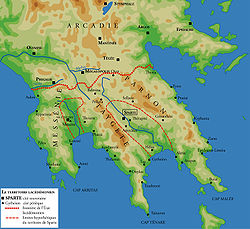 The Spartans had early conquered much of the Peloponnese and incorporated the territory into the enlarged Sparta state. Spartan society functioned within three classes: homoiois or spartiates, perioeci, and the helots
. The helots were captives of war and were state-owned slaves of Sparta. The helots powered the city-state’s agrarian economy and were the work force. Additionally, the other class of working population in Spartan society were the perioeci meaning “dwellers around” who were free peoples of conquered territories. The perioeci were allowed to maintain their own infrastructures, administrative arrangements and local economy, but had to pay tribute to Sparta and provide soldiers for the military. The homoios were the citizens of Sparta. They were the elite class and were the only deserving of the title Spartan. As a result, the Spartan population was very small in comparison with the working classes. There was a ratio of 7 or 8 helots to every Spartan citizen. These three populations performed complementary functions that distinguished Sparta with a unique economic and social organization.
While the helots and the perioeci were the workforce in agriculture and industry, the Spartans could devote themselves to training, maintaining, and operating the military. The reason for the continual strong military existence was to preserve order in Sparta and hold the large enslaved populations in check.
was the Spartan who after the end of the Peloponnesian War in 404 BCE established many of the foreign pro-Spartan governments throughout the Aegean. He also established many Spartan garrisons. Most of the polis ruling systems he set up were ten man oligarchies called decarchies. Harmosts, Spartan military governors, were left as the head of the decarchies. As the men appointed were loyal to Lysander rather than Sparta, this system has been described as Lysander's private empire. In this establishment of a new Aegean order, many lost their lives or were exiled but on the other hand Agina and Melos were restored to their former inhabitants.
Sparta was divided over what to do about Athens itself. Lysander and King Agis were for total destruction as were Sparta's leading allies Corinth and Thebes. However, a more moderate faction led by Pausanias gained the upper hand. Athens was spared but her long walls and the fortifications of pireus were demolished. Lysander did manage to insert the significant condition that Athens recall her exiles.
The return of the exiles to Athens contributed to the political instability of Athens allowing Lysander to establish shortly the oligarchy that has come to be known as Thirty Tyrants
, composed of men beholden to him. The danger of so much power being in the hands of one person had become sufficiently clear that the both King Agis and King Pausanias agreed that Lysander's wings needed to be clipped. The decarchies were declared abolished and Athens quickly benefited when Sparta permitted democracy to be restored at Athens
was one of the two kings of Sparta during Sparta’s hegemony. Plutarch later wrote that Agesilaus was a king of the traditional Spartan ideals, often seen wearing his traditional cloak which was threadbare. He began his kingship after the end of the Peloponnesian war after his brother Agis II
died and was left without an heir. (Agis’ son Leotychidas
was rumored to be the illegitimate son of the Athenian Alcibiades
.) One of Agesilaus’ biggest supporters was the famous Spartan naval commander Lysander, who was previously Agesilaus’ erastē, or mentor.
The Campaigns
Agesilaus’ first campaign was one which trekked into the eastern Aegean and Persian territories via the Hellespont. He first descended upon the Phrygians and their leader Tissaphernes
who had broken a “solemn league” with the Greeks and had earned the “downright contempt of the gods.” He followed Tissaphernes into Persian territory The Persian king, fearing further plundering of his country ordered Tissaphernes beheaded. He then attempted to bribe Agesilaus with money to leave Asia Minor
.
Remaining true to the Spartan ideals of austere living practices, Agesilaus rejected the gold saying “he would rather see it in his soldier’s hands than his own.” Agesilaus did, however, remove his army into Phrygia, grateful for the death of Tissaphernes.
Agesilaus soon began another campaign into the western regions of the Persian Empire. Plutarch states that he wished to march his armies all the way to the Persian capital of Susa
. He was unfortunately deterred by unpleasant news from Epicydidas that the mainland Greek poleis were starting war once again. This would later become known as the Corinthian War and featured an alliance between the Argives, Corinth
ians, Athenians and Thebans against Sparta. The Corinthian war took place between 395 and 386 BC.
In Greece, the Spartans under Agesilaus met the numerous rebelling poleis. Among the most important battles were Coronea and Tegyrae fought against many Greeks but especially the Thebans. Tegyrae was the site where the Thebans first defeated the Spartans. The Spartans sought the aid of the Persians, asking them to cut off their support of the Thebans, Corinthians and Athenians. The resulting Peace of Antalcidas
, named for the Spartan who negotiated it, was established in 386 BCE and resulted in Sparta’s loss of its Asian territories.
Finally, the Greek city-states attempted a peace on the mainland by sending diplomats to meet with Agesilaus in Sparta. Epaminondas
, the Theban diplomat, angered Agesilaus by arguing for the freedom of the non-Spartans of Laconia. Agesilaus then struck the Thebans out of the treaty. The ensuing Battle of Leuctra
in 371 BC marked the end of Spartan hegemony. Agesilaus himself did not fight at Leuctra so as not to appear too belligerent.
The importance of Sparta in politics largely drops off after Sparta’s defeat at Leuctra. Following Agesilaus’ death in 360 BC, Archidamus III
became king and practiced a policy of non-conflict between Athens and the Second Naval Confederacy (357-355 BC) Between 355 and 346 BC, they allied with Athens against Thebes and the Amphictyonic Council effectively pulling Theban attention away from the Peloponnese.
City-state
A city-state is an independent or autonomous entity whose territory consists of a city which is not administered as a part of another local government.-Historical city-states:...
of Sparta
Sparta
Sparta or Lacedaemon, was a prominent city-state in ancient Greece, situated on the banks of the River Eurotas in Laconia, in south-eastern Peloponnese. It emerged as a political entity around the 10th century BC, when the invading Dorians subjugated the local, non-Dorian population. From c...
was the greatest military land power of classical Greek antiquity. During the classical period, Sparta owned, dominated or influenced the entire Peloponnese. Additionally, the defeat of the Athenians and the Delian League
Delian League
The Delian League, founded in circa 477 BC, was an association of Greek city-states, members numbering between 150 to 173, under the leadership of Athens, whose purpose was to continue fighting the Persian Empire after the Greek victory in the Battle of Plataea at the end of the Greco–Persian Wars...
in the Peloponnesian War
Peloponnesian War
The Peloponnesian War, 431 to 404 BC, was an ancient Greek war fought by Athens and its empire against the Peloponnesian League led by Sparta. Historians have traditionally divided the war into three phases...
in 431-404 BCE resulted in a short-lived Spartan dominance of the Greek world from 404 to 371 BCE. Due to their mistrust of others the Spartans discouraged the creation of records about their internal affairs. The only histories of Sparta are from the writings of Xenophon
Xenophon
Xenophon , son of Gryllus, of the deme Erchia of Athens, also known as Xenophon of Athens, was a Greek historian, soldier, mercenary, philosopher and a contemporary and admirer of Socrates...
, Thucydides
Thucydides
Thucydides was a Greek historian and author from Alimos. His History of the Peloponnesian War recounts the 5th century BC war between Sparta and Athens to the year 411 BC...
, Herodotus
Herodotus
Herodotus was an ancient Greek historian who was born in Halicarnassus, Caria and lived in the 5th century BC . He has been called the "Father of History", and was the first historian known to collect his materials systematically, test their accuracy to a certain extent and arrange them in a...
and Plutarch
Plutarch
Plutarch then named, on his becoming a Roman citizen, Lucius Mestrius Plutarchus , c. 46 – 120 AD, was a Greek historian, biographer, essayist, and Middle Platonist known primarily for his Parallel Lives and Moralia...
, none of whom were Spartans. Plutarch was writing after the period of Spartan hegemony had ceased. This is particularly difficult in understanding the Spartan political system, which was distinctly different from any other Greek polis
Polis
Polis , plural poleis , literally means city in Greek. It could also mean citizenship and body of citizens. In modern historiography "polis" is normally used to indicate the ancient Greek city-states, like Classical Athens and its contemporaries, so polis is often translated as "city-state."The...
.
History and rise to power
(See History of SpartaHistory of Sparta
The History of Sparta describes the destiny of the ancient Dorian Greek state known as Sparta from its beginning in the legendary period to its forced incorporation into the Achaean League under the late Roman Republic, its conquerors, in 146 BCE, a period of roughly 1000 years...
)
Helots
The helots: / Heílôtes) were an unfree population group that formed the main population of Laconia and the whole of Messenia . Their exact status was already disputed in antiquity: according to Critias, they were "especially slaves" whereas to Pollux, they occupied a status "between free men and...
. The helots were captives of war and were state-owned slaves of Sparta. The helots powered the city-state’s agrarian economy and were the work force. Additionally, the other class of working population in Spartan society were the perioeci meaning “dwellers around” who were free peoples of conquered territories. The perioeci were allowed to maintain their own infrastructures, administrative arrangements and local economy, but had to pay tribute to Sparta and provide soldiers for the military. The homoios were the citizens of Sparta. They were the elite class and were the only deserving of the title Spartan. As a result, the Spartan population was very small in comparison with the working classes. There was a ratio of 7 or 8 helots to every Spartan citizen. These three populations performed complementary functions that distinguished Sparta with a unique economic and social organization.
While the helots and the perioeci were the workforce in agriculture and industry, the Spartans could devote themselves to training, maintaining, and operating the military. The reason for the continual strong military existence was to preserve order in Sparta and hold the large enslaved populations in check.
Sparta's Post Peloponnesian War Regime
LysanderLysander
Lysander was a Spartan general who commanded the Spartan fleet in the Hellespont which defeated the Athenians at Aegospotami in 405 BC...
was the Spartan who after the end of the Peloponnesian War in 404 BCE established many of the foreign pro-Spartan governments throughout the Aegean. He also established many Spartan garrisons. Most of the polis ruling systems he set up were ten man oligarchies called decarchies. Harmosts, Spartan military governors, were left as the head of the decarchies. As the men appointed were loyal to Lysander rather than Sparta, this system has been described as Lysander's private empire. In this establishment of a new Aegean order, many lost their lives or were exiled but on the other hand Agina and Melos were restored to their former inhabitants.
Sparta was divided over what to do about Athens itself. Lysander and King Agis were for total destruction as were Sparta's leading allies Corinth and Thebes. However, a more moderate faction led by Pausanias gained the upper hand. Athens was spared but her long walls and the fortifications of pireus were demolished. Lysander did manage to insert the significant condition that Athens recall her exiles.
The return of the exiles to Athens contributed to the political instability of Athens allowing Lysander to establish shortly the oligarchy that has come to be known as Thirty Tyrants
Thirty Tyrants
The Thirty Tyrants were a pro-Spartan oligarchy installed in Athens after its defeat in the Peloponnesian War in 404 BC. Contemporary Athenians referred to them simply as "the oligarchy" or "the Thirty" ; the expression "Thirty Tyrants" is due to later historians...
, composed of men beholden to him. The danger of so much power being in the hands of one person had become sufficiently clear that the both King Agis and King Pausanias agreed that Lysander's wings needed to be clipped. The decarchies were declared abolished and Athens quickly benefited when Sparta permitted democracy to be restored at Athens
Agesilaus and His Campaigns
Agesilaus IIAgesilaus II
Agesilaus II, or Agesilaos II was a king of Sparta, of the Eurypontid dynasty, ruling from approximately 400 BC to 360 BC, during most of which time he was, in Plutarch's words, "as good as thought commander and king of all Greece," and was for the whole of it greatly identified with his...
was one of the two kings of Sparta during Sparta’s hegemony. Plutarch later wrote that Agesilaus was a king of the traditional Spartan ideals, often seen wearing his traditional cloak which was threadbare. He began his kingship after the end of the Peloponnesian war after his brother Agis II
Agis II
Agis II was the 17th Eurypontid king of Sparta, the eldest son of Archidamus II by his first wife, and half-brother of Agesilaus II. He ruled with his Agiad co-monarch Pausanias....
died and was left without an heir. (Agis’ son Leotychidas
Leotychidas
Leotychidas [Leotychides, Latychidas] was a ruler of Sparta 491 BC-476 BC. He led Spartan forces during the Persian Wars from 490 BC to 478 BC...
was rumored to be the illegitimate son of the Athenian Alcibiades
Alcibiades
Alcibiades, son of Clinias, from the deme of Scambonidae , was a prominent Athenian statesman, orator, and general. He was the last famous member of his mother's aristocratic family, the Alcmaeonidae, which fell from prominence after the Peloponnesian War...
.) One of Agesilaus’ biggest supporters was the famous Spartan naval commander Lysander, who was previously Agesilaus’ erastē, or mentor.
The Campaigns
Agesilaus’ first campaign was one which trekked into the eastern Aegean and Persian territories via the Hellespont. He first descended upon the Phrygians and their leader Tissaphernes
Tissaphernes
Tissaphernes was a Persian soldier and statesman, grandson of Hydarnes.In 413 BC he was satrap of Lydia and Caria, and commander in chief of the Persian army in Asia Minor...
who had broken a “solemn league” with the Greeks and had earned the “downright contempt of the gods.” He followed Tissaphernes into Persian territory The Persian king, fearing further plundering of his country ordered Tissaphernes beheaded. He then attempted to bribe Agesilaus with money to leave Asia Minor
Asia Minor
Asia Minor is a geographical location at the westernmost protrusion of Asia, also called Anatolia, and corresponds to the western two thirds of the Asian part of Turkey...
.
Remaining true to the Spartan ideals of austere living practices, Agesilaus rejected the gold saying “he would rather see it in his soldier’s hands than his own.” Agesilaus did, however, remove his army into Phrygia, grateful for the death of Tissaphernes.
Agesilaus soon began another campaign into the western regions of the Persian Empire. Plutarch states that he wished to march his armies all the way to the Persian capital of Susa
Susa
Susa was an ancient city of the Elamite, Persian and Parthian empires of Iran. It is located in the lower Zagros Mountains about east of the Tigris River, between the Karkheh and Dez Rivers....
. He was unfortunately deterred by unpleasant news from Epicydidas that the mainland Greek poleis were starting war once again. This would later become known as the Corinthian War and featured an alliance between the Argives, Corinth
Corinth
Corinth is a city and former municipality in Corinthia, Peloponnese, Greece. Since the 2011 local government reform it is part of the municipality Corinth, of which it is the seat and a municipal unit...
ians, Athenians and Thebans against Sparta. The Corinthian war took place between 395 and 386 BC.
In Greece, the Spartans under Agesilaus met the numerous rebelling poleis. Among the most important battles were Coronea and Tegyrae fought against many Greeks but especially the Thebans. Tegyrae was the site where the Thebans first defeated the Spartans. The Spartans sought the aid of the Persians, asking them to cut off their support of the Thebans, Corinthians and Athenians. The resulting Peace of Antalcidas
Peace of Antalcidas
The Peace of Antalcidas , also known as the King's Peace, was a peace treaty guaranteed by the Persian King Artaxerxes II that ended the Corinthian War in ancient Greece. The treaty's alternate name comes from Antalcidas, the Spartan diplomat who traveled to Susa to negotiate the terms of the...
, named for the Spartan who negotiated it, was established in 386 BCE and resulted in Sparta’s loss of its Asian territories.
The Boeotian War
During the winter of 379/378 BCE a group of Theban exiles were able to sneak into the city and, despite the 1500 Spartan garrison, succeed in liberating Thebes. On the next few years Sparta mounted 4 expeditions against Thebes which completely failed to bring Thebes to heel.Finally, the Greek city-states attempted a peace on the mainland by sending diplomats to meet with Agesilaus in Sparta. Epaminondas
Epaminondas
Epaminondas , or Epameinondas, was a Theban general and statesman of the 4th century BC who transformed the Ancient Greek city-state of Thebes, leading it out of Spartan subjugation into a preeminent position in Greek politics...
, the Theban diplomat, angered Agesilaus by arguing for the freedom of the non-Spartans of Laconia. Agesilaus then struck the Thebans out of the treaty. The ensuing Battle of Leuctra
Battle of Leuctra
The Battle of Leuctra was a battle fought on July 6, 371 BC, between the Boeotians led by Thebans and the Spartans along with their allies amidst the post-Corinthian War conflict. The battle took place in the neighbourhood of Leuctra, a village in Boeotia in the territory of Thespiae...
in 371 BC marked the end of Spartan hegemony. Agesilaus himself did not fight at Leuctra so as not to appear too belligerent.
Sparta After Hegemony
During the Spartan Hegemony in Athens there is evidence of criticism of democracy. A document in the 420s by a political writer known as the “Old Oligarch” demonstrates the anti-democratic sentiments in Athens. The “Old Oligarch’s” political outlook is shaped by his belief that the economic classes were the source to political motivation; this view is a direct rejection of democracy’s efforts to establish civil unity. The “Old Oligarch” argues that the polis by nature is a battlefield rather than a site of public dialogue because individuals side with their socio-economic rank. Yet, despite this anti-democratic feeling, democracy eventually returned to Athens after the expulsion of the Thirty Tyrants.The importance of Sparta in politics largely drops off after Sparta’s defeat at Leuctra. Following Agesilaus’ death in 360 BC, Archidamus III
Archidamus III
Archidamus III , the son of Agesilaus II, was king of Sparta from 360 BC to 338 BC.While still a prince, he was the eispnelas of Cleonymus, son of Sphodrias. He interceded with his own father to spare his aites' father's life in a legal matter, an action which further intensified friction between...
became king and practiced a policy of non-conflict between Athens and the Second Naval Confederacy (357-355 BC) Between 355 and 346 BC, they allied with Athens against Thebes and the Amphictyonic Council effectively pulling Theban attention away from the Peloponnese.