


Near East

Encyclopedia
The Near East is a geographical
term that covers different countries for geographers, archeologists, and historians, on the one hand, and for political scientists, economists, and journalists, on the other. The term originally applied to the maximum extent of the Ottoman Empire
, which had been settled to the north by the Great Turkish War
of the late 17th century, ending with the Treaty of Karlowitz
, June 26, 1699. This war determined that Austria, Hungary and the Ukraine would not be in the Ottoman Empire and therefore ultimately would not be Near Eastern.
The term, Near East, was in use exclusively during the 2nd half of the 19th century. In the 1st half of the 20th century it began to share the geographical stage with the term, Middle East
. Since then Near East and Middle East have been approximately synonymous. Near East is used in some historic contexts and Middle East in others with no major semantic difference. Many modern agencies have chosen to abandon this terminology altogether as less appropriate to practical work in international relations. Others choose to retain it, but often with little consistency in its application.
to the expansion of the Austro-Hungarian Empire, the independence of Greece
and various smaller wars of independence resulting in the creation of "the Balkan States". Some of these states were independent and some were still nominally under the Ottomans although occupied by Austro-Hungarian troops.
The Ottoman Empire, believed to be about to collapse, was portrayed in the press as "the sick man of Europe". The Balkan states were primarily Christian. Starting in 1894 the Ottomans struck at the Armenia
ns on the explicit grounds that they were a non-Muslim people and as such were a potential threat to the Muslim empire within which they resided. The Hamidian Massacres
aroused the indignation of the entire Christian world. In the United States the now aging Julia Ward Howe
, authoress of the Battle Hymn of the Republic, leaped into the war of words and joined the Red Cross. Relations of minorities within the Ottoman Empire and the disposition of former Ottoman lands became known as "the eastern question," as the Ottomans were on the east of Europe.
It now became relevant to define the east of the eastern question. In about the middle of the 19th century "Near East" came into use to describe that part of the east closest to Europe. The term "Far East" appeared contemporaneously meaning Japan
, China
, Korea
, Indonesia
and Viet Nam; in short, the East Indies
. "Near East" applied to what had been mainly known as the Levant
, which was in the jurisdiction of the Ottoman Porte, or government. Those who used the term had little choice about its meaning. They could not set foot on most of the shores of the southern and central Mediterranean from the Gulf of Sidra
to Albania
without permits from the Ottoman Empire.
Some regions beyond the Ottoman Porte were included. One was North Africa west of Egypt. It was occupied by piratical kingdoms of the Barbary Coast
, de facto independent since the 18th century. Formerly part of the empire at its apogee, they were aggressively Muslim. Iran was included because it could not easily be reached except through the Ottoman Empire. In the 1890s the term tended to focus on the conflicts in the Balkan states and Armenia. The demise of the sick man of Europe left considerable confusion as to what was to be meant by "Near East". It now generally describes the countries of Western Asia between the Mediterranean Sea
and (including) Iran
, especially in historical contexts. There is, however, no universally understood fixed inventory of nations, languages or historical assets defined to be in it.
/b)_syria_-_belka,_woman_from_damascus,_arab_from_baghdad.jpg) The geographical terms "Near East" and "Far East" referring to areas of the globe in or contiguous to the former British Empire
The geographical terms "Near East" and "Far East" referring to areas of the globe in or contiguous to the former British Empire
and the neighboring colonies of the Dutch, Portuguese, Spanish and Germans, fit together as a pair based on the opposites of far and near, suggesting that they were innovated together. They appear together in the journals of the mid-19th century. Both terms were used before then with local British and American meanings: the near or far east of a field, village or shire.
, the oldest known script of Europe, referring to the near province and the far province of the kingdom of Pylos
. Usually these terms were given with reference to a geographic feature, such as a mountain range or a river.
Ptolemy
's Geography divided Asia on a similar basis. In the north is "Scythia this side of the Himalayas" and "Scythia beyond the Himalayas." To the south is "India on this side of the Ganges" and "India beyond the Ganges." Asia began on the coast of Anatolia
("land of the rising sun"). Beyond the Ganges and Himalayas
(including the Tien Shan) were Serica
and Serae
(sections of China
) and some other identifiable far eastern locations known to the voyagers and geographers but not to the general European public.
By the time of John Seller's Atlas Maritima of 1670, "India Beyond the Ganges" had become "the East Indies
" including China, Korea, southeast Asia and the islands of the Pacific in a map that was every bit as distorted as Ptolemy's, despite the lapse of approximately 1500 years. That "east" in turn was only an English translation of Latin Oriens and Orientalis, "the land of the rising sun," used since Roman times for "east." The world map of Jodocus Hondius
of 1590 labels all of Asia from the Caspian to the Pacific as India Orientalis, shortly to appear in translation as the East Indies.
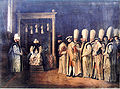 Elizabeth I of England
, primarily interested in trade with the east, collaborated with British merchants to form the first trading companies to the far-flung regions, using their own jargon. Their goals were to obtain trading concessions by treaty. The queen chartered the Company of Merchants of the Levant, shortened to Levant Company
, and soon known also as The Turkey Company, in 1581. In 1582, the ship The Great Susan transported the first ambassador, William Harebone, to the Ottoman Porte (government of the Ottoman Empire) at Constantinople
. Compared to Anatolia, Levant
also means "land of the rising sun," but where Anatolia always only meant the projection of land currently occupied by the Republic of Turkey, Levant meant anywhere in the domain ruled by the Ottoman Porte. The East India Company
(short for a much longer formal name) was chartered in 1600 for trade to the East Indies.
It has pleased western historians to write of a decline of the Ottoman Empire
as though a stable and uncontested polity of that name once existed. The borders did expand and contract but they were always dynamic and always in "question" right from the beginning. The Ottoman empire was created from the lands of the former eastern Roman Empire
on the occasion of the latter's violent demise. The last Roman emperor died fighting hand-to-hand in the streets of his capital, Constantinople, overwhelmed by the Ottoman military, in May, 1453. The victors inherited his remaining territory in the Balkans.
The populations of those lands did not accept Turkish rule. The Turks to them were pagans from the east who spoke a different language and had barbaric customs, such as the enslavement of foreigners. Intervals when there was no unrest were rare. The Hungarians had thrown off Turkish rule by 1688. Serbia was created by the Serbian Revolution, 1815-1833. The Greek War of Independence
, 1821–1832, created modern Greece, which recovered most of the lands of ancient Greece, but could not gain Constantinople. The Ottoman Porte was continuously under attack from some quarter in its empire, primarily the Balkans. Also, on a number of occasions in the early 19th century American and British warships had to attack the Barbary pirates to stop their piracy and recover thousands of enslaved Europeans and Americans.
In 1853 the Russian Empire on behalf of the Slavic Balkan states began to question the very existence of the Ottoman Empire. The result was the Crimean War
, 1853–1856, in which the British Empire and the French Empire supported the Ottoman Empire in its struggle against the incursions of the Russian Empire. It was at this time that the sick man of Europe appeared and the European physicians began to look at his territories with an eye to the future. Repeated efforts by the moslims to suppress Christianity within their borders only resulted in more revolutions, more interventions until finally most of the Balkans had been removed from the empire.
brought a change in vocabulary with the introduction of terms more familiar to the late 19th century. The Russian Empire had entered a more aggressive phase, becoming militarily active against the Ottoman Empire and also against China, with territorial aggrandizement explicitly in mind. Rethinking its policy the British government decided that the two polities under attack were necessary for the balance of power. It therefore undertook to oppose the Russians in both places, one result being the Crimean War. During that war the administration of the British Empire began promulgating a new vocabulary, giving specific regional meaning to "the Near East," the Ottoman Empire, and "the Far East," the East Indies. The two terms were now compound nouns often shown hyphenated.
In 1855 a reprint of a letter earlier sent to the Times
appeared in Littel's Living Age. Its author, an "official Chinese interpreter of 10 years' active service" and a member of the Oriental Club
, Thomas Taylor Meadows, was replying to the suggestion by another interpreter that the British Empire was wasting its resources on a false threat from Russia against China. Toward the end of the letter he said:
Much of the colonial administration belonged to this club, which had been formed by the Duke of Wellington
. Meadows' terminology must represent usage by that administration. If not the first use of the terms, the letter to the Times was certainly one of the earliest presentations of this vocabulary to the general public. They became immediately popular, supplanting "Levant" and "East Indies," which gradually receded to minor usages and then began to change meaning.
attempted to define it on the basis of archaeology.
For example, The London Review of 1861 (Telford and Barber, unsigned) in reviewing several works by Rawlinson, Layard
and others, defined themselves as making:
By arrow-headed writings they meant cuneiform
texts. In defense of the Bible as history they said:
They further defined the nations as:
The regions in their inventory were Assyria, Chaldea, Mesopotamia, Persia, Armenia, Egypt, Arabia, Syria, Palestine, Ethiopia, Caucasus, Libya, Anatolia and Abyssinia. Explicitly excluded is India. No mention is made of the Balkans.
British archaeologist D.G. Hogarth
published The Nearer East in 1902, in which he stated his view of "The Near East:"
Hogarth then proceeds to say where and why in some detail, but no more mention is made of the classics. His analysis is geopolitical
. His map delineates the Nearer East with regular lines as though surveyed. They include Iran, but not India, the Balkans, but not the Danube lands, Egypt, but not the rest of North Africa. Except for the Balkans, the region matches the later Middle East. It differs from the Ottoman Empire of the times in including Greece and Iran. Hogarth gives no evidence of being familiar with the contemporaneous initial concept of the Middle East.
of Armenia
ns because they were Christians, but it seemed to spill over into the protracted conflicts of the Balkans. For a time, "Near East" meant primarily the Balkans.
The book was never published. Instead the Normans whirled off to New York. Norman published the gist of his planned travel book curiously mixed with vituperation against the Ottoman Empire in an article in June, 1896, in Scribner's Magazine. The empire had descended from an enlightened civilization ruling over barbarians for their own good to something considerably less. The difference was the Hamidian Massacres, which were being conducted even as the couple traveled the Balkans. According to Norman now, the empire had been established by "the Moslem horde" from Asia, which was stopped by "intrepid Hungary." Furthermore, "Greece shook off the turbaned destroyer of her people" and so on. The Russians were suddenly liberators of oppressed Balkan states. Having portrayed the Armenians as revolutionaries in the name of freedom with the expectation of being rescued by the intervention of Christian Europe, he states "but her hope was vain." England had "turned her back." Norman concluded his exhortation with "In the Balkans one learns to hate the Turk." Norman made sure that Gladstone
read the article. Prince Nicolas of Montenegro wrote a letter thanking him for his article.
Throughout this article Norman uses "Near East" to mean the countries where "the eastern question" applied; that is, to all of the Balkans. The countries and regions mentioned are Greece, Bulgaria, Serbia, Bosnia-Herzegovina (which was Moslem and needed, in his view, to be suppressed), Macedonia, Montenegro, Albania, Romania. The rest of the Ottoman domain is demoted to just "the east."
not many biographical details have been promulgated. He was in effect (whatever his formal associations if any) a point man of British near eastern intelligence.
In Miller's view, the Ottoman officials were unfit to rule:
These were fighting words to be coming from a country that once insisted Europe needed Turkey and was willing to spill blood over it. For his authority Miller invokes the people, citing the "collective wisdom" of Europe, and introducing a concept to arise many times in the decades to follow under chilling circumstances:
Miller's final pronouncements on the topic could not be ignored by either the British or the Ottoman governments:
If the British Empire was now going to side with the Russian Empire, the Ottoman Empire had no choice but to cultivate a relationship with the Austro-Hungarian Empire, which was supported by the German Empire. In a few years these alignments became the Triple Entente
and the Triple Alliance
(already formed in 1882), which were in part a cause of World War I
. By its end in 1918 three empires were gone, a fourth was about to fall to revolution, and two more, the British and French, were forced to yield in revolutions started under the aegis of their own ideologies.
, Hegelesque historian of civilization at large, was becoming metaphysical about the Near East. Geography alone was not a sufficient explanation of the terms, he believed. If the Ottoman Empire had been a sick man, then:
Having supposed that it was sick, he kills it off:
To Toynbee the Near East was a spiritual being of a "Janus
-character," connected to both east and west:
From the death of the Near East new nations were able to rise from the ashes, notably the Republic of Turkey. Paradoxically it now aligned itself with the west rather than with the east. Mustafa Kemal
, its founder, a former Ottoman high-ranking officer, was insistent on this social revolution, which, among other changes, liberated women from the strait rules still in effect in most Arabic-speaking countries. The demise of the political Near East now left a gap where it had been, into which stepped the Middle East.
The use of the term Middle East as a region of international affairs apparently began in British and American diplomatic circles quite independently of each other over concern for the security of the same country: Iran, then known to the west as Persia. In 1900 Thomas Edward Gordon
published an article, The Problem of the Middle East, which began:
The threat that caused Gordon, diplomat and military officer, to publish the article was resumption of work on a railway from Russia to the Persian Gulf. Gordon, a published author, had not used the term previously, but he was to use it from then on.
A second strategic personality from American diplomatic and military circles, Alfred Thayer Mahan
, concerned about the naval vulnerability of the trade routes in the Persian Gulf
and Indian Ocean
, commented in 1902:
Apparently the sailor did not connect with the soldier, as Mahan believed he was innovating the term Middle East. It was, however, already there to be seen.
, a colonial officer killed eventually in China, uses the terms together in his 1910 book, The Conflict of Color, as "the Near and Middle East." The total super-region consisted of "India, Afghanistan, Persia, Arabistan, Asia Minor, and last, but not least, Egypt." Simpson (under his pen-name, Weale) explains that this entire region "is politically one region – in spite of the divisions into which it is academically divided." His own term revives "the Nearer East" as opposed to "the Far East."
The basis of Simpson's unity is color and colonial subjection. His color chart recognizes a spectrum of black, brown and yellow, which at the time had been traditional since the late 19th century. Apart from these was "the great white race", which the moderate Simpson tones down to simply the white race. The great whites were appearing as late as the 1920s works of James Henry Breasted
, which were taught as the gospel of ancient history throughout the entire first half of the 20th century. A red wavelength was mainly of interest in America. The eastern question was modified by Simpson to "The Problem of the Nearer East," which had nothing to do with the Ottomans but everything to do with British colonialism. Simpson wrote of the white man:
These regions were occupied by "the brown men," with the yellow in the Far East and the black in Africa. The color issue was not settled until Kenya
became independent in 1963, ending the last vestige of the British Empire.
This view reveals a somewhat less than altruistic Christian intent of the British Empire; however, it was paradoxical from the beginning, as Simpson and most other writers pointed out. The Ottomans were portrayed as the slavers, but even as the American and British fleets were striking at the Barbary pirates on behalf of freedom, their countries were promulgating a vigorous African slave trade of their own. Charles George Gordon
is known as the saint of all British colonial officers. A dedicated Christian, he spent his time between assignments living among the poor and donating his salary on their behalf. He won Ottoman confidence as a junior officer in the Crimean War. In his later career he became a high official in the Ottoman Empire, working as Governor of Egypt for the Ottoman khedive
for the purpose of conducting campaigns against slavers and slavery in Egypt and the Sudan.
to Syria
just before the war. The book does not contain a single instance of "Near East." Instead, the entire region is considered "the Middle East." The formerly Near Eastern sections of his trip are now "Turkish" and not Ottoman.
Subsequently with the disgrace of "Near East" in diplomatic and military circles, "Middle East" prevailed. However, "Near East" continues in some circles at the discretion of the defining agency or academic department. They are not generally considered distinct regions as they were at their original definition.
Although racial and colonial definitions of the Middle East are no longer considered ideologically sound, the sentiment of unity persists. For much, but by no means all, of the Middle East, the predominance of Islam lends some unity, as does the transient accident of geographical continuity. Otherwise there is but little basis except for history and convention to lump together peoples of multiple, often unrelated languages, governments, loyalties and customs.
. The new wave of diplomats often came from those programs. Archaeology on the international scene although very much of intellectual interest to the major universities fell into the shadow of international relations. Their domain became the Ancient Near East
, which could no longer be relied upon to be the Near East. The Ottoman Empire was gone, along with all the other empires of the 19th century, replaced with independent republics. Someone had to reconcile the present with the past. This duty was inherited by various specialized agencies that were formed to handle specific aspects of international relations, now so complex as to be beyond the scope and abilities of a diplomatic corps in the former sense. The ancient Near East is frozen in time. The living Near East is primarily what the agencies say it is. In most cases this single term is inadequate to describe the geographical range of their operations. The result is multiple definitions.
The Bureau of Near Eastern Affairs
, a division of the United States Department of State
, is perhaps the most influential agency to still use the term Near East. Under the Secretary of State
, it implements the official diplomacy
of the United States, called also statecraft by Secretary Clinton. The name of the bureau is traditional and historic. There is, however, no distinct Middle East. All official Middle Eastern affairs are referred to this bureau.
Working closely in conjunction with the definition of the Near East provided by the State Department is the Near East South Asia Center for Strategic Studies
(NESA), an educational institution of the United States Department of Defense
. It teaches courses and holds seminars and workshops for government officials and military officers who will work or are working within its region. As the name indicates, that region is a combination of State Department regions; however, NESA is careful to identify the State Department region. As its Near East is not different from the State Department's it does not appear in the table. Its name, however, is not entirely accurate. For example, its region includes Mauritania, a member of the State Department's Africa (Sub-Sahara).
The Washington Institute for Near East Policy
(WINEP) is a non-profit organization for research and advice on Middle Eastern policy. It regards its target countries as the Middle East but adopts the convention of calling them the Near East to be in conformance with the practices of the State Department. Its views are independent. The WINEP bundles the countries of Northwest Africa together under "North Africa." Details can be found in Policy Focus #65.
The Library of Congress
(LC) is an institution established by Congress to provide a research library for the government of the United States and serve as a national library. It is under the supervision of the United States Congress Joint Committee on the Library
and the Librarian of Congress. The Near East is a separate topic and subdivision of the African and Middle Eastern division. The Middle East contains a Hebraic section consisting of only Israel for a country, but including eleven modern and ancient languages relating to Judaism, such as Yiddish, a European language. The Near East is otherwise nearly identical to the Middle East, except that it extends partly into Central Asia and the Caucasus, regions that the State Department considers to be in Asia.
Legend: included; ✗ excluded
formulates multiple regional divisions as is convenient for its various operations. But few of them include a Near East, and that poorly defined. UNICEF recognizes the "Middle East and North Africa" region, where the Middle East is bounded by the Red Sea
on the west and includes Iran on the east. UNESCO
recognizes neither a Near East nor a Middle East, dividing the countries instead among three regions: Arab States, Asia and the Pacific, and Africa. Its division "does not forcibly reflect geography" but "refers to the execution of regional activities." The United Nations Statistics Division defines Western Asia to contain the countries included elsewhere in the Middle East. The Food and Agriculture Organization
(FAO) describes its entire theatre of operations as the Near East, but then assigns many of its members to other regions as well; for example, Cyprus, Malta and Turkey are in both the European and the Near Eastern regions. Its total area extends further into Central Asia than that of most agencies.
The Central Intelligence Agency
(CIA) is a quasi-independent agency of the United States Government. It appears to have multiple leadership. On the one hand its director is appointed by the president. It plays a significant role in providing the president with intelligence. On the other hand Congress oversees its operations through a committee. The CIA was first formed under the National Security Act of 1947
from the army's Office of Strategic Services
(OSS), which furnished both military intelligence and clandestine military operations to the army during the crisis of World War II
. Many revisions and redefinitions have taken place since then. Although the name of the CIA reflects the original advised intent of Presidents Franklin D. Roosevelt
and Harry S. Truman
, the government's needs for strategic services have frustrated that intent from the beginning. The press received by the agency in countless articles, novels and other media have tended to create various popular myths; for example, that this agency replaced any intelligence effort other than that of the OSS, or that it contains the central intelligence capability of the United States. Strategic services are officially provided by some 17 agencies called the Intelligence Community
. Army intelligence did not come to an end; in fact, all the branches of the Armed Forces retained their intelligence services. This community is currently under the leadership (in addition to all its other leadership) of the Office of the Director of National Intelligence.
Under these complex circumstances regional names are less useful. They are more historical than an accurate gauge of operations. The Directorate of Intelligence, one of four directorates into which the CIA is divided, includes the Office of Near Eastern and South Asian Analysis (NESA). Its duties are defined as "support on Middle Eastern and North African countries, as well as on the South Asian nations of India, Pakistan, and Afghanistan." The total range of countries is in fact the same as the State Department's Near East, but the names do not correspond. The Near East of the NESA is the same as the Middle East defined in the CIA-published on-line resource, The World Factbook. Its list of countries is limited by the Red Sea, comprises the entire eastern coast of the Mediterranean, including Israel, Turkey, the small nations of the Caucasus, Iran and the states of the Arabian Peninsula.
The U.S. Agency for International Development
(USAID), an independent agency under the Department of State established in place of the Marshall Plan
for the purpose of determining and distributing foreign aid, does not use the term Near East. Its definition of Middle East corresponds to that of the State Department, which officially prefers the term Near East.
The Foreign and Commonwealth Office
of Great Britain recognizes a Middle East and North Africa region, but not a Near East. Their original Middle East consumed the Near East as far as the Red Sea, ceded India to the Asia and Oceania region, and went into partnership with North Africa as far as the Atlantic.
The Ministry of Foreign Affairs of the Republic of Greece
conducts "bilateral relationships" with the countries of the "Mediterranean – Middle East Region" but has formulated no Near East Region. The Ministry of Foreign Affairs of the Republic of Turkey also does not use the term Near East. Its regions include the Middle East, the Balkans and others.
is a term of the 20th century intended to stabilize the geographical application of Near East to ancient history. The Near East may acquire varying meanings, but the Ancient Near East always has the same meaning: the ancient nations, people and languages of the enhanced Fertile Crescent
, a sweep of land from the Nile Valley through Anatolia and southward to the limits of Mesopotamia
.
Resorting to this verbal device, however, did not protect the "Ancient Near East" from the inroads of "the Middle East." For example, a high point in the use of "Ancient Near East" was for Biblical scholars the Ancient Near Eastern Texts relating to the Old Testament by James Bennett Pritchard
, a textbook of first edition dated 1950. The last great book written by Leonard Woolley
, British archaeologist, excavator of ancient Ur and associate of T.E. Lawrence and Arthur Evans
, was The Art of the Middle East, Including Persia, Mesopotamia and Palestine, published in 1961. Woolley had completed it in 1960 two weeks before his death. The geographical ranges in each case are identical.
Parallel with the growth of specialized agencies for conducting or supporting statescraft in the second half of the 20th century has been the collection of resources for scholarship and research typically in university settings. Most universities teaching the liberal arts
have library and museum collections. These are not new; however, the erection of these into "centres" of national and international interest in the second half of the 20th century have created larger databases not available to the scholars of the past. Many of these focus on the Ancient Near East or Near East in the sense of Ancient Near East.
One such institution is the Centre for the Study of Ancient Documents (CSAD) founded by and located centrally at Oxford University, Great Britain. Among its many activities CSAD numbers "a long-term project to create a library of digitised images of Greek inscriptions." These it arranges by region. The Egypt and the Near East region besides Egypt includes Cyprus, Persia and Afghanistan but not Asia Minor (a separate region).
began their training in university departments named for the Near East. Similarly the journals associated with these fields of expertise include the words Near East or Near Eastern. The meaning of Near East in these numerous establishments and publications is Middle East. Expertise on the modern Middle East is almost never mixed or confused with studies of the Ancient Near East, although often "Ancient Near East" is abbreviated to "Near East" without any implication of modern times. For example, "Near Eastern Languages" in the ancient sense includes such languages as Sumerian
and Akkadian. In the modern sense, it is likely to mean any or all of the Arabic language
s.
Geography
Geography is the science that studies the lands, features, inhabitants, and phenomena of Earth. A literal translation would be "to describe or write about the Earth". The first person to use the word "geography" was Eratosthenes...
term that covers different countries for geographers, archeologists, and historians, on the one hand, and for political scientists, economists, and journalists, on the other. The term originally applied to the maximum extent of the Ottoman Empire
Ottoman Empire
The Ottoman EmpireIt was usually referred to as the "Ottoman Empire", the "Turkish Empire", the "Ottoman Caliphate" or more commonly "Turkey" by its contemporaries...
, which had been settled to the north by the Great Turkish War
Great Turkish War
The Great Turkish War refers to a series of conflicts between the Ottoman Empire and contemporary European powers, then joined into a Holy League, during the second half of the 17th century.-1667–1683:...
of the late 17th century, ending with the Treaty of Karlowitz
Treaty of Karlowitz
The Treaty of Karlowitz was signed on 26 January 1699 in Sremski Karlovci , concluding the Austro-Ottoman War of 1683–1697 in which the Ottoman side had been defeated at the Battle of Zenta...
, June 26, 1699. This war determined that Austria, Hungary and the Ukraine would not be in the Ottoman Empire and therefore ultimately would not be Near Eastern.
The term, Near East, was in use exclusively during the 2nd half of the 19th century. In the 1st half of the 20th century it began to share the geographical stage with the term, Middle East
Middle East
The Middle East is a region that encompasses Western Asia and Northern Africa. It is often used as a synonym for Near East, in opposition to Far East...
. Since then Near East and Middle East have been approximately synonymous. Near East is used in some historic contexts and Middle East in others with no major semantic difference. Many modern agencies have chosen to abandon this terminology altogether as less appropriate to practical work in international relations. Others choose to retain it, but often with little consistency in its application.
The eastern questions
At the beginning of the 19th century the Ottoman empire included all of the Balkan Peninsula north to the southern edge of the Hungarian plain, but by the mid-1890s had lost all of it except ConstantinopleConstantinople
Constantinople was the capital of the Roman, Eastern Roman, Byzantine, Latin, and Ottoman Empires. Throughout most of the Middle Ages, Constantinople was Europe's largest and wealthiest city.-Names:...
to the expansion of the Austro-Hungarian Empire, the independence of Greece
Greece
Greece , officially the Hellenic Republic , and historically Hellas or the Republic of Greece in English, is a country in southeastern Europe....
and various smaller wars of independence resulting in the creation of "the Balkan States". Some of these states were independent and some were still nominally under the Ottomans although occupied by Austro-Hungarian troops.
The Ottoman Empire, believed to be about to collapse, was portrayed in the press as "the sick man of Europe". The Balkan states were primarily Christian. Starting in 1894 the Ottomans struck at the Armenia
Armenia
Armenia , officially the Republic of Armenia , is a landlocked mountainous country in the Caucasus region of Eurasia...
ns on the explicit grounds that they were a non-Muslim people and as such were a potential threat to the Muslim empire within which they resided. The Hamidian Massacres
Hamidian massacres
The Hamidian massacres , also referred to as the Armenian Massacres of 1894–1896, refers to the massacring of Armenians by the Ottoman Empire, with estimates of the dead ranging from anywhere between 80,000 to 300,000, and at least 50,000 orphans as a result...
aroused the indignation of the entire Christian world. In the United States the now aging Julia Ward Howe
Julia Ward Howe
Julia Ward Howe was a prominent American abolitionist, social activist, and poet, most famous as the author of "The Battle Hymn of the Republic".-Biography:...
, authoress of the Battle Hymn of the Republic, leaped into the war of words and joined the Red Cross. Relations of minorities within the Ottoman Empire and the disposition of former Ottoman lands became known as "the eastern question," as the Ottomans were on the east of Europe.
It now became relevant to define the east of the eastern question. In about the middle of the 19th century "Near East" came into use to describe that part of the east closest to Europe. The term "Far East" appeared contemporaneously meaning Japan
Japan
Japan is an island nation in East Asia. Located in the Pacific Ocean, it lies to the east of the Sea of Japan, China, North Korea, South Korea and Russia, stretching from the Sea of Okhotsk in the north to the East China Sea and Taiwan in the south...
, China
China
Chinese civilization may refer to:* China for more general discussion of the country.* Chinese culture* Greater China, the transnational community of ethnic Chinese.* History of China* Sinosphere, the area historically affected by Chinese culture...
, Korea
Korea
Korea ) is an East Asian geographic region that is currently divided into two separate sovereign states — North Korea and South Korea. Located on the Korean Peninsula, Korea is bordered by the People's Republic of China to the northwest, Russia to the northeast, and is separated from Japan to the...
, Indonesia
Indonesia
Indonesia , officially the Republic of Indonesia , is a country in Southeast Asia and Oceania. Indonesia is an archipelago comprising approximately 13,000 islands. It has 33 provinces with over 238 million people, and is the world's fourth most populous country. Indonesia is a republic, with an...
and Viet Nam; in short, the East Indies
East Indies
East Indies is a term used by Europeans from the 16th century onwards to identify what is now known as Indian subcontinent or South Asia, Southeastern Asia, and the islands of Oceania, including the Malay Archipelago and the Philippines...
. "Near East" applied to what had been mainly known as the Levant
Levant
The Levant or ) is the geographic region and culture zone of the "eastern Mediterranean littoral between Anatolia and Egypt" . The Levant includes most of modern Lebanon, Syria, Jordan, Israel, the Palestinian territories, and sometimes parts of Turkey and Iraq, and corresponds roughly to the...
, which was in the jurisdiction of the Ottoman Porte, or government. Those who used the term had little choice about its meaning. They could not set foot on most of the shores of the southern and central Mediterranean from the Gulf of Sidra
Gulf of Sidra
Gulf of Sidra is a body of water in the Mediterranean Sea on the northern coast of Libya; it is also known as Gulf of Sirte or the Great Sirte or Greater Syrtis .- Geography :The Gulf of Sidra has been a major centre for tuna fishing in the Mediterranean for centuries...
to Albania
Albania
Albania , officially known as the Republic of Albania , is a country in Southeastern Europe, in the Balkans region. It is bordered by Montenegro to the northwest, Kosovo to the northeast, the Republic of Macedonia to the east and Greece to the south and southeast. It has a coast on the Adriatic Sea...
without permits from the Ottoman Empire.
Some regions beyond the Ottoman Porte were included. One was North Africa west of Egypt. It was occupied by piratical kingdoms of the Barbary Coast
Barbary Coast
The Barbary Coast, or Barbary, was the term used by Europeans from the 16th until the 19th century to refer to much of the collective land of the Berber people. Today, the terms Maghreb and "Tamazgha" correspond roughly to "Barbary"...
, de facto independent since the 18th century. Formerly part of the empire at its apogee, they were aggressively Muslim. Iran was included because it could not easily be reached except through the Ottoman Empire. In the 1890s the term tended to focus on the conflicts in the Balkan states and Armenia. The demise of the sick man of Europe left considerable confusion as to what was to be meant by "Near East". It now generally describes the countries of Western Asia between the Mediterranean Sea
Mediterranean Sea
The Mediterranean Sea is a sea connected to the Atlantic Ocean surrounded by the Mediterranean region and almost completely enclosed by land: on the north by Anatolia and Europe, on the south by North Africa, and on the east by the Levant...
and (including) Iran
Iran
Iran , officially the Islamic Republic of Iran , is a country in Southern and Western Asia. The name "Iran" has been in use natively since the Sassanian era and came into use internationally in 1935, before which the country was known to the Western world as Persia...
, especially in historical contexts. There is, however, no universally understood fixed inventory of nations, languages or historical assets defined to be in it.
Background
British Empire
The British Empire comprised the dominions, colonies, protectorates, mandates and other territories ruled or administered by the United Kingdom. It originated with the overseas colonies and trading posts established by England in the late 16th and early 17th centuries. At its height, it was the...
and the neighboring colonies of the Dutch, Portuguese, Spanish and Germans, fit together as a pair based on the opposites of far and near, suggesting that they were innovated together. They appear together in the journals of the mid-19th century. Both terms were used before then with local British and American meanings: the near or far east of a field, village or shire.
Ideas of the east up to the Crimean War
There was a linguistic predisposition to use such terms. The Romans had used them in near Gaul / far Gaul, near Spain / far Spain and others. Before them the Greeks had the habit, which appears in Linear BLinear B
Linear B is a syllabic script that was used for writing Mycenaean Greek, an early form of Greek. It pre-dated the Greek alphabet by several centuries and seems to have died out with the fall of Mycenaean civilization...
, the oldest known script of Europe, referring to the near province and the far province of the kingdom of Pylos
Pylos
Pylos , historically known under its Italian name Navarino, is a town and a former municipality in Messenia, Peloponnese, Greece. Since the 2011 local government reform it is part of the municipality Pylos-Nestoras, of which it is the seat and a municipal unit. It was the capital of the former...
. Usually these terms were given with reference to a geographic feature, such as a mountain range or a river.
Ptolemy
Ptolemy
Claudius Ptolemy , was a Roman citizen of Egypt who wrote in Greek. He was a mathematician, astronomer, geographer, astrologer, and poet of a single epigram in the Greek Anthology. He lived in Egypt under Roman rule, and is believed to have been born in the town of Ptolemais Hermiou in the...
's Geography divided Asia on a similar basis. In the north is "Scythia this side of the Himalayas" and "Scythia beyond the Himalayas." To the south is "India on this side of the Ganges" and "India beyond the Ganges." Asia began on the coast of Anatolia
Anatolia
Anatolia is a geographic and historical term denoting the westernmost protrusion of Asia, comprising the majority of the Republic of Turkey...
("land of the rising sun"). Beyond the Ganges and Himalayas
Himalayas
The Himalaya Range or Himalaya Mountains Sanskrit: Devanagari: हिमालय, literally "abode of snow"), usually called the Himalayas or Himalaya for short, is a mountain range in Asia, separating the Indian subcontinent from the Tibetan Plateau...
(including the Tien Shan) were Serica
Serica
Serica, the land of the Seres, was the name by which the Greco-Romans referred to a country in Central Asia.Ancient Mediterranean knowledge of this nation was indistinct and distorted by fables and myths. Ptolemy and Pliny the Elder present more precise descriptions...
and Serae
Serae
Seraye is the name of a former Province of Eritrea. It has since been incorporated primarily into the Debub Region, though some western districts have become part of the Gash-Barka Region...
(sections of China
China
Chinese civilization may refer to:* China for more general discussion of the country.* Chinese culture* Greater China, the transnational community of ethnic Chinese.* History of China* Sinosphere, the area historically affected by Chinese culture...
) and some other identifiable far eastern locations known to the voyagers and geographers but not to the general European public.
By the time of John Seller's Atlas Maritima of 1670, "India Beyond the Ganges" had become "the East Indies
East Indies
East Indies is a term used by Europeans from the 16th century onwards to identify what is now known as Indian subcontinent or South Asia, Southeastern Asia, and the islands of Oceania, including the Malay Archipelago and the Philippines...
" including China, Korea, southeast Asia and the islands of the Pacific in a map that was every bit as distorted as Ptolemy's, despite the lapse of approximately 1500 years. That "east" in turn was only an English translation of Latin Oriens and Orientalis, "the land of the rising sun," used since Roman times for "east." The world map of Jodocus Hondius
Jodocus Hondius
Jodocus Hondius , sometimes called Jodocus Hondius the Elder to distinguish him from his son Henricus Hondius II, was a Flemish artist, engraver, and cartographer...
of 1590 labels all of Asia from the Caspian to the Pacific as India Orientalis, shortly to appear in translation as the East Indies.
Elizabeth I of England
Elizabeth I was queen regnant of England and Ireland from 17 November 1558 until her death. Sometimes called The Virgin Queen, Gloriana, or Good Queen Bess, Elizabeth was the fifth and last monarch of the Tudor dynasty...
, primarily interested in trade with the east, collaborated with British merchants to form the first trading companies to the far-flung regions, using their own jargon. Their goals were to obtain trading concessions by treaty. The queen chartered the Company of Merchants of the Levant, shortened to Levant Company
Levant Company
The Levant Company, or Turkey Company, was an English chartered company formed in 1581, to regulate English trade with Turkey and the Levant...
, and soon known also as The Turkey Company, in 1581. In 1582, the ship The Great Susan transported the first ambassador, William Harebone, to the Ottoman Porte (government of the Ottoman Empire) at Constantinople
Constantinople
Constantinople was the capital of the Roman, Eastern Roman, Byzantine, Latin, and Ottoman Empires. Throughout most of the Middle Ages, Constantinople was Europe's largest and wealthiest city.-Names:...
. Compared to Anatolia, Levant
Levant
The Levant or ) is the geographic region and culture zone of the "eastern Mediterranean littoral between Anatolia and Egypt" . The Levant includes most of modern Lebanon, Syria, Jordan, Israel, the Palestinian territories, and sometimes parts of Turkey and Iraq, and corresponds roughly to the...
also means "land of the rising sun," but where Anatolia always only meant the projection of land currently occupied by the Republic of Turkey, Levant meant anywhere in the domain ruled by the Ottoman Porte. The East India Company
East India Company
The East India Company was an early English joint-stock company that was formed initially for pursuing trade with the East Indies, but that ended up trading mainly with the Indian subcontinent and China...
(short for a much longer formal name) was chartered in 1600 for trade to the East Indies.
It has pleased western historians to write of a decline of the Ottoman Empire
Decline of the Ottoman Empire
The Decline of the Ottoman Empire is the period that followed after the Stagnation of the Ottoman Empire in which the empire experienced several economic and political setbacks. Directly affecting the Empire at this time was Russian imperialism...
as though a stable and uncontested polity of that name once existed. The borders did expand and contract but they were always dynamic and always in "question" right from the beginning. The Ottoman empire was created from the lands of the former eastern Roman Empire
Byzantine Empire
The Byzantine Empire was the Eastern Roman Empire during the periods of Late Antiquity and the Middle Ages, centred on the capital of Constantinople. Known simply as the Roman Empire or Romania to its inhabitants and neighbours, the Empire was the direct continuation of the Ancient Roman State...
on the occasion of the latter's violent demise. The last Roman emperor died fighting hand-to-hand in the streets of his capital, Constantinople, overwhelmed by the Ottoman military, in May, 1453. The victors inherited his remaining territory in the Balkans.
The populations of those lands did not accept Turkish rule. The Turks to them were pagans from the east who spoke a different language and had barbaric customs, such as the enslavement of foreigners. Intervals when there was no unrest were rare. The Hungarians had thrown off Turkish rule by 1688. Serbia was created by the Serbian Revolution, 1815-1833. The Greek War of Independence
Greek War of Independence
The Greek War of Independence, also known as the Greek Revolution was a successful war of independence waged by the Greek revolutionaries between...
, 1821–1832, created modern Greece, which recovered most of the lands of ancient Greece, but could not gain Constantinople. The Ottoman Porte was continuously under attack from some quarter in its empire, primarily the Balkans. Also, on a number of occasions in the early 19th century American and British warships had to attack the Barbary pirates to stop their piracy and recover thousands of enslaved Europeans and Americans.
In 1853 the Russian Empire on behalf of the Slavic Balkan states began to question the very existence of the Ottoman Empire. The result was the Crimean War
Crimean War
The Crimean War was a conflict fought between the Russian Empire and an alliance of the French Empire, the British Empire, the Ottoman Empire, and the Kingdom of Sardinia. The war was part of a long-running contest between the major European powers for influence over territories of the declining...
, 1853–1856, in which the British Empire and the French Empire supported the Ottoman Empire in its struggle against the incursions of the Russian Empire. It was at this time that the sick man of Europe appeared and the European physicians began to look at his territories with an eye to the future. Repeated efforts by the moslims to suppress Christianity within their borders only resulted in more revolutions, more interventions until finally most of the Balkans had been removed from the empire.
The original diplomatic concept of near east
Until about 1855 the words near east and far east did not refer to any particular region. The far East, a phrase containing a noun, East, qualified by an adjective, far, could be at any location in the "far east" of the speaker's home territory. The Ottoman Empire, for example, was the far East as much as the East Indies. The Crimean WarCrimean War
The Crimean War was a conflict fought between the Russian Empire and an alliance of the French Empire, the British Empire, the Ottoman Empire, and the Kingdom of Sardinia. The war was part of a long-running contest between the major European powers for influence over territories of the declining...
brought a change in vocabulary with the introduction of terms more familiar to the late 19th century. The Russian Empire had entered a more aggressive phase, becoming militarily active against the Ottoman Empire and also against China, with territorial aggrandizement explicitly in mind. Rethinking its policy the British government decided that the two polities under attack were necessary for the balance of power. It therefore undertook to oppose the Russians in both places, one result being the Crimean War. During that war the administration of the British Empire began promulgating a new vocabulary, giving specific regional meaning to "the Near East," the Ottoman Empire, and "the Far East," the East Indies. The two terms were now compound nouns often shown hyphenated.
In 1855 a reprint of a letter earlier sent to the Times
Times
The Times is a UK daily newspaper, the original English language newspaper titled "Times". Times may also refer to:In newspapers:*The Times , went defunct in 2005*The Times *The Times of Northwest Indiana...
appeared in Littel's Living Age. Its author, an "official Chinese interpreter of 10 years' active service" and a member of the Oriental Club
Oriental Club
The Oriental Club in London is a traditional private members' club established in 1824 that now admits both gentlemen and ladies to membership...
, Thomas Taylor Meadows, was replying to the suggestion by another interpreter that the British Empire was wasting its resources on a false threat from Russia against China. Toward the end of the letter he said:
"To support the 'sick man' in the Near East is an arduous and costly affair; let England, France and America too, beware how they create a 'sick giant' in the Far East, for they may rest assured that, if Turkey is [a] European necessity, China is a world necessity."
Much of the colonial administration belonged to this club, which had been formed by the Duke of Wellington
Duke of Wellington
The Dukedom of Wellington, derived from Wellington in Somerset, is a hereditary title in the senior rank of the Peerage of the United Kingdom. The first holder of the title was Arthur Wellesley, 1st Duke of Wellington , the noted Irish-born career British Army officer and statesman, and...
. Meadows' terminology must represent usage by that administration. If not the first use of the terms, the letter to the Times was certainly one of the earliest presentations of this vocabulary to the general public. They became immediately popular, supplanting "Levant" and "East Indies," which gradually receded to minor usages and then began to change meaning.
The original archaeological concept of nearer east
"Near East" remained popular in diplomatic, trade and journalistic circles, but a variation soon developed among the scholars and the men of the cloth and their associates: "the Nearer East," reverting to the classical and then more scholarly distinction of "nearer" and "farther." They undoubtedly saw a need to separate the Biblical lands from the terrain of the Ottoman Empire. The Christians saw the country as the land of the Old and New Testaments, where Christianity had developed. The scholars in the field of studies that eventually became Biblical archaeologyBiblical archaeology
For the movement associated with William F. Albright and also known as biblical archaeology, see Biblical archaeology school. For the interpretation of biblical archaeology in relation to biblical historicity, see The Bible and history....
attempted to define it on the basis of archaeology.
For example, The London Review of 1861 (Telford and Barber, unsigned) in reviewing several works by Rawlinson, Layard
Austen Henry Layard
Sir Austen Henry Layard GCB, PC was a British traveller, archaeologist, cuneiformist, art historian, draughtsman, collector, author, politician and diplomat, best known as the excavator of Nimrud.-Family:...
and others, defined themselves as making:
"an imperfect conspectus of the arrow-headed writings of the nearer east; writings which cover nearly the whole period of the postdiluvian Old Testament history ...."
By arrow-headed writings they meant cuneiform
Cuneiform
Cuneiform can refer to:*Cuneiform script, an ancient writing system originating in Mesopotamia in the 4th millennium BC*Cuneiform , three bones in the human foot*Cuneiform Records, a music record label...
texts. In defense of the Bible as history they said:
"The primeval nations, that piled their glorious homes on the Euphrates, the Tigris, and the Nile, are among us again with their archives in their hands; ...."
They further defined the nations as:
"... the countries lying between the Caspian, the Persian Gulf, and the Mediterranean ...."
The regions in their inventory were Assyria, Chaldea, Mesopotamia, Persia, Armenia, Egypt, Arabia, Syria, Palestine, Ethiopia, Caucasus, Libya, Anatolia and Abyssinia. Explicitly excluded is India. No mention is made of the Balkans.
British archaeologist D.G. Hogarth
David George Hogarth
David George Hogarth was a British archaeologist and scholar associated with T. E. Lawrence and Arthur Evans.-Archaeological career:...
published The Nearer East in 1902, in which he stated his view of "The Near East:"
"The Nearer East is a term of current fashion for a region which our grandfathers were content to call simply The East. Its area is generally understood to coincide with those classic lands, historically the most interesting on the surface of the globe, which lie about the eastern basin of the Mediterranean Sea; but few probably could say offhand where should be the limits and why."
Hogarth then proceeds to say where and why in some detail, but no more mention is made of the classics. His analysis is geopolitical
Geopolitics
Geopolitics, from Greek Γη and Πολιτική in broad terms, is a theory that describes the relation between politics and territory whether on local or international scale....
. His map delineates the Nearer East with regular lines as though surveyed. They include Iran, but not India, the Balkans, but not the Danube lands, Egypt, but not the rest of North Africa. Except for the Balkans, the region matches the later Middle East. It differs from the Ottoman Empire of the times in including Greece and Iran. Hogarth gives no evidence of being familiar with the contemporaneous initial concept of the Middle East.
The Balkan confusion
In the last years of the 19th century the term "Near East" acquired considerable disrepute in eyes of the English-speaking public as did the Ottoman Empire itself. The cause of the onus was the Hamidian MassacresHamidian massacres
The Hamidian massacres , also referred to as the Armenian Massacres of 1894–1896, refers to the massacring of Armenians by the Ottoman Empire, with estimates of the dead ranging from anywhere between 80,000 to 300,000, and at least 50,000 orphans as a result...
of Armenia
Armenia
Armenia , officially the Republic of Armenia , is a landlocked mountainous country in the Caucasus region of Eurasia...
ns because they were Christians, but it seemed to spill over into the protracted conflicts of the Balkans. For a time, "Near East" meant primarily the Balkans.
Baronet and Baroness Norman
The change is evident in the reports of influential British travellers to the Balkans. In 1894, Sir Henry Norman, 1st Baronet, a journalist, travelled to the Far East, afterwards writing a book called The Peoples and Politics of the Far East, which came out in 1895. By "Far East" he meant Siberia, China, Japan, Korea, Siam and Malaya. As the book was a big success, he was off to the Balkan states with his wife in 1896 to develop detail for a sequel, The People and Politics of the Near East, which Scribners planned to publish in 1897. Mrs. Norman, a writer herself, wrote glowing letters of the home and person of Mme. Zakki, "the wife of a Turkish cabinet minister," who, she said, was a cultivated woman living in a country home full of books. As for the natives of the Balkans, they were "a semi-civilized people."The book was never published. Instead the Normans whirled off to New York. Norman published the gist of his planned travel book curiously mixed with vituperation against the Ottoman Empire in an article in June, 1896, in Scribner's Magazine. The empire had descended from an enlightened civilization ruling over barbarians for their own good to something considerably less. The difference was the Hamidian Massacres, which were being conducted even as the couple traveled the Balkans. According to Norman now, the empire had been established by "the Moslem horde" from Asia, which was stopped by "intrepid Hungary." Furthermore, "Greece shook off the turbaned destroyer of her people" and so on. The Russians were suddenly liberators of oppressed Balkan states. Having portrayed the Armenians as revolutionaries in the name of freedom with the expectation of being rescued by the intervention of Christian Europe, he states "but her hope was vain." England had "turned her back." Norman concluded his exhortation with "In the Balkans one learns to hate the Turk." Norman made sure that Gladstone
William Ewart Gladstone
William Ewart Gladstone FRS FSS was a British Liberal statesman. In a career lasting over sixty years, he served as Prime Minister four separate times , more than any other person. Gladstone was also Britain's oldest Prime Minister, 84 years old when he resigned for the last time...
read the article. Prince Nicolas of Montenegro wrote a letter thanking him for his article.
Throughout this article Norman uses "Near East" to mean the countries where "the eastern question" applied; that is, to all of the Balkans. The countries and regions mentioned are Greece, Bulgaria, Serbia, Bosnia-Herzegovina (which was Moslem and needed, in his view, to be suppressed), Macedonia, Montenegro, Albania, Romania. The rest of the Ottoman domain is demoted to just "the east."
William Miller
If Norman was apparently attempting to change British policy, it was perhaps William Miller (1864–1945), journalist and expert on the Near East, who did the most in that direction. In essence, he signed the death warrant, so to speak, of the Age of Empires. The fall of the Ottoman Empire ultimately enmeshed all the others as well. In the Travel and Politics in the Near East, 1898, Miller claimed to have made four trips to the Balkans, 1894, 1896, 1897 and 1898, and to be, in essence, an expert on "the Near East," by which he primarily meant the Balkans. Apart from the fact that he attended Oxford and played RugbyRugby union
Rugby union, often simply referred to as rugby, is a full contact team sport which originated in England in the early 19th century. One of the two codes of rugby football, it is based on running with the ball in hand...
not many biographical details have been promulgated. He was in effect (whatever his formal associations if any) a point man of British near eastern intelligence.
In Miller's view, the Ottoman officials were unfit to rule:
"The plain fact is, that it is as hard for an Ottoman official to be honest as it is for a camel to enter through the eye of a needle. It is not so much the fault of the men as the fault of the system, which is thoroughly bad from top to bottom....Turkish administration is synonymous with corruption, inefficiency, and sloth."
These were fighting words to be coming from a country that once insisted Europe needed Turkey and was willing to spill blood over it. For his authority Miller invokes the people, citing the "collective wisdom" of Europe, and introducing a concept to arise many times in the decades to follow under chilling circumstances:
"no final solution of the difficulty has yet been found."
Miller's final pronouncements on the topic could not be ignored by either the British or the Ottoman governments:
"It remains then to consider whether the Great Powers can solve the Eastern Question.... Foreigners find it extremely difficult to understand the foreign, and especially the Eastern policy of Great Britain, and we cannot wonder at their difficulty, for it seems a mass of contradictions to Englishmen themselves.... At one moment we are bringing about the independence of Greece by sending the Turkish fleet to the bottom of the bay of Navarino. Twenty-seven years later we are spending immense sums and wasting thousands of lives in order to protect the Turks against Russia."
If the British Empire was now going to side with the Russian Empire, the Ottoman Empire had no choice but to cultivate a relationship with the Austro-Hungarian Empire, which was supported by the German Empire. In a few years these alignments became the Triple Entente
Triple Entente
The Triple Entente was the name given to the alliance among Britain, France and Russia after the signing of the Anglo-Russian Entente in 1907....
and the Triple Alliance
Triple Alliance (1882)
The Triple Alliance was the military alliance between Germany, Austria–Hungary, and Italy, , that lasted from 1882 until the start of World War I in 1914...
(already formed in 1882), which were in part a cause of World War I
World War I
World War I , which was predominantly called the World War or the Great War from its occurrence until 1939, and the First World War or World War I thereafter, was a major war centred in Europe that began on 28 July 1914 and lasted until 11 November 1918...
. By its end in 1918 three empires were gone, a fourth was about to fall to revolution, and two more, the British and French, were forced to yield in revolutions started under the aegis of their own ideologies.
Arnold Toynbee
By 1916, when millions of Europeans were becoming casualties of imperial war in the trenches of eastern and western Europe over "the eastern question," Arnold J. ToynbeeArnold J. Toynbee
Arnold Joseph Toynbee CH was a British historian whose twelve-volume analysis of the rise and fall of civilizations, A Study of History, 1934–1961, was a synthesis of world history, a metahistory based on universal rhythms of rise, flowering and decline, which examined history from a global...
, Hegelesque historian of civilization at large, was becoming metaphysical about the Near East. Geography alone was not a sufficient explanation of the terms, he believed. If the Ottoman Empire had been a sick man, then:
"There has been something pathological about the history of this Near Eastern World. It has had an undue share of political misfortunes, and had lain for centuries in a kind of spiritual paralysis between East and West—belonging to neither, partaking paradoxically of both, and wholly unable to rally itself decidedly to one or the other...."
Having supposed that it was sick, he kills it off:
"The Near East has never been more true to itself than in its lurid dissolution; past and present are fused together in the flare."
To Toynbee the Near East was a spiritual being of a "Janus
Janus
-General:*Janus , the two-faced Roman god of gates, doors, doorways, beginnings, and endings*Janus , a moon of Saturn*Janus Patera, a shallow volcanic crater on Io, a moon of Jupiter...
-character," connected to both east and west:
The limits of the Near East are not easy to define. On the north-west, Vienna is the most conspicuous boundary-mark, but one might almost equally well single out Trieste or Lvov or even Prag. Towards the southeast, the boundaries are even more shadowy. It is perhaps best to equate them with the frontiers of the Arabic language, yet the genius of the Near East overrides linguistic barriers, and encroaches on the Arabicspeaking world on the one side as well as on the German-speaking world on the other. Syria is essentially a Near Eastern country, and a physical geographer would undoubtedly carry the Near Eastern frontiers up to the desert belt of the Sahara, Nefud and Kevir.
From the death of the Near East new nations were able to rise from the ashes, notably the Republic of Turkey. Paradoxically it now aligned itself with the west rather than with the east. Mustafa Kemal
Mustafa Kemal Atatürk
Mustafa Kemal Atatürk was an Ottoman and Turkish army officer, revolutionary statesman, writer, and the first President of Turkey. He is credited with being the founder of the Republic of Turkey....
, its founder, a former Ottoman high-ranking officer, was insistent on this social revolution, which, among other changes, liberated women from the strait rules still in effect in most Arabic-speaking countries. The demise of the political Near East now left a gap where it had been, into which stepped the Middle East.
Origin of the concept of Middle East
The term middle east as a noun and adjective was common in the 19th century in nearly every context except diplomacy and archaeology. An uncountable number of places appear to have had their middle easts from gardens to regions, including the United States. The innovation of the term "Near East" to mean the holdings of the Ottoman Empire as early as the Crimean War had left a geographical gap. The East Indies, or "Far East," derived ultimately from Ptolemy's "India Beyond the Ganges." The Ottoman Empire ended at the eastern border of Iraq. "India This Side of the Ganges" and Iran had been omitted. The archaeologists counted Iran as "the Near East" because Old Persian cuneiform had been found there. This usage did not sit well with the diplomats; India was left in an equivocal state. They needed a regional term.The use of the term Middle East as a region of international affairs apparently began in British and American diplomatic circles quite independently of each other over concern for the security of the same country: Iran, then known to the west as Persia. In 1900 Thomas Edward Gordon
Thomas Edward Gordon
Sir Thomas Edward Gordon was a Scottish soldier, diplomat, and traveler. A British Army officer, he fought in India, served as a diplomat in Tehran, and travelled across the Pamirs...
published an article, The Problem of the Middle East, which began:
"It may be assumed that the most sensitive part of our external policy in the Middle East is the preservation of the independence and integrity of Persia and Afghanistan. Our active interest in Persia began with the present century, and was due to the belief that the invasion of India by a European Power was a probable event."
The threat that caused Gordon, diplomat and military officer, to publish the article was resumption of work on a railway from Russia to the Persian Gulf. Gordon, a published author, had not used the term previously, but he was to use it from then on.
A second strategic personality from American diplomatic and military circles, Alfred Thayer Mahan
Alfred Thayer Mahan
Alfred Thayer Mahan was a United States Navy flag officer, geostrategist, and historian, who has been called "the most important American strategist of the nineteenth century." His concept of "sea power" was based on the idea that countries with greater naval power will have greater worldwide...
, concerned about the naval vulnerability of the trade routes in the Persian Gulf
Persian Gulf
The Persian Gulf, in Southwest Asia, is an extension of the Indian Ocean located between Iran and the Arabian Peninsula.The Persian Gulf was the focus of the 1980–1988 Iran-Iraq War, in which each side attacked the other's oil tankers...
and Indian Ocean
Indian Ocean
The Indian Ocean is the third largest of the world's oceanic divisions, covering approximately 20% of the water on the Earth's surface. It is bounded on the north by the Indian Subcontinent and Arabian Peninsula ; on the west by eastern Africa; on the east by Indochina, the Sunda Islands, and...
, commented in 1902:
"The middle East, if I may adopt a term which I have not seen, will some day need its Malta, as well as its Gibraltar; it does not follow that either will be in the Gulf. Naval force has the quality of mobility which carries with it the privilege of temporary absences; but it needs to find on every scene of operation established bases of refit, of supply, and, in case of disaster, of security. The British Navy should have the facility to concentrate in force, if occasion arise, about Aden, India, and the Gulf."
Apparently the sailor did not connect with the soldier, as Mahan believed he was innovating the term Middle East. It was, however, already there to be seen.
The single region concept
Until the period following World War I the Near East and the Middle East coexisted, but they were not always seen as distinct. Bertram Lenox SimpsonBertram Lenox Simpson
Bertram Lenox Simpson was a British author who wrote about China under the pen name "B. L. Putnam Weale". Lenox-Simpson was the son of Clare Lenox-Simpson, who had been in the Chinese Maritime Customs Service since 1861; he had a brother, Evelyn, a mining engineer who worked in China, and a...
, a colonial officer killed eventually in China, uses the terms together in his 1910 book, The Conflict of Color, as "the Near and Middle East." The total super-region consisted of "India, Afghanistan, Persia, Arabistan, Asia Minor, and last, but not least, Egypt." Simpson (under his pen-name, Weale) explains that this entire region "is politically one region – in spite of the divisions into which it is academically divided." His own term revives "the Nearer East" as opposed to "the Far East."
The basis of Simpson's unity is color and colonial subjection. His color chart recognizes a spectrum of black, brown and yellow, which at the time had been traditional since the late 19th century. Apart from these was "the great white race", which the moderate Simpson tones down to simply the white race. The great whites were appearing as late as the 1920s works of James Henry Breasted
James Henry Breasted
James Henry Breasted was an American archaeologist and historian. After completing his PhD at the University of Berlin in 1894, he joined the faculty of the University of Chicago. In 1901 he became director of the Haskell Oriental Museum at the University of Chicago, where he continued to...
, which were taught as the gospel of ancient history throughout the entire first half of the 20th century. A red wavelength was mainly of interest in America. The eastern question was modified by Simpson to "The Problem of the Nearer East," which had nothing to do with the Ottomans but everything to do with British colonialism. Simpson wrote of the white man:
"... in India, in Central Asia, and in all the regions adjacent to the Near East, he still boldly remains a conqueror in possession of vast stretches of valuable territory; a conqueror who has no intention of lightly surrendering his conquests, and who indeed sees in every attempt to modify the old order of things a most hateful and unjustifiable revolt which must at all costs be repressed. This is so absolutely true that no candid person will be inclined to dispute it."
These regions were occupied by "the brown men," with the yellow in the Far East and the black in Africa. The color issue was not settled until Kenya
Kenya
Kenya , officially known as the Republic of Kenya, is a country in East Africa that lies on the equator, with the Indian Ocean to its south-east...
became independent in 1963, ending the last vestige of the British Empire.
This view reveals a somewhat less than altruistic Christian intent of the British Empire; however, it was paradoxical from the beginning, as Simpson and most other writers pointed out. The Ottomans were portrayed as the slavers, but even as the American and British fleets were striking at the Barbary pirates on behalf of freedom, their countries were promulgating a vigorous African slave trade of their own. Charles George Gordon
Charles George Gordon
Major-General Charles George Gordon, CB , known as "Chinese" Gordon, Gordon Pasha, and Gordon of Khartoum, was a British army officer and administrator....
is known as the saint of all British colonial officers. A dedicated Christian, he spent his time between assignments living among the poor and donating his salary on their behalf. He won Ottoman confidence as a junior officer in the Crimean War. In his later career he became a high official in the Ottoman Empire, working as Governor of Egypt for the Ottoman khedive
Khedive
The term Khedive is a title largely equivalent to the English word viceroy. It was first used, without official recognition, by Muhammad Ali Pasha , the Wāli of Egypt and Sudan, and vassal of the Ottoman Empire...
for the purpose of conducting campaigns against slavers and slavery in Egypt and the Sudan.
One presumed region, one name
The name, "Near and Middle East," held the stage for a few years before World War I. It proved to be less acceptable to a colonial point of view that saw the entire region as one. In 1916 Captain T.C. Fowle, 40th Pathans (troops of British India), wrote of a trip he had taken from KarachiKarachi
Karachi is the largest city, main seaport and the main financial centre of Pakistan, as well as the capital of the province of Sindh. The city has an estimated population of 13 to 15 million, while the total metropolitan area has a population of over 18 million...
to Syria
Syria
Syria , officially the Syrian Arab Republic , is a country in Western Asia, bordering Lebanon and the Mediterranean Sea to the West, Turkey to the north, Iraq to the east, Jordan to the south, and Israel to the southwest....
just before the war. The book does not contain a single instance of "Near East." Instead, the entire region is considered "the Middle East." The formerly Near Eastern sections of his trip are now "Turkish" and not Ottoman.
Subsequently with the disgrace of "Near East" in diplomatic and military circles, "Middle East" prevailed. However, "Near East" continues in some circles at the discretion of the defining agency or academic department. They are not generally considered distinct regions as they were at their original definition.
Although racial and colonial definitions of the Middle East are no longer considered ideologically sound, the sentiment of unity persists. For much, but by no means all, of the Middle East, the predominance of Islam lends some unity, as does the transient accident of geographical continuity. Otherwise there is but little basis except for history and convention to lump together peoples of multiple, often unrelated languages, governments, loyalties and customs.
Diplomatic
In the 20th century after decades of intense warfare and political turmoil terms such as "Near East", "Far East" and "MIddle East" were relegated to the experts, especially in the new field of political sciencePolitical science
Political Science is a social science discipline concerned with the study of the state, government and politics. Aristotle defined it as the study of the state. It deals extensively with the theory and practice of politics, and the analysis of political systems and political behavior...
. The new wave of diplomats often came from those programs. Archaeology on the international scene although very much of intellectual interest to the major universities fell into the shadow of international relations. Their domain became the Ancient Near East
Ancient Near East
The ancient Near East was the home of early civilizations within a region roughly corresponding to the modern Middle East: Mesopotamia , ancient Egypt, ancient Iran The ancient Near East was the home of early civilizations within a region roughly corresponding to the modern Middle East: Mesopotamia...
, which could no longer be relied upon to be the Near East. The Ottoman Empire was gone, along with all the other empires of the 19th century, replaced with independent republics. Someone had to reconcile the present with the past. This duty was inherited by various specialized agencies that were formed to handle specific aspects of international relations, now so complex as to be beyond the scope and abilities of a diplomatic corps in the former sense. The ancient Near East is frozen in time. The living Near East is primarily what the agencies say it is. In most cases this single term is inadequate to describe the geographical range of their operations. The result is multiple definitions.
Influential agencies represented in the table
The United States is the chief remaining nation to assign official responsibilities to a region called the Near East. Within the government the State Department has been most influential in promulgating the Near Eastern regional system. The countries of the former empires of the 19th century have in general abandoned the term and the subdivision in favor of Middle East, North Africa and various forms of Asia. In many cases, such as France, no distinct regional substructures have been employed. Each country has its own French diplomatic apparatus, although regional terms, including Proche-Orient and Moyen-Orient, may be used in a descriptive sense. The most influential agencies in the United States still using Near East as a working concept are as follows.The Bureau of Near Eastern Affairs
Bureau of Near Eastern Affairs
The Bureau of Near Eastern Affairs is an agency of the Department of State within the United States government that deals with U.S. foreign policy and diplomatic relations with the nations of the Near East.-Duties:The Bureau handles U.S...
, a division of the United States Department of State
United States Department of State
The United States Department of State , is the United States federal executive department responsible for international relations of the United States, equivalent to the foreign ministries of other countries...
, is perhaps the most influential agency to still use the term Near East. Under the Secretary of State
United States Secretary of State
The United States Secretary of State is the head of the United States Department of State, concerned with foreign affairs. The Secretary is a member of the Cabinet and the highest-ranking cabinet secretary both in line of succession and order of precedence...
, it implements the official diplomacy
Diplomacy
Diplomacy is the art and practice of conducting negotiations between representatives of groups or states...
of the United States, called also statecraft by Secretary Clinton. The name of the bureau is traditional and historic. There is, however, no distinct Middle East. All official Middle Eastern affairs are referred to this bureau.
Working closely in conjunction with the definition of the Near East provided by the State Department is the Near East South Asia Center for Strategic Studies
Near East South Asia Center for Strategic Studies
Established in 2000, the Near East South Asia Center for Strategic Studies is the preeminent U.S. Government institution for building relationships and understanding in the NESA region...
(NESA), an educational institution of the United States Department of Defense
United States Department of Defense
The United States Department of Defense is the U.S...
. It teaches courses and holds seminars and workshops for government officials and military officers who will work or are working within its region. As the name indicates, that region is a combination of State Department regions; however, NESA is careful to identify the State Department region. As its Near East is not different from the State Department's it does not appear in the table. Its name, however, is not entirely accurate. For example, its region includes Mauritania, a member of the State Department's Africa (Sub-Sahara).
The Washington Institute for Near East Policy
Washington Institute for Near East Policy
The Washington Institute for Near East Policy is a think tank based in Washington, D.C. focused on United States foreign policy in the Middle East. It was established by the American Israel Public Affairs Committee in 1985...
(WINEP) is a non-profit organization for research and advice on Middle Eastern policy. It regards its target countries as the Middle East but adopts the convention of calling them the Near East to be in conformance with the practices of the State Department. Its views are independent. The WINEP bundles the countries of Northwest Africa together under "North Africa." Details can be found in Policy Focus #65.
The Library of Congress
Library of Congress
The Library of Congress is the research library of the United States Congress, de facto national library of the United States, and the oldest federal cultural institution in the United States. Located in three buildings in Washington, D.C., it is the largest library in the world by shelf space and...
(LC) is an institution established by Congress to provide a research library for the government of the United States and serve as a national library. It is under the supervision of the United States Congress Joint Committee on the Library
United States Congress Joint Committee on the Library
The Joint Committee on the Library is a joint committee of the United States Congress devoted to the affairs and administration of the Library of Congress, which is the library of the federal legislature. There are five members of each house on the committee. It has no subcommittees.The committee...
and the Librarian of Congress. The Near East is a separate topic and subdivision of the African and Middle Eastern division. The Middle East contains a Hebraic section consisting of only Israel for a country, but including eleven modern and ancient languages relating to Judaism, such as Yiddish, a European language. The Near East is otherwise nearly identical to the Middle East, except that it extends partly into Central Asia and the Caucasus, regions that the State Department considers to be in Asia.
Table of near eastern countries recognized by some agencies
| Country | State Dept. | WINEP | LC |
|---|---|---|---|
| Afghanistan Afghanistan Afghanistan , officially the Islamic Republic of Afghanistan, is a landlocked country located in the centre of Asia, forming South Asia, Central Asia and the Middle East. With a population of about 29 million, it has an area of , making it the 42nd most populous and 41st largest nation in the world... |
✗ | ✗ | |
| Algeria Algeria Algeria , officially the People's Democratic Republic of Algeria , also formally referred to as the Democratic and Popular Republic of Algeria, is a country in the Maghreb region of Northwest Africa with Algiers as its capital.In terms of land area, it is the largest country in Africa and the Arab... |
|||
| Armenia Armenia Armenia , officially the Republic of Armenia , is a landlocked mountainous country in the Caucasus region of Eurasia... |
✗ | ✗ | |
| Azerbaijan Azerbaijan Azerbaijan , officially the Republic of Azerbaijan is the largest country in the Caucasus region of Eurasia. Located at the crossroads of Western Asia and Eastern Europe, it is bounded by the Caspian Sea to the east, Russia to the north, Georgia to the northwest, Armenia to the west, and Iran to... |
✗ | ✗ | |
| Bahrain Bahrain ' , officially the Kingdom of Bahrain , is a small island state near the western shores of the Persian Gulf. It is ruled by the Al Khalifa royal family. The population in 2010 stood at 1,214,705, including 235,108 non-nationals. Formerly an emirate, Bahrain was declared a kingdom in 2002.Bahrain is... |
|||
| Cyprus Cyprus Cyprus , officially the Republic of Cyprus , is a Eurasian island country, member of the European Union, in the Eastern Mediterranean, east of Greece, south of Turkey, west of Syria and north of Egypt. It is the third largest island in the Mediterranean Sea.The earliest known human activity on the... |
✗ | ✗ | |
| Egypt Egypt Egypt , officially the Arab Republic of Egypt, Arabic: , is a country mainly in North Africa, with the Sinai Peninsula forming a land bridge in Southwest Asia. Egypt is thus a transcontinental country, and a major power in Africa, the Mediterranean Basin, the Middle East and the Muslim world... |
|||
| Georgia Georgia (country) Georgia is a sovereign state in the Caucasus region of Eurasia. Located at the crossroads of Western Asia and Eastern Europe, it is bounded to the west by the Black Sea, to the north by Russia, to the southwest by Turkey, to the south by Armenia, and to the southeast by Azerbaijan. The capital of... |
✗ | ✗ | |
| Iran Iran Iran , officially the Islamic Republic of Iran , is a country in Southern and Western Asia. The name "Iran" has been in use natively since the Sassanian era and came into use internationally in 1935, before which the country was known to the Western world as Persia... |
|||
| Iraq Iraq Iraq ; officially the Republic of Iraq is a country in Western Asia spanning most of the northwestern end of the Zagros mountain range, the eastern part of the Syrian Desert and the northern part of the Arabian Desert.... |
|||
| Israel Israel The State of Israel is a parliamentary republic located in the Middle East, along the eastern shore of the Mediterranean Sea... |
✗ | ||
| Jordan Jordan Jordan , officially the Hashemite Kingdom of Jordan , Al-Mamlaka al-Urduniyya al-Hashemiyya) is a kingdom on the East Bank of the River Jordan. The country borders Saudi Arabia to the east and south-east, Iraq to the north-east, Syria to the north and the West Bank and Israel to the west, sharing... |
|||
| Kazakhstan Kazakhstan Kazakhstan , officially the Republic of Kazakhstan, is a transcontinental country in Central Asia and Eastern Europe. Ranked as the ninth largest country in the world, it is also the world's largest landlocked country; its territory of is greater than Western Europe... |
✗ | ✗ | |
| Kuwait Kuwait The State of Kuwait is a sovereign Arab state situated in the north-east of the Arabian Peninsula in Western Asia. It is bordered by Saudi Arabia to the south at Khafji, and Iraq to the north at Basra. It lies on the north-western shore of the Persian Gulf. The name Kuwait is derived from the... |
|||
| Kyrgyzstan Kyrgyzstan Kyrgyzstan , officially the Kyrgyz Republic is one of the world's six independent Turkic states . Located in Central Asia, landlocked and mountainous, Kyrgyzstan is bordered by Kazakhstan to the north, Uzbekistan to the west, Tajikistan to the southwest and China to the east... |
✗ | ✗ | |
| Lebanon Lebanon Lebanon , officially the Republic of LebanonRepublic of Lebanon is the most common term used by Lebanese government agencies. The term Lebanese Republic, a literal translation of the official Arabic and French names that is not used in today's world. Arabic is the most common language spoken among... |
|||
| Libya Libya Libya is an African country in the Maghreb region of North Africa bordered by the Mediterranean Sea to the north, Egypt to the east, Sudan to the southeast, Chad and Niger to the south, and Algeria and Tunisia to the west.... |
|||
| Mauritania Mauritania Mauritania is a country in the Maghreb and West Africa. It is bordered by the Atlantic Ocean in the west, by Western Sahara in the north, by Algeria in the northeast, by Mali in the east and southeast, and by Senegal in the southwest... |
✗ | ✗ | |
| Morocco Morocco Morocco , officially the Kingdom of Morocco , is a country located in North Africa. It has a population of more than 32 million and an area of 710,850 km², and also primarily administers the disputed region of the Western Sahara... |
|||
| Oman Oman Oman , officially called the Sultanate of Oman , is an Arab state in southwest Asia on the southeast coast of the Arabian Peninsula. It is bordered by the United Arab Emirates to the northwest, Saudi Arabia to the west, and Yemen to the southwest. The coast is formed by the Arabian Sea on the... |
|||
| Palestinian territories Palestinian territories The Palestinian territories comprise the West Bank and the Gaza Strip. Since the Palestinian Declaration of Independence in 1988, the region is today recognized by three-quarters of the world's countries as the State of Palestine or simply Palestine, although this status is not recognized by the... |
|||
| Qatar Qatar Qatar , also known as the State of Qatar or locally Dawlat Qaṭar, is a sovereign Arab state, located in the Middle East, occupying the small Qatar Peninsula on the northeasterly coast of the much larger Arabian Peninsula. Its sole land border is with Saudi Arabia to the south, with the rest of its... |
|||
| Saudi Arabia Saudi Arabia The Kingdom of Saudi Arabia , commonly known in British English as Saudi Arabia and in Arabic as as-Sa‘ūdiyyah , is the largest state in Western Asia by land area, constituting the bulk of the Arabian Peninsula, and the second-largest in the Arab World... |
|||
| Syria Syria Syria , officially the Syrian Arab Republic , is a country in Western Asia, bordering Lebanon and the Mediterranean Sea to the West, Turkey to the north, Iraq to the east, Jordan to the south, and Israel to the southwest.... |
|||
| Tajikstan | ✗ | ✗ | |
| Tunisia Tunisia Tunisia , officially the Tunisian RepublicThe long name of Tunisia in other languages used in the country is: , is the northernmost country in Africa. It is a Maghreb country and is bordered by Algeria to the west, Libya to the southeast, and the Mediterranean Sea to the north and east. Its area... |
|||
| Turkey Turkey Turkey , known officially as the Republic of Turkey , is a Eurasian country located in Western Asia and in East Thrace in Southeastern Europe... |
✗ | ||
| Turkmenistan Turkmenistan Turkmenistan , formerly also known as Turkmenia is one of the Turkic states in Central Asia. Until 1991, it was a constituent republic of the Soviet Union, the Turkmen Soviet Socialist Republic . Turkmenistan is one of the six independent Turkic states... |
✗ | ✗ | |
| United Arab Emirates United Arab Emirates The United Arab Emirates, abbreviated as the UAE, or shortened to "the Emirates", is a state situated in the southeast of the Arabian Peninsula in Western Asia on the Persian Gulf, bordering Oman, and Saudi Arabia, and sharing sea borders with Iraq, Kuwait, Bahrain, Qatar, and Iran.The UAE is a... |
|||
| Uzbekistan Uzbekistan Uzbekistan , officially the Republic of Uzbekistan is a doubly landlocked country in Central Asia and one of the six independent Turkic states. It shares borders with Kazakhstan to the west and to the north, Kyrgyzstan and Tajikistan to the east, and Afghanistan and Turkmenistan to the south.... |
✗ | ✗ | |
| Yemen Yemen The Republic of Yemen , commonly known as Yemen , is a country located in the Middle East, occupying the southwestern to southern end of the Arabian Peninsula. It is bordered by Saudi Arabia to the north, the Red Sea to the west, and Oman to the east.... |
Legend: included; ✗ excluded
Other regional systems
The United NationsUnited Nations
The United Nations is an international organization whose stated aims are facilitating cooperation in international law, international security, economic development, social progress, human rights, and achievement of world peace...
formulates multiple regional divisions as is convenient for its various operations. But few of them include a Near East, and that poorly defined. UNICEF recognizes the "Middle East and North Africa" region, where the Middle East is bounded by the Red Sea
Red Sea
The Red Sea is a seawater inlet of the Indian Ocean, lying between Africa and Asia. The connection to the ocean is in the south through the Bab el Mandeb strait and the Gulf of Aden. In the north, there is the Sinai Peninsula, the Gulf of Aqaba, and the Gulf of Suez...
on the west and includes Iran on the east. UNESCO
UNESCO
The United Nations Educational, Scientific and Cultural Organization is a specialized agency of the United Nations...
recognizes neither a Near East nor a Middle East, dividing the countries instead among three regions: Arab States, Asia and the Pacific, and Africa. Its division "does not forcibly reflect geography" but "refers to the execution of regional activities." The United Nations Statistics Division defines Western Asia to contain the countries included elsewhere in the Middle East. The Food and Agriculture Organization
Food and Agriculture Organization
The Food and Agriculture Organization of the United Nations is a specialised agency of the United Nations that leads international efforts to defeat hunger. Serving both developed and developing countries, FAO acts as a neutral forum where all nations meet as equals to negotiate agreements and...
(FAO) describes its entire theatre of operations as the Near East, but then assigns many of its members to other regions as well; for example, Cyprus, Malta and Turkey are in both the European and the Near Eastern regions. Its total area extends further into Central Asia than that of most agencies.
The Central Intelligence Agency
Central Intelligence Agency
The Central Intelligence Agency is a civilian intelligence agency of the United States government. It is an executive agency and reports directly to the Director of National Intelligence, responsible for providing national security intelligence assessment to senior United States policymakers...
(CIA) is a quasi-independent agency of the United States Government. It appears to have multiple leadership. On the one hand its director is appointed by the president. It plays a significant role in providing the president with intelligence. On the other hand Congress oversees its operations through a committee. The CIA was first formed under the National Security Act of 1947
National Security Act of 1947
The National Security Act of 1947 was signed by United States President Harry S. Truman on July 26, 1947, and realigned and reorganized the U.S. Armed Forces, foreign policy, and Intelligence Community apparatus in the aftermath of World War II...
from the army's Office of Strategic Services
Office of Strategic Services
The Office of Strategic Services was a United States intelligence agency formed during World War II. It was the wartime intelligence agency, and it was a predecessor of the Central Intelligence Agency...
(OSS), which furnished both military intelligence and clandestine military operations to the army during the crisis of World War II
World War II
World War II, or the Second World War , was a global conflict lasting from 1939 to 1945, involving most of the world's nations—including all of the great powers—eventually forming two opposing military alliances: the Allies and the Axis...
. Many revisions and redefinitions have taken place since then. Although the name of the CIA reflects the original advised intent of Presidents Franklin D. Roosevelt
Franklin D. Roosevelt
Franklin Delano Roosevelt , also known by his initials, FDR, was the 32nd President of the United States and a central figure in world events during the mid-20th century, leading the United States during a time of worldwide economic crisis and world war...
and Harry S. Truman
Harry S. Truman
Harry S. Truman was the 33rd President of the United States . As President Franklin D. Roosevelt's third vice president and the 34th Vice President of the United States , he succeeded to the presidency on April 12, 1945, when President Roosevelt died less than three months after beginning his...
, the government's needs for strategic services have frustrated that intent from the beginning. The press received by the agency in countless articles, novels and other media have tended to create various popular myths; for example, that this agency replaced any intelligence effort other than that of the OSS, or that it contains the central intelligence capability of the United States. Strategic services are officially provided by some 17 agencies called the Intelligence Community
Intelligence community
Intelligence community may refer to* Bangladeshi intelligence community* Croatian intelligence community * Israeli intelligence community* Italian intelligence community, see SISMI...
. Army intelligence did not come to an end; in fact, all the branches of the Armed Forces retained their intelligence services. This community is currently under the leadership (in addition to all its other leadership) of the Office of the Director of National Intelligence.
Under these complex circumstances regional names are less useful. They are more historical than an accurate gauge of operations. The Directorate of Intelligence, one of four directorates into which the CIA is divided, includes the Office of Near Eastern and South Asian Analysis (NESA). Its duties are defined as "support on Middle Eastern and North African countries, as well as on the South Asian nations of India, Pakistan, and Afghanistan." The total range of countries is in fact the same as the State Department's Near East, but the names do not correspond. The Near East of the NESA is the same as the Middle East defined in the CIA-published on-line resource, The World Factbook. Its list of countries is limited by the Red Sea, comprises the entire eastern coast of the Mediterranean, including Israel, Turkey, the small nations of the Caucasus, Iran and the states of the Arabian Peninsula.
The U.S. Agency for International Development
United States Agency for International Development
The United States Agency for International Development is the United States federal government agency primarily responsible for administering civilian foreign aid. President John F. Kennedy created USAID in 1961 by executive order to implement development assistance programs in the areas...
(USAID), an independent agency under the Department of State established in place of the Marshall Plan
Marshall Plan
The Marshall Plan was the large-scale American program to aid Europe where the United States gave monetary support to help rebuild European economies after the end of World War II in order to combat the spread of Soviet communism. The plan was in operation for four years beginning in April 1948...
for the purpose of determining and distributing foreign aid, does not use the term Near East. Its definition of Middle East corresponds to that of the State Department, which officially prefers the term Near East.
The Foreign and Commonwealth Office
Foreign and Commonwealth Office
The Foreign and Commonwealth Office, commonly called the Foreign Office or the FCO is a British government department responsible for promoting the interests of the United Kingdom overseas, created in 1968 by merging the Foreign Office and the Commonwealth Office.The head of the FCO is the...
of Great Britain recognizes a Middle East and North Africa region, but not a Near East. Their original Middle East consumed the Near East as far as the Red Sea, ceded India to the Asia and Oceania region, and went into partnership with North Africa as far as the Atlantic.
The Ministry of Foreign Affairs of the Republic of Greece
Greece
Greece , officially the Hellenic Republic , and historically Hellas or the Republic of Greece in English, is a country in southeastern Europe....
conducts "bilateral relationships" with the countries of the "Mediterranean – Middle East Region" but has formulated no Near East Region. The Ministry of Foreign Affairs of the Republic of Turkey also does not use the term Near East. Its regions include the Middle East, the Balkans and others.
Archaeological
The Ancient Near EastAncient Near East
The ancient Near East was the home of early civilizations within a region roughly corresponding to the modern Middle East: Mesopotamia , ancient Egypt, ancient Iran The ancient Near East was the home of early civilizations within a region roughly corresponding to the modern Middle East: Mesopotamia...
is a term of the 20th century intended to stabilize the geographical application of Near East to ancient history. The Near East may acquire varying meanings, but the Ancient Near East always has the same meaning: the ancient nations, people and languages of the enhanced Fertile Crescent
Fertile Crescent
The Fertile Crescent, nicknamed "The Cradle of Civilization" for the fact the first civilizations started there, is a crescent-shaped region containing the comparatively moist and fertile land of otherwise arid and semi-arid Western Asia. The term was first used by University of Chicago...
, a sweep of land from the Nile Valley through Anatolia and southward to the limits of Mesopotamia
Mesopotamia
Mesopotamia is a toponym for the area of the Tigris–Euphrates river system, largely corresponding to modern-day Iraq, northeastern Syria, southeastern Turkey and southwestern Iran.Widely considered to be the cradle of civilization, Bronze Age Mesopotamia included Sumer and the...
.
Resorting to this verbal device, however, did not protect the "Ancient Near East" from the inroads of "the Middle East." For example, a high point in the use of "Ancient Near East" was for Biblical scholars the Ancient Near Eastern Texts relating to the Old Testament by James Bennett Pritchard
James B. Pritchard
James Bennett Pritchard was an American archeologist whose work explicated the interrelationships of the religions of ancient Israel, Canaan, Egypt, Assyria, and Babylon...
, a textbook of first edition dated 1950. The last great book written by Leonard Woolley
Leonard Woolley
Sir Charles Leonard Woolley was a British archaeologist best known for his excavations at Ur in Mesopotamia...
, British archaeologist, excavator of ancient Ur and associate of T.E. Lawrence and Arthur Evans
Arthur Evans
Sir Arthur John Evans FRS was a British archaeologist most famous for unearthing the palace of Knossos on the Greek island of Crete and for developing the concept of Minoan civilization from the structures and artifacts found there and elsewhere throughout eastern Mediterranean...
, was The Art of the Middle East, Including Persia, Mesopotamia and Palestine, published in 1961. Woolley had completed it in 1960 two weeks before his death. The geographical ranges in each case are identical.
Parallel with the growth of specialized agencies for conducting or supporting statescraft in the second half of the 20th century has been the collection of resources for scholarship and research typically in university settings. Most universities teaching the liberal arts
Liberal arts
The term liberal arts refers to those subjects which in classical antiquity were considered essential for a free citizen to study. Grammar, Rhetoric and Logic were the core liberal arts. In medieval times these subjects were extended to include mathematics, geometry, music and astronomy...
have library and museum collections. These are not new; however, the erection of these into "centres" of national and international interest in the second half of the 20th century have created larger databases not available to the scholars of the past. Many of these focus on the Ancient Near East or Near East in the sense of Ancient Near East.
One such institution is the Centre for the Study of Ancient Documents (CSAD) founded by and located centrally at Oxford University, Great Britain. Among its many activities CSAD numbers "a long-term project to create a library of digitised images of Greek inscriptions." These it arranges by region. The Egypt and the Near East region besides Egypt includes Cyprus, Persia and Afghanistan but not Asia Minor (a separate region).
Academic
A large percentage of experts on the modern Middle EastMiddle East
The Middle East is a region that encompasses Western Asia and Northern Africa. It is often used as a synonym for Near East, in opposition to Far East...
began their training in university departments named for the Near East. Similarly the journals associated with these fields of expertise include the words Near East or Near Eastern. The meaning of Near East in these numerous establishments and publications is Middle East. Expertise on the modern Middle East is almost never mixed or confused with studies of the Ancient Near East, although often "Ancient Near East" is abbreviated to "Near East" without any implication of modern times. For example, "Near Eastern Languages" in the ancient sense includes such languages as Sumerian
Sumerian language
Sumerian is the language of ancient Sumer, which was spoken in southern Mesopotamia since at least the 4th millennium BC. During the 3rd millennium BC, there developed a very intimate cultural symbiosis between the Sumerians and the Akkadians, which included widespread bilingualism...
and Akkadian. In the modern sense, it is likely to mean any or all of the Arabic language
Arabic language
Arabic is a name applied to the descendants of the Classical Arabic language of the 6th century AD, used most prominently in the Quran, the Islamic Holy Book...
s.
See also
- Ancient Near EastAncient Near EastThe ancient Near East was the home of early civilizations within a region roughly corresponding to the modern Middle East: Mesopotamia , ancient Egypt, ancient Iran The ancient Near East was the home of early civilizations within a region roughly corresponding to the modern Middle East: Mesopotamia...
- Eastern MediterraneanEastern MediterraneanThe Eastern Mediterranean is a term that denotes the countries geographically to the east of the Mediterranean Sea. This region is also known as Greater Syria or the Levant....
- Fertile CrescentFertile CrescentThe Fertile Crescent, nicknamed "The Cradle of Civilization" for the fact the first civilizations started there, is a crescent-shaped region containing the comparatively moist and fertile land of otherwise arid and semi-arid Western Asia. The term was first used by University of Chicago...
- Greater SyriaGreater SyriaGreater Syria , also known simply as Syria, is a term that denotes a region in the Near East bordering the Eastern Mediterranean Sea or the Levant....
- LevantLevantThe Levant or ) is the geographic region and culture zone of the "eastern Mediterranean littoral between Anatolia and Egypt" . The Levant includes most of modern Lebanon, Syria, Jordan, Israel, the Palestinian territories, and sometimes parts of Turkey and Iraq, and corresponds roughly to the...
- MashriqMashriqMashriq or Mashreq is derived from the Arabic consonantal root sh-r-q relating to the east or the sunrise, and essentially means "east"...
- MesopotamiaMesopotamiaMesopotamia is a toponym for the area of the Tigris–Euphrates river system, largely corresponding to modern-day Iraq, northeastern Syria, southeastern Turkey and southwestern Iran.Widely considered to be the cradle of civilization, Bronze Age Mesopotamia included Sumer and the...
- Middle EastMiddle EastThe Middle East is a region that encompasses Western Asia and Northern Africa. It is often used as a synonym for Near East, in opposition to Far East...
- Near Eastern archaeologyNear Eastern archaeologyNear Eastern Archaeology is a regional branch of the wider, global discipline of Archaeology...
- Oriental studiesOriental studiesOriental studies is the academic field of study that embraces Near Eastern and Far Eastern societies and cultures, languages, peoples, history and archaeology; in recent years the subject has often been turned into the newer terms of Asian studies and Middle Eastern studies...
- Transcaucasia
- Western Asia