


Alexandria

Encyclopedia
Alexandria is the second-largest city of Egypt
, with a population of 4.1 million, extending about 32 km (19.9 mi) along the coast of the Mediterranean Sea
in the north central part of the country; it is also the largest city lying directly on the Mediterranean coast. It is Egypt's largest seaport, serving approximately 80% of Egypt's imports and exports. Alexandria is also an important tourist resort. It is home to the Bibliotheca Alexandrina
(the new Library of Alexandria
). It is an important industrial centre because of its natural gas
and oil pipeline
s from Suez
.
Alexandria was founded around a small pharaonic
town c. 331 BC by Alexander the Great. It remained Egypt's capital for nearly a thousand years, until the Muslim conquest of Egypt
in AD 641, when a new capital was founded at Fustat (Fustat was later absorbed into Cairo
). Alexandria was known because of its Lighthouse of Alexandria
(Pharos), one of the Seven Wonders of the Ancient World
; its library (the largest library in the ancient world); and the Catacombs of Kom el Shoqafa, one of the Seven Wonders of the Middle Ages. Ongoing maritime archaeology
in the harbor of Alexandria, which began in 1994, is revealing details of Alexandria both before the arrival of Alexander, when a city named Rhacotis existed there, and during the Ptolemaic dynasty
.
From the late 19th century, Alexandria became a major centre of the international shipping industry and one of the most important trading centres in the world, both because it profited from the easy overland connection between the Mediterranean Sea and the Red Sea
, and the lucrative trade in Egyptian cotton.
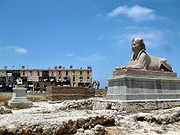
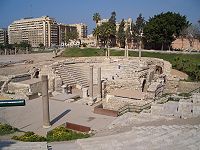 Alexandria was founded by Alexander the Great in April 331 BC as (Alexándreia). Alexander's chief architect
for the project was Dinocrates. Alexandria was intended to supersede Naucratis
as a Hellenistic
center in Egypt, and to be the link between Greece and the rich Nile Valley
. An Egyptian city, Rhakotis, already existed on the shore, and later gave its name to Alexandria in the Egyptian language
(Egyptian *Raˁ-Ḳāṭit, written rˁ-ḳṭy.t, 'That which is built up'). It continued to exist as the Egyptian quarter of the city. A few months after the foundation, Alexander left Egypt and never returned to his city. After Alexander's departure, his viceroy, Cleomenes
, continued the expansion. Following a struggle with the other successors of Alexander, his general Ptolemy
succeeded in bringing Alexander's body to Alexandria.
Although Cleomenes was mainly in charge of overseeing Alexandria's continuous development, the Heptastadion and the mainland quarters seem to have been primarily Ptolemaic work. Inheriting the trade of ruined Tyre and becoming the centre of the new commerce between Europe and the Arabian
and Indian East, the city grew in less than a generation to be larger than Carthage
. In a century, Alexandria had become the largest city in the world and, for some centuries more, was second only to Rome. It became Egypt's main Greek city, with Greek people
from diverse backgrounds.
Alexandria was not only a centre of Hellenism
, but was also home to the largest Jewish community in the world. The Septuagint, a Greek translation of the Hebrew Bible
, was produced there. The early Ptolemies kept it in order and fostered the development of its museum into the leading Hellenistic center of learning (Library of Alexandria
), but were careful to maintain the distinction of its population's three largest ethnicities: Greek, Jewish, and Egyptian
.[…] A reading of Alexandrian poetry might easily give the impression that Egyptians did not exist at all; indeed Egypt itself is hardly mentioned except for the Nile and the Nile flood, […] This omission of the Egypt and Egyptians from poetry masks a fundamental insecurity. It is no coincidence that one of the few poetic references to Egyptians presents them as muggers.}} From this division arose much of the later turbulence, which began to manifest itself under Ptolemy Philopater
who reigned from 221–204 BC. The reign of Ptolemy VIII Physcon
from 144–116 BC was marked by purges and civil warfare.
The city passed formally under Roman jurisdiction in 80 BC, according to the will of Ptolemy Alexander
, but only after it had been under Roman influence for more than a hundred years. It was captured by Julius Caesar
in 47 BC during a Roman intervention in the domestic civil war between king Ptolemy XIII
and his advisers, and the fabled queen Cleopatra VII. It was finally captured by Octavian
, future emperor
Augustus on 1 August 30 BC, with the name of the month later being changed to August to commemorate his victory.
In AD 115, large parts of Alexandria were destroyed during the Kitos War
, which gave Hadrian
and his architect, Decriannus, an opportunity to rebuild it. In 215, the emperor
Caracalla
visited the city and, because of some insulting satire
s that the inhabitants had directed at him, abruptly commanded his troops to put to death
all youths capable of bearing arms. On 21 July 365, Alexandria was devastated by a tsunami
(365 Crete earthquake
), an event still annually commemorated 17 hundred years later as a "day of horror." In the late 4th century, persecution of pagans
by newly Christian Romans had reached new levels of intensity. In 391, the Patriarch Theophilus destroyed all pagan temples in Alexandria under orders from Emperor Theodosius I
. The Brucheum and Jewish quarters were desolate in the 5th century. On the mainland, life seemed to have centred in the vicinity of the Serapeum and Caesareum, both of which became Christian churches
. The Pharos
and Heptastadium quarters, however, remained populous and were left intact.
In 619, Alexandria fell to the Sassanid Persians
. Although the Byzantine Emperor Heraclius
recovered it in 629, in 641 the Arabs under the general Amr ibn al-As
captured it during the Muslim conquest of Egypt
, after a siege that lasted 14 months.
Alexandria figured prominently in the military operation
s of Napoleon
's expedition to Egypt in 1798. French troops stormed the town on 2 July 1798, and it remained in their hands until the arrival of a British expedition in 1801. The British won a considerable victory over the French at the Battle of Alexandria on 21 March 1801, following which they besieged the town, which fell to them on 2 September 1801. Mohammed Ali
, the Ottoman Governor of Egypt, began rebuilding and redevelopment around 1810, and by 1850, Alexandria had returned to something akin to its former glory. In July 1882, the city came under bombardment from British naval forces and was occupied. In July 1954, the city was a target of an Israeli bombing campaign that later became known as the Lavon Affair
. On October 26, 1954, Alexandria's Mansheyya Square was the site of a failed assassination attempt
on Gamal Abdel Nasser
.
The most important battles and sieges of Alexandria include:
BWh), but the prevailing north wind, blowing across the Mediterranean, gives the city a different climate from the desert hinterland. The city's climate shows Mediterranean
(Csa) characteristics, namely mild, variably rainy winters and hot summers that, at times, can be very humid; January and February are the coolest months, with daily maximum temperatures typically ranging from 12 to 18 °C (53.6 to 64.4 F) and minimum temperatures that could reach 5 °C (41 °F). Alexandria experiences violent storms
, rain and sometimes hail during the cooler months. July and August are the hottest and driest months of the year, with an average daily maximum temperature of 30 °C (86 °F).
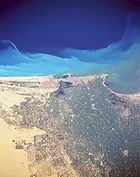
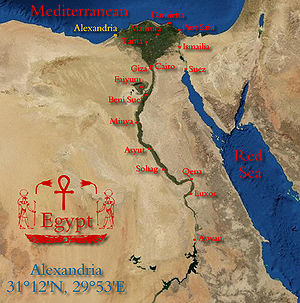 Greek Alexandria was divided into three regions:
Brucheum
The Jewish quarter
Rhakotis
Two main streets, lined with colonnade
s and said to have been each about 60 metres (196.9 ft) wide, intersected in the center of the city, close to the point where the Sema (or Soma) of Alexander (his Mausoleum
) rose. This point is very near the present mosque
of Nebi Daniel; and the line of the great East–West "Canopic" street, only slightly diverged from that of the modern Boulevard de Rosette (now Sharia Fouad). Traces of its pavement and canal have been found near the Rosetta Gate, but remnants of streets and canals were exposed in 1899 by German excavators outside the east fortifications, which lie well within the area of the ancient city.
Alexandria consisted originally of little more than the island of Pharos, which was joined to the mainland by a mole
nearly a mile long (1260 m) and called the Heptastadion ("seven stadia"—a stadium
was a Greek unit of length
measuring approximately 180 m). The end of this abutted on the land at the head of the present Grand Square, where the "Moon Gate" rose. All that now lies between that point and the modern "Ras al-Tiin" quarter is built on the silt which gradually widened and obliterated this mole. The Ras al-Tiin quarter represents all that is left of the island of Pharos, the site of the actual lighthouse having been weathered away by the sea. On the east of the mole was the Great Harbor, now an open bay; on the west lay the port of Eunostos, with its inner basin Kibotos, now vastly enlarged to form the modern harbor.
In Strabo
's time, (latter half of 1st century BC) the principal buildings were as follows, enumerated as they were to be seen from a ship entering the Great Harbor.
The names of a few other public buildings on the mainland are known, but there is little information as to their actual position. None, however, are as famous as the building that stood on the eastern point of Pharos island. There, The Great Lighthouse
, one of the Seven Wonders of the World
, reputed to be 138 meters (450 ft) high, was situated. The first Ptolemy
began the project, and the second Ptolemy (Ptolemy II Philadelphus
) completed it, at a total cost of 800 talents. It took 12 years to complete and served as a prototype
for all later lighthouse
s in the world. The light was produced by a furnace at the top and the tower was built mostly with solid blocks of limestone. The Pharos lighthouse was destroyed by an earthquake in the 14th century, making it the second longest surviving ancient wonder, after the Great Pyramid of Giza
. A temple of Hephaestus
also stood on Pharos at the head of the mole.
In the 1st century, the population of Alexandria contained over 180,000 adult male citizens (from a papyrus dated 32 AD), in addition to a large number of freedmen, women, children and slaves. Estimates of the total population range from 500,000 to over 1,000,000, making it one of the largest cities ever built before the Industrial Revolution
and the largest pre-industrial city that was not an imperial capital.
subsidence
, and the rest has been built over in modern times.
"Pompey's Pillar
", a Roman triumphal column, is one of the best-known ancient monument
s still standing in Alexandria today. It is located on Alexandria's ancient acropolis
—a modest hill located adjacent to the city's Arab cemetery
—and was originally part of a temple colonnade. Including its pedestal
, it is 30 m (99 ft) high; the shaft is of polished red granite, 2.7 meters in diameter at the base, tapering to 2.4 meters at the top. The shaft is 88 feet (26.8 m) high made out of a single piece of granite. This would be 132 cubic meters or approximately 396 tons. Pompey's Pillar may have been erected using the same methods that were used to erect the ancient obelisk
s. The Romans
had cranes but they were not strong enough to lift something this heavy. Roger Hopkins and Mark Lehrner conducted several obelisk erecting experiments including a successful attempt to erect a 25-ton obelisk in 1999. This followed two experiments to erect smaller obelisks and two failed attempts to erect a 25-ton obelisk. The structure was plundered and demolished in the 4th century when a bishop decreed that Paganism must be eradicated. "Pompey's Pillar" is a misnomer
, as it has nothing to do with Pompey
, having been erected in 293 for Diocletian
, possibly in memory of the rebellion of Domitius Domitianus
. Beneath the acropolis itself are the subterranean remains of the Serapeum, where the mysteries of the god Serapis
were enacted, and whose carved wall niches are believed to have provided overflow storage space for the ancient Library. In more recent years, a lot of ancient artifacts have been discovered from the surrounding sea, mostly pieces of old pottery.
Alexandria's catacombs
, known as Kom al-Shoqafa, are a short distance southwest of the pillar, consist of a multi-level labyrinth, reached via a large spiral staircase
, and featuring dozens of chambers adorned with sculpted pillars, statues, and other syncretic
Romano-Egyptian religious symbols
, burial niches, and sarcophagi
, as well as a large Roman-style banquet room, where memorial meals were conducted by relatives of the deceased. The catacombs were long forgotten by the citizens until they were discovered by accident in the 1800s.
The most extensive ancient excavation currently being conducted in Alexandria is known as Kom al-Dikka. It has revealed the ancient city's well-preserved theater, and the remains of its Roman-era baths
.
Society, and by many individuals, notably Greeks proud of a city which is one of the glories of their national history.
The past and present directors of the museum have been enabled from time to time to carry out systematic excavations whenever opportunity is offered; D. G. Hogarth
made tentative researches on behalf of the Egypt Exploration Fund
and the Society for the Promotion of Hellenic Studies in 1895; and a German expedition worked for two years (1898–1899). But two difficulties face the would-be excavator in Alexandria: lack of space for excavation and the underwater location of some areas of interest.
Since the great and growing modern city stands immediately over the ancient one, it is almost impossible to find any considerable space in which to dig, except at enormous cost. Cleopatra VII's royal quarters were inundated by earthquakes and tidal waves, leading to gradual subsidence
in the 4th century AD. This underwater section, containing many of the most interesting sections of the Hellenistic city, including the palace quarter, was explored in 1992 and is still being extensively investigated by the French underwater archaeologist Franck Goddio
and his team
. It raised a noted head of Caesarion
. These are being opened up to tourists, to some controversy. The spaces that are most open are the low grounds to northeast and southwest, where it is practically impossible to get below the Roman strata
.
The most important results were those achieved by Dr. G. Botti, late director of the museum, in the neighborhood of “Pompey's Pillar”, where there is a good deal of open ground. Here, substructures of a large building or group of buildings have been exposed, which are perhaps part of the Serapeum. Nearby, immense catacombs
and columbaria have been opened which may have been appendages of the temple. These contain one very remarkable vault with curious painted reliefs, now artificially lit and open to visitors.
The objects found in these researches are in the museum, the most notable being a great basalt bull, probably once an object of cult in the Serapeum. Other catacombs and tombs have been opened in Kom al-Shoqqafa (Roman) and Ras al-Tiin (painted).
The German excavation team found remains of a Ptolemaic colonnade and streets in the north-east of the city, but little else. Hogarth explored part of an immense brick structure under the mound of Kom al-Dikka, which may have been part of the Paneum, the Mausolea, or a Roman fortress.
The making of the new foreshore led to the dredging up of remains of the Patriarchal Church; and the foundations of modern buildings are seldom laid without some objects of antiquity being discovered. The wealth underground is doubtlessly immense; but despite all efforts, there is not much for antiquarians to see in Alexandria outside the museum and the neighborhood of “Pompey's Pillar”.
 Modern Alexandria is divided into six districts:
There are also two cities under the jurisdiction of the Alexandria governorate forming metropolitan
Alexandria:
, Assafra, Attarine, Azarita (aka Mazarita; originally Lazarette), Bab Sidra, Bahari, Bacchus, Bolkly
(Bokla), Burg al-Arab, Camp Shezar, Cleopatra, Dekheila, Downtown
, Eastern Harbor
, Fleming, Gabbari (aka: Qabbari, Qubbary, Kabbary), Gianaclis, Glym (short for Glymenopoulos), Gumrok (aka al-Gomrok), Hadara, Ibrahimiyya, King Mariout, Kafr Abdu, Karmous, also known as Karmouz, Kom al-Dik (aka Kom al-Dikka), Labban
, Laurent, Louran, Maamoura Beach
, Maamoura, Mafrouza, Mandara, Manshiyya, Mex, Miami, Montaza
, Muharram Bey, Mustafa Kamel, Ramleh (aka al-Raml), Ras al-Tiin, Rushdy, Saba Pasha
, San Stefano, Shatby, Schutz, Sidi Bishr, Sidi Gaber, Smouha, Sporting
, Stanley
, Syouf, Tharwat, Victoria, Wardeyan, Western Harbor and Zizinia.
in Bahary
. Other notable mosques in the city include Ali ibn Abi Talib
mosque in Somouha, Bilal
mosque, al-Gamaa al-Bahari in Mandara, Hatem mosque in Somouha, Hoda el-Islam mosque in Sidi Bishr, al-Mowasah mosque in Hadara, Sharq al-Madina mosque in Miami, al-Shohadaa mosque in Mostafa Kamel, Al Qa'ed Ibrahim Mosque, Yehia mosque in Zizinia, Sidi Gaber mosque in Sidi Gaber, and Sultan mosque.
in the world. The Pope of Alexandria was the second among equals, second only to the bishop of Rome
, the capital of the Roman Empire
until 430. The Church of Alexandria had jurisdiction over the entire continent of Africa. After the Council of Chalcedon
in AD 451, the Church of Alexandria was split between the Miaphysites
and the Melkite
s. The Miaphysites went on to constitute what is known today as the Coptic Orthodox Church of Alexandria. The Melkites went on the constitute what is known today as the Greek Orthodox Church of Alexandria
. In the 19th century, Catholic
and Protestant
missionaries converted some of the adherents of the Orthodox churches to their respective faiths.
Today, the patriarchal seat of the Pope of the Coptic Orthodox Church is Saint Mark Cathedral
in Ramleh. The most important Coptic Orthodox churches in Alexandria include Pope Cyril I
Church in Cleopatra, Saint George
s Church in Sporting, Saint Mark
& Pope Peter I
Church in Sidi Bishr, Saint Mary Church in Assafra, Saint Mary Church in Gianaclis, Saint Mina
Church in Fleming, Saint Mina Church in Mandara, and Saint Takla Haymanot's Church
in Ibrahimeya.
The most important Greek Orthodox
churches in Alexandria are Saint Anargyri Church, Church of the Annunciation
, Saint Anthony
Church, Archangels Gabriel
& Michael
Church, Saint Catherine Church, Cathedral of the Dormition
in Mansheya, Church of the Dormition, Prophet Elijah Church, Saint Georges Church, Church of the Immaculate Conception
in Ibrahemeya, Saint Joseph
Church in Fleming, Saint Joseph of Arimathea
Church, Saint Mark & Saint Nectarios Chapel in Ramleh, Saint Nicholas
Church, Saint Paraskevi
Church, Saint Sava
Cathedral in Ramleh, and Saint Theodore
Chapel. In communion with the Greek Orthodox Church is the Russian Orthodox
church of Saint Alexander Nevsky
in Alexandria, which serves the Russian speaking community in the city.
Churches that follow the Latin Catholic rite include Saint Catherine Church in Mansheya and Church of the Jesuits
in Cleopatra.
The Saint Mark Church in Shatby, found as part of Collège Saint Marc
is multi-denominational and hold liturgies according to Latin Catholic, Coptic Catholic
and Coptic Orthodox rites.
, after which negative reactions towards Zionism
among Egyptians led to Jewish residents in the city, and elsewhere in Egypt, being perceived as Zionist collaborators. Most Jewish residents of Egypt left to the newly established State of Israel
, France
, Brazil
, and other countries in the 1950s and 1960s. The community once numbered 50,000 but is now estimated at below 50. The most important synagogue
in Alexandria is the Eliyahu Hanavi Synagogue
.
is a public university that follows the Egyptian system of higher education. Many of its faculties are internationally renowned, most notably its Faculty of Medicine & Faculty of Engineering
. In addition, the Arab Academy for Science and Technology and Maritime Transport
is a semi-private educational institution that offers courses for high school, undergraduate level, and postgraduate students. It is considered the most reputable university in Egypt after the AUC American University in Cairo
because of its worldwide recognition from (board of engineers at UK & ABET in US). Université Senghor
is a private French university that focuses on the teaching of humanities, politics and international relations, which mainly targets students from the African continent. Other institutions of higher education in Alexandria include Alexandria Institute of Technology (AIT) and Pharos University in Alexandria
.
missionaries include Collège de la Mère de Dieu, Collège Notre Dame de Sion, Collège Saint Marc
, Ecoles des Soeurs Franciscaines (four different schools), École Gérard, École Saint Gabriel, École Saint-Vincent de Paul, École saint joseph, École Sainte Catherine, and Institution Sainte Jeanne-Antide. As a reaction to the establishment of French religious institutions, a secular (laic) mission established Lycée el-Horreya, which initially followed a French system of education, but is currently a public school run by the Egyptian government. The only school in Alexandria that completely follows the French educational system is École Champollion. It is usually frequented by the children of French expatriates and diplomats in Alexandria.
English schools in Alexandria are fewer in number and more recently established, in comparison with the French schools. The most important English language schools in the city include Alexandria Language School(AlS), Alexandria American School, British School of Alexandria, Egyptian American School, Modern American School, Sidi Gaber Language Schools, Riada American school, Taymour English School (TES), Sacred Heart Girls' School (SHS), Schutz American School
, Victoria College
, El Manar Language School for Girls
, previously called (Scottish School for Girls), Kaumeya Language School (KLS), El Nasr Boys' School
(EBS), and El Nasr Girls' College
(EGC). Most of these schools were nationalized during the era of Nasser
, and are currently Egyptian public schools run by the Egyptian ministry of education.
The only German school in Alexandria is the Deutsche Schule der Borromärinnen (DSB of Saint Charles Borromé).
The Montessori educational system was first introduced in Alexandria in 2009 at Alexandria Montessori.
N.B: The most notable public schools in Alexandria include, AlAbasseia High School, Gamal Abdel Nasser High School and EL Manar language School for girls.
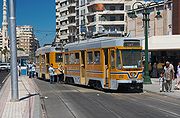
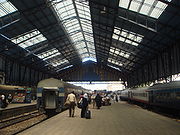
which is located about 25 km away from city centre.
From late 2011, Alexandria International will be closed to commercial operations for two years as it undergoes expansion, with all airlines operating out of Borg al Arab Airport from then onwards, where a brand new terminal was completed in February 2010.
) to Abu Qir
, parallel to the tram line
. The commuter line's locomotives operate on diesel
, as opposed to the overhead-electric tram.
Alexandria plays host to two intercity rail stations: the aforementioned Misr Station (in the older Manshia district in the western part of the city) and Sidi Gaber Station (in the district of Sidi Gaber in the center of the eastern expansion in which most Alexandrines reside), both of which also serve the commuter rail line. Intercity passenger service is operated by Egyptian National Railways
.
Modern air conditioned red double-decker bus
es run the length of the Courniche. Fare (any distance) is 3 L.E. (Egyptian pound
) (£0.33/0.39€/$0.52) .
and are widely available. While Egyptian law requires all cabs to carry meters
, these generally do not work and fares must be negotiated with the driver on either departure or arrival.
The minibus
share taxi
system, or mashrū` operates along well-known traffic arteries. The routes can be identified by both their endpoints and the route between them:
The route is generally written in Arabic on the side of the vehicle, although some drivers change their route without changing the paint. Some drivers also drive only a segment of a route rather than the whole path; such drivers generally stop at a point known as a major hub of the transportation system (for example, Victoria) to allow riders to transfer to another car or to another mode of transport.
Fare is generally L.E. 1.25 to travel the whole route. Shorter trips may have a lower fare, depending on the driver and the length of the trip.
is divided into:
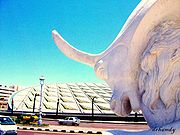 The Royal Library of Alexandria in Alexandria, Egypt
, was once the largest library
in the world. It is generally thought to have been founded at the beginning of the 3rd century BCE, during the reign of Ptolemy II of Egypt
. It was likely created after his father had built what would become the first part of the Library complex, the temple of the Muse
s—the Museion
, Greek Μουσείον (from which the modern English
word museum is derived).
It has been reasonably established that the Library, or parts of the collection, were destroyed by fire on a number of occasions (library fires were common and replacement of handwritten manuscripts was very difficult, expensive, and time-consuming). To this day the details of the destruction (or destructions) remain a lively source of controversy. The Bibliotheca Alexandrina
was inaugurated in 2003 near the site of the old Library.
The museum is housed in the old Al-Saad Bassili Pasha Palace, who was one of the wealthiest wood merchants in Alexandria. Construction on the site was first undertaken in 1926.
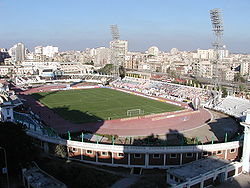 The main sport that interests Alexandrians is football, as is the case in the rest of Egypt and Africa. Alexandria Stadium
is a multi-purpose stadium
in Alexandria, Egypt
. It is currently used mostly for football matches, and was used for the 2006 African Cup of Nations. The stadium is the oldest stadium in Egypt and Africa, being built in 1929. The stadium holds 20,000 people. Alexandria was one of three cities that participated in hosting the African Cup of Nations in January 2006, which Egypt won. Sea sports such as surfing
, jet-skiing
and water polo
are practised on a lower scale.
Alexandria has four stadium
s:
Other less popular sports like tennis and squash
are usually played in private social and sports club
s, like:
, author of The Alexandria Quartet
. Cavafy incorporated Greek history and mythology and his homosexuality into his poetry. Durrell used the cosmopolitan city as a landscape to explore human desires. Of Arabic novels set in Alexandria Naguib Mahfouz
's Miramar
is the best known. In the 2000s writers such as Jon Courtenay Grimwood
, Ki Longfellow
, and Keith Miller have used Alexandria as a setting for speculative fiction
.
, due to its public and private beaches and ancient history and Museum
s, especially the Bibliotheca Alexandrina
, based on reviving the ancient Library of Alexandria
.
Egypt
Egypt , officially the Arab Republic of Egypt, Arabic: , is a country mainly in North Africa, with the Sinai Peninsula forming a land bridge in Southwest Asia. Egypt is thus a transcontinental country, and a major power in Africa, the Mediterranean Basin, the Middle East and the Muslim world...
, with a population of 4.1 million, extending about 32 km (19.9 mi) along the coast of the Mediterranean Sea
Mediterranean Sea
The Mediterranean Sea is a sea connected to the Atlantic Ocean surrounded by the Mediterranean region and almost completely enclosed by land: on the north by Anatolia and Europe, on the south by North Africa, and on the east by the Levant...
in the north central part of the country; it is also the largest city lying directly on the Mediterranean coast. It is Egypt's largest seaport, serving approximately 80% of Egypt's imports and exports. Alexandria is also an important tourist resort. It is home to the Bibliotheca Alexandrina
Bibliotheca Alexandrina
The Bibliotheca Alexandrina or Maktabat al-Iskandarīyah is a major library and cultural center located on the shore of the Mediterranean Sea in the Egyptian city of Alexandria...
(the new Library of Alexandria
Library of Alexandria
The Royal Library of Alexandria, or Ancient Library of Alexandria, in Alexandria, Egypt, was the largest and most significant great library of the ancient world. It flourished under the patronage of the Ptolemaic dynasty and functioned as a major center of scholarship from its construction in the...
). It is an important industrial centre because of its natural gas
Natural gas
Natural gas is a naturally occurring gas mixture consisting primarily of methane, typically with 0–20% higher hydrocarbons . It is found associated with other hydrocarbon fuel, in coal beds, as methane clathrates, and is an important fuel source and a major feedstock for fertilizers.Most natural...
and oil pipeline
Pipeline transport
Pipeline transport is the transportation of goods through a pipe. Most commonly, liquids and gases are sent, but pneumatic tubes that transport solid capsules using compressed air are also used....
s from Suez
Suez
Suez is a seaport city in north-eastern Egypt, located on the north coast of the Gulf of Suez , near the southern terminus of the Suez Canal, having the same boundaries as Suez governorate. It has three harbors, Adabya, Ain Sokhna and Port Tawfiq, and extensive port facilities...
.
Alexandria was founded around a small pharaonic
Ancient Egypt
Ancient Egypt was an ancient civilization of Northeastern Africa, concentrated along the lower reaches of the Nile River in what is now the modern country of Egypt. Egyptian civilization coalesced around 3150 BC with the political unification of Upper and Lower Egypt under the first pharaoh...
town c. 331 BC by Alexander the Great. It remained Egypt's capital for nearly a thousand years, until the Muslim conquest of Egypt
Muslim conquest of Egypt
At the commencement of the Muslims conquest of Egypt, Egypt was part of the Byzantine Empire with its capital in Constantinople. However, it had been occupied just a decade before by the Persian Empire under Khosrau II...
in AD 641, when a new capital was founded at Fustat (Fustat was later absorbed into Cairo
Cairo
Cairo , is the capital of Egypt and the largest city in the Arab world and Africa, and the 16th largest metropolitan area in the world. Nicknamed "The City of a Thousand Minarets" for its preponderance of Islamic architecture, Cairo has long been a centre of the region's political and cultural life...
). Alexandria was known because of its Lighthouse of Alexandria
Lighthouse of Alexandria
The Lighthouse of Alexandria, also known as the Pharos of Alexandria , was a tower built between 280 and 247 BC on the island of Pharos at Alexandria, Egypt...
(Pharos), one of the Seven Wonders of the Ancient World
Seven Wonders of the Ancient World
The Seven Wonders of the World refers to remarkable constructions of classical antiquity listed by various authors in guidebooks popular among the ancient Hellenic tourists, particularly in the 1st and 2nd centuries BC...
; its library (the largest library in the ancient world); and the Catacombs of Kom el Shoqafa, one of the Seven Wonders of the Middle Ages. Ongoing maritime archaeology
Maritime archaeology
Maritime archaeology is a discipline within archaeology as a whole that specifically studies human interaction with the sea, lakes and rivers through the study of associated physical remains, be they vessels, shore side facilities, port-related structures, cargoes, human remains and submerged...
in the harbor of Alexandria, which began in 1994, is revealing details of Alexandria both before the arrival of Alexander, when a city named Rhacotis existed there, and during the Ptolemaic dynasty
Ptolemaic dynasty
The Ptolemaic dynasty, was a Macedonian Greek royal family which ruled the Ptolemaic Empire in Egypt during the Hellenistic period. Their rule lasted for 275 years, from 305 BC to 30 BC...
.
From the late 19th century, Alexandria became a major centre of the international shipping industry and one of the most important trading centres in the world, both because it profited from the easy overland connection between the Mediterranean Sea and the Red Sea
Red Sea
The Red Sea is a seawater inlet of the Indian Ocean, lying between Africa and Asia. The connection to the ocean is in the south through the Bab el Mandeb strait and the Gulf of Aden. In the north, there is the Sinai Peninsula, the Gulf of Aqaba, and the Gulf of Suez...
, and the lucrative trade in Egyptian cotton.
History
Architecture
Architecture is both the process and product of planning, designing and construction. Architectural works, in the material form of buildings, are often perceived as cultural and political symbols and as works of art...
for the project was Dinocrates. Alexandria was intended to supersede Naucratis
Naucratis
Naucratis or Naukratis, , loosely translated as " power over ships" , was a city of Ancient Egypt, on the Canopic branch of the Nile river, 45 mi SE of the open sea and the later capital of Ptolemaic Egypt, Alexandria...
as a Hellenistic
Hellenistic civilization
Hellenistic civilization represents the zenith of Greek influence in the ancient world from 323 BCE to about 146 BCE...
center in Egypt, and to be the link between Greece and the rich Nile Valley
Nile
The Nile is a major north-flowing river in North Africa, generally regarded as the longest river in the world. It is long. It runs through the ten countries of Sudan, South Sudan, Burundi, Rwanda, Democratic Republic of the Congo, Tanzania, Kenya, Ethiopia, Uganda and Egypt.The Nile has two major...
. An Egyptian city, Rhakotis, already existed on the shore, and later gave its name to Alexandria in the Egyptian language
Egyptian language
Egyptian is the oldest known indigenous language of Egypt and a branch of the Afroasiatic language family. Written records of the Egyptian language have been dated from about 3400 BC, making it one of the oldest recorded languages known. Egyptian was spoken until the late 17th century AD in the...
(Egyptian *Raˁ-Ḳāṭit, written rˁ-ḳṭy.t, 'That which is built up'). It continued to exist as the Egyptian quarter of the city. A few months after the foundation, Alexander left Egypt and never returned to his city. After Alexander's departure, his viceroy, Cleomenes
Cleomenes of Naucratis
Cleomenes , a Greek of Naucratis in Egypt, was appointed by Alexander III of Macedon as nomarch of the Arabian district of Egypt and receiver of the tributes from all the districts of Egypt and the neighbouring part of Africa...
, continued the expansion. Following a struggle with the other successors of Alexander, his general Ptolemy
Ptolemy I Soter
Ptolemy I Soter I , also known as Ptolemy Lagides, c. 367 BC – c. 283 BC, was a Macedonian general under Alexander the Great, who became ruler of Egypt and founder of both the Ptolemaic Kingdom and the Ptolemaic Dynasty...
succeeded in bringing Alexander's body to Alexandria.
Although Cleomenes was mainly in charge of overseeing Alexandria's continuous development, the Heptastadion and the mainland quarters seem to have been primarily Ptolemaic work. Inheriting the trade of ruined Tyre and becoming the centre of the new commerce between Europe and the Arabian
Arabian Peninsula
The Arabian Peninsula is a land mass situated north-east of Africa. Also known as Arabia or the Arabian subcontinent, it is the world's largest peninsula and covers 3,237,500 km2...
and Indian East, the city grew in less than a generation to be larger than Carthage
Carthage
Carthage , implying it was a 'new Tyre') is a major urban centre that has existed for nearly 3,000 years on the Gulf of Tunis, developing from a Phoenician colony of the 1st millennium BC...
. In a century, Alexandria had become the largest city in the world and, for some centuries more, was second only to Rome. It became Egypt's main Greek city, with Greek people
Greeks
The Greeks, also known as the Hellenes , are a nation and ethnic group native to Greece, Cyprus and neighboring regions. They also form a significant diaspora, with Greek communities established around the world....
from diverse backgrounds.
Alexandria was not only a centre of Hellenism
Hellenistic period
The Hellenistic period or Hellenistic era describes the time which followed the conquests of Alexander the Great. It was so named by the historian J. G. Droysen. During this time, Greek cultural influence and power was at its zenith in Europe and Asia...
, but was also home to the largest Jewish community in the world. The Septuagint, a Greek translation of the Hebrew Bible
Hebrew Bible
The Hebrew Bible is a term used by biblical scholars outside of Judaism to refer to the Tanakh , a canonical collection of Jewish texts, and the common textual antecedent of the several canonical editions of the Christian Old Testament...
, was produced there. The early Ptolemies kept it in order and fostered the development of its museum into the leading Hellenistic center of learning (Library of Alexandria
Library of Alexandria
The Royal Library of Alexandria, or Ancient Library of Alexandria, in Alexandria, Egypt, was the largest and most significant great library of the ancient world. It flourished under the patronage of the Ptolemaic dynasty and functioned as a major center of scholarship from its construction in the...
), but were careful to maintain the distinction of its population's three largest ethnicities: Greek, Jewish, and Egyptian
Egyptians
Egyptians are nation an ethnic group made up of Mediterranean North Africans, the indigenous people of Egypt.Egyptian identity is closely tied to geography. The population of Egypt is concentrated in the lower Nile Valley, the small strip of cultivable land stretching from the First Cataract to...
.[…] A reading of Alexandrian poetry might easily give the impression that Egyptians did not exist at all; indeed Egypt itself is hardly mentioned except for the Nile and the Nile flood, […] This omission of the Egypt and Egyptians from poetry masks a fundamental insecurity. It is no coincidence that one of the few poetic references to Egyptians presents them as muggers.}} From this division arose much of the later turbulence, which began to manifest itself under Ptolemy Philopater
Ptolemy IV Philopator
Ptolemy IV Philopator , son of Ptolemy III and Berenice II of Egypt was the fourth Pharaoh of Ptolemaic Egypt...
who reigned from 221–204 BC. The reign of Ptolemy VIII Physcon
Ptolemy VIII Physcon
Ptolemy VIII Euergetes II , nicknamed , Phúskōn, Physcon for his obesity, was a king of the Ptolemaic dynasty in Egypt. His complicated career started in 170 BC, when Antiochus IV Epiphanes invaded Egypt, captured his brother Ptolemy VI Philometor and let him continue as a puppet monarch...
from 144–116 BC was marked by purges and civil warfare.
The city passed formally under Roman jurisdiction in 80 BC, according to the will of Ptolemy Alexander
Ptolemy X Alexander I
Ptolemy X Alexander I was King of Egypt from 110 BC to 109 BC and 107 BC till 88 BC.He was the son of Ptolemy VIII Physcon and Cleopatra III. In 110 BC he became King with his mother as co-regent, after his mother had deposed his brother Ptolemy IX Lathyros. However, in 109 BC he was deposed by...
, but only after it had been under Roman influence for more than a hundred years. It was captured by Julius Caesar
Julius Caesar
Gaius Julius Caesar was a Roman general and statesman and a distinguished writer of Latin prose. He played a critical role in the gradual transformation of the Roman Republic into the Roman Empire....
in 47 BC during a Roman intervention in the domestic civil war between king Ptolemy XIII
Ptolemy XIII Theos Philopator
Ptolemy XIII Theos Philopator was one of the last members of the Ptolemaic dynasty of Egypt.- Co-ruler of Egypt, inner turmoil :...
and his advisers, and the fabled queen Cleopatra VII. It was finally captured by Octavian
Augustus
Augustus ;23 September 63 BC – 19 August AD 14) is considered the first emperor of the Roman Empire, which he ruled alone from 27 BC until his death in 14 AD.The dates of his rule are contemporary dates; Augustus lived under two calendars, the Roman Republican until 45 BC, and the Julian...
, future emperor
Emperor
An emperor is a monarch, usually the sovereign ruler of an empire or another type of imperial realm. Empress, the female equivalent, may indicate an emperor's wife or a woman who rules in her own right...
Augustus on 1 August 30 BC, with the name of the month later being changed to August to commemorate his victory.
In AD 115, large parts of Alexandria were destroyed during the Kitos War
Kitos War
The Kitos War , translation: Rebellion of the exile) is the name given to the second of the Jewish–Roman wars. Major revolts by diasporic Jews in Cyrene , Cyprus, Mesopotamia and Aegyptus spiraled out of control resulting in a widespread slaughter of Roman citizens and others by the Jewish rebels...
, which gave Hadrian
Hadrian
Hadrian , was Roman Emperor from 117 to 138. He is best known for building Hadrian's Wall, which marked the northern limit of Roman Britain. In Rome, he re-built the Pantheon and constructed the Temple of Venus and Roma. In addition to being emperor, Hadrian was a humanist and was philhellene in...
and his architect, Decriannus, an opportunity to rebuild it. In 215, the emperor
Roman Emperor
The Roman emperor was the ruler of the Roman State during the imperial period . The Romans had no single term for the office although at any given time, a given title was associated with the emperor...
Caracalla
Caracalla
Caracalla , was Roman emperor from 198 to 217. The eldest son of Septimius Severus, he ruled jointly with his younger brother Geta until he murdered the latter in 211...
visited the city and, because of some insulting satire
Satire
Satire is primarily a literary genre or form, although in practice it can also be found in the graphic and performing arts. In satire, vices, follies, abuses, and shortcomings are held up to ridicule, ideally with the intent of shaming individuals, and society itself, into improvement...
s that the inhabitants had directed at him, abruptly commanded his troops to put to death
Capital punishment
Capital punishment, the death penalty, or execution is the sentence of death upon a person by the state as a punishment for an offence. Crimes that can result in a death penalty are known as capital crimes or capital offences. The term capital originates from the Latin capitalis, literally...
all youths capable of bearing arms. On 21 July 365, Alexandria was devastated by a tsunami
Tsunami
A tsunami is a series of water waves caused by the displacement of a large volume of a body of water, typically an ocean or a large lake...
(365 Crete earthquake
365 Crete earthquake
The AD 365 Crete earthquake was an undersea earthquake that occurred at about sunrise on 21 July 365 in the Eastern Mediterranean, with an assumed epicentre near Crete. Geologists today estimate the quake to have been 8 on the Richter Scale or higher, causing widespread destruction in central and...
), an event still annually commemorated 17 hundred years later as a "day of horror." In the late 4th century, persecution of pagans
Paganism
Paganism is a blanket term, typically used to refer to non-Abrahamic, indigenous polytheistic religious traditions....
by newly Christian Romans had reached new levels of intensity. In 391, the Patriarch Theophilus destroyed all pagan temples in Alexandria under orders from Emperor Theodosius I
Theodosius I
Theodosius I , also known as Theodosius the Great, was Roman Emperor from 379 to 395. Theodosius was the last emperor to rule over both the eastern and the western halves of the Roman Empire. During his reign, the Goths secured control of Illyricum after the Gothic War, establishing their homeland...
. The Brucheum and Jewish quarters were desolate in the 5th century. On the mainland, life seemed to have centred in the vicinity of the Serapeum and Caesareum, both of which became Christian churches
Christian Church
The Christian Church is the assembly or association of followers of Jesus Christ. The Greek term ἐκκλησία that in its appearances in the New Testament is usually translated as "church" basically means "assembly"...
. The Pharos
Lighthouse of Alexandria
The Lighthouse of Alexandria, also known as the Pharos of Alexandria , was a tower built between 280 and 247 BC on the island of Pharos at Alexandria, Egypt...
and Heptastadium quarters, however, remained populous and were left intact.
In 619, Alexandria fell to the Sassanid Persians
Sassanid Empire
The Sassanid Empire , known to its inhabitants as Ērānshahr and Ērān in Middle Persian and resulting in the New Persian terms Iranshahr and Iran , was the last pre-Islamic Persian Empire, ruled by the Sasanian Dynasty from 224 to 651...
. Although the Byzantine Emperor Heraclius
Heraclius
Heraclius was Byzantine Emperor from 610 to 641.He was responsible for introducing Greek as the empire's official language. His rise to power began in 608, when he and his father, Heraclius the Elder, the exarch of Africa, successfully led a revolt against the unpopular usurper Phocas.Heraclius'...
recovered it in 629, in 641 the Arabs under the general Amr ibn al-As
'Amr ibn al-'As
`Amr ibn al-`As was an Arab military commander who is most noted for leading the Muslim conquest of Egypt in 640. A contemporary of Muhammad, and one of the Sahaba , who rose quickly through the Muslim hierarchy following his conversion to Islam in the year 8 AH...
captured it during the Muslim conquest of Egypt
Muslim conquest of Egypt
At the commencement of the Muslims conquest of Egypt, Egypt was part of the Byzantine Empire with its capital in Constantinople. However, it had been occupied just a decade before by the Persian Empire under Khosrau II...
, after a siege that lasted 14 months.
Alexandria figured prominently in the military operation
Military operation
Military operation is the coordinated military actions of a state in response to a developing situation. These actions are designed as a military plan to resolve the situation in the state's favor. Operations may be of combat or non-combat types, and are referred to by a code name for the purpose...
s of Napoleon
Napoleon I of France
Napoleon Bonaparte was a French military and political leader during the latter stages of the French Revolution.As Napoleon I, he was Emperor of the French from 1804 to 1815...
's expedition to Egypt in 1798. French troops stormed the town on 2 July 1798, and it remained in their hands until the arrival of a British expedition in 1801. The British won a considerable victory over the French at the Battle of Alexandria on 21 March 1801, following which they besieged the town, which fell to them on 2 September 1801. Mohammed Ali
Muhammad Ali of Egypt
Muhammad Ali Pasha al-Mas'ud ibn Agha was a commander in the Ottoman army, who became Wāli, and self-declared Khedive of Egypt and Sudan...
, the Ottoman Governor of Egypt, began rebuilding and redevelopment around 1810, and by 1850, Alexandria had returned to something akin to its former glory. In July 1882, the city came under bombardment from British naval forces and was occupied. In July 1954, the city was a target of an Israeli bombing campaign that later became known as the Lavon Affair
Lavon Affair
The Lavon Affair refers to a failed Israeli covert operation, code named Operation Susannah, conducted in Egypt in the Summer of 1954. As part of the false flag operation, a group of Egyptian Jews were recruited by Israeli military intelligence for plans to plant bombs inside Egyptian, American and...
. On October 26, 1954, Alexandria's Mansheyya Square was the site of a failed assassination attempt
Assassination
To carry out an assassination is "to murder by a sudden and/or secret attack, often for political reasons." Alternatively, assassination may be defined as "the act of deliberately killing someone, especially a public figure, usually for hire or for political reasons."An assassination may be...
on Gamal Abdel Nasser
Gamal Abdel Nasser
Gamal Abdel Nasser Hussein was the second President of Egypt from 1956 until his death. A colonel in the Egyptian army, Nasser led the Egyptian Revolution of 1952 along with Muhammad Naguib, the first president, which overthrew the monarchy of Egypt and Sudan, and heralded a new period of...
.
The most important battles and sieges of Alexandria include:
- Siege of Alexandria (47 BC)Siege of Alexandria (47 BC)The Siege of Alexandria was a series of skirmishes and battles occurring between the forces of Julius Caesar, Cleopatra VII and Ptolemy XIII between 48 and 47 BC...
, Caesar's civil war - Battle of Alexandria (30 BC)Battle of Alexandria (30 BC)The Battle of Alexandria was fought on July 31, 30 BC between the forces of Octavian and Mark Antony during the Final War of the Roman Republic. Although Antony's side was plagued by desertions, he still managed to narrowly win the battle...
, Final war of the Roman Republic - Siege of Alexandria (619), Byzantine-Persian Wars
- Siege of Alexandria (641), Rashidun conquest of Byzantine Egypt
- Battle of Alexandria, French Revolutionary Wars
- Siege of Alexandria (1801), French Revolutionary Wars
- Alexandria expedition of 1807, French Revolutionary Wars
Climate
Alexandria has an arid climate (Köppen climate classificationKöppen climate classification
The Köppen climate classification is one of the most widely used climate classification systems. It was first published by Crimea German climatologist Wladimir Köppen in 1884, with several later modifications by Köppen himself, notably in 1918 and 1936...
BWh), but the prevailing north wind, blowing across the Mediterranean, gives the city a different climate from the desert hinterland. The city's climate shows Mediterranean
Mediterranean climate
A Mediterranean climate is the climate typical of most of the lands in the Mediterranean Basin, and is a particular variety of subtropical climate...
(Csa) characteristics, namely mild, variably rainy winters and hot summers that, at times, can be very humid; January and February are the coolest months, with daily maximum temperatures typically ranging from 12 to 18 °C (53.6 to 64.4 F) and minimum temperatures that could reach 5 °C (41 °F). Alexandria experiences violent storms
Severe weather
Severe weather phenomena are weather conditions that are hazardous to human life and property.- Examples Include :Severe weather can occur under a variety of situations, but three characteristics are generally needed: a temperature or moisture boundary, moisture, and , instability in the...
, rain and sometimes hail during the cooler months. July and August are the hottest and driest months of the year, with an average daily maximum temperature of 30 °C (86 °F).
Layout of the ancient city
Brucheum
- the Royal or Greek quarter, forming the most magnificent portion of the city. In Roman times Brucheum was enlarged by the addition of an official quarter, making four regions in all. The city was laid out as a grid of parallel streets, each of which had an attendant subterranean canal;
The Jewish quarter
- forming the northeast portion of the city;
Rhakotis
- The old city of Rhakotis that had been absorbed into Alexandria. It was occupied chiefly by Egyptians. (from CopticCoptic languageCoptic or Coptic Egyptian is the current stage of the Egyptian language, a northern Afro-Asiatic language spoken in Egypt until at least the 17th century. Egyptian began to be written using the Greek alphabet in the 1st century...
Rakotə "Alexandria").
Two main streets, lined with colonnade
Colonnade
In classical architecture, a colonnade denotes a long sequence of columns joined by their entablature, often free-standing, or part of a building....
s and said to have been each about 60 metres (196.9 ft) wide, intersected in the center of the city, close to the point where the Sema (or Soma) of Alexander (his Mausoleum
Mausoleum
A mausoleum is an external free-standing building constructed as a monument enclosing the interment space or burial chamber of a deceased person or persons. A monument without the interment is a cenotaph. A mausoleum may be considered a type of tomb or the tomb may be considered to be within the...
) rose. This point is very near the present mosque
Mosque
A mosque is a place of worship for followers of Islam. The word is likely to have entered the English language through French , from Portuguese , from Spanish , and from Berber , ultimately originating in — . The Arabic word masjid literally means a place of prostration...
of Nebi Daniel; and the line of the great East–West "Canopic" street, only slightly diverged from that of the modern Boulevard de Rosette (now Sharia Fouad). Traces of its pavement and canal have been found near the Rosetta Gate, but remnants of streets and canals were exposed in 1899 by German excavators outside the east fortifications, which lie well within the area of the ancient city.
Alexandria consisted originally of little more than the island of Pharos, which was joined to the mainland by a mole
Mole (architecture)
A mole is a massive structure, usually of stone, used as a pier, breakwater, or a causeway between places separated by water. The word comes from Middle French mole and ultimately Latin mōlēs meaning a large mass, especially of rock and has the same root as molecule.Historically, the term "mole"...
nearly a mile long (1260 m) and called the Heptastadion ("seven stadia"—a stadium
Stadium
A modern stadium is a place or venue for outdoor sports, concerts, or other events and consists of a field or stage either partly or completely surrounded by a structure designed to allow spectators to stand or sit and view the event.)Pausanias noted that for about half a century the only event...
was a Greek unit of length
Unit of length
Many different units of length have been used across the world. The main units in modern use are U.S. customary units in the United States and the Metric system elsewhere. British Imperial units are still used for some purposes in the United Kingdom and some other countries...
measuring approximately 180 m). The end of this abutted on the land at the head of the present Grand Square, where the "Moon Gate" rose. All that now lies between that point and the modern "Ras al-Tiin" quarter is built on the silt which gradually widened and obliterated this mole. The Ras al-Tiin quarter represents all that is left of the island of Pharos, the site of the actual lighthouse having been weathered away by the sea. On the east of the mole was the Great Harbor, now an open bay; on the west lay the port of Eunostos, with its inner basin Kibotos, now vastly enlarged to form the modern harbor.
In Strabo
Strabo
Strabo, also written Strabon was a Greek historian, geographer and philosopher.-Life:Strabo was born to an affluent family from Amaseia in Pontus , a city which he said was situated the approximate equivalent of 75 km from the Black Sea...
's time, (latter half of 1st century BC) the principal buildings were as follows, enumerated as they were to be seen from a ship entering the Great Harbor.
- The Royal PalacesPalaceA palace is a grand residence, especially a royal residence or the home of a head of state or some other high-ranking dignitary, such as a bishop or archbishop. The word itself is derived from the Latin name Palātium, for Palatine Hill, one of the seven hills in Rome. In many parts of Europe, the...
, filling the northeast angle of the town and occupying the promontory of Lochias, which shut in the Great Harbor on the east. Lochias (the modern Pharillon) has almost entirely disappeared into the sea, together with the palaces, the "Private Port," and the island of Antirrhodus. There has been a land subsidenceSubsidenceSubsidence is the motion of a surface as it shifts downward relative to a datum such as sea-level. The opposite of subsidence is uplift, which results in an increase in elevation...
here, as throughout the northeast coast of Africa. - The Great Theater, on the modern Hospital Hill near the Ramleh station. This was used by Caesar as a fortress, where he withstood a siege from the city mob after the battle of PharsalusBattle of PharsalusThe Battle of Pharsalus was a decisive battle of Caesar's Civil War. On 9 August 48 BC at Pharsalus in central Greece, Gaius Julius Caesar and his allies formed up opposite the army of the republic under the command of Gnaeus Pompeius Magnus...
- The PoseidonPoseidonPoseidon was the god of the sea, and, as "Earth-Shaker," of the earthquakes in Greek mythology. The name of the sea-god Nethuns in Etruscan was adopted in Latin for Neptune in Roman mythology: both were sea gods analogous to Poseidon...
, or TempleGreek templeGreek temples were structures built to house deity statues within Greek sanctuaries in Greek paganism. The temples themselves did usually not directly serve a cult purpose, since the sacrifices and rituals dedicated to the respective deity took place outside them...
of the Sea God, close to the theater - The Timonium built by Marc AntonyMark AntonyMarcus Antonius , known in English as Mark Antony, was a Roman politician and general. As a military commander and administrator, he was an important supporter and loyal friend of his mother's cousin Julius Caesar...
- The Emporium (Exchange)
- The Apostases (Magazines)
- The Navalia (Docks), lying west of the Timonium, along the seafront as far as the mole
- Behind the Emporium rose the Great Caesareum, by which stood the two great obeliskObeliskAn obelisk is a tall, four-sided, narrow tapering monument which ends in a pyramid-like shape at the top, and is said to resemble a petrified ray of the sun-disk. A pair of obelisks usually stood in front of a pylon...
s, which become known as “Cleopatra's NeedleCleopatra's NeedleCleopatra's Needle is the popular name for each of three Ancient Egyptian obelisks re-erected in London, Paris, and New York City during the nineteenth century. The London and New York ones are a pair, while the Paris one comes from a different original site where its twin remains...
s,” and were transported to New York City and London. This temple became, in time, the Patriarchal Church, though some ancient remains of the temple have been discovered. The actual Caesareum, the parts not eroded by the waves, lies under the houses lining the new seawall. - The GymnasiumGymnasium (ancient Greece)The gymnasium in ancient Greece functioned as a training facility for competitors in public games. It was also a place for socializing and engaging in intellectual pursuits. The name comes from the Ancient Greek term gymnós meaning "naked". Athletes competed in the nude, a practice said to...
and the PalaestraPalaestraThe palaestra was the ancient Greek wrestling school. The events that did not require a lot of space, such as boxing and wrestling, were practised there...
are both inland, near the Boulevard de Rosette in the eastern half of the town; sites unknown. - The Temple of SaturnSaturn (mythology)In ancient Roman religion and myth, Saturn was a major god presiding over agriculture and the harvest time. His reign was depicted as a Golden Age of abundance and peace by many Roman authors. In medieval times he was known as the Roman god of agriculture, justice and strength. He held a sickle in...
; site unknown. - The Mausolea of Alexander (Soma) and the Ptolemies in one ring-fence, near the point of intersection of the two main streets.
- The MusaeumMusaeumThe Musaeum or Mouseion at Alexandria , which included the famous Library of Alexandria, was an institution founded, according to Johannes Tzetzes, by Ptolemy I Soter or, perhaps more likely, by Ptolemy II Philadelphus at Hellenistic Alexandria in Egypt. The Mouseion remained supported by the...
with its famous LibraryLibrary of AlexandriaThe Royal Library of Alexandria, or Ancient Library of Alexandria, in Alexandria, Egypt, was the largest and most significant great library of the ancient world. It flourished under the patronage of the Ptolemaic dynasty and functioned as a major center of scholarship from its construction in the...
and theater in the same region; site unknown. - The SerapeumSerapeumA serapeum is a temple or other religious institution dedicated to the syncretic Hellenistic-Egyptian god Serapis, who combined aspects of Osiris and Apis in a humanized form that was accepted by the Ptolemaic Greeks of Alexandria...
, the most famous of all Alexandrian temples. Strabo tells us that this stood in the west of the city; and recent discoveries go far as to place it near “Pompey's Pillar,” which was an independent monument erected to commemorate DiocletianDiocletianDiocletian |latinized]] upon his accession to Diocletian . c. 22 December 244 – 3 December 311), was a Roman Emperor from 284 to 305....
's siege of the city.
The names of a few other public buildings on the mainland are known, but there is little information as to their actual position. None, however, are as famous as the building that stood on the eastern point of Pharos island. There, The Great Lighthouse
Lighthouse of Alexandria
The Lighthouse of Alexandria, also known as the Pharos of Alexandria , was a tower built between 280 and 247 BC on the island of Pharos at Alexandria, Egypt...
, one of the Seven Wonders of the World
Wonders of the World
Various lists of the Wonders of the World have been compiled from antiquity to the present day, to catalogue the world's most spectacular natural wonders and manmade structures....
, reputed to be 138 meters (450 ft) high, was situated. The first Ptolemy
Ptolemy
Claudius Ptolemy , was a Roman citizen of Egypt who wrote in Greek. He was a mathematician, astronomer, geographer, astrologer, and poet of a single epigram in the Greek Anthology. He lived in Egypt under Roman rule, and is believed to have been born in the town of Ptolemais Hermiou in the...
began the project, and the second Ptolemy (Ptolemy II Philadelphus
Ptolemy II Philadelphus
Ptolemy II Philadelphus was the king of Ptolemaic Egypt from 283 BCE to 246 BCE. He was the son of the founder of the Ptolemaic kingdom Ptolemy I Soter and Berenice, and was educated by Philitas of Cos...
) completed it, at a total cost of 800 talents. It took 12 years to complete and served as a prototype
Prototype
A prototype is an early sample or model built to test a concept or process or to act as a thing to be replicated or learned from.The word prototype derives from the Greek πρωτότυπον , "primitive form", neutral of πρωτότυπος , "original, primitive", from πρῶτος , "first" and τύπος ,...
for all later lighthouse
Lighthouse
A lighthouse is a tower, building, or other type of structure designed to emit light from a system of lamps and lenses or, in older times, from a fire, and used as an aid to navigation for maritime pilots at sea or on inland waterways....
s in the world. The light was produced by a furnace at the top and the tower was built mostly with solid blocks of limestone. The Pharos lighthouse was destroyed by an earthquake in the 14th century, making it the second longest surviving ancient wonder, after the Great Pyramid of Giza
Great Pyramid of Giza
The Great Pyramid of Giza is the oldest and largest of the three pyramids in the Giza Necropolis bordering what is now El Giza, Egypt. It is the oldest of the Seven Wonders of the Ancient World, and the only one to remain largely intact...
. A temple of Hephaestus
Hephaestus
Hephaestus was a Greek god whose Roman equivalent was Vulcan. He is the son of Zeus and Hera, the King and Queen of the Gods - or else, according to some accounts, of Hera alone. He was the god of technology, blacksmiths, craftsmen, artisans, sculptors, metals, metallurgy, fire and volcanoes...
also stood on Pharos at the head of the mole.
In the 1st century, the population of Alexandria contained over 180,000 adult male citizens (from a papyrus dated 32 AD), in addition to a large number of freedmen, women, children and slaves. Estimates of the total population range from 500,000 to over 1,000,000, making it one of the largest cities ever built before the Industrial Revolution
Industrial Revolution
The Industrial Revolution was a period from the 18th to the 19th century where major changes in agriculture, manufacturing, mining, transportation, and technology had a profound effect on the social, economic and cultural conditions of the times...
and the largest pre-industrial city that was not an imperial capital.
Ancient remains
Due to the constant presence of war in Alexandria in ancient times, very little of the ancient city has survived into the present day. Much of the royal and civic quarters sank beneath the harbor due to earthquakeEarthquake
An earthquake is the result of a sudden release of energy in the Earth's crust that creates seismic waves. The seismicity, seismism or seismic activity of an area refers to the frequency, type and size of earthquakes experienced over a period of time...
subsidence
Subsidence
Subsidence is the motion of a surface as it shifts downward relative to a datum such as sea-level. The opposite of subsidence is uplift, which results in an increase in elevation...
, and the rest has been built over in modern times.
"Pompey's Pillar
Pompey's Pillar (column)
Pompey's Pillar is a Roman triumphal column in Alexandria, Egypt, and the largest of its type constructed outside of the imperial capitals of Rome and Constantinople...
", a Roman triumphal column, is one of the best-known ancient monument
Ancient monument
An ancient monument is an early historical structure or monument worthy of preservation and study due to archaeological or heritage interest. In the United Kingdom it is a legal term, differing from the American term National Monument in being far more numerous and always man-made...
s still standing in Alexandria today. It is located on Alexandria's ancient acropolis
Acropolis
Acropolis means "high city" in Greek, literally city on the extremity and is usually translated into English as Citadel . For purposes of defense, early people naturally chose elevated ground to build a new settlement, frequently a hill with precipitous sides...
—a modest hill located adjacent to the city's Arab cemetery
Cemetery
A cemetery is a place in which dead bodies and cremated remains are buried. The term "cemetery" implies that the land is specifically designated as a burying ground. Cemeteries in the Western world are where the final ceremonies of death are observed...
—and was originally part of a temple colonnade. Including its pedestal
Pedestal
Pedestal is a term generally applied to the support of a statue or a vase....
, it is 30 m (99 ft) high; the shaft is of polished red granite, 2.7 meters in diameter at the base, tapering to 2.4 meters at the top. The shaft is 88 feet (26.8 m) high made out of a single piece of granite. This would be 132 cubic meters or approximately 396 tons. Pompey's Pillar may have been erected using the same methods that were used to erect the ancient obelisk
Obelisk
An obelisk is a tall, four-sided, narrow tapering monument which ends in a pyramid-like shape at the top, and is said to resemble a petrified ray of the sun-disk. A pair of obelisks usually stood in front of a pylon...
s. The Romans
Ancient Rome
Ancient Rome was a thriving civilization that grew on the Italian Peninsula as early as the 8th century BC. Located along the Mediterranean Sea and centered on the city of Rome, it expanded to one of the largest empires in the ancient world....
had cranes but they were not strong enough to lift something this heavy. Roger Hopkins and Mark Lehrner conducted several obelisk erecting experiments including a successful attempt to erect a 25-ton obelisk in 1999. This followed two experiments to erect smaller obelisks and two failed attempts to erect a 25-ton obelisk. The structure was plundered and demolished in the 4th century when a bishop decreed that Paganism must be eradicated. "Pompey's Pillar" is a misnomer
Misnomer
A misnomer is a term which suggests an interpretation that is known to be untrue. Such incorrect terms sometimes derive their names because of the form, action, or origin of the subject becoming named popularly or widely referenced—long before their true natures were known.- Sources of misnomers...
, as it has nothing to do with Pompey
Pompey
Gnaeus Pompeius Magnus, also known as Pompey or Pompey the Great , was a military and political leader of the late Roman Republic...
, having been erected in 293 for Diocletian
Diocletian
Diocletian |latinized]] upon his accession to Diocletian . c. 22 December 244 – 3 December 311), was a Roman Emperor from 284 to 305....
, possibly in memory of the rebellion of Domitius Domitianus
Domitius Domitianus
Lucius Domitius Domitianus was a Roman usurper against Diocletian, who seized power for a short time in Aegyptus.Domitianus revolted against Diocletian in 297 AD, but died in December of the same year, when Diocletian went to Aegyptus to quell with the revolt. Numismatic and papyrological evidence...
. Beneath the acropolis itself are the subterranean remains of the Serapeum, where the mysteries of the god Serapis
Serapis
Serapis or Sarapis is a Graeco-Egyptian name of God. Serapis was devised during the 3rd century BC on the orders of Ptolemy I of Egypt as a means to unify the Greeks and Egyptians in his realm. The god was depicted as Greek in appearance, but with Egyptian trappings, and combined iconography...
were enacted, and whose carved wall niches are believed to have provided overflow storage space for the ancient Library. In more recent years, a lot of ancient artifacts have been discovered from the surrounding sea, mostly pieces of old pottery.
Alexandria's catacombs
Catacombs
Catacombs, human-made subterranean passageways for religious practice. Any chamber used as a burial place can be described as a catacomb, although the word is most commonly associated with the Roman empire...
, known as Kom al-Shoqafa, are a short distance southwest of the pillar, consist of a multi-level labyrinth, reached via a large spiral staircase
Stairway
Stairway, staircase, stairwell, flight of stairs, or simply stairs are names for a construction designed to bridge a large vertical distance by dividing it into smaller vertical distances, called steps...
, and featuring dozens of chambers adorned with sculpted pillars, statues, and other syncretic
Syncretism
Syncretism is the combining of different beliefs, often while melding practices of various schools of thought. The term means "combining", but see below for the origin of the word...
Romano-Egyptian religious symbols
Religious symbolism
Religious symbolism is the use of symbols, including archetypes, acts, artwork, events, or natural phenomena, by a religion. Religions view religious texts, rituals, and works of art as symbols of compelling ideas or ideals...
, burial niches, and sarcophagi
Sarcophagus
A sarcophagus is a funeral receptacle for a corpse, most commonly carved or cut from stone. The word "sarcophagus" comes from the Greek σαρξ sarx meaning "flesh", and φαγειν phagein meaning "to eat", hence sarkophagus means "flesh-eating"; from the phrase lithos sarkophagos...
, as well as a large Roman-style banquet room, where memorial meals were conducted by relatives of the deceased. The catacombs were long forgotten by the citizens until they were discovered by accident in the 1800s.
The most extensive ancient excavation currently being conducted in Alexandria is known as Kom al-Dikka. It has revealed the ancient city's well-preserved theater, and the remains of its Roman-era baths
Thermae
In ancient Rome, thermae and balnea were facilities for bathing...
.
Antiquities
Persistent efforts have been made to explore the antiquities of Alexandria. Encouragement and help have been given by the local ArchaeologicalArchaeology
Archaeology, or archeology , is the study of human society, primarily through the recovery and analysis of the material culture and environmental data that they have left behind, which includes artifacts, architecture, biofacts and cultural landscapes...
Society, and by many individuals, notably Greeks proud of a city which is one of the glories of their national history.
The past and present directors of the museum have been enabled from time to time to carry out systematic excavations whenever opportunity is offered; D. G. Hogarth
David George Hogarth
David George Hogarth was a British archaeologist and scholar associated with T. E. Lawrence and Arthur Evans.-Archaeological career:...
made tentative researches on behalf of the Egypt Exploration Fund
Egypt Exploration Society
The Egypt Exploration Society is the foremost learned society in the United Kingdom promoting the field of Egyptology....
and the Society for the Promotion of Hellenic Studies in 1895; and a German expedition worked for two years (1898–1899). But two difficulties face the would-be excavator in Alexandria: lack of space for excavation and the underwater location of some areas of interest.
Since the great and growing modern city stands immediately over the ancient one, it is almost impossible to find any considerable space in which to dig, except at enormous cost. Cleopatra VII's royal quarters were inundated by earthquakes and tidal waves, leading to gradual subsidence
Subsidence
Subsidence is the motion of a surface as it shifts downward relative to a datum such as sea-level. The opposite of subsidence is uplift, which results in an increase in elevation...
in the 4th century AD. This underwater section, containing many of the most interesting sections of the Hellenistic city, including the palace quarter, was explored in 1992 and is still being extensively investigated by the French underwater archaeologist Franck Goddio
Franck Goddio
Franck Goddio is a French underwater archaeologist. After studying at the École Nationale de la Statistique et de l'Administration Économique in Paris, from which he holds a degree in mathematics and statistics, Franck Goddio held key positions as advisor for national and international...
and his team
Underwater archaeology
Underwater archaeology is archaeology practised underwater. As with all other branches of archaeology it evolved from its roots in pre-history and in the classical era to include sites from the historical and industrial eras...
. It raised a noted head of Caesarion
Caesarion
Ptolemy XV Philopator Philometor Caesar , better known by the nicknames Caesarion and Ptolemy Caesar , was the last king of the Ptolemaic dynasty of Egypt, who reigned jointly with his mother Cleopatra VII of Egypt, from September 2, 44 BC...
. These are being opened up to tourists, to some controversy. The spaces that are most open are the low grounds to northeast and southwest, where it is practically impossible to get below the Roman strata
Stratum
In geology and related fields, a stratum is a layer of sedimentary rock or soil with internally consistent characteristics that distinguish it from other layers...
.
The most important results were those achieved by Dr. G. Botti, late director of the museum, in the neighborhood of “Pompey's Pillar”, where there is a good deal of open ground. Here, substructures of a large building or group of buildings have been exposed, which are perhaps part of the Serapeum. Nearby, immense catacombs
Catacombs
Catacombs, human-made subterranean passageways for religious practice. Any chamber used as a burial place can be described as a catacomb, although the word is most commonly associated with the Roman empire...
and columbaria have been opened which may have been appendages of the temple. These contain one very remarkable vault with curious painted reliefs, now artificially lit and open to visitors.
The objects found in these researches are in the museum, the most notable being a great basalt bull, probably once an object of cult in the Serapeum. Other catacombs and tombs have been opened in Kom al-Shoqqafa (Roman) and Ras al-Tiin (painted).
The German excavation team found remains of a Ptolemaic colonnade and streets in the north-east of the city, but little else. Hogarth explored part of an immense brick structure under the mound of Kom al-Dikka, which may have been part of the Paneum, the Mausolea, or a Roman fortress.
The making of the new foreshore led to the dredging up of remains of the Patriarchal Church; and the foundations of modern buildings are seldom laid without some objects of antiquity being discovered. The wealth underground is doubtlessly immense; but despite all efforts, there is not much for antiquarians to see in Alexandria outside the museum and the neighborhood of “Pompey's Pillar”.
Districts
- al-MontazaMontaza, AlexandriaMontaza is the name of both a district and a park in Alexandria, Egypt. The district includes the park, but the two are legally distinct.- Montaza District :...
District: population 1,190,287 - Sharak (Eastern Alexandria District: population 985,786
- Wassat (Central Alexandria) District: population 520,450
- al-Amriya District: population 845,845
- Agamy (Western Alexandria)AgamiAgamy is a city in the Alexandria Governorate of Egypt. Situated 20 km west of Alexandria, the town is a popular destination for both local Alexandrians and tourists in Giza and Cairo...
District: population 386,374 - al-Gomrok District: population 145,558
There are also two cities under the jurisdiction of the Alexandria governorate forming metropolitan
Metropolitan area
The term metropolitan area refers to a region consisting of a densely populated urban core and its less-populated surrounding territories, sharing industry, infrastructure, and housing. A metropolitan area usually encompasses multiple jurisdictions and municipalities: neighborhoods, townships,...
Alexandria:
- Borg Al-ArabBorg El ArabBorg El Arab is an industrial city and resort in Alexandria, Egypt.-Overview:It is located about 45 kilometers south-west Alexandria city centre and some seven kilometers from the Mediterranean coast. North of the Borg El Arab city is King Mayriott resort and Mayriott Lake. The city has an...
city: population 186,900 - New Borg Al-Arab city: population 7,600
Neighbourhoods
Agami, Amreya, AnfoushiAnfoushi
Anfoushi is a neighborhood in Alexandria, Egypt. It is considered one of the oldest neighborhoods in the city and home to lots of old landmarks, and some clubs.Landmarks in Anfoushi include:* Abu el-Abbas el-Mursi Mosque* Citadel of Qaitbay- See also :...
, Assafra, Attarine, Azarita (aka Mazarita; originally Lazarette), Bab Sidra, Bahari, Bacchus, Bolkly
Bolkly
Bolkly , is a neighbourhood in Alexandria, Egypt. In speech, the name has been modified over generations into a more pronounceable one for the local tongue: "Bokla"...
(Bokla), Burg al-Arab, Camp Shezar, Cleopatra, Dekheila, Downtown
Downtown, Alexandria, Egypt
Downtown is a popular neighborhood in Alexandria, Egypt. Home to many popular shops and craftsmen....
, Eastern Harbor
Alexandria Port
The Port of Alexandria is on the West Verge of the Nile Delta between the Mediterranean Sea and Mariut Lake in Alexandria, Egypt. Considered the second most important city and the main port in Egypt, it handles over three quarters of Egypt’s foreign trade. Alexandria port consists of two harbours ...
, Fleming, Gabbari (aka: Qabbari, Qubbary, Kabbary), Gianaclis, Glym (short for Glymenopoulos), Gumrok (aka al-Gomrok), Hadara, Ibrahimiyya, King Mariout, Kafr Abdu, Karmous, also known as Karmouz, Kom al-Dik (aka Kom al-Dikka), Labban
Labban
Labban is a neighborhood in Alexandria, Egypt. It lies next to the Western Harbor,Historical places in Labban include:- 7 Girls church and clinic,- Sant Catrine Cathetrade,- Lebone Building...
, Laurent, Louran, Maamoura Beach
Maamoura Beach, Alexandria
Maamoura Beach is a neighborhood in Alexandria, Egypt. It is located east of Montaza's royal gardens, and administrated by both the Governorate of Alexandria and the Maamoura Housing and Construction company...
, Maamoura, Mafrouza, Mandara, Manshiyya, Mex, Miami, Montaza
Montaza, Alexandria
Montaza is the name of both a district and a park in Alexandria, Egypt. The district includes the park, but the two are legally distinct.- Montaza District :...
, Muharram Bey, Mustafa Kamel, Ramleh (aka al-Raml), Ras al-Tiin, Rushdy, Saba Pasha
Saba Pasha
- See also :* Neighborhoods in Alexandria...
, San Stefano, Shatby, Schutz, Sidi Bishr, Sidi Gaber, Smouha, Sporting
Sporting, Alexandria, Egypt
Sporting is a neighborhood in Alexandria, Egypt. Most famous for the sports club there, which is also called "Alexandria Sporting Club".- Location :...
, Stanley
Stanley, Alexandria, Egypt
Stanley is a neighborhood near the city centre of Alexandria, Egypt. The area includes the Stanley Bridge over the Stanley Bay along the Corniche. It also includes the Stanley Beach with three levels of beach cabins.- See also :...
, Syouf, Tharwat, Victoria, Wardeyan, Western Harbor and Zizinia.
Squares
- (Ahmed) Orabi Square (Mansheya Square), in DowntownDowntown, Alexandria, EgyptDowntown is a popular neighborhood in Alexandria, Egypt. Home to many popular shops and craftsmen....
- Saad Zaghlul Square, in Downtown
- Tahrir SquareTahrir Square, AlexandriaTahrir Square , is a public town square in Alexandria, Egypt....
(formerly Mohammed AliMuhammad Ali of EgyptMuhammad Ali Pasha al-Mas'ud ibn Agha was a commander in the Ottoman army, who became Wāli, and self-declared Khedive of Egypt and Sudan...
Square, originally Place des Consuls), in Downtown - Ahmed ZewailAhmed ZewailAhmed Hassan Zewail is an Egyptian-American scientist who won the 1999 Nobel Prize in Chemistry for his work on femtochemistry. He is the Linus Pauling Chair Professor Chemistry and Professor of Physics at the California Institute of Technology.- Birth and education :Ahmed Zewail was born on...
Square, near Wabour al-Mayah
Palaces
- Montaza PalaceMontaza PalaceMontaza Palace is a palace and extensive gardens in the Montaza district of Alexandria, Egypt. It was built on a low plateau east of central Alexandria overlooking a beach on the Mediterranean Sea.-History:Palaces and gardens...
, in MontazaMontaza, AlexandriaMontaza is the name of both a district and a park in Alexandria, Egypt. The district includes the park, but the two are legally distinct.- Montaza District :... - Ras al-Tiin Palace, in Ras al-Tiin
- Presidential Palace, in Maamoura
Recreational
- Montaza Royal Gardens
- Antoniades Park
- Shallalat GardensShallalat GardensShallalat Gardens is the name of ancient garden located in Alexandria, Egypt. Shallalat Gardens occupy a big area of Al Shatby neighborhood.Parts of the ancient Alexandria Wall are still present at the gardens uptil now.- See also :...
- Alexandria ZooAlexandria ZooThe Alexandria Zoo is a zoo close to the Smouha neighborhood in Alexandria, Egypt.The zoo charges an entrance fee, this allows guests to walk around the zoo and view a selection of animals from around the world..-Animals:...
- Green Plaza
- Fantazy Land
- Maamoura Beach, AlexandriaMaamoura Beach, AlexandriaMaamoura Beach is a neighborhood in Alexandria, Egypt. It is located east of Montaza's royal gardens, and administrated by both the Governorate of Alexandria and the Maamoura Housing and Construction company...
- Marina VillageMarina, EgyptMarina, also Marina El Alamein , ancient Leukaspis or Antiphrae, is a tourist village located on the northern coast of Egypt, with a 11 km long beach. It is situated about 300 km away from Cairo, in the El Alamein area...
Religion
Islam
The most famous mosque in Alexandria is El-Mursi Abul Abbas MosqueEl-Mursi Abul Abbas Mosque
El-Mursi Abul-Abbas Mosque is a famous mosque in Alexandria, Egypt. It is dedicated to the 13th century Alexandrine Sufi saint el-Mursi Abul Abbas whose tomb it contains.It is located in the Anfoushi neighborhood of Alexandria, near the Citadel of Qaitbay....
in Bahary
Bahary
- See also :* Neighborhoods in Alexandria...
. Other notable mosques in the city include Ali ibn Abi Talib
Ali
' |Ramaḍān]], 40 AH; approximately October 23, 598 or 600 or March 17, 599 – January 27, 661).His father's name was Abu Talib. Ali was also the cousin and son-in-law of the Islamic prophet Muhammad, and ruled over the Islamic Caliphate from 656 to 661, and was the first male convert to Islam...
mosque in Somouha, Bilal
Bilal ibn Ribah
Bilal ibn Rabah or Bilal al-Habashi was an Ethiopian born in Mecca in the late 6th century, sometime between 578 and 582.The Islamic prophet Muhammad chose a former African slave Bilal as his muezzin, effectively making him the first muezzin of the Islamic faith...
mosque, al-Gamaa al-Bahari in Mandara, Hatem mosque in Somouha, Hoda el-Islam mosque in Sidi Bishr, al-Mowasah mosque in Hadara, Sharq al-Madina mosque in Miami, al-Shohadaa mosque in Mostafa Kamel, Al Qa'ed Ibrahim Mosque, Yehia mosque in Zizinia, Sidi Gaber mosque in Sidi Gaber, and Sultan mosque.
Christianity
After Rome, Alexandria was considered the major seat of ChristianityChristianity
Christianity is a monotheistic religion based on the life and teachings of Jesus as presented in canonical gospels and other New Testament writings...
in the world. The Pope of Alexandria was the second among equals, second only to the bishop of Rome
Diocese of Rome
The Diocese of Rome is a diocese of the Catholic Church in Rome, Italy. The bishop of Rome is the Pope, who is the Supreme Pontiff and leader of the Catholic Church...
, the capital of the Roman Empire
Roman Empire
The Roman Empire was the post-Republican period of the ancient Roman civilization, characterised by an autocratic form of government and large territorial holdings in Europe and around the Mediterranean....
until 430. The Church of Alexandria had jurisdiction over the entire continent of Africa. After the Council of Chalcedon
Council of Chalcedon
The Council of Chalcedon was a church council held from 8 October to 1 November, 451 AD, at Chalcedon , on the Asian side of the Bosporus. The council marked a significant turning point in the Christological debates that led to the separation of the church of the Eastern Roman Empire in the 5th...
in AD 451, the Church of Alexandria was split between the Miaphysites
Miaphysitism
Miaphysitism is a Christological formula of the Oriental Orthodox Churches and of the various churches adhering to the first three Ecumenical Councils...
and the Melkite
Melkite
The term Melkite, also written Melchite, refers to various Byzantine Rite Christian churches and their members originating in the Middle East. The word comes from the Syriac word malkāyā , and the Arabic word Malakī...
s. The Miaphysites went on to constitute what is known today as the Coptic Orthodox Church of Alexandria. The Melkites went on the constitute what is known today as the Greek Orthodox Church of Alexandria
Greek Orthodox Church of Alexandria
The Greek Orthodox Church of Alexandria, also known as the Patriarchate of Alexandria and All Africa is an autocephalous Greek Orthodox Church within the wider communion of Orthodox Christianity.Officially, it is called the Greek Orthodox Patriarchate of Alexandria to distinguish it from the...
. In the 19th century, Catholic
Catholic
The word catholic comes from the Greek phrase , meaning "on the whole," "according to the whole" or "in general", and is a combination of the Greek words meaning "about" and meaning "whole"...
and Protestant
Protestantism
Protestantism is one of the three major groupings within Christianity. It is a movement that began in Germany in the early 16th century as a reaction against medieval Roman Catholic doctrines and practices, especially in regards to salvation, justification, and ecclesiology.The doctrines of the...
missionaries converted some of the adherents of the Orthodox churches to their respective faiths.
Today, the patriarchal seat of the Pope of the Coptic Orthodox Church is Saint Mark Cathedral
Saint Mark's Coptic Orthodox Cathedral (Alexandria)
Saint Mark's Coptic Orthodox Cathedral in Alexandria is the historical seat of the Pope of Alexandria, the head of the Coptic Orthodox Church.-Beginning:The cathedral is said to stand on the site of the church founded by St. Mark the Evangelist in 60 AD.St...
in Ramleh. The most important Coptic Orthodox churches in Alexandria include Pope Cyril I
Cyril of Alexandria
Cyril of Alexandria was the Patriarch of Alexandria from 412 to 444. He came to power when the city was at its height of influence and power within the Roman Empire. Cyril wrote extensively and was a leading protagonist in the Christological controversies of the later 4th and 5th centuries...
Church in Cleopatra, Saint George
Saint George
Saint George was, according to tradition, a Roman soldier from Syria Palaestina and a priest in the Guard of Diocletian, who is venerated as a Christian martyr. In hagiography Saint George is one of the most venerated saints in the Catholic , Anglican, Eastern Orthodox, and the Oriental Orthodox...
s Church in Sporting, Saint Mark
Mark the Evangelist
Mark the Evangelist is the traditional author of the Gospel of Mark. He is one of the Seventy Disciples of Christ, and the founder of the Church of Alexandria, one of the original four main sees of Christianity....
& Pope Peter I
Pope Peter of Alexandria
Pope Peter of Alexandria was Pope of Alexandria . He is revered as a saint by the Coptic Orthodox Church, the Roman Catholic Church, and the Eastern Orthodox Church.-Life:...
Church in Sidi Bishr, Saint Mary Church in Assafra, Saint Mary Church in Gianaclis, Saint Mina
Saint Menas
Saint Menas , the Martyr and Wonder-worker, is one of the most well-known Egyptian saints in the East and the West, due to the many miracles that are attributed to his intercession and prayers...
Church in Fleming, Saint Mina Church in Mandara, and Saint Takla Haymanot's Church
St. Takla Haymanot's Church (Alexandria)
St. Takla Haymanot's Church is a Coptic Orthodox church in the city of Alexandria, Egypt, located in the district of Ibrahimia near Alexandria Sporting Club. Consecrated on 19 June 1969, it is dedicated to Saint Takla Haymanot, a 13th-century Ethiopian monk...
in Ibrahimeya.
The most important Greek Orthodox
Greek Orthodox Church
The Greek Orthodox Church is the body of several churches within the larger communion of Eastern Orthodox Christianity sharing a common cultural tradition whose liturgy is also traditionally conducted in Koine Greek, the original language of the New Testament...
churches in Alexandria are Saint Anargyri Church, Church of the Annunciation
Annunciation
The Annunciation, also referred to as the Annunciation to the Blessed Virgin Mary or Annunciation of the Lord, is the Christian celebration of the announcement by the angel Gabriel to Virgin Mary, that she would conceive and become the mother of Jesus the Son of God. Gabriel told Mary to name her...
, Saint Anthony
Anthony of Padua
Anthony of Padua or Anthony of Lisbon, O.F.M., was a Portuguese Catholic priest and friar of the Franciscan Order. Though he died in Padua, Italy, he was born to a wealthy family in Lisbon, Portugal, which is where he was raised...
Church, Archangels Gabriel
Gabriel
In Abrahamic religions, Gabriel is an Archangel who typically serves as a messenger to humans from God.He first appears in the Book of Daniel, delivering explanations of Daniel's visions. In the Gospel of Luke Gabriel foretells the births of both John the Baptist and of Jesus...
& Michael
Michael (archangel)
Michael , Micha'el or Mîkhā'ēl; , Mikhaḗl; or Míchaël; , Mīkhā'īl) is an archangel in Jewish, Christian, and Islamic teachings. Roman Catholics, Anglicans, and Lutherans refer to him as Saint Michael the Archangel and also simply as Saint Michael...
Church, Saint Catherine Church, Cathedral of the Dormition
Dormition of the Theotokos
The Dormition of the Theotokos is a Great Feast of the Eastern Orthodox, Oriental Orthodox and Eastern Catholic Churches which commemorates the "falling asleep" or death of the Theotokos , and her bodily resurrection before being taken up into heaven. It is celebrated on August 15 The Dormition...
in Mansheya, Church of the Dormition, Prophet Elijah Church, Saint Georges Church, Church of the Immaculate Conception
Immaculate Conception
The Immaculate Conception of Mary is a dogma of the Roman Catholic Church, according to which the Virgin Mary was conceived without any stain of original sin. It is one of the four dogmata in Roman Catholic Mariology...
in Ibrahemeya, Saint Joseph
Saint Joseph
Saint Joseph is a figure in the Gospels, the husband of the Virgin Mary and the earthly father of Jesus Christ ....
Church in Fleming, Saint Joseph of Arimathea
Joseph of Arimathea
Joseph of Arimathea was, according to the Gospels, the man who donated his own prepared tomb for the burial of Jesus after Jesus' Crucifixion. He is mentioned in all four Gospels.-Gospel references:...
Church, Saint Mark & Saint Nectarios Chapel in Ramleh, Saint Nicholas
Saint Nicholas
Saint Nicholas , also called Nikolaos of Myra, was a historic 4th-century saint and Greek Bishop of Myra . Because of the many miracles attributed to his intercession, he is also known as Nikolaos the Wonderworker...
Church, Saint Paraskevi
Paraskevi of Rome
Saint Paraskevi of Rome is venerated as a Christian martyr of the 2nd century. According to Christian tradition, she was born in Rome about 140 AD to parents who were Christians. Her parents, Agathon and Politia, were of Greek origin, and had prayed for many years to have a child...
Church, Saint Sava
Saint Sava
Saint Sava was a Serbian Prince and Orthodox monk, the first Archbishop of the autocephalous Serbian Church, the founder of Serbian law and literature, and a diplomat. Sava was born Rastko Nemanjić , the youngest son of Serbian Grand Župan Stefan Nemanja , and ruled the appanage of Hum briefly in...
Cathedral in Ramleh, and Saint Theodore
Theodore of Amasea
See also Theodore StratelatesSaint Theodore of Amasea is one of the two saints called Theodore who are venerated as Warrior Saints and Great Martyrs in the Eastern Orthodox Church. He is also known as Theodore Tiro...
Chapel. In communion with the Greek Orthodox Church is the Russian Orthodox
Russian Orthodox Church
The Russian Orthodox Church or, alternatively, the Moscow Patriarchate The ROC is often said to be the largest of the Eastern Orthodox churches in the world; including all the autocephalous churches under its umbrella, its adherents number over 150 million worldwide—about half of the 300 million...
church of Saint Alexander Nevsky
Alexander Nevsky
Alexander Nevsky was the Prince of Novgorod and Grand Prince of Vladimir during some of the most trying times in the city's history. Commonly regarded as the key figure of medieval Rus, Alexander was the grandson of Vsevolod the Big Nest and rose to legendary status on account of his military...
in Alexandria, which serves the Russian speaking community in the city.
Churches that follow the Latin Catholic rite include Saint Catherine Church in Mansheya and Church of the Jesuits
Society of Jesus
The Society of Jesus is a Catholic male religious order that follows the teachings of the Catholic Church. The members are called Jesuits, and are also known colloquially as "God's Army" and as "The Company," these being references to founder Ignatius of Loyola's military background and a...
in Cleopatra.
The Saint Mark Church in Shatby, found as part of Collège Saint Marc
Collège Saint Marc, Alexandria
Collège Saint Marc is a French Roman Catholic school in Alexandria, Egypt. The school is located in the Shatby neighborhood at downtown Alexandria....
is multi-denominational and hold liturgies according to Latin Catholic, Coptic Catholic
Coptic Catholic Church
The Coptic Catholic Church is an Alexandrian Rite particular Church in full communion with the Pope of Rome. Historically, Coptic Catholics represent a schism from the Coptic Orthodox Church, leaving that church in order to come into full communion with the Bishop of Rome.The current Coptic...
and Coptic Orthodox rites.
Judaism
Alexandria's once-flourishing Jewish community declined rapidly following the 1948 Arab-Israeli War1948 Arab-Israeli War
The 1948 Arab–Israeli War, known to Israelis as the War of Independence or War of Liberation The war commenced after the termination of the British Mandate for Palestine and the creation of an independent Israel at midnight on 14 May 1948 when, following a period of civil war, Arab armies invaded...
, after which negative reactions towards Zionism
Zionism
Zionism is a Jewish political movement that, in its broadest sense, has supported the self-determination of the Jewish people in a sovereign Jewish national homeland. Since the establishment of the State of Israel, the Zionist movement continues primarily to advocate on behalf of the Jewish state...
among Egyptians led to Jewish residents in the city, and elsewhere in Egypt, being perceived as Zionist collaborators. Most Jewish residents of Egypt left to the newly established State of Israel
Israel
The State of Israel is a parliamentary republic located in the Middle East, along the eastern shore of the Mediterranean Sea...
, France
France
The French Republic , The French Republic , The French Republic , (commonly known as France , is a unitary semi-presidential republic in Western Europe with several overseas territories and islands located on other continents and in the Indian, Pacific, and Atlantic oceans. Metropolitan France...
, Brazil
Brazil
Brazil , officially the Federative Republic of Brazil , is the largest country in South America. It is the world's fifth largest country, both by geographical area and by population with over 192 million people...
, and other countries in the 1950s and 1960s. The community once numbered 50,000 but is now estimated at below 50. The most important synagogue
Synagogue
A synagogue is a Jewish house of prayer. This use of the Greek term synagogue originates in the Septuagint where it sometimes translates the Hebrew word for assembly, kahal...
in Alexandria is the Eliyahu Hanavi Synagogue
Eliyahu Hanavi Synagogue (Alexandria)
Eliyahu Hanavi Synagogue is a synagogue in Alexandria, Egypt. It is located in Nabi Daniel street. Built in 1354, it was bombed by the French during their invasion of Egypt in 1798, and was re-built in 1850 with contributions from the Muhammad Ali Dynasty...
.
Education
Colleges and universities
Alexandria has a number of higher education institutions. Alexandria UniversityAlexandria University
Alexandria University is a university in Alexandria, Egypt. It was established in 1938 as a satellite of Fuad University , becoming an independent entity in 1942. It was known as Farouk University until the Egyptian Revolution of 1952 when its name was changed to the University of Alexandria...
is a public university that follows the Egyptian system of higher education. Many of its faculties are internationally renowned, most notably its Faculty of Medicine & Faculty of Engineering
Faculty of Engineering, Alexandria University
- History :At the beginning of the academic year 1941 - 1942, the Faculty of Engineering of King Fuad I University established a branch in Alexandria for the preparatory year study. In 1942, Farouk I University was established in Alexandria, and the branch of the faculty of Engineering became the...
. In addition, the Arab Academy for Science and Technology and Maritime Transport
Arab Academy for Science and Technology and Maritime Transport
The Arab Academy for Science and Technology and Maritime Transport is an organization specialized in Science and Technology and Maritime Transport....
is a semi-private educational institution that offers courses for high school, undergraduate level, and postgraduate students. It is considered the most reputable university in Egypt after the AUC American University in Cairo
American University in Cairo
The American University in Cairo is an independent, non-profit, apolitical, secular institution of higher learning located in Cairo, Egypt...
because of its worldwide recognition from (board of engineers at UK & ABET in US). Université Senghor
Senghor University
Senghor University is an international organization for the Francophonie. Located at "Ahmed Orabi Square", Manshiyya, al-, Alexandria, Egypt.-See also:*Educational institutions in Alexandria-External links:...
is a private French university that focuses on the teaching of humanities, politics and international relations, which mainly targets students from the African continent. Other institutions of higher education in Alexandria include Alexandria Institute of Technology (AIT) and Pharos University in Alexandria
Pharos University in Alexandria
Pharos University in Alexandria جامعة فاروس بالإسكندرية is a non-governmental and profit making university in Alexandria, Egypt. It is one of only two private universities in Alexandria offering bachelor degrees of 4 and 5 years...
.
Schools
Alexandria has a long history of foreign educational institutions. The first foreign schools date to the early 19th century, when French missionaries began establishing French charitable schools to educate the Egyptians. Today, the most important French schools in Alexandria run by CatholicCatholic
The word catholic comes from the Greek phrase , meaning "on the whole," "according to the whole" or "in general", and is a combination of the Greek words meaning "about" and meaning "whole"...
missionaries include Collège de la Mère de Dieu, Collège Notre Dame de Sion, Collège Saint Marc
Collège Saint Marc, Alexandria
Collège Saint Marc is a French Roman Catholic school in Alexandria, Egypt. The school is located in the Shatby neighborhood at downtown Alexandria....
, Ecoles des Soeurs Franciscaines (four different schools), École Gérard, École Saint Gabriel, École Saint-Vincent de Paul, École saint joseph, École Sainte Catherine, and Institution Sainte Jeanne-Antide. As a reaction to the establishment of French religious institutions, a secular (laic) mission established Lycée el-Horreya, which initially followed a French system of education, but is currently a public school run by the Egyptian government. The only school in Alexandria that completely follows the French educational system is École Champollion. It is usually frequented by the children of French expatriates and diplomats in Alexandria.
English schools in Alexandria are fewer in number and more recently established, in comparison with the French schools. The most important English language schools in the city include Alexandria Language School(AlS), Alexandria American School, British School of Alexandria, Egyptian American School, Modern American School, Sidi Gaber Language Schools, Riada American school, Taymour English School (TES), Sacred Heart Girls' School (SHS), Schutz American School
Schutz American School, Alexandria
The Schutz American School is an independent, coeducational day school which offers an educational program from prekindergarten through grade 12 for students of all nationalities. The School was founded in 1924...
, Victoria College
Victoria College, Alexandria
Victoria College, Alexandria, was founded in 1902 under the impetus of the recently ennobled Evelyn Baring, 1st Earl of Cromer of the Barings Bank, that was heavily invested in Egyptian stability. For years the British Consul-General was ex officio on the board of Victoria College...
, El Manar Language School for Girls
Manar English Girls School
El Manar English Girls School M.E.G.S is a school in El Raml Station , Alexandria, Egypt. It was founded in 1925 as the Scottish school in Alexandria...
, previously called (Scottish School for Girls), Kaumeya Language School (KLS), El Nasr Boys' School
El Nasr Boys' School
El Nasr Boys' School is a famous school in El Shatby, Alexandria, Egypt. It was founded in 1929 by the British people in Alexandria. It is one of the main old schools in the city...
(EBS), and El Nasr Girls' College
El Nasr Girls' College
El Nasr Girls' College is a school in El Shatby, Alexandria, Egypt. It was established in 1935, and was originally known as English Girls College.- History :...
(EGC). Most of these schools were nationalized during the era of Nasser
Gamal Abdel Nasser
Gamal Abdel Nasser Hussein was the second President of Egypt from 1956 until his death. A colonel in the Egyptian army, Nasser led the Egyptian Revolution of 1952 along with Muhammad Naguib, the first president, which overthrew the monarchy of Egypt and Sudan, and heralded a new period of...
, and are currently Egyptian public schools run by the Egyptian ministry of education.
The only German school in Alexandria is the Deutsche Schule der Borromärinnen (DSB of Saint Charles Borromé).
The Montessori educational system was first introduced in Alexandria in 2009 at Alexandria Montessori.
N.B: The most notable public schools in Alexandria include, AlAbasseia High School, Gamal Abdel Nasser High School and EL Manar language School for girls.
Transport
Airports
Alexandria is served by Alexandria International Airport and Borg al Arab AirportBorg El Arab Airport
Airlines and destinations will be completely updated upon the completion of the new terminal building by late 2011 and transfer of airlines from Alexandria International Airport.- See also :*Alexandria International Airport*Transportation in Alexandria...
which is located about 25 km away from city centre.
From late 2011, Alexandria International will be closed to commercial operations for two years as it undergoes expansion, with all airlines operating out of Borg al Arab Airport from then onwards, where a brand new terminal was completed in February 2010.
Highways
- The International coastal road. (Alexandria - Port SaidPort SaidPort Said is a city that lies in north east Egypt extending about 30 km along the coast of the Mediterranean Sea, north of the Suez Canal, with an approximate population of 603,787...
) - The Desert road. (Alexandria - Cairo /220 km 6-8 lanes, mostly lit)
- The Agricultural road. (Alexandria - Cairo)
- The Circular road. the turnpike
- Ta'ameer Road "Mehwar El-Ta'ameer" - (Alexandria - North Coast)
Train
Alexandria's intracity commuter rail system extends from Misr Station (Alexandria's primary intercity railway stationTrain station
A train station, also called a railroad station or railway station and often shortened to just station,"Station" is commonly understood to mean "train station" unless otherwise qualified. This is evident from dictionary entries e.g...
) to Abu Qir
Abu Qir
Abū Qīr is a village on the Mediterranean coast of Egypt, northeast of Alexandria by rail, containing a castle used as a state prison by Muhammad Ali of Egypt....
, parallel to the tram line
Alexandria Tram
The Alexandria tramway network serves the city of Alexandria, Egypt. It consists of 38 stations. It is one of only 3 non-heritage tram systems in the world that use double-deck cars. The others are Blackpool in the UK and Hong Kong.- History :...
. The commuter line's locomotives operate on diesel
Diesel locomotive
A diesel locomotive is a type of railroad locomotive in which the prime mover is a diesel engine, a reciprocating engine operating on the Diesel cycle as invented by Dr. Rudolf Diesel...
, as opposed to the overhead-electric tram.
Alexandria plays host to two intercity rail stations: the aforementioned Misr Station (in the older Manshia district in the western part of the city) and Sidi Gaber Station (in the district of Sidi Gaber in the center of the eastern expansion in which most Alexandrines reside), both of which also serve the commuter rail line. Intercity passenger service is operated by Egyptian National Railways
Egyptian National Railways
Egyptian National Railways is the national railway of Egypt and managed by the parastatal Egyptian Railway Authority .-1833–77:...
.
Tram
An extensive tramway network was built in 1860 and is the oldest in Africa.Buses
Public buses are operated by Alexandria Governorate's Agency for Public Passenger Transport.Modern air conditioned red double-decker bus
Double-decker bus
A double-decker bus is a bus that has two storeys or 'decks'. Global usage of this type of bus is more common in outer touring than in its intra-urban transportion role. Double-decker buses are also commonly found in certain parts of Europe, Asia, and former British colonies and protectorates...
es run the length of the Courniche. Fare (any distance) is 3 L.E. (Egyptian pound
Egyptian pound
The Egyptian Pound is the currency of Egypt. It is divided into 100 Qirsh , or 1,000 Milliemes ....
) (£0.33/0.39€/$0.52) .
Taxis and minibuses
Taxis in Alexandria sport a yellow-and-black liveryLivery
A livery is a uniform, insignia or symbol adorning, in a non-military context, a person, an object or a vehicle that denotes a relationship between the wearer of the livery and an individual or corporate body. Often, elements of the heraldry relating to the individual or corporate body feature in...
and are widely available. While Egyptian law requires all cabs to carry meters
Taximeter
A taximeter is a mechanical or electronic device installed in taxicabs and auto rickshaws that calculates passenger fares based on a combination of distance travelled and waiting time...
, these generally do not work and fares must be negotiated with the driver on either departure or arrival.
The minibus
Minibus
A minibus or minicoach is a passenger carrying motor vehicle that is designed to carry more people than a multi-purpose vehicle or minivan, but fewer people than a full-size bus. In the United Kingdom, the word "minibus" is used to describe any full-sized passenger carrying van. Minibuses have a...
share taxi
Share taxi
A share taxi is a mode of transport that falls between taxis and conventional buses. These informal vehicles for hire are found throughout the world. They are smaller than buses, and usually take passengers on a fixed or semi-fixed route without timetables, usually leaving when all seats are filled...
system, or mashrū` operates along well-known traffic arteries. The routes can be identified by both their endpoints and the route between them:
- Corniche routes:
- Mandara-Bahari
- Mandara-Manshia
- Assafra-Bahari
- Assafra-Manshia
- Al-Sa'aa-Manshia
- Abu Qir routes
- Mandara-El Mahata (i.e. Misr Station)
- Abu Qir-El Mahata
- Victoria-El Mahata
- Mandara-Victoria
- Interior routes
- Cabo-Bahari
- Manshia-El Awayid
- Manshia-Al Mouqif Al Gadid (the New Bus Station)
The route is generally written in Arabic on the side of the vehicle, although some drivers change their route without changing the paint. Some drivers also drive only a segment of a route rather than the whole path; such drivers generally stop at a point known as a major hub of the transportation system (for example, Victoria) to allow riders to transfer to another car or to another mode of transport.
Fare is generally L.E. 1.25 to travel the whole route. Shorter trips may have a lower fare, depending on the driver and the length of the trip.
Port
The portPort
A port is a location on a coast or shore containing one or more harbors where ships can dock and transfer people or cargo to or from land....
is divided into:
- The Eastern Harbour
- The Western Harbour
Libraries
Egypt
Egypt , officially the Arab Republic of Egypt, Arabic: , is a country mainly in North Africa, with the Sinai Peninsula forming a land bridge in Southwest Asia. Egypt is thus a transcontinental country, and a major power in Africa, the Mediterranean Basin, the Middle East and the Muslim world...
, was once the largest library
Library
In a traditional sense, a library is a large collection of books, and can refer to the place in which the collection is housed. Today, the term can refer to any collection, including digital sources, resources, and services...
in the world. It is generally thought to have been founded at the beginning of the 3rd century BCE, during the reign of Ptolemy II of Egypt
Ptolemy II Philadelphus
Ptolemy II Philadelphus was the king of Ptolemaic Egypt from 283 BCE to 246 BCE. He was the son of the founder of the Ptolemaic kingdom Ptolemy I Soter and Berenice, and was educated by Philitas of Cos...
. It was likely created after his father had built what would become the first part of the Library complex, the temple of the Muse
Muse
The Muses in Greek mythology, poetry, and literature, are the goddesses who inspire the creation of literature and the arts. They were considered the source of the knowledge, related orally for centuries in the ancient culture, that was contained in poetic lyrics and myths...
s—the Museion
Musaeum
The Musaeum or Mouseion at Alexandria , which included the famous Library of Alexandria, was an institution founded, according to Johannes Tzetzes, by Ptolemy I Soter or, perhaps more likely, by Ptolemy II Philadelphus at Hellenistic Alexandria in Egypt. The Mouseion remained supported by the...
, Greek Μουσείον (from which the modern English
Modern English
Modern English is the form of the English language spoken since the Great Vowel Shift in England, completed in roughly 1550.Despite some differences in vocabulary, texts from the early 17th century, such as the works of William Shakespeare and the King James Bible, are considered to be in Modern...
word museum is derived).
It has been reasonably established that the Library, or parts of the collection, were destroyed by fire on a number of occasions (library fires were common and replacement of handwritten manuscripts was very difficult, expensive, and time-consuming). To this day the details of the destruction (or destructions) remain a lively source of controversy. The Bibliotheca Alexandrina
Bibliotheca Alexandrina
The Bibliotheca Alexandrina or Maktabat al-Iskandarīyah is a major library and cultural center located on the shore of the Mediterranean Sea in the Egyptian city of Alexandria...
was inaugurated in 2003 near the site of the old Library.
Theaters
- Alexandria Opera HouseAlexandria Opera HouseAlexandria Opera House or Sayyid Darwish Theatre was built in 1918 and opened in 1921 in the city of Alexandria, Egypt and it was named Teatro Mohamed Ali.-Source:* on cairoopera.org...
, where Classical Music, Arabic Music, Opera and Ballet are performed.
Museums
- Alexandria AquariumAlexandria AquariumAlexandria Aquarium is a small aquarium in Alexandria, Egypt. It was built in 1930 and is near Qaitbay fort on Alexandria's Eastern Harbour. The aquarium exhibits many species from the Mediterranean and Red Seas around Egypt, as well as some freshwater species from the Nile and the Amazon. Animals...
- The Graeco-Roman MuseumGraeco-Roman MuseumThe Graeco-Roman Museum of Alexandria in Egypt was created in 1892. It was first built in an 5-room apartment, inside one small building in Rosetta Street . In 1895, it was transferred to another building that only had eleven rooms. More rooms were added later to this building, now located near...
- Royal Jewelry MuseumRoyal Jewelry MuseumThe Royal Jewelry Museum is an art and history museum in the Zizenia neighborhood of Alexandria, Egypt. It is located in the former palace of Princess Fatma Al-Zahra'. Its halls contain an inestimable collection of jewels and jewelry of the Muhammad Ali Dynasty...
- The Museum of Fine Arts
- The Cavafy museum
- The Alexandria National Museum was inaugurated 31 December 2003. It is located in a restored Italian style palace in Tariq Al-Horreya Street (former Rue Fouad), near the centre of the city. It contains about 1,800 artifacts that narrate the story of Alexandria and EgyptEgyptEgypt , officially the Arab Republic of Egypt, Arabic: , is a country mainly in North Africa, with the Sinai Peninsula forming a land bridge in Southwest Asia. Egypt is thus a transcontinental country, and a major power in Africa, the Mediterranean Basin, the Middle East and the Muslim world...
. Most of these pieces came from other Egyptian museums.
The museum is housed in the old Al-Saad Bassili Pasha Palace, who was one of the wealthiest wood merchants in Alexandria. Construction on the site was first undertaken in 1926.
Related words
- al-Iskandariyya(h) (الإسكندرية) (noun) (formal): Refers to the city of "Alexandria", used in formal texts and speech. Its Egyptian ArabicEgyptian ArabicEgyptian Arabic is the language spoken by contemporary Egyptians.It is more commonly known locally as the Egyptian colloquial language or Egyptian dialect ....
equivalent is Eskenderreya or Iskindereyya(h). Iskandariyya(h) and Eskendereyya(h) are different in pronunciation, though they have the same spellingSpellingSpelling is the writing of one or more words with letters and diacritics. In addition, the term often, but not always, means an accepted standard spelling or the process of naming the letters...
when written in Arabic. In Modern Standard Arabic, Iskandariyya(h) always takes the definite articleArticle (grammar)An article is a word that combines with a noun to indicate the type of reference being made by the noun. Articles specify the grammatical definiteness of the noun, in some languages extending to volume or numerical scope. The articles in the English language are the and a/an, and some...
al-, whereas in Egyptian Arabic, Eskendereyya(h) either never takes al- or it does but is then elidedElisionElision is the omission of one or more sounds in a word or phrase, producing a result that is easier for the speaker to pronounce...
into the main word, depending on one's linguistic opinion; the effect, however, is the same. The optional h at the end of both of them is called a ta' marbuta which is not usually pronounced, but is always written. - "Alex" (noun): Natives of both Alexandria and Cairo who have a certain knowledge of English refer to Alexandria as "Alex", especially informally.
- Eskandarany (اسكندراني): The adjectival form in Egyptian Arabic, meaning "from Alexandria" or "native Alexandrian" (masc.). The feminine form of Eskandarany is Eskandaraneyya(h) (اسكندرانية)). The plural form is also Eskandaraneyya(h). Its equivalent in Modern Standard Arabic is Iskandariyy (إسكندري), plural Iskandarīūn (إسكندريون).
Sports
Alexandria Stadium
Alexandria Stadium is a multi-purpose stadium in Alexandria, Egypt. It is currently used mostly for football matches, and was used for the 2006 African Cup of Nations. The stadium is the oldest stadium in Egypt and Africa, being built in 1929...
is a multi-purpose stadium
Multi-purpose stadium
Multi-purpose stadiums are a type of stadium designed in such a way as to be easily used by multiple sports. While any stadium could potentially host more than one sport, this concept usually refers to a specific design philosophy that stresses multi-functionality over specificity...
in Alexandria, Egypt
Egypt
Egypt , officially the Arab Republic of Egypt, Arabic: , is a country mainly in North Africa, with the Sinai Peninsula forming a land bridge in Southwest Asia. Egypt is thus a transcontinental country, and a major power in Africa, the Mediterranean Basin, the Middle East and the Muslim world...
. It is currently used mostly for football matches, and was used for the 2006 African Cup of Nations. The stadium is the oldest stadium in Egypt and Africa, being built in 1929. The stadium holds 20,000 people. Alexandria was one of three cities that participated in hosting the African Cup of Nations in January 2006, which Egypt won. Sea sports such as surfing
Surfing
Surfing' is a surface water sport in which the surfer rides a surfboard on the crest and face of a wave which is carrying the surfer towards the shore...
, jet-skiing
Personal water craft
A personal water craft , also called water scooter, is a recreational watercraft that the rider rides or stands on, rather than inside of, as in a boat....
and water polo
Water polo
Water polo is a team water sport. The playing team consists of six field players and one goalkeeper. The winner of the game is the team that scores more goals. Game play involves swimming, treading water , players passing the ball while being defended by opponents, and scoring by throwing into a...
are practised on a lower scale.
Alexandria has four stadium
Stadium
A modern stadium is a place or venue for outdoor sports, concerts, or other events and consists of a field or stage either partly or completely surrounded by a structure designed to allow spectators to stand or sit and view the event.)Pausanias noted that for about half a century the only event...
s:
- Borg El Arab StadiumBorg El Arab StadiumThe Egyptian Army Stadium or Borg El Arab Stadium is a stadium commissioned in 2006 in the Mediterranean Sea resort of Borg el Arab; 50 km west of Alexandria, Egypt. It is the largest stadium in Egypt and the second largest in Africa with a capacity of 86,000 and is an all-seater...
- Harras El-Hedoud StadiumHarras El-Hedoud StadiumHarras El-Hedoud Stadium is a multi-purpose stadium in Alexandria, Egypt. It is currently used mostly for football matches, and was used for the 2006 African Cup of Nations. The stadium holds 22,000 people...
- Alexandria StadiumAlexandria StadiumAlexandria Stadium is a multi-purpose stadium in Alexandria, Egypt. It is currently used mostly for football matches, and was used for the 2006 African Cup of Nations. The stadium is the oldest stadium in Egypt and Africa, being built in 1929...
- El-Krom Stadium
Other less popular sports like tennis and squash
Squash (sport)
Squash is a high-speed racquet sport played by two players in a four-walled court with a small, hollow rubber ball...
are usually played in private social and sports club
Sports club
A sports club or sport club, sometimes athletics club or sports association is a club for the purpose of playing one or more sports...
s, like:
- Alexandria Sporting Club - in "SportingSporting, Alexandria, EgyptSporting is a neighborhood in Alexandria, Egypt. Most famous for the sports club there, which is also called "Alexandria Sporting Club".- Location :...
" - Alexandria Country club
- El-Ittihad El-Iskandary Club
- El-OlympiEl-OlympiEgyptian Olympic Athletes Club, Alexandria shortened for El-Olympi is an Egyptian athletic club based in Alexandria,Founded in 1905, It's one of the oldest clubs in Egypt mostly known for it's achievements in the Track and field games winning several gold medals in continental championships and...
Club - KoroumKoroumEl Koroum is an Egyptian football club based in Alexandria. They were a member of the Egyptian Second Division. Their home stadium is Alexandria Stadium.-Current squad:...
Club - Haras El Hodood Club
- Lagoon Resort Courts
- Smouha SC - in "Smouha"
Literature
Two writers loom large over the modern literature of Alexandria: C.P. Cavafy, the Alexandria-born Greek poet, and the Indian-born Briton Lawrence DurrellLawrence Durrell
Lawrence George Durrell was an expatriate British novelist, poet, dramatist, and travel writer, though he resisted affiliation with Britain and preferred to be considered cosmopolitan...
, author of The Alexandria Quartet
The Alexandria Quartet
The Alexandria Quartet is a tetralogy of novels by British writer Lawrence Durrell, published between 1957 and 1960. A critical and commercial success, the books present four perspectives on a single set of events and characters in Alexandria, Egypt, before and during World War II.As Durrell...
. Cavafy incorporated Greek history and mythology and his homosexuality into his poetry. Durrell used the cosmopolitan city as a landscape to explore human desires. Of Arabic novels set in Alexandria Naguib Mahfouz
Naguib Mahfouz
Naguib Mahfouz was an Egyptian writer who won the 1988 Nobel Prize for Literature. He is regarded as one of the first contemporary writers of Arabic literature, along with Tawfiq el-Hakim, to explore themes of existentialism. He published over 50 novels, over 350 short stories, dozens of movie...
's Miramar
Miramar (novel)
Miramar is a novel authored by Naguib Mahfouz, an Egyptian Nobel Prize-winning author. It was written in 1967 and translated into English in 1978.-Plot summary:...
is the best known. In the 2000s writers such as Jon Courtenay Grimwood
Jon Courtenay Grimwood
Jon Courtenay Grimwood is a British science fiction and fantasy author.He was born in Valletta, Malta, grew up in Britain, Southeast Asia and Norway in the 1960s and 1970s. He studied at Kingston College, then worked in publishing and as a freelance writer for magazines and newspapers including The...
, Ki Longfellow
Ki Longfellow
Ki Longfellow is an American novelist, playwright, theatrical producer, theater director and entrepreneur. In Britain, as the widow of Vivian Stanshall, she is well known as the guardian of his artistic heritage, but elsewhere she is best known for her own work, especially the novel The Secret...
, and Keith Miller have used Alexandria as a setting for speculative fiction
Speculative fiction
Speculative fiction is an umbrella term encompassing the more fantastical fiction genres, specifically science fiction, fantasy, horror, supernatural fiction, superhero fiction, utopian and dystopian fiction, apocalyptic and post-apocalyptic fiction, and alternate history in literature as well as...
.
- Novels
- Unreal City (1952) by Robert LiddellRobert LiddellRobert Liddell was an English literary critic, biographer, novelist, travel writer and poet. He was born in Tunbridge Wells, England, and educated at Haileybury School and at Corpus Christi College, Oxford. During the years 1933 to 1938 he was employed at the Bodleian Library as an assistant in...
. - Academic Year (1955, set in late 1940s) by D.J. EnrightD. J. EnrightDennis Joseph Enright was a British academic, poet, novelist and critic, and general man of letters.-Life:He was born in Royal Leamington Spa, Warwickshire, and educated at Leamington College and Downing College, Cambridge...
. - The Alexandria Quartet (1957–60, set in 1930s) by Lawrence Durrell.
- The Alexandria Rhapsody (2011) by George LeonardosGeorge Leonardos- Early life :Son of Anastase and Maria, Leonardos was born in Alexandria, Egypt on 20 February 1937. His father died when he was two years old and he lived with his mother in Alexandria until 1954. He was an avid reader of fiction and history, and as a high school student in Alexandria had his...
- The Bat (part of the Drifting Cities trilogy) (1965, set in 1943-44) by Stratis Tsirkas.
- Miramar (1967) by Naguib Mahfouz.
- The Danger Tree (1977, set in 1942, partly in Alexandria) by Olivia ManningOlivia ManningOlivia Mary Manning CBE was a British novelist, poet, writer and reviewer. Her fiction and non-fiction, frequently detailing journeys and personal odysseys, were principally set in England, Ireland, Europe and the Middle East. She often wrote from her personal experience, though her books also...
. - The Beacon at Alexandria (1986, set in 4th century) by Gillian BradshawGillian BradshawGillian Marucha Bradshaw is an American writer of historical fiction, historical fantasy, children's literature, science fiction, and contemporary science-based novels, who currently lives in Britain...
. - City of Saffron (tr. 1989, set in 1930s) by Edwar Al-KharratEdwar al-KharratEdwar al-Kharrat is an Egyptian novelist, writer and critic. He was born in Alexandria to a Coptic Christian family. He studied law at Alexandria University and worked briefly in banking and insurance. He was also actively engaged in left-wing politics and spent two years in jail from 1948–50...
. - Girls of Alexandria (tr. 1993, set in 1930s and '40s) by Edwar Al-Kharrat.
- The Alexandria Semaphore (1994) by Robert SoléRobert SoléRobert Solé is a French journalist and novelist of Egyptian origin. Born in Cairo in 1946, Solé moved to France at the age of 18. He has served as ombudsman of the Parisian newspaper Le Monde. His works of fiction include Le Tarbouche and La Mamelouka.-External links:* *...
. - The House over the Catacombs (1993) and the Song of the Soul (1997) by George LeonardosGeorge Leonardos- Early life :Son of Anastase and Maria, Leonardos was born in Alexandria, Egypt on 20 February 1937. His father died when he was two years old and he lived with his mother in Alexandria until 1954. He was an avid reader of fiction and history, and as a high school student in Alexandria had his...
. - No One Sleeps in Alexandria (1996, set during World War IIWorld War IIWorld War II, or the Second World War , was a global conflict lasting from 1939 to 1945, involving most of the world's nations—including all of the great powers—eventually forming two opposing military alliances: the Allies and the Axis...
) by Ibrahim Abdel Meguid. - PashazadeArabesk trilogyThe Arabesk trilogy is a sequence of alternate history novels by the British author Jon Courtenay Grimwood.Starting with the 2001 novel Pashazade and continuing with Effendi and Felaheen , the point of divergence is in 1915, with Woodrow Wilson brokering an earlier peace so that World War I never...
(2001) alternate history by Jon Courtenay Grimwood. - The Alexander Cipher (2007) by Will Adams.
- Flow Down Like Silver, Hypatia of Alexandria (2009) by Ki Longfellow.
- The Book on Fire (2009, urban fantasy) by Keith Miller.
- AlexandriaAlexandria (novel)Alexandria is a crime novel by Lindsey Davis, published in 2009. It is the nineteenth in her Falco series, starring Marcus Didius Falco, Informer and Imperial Agent.-Plot introduction:...
(2009, historical crime, set in AD77) by Lindsey DavisLindsey DavisLindsey Davis is an English historical novelist, best known as the author of the Falco series of crime stories set in ancient Rome and its empire.-Biography:...
. - "La lente découverte de l'étrangeté" (novel), 2002, by Victor Teboul.
- Unreal City (1952) by Robert Liddell
- History
- Alexandria: A History and a Guide (1922; numerous reprints) by E.M. ForsterE. M. ForsterEdward Morgan Forster OM, CH was an English novelist, short story writer, essayist and librettist. He is known best for his ironic and well-plotted novels examining class difference and hypocrisy in early 20th-century British society...
. - Alexandria: City of Memory (Yale University Press, 2004) by Michael Haag.
- Vintage Alexandria: Photographs of the City 1860-1960 (The American University in Cairo Press, 2008) by Michael Haag.
- Alexandria: A History and a Guide (1922; numerous reprints) by E.M. Forster
- Memoirs
- Out of Egypt (1994; fictionalised description of family history in Alexandria) by André AcimanAndré Aciman-External links:***...
. - Farewell to Alexandria (tr. 2004) Harry E. Tzalas.
- Out of Egypt (1994; fictionalised description of family history in Alexandria) by André Aciman
- Game
- Final Fantasy IX (PSX) Alexandria is a major city-state in this game.
Songs
- Songs in French:
- Alexandrie by Georges MoustakiGeorges MoustakiGiuseppe Mustacchi, known as Georges Moustaki , is a French singer and songwriter of Italo-Greek Jewish origin, best known for his poetic rhythm, eloquent simplicity and his hundreds of romantic songs...
. - Alexandrie, Alexandra by Claude FrançoisClaude FrançoisClaude François was a French pop singer, songwriter and dancer. He wrote "Comme d'habitude," the original version of "My Way."-Early life:...
.
- Alexandrie by Georges Moustaki
- Songs in Greek:
- Alexandria by Yannis Kotsiras.
- Songs in Arabic:
- Shat Eskendereya by FairouzFairuzNouhad Wadi Haddad , famously known as Fairuz is a Lebanese singer who is widely considered to be the most famous living singer in the Arab world and one of the best known of all time...
. - been shateen we maya by Mohamed Kandil.
- Ahsan Nas by DalidaDalidaDalida , born with Italian name of Iolanda Cristina Gigliotti, was a world-famous singer and actress born in Egypt with Italian origins but naturalised French with the name Yolanda Gigliotti. She spent her early years in Egypt amongst the Italian Egyptian community, but she lived most of her adult...
. - Leil Eskendereya by Moustafa AmarMoustafa AmarMoustafa Amar is an Egyptian musician and actor.- Early life :Moustafa Amar attended Al-Shaheed Abbas School where his talent and love for music and singing earned him the role of lead singer in the school concert. His father got him a guitar when he was ten and he began taking summer classes...
. - Ya Wad Ya Eskandarany by Moustafa Amar.
- Ya Eskendereya by Mohamed MounirMohamed MounirMohamed Mounir is a popular Egyptian singer and actor. He is one of the best-known musicians, both in Egypt and throughout the Middle East, with a musical career spanning more than three decades. He incorporates various genres into his music, including classical Arabic Music, Nubian music, blues,...
(lyrics by Ahmed Fouad NegmAhmed Fouad NegmAhmed Fouad Negm -Background:Ahmed Fouad Negm was born to a family of fellahin the Egyptian countryside. His mother, Hanem Morsi Negm, was a housewife, and his father Mohammed Ezat Negm, a police officer. Negm was one of seventeen brothers, only six of whom are still living...
). - Ayouh by Natasha
- Shat Eskendereya by Fairouz
- Songs in English:
- Alexandria by KamelotKamelotKamelot is an American symphonic power metal band from Tampa, Florida. The band was formed by Thomas Youngblood and Richard Warner in 1991. Norwegian vocalist Roy Khan joined for the album Siége Perilous, and shared song-writing duties with Youngblood until his departure in April 2011.As of 2010,...
- Alexandra Leaving by Leonard CohenLeonard CohenLeonard Norman Cohen, is a Canadian singer-songwriter, musician, poet and novelist. Cohen published his first book of poetry in Montreal in 1956 and his first novel in 1963. His work often explores religion, isolation, sexuality and interpersonal relationships...
, based on a poem by Constantine P. CavafyConstantine P. CavafyConstantine P. Cavafy, also known as Konstantin or Konstantinos Petrou Kavafis, or Kavaphes was a renowned Greek poet who lived in Alexandria and worked as a journalist and civil servant...
.
- Alexandria by Kamelot
- Songs in other languages:
- Ya MustafaYa MustafaYa Mustafa, also spelled Ya Mustapha , is a famous Egyptian song of unclear origin, whose lyrics are composed in 3 different languages: Arabic, French and Italian. There are also versions in the Greek and Turkish languages, where they are very popular in the respective countries . The music of the...
reproduced Dario MorenoDarío MorenoDarío Moreno was a Turkish polyglot singer of Jewish origin, as well as an accomplished composer, lyricist and guitarist, who was born in Aydın, Turkey, in 1921, and who attained fame and made a remarkable career centered in France which also included films, during the fifties and the...
, Bob AzzamBob AzzamBob Azzam was a Lebanese singer. With his international hit song "Mustapha", Azzam achieved success in France in the 1960s. The track peaked at #23 in the UK Singles Chart, spending fourteen weeks in that chart...
and many others - lyrics in Arabic, French and Italian
- Ya Mustafa
Tourism
Alexandria is a main summer resort and tourist attractionTourism in Egypt
Tourism is one of the most important sectors in Egypt's economy. More than 12.8 million tourists visited Egypt in 2008, providing revenues of nearly $11 billion. The sector employs about 12 percent of Egypt's workforce. -History:...
, due to its public and private beaches and ancient history and Museum
Museum
A museum is an institution that cares for a collection of artifacts and other objects of scientific, artistic, cultural, or historical importance and makes them available for public viewing through exhibits that may be permanent or temporary. Most large museums are located in major cities...
s, especially the Bibliotheca Alexandrina
Bibliotheca Alexandrina
The Bibliotheca Alexandrina or Maktabat al-Iskandarīyah is a major library and cultural center located on the shore of the Mediterranean Sea in the Egyptian city of Alexandria...
, based on reviving the ancient Library of Alexandria
Library of Alexandria
The Royal Library of Alexandria, or Ancient Library of Alexandria, in Alexandria, Egypt, was the largest and most significant great library of the ancient world. It flourished under the patronage of the Ptolemaic dynasty and functioned as a major center of scholarship from its construction in the...
.
Notable people
- Alexander the Great (Macedonian King founder of the city)
- Alypius (music writer)Alypius (music writer)Alypius of Alexandria was a Greek writer on music who flourished c. 360. Of his works, only a small fragment has been preserved, under the title of Introduction to Music .-Works:...
(4th century BC Greek writer on music) - Alexander IolasAlexander IolasAlexander Iolas or Alexandre Iolas was a Greek - American gallerist and collector....
(1907–1987) Greek art collector - Ahmed RamzyAhmed RamzyAhmed Ramzy is an Egyptian actor who played the leading roles in many Egyptian films in the 1950s, 60s, and 70s.-Early life:Ramzy was born Ramzy Mahmoud Bayoumi in 1930 to an Egyptian orthopedist and university professor father, his mother was a young Scottish lady.Ramzy graduated from...
(Egyptian actor) - André AcimanAndré Aciman-External links:***...
(American writer) - Antonis BenakisAntonis BenakisAntonis Benakis was a Greek art collector and the founder of the Benaki Museum in Athens, Greece, the son of politician and magnate Emmanuel Benakis and the brother of author Penelope Delta...
(1873–1954) Greek art collectorCollection (museum)A museum is distinguished by a collection of often unique objects that forms the core of its activities for exhibitions, education, research, etc. This differentiates it from an archive or library, where the contents may be more paper-based, replaceable and less exhibition oriented... - ApollosApollosSaint Apollos is an apostle who is also a 1st century Alexandrian Jewish Christian mentioned several times in the New Testament...
(1st century, Acts 8:24) Early ChristianChristianA Christian is a person who adheres to Christianity, an Abrahamic, monotheistic religion based on the life and teachings of Jesus of Nazareth as recorded in the Canonical gospels and the letters of the New Testament...
EvangelistEvangelismEvangelism refers to the practice of relaying information about a particular set of beliefs to others who do not hold those beliefs. The term is often used in reference to Christianity.... - AriusAriusArius was a Christian presbyter in Alexandria, Egypt of Libyan origins. His teachings about the nature of the Godhead, which emphasized the Father's divinity over the Son , and his opposition to the Athanasian or Trinitarian Christology, made him a controversial figure in the First Council of...
(4th century Christian theologian who sparked the Arian controversyArian controversyThe Arian controversy describes several controversies between the Christian Church fathers Arius and Athanasius related to Christology which divided the Christian church from before the Council of Nicaea in 325 to after the Council of Constantinople in 381...
) - AthanasiusAthanasius of AlexandriaAthanasius of Alexandria [b. ca. – d. 2 May 373] is also given the titles St. Athanasius the Great, St. Athanasius I of Alexandria, St Athanasius the Confessor and St Athanasius the Apostolic. He was the 20th bishop of Alexandria. His long episcopate lasted 45 years Athanasius of Alexandria [b....
(Christian saint and theologian) - Chaeremon of AlexandriaChaeremon of AlexandriaChaeremon of Alexandria was a Stoic philosopher, historian, and grammarian.Chaeremon was superintendent of the portion of the Alexandrian library that was kept in the Temple of Serapis, and as custodian and expounder of the sacred books he belonged to the higher ranks of the priesthood...
(StoicStoicismStoicism is a school of Hellenistic philosophy founded in Athens by Zeno of Citium in the early . The Stoics taught that destructive emotions resulted from errors in judgment, and that a sage, or person of "moral and intellectual perfection," would not suffer such emotions.Stoics were concerned...
philosopherPhilosophyPhilosophy is the study of general and fundamental problems, such as those connected with existence, knowledge, values, reason, mind, and language. Philosophy is distinguished from other ways of addressing such problems by its critical, generally systematic approach and its reliance on rational...
and grammarGrammarIn linguistics, grammar is the set of structural rules that govern the composition of clauses, phrases, and words in any given natural language. The term refers also to the study of such rules, and this field includes morphology, syntax, and phonology, often complemented by phonetics, semantics,...
ian) - Ptolemy I SoterPtolemy I SoterPtolemy I Soter I , also known as Ptolemy Lagides, c. 367 BC – c. 283 BC, was a Macedonian general under Alexander the Great, who became ruler of Egypt and founder of both the Ptolemaic Kingdom and the Ptolemaic Dynasty...
(Macedonian General founder of the Ptolemaic dynasty) - Cleopatra VII (last Macedonian Ptolemaic ruler)
- Constantine P. CavafyConstantine P. CavafyConstantine P. Cavafy, also known as Konstantin or Konstantinos Petrou Kavafis, or Kavaphes was a renowned Greek poet who lived in Alexandria and worked as a journalist and civil servant...
(1863–1933) (Greek poet) - Cosmas IndicopleustesCosmas IndicopleustesCosmas Indicopleustes was an Alexandrian merchant and later hermit, probably of Nestorian tendencies. He was a 6th-century traveller, who made several voyages to India during the reign of emperor Justinian...
(6th century) (Greek monk, geographer and writer) - Demis RoussosDemis RoussosArtemios Ventouris Roussos is a Greek singer and performer, best known for being the main musical partner of movie soundtrack composer Vangelis and a string of international hit records as a solo performer in the 1960s and 1970s...
(Greek singer) - Eric HobsbawmEric HobsbawmEric John Ernest Hobsbawm , CH, FBA, is a British Marxist historian, public intellectual, and author...
(British historian) - EuclidEuclidEuclid , fl. 300 BC, also known as Euclid of Alexandria, was a Greek mathematician, often referred to as the "Father of Geometry". He was active in Alexandria during the reign of Ptolemy I...
(Mathematician) - Farida of EgyptFarida of EgyptQueen Farida, born Safinaz Zulficar was the Queen consort of Egypt and the first wife of King Farouk.-Personal life:...
(Former Queen of Egypt) - Farouk HosnyFarouk HosnyFarouk Hosny , is an Egyptian abstract painter who was Minister of Culture from 1987 to 2011.-Early life and career:...
(Egyptian former Minister of Culture) - Princess Fawzia Fuad of Egypt
- Filippo Tommaso MarinettiFilippo Tommaso MarinettiFilippo Tommaso Emilio Marinetti was an Italian poet and editor, the founder of the Futurist movement, and a fascist ideologue.-Childhood and adolescence:...
(Italian poet and artist, founder of Futurism) - Georges MoustakiGeorges MoustakiGiuseppe Mustacchi, known as Georges Moustaki , is a French singer and songwriter of Italo-Greek Jewish origin, best known for his poetic rhythm, eloquent simplicity and his hundreds of romantic songs...
(Greek-French singer and composer) - George LeonardosGeorge Leonardos- Early life :Son of Anastase and Maria, Leonardos was born in Alexandria, Egypt on 20 February 1937. His father died when he was two years old and he lived with his mother in Alexandria until 1954. He was an avid reader of fiction and history, and as a high school student in Alexandria had his...
(Greek journalist and author) - Georges SchehadéGeorges SchehadéGeorges Schehadé was a Lebanese playwright and poet writing in French.-Life and career:Georges Schehadé was born in Alexandria, Egypt, in a Greek orthodox family but spent most of his life in Beirut, Lebanon...
(Lebanese poet and playwright) - Gideon GechtmanGideon GechtmanGideon Gechtman was an Israeli artist and sculptor. His art is most noted for holding a dialogue with death, often in relation with his own biography.-Biography:...
(Israeli sculptor) - Giuseppe UngarettiGiuseppe UngarettiGiuseppe Ungaretti was an Italian modernist poet, journalist, essayist, critic and academic. A leading representative of the experimental trend known as Ermetismo , he was one of the most prominent contributors to 20th century Italian literature. Influenced by symbolism, he was briefly aligned...
(Italian poet) - Haim SabanHaim SabanHaim Saban is an Egyptian born Israeli-American television and media proprietor. With an estimated net worth of $3.5 billion, he is ranked by Forbes as the 104th richest person in America.-Biography:...
(American billionaire) - Hend Rostom (Egyptian actress)
- Hypatia (4th-5th century CE) (Greek philosopher)
- Jacob QueridoJacob QueridoJacob Querido was the successor of the self-proclaimed Jewish Messiah Sabbatai Zevi. Born in Thessaloniki, he was the son of Joseph the Philosopher and brother of Jochebed, Shabbatai Zevi's last wife...
(Jewish/Muslim Mystic) - Jean DessesJean DessesJean Dessès , was a world leading fashion designer in the 1940s, 1950s and 1960s. His designs reflected the influences of his travels, specializing in creating draped evening gowns in chiffon and mousseline, based on early Greek and Egyptian robes.-Biography:Born Jean Dimitre Verginie in...
(1904–1970) (Greek fashion designer) - Konstantinos ParthenisKonstantinos ParthenisKonstantinos Parthenis born in Alexandria, Egypt was a distinguished Greek painter. Parthenis broke with the Greek academic tradition of the 19th century and introduced modern elements together with traditional themes, like the figure of Christ, in his art.-External links:*...
(1878–1967) (Greek painter) - Bayram Al-TunsiMahmud Bayram el-TunsiMahmud Bayram el-Tunsi was an Egyptian poet who was exiled from Egypt by the British for his nationalist poetry.Bayram el-Tunsi received his education at religious schools. However, he learned the art of poetry by listening to oral presentations in the form known as zajal...
(Egyptian poet) - Dr.Mohammed Aboul-Fotouh HassabMohammed Aboul-Fotouh HassabMohammed Aboul-Fotouh Hassab was an Egyptian gastro-intestinal surgeon. He is well known for the description of his operation Hassab’s decongestion operation for the treatment of oesophageal varices as a result of portal hypertension. Dr...
(gastro-intestinal surgeon known for Hassab’s decongestion operationHassab’s decongestion operationHassab’s decongestion operation is an elective surgical procedure to treat esophageal varices in patients with portal hypertension as a result of cirrhosis of the liver. It was created by Dr. Mohammed Aboul-Fotouh Hassab, a professor of surgery at Alexandria University in Egypt...
for treatment of oesophageal varices as a result of portal hypertension) - Mohammad Moustafa HaddaraMohammad Moustafa HaddaraProfessor Dr. Mohammad Moustafa Haddara was a distinguished Arabic scholar.Dr. Haddara was Professor of Arabic Literature, at Alexandria University, Egypt, and a Professor at King Saud University, Riyadh, Saudi Arabia....
(Egyptian scholar) - Mohamed Al FayedMohamed Al-FayedMohamed Abdel Moneim Al-Fayed is an Egyptian businessman and billionaire. Amongst his business interests are ownership of the English Premiership football team Fulham Football Club, Hôtel Ritz Paris and formerly Harrods Department Store, Knightsbridge...
(Egyptian businessman) - Moustafa AmarMoustafa AmarMoustafa Amar is an Egyptian musician and actor.- Early life :Moustafa Amar attended Al-Shaheed Abbas School where his talent and love for music and singing earned him the role of lead singer in the school concert. His father got him a guitar when he was ten and he began taking summer classes...
(Egyptian singer) - Nikos TsiforosNikos TsiforosNikos Tsiforos was a Greek screenwriter and film director. He wrote 64 films between 1948 and 1970. He also directed 17 films between 1948 and 1961.-Biography:...
(Greek screenwriter and film director) - OrigenOrigenOrigen , or Origen Adamantius, 184/5–253/4, was an early Christian Alexandrian scholar and theologian, and one of the most distinguished writers of the early Church. As early as the fourth century, his orthodoxy was suspect, in part because he believed in the pre-existence of souls...
(Greek Christian scholar) - Omar SharifOmar SharifOmar Sharif is an Egyptian actor who has starred in Hollywood films including Lawrence of Arabia, Doctor Zhivago and Funny Girl. He has been nominated for an Academy Award and has won two Golden Globe Awards.-Early life:...
(Egyptian actor) - Pappus of AlexandriaPappus of AlexandriaPappus of Alexandria was one of the last great Greek mathematicians of Antiquity, known for his Synagoge or Collection , and for Pappus's Theorem in projective geometry...
(4th century AD Hellenized Egyptian mathematician) - PhiloPhiloPhilo , known also as Philo of Alexandria , Philo Judaeus, Philo Judaeus of Alexandria, Yedidia, "Philon", and Philo the Jew, was a Hellenistic Jewish Biblical philosopher born in Alexandria....
(20 BC – AD 50 Jewish philosopher) - Penelope DeltaPenelope DeltaPenelope Delta was a Greek author of books for children. Practically the first Greek children's books writer, her historical novels have been widely read and influenced Greek popular perceptions on national identity and history...
(1874–1941) (Greek author) - Rudolf HessRudolf HessRudolf Walter Richard Hess was a prominent Nazi politician who was Adolf Hitler's deputy in the Nazi Party during the 1930s and early 1940s...
(German deputy führer of the Nazi Party) - Sayed DarwishSayed DarwishSayed Darwish was an Egyptian singer and composer who was considered the father of Egyptian popular music and one of their greatest musicians and their single greatest composer. He was born in Alexandria on March 17, 1892. Darwish died of a heart attack in Alexandria on September 15, 1923 . The...
(Egyptian music composerComposerA composer is a person who creates music, either by musical notation or oral tradition, for interpretation and performance, or through direct manipulation of sonic material through electronic media...
) - Tawfiq al-Hakeem (Egyptian writer)
- Teboul, Ph.D., Victor (Canadian Writer)
- Youssef ChahineYoussef ChahineYoussef Chahine was an Egyptian film director active in the Egyptian film industry since 1950. He was credited with launching the career of actor Omar Sharif...
(Egyptian film director)
Twin towns — Sister cities
Alexandria is twinned with:| Bratislava Bratislava Bratislava is the capital of Slovakia and, with a population of about 431,000, also the country's largest city. Bratislava is in southwestern Slovakia on both banks of the Danube River. Bordering Austria and Hungary, it is the only national capital that borders two independent countries.Bratislava... in Slovakia Slovakia The Slovak Republic is a landlocked state in Central Europe. It has a population of over five million and an area of about . Slovakia is bordered by the Czech Republic and Austria to the west, Poland to the north, Ukraine to the east and Hungary to the south... Odessa Odessa Odessa or Odesa is the administrative center of the Odessa Oblast located in southern Ukraine. The city is a major seaport located on the northwest shore of the Black Sea and the fourth largest city in Ukraine with a population of 1,029,000 .The predecessor of Odessa, a small Tatar settlement,... in Ukraine Ukraine Ukraine is a country in Eastern Europe. It has an area of 603,628 km², making it the second largest contiguous country on the European continent, after Russia... Cleveland in United States United States The United States of America is a federal constitutional republic comprising fifty states and a federal district... Constanţa Constanta Constanța is the oldest extant city in Romania, founded around 600 BC. The city is located in the Dobruja region of Romania, on the Black Sea coast. It is the capital of Constanța County and the largest city in the region.... in Romania Romania Romania is a country located at the crossroads of Central and Southeastern Europe, on the Lower Danube, within and outside the Carpathian arch, bordering on the Black Sea... |
Kazanlak Kazanlak Kazanlak, formerly Kazanlık is a Bulgarian town in Stara Zagora Province, located in the middle of the plain of the same name, at the foot of the Balkan mountain range, at the eastern end of the Rose Valley... in Bulgaria Bulgaria Bulgaria , officially the Republic of Bulgaria , is a parliamentary democracy within a unitary constitutional republic in Southeast Europe. The country borders Romania to the north, Serbia and Macedonia to the west, Greece and Turkey to the south, as well as the Black Sea to the east... Durban Durban Durban is the largest city in the South African province of KwaZulu-Natal and the third largest city in South Africa. It forms part of the eThekwini metropolitan municipality. Durban is famous for being the busiest port in South Africa. It is also seen as one of the major centres of tourism... in South Africa South Africa The Republic of South Africa is a country in southern Africa. Located at the southern tip of Africa, it is divided into nine provinces, with of coastline on the Atlantic and Indian oceans... Thessaloniki Thessaloniki Thessaloniki , historically also known as Thessalonica, Salonika or Salonica, is the second-largest city in Greece and the capital of the region of Central Macedonia as well as the capital of the Decentralized Administration of Macedonia and Thrace... in Greece Greece Greece , officially the Hellenic Republic , and historically Hellas or the Republic of Greece in English, is a country in southeastern Europe.... St. Petersburg Saint Petersburg Saint Petersburg is a city and a federal subject of Russia located on the Neva River at the head of the Gulf of Finland on the Baltic Sea... in Russia Russia Russia or , officially known as both Russia and the Russian Federation , is a country in northern Eurasia. It is a federal semi-presidential republic, comprising 83 federal subjects... |
Shanghai Shanghai Shanghai is the largest city by population in China and the largest city proper in the world. It is one of the four province-level municipalities in the People's Republic of China, with a total population of over 23 million as of 2010... in China China Chinese civilization may refer to:* China for more general discussion of the country.* Chinese culture* Greater China, the transnational community of ethnic Chinese.* History of China* Sinosphere, the area historically affected by Chinese culture... Kanpur in India India India , officially the Republic of India , is a country in South Asia. It is the seventh-largest country by geographical area, the second-most populous country with over 1.2 billion people, and the most populous democracy in the world... Baltimore Baltimore Baltimore is the largest independent city in the United States and the largest city and cultural center of the US state of Maryland. The city is located in central Maryland along the tidal portion of the Patapsco River, an arm of the Chesapeake Bay. Baltimore is sometimes referred to as Baltimore... in United States United States The United States of America is a federal constitutional republic comprising fifty states and a federal district... Kuching Kuching Kuching , officially the City of Kuching, and formerly the City of Sarawak, is the capital and most populous city of the East Malaysian state of Sarawak. It is the largest city on the island of Borneo, and the fourth largest city in Malaysia.... in Malaysia |
Izmir Izmir Izmir is a large metropolis in the western extremity of Anatolia. The metropolitan area in the entire Izmir Province had a population of 3.35 million as of 2010, making the city third most populous in Turkey... in Turkey Turkey Turkey , known officially as the Republic of Turkey , is a Eurasian country located in Western Asia and in East Thrace in Southeastern Europe... since 1996 |
See also
- Alexandria Governorate
- Governorates of EgyptGovernorates of EgyptEgypt is divided for administrative purposes into 27 governorates . Egyptian governorates are the top tier of the country's five-tier jurisdiction hierarchy. A governorate is administered by a governor, who is appointed by the President of Egypt and serves at the president's discretion...
- Library of AlexandriaLibrary of AlexandriaThe Royal Library of Alexandria, or Ancient Library of Alexandria, in Alexandria, Egypt, was the largest and most significant great library of the ancient world. It flourished under the patronage of the Ptolemaic dynasty and functioned as a major center of scholarship from its construction in the...
- List of megalithic sites
- Of AlexandriaOf Alexandria- of Alexandria :* Ammonius of Alexandria , a Greek philosopher from Alexandria and one of the founders of Neoplatonism.* Appian of Alexandria , a Roman historian* Athanasius of Alexandria - of Alexandria :* Ammonius of Alexandria (3rd century AD), a Greek philosopher from Alexandria and one of the...
, related to Alexandria - List of cities in Egypt
Further reading
- A. Bernand, Alexandrie la Grande (1966)
- A. J. Butler, The Arab Conquest of Egypt (2nd. ed., 1978)
- P.-A. Claudel, Alexandrie. Histoire d'un mythe (2011)
- A. De Cosson, Mareotis (1935)
- J.-Y. Empereur, Alexandria Rediscovered (1998)
- E. M. Forster, Alexandria A History and a Guide (1922) (reprint ed. M. Allott, 2004)
- P. M. Fraser, Ptolemaic Alexandria (1972)
- M. Haag, Alexandria: City of Memory (2004) [20th-century social and literary history]
- M. Haag, Alexandria Illustrated
- R. Ilbert, I. Yannakakis, Alexandrie 1860-1960 (1992)
- R. Ilbert, Alexandrie entre deux mondes (1988)
- V. W. Von Hagen, The Roads that led to Rome (1967)