

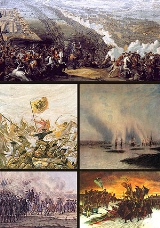
Great Northern War

Encyclopedia
The Great Northern War (1700–21) was a conflict in which a coalition led by the Tsardom of Russia
successfully contested the supremacy of the Swedish Empire
in northern Central Europe
and Eastern Europe
. The initial leaders of the anti-Swedish alliance were Peter I the Great of Russia, Frederick IV
of Denmark–Norway
and August II the Strong of Saxe
-Poland-Lithuania. Frederik IV and August II were forced out of the alliance in 1700 and 1706 respectively, but re-joined it in 1709. George I
of Brunswick-Lüneburg
(Hanover) joined the coalition in 1714 for Hanover and in 1717 for Britain, and Frederick William I
of Brandenburg-Prussia
joined it in 1715.
Charles XII
led the Swedish army. On the Swedish side were Holstein-Gottorp
, several Polish and Lithuanian magnates under Stanisław Leszczyński (1704–10) and cossack
s under the Ukrainian Hetman Ivan Mazepa
(1708–10). The Ottoman Empire
temporarily hosted Charles XII of Sweden and intervened against Peter I.
The war started when an alliance of Denmark–Norway
, Saxony
, Poland-Lithuania and Russia
declared war on the Swedish Empire
, launching a threefold attack at Swedish Holstein-Gottorp
, Swedish Livonia
, and Swedish Ingria
, sensing an opportunity as Sweden
was ruled by the young Karl XII (also called Charles XII), who was 18 years old and inexperienced at the time. Sweden parried the Danish and Russian attacks at Travendal
and Narva
, and in a counter-offensive pushed August II's forces through Lithuania and Poland to Saxony, dethroning August on the way and forcing him to acknowledge defeat in the Treaty of Altranstädt
, which also secured the extradition and execution of Johann Reinhold Patkul, architect of the alliance seven years' earlier. Peter I had meanwhile recovered and gained ground in Sweden's Baltic provinces, where he cemented Russia's access to the Baltic Sea
by founding Saint Petersburg
in 1703. Charles XII moved from Saxony into Russia
to confront Peter, but the campaign ended with the destruction of the main Swedish army in Poltava
(now Ukraine), and Charles's exile in Ottoman Bender. Russian pursuit was halted at the Pruth river by the Ottoman army.
After Poltava, the initial anti-Swedish coalition was re-established and subsequently joined by Hanover and Prussia. The remaining Swedish forces south and east of the Baltic Sea were evicted, with the last city, Riga, falling in 1710. Most of the Swedish dominions
were partitioned among the coalition members, destroying the Swedish dominium maris baltici
. Sweden proper was invaded by Denmark–Norway from the West and by Russia from the East, occupying all of Finland by 1714. Though the Danish attacks were repulsed
, Russia managed to occupy Finland and inflict severe losses on the Swedish navy and coastal fortresses. Charles XII opened up a Norwegian front
, but was killed in Fredriksten
in 1718.
The war ended with a defeat for Sweden, leaving Russia as the new major power in the Baltic Sea
and a new important player in European politics — it began of a pattern of Russian expansion that would only be stopped two centuries later
.
The formal conclusion of the war was marked by the Swedish-Hanoveranian and Swedish-Prussian Treaties of Stockholm
(1719), the Dano-Swedish Treaty of Frederiksborg
(1720), and the Russo-Swedish Treaty of Nystad
(1721). Therein, Sweden ceded her exemption from the sound dues
, lost all her dominions except for Finland and the northern part of Swedish Pomerania
, and ended her alliance with Holstein-Gottorp. Hanover gained Bremen-Verden
, Brandenburg-Prussia incorporated the Oder
estuary, Russia secured the Baltic provinces, and Denmark strengthened her position in Schleswig-Holstein
. In Sweden, the absolute monarchy
had come to an end with Charles XII's death, and the Age of Liberty began.
created a Baltic
empire centred on the Gulf of Finland
and comprising the provinces of Karelia
, Ingria
, Estonia
, and Livonia
. During the Thirty Years' War
Sweden gained tracts in Germany
as well, including Western Pomerania
, Wismar
, the Duchy of Bremen, and Verden
. During the same period Sweden conquered Danish and Norwegian provinces north of the Sound
(1645; 1658). These victories may be ascribed to a well-trained army, which despite its comparatively small size was far more professional than most continental armies, and also to a modernization of administration (both civilian and military) in the course of the 17th century which enabled the monarchy to harness the resources of the country and its empire in an effective way. Fighting in the field, the Swedish army was able, in particular, to make quick, sustained marches across large tracts of land and to maintain a high rate of small arms
fire due to proficient military drill.
However, the Swedish state ultimately proved unable to support and maintain its army in a prolonged war. Campaigns on the continent had been proposed on the basis that the army would be financially self-supporting through plunder and taxation of newly gained land, a concept shared by most major powers of the period. The cost of the warfare proved to be much higher than the occupied countries could fund, and Sweden's coffers, and resources in manpower, were eventually drained in the course of long conflicts.
The foreign interventions in Russia during the Time of Troubles
resulted in Swedish gains in the Treaty of Stolbovo
(1617). The treaty deprived Russia of direct access to the Baltic Sea
. Russian fortunes began to reverse in the final years of the 17th century, notably with the rise to power of Peter I (The Great)
, who looked to address the earlier losses and re-establish a Baltic presence. In the late 1690s, the adventurer Johann Patkul
managed to ally Russia with Denmark and Saxony by the secret Treaty of Preobrazhenskoye
and in 1700 the three powers attacked.
Charles XII of Sweden
, Frederick IV of Holstein-Gottorp
, August II and Frederik IV of Denmark–Norway were all grandsons of Frederik III of Denmark–Norway succeeded Charles XI of Sweden
in 1697, aged 14. From his predecessor, he took over the Swedish Empire as an absolute monarch. Charles XI had tried to keep the empire out of wars, and concentrated on inner reforms such as reduction
and allotment
, which had strengthened the monarch's status and the empire's military abilities. Charles XII refrained from all kinds of luxury and alcohol and usage of the French language. He preferred the life of an ordinary soldier on horseback, not that of contemporary baroque courts. He determinedly pursued his goal of dethroning his adversaries, whom he considered unworthy of their thrones due to broken promises, thereby refusing to take several chances to make peace. During the war, the most important Swedish commanders besides Charles XII were his close friend Carl Gustav Rehnskiöld
, also Magnus Stenbock
and Adam Ludwig Lewenhaupt
.
Charles Frederick
, son of Frederick IV, Duke of Holstein-Gottorp
(a cousin of Charles XII), and Hedvig Sophia
, daughter of Charles XI of Sweden; was the Swedish heir since 1702. He claimed the throne upon Charles XII's death, but was supplanted by Ulrike Eleonora. Charles Frederick was married to a daughter of Peter I, Anna Petrovna.
Ivan Mazepa
was a Ukrainian cossack
hetman who fought for Russia but defected to Charles XII in 1708. Mazepa died in 1710 in Ottoman exile.
into a modernized empire
relying on trade and on a strong, professional army and navy. He greatly expanded the size of Russia during his reign while providing access to the Baltic, Black, and Caspian Seas. The most important Russian commanders besides Peter were Aleksandr Danilovich Menshikov
and Boris Sheremetev.
August II, The Strong, elector of Saxony
and another cousin of Charles XII, gained the Polish crown after the death of Jan Sobieski in 1696. His ambitions to transform the Polish–Lithuanian Commonwealth into an absolute monarchy were not realized. His meeting with Peter the Great in Prawa in September 1698, where the plans were made to attack Sweden, became legendary for its decadence.
Frederik IV of Denmark–Norway, another cousin of Charles XII, succeeded Christian V
in 1699 and continued his anti-Swedish policies. After the setbacks of 1700, he focused on transforming his state, an absolute monarchy, in a manner similar to Charles XI of Sweden. He did not achieve his main goal: to regain the former eastern Danish provinces lost to Sweden in the course of the 17th century. He was not able to keep northern Swedish Pomerania, Danish from 1715 to 1720. He did put an end to the Swedish threat south of Denmark. He ended Sweden's exemption from the Sound Dues (transit taxes/tariffs on cargo moved between the North Sea and the Baltic Sea).
Frederick William I
entered the war as elector of Brandenburg and king in Prussia
- the royal title had been secured in 1701. He was determined to gain the Oder
estuary with its access to the Baltic Sea
for the Brandenburgian core areas, which had been a state goal for centuries
.
George I
of the House of Hanover
, elector of Brunswick-Lüneburg
and since 1714 king of Great Britain
and Ireland
, took the opportunity to connect his land-locked German electorate to the North Sea
.
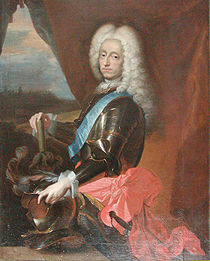 In 1700, Charles XII had a standing army of 77,000 men (based on annual training). By 1707 this number had swollen to at least 120,000 despite casualties.
Russia was able to mobilize a larger army, but could not put all of them into action simultaneously. The Russian mobilization system was ineffective and the expanding nation needed to be defended in many locations. A grand mobilization covering Russia's vast territories would have been unrealistic. Peter I tried to raise his army's morale to Swedish levels.
Denmark contributed 20,000 men in their invasion of Holstein-Gottorp and more on other fronts.
Poland and Saxony together could mobilize at least 100,000 men.
directed his first attack against Sweden's ally Holstein-Gottorp
. In 1697, Danish forces had leveled several of Gottorp's fortresses. In March 1700, a Danish army laid siege to Tönning
. Simultaneously, August II's forces advanced through Swedish Livonia
, captured Dünamünde and laid siege to Riga
. Earlier attempts to storm Riga had been made in December 1699.
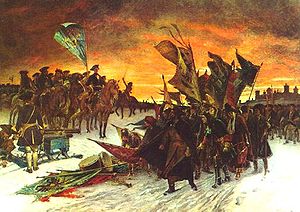 Charles XII of Sweden
first focused on attacking Denmark. The Swedish navy was able to outmaneuver the Danish Sound
blockade and deploy an army near the Danish capital, Copenhagen
. This surprise move and pressure by the Maritime Powers (Great Britain
and the Dutch Republic
) forced Denmark–Norway to withdraw from the war in August 1700 according to the terms of the Peace of Travendal
.
Charles XII was now able to speedily deploy his army to the eastern coast of the Baltic Sea
and face his remaining enemies: besides the army of Augustus II in Livonia, an army of Russian czar Peter I
was already on its way to invade Swedish Ingria
, where it laid siege to Narva
in October. In November, the Russian and Swedish armies met at the First Battle of Narva
where the Russians suffered a crushing defeat.
After the dissolution of the first coalition through the peace of Travendal
and with the victory at Narva; the Swedish chancellor, Benedict Oxenstjerna, attempted to use the bidding for the favor of Sweden by France
and the Maritime Powers (then on the eve of the War of the Spanish Succession
) to end the war and make Charles an arbiter of Europe.
, King of Poland and Grand Duke of Lithuania
. Charles crossed into the Polish–Lithuanian Commonwealth and decisively defeated the Saxe-Polish forces in the Battle of Kliszów
in 1702. This successful invasion enabled Charles XII to dethrone August II and coerce the Polish sejm
to replace him with Stanisław Leszczyński in 1704. August II resisted, still possessing control of his native Saxony, but was decisively defeated at the Battle of Fraustadt
in 1706, a battle sometimes compared to the Ancient Battle of Cannae
due to the Swedish forces' use of double envelopment, with a deadly result for the Saxon army. August II was forced to sign the Treaty of Altranstadt
in 1706 in which he made peace with the Swedish Empire, renounced his claims to the Polish–Lithuanian crown, accepted Stanisław Leszczyński as king, and ended his alliance with Russia. Patkul was also extradited and executed by breaking on the wheel in 1707, an incident which given his diplomatic immunity, infuriated opinion against the Swedish king, who then was expected to win the war against the only hostile power remaining, Czar Peter's Russia.
proved a grave setback for Peter the Great, but the shift of Charles XII's army to the Polish-Saxon threat soon afterwards, instead of pursuing Peter, provided the latter with an opportunity to recover and gain ground in the Baltic provinces. Russian victories at Erastfer
and Nöteborg (Shlisselburg)
provided access to Ingria
in 1703, and here Peter began building his new capital, Saint Petersburg
. on the site of the earlier Swedish fortress Nyen
. Already before the launching of the war, Peter had decided to build a navy
and a modern-style army, based primarily on infantry drilled in the use of firearms. Due to the efforts of general Adam Ludwig Lewenhaupt
, who fended the Russians off with smaller forces in the battles of Gemäuerthof
and Jakobstadt, most of the Baltic provinces held by Sweden remained under her control.
Charles spent the years 1702-06 in a protracted struggle with August the Strong; he had already inflicted defeat on him at Riga
in June 1701 and took Warsaw the following year, but trying to force a decisive defeat proved elusive. Charles wanted not just to defeat the army but to depose August (see above), whom he regarded as especially treasonous, and have him replaced with someone who would be a Swedish ally, and this goal proved hard to achieve. After years of marches and fighting around Poland he finally had to invade August's hereditary Saxony
to bring him out of the war. In the treaty of Altranstädt (1706)
, August was indeed forced to step down from the Polish throne, but Charles had lost a valuable time advantage over his main enemy in the East, Peter I, who had had the time to recover and build up a new and better army.
At this point, in 1707, Peter offered to retrocede everything he had so far occupied (essentially Ingria) except Saint Petersburg and the line of the Neva, to avoid a full-scale war, but Charles XII refused. Instead he initiated a march from Saxony to invade Russia
. Though his primary goal was Moscow
, the strength of his forces was sapped by the cold weather (the winter of 1708/09 being one of the most severe in modern European history) and Peter's use of scorched earth
tactics. When the main army turned south to recover in Ukraine
, the second army with supplies and reinforcements was intercepted and routed in Lesnaya
- so were the supplies and reinforcements of Swedish ally Ivan Mazepa
in Baturyn
. Charles was crushingly defeated by a larger Russian force under Peter in the Battle of Poltava
and fled to the Ottoman Empire
while the remains of his army surrendered at Perevolochna
.
This shattering defeat did not end the war, although it decided it. Denmark and Saxony joined the war again and Augustus the Strong, through the politics of Boris Kurakin
, regained the Polish throne. Peter continued his campaigns in the Baltics, and eventually he built up a powerful navy. In 1710 the Russian forces captured Riga
, at the time the most populated city in the Swedish realm, and Tallinn
, evicting the Swedes from the Baltic provinces, now integrated in the Russian Empire by the capitulation of Estonia and Livonia
.
; Frederik IV of Denmark–Norway with Augustus the Strong in the Treaty of Dresden (1709)
; and Russia with Denmark–Norway in the subsequent Treaty of Copenhagen
. In the Treaty of Hanover (1710)
, Brunswick-Lüneburg
(Hanover
) whose elector was to become George I of Great Britain
allied with Russia. In 1713, Brandenburg-Prussia
allied with Russia in the Treaty of Schwedt
. George I of Great Britain and Hanover concluded three alliances in 1715: the Treaty of Berlin
with Denmark–Norway, the Treaty of Stettin
with Brandenburg-Prussia, and the Treaty of Greifswald
with Russia.
, founding a colony in front of Bender, Moldova
. Peter I demanded Charles's eviction, and when the sultan refused, Peter decided to force it by invading the Ottoman Empire. Peter's army was trapped by an Ottoman army at the Pruth river. Peter managed to negotiate a retreat, making a few territorial concessions and promising to withdraw his forces from the Holy Roman Empire
as well as allowing Charles's return to Sweden. These terms were laid out in the Treaty of Adrianople (1713). Charles showed no interest in returning, established a provisional court in his colony, and sought to persuade the sultan to engage in an Ottoman-Swedish assault on Russia. The sultan put an end to the generous hospitality granted and had the king arrested in what became known as the "kalabalik"
in 1713. Charles was then confined at Timurtash and Demotika; later he abandoned his hopes for an Ottoman front and returned to Sweden in a 14-day ride.
, pursued by the coalition. In 1711, siege was laid to Stralsund. Yet the town could not be taken due to the arrival of a Swedish relief army, which secured the Pomeranian pocket before turning west to defeat an allied army in the Battle of Gadebusch
. Pursued by coalition forces, the Swedish army was trapped and surrendered in the Siege of Tönning
.
In 1714, Charles XII returned from the Ottoman Empire, arriving in Stralsund
in November. In nearby Greifswald
, already lost to Sweden, Russian tsar Peter the Great and British king George I, in his position as Elector of Hanover, had just signed an alliance on 17 (OS)
/28 (NS)
October. Previoulsy a formally neutral party in the Pomeranian campaigns, Brandenburg-Prussia
openly joined the coalition by declaring war on Sweden in the summer of 1715. Charles was then at war with much of Northern Europe, and Stralsund was doomed. Charles remained there until December 1715, escaping only days before Stralsund fell
. When Wismar
surrendered in 1716, all of Sweden’s Baltic and German possessions were lost.
, starting in February 1716, to force Denmark–Norway into a separate peace treaty. Furthermore, he attempted to bar Great Britain
access to the Baltic Sea. In search for allies, Charles XII also negotiated with the British Jacobite party
. This resulted in Great Britain declaring war on Sweden in 1717. The Norwegian campaigns were halted and the army withdrawn
when Charles XII was shot dead while besieging Norwegian Fredriksten
on 30 November 1718 (OS
). He was succeeded by his sister, Ulrika Eleonora
.
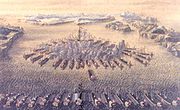 In 1714, Peter's galley navy managed to capture a small detachment of the Swedish navy in the first Russian naval victory
near Hanko peninsula. The Russian army occupied Finland
mostly in 1713-1714, Viborg
had been captured already in 1710. The last stand of the Finnish troops was in the battle of Napue
in early 1714 in Isokyrö
, Ostrobothnia
. The occupation period of Finland in 1714-1721 is known as the Greater Wrath
.
on August 13. The Russians returned again in 1720 and 1721 although the presence of a British naval squadron limited the extent of the raids (after making peace with Sweden in 1719, the British had switched over to an anti-Russian policy in the Baltic).
's death, the anti-Swedish allies became increasingly divided on how to fill the power gap left behind by the defeated and retreating Swedish armies. George I and Frederik IV both coveted hegemony in northern Germany, while August the Strong was concerned about Frederick William I's ambitions on the southeastern Baltic coast. Peter the Great, whose forces were spread all around the Baltic Sea, envisioned hegemony in East Central Europe and sought to establish naval bases as far west as Mecklenburg
. In January 1719, George I, August II and emperor Charles VI
concluded a treaty in Vienna aimed at the reduction of Russia's frontiers to the pre-war limits.
Hanover-Great Britain and Brandenburg-Prussia thereupon negotiated separate peace treaties with Sweden, the treaties of Stockholm
in 1719 and early 1720, which partitioned Sweden's northern German dominions among the parties. The negotiations were mediated by French
diplomats, who sought to prevent a complete collapse of Sweden's position on the southern Baltic coast and achieved that Sweden was to retain Wismar
and northern Swedish Pomerania
. Hanover gained Swedish Bremen-Verden
, Brandenburg-Prussia incorporated southern Swedish Pomerania.
In addition to the rivalries in the anti-Swedish coalition, there was an inner-Swedish rivalry between Charles Frederick, Duke of Holstein-Gottorp
, and Frederick I of Hesse-Cassel
for the Swedish throne. The Gottorp party succumbed and Ulrike Eleonora, wife of Frederick I, transferred power to her husband in May 1720. When peace was concluded with Denmark, the anti-Swedish coalition had already fallen apart, and Denmark was not in a military position to negotiate a return of her former eastern provinces across the sound
. Frederick I was however willing to cede the Swedish support for his rival in Holstein-Gottorp, which came under Danish control and the northern part annexed, and furthermore cede the Swedish privilege of exemption from the sound dues
. A respective treaty was concluded in Frederiksborg
in June 1720.
When Sweden finally was at peace with Hanover, Great Britain, Brandenburg-Prussia and Denmark–Norway, she hoped that the anti-Russian sentiments of the Vienna parties and France would culminate in an alliance which would restore to her her Russian-occupied eastern provinces. Yet, primarily due to internal conflicts in Great Britain and France, that did not happen. Therefore, the war was finally concluded by the Treaty of Nystad
between Russia and Sweden in Uusikaupunki
(Nystad) on 30 August 1721 (OS
). Finland was returned to Sweden, while Swedish Estonia
, Livonia
, Ingria
, Kexholm and the bulk of Karelia
were ceded to Russia. Sweden's dissatisfaction with the result led to fruitless attempts at recovering the lost territories in the course of the following century, such as Hats' Russian War, and Gustav III's Russian War.
Saxe-Poland-Lithuania and Sweden did not conclude a formal peace treaty, instead, they renewed the Peace of Oliva that had ended the Second Northern War
in 1660.
Sweden had lost almost all of its "overseas" holdings gained in the 17th century, and ceased to be a major power. Russia gained its Baltic territories, and became the greatest power in Eastern Europe
.
Tsardom of Russia
The Tsardom of Russia was the name of the centralized Russian state from Ivan IV's assumption of the title of Tsar in 1547 till Peter the Great's foundation of the Russian Empire in 1721.From 1550 to 1700, Russia grew 35,000 km2 a year...
successfully contested the supremacy of the Swedish Empire
Swedish Empire
The Swedish Empire refers to the Kingdom of Sweden between 1561 and 1721 . During this time, Sweden was one of the great European powers. In Swedish, the period is called Stormaktstiden, literally meaning "the Great Power Era"...
in northern Central Europe
Central Europe
Central Europe or alternatively Middle Europe is a region of the European continent lying between the variously defined areas of Eastern and Western Europe...
and Eastern Europe
Eastern Europe
Eastern Europe is the eastern part of Europe. The term has widely disparate geopolitical, geographical, cultural and socioeconomic readings, which makes it highly context-dependent and even volatile, and there are "almost as many definitions of Eastern Europe as there are scholars of the region"...
. The initial leaders of the anti-Swedish alliance were Peter I the Great of Russia, Frederick IV
Frederick IV of Denmark
Frederick IV was the king of Denmark and Norway from 1699 until his death. Frederick was the son of King Christian V of Denmark and Norway and Charlotte Amalie of Hesse-Kassel .-Foreign affairs:...
of Denmark–Norway
Denmark–Norway
Denmark–Norway is the historiographical name for a former political entity consisting of the kingdoms of Denmark and Norway, including the originally Norwegian dependencies of Iceland, Greenland and the Faroe Islands...
and August II the Strong of Saxe
Electorate of Saxony
The Electorate of Saxony , sometimes referred to as Upper Saxony, was a State of the Holy Roman Empire. It was established when Emperor Charles IV raised the Ascanian duchy of Saxe-Wittenberg to the status of an Electorate by the Golden Bull of 1356...
-Poland-Lithuania. Frederik IV and August II were forced out of the alliance in 1700 and 1706 respectively, but re-joined it in 1709. George I
George I of Great Britain
George I was King of Great Britain and Ireland from 1 August 1714 until his death, and ruler of the Duchy and Electorate of Brunswick-Lüneburg in the Holy Roman Empire from 1698....
of Brunswick-Lüneburg
Brunswick-Lüneburg
The Duchy of Brunswick-Lüneburg , or more properly Duchy of Brunswick and Lüneburg, was an historical ducal state from the late Middle Ages until the late Early Modern era within the North-Western domains of the Holy Roman Empire of the German Nation, in what is now northern Germany...
(Hanover) joined the coalition in 1714 for Hanover and in 1717 for Britain, and Frederick William I
Frederick William I of Prussia
Frederick William I of the House of Hohenzollern, was the King in Prussia and Elector of Brandenburg from 1713 until his death...
of Brandenburg-Prussia
Brandenburg-Prussia
Brandenburg-Prussia is the historiographic denomination for the Early Modern realm of the Brandenburgian Hohenzollerns between 1618 and 1701. Based in the Electorate of Brandenburg, the main branch of the Hohenzollern intermarried with the branch ruling the Duchy of Prussia, and secured succession...
joined it in 1715.
Charles XII
Charles XII of Sweden
Charles XII also Carl of Sweden, , Latinized to Carolus Rex, Turkish: Demirbaş Şarl, also known as Charles the Habitué was the King of the Swedish Empire from 1697 to 1718...
led the Swedish army. On the Swedish side were Holstein-Gottorp
Holstein-Gottorp
Holstein-Gottorp or Schleswig-Holstein-Gottorp is the historiographical name, as well as contemporary shorthand name, for the parts of the duchies of Schleswig and Holstein that were ruled by the dukes of Schleswig-Holstein-Gottorp. Other parts of the duchies were ruled by the kings of Denmark. The...
, several Polish and Lithuanian magnates under Stanisław Leszczyński (1704–10) and cossack
Cossack
Cossacks are a group of predominantly East Slavic people who originally were members of democratic, semi-military communities in what is today Ukraine and Southern Russia inhabiting sparsely populated areas and islands in the lower Dnieper and Don basins and who played an important role in the...
s under the Ukrainian Hetman Ivan Mazepa
Ivan Mazepa
Ivan Stepanovych Mazepa , Cossack Hetman of the Hetmanate in Left-bank Ukraine, from 1687–1708. He was famous as a patron of the arts, and also played an important role in the Battle of Poltava where after learning of Peter I's intent to relieve him as acting Hetman of Ukraine and replace him...
(1708–10). The Ottoman Empire
Ottoman Empire
The Ottoman EmpireIt was usually referred to as the "Ottoman Empire", the "Turkish Empire", the "Ottoman Caliphate" or more commonly "Turkey" by its contemporaries...
temporarily hosted Charles XII of Sweden and intervened against Peter I.
The war started when an alliance of Denmark–Norway
Denmark–Norway
Denmark–Norway is the historiographical name for a former political entity consisting of the kingdoms of Denmark and Norway, including the originally Norwegian dependencies of Iceland, Greenland and the Faroe Islands...
, Saxony
Electorate of Saxony
The Electorate of Saxony , sometimes referred to as Upper Saxony, was a State of the Holy Roman Empire. It was established when Emperor Charles IV raised the Ascanian duchy of Saxe-Wittenberg to the status of an Electorate by the Golden Bull of 1356...
, Poland-Lithuania and Russia
Tsardom of Russia
The Tsardom of Russia was the name of the centralized Russian state from Ivan IV's assumption of the title of Tsar in 1547 till Peter the Great's foundation of the Russian Empire in 1721.From 1550 to 1700, Russia grew 35,000 km2 a year...
declared war on the Swedish Empire
Swedish Empire
The Swedish Empire refers to the Kingdom of Sweden between 1561 and 1721 . During this time, Sweden was one of the great European powers. In Swedish, the period is called Stormaktstiden, literally meaning "the Great Power Era"...
, launching a threefold attack at Swedish Holstein-Gottorp
Holstein-Gottorp
Holstein-Gottorp or Schleswig-Holstein-Gottorp is the historiographical name, as well as contemporary shorthand name, for the parts of the duchies of Schleswig and Holstein that were ruled by the dukes of Schleswig-Holstein-Gottorp. Other parts of the duchies were ruled by the kings of Denmark. The...
, Swedish Livonia
Swedish Livonia
- Swedish infantry and cavalry regiments:Infantry regiments:* Garnisonsregementet i Riga * Guvenörsregementet i Riga * Livländsk infanteribataljon I...
, and Swedish Ingria
Swedish Ingria
Swedish Ingria was a dominion of the Swedish Empire from 1580 to 1595 and then again from 1617 to 1721, when it was ceded to the Russian Empire in the Treaty of Nystad....
, sensing an opportunity as Sweden
Swedish Empire
The Swedish Empire refers to the Kingdom of Sweden between 1561 and 1721 . During this time, Sweden was one of the great European powers. In Swedish, the period is called Stormaktstiden, literally meaning "the Great Power Era"...
was ruled by the young Karl XII (also called Charles XII), who was 18 years old and inexperienced at the time. Sweden parried the Danish and Russian attacks at Travendal
Peace of Travendal
The Peace of Travendal was a peace treaty concluded during the Great Northern War on 8 or 18 August 1700 between the Swedish Empire, Denmark-Norway and Holstein-Gottorp in Traventhal....
and Narva
Battle of Narva (1700)
The Battle of Narva on 19 November 1700 was an early battle in the Great Northern War. A Swedish relief army under Charles XII of Sweden defeated a Russian siege force three times its size. Before, Charles XII had forced Denmark-Norway to sign the Treaty of Travendal...
, and in a counter-offensive pushed August II's forces through Lithuania and Poland to Saxony, dethroning August on the way and forcing him to acknowledge defeat in the Treaty of Altranstädt
Treaty of Altranstädt (1706)
The Treaty of Altranstädt was concluded between Charles XII of Sweden and Augustus the Strong of Saxony and Poland-Lithuania, on 13 October 1706, during the Great Northern War...
, which also secured the extradition and execution of Johann Reinhold Patkul, architect of the alliance seven years' earlier. Peter I had meanwhile recovered and gained ground in Sweden's Baltic provinces, where he cemented Russia's access to the Baltic Sea
Baltic Sea
The Baltic Sea is a brackish mediterranean sea located in Northern Europe, from 53°N to 66°N latitude and from 20°E to 26°E longitude. It is bounded by the Scandinavian Peninsula, the mainland of Europe, and the Danish islands. It drains into the Kattegat by way of the Øresund, the Great Belt and...
by founding Saint Petersburg
Saint Petersburg
Saint Petersburg is a city and a federal subject of Russia located on the Neva River at the head of the Gulf of Finland on the Baltic Sea...
in 1703. Charles XII moved from Saxony into Russia
Charles XII invasion of Russia
The invasion of Russia by Charles XII of Sweden was a campaign undertaken during the Great Northern War between Sweden and the allied states of Russia, Poland, and Denmark...
to confront Peter, but the campaign ended with the destruction of the main Swedish army in Poltava
Battle of Poltava
The Battle of Poltava on 27 June 1709 was the decisive victory of Peter I of Russia over the Swedish forces under Field Marshal Carl Gustav Rehnskiöld in one of the battles of the Great Northern War. It is widely believed to have been the beginning of Sweden's decline as a Great Power; the...
(now Ukraine), and Charles's exile in Ottoman Bender. Russian pursuit was halted at the Pruth river by the Ottoman army.
After Poltava, the initial anti-Swedish coalition was re-established and subsequently joined by Hanover and Prussia. The remaining Swedish forces south and east of the Baltic Sea were evicted, with the last city, Riga, falling in 1710. Most of the Swedish dominions
Dominions of Sweden
The Dominions of Sweden or Svenska besittningar were territories that historically came under control of the Swedish Crown, but never became fully integrated with Sweden. This generally meant that they were ruled by Governors-General under the Swedish monarch, but within certain limits retained...
were partitioned among the coalition members, destroying the Swedish dominium maris baltici
Dominium maris baltici
The establishment of a was one of the primary political aims of the Danish and Swedish kingdoms in the late medieval and Early Modern eras...
. Sweden proper was invaded by Denmark–Norway from the West and by Russia from the East, occupying all of Finland by 1714. Though the Danish attacks were repulsed
Battle of Helsingborg (1710)
The Battle of Helsingborg was Denmark's failed and final attempt to regain the Scanian lands, lost to Sweden in 1658.On the Ringstorp heights northwest of Helsingborg, 14,000 Danish invaders under Jørgen Rantzau were decisively defeated by an equally large Swedish army under Magnus...
, Russia managed to occupy Finland and inflict severe losses on the Swedish navy and coastal fortresses. Charles XII opened up a Norwegian front
Great Northern War and Norway
The Great Northern War was the war fought between a coalition of Denmark–Norway, Russia and Saxony-Poland on one side and Sweden on the other side from 1700 to 1721. It started by a coordinated attack on Sweden by the coalition in 1700, and ended 1721 with the conclusion of the Treaty of Nystad,...
, but was killed in Fredriksten
Fredriksten
-History:This Fortresses was constructed ny Denmark-Norway in the 17th century as a replacement for the border fortress at Bohus, which had been lost when the province of Bohuslän was ceded to Sweden by the terms of the Treaty of Roskilde in 1658...
in 1718.
The war ended with a defeat for Sweden, leaving Russia as the new major power in the Baltic Sea
Baltic Sea
The Baltic Sea is a brackish mediterranean sea located in Northern Europe, from 53°N to 66°N latitude and from 20°E to 26°E longitude. It is bounded by the Scandinavian Peninsula, the mainland of Europe, and the Danish islands. It drains into the Kattegat by way of the Øresund, the Great Belt and...
and a new important player in European politics — it began of a pattern of Russian expansion that would only be stopped two centuries later
Russo-Japanese War
The Russo-Japanese War was "the first great war of the 20th century." It grew out of rival imperial ambitions of the Russian Empire and Japanese Empire over Manchuria and Korea...
.
The formal conclusion of the war was marked by the Swedish-Hanoveranian and Swedish-Prussian Treaties of Stockholm
Treaty of Stockholm (Great Northern War)
With the death of Charles XII of Sweden in 1718 it was obvious that the Great Northern War was coming to a close. His successor Frederick I began negotiating the Treaty of Stockholm, which refers to the two treaties signed in 1719 and 1720 that ended the war between Sweden on one side and Hanover...
(1719), the Dano-Swedish Treaty of Frederiksborg
Treaty of Frederiksborg
The Treaty of Frederiksborg refers to the treaty signed at Frederiksborg Palace on 3 July 1720 that ended the Great Northern War between Sweden and Denmark-Norway. Sweden paid 600,000 Riksdaler in damages, broke the alliance with Holstein and forfeited its right to duty free passage of Öresund...
(1720), and the Russo-Swedish Treaty of Nystad
Treaty of Nystad
The Treaty of Nystad was the last peace treaty of the Great Northern War. It was concluded between the Tsardom of Russia and Swedish Empire on 30 August / 10 September 1721 in the then Swedish town of Nystad , after Sweden had settled with the other parties in Stockholm and Frederiksborg.During...
(1721). Therein, Sweden ceded her exemption from the sound dues
Sound Dues
The Sound Dues were a toll on the use of the Sound which constituted up to two thirds of Denmark's state income in the 16th and 17th centuries...
, lost all her dominions except for Finland and the northern part of Swedish Pomerania
Swedish Pomerania
Swedish Pomerania was a Dominion under the Swedish Crown from 1630 to 1815, situated on what is now the Baltic coast of Germany and Poland. Following the Polish War and the Thirty Years' War, Sweden held extensive control over the lands on the southern Baltic coast, including Pomerania and parts...
, and ended her alliance with Holstein-Gottorp. Hanover gained Bremen-Verden
Bremen-Verden
Bremen-Verden, formally the Duchies of Bremen and Verden , were two territories and immediate fiefs of the Holy Roman Empire, which emerged and gained Imperial immediacy in 1180...
, Brandenburg-Prussia incorporated the Oder
Oder
The Oder is a river in Central Europe. It rises in the Czech Republic and flows through western Poland, later forming of the border between Poland and Germany, part of the Oder-Neisse line...
estuary, Russia secured the Baltic provinces, and Denmark strengthened her position in Schleswig-Holstein
Schleswig-Holstein
Schleswig-Holstein is the northernmost of the sixteen states of Germany, comprising most of the historical duchy of Holstein and the southern part of the former Duchy of Schleswig...
. In Sweden, the absolute monarchy
Absolute monarchy
Absolute monarchy is a monarchical form of government in which the monarch exercises ultimate governing authority as head of state and head of government, his or her power not being limited by a constitution or by the law. An absolute monarch thus wields unrestricted political power over the...
had come to an end with Charles XII's death, and the Age of Liberty began.
Background
Between 1560 and 1658, SwedenSweden proper
Sweden proper, , is a term used to distinguish those territories that were fully integrated into the Kingdom of Sweden, as opposed to the dominions and possessions of, or states in union with, Sweden....
created a Baltic
Baltic region
The terms Baltic region, Baltic Rim countries, and Baltic Rim refer to slightly different combinations of countries in the general area surrounding the Baltic Sea.- Etymology :...
empire centred on the Gulf of Finland
Gulf of Finland
The Gulf of Finland is the easternmost arm of the Baltic Sea. It extends between Finland and Estonia all the way to Saint Petersburg in Russia, where the river Neva drains into it. Other major cities around the gulf include Helsinki and Tallinn...
and comprising the provinces of Karelia
Karelia
Karelia , the land of the Karelian peoples, is an area in Northern Europe of historical significance for Finland, Russia, and Sweden...
, Ingria
Ingria
Ingria is a historical region in the eastern Baltic, now part of Russia, comprising the southern bank of the river Neva, between the Gulf of Finland, the Narva River, Lake Peipus in the west, and Lake Ladoga and the western bank of the Volkhov river in the east...
, Estonia
Estonia
Estonia , officially the Republic of Estonia , is a state in the Baltic region of Northern Europe. It is bordered to the north by the Gulf of Finland, to the west by the Baltic Sea, to the south by Latvia , and to the east by Lake Peipsi and the Russian Federation . Across the Baltic Sea lies...
, and Livonia
Livonia
Livonia is a historic region along the eastern shores of the Baltic Sea. It was once the land of the Finnic Livonians inhabiting the principal ancient Livonian County Metsepole with its center at Turaida...
. During the Thirty Years' War
Thirty Years' War
The Thirty Years' War was fought primarily in what is now Germany, and at various points involved most countries in Europe. It was one of the most destructive conflicts in European history....
Sweden gained tracts in Germany
Germany
Germany , officially the Federal Republic of Germany , is a federal parliamentary republic in Europe. The country consists of 16 states while the capital and largest city is Berlin. Germany covers an area of 357,021 km2 and has a largely temperate seasonal climate...
as well, including Western Pomerania
Pomerania
Pomerania is a historical region on the south shore of the Baltic Sea. Divided between Germany and Poland, it stretches roughly from the Recknitz River near Stralsund in the West, via the Oder River delta near Szczecin, to the mouth of the Vistula River near Gdańsk in the East...
, Wismar
Wismar
Wismar , is a small port and Hanseatic League town in northern Germany on the Baltic Sea, in the state of Mecklenburg-Vorpommern,about 45 km due east of Lübeck, and 30 km due north of Schwerin. Its natural harbour, located in the Bay of Wismar is well-protected by a promontory. The...
, the Duchy of Bremen, and Verden
Verden, Germany
Verden an der Aller, also called Verden or simply Verden , is a town in Lower Saxony, Germany, on the river Aller. It is the administrative centre of the district of Verden...
. During the same period Sweden conquered Danish and Norwegian provinces north of the Sound
Oresund
The Sound , is the strait that separates the Danish island Zealand from the southern Swedish province of Scania. Its width is just at the narrowest point between Helsingør, Denmark, and Helsingborg, Sweden...
(1645; 1658). These victories may be ascribed to a well-trained army, which despite its comparatively small size was far more professional than most continental armies, and also to a modernization of administration (both civilian and military) in the course of the 17th century which enabled the monarchy to harness the resources of the country and its empire in an effective way. Fighting in the field, the Swedish army was able, in particular, to make quick, sustained marches across large tracts of land and to maintain a high rate of small arms
Small arms
Small arms is a term of art used by armed forces to denote infantry weapons an individual soldier may carry. The description is usually limited to revolvers, pistols, submachine guns, carbines, assault rifles, battle rifles, multiple barrel firearms, sniper rifles, squad automatic weapons, light...
fire due to proficient military drill.
However, the Swedish state ultimately proved unable to support and maintain its army in a prolonged war. Campaigns on the continent had been proposed on the basis that the army would be financially self-supporting through plunder and taxation of newly gained land, a concept shared by most major powers of the period. The cost of the warfare proved to be much higher than the occupied countries could fund, and Sweden's coffers, and resources in manpower, were eventually drained in the course of long conflicts.
The foreign interventions in Russia during the Time of Troubles
Time of Troubles
The Time of Troubles was a period of Russian history comprising the years of interregnum between the death of the last Russian Tsar of the Rurik Dynasty, Feodor Ivanovich, in 1598, and the establishment of the Romanov Dynasty in 1613. In 1601-1603, Russia suffered a famine that killed one-third...
resulted in Swedish gains in the Treaty of Stolbovo
Treaty of Stolbovo
The Treaty of Stolbovo is a peace treaty of 1617 that ended the Ingrian War, fought between Sweden and Russia.After nearly two months of negotiations, representatives from Sweden and Russia met at the village of Stolbova, south of Lake Ladoga, on 27 February 1617.From the outset, Sweden had gone...
(1617). The treaty deprived Russia of direct access to the Baltic Sea
Baltic Sea
The Baltic Sea is a brackish mediterranean sea located in Northern Europe, from 53°N to 66°N latitude and from 20°E to 26°E longitude. It is bounded by the Scandinavian Peninsula, the mainland of Europe, and the Danish islands. It drains into the Kattegat by way of the Øresund, the Great Belt and...
. Russian fortunes began to reverse in the final years of the 17th century, notably with the rise to power of Peter I (The Great)
Peter I of Russia
Peter the Great, Peter I or Pyotr Alexeyevich Romanov Dates indicated by the letters "O.S." are Old Style. All other dates in this article are New Style. ruled the Tsardom of Russia and later the Russian Empire from until his death, jointly ruling before 1696 with his half-brother, Ivan V...
, who looked to address the earlier losses and re-establish a Baltic presence. In the late 1690s, the adventurer Johann Patkul
Johann Patkul
Johann Reinhold Patkul was a Livonian politician and agitator of Baltic German extraction.Patkul was born in prison at Stockholm, where his father had been imprisoned under suspicion of treason...
managed to ally Russia with Denmark and Saxony by the secret Treaty of Preobrazhenskoye
Treaty of Preobrazhenskoye
The Treaty of Preobrazhenskoye was negotiated by Johann Patkul and signed on November 22, 1699 in Preobrazhenskoye , a favoured residence of the tsar Peter the Great. It followed an informal meeting of Peter and Augustus at Rava in August 1698...
and in 1700 the three powers attacked.
Swedish camp
Charles XII of SwedenCharles XII of Sweden
Charles XII also Carl of Sweden, , Latinized to Carolus Rex, Turkish: Demirbaş Şarl, also known as Charles the Habitué was the King of the Swedish Empire from 1697 to 1718...
Charles XII of Sweden
Charles XII of Sweden
Charles XII also Carl of Sweden, , Latinized to Carolus Rex, Turkish: Demirbaş Şarl, also known as Charles the Habitué was the King of the Swedish Empire from 1697 to 1718...
, Frederick IV of Holstein-Gottorp
Frederick IV, Duke of Holstein-Gottorp
Duke Frederick IV of Holstein-Gottorp was Duke of Schleswig.He was born in Gottorp as the elder son of Duke Christian Albrecht of Holstein-Gottorp and Princess Frederika Amalia of Denmark...
, August II and Frederik IV of Denmark–Norway were all grandsons of Frederik III of Denmark–Norway succeeded Charles XI of Sweden
Charles XI of Sweden
Charles XI also Carl, was King of Sweden from 1660 until his death, in a period in Swedish history known as the Swedish empire ....
in 1697, aged 14. From his predecessor, he took over the Swedish Empire as an absolute monarch. Charles XI had tried to keep the empire out of wars, and concentrated on inner reforms such as reduction
Reduction (Sweden)
In the reductions in Sweden, fiefs that had been granted to the Swedish nobility were returned to the Crown.The first reduction under Charles X Gustav of Sweden in 1655 restored a quarter of "donations" made after 1632. In the Great Reduction of 1680 under Charles XI of Sweden the Crown...
and allotment
Swedish allotment system
The allotment system was a system used in Sweden for keeping a trained army at all times. This system came into use in around 1640, and was replaced in the early 1900s by the Swedish Armed Forces conscription system...
, which had strengthened the monarch's status and the empire's military abilities. Charles XII refrained from all kinds of luxury and alcohol and usage of the French language. He preferred the life of an ordinary soldier on horseback, not that of contemporary baroque courts. He determinedly pursued his goal of dethroning his adversaries, whom he considered unworthy of their thrones due to broken promises, thereby refusing to take several chances to make peace. During the war, the most important Swedish commanders besides Charles XII were his close friend Carl Gustav Rehnskiöld
Carl Gustav Rehnskiöld
Count Carl Gustav Rehnskiöld was a Swedish Field Marshal under the command of King Charles XII of Sweden. Despite being choleric and irritable, Rehnskiöld's military skills made him the chief military advisor and second-in-command to King Charles and earned him the epithet the "Parmenio of the...
, also Magnus Stenbock
Magnus Stenbock
Count Magnus Gustafsson Stenbock was a Swedish military officer at the time of the Great Northern War.He was the son of Gustaf Otto Stenbock and Christina Catharine de la Gardie....
and Adam Ludwig Lewenhaupt
Adam Ludwig Lewenhaupt
Adam Ludwig Lewenhaupt was a Swedish general.-Biography:Educated at Lund University, Rostock, Wittenberg and Uppsala, he originally pursued a career in the diplomatic arena, but found this occupation quite undesirable. He then became a soldier, served in the Austrian army against the Turks, and...
.
Charles Frederick
Charles Frederick, Duke of Holstein-Gottorp
Duke Charles Frederick of Holstein-Gottorp was the son of Frederick IV of Holstein-Gottorp and his wife, Hedvig Sophia, daughter of King Charles XI of Sweden...
, son of Frederick IV, Duke of Holstein-Gottorp
Frederick IV, Duke of Holstein-Gottorp
Duke Frederick IV of Holstein-Gottorp was Duke of Schleswig.He was born in Gottorp as the elder son of Duke Christian Albrecht of Holstein-Gottorp and Princess Frederika Amalia of Denmark...
(a cousin of Charles XII), and Hedvig Sophia
Hedvig Sophia of Sweden
Princess Hedvig Sophia Augusta of Sweden was a Swedish princess and a Duchess Consort of Holstein-Gottorp, the eldest child of King Charles XI of Sweden, and his spouse Queen Ulrica Eleanor. She was heir presumptive to the Swedish throne until her death and the Regent of the duchy of...
, daughter of Charles XI of Sweden; was the Swedish heir since 1702. He claimed the throne upon Charles XII's death, but was supplanted by Ulrike Eleonora. Charles Frederick was married to a daughter of Peter I, Anna Petrovna.
Ivan Mazepa
Ivan Mazepa
Ivan Stepanovych Mazepa , Cossack Hetman of the Hetmanate in Left-bank Ukraine, from 1687–1708. He was famous as a patron of the arts, and also played an important role in the Battle of Poltava where after learning of Peter I's intent to relieve him as acting Hetman of Ukraine and replace him...
was a Ukrainian cossack
Cossack
Cossacks are a group of predominantly East Slavic people who originally were members of democratic, semi-military communities in what is today Ukraine and Southern Russia inhabiting sparsely populated areas and islands in the lower Dnieper and Don basins and who played an important role in the...
hetman who fought for Russia but defected to Charles XII in 1708. Mazepa died in 1710 in Ottoman exile.
Allied camp
Peter I, The Great became Tsar in 1682 upon the death of his elder brother Feodor but did not become the actual ruler until 1689. He set forth reforming the country, turning the Russian tsardomTsardom of Russia
The Tsardom of Russia was the name of the centralized Russian state from Ivan IV's assumption of the title of Tsar in 1547 till Peter the Great's foundation of the Russian Empire in 1721.From 1550 to 1700, Russia grew 35,000 km2 a year...
into a modernized empire
Russian Empire
The Russian Empire was a state that existed from 1721 until the Russian Revolution of 1917. It was the successor to the Tsardom of Russia and the predecessor of the Soviet Union...
relying on trade and on a strong, professional army and navy. He greatly expanded the size of Russia during his reign while providing access to the Baltic, Black, and Caspian Seas. The most important Russian commanders besides Peter were Aleksandr Danilovich Menshikov
Aleksandr Danilovich Menshikov
Aleksandr Danilovich Menshikov was a Russian statesman, whose official titles included Generalissimus, Prince of the Russian Empire and Duke of Izhora , Prince of the Holy Roman Empire, Duke of Cosel. A highly appreciated associate and friend of Tsar Peter the Great, he was the de facto ruler of...
and Boris Sheremetev.
August II, The Strong, elector of Saxony
Electorate of Saxony
The Electorate of Saxony , sometimes referred to as Upper Saxony, was a State of the Holy Roman Empire. It was established when Emperor Charles IV raised the Ascanian duchy of Saxe-Wittenberg to the status of an Electorate by the Golden Bull of 1356...
and another cousin of Charles XII, gained the Polish crown after the death of Jan Sobieski in 1696. His ambitions to transform the Polish–Lithuanian Commonwealth into an absolute monarchy were not realized. His meeting with Peter the Great in Prawa in September 1698, where the plans were made to attack Sweden, became legendary for its decadence.
Frederik IV of Denmark–Norway, another cousin of Charles XII, succeeded Christian V
Christian V of Denmark
Christian V , was king of Denmark and Norway from 1670 to 1699, the son of Frederick III of Denmark and Sophie Amalie of Brunswick-Lüneburg...
in 1699 and continued his anti-Swedish policies. After the setbacks of 1700, he focused on transforming his state, an absolute monarchy, in a manner similar to Charles XI of Sweden. He did not achieve his main goal: to regain the former eastern Danish provinces lost to Sweden in the course of the 17th century. He was not able to keep northern Swedish Pomerania, Danish from 1715 to 1720. He did put an end to the Swedish threat south of Denmark. He ended Sweden's exemption from the Sound Dues (transit taxes/tariffs on cargo moved between the North Sea and the Baltic Sea).
Frederick William I
Frederick William I of Prussia
Frederick William I of the House of Hohenzollern, was the King in Prussia and Elector of Brandenburg from 1713 until his death...
entered the war as elector of Brandenburg and king in Prussia
Kingdom of Prussia
The Kingdom of Prussia was a German kingdom from 1701 to 1918. Until the defeat of Germany in World War I, it comprised almost two-thirds of the area of the German Empire...
- the royal title had been secured in 1701. He was determined to gain the Oder
Oder
The Oder is a river in Central Europe. It rises in the Czech Republic and flows through western Poland, later forming of the border between Poland and Germany, part of the Oder-Neisse line...
estuary with its access to the Baltic Sea
Baltic Sea
The Baltic Sea is a brackish mediterranean sea located in Northern Europe, from 53°N to 66°N latitude and from 20°E to 26°E longitude. It is bounded by the Scandinavian Peninsula, the mainland of Europe, and the Danish islands. It drains into the Kattegat by way of the Øresund, the Great Belt and...
for the Brandenburgian core areas, which had been a state goal for centuries
Brandenburg-Pomeranian conflict
Starting in the 12th century, the Margraviate, later Electorate of Brandenburg was in conflict with the neighboring Duchy of Pomerania over frontier territories claimed by both Brandenburg and Pomerania, and over the status of the Pomeranian duchy, which Brandenburg claimed as a fief, whereas...
.
George I
George I of Great Britain
George I was King of Great Britain and Ireland from 1 August 1714 until his death, and ruler of the Duchy and Electorate of Brunswick-Lüneburg in the Holy Roman Empire from 1698....
of the House of Hanover
House of Hanover
The House of Hanover is a deposed German royal dynasty which has ruled the Duchy of Brunswick-Lüneburg , the Kingdom of Hanover, the Kingdom of Great Britain, the Kingdom of Ireland and the United Kingdom of Great Britain and Ireland...
, elector of Brunswick-Lüneburg
Brunswick-Lüneburg
The Duchy of Brunswick-Lüneburg , or more properly Duchy of Brunswick and Lüneburg, was an historical ducal state from the late Middle Ages until the late Early Modern era within the North-Western domains of the Holy Roman Empire of the German Nation, in what is now northern Germany...
and since 1714 king of Great Britain
Great Britain
Great Britain or Britain is an island situated to the northwest of Continental Europe. It is the ninth largest island in the world, and the largest European island, as well as the largest of the British Isles...
and Ireland
Ireland
Ireland is an island to the northwest of continental Europe. It is the third-largest island in Europe and the twentieth-largest island on Earth...
, took the opportunity to connect his land-locked German electorate to the North Sea
North Sea
In the southwest, beyond the Straits of Dover, the North Sea becomes the English Channel connecting to the Atlantic Ocean. In the east, it connects to the Baltic Sea via the Skagerrak and Kattegat, narrow straits that separate Denmark from Norway and Sweden respectively...
.
Army size
Russia was able to mobilize a larger army, but could not put all of them into action simultaneously. The Russian mobilization system was ineffective and the expanding nation needed to be defended in many locations. A grand mobilization covering Russia's vast territories would have been unrealistic. Peter I tried to raise his army's morale to Swedish levels.
Denmark contributed 20,000 men in their invasion of Holstein-Gottorp and more on other fronts.
Poland and Saxony together could mobilize at least 100,000 men.
1700: Denmark, Riga and Narva
Frederik IV of Denmark–NorwayDenmark–Norway
Denmark–Norway is the historiographical name for a former political entity consisting of the kingdoms of Denmark and Norway, including the originally Norwegian dependencies of Iceland, Greenland and the Faroe Islands...
directed his first attack against Sweden's ally Holstein-Gottorp
Holstein-Gottorp
Holstein-Gottorp or Schleswig-Holstein-Gottorp is the historiographical name, as well as contemporary shorthand name, for the parts of the duchies of Schleswig and Holstein that were ruled by the dukes of Schleswig-Holstein-Gottorp. Other parts of the duchies were ruled by the kings of Denmark. The...
. In 1697, Danish forces had leveled several of Gottorp's fortresses. In March 1700, a Danish army laid siege to Tönning
Siege of Tönning
During the Great Northern War, the fortress of Tönning in the territory of Holstein-Gottorp, an ally of the Swedish Empire, was besieged twice: Denmark-Norway was forced to lift the first siege in 1700, but a combined force of the anti-Swedish coalition successfully besieged and took Tönning in...
. Simultaneously, August II's forces advanced through Swedish Livonia
Swedish Livonia
- Swedish infantry and cavalry regiments:Infantry regiments:* Garnisonsregementet i Riga * Guvenörsregementet i Riga * Livländsk infanteribataljon I...
, captured Dünamünde and laid siege to Riga
Riga
Riga is the capital and largest city of Latvia. With 702,891 inhabitants Riga is the largest city of the Baltic states, one of the largest cities in Northern Europe and home to more than one third of Latvia's population. The city is an important seaport and a major industrial, commercial,...
. Earlier attempts to storm Riga had been made in December 1699.
Charles XII of Sweden
Charles XII also Carl of Sweden, , Latinized to Carolus Rex, Turkish: Demirbaş Şarl, also known as Charles the Habitué was the King of the Swedish Empire from 1697 to 1718...
first focused on attacking Denmark. The Swedish navy was able to outmaneuver the Danish Sound
Oresund
The Sound , is the strait that separates the Danish island Zealand from the southern Swedish province of Scania. Its width is just at the narrowest point between Helsingør, Denmark, and Helsingborg, Sweden...
blockade and deploy an army near the Danish capital, Copenhagen
Copenhagen
Copenhagen is the capital and largest city of Denmark, with an urban population of 1,199,224 and a metropolitan population of 1,930,260 . With the completion of the transnational Øresund Bridge in 2000, Copenhagen has become the centre of the increasingly integrating Øresund Region...
. This surprise move and pressure by the Maritime Powers (Great Britain
Early Modern Britain
Early modern Britain is the history of the island of Great Britain, roughly corresponding to the 16th, 17th, and 18th centuries. Major historical events in Early Modern British history include the English Renaissance, the English Reformation and Scottish Reformation, the English Civil War, the...
and the Dutch Republic
Dutch Republic
The Dutch Republic — officially known as the Republic of the Seven United Netherlands , the Republic of the United Netherlands, or the Republic of the Seven United Provinces — was a republic in Europe existing from 1581 to 1795, preceding the Batavian Republic and ultimately...
) forced Denmark–Norway to withdraw from the war in August 1700 according to the terms of the Peace of Travendal
Peace of Travendal
The Peace of Travendal was a peace treaty concluded during the Great Northern War on 8 or 18 August 1700 between the Swedish Empire, Denmark-Norway and Holstein-Gottorp in Traventhal....
.
Charles XII was now able to speedily deploy his army to the eastern coast of the Baltic Sea
Baltic Sea
The Baltic Sea is a brackish mediterranean sea located in Northern Europe, from 53°N to 66°N latitude and from 20°E to 26°E longitude. It is bounded by the Scandinavian Peninsula, the mainland of Europe, and the Danish islands. It drains into the Kattegat by way of the Øresund, the Great Belt and...
and face his remaining enemies: besides the army of Augustus II in Livonia, an army of Russian czar Peter I
Peter I of Russia
Peter the Great, Peter I or Pyotr Alexeyevich Romanov Dates indicated by the letters "O.S." are Old Style. All other dates in this article are New Style. ruled the Tsardom of Russia and later the Russian Empire from until his death, jointly ruling before 1696 with his half-brother, Ivan V...
was already on its way to invade Swedish Ingria
Ingria
Ingria is a historical region in the eastern Baltic, now part of Russia, comprising the southern bank of the river Neva, between the Gulf of Finland, the Narva River, Lake Peipus in the west, and Lake Ladoga and the western bank of the Volkhov river in the east...
, where it laid siege to Narva
Narva
Narva is the third largest city in Estonia. It is located at the eastern extreme point of Estonia, by the Russian border, on the Narva River which drains Lake Peipus.-Early history:...
in October. In November, the Russian and Swedish armies met at the First Battle of Narva
Battle of Narva (1700)
The Battle of Narva on 19 November 1700 was an early battle in the Great Northern War. A Swedish relief army under Charles XII of Sweden defeated a Russian siege force three times its size. Before, Charles XII had forced Denmark-Norway to sign the Treaty of Travendal...
where the Russians suffered a crushing defeat.
After the dissolution of the first coalition through the peace of Travendal
Peace of Travendal
The Peace of Travendal was a peace treaty concluded during the Great Northern War on 8 or 18 August 1700 between the Swedish Empire, Denmark-Norway and Holstein-Gottorp in Traventhal....
and with the victory at Narva; the Swedish chancellor, Benedict Oxenstjerna, attempted to use the bidding for the favor of Sweden by France
France
The French Republic , The French Republic , The French Republic , (commonly known as France , is a unitary semi-presidential republic in Western Europe with several overseas territories and islands located on other continents and in the Indian, Pacific, and Atlantic oceans. Metropolitan France...
and the Maritime Powers (then on the eve of the War of the Spanish Succession
War of the Spanish Succession
The War of the Spanish Succession was fought among several European powers, including a divided Spain, over the possible unification of the Kingdoms of Spain and France under one Bourbon monarch. As France and Spain were among the most powerful states of Europe, such a unification would have...
) to end the war and make Charles an arbiter of Europe.
1701–1706: Poland-Lithuania/Saxony
Charles XII then turned south to meet his last undefeated opponent: August II, Elector of SaxonyElectorate of Saxony
The Electorate of Saxony , sometimes referred to as Upper Saxony, was a State of the Holy Roman Empire. It was established when Emperor Charles IV raised the Ascanian duchy of Saxe-Wittenberg to the status of an Electorate by the Golden Bull of 1356...
, King of Poland and Grand Duke of Lithuania
Grand Duchy of Lithuania
The Grand Duchy of Lithuania was a European state from the 12th /13th century until 1569 and then as a constituent part of Polish-Lithuanian Commonwealth until 1791 when Constitution of May 3, 1791 abolished it in favor of unitary state. It was founded by the Lithuanians, one of the polytheistic...
. Charles crossed into the Polish–Lithuanian Commonwealth and decisively defeated the Saxe-Polish forces in the Battle of Kliszów
Battle of Kliszów
The Battle of Klissow took place on July 8 / July 9 / July 19, 1702 near Kliszów, Poland-Lithuania, during the Great Northern War...
in 1702. This successful invasion enabled Charles XII to dethrone August II and coerce the Polish sejm
Sejm
The Sejm is the lower house of the Polish parliament. The Sejm is made up of 460 deputies, or Poseł in Polish . It is elected by universal ballot and is presided over by a speaker called the Marshal of the Sejm ....
to replace him with Stanisław Leszczyński in 1704. August II resisted, still possessing control of his native Saxony, but was decisively defeated at the Battle of Fraustadt
Battle of Fraustadt
The Battle of Fraustadt was fought on February 2, 1706 / February 3, 1706 / February 13, 1706 between Sweden and Saxony-Poland and their Russian allies near Fraustadt in Poland. During the Battle of Fraustadt on February 3, August II was only 120 kilometers away with a cavalry force about 8000...
in 1706, a battle sometimes compared to the Ancient Battle of Cannae
Battle of Cannae
The Battle of Cannae was a major battle of the Second Punic War, which took place on August 2, 216 BC near the town of Cannae in Apulia in southeast Italy. The army of Carthage under Hannibal decisively defeated a numerically superior army of the Roman Republic under command of the consuls Lucius...
due to the Swedish forces' use of double envelopment, with a deadly result for the Saxon army. August II was forced to sign the Treaty of Altranstadt
Treaty of Altranstädt (1706)
The Treaty of Altranstädt was concluded between Charles XII of Sweden and Augustus the Strong of Saxony and Poland-Lithuania, on 13 October 1706, during the Great Northern War...
in 1706 in which he made peace with the Swedish Empire, renounced his claims to the Polish–Lithuanian crown, accepted Stanisław Leszczyński as king, and ended his alliance with Russia. Patkul was also extradited and executed by breaking on the wheel in 1707, an incident which given his diplomatic immunity, infuriated opinion against the Swedish king, who then was expected to win the war against the only hostile power remaining, Czar Peter's Russia.
1702–1710: Russia and the Baltic provinces
The Battle of NarvaBattle of Narva (1700)
The Battle of Narva on 19 November 1700 was an early battle in the Great Northern War. A Swedish relief army under Charles XII of Sweden defeated a Russian siege force three times its size. Before, Charles XII had forced Denmark-Norway to sign the Treaty of Travendal...
proved a grave setback for Peter the Great, but the shift of Charles XII's army to the Polish-Saxon threat soon afterwards, instead of pursuing Peter, provided the latter with an opportunity to recover and gain ground in the Baltic provinces. Russian victories at Erastfer
Battle of Erastfer
The battle of Erastfer took place on December 29, 1701 / December 30, 1701 / January 9 / 1702 near Erastfer in eastern Swedish Livonia between a Russian force of 12,000 men led by general Boris Sheremetev and a Swedish force of 2,200 under the command of Wolmar...
and Nöteborg (Shlisselburg)
Siege of Nöteborg (1702)
The Siege of Nöteborg was one of the first sieges of the Great Northern War, when Russian forces captured the Swedish fortress of Nöteborg, later renamed Shlisselburg, in October 1702. With the aim of capturing the Swedish fortress of Nöteborg, Peter the Great assembled a force of 35,000 and...
provided access to Ingria
Ingria
Ingria is a historical region in the eastern Baltic, now part of Russia, comprising the southern bank of the river Neva, between the Gulf of Finland, the Narva River, Lake Peipus in the west, and Lake Ladoga and the western bank of the Volkhov river in the east...
in 1703, and here Peter began building his new capital, Saint Petersburg
Saint Petersburg
Saint Petersburg is a city and a federal subject of Russia located on the Neva River at the head of the Gulf of Finland on the Baltic Sea...
. on the site of the earlier Swedish fortress Nyen
Nyen
Nyenschantz was a Swedish fortress built in 1611 at the mouth of the Neva river in Swedish Ingria on the site of the present day St. Petersburg in Russia.-History:...
. Already before the launching of the war, Peter had decided to build a navy
Navy
A navy is the branch of a nation's armed forces principally designated for naval and amphibious warfare; namely, lake- or ocean-borne combat operations and related functions...
and a modern-style army, based primarily on infantry drilled in the use of firearms. Due to the efforts of general Adam Ludwig Lewenhaupt
Adam Ludwig Lewenhaupt
Adam Ludwig Lewenhaupt was a Swedish general.-Biography:Educated at Lund University, Rostock, Wittenberg and Uppsala, he originally pursued a career in the diplomatic arena, but found this occupation quite undesirable. He then became a soldier, served in the Austrian army against the Turks, and...
, who fended the Russians off with smaller forces in the battles of Gemäuerthof
Battle of Gemauerthof
The Battle of Gemäuerthof was a battle in the Great Northern War. The Swedish forces under Adam Ludwig Lewenhaupt fought a Russian army under Boris Sheremetyev. The Swedes, exhausted after forced marching, went to camp and were cooking supper when the news came of a large Russian army nearby...
and Jakobstadt, most of the Baltic provinces held by Sweden remained under her control.
Charles spent the years 1702-06 in a protracted struggle with August the Strong; he had already inflicted defeat on him at Riga
Crossing of the Daugava
The Crossing of the Düna on July 9, 1701 was a Swedish push into the Polish-Lithuanian Commonwealth after the Swedes' victory at the Narva in late 1700. The Swedish king Charles XII was in hot pursuit king Augustus II the Strong of Poland and Saxony, who was commanding Saxon and Russian troops...
in June 1701 and took Warsaw the following year, but trying to force a decisive defeat proved elusive. Charles wanted not just to defeat the army but to depose August (see above), whom he regarded as especially treasonous, and have him replaced with someone who would be a Swedish ally, and this goal proved hard to achieve. After years of marches and fighting around Poland he finally had to invade August's hereditary Saxony
Saxony
The Free State of Saxony is a landlocked state of Germany, contingent with Brandenburg, Saxony Anhalt, Thuringia, Bavaria, the Czech Republic and Poland. It is the tenth-largest German state in area, with of Germany's sixteen states....
to bring him out of the war. In the treaty of Altranstädt (1706)
Treaty of Altranstädt (1706)
The Treaty of Altranstädt was concluded between Charles XII of Sweden and Augustus the Strong of Saxony and Poland-Lithuania, on 13 October 1706, during the Great Northern War...
, August was indeed forced to step down from the Polish throne, but Charles had lost a valuable time advantage over his main enemy in the East, Peter I, who had had the time to recover and build up a new and better army.
At this point, in 1707, Peter offered to retrocede everything he had so far occupied (essentially Ingria) except Saint Petersburg and the line of the Neva, to avoid a full-scale war, but Charles XII refused. Instead he initiated a march from Saxony to invade Russia
Charles XII invasion of Russia
The invasion of Russia by Charles XII of Sweden was a campaign undertaken during the Great Northern War between Sweden and the allied states of Russia, Poland, and Denmark...
. Though his primary goal was Moscow
Moscow
Moscow is the capital, the most populous city, and the most populous federal subject of Russia. The city is a major political, economic, cultural, scientific, religious, financial, educational, and transportation centre of Russia and the continent...
, the strength of his forces was sapped by the cold weather (the winter of 1708/09 being one of the most severe in modern European history) and Peter's use of scorched earth
Scorched earth
A scorched earth policy is a military strategy or operational method which involves destroying anything that might be useful to the enemy while advancing through or withdrawing from an area...
tactics. When the main army turned south to recover in Ukraine
Ukraine
Ukraine is a country in Eastern Europe. It has an area of 603,628 km², making it the second largest contiguous country on the European continent, after Russia...
, the second army with supplies and reinforcements was intercepted and routed in Lesnaya
Battle of Lesnaya
The Battle of Lesnaya , was one of the major battles of the Great Northern War. It took place on September 28, 1708 / September 29, 1708 / October 9, 1708 between a Russian army of 18,000 men commanded by the Princes Repnin and Menshikov, and a Swedish force of about 13,000 men, under the...
- so were the supplies and reinforcements of Swedish ally Ivan Mazepa
Ivan Mazepa
Ivan Stepanovych Mazepa , Cossack Hetman of the Hetmanate in Left-bank Ukraine, from 1687–1708. He was famous as a patron of the arts, and also played an important role in the Battle of Poltava where after learning of Peter I's intent to relieve him as acting Hetman of Ukraine and replace him...
in Baturyn
Baturyn
Baturyn , is a historic town in the Chernihiv Oblast of northern Ukraine. It is located in the Bakhmatskyi Raion of the oblast, on the banks of the Seym River...
. Charles was crushingly defeated by a larger Russian force under Peter in the Battle of Poltava
Battle of Poltava
The Battle of Poltava on 27 June 1709 was the decisive victory of Peter I of Russia over the Swedish forces under Field Marshal Carl Gustav Rehnskiöld in one of the battles of the Great Northern War. It is widely believed to have been the beginning of Sweden's decline as a Great Power; the...
and fled to the Ottoman Empire
Ottoman Empire
The Ottoman EmpireIt was usually referred to as the "Ottoman Empire", the "Turkish Empire", the "Ottoman Caliphate" or more commonly "Turkey" by its contemporaries...
while the remains of his army surrendered at Perevolochna
Surrender at Perevolochna
The surrender at Perevolochna was the capitulation of almost the entire Swedish army on June 30, 1709 / July 1, 1709 / July 11, 1709...
.
This shattering defeat did not end the war, although it decided it. Denmark and Saxony joined the war again and Augustus the Strong, through the politics of Boris Kurakin
Boris Kurakin
Prince Boris Ivanovich Kurakin was the first permanent Russian ambassador abroad, and one of the closest associates of Peter the Great...
, regained the Polish throne. Peter continued his campaigns in the Baltics, and eventually he built up a powerful navy. In 1710 the Russian forces captured Riga
Riga
Riga is the capital and largest city of Latvia. With 702,891 inhabitants Riga is the largest city of the Baltic states, one of the largest cities in Northern Europe and home to more than one third of Latvia's population. The city is an important seaport and a major industrial, commercial,...
, at the time the most populated city in the Swedish realm, and Tallinn
Tallinn
Tallinn is the capital and largest city of Estonia. It occupies an area of with a population of 414,940. It is situated on the northern coast of the country, on the banks of the Gulf of Finland, south of Helsinki, east of Stockholm and west of Saint Petersburg. Tallinn's Old Town is in the list...
, evicting the Swedes from the Baltic provinces, now integrated in the Russian Empire by the capitulation of Estonia and Livonia
Capitulation of Estonia and Livonia
With the Capitulation of Estonia and Livonia in 1710 the Swedish dominions Estonia and Livonia were integrated into the Russian Empire following their conquest during the Great Northern War...
.
Formation of a new anti-Swedish alliance
After Poltava, Peter the Great and Augustus the Strong allied again in the Treaty of Thorn (1709)Treaty of Thorn (1709)
The Treaty of Thorn was concluded on 9 October 1709 between Augustus the Strong and Peter the Great in Thorn , during the Great Northern War...
; Frederik IV of Denmark–Norway with Augustus the Strong in the Treaty of Dresden (1709)
Treaty of Dresden (1709)
The Treaty of Dresden was concluded on 28 June 1709, during the Great Northern War. It established re-established the alliance between Frederik IV of Denmark-Norway and Augustus the Strong against the Swedish Empire.-External links:*...
; and Russia with Denmark–Norway in the subsequent Treaty of Copenhagen
Treaty of Copenhagen (1709)
On 22 October 1709, during the Great Northern War, the alliance between the Russian Empire and Denmark-Norway was renewed in the Treaty of Copenhagen. Charles XII of Sweden had destroyed the previous alliance in Travendal . For Russia, Vasily Lukich Dolgorukov signed the treaty in...
. In the Treaty of Hanover (1710)
Treaty of Hanover (1710)
The Treaty of Hanover was concluded on 3 July 1710, during the Great Northern War. It allied the Russian Empire with Brunswick-Lüneburg...
, Brunswick-Lüneburg
Brunswick-Lüneburg
The Duchy of Brunswick-Lüneburg , or more properly Duchy of Brunswick and Lüneburg, was an historical ducal state from the late Middle Ages until the late Early Modern era within the North-Western domains of the Holy Roman Empire of the German Nation, in what is now northern Germany...
(Hanover
House of Hanover
The House of Hanover is a deposed German royal dynasty which has ruled the Duchy of Brunswick-Lüneburg , the Kingdom of Hanover, the Kingdom of Great Britain, the Kingdom of Ireland and the United Kingdom of Great Britain and Ireland...
) whose elector was to become George I of Great Britain
George I of Great Britain
George I was King of Great Britain and Ireland from 1 August 1714 until his death, and ruler of the Duchy and Electorate of Brunswick-Lüneburg in the Holy Roman Empire from 1698....
allied with Russia. In 1713, Brandenburg-Prussia
Brandenburg-Prussia
Brandenburg-Prussia is the historiographic denomination for the Early Modern realm of the Brandenburgian Hohenzollerns between 1618 and 1701. Based in the Electorate of Brandenburg, the main branch of the Hohenzollern intermarried with the branch ruling the Duchy of Prussia, and secured succession...
allied with Russia in the Treaty of Schwedt
Treaty of Schwedt
The Treaty of Schwedt was concluded on 6 October 1713, during the Great Northern War, between the Tsardom of Russia and Brandenburg-Prussia in Schwedt. Brandenburg-Prussia was promised southern Swedish Pomerania up to the Peene river, which had just been conquered by Russia...
. George I of Great Britain and Hanover concluded three alliances in 1715: the Treaty of Berlin
Treaty of Berlin (1715)
The Treaty of Berlin was concluded on 2 May 1715, during the Great Northern War. It allied George I of Great Britain, as Elector of Hanover, with Denmark-Norway in turn for the cession of the Swedish dominion Bremen-Verden, which was occupied by Denmark, to Hanover. With the treaty, Denmark and...
with Denmark–Norway, the Treaty of Stettin
Treaty of Stettin (1715)
The Treaty of Stettin was concluded on 28 April 1715, during the Great Northern War, in the Prussian camp at Stettin . George I of Great Britain as Elector of Hanover aliied with the Kingdom of Prussia against the Swedish Empire.-External links:...
with Brandenburg-Prussia, and the Treaty of Greifswald
Treaty of Greifswald
The Treaty of Greifswald was concluded on 28 October 1715, during the Great Northern War. George I of Great Britain and Elector of Hanover was assured Russian neutrality in his annexation of the Swedish dominion Bremen-Verden, on which he had agreed in the Treaty of Berlin...
with Russia.
1709–1714: Ottoman Empire
When his army surrendered, Charles XII of Sweden and a few soldiers escaped to Ottoman territoryOttoman Empire
The Ottoman EmpireIt was usually referred to as the "Ottoman Empire", the "Turkish Empire", the "Ottoman Caliphate" or more commonly "Turkey" by its contemporaries...
, founding a colony in front of Bender, Moldova
Bender, Moldova
Bender or Bendery, also known as Tighina is a city within the internationally recognized borders of Moldova under de facto control of the unrecognized Transnistria Republic since 1992...
. Peter I demanded Charles's eviction, and when the sultan refused, Peter decided to force it by invading the Ottoman Empire. Peter's army was trapped by an Ottoman army at the Pruth river. Peter managed to negotiate a retreat, making a few territorial concessions and promising to withdraw his forces from the Holy Roman Empire
Holy Roman Empire
The Holy Roman Empire was a realm that existed from 962 to 1806 in Central Europe.It was ruled by the Holy Roman Emperor. Its character changed during the Middle Ages and the Early Modern period, when the power of the emperor gradually weakened in favour of the princes...
as well as allowing Charles's return to Sweden. These terms were laid out in the Treaty of Adrianople (1713). Charles showed no interest in returning, established a provisional court in his colony, and sought to persuade the sultan to engage in an Ottoman-Swedish assault on Russia. The sultan put an end to the generous hospitality granted and had the king arrested in what became known as the "kalabalik"
Skirmish at Bender
The Skirmish at Bender was devised to remove Charles XII of Sweden from the Ottoman Empire after his military defeats in Russia. It took place on February 1, 1713 on Ottoman territory, in what is now the town of Bender, Moldova.-History:...
in 1713. Charles was then confined at Timurtash and Demotika; later he abandoned his hopes for an Ottoman front and returned to Sweden in a 14-day ride.
1710–1716: Northern Germany
In 1710, the Swedish army in Poland retreated to Swedish PomeraniaSwedish Pomerania
Swedish Pomerania was a Dominion under the Swedish Crown from 1630 to 1815, situated on what is now the Baltic coast of Germany and Poland. Following the Polish War and the Thirty Years' War, Sweden held extensive control over the lands on the southern Baltic coast, including Pomerania and parts...
, pursued by the coalition. In 1711, siege was laid to Stralsund. Yet the town could not be taken due to the arrival of a Swedish relief army, which secured the Pomeranian pocket before turning west to defeat an allied army in the Battle of Gadebusch
Battle of Gadebusch
The Battle of Gadebusch was Sweden's final great victory in the Great Northern War. It was fought by the Swedes to prevent the loss of the city of Stralsund to Danish and Saxon forces.- Prelude :...
. Pursued by coalition forces, the Swedish army was trapped and surrendered in the Siege of Tönning
Siege of Tönning
During the Great Northern War, the fortress of Tönning in the territory of Holstein-Gottorp, an ally of the Swedish Empire, was besieged twice: Denmark-Norway was forced to lift the first siege in 1700, but a combined force of the anti-Swedish coalition successfully besieged and took Tönning in...
.
In 1714, Charles XII returned from the Ottoman Empire, arriving in Stralsund
Stralsund
- Main sights :* The Brick Gothic historic centre is a UNESCO World Heritage Site.* The heart of the old town is the Old Market Square , with the Gothic Town Hall . Behind the town hall stands the imposing Nikolaikirche , built in 1270-1360...
in November. In nearby Greifswald
Greifswald
Greifswald , officially, the University and Hanseatic City of Greifswald is a town in northeastern Germany. It is situated in the state of Mecklenburg-Vorpommern, at an equal distance of about from Germany's two largest cities, Berlin and Hamburg. The town borders the Baltic Sea, and is crossed...
, already lost to Sweden, Russian tsar Peter the Great and British king George I, in his position as Elector of Hanover, had just signed an alliance on 17 (OS)
Old Style and New Style dates
Old Style and New Style are used in English language historical studies either to indicate that the start of the Julian year has been adjusted to start on 1 January even though documents written at the time use a different start of year ; or to indicate that a date conforms to the Julian...
/28 (NS)
Old Style and New Style dates
Old Style and New Style are used in English language historical studies either to indicate that the start of the Julian year has been adjusted to start on 1 January even though documents written at the time use a different start of year ; or to indicate that a date conforms to the Julian...
October. Previoulsy a formally neutral party in the Pomeranian campaigns, Brandenburg-Prussia
Brandenburg-Prussia
Brandenburg-Prussia is the historiographic denomination for the Early Modern realm of the Brandenburgian Hohenzollerns between 1618 and 1701. Based in the Electorate of Brandenburg, the main branch of the Hohenzollern intermarried with the branch ruling the Duchy of Prussia, and secured succession...
openly joined the coalition by declaring war on Sweden in the summer of 1715. Charles was then at war with much of Northern Europe, and Stralsund was doomed. Charles remained there until December 1715, escaping only days before Stralsund fell
Battle of Stralsund (1715)
The Siege of Stralsund was a battle during the Great Northern War. The Swedish Empire defended her Swedish Pomeranian port of Stralsund against a coalition of Denmark-Norway, the Electorate of Saxony and the Tsardom of Russia, which was joined by Brandenburg-Prussia during the siege.A first attempt...
. When Wismar
Wismar
Wismar , is a small port and Hanseatic League town in northern Germany on the Baltic Sea, in the state of Mecklenburg-Vorpommern,about 45 km due east of Lübeck, and 30 km due north of Schwerin. Its natural harbour, located in the Bay of Wismar is well-protected by a promontory. The...
surrendered in 1716, all of Sweden’s Baltic and German possessions were lost.
1716–1718: Norway
After Charles XII had returned from the Ottoman Empire and resumed personal control of the war effort, he initiated two Norwegian CampaignsGreat Northern War and Norway
The Great Northern War was the war fought between a coalition of Denmark–Norway, Russia and Saxony-Poland on one side and Sweden on the other side from 1700 to 1721. It started by a coordinated attack on Sweden by the coalition in 1700, and ended 1721 with the conclusion of the Treaty of Nystad,...
, starting in February 1716, to force Denmark–Norway into a separate peace treaty. Furthermore, he attempted to bar Great Britain
Great Britain
Great Britain or Britain is an island situated to the northwest of Continental Europe. It is the ninth largest island in the world, and the largest European island, as well as the largest of the British Isles...
access to the Baltic Sea. In search for allies, Charles XII also negotiated with the British Jacobite party
Jacobite rising
The Jacobite Risings were a series of uprisings, rebellions, and wars in Great Britain and Ireland occurring between 1688 and 1746. The uprisings were aimed at returning James VII of Scotland and II of England, and later his descendants of the House of Stuart, to the throne after he was deposed by...
. This resulted in Great Britain declaring war on Sweden in 1717. The Norwegian campaigns were halted and the army withdrawn
Carolean Death March
The Carolean Death March or the Catastrophe of Øyfjellet refers to the disastrous retreat by a Swedish Carolean army under the command of Carl Gustaf Armfeldt across the Tydal mountain range in Trøndelag around the new year 1718-1719.-Background:...
when Charles XII was shot dead while besieging Norwegian Fredriksten
Fredriksten
-History:This Fortresses was constructed ny Denmark-Norway in the 17th century as a replacement for the border fortress at Bohus, which had been lost when the province of Bohuslän was ceded to Sweden by the terms of the Treaty of Roskilde in 1658...
on 30 November 1718 (OS
Old Style and New Style dates
Old Style and New Style are used in English language historical studies either to indicate that the start of the Julian year has been adjusted to start on 1 January even though documents written at the time use a different start of year ; or to indicate that a date conforms to the Julian...
). He was succeeded by his sister, Ulrika Eleonora
Ulrika Eleonora of Sweden
Ulrika Eleonora or Ulrica Eleanor , also known as Ulrika Eleonora the Younger, was Queen regnant of Sweden from 5 December 1718 to 29 February 1720, and then Queen consort until her death....
.
1713–1721: Finland
Battle of Gangut
The Battle of Gangut took place on July 27Jul./ August 7, 1714Greg. during the Great Northern War , in the waters of Riilahti Bay, north of the Hanko Peninsula, near the site of the modern-day city of Hanko, Finland, between the Swedish Navy and Imperial Russian Navy...
near Hanko peninsula. The Russian army occupied Finland
Finland
Finland , officially the Republic of Finland, is a Nordic country situated in the Fennoscandian region of Northern Europe. It is bordered by Sweden in the west, Norway in the north and Russia in the east, while Estonia lies to its south across the Gulf of Finland.Around 5.4 million people reside...
mostly in 1713-1714, Viborg
Vyborg
Vyborg is a town in Leningrad Oblast, Russia, situated on the Karelian Isthmus near the head of the Bay of Vyborg, to the northwest of St. Petersburg and south from Russia's border with Finland, where the Saimaa Canal enters the Gulf of Finland...
had been captured already in 1710. The last stand of the Finnish troops was in the battle of Napue
Battle of Storkyro
The Battle of Storkyro was fought on February 19, 1714 / March 2, 1714 near the village of Napo in Storkyro parish , Ostrobothnia, Swedish Empire between a Swedish and a Russian army, as part of the Great Northern War....
in early 1714 in Isokyrö
Isokyrö
Isokyrö is a municipality of Finland.It is located in the province of Western Finland and is part of the Ostrobothnia region. The municipality has a population of and covers an area of of which is water. The population density is ....
, Ostrobothnia
Ostrobothnia (region)
Ostrobothnia is a region of Finland. It is located in Western Finland. It borders the regions Central Ostrobothnia, Southern Ostrobothnia, and Satakunta and is one of the four regions making up the historical province of Ostrobothnia....
. The occupation period of Finland in 1714-1721 is known as the Greater Wrath
Greater Wrath
The Greater Wrath is a term used in Finnish history for the Russian invasion and subsequent military occupation of Eastern Sweden, now Finland, from 1714 until the treaty of Nystad 1721, which ended the Great Northern War, although sometimes the term is used to denote all of the Great Northern...
.
1719-1721: Sweden
After the death of Charles XII, Sweden still refused to make peace with Russia on Peter's terms. In 1719 the Russian galley fleet raided the Swedish east coast. Several cities were attacked and almost all buildings in the archipelago of Stockholm were burned. A smaller Russian force advanced on the Swedish capital, but was stopped at the battle of StäketBattle of Stäket
The Battle of Stäket was a minor battle during the Great Northern War. A probing Russian force, circumventing Vaxholm Castle, attempted to pass through Baggensstäket, a very narrow passage in the Stockholm archipelago...
on August 13. The Russians returned again in 1720 and 1721 although the presence of a British naval squadron limited the extent of the raids (after making peace with Sweden in 1719, the British had switched over to an anti-Russian policy in the Baltic).
Peace
By the time of Charles XIICharles XII of Sweden
Charles XII also Carl of Sweden, , Latinized to Carolus Rex, Turkish: Demirbaş Şarl, also known as Charles the Habitué was the King of the Swedish Empire from 1697 to 1718...
's death, the anti-Swedish allies became increasingly divided on how to fill the power gap left behind by the defeated and retreating Swedish armies. George I and Frederik IV both coveted hegemony in northern Germany, while August the Strong was concerned about Frederick William I's ambitions on the southeastern Baltic coast. Peter the Great, whose forces were spread all around the Baltic Sea, envisioned hegemony in East Central Europe and sought to establish naval bases as far west as Mecklenburg
Mecklenburg
Mecklenburg is a historical region in northern Germany comprising the western and larger part of the federal-state Mecklenburg-Vorpommern...
. In January 1719, George I, August II and emperor Charles VI
Charles VI, Holy Roman Emperor
Charles VI was the penultimate Habsburg sovereign of the Habsburg Empire. He succeeded his elder brother, Joseph I, as Holy Roman Emperor, King of Bohemia , Hungary and Croatia , Archduke of Austria, etc., in 1711...
concluded a treaty in Vienna aimed at the reduction of Russia's frontiers to the pre-war limits.
Hanover-Great Britain and Brandenburg-Prussia thereupon negotiated separate peace treaties with Sweden, the treaties of Stockholm
Treaty of Stockholm (Great Northern War)
With the death of Charles XII of Sweden in 1718 it was obvious that the Great Northern War was coming to a close. His successor Frederick I began negotiating the Treaty of Stockholm, which refers to the two treaties signed in 1719 and 1720 that ended the war between Sweden on one side and Hanover...
in 1719 and early 1720, which partitioned Sweden's northern German dominions among the parties. The negotiations were mediated by French
France
The French Republic , The French Republic , The French Republic , (commonly known as France , is a unitary semi-presidential republic in Western Europe with several overseas territories and islands located on other continents and in the Indian, Pacific, and Atlantic oceans. Metropolitan France...
diplomats, who sought to prevent a complete collapse of Sweden's position on the southern Baltic coast and achieved that Sweden was to retain Wismar
Wismar
Wismar , is a small port and Hanseatic League town in northern Germany on the Baltic Sea, in the state of Mecklenburg-Vorpommern,about 45 km due east of Lübeck, and 30 km due north of Schwerin. Its natural harbour, located in the Bay of Wismar is well-protected by a promontory. The...
and northern Swedish Pomerania
Swedish Pomerania
Swedish Pomerania was a Dominion under the Swedish Crown from 1630 to 1815, situated on what is now the Baltic coast of Germany and Poland. Following the Polish War and the Thirty Years' War, Sweden held extensive control over the lands on the southern Baltic coast, including Pomerania and parts...
. Hanover gained Swedish Bremen-Verden
Bremen-Verden
Bremen-Verden, formally the Duchies of Bremen and Verden , were two territories and immediate fiefs of the Holy Roman Empire, which emerged and gained Imperial immediacy in 1180...
, Brandenburg-Prussia incorporated southern Swedish Pomerania.
In addition to the rivalries in the anti-Swedish coalition, there was an inner-Swedish rivalry between Charles Frederick, Duke of Holstein-Gottorp
Charles Frederick, Duke of Holstein-Gottorp
Duke Charles Frederick of Holstein-Gottorp was the son of Frederick IV of Holstein-Gottorp and his wife, Hedvig Sophia, daughter of King Charles XI of Sweden...
, and Frederick I of Hesse-Cassel
Frederick I of Sweden
Frederick I, , was a prince consort of Sweden from 1718 to 1720, and a King of Sweden from 1720 until his death and also Landgrave of Hesse-Kassel from 1730...
for the Swedish throne. The Gottorp party succumbed and Ulrike Eleonora, wife of Frederick I, transferred power to her husband in May 1720. When peace was concluded with Denmark, the anti-Swedish coalition had already fallen apart, and Denmark was not in a military position to negotiate a return of her former eastern provinces across the sound
Oresund
The Sound , is the strait that separates the Danish island Zealand from the southern Swedish province of Scania. Its width is just at the narrowest point between Helsingør, Denmark, and Helsingborg, Sweden...
. Frederick I was however willing to cede the Swedish support for his rival in Holstein-Gottorp, which came under Danish control and the northern part annexed, and furthermore cede the Swedish privilege of exemption from the sound dues
Sound Dues
The Sound Dues were a toll on the use of the Sound which constituted up to two thirds of Denmark's state income in the 16th and 17th centuries...
. A respective treaty was concluded in Frederiksborg
Treaty of Frederiksborg
The Treaty of Frederiksborg refers to the treaty signed at Frederiksborg Palace on 3 July 1720 that ended the Great Northern War between Sweden and Denmark-Norway. Sweden paid 600,000 Riksdaler in damages, broke the alliance with Holstein and forfeited its right to duty free passage of Öresund...
in June 1720.
When Sweden finally was at peace with Hanover, Great Britain, Brandenburg-Prussia and Denmark–Norway, she hoped that the anti-Russian sentiments of the Vienna parties and France would culminate in an alliance which would restore to her her Russian-occupied eastern provinces. Yet, primarily due to internal conflicts in Great Britain and France, that did not happen. Therefore, the war was finally concluded by the Treaty of Nystad
Treaty of Nystad
The Treaty of Nystad was the last peace treaty of the Great Northern War. It was concluded between the Tsardom of Russia and Swedish Empire on 30 August / 10 September 1721 in the then Swedish town of Nystad , after Sweden had settled with the other parties in Stockholm and Frederiksborg.During...
between Russia and Sweden in Uusikaupunki
Uusikaupunki
Uusikaupunki , is a town and municipality of Finland.It is located in the Finland Proper region. The municipality has a population of and covers an area of of which is inland water. The population density is .The municipality is unilingually Finnish...
(Nystad) on 30 August 1721 (OS
Old Style and New Style dates
Old Style and New Style are used in English language historical studies either to indicate that the start of the Julian year has been adjusted to start on 1 January even though documents written at the time use a different start of year ; or to indicate that a date conforms to the Julian...
). Finland was returned to Sweden, while Swedish Estonia
Estonia
Estonia , officially the Republic of Estonia , is a state in the Baltic region of Northern Europe. It is bordered to the north by the Gulf of Finland, to the west by the Baltic Sea, to the south by Latvia , and to the east by Lake Peipsi and the Russian Federation . Across the Baltic Sea lies...
, Livonia
Swedish Livonia
- Swedish infantry and cavalry regiments:Infantry regiments:* Garnisonsregementet i Riga * Guvenörsregementet i Riga * Livländsk infanteribataljon I...
, Ingria
Ingria
Ingria is a historical region in the eastern Baltic, now part of Russia, comprising the southern bank of the river Neva, between the Gulf of Finland, the Narva River, Lake Peipus in the west, and Lake Ladoga and the western bank of the Volkhov river in the east...
, Kexholm and the bulk of Karelia
Karelia
Karelia , the land of the Karelian peoples, is an area in Northern Europe of historical significance for Finland, Russia, and Sweden...
were ceded to Russia. Sweden's dissatisfaction with the result led to fruitless attempts at recovering the lost territories in the course of the following century, such as Hats' Russian War, and Gustav III's Russian War.
Saxe-Poland-Lithuania and Sweden did not conclude a formal peace treaty, instead, they renewed the Peace of Oliva that had ended the Second Northern War
Second Northern War
The Second Northern War was fought between Sweden and its adversaries the Polish–Lithuanian Commonwealth , Russia , Brandenburg-Prussia , the Habsburg Monarchy and Denmark–Norway...
in 1660.
Sweden had lost almost all of its "overseas" holdings gained in the 17th century, and ceased to be a major power. Russia gained its Baltic territories, and became the greatest power in Eastern Europe
Eastern Europe
Eastern Europe is the eastern part of Europe. The term has widely disparate geopolitical, geographical, cultural and socioeconomic readings, which makes it highly context-dependent and even volatile, and there are "almost as many definitions of Eastern Europe as there are scholars of the region"...
.