
All Topics  
Indus River

 
Indus River

   Email Print
   Bookmark   Link


Indus River


The Indus River (Sanskrit
Sanskrit

Sanskrit is a historical Indo-Aryan language, one of the liturgical languages of Hinduism and Buddhism, and one of the 22 official languages of India....
: ?????? Sindhu; Urdu
Urdu

Urdu is a Central_Indo-Aryan_languages#Central_Zone_.28Madhya_or_Hindi.29 Indo-Aryan languages of the Indo-Iranian languages, belonging to the Indo-European languages family of languages....
: Sindh; Sindhi
Sindhi language

Sindhi is the language of the Sindh region of Pakistan. It is spoken by approximately 41 million people in Pakistan, and is also spoken by a minority 12 million in India; it is the third most spoken language of Pakistan, and the official language of Sindh in Pakistan....
: Sindhu; Punjabi
Punjabi language

'Punjabi' , , is an Indo-Aryan language spoken by inhabitants of the historical Punjab region and their diasporas. Speakers include adherents of the religions of Islam, Sikhism and Hinduism....
 ???? ; Avestan
Avestan language

Avestan is a Eastern Iranian language that was used to compose the sacred hymns and canon of the Zoroastrianism Avesta. Iranian languages are part of the hypothetical Indo-Iranian languages Language group....
: Hindu; Pashto
Pashto language

Pashto , also known as Afghani, is an Indo-European language spoken primarily in Afghanistan and northwestern Pakistan. Pashto belongs to the East Iranian languages branch of the Indo-Iranian languages language family....
: Abasin "Father of Rivers"; Persian
Persian language

name=Persian|nativename=|pronunciation=[f??r'si]|image=|caption=Farsi in Perso-Arabic script |states= Iran, Afghanistan, Tajikistan, Uzbekistan, and Bahrain....
: "Indigo Waters"; Tibetan
Tibetan language

The Tibetan languages are a cluster of mutually unintelligible Tibeto-Burman languages spoken primarily by Tibetan peoples who live across a wide area of eastern Central Asia bordering South Asia, including the Tibetan Plateau and the northern Indian subcontinent in Baltistan, Ladakh, Nepal, Sikkim, and Bhutan....
: "Lion River"; Chinese
Chinese language

Chinese or the Sinitic language is a language family consisting of language mutually unintelligible to varying degrees. Originally the indigenous languages spoken by the Han Chinese in China, it forms one of the two branches of Sino-Tibetan languages of languages....
: Yìndù Hé; Greek
Greek language

Greek is an Indo-European languages native to the southern Balkan peninsula, the language of the Greek people. It forms an independent branch within Indo-European....
: ??d?? Indos) is the longest river in Pakistan
Pakistan

Pakistan , officially the Islamic Republic of Pakistan, is a country located in South Asia and borders Central Asia and the Middle East. It has a 1,046 kilometre coastline along the Arabian Sea and Gulf of Oman in the south, and is bordered by Afghanistan and Iran in the west, India in the east and People's Republic of China in th...
 and the twenty-first largest river in the world, in terms of annual flow, on the Indian Subcontinent
Indian subcontinent

The Indian subcontinent is a large section of the Asian continent consisting of the land lying substantially on the Indian Plate. The subcontinent includes parts of various countries in South Asia, including those on the continental crust , an Island#Continental islands country on the continental shelf , and an Island#Oceanic islands countr...
.


Discussion
Ask a question about 'Indus River'
Start a new discussion about 'Indus River'
Answer questions from other users
Full Discussion Forum


Recent Posts


Encyclopedia


The Indus River (Sanskrit
Sanskrit

Sanskrit is a historical Indo-Aryan language, one of the liturgical languages of Hinduism and Buddhism, and one of the 22 official languages of India....
: ?????? Sindhu; Urdu
Urdu

Urdu is a Central_Indo-Aryan_languages#Central_Zone_.28Madhya_or_Hindi.29 Indo-Aryan languages of the Indo-Iranian languages, belonging to the Indo-European languages family of languages....
: Sindh; Sindhi
Sindhi language

Sindhi is the language of the Sindh region of Pakistan. It is spoken by approximately 41 million people in Pakistan, and is also spoken by a minority 12 million in India; it is the third most spoken language of Pakistan, and the official language of Sindh in Pakistan....
: Sindhu; Punjabi
Punjabi language

'Punjabi' , , is an Indo-Aryan language spoken by inhabitants of the historical Punjab region and their diasporas. Speakers include adherents of the religions of Islam, Sikhism and Hinduism....
 ???? ; Avestan
Avestan language

Avestan is a Eastern Iranian language that was used to compose the sacred hymns and canon of the Zoroastrianism Avesta. Iranian languages are part of the hypothetical Indo-Iranian languages Language group....
: Hindu; Pashto
Pashto language

Pashto , also known as Afghani, is an Indo-European language spoken primarily in Afghanistan and northwestern Pakistan. Pashto belongs to the East Iranian languages branch of the Indo-Iranian languages language family....
: Abasin "Father of Rivers"; Persian
Persian language

name=Persian|nativename=|pronunciation=[f??r'si]|image=|caption=Farsi in Perso-Arabic script |states= Iran, Afghanistan, Tajikistan, Uzbekistan, and Bahrain....
: "Indigo Waters"; Tibetan
Tibetan language

The Tibetan languages are a cluster of mutually unintelligible Tibeto-Burman languages spoken primarily by Tibetan peoples who live across a wide area of eastern Central Asia bordering South Asia, including the Tibetan Plateau and the northern Indian subcontinent in Baltistan, Ladakh, Nepal, Sikkim, and Bhutan....
: "Lion River"; Chinese
Chinese language

Chinese or the Sinitic language is a language family consisting of language mutually unintelligible to varying degrees. Originally the indigenous languages spoken by the Han Chinese in China, it forms one of the two branches of Sino-Tibetan languages of languages....
: Yìndù Hé; Greek
Greek language

Greek is an Indo-European languages native to the southern Balkan peninsula, the language of the Greek people. It forms an independent branch within Indo-European....
: ??d?? Indos) is the longest river in Pakistan
Pakistan

Pakistan , officially the Islamic Republic of Pakistan, is a country located in South Asia and borders Central Asia and the Middle East. It has a 1,046 kilometre coastline along the Arabian Sea and Gulf of Oman in the south, and is bordered by Afghanistan and Iran in the west, India in the east and People's Republic of China in th...
 and the twenty-first largest river in the world, in terms of annual flow, on the Indian Subcontinent
Indian subcontinent

The Indian subcontinent is a large section of the Asian continent consisting of the land lying substantially on the Indian Plate. The subcontinent includes parts of various countries in South Asia, including those on the continental crust , an Island#Continental islands country on the continental shelf , and an Island#Oceanic islands countr...
. It is often considered the life-line of Pakistan
Pakistan

Pakistan , officially the Islamic Republic of Pakistan, is a country located in South Asia and borders Central Asia and the Middle East. It has a 1,046 kilometre coastline along the Arabian Sea and Gulf of Oman in the south, and is bordered by Afghanistan and Iran in the west, India in the east and People's Republic of China in th...
 by the people of that country. The Europeans used the name "India" for the entire Indian Subcontinent
Indian subcontinent

The Indian subcontinent is a large section of the Asian continent consisting of the land lying substantially on the Indian Plate. The subcontinent includes parts of various countries in South Asia, including those on the continental crust , an Island#Continental islands country on the continental shelf , and an Island#Oceanic islands countr...
 based on Indos, the Greek appellation of this river. Originating in the Tibetan plateau
Tibetan Plateau

The Tibetan Plateau , also known as the Qinghai-Tibetan Plateau is a vast, elevated plateau in Central Asia covering most of the Tibet Autonomous Region and Qinghai Province in China and Ladakh in Kashmir, India....
 in the vicinity of Lake Mansarovar, the river runs a course through Ladakh
Ladakh

Ladakh is a region in the Indian Indian state of Jammu and Kashmir between the Kunlun Mountains mountain range in the north and the main Great Himalayas to the south, inhabited by people of Indo-Aryans and Tibetan people descent....
 district of the state of Jammu and Kashmir
Jammu and Kashmir

Jammu and Kashmir is the northernmost States and territories of India of India. It is situated mostly in the Himalayas mountains. Jammu and Kashmir shares a border with the People's Republic of China to the northeast, the states of Himachal Pradesh and Punjab to the south and Pakistani-administered territories of Kashmir, namely Azad Kashm...
 in India
India

India, officially the Republic of India , is a country in South Asia. It is the List of countries and outlying territories by total area country by geographical area, the List of countries by population country, and the most populous liberal democracy in the world....
 and the Northern Areas (Gilgit
Gilgit

Gilgit is a city in Northern PakistanGilgit may refer to other terms related with the area of the city:* Gilgit River* Gilgit Valley...
-Baltistan
Baltistan

Baltistan , also known as ?????? in the Balti language, is a region in northern Pakistan , bordering Xinjiang Autonomous regions of China of People's Republic of China....
), flowing through the North in a southerly direction along the entire length of the country, to merge into the Arabian Sea
Arabian Sea

The Arabian Sea is a region of the Indian Ocean bounded on the east by India, on the north by Pakistan and Iran, on the west by Arabian Peninsula, on the south, approximately, by a line between Cape Guardafui, the north-east point of Somalia, Socotra, Kanyakumari in India, and the western coast of Sri Lanka....
 near Pakistan's port city of Karachi
Karachi

is the largest city, seaport and the International financial centre of Pakistan. It is List of metropolitan areas by population in terms of metropolitan population, and is Pakistan's premier centre of banking, industry, and trade....
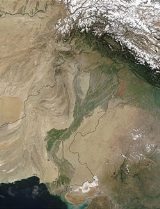
. The total length of the river is 3,180 kilometres (1,976 miles). The river has a total drainage area exceeding 1,165,000 square kilometres (450,000 square miles). The river's estimated annual flow stands at around 207 cubic kilometres. Beginning at the heights of the world with glaciers, the river feeds the ecosystem
Ecosystem

An ecosystem is a natural unit consisting of all plants, animals and micro-organisms in an area functioning together with all of the non-living physical factors of the environment....
 of temperate forests, plains
Plains

Plains is the plural of plain a geographical feature.Plains or The Plains may also refer to:...
 and arid countryside. Together with the rivers Chenab, Ravi
Ravi River

File:Ravi river lahore.JPGThe Ravi River is a river in Pakistan and India originating in Himachal Pradesh, India. It is one of the five rivers which give Punjab region its name....
, Sutlej
Sutlej

The Sutlej River is the longest of the five rivers that flow through the historic crossroad region of Punjab region in northern India and Pakistan....
, Jhelum
Jhelum River

Jehlum River or Jhelum River is a river that flows in India and Pakistan. It is the largest and most western of the five rivers of Punjab region, and passes through Jhelum District....
, Beas
Beas River

The Beas River is the second easternmost of the rivers of the Punjab region. The river rises in the Himalayas in central Himachal Pradesh, India, and flows for some 290 miles to the Sutlej River in western Punjab state....
 and the extinct Sarasvati River
Sarasvati River

The Sarasvati River is one of the chief Rigvedic rivers mentioned in ancient Hindu texts. The Nadistuti hymn in the Rigveda mentions the Sarasvati between the Yamuna in the east and the Sutlej in the west, and later Vedic texts like Tandya and Jaiminiya Brahmanas as well as the Mahabharata mention that the Sarasvati dried up in a desert....
, the Indus forms the Sapta Sindhu
Sapta Sindhu

The Sapta Sindhu "seven rivers" are the seven sacred rivers in Indian mythology. The Rig Veda often refers to the seven rivers.). In RV 7.36.6, the Sarasvati is the seventh river, whose mother is the Sindhu....
 (Seven Rivers) delta
Indus River Delta

The Indus River Delta forms where the Indus River flows into the Arabian Sea in Pakistan. The delta covers an area of about 16,000 square miles , and is approximately 130 miles across where it meets the sea....
 in the Sindh
Sindh

Sindh is one of the four Subdivisions of Pakistan of Pakistan and historically is home to the Sindhi people. Different cultural and ethnic groups also reside in Sindh including Urdu-speaking Muslim refugees who migrated to Pakistan from India upon independence as well as the people migrated from other provinces after independence....
 province of Pakistan.

The Indus provides the key water resources for the economy of Pakistan
Economy of Pakistan

Pakistan has the third fastest growing economy in Asia. Its economy encompasses textiles, chemicals, food processing, agriculture and other industries....
 - especially the Breadbasket of Punjab province
Punjab (Pakistan)

The Punjab...
, which accounts for most of the nation's agricultural production, and Sindh
Sindh

Sindh is one of the four Subdivisions of Pakistan of Pakistan and historically is home to the Sindhi people. Different cultural and ethnic groups also reside in Sindh including Urdu-speaking Muslim refugees who migrated to Pakistan from India upon independence as well as the people migrated from other provinces after independence....
. The word Punjab is a combination of the Persian
Persian language

name=Persian|nativename=|pronunciation=[f??r'si]|image=|caption=Farsi in Perso-Arabic script |states= Iran, Afghanistan, Tajikistan, Uzbekistan, and Bahrain....
 words Panj meaning Five, and 'ab' meaning Water, giving the literal meaning of the Land of the Five Rivers. The five rivers after which Punjab is named are the Beas
Beas River

The Beas River is the second easternmost of the rivers of the Punjab region. The river rises in the Himalayas in central Himachal Pradesh, India, and flows for some 290 miles to the Sutlej River in western Punjab state....
, Jhelum
Jhelum River

Jehlum River or Jhelum River is a river that flows in India and Pakistan. It is the largest and most western of the five rivers of Punjab region, and passes through Jhelum District....
, Chenab
Chenab River

The Chenab River is formed by the confluence of the Chandra River and Bhaga River rivers at Tandi located in the upper Himalayas in the Lahul and Spiti District of Himachal Pradesh, India....
, Ravi
Ravi River

File:Ravi river lahore.JPGThe Ravi River is a river in Pakistan and India originating in Himachal Pradesh, India. It is one of the five rivers which give Punjab region its name....
 and Sutlej. The river also supports many heavy industries and provides the main supply of potable water in Pakistan.

The ultimate source of the Indus is in Tibet
Tibet

Tibet is a Tibetan Plateau in Asia, north of the Himalayas, and the home to the indigenous Tibetan people and its related ethnic groups. With an average elevation of 4,900 metres , it is the highest region on Earth and has in recent decades increasingly been referred to as the "Roof of the World"....
; it begins at the confluence of the Sengge and Gar rivers that drain the Nganglong Kangri and Gangdise Shan mountain ranges. The Indus then flows northwest through Ladakh
Ladakh

Ladakh is a region in the Indian Indian state of Jammu and Kashmir between the Kunlun Mountains mountain range in the north and the main Great Himalayas to the south, inhabited by people of Indo-Aryans and Tibetan people descent....
 and Baltistan
Baltistan

Baltistan , also known as ?????? in the Balti language, is a region in northern Pakistan , bordering Xinjiang Autonomous regions of China of People's Republic of China....
 into Gilgit
Gilgit River

Gilgit River is a tributary of the Indus River, and flows past the town of Gilgit. It is located in the Northern Areas of Kashmir, Pakistan....
, just south of the Karakoram
Karakoram

Karakoram is a large mountain range spanning the borders between Pakistan, China, and India, located in the regions of Gilgit District, Ladakh, and Baltistan....
 range. The Shyok River
Shyok River

The Shyok River is a river flowing through Ladakh and the disputed Northern Areas of Pakistan .Shyok river originates from the Rimo glacier, one of the tongues of Siachen Glacier and becomes very wide at the confluence with the Nubra River ....
, Shigar
Shigar

Shigar is a town in Baltistan near Skardu in northern Pakistan. Nearby is the Shigar River.External links*See also*Shigar Valley...
 and Gilgit
Gilgit

Gilgit is a city in Northern PakistanGilgit may refer to other terms related with the area of the city:* Gilgit River* Gilgit Valley...
 streams carry glacial waters into the main river. It gradually bends to the south, coming out of the hills between Peshawar
Peshawar

is the capital of the North-West Frontier Province and the administrative centre for the Federally Administered Tribal Areas of Pakistan."Peshawar" literally means The High Fort in Persian language and is known as Pekhawar in Pashto....
 and Rawalpindi
Rawalpindi

is a city in the Potwar Plateau near Pakistan's capital city of Islamabad, in the Subdivisions of Pakistan of Punjab . The area was home to the pre-historic Soanian culture indigenous to this region....
. The Indus passes gigantic gorges 4,500-5,200 metres (15,000-17,000 feet) high near the Nanga Parbat
Nanga Parbat

Nanga Parbat is the List of highest mountains mountain on Earth. Nanga Parbat means "Naked Mountain" in Urdu, parbat deriving from the Sanskrit word parvata meaning "mountain, rock", and nanga from the Sanskrit word nagna meaning "naked, bare"....
 massif
Massif

In geology, a massif is a section of a planet's Crust that is demarcated by geologic faults or flexures. In the Plate tectonics, a massif tends to retain its internal structure while being displaced as a whole....
. It flows swiftly across Hazara, and is dammed at the Tarbela Reservoir. The Kabul River
Kabul River

Kabul River , classically called the Cophes , is a river that rises in the Sanglakh Range in Afghanistan, separated from the watershed of the Helmand River by the Unai Pass....
 joins it near Attock
Attock

Attock , the headquarters of Attock District, is a city located in the northern border of the Punjab province of Pakistan, and also a border district on the river Indus....
. The remainder of its route to the sea is in plains of the Punjab
Punjab region

Punjab , also Panjab , is a region straddling the border between India and Pakistan. The "Five Rivers" are Beas River, Ravi River, Sutlej, Chenab and Jhelum River; all these are tributaries of the Indus river, Jhelum being the biggest one....
 and Sindh
Sindh

Sindh is one of the four Subdivisions of Pakistan of Pakistan and historically is home to the Sindhi people. Different cultural and ethnic groups also reside in Sindh including Urdu-speaking Muslim refugees who migrated to Pakistan from India upon independence as well as the people migrated from other provinces after independence....
, and the river becomes slow-flowing and highly braided. It is joined by Panjnad River
Panjnad River

Panjnad River is a river in Punjab , Pakistan. Panjnad River is formed by successive confluence of the five rivers of Punjab region, namely Jhelum River, Chenab River, Ravi River, Beas River and Sutlej River....
 at Mithankot
Mithankot

Mithankot , is located in southern Punjab, Pakistan, Pakistan....
. Beyond this confluence, the river, at one time, was named Satnad River (Sat = seven, Nadi = river), as the river was now carrying the waters of the Kabul River, the Indus River and the five Punjab rivers. Passing by Jamshoro
Jamshoro

Jamshoro is a city in Jamshoro District, Sindh, Pakistan. It is located on the right bank of Indus River, approximately 18 kilometres north-west of the city of Hyderabad, Pakistan and 150 kilometres north-east from the provincial capital Karachi....
, it ends in a large delta to the east of Thatta
Thatta

Thatta or Thatto is an historic town of 22,000 inhabitants in the Sindh province of Pakistan, near Lake Keenjhar, the largest freshwater lake in the country....
.

The Indus is one of the few rivers in the world that exhibit a tidal bore
Tidal bore

A tidal bore is a tide phenomenon in which the leading edge of the incoming tide forms a wave of water that travel up a river or narrow bay against the direction of the current....
. The Indus system is largely fed by the snows and glaciers of the Himalayas
Himalayas

The Himalaya Range or Himalayas for short , meaning "abode of snow" ), is a mountain range in Asia, separating the Indian subcontinent from the Tibetan Plateau....
, Karakoram
Karakoram

Karakoram is a large mountain range spanning the borders between Pakistan, China, and India, located in the regions of Gilgit District, Ladakh, and Baltistan....
 and the Hindu Kush
Hindu Kush

The Hindu Kush is a mountain range located in eastern and central Afghanistan, northwestern Pakistan and northeastern India.The origin of the name Hindu Kush is disputed, despite its coinage apparently dating back no further than c.1330....
 ranges of Tibet
Tibet

Tibet is a Tibetan Plateau in Asia, north of the Himalayas, and the home to the indigenous Tibetan people and its related ethnic groups. With an average elevation of 4,900 metres , it is the highest region on Earth and has in recent decades increasingly been referred to as the "Roof of the World"....
, the state of Jammu and Kashmir
Jammu and Kashmir

Jammu and Kashmir is the northernmost States and territories of India of India. It is situated mostly in the Himalayas mountains. Jammu and Kashmir shares a border with the People's Republic of China to the northeast, the states of Himachal Pradesh and Punjab to the south and Pakistani-administered territories of Kashmir, namely Azad Kashm...
 in India
India

India, officially the Republic of India , is a country in South Asia. It is the List of countries and outlying territories by total area country by geographical area, the List of countries by population country, and the most populous liberal democracy in the world....
 and the Northern Areas
Northern Areas

The Northern Areas is officially referred to by the government of Pakistan as the Federally Administered Northern Areas . The Northern Areas is the northernmost political entity within the Pakistani-controlled part of the former princely state of Jammu and Kashmir....
 of Pakistan
Pakistan

Pakistan , officially the Islamic Republic of Pakistan, is a country located in South Asia and borders Central Asia and the Middle East. It has a 1,046 kilometre coastline along the Arabian Sea and Gulf of Oman in the south, and is bordered by Afghanistan and Iran in the west, India in the east and People's Republic of China in th...
. The flow of the river is also determined by the seasons - it diminishes greatly in the winter, while flooding its banks in the monsoon
Monsoon

A monsoon is a seasonal prevailing wind that lasts for several months. The term was first used in English in India, Bangladesh, Pakistan, and neighboring countries to refer to the big seasonal winds blowing from the Indian Ocean and Arabian Sea in the southwest bringing heavy rainfall to the region....
 months from July to September. There is also evidence of a steady shift in the course of the river since prehistoric times - it deviated westwards from flowing into the Rann of Kutch
Rann of Kutch

The Rann of Kutch is a seasonally marshy region located in the Thar Desert biogeographic province in Gujarat situated 8km away from village KHARAGHODA located in patdi town of surendra nagar districtStates and territories of India of northwestern India and the Sind Subdivisions of Pakistan of Pakistan....
.

History

Indus Sites
Ivc Map
Map of Vedic India
Paleolithic
Paleolithic

The Paleolithic or Palaeolithic or "Old Stone" era is a Prehistory era distinguished by the development of the first stone tools, and covers roughly 99% of human history....
 sites have been discovered in Pothohar near Pakistan's capital Islamabad
Islamabad

Islamabad is the Capital of Pakistan, and is the tenth largest city in Pakistan. The Rawalpindi/Islamabad List of most populous metropolitan areas in Pakistan is the third largest in Pakistan with a population of over 4.5 million inhabitants, 1.5 million in Islamabad and three million in Rawalpindi....
, with the stone tools of the Soan Culture. In ancient Gandhara
Gandhara

Gandhara is the name of an ancient kingdom , located in northern Pakistan, Jammu and Kashmir and eastern Afghanistan. Gandhara was located mainly in the vale of Peshawar, the Potohar plateau and on the Kabul River....
, near Islamabad
Islamabad

Islamabad is the Capital of Pakistan, and is the tenth largest city in Pakistan. The Rawalpindi/Islamabad List of most populous metropolitan areas in Pakistan is the third largest in Pakistan with a population of over 4.5 million inhabitants, 1.5 million in Islamabad and three million in Rawalpindi....
, evidence of cave dwellers dated 15,000 years ago has been discovered at Mardan
Mardan

Mardan is a city and headquarters of Mardan District in the North-West Frontier Province of Pakistan. It is located at 34?12'0N 72?1'60E with an altitude of 283 metres lying the south-west of the district....
.

The major cities of the Indus Valley Civilization
Indus Valley Civilization

The Indus Valley Civilization , abbreviated IVC, was an ancient civilization that flourished in the Indus River basin. Primarily centered along the Indus river, the civilization encompassed most of Pakistan, including its Sindh, Punjab and Balochistan provinces, and extending into modern day Indian states of Gujarat, Haryana, Punjab...
, such as Harappa
Harappa

Harappa is a city in Punjab , northeast Pakistan, about 35 km southwest of Sahiwal.The modern town is located near the former course of the Ravi River and also beside the ruins of an ancient history fortification city, which was part of the Cemetery H culture and the Indus Valley Civilization....
 and Mohenjo-daro
Mohenjo-daro

Mohenjo-daro was one of the largest city-settlements of the Indus Valley Civilization of south Asia situated in the province of Sind, Pakistan....
, date back to around 3300 BC, and represent some of the largest human habitations of the ancient world. The Indus Valley Civilization extended from Balochistan
Balochistan (region)

Balochistan or Baluchistan is an arid region located in the Iranian Plateau in Southwest Asia and South Asia, between Pakistan, Iran and Afghanistan....
 to Gujarat
Gujarat

Gujarat is a States and territories of India in western India. Gujarat borders Pakistan to the north west and the state of Rajasthan to the north and northeast, Madhya Pradesh to the east, Maharashtra and the Union territory of Diu, Daman District, India, Dadra and Nagar Haveli to the south....
, with an upward reach from east of Jhelum River
Jhelum River

Jehlum River or Jhelum River is a river that flows in India and Pakistan. It is the largest and most western of the five rivers of Punjab region, and passes through Jhelum District....
 to Ropar on the upper Sutlej
Sutlej

The Sutlej River is the longest of the five rivers that flow through the historic crossroad region of Punjab region in northern India and Pakistan....
. The coastal settlements extended from Sutkagan Dor
Sutkagan Dor

Sutkagan Dor is the westernmost known archaeological site of Indus Valley Civilization. It is located about 480 km west of Karachi on Makran coast near the Iran border in Balochistan in Pakistan....
 at the Iran
Iran

Iran , officially the Islamic Republic of Iran and formerly known internationally as Persian Empire until 1935, is a country in Central Eurasia, located on the northeastern shore of the Persian Gulf and the southern shore of the Caspian Sea....
ian border to Lothal
Lothal

Lothal is one of the most prominent cities of the ancient Indus Valley Civilization. Located in the modern state of Gujarat and dating from 24th century BC, it is one of India's most important archaeology site that dates from that era....
 in Gujarat
Gujarat

Gujarat is a States and territories of India in western India. Gujarat borders Pakistan to the north west and the state of Rajasthan to the north and northeast, Madhya Pradesh to the east, Maharashtra and the Union territory of Diu, Daman District, India, Dadra and Nagar Haveli to the south....
. There is an Indus site on the Oxus river at Shortughai in northern Afghanistan
Afghanistan

Afghanistan , officially the Islamic republic of Afghanistan, is a landlocked country that is located approximately in the center of Asia....
 (Kenoyer 1998:96), and the Indus site Alamgirpur at the Hindon River is located only 28 km from Delhi
Delhi

Delhi , sometimes referred to as Dilli , is the List of most populous cities in India metropolis in India and, with over 11 million residents, the List of metropolitan areas by population....
 (S.P. Gupta 1995:183). To date, over 1,052 cities and settlements have been found, mainly in the general region of the Ghaggar-Hakra River
Ghaggar-Hakra River

The Ghaggar-Hakra River is an intermittent river in India and Pakistan that flows only during the monsoon season.It is often identified with the Vedic Sarasvati River, but it is disputed whether all Rigveda references to the Sarasvati should be taken to refer to this river....
 and its tributaries. Among the settlements were the major urban centers of Harappa
Harappa

Harappa is a city in Punjab , northeast Pakistan, about 35 km southwest of Sahiwal.The modern town is located near the former course of the Ravi River and also beside the ruins of an ancient history fortification city, which was part of the Cemetery H culture and the Indus Valley Civilization....
 and Mohenjo-daro
Mohenjo-daro

Mohenjo-daro was one of the largest city-settlements of the Indus Valley Civilization of south Asia situated in the province of Sind, Pakistan....
, as well as Lothal
Lothal

Lothal is one of the most prominent cities of the ancient Indus Valley Civilization. Located in the modern state of Gujarat and dating from 24th century BC, it is one of India's most important archaeology site that dates from that era....
, Dholavira
Dholavira

Dholavira, an ancient metropolis, and locally known as Kotada Timba Prachin Mahanagar Dholavira, is one of the largest and most prominent archaeological sites in India, belonging to the Indus Valley Civilization....
, Ganeriwala
Ganeriwala

Ganeriwala is an Indus Valley civilization site of an urban center in the Punjab , Pakistan. It is located near the border to India and was discovered by Pakistani archaeologist M.R....
, and Rakhigarhi
Rakhigarhi

Rakhigarhi, or Rakhi Garhi, is a village in Hisar District in the northwest Indian state of Haryana, around 150 kilometers from Delhi. It lies on the Chautang River....
. Only 90-96 of the over-800 known Indus Valley sites have been discovered on the Indus and its tributaries. The Sutlej
Sutlej

The Sutlej River is the longest of the five rivers that flow through the historic crossroad region of Punjab region in northern India and Pakistan....
, now a tributary of the Indus, in Harappan times flowed into the Ghaggar-Hakra River
Ghaggar-Hakra River

The Ghaggar-Hakra River is an intermittent river in India and Pakistan that flows only during the monsoon season.It is often identified with the Vedic Sarasvati River, but it is disputed whether all Rigveda references to the Sarasvati should be taken to refer to this river....
, in the watershed of which were more Harappan sites than along the Indus (S.P. Gupta 1995: 183).

Most scholars believe that settlements of Gandhara grave culture
Gandhara grave culture

The Gandhara grave culture emerges from ca. 1600 BC, and flourishes in Gandhara, Pakistan ca. 1500 BC to 500 BC .Relevant finds, artifacts found primarily in graves, were distributed along the banks of the Lower Swat Valley and Panchkora Valley of Dir rivers in the north, Taxila in the southeast, along the Gomal River to the sout...
 of the early Indo-Aryans
Indo-Aryans

Indo-Aryan is an ethno-linguistic term referring to the wide collection of peoples united as native speakers of the Indo-Iranian languages of the family of Indo-European languages....
 flourished in Gandhara
Gandhara

Gandhara is the name of an ancient kingdom , located in northern Pakistan, Jammu and Kashmir and eastern Afghanistan. Gandhara was located mainly in the vale of Peshawar, the Potohar plateau and on the Kabul River....
 from 1700 BC to 600 BC, when Mohenjo-daro
Mohenjo-daro

Mohenjo-daro was one of the largest city-settlements of the Indus Valley Civilization of south Asia situated in the province of Sind, Pakistan....
 and Harappa
Harappa

Harappa is a city in Punjab , northeast Pakistan, about 35 km southwest of Sahiwal.The modern town is located near the former course of the Ravi River and also beside the ruins of an ancient history fortification city, which was part of the Cemetery H culture and the Indus Valley Civilization....
 had already been abandoned.

The name Indus is a Latinization of Hindu, in turn the Iranian
Iranian languages

The Iranian languages are a branch of the Indo-European languages and its subfamily, Indo-Iranian languages. These languages are mainly spoken by the Iranian Peoples....
 variant of Sindhu, the name of the Indus in the Rigveda
Rigveda

The Rigveda is an ancient Indian subcontinent sacred collection of Vedic Sanskrit hymns dedicated to the Rigvedic deities . It is counted among the four canonical sacred texts of Hinduism known as the Vedas....
. The Sanskrit
Sanskrit

Sanskrit is a historical Indo-Aryan language, one of the liturgical languages of Hinduism and Buddhism, and one of the 22 official languages of India....
 Sindhu generically means river, stream, ocean, probably from a root sidh , to keep off; Sindhu is attested 176 times in the Rigveda
Rigveda

The Rigveda is an ancient Indian subcontinent sacred collection of Vedic Sanskrit hymns dedicated to the Rigvedic deities . It is counted among the four canonical sacred texts of Hinduism known as the Vedas....
, 95 times in the plural, more often used in the generic meaning. Already in the Rigveda
Rigveda

The Rigveda is an ancient Indian subcontinent sacred collection of Vedic Sanskrit hymns dedicated to the Rigvedic deities . It is counted among the four canonical sacred texts of Hinduism known as the Vedas....
, notably in the later hymns, the meaning of the word is narrowed to refer to the Indus river in particular, for example in the list of rivers of the Nadistuti sukta
Nadistuti sukta

The Nadistuti sukta ,"hymn of praise of rivers", is hymn 10.75 of the Rigveda.It is important for the reconstruction of the geography of the Vedic civilization....
. This resulted in the anomaly of a river with masculine gender: all other Rigvedic rivers
Rigvedic rivers

Rivers play a prominent part in the hymns of the Rigveda, and consequently in early Historical Vedic religion....
 are female, not just grammatically, being imagined as goddesses and compared to cows and mares yielding milk and butter.

The Indus has formed a natural boundary between the Indian Subcontinent
Indian subcontinent

The Indian subcontinent is a large section of the Asian continent consisting of the land lying substantially on the Indian Plate. The subcontinent includes parts of various countries in South Asia, including those on the continental crust , an Island#Continental islands country on the continental shelf , and an Island#Oceanic islands countr...
 hinterland and its frontier with the Iranian Plateau
Iranian plateau

The Iranian plateau, also known as the Persian plateau is a geological formation in Southwest Asia, Southern Asia and the Caucasus region....
, a region which includes Pakistan's Balochistan
Balochistan

Balochistan or Baluchistan may refer to:Modern territories* Balochistan , a large region covering southwest Pakistan, southwest Afghanistan and southeast Iran...
, North West Frontier Province as well as Afghanistan
Afghanistan

Afghanistan , officially the Islamic republic of Afghanistan, is a landlocked country that is located approximately in the center of Asia....
, Tajikistan
Tajikistan

Tajikistan , officially the Republic of Tajikistan , is a mountainous landlocked country in Central Asia. Afghanistan borders to the south, Uzbekistan to the west, Kyrgyzstan to the north, and People's Republic of China to the east....
 and Iran
Iran

Iran , officially the Islamic Republic of Iran and formerly known internationally as Persian Empire until 1935, is a country in Central Eurasia, located on the northeastern shore of the Persian Gulf and the southern shore of the Caspian Sea....
. It has been crossed by the armies of Alexander the Great
Alexander the Great

Alexander the Great , also known as Alexander III of Macedon was an ancient Greeks King of Macedon . He was one of the most successful military commanders of all time and is presumed undefeated in battle....
 - His Macedon
Macedon

Macedon or Macedonia was the name of a monarchy centred in the northernmost part of ancient Greece. The homeland of the ancient Macedonians, it was bordered by the kingdom of Epirus to the west and the region of Thrace to the east....
ian forces retreated along the southern course of the river at the end of the Asian campaign after conquering what is now Pakistan
Pakistan

Pakistan , officially the Islamic Republic of Pakistan, is a country located in South Asia and borders Central Asia and the Middle East. It has a 1,046 kilometre coastline along the Arabian Sea and Gulf of Oman in the south, and is bordered by Afghanistan and Iran in the west, India in the east and People's Republic of China in th...
 and joining it to the Hellenic
Hellenic

Hellenic is a synonym for Greek.It may refer to:* Greek * Hellenism ...
 Empire. The Indus plains have also been under the domination of the Persian empire
Persian Empire

The 'Persian Empire' was a series of successive Iranian or Persianization empires that ruled over the Iranian plateau, the original Persian homeland, and beyond in Southwest Asia, South Asia, Central Asia and the Caucasus....
 and the Kushan empire
Kushan Empire

The Kushan Empire of Ancient India originally formed in Bactria on either side of the middle course of the Oxus River or Syr Darya in what is now northern Afghanistan, Pakistan, southern Tajikistan and Uzbekistan....
. The Muslim
Muslim

:A Muslim , , is an adherent of the religion of Islam. The feminine form is Muslimah . Literally, the word means "one who submits "....
 armies of Muhammad bin Qasim
Muhammad bin Qasim

Muhammad bin Qasim Al-Thaqafi was an Umayyad general who conquered the Sindh and Punjab regions along the Indus River . He was born in the city of Taif ....
, Mahmud of Ghazni
Mahmud of Ghazni

'Mahmud of Ghazni Province' , also known as , was the founder of the Ghaznavid Empire, which he ruled from 997 until his death. Mahmud turned the former provincial city of Ghazni into the wealthy capital of an extensive empire which extended from Afghanistan into most of Iran as well as Pakistan and regions of North-West India....
, Mohammed Ghori, Tamerlane and Babur
Babur

Babur was a Muslim conqueror from Central Asia who, following a series of setbacks, finally succeeded in laying the basis for the Mughal Empire of Indian subcontinent....
 also crossed the river to strike into the inner regions of Punjab
Punjab region

Punjab , also Panjab , is a region straddling the border between India and Pakistan. The "Five Rivers" are Beas River, Ravi River, Sutlej, Chenab and Jhelum River; all these are tributaries of the Indus river, Jhelum being the biggest one....
 , Rajasthan
Rajasthan

Rajasthan is the largest States and territories of India of the Republic of India in terms of area. It encompasses most of the area of the large, inhospitable Great Indian Desert , which has an edge paralleling the Sutlej-Indus river valley along its border with Pakistan....
 and Gujarat
Gujarat

Gujarat is a States and territories of India in western India. Gujarat borders Pakistan to the north west and the state of Rajasthan to the north and northeast, Madhya Pradesh to the east, Maharashtra and the Union territory of Diu, Daman District, India, Dadra and Nagar Haveli to the south....
.

The word "India"
Etymology of India

The name India may refer to either the region of Greater India , or to the contemporary Republic of India contained therein. The term is derived from the name of the Sindhu and has been in use in Greek since Herodotus ....
 is a reference to the Indus River. In ancient times, "India"
Etymology of India

The name India may refer to either the region of Greater India , or to the contemporary Republic of India contained therein. The term is derived from the name of the Sindhu and has been in use in Greek since Herodotus ....
 referred to the region of modern-day Pakistan
Pakistan

Pakistan , officially the Islamic Republic of Pakistan, is a country located in South Asia and borders Central Asia and the Middle East. It has a 1,046 kilometre coastline along the Arabian Sea and Gulf of Oman in the south, and is bordered by Afghanistan and Iran in the west, India in the east and People's Republic of China in th...
 along the Indus river which traded extensively with the ancient world. It was only after the arrival of the British in the 16th century that name began to be applied to the entire region.

Geography

Induszanskar

Tributaries


* Astor River
* Beas River
Beas River

The Beas River is the second easternmost of the rivers of the Punjab region. The river rises in the Himalayas in central Himachal Pradesh, India, and flows for some 290 miles to the Sutlej River in western Punjab state....

* Chenab River
Chenab River

The Chenab River is formed by the confluence of the Chandra River and Bhaga River rivers at Tandi located in the upper Himalayas in the Lahul and Spiti District of Himachal Pradesh, India....

* Gar River
* Ghizar River
* Gilgit River
Gilgit River

Gilgit River is a tributary of the Indus River, and flows past the town of Gilgit. It is located in the Northern Areas of Kashmir, Pakistan....

* Gumal River


* Hunza River
Hunza River

Hunza River is the principal river of Hunza, in the Northern Areas, Pakistan. It is formed by the confluence of the Kilik and Khunjerab nalas which are fed by glaciers....

* Jhelum River
Jhelum River

Jehlum River or Jhelum River is a river that flows in India and Pakistan. It is the largest and most western of the five rivers of Punjab region, and passes through Jhelum District....

* Tanubal River
* Kabul River
Kabul River

Kabul River , classically called the Cophes , is a river that rises in the Sanglakh Range in Afghanistan, separated from the watershed of the Helmand River by the Unai Pass....

* Kunar River
Kunar River

The Kunar River is about 480 km long, located in eastern Afghanistan and north-western Pakistan. The Kunar river system is fed from melting glaciers and snow of the Hindu Kush mountains....

* Ravi River
Ravi River

File:Ravi river lahore.JPGThe Ravi River is a river in Pakistan and India originating in Himachal Pradesh, India. It is one of the five rivers which give Punjab region its name....

* Shigar River
Shigar River

Shigar River is located in Baltistan, Northern Areas, Pakistan, Pakistan. The Shigar River is formed from the melt water of the Baltoro Glacier and Biafo Glacier....


* Shingo River
Shingo river

The Shingo River is a tributary of the Suru River , and flows through the Ladakh region. The Shingo river enters India from Pok and meets Dras river, coming from Dras....

* Shyok River
Shyok River

The Shyok River is a river flowing through Ladakh and the disputed Northern Areas of Pakistan .Shyok river originates from the Rimo glacier, one of the tongues of Siachen Glacier and becomes very wide at the confluence with the Nubra River ....

* Suru River
* Sutlej River
* Swaan River
* Zhob River
Zhob River

Zhob River is located in Balochistan , Pakistan. The meltwater from the Sulaiman Mountains forms Zhob Rivers and it flows through Balochistan and drains into Gomal River near Khajuri Kachadd....

* Balram River


Geology


The Indus River feeds the Indus submarine fan located in the Indian Ocean
Indian Ocean

The Indian Ocean is the third largest of the world's oceanic divisions, covering about 20% of the water on the Earth's surface. It is bounded on the north by Asia ; on the west by Africa; on the east by Indochina, the Sunda Islands, and Australia; and on the south by the Southern Ocean ....
, which is the second largest sediment body on the Earth at around 5 million cubic kilometres of material eroded from the mountains. Studies of the sediment in the modern river indicate that the Karakoram Mountains
Karakoram

Karakoram is a large mountain range spanning the borders between Pakistan, China, and India, located in the regions of Gilgit District, Ladakh, and Baltistan....
 in northern Pakistan are the single most important source of material, with the Himalayas providing the next largest contribution, mostly via the large rivers of the Punjab (i.e., the Jhelum
Jhelum River

Jehlum River or Jhelum River is a river that flows in India and Pakistan. It is the largest and most western of the five rivers of Punjab region, and passes through Jhelum District....
, Ravi
Ravi

Ravi may refer to:* Ravi , a Hindu solar deity* Ravi is a given name in India and South Asia.* Ravi River . A 720 km river that originates in the Himalayas and joins the Chenab river in Pakistan...
, Chenab, Beas
Beas

Beas may refer to:* Beas, Punjab, a town in Punjab, India.* Beas River, a river in the northwestern region of India....
 and the Sutlej
Sutlej

The Sutlej River is the longest of the five rivers that flow through the historic crossroad region of Punjab region in northern India and Pakistan....
). Analysis of sediments from the Arabian Sea has demonstrated that prior to five million years ago the Indus was not connected to these Punjab rivers which instead flowed east into the Ganges and were captured after that time. Earlier work showed that sand and silt from western Tibet was reaching the Arabian Sea by 45 million years ago, implying the existence of an ancient Indus River by that time. The delta of this proto-Indus river has subsequently been found in the Katawaz Basin, on the Afghan-Pakistan border. Most recently the Indus was paralleled by the ancient Saraswati River, which the Rigveda
Rigveda

The Rigveda is an ancient Indian subcontinent sacred collection of Vedic Sanskrit hymns dedicated to the Rigvedic deities . It is counted among the four canonical sacred texts of Hinduism known as the Vedas....
 suggests flowed from the Himalayas
Himalayas

The Himalaya Range or Himalayas for short , meaning "abode of snow" ), is a mountain range in Asia, separating the Indian subcontinent from the Tibetan Plateau....
 between the Sutlej
Sutlej

The Sutlej River is the longest of the five rivers that flow through the historic crossroad region of Punjab region in northern India and Pakistan....
 and the Yamuna
Yamuna

The Yamuna is a major tributary river of the Ganges in northern India. With a total length of around , it is the largest tributary of the Ganges....
 Rivers, close to modern day Chandigarh
Chandigarh

Chandigarh , also called The Beautiful City, is a city in India that serves as the Capital of two states and territories of India, Punjab, India and Haryana, and is a union territory of India....
.

In the Nanga Parbat
Nanga Parbat

Nanga Parbat is the List of highest mountains mountain on Earth. Nanga Parbat means "Naked Mountain" in Urdu, parbat deriving from the Sanskrit word parvata meaning "mountain, rock", and nanga from the Sanskrit word nagna meaning "naked, bare"....
 region, the massive amounts of erosion due to the Indus river following the capture and rerouting through that area is thought to bring middle and lower crustal rocks to the surface.

Wildlife

Accounts of the Indus valley from the times of Alexander's campaign indicate a healthy forest cover in the region, which has now considerably receded. The Mughal Emperor Babar
Babar

Babar may refer to:* The Babur , 16th-century ruler of the Indian Subcontinent and founder of the Mughal Empire*Babar the Elephant**Babar **...
 writes of encountering rhinoceroses along its bank in his memoirs (the Babarnama). Extensive deforestation
Deforestation

Deforestation is the logging or burning of trees in forested areas. There are several reasons for doing so: trees or derived charcoal can be sold as a commodity and are used by humans while cleared land is used as pasture, plantations of commodities and human settlement....
 and human interference in the ecology of the Shivalik Hills has led to a marked deterioration in vegetation and growing conditions. The Indus valley regions are arid with poor vegetation. Agriculture is sustained largely due to irrigation works.

The Blind
Blindness

Blindness is the condition of lacking visual perception due to physiological or neurological factors.Various scales have been developed to describe the extent of vision loss and define "blindness." Total blindness is the complete lack of form and visual light perception and is clinically recorded as "NLP," an abbreviation for "no ligh...
 Indus River Dolphin (Platanista gangetica minor) is a sub-species of Dolphins found only in the Indus River. It formerly also occurred in the tributaries of the Indus river. Palla fish (Hilsa
Hilsa

Hilsa is the national fish of Bangladesh, also popular in India's Assamese language-, Bengali language- and Oriya language-speaking regions and in Pakistan Sindh ....
) of the river is a delicacy for people living along the river. The population of fishes in the river is moderately high, with Sukkur
Sukkur

Sukkur , formerly Alor , is the third largest city of Sindh province, situated on the west bank of Indus River in Pakistan in Sukkur District....
, Thatta
Thatta

Thatta or Thatto is an historic town of 22,000 inhabitants in the Sindh province of Pakistan, near Lake Keenjhar, the largest freshwater lake in the country....
 and Kotri
Kotri

Kotri , a large town, is the headquarters station of the Kotri Taluka, or administrative district. It is situated on the right bank of the Indus River and since 1900 has been connected with Gudu Bander on the other side of the river by an iron bridge replacing the steam ferry which used to ply between these two places....
 being the major fishing centres - all in the lower Sindh course. But damming and irrigation has made fish farming an important economic activity. Located southeast of Karachi
Karachi

is the largest city, seaport and the International financial centre of Pakistan. It is List of metropolitan areas by population in terms of metropolitan population, and is Pakistan's premier centre of banking, industry, and trade....
, the large delta has been recognised by conservationists as one of the world's most important ecological regions. Here the river turns into many marshes, streams and creeks and meets the sea at shallow levels. Here marine fishes are found in abundance, including Pomfret
Pomfret

Pomfret are perciform fishes belonging to the family Bramidae.They are found in the Atlantic, Indian Ocean, and Pacific Oceans, and the largest species, the Atlantic pomfret, Brama brama, grows up to one metre long....
 and Prawns.

Economy

- Background on the Indus River, near Sukkur
Sukkur

Sukkur , formerly Alor , is the third largest city of Sindh province, situated on the west bank of Indus River in Pakistan in Sukkur District....
, Sindh, Pakistan]] The Indus is the most important supplier of water resources to the Punjab
Punjab (Pakistan)

The Punjab...
 and Sindh
Sindh

Sindh is one of the four Subdivisions of Pakistan of Pakistan and historically is home to the Sindhi people. Different cultural and ethnic groups also reside in Sindh including Urdu-speaking Muslim refugees who migrated to Pakistan from India upon independence as well as the people migrated from other provinces after independence....
 plains - it forms the backbone of agriculture and food production in Pakistan. The river is especially critical as rainfall is meagre in the lower Indus valley. Irrigation canals were first built by the people of the Indus valley civilization, and later by the engineers of the Kushan Empire
Kushan Empire

The Kushan Empire of Ancient India originally formed in Bactria on either side of the middle course of the Oxus River or Syr Darya in what is now northern Afghanistan, Pakistan, southern Tajikistan and Uzbekistan....
 and the Mughal Empire
Mughal Empire

The Mughal Empire was a Muslim imperial power of the Indian subcontinent which began in 1526, ruled most of the Indian Subcontinent by the late 17th and early 18th centuries, and ended in the mid-19th century....
. Modern irrigation was introduced by the British East India Company
British East India Company

The East India Company was an early England joint-stock company that was formed initially for pursuing trade with the Indies, but that ended up trading with the Indian subcontinent and China....
 in 1850 - the construction of modern canals accompanied with the restoration of old canals. The British supervised the construction of one of the most complex irrigation networks in the world. The Guddu Barrage
Guddu Barrage

Guddu Barrage is a barrage across river River, near Sukkur in Pakistan. President Iskander Mirza laid foundation-stone of the Guddu Barrage on February 2, 1957....
 is 1,350 metres (4,450 ft) long - irrigating Sukkur
Sukkur

Sukkur , formerly Alor , is the third largest city of Sindh province, situated on the west bank of Indus River in Pakistan in Sukkur District....
, Jacobabad
Jacobabad

Jacobabad is the capital city of Jacobabad District, Sindh, Pakistan. The city is also the administrative centre of Jacobabad Taluka, an administrative tehsil of the district, the city is subdivided into 8 Union Councils of Pakistan....
, Larkana
Larkana

Larkana or Larkano is the fourth largest city located in the Northwest of Sindh Province, Pakistan, located in Larkana District. In August 2000 Larkana celebrated its hundred years of existence....
 and Kalat
Kalat District

Kalat or Qalat is a Districts of Pakistan in Balochistan , Pakistan. It is one of 26 in that province, and encompasses an area of 6,621 square kilometre....
. The Sukkur Barrage
Sukkur barrage

The Sukkur barrage is a barrage across the Indus river near the city of Sukkur, Pakistan. It was built during the British Raj from 1923 to 1932 as the Lloyd Barrage to help alleviate famines caused by lack of rain....
 serves over 20,000 square kilometres (5,000,000 acres).

After the Partition of India
Partition of India

File:Brit IndianEmpireReligions3.jpgThe Partition of India was the Partition of British India that led to the creation, on August 14, 1947 and August 15, 1947, respectively, of the Sovereignty states of the Dominion of Pakistan and the Union of India ....
, a water control treaty signed between India
India

India, officially the Republic of India , is a country in South Asia. It is the List of countries and outlying territories by total area country by geographical area, the List of countries by population country, and the most populous liberal democracy in the world....
 and Pakistan
Pakistan

Pakistan , officially the Islamic Republic of Pakistan, is a country located in South Asia and borders Central Asia and the Middle East. It has a 1,046 kilometre coastline along the Arabian Sea and Gulf of Oman in the south, and is bordered by Afghanistan and Iran in the west, India in the east and People's Republic of China in th...
 in 1960 guaranteed that Pakistan would receive water from the Indus River independent of upstream control by India
India

India, officially the Republic of India , is a country in South Asia. It is the List of countries and outlying territories by total area country by geographical area, the List of countries by population country, and the most populous liberal democracy in the world....
. The project, Indus Basin Project
Indus Basin Project

The Indus Basin Project is a water control project that resulted from a treaty, Indus Waters Treaty, signed between India and Pakistan in 1960 that guaranteed that Pakistan would receive water from the Indus River independent from upstream control by India....
, consisted primarily of the construction of two main dams, the Mangla Dam
Mangla Dam

The Mangla Dam in PoK, Pakistan is the twelfth largest dam in the world . It was built in 1967 with funding from the World Bank....
 built on the Jhelum River
Jhelum River

Jehlum River or Jhelum River is a river that flows in India and Pakistan. It is the largest and most western of the five rivers of Punjab region, and passes through Jhelum District....
 and the Tarbela Dam
Tarbela Dam

Tarbela Dam or Torabela is a large dam on the Indus River in Pakistan. It is located about 50 kilometers northwest of Islamabad, and a height of above the river bed and a reservoir size of makes it the largest earth filled dam in the world....
 constructed on the Indus River, together with their subsidiary dams. The Pakistan Water and Power Development Authority undertook the construction of the Chashma-Jhelum link canal - linking the waters of the Indus and Jhelum rivers - extending water supplies to the regions of Bahawalpur
Bahawalpur

Bahawalpur is the capital city of Bahawalpur District located in , Punjab, Pakistan Pakistan. The population according to the 1998 census was 403,408, Saraiki , Punjabi language are the local languages of the area while Urdu and English are also spoken....
 and Multan
Multan

is a city in the Punjab of Pakistan and capital of Multan District. It is located in the southern part of the province. Multan District has a population of over 3.8 million and the city itself is the sixth largest within the boundaries of Pakistan....
. Pakistan constructed the Tarbela Dam
Tarbela Dam

Tarbela Dam or Torabela is a large dam on the Indus River in Pakistan. It is located about 50 kilometers northwest of Islamabad, and a height of above the river bed and a reservoir size of makes it the largest earth filled dam in the world....
 near Rawalpindi
Rawalpindi

is a city in the Potwar Plateau near Pakistan's capital city of Islamabad, in the Subdivisions of Pakistan of Punjab . The area was home to the pre-historic Soanian culture indigenous to this region....
 - standing 2743 metres (9,000 ft) long and 143 metres (470 ft) high, with an 80 kilometre (50 mile) long reservoir. The Kotri Barrage near Hyderabad
Hyderabad, Sindh

is located in the Sindh province of Pakistan. The city was founded in 1768 by Kalhora Dynasty upon the ruins of a Mauryan fishing village along the bank of the Indus known as Neroon Kot ....
 is 915 metres (3,000 ft) long and provides additional supplies for Karachi
Karachi

is the largest city, seaport and the International financial centre of Pakistan. It is List of metropolitan areas by population in terms of metropolitan population, and is Pakistan's premier centre of banking, industry, and trade....
. The Taunsa Barrage
Taunsa Barrage

The Taunsa Barrage is located on the Indus river in the Punjab province of Pakistan.The Taunsa Barrage was completed in 1958, and it has been identified as the barrage with the highest priority for rehabilitation....
 near Dera Ghazi Khan
Dera Ghazi Khan

Dera Ghazi Khan is located in Dera Ghazi Khan District, Punjab , Pakistan. Dera Ghazi Khan is one of the most populous cities in Southern Punjab and it is the largest district in Punjab in terms of area, being approximately in extent....
 produces 100,000 kilowatts of electricity. The extensive linking of tributaries with the Indus has helped spread water resources to the valley of Peshawar
Peshawar

is the capital of the North-West Frontier Province and the administrative centre for the Federally Administered Tribal Areas of Pakistan."Peshawar" literally means The High Fort in Persian language and is known as Pekhawar in Pashto....
, in the Northwest Frontier Province. The extensive irrigation and dam projects provide the basis for Pakistan's large production of crops such as cotton
Cotton

Cotton is a soft, staple fiber that grows in a form known as a boll around the seeds of the cotton plant a shrub native to tropical and subtropical regions around the world, including the Americas, India and Africa....
, sugarcane
Sugarcane

Sugarcane is a genus of 6 to 37 species of tall perennial plant Poaceae , native to warm temperate to tropical regions of the Old World. They have stout, jointed, fibrous stalks that are rich in sugar and measure 2 to 6 meters tall....
 and wheat
Wheat

Wheat , is a worldwide cultivated Poaceae from the Levant region of the Middle East. Globally, after maize, wheat is the second most-produced food among the cereal just above rice....
. The dams also generate electricity for heavy industries and urban centres.

People

Indus Near Skardu
The inhabitants of the regions through whom the Indus river passes and forms a major natural feature and resource are diverse in ethnicity, religion, national and linguistic backgrounds. On the northern course of the river in the state of Jammu and Kashmir
Jammu and Kashmir

Jammu and Kashmir is the northernmost States and territories of India of India. It is situated mostly in the Himalayas mountains. Jammu and Kashmir shares a border with the People's Republic of China to the northeast, the states of Himachal Pradesh and Punjab to the south and Pakistani-administered territories of Kashmir, namely Azad Kashm...
 in India
India

India, officially the Republic of India , is a country in South Asia. It is the List of countries and outlying territories by total area country by geographical area, the List of countries by population country, and the most populous liberal democracy in the world....
 live the Buddhist people of Ladakh
Ladakh

Ladakh is a region in the Indian Indian state of Jammu and Kashmir between the Kunlun Mountains mountain range in the north and the main Great Himalayas to the south, inhabited by people of Indo-Aryans and Tibetan people descent....
, of Tibetan
Tibetan people

group = Tibetans|image = File:Bundesarchiv Bild 135-BB-046-03, Tibetexpedition, Tibeter.jpg|caption =|population = between 5 and 10 million...
 stock along with the Kashmiris
Kashmiri people

The Kashmiri people are a Dardic ethnic group living in the central valley of Kashmir in the Indian state of Jammu and Kashmir who speak the Kashmiri language....
, of Indo-Aryan
Indo-Aryan

Indo-Aryan refers to:* Indo-Aryan languages* Indo-Aryan migration, a supposition that holds that the Indo-Aryans migrated to India.* Indigenous Aryans, a theory that holds that the Indo-Aryans are native to India....
 and Dardic
Dardic

Dardic may refer to:* Dardic people* Dardic languages...
 stock and practising Islam
Islam

Islam is a Monotheism, Abrahamic religion originating with the teachings of the Prophets of Islam Muhammad, a 7th century Arab religious and political figure....
 and Hinduism
Hinduism

'Hinduism' is the predominant religion of the Indian subcontinent. Hinduism is often referred to as , a Sanskrit phrase meaning "the eternal dharma", by its practitioners....
. As it descends into Northern Areas of Pakistan
Pakistan

Pakistan , officially the Islamic Republic of Pakistan, is a country located in South Asia and borders Central Asia and the Middle East. It has a 1,046 kilometre coastline along the Arabian Sea and Gulf of Oman in the south, and is bordered by Afghanistan and Iran in the west, India in the east and People's Republic of China in th...
, the Indus river forms a distinctive boundary of ethnicity and cultures - upon the western banks the population is largely Pashtun, Baloch, and of other Iranian stock, with close cultural, economic and ethnic ties to Afghanistan
Afghanistan

Afghanistan , officially the Islamic republic of Afghanistan, is a landlocked country that is located approximately in the center of Asia....
 and Iran
Iran

Iran , officially the Islamic Republic of Iran and formerly known internationally as Persian Empire until 1935, is a country in Central Eurasia, located on the northeastern shore of the Persian Gulf and the southern shore of the Caspian Sea....
. The eastern banks are largely populated by peoples of Indo-Aryan stock, such as the Punjabis, the Sindhis and the Seraikis. In northern Punjab
Punjab (Pakistan)

The Punjab...
 and the North-West Frontier Province
North-West Frontier Province

File:Makra Peak by Khalid Mahmood.jpgThe North-West Frontier Province is the smallest of the Subdivisions of Pakistan of Pakistan. The NWFP is home to the majority Pashtuns as well as other smaller ethnic groups....
, ethnic Pashtun tribes live alongside Dardic
Dardic

Dardic may refer to:* Dardic people* Dardic languages...
 people in the hills (Khowar, Kalash
Kalash

Kalash or Kalasha may refer to:*A people of northern Pakistan, the Kalash**their language, Kalasha-mun language*A people of Nuristan in Afghanistan, the Nuristani people...
, Shina
Shina

Shina can refer to:* Shina , a Japanese term for mainland China; it is not used in Mongolia, Taiwan etc. and is considered offensive by many Chinese people...
, etc.), Burushos (in Hunza
Hunza

Hunza may refer to*Hunza Valley*Former Hunza *Hunza River*Hunza Peak*Hunza people*Hunza is the Muisca name of the city of Tunja, Colombia...
), and Punjabi people
Punjabi people

The Punjabi people are an Indo-Aryans ethnic group from South Asia . They originate from the Punjab region, which has been host to some of the oldest civilizations in the world including one of the world's first and oldest civilizations, Indus Valley Civilization....
. In the southern portion of the Punjab
Punjab (Pakistan)

The Punjab...
 province, the Saraiki
Saraiki

Saraiki may refer to:* Saraiki people, an ethnic group of central Pakistan* Saraiki language, sometimes regarded as a dialect of Punjabi or Sindhi...
 peoples speak a distinctive tongue and practise distinctive traditions. In the province of Sindh
Sindh

Sindh is one of the four Subdivisions of Pakistan of Pakistan and historically is home to the Sindhi people. Different cultural and ethnic groups also reside in Sindh including Urdu-speaking Muslim refugees who migrated to Pakistan from India upon independence as well as the people migrated from other provinces after independence....
, peoples of Sindhi
Sindhi language

Sindhi is the language of the Sindh region of Pakistan. It is spoken by approximately 41 million people in Pakistan, and is also spoken by a minority 12 million in India; it is the third most spoken language of Pakistan, and the official language of Sindh in Pakistan....
 and Muhajir
Muhajir

Muhajir or Mohajir is an Arabic word meaning emigrant. The Islamic calendar Hijri year starts when Muhammad and his companions Migration to Medina Mecca for Medina in what is known as Hijra....
  backgrounds form the local populations. Upon the western banks of the river live the Balochi and Pashtun peoples of Balochistan
Balochistan (Pakistan)

Balochistan, or Baluchistan, is a Subdivisions of Pakistan in Pakistan, the largest in the country by geographical area; it is slightly smaller than Norway....
.

Modern issues


The Indus is a strategically vital resource for Pakistan's economy and society. After the Partition of India
Partition of India

File:Brit IndianEmpireReligions3.jpgThe Partition of India was the Partition of British India that led to the creation, on August 14, 1947 and August 15, 1947, respectively, of the Sovereignty states of the Dominion of Pakistan and the Union of India ....
 in 1947, the use of the waters of the Indus and its five eastern tributaries became a major dispute between India and Pakistan. The irrigation canals of the Sutlej valley and the Bari Doab were split - with the canals laying primarily in Pakistan and the headwork dams in India are disrupting supply in some parts of Pakistan. The concern over India building large dams over various Punjab rivers that could undercut the supply flowing to Pakistan, as well as the possibility that India could divert rivers in the time of war, caused political consternation in Pakistan. Holding diplomatic talks brokered by the World Bank, India and Pakistan signed the Indus Waters Treaty
Indus Waters Treaty

The Indus Waters Treaty is a water-sharing treaty between the Republic of India and Islamic Republic Of Pakistan. The treaty was signed in Karachi on September 19, 1960 by the then Indian Prime Minister Jawaharlal Nehru and the then President of Pakistan Field Marshal Mohammad Ayub Khan....
 in 1960. The treaty gave India control of the three easternmost rivers of the Punjab, the Sutlej
Sutlej

The Sutlej River is the longest of the five rivers that flow through the historic crossroad region of Punjab region in northern India and Pakistan....
, the Beas
Beas River

The Beas River is the second easternmost of the rivers of the Punjab region. The river rises in the Himalayas in central Himachal Pradesh, India, and flows for some 290 miles to the Sutlej River in western Punjab state....
 and the Ravi
Ravi River

File:Ravi river lahore.JPGThe Ravi River is a river in Pakistan and India originating in Himachal Pradesh, India. It is one of the five rivers which give Punjab region its name....
, while Pakistan gained control of the three western rivers, the Jhelum
Jhelum River

Jehlum River or Jhelum River is a river that flows in India and Pakistan. It is the largest and most western of the five rivers of Punjab region, and passes through Jhelum District....
, the Chenab and the Indus. India retained the right to use of the western rivers for non irrigation projects. (See discussion regarding a recent dispute about a hydroelectric project on the Chenab (not Indus) known as the Baglihar Project).

Hindu pilgrimage to holy sites alongside the river has been a source of conflict between the two nations. Pakistan and India do not generally allow each others' citizens to cross borders for religious pilgrimages.

There are concerns that extensive deforestation, industrial pollution and global warming
Global warming

Global warming is the increase in the Instrumental temperature record of the Earth's near-surface air and the oceans since the mid-twentieth century and its projected continuation....
 are affecting the vegetation and wildlife of the Indus delta, while affecting agricultural production as well. There are also concerns that the Indus river may be shifting its course westwards - although the progression spans centuries. On numerous occasions, sediment clogging owing to poor maintenance of canals has affected agricultural production and vegetation. In addition, extreme heat has caused water to evaporate, leaving salt deposits that render lands useless for cultivation.

See also

  • 1974 Hunza earthquake
    1974 Hunza earthquake

    The 1974 Hunza Earthquake was a magnitude 6.2 earthquake in the rugged and isolated Hunza Valley, Hazara, Pakistan and Swat districts of northern Pakistan at 12:11 UTC on December 28, 1974....
  • Sindhology
    Sindhology

    Sindhology is a field of study and academic research that covers the History of Sindh, Sindhi people, Sindh#Cultural heritage, and Sindhi literature of Sindh....


External links

  • The Northern Kashmir WebSite
  • Peace Palace Library