


Astyages

Encyclopedia
AstyagesAstyages (spelled by Herodotus
as Ἀστυάγης - Astyages; by Ctesias
as Astyigas; by Diodorus as Aspadas; Akkadian
: Ištumegu, was the last king of the Median Empire
, r. 585 BCE-550 BCE, the son of Cyaxares
; he was dethroned in 550 BCE by Cyrus the Great
.
His name derives from the Old Iranian Rishti Vaiga, which means "swinging the spear, lance-hurler."
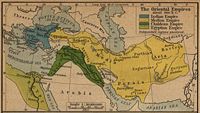 Astyages succeeded his father in 585 BCE, following the Battle of Halys
, which ended a five-year war between the Lydians
and the Medes
. He inherited a large empire, ruled in alliance with his two brothers-in-law, Croesus
of Lydia
and Nebuchadnezzar
of Babylon
, whose wife, Amytis, Astyages' sister, was the queen for whom Nebuchadnezzar was said to have built the Hanging Gardens of Babylon
.
Married to Aryenis
, the sister of King Croesus
of Lydia
, to seal the treaty between the two empires, Astyages ascended to the Median
throne upon his father's death later that year. By her he had perhaps a daughter Amytis (same as Amytis above married to Nebuchadnezzar?) married to Cyrus the Great.
The reign of Astyages was noted for its both its stability and for the growth of the eastern prophet-based religion, Zoroastrianism
, throughout his empire, at the same time that Croesus was patronizing notable western philosophers (Thales
, Solon
, Aesop
, etc.), and Nebuchadnezzar was busily turning his city of Babylon into the greatest metropolis the world had yet seen.
After thirty-two years of relative stability, Astyages lost the support of his nobles during the war to his grandson Cyrus, as attested to at length in the Cyropaedia of Xenophon
, resulting in the formation of the Persian
empire, which can be considered therefore a dynastic successor of the Medes.
historian Herodotus
relates that Astyages had a dream in which his daughter, Mandane, gave birth to a son who would destroy his empire. Fearful of the dream's prophecy, Astyages married her off to Cambyses I of Anšan
, who had a reputation for being a "quiet and thoughtful prince" and whom Astyages believed to be no threat.
When a second dream warned Astyages of the dangers of Mandane's offspring, Astyages sent his general Harpagus
to kill the child, who was none other than Cyrus himself. Harpagus, unwilling to spill royal blood, gave the infant to a shepherd, Mitridates, whose wife had just given birth to a stillborn child. Cyrus was raised as Mitridates' own son, and Harpagus presented the stillborn child to Astyages as the dead Cyrus.
When Cyrus was found alive at age ten, Astyages spared the boy on the advice of his Magi
, returning him to his parents in Anshan. Harpagus, however, did not escape punishment, as Astyages is said to have fed him his own son at a banquet.
Cyrus succeeded his father in 559, and in 553, on the advice of Harpagus, who was eager for revenge for being given the "abominable supper," Cyrus rebelled against Astyages. After three years of fighting, Astyages' troops mutinied during the battle of Pasargadae
, and Cyrus conquered the Median's empire. Astyages was spared by Cyrus, and despite being taunted by Harpagus, Herodotus says he was treated well and remained in Cyrus' court until his death.
Rather than giving the popular mythology that Cyrus was suckled by a dog, Herodotus explains that the herdsman Mitridates lived with another of Astyages' slaves, namely a woman named 'Spaco,' which he explains is Median
for "dog."
refers to the mutiny on the battlefield as the cause for Astyages' overthrow, but does not mention Harpagus by name. However, since Harpagus was Astyages' general at the battle of Pasargadae and his family were granted high positions in Cyrus' empire after the war, and since Harpagus went on to become Cyrus' most successful general, it is possible he had something to do with the mutiny against Astyages. Cyrus then went on to pillage Astyages' capital of Ecbatana
.
Ancient sources agree that after Astyages was taken by Cyrus he was treated with clemency, though the accounts differ. Herodotus says that Cyrus kept Astyages at his court during the remainder of his life, while according to Ctesias
, he was made a governor of a region of Parthia
and was later murdered by a political opponent, Oebaras. The circumstances of Astyages' death are not known.
After Astyages' overthrow, Croesus
marched on Cyrus to avenge Astyages. Cyrus, with Harpagus at his side, defeated Croesus
and conquered Lydia
in 547 BCE.
Herodotus
Herodotus was an ancient Greek historian who was born in Halicarnassus, Caria and lived in the 5th century BC . He has been called the "Father of History", and was the first historian known to collect his materials systematically, test their accuracy to a certain extent and arrange them in a...
as Ἀστυάγης - Astyages; by Ctesias
Ctesias
Ctesias of Cnidus was a Greek physician and historian from Cnidus in Caria. Ctesias, who lived in the 5th century BC, was physician to Artaxerxes Mnemon, whom he accompanied in 401 BC on his expedition against his brother Cyrus the Younger....
as Astyigas; by Diodorus as Aspadas; Akkadian
Akkadian language
Akkadian is an extinct Semitic language that was spoken in ancient Mesopotamia. The earliest attested Semitic language, it used the cuneiform writing system derived ultimately from ancient Sumerian, an unrelated language isolate...
: Ištumegu, was the last king of the Median Empire
Medes
The MedesThe Medes...
, r. 585 BCE-550 BCE, the son of Cyaxares
Cyaxares
Cyaxares, Cyaxares the Great or Hvakhshathra , the son of King Phraortes, was the first king of Media. According to Herodotus, Cyaxares, grandson of Deioces, had a far greater military reputation than his father or grandfather, therefore he is often being described as the first official Median...
; he was dethroned in 550 BCE by Cyrus the Great
Cyrus the Great
Cyrus II of Persia , commonly known as Cyrus the Great, also known as Cyrus the Elder, was the founder of the Achaemenid Empire. Under his rule, the empire embraced all the previous civilized states of the ancient Near East, expanded vastly and eventually conquered most of Southwest Asia and much...
.
His name derives from the Old Iranian Rishti Vaiga, which means "swinging the spear, lance-hurler."
Reign
Battle of Halys
The Battle of Halys, also known as the Battle of the Eclipse, took place at the river Halys on May 28, 585 BC between the Medes and the Lydians...
, which ended a five-year war between the Lydians
Lydians
The Lydians were the inhabitants of Lydia, a region in western Anatolia, who spoke the distinctive Lydian language, an Indo-European language of the Anatolian group....
and the Medes
Medes
The MedesThe Medes...
. He inherited a large empire, ruled in alliance with his two brothers-in-law, Croesus
Croesus
Croesus was the king of Lydia from 560 to 547 BC until his defeat by the Persians. The fall of Croesus made a profound impact on the Hellenes, providing a fixed point in their calendar. "By the fifth century at least," J.A.S...
of Lydia
Lydia
Lydia was an Iron Age kingdom of western Asia Minor located generally east of ancient Ionia in the modern Turkish provinces of Manisa and inland İzmir. Its population spoke an Anatolian language known as Lydian....
and Nebuchadnezzar
Nebuchadnezzar
Nebuchadnezzar was the name of several kings of Babylonia.* Nebuchadnezzar I, who ruled the Babylonian Empire in the 12th century BC* Nebuchadnezzar II , the Babylonian ruler mentioned in the biblical Book of Daniel...
of Babylon
Babylon
Babylon was an Akkadian city-state of ancient Mesopotamia, the remains of which are found in present-day Al Hillah, Babil Province, Iraq, about 85 kilometers south of Baghdad...
, whose wife, Amytis, Astyages' sister, was the queen for whom Nebuchadnezzar was said to have built the Hanging Gardens of Babylon
Hanging Gardens of Babylon
The Hanging Gardens of Babylon were considered to be one of the greatest Seven Wonders of the Ancient World, and the only one of the Wonders which may in fact have been legendary. They were purportedly built in the ancient city-state of Babylon, near present-day Al Hillah, Babil, in Iraq...
.
Married to Aryenis
Aryenis
Aryenis of Lydia was, according to Herodotus, the daughter of King Alyattes II of Lydia and the sister of King Croesus of Lydia.Aryenis was also the Queen consort of Astyages, King of Media and mother of Mandane of Media and a probable Amytis, married to her nephew Cyrus the Great...
, the sister of King Croesus
Croesus
Croesus was the king of Lydia from 560 to 547 BC until his defeat by the Persians. The fall of Croesus made a profound impact on the Hellenes, providing a fixed point in their calendar. "By the fifth century at least," J.A.S...
of Lydia
Lydia
Lydia was an Iron Age kingdom of western Asia Minor located generally east of ancient Ionia in the modern Turkish provinces of Manisa and inland İzmir. Its population spoke an Anatolian language known as Lydian....
, to seal the treaty between the two empires, Astyages ascended to the Median
Medes
The MedesThe Medes...
throne upon his father's death later that year. By her he had perhaps a daughter Amytis (same as Amytis above married to Nebuchadnezzar?) married to Cyrus the Great.
The reign of Astyages was noted for its both its stability and for the growth of the eastern prophet-based religion, Zoroastrianism
Zoroastrianism
Zoroastrianism is a religion and philosophy based on the teachings of prophet Zoroaster and was formerly among the world's largest religions. It was probably founded some time before the 6th century BCE in Greater Iran.In Zoroastrianism, the Creator Ahura Mazda is all good, and no evil...
, throughout his empire, at the same time that Croesus was patronizing notable western philosophers (Thales
Thales
Thales of Miletus was a pre-Socratic Greek philosopher from Miletus in Asia Minor, and one of the Seven Sages of Greece. Many, most notably Aristotle, regard him as the first philosopher in the Greek tradition...
, Solon
Solon
Solon was an Athenian statesman, lawmaker, and poet. He is remembered particularly for his efforts to legislate against political, economic and moral decline in archaic Athens...
, Aesop
Aesop
Aesop was a Greek writer credited with a number of popular fables. Older spellings of his name have included Esop and Isope. Although his existence remains uncertain and no writings by him survive, numerous tales credited to him were gathered across the centuries and in many languages in a...
, etc.), and Nebuchadnezzar was busily turning his city of Babylon into the greatest metropolis the world had yet seen.
After thirty-two years of relative stability, Astyages lost the support of his nobles during the war to his grandson Cyrus, as attested to at length in the Cyropaedia of Xenophon
Xenophon
Xenophon , son of Gryllus, of the deme Erchia of Athens, also known as Xenophon of Athens, was a Greek historian, soldier, mercenary, philosopher and a contemporary and admirer of Socrates...
, resulting in the formation of the Persian
Achaemenid Empire
The Achaemenid Empire , sometimes known as First Persian Empire and/or Persian Empire, was founded in the 6th century BCE by Cyrus the Great who overthrew the Median confederation...
empire, which can be considered therefore a dynastic successor of the Medes.
Cyrus and Astyages in Herodotus
The account given by the ancient GreekAncient Greece
Ancient Greece is a civilization belonging to a period of Greek history that lasted from the Archaic period of the 8th to 6th centuries BC to the end of antiquity. Immediately following this period was the beginning of the Early Middle Ages and the Byzantine era. Included in Ancient Greece is the...
historian Herodotus
Herodotus
Herodotus was an ancient Greek historian who was born in Halicarnassus, Caria and lived in the 5th century BC . He has been called the "Father of History", and was the first historian known to collect his materials systematically, test their accuracy to a certain extent and arrange them in a...
relates that Astyages had a dream in which his daughter, Mandane, gave birth to a son who would destroy his empire. Fearful of the dream's prophecy, Astyages married her off to Cambyses I of Anšan
Anshan (Persia)
Anshan - History :Before 1973, when it was identified as Tall-i Malyan, Anshan had been assumed by scholars to be somewhere in the central Zagros mountain range....
, who had a reputation for being a "quiet and thoughtful prince" and whom Astyages believed to be no threat.
When a second dream warned Astyages of the dangers of Mandane's offspring, Astyages sent his general Harpagus
Harpagus
Harpagus, also known as Harpagos or Hypargus , was a Median general from the 6th century BCE, credited by Herodotus as having put Cyrus the Great on the throne through his defection during the battle of Pasargadae.-Biography:According to Herodotus' Histories, Harpagus was a member of the Median...
to kill the child, who was none other than Cyrus himself. Harpagus, unwilling to spill royal blood, gave the infant to a shepherd, Mitridates, whose wife had just given birth to a stillborn child. Cyrus was raised as Mitridates' own son, and Harpagus presented the stillborn child to Astyages as the dead Cyrus.
When Cyrus was found alive at age ten, Astyages spared the boy on the advice of his Magi
Magi
Magi is a term, used since at least the 4th century BC, to denote a follower of Zoroaster, or rather, a follower of what the Hellenistic world associated Zoroaster with, which...
, returning him to his parents in Anshan. Harpagus, however, did not escape punishment, as Astyages is said to have fed him his own son at a banquet.
Cyrus succeeded his father in 559, and in 553, on the advice of Harpagus, who was eager for revenge for being given the "abominable supper," Cyrus rebelled against Astyages. After three years of fighting, Astyages' troops mutinied during the battle of Pasargadae
Pasargadae
Pasargadae , the capital of Cyrus the Great and also his last resting place, was a city in ancient Persia, and is today an archaeological site and one of Iran's UNESCO World Heritage Sites.-History:...
, and Cyrus conquered the Median's empire. Astyages was spared by Cyrus, and despite being taunted by Harpagus, Herodotus says he was treated well and remained in Cyrus' court until his death.
Rather than giving the popular mythology that Cyrus was suckled by a dog, Herodotus explains that the herdsman Mitridates lived with another of Astyages' slaves, namely a woman named 'Spaco,' which he explains is Median
Median language
The Median language was the language of the Medes. It is an Old Iranian language and classified as belonging to the northwestern Iranian subfamily which includes many other languages such as Azari, Zazaki, Gilaki, Mazandarani, Kurdish and Baluchi.-Attestation:Median is only attested by numerous...
for "dog."
Defeat
The contemporary Chronicle of NabonidusNabonidus Chronicle
The Nabonidus Chronicle is an ancient Babylonian text, part of a larger series of Babylonian Chronicles incribed in cuneiform script on clay tablets...
refers to the mutiny on the battlefield as the cause for Astyages' overthrow, but does not mention Harpagus by name. However, since Harpagus was Astyages' general at the battle of Pasargadae and his family were granted high positions in Cyrus' empire after the war, and since Harpagus went on to become Cyrus' most successful general, it is possible he had something to do with the mutiny against Astyages. Cyrus then went on to pillage Astyages' capital of Ecbatana
Ecbatana
Ecbatana is supposed to be the capital of Astyages , which was taken by the Persian emperor Cyrus the Great in the sixth year of Nabonidus...
.
Ancient sources agree that after Astyages was taken by Cyrus he was treated with clemency, though the accounts differ. Herodotus says that Cyrus kept Astyages at his court during the remainder of his life, while according to Ctesias
Ctesias
Ctesias of Cnidus was a Greek physician and historian from Cnidus in Caria. Ctesias, who lived in the 5th century BC, was physician to Artaxerxes Mnemon, whom he accompanied in 401 BC on his expedition against his brother Cyrus the Younger....
, he was made a governor of a region of Parthia
Parthia
Parthia is a region of north-eastern Iran, best known for having been the political and cultural base of the Arsacid dynasty, rulers of the Parthian Empire....
and was later murdered by a political opponent, Oebaras. The circumstances of Astyages' death are not known.
After Astyages' overthrow, Croesus
Croesus
Croesus was the king of Lydia from 560 to 547 BC until his defeat by the Persians. The fall of Croesus made a profound impact on the Hellenes, providing a fixed point in their calendar. "By the fifth century at least," J.A.S...
marched on Cyrus to avenge Astyages. Cyrus, with Harpagus at his side, defeated Croesus
Croesus
Croesus was the king of Lydia from 560 to 547 BC until his defeat by the Persians. The fall of Croesus made a profound impact on the Hellenes, providing a fixed point in their calendar. "By the fifth century at least," J.A.S...
and conquered Lydia
Lydia
Lydia was an Iron Age kingdom of western Asia Minor located generally east of ancient Ionia in the modern Turkish provinces of Manisa and inland İzmir. Its population spoke an Anatolian language known as Lydian....
in 547 BCE.