
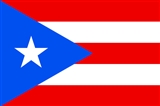
Puerto Rico (ˌ or ˌ), officially the
Commonwealth of Puerto Rico , is an unincorporated territory of the
United StatesThe United States of America is a federal constitutional republic comprising fifty states and a federal district...
, located in the northeastern Caribbean, east of the
Dominican RepublicThe Dominican Republic is a nation on the island of La Hispaniola, part of the Greater Antilles archipelago in the Caribbean region. The western third of the island is occupied by the nation of Haiti, making Hispaniola one of two Caribbean islands that are shared by two countries...
and west of both the
United States Virgin IslandsThe Virgin Islands of the United States are a group of islands in the Caribbean that are an insular area of the United States. The islands are geographically part of the Virgin Islands archipelago and are located in the Leeward Islands of the Lesser Antilles.The U.S...
and the
British Virgin IslandsThe Virgin Islands, often called the British Virgin Islands , is a British overseas territory and overseas territory of the European Union, located in the Caribbean to the east of Puerto Rico. The islands make up part of the Virgin Islands archipelago, the remaining islands constituting the U.S...
.
Puerto Rico (Spanish for "rich port") comprises an
archipelagoAn archipelago , sometimes called an island group, is a chain or cluster of islands. The word archipelago is derived from the Greek ἄρχι- – arkhi- and πέλαγος – pélagos through the Italian arcipelago...
that includes the main island of Puerto Rico and a number of smaller islands, the largest of which are
ViequesVieques , in full Isla de Vieques, is an island–municipality of Puerto Rico in the northeastern Caribbean, part of an island grouping sometimes known as the Spanish Virgin Islands...
,
CulebraIsla Culebra is an island-municipality of Puerto Rico originally called Isla Pasaje and Isla de San Ildefonso. It is located approximately east of the Puerto Rican mainland, west of St. Thomas and north of Vieques. Culebra is spread over 5 wards and Culebra Pueblo...
, and
MonaMona is the third largest island of the archipelago of Puerto Rico, after the main island of Puerto Rico and Vieques. It is the largest of three islands located in the Mona Passage, a strait between the Dominican Republic and Puerto Rico, the others being Monito Island and Desecheo Island...
. The main island of Puerto Rico is the smallest by land area of the
Greater AntillesThe Greater Antilles are one of three island groups in the Caribbean. Comprising Cuba, Jamaica, Hispaniola , and Puerto Rico, the Greater Antilles constitute almost 90% of the land mass of the entire West Indies.-Greater Antilles in context :The islands of the Caribbean Sea, collectively known as...
. However, it ranks third in population amongst that group of four islands, which also include
CubaThe Republic of Cuba is an island nation in the Caribbean. The nation of Cuba consists of the main island of Cuba, the Isla de la Juventud, and several archipelagos. Havana is the largest city in Cuba and the country's capital. Santiago de Cuba is the second largest city...
,
HispaniolaHispaniola is a major island in the Caribbean, containing the two sovereign states of the Dominican Republic and Haiti. The island is located between the islands of Cuba to the west and Puerto Rico to the east, within the hurricane belt...
(
Dominican RepublicThe Dominican Republic is a nation on the island of La Hispaniola, part of the Greater Antilles archipelago in the Caribbean region. The western third of the island is occupied by the nation of Haiti, making Hispaniola one of two Caribbean islands that are shared by two countries...
and
HaitiHaiti , officially the Republic of Haiti , is a Caribbean country. It occupies the western, smaller portion of the island of Hispaniola, in the Greater Antillean archipelago, which it shares with the Dominican Republic. Ayiti was the indigenous Taíno or Amerindian name for the island...
), and
JamaicaJamaica is an island nation of the Greater Antilles, in length, up to in width and 10,990 square kilometres in area. It is situated in the Caribbean Sea, about south of Cuba, and west of Hispaniola, the island harbouring the nation-states Haiti and the Dominican Republic...
. Due to its location, Puerto Rico enjoys a tropical climate and also experiences the Atlantic hurricane season.
Originally populated for centuries by indigenous
aboriginalThe indigenous peoples of the Americas are the pre-Columbian inhabitants of North and South America, their descendants and other ethnic groups who are identified with those peoples. Indigenous peoples are known in Canada as Aboriginal peoples, and in the United States as Native Americans...
peoples known as
TaínoThe Taínos were pre-Columbian inhabitants of the Bahamas, Greater Antilles, and the northern Lesser Antilles. It is thought that the seafaring Taínos are relatives of the Arawak people of South America...
s, the island was claimed by
Christopher ColumbusChristopher Columbus was an explorer, colonizer, and navigator, born in the Republic of Genoa, in northwestern Italy. Under the auspices of the Catholic Monarchs of Spain, he completed four voyages across the Atlantic Ocean that led to general European awareness of the American continents in the...
for Spain during his second voyage to the Americas on November 19, 1493. Under Spanish rule, the island was colonized and the indigenous population was forced into
slaverySlavery is a system under which people are treated as property to be bought and sold, and are forced to work. Slaves can be held against their will from the time of their capture, purchase or birth, and deprived of the right to leave, to refuse to work, or to demand compensation...
and nearly wiped out due to, among other things, European infectious diseases. The remaining population was emancipated by
King Charles ICharles V was ruler of the Holy Roman Empire from 1519 and, as Charles I, of the Spanish Empire from 1516 until his voluntary retirement and abdication in favor of his younger brother Ferdinand I and his son Philip II in 1556.As...
in 1520. Spain possessed Puerto Rico for over 400 years, despite attempts at capture of the island by France, the Netherlands, and England.
The relationship between Puerto Rico and the United States has its origins dating back to the
Spanish-American WarThe Spanish–American War was a conflict in 1898 between Spain and the United States, effectively the result of American intervention in the ongoing Cuban War of Independence...
, in which Spain, under the terms of the
Treaty of Paris of 1898The Treaty of Paris of 1898 was signed on December 10, 1898, at the end of the Spanish-American War, and came into effect on April 11, 1899, when the ratifications were exchanged....
, ceded the island to the United States. Puerto Ricans are U.S. citizens and the
United States CongressThe United States Congress is the bicameral legislature of the federal government of the United States, consisting of the Senate and the House of Representatives. The Congress meets in the United States Capitol in Washington, D.C....
legislates many aspects of Puerto Rican life. However, the islanders may not vote in U.S. presidential elections. Since 1947, Puerto Ricans have been able to elect their own
governorA governor is a governing official, usually the executive of a non-sovereign level of government, ranking under the head of state...
. Its official languages are Spanish and English, with Spanish being the primary language. The island's current
political statusThe current political status of Puerto Rico is the result of various political activities both within the United States and Puerto Rican governments. The basic question regarding this issue is whether Puerto Rico should remain a U.S. territory, become a U.S...
, including the possibility of
statehoodA U.S. state is any one of the 50 federated states of the United States of America that share sovereignty with the federal government. Because of this shared sovereignty, an American is a citizen both of the federal entity and of his or her state of domicile. Four states use the official title of...
or
independenceThe Puerto Rican independence movement refers to initiatives throughout the history of Puerto Rico aimed at obtaining independence for the Island, first from Spain, and then from the United States...
, is widely debated in Puerto Rico.
Name
Puerto RicansA Puerto Rican is a person who was born in Puerto Rico.Puerto Ricans born and raised in the continental United States are also sometimes referred to as Puerto Ricans, although they were not born in Puerto Rico...
often call the island
Borinquen, from
Borikén, its
indigenousIndigenous peoples are ethnic groups that are defined as indigenous according to one of the various definitions of the term, there is no universally accepted definition but most of which carry connotations of being the "original inhabitants" of a territory....
TaínoThe Taínos were pre-Columbian inhabitants of the Bahamas, Greater Antilles, and the northern Lesser Antilles. It is thought that the seafaring Taínos are relatives of the Arawak people of South America...
name, which means "Land of the Valiant Lord". The terms
boricua and
borincano derive from
Borikén and
Borinquen respectively, and are commonly used to identify someone of Puerto Rican heritage. The island is also popularly known in Spanish as
la isla del encanto, which means "the island of enchantment" in English.
Columbus named the island San Juan Bautista, in honor of Saint
John the BaptistJohn the Baptist was an itinerant preacher and a major religious figure mentioned in the Canonical gospels. He is described in the Gospel of Luke as a relative of Jesus, who led a movement of baptism at the Jordan River...
. Eventually, traders and other maritime visitors came to refer to the entire island as "Puerto Rico", and "San Juan" became the name of the main trading/shipping port.
Pre-Columbian era
The ancient history of the archipelago known today as "Puerto Rico" before the arrival of
Christopher ColumbusChristopher Columbus was an explorer, colonizer, and navigator, born in the Republic of Genoa, in northwestern Italy. Under the auspices of the Catholic Monarchs of Spain, he completed four voyages across the Atlantic Ocean that led to general European awareness of the American continents in the...
is not well known. Unlike other larger more advanced indigenous communities in the New World (Aztec, Inca) which left behind abundant archeological and physical evidence of their societies, the indigenous population of Puerto Rico left scant records. What is known today about them comes from scarce archaeological findings and early Spanish scholarly accounts. Today, there are few and rare cave drawings, rock carvings and ancient recreational activity sites that have been identified with some degree of speculation as to who left them behind. The first comprehensive book on the history of Puerto Rico was written by
Fray Íñigo Abbad y LasierraFray Íñigo Abbad y Lasierra , born in Estadilla, Spain, was a Benedictine monk and the first historian to extensively document Puerto Rico's history, nationality and culture....
in 1786, almost three centuries after the first Spaniards arrived on the island.
The first settlers were the
Ortoiroid peopleThe Ortoiroid people were the first human settlers of the Caribbean, who peaked culturally from 5000—200 BCE. They are believed to have originated in the Orinoco valley in South America, migrating to the Antilles from Trinidad and Tobago to Puerto Rico...
, an Archaic Period culture of
AmerindianThe indigenous peoples of the Americas are the pre-Columbian inhabitants of North and South America, their descendants and other ethnic groups who are identified with those peoples. Indigenous peoples are known in Canada as Aboriginal peoples, and in the United States as Native Americans...
hunters and fishermen. An archaeological dig in the island of Vieques in 1990 found the remains of what is believed to be an
Arcaico (Archaic) man (named "Puerto Ferro Man") dated to around 2000 BCE. The
IgneriThe Igneri were an ethnic group that was once part of the Arawak tribe. They inhabited the Lesser Antilles and Puerto Rico during the Pre-Columbian era. They are said to have originated in the Orinoco region in Venezuela...
, a tribe from the region of the
OrinocoThe Orinoco is one of the longest rivers in South America at . Its drainage basin, sometimes called the Orinoquia, covers , with 76.3% of it in Venezuela and the remainder in Colombia...
river, in northern South America, arrived between 120 and 400 CE. The Arcaicos and Igneri co-existed on the island between the 4th and 10th centuries, and perhaps clashed.
Between the 7th and 11th centuries the
TaínoThe Taínos were pre-Columbian inhabitants of the Bahamas, Greater Antilles, and the northern Lesser Antilles. It is thought that the seafaring Taínos are relatives of the Arawak people of South America...
culture developed on the island, and by approximately 1000 CE had become dominant. At the time of Columbus' arrival, an estimated 30 to 60 thousand Taíno Amerindians, led by
caciqueCacique is a title derived from the Taíno word for the pre-Columbian chiefs or leaders of tribes in the Bahamas, Greater Antilles, and the northern Lesser Antilles...
(chief) Agüeybaná, inhabited the island. They called it Boriken, "the great land of the valiant and noble Lord". The natives lived in small villages led by a cacique and subsisted on hunting, fishing and gathering of indigenous
cassavaCassava , also called yuca or manioc, a woody shrub of the Euphorbiaceae native to South America, is extensively cultivated as an annual crop in tropical and subtropical regions for its edible starchy tuberous root, a major source of carbohydrates...
root and fruit. This lasted until
Christopher ColumbusChristopher Columbus was an explorer, colonizer, and navigator, born in the Republic of Genoa, in northwestern Italy. Under the auspices of the Catholic Monarchs of Spain, he completed four voyages across the Atlantic Ocean that led to general European awareness of the American continents in the...
arrived in 1493. However, Puerto Rican culture today exhibits many Taíno influences within its music and vocabulary.
Spanish colony
When
Christopher ColumbusChristopher Columbus was an explorer, colonizer, and navigator, born in the Republic of Genoa, in northwestern Italy. Under the auspices of the Catholic Monarchs of Spain, he completed four voyages across the Atlantic Ocean that led to general European awareness of the American continents in the...
arrived in Puerto Rico during his second voyage on , 1493, the island was inhabited by the Taínos. They called the island "Borikén" or, in Spanish, "Borinquen".
[Today, Puerto Ricans are also known as Boricuas, or people from Borinquen.] Columbus named the island San Juan Bautista, in honor of Saint
John the BaptistJohn the Baptist was an itinerant preacher and a major religious figure mentioned in the Canonical gospels. He is described in the Gospel of Luke as a relative of Jesus, who led a movement of baptism at the Jordan River...
. The first Spanish settlement, Caparra, was founded on August 8, 1508 by
Juan Ponce de LeónJuan Ponce de León was a Spanish explorer. He became the first Governor of Puerto Rico by appointment of the Spanish crown. He led the first European expedition to Florida, which he named...
, a
lieutenantA lieutenant is a junior commissioned officer in many nations' armed forces. Typically, the rank of lieutenant in naval usage, while still a junior officer rank, is senior to the army rank...
under Columbus, who later became the
first governor of the island.
[Vicente Yañez Pinzón]Vicente Yáñez Pinzón was a Spanish navigator, explorer, and conquistador, the youngest of the Pinzón brothers...
is considered the first appointed governor of Puerto Rico, but he never arrived on the island. Eventually, traders and other maritime visitors came to refer to the entire island as "Puerto Rico", and "San Juan" became the name of the main trading/shipping port.
Soon thereafter, the
SpanishThe Spanish are citizens of the Kingdom of Spain. Within Spain, there are also a number of vigorous nationalisms and regionalisms, reflecting the country's complex history....
began to colonize the island. The indigenous population (Taínos) came to be exploited and forced into slavery. Within 50 years they were reduced to near extinction by the harsh conditions of work and by European
infectious diseaseInfectious diseases, also known as communicable diseases, contagious diseases or transmissible diseases comprise clinically evident illness resulting from the infection, presence and growth of pathogenic biological agents in an individual host organism...
s to which they had no natural immunity. For example, the
smallpoxSmallpox was an infectious disease unique to humans, caused by either of two virus variants, Variola major and Variola minor. The disease is also known by the Latin names Variola or Variola vera, which is a derivative of the Latin varius, meaning "spotted", or varus, meaning "pimple"...
outbreak in 1518–1519 wiped out much of the Island's indigenous population.
In 1520,
King Charles I of SpainCharles V was ruler of the Holy Roman Empire from 1519 and, as Charles I, of the Spanish Empire from 1516 until his voluntary retirement and abdication in favor of his younger brother Ferdinand I and his son Philip II in 1556.As...
issued a royal decree collectively emancipating the remaining Taíno population. Essentially, the Taíno presence while not completely extinct had almost vanished.
The importation of Sub-Saharan African slaves was introduced to provide the new manual work force for the Spanish colonists and merchants. Following the decline of the Taíno population, more slaves were brought to Puerto Rico; however, the number of slaves on the island paled in comparison to those in neighboring islands. African slavery was primarily restricted to coastal ports and cities, while the interior of the island continued to be essentially unexplored and undeveloped. Spanish and other European colonists were concentrated in island's seaports. Puerto Rico soon became an important stronghold and a significant port for Spanish Main colonial expansion. Various forts and walls, such as
La FortalezaLa Fortaleza is the current official residence of the Governor of Puerto Rico. It was built between 1533 and 1540 to defend the harbor of San Juan. The structure is also known as Palacio de Santa Catalina . It is the oldest executive mansion in the New World...
,
El Castillo San Felipe del MorroAlso known as Fort San Felipe del Morro or Morro Castle, is a 16th-century citadel located in San Juan, Puerto Rico.- Rundown :Lies on the northwestern-most point of the islet of San Juan, Puerto Rico...
and
El Castillo de San CristóbalThe Castillo de San Cristóbal is a Spanish fort in San Juan, Puerto Rico. It was built by Spain to protect against land based attacks on the city of San Juan. It is part of San Juan National Historic Site....
, were built to protect the strategic port of San Juan from numerous European invasion attempts. San Juan served as an important port-of-call for ships of all European nations for purposes of taking on water, food and other commercial provisions and mercantile exchange.
In 1607, Puerto Rico served as a port provisioning the English ships
Godspeed,
Susan Constant and
Discovery, which were on their way to establish
Jamestown, VirginiaJamestown was a settlement in the Colony of Virginia. Established by the Virginia Company of London as "James Fort" on May 14, 1607 , it was the first permanent English settlement in what is now the United States, following several earlier failed attempts, including the Lost Colony of Roanoke...
, the first successful English settlement in the New World. The Netherlands and England made several attempts to capture Puerto Rico but failed to wrest it from the long-term possession by Spain, which held tenaciously onto its increasingly prized island colony.
During the late 17th and early 18th centuries, Spanish colonial emphasis continued to be focussed on the more prosperous mainland North, Central, and South American colonies. This continued distraction on the part of the Spanish Crown left the island of Puerto Rico virtually unexplored, undeveloped, and (excepting coastal outposts) largely unsettled before the nineteenth century. But as independence movements in the larger Spanish colonies grew successful, Spain began to pay attention to Puerto Rico as one of its last remaining maritime colonies. Amidst the attacks, Puerto Rican culture began to flourish. In 1786, the first comprehensive history of Puerto Rico—
Historia Geográfica, Civil y Política de Puerto Rico by
Fray Iñigo Abbad y LasierraFray Íñigo Abbad y Lasierra , born in Estadilla, Spain, was a Benedictine monk and the first historian to extensively document Puerto Rico's history, nationality and culture....
—was published in
MadridMadrid is the capital and largest city of Spain. The population of the city is roughly 3.3 million and the entire population of the Madrid metropolitan area is calculated to be 6.271 million. It is the third largest city in the European Union, after London and Berlin, and its metropolitan...
, documenting the history of Puerto Rico from the time of Columbus' landing in 1493 until 1783. The book also presents a first hand account of Puerto Rican identity, including music, clothing, personality and nationality.
In 1779, citizens of the still-Spanish colony of Puerto Rico fought in the
American Revolutionary WarThe American Revolutionary War , the American War of Independence, or simply the Revolutionary War, began as a war between the Kingdom of Great Britain and thirteen British colonies in North America, and ended in a global war between several European great powers.The war was the result of the...
under the command of Bernardo de Gálvez, named
Field MarshalField Marshal is a military rank. Traditionally, it is the highest military rank in an army.-Etymology:The origin of the rank of field marshal dates to the early Middle Ages, originally meaning the keeper of the king's horses , from the time of the early Frankish kings.-Usage and hierarchical...
of the Spanish colonial army in North America. Puerto Ricans participated in the capture of
PensacolaPensacola is the westernmost city in the Florida Panhandle and the county seat of Escambia County, Florida, United States of America. As of the 2000 census, the city had a total population of 56,255 and as of 2009, the estimated population was 53,752...
, the capital of the British colony of
West FloridaWest Florida was a region on the north shore of the Gulf of Mexico, which underwent several boundary and sovereignty changes during its history. West Florida was first established in 1763 by the British government; as its name suggests it largely consisted of the western portion of the region...
, and the cities of
Baton RougeBaton Rouge is the capital of the U.S. state of Louisiana. It is located in East Baton Rouge Parish and is the second-largest city in the state.Baton Rouge is a major industrial, petrochemical, medical, and research center of the American South...
,
St. LouisSt. Louis is an independent city on the eastern border of Missouri, United States. With a population of 319,294, it was the 58th-largest U.S. city at the 2010 U.S. Census. The Greater St...
and
MobileMobile is the third most populous city in the Southern US state of Alabama and is the county seat of Mobile County. It is located on the Mobile River and the central Gulf Coast of the United States. The population within the city limits was 195,111 during the 2010 census. It is the largest...
. The Puerto Rican troops, under the leadership of Brigadier General Ramón de Castro, helped defeat the British and Indian army of 2,500 soldiers and British warships in Pensacola.
In 1809, in a further move to secure its political bond with the island and in the midst of the European
Peninsular WarThe Peninsular War was a war between France and the allied powers of Spain, the United Kingdom, and Portugal for control of the Iberian Peninsula during the Napoleonic Wars. The war began when French and Spanish armies crossed Spain and invaded Portugal in 1807. Then, in 1808, France turned on its...
, the
Supreme Central JuntaIn the Napoleonic era, junta was the name chosen by several local administrations formed in Spain during the Peninsular War as a patriotic alternative to the official administration toppled by the French invaders...
based in
CádizCadiz is a city and port in southwestern Spain. It is the capital of the homonymous province, one of eight which make up the autonomous community of Andalusia....
recognized Puerto Rico as an overseas province of Spain with the right to send representatives to the recently convened
Spanish parliamentThe Cádiz Cortes were sessions of the national legislative body which met in the safe haven of Cádiz during the French occupation of Spain during the Napoleonic Wars...
with equal representation to Mainland Iberian, Mediterranean (Balearic Islands) and Atlantic maritime Spanish provinces (Canary Islands). The first Spanish parliamentary representative from the island of Puerto Rico,
Ramon Power y GiraltCaptain Ramón Power y Giralt , commonly known only as "Ramón Power", was, according to Puerto Rican historian Lidio Cruz Monclova, among the first native born Puerto Ricans to refer to himself as a "Puerto Rican" and to fight for the equal representation of Puerto Rico in front of the parliamentary...
, died after serving a three-year term in the Cortes. These
parliamentary and constitutional reformsThe Spanish Constitution of 1812 was promulgated 19 March 1812 by the Cádiz Cortes, the national legislative assembly of Spain, while in refuge from the Peninsular War...
, which were in force from 1810 to 1814 and again from 1820 to 1823, were reversed twice afterwards when the traditional monarchy was restored by
Ferdinand VII. Nineteenth century immigration and commercial trade reforms further augmented the island's European population and economy, and expanded Spanish cultural and social imprint on the local character of the island.
In the early 19th century, Puerto Rico had an Independence movement which, due to the harsh persecution by the Spanish authorities, met in the island of St. Thomas. The movement was largely inspired by the ideals of
Simón BolívarSimón José Antonio de la Santísima Trinidad Bolívar y Palacios Ponte y Yeiter, commonly known as Simón Bolívar was a Venezuelan military and political leader...
of establishing a
United Provinces of New GranadaThe United Provinces of New Granada was a country in South America from 1811 to 1816, a period known in Colombian history as the Patria Boba. It was formed from areas of the New Kingdom of Granada. The government was a federation with a parliamentary system, consisting of a weak executive and...
which included Puerto Rico and Cuba. Among the influential members of this movement was Brigadier General
Antonio Valero de BernabeBrigadier General Antonio Valero de Bernabé , aka The Liberator from Puerto Rico, was a military leader who fought for the independence of South America together with Simón Bolívar and who wanted the independence of Puerto Rico...
, a Puerto Rican military leader known in Latin America as the "Liberator from Puerto Rico" who fought alongside Bolivar and
María de las Mercedes BarbudoMaría de las Mercedes Barbudo was a political activist who was the first Puerto Rican female "Independentista", meaning that she was the first Puerto Rican woman to become an avid advocate of Puerto Rican Independence or "Freedom Fighter"...
, a businesswoman also known as the "first Puerto Rican female freedom fighter". The movement was discovered and Governor
Miguel de la TorreMiguel de la Torre y Pando, conde de Torrepando was a Spanish General, Governor and Captain General, who served in Spain, Venezuela, Colombia and Puerto Rico during the Spanish American wars of independence and after.At the age of fourteen he joined the Spanish Army as a soldier during the War of...
had its members imprisoned or exiled.
With the increasingly rapid growth of independent former Spanish colonies in the South and Central American states in the first part of the century, Puerto Rico and Cuba continued to grow in strategic importance to the Spanish Crown. In a very deliberate move to increase its hold on its last two new world colonies, the Spanish Crown revived the Royal Decree of Graces of 1815. This time the decree was printed in three languages: Spanish, English and French. Its primary intent was to attract Europeans of non-Spanish origin, with the hope that the independence movements would lose their popularity and strength with increase of new loyalist settlers with strong sympathies to Spain.
In 1858, Samuel Morse introduced wired communication to
Latin AmericaLatin America is a region of the Americas where Romance languages – particularly Spanish and Portuguese, and variably French – are primarily spoken. Latin America has an area of approximately 21,069,500 km² , almost 3.9% of the Earth's surface or 14.1% of its land surface area...
when he established a telegraph system in Puerto Rico. Morse's oldest daughter Susan Walker Morse (1821-1885), would often visit her uncle Charles Pickering Walker who owned the Hacienda Concordia in the town of
GuayamaGuayama is a municipality of Puerto Rico founded on January 29, 1736 and located on the Southern Coastal Valley region, bordering the Caribbean, south of Cayey; east of Salinas; and west of Patillas and Arroyo. Guayama is spread over 9 wards and Guayama Pueblo...
. Morse, who often spent his winters at the Hacienda with his daughter and son-in-law, who lived and owned the Habienda Henriqueta, set a two-mile telegraph line connecting his son-in-law's hacienda to their house in Arroyo. The line was inaugurated on March 1, 1859 in a ceremony flanked by the Spanish and American flags. The first lines transmitted by Morse that day in Puerto Rico were:
"Puerto Rico, beautiful jewel! When you are linked with the other jewels of the Antilles in the necklace of the world's telegraph, yours will not shine less brilliantly in the crown of your Queen!"
As an incentive to immigrate and colonize, free land was offered to those who wanted to populate the two islands on the condition that they swear their loyalty to the Spanish Crown and allegiance to the Roman Catholic Church. It was very successful and European immigration continued even after 1898. Puerto Rico today still receives Spanish and European immigration.
Poverty and political estrangement with Spain led to a small but significant uprising in 1868 known as "
Grito de LaresEl Grito de Lares —also referred as the Lares uprising, the Lares revolt, Lares rebellion or even Lares Revolution—was the first major revolt against Spanish rule and call for independence in Puerto Rico...
." It began in the rural town of Lares, but was subdued when rebels moved to the neighboring town of San Sebastián. Leaders of this independence movement included
Ramón Emeterio BetancesRamón Emeterio Betances y Alacán was a Puerto Rican nationalist. He was the primary instigator of the Grito de Lares revolution, and as such, is considered to be the father of the Puerto Rican independence movement...
, considered the "father" of the Puerto Rican independence movement, and other political figures such as
Segundo Ruiz BelvisSegundo Ruiz Belvis , was a dedicated abolitionist who also fought for Puerto Rico's right to independence.-Early years:...
.
Leaders of "El Grito de Lares", who were in exile in New York City, joined the Puerto Rican Revolutionary Committee, founded on December 8, 1895, and continued their quest for Puerto Rican independence. In 1897,
Antonio Mattei LluberasAntonio Mattei Lluberas , was a businessman and politician who in 1897 planned and led the second and last major uprising against Spanish colonial rule in Puerto Rico, known as the Intentona de Yauco.-Early years:...
and the local leaders of the independence movement of the town of Yauco organized another uprising, which became known as the "
Intentona de YaucoThe Intentona de Yauco a.k.a. the "Attempted Coup of Yauco" of 1897, was the second and last major revolt against Spanish colonial rule in Puerto Rico, staged by Puerto Rico's pro-independence movement....
". This was the first time that the current Puerto Rican flag was unfurled on Puerto Rican soil. The local conservative political factions, which believed that such an attempt would be a threat to their struggle for (colonial) autonomy, opposed such an action. Rumors of the planned event spread to the local Spanish authorities who acted swiftly and put an end to what would be the last major uprising in the island to Spanish colonial rule.
In 1897,
Luis Muñoz RiveraLuis Muñoz Rivera was a Puerto Rican poet, journalist and politician. He was a major figure in the struggle for political autonomy of Puerto Rico....
and others persuaded the liberal Spanish government to agree to Charters of Autonomy for Cuba and Puerto Rico. In 1898, Puerto Rico's first, but short-lived, autonomous government was organized as an 'overseas province' of Spain. This bilaterally agreed-upon charter maintained a governor appointed by Spain, which held the power to annul any legislative decision, and a partially elected parliamentary structure. In February, Governor-General
Manuel MacíasManuel Macías y Casado was a Spanish general. He served as Governor-General of Puerto Rico during the Spanish-American War and as governor of Melilla , and occupied various other posts. Born in Teruel, Spain, Macías attended the Colegio de Infantería and became a sub-lieutenant at the age of 17....
inaugurated the new government under the Autonomous Charter. General elections were held in March and the autonomous government began to function on , 1898.
United States colony
In 1890, Captain
Alfred Thayer MahanAlfred Thayer Mahan was a United States Navy flag officer, geostrategist, and historian, who has been called "the most important American strategist of the nineteenth century." His concept of "sea power" was based on the idea that countries with greater naval power will have greater worldwide...
, a member of the Navy War Board and leading U.S. strategic thinker, wrote a book titled
The Influence of Sea Power upon History in which he argued for the creation of a large and powerful navy modeled after the British Royal Navy. Part of his strategy called for the acquisition of colonies in the
Caribbean SeaThe Caribbean Sea is a sea of the Atlantic Ocean located in the tropics of the Western hemisphere. It is bounded by Mexico and Central America to the west and southwest, to the north by the Greater Antilles, and to the east by the Lesser Antilles....
which would serve as coaling and naval stations and which would serve as strategical points of defense upon the construction of a canal in the
IsthmusAn isthmus is a narrow strip of land connecting two larger land areas usually with waterforms on either side.Canals are often built through isthmuses where they may be particularly advantageous to create a shortcut for marine transportation...
.
This idea was not new, since
William H. SewardWilliam Henry Seward, Sr. was the 12th Governor of New York, United States Senator and the United States Secretary of State under Abraham Lincoln and Andrew Johnson...
, the former Secretary of State under the administrations of various presidents, among them
Abraham LincolnAbraham Lincoln was the 16th President of the United States, serving from March 1861 until his assassination in April 1865. He successfully led his country through a great constitutional, military and moral crisis – the American Civil War – preserving the Union, while ending slavery, and...
and Ulysses Grant, had stressed that a canal be built either in
HondurasHonduras is a republic in Central America. It was previously known as Spanish Honduras to differentiate it from British Honduras, which became the modern-day state of Belize...
,
NicaraguaNicaragua is the largest country in the Central American American isthmus, bordered by Honduras to the north and Costa Rica to the south. The country is situated between 11 and 14 degrees north of the Equator in the Northern Hemisphere, which places it entirely within the tropics. The Pacific Ocean...
or
PanamaPanama , officially the Republic of Panama , is the southernmost country of Central America. Situated on the isthmus connecting North and South America, it is bordered by Costa Rica to the northwest, Colombia to the southeast, the Caribbean Sea to the north and the Pacific Ocean to the south. The...
and that the United States annex the
Dominican RepublicThe Dominican Republic is a nation on the island of La Hispaniola, part of the Greater Antilles archipelago in the Caribbean region. The western third of the island is occupied by the nation of Haiti, making Hispaniola one of two Caribbean islands that are shared by two countries...
and purchase Puerto Rico and Cuba. The idea of annexing the Dominican Republic failed to receive the approval of the U.S. Senate and Spain did not accept the dollars which the U.S. offered for Puerto Rico and Cuba.
Captain Mahan made the following statement to the War Department:
Having therefore no foreign establishments either colonial or military, the ships of war of the United States, in war will be like land birds, unable to fly far from their own shores. To provide resting places for them where they can coal and repair, would be one of the first duties of a government proposing to itself the development of the power of the nation at sea
Since 1894, the
Naval War CollegeThe Naval War College is an education and research institution of the United States Navy that specializes in developing ideas for naval warfare and passing them along to officers of the Navy. The college is located on the grounds of Naval Station Newport in Newport, Rhode Island...
had been formulating
contingency planA contingency plan is a plan devised for an exceptional risk which is impractical or impossible to avoid. Contingency plans are often devised by governments or businesses who want to be prepared for events which, while highly unlikely, may have catastrophic effects. For example, suppose many...
s for a war with Spain. By 1896, the Office of Naval Intelligence had prepared a plan which included military operations in Puerto Rican waters. This prewar planning did not contemplate major territorial acquisitions. Except for one 1895 plan which recommended annexation of the island then named
Isle of Pines (later renamed as Isla de la Juventud), a recommendation dropped in later planning, plans developed for attacks on Spanish territories were intended as support operations against Spain's forces in and around Cuba. However, Jorge Rodriguez Beruf, recognized as a foremost researcher on United States militarism in Puerto Rico, writes that not only was Puerto Rico considered valuable as a naval station, Puerto Rico and Cuba were also abundant in sugar – a valuable commercial commodity which the United States lacked.
On July 25, 1898, during the
Spanish-American WarThe Spanish–American War was a conflict in 1898 between Spain and the United States, effectively the result of American intervention in the ongoing Cuban War of Independence...
, Puerto Rico was invaded by the United States with a landing at
GuánicaGuánica is a municipality in southwestern Puerto Rico located on southern coast, bordering the Caribbean Sea, south of Sabana Grande, east of Lajas, and west of Yauco. It is part of the Yauco Metropolitan Statistical Area....
. As an outcome of the war, Spain ceded Puerto Rico, along with the
PhilippinesThe Philippines , officially known as the Republic of the Philippines , is a country in Southeast Asia in the western Pacific Ocean. To its north across the Luzon Strait lies Taiwan. West across the South China Sea sits Vietnam...
and
GuamGuam is an organized, unincorporated territory of the United States located in the western Pacific Ocean. It is one of five U.S. territories with an established civilian government. Guam is listed as one of 16 Non-Self-Governing Territories by the Special Committee on Decolonization of the United...
, that were under Spanish sovereignty, to the U.S. under the
Treaty of ParisThe Treaty of Paris of 1898 was signed on December 10, 1898, at the end of the Spanish-American War, and came into effect on April 11, 1899, when the ratifications were exchanged....
. Spain relinquished sovereignty over
CubaThe Republic of Cuba is an island nation in the Caribbean. The nation of Cuba consists of the main island of Cuba, the Isla de la Juventud, and several archipelagos. Havana is the largest city in Cuba and the country's capital. Santiago de Cuba is the second largest city...
, but did not cede it to the U.S.
The United States and Puerto Rico thus began a long-standing relationship. Puerto Rico began the 20th century under the military rule of the U.S. with officials, including the governor, appointed by the
President of the United StatesThe President of the United States of America is the head of state and head of government of the United States. The president leads the executive branch of the federal government and is the commander-in-chief of the United States Armed Forces....
. The
Foraker ActThe Foraker Act,officially the Organic Act of 1900, is a United States federal law that established civilian government on the island of Puerto Rico, which had been newly acquired by the United States as a result of the Spanish–American War. Section VII of the Foraker Act also established Puerto...
of 1900 gave Puerto Rico a certain amount of civilian popular government, including a popularly elected House of Representatives, also a judicial system following the
American legal systemThe law of the United States consists of many levels of codified and uncodified forms of law, of which the most important is the United States Constitution, the foundation of the federal government of the United States...
that includes both state courts and
federal courtsThe United States federal courts make up the judiciary branch of federal government of the United States organized under the United States Constitution and laws of the federal government.-Categories:...
establishing a Puerto Rico Supreme Court and a
United State District CourtThe United States territorial courts are tribunals established in territories of the United States by the United States Congress, pursuant to its power under Article Four of the United States Constitution, the Territorial Clause...
; and a non-voting member of Congress, by the title of "Resident Commissioner". In addition, this Act extended all U.S. laws "not locally inapplicable" to Puerto Rico, specifying specific exemption from U.S. Internal Revenue laws. The act empowered the civil government to legislate on "all matters of legislative character not locally inapplicable", including the power to modify and repeal any laws then in existence in Puerto Rico, though the U.S. Congress retained the power to annul acts of the Puerto Rico legislature. During an address to the Puerto Rican legislature in 1906, President
Theodore RooseveltTheodore "Teddy" Roosevelt was the 26th President of the United States . He is noted for his exuberant personality, range of interests and achievements, and his leadership of the Progressive Movement, as well as his "cowboy" persona and robust masculinity...
recommended that Puerto Ricans become U.S. citizens. In 1917, "Puerto Ricans were collectively made U.S. citizens" via the
Jones ActThe Jones–Shafroth Act was a 1917 Act of the United States Congress by which Puerto Ricans were collectively made U.S. citizens, the people of Puerto Rico were empowered to have a popularly-elected Senate, established a bill of rights, and authorized the election of a Resident Commissioner to a...
. The same Act also provided for a popularly elected Senate to complete a bicameral Legislative Assembly, a
bill of rightsA bill of rights is a list of the most important rights of the citizens of a country. The purpose of these bills is to protect those rights against infringement. The term "bill of rights" originates from England, where it referred to the Bill of Rights 1689. Bills of rights may be entrenched or...
and authorized the election of a Resident Commissioner to a four-year term. As a result of their new U.S. citizenship, many Puerto Ricans were drafted into World War I and all subsequent wars with U.S. participation in which a national military draft was in effect.
Natural disasters, including a major
earthquakeThe San Fermín earthquake, also known as the Puerto Rico earthquake of 1918, was a major earthquake that struck the island of Puerto Rico at 10:14am on October 11, 1918. The magnitude for the earthquake has been reported at around 7.5 ; however, that might not be an exact number...
, a
tsunamiA tsunami is a series of water waves caused by the displacement of a large volume of a body of water, typically an ocean or a large lake...
and several hurricanes, and the
Great DepressionThe Great Depression was a severe worldwide economic depression in the decade preceding World War II. The timing of the Great Depression varied across nations, but in most countries it started in about 1929 and lasted until the late 1930s or early 1940s...
impoverished the island during the first few decades under U.S. rule. Some political leaders, like
Pedro Albizu CamposDon Pedro Albizu Campos was a Puerto Rican politician and one of the leading figures in the Puerto Rican independence movement. He was the leader and president of the Puerto Rican Nationalist Party from 1930 until his death...
who led the
Puerto Rican Nationalist PartyThe Puerto Rican Nationalist Party was founded on September 17, 1922. Its main objective is to work for Puerto Rican Independence.In 1919, José Coll y Cuchí, a member of the Union Party of Puerto Rico, felt that the Union Party was not doing enough for the cause of Puerto Rican independence and he...
, demanded change. On , 1937, a march was organized in the southern city of
PoncePonce is both a city and a municipality in the southern part of Puerto Rico. The city is the seat of the municipal government.The city of Ponce, the fourth most populated in Puerto Rico, and the most populated outside of the San Juan metropolitan area, is named for Juan Ponce de León y Loayza, the...
by the Puerto Rican Nationalist Party. This march turned bloody when the Insular Police, "a force somewhat resembling the National Guard which answered to the U.S.-appointed governor", opened fire upon unarmed and defenseless cadets and bystanders alike, as reported by a U.S. Congressman
Vito MarcantonioVito Anthony Marcantonio was an American lawyer and democratic socialist politician. Originally a member of the Republican Party and a supporter of Fiorello LaGuardia, he switched to the American Labor Party.-Early life:...
and the "Hays Commission" led by
Arthur Garfield HaysArthur Garfield Hays was a lawyer born in Rochester, New York. His father and mother, both of German descent, belonged to prospering families in the clothing manufacturing industry...
. Nineteen were killed and over 200 were badly wounded, many in their backs while running away. An
American Civil Liberties UnionThe American Civil Liberties Union is a U.S. non-profit organization whose stated mission is "to defend and preserve the individual rights and liberties guaranteed to every person in this country by the Constitution and laws of the United States." It works through litigation, legislation, and...
report declared it a massacre and it has since been known as the
Ponce MassacreThe Ponce massacre occurred on 21 March 1937 when a peaceful march in Ponce, Puerto Rico, by the Puerto Rican Nationalist Party commemorating the ending of slavery in Puerto Rico by the governing Spanish National Assembly in 1873, and coinciding with a protest against the incarceration by the...
. On April 2, 1943, U.S. Senator Millard Tydings introduced a bill in Congress
calling for independence for Puerto Rico. This bill ultimately was defeated.
The internal governance changed during the latter years of the
RooseveltFranklin Delano Roosevelt , also known by his initials, FDR, was the 32nd President of the United States and a central figure in world events during the mid-20th century, leading the United States during a time of worldwide economic crisis and world war...
–
TrumanHarry S. Truman was the 33rd President of the United States . As President Franklin D. Roosevelt's third vice president and the 34th Vice President of the United States , he succeeded to the presidency on April 12, 1945, when President Roosevelt died less than three months after beginning his...
administrations, as a form of compromise led by
Luis Muñoz MarínDon José Luis Alberto Muñoz Marín was a Puerto Rican poet, journalist, and politician. Regarded as the "father of modern Puerto Rico," he was the first democratically elected Governor of Puerto Rico. Muñoz Marín was the son of Luis Muñoz Rivera, a renowned autonomist leader...
and others. It culminated with the appointment by President Truman in 1946 of the first Puerto Rican-born governor,
Jesús T. PiñeroJesús Toribio Piñero Jiménez was the first native Puerto Rican to be appointed governor of Puerto Rico by the Government of the United States.-Early years:...
. On , 1948, Piñero signed the "Ley de la Mordaza" (Gag Law) or Law 53 as it was officially known, passed by the Puerto Rican legislature which made it illegal to display the
Puerto Rican FlagThe flags of Puerto Rico represent and symbolize the island and people of Puerto Rico. The most commonly used flags of Puerto Rico are the current flag, which represents the people of the commonwealth of Puerto Rico; municipal flags, which represent the different regions of the island; political...
, sing patriotic songs, talk of independence and to fight for the liberation of the island. It resembled the anti-communist
Smith LawThe Alien Registration Act or Smith Act of 1940 is a United States federal statute that set criminal penalties for advocating the overthrow of the U.S...
passed in the United States.
Commonwealth
In 1947, the U.S. granted Puerto Ricans the right to elect democratically their own
governorThe Governor of Puerto Rico is the Head of Government of the Commonwealth of Puerto Rico. Since 1948, the Governor has been elected by the people of Puerto Rico...
. Luis Muñoz Marín was elected during the 1948 general elections, becoming the first popularly elected governor of Puerto Rico. In 1950, the U.S. Congress approved Public Law 600 (P.L. 81-600) which allowed for a democratic
referendumA referendum is a direct vote in which an entire electorate is asked to either accept or reject a particular proposal. This may result in the adoption of a new constitution, a constitutional amendment, a law, the recall of an elected official or simply a specific government policy. It is a form of...
in Puerto Rico to determine whether Puerto Ricans desired to draft their own local constitution. This act was meant to be adopted in the "nature of a compact". It required congressional approval of the Puerto Rico Constitution before it could go into effect and repealed certain sections of the Organic Act of 1917. The sections of this statute left in force were then entitled the
Puerto Rican Federal Relations Act.
On October 30, 1950,
Pedro Albizu CamposDon Pedro Albizu Campos was a Puerto Rican politician and one of the leading figures in the Puerto Rican independence movement. He was the leader and president of the Puerto Rican Nationalist Party from 1930 until his death...
and other nationalists led a 3-day revolt against the United States in various cities and towns of Puerto Rico. The most notable occurred in Jayuya and Utuado. In the Jayuya revolt, known as the
Jayuya UprisingThe Jayuya Uprising, also known as the Jayuya Revolt or El Grito de Jayuya, refers to a nationalist revolt in the town of Jayuya, Puerto Rico which occurred on October 30, 1950...
, the United States declared
martial lawMartial law is the imposition of military rule by military authorities over designated regions on an emergency basis— only temporary—when the civilian government or civilian authorities fail to function effectively , when there are extensive riots and protests, or when the disobedience of the law...
and attacked Jayuya with infantry, artillery and bombers. The
Utuado UprisingThe Utuado Uprising, also known as the Utuado Revolt or El Grito de Utuado, refers to the revolt against the United States government in Puerto Rico which occurred on October 30, 1950 in various localities in Puerto Rico and which in Utuado culminated in the "Utuado massacre".-Events leading to the...
culminated in what is known as the Utuado massacre. On , 1950, Puerto Rican nationalists
Griselio TorresolaGriselio Torresola born in Jayuya, Puerto Rico, was one of two Puerto Rican Nationalists who attempted to assassinate United States President Harry Truman. During the attack on the president, Torresola mortally wounded White House policeman Private Leslie Coffelt and wounded two other law...
and
Oscar CollazoOscar Collazo , was one of two Puerto Ricans who attempted to assassinate U.S. President Harry S. Truman.-Early life:...
attempted to assassinateThe assassination attempt on U.S. President Harry S. Truman occurred on November 1, 1950. It was perpetrated by two Puerto Rican pro-independence activists, Oscar Collazo and Griselio Torresola, while the President resided at the Blair House. The attempt resulted in the deaths of White House Police...
President Harry S Truman. Torresola was killed during the attack, but Collazo was captured. Collazo served 29 years in a federal prison, being released in 1979. Don Pedro Albizu Campos also served many years in a federal prison in
Atlanta, GeorgiaAtlanta is the capital and most populous city in the U.S. state of Georgia. According to the 2010 census, Atlanta's population is 420,003. Atlanta is the cultural and economic center of the Atlanta metropolitan area, which is home to 5,268,860 people and is the ninth largest metropolitan area in...
, for seditious conspiracy to overthrow the U.S. government in Puerto Rico.
The
Constitution of Puerto RicoThe Constitution of the Commonwealth of Puerto Rico is the controlling government document of the Commonwealth of Puerto Rico. It is composed of nine articles detailing the structure of the government as well as the function of several of its institutions. The document also contains an extensive...
was approved by a Constitutional Convention on , 1952, ratified by the U.S. Congress, approved by President Truman on of that year, and proclaimed by Gov. Muñoz Marín on , 1952, on the anniversary of the , 1898, landing of U.S. troops in the
Puerto Rican CampaignThe Puerto Rican Campaign was an American military sea and land operation on the island of Puerto Rico during the Spanish–American War. The offensive began on May 12, 1898, when the United States Navy attacked the archipelago’s capital, San Juan. Though the damage inflicted on the city was minimal,...
of the
Spanish-American WarThe Spanish–American War was a conflict in 1898 between Spain and the United States, effectively the result of American intervention in the ongoing Cuban War of Independence...
, until then an annual Puerto Rico holiday. Puerto Rico adopted the name of
Estado Libre Asociado (literally translated as "Free Associated State"), officially translated into English as
CommonwealthIn the terminology of the United States insular areas, a Commonwealth is a type of organized but unincorporated dependent territory.The definition of "Commonwealth" according to current U.S. State Department policy reads: "The term 'Commonwealth' does not describe or provide for any specific...
, for its
body politicA polity is a state or one of its subordinate civil authorities, such as a province, prefecture, county, municipality, city, or district. It is generally understood to mean a geographic area with a corresponding government. Thomas Hobbes considered bodies politic in this sense in Leviathan...
. The United States Congress legislates over many fundamental aspects of Puerto Rican life, including citizenship, currency, postal service,
foreign affairsForeign Affairs is an American magazine and website on international relations and U.S. foreign policy published since 1922 by the Council on Foreign Relations six times annually...
, military defense, communications,
labor relationsIndustrial relations is a multidisciplinary field that studies the employment relationship. Industrial relations is increasingly being called employment relations because of the importance of non-industrial employment relationships. Many outsiders also equate industrial relations to labour relations...
, the
environmentThe natural environment encompasses all living and non-living things occurring naturally on Earth or some region thereof. It is an environment that encompasses the interaction of all living species....
,
commerceWhile business refers to the value-creating activities of an organization for profit, commerce means the whole system of an economy that constitutes an environment for business. The system includes legal, economic, political, social, cultural, and technological systems that are in operation in any...
, finance, health and welfare, and many others.
During the 1950s Puerto Rico experienced rapid industrialization, due in large part to
Operación Manos a la Obra ("
Operation BootstrapFor other uses, see Bootstrapping and Bootstrapping .Operation Bootstrap is the name given to the ambitious projects which industrialized Puerto Rico in the mid-20th century.-History:...
"), an offshoot of FDR's New Deal, which aimed to transform Puerto Rico's economy from agriculture-based to manufacturing-based. Presently, Puerto Rico has become a major tourist destination, as well as a global center for pharmaceutical manufacturing. Yet it still struggles to define its political status. Three plebiscites have been held in recent decades to resolve the political status, but no changes have been attained. Support for the pro-statehood party, Partido Nuevo Progresista (PNP), and the pro-commonwealth party, Partido Popular Democrático (PPD), remains about equal. The only registered pro-independence party, the
Partido Independentista PuertorriqueñoThe Puerto Rican Independence Party is a Puerto Rican political party that campaigns for the independence of Puerto Rico from United States suzerainty....
(PIP), usually receives 3–5% of the electoral votes.
Government and politics
Puerto Rico has a
republicA republic is a form of government in which the people, or some significant portion of them, have supreme control over the government and where offices of state are elected or chosen by elected people. In modern times, a common simplified definition of a republic is a government where the head of...
an form of government, subject to U.S. jurisdiction and sovereignty. Its current powers are all delegated by the
United States CongressThe United States Congress is the bicameral legislature of the federal government of the United States, consisting of the Senate and the House of Representatives. The Congress meets in the United States Capitol in Washington, D.C....
and lack full protection under the
United States ConstitutionThe Constitution of the United States is the supreme law of the United States of America. It is the framework for the organization of the United States government and for the relationship of the federal government with the states, citizens, and all people within the United States.The first three...
. Puerto Rico's head of state is the
President of the United StatesThe President of the United States of America is the head of state and head of government of the United States. The president leads the executive branch of the federal government and is the commander-in-chief of the United States Armed Forces....
.
The government of Puerto Rico, based on the formal
republican systemRepublicanism is the political value system that has been a major part of American civic thought since the American Revolution. It stresses liberty and inalienable rights as central values, makes the people as a whole sovereign, supports activist government to promote the common good, rejects...
, is composed of three branches: executive, legislative, and judicial. The executive branch is headed by the
GovernorThe Governor of Puerto Rico is the Head of Government of the Commonwealth of Puerto Rico. Since 1948, the Governor has been elected by the people of Puerto Rico...
, currently
Luis FortuñoLuis Guillermo Fortuño Burset is the governor of the Commonwealth of Puerto Rico, a territory of the United States of America. Fortuño is also the president of the New Progressive Party of Puerto Rico , a member of the Republican National Committee, and will be president of the Council of State...
. The legislative branch consists of a bicameral
Legislative AssemblyThe Legislative Assembly of Puerto Rico is the territorial legislature of the Commonwealth of Puerto Rico. The structure and responsibilities of the Legislative Assembly are defined in Article III of the Constitution of Puerto Rico....
made up of a
SenateThe Senate of Puerto Rico is the upper house of the Legislative Assembly of Puerto Rico, the territorial legislature of Puerto Rico. The Senate is composed of 27 senators, representing eight constituent senatorial districts across the commonwealth, with two senators elected per district; an...
upper chamber and a
House of RepresentativesThe House of Representatives of Puerto Rico is the lower house of the Legislative Assembly of Puerto Rico, the territorial legislature of Puerto Rico...
lower chamber. The Senate is headed by the President of the Senate, while the House of Representatives is headed by the Speaker of the House.
The judicial branch is headed by the Chief Justice of the
Supreme Court of Puerto RicoThe Supreme Court of Puerto Rico is the highest court of the Commonwealth of Puerto Rico, having judicial authority within Puerto Rico to interpret and decide questions of Commonwealth law. As the highest body of the judicial branch of the Puerto Rican government, it is analogous to one of the...
. The legal system is a mix of the
civil lawCivil law is a legal system inspired by Roman law and whose primary feature is that laws are codified into collections, as compared to common law systems that gives great precedential weight to common law on the principle that it is unfair to treat similar facts differently on different...
and the
common lawCommon law is law developed by judges through decisions of courts and similar tribunals rather than through legislative statutes or executive branch action...
systems. The governor and legislators are elected by popular vote every four years. Members of the Judicial branch are appointed by the governor with the "advice and consent" of the Senate.
Puerto Rico is represented in the United States Congress by a nonvoting delegate, formally called a
Resident CommissionerThe Resident Commissioner of Puerto Rico is a non-voting member of the United States House of Representatives elected by the voters of the Commonwealth of Puerto Rico every four years...
(currently
Pedro PierluisiPedro R. Pierluisi Urrutia is a Puerto Rican lawyer and politician affiliated with the New Progressive Party of Puerto Rico and the United States Democratic Party...
). Current legislation has returned the Commissioner's power to vote in the
Committee of the WholeIn the United States House of Representatives, the Committee of the Whole, short for Committee of the Whole House on the State of the Union, is a parliamentary device in which the House of Representatives is considered one large congressional committee...
, but not on matters where the vote would represent a decisive participation. Puerto Rican elections are governed by the
Federal Election CommissionThe Federal Election Commission is an independent regulatory agency that was founded in 1975 by the United States Congress to regulate the campaign finance legislation in the United States. It was created in a provision of the 1975 amendment to the Federal Election Campaign Act...
and the
State Elections Commission of Puerto RicoThe State Elections Commission of Puerto Rico —Spanish: Comisión Estatal de Elecciones de Puerto Rico — is the entity that guarantees the right to vote to the citizens of Puerto Rico. It was created on December 20, 1997 by Law Number 4, as amended, known as the .-External links:* -...
. While residing in Puerto Rico, Puerto Ricans cannot vote in U.S. presidential elections, but they can vote in primaries. Puerto Ricans who become residents of a
U.S. stateA U.S. state is any one of the 50 federated states of the United States of America that share sovereignty with the federal government. Because of this shared sovereignty, an American is a citizen both of the federal entity and of his or her state of domicile. Four states use the official title of...
can vote in presidential elections.
As Puerto Rico is not an independent country, it hosts no embassies. It is host, however, to
consulatesThe political title Consul is used for the official representatives of the government of one state in the territory of another, normally acting to assist and protect the citizens of the consul's own country, and to facilitate trade and friendship between the peoples of the two countries...
from 41 countries, mainly from the
AmericasThe Americas, or America , are lands in the Western hemisphere, also known as the New World. In English, the plural form the Americas is often used to refer to the landmasses of North America and South America with their associated islands and regions, while the singular form America is primarily...
and Europe. Most consulates are located in San Juan. As an unincorporated territory of the United States, Puerto Rico does not have any first-order administrative divisions as defined by the U.S. government, but has 78 municipalities at the second level. Mona Island is not a municipality, but part of the municipality of
MayagüezMayagüez is the eighth-largest municipality of Puerto Rico. Originally founded as "Nuestra Señora de la Candelaria" it is also known as "La Sultana del Oeste" , "Ciudad de las Aguas Puras" , or "Ciudad del Mangó"...
.
Municipalities are subdivided into wards or
barrioBarrio is a Spanish word meaning district or neighborhood.-Usage:In its formal usage in English, barrios are generally considered cohesive places, sharing, for example, a church and traditions such as feast days...
s, and those into sectors. Each municipality has a
mayorIn many countries, a Mayor is the highest ranking officer in the municipal government of a town or a large urban city....
and a municipal legislature elected for a four year term. The municipality of
San JuanSan Juan , officially Municipio de la Ciudad Capital San Juan Bautista , is the capital and most populous municipality in Puerto Rico, an unincorporated territory of the United States. As of the 2010 census, it had a population of 395,326 making it the 46th-largest city under the jurisdiction of...
(previously called "town"), was founded first, in 1521, San Germán in 1570, Coamo in 1579,
AreciboArecibo may refer to:*Arecibo, Puerto Rico, a municipality located by the Atlantic Ocean*Arecibo Observatory, a very sensitive radio telescope located approximately south-southwest from the city of Arecibo...
in 1614,
AguadaAguada is a municipality of Puerto Rico, located in the western coastal valley region bordering the Atlantic Ocean, west of Rincón, Aguadilla and Moca; and north of Anasco. It is part of the Aguadilla-Isabela-San Sebastián Metropolitan Statistical Area...
in 1692 and
PoncePonce is both a city and a municipality in the southern part of Puerto Rico. The city is the seat of the municipal government.The city of Ponce, the fourth most populated in Puerto Rico, and the most populated outside of the San Juan metropolitan area, is named for Juan Ponce de León y Loayza, the...
in 1692. An increase of settlement saw the founding of 30 municipalities in the 18th century and 34 in the 19th. Six were founded in the 20th century; the last was
FloridaFlorida is a municipality of Puerto Rico located north of Ciales, south of Barceloneta, east of Arecibo, and west of Manatí. Florida is spread over one ward and Florida Pueblo...
in 1971.
From 1952 to 2007, Puerto Rico had three political parties which stood for three distinct future political scenarios. The
Popular Democratic PartyThe Popular Democratic Party of Puerto Rico is a political party that supports Puerto Rico's right to self-determination and sovereignty, through the enhancement of Puerto Rico's current status as a commonwealth....
(PPD) seeks to maintain the island's "association" status as a commonwealth, improved commonwealth and/or seek a true free sovereign-association status or Free Associated Republic, and has won a plurality vote in referendums on the island's status held over six decades after the island was invaded by the U.S. The
New Progressive PartyThe New Progressive Party of Puerto Rico is a political party that advocates for Puerto Rico's admission to the United States of America as the 51st state...
(PNP) believes Puerto Rico should become a
U.S. stateThe 51st state, in United States political discourse, is a phrase that refers to areas either seriously or derisively considered candidates for addition to the 50 states already part of the United States. Before 1959, when Alaska and Hawaii joined the U.S., the term "the 49th state" was used...
. The
Puerto Rican Independence PartyThe Puerto Rican Independence Party is a Puerto Rican political party that campaigns for the independence of Puerto Rico from United States suzerainty....
seeks
independenceThe Puerto Rican independence movement refers to initiatives throughout the history of Puerto Rico aimed at obtaining independence for the Island, first from Spain, and then from the United States...
. In 2007, a fourth party, the
Puerto Ricans for Puerto Rico PartyThe Puerto Ricans for Puerto Rico Party is a Puerto Rican political party which tenets are citizen participation, sustainable development, effective administration, and quality of life...
(PPR), was registered. The PPR claims that it seeks to address the islands' problems from a status-neutral platform. It ceased to remain a registered political party when it failed to obtain the requisite number of votes in the 2008 general election to remain so. Non-registered parties include the
Puerto Rican Nationalist PartyThe Puerto Rican Nationalist Party was founded on September 17, 1922. Its main objective is to work for Puerto Rican Independence.In 1919, José Coll y Cuchí, a member of the Union Party of Puerto Rico, felt that the Union Party was not doing enough for the cause of Puerto Rican independence and he...
, the Socialist Workers Movement, the
Hostosian National Independence MovementThe Hostosian National Independence Movement is a leftist and pro-independence organization in Puerto Rico.-Formation:The MINH was formed on May 6, 2004, by a merger of the National Hostosian Congress and the New Puerto Rican Independence Movement . The two groups that formed the MINH were...
, and others.
Political status
The nature of Puerto Rico's political relationship with the U.S. is the subject of ongoing debate in Puerto Rico, the
United States CongressThe United States Congress is the bicameral legislature of the federal government of the United States, consisting of the Senate and the House of Representatives. The Congress meets in the United States Capitol in Washington, D.C....
, and the
United NationsThe United Nations is an international organization whose stated aims are facilitating cooperation in international law, international security, economic development, social progress, human rights, and achievement of world peace...
. Specifically, the basic question is whether Puerto Rico should remain a U.S. territory, become a
U.S. stateA U.S. state is any one of the 50 federated states of the United States of America that share sovereignty with the federal government. Because of this shared sovereignty, an American is a citizen both of the federal entity and of his or her state of domicile. Four states use the official title of...
, or become an independent country.
Estado Libre Asociado
In 1950, the U.S. Congress granted Puerto Ricans the right to organize a
constitutional conventionA constitutional convention is now a gathering for the purpose of writing a new constitution or revising an existing constitution. A general constitutional convention is called to create the first constitution of a political unit or to entirely replace an existing constitution...
via a referendum that gave them the option of voting their preference, "yes" or "no", on a proposed U.S. law that would organize Puerto Rico as a "commonwealth" that would continue United States sovereignty over Puerto Rico and its people. Puerto Rico's electorate expressed its support for this measure in 1951 with a second referendum to ratify the constitution. The
Constitution of Puerto RicoThe Constitution of the Commonwealth of Puerto Rico is the controlling government document of the Commonwealth of Puerto Rico. It is composed of nine articles detailing the structure of the government as well as the function of several of its institutions. The document also contains an extensive...
was formally adopted on , 1952. The Constitutional Convention specified the name by which the
body politicA polity is a state or one of its subordinate civil authorities, such as a province, prefecture, county, municipality, city, or district. It is generally understood to mean a geographic area with a corresponding government. Thomas Hobbes considered bodies politic in this sense in Leviathan...
would be known. The purpose of Congress in the 1950 and 1952 legislation was to accord to Puerto Rico the degree of autonomy and independence normally associated with a State of the Union.
On February 4, 1952, the convention approved Resolution 22 which chose in English the word
Commonwealth, meaning a "politically organized community" or "state", which is simultaneously connected by a compact or treaty to another political system. Puerto Rico officially designates itself with the term "Commonwealth of Puerto Rico" in its constitution, as a translation into English of the term to "Estado Libre Asociado" (ELA). Literally translated into English the phrase
Estado Libre Asociado means "Associated Free State." The preamble of the Commonwealth constitution in part reads:
"We, the people of Puerto Rico, in order to organise ourselves politically on a fully democratic basis, ...do ordain and establish this Constitution for the commonwealth which, in the exercise of our natural rights, we now create within our union with the
United States of AmericaThe United States of America is a federal constitutional republic comprising fifty states and a federal district...
.
In so doing, we declare:
... We consider as determining factors in our life our citizenship of the United States of America and our aspiration continually to enrich our democratic heritage in the individual and collective enjoyment of its rights and privileges; our loyalty to the principles of the
Federal ConstitutionThe Constitution of the United States is the supreme law of the United States of America. It is the framework for the organization of the United States government and for the relationship of the federal government with the states, citizens, and all people within the United States.The first three...
;...
While the approval of the commonwealth constitution by the people of Puerto Rico, the U.S. Congress and the U.S. President, as a federal law, marked a historic change in the civil government for the islands, neither it nor the public laws approved by Congress in 1950 and 1952 revoked statutory provisions concerning the legal relationship of Puerto Rico to the United States. This relationship is based on the Territorial Clause of the U.S. Constitution. The statutory provisions that set forth the conditions of the relationship are commonly referred to as the Federal Relations Act (FRA). Inclusive by Resolution number 34, approved by the Constitutional Convention and ratified in the Referendum held on November 4, 1952, the following new sentence was added to section 3 of article VII of the commonwealth constitution: "Any amendment or revision of this constitution shall be consistent with the resolution enacted by the applicable provisions of the Constitution of the United States, with the Puerto Rican Federal Relations Act and with Public Law 600,
Eighty-first CongressThe Eighty-first United States Congress was a meeting of the legislative branch of the United States federal government, composed of the United States Senate and the United States House of Representatives...
, adopted in the nature of a compact". The provisions of the Federal Relations Act as codified on the U.S. Code Title 48, Chapter 4 shall apply to the island of Puerto Rico and to the adjacent islands belonging to the United States and waters of those islands; and the name Puerto Rico, as used in the chapter, shall be held to include not only the island of that name, but all the adjacent islands as aforesaid. While specified subsections of the FRA were "adopted in the nature of a compact", other provisions, by comparison, are excluded from the compact reference. Matters still subject to congressional authority and established pursuant to legislation include the citizenship status of residents, tax provisions, civil rights, trade and commerce, public finance, the administration of public lands controlled by the federal government, the application of federal law over navigable waters, congressional representation, and the judicial process, among others.
In 1967, Puerto Rico's Legislative Assembly polled the political preferences of the Puerto Rican electorate by passing a plebiscite act that provided for a vote on the status of Puerto Rico. This constituted the first plebiscite by the Legislature for a choice among three status options (commonwealth, statehood, and independence). Claiming "foul play" and dubbing the process as illegitimate and contrary to norms of international law regarding decolonization procedures, the plebiscite was boycotted by the major pro-statehood and pro-independence parties of the time, the Republican Party of Puerto Rico and the Puerto Rican Independence Party, respectively. The Commonwealth option, represented by the PDP, won with a majority of 60.4% of the votes. After the plebiscite, efforts in the 1970s, 1980s, 1990s and 2000s to enact legislation to address the status issue died in U.S. Congressional committees. In subsequent plebiscites organized by Puerto Rico held in 1993 and 1998 (without any formal commitment on the part of the U.S. Government to honor the results), the current political status failed to receive majority support (receiving 48.6% in 1993 and only 0.3% in 1998), while the "none of the above" option, which was the
Popular Democratic PartyThe Popular Democratic Party of Puerto Rico is a political party that supports Puerto Rico's right to self-determination and sovereignty, through the enhancement of Puerto Rico's current status as a commonwealth....
sponsored choice, was the winning option with 50.3% of the votes. Disputes arose as to the definition of each of the ballot alternatives, and Commonwealth advocates, among others, reportedly urged a vote for "none of the above".
Within the United States
Constitutionally, Puerto Rico is subject to the Congress' plenary powers under the territorial clause of Article IV, sec. 3, of the U.S. Constitution. U.S. federal law applies to Puerto Rico, even though Puerto Rico is not a
stateA U.S. state is any one of the 50 federated states of the United States of America that share sovereignty with the federal government. Because of this shared sovereignty, an American is a citizen both of the federal entity and of his or her state of domicile. Four states use the official title of...
of the American Union and their residents have no voting representation in the U.S. Congress. Like the States of the American Union, Puerto Rico lacks "the full sovereignty of an independent nation," for example, the power to manage its "external relations with other nations," which was retained by the Federal Government. The Supreme Court has indicated that once the Constitution has been extended to an area (by Congress or the Courts), its coverage is irrevocable. To hold that the political branches may switch the Constitution on or off at will would lead to a regime in which they, not this Court, say "what the law is.".
Puerto Ricans "were collectively made U.S. citizens" in 1917 as a result of the
Jones-Shafroth ActThe Jones–Shafroth Act was a 1917 Act of the United States Congress by which Puerto Ricans were collectively made U.S. citizens, the people of Puerto Rico were empowered to have a popularly-elected Senate, established a bill of rights, and authorized the election of a Resident Commissioner to a...
., yet they cannot vote for the U.S. president. Since Puerto Rico is an
unincorporated territoryUnincorporated territory is a legal term of art in United States law denoting an area controlled by the government of the United States, but which is not a part of the United States proper ....
(see above) and not a U.S. state, the
United States ConstitutionThe Constitution of the United States is the supreme law of the United States of America. It is the framework for the organization of the United States government and for the relationship of the federal government with the states, citizens, and all people within the United States.The first three...
does not fully enfranchise US citizens residing in Puerto Rico.(
See also: "
Voting rights in Puerto RicoVoting rights of United States citizens in Puerto Rico, like the voting rights of other United States territories, differ from those of United States citizens in each of the fifty states and the District of Columbia. Residents of Puerto Rico and other U.S. territories do not have voting...
"). Despite their American citizenship, however, only the "fundamental rights" under the federal constitution apply to Puerto Ricans. Various other U.S Supreme Court decisions have been held opinions on which rights apply in Puerto Rico and which ones do not. Puerto Ricans have a long history of service in the U.S. armed forces and, since 1917, they have been included in the U.S. compulsory draft whenever it has been in effect.
Though the Commonwealth government has its own tax laws, Puerto Ricans are also required to pay most U.S. federal taxes, with the major exception being the federal personal income tax. In 2009, Puerto Rico paid into the US Treasury. Residents of Puerto Rico pay into Social Security, and are thus eligible for Social Security benefits upon retirement. However, they are excluded from the
Supplemental Security IncomeSupplemental Security Income is a United States government program that provides stipends to low-income people who are either aged , blind, or disabled. Although administered by the Social Security Administration, SSI is funded from the U.S. Treasury general funds, not the Social Security trust fund...
(SSI), and the island actually receives a small fraction of the
Medicaid Medicaid is the United States health program for certain people and families with low incomes and resources. It is a means-tested program that is jointly funded by the state and federal governments, and is managed by the states. People served by Medicaid are U.S. citizens or legal permanent...
funding it would receive if it were a U.S. state. Also, Medicare providers receive less-than-full state-like reimbursements for services rendered to beneficiaries in Puerto Rico, even though the latter paid fully into the system.
In 1992, President
George H. W. BushGeorge Herbert Walker Bush is an American politician who served as the 41st President of the United States . He had previously served as the 43rd Vice President of the United States , a congressman, an ambassador, and Director of Central Intelligence.Bush was born in Milton, Massachusetts, to...
issued a memorandum to heads of executive departments and agencies establishing the current administrative relationship between the federal government and the Commonwealth of Puerto Rico. This memorandum directs all federal departments, agencies, and officials to treat Puerto Rico administratively as if it were a state, insofar as doing so would not disrupt federal programs or operations. Federal executive branch agencies have significant presence in Puerto Rico, just as in any state, including the
Federal Bureau of InvestigationThe Federal Bureau of Investigation is an agency of the United States Department of Justice that serves as both a federal criminal investigative body and an internal intelligence agency . The FBI has investigative jurisdiction over violations of more than 200 categories of federal crime...
,
Federal Emergency Management AgencyThe Federal Emergency Management Agency is an agency of the United States Department of Homeland Security, initially created by Presidential Reorganization Plan No. 1 of 1978 and implemented by two Executive Orders...
,
Transportation Security AdministrationThe Transportation Security Administration is an agency of the U.S. Department of Homeland Security that exercises authority over the safety and security of the traveling public in the United States....
,
Social Security AdministrationThe United States Social Security Administration is an independent agency of the United States federal government that administers Social Security, a social insurance program consisting of retirement, disability, and survivors' benefits...
, and others. While Puerto Rico has its own Commonwealth judicial system similar to that of a U.S. state, there is also a federal district court in Puerto Rico, and Puerto Ricans judges have served in that Court and in other federal courts on the mainland regardless of their residency status at the time of their appointment. Puerto Ricans are also regularly appointed to high-level federal positions, including serving as United States Ambassadors.
International status
On November 27, 1953, shortly after the establishment of the Commonwealth, the General Assembly of the
United NationsThe United Nations is an international organization whose stated aims are facilitating cooperation in international law, international security, economic development, social progress, human rights, and achievement of world peace...
approved Resolution 748, removing Puerto Rico's classification as a
non-self-governing territoryThe United Nations list of Non-Self-Governing Territories is a list of countries that, according to the United Nations, are non-decolonized. The list was initially prepared in 1946 pursuant to Chapter XI of the United Nations Charter, and has been updated by the General Assembly on recommendation...
under article 73(e) of the Charter from UN. But the General Assembly did not apply the full list of criteria which was enunciated in 1960 when it took favorable note of the cessation of transmission of information regarding the non-self-governing status of Puerto Rico. According to the White House Task Force on Puerto Rico's Political Status in its , 2007 report, the U.S., in its written submission to the UN in 1953, never represented that Congress could not change its relationship with Puerto Rico without the territory's consent. It stated that the U.S. Justice Department in 1959 reiterated that Congress held power over Puerto Rico pursuant to the Territorial Clause of the U.S. Constitution.
In 1993, the
United States Court of Appeals for the Eleventh CircuitThe United States Court of Appeals for the Eleventh Circuit is a federal court with appellate jurisdiction over the district courts in the following districts:* Middle District of Alabama...
stated that Congress may unilaterally repeal the Puerto Rican Constitution or the Puerto Rican Federal Relations Act and replace them with any rules or regulations of its choice. In a 1996 report on a Puerto Rico status political bill, the U.S. House Committee on Resources stated, "Puerto Rico's current status does not meet the criteria for any of the options for full self-government under Resolution 1541" (the three established forms of full self-government being stated in the report as (1) national independence, (2) free association based on separate sovereignty, or (3) full integration with another nation on the basis of equality). The report concluded that Puerto Rico "... remains an unincorporated territory and does not have the status of 'free association' with the United States as that status is defined under United States law or international practice", that the establishment of local self-government with the consent of the people can be unilaterally revoked by the U.S. Congress, and that U.S. Congress can also withdraw the U.S. citizenship of Puerto Rican residents of Puerto Rico at any time, for a legitimate Federal purpose. The application of the U.S. Constitution to Puerto Rico is limited by the
Insular CasesThe Insular Cases are several U.S. Supreme Court cases concerning the status of territories acquired by the U.S. in the Spanish-American War . The name "insular" derives from the fact that these territories are islands and were administered by the War Department's Bureau of Insular Affairs...
.
The United Nations
Special Committee on DecolonizationThe Special Committee on Decolonization was created in 1961 by the General Assembly of the United Nations with the purpose of monitoring implementation of the Declaration on the Granting of Independence to Colonial Countries and Peoples...
passed a resolution and adopted a consensus text introduced by Cuba's delegate on June 20, 2011, calling on the United States to expedite a process "that would allow Puerto Ricans to fully exercise their inalienable right to self-determination and independence."
Recent developments
In 2005 and 2007, two reports were issued by the U.S. President's Task Force on Puerto Rico's Status. Both reports conclude that Puerto Rico continues to be a territory of U.S. under the plenary powers of the U.S. Congress. Reactions from Puerto Rico's two major political parties were mixed. The Popular Democratic Party (PPD) challenged the task force's report and committed to validating the current status in all international forums, including the United Nations. It also rejected any "colonial or territorial status" as a status option, and vowed to keep working for the enhanced Commonwealth status that was approved by the PPD in 1998, which included sovereignty, an association based on "respect and dignity between both nations", and common citizenship. The New Progressive Party (PNP) supported the White House Report's conclusions and supported bills to provide for a democratic referendum process among Puerto Rico voters.
According to a CRS report, the recent activity regarding Puerto Rico's political status, in Congress and on the island, suggests that action may be taken in the 111th Congress.
The reports issued in 2007 and 2005 by the
President's Task Force on Puerto Rico's StatusThe mission of the President’s Task Force on Puerto Rico’s Status is to provide options for Puerto Rico’s future status and relationship with the Government of the United States....
may be the basis for reconsideration of the existing commonwealth status, as legislative developments during the 109th and 110th Congresses suggested. Agreement on the process to be used in considering the status proposals has been as elusive as agreement on the end result. Congress would have a determinative role in any resolution of the issue. The four options that appear to be most frequently discussed include continuation of the commonwealth, modification of the current commonwealth agreement, statehood, or independence. If independence, or separate national sovereignty, were selected, Puerto Rican officials might seek to negotiate a compact of free association with the United States.
On June 15, 2009, the
United Nations Special Committee on DecolonizationThe Special Committee on Decolonization was created in 1961 by the General Assembly of the United Nations with the purpose of monitoring implementation of the Declaration on the Granting of Independence to Colonial Countries and Peoples...
approved a draft resolution calling on the Government of the United States to expedite a process that would allow the Puerto Rican people to exercise fully their inalienable right to self-determination and independence.
On April 29, 2010, the U.S. House voted 223–169 to approve a measure for a federally sanctioned process for Puerto Rico's self determination, allowing Puerto Rico to set a new referendum on whether to continue its present form of commonwealth political status or to have a different political status. If Puerto Ricans vote to continue to have their present form of political status, the Government of Puerto Rico is authorized to conduct additional plebiscites at intervals of every eight years from the date on which the results of the prior plebiscite are certified; if Puerto Ricans vote to have a different political status, a second referendum would determine whether Puerto Rico would become a U.S. state, an independent country, or a sovereign nation associated with the U.S. that would not be subject to the Territorial Clause of the United States Constitution. During the House debate, a fourth option, to retain its present form of commonwealth (
status quoStatu quo, a commonly used form of the original Latin "statu quo" – literally "the state in which" – is a Latin term meaning the current or existing state of affairs. To maintain the status quo is to keep the things the way they presently are...
) political status, was added as an option in the second plebiscite.
Immediately following
U.S. HouseThe United States House of Representatives is one of the two Houses of the United States Congress, the bicameral legislature which also includes the Senate.The composition and powers of the House are established in Article One of the Constitution...
passage, H.R. 2499 was sent to the
U.S. SenateThe United States Senate is the upper house of the bicameral legislature of the United States, and together with the United States House of Representatives comprises the United States Congress. The composition and powers of the Senate are established in Article One of the U.S. Constitution. Each...
, where it was given two formal readings and referred to the
Senate Committee on Energy and Natural ResourcesThe United States Senate Committee on Energy and Natural Resources has jurisdiction over matters related to energy and nuclear waste policy, territorial policy, native Hawaiian matters, and public lands....
.
A Senate hearing was held on May 19, 2010, for the purpose of gathering testimony on the bill. Among those offering testimony were
Resident Commissioner of Puerto RicoThe Resident Commissioner of Puerto Rico is a non-voting member of the United States House of Representatives elected by the voters of the Commonwealth of Puerto Rico every four years...
,
Pedro PierluisiPedro R. Pierluisi Urrutia is a Puerto Rican lawyer and politician affiliated with the New Progressive Party of Puerto Rico and the United States Democratic Party...
;
Governor of Puerto RicoThe Governor of Puerto Rico is the Head of Government of the Commonwealth of Puerto Rico. Since 1948, the Governor has been elected by the people of Puerto Rico...
,
Luis FortuñoLuis Guillermo Fortuño Burset is the governor of the Commonwealth of Puerto Rico, a territory of the United States of America. Fortuño is also the president of the New Progressive Party of Puerto Rico , a member of the Republican National Committee, and will be president of the Council of State...
; President of the
Popular Democratic Party of Puerto RicoThe Popular Democratic Party of Puerto Rico is a political party that supports Puerto Rico's right to self-determination and sovereignty, through the enhancement of Puerto Rico's current status as a commonwealth....
,
Héctor FerrerHéctor J. Ferrer Ríos is a Puerto Rican lawyer and politician who presides the Popular Democratic Party of Puerto Rico.Héctor Ferrer became president of the Popular Democratic Party shortly after November 2008 when the Party suffered the biggest defeat in its seventy-year history...
; and President of the
Puerto Rican Independence PartyThe Puerto Rican Independence Party is a Puerto Rican political party that campaigns for the independence of Puerto Rico from United States suzerainty....
,
Rubén BerríosRubén Ángel Berríos Martínez is a lawyer, a Puerto Rican politician, and the current president of the Puerto Rican Independence Party...
.
The U.S. Senate Energy and Natural Resources Committee Chair Senator Jeff Bingaman (D-NM) and Ranking Member Senator Lisa Murkowski (R-AK) formally requested the White House to share President's position regarding The Puerto Rico Democracy Act of 2010 (H.R. 2499) and constitutionally-viable status alternatives in a letter dated May 27 following a hearing on the legislation. The Senators requested the President's Task Force on Puerto Rico's Status clarify the White House position on the issue. According to the Senate Energy & Natural Resources Committee leadership, the four options are the continuation of the current commonwealth status, subject to the territorial clause (under Article IV of the Constitution), statehood, independence, and free association. "Efforts to address Puerto Rico's political status have been hampered by a failure of the federal government to clearly define these status options and that failure has undermined Puerto Rico's efforts to accurately assess the views of the voters," the letter stated. "In recent years, however, a consistent administration and congressional view has emerged that only four status options are available for Puerto Rico's future relations with the United States." Bingaman and Murkowski wrote that "this analysis of the status options favored by the principal political parties in Puerto Rico concludes that a fifth option, ‘New Commonwealth,’ is incompatible with the Constitution and basic laws of the United States in several respects," according to the analysis and conclusion of the U.S. Department of Justice under the administrations of Presidents Bill Clinton and George W. Bush.
The latest Task Force report was released on March 11, 2011; The Task Force recommends related to the status that all relevant parties—the President, Congress, and the leadership and people of Puerto Rico—work to ensure that Puerto Ricans are able to express their will about status options and have that will acted upon by the end of 2012 or soon thereafter. At p. 28, the March 2011 Report suggests a two-plebiscite process, including a "first plebiscite that requires the people of Puerto Rico to choose whether they wish to be part of the United States (either via Statehood or Commonwealth) or wish to be independent (via Independence or Free Association). If continuing to be part of the United States were chosen in the first plebiscite, a second vote would be taken between Statehood and Commonwealth." The Report clarifies, consistent with the legal conclusions reached by prior Task Force reports, that the proposals for enhanced Commonwealth remains constitutionally problematic and that under the Commonwealth option, Puerto Rico would remain, as it is today, subject to the Territory Clause of the U.S. Constitution.
If efforts on the Island do not provide a clear result in the short term, the President should support, and Congress should enact, self-executing legislation that specifies in advance for the people of Puerto Rico a set of acceptable status options that the United States is politically committed to fulfilling. This legislation should commit the United States to honor the choice of Puerto Rico (provided it is one of the status options specified in the legislation) and should specify the means by which such a choice would be made. The Task Force recommends that, by the end of 2012, the Administration develop, draft, and work with Congress to enact the proposed legislation.
The Task Force believes that the time to act is now, and recommends that, if there is no decisive result
by a plebiscite this summer, the Administration, Congress, and stakeholders in Puerto Rico work as
rapidly as possible to develop the legislation contemplated by the Task Force. The report indicates that the long-term economic well-being of Puerto Rico would be dramatically improved by an early decision on the status question. The Task Force therefore
recommends that, by the end of 2012, the Administration develop, draft, and work with Congress to
enact the proposed legislation.
The United Nations Special Committee on Decolonization passed a resolution and adopted a consensus text introduced by Cuba's delegate on June 20, 2011, calling on the United States to expedite a process "that would allow Puerto Ricans to fully exercise their inalienable right to self-determination and independence."
On October 2011, Governor
Luis FortuñoLuis Guillermo Fortuño Burset is the governor of the Commonwealth of Puerto Rico, a territory of the United States of America. Fortuño is also the president of the New Progressive Party of Puerto Rico , a member of the Republican National Committee, and will be president of the Council of State...
set August 12, 2012 to hold the first part of a two-step status plebiscite. If a second status vote is required, it will take place on the same day as the general election in November 6, 2012, he added.
The first referendum will ask voters whether they want to maintain the current commonwealth status under the territorial clause of the U.S. Constitution or whether they prefer a nonterritorial option.
If more voters check that nonterritorial option, a second vote would be held giving people three status options: statehood, independence or free association.
Currently the project of law was submitted to the
Legislative Assembly of Puerto RicoThe Legislative Assembly of Puerto Rico is the territorial legislature of the Commonwealth of Puerto Rico. The structure and responsibilities of the Legislative Assembly are defined in Article III of the Constitution of Puerto Rico....
.
Geography
Puerto Rico consists of the main island of Puerto Rico and various smaller islands, including
ViequesVieques , in full Isla de Vieques, is an island–municipality of Puerto Rico in the northeastern Caribbean, part of an island grouping sometimes known as the Spanish Virgin Islands...
,
CulebraIsla Culebra is an island-municipality of Puerto Rico originally called Isla Pasaje and Isla de San Ildefonso. It is located approximately east of the Puerto Rican mainland, west of St. Thomas and north of Vieques. Culebra is spread over 5 wards and Culebra Pueblo...
,
MonaMona is the third largest island of the archipelago of Puerto Rico, after the main island of Puerto Rico and Vieques. It is the largest of three islands located in the Mona Passage, a strait between the Dominican Republic and Puerto Rico, the others being Monito Island and Desecheo Island...
,
DesecheoDesecheo is a small uninhabited island of the archipelago of Puerto Rico located in the northeast of the Mona Passage; 21 km from the west coast of the main island of Puerto Rico and 50 km northeast of Mona Island. It has a land area of 1.5 km² . Politically, the island is...
, and
Caja de MuertosCaja de Muertos is an uninhabited island off the southern coast of Puerto Rico, in the municipality of Ponce. The island is protected by the Reserva Natural Caja de Muertos natural reserve, because of its native turtle traffic...
. Of these last five, only Culebra and Vieques are inhabited year-round. Mona is uninhabited most of the year except for employees of the Puerto Rico Department of Natural Resources. There are also many other even smaller islands including
MonitoMonito Island is an uninhabited island about 5 kilometers northwest of much larger Mona Island. Monito is the masculine diminutive form of Mona in Spanish. It is one of three islands in the Mona Passage, and part of the Isla de Mona e Islote Monito barrio, a subdivision of the municipality of...
and "La Isleta de San Juan" which includes Old San Juan and
Puerta de Tierra and is connected to the main island by bridges.
The Commonwealth of Puerto Rico has an area of 13790 square kilometres (5,324.3 sq mi), of which 8870 km² (3,424.7 sq mi) is land and 4921 km² (1,900 sq mi) is water. The maximum length of the main island from east to west is 180 km (111.8 mi), and the maximum width from north to south is 65 km (40.4 mi). Puerto Rico is the smallest of the Greater Antilles. It is 80% of the size of
JamaicaJamaica is an island nation of the Greater Antilles, in length, up to in width and 10,990 square kilometres in area. It is situated in the Caribbean Sea, about south of Cuba, and west of Hispaniola, the island harbouring the nation-states Haiti and the Dominican Republic...
, just over 18% of the size of
HispaniolaHispaniola is a major island in the Caribbean, containing the two sovereign states of the Dominican Republic and Haiti. The island is located between the islands of Cuba to the west and Puerto Rico to the east, within the hurricane belt...
and 8% of the size of
CubaThe Republic of Cuba is an island nation in the Caribbean. The nation of Cuba consists of the main island of Cuba, the Isla de la Juventud, and several archipelagos. Havana is the largest city in Cuba and the country's capital. Santiago de Cuba is the second largest city...
, the largest of the Greater Antilles.
Puerto Rico is mostly mountainous with large coastal areas in the north and south. The main mountain range is called "La Cordillera Central" (The Central Range). The highest elevation in Puerto Rico,
Cerro de PuntaCerro de Punta or just Cerro Punta is the highest peak in Puerto Rico, raising to above sea level. It is located in the municipality of Ponce.-Location:...
1339 metres (4,393 ft), is located in this range. Another important peak is
El YunqueThe mountain lies completely within the boundaries of the El Yunque National Forest, part of the U.S. Forest Service, which is the only rainforest that belongs to the U.S. Forest Service. The peak itself is one of the highest in Puerto Rico, standing at 1,080 meters above sea level...
, one of the highest in the
Sierra de Luquillo at the
El Yunque National ForestEl Yunque National Forest, formerly known as the Luquillo National Forest, and the Caribbean National Forest, is a forest located in northeastern Puerto Rico. It is the only tropical rain forest in the United States...
, with an elevation of 1065 m (3,494.1 ft).
Puerto Rico has 17 lakes, all man-made, and more than
50 rivers, most originating in the Cordillera Central. Rivers in the northern region of the island are typically longer and of higher
water flow ratesThe volumetric flow rate in fluid dynamics and hydrometry, is the volume of fluid which passes through a given surface per unit time...
than those of the south, since the south receives less rain than the central and northern regions.
Puerto Rico is composed of
CretaceousThe Cretaceous , derived from the Latin "creta" , usually abbreviated K for its German translation Kreide , is a geologic period and system from circa to million years ago. In the geologic timescale, the Cretaceous follows the Jurassic period and is followed by the Paleogene period of the...
to
EoceneThe Eocene Epoch, lasting from about 56 to 34 million years ago , is a major division of the geologic timescale and the second epoch of the Paleogene Period in the Cenozoic Era. The Eocene spans the time from the end of the Palaeocene Epoch to the beginning of the Oligocene Epoch. The start of the...
volcanic and plutonic rocks, overlain by younger
OligoceneThe Oligocene is a geologic epoch of the Paleogene Period and extends from about 34 million to 23 million years before the present . As with other older geologic periods, the rock beds that define the period are well identified but the exact dates of the start and end of the period are slightly...
and more recent carbonates and other sedimentary rocks. Most of the caverns and
karstKilometer-square Area Radio Synthesis Telescope is a Chinese telescope project to which FAST is a forerunner. KARST is a set of large spherical reflectors on karst landforms, which are bowlshaped limestone sinkholes named after the Kras region in Slovenia and Northern Italy. It will consist of...
topography on the island occurs in the northern region in the carbonates. The oldest rocks are approximately years old (
JurassicThe Jurassic is a geologic period and system that extends from about Mya to Mya, that is, from the end of the Triassic to the beginning of the Cretaceous. The Jurassic constitutes the middle period of the Mesozoic era, also known as the age of reptiles. The start of the period is marked by...
) and are located at Sierra Bermeja in the southwest part of the island. They may represent part of the
oceanic crustOceanic crust is the part of Earth's lithosphere that surfaces in the ocean basins. Oceanic crust is primarily composed of mafic rocks, or sima, which is rich in iron and magnesium...
and are believed to come from the Pacific Ocean realm.
Puerto Rico lies at the boundary between the Caribbean and North American
platePlate tectonics is a scientific theory that describes the large scale motions of Earth's lithosphere...
s and is being deformed by the
tectonicTectonics is a field of study within geology concerned generally with the structures within the lithosphere of the Earth and particularly with the forces and movements that have operated in a region to create these structures.Tectonics is concerned with the orogenies and tectonic development of...
stresses caused by their interaction. These stresses may cause earthquakes and
tsunamiA tsunami is a series of water waves caused by the displacement of a large volume of a body of water, typically an ocean or a large lake...
s. These seismic events, along with
landslideA landslide or landslip is a geological phenomenon which includes a wide range of ground movement, such as rockfalls, deep failure of slopes and shallow debris flows, which can occur in offshore, coastal and onshore environments...
s, represent some of the most dangerous
geologic hazardsA geologic hazard is one of several types of adverse geologic conditions capable of causing damage or loss of property and life. These hazards consist of sudden phenomena and slow phenomena:Sudden phenomena include:...
in the island and in the northeastern Caribbean. The
most recent major earthquakeThe San Fermín earthquake, also known as the Puerto Rico earthquake of 1918, was a major earthquake that struck the island of Puerto Rico at 10:14am on October 11, 1918. The magnitude for the earthquake has been reported at around 7.5 ; however, that might not be an exact number...
occurred on , 1918, and had an estimated magnitude of 7.5 on the
Richter scaleThe expression Richter magnitude scale refers to a number of ways to assign a single number to quantify the energy contained in an earthquake....
. It originated off the coast of Aguadilla and was accompanied by a tsunami.
The
Puerto Rico TrenchThe Puerto Rico Trench is an oceanic trench located on the boundary between the Caribbean Sea and the Atlantic Ocean. The trench is associated with a complex transition between the subduction zone to the south along the Lesser Antilles island arc and the major transform fault zone or plate boundary...
, the largest and deepest trench in the Atlantic, is located about 115 km (71.5 mi) north of Puerto Rico at the boundary between the Caribbean and North American plates. It is 280 km (174 mi) long. At its deepest point, named the
Milwaukee DeepMilwaukee Deep, also known as The Milwaukee Depth, is the deepest part of the Atlantic Ocean and is part of the Puerto Rico Trench. It has a maximum depth of at least . It is just north of the coast of Puerto Rico at Punto Palmas Altas in Manatí.This ocean floor feature is named for the USS...
, it is almost 8400 m (27,559.1 ft) deep, or about 5.2 miles. The island experiences frequent tremors and is an area of concern for major earthquakes.
Located in the
tropicsThe tropics is a region of the Earth surrounding the Equator. It is limited in latitude by the Tropic of Cancer in the northern hemisphere at approximately N and the Tropic of Capricorn in the southern hemisphere at S; these latitudes correspond to the axial tilt of the Earth...
, Puerto Rico has an average temperature of 82.4 °F (28 °C) throughout the year. Temperatures do not change drastically throughout the seasons. The temperature in the south is usually a few degrees higher than the north and temperatures in the central interior mountains are always cooler than the rest of the island. The Hurricane season spans from June to November. The all-time low in Puerto Rico has been 39 °F (3.9 °C), registered in
AibonitoAibonito is a small mountain town in Puerto Rico located in the Mountain range of Cayey, north of Salinas; south of Barranquitas and Comerio; east of Coamo; and west of Cidra, and Cayey. Aibonito is spread over 8 wards and Aibonito Pueblo...
.
Species
endemicEndemism is the ecological state of being unique to a defined geographic location, such as an island, nation or other defined zone, or habitat type; organisms that are indigenous to a place are not endemic to it if they are also found elsewhere. For example, all species of lemur are endemic to the...
to the archipelago are 239 plants, 16 birds and 39
amphibianAmphibians , are a class of vertebrate animals including animals such as toads, frogs, caecilians, and salamanders. They are characterized as non-amniote ectothermic tetrapods...
s/
reptileReptiles are members of a class of air-breathing, ectothermic vertebrates which are characterized by laying shelled eggs , and having skin covered in scales and/or scutes. They are tetrapods, either having four limbs or being descended from four-limbed ancestors...
s, recognized as of 1998. Most of these (234, 12 and 33 respectively) are found on the main island. The most recognizable endemic species and a symbol of Puerto Rican pride is the
CoquíThe Common Coquí or Coquí is a frog native to Puerto Rico belonging to the Eleutherodactylus genus of the Leptodactylidae family. The species is named for the loud sound the males make at night. This sound serves two purposes...
, a small frog easily identified by the sound of its call, and from which it gets its name. Most
Coquí species (13 of 17) live in the
El Yunque National ForestEl Yunque National Forest, formerly known as the Luquillo National Forest, and the Caribbean National Forest, is a forest located in northeastern Puerto Rico. It is the only tropical rain forest in the United States...
, a
tropical rainforestTropical and subtropical moist broadleaf forests , also known as tropical moist forests, are a tropical and subtropical forest biome....
in the northeast of the island previously known as the Caribbean National Forest. El Yunque is home to more than 240 plants, 26 of which are endemic to the island. It is also home to 50 bird species, including the critically endangered Puerto Rican Amazon. Across the island in the southwest, the 40 km² (15.4 sq mi) of dry land at the Guánica Commonwealth Forest Reserve contain over 600 uncommon species of plants and animals, including 48 endangered species and 16 endemic to Puerto Rico.
Administrative divisions
As an unincorporated territory of the United States, Puerto Rico does not have any first order administrative divisions as defined by the U.S. Government, but there are 78
municipalitiesThe Municipalities of Puerto Rico number 78 and they make up the smallest electoral division of the Commonwealth. Each municipality is divided into barrios, though the latter are not vested with political authority.-Administrative divisions:...
at the secondary level which function as counties. Municipalities are further subdivided into
barrioBarrio is a Spanish word meaning district or neighborhood.-Usage:In its formal usage in English, barrios are generally considered cohesive places, sharing, for example, a church and traditions such as feast days...
s, and those into sectors. Each municipality has a
mayorIn many countries, a Mayor is the highest ranking officer in the municipal government of a town or a large urban city....
and a municipal legislature elected for four year terms.
The first municipality (previously called "town") of Puerto Rico,
San JuanSan Juan , officially Municipio de la Ciudad Capital San Juan Bautista , is the capital and most populous municipality in Puerto Rico, an unincorporated territory of the United States. As of the 2010 census, it had a population of 395,326 making it the 46th-largest city under the jurisdiction of...
, was founded in 1521. In the 16th century two more municipalities were established, San Germán (1570) and Coamo (1579). Three more municipalities were established in the 17th century. These were
AreciboArecibo may refer to:*Arecibo, Puerto Rico, a municipality located by the Atlantic Ocean*Arecibo Observatory, a very sensitive radio telescope located approximately south-southwest from the city of Arecibo...
(1614),
AguadaAguada is a municipality of Puerto Rico, located in the western coastal valley region bordering the Atlantic Ocean, west of Rincón, Aguadilla and Moca; and north of Anasco. It is part of the Aguadilla-Isabela-San Sebastián Metropolitan Statistical Area...
(1692) and
PoncePonce is both a city and a municipality in the southern part of Puerto Rico. The city is the seat of the municipal government.The city of Ponce, the fourth most populated in Puerto Rico, and the most populated outside of the San Juan metropolitan area, is named for Juan Ponce de León y Loayza, the...
(1692). The 18th and 19th century saw an increase in settlement in Puerto Rico with 30 municipalities being established in the 18th century and 34 more in the 19th century. Only six municipalities were founded in the 20th century with the last,
FloridaFlorida is a municipality of Puerto Rico located north of Ciales, south of Barceloneta, east of Arecibo, and west of Manatí. Florida is spread over one ward and Florida Pueblo...
, being founded in 1971.
Economy
In the early 20th century the greatest contributor to Puerto Rico's economy was
agricultureAgriculture is the cultivation of animals, plants, fungi and other life forms for food, fiber, and other products used to sustain life. Agriculture was the key implement in the rise of sedentary human civilization, whereby farming of domesticated species created food surpluses that nurtured the...
and its main crop was sugar. In the late 1940s a series of projects codenamed
Operation BootstrapFor other uses, see Bootstrapping and Bootstrapping .Operation Bootstrap is the name given to the ambitious projects which industrialized Puerto Rico in the mid-20th century.-History:...
encouraged a significant shift to manufacture via tax exemptions. Manufacturing quickly replaced agriculture as the main industry of the island. Puerto Rico is classified as a "high income country" by the
World BankThe World Bank is an international financial institution that provides loans to developing countries for capital programmes.The World Bank's official goal is the reduction of poverty...
.
Economic conditions have improved dramatically since the
Great DepressionThe Great Depression was a severe worldwide economic depression in the decade preceding World War II. The timing of the Great Depression varied across nations, but in most countries it started in about 1929 and lasted until the late 1930s or early 1940s...
because of external investment in capital-intensive industries such as
petrochemicalPetrochemicals are chemical products derived from petroleum. Some chemical compounds made from petroleum are also obtained from other fossil fuels, such as coal or natural gas, or renewable sources such as corn or sugar cane....
s, pharmaceuticals and
technologyTechnology is the making, usage, and knowledge of tools, machines, techniques, crafts, systems or methods of organization in order to solve a problem or perform a specific function. It can also refer to the collection of such tools, machinery, and procedures. The word technology comes ;...
. Once the beneficiary of special tax treatment from the U.S. government, today local industries must compete with those in more economically depressed parts of the world where wages are not subject to U.S. minimum wage legislation. In recent years, some U.S. and foreign owned factories have moved to lower wage countries in Latin America and Asia. Puerto Rico is subject to U.S. trade laws and restrictions.
Also, starting around 1950, there was heavy migration from Puerto Rico to the Continental United States, particularly New York City, in search of better economic conditions. Puerto Rican migration to New York displayed an average yearly migration of 1,800 for the years 1930–1940, 31,000 for 1946–1950, 45,000 for 1951–1960, and a peak of 75,000 in 1953. As of 2003, the
U.S. Census BureauThe United States Census Bureau is the government agency that is responsible for the United States Census. It also gathers other national demographic and economic data...
estimates that more people of Puerto Rican birth or ancestry live in the U.S. than in Puerto Rico.
On May 1, 2006, the Puerto Rican government faced significant
shortages in cash flowsThe 2006 Puerto Rico budget crisis was a political, economic, and social crisis that saw much of the government of Puerto Rico shut down after it ran out of funds near the end of the 2005-2006 fiscal year. The shut down lasted for two weeks from May 1, 2006 through May 14, 2006, leaving nearly...
, which forced the closure of the local Department of Education and 42 other government agencies. All 1,536 public schools closed, and 95,762 people were furloughed in the first-ever partial shutdown of the government in the island's history. On , 2006, the
budget crisisThe 2006 Puerto Rico budget crisis was a political, economic, and social crisis that saw much of the government of Puerto Rico shut down after it ran out of funds near the end of the 2005-2006 fiscal year. The shut down lasted for two weeks from May 1, 2006 through May 14, 2006, leaving nearly...
was resolved with a new tax reform agreement so that all government employees could return to work. On , 2006, a 5.5% sales tax was implemented. Municipalities are required by law to apply a municipal sales tax of 1.5% bringing the total sales tax to 7%.
TourismTourism has been a money revenue industry for Puerto Rico for a number of decades given it is host to diverse natural wonders, cultural and historical buildings, concerts and sporting events....
is an important component of Puerto Rican economy supplying an approximate . In 1999, an estimated tourists visited the island, most from the U.S. Nearly a third of these are
cruise shipA cruise ship or cruise liner is a passenger ship used for pleasure voyages, where the voyage itself and the ship's amenities are part of the experience, as well as the different destinations along the way...
passengers. A steady increase in hotel registrations since 1998 and the construction of new hotels and new tourism projects, such as the
Puerto Rico Convention CenterThe Dr. Pedro Rosselló González, Puerto Rico Convention Center is a convention center located in Isla Grande , in San Juan, Puerto Rico owned by the Puerto Rico Convention District Authority, a government agency of Puerto Rico, and...
, indicate the current strength of the tourism industry. In 2009, tourism accounted for nearly 7% of the islands' gross national product.
Puerto Ricans had
median household incomeThe median household income is commonly used to generate data about geographic areas and divides households into two equal segments with the first half of households earning less than the median household income and the other half earning more...
of $18,314 for 2009, which makes Puerto Rico's economy comparable to the independent nations of
LatviaLatvia , officially the Republic of Latvia , is a country in the Baltic region of Northern Europe. It is bordered to the north by Estonia , to the south by Lithuania , to the east by the Russian Federation , to the southeast by Belarus and shares maritime borders to the west with Sweden...
or Poland. By comparison, the poorest state of the Union,
MississippiMississippi is a U.S. state located in the Southern United States. Jackson is the state capital and largest city. The name of the state derives from the Mississippi River, which flows along its western boundary, whose name comes from the Ojibwe word misi-ziibi...
, had median household income of $36,646 in 2009. Nevertheless, Puerto Rico's GDP per capita compares favorably to other independent Caribbean nations, and is one of the highest in North America. See
List of North American countries by GDP per capita.
Puerto Rico's public debt has grown at a faster pace than the growth of its economy, reaching in 2008. In ,
Luis FortuñoLuis Guillermo Fortuño Burset is the governor of the Commonwealth of Puerto Rico, a territory of the United States of America. Fortuño is also the president of the New Progressive Party of Puerto Rico , a member of the Republican National Committee, and will be president of the Council of State...
enacted several measures aimed at eliminating the government's deficit, including laying off 12,505 government employees. Puerto Rico's unemployment rate was 15.9 percent in . Some analysts said they expect the government's layoffs to propel that rate to 17 percent.
In November 2010, Gov. Fortuño proposed a tax reform plan that would be implemented in a six-year period, retroactive to , 2010. The first phase, applicable to year 2010, reduces taxes to all individual taxpayers by 7–15%. By year 2016, average relief for individual taxpayers will represent a 50% tax cut and a 30% cut for corporate taxpayers, whose tax rate will be lowered from 41 to 30%.
Businesses and consumers in Puerto Rico are subjected to economic discrimination by many U.S. and multinational companies that limit access to products or offer them at higher prices to businesses and consumers located in Puerto Rico. For example, Apple does not include K-12 or post-secondary educational institutions in their national pricing program offering discounts to teachers and students and special pricing for institutional purchases. Likewise, Minneapolis-based
Best BuyBest Buy Co., Inc. is an American specialty retailer of consumer electronics in the United States, accounting for 19% of the market. It also operates in Mexico, Canada & China. The company's subsidiaries include Geek Squad, CinemaNow, Magnolia Audio Video, Pacific Sales, and, in Canada operates...
does not allow residents of Puerto Rico to purchase goods on their website, which may be purchased from the 50 states, Guam and the United States Virgin Islands, but invites potential customers to skirt their own rules: "Now you can order items online and ship them to a U.S. address* – or pick them up at a U.S. store. International orders may be shipped to street addresses in the U.S., U.S. Virgin Islands and Guam, along with AFO/FPO mailing address."
At the same time, the latest report by the President Task Force on Puerto Rico Status recognizes that the status question and the economy are intimately linked. Many participants in the forums conducted by the Task Force argued that uncertainty about status is holding Puerto Rico back in economic areas. And although there are a number of economic actions that should be taken immediately or in the short term, regardless of the ultimate outcome of the
status question, identifying the most effective means of assisting the Puerto Rican economy depends
on resolving the ultimate question of status. In short, the long-term economic well-being of Puerto Rico would be dramatically improved by an early decision on the status question.
Demographics
The population of Puerto Rico has been shaped by
Amerindian settlementThe indigenous peoples of the Americas are the pre-Columbian inhabitants of North and South America, their descendants and other ethnic groups who are identified with those peoples. Indigenous peoples are known in Canada as Aboriginal peoples, and in the United States as Native Americans...
,
European colonizationThe Spanish Empire comprised territories and colonies administered directly by Spain in Europe, in America, Africa, Asia and Oceania. It originated during the Age of Exploration and was therefore one of the first global empires. At the time of Habsburgs, Spain reached the peak of its world power....
,
slaverySlavery is a system under which people are treated as property to be bought and sold, and are forced to work. Slaves can be held against their will from the time of their capture, purchase or birth, and deprived of the right to leave, to refuse to work, or to demand compensation...
, economic migration, and Puerto Rico's status as unincorporated territory of the United States.
Population and racial makeup
Continuous European immigration during the 19th century helped the population grow from 155,000 in 1800 to almost a million at the close of the century. A census conducted by royal decree on , 1858 gives the following totals of the Puerto Rican population at this time: 341,015 as Free
coloredColored is a term once widely used in the United States to describe black people and Native Americans...
; 300,430 identified as Whites; and 41,736 were slaves.
During the 19th century hundreds of
CorsicaCorsican immigration to Puerto Rico came about as a result of various economic and political changes in the mid-19th century Europe; among those factors were the social-economic changes which came about in Europe as a result of the Second Industrial Revolution, political discontent and widespread...
n,
FrenchThe French immigration to Puerto Rico came about as a result of the economic and political situations which occurred in various places such as Louisiana , Saint-Domingue and in Europe....
,
LebaneseLebanon , officially the Republic of LebanonRepublic of Lebanon is the most common term used by Lebanese government agencies. The term Lebanese Republic, a literal translation of the official Arabic and French names that is not used in today's world. Arabic is the most common language spoken among...
,
ChineseLarge scale Chinese immigration to Puerto Rico and the Caribbean began during the 19th century. Unlike their European counterparts, Chinese immigrants had to face various obstacles which prohibited or restricted their entry in Puerto Rico....
, and
PortuguesePortugal , officially the Portuguese Republic is a country situated in southwestern Europe on the Iberian Peninsula. Portugal is the westernmost country of Europe, and is bordered by the Atlantic Ocean to the West and South and by Spain to the North and East. The Atlantic archipelagos of the...
families arrived in Puerto Rico, along with large numbers of immigrants from Spain (mainly from
CataloniaCatalonia is an autonomous community in northeastern Spain, with the official status of a "nationality" of Spain. Catalonia comprises four provinces: Barcelona, Girona, Lleida, and Tarragona. Its capital and largest city is Barcelona. Catalonia covers an area of 32,114 km² and has an...
,
AsturiasThe Principality of Asturias is an autonomous community of the Kingdom of Spain, coextensive with the former Kingdom of Asturias in the Middle Ages...
, Galicia, the
Balearic IslandsThe Balearic Islands are an archipelago of Spain in the western Mediterranean Sea, near the eastern coast of the Iberian Peninsula.The four largest islands are: Majorca, Minorca, Ibiza and Formentera. The archipelago forms an autonomous community and a province of Spain with Palma as the capital...
,
AndalusiaAndalusia is the most populous and the second largest in area of the autonomous communities of Spain. The Andalusian autonomous community is officially recognised as a nationality of Spain. The territory is divided into eight provinces: Huelva, Seville, Cádiz, Córdoba, Málaga, Jaén, Granada and...
, and the
Canary IslandsThe Canary Islands , also known as the Canaries , is a Spanish archipelago located just off the northwest coast of mainland Africa, 100 km west of the border between Morocco and the Western Sahara. The Canaries are a Spanish autonomous community and an outermost region of the European Union...
) and numerous Spanish loyalists from Spain's former colonies in South America. Other settlers included
IrishFrom the 16th to the 19th century, there was considerable Irish immigration to Puerto Rico, for a number of reasons. During the 16th century many Irishmen, who were known as "Wild Geese," fled the English Army and joined the Spanish Army. Some of these men were stationed in Puerto Rico and...
,
ScotsScotland is a country that is part of the United Kingdom. Occupying the northern third of the island of Great Britain, it shares a border with England to the south and is bounded by the North Sea to the east, the Atlantic Ocean to the north and west, and the North Channel and Irish Sea to the...
,
GermansGerman immigration to Puerto Rico increased when German businessmen immigrated to Puerto Rico during the early part of the 19th century. However, it was the economic and political situation in Europe during the early 19th century plus, the fact that the Spanish Crown issued the Royal Decree of...
,
ItaliansThe Italian people are an ethnic group that share a common Italian culture, ancestry and speak the Italian language as a mother tongue. Within Italy, Italians are defined by citizenship, regardless of ancestry or country of residence , and are distinguished from people...
and thousands others who were granted land by Spain during the
Real Cedula de Gracias de 1815 ("
Royal Decree of Graces of 1815The Royal Decree of Graces of 1815 is a legal order approved by the Spanish Crown in the early half of the 19th century to encourage Spaniards and later Europeans of non-Spanish origin to settle and populate the colonies of Cuba and Puerto Rico....
"), which allowed European Catholics to settle in the island with land allotments in the interior of the island, provided they agreed to pay taxes and continue to support the Catholic Church.
Between 1960 and 1990 the census questionnaire in Puerto Rico did not ask about race or color. However, the 2000 United States Census included a racial self-identification question in Puerto Rico. According to the census, most Puerto Ricans self-identified as White and few declared themselves to be Black or some other race. A recent study conducted in Puerto Rico suggests that around 52.6% of the population possess Amerindian mtDNA.
Immigration and Emigration
Puerto Rico has recently become the permanent home of over 100,000 legal residents who immigrated from not only the
Dominican RepublicThere's been movement of people from the territory of the Dominican Republic to its eastern neighbor Puerto Rico, and vice versa, since colonial times, but Dominican immigration to Puerto Rico has risen sharply in recent decades, with tens of thousands of arrivals since 1961...
, but from other Latin American countries. These include
CubaThe Republic of Cuba is an island nation in the Caribbean. The nation of Cuba consists of the main island of Cuba, the Isla de la Juventud, and several archipelagos. Havana is the largest city in Cuba and the country's capital. Santiago de Cuba is the second largest city...
,
ColombiaColombia, officially the Republic of Colombia , is a unitary constitutional republic comprising thirty-two departments. The country is located in northwestern South America, bordered to the east by Venezuela and Brazil; to the south by Ecuador and Peru; to the north by the Caribbean Sea; to the...
, and
VenezuelaVenezuela , officially called the Bolivarian Republic of Venezuela , is a tropical country on the northern coast of South America. It borders Colombia to the west, Guyana to the east, and Brazil to the south...
, as well as surrounding Caribbean islands,
HaitiHaiti , officially the Republic of Haiti , is a Caribbean country. It occupies the western, smaller portion of the island of Hispaniola, in the Greater Antillean archipelago, which it shares with the Dominican Republic. Ayiti was the indigenous Taíno or Amerindian name for the island...
,
BarbadosBarbados is an island country in the Lesser Antilles. It is in length and as much as in width, amounting to . It is situated in the western area of the North Atlantic and 100 kilometres east of the Windward Islands and the Caribbean Sea; therein, it is about east of the islands of Saint...
, and the American Virgin Islands among them.
EmigrationEmigration is the act of leaving one's country or region to settle in another. It is the same as immigration but from the perspective of the country of origin. Human movement before the establishment of political boundaries or within one state is termed migration. There are many reasons why people...
is a major part of contemporary Puerto Rican history. Starting soon after World War II, poverty, cheap airfare, and promotion by the island government caused waves of Puerto Ricans to move to the United States, particularly to
New YorkPuerto Ricans have both immigrated and migrated to New York. The first group of Puerto Ricans moved to New York in the mid-19th century when Puerto Rico was a Spanish Colony and its people Spanish subjects and therefore they were immigrants. The following wave of Puerto Ricans to move to New York...
,
New JerseyNew Jersey is a state in the Northeastern and Middle Atlantic regions of the United States. , its population was 8,791,894. It is bordered on the north and east by the state of New York, on the southeast and south by the Atlantic Ocean, on the west by Pennsylvania and on the southwest by Delaware...
,
MassachusettsThe Commonwealth of Massachusetts is a state in the New England region of the northeastern United States of America. It is bordered by Rhode Island and Connecticut to the south, New York to the west, and Vermont and New Hampshire to the north; at its east lies the Atlantic Ocean. As of the 2010...
, and
FloridaFlorida is a state in the southeastern United States, located on the nation's Atlantic and Gulf coasts. It is bordered to the west by the Gulf of Mexico, to the north by Alabama and Georgia and to the east by the Atlantic Ocean. With a population of 18,801,310 as measured by the 2010 census, it...
. This trend continued even as Puerto Rico's economy improved and its birth rate declined, and Puerto Ricans continue to follow a pattern of "circular migration".
Language
The official languages are Spanish and English with Spanish being the primary language. English is taught as a second language in public and private schools from elementary levels to high school and at the university level.
The Spanish of Puerto Rico has evolved into having many idiosyncrasies in vocabulary and syntax which differentiate it from the Spanish spoken in other Spanish-speaking countries. While the Spanish spoken in all Iberian, Mediterranean and Atlantic Spanish Maritime Provinces was brought to the island over the centuries, the most profound regional impact on the Spanish spoken in Puerto Rico has been from the Spanish spoken in present day Canary Islands.
As a result of the natural inclusion of indigenous vocabulary in all New World former European colonies (English, French, Spanish, Dutch, etc.), the Spanish of Puerto Rico also includes occasional "
TaínoThe Taínos were pre-Columbian inhabitants of the Bahamas, Greater Antilles, and the northern Lesser Antilles. It is thought that the seafaring Taínos are relatives of the Arawak people of South America...
" words, which are typically in the context of vegetation, natural phenomenon or primitive musical instruments. Similarly, African-attributed words exist within the contexts of foods, music or dances developed in coastal towns with concentrations of descendants of former Sub-Saharan slaves.
Since the acquisition of the Island by the US from Spain in 1898, the linguistic impression of American English increasingly leaves its linguistic impact on the island in all aspects of social, commercial and educational exchange.
According to a study by the University of Puerto Rico, nine of every ten Puerto Ricans residing in Puerto Rico do not speak English at the advanced level. More recently, according to the
2005–2009 Population and Housing Narrative Profile for Puerto Rico, among people at least five years old living in Puerto Rico in 2005–2009, 95 percent spoke a language other than English at home. Of those speaking a language other than English at home, 100 percent spoke Spanish and less than 0.5 percent spoke some other language; 85 percent reported that they did not speak English "very well."
Religion
The
Roman Catholic ChurchThe Roman Catholic Church in Puerto Rico is part of the worldwide Roman Catholic Church, under the spiritual leadership of the Pope and the curia in Rome.-Present situation:...
has historically been the dominant religion in Puerto Rico. The first dioceses in the Americas, including the first diocese of Puerto Rico, were authorized by Pope Julius II in 1511. One Pope, John Paul II, visited Puerto Rico in October 1984. All
municipalitiesThe Municipalities of Puerto Rico number 78 and they make up the smallest electoral division of the Commonwealth. Each municipality is divided into barrios, though the latter are not vested with political authority.-Administrative divisions:...
in Puerto Rico have at least one Catholic church, most of which are located at the town center or "
plaza".
ProtestantismProtestantism is one of the three major groupings within Christianity. It is a movement that began in Germany in the early 16th century as a reaction against medieval Roman Catholic doctrines and practices, especially in regards to salvation, justification, and ecclesiology.The doctrines of the...
, which was suppressed under the Spanish regime, has spread under American rule, making modern Puerto Rico interconfessional. The first Protestant church, Holy Trinity Church in Ponce, was established by the Anglican diocese of Antigua in 1872. In 1872,
GermanGerman immigration to Puerto Rico increased when German businessmen immigrated to Puerto Rico during the early part of the 19th century. However, it was the economic and political situation in Europe during the early 19th century plus, the fact that the Spanish Crown issued the Royal Decree of...
settlers in
PoncePonce is both a city and a municipality in the southern part of Puerto Rico. The city is the seat of the municipal government.The city of Ponce, the fourth most populated in Puerto Rico, and the most populated outside of the San Juan metropolitan area, is named for Juan Ponce de León y Loayza, the...
founded the Iglesia Santisima Trinidad, an Anglican Church, the first non-Roman Catholic Church in the Spanish Colonies.
In 1940,
Juanita Garcia PerazaJuanita Garcia Peraza, also known as "Mita" was the founder of the "Mita congregation", the only Protestant religion of Puerto Rican origin.-Early years:...
founded the
Mita CongregationThe Mita Congregation is a Christian congregation based in Puerto Rico. The congregation has chapters in the United States, Canada, Venezuela, Colombia, Ecuador, Panama, Costa Rica, Mexico El Salvador, Spain, and in the Dominican Republic...
, the first religion of Puerto Rican origin.
Taíno religious practicesThe Taínos were pre-Columbian inhabitants of the Bahamas, Greater Antilles, and the northern Lesser Antilles. It is thought that the seafaring Taínos are relatives of the Arawak people of South America...
have been rediscovered/reinvented to a degree by a handful of advocates. Various African religious practices have been present since the arrival of African slaves. In particular, the Yoruba beliefs of
SanteríaSantería is a syncretic religion of West African and Caribbean origin influenced by Roman Catholic Christianity, also known as Regla de Ocha, La Regla Lucumi, or Lukumi. Its liturgical language, a dialect of Yoruba, is also known as Lucumi....
and/or
IfáIfá refers to the system of divination and the verses of the literary corpus known as the Odú Ifá. Yoruba religion identifies Orunmila as the Grand Priest; as that which revealed Oracle divinity to the world...
, and the
KongoThe Bakongo or the Kongo people , also sometimes referred to as Kongolese or Congolese, is a Bantu ethnic group which lives along the Atlantic coast of Africa from Pointe-Noire to Luanda, Angola...
-derived Palo Mayombe find adherence among a few individuals who practice some form of
African traditional religionThe traditional religions indigenous to Africa have, for most of their existence, been orally rather than scripturally transmitted. They are generally associated with animism. Most have ethno-based creations stories...
.
In 1952, a handful of American Jews established the island's first
synagogueA synagogue is a Jewish house of prayer. This use of the Greek term synagogue originates in the Septuagint where it sometimes translates the Hebrew word for assembly, kahal...
in the former residence of William Korber, a wealthy Puerto Rican of
GermanGerman immigration to Puerto Rico increased when German businessmen immigrated to Puerto Rico during the early part of the 19th century. However, it was the economic and political situation in Europe during the early 19th century plus, the fact that the Spanish Crown issued the Royal Decree of...
descent, which was designed and built by
CzechCzechs, or Czech people are a western Slavic people of Central Europe, living predominantly in the Czech Republic. Small populations of Czechs also live in Slovakia, Austria, the United States, the United Kingdom, Chile, Argentina, Canada, Germany, Russia and other countries...
architect
Antonin NechodomaAntonin Nechodoma , was a Czech architect who practiced in Puerto Rico and Dominican Republic from 1905 to 1928. He is known for the introduction of the Prairie Style to the Caribbean and the integration of Arts and Crafts elements to his architecture...
. The synagogue, called Sha'are Zedeck, hired its first rabbi in 1954. Puerto Rico now is home to the largest Jewish community in the Caribbean, numbering 3,000, and is the only Caribbean island in which the Conservative, Reform and Orthodox Jewish movements all are represented.
In 2007, there were about 5,000 Muslims in Puerto Rico, representing about 0.13% of the population There were eight Islamic mosques spread throughout the island, with most Muslims living in Rio Piedras.
In 2010, there were 26,293
Jehovah's WitnessesJehovah's Witnesses is a millenarian restorationist Christian denomination with nontrinitarian beliefs distinct from mainstream Christianity. The religion reports worldwide membership of over 7 million adherents involved in evangelism, convention attendance of over 12 million, and annual...
, with 323 congregations and a ratio of 1 Witness to 150 residents.
The
Padmasambhava Buddhist CenterLarge scale Chinese immigration to Puerto Rico and the Caribbean began during the 19th century. Unlike their European counterparts, Chinese immigrants had to face various obstacles which prohibited or restricted their entry in Puerto Rico....
, whose followers practice
Tibetan BuddhismTibetan Buddhism is the body of Buddhist religious doctrine and institutions characteristic of Tibet and certain regions of the Himalayas, including northern Nepal, Bhutan, and India . It is the state religion of Bhutan...
, has a branch in Puerto Rico.
Culture
Modern Puerto Rican culture is a unique mix of cultural antecedents, including African (from the slaves),
TaínoThe Taínos were pre-Columbian inhabitants of the Bahamas, Greater Antilles, and the northern Lesser Antilles. It is thought that the seafaring Taínos are relatives of the Arawak people of South America...
(Amerindians), Spanish, and more recently, North American.
From the Spanish Puerto Rico received the Spanish language, the Catholic religion and the vast majority of their cultural and moral values and traditions. The United States added English language influence, the university system and the adoption of some holidays and practices. On , 1903,
University of Puerto RicoThe University of Puerto Rico is the state university system of Puerto Rico. The system consists of 11 campuses and has approximately 64,511 students and 5,300 faculty members...
was officially founded, branching out from the "Escuela Normal Industrial", a smaller organism that was founded in Fajardo three years before.
Much of the Puerto Rican culture centers on the influence of music. Like the country as a whole, Puerto Rican music has been developed by mixing other cultures with local and traditional rhythms. Early in the history of Puerto Rican music, the influences of African and Spanish traditions were most noticeable. However, the cultural movements across the Caribbean and North America have played a vital role in the more recent musical influences that have reached Puerto Rico.
The official symbols of Puerto Rico are the
Reinita mora or
Puerto Rican SpindalisThe Puerto Rican Spindalis, Spindalis portoricensis, is a tanager endemic to the island of Puerto Rico, where it is commonly known as Reina Mora. The species is widely distributed throughout the island and is an important part of the Puerto Rican ecosystem because of its help in seed dispersal and...
(a type of bird), the
Flor de MagaFlor de Maga is the official national flower of Puerto Rico. The tree from which it originates, the Maga tree is widely distributed throughout the island...
(a type of flower), and the
Ceiba or
KapokCeiba pentandra is a tropical tree of the order Malvales and the family Malvaceae , native to Mexico, Central America and the Caribbean, northern South America, and to tropical west Africa...
(a type of tree). The unofficial animal and a symbol of Puerto Rican pride is the Coquí, a small frog genus. Other popular symbols of Puerto Rico are the "
jíbaroJíbaro is a term from the Taíno words "jiba" and "ro", that means forest people, commonly used in Puerto Rico to refer to mountain-dwelling peasants, but in modern times it has gained a broader cultural meaning.-History:...
", the "countryman", and the carite.
Sports
BaseballBaseball is a bat-and-ball sport played between two teams of nine players each. The aim is to score runs by hitting a thrown ball with a bat and touching a series of four bases arranged at the corners of a ninety-foot diamond...
was one of the first sports to gain widespread popularity in Puerto Rico. The Puerto Rico Baseball League serves as the only active professional league, operating as a winter league. No
Major League BaseballMajor League Baseball is the highest level of professional baseball in the United States and Canada, consisting of teams that play in the National League and the American League...
franchise or affiliate plays in Puerto Rico, however, San Juan hosted the
Montreal ExposThe Montreal Expos were a Major League Baseball team located in Montreal, Quebec from 1969 through 2004, holding the first MLB franchise awarded outside the United States. After the 2004 season, MLB moved the Expos to Washington, D.C. and renamed them the Nationals.Named after the Expo 67 World's...
for several series in 2003 and 2004 before they moved to Washington, D.C. and became the
Washington NationalsThe Washington Nationals are a professional baseball team based in Washington, D.C. The Nationals are a member of the Eastern Division of the National League of Major League Baseball . The team moved into the newly built Nationals Park in 2008, after playing their first three seasons in RFK Stadium...
. The
Puerto Rico national baseball teamThe Puerto Rico National Baseball Team is a team that is selected by the Puerto Rican Baseball Federation to compete in major international events in representation of Puerto Rico...
has participated in the
World Cup of BaseballThe Baseball World Cup is an international tournament in which national baseball teams from around the world compete. It is sanctioned by the International Baseball Federation . Along with the World Baseball Classic, it is one of two active tournaments considered by the IBAF to be a major world...
winning one gold (1951), four silver and four bronze medals and the Caribbean Series, winning fourteen times. Famous Puerto Rican baseball players include
Roberto ClementeRoberto Clemente Walker was a Puerto Rican Major League Baseball right fielder. He was born in Carolina, Puerto Rico, the youngest of seven children. Clemente played his entire 18-year baseball career with the Pittsburgh Pirates . He was awarded the National League's Most Valuable Player Award in...
and
Orlando CepedaOrlando Manuel Cepeda Pennes is a former Puerto Rican Major League Baseball first baseman.Cepeda was born to a poor family. His father, Pedro Cepeda, was a baseball player in Puerto Rico, which influenced his interest in the sport from a young age. His first contact with professional baseball was...
and
Roberto AlomarRoberto "Robbie" Alomar Velázquez is a former Major League Baseball player , regarded by many as one of the best second basemen in MLB history. During his career he won more Gold Gloves than any other second baseman in history, and also won the second-most Silver Slugger Awards for a second...
, enshrined in the Baseball Hall of Fame in 1973, 1999, and 2011 respectively.
BoxingBoxing, also called pugilism, is a combat sport in which two people fight each other using their fists. Boxing is supervised by a referee over a series of between one to three minute intervals called rounds...
,
basketballBasketball is a team sport in which two teams of five players try to score points by throwing or "shooting" a ball through the top of a basketball hoop while following a set of rules...
, and
volleyballVolleyball is a team sport in which two teams of six players are separated by a net. Each team tries to score points by grounding a ball on the other team's court under organized rules.The complete rules are extensive...
are considered popular sports as well.
Wilfredo GómezWilfredo Gómez , sometimes referred to as Bazooka Gómez, is a former boxer and three time world champion.-Biography:...
and
McWilliams ArroyoMcWilliams Arroyo is a Puerto Rican professional boxer. He was introduced to boxing in his childhood, becoming involved at the age of 12. As an amateur, Arroyo represented Puerto Rico in numerous international events....
have won their respective divisions at the
World Amateur Boxing ChampionshipsThe World Amateur Boxing Championships is a biennial amateur boxing competition organised by the International Boxing Association , which is the sport governing body. Alongside the Olympic boxing programme, it is the highest level of competition for the sport...
. Other medalists include
José PedrazaJosé Pedraza González is a Puerto Rican professional boxer. As an amateur he represented Puerto Rico, winning medals in multiple international competitions...
, who holds a silver medal, as well as three boxers that finished in third place, José Luis Vellón,
Nelson DieppaNelson Dieppa is a Puerto Rican professional boxer. As an amateur, he represented Puerto Rico in international events including the 1991 World Amateur Boxing Championships, 1991 Pan American Games and the 1992 Summer Olympics. Dieppa debuted as a professional on February 13, 1993, when he defeated...
and
McJoe ArroyoMcJoe Arroyo is a Puerto Rican amateur boxer best known for winning a bronze medal at the2007 World Amateur Boxing Championships as a bantamweight....
. In the professional circuit, Puerto Rico has the third-most
boxing world champions and its the global leader in champions per capita. These include
Miguel CottoMiguel Ángel Cotto Vázquez is a Puerto Rican professional boxer and the reigning WBA light middleweight champion. He is the younger brother of contender Jose Miguel Cotto and cousin of Abner Cotto...
,
Félix TrinidadFélix 'Tito' Trinidad, Jr. is a Puerto Rican professional boxer, considered one of the best in Puerto Rico's history. After winning five National Amateur Championships in Puerto Rico, he debuted as a professional when he was 17. He won his first world championship when he defeated Maurice Blocker...
,
Wilfred BenítezWilfred Benítez , is a Puerto Rican boxer. He is remembered best as a skilled and aggressive fighter with exceptional defensive abilities who won world championships in three separate weight divisions, and was the youngest world champion in boxing history at the age of 17...
and Gómez among others. The
Puerto Rico national basketball teamThe Puerto Rico men's national basketball team represents Puerto Rico in international basketball competitions such as the Olympics, the World Championship, and the Americas Championship...
joined the
International Basketball FederationThe International Basketball Federation, more commonly known as FIBA , from its French name Fédération Internationale de Basketball, is an association of national organizations which governs international competition in basketball...
in 1957. Since then, it has won more than 30 medals in international competitions, including gold in three
FIBA Americas ChampionshipThe FIBA Americas Championship is the name commonly used to refer to the American Basketball Championship that take place every two years between national teams of the continents...
s and the 1994
Goodwill GamesThe Goodwill Games was an international sports competition, created by Ted Turner in reaction to the political troubles surrounding the Olympic Games of the 1980s...
. , 2004, became a landmark date for the team when it became the first team to defeat the United States in an Olympic tournament since the integration of
National Basketball AssociationThe National Basketball Association is the pre-eminent men's professional basketball league in North America. It consists of thirty franchised member clubs, of which twenty-nine are located in the United States and one in Canada...
players. Winning the inaugural game with scores of 92–73 as part of the
2004 Summer OlympicsThe 2004 Summer Olympic Games, officially known as the Games of the XXVIII Olympiad, was a premier international multi-sport event held in Athens, Greece from August 13 to August 29, 2004 with the motto Welcome Home. 10,625 athletes competed, some 600 more than expected, accompanied by 5,501 team...
organized in
AthensAthens , is the capital and largest city of Greece. Athens dominates the Attica region and is one of the world's oldest cities, as its recorded history spans around 3,400 years. Classical Athens was a powerful city-state...
, Greece. Baloncesto Superior Nacional acts as the top-level professional basketball league in Puerto Rico, and has experienced success since its beginning in 1930.
Miscellaneous practices of this sport have experienced some success, including the "Puerto Rico All Stars" team, which has won twelve world championships in unicycle basketball. Organized
StreetballStreetball or street basketball is a variation of the sport of basketball, typically played on outdoor courts and featuring significantly less by way of formal structure and enforcement of the game's rules...
has gathered some exposition, with teams like "Puerto Rico Street Ball" competing against established organizations including the
Capitanes de AreciboThe Capitanes de Arecibo are a team in the Baloncesto Superior Nacional , Puerto Rico's main basketball league. In 2010, the team also played in the Premier Basketball League under the name Capitanes de Puerto Rico....
and AND1's
Mixtape Tour TeamThe AND1 Live Tour, formerly known as the AND1 Mixtape Tour, is a traveling basketball competition and exhibition presented by B-Ball and Company and the basketball apparel manufacturer AND1. A group of streetball players, along with Emcee Rell and B-Ball and Company CEO Linda Hill, travel from...
. Consequently, practitioners of this style have earned participation in international teams, including
Orlando "El Gato" MeléndezOrlando Melendez a.k.a. "El Gato" , is the first Puerto Rican-born basketball player ever to play for the Harlem Globetrotters.-Early years:...
, who became the first Puerto Rican born athlete to play for the
Harlem GlobetrottersThe Harlem Globetrotters are an exhibition basketball team that combines athleticism, theater and comedy. The executive offices for the team are currently in downtown Phoenix, Arizona; the team is owned by Shamrock Holdings, which oversees the various investments of the Roy E. Disney family.Over...
.
Orlando AntiguaOrlando Antigua a.k.a. "Hurricane" , an American basketball player, became the first Hispanic and the first non-black to play for the Harlem Globetrotters in 52 years when he signed in 1995....
, whose mother is Puerto Rican, made history in 1995, when he became the first Hispanic and the first non-black in 52 years to play for the
Harlem GlobetrottersThe Harlem Globetrotters are an exhibition basketball team that combines athleticism, theater and comedy. The executive offices for the team are currently in downtown Phoenix, Arizona; the team is owned by Shamrock Holdings, which oversees the various investments of the Roy E. Disney family.Over...
.
The
Puerto Rico IslandersPuerto Rico Islanders is a Puerto Rican professional football team based in Bayamón, Puerto Rico. Founded in 2003, the team plays in the North American Soccer League , the second tier of the American Soccer Pyramid....
Football Club, founded in 2003, plays in the
United Soccer Leagues First DivisionThe United Soccer Leagues First Division was a professional men's soccer league in the United States, Canada, and Puerto Rico....
, which constitutes the second tier of football in North America.
Puerto RicoThe Puerto Rico national football team is the national team of Puerto Rico and is controlled by Federación Puertorriqueña de Fútbol. Puerto Rico's national football team is a member of the Caribbean Football Union, part of the CONCACAF....
is also a member of
FIFAThe Fédération Internationale de Football Association , commonly known by the acronym FIFA , is the international governing body of :association football, futsal and beach football. Its headquarters are located in Zurich, Switzerland, and its president is Sepp Blatter, who is in his fourth...
and
CONCACAFThe Confederation of North, Central American and Caribbean Association Football is the continental governing body for association football in North America, Central America and the Caribbean...
. In 2008 the archipelago's first unified league, the
Puerto Rico Soccer LeagueThe Puerto Rico Soccer League or PRSL is an association football league in Puerto Rico. It is the first unified football league in the island's history, and had a total of six teams for the 2011 season. Association football has been growing in popularity in recent years, and this is an attempt to...
, was established. Secondary sports include
Professional wrestlingProfessional wrestling is a mode of spectacle, combining athletics and theatrical performance.Roland Barthes, "The World of Wrestling", Mythologies, 1957 It takes the form of events, held by touring companies, which mimic a title match combat sport...
and
road runningRoad running is the sport of running on a measured course over an established road . These events would be classified as long distance according to athletics terminology, with distances typically ranging from 5 kilometers to 42.2 kilometers in the marathon. They may involve large numbers of runners...
. The
World Wrestling CouncilThe World Wrestling Council is one of Puerto Rico's two main professional wrestling promotions, the other one being the International Wrestling Association....
and
International Wrestling AssociationThe International Wrestling Association is a wrestling promotion in Puerto Rico, started in Japan in 1994 by promoter Victor Quiñones. The Hispanic division was created in 1999. The company was a member of the National Wrestling Alliance until 2001, but again became a member in 2007...
are the largest wrestling promotions in the main island. The World's Best 10K, held annually in San Juan, has been ranked among the 20 most competitive races globally.
Puerto Rico has representation in all international competitions including the Summer and Winter Olympics, the
Pan American GamesThe Pan-American or Pan American Games are a major event in the Americas featuring summer and formerly winter sports, in which thousands of athletes participate in a variety of competitions. The Pan American Games are the second largest multi-sport event after the Summer Olympics...
, the
Caribbean World SeriesThe Caribbean Series , also called the Caribbean World Series is the highest baseball tournament at club level in Latin America. The league winners from the Winter Leagues of Dominican Republic, Mexico, Puerto Rico and Venezuela participate in the tournament...
, and the
Central American and Caribbean GamesThe Central American and Caribbean Games are a multi-sport regional championships event, held quadrennial , typically in the middle year between Summer Olympics...
. Puerto Rican athletes have won six medals (one silver, five bronze) in Olympic competition, the first one in 1948 by boxer
Juan Evangelista VenegasJuan Evangelista Venegas was the first Puerto Rican to win an Olympic medal.-Early years:Venegas was born in an underprivileged section of San Juan, Puerto Rico where fighting was a common way of life. Many of the youth at that time saw the sport of boxing as a way to a better life...
. On San Juan's
Hiram Bithorn StadiumHiram Bithorn Stadium is a baseball park in San Juan, Puerto Rico, operated by the municipal government of the city of San Juan. Its name honors the first Puerto Rican to play in the major leagues, Hiram Bithorn, who first played with the Chicago Cubs in 1942...
hosted the opening round as well as the second round of the newly formed
World Baseball ClassicThe World Baseball Classic is an international baseball tournament sanctioned by the International Baseball Federation and created by Major League Baseball , the Major League Baseball Players Association , and other professional baseball leagues and their players associations around the world...
. The
Central American and Caribbean GamesThe Central American and Caribbean Games are a multi-sport regional championships event, held quadrennial , typically in the middle year between Summer Olympics...
were held in
1993The 17th Central American and Caribbean Games were held in Ponce, a city in southern Puerto Rico. The Games were held from November 19 to November 30, 1993 and included 3,570 athletes from 32 nations.-Organization and Planning:...
in
PoncePonce is both a city and a municipality in the southern part of Puerto Rico. The city is the seat of the municipal government.The city of Ponce, the fourth most populated in Puerto Rico, and the most populated outside of the San Juan metropolitan area, is named for Juan Ponce de León y Loayza, the...
and will be held in
2010The 21st Central American and Caribbean Games took place in Mayagüez, Puerto Rico, from July 18, 2010 to August 1, 2010.-Bid:...
in Mayagüez.
Education
Education in Puerto Rico is divided in three levels—Primary (elementary school grades 1–6), Secondary (intermediate and high school grades 7–12), and Higher Level (undergraduate and graduate studies). As of 2002, the literacy rate of the Puerto Rican population was 94.1%; by gender, it was 93.9% for males and 94.4% for females. According to the 2000 Census, 60.0% of the population attained a high school degree or higher level of education, and 18.3% has a bachelor's degree or higher.
Instruction at the primary school level is compulsory between the ages of 5 and 18 and is enforced by the state. The Constitution of Puerto Rico grants the right to an education to every citizen on the island. To this end, public schools in Puerto Rico provide free and non-sectarian education at the elementary and secondary levels. At any of the three levels, students may attend either public or
privatePrivate schools, also known as independent schools or nonstate schools, are not administered by local, state or national governments; thus, they retain the right to select their students and are funded in whole or in part by charging their students' tuition, rather than relying on mandatory...
schools. As of 1999, there were 1532 public schools and 569 private schools in the island.
The largest and oldest university system in Puerto Rico is the public
University of Puerto RicoThe University of Puerto Rico is the state university system of Puerto Rico. The system consists of 11 campuses and has approximately 64,511 students and 5,300 faculty members...
(UPR) with 11 campuses. The largest private university systems on the island are the Sistema Universitario Ana G. Mendez which operates the Universidad del Turabo, Metropolitan University and
Universidad del EsteUniversidad del Este Eastern University in English— is a private non-profit institution of higher education and a component of the Ana G...
, the multi-campus Inter American University, the Pontifical Catholic University, and the Universidad del Sagrado Corazón. Puerto Rico has four schools of Medicine and four Law Schools.
Transportation
Cities and towns in Puerto Rico are interconnected by a system of roads, freeways,
expresswayA limited-access road known by various terms worldwide, including limited-access highway, dual-carriageway and expressway, is a highway or arterial road for high-speed traffic which has many or most characteristics of a controlled-access highway , including limited or no access to adjacent...
s, and
highwayA highway is any public road. In American English, the term is common and almost always designates major roads. In British English, the term designates any road open to the public. Any interconnected set of highways can be variously referred to as a "highway system", a "highway network", or a...
s maintained by the Highways and Transportation Authority under the jurisdiction of the U.S. Department of Transportation, and patrolled by the Puerto Rico Police Department. The island's
metropolitan areaThe term metropolitan area refers to a region consisting of a densely populated urban core and its less-populated surrounding territories, sharing industry, infrastructure, and housing. A metropolitan area usually encompasses multiple jurisdictions and municipalities: neighborhoods, townships,...
is served by a
public bus transit systemAutoridad Metropolitana de Autobuses or by its initials in Spanish, AMA, is a public bus transit system based in San Juan, Puerto Rico. It is operated by the Department of Transportation and Public Works of Puerto Rico....
and a
metro systemA rapid transit, underground, subway, elevated railway, metro or metropolitan railway system is an electric passenger railway in an urban area with a high capacity and frequency, and grade separation from other traffic. Rapid transit systems are typically located either in underground tunnels or on...
called
Tren UrbanoThe Tren Urbano — or Urban Train in English — is a fully automated rapid transit that serves the metropolitan area of San Juan, which includes the municipalities of San Juan, Bayamón and Guaynabo. It is electrified by third rail at 750 V DC...
(in English: Urban Train). Other forms of public transportation include seaborne ferries (that serve Puerto Rico's archipelago) as well as
Carros Públicos (
private mini busesA share taxi is a mode of transport that falls between taxis and conventional buses. These informal vehicles for hire are found throughout the world. They are smaller than buses, and usually take passengers on a fixed or semi-fixed route without timetables, usually leaving when all seats are filled...
).
The island has three
international airportAn international airport is any airport that can accommodate flights from other countries and are typically equipped with customs and immigration facilities to handle these flights to and from other countries...
s, the
Luis Muñoz Marín International AirportLuis Muñoz Marín International Airport is a joint civil-military public airport located in Carolina, Puerto Rico, three miles southeast of San Juan. Over 4 million passengers board a plane at the airport per year according to FAA reports . It is owned and managed by the Puerto Rico Ports...
in
CarolinaCarolina is a city located in the northern part of Puerto Rico, bordering the Atlantic Ocean; it lies north of Gurabo and Juncos; east of Trujillo Alto and San Juan; and west of Canóvanas and Loíza. Carolina is spread over 12 wards plus Carolina Pueblo...
,
Mercedita AirportMercedita Airport is a commercial airport located three miles east of the central business district of Ponce, Puerto Rico. The airport covers and has one runway. Passenger movement at the airport in FY 2008 was 278,911, an astounding 1,228% increase over fiscal year 2003 and the highest of all...
in Ponce, and the
Rafael Hernández AirportRafael Hernández Airport is an airport located in Aguadilla, Puerto Rico. It is named after the Puerto Rican composer Rafael Hernández Marín. The airport is the second international airport in Puerto Rico in the region of Porta del Sol, Puerto Rico's west coast.Rafael Hernandez Airport mainly...
in Aguadilla, and 27 local airports. The Luis Muñoz Marín International Airport is the largest aerial transportation hub in the Caribbean, and one of the largest in the world in terms of passenger and cargo movement.
Puerto Rico has 9
portA port is a location on a coast or shore containing one or more harbors where ships can dock and transfer people or cargo to or from land....
s in different cities across the main island. The
San Juan PortThe Port of San Juan is a seaport facility located in the metropolitan area of San Juan, Puerto Rico.The "Port of San Juan" is the general name used to call various passenger and cargo facilities located in lands around the San Juan Bay...
is the largest in Puerto Rico, and the busiest port in the Caribbean and the 10th busiest in the United States in terms of commercial activity and cargo movement, respectively. The second largest port is the Port of the Americas in Ponce, currently under expansion to increase cargo capacity to twenty-foot containers (
TEUsThe twenty-foot equivalent unit is an inexact unit of cargo capacity often used to describe the capacity of container ships and container terminals...
) per year.
Law enforcement
In December 2009, the government of Puerto Rico enacted a new law (Law 191 of 2009) aimed at strengthening the issuance and usage of
birth certificateA birth certificate is a vital record that documents the birth of a child. The term "birth certificate" can refer to either the original document certifying the circumstances of the birth or to a certified copy of or representation of the ensuing registration of that birth...
s to combat fraud and protect the identity and credit of all U.S. citizens born in Puerto Rico. The new law was based on collaboration with the U.S. Department of State (DOS) and the U.S. Department of Homeland Security (DHS) to address the fraudulent use of Puerto Rico-issued birth certificates to unlawfully obtain U.S. passports, Social Security benefits, and other federal services. Gov. Fortuño signed into law a bill that would prohibit the long-standing tradition by many public and private institutions in Puerto Rico of requiring an original birth certificate for many transactions, such as enrolling in schools, sports leagues and summer camps. It also invalidated all Puerto Rico-issued birth certificates, effective , 2010, and mandated the issuance of new, more secure birth certificates effective that date. The law was in response to a request by federal agencies that had identified major national identity fraud through a disproportionately fraudulent use of Puerto Rico-issued birth certificates. In the past, many common official and unofficial transactions in Puerto Rico unnecessarily required the submission, retention, and storage of birth certificates. As a result, hundreds of thousands of original birth certificates were stored without adequate protection, making them easy targets for theft. Subsequently, many birth certificates have been stolen from schools and other institutions, sold on the black market for prices up to $10,000 each, and used to illegally obtain passports, licenses, and other government and private sector documentation and benefits. This left Puerto Rico-born U.S. citizens vulnerable to identity theft, ruined credit, stolen Social Security benefits, and increased "random" security checks at airports, among others. Several organizations, including the
National Institute for Latino PolicyThe National Institute for Latino Policy was established in 1982 as the Institute for Puerto Rican Policy in New York City, United States as a non-profit and nonpartisan policy center focusing on critical Latino policy issues....
and the Puerto Rican Legal Defense and Education Fund, had urged the governor to delay the date on which all previously issued birth certificates would be invalidated. In June, a law was signed by Fortuño extending the validity of birth certificates issued on or before , 2010, until , 2010, in order to provide additional time for new birth certificates to be procured.
Secretary of StateSecretary of State or State Secretary is a commonly used title for a senior or mid-level post in governments around the world. The role varies between countries, and in some cases there are multiple Secretaries of State in the Government....
Kenneth McClintockKenneth D. McClintock-Hernández is the current Secretary of State of Puerto Rico. Mr. McClintock served as co-chair of Hillary Clinton presidential campaign's National Hispanic Leadership Council in 2008, co-chaired Clinton's successful Puerto Rico primary campaign that year and served as the...
made it clear that there had always been the intention to allow for a short period between the date new certificates would be issued and old certificates would become invalid, previously unannounced so that the sense of urgency would not be lost. Fortuño subsequently signed an Executive Order extending the validity of birth certificates issued before , 2010, for a final 30-day period that ended on , 2010.
See also
External links
United States government
United Nations (U.N.) Declaration on Puerto Rico