


Duchy of Normandy

Encyclopedia
The Duchy of Normandy stems from various Danish
, Norwegian
, Hiberno-Norse, Orkney Viking
and Anglo-Danish (from the Danelaw
) invasions of France
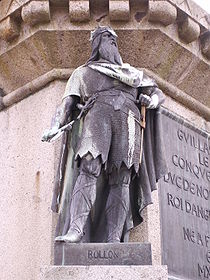
in the 9th century. A fief, probably as a county, was created by the treaty of Saint-Clair-sur-Epte in 911 out of concessions made by King Charles
, and granted to Rollo
, leader of the Viking
s known as Northmen (or in Latin Nortmanni).
Originally coterminous with the ecclesiastical province
of Rouen composed of the northern portion of the province of Neustria
that was centered around Rouen
on the Seine
, it was later expanded by Rollo's conquests southward to include the areas of Évreux
and Alençon
and westward into Breton
territory. Eventually the County roughly corresponded to the two present-day Regions of Upper and Lower Normandy of the modern French Republic
, plus the Channel Islands
, which remain under the British crown
as successors of the dukes of Normandy. All former mainland territory is now part of France
, and the Duchy now consists solely of the Channel Island Bailiwick
s of Jersey
and Guernsey
, which are Crown Dependencies of the British Monarchy
. The British sovereign is the current Duke of Normandy
.
When the Norse-speaking settlers spread out over the lands of the Duchy, they married local women and adopted the Gallo-Romance speech of the existing populations — much as Norman rulers later adopted in England the speech of the conquered people. In Normandy, the new Norman language
formed by the interaction of peoples, inherited vocabulary from Norse. In England the Norman language developed into the Anglo-Norman language
. The literature of the Duchy and England during the period of the Anglo-Norman realm is known as Anglo-Norman literature
.
The Norman dukes created the most powerful and consolidated duchy in Western Europe between the years 980, when the dukes helped place Hugh Capet on the French throne, and 1050. Scholar churchmen were brought into Normandy from the Rhineland, built and endowed monasteries and supported monastic schools. The dukes imposed heavy feudal burdens on the ecclesiastical fiefs, which supplied the armed knights that enabled the dukes to control the restive lay lords but whose bastards could not inherit; by the mid-11th century the Duke of Normandy could count on more than 300 armed and mounted knights from his ecclesiastical vassals alone. By the 1020s the dukes were able to impose vassal
age on the lay nobility as well.
 It was formed from Rouen
county, the Pays de Caux
and Talou (Dieppe county) which the Vikings had colonised. The capital was established at Rouen in 912, and a western capital was later established at Caen
as the Duchy expanded.
In 928 Evreux county, Hiémois county and the Bessin
were added.
In 931-934, William Longsword
, Rollo's son, added the Cotentin Peninsula
and the Avranchin
. The Channel Islands
were added in 933.
Sometime around 950-956, Normandy or its frontier part got the position as a marchio, according to Werner.
Richard II
was the first to be styled duke of Normandy (the ducal title became established between 987-1006).
In 1066, Duke William defeated Harold II of England at the Battle of Hastings
and was subsequently crowned King of England
, through the Norman Conquest of England
, which started the consequential Normanisation.
Anglo-Norman
and French relations became complicated after the Norman Conquest, as the Norman rulers retained control of their holdings in Normandy as vassals owing fealty
to the King of France, but were his equals as King of England. In the 1150s with the creation of the Angevin Empire
the Normans controlled half of France and all of England, dwarfing the power of France. Yet the Normans were still technically vassals to France.
One interpretation of the Conquest maintains that England became a cultural and economic backwater for almost 150 years after as kings of England preferred to rule from cities in Normandy such as Rouen and concentrate on their more lucrative continental holdings. Another interpretation has it that the Norman Duke-Kings neglected their continental territories, where they in theory owed fealty to the Kings of France, in favour of consolidating their power in their new sovereign realm of England. The resources poured into the construction of cathedral
s, castle
s and the administration of the new realm arguably diverted energy and concentration away from the need to defend Normandy, alienating the local nobility and weakening Norman control over the borders of the territory, while at the same time the power of the Kings of France grew.
The Duchy was ruled as part of the Anglo-Norman realm until 1204, when Philip II of France
conquered the continental lands of the Duchy. It became part of the royal demesne. The English sovereigns continued to claim it until the Treaty of Paris (1259)
but in fact kept only the Channel Islands
as part of the former duchy.
Having little confidence in the fidelity of the Normans, the King of France installed French administrators in his new possession and built a powerful fortress, the Château de Rouen
, as a symbol of royal power. Within the royal demesne, Normandy retained some specificity. Norman law
continued to serve as the basis for court decisions. In 1315, faced with the constant encroachments of royal power on the liberties of Normandy, the barons and towns pressed on the king the Norman Charter. This document did not provide autonomy to the province but protected it against arbitrary royal acts. The judgments of the Exchequer, the main court of Normandy, were declared final. This meant that Paris could not reverse a judgement of Rouen. Another important concession was that the King of France could not raise a new tax without the consent of the Normans. However the charter, granted at a time when royal authority was faltering, was violated several times thereafter, when the monarchy had regained its power.
The Duchy of Normandy survived mainly by the intermittent installation of a duke. In practice, the King of France sometimes gave that portion of his kingdom to a close member of his family, who then did homage to the king. Philippe VI made his eldest son Jean
, heir to the throne, Duke of Normandy. In turn, Jean II appointed his heir, Charles
, who was also known by his title of Dauphin.
In 1465, Louis XI
was forced by his nobles to cede the duchy to his eighteen year old brother Charles
, as an appanage
. This concession was a problem for the king since Charles was the puppet of his enemies. Normandy could thus serve as a basis for rebellion against the royal power. Louis XI therefore agreed with his brother to exchange Normandy for the Duchy of Guyenne
(Aquitaine). Finally, to signify that Normandy would not be ceded again, on 9 November 1469 the ducal ring was placed on an anvil and smashed. This was the definitive end of the duchy on the continent.
Nevertheless, James II
was honorarily created "Duke of Normandy" by King Louis XIV of France on 31 December 1660. This was a few months after the restoration of his brother Charles II to the English and Irish thrones (Charles II had been crowned King of Scotland in 1651), and probably was done as a political gesture of support for James - since his brother also would have claimed the title "Duke of Normandy".
Finally, Dauphin Louis Charles
, the second son of Louis XVI
, was also known as Duke of Normandy before the death of his elder brother in 1789. But that title was purely honorary.
, which for administrative purposes are grouped into the two bailiwick
s of Jersey (comprising the island of Jersey
and uninhabited islets such as the Minquiers
and Écréhous
) and Guernsey (comprising the islands of Guernsey
, Sark
, Alderney
, Brecqhou
, Herm
, Jethou
and Lihou
). The current Duke (despite the holder being a female) is Elizabeth II of the United Kingdom
. The Duchy is not part of the United Kingdom but is a Crown Dependency of the Monarch.
Denmark
Denmark is a Scandinavian country in Northern Europe. The countries of Denmark and Greenland, as well as the Faroe Islands, constitute the Kingdom of Denmark . It is the southernmost of the Nordic countries, southwest of Sweden and south of Norway, and bordered to the south by Germany. Denmark...
, Norwegian
Norway
Norway , officially the Kingdom of Norway, is a Nordic unitary constitutional monarchy whose territory comprises the western portion of the Scandinavian Peninsula, Jan Mayen, and the Arctic archipelago of Svalbard and Bouvet Island. Norway has a total area of and a population of about 4.9 million...
, Hiberno-Norse, Orkney Viking
Viking
The term Viking is customarily used to refer to the Norse explorers, warriors, merchants, and pirates who raided, traded, explored and settled in wide areas of Europe, Asia and the North Atlantic islands from the late 8th to the mid-11th century.These Norsemen used their famed longships to...
and Anglo-Danish (from the Danelaw
Danelaw
The Danelaw, as recorded in the Anglo-Saxon Chronicle , is a historical name given to the part of England in which the laws of the "Danes" held sway and dominated those of the Anglo-Saxons. It is contrasted with "West Saxon law" and "Mercian law". The term has been extended by modern historians to...
) invasions of France
France
The French Republic , The French Republic , The French Republic , (commonly known as France , is a unitary semi-presidential republic in Western Europe with several overseas territories and islands located on other continents and in the Indian, Pacific, and Atlantic oceans. Metropolitan France...
in the 9th century. A fief, probably as a county, was created by the treaty of Saint-Clair-sur-Epte in 911 out of concessions made by King Charles
Charles the Simple
Charles III , called the Simple or the Straightforward , was the undisputed King of France from 898 until 922 and the King of Lotharingia from 911 until 919/23...
, and granted to Rollo
Rollo of Normandy
Rollo , baptised Robert and so sometimes numbered Robert I to distinguish him from his descendants, was a Norse nobleman of Norwegian or Danish descent and founder and first ruler of the Viking principality in what soon became known as Normandy...
, leader of the Viking
Viking
The term Viking is customarily used to refer to the Norse explorers, warriors, merchants, and pirates who raided, traded, explored and settled in wide areas of Europe, Asia and the North Atlantic islands from the late 8th to the mid-11th century.These Norsemen used their famed longships to...
s known as Northmen (or in Latin Nortmanni).
Originally coterminous with the ecclesiastical province
Ecclesiastical Province
An ecclesiastical province is a large jurisdiction of religious government, so named by analogy with a secular province, existing in certain hierarchical Christian churches, especially in the Catholic Church and Orthodox Churches and in the Anglican Communion...
of Rouen composed of the northern portion of the province of Neustria
Neustria
The territory of Neustria or Neustrasia, meaning "new [western] land", originated in 511, made up of the regions from Aquitaine to the English Channel, approximating most of the north of present-day France, with Paris and Soissons as its main cities...
that was centered around Rouen
Rouen
Rouen , in northern France on the River Seine, is the capital of the Haute-Normandie region and the historic capital city of Normandy. Once one of the largest and most prosperous cities of medieval Europe , it was the seat of the Exchequer of Normandy in the Middle Ages...
on the Seine
Seine
The Seine is a -long river and an important commercial waterway within the Paris Basin in the north of France. It rises at Saint-Seine near Dijon in northeastern France in the Langres plateau, flowing through Paris and into the English Channel at Le Havre . It is navigable by ocean-going vessels...
, it was later expanded by Rollo's conquests southward to include the areas of Évreux
Évreux
Évreux is a commune in the Eure department, of which it is the capital, in Haute Normandie in northern France.-History:In late Antiquity, the town, attested in the fourth century CE, was named Mediolanum Aulercorum, "the central town of the Aulerci", the Gallic tribe then inhabiting the area...
and Alençon
Alençon
Alençon is a commune in Normandy, France, capital of the Orne department. It is situated west of Paris. Alençon belongs to the intercommunality of Alençon .-History:...
and westward into Breton
Brittany
Brittany is a cultural and administrative region in the north-west of France. Previously a kingdom and then a duchy, Brittany was united to the Kingdom of France in 1532 as a province. Brittany has also been referred to as Less, Lesser or Little Britain...
territory. Eventually the County roughly corresponded to the two present-day Regions of Upper and Lower Normandy of the modern French Republic
France
The French Republic , The French Republic , The French Republic , (commonly known as France , is a unitary semi-presidential republic in Western Europe with several overseas territories and islands located on other continents and in the Indian, Pacific, and Atlantic oceans. Metropolitan France...
, plus the Channel Islands
Channel Islands
The Channel Islands are an archipelago of British Crown Dependencies in the English Channel, off the French coast of Normandy. They include two separate bailiwicks: the Bailiwick of Guernsey and the Bailiwick of Jersey...
, which remain under the British crown
The Crown
The Crown is a corporation sole that in the Commonwealth realms and any provincial or state sub-divisions thereof represents the legal embodiment of governance, whether executive, legislative, or judicial...
as successors of the dukes of Normandy. All former mainland territory is now part of France
France
The French Republic , The French Republic , The French Republic , (commonly known as France , is a unitary semi-presidential republic in Western Europe with several overseas territories and islands located on other continents and in the Indian, Pacific, and Atlantic oceans. Metropolitan France...
, and the Duchy now consists solely of the Channel Island Bailiwick
Bailiwick
A bailiwick is usually the area of jurisdiction of a bailiff, and may also apply to a territory in which the sheriff's functions were exercised by a privately appointed bailiff under a royal or imperial writ. The word is now more generally used in a metaphorical sense, to indicate a sphere of...
s of Jersey
Jersey
Jersey, officially the Bailiwick of Jersey is a British Crown Dependency off the coast of Normandy, France. As well as the island of Jersey itself, the bailiwick includes two groups of small islands that are no longer permanently inhabited, the Minquiers and Écréhous, and the Pierres de Lecq and...
and Guernsey
Guernsey
Guernsey, officially the Bailiwick of Guernsey is a British Crown dependency in the English Channel off the coast of Normandy.The Bailiwick, as a governing entity, embraces not only all 10 parishes on the Island of Guernsey, but also the islands of Herm, Jethou, Burhou, and Lihou and their islet...
, which are Crown Dependencies of the British Monarchy
Monarchy of the United Kingdom
The monarchy of the United Kingdom is the constitutional monarchy of the United Kingdom and its overseas territories. The present monarch, Queen Elizabeth II, has reigned since 6 February 1952. She and her immediate family undertake various official, ceremonial and representational duties...
. The British sovereign is the current Duke of Normandy
Duke of Normandy
The Duke of Normandy is the title of the reigning monarch of the British Crown Dependancies of the Bailiwick of Guernsey and the Bailiwick of Jersey. The title traces its roots to the Duchy of Normandy . Whether the reigning sovereign is a male or female, they are always titled as the "Duke of...
.
When the Norse-speaking settlers spread out over the lands of the Duchy, they married local women and adopted the Gallo-Romance speech of the existing populations — much as Norman rulers later adopted in England the speech of the conquered people. In Normandy, the new Norman language
Norman language
Norman is a Romance language and one of the Oïl languages. Norman can be classified as one of the northern Oïl languages along with Picard and Walloon...
formed by the interaction of peoples, inherited vocabulary from Norse. In England the Norman language developed into the Anglo-Norman language
Anglo-Norman language
Anglo-Norman is the name traditionally given to the kind of Old Norman used in England and to some extent elsewhere in the British Isles during the Anglo-Norman period....
. The literature of the Duchy and England during the period of the Anglo-Norman realm is known as Anglo-Norman literature
Anglo-Norman literature
Anglo-Norman literature is literature composed in the Anglo-Norman language developed during the period 1066–1204 when the Duchy of Normandy and England were united in the Anglo-Norman realm.-Introduction:...
.
The Norman dukes created the most powerful and consolidated duchy in Western Europe between the years 980, when the dukes helped place Hugh Capet on the French throne, and 1050. Scholar churchmen were brought into Normandy from the Rhineland, built and endowed monasteries and supported monastic schools. The dukes imposed heavy feudal burdens on the ecclesiastical fiefs, which supplied the armed knights that enabled the dukes to control the restive lay lords but whose bastards could not inherit; by the mid-11th century the Duke of Normandy could count on more than 300 armed and mounted knights from his ecclesiastical vassals alone. By the 1020s the dukes were able to impose vassal
Vassal
A vassal or feudatory is a person who has entered into a mutual obligation to a lord or monarch in the context of the feudal system in medieval Europe. The obligations often included military support and mutual protection, in exchange for certain privileges, usually including the grant of land held...
age on the lay nobility as well.
Chronology of the Duchy
Rouen
Rouen , in northern France on the River Seine, is the capital of the Haute-Normandie region and the historic capital city of Normandy. Once one of the largest and most prosperous cities of medieval Europe , it was the seat of the Exchequer of Normandy in the Middle Ages...
county, the Pays de Caux
Pays de Caux
The Pays de Caux is an area in Normandy occupying the greater part of the French département of Seine Maritime in Haute-Normandie. It is a chalk plateau to the north of the Seine Estuary and extending to the cliffs on the English Channel coast - its coastline is known as the Côte d'Albâtre...
and Talou (Dieppe county) which the Vikings had colonised. The capital was established at Rouen in 912, and a western capital was later established at Caen
Caen
Caen is a commune in northwestern France. It is the prefecture of the Calvados department and the capital of the Basse-Normandie region. It is located inland from the English Channel....
as the Duchy expanded.
In 928 Evreux county, Hiémois county and the Bessin
Bessin
The Bessin is an area in Normandy, France, corresponding to the territory of the Bajocasse tribe of Gaul who also gave their name to the city of Bayeux, central town of the Bessin.-History:The territory was annexed by the Duchy of Normandy in 924....
were added.
In 931-934, William Longsword
William I of Normandy
William I Longsword was the second Duke of Normandy from his father's death until his own assassination. The title dux was not in use at the time and has been applied to early Norman rulers retroactively. William actually used the title comes .-Biography:Little is known about his early years...
, Rollo's son, added the Cotentin Peninsula
Cotentin Peninsula
The Cotentin Peninsula, also known as the Cherbourg Peninsula, is a peninsula in Normandy, forming part of the north-western coast of France. It juts out north-westwards into the English Channel, towards Great Britain...
and the Avranchin
Avranchin
The Avranchin is an area in Normandy, France, corresponding to the territory of the Abrincates, tribe of Celts who also gave their name to the city of Avranches, main town of the Avranchin....
. The Channel Islands
Channel Islands
The Channel Islands are an archipelago of British Crown Dependencies in the English Channel, off the French coast of Normandy. They include two separate bailiwicks: the Bailiwick of Guernsey and the Bailiwick of Jersey...
were added in 933.
Sometime around 950-956, Normandy or its frontier part got the position as a marchio, according to Werner.
Richard II
Richard II, Duke of Normandy
Richard II , called the Good , was the eldest son and heir of Richard I the Fearless and Gunnora.-Biography:...
was the first to be styled duke of Normandy (the ducal title became established between 987-1006).
In 1066, Duke William defeated Harold II of England at the Battle of Hastings
Battle of Hastings
The Battle of Hastings occurred on 14 October 1066 during the Norman conquest of England, between the Norman-French army of Duke William II of Normandy and the English army under King Harold II...
and was subsequently crowned King of England
England
England is a country that is part of the United Kingdom. It shares land borders with Scotland to the north and Wales to the west; the Irish Sea is to the north west, the Celtic Sea to the south west, with the North Sea to the east and the English Channel to the south separating it from continental...
, through the Norman Conquest of England
Norman conquest of England
The Norman conquest of England began on 28 September 1066 with the invasion of England by William, Duke of Normandy. William became known as William the Conqueror after his victory at the Battle of Hastings on 14 October 1066, defeating King Harold II of England...
, which started the consequential Normanisation.
Anglo-Norman
Anglo-Norman
The Anglo-Normans were mainly the descendants of the Normans who ruled England following the Norman conquest by William the Conqueror in 1066. A small number of Normans were already settled in England prior to the conquest...
and French relations became complicated after the Norman Conquest, as the Norman rulers retained control of their holdings in Normandy as vassals owing fealty
Fealty
An oath of fealty, from the Latin fidelitas , is a pledge of allegiance of one person to another. Typically the oath is made upon a religious object such as a Bible or saint's relic, often contained within an altar, thus binding the oath-taker before God.In medieval Europe, fealty was sworn between...
to the King of France, but were his equals as King of England. In the 1150s with the creation of the Angevin Empire
Angevin Empire
The term Angevin Empire is a modern term describing the collection of states once ruled by the Angevin Plantagenet dynasty.The Plantagenets ruled over an area stretching from the Pyrenees to Ireland during the 12th and early 13th centuries, located north of Moorish Iberia. This "empire" extended...
the Normans controlled half of France and all of England, dwarfing the power of France. Yet the Normans were still technically vassals to France.
One interpretation of the Conquest maintains that England became a cultural and economic backwater for almost 150 years after as kings of England preferred to rule from cities in Normandy such as Rouen and concentrate on their more lucrative continental holdings. Another interpretation has it that the Norman Duke-Kings neglected their continental territories, where they in theory owed fealty to the Kings of France, in favour of consolidating their power in their new sovereign realm of England. The resources poured into the construction of cathedral
Cathedral
A cathedral is a Christian church that contains the seat of a bishop...
s, castle
Castle
A castle is a type of fortified structure built in Europe and the Middle East during the Middle Ages by European nobility. Scholars debate the scope of the word castle, but usually consider it to be the private fortified residence of a lord or noble...
s and the administration of the new realm arguably diverted energy and concentration away from the need to defend Normandy, alienating the local nobility and weakening Norman control over the borders of the territory, while at the same time the power of the Kings of France grew.
The Duchy was ruled as part of the Anglo-Norman realm until 1204, when Philip II of France
Philip II of France
Philip II Augustus was the King of France from 1180 until his death. A member of the House of Capet, Philip Augustus was born at Gonesse in the Val-d'Oise, the son of Louis VII and his third wife, Adela of Champagne...
conquered the continental lands of the Duchy. It became part of the royal demesne. The English sovereigns continued to claim it until the Treaty of Paris (1259)
Treaty of Paris (1259)
The Treaty of Paris was a treaty between Louis IX of France and Henry III of England, agreed to on December 4, 1259....
but in fact kept only the Channel Islands
Channel Islands
The Channel Islands are an archipelago of British Crown Dependencies in the English Channel, off the French coast of Normandy. They include two separate bailiwicks: the Bailiwick of Guernsey and the Bailiwick of Jersey...
as part of the former duchy.
Having little confidence in the fidelity of the Normans, the King of France installed French administrators in his new possession and built a powerful fortress, the Château de Rouen
Rouen
Rouen , in northern France on the River Seine, is the capital of the Haute-Normandie region and the historic capital city of Normandy. Once one of the largest and most prosperous cities of medieval Europe , it was the seat of the Exchequer of Normandy in the Middle Ages...
, as a symbol of royal power. Within the royal demesne, Normandy retained some specificity. Norman law
Norman law
Norman law refers to the customary law of Normandy which developed between the 10th and 13th centuries following the establishment of the Vikings there and which survives today still through the legal systems of Jersey and Guernsey in the Channel Islands....
continued to serve as the basis for court decisions. In 1315, faced with the constant encroachments of royal power on the liberties of Normandy, the barons and towns pressed on the king the Norman Charter. This document did not provide autonomy to the province but protected it against arbitrary royal acts. The judgments of the Exchequer, the main court of Normandy, were declared final. This meant that Paris could not reverse a judgement of Rouen. Another important concession was that the King of France could not raise a new tax without the consent of the Normans. However the charter, granted at a time when royal authority was faltering, was violated several times thereafter, when the monarchy had regained its power.
The Duchy of Normandy survived mainly by the intermittent installation of a duke. In practice, the King of France sometimes gave that portion of his kingdom to a close member of his family, who then did homage to the king. Philippe VI made his eldest son Jean
John II of France
John II , called John the Good , was the King of France from 1350 until his death. He was the second sovereign of the House of Valois and is perhaps best remembered as the king who was vanquished at the Battle of Poitiers and taken as a captive to England.The son of Philip VI and Joan the Lame,...
, heir to the throne, Duke of Normandy. In turn, Jean II appointed his heir, Charles
Charles V of France
Charles V , called the Wise, was King of France from 1364 to his death in 1380 and a member of the House of Valois...
, who was also known by his title of Dauphin.
In 1465, Louis XI
Louis XI of France
Louis XI , called the Prudent , was the King of France from 1461 to 1483. He was the son of Charles VII of France and Mary of Anjou, a member of the House of Valois....
was forced by his nobles to cede the duchy to his eighteen year old brother Charles
Charles de Valois, Duc de Berry
Charles de Valois, Duke of Berry was a son of Charles VII, King of France. He spent most of his life in conflict with his elder brother, King Louis XI of France.-Life:...
, as an appanage
Appanage
An apanage or appanage or is the grant of an estate, titles, offices, or other things of value to the younger male children of a sovereign, who would otherwise have no inheritance under the system of primogeniture...
. This concession was a problem for the king since Charles was the puppet of his enemies. Normandy could thus serve as a basis for rebellion against the royal power. Louis XI therefore agreed with his brother to exchange Normandy for the Duchy of Guyenne
Duke of Aquitaine
The Duke of Aquitaine ruled the historical region of Aquitaine under the supremacy of Frankish, English and later French kings....
(Aquitaine). Finally, to signify that Normandy would not be ceded again, on 9 November 1469 the ducal ring was placed on an anvil and smashed. This was the definitive end of the duchy on the continent.
Nevertheless, James II
James II of England
James II & VII was King of England and King of Ireland as James II and King of Scotland as James VII, from 6 February 1685. He was the last Catholic monarch to reign over the Kingdoms of England, Scotland, and Ireland...
was honorarily created "Duke of Normandy" by King Louis XIV of France on 31 December 1660. This was a few months after the restoration of his brother Charles II to the English and Irish thrones (Charles II had been crowned King of Scotland in 1651), and probably was done as a political gesture of support for James - since his brother also would have claimed the title "Duke of Normandy".
Finally, Dauphin Louis Charles
Louis XVII of France
Louis XVII , from birth to 1789 known as Louis-Charles, Duke of Normandy; then from 1789 to 1791 as Louis-Charles, Dauphin of France; and from 1791 to 1793 as Louis-Charles, Prince Royal of France, was the son of King Louis XVI of France and Queen Marie Antoinette...
, the second son of Louis XVI
Louis XVI of France
Louis XVI was a Bourbon monarch who ruled as King of France and Navarre until 1791, and then as King of the French from 1791 to 1792, before being executed in 1793....
, was also known as Duke of Normandy before the death of his elder brother in 1789. But that title was purely honorary.
The Duchy today
The Duchy of Normandy survives as the Channel IslandsChannel Islands
The Channel Islands are an archipelago of British Crown Dependencies in the English Channel, off the French coast of Normandy. They include two separate bailiwicks: the Bailiwick of Guernsey and the Bailiwick of Jersey...
, which for administrative purposes are grouped into the two bailiwick
Bailiwick
A bailiwick is usually the area of jurisdiction of a bailiff, and may also apply to a territory in which the sheriff's functions were exercised by a privately appointed bailiff under a royal or imperial writ. The word is now more generally used in a metaphorical sense, to indicate a sphere of...
s of Jersey (comprising the island of Jersey
Jersey
Jersey, officially the Bailiwick of Jersey is a British Crown Dependency off the coast of Normandy, France. As well as the island of Jersey itself, the bailiwick includes two groups of small islands that are no longer permanently inhabited, the Minquiers and Écréhous, and the Pierres de Lecq and...
and uninhabited islets such as the Minquiers
Minquiers
The Minquiers are a group of islands and rocks situated 9 miles south of Jersey forming part of the Bailiwick of Jersey....
and Écréhous
Écréhous
The Écréhous are a group of islands and rocks situated six miles north-east of Jersey . They form part of the Bailiwick of Jersey and are administratively part of the Parish of St...
) and Guernsey (comprising the islands of Guernsey
Guernsey
Guernsey, officially the Bailiwick of Guernsey is a British Crown dependency in the English Channel off the coast of Normandy.The Bailiwick, as a governing entity, embraces not only all 10 parishes on the Island of Guernsey, but also the islands of Herm, Jethou, Burhou, and Lihou and their islet...
, Sark
Sark
Sark is a small island in the Channel Islands in southwestern English Channel, off the French coast of Normandy. It is a royal fief, geographically located in the Channel Islands in the Bailiwick of Guernsey, with its own set of laws based on Norman law and its own parliament. It has a population...
, Alderney
Alderney
Alderney is the most northerly of the Channel Islands. It is part of the Bailiwick of Guernsey, a British Crown dependency. It is long and wide. The area is , making it the third-largest island of the Channel Islands, and the second largest in the Bailiwick...
, Brecqhou
Brecqhou
Brecqhou is one of the Channel Islands and part of the Bailiwick of Guernsey. It is located just west of Sark and has a surface area of approximately...
, Herm
Herm
Herm is the smallest of the Channel Islands that is open to the public and is part of the Bailiwick of Guernsey. Cars are banned from the small island just like its Channel Island neighbour, Sark. Unlike Sark, bicycles are also banned...
, Jethou
Jethou
Jethou is a small island that is part of the Bailiwick of Guernsey in the Channel Islands. It is privately leased, and not open to the public.It is immediately south of Herm and has an area of approximately .-History:...
and Lihou
Lihou
Not to be confused with Lihou Reef National Nature ReserveLihou is a small tidal island that is part of the Bailiwick of Guernsey, Channel Islands. It lies off the west coast of Guernsey and is the most westerly point in the Channel Islands. Coordinates: . The island was bought by the States of...
). The current Duke (despite the holder being a female) is Elizabeth II of the United Kingdom
Elizabeth II of the United Kingdom
Elizabeth II is the constitutional monarch of 16 sovereign states known as the Commonwealth realms: the United Kingdom, Canada, Australia, New Zealand, Jamaica, Barbados, the Bahamas, Grenada, Papua New Guinea, the Solomon Islands, Tuvalu, Saint Lucia, Saint Vincent and the Grenadines, Belize,...
. The Duchy is not part of the United Kingdom but is a Crown Dependency of the Monarch.
See also
- Duke of NormandyDuke of NormandyThe Duke of Normandy is the title of the reigning monarch of the British Crown Dependancies of the Bailiwick of Guernsey and the Bailiwick of Jersey. The title traces its roots to the Duchy of Normandy . Whether the reigning sovereign is a male or female, they are always titled as the "Duke of...
- Anglo-NormanAnglo-NormanThe Anglo-Normans were mainly the descendants of the Normans who ruled England following the Norman conquest by William the Conqueror in 1066. A small number of Normans were already settled in England prior to the conquest...
- Norman architectureNorman architectureAbout|Romanesque architecture, primarily English|other buildings in Normandy|Architecture of Normandy.File:Durham Cathedral. Nave by James Valentine c.1890.jpg|thumb|200px|The nave of Durham Cathedral demonstrates the characteristic round arched style, though use of shallow pointed arches above the...
- NormandyNormandyNormandy is a geographical region corresponding to the former Duchy of Normandy. It is in France.The continental territory covers 30,627 km² and forms the preponderant part of Normandy and roughly 5% of the territory of France. It is divided for administrative purposes into two régions:...
- Gesta Normannorum DucumGesta Normannorum DucumGesta Normannorum Ducum is a chronicle originally created by the monk William of Jumièges just before 1060. In 1070 William I had William of Jumièges extend the work to detail his rights to the throne of England. In later times, Orderic Vitalis and Robert of Torigni Gesta Normannorum Ducum (Deeds...
- Roman de RouRoman de RouRoman de Rou is a verse chronicle by Wace in Norman covering the history of the Dukes of Normandy from the time of Rollo of Normandy to the battle of Tinchebray in 1106...
- History of NormandyHistory of NormandyNormandy was a province in the North-West of France under the Ancien Régime. Initially populated by Celtic tribes in the West and Belgian tribes in the North East, it was conquered in 98 AD by the Romans and integrated into the province of Gallia Lugdunensis by Augustus. In the 4th century, Gratian...