
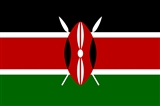
Kenya officially known as the Republic of Kenya, is a country in
East AfricaEast Africa or Eastern Africa is the easterly region of the African continent, variably defined by geography or geopolitics. In the UN scheme of geographic regions, 19 territories constitute Eastern Africa:...
that lies on the
equatorAn equator is the intersection of a sphere's surface with the plane perpendicular to the sphere's axis of rotation and containing the sphere's center of mass....
, with the
Indian OceanThe Indian Ocean is the third largest of the world's oceanic divisions, covering approximately 20% of the water on the Earth's surface. It is bounded on the north by the Indian Subcontinent and Arabian Peninsula ; on the west by eastern Africa; on the east by Indochina, the Sunda Islands, and...
to its south-east. It is bordered by
TanzaniaThe United Republic of Tanzania is a country in East Africa bordered by Kenya and Uganda to the north, Rwanda, Burundi, and the Democratic Republic of the Congo to the west, and Zambia, Malawi, and Mozambique to the south. The country's eastern borders lie on the Indian Ocean.Tanzania is a state...
to the south,
UgandaUganda , officially the Republic of Uganda, is a landlocked country in East Africa. Uganda is also known as the "Pearl of Africa". It is bordered on the east by Kenya, on the north by South Sudan, on the west by the Democratic Republic of the Congo, on the southwest by Rwanda, and on the south by...
to the west,
South SudanSouth Sudan , officially the Republic of South Sudan, is a landlocked country located in the Sahel region of northeastern Africa. It is also part of the North Africa UN sub-region. Its current capital is Juba, which is also its largest city; the capital city is planned to be moved to the more...
to the north-west,
EthiopiaEthiopia , officially known as the Federal Democratic Republic of Ethiopia, is a country located in the Horn of Africa. It is the second-most populous nation in Africa, with over 82 million inhabitants, and the tenth-largest by area, occupying 1,100,000 km2...
to the north and
SomaliaSomalia , officially the Somali Republic and formerly known as the Somali Democratic Republic under Socialist rule, is a country located in the Horn of Africa. Since the outbreak of the Somali Civil War in 1991 there has been no central government control over most of the country's territory...
to the north-east.
Kenya has a land area of 580,000 km
2 and a population of nearly 41 million, representing 42 different peoples and cultures. The country is named after
Mount KenyaMount Kenya is the highest mountain in Kenya and the second-highest in Africa, after Kilimanjaro. The highest peaks of the mountain are Batian , Nelion and Point Lenana . Mount Kenya is located in central Kenya, just south of the equator, around north-northeast of the capital Nairobi...
, a significant landmark and second among
Africa's highest mountain peaksThis is a list of the highest mountains of Africa. It aims to include the 75 highest mountains with a prominence of at least 500 m. Some regions are still poorly described and the list is likely to be both incomplete and not completely accurate. This is especially true for the Ethiopian Highlands,...
.
Following a referendum and adoption of a new constitution in August 2010, Kenya is now divided into 47 counties that are semi-autonomous units of governance. These units are expected to be fully implemented by August 2012 – in time for the first general election under the new constitution. The counties will be governed by elected
governorA governor is a governing official, usually the executive of a non-sovereign level of government, ranking under the head of state...
s and will operate independent of the central government in Nairobi.
The country's
geographyThe geography of Kenya is diverse. Kenya has a coastline on the Indian Ocean, which contains swamps of East African mangroves. Inland are broad plains and numerous hills. Central and Western Kenya is characterized by the Great Rift Valley home to three of Africa's highest mountains, Mount Kenya,...
is as diverse as its multi-ethnic
populationKenya is a multi-ethnic state in the southern Great Lakes region of East Africa. It is primarily inhabited by Bantu and Nilotic populations, with some Cushitic ethnic minorities in the north. Its total population is estimated at 41 million inhabitants as of 2011....
. It has a warm and humid climate along its coastline on the Indian Ocean which changes to wildlife-rich
savannahSavannah or savanna is a type of grassland.It can also mean:-People:* Savannah King, a Canadian freestyle swimmer* Savannah Outen, a singer who gained popularity on You Tube...
grasslands as you move inland towards the capital
NairobiNairobi is the capital and largest city of Kenya. The city and its surrounding area also forms the Nairobi County. The name "Nairobi" comes from the Maasai phrase Enkare Nyirobi, which translates to "the place of cool waters". However, it is popularly known as the "Green City in the Sun" and is...
. Nairobi has a cool climate that gets colder as you move towards
Mount KenyaMount Kenya is the highest mountain in Kenya and the second-highest in Africa, after Kilimanjaro. The highest peaks of the mountain are Batian , Nelion and Point Lenana . Mount Kenya is located in central Kenya, just south of the equator, around north-northeast of the capital Nairobi...
which has three permanently snow-capped peaks. The warm and humid tropical climate reappears further inland towards lake Victoria, before giving way to temperate forested and hilly areas in the western region. The North Eastern regions along the border with Somalia and Ethiopia are arid and semi-arid areas with near-
desertA desert is a landscape or region that receives an extremely low amount of precipitation, less than enough to support growth of most plants. Most deserts have an average annual precipitation of less than...
landscapes. The country also has significant
geothermalGeothermal is related to energy and may refer to:* The geothermal gradient and associated heat flows from within the Earth- Renewable technology :...
activity that puts a lot of electricity in the national grid.
Kenya's capital city,
NairobiNairobi is the capital and largest city of Kenya. The city and its surrounding area also forms the Nairobi County. The name "Nairobi" comes from the Maasai phrase Enkare Nyirobi, which translates to "the place of cool waters". However, it is popularly known as the "Green City in the Sun" and is...
, is situated next to a national park. The country is famous for its
safariA safari is an overland journey, usually a trip by tourists to Africa. Traditionally, the term is used for a big-game hunt, but today the term often refers to a trip taken not for the purposes of hunting, but to observe and photograph animals and other wildlife.-Etymology:Entering the English...
s and diverse world-famous wildlife reserves such as
Tsavo National ParkTsavo National Park may refer to:* Tsavo East National Park, a national park in Kenya on the eastern side of the A109 road.* Tsavo West National Park, a national park in Kenya on the western side of the A109 road....
, the Maasai Mara, Nakuru National Park, and Aberdares National Park that attract tourists from all over the world.
Lake VictoriaLake Victoria is one of the African Great Lakes. The lake was named for Queen Victoria of the United Kingdom, by John Hanning Speke, the first European to discover this lake....
, the world's second largest fresh-water lake (after
Lake SuperiorLake Superior is the largest of the five traditionally-demarcated Great Lakes of North America. It is bounded to the north by the Canadian province of Ontario and the U.S. state of Minnesota, and to the south by the U.S. states of Wisconsin and Michigan. It is the largest freshwater lake in the...
in the US and Canada) and the world's largest tropical lake, is situated to the southwest and is shared with Uganda and Tanzania.
As part of
East AfricaEast Africa or Eastern Africa is the easterly region of the African continent, variably defined by geography or geopolitics. In the UN scheme of geographic regions, 19 territories constitute Eastern Africa:...
, Kenya has seen human habitation since the
Lower PaleolithicThe Lower Paleolithic is the earliest subdivision of the Paleolithic or Old Stone Age. It spans the time from around 2.5 million years ago when the first evidence of craft and use of stone tools by hominids appears in the current archaeological record, until around 300,000 years ago, spanning the...
period. The
Bantu expansionThe Bantu expansion or the Bantu Migration was a millennia-long series of migrations of speakers of the original proto-Bantu language group...
reached the area by the first millennium AD, and the borders of the modern state comprise the crossroads of the
BantuThe Bantu languages constitute a traditional sub-branch of the Niger–Congo languages. There are about 250 Bantu languages by the criterion of mutual intelligibility, though the distinction between language and dialect is often unclear, and Ethnologue counts 535 languages...
, the Nilo-Saharan, and the Afro-Asiatic linguistic areas of Africa, making Kenya a truly multi-ethnic state. European and Arab presence in
MombasaMombasa is the second-largest city in Kenya. Lying next to the Indian Ocean, it has a major port and an international airport. The city also serves as the centre of the coastal tourism industry....
dates to the Early Modern period, but
European explorationEuropean exploration of Africa began with Ancient Greeks and Romans, who explored and established settlements in North Africa. Fifteenth Century Portugal, especially under Henry the Navigator probed along the West African coast. Scientific curiosity and Christian missionary spirit soon were...
of the interior began only in the 19th century. The
British EmpireThe British Empire comprised the dominions, colonies, protectorates, mandates and other territories ruled or administered by the United Kingdom. It originated with the overseas colonies and trading posts established by England in the late 16th and early 17th centuries. At its height, it was the...
established the
East Africa ProtectorateEast Africa Protectorate was an area of East Africa occupying roughly the same terrain as present-day Kenya from the Indian Ocean inland to Uganda and the Great Rift Valley...
in 1895, known from 1920 as the
Kenya ColonyThe Colony and Protectorate of Kenya was part of the British Empire in Africa. It was established when the former East Africa Protectorate was transformed into a British crown colony in 1920...
. The independent Republic of Kenya was founded in December 1963.
The capital, Nairobi, is a regional commercial hub. The
economy of KenyaKenya's economy is market-based, with a few state-owned infrastructure enterprises, and maintains a liberalized external trade system. The country is generally perceived as Eastern and central Africa's hub for Financial, Communication and Transportation services...
is the second largest (after Ethiopia) by GDP in East and Central Africa. Agriculture is a major employer and the country traditionally exports tea and coffee, and more recently fresh flowers to Europe. The service industry is a major economic driver, mostly the telecommunications sector, and contributes 62 percent of GDP.
Kenya is a member of the
East African CommunityThe East African Community is an intergovernmental organisation comprising the five east African countries Burundi, Kenya, Rwanda, Tanzania, and Uganda. Pierre Nkurunziza, the President of the Republic of Burundi, is the current Chairman of the East African Community. The EAC was originally...
and produces world-class athletes such as world champions
Paul TergatPaul Kibii Tergat is a Kenyan professional long distance runner. He held the world record in the marathon from 2003 to 2007, with a time of 2:04:55, and is regarded as one of the most accomplished long-distance runners of all time.Now concentrating exclusively on the marathon, Tergat won many...
and
David RudishaDavid Lekuta Rudisha is a Kenyan middle distance runner and world record holder in the 800 metres with a time of 1:41.01. Rudisha holds four of the ten fastest times for this event.-Early life:...
.
Etymology
The word Kenya, ˈ, originates from the Kikuyu,
EmbuThe Embu inhabit Embu District in Kenya. They speak Embu language. To the south of Embu are to be found their cousins, the Mbeere people, in Mbeere District. Previously, the Embu and Mbeere were in one district, Embu District, and just referred to as the Embu people. To the east, Embu neighbors...
and Kamba names for
Mount KenyaMount Kenya is the highest mountain in Kenya and the second-highest in Africa, after Kilimanjaro. The highest peaks of the mountain are Batian , Nelion and Point Lenana . Mount Kenya is located in central Kenya, just south of the equator, around north-northeast of the capital Nairobi...
, "Kirinyaga", "Kirinyaa" and "Kiinyaa". Prehistoric volcanic eruptions of Mount Kenya (now extinct) may have resulted in its association with divinity and creation among the indigenous Kikuyu-related ethnic groups who are the native inhabitants of the agricultural land surrounding Mount Kenya.
In the 19th century, the German explorer Ludwig Krapf recorded the name as both Kenia and Kegnia believed by some to be a corruption of the Kamba version.
Others say that this was—on the contrary—a very precise notation of a correct African pronunciation ˈ.
Geography and climate
At 580367 km² (224,081 sq mi), Kenya is the world's forty-seventh largest country (after
MadagascarThe Republic of Madagascar is an island country located in the Indian Ocean off the southeastern coast of Africa...
). It lies between latitudes
5°NThe 5th parallel north is a circle of latitude that is 5 degrees north of the Earth's equatorial plane. It crosses the Atlantic Ocean, Africa, the Indian Ocean, Southeast Asia, the Pacific Ocean and South America....
and
5°SThe 5th parallel south is a circle of latitude that is 5 degrees south of the Earth's equatorial plane. It crosses the Atlantic Ocean, Africa, the Indian Ocean, Southeast Asia, Australasia, the Pacific Ocean and South America....
, and longitudes
34°The meridian 34° east of Greenwich is a line of longitude that extends from the North Pole across the Arctic Ocean, Europe, Turkey, Africa, the Indian Ocean, the Southern Ocean, and Antarctica to the South Pole....
and
42°EThe meridian 42° east of Greenwich is a line of longitude that extends from the North Pole across the Arctic Ocean, Europe, Asia, Africa, the Indian Ocean, the Southern Ocean, and Antarctica to the South Pole....
.
From the coast on the Indian Ocean, the low plains rise to central highlands. The highlands are bisected by the
Great Rift ValleyThe Great Rift Valley is a name given in the late 19th century by British explorer John Walter Gregory to the continuous geographic trench, approximately in length, that runs from northern Syria in Southwest Asia to central Mozambique in South East Africa...
; a fertile plateau lies in the east. The Kenyan Highlands comprise one of the most successful agricultural production regions in Africa. The highlands are the site of the highest point in Kenya (and the second highest in Africa):
Mount KenyaMount Kenya is the highest mountain in Kenya and the second-highest in Africa, after Kilimanjaro. The highest peaks of the mountain are Batian , Nelion and Point Lenana . Mount Kenya is located in central Kenya, just south of the equator, around north-northeast of the capital Nairobi...
, which reaches 5199 m (17,057 ft) and is the site of glaciers.
Mount KilimanjaroKilimanjaro, with its three volcanic cones, Kibo, Mawenzi, and Shira, is a dormant volcano in Kilimanjaro National Park, Tanzania and the highest mountain in Africa at above sea level .-Geology:...
(5895 m (19,341 ft)) can be seen from Kenya to the South of the Tanzanian border.
Kenya's climate varies from tropical along the coast to temperate inland to
aridA region is said to be arid when it is characterized by a severe lack of available water, to the extent of hindering or even preventing the growth and development of plant and animal life...
in the north and northeast parts of the country. Kenya receives a great deal of sunshine all the year round, and summer clothes are worn throughout the year. It is usually cool at night and early in the morning inland at higher elevations. The "long rains" season occurs from March/April to May/June. The "short rains" season occurs from October to November/December. The rainfall is sometimes heavy and often falls in the afternoons and evenings. The temperature remains high throughout these months of tropical rain. The hottest period is February and March, leading into the season of the long rains, and the coldest is in July and August.
| City |
Elevation (m) | Max (°C) | Min (°C) |
| Mombasa |
|
17 |
30.3 |
22.4 |
| Nairobi |
|
1,661 |
25.2 |
13.6 |
| Eldoret |
|
2,085 |
23.6 |
9.5 |
| Lodwar |
|
506 |
34.8 |
23.7 |
| Mandera |
|
506 |
34.8 |
25.7 |
Kenya has considerable land area devoted to
wildlifeWildlife includes all non-domesticated plants, animals and other organisms. Domesticating wild plant and animal species for human benefit has occurred many times all over the planet, and has a major impact on the environment, both positive and negative....
habitats, including the
Masai MaraThe Maasai Mara National Reserve is a large game reserve in south-western Kenya, which is effectively the northern continuation of the Serengeti National Park in Tanzania...
, where
Blue WildebeestThe Blue Wildebeest , also called the Common Wildebeest, is a large antelope and one of two species of wildebeest. It grows to 115–145 cm shoulder height and attains a body mass of 168–274 kg. They range the open plains, bushveld and dry woodlands of Southern and East Africa, living for...
and other
bovidA bovid is any of almost 140 species of cloven-hoofed ruminant mammal at least the males of which bear characteristic unbranching horns covered in a permanent sheath of keratin....
s participate in a large scale annual migration. Up to 250,000 blue wildebeest perish each year in the long and arduous movement to find forage in the dry season. The
"Big Five"The phrase Big Five game was coined by white hunters and refers to the five most difficult animals in Africa to hunt on foot. The term is still used in most tourist and wildlife guides that discuss African wildlife safaris. The collection consists of the lion, African elephant, cape buffalo,...
animals of Africa can be found in Kenya and in the Masai Mara in particular: the
lionThe lion is one of the four big cats in the genus Panthera, and a member of the family Felidae. With some males exceeding 250 kg in weight, it is the second-largest living cat after the tiger...
,
leopardThe leopard , Panthera pardus, is a member of the Felidae family and the smallest of the four "big cats" in the genus Panthera, the other three being the tiger, lion, and jaguar. The leopard was once distributed across eastern and southern Asia and Africa, from Siberia to South Africa, but its...
,
buffaloThe African buffalo, affalo, nyati, Mbogo or Cape buffalo is a large African bovine. It is not closely related to the slightly larger wild Asian water buffalo, but its ancestry remains unclear...
,
rhinocerosRhinoceros , also known as rhino, is a group of five extant species of odd-toed ungulates in the family Rhinocerotidae. Two of these species are native to Africa and three to southern Asia....
and
elephantElephants are large land mammals in two extant genera of the family Elephantidae: Elephas and Loxodonta, with the third genus Mammuthus extinct...
. A significant population of other wild animals, reptiles and birds can be found in the
national parks and game reserves in the country. The annual animal migration – especially migration of the
wildebeestThe wildebeest , also called the gnu is an antelope of the genus Connochaetes. It is a hooved mammal...
– occurs between June and September with millions of animals taking part.
Kenya is the setting for one of the Natural Wonders of the World – the great
wildebeestThe wildebeest , also called the gnu is an antelope of the genus Connochaetes. It is a hooved mammal...
migrationAnimal migration is the relatively long-distance movement of individuals, usually on a seasonal basis. It is a ubiquitous phenomenon, found in all major animal groups, including birds, mammals, fish, reptiles, amphibians, insects, and crustaceans. The trigger for the migration may be local...
. 11.5 million of these ungulates migrate a distance of 1,800 miles from the
SerengetiThe Serengeti ecosystem is a geographical region in Africa. It is located in north Tanzania and extends to south-western Kenya between latitudes 1 and 3 S and longitudes 34 and 36 E. It spans some ....
in neighbouring
TanzaniaThe United Republic of Tanzania is a country in East Africa bordered by Kenya and Uganda to the north, Rwanda, Burundi, and the Democratic Republic of the Congo to the west, and Zambia, Malawi, and Mozambique to the south. The country's eastern borders lie on the Indian Ocean.Tanzania is a state...
to the
Masai MaraThe Maasai Mara National Reserve is a large game reserve in south-western Kenya, which is effectively the northern continuation of the Serengeti National Park in Tanzania...
in Kenya, in a constant clockwise fashion, searching for food and water supplies.
Prehistory
Giant crocodileThe term prehistoric reptile covers a broad category that is intended to help distinguish the dinosaurs from other prehistoric reptiles. As the dinosaurs, because of their long and successful reign for many millions of years, are almost exclusively dealt with in their own category of prehistoric...
fossils have been discovered in Kenya, dating from the Mesozoic Era, over 200 million years ago. The fossils were found in an excavation conducted by a team from the
University of UtahThe University of Utah, also known as the U or the U of U, is a public, coeducational research university in Salt Lake City, Utah, United States. The university was established in 1850 as the University of Deseret by the General Assembly of the provisional State of Deseret, making it Utah's oldest...
and the
National Museums of KenyaThe National Museums of Kenya is a State Corporation that manages Museums, Sites and Monuments in Kenya. It also practices scientific research. Its headquarters and the National Museum are located on Museum Hill, near Uhuru Highway between Central Business District and Westlands in Nairobi...
in July–August 2004 at Lokitaung Gorge, near
Lake TurkanaLake Turkana , formerly known as Lake Rudolf, is a lake in the Great Rift Valley in Kenya, with its far northern end crossing into Ethiopia. It is the world's largest permanent desert lake and the world's largest alkaline lake...
.
Fossils found in East Africa suggest that primates roamed the area more than 20 million years ago. Recent finds near Kenya's Lake Turkana indicate that hominids such as
Homo habilisHomo habilis is a species of the genus Homo, which lived from approximately at the beginning of the Pleistocene period. The discovery and description of this species is credited to both Mary and Louis Leakey, who found fossils in Tanzania, East Africa, between 1962 and 1964. Homo habilis Homo...
(1.8 and 2.5 million years ago) and
Homo erectusHomo erectus is an extinct species of hominid that lived from the end of the Pliocene epoch to the later Pleistocene, about . The species originated in Africa and spread as far as India, China and Java. There is still disagreement on the subject of the classification, ancestry, and progeny of H...
(1.8 million to 350 000 years ago) are possible direct ancestors of modern Homo sapiens and lived in Kenya during the
PleistoceneThe Pleistocene is the epoch from 2,588,000 to 11,700 years BP that spans the world's recent period of repeated glaciations. The name pleistocene is derived from the Greek and ....
epoch. In 1984 one particular discovery made at
Lake TurkanaLake Turkana , formerly known as Lake Rudolf, is a lake in the Great Rift Valley in Kenya, with its far northern end crossing into Ethiopia. It is the world's largest permanent desert lake and the world's largest alkaline lake...
by famous palaeoanthropologist
Richard LeakeyRichard Erskine Frere Leakey is a politician, paleoanthropologist and conservationist. He is second of the three sons of the archaeologists Louis Leakey and Mary Leakey, and is the younger brother of Colin Leakey...
and
Kamoya KimeuKamoya Kimeu, is one of the world's most successful fossil collectors who, together with paleontologists Meave Leakey and Richard Leakey, is responsible for some of the most significant paleoanthropological discoveries...
was the skeleton of a
Turkana boyTurkana Boy, also occasionally, Nariokotome Boy is the common name of fossil KNM-WT 15000, a nearly complete skeleton of a hominid who died in the early Pleistocene. This specimen is the most complete early human skeleton ever found. It is 1.5 million years old...
belonging to Homo erectus from 1.6 million years ago. Previous research on early hominids is particularly identified with
Mary LeakeyMary Leakey was a British archaeologist and anthropologist, who discovered the first skull of a fossil ape on Rusinga Island and also a noted robust Australopithecine called Zinjanthropus at Olduvai. For much of her career she worked together with her husband, Louis Leakey, in Olduvai Gorge,...
and
Louis LeakeyLouis Seymour Bazett Leakey was a British archaeologist and naturalist whose work was important in establishing human evolutionary development in Africa. He also played a major role in creating organizations for future research in Africa and for protecting wildlife there...
, who were responsible for the preliminary archaeological research at
OlorgesailieOlorgesailie is a geological formation in East Africa containing a group of Lower Paleolithic archaeological sites. It is on the floor of the Eastern Rift Valley in southern Kenya, southwest of Nairobi along the road to Lake Magadi. Olorgesailie is noted for the large number of Acheulean hand...
and
Hyrax HillHyrax Hill is a prehistoric site near Nakuru in the Rift Valley province of Kenya. It is considered one of the country's most important neolithic excavation sites. Hyrax Hill dates from 1500 B.C. and was discovered by Louis and Mary Leakey in 1926....
. Later work at the former was undertaken by
Glynn IsaacGlynn Llywelyn Isaac was a South African archaeologist who specialised in the very early prehistory of Africa...
.
Kenya has been inhabited by people for as long as human history has existed.
Pre-colonial history
The first inhabitants of present-day Kenya were
hunter-gathererA hunter-gatherer or forage society is one in which most or all food is obtained from wild plants and animals, in contrast to agricultural societies which rely mainly on domesticated species. Hunting and gathering was the ancestral subsistence mode of Homo, and all modern humans were...
groups, akin to the modern
Khoisan Khoisan is a unifying name for two ethnic groups of Southern Africa, who share physical and putative linguistic characteristics distinct from the Bantu majority of the region. Culturally, the Khoisan are divided into the foraging San and the pastoral Khoi...
speakers. These people were later replaced by agropastoralist Cushitic speakers from the
Horn of AfricaThe Horn of Africa is a peninsula in East Africa that juts hundreds of kilometers into the Arabian Sea and lies along the southern side of the Gulf of Aden. It is the easternmost projection of the African continent...
. During the early
HoloceneThe Holocene is a geological epoch which began at the end of the Pleistocene and continues to the present. The Holocene is part of the Quaternary period. Its name comes from the Greek words and , meaning "entirely recent"...
the regional climate shifted from dry to wetter climatic conditions, this provided an opportunity for the development of cultural traditions, such as
agricultureAgriculture is the cultivation of animals, plants, fungi and other life forms for food, fiber, and other products used to sustain life. Agriculture was the key implement in the rise of sedentary human civilization, whereby farming of domesticated species created food surpluses that nurtured the...
and
herdingHerding is the act of bringing individual animals together into a group , maintaining the group and moving the group from place to place—or any combination of those. While the layperson uses the term "herding", most individuals involved in the process term it mustering, "working stock" or...
, in a more favorable environment.
Around 500 BC
NiloticThe Nilo-Saharan languages are a proposed family of African languages spoken by some 50 million people, mainly in the upper parts of the Chari and Nile rivers , including historic Nubia, north of where the two tributaries of Nile meet...
speaking
pastoralistsPastoralism or pastoral farming is the branch of agriculture concerned with the raising of livestock. It is animal husbandry: the care, tending and use of animals such as camels, goats, cattle, yaks, llamas, and sheep. It may have a mobile aspect, moving the herds in search of fresh pasture and...
(ancestral to Kenya's Nilotic speakers) started migrating from present-day Southern Sudan into Kenya. Nilotic groups in Kenya include the Samburu,
LuoThe Luo are an ethnic linguistic group located in an area that stretches from South Sudan and Ethiopia through northern Uganda and eastern Congo , into western Kenya, and ending in the upper tip of Tanzania. These people speak an Eastern Sudanic language, a branch of the Nilo-Saharan language...
,
TurkanaThe Turkana are a Nilotic people native to the Turkana District in northwest Kenya, a dry and hot region bordering Lake Turkana in the east, Pokot, Rendille and Samburuto the south, Uganda to the west, and Sudan and Ethiopia to the north...
, Maasai.
By the first millennium AD,
BantuThe Bantu languages constitute a traditional sub-branch of the Niger–Congo languages. There are about 250 Bantu languages by the criterion of mutual intelligibility, though the distinction between language and dialect is often unclear, and Ethnologue counts 535 languages...
speaking
farmerA farmer is a person engaged in agriculture, who raises living organisms for food or raw materials, generally including livestock husbandry and growing crops, such as produce and grain...
s moved into the region. The Bantus originated in
West AfricaWest Africa or Western Africa is the westernmost region of the African continent. Geopolitically, the UN definition of Western Africa includes the following 16 countries and an area of approximately 5 million square km:-Flags of West Africa:...
along the
Benue RiverThe Benue River is the major tributary of the Niger River. The river is approximately 1,400 km long and is almost entirely navigable during the summer months...
in what is now eastern
NigeriaNigeria , officially the Federal Republic of Nigeria, is a federal constitutional republic comprising 36 states and its Federal Capital Territory, Abuja. The country is located in West Africa and shares land borders with the Republic of Benin in the west, Chad and Cameroon in the east, and Niger in...
and western
CameroonCameroon, officially the Republic of Cameroon , is a country in west Central Africa. It is bordered by Nigeria to the west; Chad to the northeast; the Central African Republic to the east; and Equatorial Guinea, Gabon, and the Republic of the Congo to the south. Cameroon's coastline lies on the...
. The Bantu migration brought new developments in agriculture and
iron workingThe history of ferrous metallurgy began far back in prehistory. The earliest surviving iron artifacts, from the 5th millennium BC in Iran and 2nd millennium BC in China, were made from meteoritic iron-nickel. It is not known when or where the smelting of iron from ores began, but by the end of the...
to the region. Bantu groups in Kenya include the Kikuyu, Luhya, Kamba, Kisii, and Mijikenda among others.
Arab traders began frequenting the Kenya coast around the 1st century AD. Kenya's proximity to the
Arabian PeninsulaThe Arabian Peninsula is a land mass situated north-east of Africa. Also known as Arabia or the Arabian subcontinent, it is the world's largest peninsula and covers 3,237,500 km2...
invited colonization, and Arab and
PersianThe Iranian peoples are an Indo-European ethnic-linguistic group, consisting of the speakers of Iranian languages, a major branch of the Indo-European language family, as such forming a branch of Indo-European-speaking peoples...
settlements sprouted along the coast by the 8th century.
The Kenyan coast had served host to communities of
ironworkIronwork is any weapon, artwork, utensil or architectural feature made of iron especially used for decoration. There are two main types of ironwork wrought iron and cast iron. While the use of iron dates as far back as 4000BC, it was the Hittites who first knew how to extract it and develop weapons...
ers and communities of subsistence farmers, hunters and fishers who supported the economy with agriculture, fishing, metal production and trade with foreign countries.
The
Kilwa SultanateThe Kilwa Sultanate was a Medieval sultanate, centered at Kilwa , whose authority, at its height, stretched over the entire length of the Swahili Coast. It was founded in the 10th century by Ali ibn al-Hassan Shirazi...
was a medieval sultanate, centered at
KilwaKilwa Kisiwani is a community on an island off the coast of East Africa, in present day Tanzania.- History :A document written around AD 1200 called al-Maqama al Kilwiyya discovered in Oman, gives details of a mission to reconvert Kilwa to Ibadism, as it had recently been effected by the Ghurabiyya...
in modern-day
TanzaniaThe United Republic of Tanzania is a country in East Africa bordered by Kenya and Uganda to the north, Rwanda, Burundi, and the Democratic Republic of the Congo to the west, and Zambia, Malawi, and Mozambique to the south. The country's eastern borders lie on the Indian Ocean.Tanzania is a state...
. At its height, its authority stretched over the entire length of the
Swahili CoastThe Swahili Coast refers to the coast or coastal area of East Africa inhabited by the Swahili people, mainly Kenya, Tanzania, and north Mozambique...
, including Kenya. It was founded in the 10th century by Ali ibn al-Hassan Shirazi, a
PersianThe Persian people are part of the Iranian peoples who speak the modern Persian language and closely akin Iranian dialects and languages. The origin of the ethnic Iranian/Persian peoples are traced to the Ancient Iranian peoples, who were part of the ancient Indo-Iranians and themselves part of...
Prince of
ShirazShiraz may refer to:* Shiraz, Iran, a city in Iran* Shiraz County, an administrative subdivision of Iran* Vosketap, Armenia, formerly called ShirazPeople:* Hovhannes Shiraz, Armenian poet* Ara Shiraz, Armenian sculptor...
. The Persian rulers would go on to build elaborate coral mosques and introduced copper coinage.
During this period,
ArabArab people, also known as Arabs , are a panethnicity primarily living in the Arab world, which is located in Western Asia and North Africa. They are identified as such on one or more of genealogical, linguistic, or cultural grounds, with tribal affiliations, and intra-tribal relationships playing...
s from southern Arabia settled on the coast. They established many new autonomous city-states, including
MombasaMombasa is the second-largest city in Kenya. Lying next to the Indian Ocean, it has a major port and an international airport. The city also serves as the centre of the coastal tourism industry....
,
MalindiMalindi is a town on Malindi Bay at the mouth of the Galana River, lying on the Indian Ocean coast of Kenya. It is 120 kilometres northeast of Mombasa. The population of Malindi is 117,735 . It is the capital of the Malindi District.Tourism is the major industry in Malindi. The city is...
and
ZanzibarZanzibar ,Persian: زنگبار, from suffix bār: "coast" and Zangi: "bruin" ; is a semi-autonomous part of Tanzania, in East Africa. It comprises the Zanzibar Archipelago in the Indian Ocean, off the coast of the mainland, and consists of numerous small islands and two large ones: Unguja , and Pemba...
. The Arab migrants also introduced
IslamIslam . The most common are and . : Arabic pronunciation varies regionally. The first vowel ranges from ~~. The second vowel ranges from ~~~...
and the
Omani dialectOmani Arabic is a variety of Gulf Arabic dialect spoken in the Hajar Mountains of Oman and in a few neighboring coastal regions. It was formerly spoken by colonists in Kenya and Tanzania, but most or all of them have shifted to Swahili.- References :* -External links:*...
of Arabic to the area. This blending of cultures left a notable Arabian influence on the local Bantu
Swahili cultureSwahili culture is the culture of the Swahili people living on the east coast of Tanzania, Kenya, and Mozambique as well as on the islands in the area, from Zanzibar to Comoros, who speak Swahili as their native language....
and
languageSwahili or Kiswahili is a Bantu language spoken by various ethnic groups that inhabit several large stretches of the Mozambique Channel coastline from northern Kenya to northern Mozambique, including the Comoro Islands. It is also spoken by ethnic minority groups in Somalia...
of the coast. The Arabs built Mombasa into a major port city and established trade links with other nearby city-states, as well as commercial centers in Persia, Arabia, and even India. By the fifteenth-century, Portuguese voyager
Duarte BarbosaDuarte Barbosa was a Portuguese writer and Portuguese India officer between 1500 and 1516–17, with the post of scrivener in Cannanore factory and sometimes interpreter of the local language...
claimed that "Mombasa is a place of great traffic and has a good harbour in which there are always moored small craft of many kinds and also great ships, both of which are bound from Sofala and others which come from Cambay and Melinde and others which sail to the island of Zanzibar."
In the centuries preceding colonization, the Swahili coast of Kenya was part of the east African region which traded with the Arab world and India especially for
ivoryIvory is a term for dentine, which constitutes the bulk of the teeth and tusks of animals, when used as a material for art or manufacturing. Ivory has been important since ancient times for making a range of items, from ivory carvings to false teeth, fans, dominoes, joint tubes, piano keys and...
and
slavesSlavery is a system under which people are treated as property to be bought and sold, and are forced to work. Slaves can be held against their will from the time of their capture, purchase or birth, and deprived of the right to leave, to refuse to work, or to demand compensation...
(the
AmeruThe Meru people, or Ameru, are a Bantu ethnic group who mainly inhabit the Meru region of Kenya. They speak Kimîîru language.The Meru people of Kenya should not be mistaken with the Meru of neighboring Tanzania, or Wameru.-Location:...
tribe is said to have originated from slaves escaping from Arab lands some time around the year 1700). Initially these traders came mainly from Arab states, but later many came from
ZanzibarZanzibar ,Persian: زنگبار, from suffix bār: "coast" and Zangi: "bruin" ; is a semi-autonomous part of Tanzania, in East Africa. It comprises the Zanzibar Archipelago in the Indian Ocean, off the coast of the mainland, and consists of numerous small islands and two large ones: Unguja , and Pemba...
(such as
Tippu TipTippu Tip or Tib , real name Hamad bin Muḥammad bin Jumah bin Rajab bin Muḥammad bin Sa‘īd al-Murghabī, , was a Swahili-Zanzibari trader. He was famously known as Tippu Tib after an eye disease which made him blind...
). Close to 90% of the population on the Kenya coast was enslaved.
SwahiliSwahili or Kiswahili is a Bantu language spoken by various ethnic groups that inhabit several large stretches of the Mozambique Channel coastline from northern Kenya to northern Mozambique, including the Comoro Islands. It is also spoken by ethnic minority groups in Somalia...
, a Bantu language with Arabic,
PersianPersian is an Iranian language within the Indo-Iranian branch of the Indo-European languages. It is primarily spoken in Iran, Afghanistan, Tajikistan and countries which historically came under Persian influence...
, and other Middle Eastern and South Asian
loanwordA loanword is a word borrowed from a donor language and incorporated into a recipient language. By contrast, a calque or loan translation is a related concept where the meaning or idiom is borrowed rather than the lexical item itself. The word loanword is itself a calque of the German Lehnwort,...
s, later developed as a
lingua francaA lingua franca is a language systematically used to make communication possible between people not sharing a mother tongue, in particular when it is a third language, distinct from both mother tongues.-Characteristics:"Lingua franca" is a functionally defined term, independent of the linguistic...
for trade between the different peoples.
Throughout the centuries the Kenyan Coast has played host to many merchants and explorers. Among the cities that line the Kenyan coast is the City of Malindi. It has remained an important Swahili settlement since the 14th century and once rivaled Mombasa for dominance in this part of East Africa. Malindi has traditionally been a friendly port city for foreign powers. In 1414, the Arab Sultan of Malindi initiated diplomatic relations with
Ming DynastyThe Ming Dynasty, also Empire of the Great Ming, was the ruling dynasty of China from 1368 to 1644, following the collapse of the Mongol-led Yuan Dynasty. The Ming, "one of the greatest eras of orderly government and social stability in human history", was the last dynasty in China ruled by ethnic...
China during the voyages of the explorer
Zheng HeZheng He , also known as Ma Sanbao and Hajji Mahmud Shamsuddin was a Hui-Chinese mariner, explorer, diplomat and fleet admiral, who commanded voyages to Southeast Asia, South Asia, the Middle East, and East Africa, collectively referred to as the Voyages of Zheng He or Voyages of Cheng Ho from...
. Malindi authorities welcomed Portuguese explorer,
Vasco da GamaVasco da Gama, 1st Count of Vidigueira was a Portuguese explorer, one of the most successful in the Age of Discovery and the commander of the first ships to sail directly from Europe to India...
, in 1498.
Colonial history
The colonial history of Kenya dates from the establishment of a
GermanThe German Empire refers to Germany during the "Second Reich" period from the unification of Germany and proclamation of Wilhelm I as German Emperor on 18 January 1871, to 1918, when it became a federal republic after defeat in World War I and the abdication of the Emperor, Wilhelm II.The German...
protectorate over the Sultan of
ZanzibarZanzibar ,Persian: زنگبار, from suffix bār: "coast" and Zangi: "bruin" ; is a semi-autonomous part of Tanzania, in East Africa. It comprises the Zanzibar Archipelago in the Indian Ocean, off the coast of the mainland, and consists of numerous small islands and two large ones: Unguja , and Pemba...
's coastal possessions in 1885, followed by the arrival of the
Imperial British East Africa CompanyThe Imperial British East Africa Company was the administrator of British East Africa, which was the forerunner of the East Africa Protectorate, later Kenya. The IBEAC was a commercial association founded to develop African trade in the areas controlled by the British colonial power...
in 1888. Incipient imperial rivalry was forestalled when Germany handed its coastal holdings to Britain in 1890. This was followed by the building of the
Kenya–Uganda railwayThe Uganda Railway is a railway system and former railway company linking the interiors of Uganda and Kenya with the Indian Ocean at Mombasa in Kenya.-Origins:...
passing through the country. This was resisted by some tribes — notably the
NandiThe Nandi people are a number of Kenyan tribes living in the highland areas of the Nandi Hills in Rift Valley Province who speak the Nandi languages. They are a sub-group of the Kalenjin people....
led by
OrkoiyotAn Orkoiyot is the supreme chief of the Nandi people of Kenya. As the Nandi have a dual administrative system, the Orkoiyot is the chief spiritual leader and also has the authority to make decisions regarding security, involving the waging of war. Orkoiyot does not manage the affairs of everyday...
Koitalel Arap SamoeiKoitalel Arap Samoei was an Orkoiyot, the supreme chief of the Nandi people of Kenya, who led the Nandi rebellion against the British colonial rule....
for ten years from 1895 to 1905 — still the British eventually built the railway. The Nandi were the first tribe to be put in a native reserve to stop them from disrupting the building of the railway. During the railway construction era, there was a significant inflow of Indian peoples, who provided the bulk of the skilled manpower required for construction.
While building the railroad through
TsavoTsavo is a region of Kenya located at the crossing of the Uganda Railway over the Tsavo River, close to where it meets the Athi River. It is a KiKamba word meaning "a place of slaughter", a reference to the murderous attacks of Maasai morani on Kamba people there...
, a number of the Indian railway workers and local African labourers were attacked by two lions known as the
Tsavo maneatersThe Tsavo Man-Eaters were a pair of notorious man-eating lions responsible for the deaths of a number of construction workers on the Kenya-Uganda Railway, from March through December 1898.-History:...
. They and most of their descendants later remained in Kenya and formed the core of several distinct Indian communities such as the Ismaili Muslim and
SikhA Sikh is a follower of Sikhism. It primarily originated in the 15th century in the Punjab region of South Asia. The term "Sikh" has its origin in Sanskrit term शिष्य , meaning "disciple, student" or शिक्ष , meaning "instruction"...
communities.
At the outbreak of World War I in August 1914, the governors of British East Africa (as the Protectorate was generally known) and
German East AfricaGerman East Africa was a German colony in East Africa, which included what are now :Burundi, :Rwanda and Tanganyika . Its area was , nearly three times the size of Germany today....
agreed a truce in an attempt to keep the young colonies out of direct hostilities. Lt Col Paul von Lettow-Vorbeck took command of the German military forces, determined to tie down as many British resources as possible. Completely cut off from Germany, von Lettow conducted an effective
guerilla warfareGuerrilla warfare is a form of irregular warfare and refers to conflicts in which a small group of combatants including, but not limited to, armed civilians use military tactics, such as ambushes, sabotage, raids, the element of surprise, and extraordinary mobility to harass a larger and...
campaign, living off the land, capturing British supplies, and remaining undefeated. He eventually surrendered in
ZambiaZambia , officially the Republic of Zambia, is a landlocked country in Southern Africa. The neighbouring countries are the Democratic Republic of the Congo to the north, Tanzania to the north-east, Malawi to the east, Mozambique, Zimbabwe, Botswana and Namibia to the south, and Angola to the west....
eleven days after the Armistice was signed in 1918. To chase von Lettow the British deployed the
British Indian ArmyThe British Indian Army, officially simply the Indian Army, was the principal army of the British Raj in India before the partition of India in 1947...
troops from India and then needed large numbers of porters to overcome the formidable logistics of transporting supplies far into the interior on foot. The
Carrier CorpsThe Carrier Corps was a military organisation created in Kenya in World War I to provide military labour to support the British campaign against the German Military forces in East Africa, commanded by Paul von Lettow-Vorbeck....
was formed and ultimately mobilised over 400,000 Africans, contributing to their long-term politicisation.
During the early part of the 20th century, the interior central highlands were settled by British and other European farmers, who became wealthy farming
coffeeCoffee is a brewed beverage with a dark,init brooo acidic flavor prepared from the roasted seeds of the coffee plant, colloquially called coffee beans. The beans are found in coffee cherries, which grow on trees cultivated in over 70 countries, primarily in equatorial Latin America, Southeast Asia,...
and tea. (One depiction of this period of change from one colonist's perspective is found in the memoir "
Out of AfricaOut of Africa is a 1985 romantic drama film directed and produced by Sydney Pollack, and starring Robert Redford and Meryl Streep. The film is based loosely on the autobiographical book Out of Africa written by Isak Dinesen , which was published in 1937, with additional material from Dinesen's book...
" by Danish author Baroness Karen von Blixen-Finecke, published in 1937.) By the 1930s, approximately 30,000 white settlers lived in the area and gained a political voice because of their contribution to the market economy. The area was already home to over a million members of the Kikuyu people, most of whom had no land claims in European terms, and lived as itinerant farmers. To protect their interests, the settlers banned the growing of coffee, introduced a hut tax, and the landless were granted less and less land in exchange for their labour. A massive exodus to the cities ensued as their ability to provide a living from the land dwindled. By the 1950s, the white population numbered 80,000.
From October 1952 to December 1959, Kenya was under a state of emergency arising from the
Mau Mau rebellionThe Mau Mau Uprising was a military conflict that took place in Kenya between 1952 and 1960...
against British rule. The governor requested and obtained British and African troops, including the
King's African RiflesThe King's African Rifles was a multi-battalion British colonial regiment raised from the various British possessions in East Africa from 1902 until independence in the 1960s. It performed both military and internal security functions within the East African colonies as well as external service as...
. The British began
counter-insurgencyA counter-insurgency or counterinsurgency involves actions taken by the recognized government of a nation to contain or quell an insurgency taken up against it...
operations; in May 1953 General Sir
George ErskineGeneral Sir George Watkin Eben James Erskine GCB, KBE, DSO was a senior British Army officer during World War II-Background:...
took charge as commander-in-chief of the colony's armed forces, with the personal backing of
Winston ChurchillSir Winston Leonard Spencer-Churchill, was a predominantly Conservative British politician and statesman known for his leadership of the United Kingdom during the Second World War. He is widely regarded as one of the greatest wartime leaders of the century and served as Prime Minister twice...
.
The capture of Warũhiũ Itote (aka General China) on 15 January 1954, and the subsequent interrogation led to a better understanding of the Mau Mau command structure. Operation Anvil opened on 24 April 1954, after weeks of planning by the army with the approval of the War Council. The operation effectively placed Nairobi under military siege, and the occupants were screened and the Mau Mau supporters moved to detention camps. The Home Guard formed the core of the government's strategy as it was composed of loyalist Africans, not foreign forces like the
British ArmyThe British Army is the land warfare branch of Her Majesty's Armed Forces in the United Kingdom. It came into being with the unification of the Kingdom of England and Scotland into the Kingdom of Great Britain in 1707. The new British Army incorporated Regiments that had already existed in England...
and
King's African RiflesThe King's African Rifles was a multi-battalion British colonial regiment raised from the various British possessions in East Africa from 1902 until independence in the 1960s. It performed both military and internal security functions within the East African colonies as well as external service as...
. By the end of the emergency, the Home Guard had killed 4686 Mau Mau, amounting to 42% of the total insurgents. The capture of
Dedan KimathiDedan Kimathi Waciuri , was a Kenyan rebel leader who fought against the British colonial government in Kenya in the 1950s. He was convicted and executed in 1957 for murder and terrorism....
on 21 October 1956, in
NyeriNyeri is a town in situated in the Central Highlands of Kenya Kenya, which was the administrative headquarters of the country's former Central Province...
signified the ultimate defeat of the Mau Mau and essentially ended the military offensive. During this period, substantial governmental changes to land tenure occurred, the most important of which was the Swynnerton Plan, which was used to both reward loyalists and punish Mau Mau.
Post-colonial history
The first direct elections for Africans to the Legislative Council took place in 1957. Despite British hopes of handing power to "moderate" African rivals, it was the
Kenya African National UnionThe Kenya African National Union, better known as KANU is a political party which ruled Kenya for nearly 40 years after its independence from British colonial rule in 1963, until its electoral loss at the end of 2002...
(KANU) of Jomo Kenyatta that formed a government shortly before Kenya became independent on 12 December 1963, on the same day forming the first Constitution of Kenya. During the same year, the Kenyan army fought the
Shifta WarThe Shifta War was a secessionist conflict in which ethnic Somalis in the Northern Frontier District of Kenya attempted to join with their fellow Somalis in a Greater Somalia...
against ethnic
SomalisSomalis are an ethnic group located in the Horn of Africa, also known as the Somali Peninsula. The overwhelming majority of Somalis speak the Somali language, which is part of the Cushitic branch of the Afro-Asiatic language family...
who wanted Kenya's Northern Frontier District joined with the Republic of
SomaliaSomalia , officially the Somali Republic and formerly known as the Somali Democratic Republic under Socialist rule, is a country located in the Horn of Africa. Since the outbreak of the Somali Civil War in 1991 there has been no central government control over most of the country's territory...
. The Shifta War officially ended with the signature of the Arusha Memorandum in October, 1967, but relative insecurity prevailed through 1969. To discourage further invasions, Kenya signed a defence pact with
EthiopiaEthiopia , officially known as the Federal Democratic Republic of Ethiopia, is a country located in the Horn of Africa. It is the second-most populous nation in Africa, with over 82 million inhabitants, and the tenth-largest by area, occupying 1,100,000 km2...
in 1969, which is still in effect.
On 12 December 1964 the Republic of Kenya was proclaimed, and
Jomo KenyattaJomo Kenyattapron.] served as the first Prime Minister and President of Kenya. He is considered the founding father of the Kenyan nation....
became Kenya's first president. At Kenyatta's death in 1978,
Daniel arap MoiDaniel Toroitich arap Moi was the President of Kenya from 1978 until 2002.Daniel arap Moi is popularly known to Kenyans as 'Nyayo', a Swahili word for 'footsteps'...
became President. Daniel arap Moi retained the Presidency, being unopposed in elections held in 1979, 1983 (
snap electionA snap election is an election called earlier than expected. Generally it refers to an election in a parliamentary system called when not required , usually to capitalize on a unique electoral opportunity or to decide a pressing issue...
s) and 1988, all of which were held under the single party constitution. The 1983 elections were held a year early, and were a direct result of an abortive military coup attempt on 2 August 1982.
The abortive coup was masterminded by a low ranked Air Force serviceman, Senior Private Hezekiah Ochuka and was staged mainly by enlisted men in the Air Force. The attempt was quickly suppressed by Loyalist forces led by the Army, the General Service Unit (GSU) — a paramilitary wing of the police — and later the regular police, but not without civilian casualties. This event led to the disbanding of the entire Air Force and a large number of its former members were either dismissed or court-martialled.
The election held in 1988 saw the advent of the mlolongo (queuing) system, where voters were supposed to line up behind their favoured candidates instead of a secret ballot. This was seen as the climax of a very undemocratic regime and it led to widespread agitation for constitutional reform. Several contentious clauses, including one that allowed for only one political party were changed in the following years. In democratic, multiparty elections in 1992 and 1997, Daniel arap Moi won re-election. In 2002, Moi was constitutionally barred from running, and
Mwai KǐbakǐMwai Kibaki is the current and third President of the republic of Kenya.Kibaki was previously Vice President of Kenya for ten years from 1978–1988 and also held cabinet ministerial positions, including a widely acclaimed stint as Minister for Finance , Minister for Home Affairs and Minister for...
, running for the opposition coalition "National Rainbow Coalition" —
NARCThe National Rainbow Coalition was a coalition of Kenyan political parties in power from 2002 and 2005 when it fell apart in a controversy between its wings about a constitutional referendum.-Formation:...
, was elected President. Anderson (2003) reports the elections were judged free and fair by local and international observers, and seemed to mark a turning point in Kenya's democratic evolution.
Politics
Kenya is a
presidentialA presidential system is a system of government where an executive branch exists and presides separately from the legislature, to which it is not responsible and which cannot, in normal circumstances, dismiss it....
representative democraticRepresentative democracy is a form of government founded on the principle of elected individuals representing the people, as opposed to autocracy and direct democracy...
republicA republic is a form of government in which the people, or some significant portion of them, have supreme control over the government and where offices of state are elected or chosen by elected people. In modern times, a common simplified definition of a republic is a government where the head of...
, whereby the President is both the
head of stateA head of state is the individual that serves as the chief public representative of a monarchy, republic, federation, commonwealth or other kind of state. His or her role generally includes legitimizing the state and exercising the political powers, functions, and duties granted to the head of...
and
head of governmentHead of government is the chief officer of the executive branch of a government, often presiding over a cabinet. In a parliamentary system, the head of government is often styled prime minister, chief minister, premier, etc...
, and of a
multi-party systemA multi-party system is a system in which multiple political parties have the capacity to gain control of government separately or in coalition, e.g.The Conservative-Liberal Democrat coalition in the United Kingdom formed in 2010. The effective number of parties in a multi-party system is normally...
.
Executive powerExecutive Power is Vince Flynn's fifth novel, and the fourth to feature Mitch Rapp, an American agent that works for the CIA as an operative for a covert counter terrorism unit called the "Orion Team."-Plot summary:...
is exercised by the government. Legislative power is vested in both the
governmentGovernment refers to the legislators, administrators, and arbitrators in the administrative bureaucracy who control a state at a given time, and to the system of government by which they are organized...
and the
National AssemblyThe unicameral National Assembly of Kenya is the country's legislative body.The current National Assembly has a total of 224 members. 210 members are directly elected in single member constituencies using the simple majority system...
. The
JudiciaryThe judiciary is the system of courts that interprets and applies the law in the name of the state. The judiciary also provides a mechanism for the resolution of disputes...
is independent of the executive and the legislature. There was growing concern especially during former president Daniel arap Moi's tenure that the executive was increasingly meddling with the affairs of the judiciary.
Kenya has maintained remarkable stability despite changes in its political system and crises in neighbouring countries. A cross-party parliamentary reform initiative in the autumn of 1997 revised some oppressive laws inherited from the colonial era that had been used to limit freedom of speech and assembly. This improved public freedoms and contributed to generally credible national elections in December 1997.
In December 2002, Kenyans held democratic and open elections, most of which were judged free and fair by international observers. The 2002 elections marked an important turning point in Kenya's democratic evolution in that power was transferred peacefully from the
Kenya African UnionKenya African Union was a political organization formed in 1944to articulate Kenyan grievances against the British colonial administration of the time...
(KANU), which had ruled the country since independence to the
National Rainbow CoalitionThe National Rainbow Coalition was a coalition of Kenyan political parties in power from 2002 and 2005 when it fell apart in a controversy between its wings about a constitutional referendum.-Formation:...
(Narc), a coalition of political parties.
Under the presidency of
Mwai KibakiMwai Kibaki is the current and third President of the republic of Kenya.Kibaki was previously Vice President of Kenya for ten years from 1978–1988 and also held cabinet ministerial positions, including a widely acclaimed stint as Minister for Finance , Minister for Home Affairs and Minister for...
, the new ruling coalition promised to focus its efforts on generating economic growth, combating corruption, improving education, and rewriting its constitution. A few of these promises have been met. There is free primary education. In 2007 the government issued a statement declaring that from 2008, secondary education would be heavily subsidised, with the government footing all tuition fees.
2007 elections
The latest general elections were held on 27 December 2007. In them, President Kibaki under the
Party of National UnityParty of National Unity was founded as a political coalition of parties in Kenya. On September 16, 2007, Kenyan President Mwai Kibaki announced the party formation and said that he would run as its presidential candidate in the December 2007 Kenyan elections...
ran for re-election against the main opposition party, the
Orange Democratic MovementOrange Democratic Movement refers to a political party in Kenya, which is the successor of a former grassroots people's movement which was formed in the 2005 Kenyan constitutional referendum. The erstwhile single party which separated in August 2007 into two...
(ODM). The elections were seen to have been flawed with international observers saying that they were below international standards. After a split which would take a crucial 8% of the votes away from the ODM to the newly formed Orange Democratic Movement-Kenya (ODM-K)'s candidate,
Kalonzo MusyokaStephen Kalonzo Musyoka is a Kenyan politician, currently serving as Vice President of Kenya. Musyoka served in the government under President Daniel arap Moi and was Minister for Foreign Affairs from 1993 until 1998; subsequently, under President Mwai Kibaki, he was Minister of Foreign Affairs...
, the race tightened between ODM candidate
Raila OdingaRaila Amollo Odinga , also popularly known to Kenyans as Agwambo, is a Kenyan politician, currently serving as the Prime Minister of Kenya in a coalition government. He has served as a Member of Parliament for Langata since 1992, was Minister of Energy from 2001 to 2002, and was Minister of Roads,...
and Kibaki. As the count came in to the Electoral Commission of Kenya (ECK) headquarters, Odinga was shown to have a slight, and then substantial lead as the results from his strongholds came in early. As the ECK continued to count the votes, Kibaki closed the gap and then overtook his opponent by a substantial margin after votes from his stronghold arrived later. This led to protests and open discrediting of the ECK for complicity and to Odinga declaring himself the "people's president" and calling for a recount.
The protests
escalated into ethnic violenceThe 2007–2008 Kenyan crisis refers to a political, economic, and humanitarian crisis that erupted in Kenya after incumbent President Mwai Kibaki was declared the winner of the presidential election held on December 27, 2007. Supporters of Kibaki's opponent, Raila Odinga of the Orange Democratic...
and destruction of property, almost 1,000 people were killed and nearly 600,000 displaced. The dispute caused underlying tensions over land and its distribution to re-erupt, as it had in the 1992 and 1997 elections. Hundreds of thousands were forced off their land to relatives elsewhere in the country and some claim weapons are being bought in the region, perhaps in anticipation of the 2012 elections.
A group of eminent persons of Africa, led by former United Nations secretary-general
Kofi AnnanKofi Atta Annan is a Ghanaian diplomat who served as the seventh Secretary-General of the UN from 1 January 1997 to 31 December 2006...
, brokered a peaceful solution to the political stalemate.
2008
On 28 February 2008, Kibaki and Odinga signed an agreement on the formation of a
coalitionA coalition is a pact or treaty among individuals or groups, during which they cooperate in joint action, each in their own self-interest, joining forces together for a common cause. This alliance may be temporary or a matter of convenience. A coalition thus differs from a more formal covenant...
government in which Odinga would become Kenya's second prime Minister. Under the deal, the president would appoint cabinet ministers from both
PNUParty of National Unity was founded as a political coalition of parties in Kenya. On September 16, 2007, Kenyan President Mwai Kibaki announced the party formation and said that he would run as its presidential candidate in the December 2007 Kenyan elections...
and
ODMOrange Democratic Movement refers to a political party in Kenya, which is the successor of a former grassroots people's movement which was formed in the 2005 Kenyan constitutional referendum. The erstwhile single party which separated in August 2007 into two...
camps depending on each party's strength in
ParliamentA parliament is a legislature, especially in those countries whose system of government is based on the Westminster system modeled after that of the United Kingdom. The name is derived from the French , the action of parler : a parlement is a discussion. The term came to mean a meeting at which...
. The agreement stipulated that the cabinet would include a vice-president and two deputy Prime Ministers. After being debated and passed by Parliament, the coalition would hold until the end of the current Parliament or if either of the parties withdraws from the deal before then.
The new office of the PM will have
powerPower is a measurement of an entity's ability to control its environment, including the behavior of other entities. The term authority is often used for power perceived as legitimate by the social structure. Power can be seen as evil or unjust, but the exercise of power is accepted as endemic to...
and
authorityThe word Authority is derived mainly from the Latin word auctoritas, meaning invention, advice, opinion, influence, or command. In English, the word 'authority' can be used to mean power given by the state or by academic knowledge of an area .-Authority in Philosophy:In...
to co-ordinate and supervise the functions of the Government and will be occupied by an elected
MPA Member of Parliament is a representative of the voters to a :parliament. In many countries with bicameral parliaments, the term applies specifically to members of the lower house, as upper houses often have a different title, such as senate, and thus also have different titles for its members,...
who will be the leader of the party or coalition with majority members in
ParliamentA parliament is a legislature, especially in those countries whose system of government is based on the Westminster system modeled after that of the United Kingdom. The name is derived from the French , the action of parler : a parlement is a discussion. The term came to mean a meeting at which...
. The world watched Annan and his UN-backed panel and African Union chairman Jakaya Kikwete as they brought together the erstwhile rivals to the signing ceremony, beamed live on
nationA nation may refer to a community of people who share a common language, culture, ethnicity, descent, and/or history. In this definition, a nation has no physical borders. However, it can also refer to people who share a common territory and government irrespective of their ethnic make-up...
al TV from the steps of
NairobiNairobi is the capital and largest city of Kenya. The city and its surrounding area also forms the Nairobi County. The name "Nairobi" comes from the Maasai phrase Enkare Nyirobi, which translates to "the place of cool waters". However, it is popularly known as the "Green City in the Sun" and is...
's
HarambeeHarambee is a Kenyan tradition of community self-help events, eg. fundraising or development activities. Harambee literally means "all pull together" in Swahili, and is also the official motto of Kenya and appears on its coat of arms....
House. On 29 February 2008, representatives of
PNUParty of National Unity was founded as a political coalition of parties in Kenya. On September 16, 2007, Kenyan President Mwai Kibaki announced the party formation and said that he would run as its presidential candidate in the December 2007 Kenyan elections...
and
ODMOrange Democratic Movement refers to a political party in Kenya, which is the successor of a former grassroots people's movement which was formed in the 2005 Kenyan constitutional referendum. The erstwhile single party which separated in August 2007 into two...
began working on the finer details of the power-sharing agreement. Kenyan lawmakers unanimously approved a power-sharing deal 18 March 2008, aimed at salvaging a country usually seen as one of the most stable and prosperous in Africa. The deal brought Kibaki's PNU and Odinga's ODM together and heralded the formation of the
grand coalitionA grand coalition is an arrangement in a multi-party parliamentary system in which the two largest political parties of opposing political ideologies unite in a coalition government...
, in which the two political parties would share power equally.
Grand coalition
On 13 April 2008, President Kibaki named a
grand coalitionA grand coalition is an arrangement in a multi-party parliamentary system in which the two largest political parties of opposing political ideologies unite in a coalition government...
cabinet of 41
MinistersA minister is a politician who holds significant public office in a national or regional government. Senior ministers are members of the cabinet....
- including the prime minister and his two deputies. The cabinet, which included 50 Assistant Ministers, was sworn in at the State House in Nairobi on Thursday, 17 April 2008 in the presence of Dr.
Kofi AnnanKofi Atta Annan is a Ghanaian diplomat who served as the seventh Secretary-General of the UN from 1 January 1997 to 31 December 2006...
and other invited dignitaries.
A constitutional change was considered that would eliminate the position of Prime Minister and simultaneously reduce the powers of the President. A
referendumA constitutional referendum was held in Kenya on August 4, 2010 on whether to adopt a proposed new constitution passed by parliament on April 1, 2010...
to vote on the proposed constitution was held on 4 August 2010, and the new constitution passed by a wide margin. Among other things, the new constitution delegates more power to local governments and gives Kenyans a
bill of rightsA bill of rights is a list of the most important rights of the citizens of a country. The purpose of these bills is to protect those rights against infringement. The term "bill of rights" originates from England, where it referred to the Bill of Rights 1689. Bills of rights may be entrenched or...
. It was promulgated on 27 August 2010 at a euphoric ceremony in Nairobi's
Uhuru ParkUhuru Park is a recreational park adjacent to the central business district of Nairobi, Kenya. It contains an artificial lake and an assembly ground used for occasional political and religious gatherings...
, accompanied by a 21-gun salute. The event was graced by a number of African leaders and praised by the international community. As of that day, the new constitution heralding the Second Republic came into force.
Administrative Regions
Kenya is divided into 47 semi-autonomous counties that will be headed by governors who will be elected in the first general election under the new constitution in August 2012. Under the old constitution, Kenya comprised eight provinces each headed by a Provincial Commissioner (centrally appointed by the president). The provinces (mkoa singular mikoa plural in
SwahiliSwahili or Kiswahili is a Bantu language spoken by various ethnic groups that inhabit several large stretches of the Mozambique Channel coastline from northern Kenya to northern Mozambique, including the Comoro Islands. It is also spoken by ethnic minority groups in Somalia...
) were subdivided into
districtsThe provinces of Kenya are subdivided into number of districts .- List of districts of Kenya :Following a High Court ruling in September 2009, there are 46 legal districts in Kenya :Coast Province:...
(wilaya). There were 69 districts as of 1999 census. Districts are then subdivided into 497
divisions||The districts of Kenya are divided into 262 divisions . Divisions of Kenya are further subdivided into locations. The divisions are listed below, by district:-Baringo District:*Kabarnet*Kabartonjo*Marigat*Mochongoi*Mogotio*Nginyang...
(taarafa). The divisions are then subdivided into 2,427
locations||Locations are a type of administrative region in Kenya. Location are a fourth level subdivision below Provinces, Districts and Divisions. Locations are further subdivided into Sub-locations . As of 1999 census there were 2,427 locations and 6,612 sublocations in Kenya .Each division in Kenya is...
(mtaa) and then 6,612 sublocations (mtaa mdogo). The City of Nairobi enjoys the status of a full administrative province. The government supervises administration of districts and provinces. The provinces are:
Under the current Kenya constitution, local government authorities are not recognized. However, under the old constitution, local governance in Kenya was practised through
local authoritiesLocal authorities in Kenya are the bodies controlling local governance in Kenya.Kenya has four classes of local authorities: City, Municipality, Town and County council. Currently there are three authorities with city status: Nairobi, the national capital, Mombasa and Kisumu...
. Many urban centres host city, municipal or town councils. Local authorities in rural areas are known as county councils. Local councillors are elected by civic elections, which are held alongside general elections.
Constituencies are an electoral subdivision. An Interim Boundaries commission was formed in year 2010 to review the constituencies and in its report, it recommended creation of additional 80 constituencies. Currently, there are 210
Constituencies in KenyaConstituencies of Kenya are used to select members of the Kenyan parliament. Currently there are 210 constituencies in Kenya. However, following the promulgation of the new constitution, the number of constituencies are to be increased to 290...
.
Economy
Despite western donors' early disillusionment with the government, the economy has seen much expansion, seen by strong performance in
tourismTourism is travel for recreational, leisure or business purposes. The World Tourism Organization defines tourists as people "traveling to and staying in places outside their usual environment for not more than one consecutive year for leisure, business and other purposes".Tourism has become a...
, higher education and telecommunications, and acceptable post-drought results in agriculture, especially the vital tea sector. Kenya's economy grew by more than 7% in 2007 and its foreign debt was greatly reduced.
East and central Africa's biggest economy has posted tremendous growth in the service sector, boosted by rapid expansion in telecommunication and financial activity over the last decade, and now contributes 62 percent of GDP. Unfortunately, a massive 22 percent of GDP still comes from the unreliable agricultural sector which employs 75 percent of the labor force (a consistent characteristic of under-developed economies that have not attained
food securityFood security refers to the availability of food and one's access to it. A household is considered food-secure when its occupants do not live in hunger or fear of starvation. According to the World Resources Institute, global per capita food production has been increasing substantially for the past...
- an important catalyst of economic growth) and a significant portion of the population regularly starves and is heavily dependent on food aid. Industry and manufacturing is the smallest sector that accounts for 16 percent of the GDP.
Kenya has traditionally been a liberal market with minimal government involvement (price control) seen in the oil industry. However, recent legislation allows the government to determine and gazette price-controls on essential commodities like maize flour, kerosine and cooking oil.
Privatisation of state corporations like the defunct Kenya Post and Telecommunications Company, which resulted in East Africa's most profitable company –
SafaricomSafaricom, Ltd is a leading mobile network operator in Kenya. It was formed in 1997 as a fully owned subsidiary of Telkom Kenya. In May 2000, Vodafone group Plc of the United Kingdom, the world's largest telecommunication company, acquired a 40% stake and management responsibility for the...
, has led to their revival due to massive private investment.
As of May 2010, economic prospects are positive with 4–5% GDP growth expected, largely because of expansions in tourism, telecommunications, transport, construction and a recovery in agriculture. The
World BankThe World Bank is an international financial institution that provides loans to developing countries for capital programmes.The World Bank's official goal is the reduction of poverty...
predicts growth of 4% in 2010 and a potential of 4.9% growth in 2011.
In March 1996, the Presidents of Kenya, Tanzania, and Uganda re-established the
East African CommunityThe East African Community is an intergovernmental organisation comprising the five east African countries Burundi, Kenya, Rwanda, Tanzania, and Uganda. Pierre Nkurunziza, the President of the Republic of Burundi, is the current Chairman of the East African Community. The EAC was originally...
(EAC). The EAC's objectives include harmonizing tariffs and customs regimes, free movement of people, and improving regional infrastructures. In March 2004, the three East African countries signed a
Customs Union AgreementA customs union is a type of trade bloc which is composed of a free trade area with a common external tariff. The participant countries set up common external trade policy, but in some cases they use different import quotas...
.
The more efficient and lucrative technology-knowledge-and-skill-based service; industry and manufacturing sectors only employ 25 percent of the labor force but contributes the remaining 75 percent of the GDP.
Kenya ranks poorly on
Transparency InternationalTransparency International is a non-governmental organization that monitors and publicizes corporate and political corruption in international development. It publishes an annual Corruption Perceptions Index, a comparative listing of corruption worldwide...
's corruption perception index.
Kenya is East and Central Africa's hub for Financial services. The Nairobi Securities Exchange (NSE) is ranked 4th in Africa in terms of Market capitalization. The Kenya banking system is supervised by the Central Bank of Kenya (CBK). As of late July 2004, the system consisted of 43 commercial banks (down from 48 in 2001), several
non-bank financial institutionA non-bank financial institution is a financial institution that does not have a full banking license or is not supervised by a national or international banking regulatory agency. NBFIs facilitate bank-related financial services, such as investment, risk pooling, contractual savings, and market...
s, including mortgage companies, four savings and loan associations, and several score foreign-exchange bureaus.
Tourism
Kenya's services sector, which contributes about 63 percent of GDP, is dominated by tourism. The tourism sector has exhibited steady growth in most years since independence and by the late 1980s had become the country's principal source of foreign exchange. Tourists, the largest number from Germany and the United Kingdom, are attracted mainly to the coastal beaches and the
game reserveA game reserve is an area of land set aside for maintenance of wildlife for tourism or hunting purposes. Many game reserves are located in Africa. Most are open to the public, and tourists commonly take sightseeing safaris or hunt wild game....
s, notably, the expansive
Tsavo National ParkTsavo National Park may refer to:* Tsavo East National Park, a national park in Kenya on the eastern side of the A109 road.* Tsavo West National Park, a national park in Kenya on the western side of the A109 road....
(20,808 square kilometers) in the southeast. Tourism has seen a substantial revival over the past several years and is the major contributor to the pick-up in the country's economic growth. Tourism is now Kenya's largest foreign exchange earning sector, followed by flowers, tea, and coffee. In 2006 tourism generated US$803 million, up from US$699 million the previous year.
Agriculture
Agriculture is the second largest contributor to Kenya's
gross domestic productGross domestic product refers to the market value of all final goods and services produced within a country in a given period. GDP per capita is often considered an indicator of a country's standard of living....
(GDP), after the service sector. In 2005 agriculture, including
forestryForestry is the interdisciplinary profession embracing the science, art, and craft of creating, managing, using, and conserving forests and associated resources in a sustainable manner to meet desired goals, needs, and values for human benefit. Forestry is practiced in plantations and natural stands...
and
fishingFishing is the activity of trying to catch wild fish. Fish are normally caught in the wild. Techniques for catching fish include hand gathering, spearing, netting, angling and trapping....
, accounted for about 24 percent of GDP, as well as for 18 percent of wage employment and 50 percent of revenue from exports. The principal cash crops are tea, horticultural produce, and
coffeeCoffee is a brewed beverage with a dark,init brooo acidic flavor prepared from the roasted seeds of the coffee plant, colloquially called coffee beans. The beans are found in coffee cherries, which grow on trees cultivated in over 70 countries, primarily in equatorial Latin America, Southeast Asia,...
; horticultural produce and tea are the main growth sectors and the two most valuable of all of Kenya's exports. The production of major food staples such as
cornMaize known in many English-speaking countries as corn or mielie/mealie, is a grain domesticated by indigenous peoples in Mesoamerica in prehistoric times. The leafy stalk produces ears which contain seeds called kernels. Though technically a grain, maize kernels are used in cooking as a vegetable...
is subject to sharp weather-related fluctuations. Production downturns periodically necessitate food aid—for example, in 2004 aid for 1.8 million people because of one of Kenya's intermittent droughts. Tea, coffee, sisal, pyrethrum, corn, and wheat are grown in the fertile highlands, one of the most successful agricultural production regions in Africa.
LivestockLivestock refers to one or more domesticated animals raised in an agricultural setting to produce commodities such as food, fiber and labor. The term "livestock" as used in this article does not include poultry or farmed fish; however the inclusion of these, especially poultry, within the meaning...
predominates in the semi-arid savanna to the north and east.
CoconutsCOcOnuts is the second album released by Jane, comprising Animal Collective member Panda Bear, and Scott Mou. It was originally self-released on CD-R's, but later became the first album released by Psych-o-path Records in 2005. The Psych-o-path version was remastered by Rusty Santos and Edik Kleyner....
, pineapples, cashew nuts,
cottonCotton is a soft, fluffy staple fiber that grows in a boll, or protective capsule, around the seeds of cotton plants of the genus Gossypium. The fiber is almost pure cellulose. The botanical purpose of cotton fiber is to aid in seed dispersal....
,
sugarcaneSugarcane refers to any of six to 37 species of tall perennial grasses of the genus Saccharum . Native to the warm temperate to tropical regions of South Asia, they have stout, jointed, fibrous stalks that are rich in sugar, and measure two to six metres tall...
,
sisalSisal is an agave that yields a stiff fibre traditionally used in making twine, rope and also dartboards. The term may refer either to the plant or the fibre, depending on context...
, and
cornMaize known in many English-speaking countries as corn or mielie/mealie, is a grain domesticated by indigenous peoples in Mesoamerica in prehistoric times. The leafy stalk produces ears which contain seeds called kernels. Though technically a grain, maize kernels are used in cooking as a vegetable...
are grown in the lower-lying areas.
Unfortunately, the country has not attained the level of investment and efficiency in agriculture that can guarantee
food securityFood security refers to the availability of food and one's access to it. A household is considered food-secure when its occupants do not live in hunger or fear of starvation. According to the World Resources Institute, global per capita food production has been increasing substantially for the past...
and coupled with resulting
povertyPoverty is the lack of a certain amount of material possessions or money. Absolute poverty or destitution is inability to afford basic human needs, which commonly includes clean and fresh water, nutrition, health care, education, clothing and shelter. About 1.7 billion people are estimated to live...
(53 percent of the population lives below the poverty line), a significant portion of the population regularly starves and is heavily dependent on food aid. Poor roads, an inadequate railway network, under-utilised water transport and expensive air transport have isolated mostly
aridA region is said to be arid when it is characterized by a severe lack of available water, to the extent of hindering or even preventing the growth and development of plant and animal life...
and
semi-aridA semi-arid climate or steppe climate describes climatic regions that receive precipitation below potential evapotranspiration, but not extremely...
areas and farmers in other regions often leave food to rot in the fields because they cannot access markets. This was last seen in August and September 2011 prompting the
Kenyans for KenyaThe "Kenyans for Kenya" initiative is a fundraiser that was started in July 2011 by corporate leaders and the Red Cross in response to media reports of famine and deaths from starvation in Turkana District....
initiative by the Red Cross.
Industry and manufacturing
Although Kenya is the most industrially developed country in East Africa,
manufacturingManufacturing is the use of machines, tools and labor to produce goods for use or sale. The term may refer to a range of human activity, from handicraft to high tech, but is most commonly applied to industrial production, in which raw materials are transformed into finished goods on a large scale...
still accounts for only 14 percent of gross domestic product (GDP). Industrial activity, concentrated around the three largest urban centers,
NairobiNairobi is the capital and largest city of Kenya. The city and its surrounding area also forms the Nairobi County. The name "Nairobi" comes from the Maasai phrase Enkare Nyirobi, which translates to "the place of cool waters". However, it is popularly known as the "Green City in the Sun" and is...
,
MombasaMombasa is the second-largest city in Kenya. Lying next to the Indian Ocean, it has a major port and an international airport. The city also serves as the centre of the coastal tourism industry....
, and
KisumuKisumu is a port city in western Kenya at , with a population of 355,024 . It is the third largest city in Kenya, the principal city of western Kenya, the immediate former capital of Nyanza Province and the headquarters of Kisumu County. It has a municipal charter but no city charter...
, is dominated by food-processing industries such as grain milling, beer production, and sugarcane crushing, and the fabrication of consumer goods, e.g., vehicles from kits. There is a vibrant and fast growing cement production industry. Kenya has an
oil refineryAn oil refinery or petroleum refinery is an industrial process plant where crude oil is processed and refined into more useful petroleum products, such as gasoline, diesel fuel, asphalt base, heating oil, kerosene, and liquefied petroleum gas...
that processes imported crude petroleum into petroleum products, mainly for the domestic market. In addition, a substantial and expanding informal sector commonly referred to as Jua Kali engages in small-scale manufacturing of household goods, motor-vehicle parts, and farm implements.
Kenya's inclusion among the beneficiaries of the U.S. Government's African Growth and Opportunity Act (AGOA) has given a boost to manufacturing in recent years. Since AGOA took effect in 2000, Kenya's clothing sales to the United States increased from US$44 million to US$270 million (2006). Other initiatives to strengthen manufacturing have been the new government's favorable tax measures, including the removal of duty on capital equipment and other raw materials.
Energy
The largest share of Kenya's electricity supply comes from hydroelectric stations at dams along the upper
Tana RiverThe long Tana River is the longest river in Kenya, and gives its name to the Tana River District. Its tributaries include the Thika. The river rises in the Aberdare Mountains to the west of Nyeri. Initially it runs east before turning south around the massif of Mount Kenya. The river then runs...
, as well as the Turkwel Gorge Dam in the west. A petroleum-fired plant on the coast,
geothermal facilitiesGeothermal power is very cost-effective in the Rift area of Kenya, East Africa. Kenya was the first African country to build geothermal energy sources. Kenya Electricity Generating Company has built two plants, Olkaria I and Olkaria II , with a third private plant Olkaria III...
at Olkaria (near Nairobi), and electricity imported from
UgandaUganda , officially the Republic of Uganda, is a landlocked country in East Africa. Uganda is also known as the "Pearl of Africa". It is bordered on the east by Kenya, on the north by South Sudan, on the west by the Democratic Republic of the Congo, on the southwest by Rwanda, and on the south by...
make up the rest of the supply. Kenya's installed capacity stood at 1,142 megawatts between 2001 and 2003. The state-owned
Kenya Electricity Generating Company (KenGen) Kenya Electricity Generating Company or simply KenGen is a state-owned company, the largest power producing company in Kenya producing about 80 % of the electricity consumed in the country....
, established in 1997 under the name of Kenya Power Company, handles the generation of electricity, while the Kenya Power and Lighting Company (KPLC), which is slated for privatization, handles transmission and distribution. Shortfalls of electricity occur periodically, when
droughtA drought is an extended period of months or years when a region notes a deficiency in its water supply. Generally, this occurs when a region receives consistently below average precipitation. It can have a substantial impact on the ecosystem and agriculture of the affected region...
reduces water flow. To become energy sufficient, Kenya aims to build a nuclear power plant by 2017.
HydrocarbonIn organic chemistry, a hydrocarbon is an organic compound consisting entirely of hydrogen and carbon. Hydrocarbons from which one hydrogen atom has been removed are functional groups, called hydrocarbyls....
reserves have yet to be discovered on Kenya's territory, despite several decades of intermittent exploration. Kenya currently imports all crude petroleum requirements. Kenya, east Africa's largest economy, has no strategic reserves and relies solely on oil marketers' 21-day oil reserves required under industry regulations. Petroleum accounts for 20 to 25 percent of the national import bill.
Although Kenya is yet to give a formal indication of where its exploration program, which now involves half a dozen companies, is headed, in recent weeks, well-placed sources in
Uganda'sUganda , officially the Republic of Uganda, is a landlocked country in East Africa. Uganda is also known as the "Pearl of Africa". It is bordered on the east by Kenya, on the north by South Sudan, on the west by the Democratic Republic of the Congo, on the southwest by Rwanda, and on the south by...
oil industry have suggested that the country is on the verge on making an announcement that could cement
East Africa'sEast Africa or Eastern Africa is the easterly region of the African continent, variably defined by geography or geopolitics. In the UN scheme of geographic regions, 19 territories constitute Eastern Africa:...
position as major
oilPetroleum or crude oil is a naturally occurring, flammable liquid consisting of a complex mixture of hydrocarbons of various molecular weights and other liquid organic compounds, that are found in geologic formations beneath the Earth's surface. Petroleum is recovered mostly through oil drilling...
region on the continent. Optimism surrounding the Kenyan program is informed by recent oil discoveries in
UgandaUganda , officially the Republic of Uganda, is a landlocked country in East Africa. Uganda is also known as the "Pearl of Africa". It is bordered on the east by Kenya, on the north by South Sudan, on the west by the Democratic Republic of the Congo, on the southwest by Rwanda, and on the south by...
that, combined with the fact that the rocks that form the
East African RiftThe East African Rift is an active continental rift zone in eastern Africa that appears to be a developing divergent tectonic plate boundary. It is part of the larger Great Rift Valley. The rift is a narrow zone in which the African Plate is in the process of splitting into two new tectonic plates...
System are about the same age, suggests a high potential for oil in Kenya.
GasNatural gas is a naturally occurring gas mixture consisting primarily of methane, typically with 0–20% higher hydrocarbons . It is found associated with other hydrocarbon fuel, in coal beds, as methane clathrates, and is an important fuel source and a major feedstock for fertilizers.Most natural...
discoveries in
TanzaniaThe United Republic of Tanzania is a country in East Africa bordered by Kenya and Uganda to the north, Rwanda, Burundi, and the Democratic Republic of the Congo to the west, and Zambia, Malawi, and Mozambique to the south. The country's eastern borders lie on the Indian Ocean.Tanzania is a state...
and significant proven oil reserves along the border between
UgandaUganda , officially the Republic of Uganda, is a landlocked country in East Africa. Uganda is also known as the "Pearl of Africa". It is bordered on the east by Kenya, on the north by South Sudan, on the west by the Democratic Republic of the Congo, on the southwest by Rwanda, and on the south by...
and
DR CongoThe Democratic Republic of the Congo is a state located in Central Africa. It is the second largest country in Africa by area and the eleventh largest in the world...
have also encouraged interest in the once largely overlooked
regionEast Africa or Eastern Africa is the easterly region of the African continent, variably defined by geography or geopolitics. In the UN scheme of geographic regions, 19 territories constitute Eastern Africa:...
. Reacting to the current speculation about prospects for an early oil find, senior
geologistsA geologist is a scientist who studies the solid and liquid matter that constitutes the Earth as well as the processes and history that has shaped it. Geologists usually engage in studying geology. Geologists, studying more of an applied science than a theoretical one, must approach Geology using...
at Uganda's
Energy MinistryThe Ministry of Energy and Mineral Development is a government ministry of Uganda, with offices in Kampala. The mandate of the Ministry, according to its website, is "To establish, promote the development, strategically manage and safeguard the rational and sustainable exploitation and utilization...
who were at the forefront of the country's search for oil two decades ago, said they had no reason to doubt that there was oil in Kenya, with the area around
Lake TurkanaLake Turkana , formerly known as Lake Rudolf, is a lake in the Great Rift Valley in Kenya, with its far northern end crossing into Ethiopia. It is the world's largest permanent desert lake and the world's largest alkaline lake...
and the coastal belt being singled out as the most promising prospects.
Before its exit mid this year,
China National Offshore Oil Corporation (CNOOC)China National Offshore Oil Corporation is one of the three major national oil companies of China....
had worked with Africa Oil and Lion Energy Corp to drill an exploratory well in block 9 in northern Kenya. It also had a license for block L2, an inland area in the
Lamu-Threats to Lamu:In a 2010 report titled Saving Our Vanishing Heritage, Global Heritage Fund identified Lamu as one of 12 worldwide sites most "On the Verge" of irreparable loss and damage, citing insufficient management and development pressure as primary causes.- See also :* Juma and the Magic...
basin.
Vision 2030
In 2007, the Kenyan government unveiled
Vision 2030Kenya Vision 2030 is the country’s development blueprint covering the period 2008 to 2030. It's objective is to help transform Kenya into a, “middle-income country providing a high quality life to all its citizens by the year 2030”...
, an economic
blueprintA blueprint is a type of paper-based reproduction usually of a technical drawing, documenting an architecture or an engineering design. More generally, the term "blueprint" has come to be used to refer to any detailed plan....
it hopes will put the country in the same league as the Asian Economic Tigers by the year 2030.
style="line-height:0.8em;"|
| GDP |
$17.43 billion (2005) at Market Price. $ 41.36 billion (Purchasing Power Parity, 2006)
There exists an informal economy that is never counted as part of the official GDP figures. |
| Annual growth rate |
5.8% (2005): 2006 = 6.1% : Estimate for 2007 = 7.2% |
| Per capita income |
Per Capita Income (PPP)= $1,200 |
| Natural resources |
Wildlife, land (5% arableIn geography and agriculture, arable land is land that can be used for growing crops. It includes all land under temporary crops , temporary meadows for mowing or pasture, land under market and kitchen gardens and land temporarily fallow... ) |
| Agricultural produce |
tea, coffeeCoffee is a brewed beverage with a dark,init brooo acidic flavor prepared from the roasted seeds of the coffee plant, colloquially called coffee beans. The beans are found in coffee cherries, which grow on trees cultivated in over 70 countries, primarily in equatorial Latin America, Southeast Asia,... , sugarcaneSugarcane refers to any of six to 37 species of tall perennial grasses of the genus Saccharum . Native to the warm temperate to tropical regions of South Asia, they have stout, jointed, fibrous stalks that are rich in sugar, and measure two to six metres tall... , horticultural products, cornMaize known in many English-speaking countries as corn or mielie/mealie, is a grain domesticated by indigenous peoples in Mesoamerica in prehistoric times. The leafy stalk produces ears which contain seeds called kernels. Though technically a grain, maize kernels are used in cooking as a vegetable... , wheatWheat is a cereal grain, originally from the Levant region of the Near East, but now cultivated worldwide. In 2007 world production of wheat was 607 million tons, making it the third most-produced cereal after maize and rice... , riceRice is the seed of the monocot plants Oryza sativa or Oryza glaberrima . As a cereal grain, it is the most important staple food for a large part of the world's human population, especially in East Asia, Southeast Asia, South Asia, the Middle East, and the West Indies... , sisalSisal is an agave that yields a stiff fibre traditionally used in making twine, rope and also dartboards. The term may refer either to the plant or the fibre, depending on context... , pineapples, pyrethrumPyrethrum refers to several Old World plants of the genus Chrysanthemum which are cultivated as ornamentals for their showy flower heads. Pyrethrum is also the name of a natural insecticide made from the dried flower heads of C. cinerariifolium and C... , dairy products, meat and meat products, hides, skins |
| Industry |
petroleum products, grain and sugar milling, cement, beer, soft drinks, textiles, vehicle assembly, paper and light manufacturing, tourism |
style="line-height:0.8em;"| Trade in 2002
| Exports |
$2.2 billion |
tea, coffee, horticultural products, petroleum products, cement, pyrethrum, soda ash, sisal, hides and skins, fluorspar |
| Major markets (2006) |
UgandaUganda , officially the Republic of Uganda, is a landlocked country in East Africa. Uganda is also known as the "Pearl of Africa". It is bordered on the east by Kenya, on the north by South Sudan, on the west by the Democratic Republic of the Congo, on the southwest by Rwanda, and on the south by... , United Kingdom, TanzaniaThe United Republic of Tanzania is a country in East Africa bordered by Kenya and Uganda to the north, Rwanda, Burundi, and the Democratic Republic of the Congo to the west, and Zambia, Malawi, and Mozambique to the south. The country's eastern borders lie on the Indian Ocean.Tanzania is a state... , Netherlands, United States, Pakistan |
| Imports |
$3.2 billion |
machinery, vehicles, crude petroleum, iron and steel, resins and plastic materials, refined petroleum products, pharmaceuticals, paper and paper products, fertilizers, wheat |
| Major suppliers |
United Kingdom, Japan, South Africa, Germany, United Arab EmiratesThe United Arab Emirates, abbreviated as the UAE, or shortened to "the Emirates", is a state situated in the southeast of the Arabian Peninsula in Western Asia on the Persian Gulf, bordering Oman, and Saudi Arabia, and sharing sea borders with Iraq, Kuwait, Bahrain, Qatar, and Iran.The UAE is a... , Italy, India, France, United States, Saudi ArabiaThe Kingdom of Saudi Arabia , commonly known in British English as Saudi Arabia and in Arabic as as-Sa‘ūdiyyah , is the largest state in Western Asia by land area, constituting the bulk of the Arabian Peninsula, and the second-largest in the Arab World...
|
Oil exploration
Early in 2006 Chinese President
Hu JintaoHu Jintao is the current Paramount Leader of the People's Republic of China. He has held the titles of General Secretary of the Communist Party of China since 2002, President of the People's Republic of China since 2003, and Chairman of the Central Military Commission since 2004, succeeding Jiang...
signed an oil exploration contract with Kenya, the latest in a series of deals designed to keep Africa's natural resources flowing to China's rapidly expanding economy.
The deal allowed for China's state-controlled offshore oil and gas company,
CNOOCChina National Offshore Oil Corporation is one of the three major national oil companies of China....
, to prospect for oil in Kenya, which is just beginning to drill its first exploratory wells on the borders of Sudan and Somalia and in coastal waters. No oil has been discovered yet, and there has been no formal estimate of the possible reserves.
Demographics
Kenya has a young population, with 73% of residents aged below 30 years, due to rapid population growth; from 2.9 million to 40 million over the last century.
Kenya's rising urban population has a diverse ethnic background whose people are variedly fluent in their mother tongues and the two official languages – English and
SwahiliSwahili or Kiswahili is a Bantu language spoken by various ethnic groups that inhabit several large stretches of the Mozambique Channel coastline from northern Kenya to northern Mozambique, including the Comoro Islands. It is also spoken by ethnic minority groups in Somalia...
. Peri-urban and rural populations are less multilingual with many in remote villages speaking only their mother tongue.
Ethnic groups: Kikuyu 22%, Luhya 14%,
LuoThe Luo are an ethnic linguistic group located in an area that stretches from South Sudan and Ethiopia through northern Uganda and eastern Congo , into western Kenya, and ending in the upper tip of Tanzania. These people speak an Eastern Sudanic language, a branch of the Nilo-Saharan language...
13%, Kalenjin 12%, Kamba 11%, Kisii 6%,
MeruThe Meru people, or Ameru, are a Bantu ethnic group who mainly inhabit the Meru region of Kenya. They speak Kimîîru language.The Meru people of Kenya should not be mistaken with the Meru of neighboring Tanzania, or Wameru.-Location:...
6%, other African 15%, non-African (
AsianAsian people or Asiatic people is a term with multiple meanings that refers to people who descend from a portion of Asia's population.- Central Asia :...
,
EuropeanEuropean people may refer to:*Ethnic groups in Europe*Demographics of Europe*people from Europe*people from the European Union*People outside of Europe of European descent** European African or White African**White American ***European American...
, and Arab) 1%.
Population of major cities
Major cities in Kenya include:
| City | Population |
NairobiNairobi is the capital and largest city of Kenya. The city and its surrounding area also forms the Nairobi County. The name "Nairobi" comes from the Maasai phrase Enkare Nyirobi, which translates to "the place of cool waters". However, it is popularly known as the "Green City in the Sun" and is... |
3 375 000 |
MombasaMombasa is the second-largest city in Kenya. Lying next to the Indian Ocean, it has a major port and an international airport. The city also serves as the centre of the coastal tourism industry.... |
966 000 |
| Nakuru Nakuru, the provincial capital of Kenya's Rift Valley province, with roughly 300,000 inhabitants, and currently the fourth largest urban centre in the country, lies about 1850 m above sea level... |
337 200 |
KisumuKisumu is a port city in western Kenya at , with a population of 355,024 . It is the third largest city in Kenya, the principal city of western Kenya, the immediate former capital of Nyanza Province and the headquarters of Kisumu County. It has a municipal charter but no city charter... |
273 400 |
| Meru -Transport:The City of Meru is linked to Nairobi by a paved road, whether from the south around the east side of Mount Kenya, via Embu, or from the northwest around the west and north side of Mount Kenya, via Nanyuki and Timau.... |
273 000 |
| Nyeri Nyeri is a town in situated in the Central Highlands of Kenya Kenya, which was the administrative headquarters of the country's former Central Province... |
179 500 |
| Machakos Machakos is a town in Kenya, 64 kilometres southeast of Nairobi. It is the capital of the Machakos District in Eastern Province of Kenya. Machakos Town is a major rural centre, and also a satellite town due to its proximity to Nairobi. Its population is rapidly growing and is 192,117... |
140 900 |
| Eldoret Eldoret is a town in western Kenya and the administrative centre of Uasin Gishu District of Rift Valley Province. Lying south of the Cherangani Hills, the local elevation varies from about 2100 metres above sea level at the airport to more than 2700 metres in nearby areas... |
100,000 |
In addition, Kenya's capital, Nairobi, is home to
KiberaKibera is a division of Nairobi Area, Kenya, and neighbourhood of the city of Nairobi, located from the city centre. Kibera is the largest slum in Nairobi, and the second largest urban slum in Africa...
, one of the world's largest
slumA shanty town is a slum settlement of impoverished people who live in improvised dwellings made from scrap materials: often plywood, corrugated metal and sheets of plastic...
. The shanty town is believed to house between 170,000 and 1 million locals. The UNHCR base in
DadaabDadaab is a semi-arid town in the North Eastern Province in Kenya. As of 2011, it hosts what is often described as the largest refugee camp in the world.-General:...
in the north also currently houses around 500,000 people.
Religion
The vast majority of Kenyans are Christian (83%), with 47.7% regarding themselves as Protestant and 23.5% as Roman Catholic.
Sizeable minorities of other faiths do exist (
MuslimIslam is the religion of approximately 11.2% of the Kenyan population, or approximately 4.3 million people. The Kenyan coast is mostly populated by Muslims. Nairobi has several mosques and a notable Muslim population....
11.2%,
indigenous beliefsThe traditional religions indigenous to Africa have, for most of their existence, been orally rather than scripturally transmitted. They are generally associated with animism. Most have ethno-based creations stories...
1.7%). Sixty percent of the Muslim population lives in
Coast ProvinceCoast Province of Kenya, along the Indian Ocean, is one of Kenya's seven administrative provinces outside Nairobi. It comprises the Indian Ocean coastal strip with the capital city at Mombasa and is inhabited by the Mijikenda and Swahili, among others...
, comprising 50 percent of the total population there. Western areas of Coast Province are mostly Christian. The upper part of Eastern Province is home to 10 percent of the country's Muslims, where they constitute the majority religious group. In addition, there is a fairly large Hindu population in Kenya (around 50,000), which has played a key role in the local economy. There is also a small group of Baha'is.
Health
Despite major achievements in the health sector, there is still a lot to be desired. Too many women and children still die at birth or within the first year of life. More die before their 5th birthday.
Malaria, HIV/AIDS, pneumonia, diarrhea and malnutrition are the major child killers and responsible for much morbidity.
Weak policies, inadequate health workers, weak management and poor leadership in most public health facilities are largely to blame.
There are 3–5 births per woman on average. Life expectancy is estimated at between 47 and 55 years. There is a large number of HIV-positive people in Kenya. Maternal mortality is high, partly because of
female genital mutilationFemale genital mutilation , also known as female genital cutting and female circumcision, is defined by the World Health Organization as "all procedures that involve partial or total removal of the external female genitalia, or other injury to the female genital organs for non-medical reasons."FGM...
.
Education
Kenya's
educationEducation in its broadest, general sense is the means through which the aims and habits of a group of people lives on from one generation to the next. Generally, it occurs through any experience that has a formative effect on the way one thinks, feels, or acts...
system consists of early childhood education, primary, secondary and college. Early childhood education takes at least three years, primary eight years, secondary four and university four or six years depending on the course. Preschooling, which targets children from age three to five, is an integral component of the education system and is a key requirement for admission to Standard One (First Grade). At the end of primary education, pupils sit the Kenya Certificate of Primary Education (KCPE), which determines those who proceed to secondary school or vocational training. Primary school age is 6/7-13/14 years. For those who proceed to secondary level, there is a national examination at the end of Form Four – the
Kenya Certificate of Secondary EducationKCSE stands for the Kenya Certificate of Secondary Education, which is taken at the completion of Secondary Education.The first KCSE exam was held in 1989 at the same time as the last Kenya Advanced Certificate of Education , which it replaced as the entrance requirement for Kenyan Universities.The...
(KCSE), which determines those proceeding to the universities, other professional training or employment. The Joint Admission Board (JAB) is responsible for selecting students joining the public universities. Other than the public schools, there are many private schools in the country, mainly in urban areas. Similarly, there are a number of
international schoolAn International school is loosely defined as a school that promotes international education, in an international environment, either by adopting an international curriculum such as that of the International Baccalaureate or Cambridge International Examinations, or by following a national...
s catering for various overseas educational systems.
Historical background
Independent Kenya's first system of
educationEducation in its broadest, general sense is the means through which the aims and habits of a group of people lives on from one generation to the next. Generally, it occurs through any experience that has a formative effect on the way one thinks, feels, or acts...
was introduced by British colonists. After Kenya's independence on 12 December 1963, an authority named the Ominde Commission was formed to introduce changes that would reflect the nation's sovereignty. The commission focused on
identityCultural identity is the identity of a group or culture, or of an individual as far as one is influenced by one's belonging to a group or culture. Cultural identity is similar to and has overlaps with, but is not synonymous with, identity politics....
and unity, which were critical issues at the time. Changes in the subject content of history and geography were made to reflect national cohesion. Between 1964 and 1985, the 7–4–2–3 system was adopted – seven years of primary, four years of lower secondary, two years of upper secondary, and three years of university. All schools had a common
curriculumSee also Syllabus.In formal education, a curriculum is the set of courses, and their content, offered at a school or university. As an idea, curriculum stems from the Latin word for race course, referring to the course of deeds and experiences through which children grow to become mature adults...
.
In 1981, the Presidential Working Party on the Second University was commissioned to look at both the possibilities of setting up a second university in Kenya as well as the reforming of the entire education system. The committee recommended that the 7–4–2–3 system be changed to an 8–4–4 system (eight years in primary, four years in secondary, and four years in university education). The table under Present-day education in Kenya below shows the structure of the 8–4–4 system. Although the 7–4–2–3 system theoretically ended with the introduction of the new 8–4–4 system in 1985, the last batch of students from the former system graduated from Kenyan Universities in 1992.
Present-day education in Kenya
The current 8–4–4 system was launched in January 1985. It put more emphasis on vocational subjects on the assumption that the new structure would enable school dropouts at all levels either to be self-employed or to secure
employmentEmployment is a contract between two parties, one being the employer and the other being the employee. An employee may be defined as:- Employee :...
in the informal sector.
In January 2003, the Government of Kenya announced the introduction of free primary education. As a result, primary school enrollment increased by about 70%. Secondary and tertiary education enrollment has not increased proportionally because payment is still required for attendance.
In class eight of primary school the Kenya Certificate of Primary Examination (K.C.P.E.) is taken. The result of this examination is needed for placement at secondary school. In form four of secondary schools the Kenya Certificate of Secondary Examination (K.C.S.E.) is taken. Students sit examinations in eight subjects of their choosing. However, English, KiSwahili (Languages) and Mathematics are compulsory subjects.
Private schooling also exists in Kenya.
In 2007 the government issued a statement declaring that from 2008, secondary education would be heavily subsidized, with the government footing all tuition fees.
Culture
Kenya is a diverse country. Notable peoples include the
SwahiliThe Swahili people are a Bantu ethnic group and culture found in East Africa, mainly in the coastal regions and the islands of Kenya, Tanzania and north Mozambique. According to JoshuaProject, the Swahili number in at around 1,328,000. The name Swahili is derived from the Arabic word Sawahil,...
on the coast,
pastoralistPastoralism or pastoral farming is the branch of agriculture concerned with the raising of livestock. It is animal husbandry: the care, tending and use of animals such as camels, goats, cattle, yaks, llamas, and sheep. It may have a mobile aspect, moving the herds in search of fresh pasture and...
communities in the north, and several different communities in the central and western regions. The Maasai culture is well known because of tourism, despite being a minor percentage of the Kenyan population. They are renowned for their elaborate upper body adornment and jewelry.
Kenya has an extensive music, television and theatre scene.
Literature
Ngugi wa Thiong'oNgũgĩ wa Thiong'o is a Kenyan author, formerly working in English and now working in Gĩkũyũ. His work includes novels, plays, short stories, and essays, ranging from literary and social criticism to children's literature...
is one of the best known writers of Kenya. His book,
Weep Not, ChildWeep Not, Child is Kenyan author Ngũgĩ wa Thiong'o's first novel, published in 1964 under the name James Ngugi. It was the first English novel to be published by an East African. Thiong'o's works deal with the relationship between Africans and the British colonists in Africa, and are heavily...
is an illustration of life in Kenya during the British occupation. This is a story about the effects of the Mau Mau on the lives of black Kenyans. Its combination of themes—
colonialismColonialism is the establishment, maintenance, acquisition and expansion of colonies in one territory by people from another territory. It is a process whereby the metropole claims sovereignty over the colony and the social structure, government, and economics of the colony are changed by...
, education, and love—helped to make it one of the best-known novels in Africa.
M.G. Vassanji's 2003 novel The In-Between World of Vikram Lall won the
Giller PrizeThe Scotiabank Giller Prize, or Giller Prize, is a literary award given to a Canadian author of a novel or short story collection published in English the previous year, after an annual juried competition between publishers who submit entries...
in 2003. It is the fictional memoir of a Kenyan of Indian heritage and his family as they adjust to the changing political climates in colonial and post-colonial Kenya.
Since 2003, the literary journal
Kwani?Kwani? is a Kenyan literary journal. The magazine grew out of a series of conversations that took place among a group of Nairobi-based writers in the early 2000s. Its founding editor, Binyavanga Wainaina, spearheaded the project shortly after winning the 2002 Caine Prize for African Writing...
has been publishing Kenyan contemporary literature.
Music
Kenya has a diverse assortment of popular music forms, in addition to multiple types of
folk musicFolk music is an English term encompassing both traditional folk music and contemporary folk music. The term originated in the 19th century. Traditional folk music has been defined in several ways: as music transmitted by mouth, as music of the lower classes, and as music with unknown composers....
based on the variety over 40 regional languages.
The
guitarThe guitar is a plucked string instrument, usually played with fingers or a pick. The guitar consists of a body with a rigid neck to which the strings, generally six in number, are attached. Guitars are traditionally constructed of various woods and strung with animal gut or, more recently, with...
is the most dominant
instrumentA musical instrument is a device created or adapted for the purpose of making musical sounds. In principle, any object that produces sound can serve as a musical instrument—it is through purpose that the object becomes a musical instrument. The history of musical instruments dates back to the...
in Kenyan popular music. Guitar rhythms are very complex and include both native beats and imported ones, especially the
CongoleseThe Democratic Republic of the Congo is a state located in Central Africa. It is the second largest country in Africa by area and the eleventh largest in the world...
cavachaCavacha is a type of rhythm found in the popular music of Zaire and Kenya. It is a fast-paced rhythm typically played on a drum kit, often with the snare drum or hi hat. Zairean bands such as Zaiko Langa Langa and Orchestra Shama Shama popularized this form of rhythm in the 1960s and 1970s....
rhythm; music usually involves the interplay of multiple parts and, more recently, showy guitar solos.
Lyrics are most often in
SwahiliSwahili or Kiswahili is a Bantu language spoken by various ethnic groups that inhabit several large stretches of the Mozambique Channel coastline from northern Kenya to northern Mozambique, including the Comoro Islands. It is also spoken by ethnic minority groups in Somalia...
or English. There's also some emerging aspect of
LingalaLingala, or Ngala, is a Bantu language spoken throughout the northwestern part of the Democratic Republic of the Congo and a large part of the Republic of the Congo , as well as to some degree in Angola and the Central African Republic. It has over 10 million speakers...
borrowed from
CongoThe term Congolese music can refer to the music of two different countries:*Music of the Republic of the Congo *Music of the Democratic Republic of the Congo...
musicians. Lyrics are also written in the indigenous languages, though urban
radioRadio is the transmission of signals through free space by modulation of electromagnetic waves with frequencies below those of visible light. Electromagnetic radiation travels by means of oscillating electromagnetic fields that pass through the air and the vacuum of space...
will generally not play music in one of the "tribal" languages. This however has been seen through the emergence of vernacular radio stations that broadcast in native languages.
Benga musicBenga is a genre of Kenyan popular music. It evolved between the late 1940s and late 1960s, in Kenya's capital city of Nairobi. In the 1940s, the African Broadcasting Service in Nairobi aired a steady stream of soukous, South African kwela, Zairean finger-style guitar and various kinds of Cuban...
has been popular since the late 1960s, especially around
Lake VictoriaLake Victoria is one of the African Great Lakes. The lake was named for Queen Victoria of the United Kingdom, by John Hanning Speke, the first European to discover this lake....
. The word benga is occasionally used to refer to any kind of pop music.
bassThe bass guitar is a stringed instrument played primarily with the fingers or thumb , or by using a pick....
, guitar and
percussionA percussion instrument is any object which produces a sound when hit with an implement or when it is shaken, rubbed, scraped, or otherwise acted upon in a way that sets the object into vibration...
are the usual instruments.
ZanzibarZanzibar ,Persian: زنگبار, from suffix bār: "coast" and Zangi: "bruin" ; is a semi-autonomous part of Tanzania, in East Africa. It comprises the Zanzibar Archipelago in the Indian Ocean, off the coast of the mainland, and consists of numerous small islands and two large ones: Unguja , and Pemba...
an
taarabTaarab is a music genre popular in Tanzania and Kenya. It is influenced by music from the cultures with a historical presence in East Africa, including music from East Asia, Sub-Saharan Africa, North Africa, the Middle East and Europe...
music has also become popular, as has
hip hopHip hop music, also called hip-hop, rap music or hip-hop music, is a musical genre consisting of a stylized rhythmic music that commonly accompanies rapping, a rhythmic and rhyming speech that is chanted...
,
reggaeReggae is a music genre first developed in Jamaica in the late 1960s. While sometimes used in a broader sense to refer to most types of Jamaican music, the term reggae more properly denotes a particular music style that originated following on the development of ska and rocksteady.Reggae is based...
,
soulSoul music is a music genre originating in the United States combining elements of gospel music and rhythm and blues. According to the Rock and Roll Hall of Fame, soul is "music that arose out of the black experience in America through the transmutation of gospel and rhythm & blues into a form of...
,
soukousSoukous is a dance music genre that originated in the two neighbouring countries of Belgian Congo and French Congo during the 1930s and early 1940s, and which has gained popularity throughout Africa...
,
zoukZouk is a style of rhythmic music originating from the Caribbean islands of Guadeloupe & Martinique. Zouk means "party" or "festival" in the local Antillean Creole of French, although the word originally referred to, and is still used to refer to, a popular dance, based on the Polish dance, the...
,
rock and rollRock and roll is a genre of popular music that originated and evolved in the United States during the late 1940s and early 1950s, primarily from a combination of African American blues, country, jazz, and gospel music...
,
funkFunk is a music genre that originated in the mid-late 1960s when African American musicians blended soul music, jazz and R&B into a rhythmic, danceable new form of music. Funk de-emphasizes melody and harmony and brings a strong rhythmic groove of electric bass and drums to the foreground...
and
EuropopEuropop refers to a style of pop music that first developed in today's form in Europe, throughout the late 1970s. Europop topped the charts throughout the 1980s and ’90s...
.
Sports
Kenya is active in several sports, among them
cricketCricket is a bat-and-ball game played between two teams of 11 players on an oval-shaped field, at the centre of which is a rectangular 22-yard long pitch. One team bats, trying to score as many runs as possible while the other team bowls and fields, trying to dismiss the batsmen and thus limit the...
,
rallyingRallying, also known as rally racing, is a form of auto racing that takes place on public or private roads with modified production or specially built road-legal cars...
,
football (soccer)Association football, more commonly known as football or soccer, is a sport played between two teams of eleven players with a spherical ball...
,
rugby unionRugby union, often simply referred to as rugby, is a full contact team sport which originated in England in the early 19th century. One of the two codes of rugby football, it is based on running with the ball in hand...
and
boxingBoxing, also called pugilism, is a combat sport in which two people fight each other using their fists. Boxing is supervised by a referee over a series of between one to three minute intervals called rounds...
. But the country is known chiefly for its dominance in Middle-distance and
long-distanceLong-distance track event races require runners to balance their energy. These types of races are predominantly aerobic in nature and at the highest level, exceptional levels of aerobic endurance is required more than anything else...
athletics. Kenya has consistently produced Olympic and
Commonwealth GamesThe Commonwealth Games is an international, multi-sport event involving athletes from the Commonwealth of Nations. The event was first held in 1930 and takes place every four years....
champions in various distance events, especially in 800 m, 1,500 m, 3,000 m steeplechase, 5,000 m, 10,000 m and the marathons. Kenyan athletes (particularly Kalenjin) continue to dominate the world of distance running, although competition from
MoroccoMorocco , officially the Kingdom of Morocco , is a country located in North Africa. It has a population of more than 32 million and an area of 710,850 km², and also primarily administers the disputed region of the Western Sahara...
and
EthiopiaEthiopia , officially known as the Federal Democratic Republic of Ethiopia, is a country located in the Horn of Africa. It is the second-most populous nation in Africa, with over 82 million inhabitants, and the tenth-largest by area, occupying 1,100,000 km2...
has reduced this supremacy. Kenya's best-known athletes included the four-time women's
Boston MarathonThe Boston Marathon is an annual marathon hosted by the U.S. city of Boston, Massachusetts, on Patriots' Day, the third Monday of April. Begun in 1897 and inspired by the success of the first modern-day marathon competition in the 1896 Summer Olympics, the Boston Marathon is the world's oldest...
winner and two-time world champion
Catherine NderebaWincatherine Nyambura Ndereba is a Kenyan marathon runner. She has twice won the marathon at the World Championships in Athletics and won silver medals in the Olympics in 2004 and 2008. She is also a four-time winner of the Boston Marathon...
, former Marathon world record-holder
Paul TergatPaul Kibii Tergat is a Kenyan professional long distance runner. He held the world record in the marathon from 2003 to 2007, with a time of 2:04:55, and is regarded as one of the most accomplished long-distance runners of all time.Now concentrating exclusively on the marathon, Tergat won many...
, and
John NgugiJohn Ngugi Kamau , is a former Kenyan athlete, often called one of the greatest cross country runners of all time and winner of the 5000 metres at the 1988 Summer Olympics.-Career:...
.
Kenya won several medals during the Beijing Olympics, five gold, five silver and four bronze, making it Africa's most successful nation in the 2008 Olympics. New athletes gained attention, such as
Pamela JelimoPamela Jelimo is a Kenyan middle-distance runner, specialising in the 800 metres. She won the gold medal at the 2008 Olympics in Beijing. She is the first Kenyan woman to win an Olympic gold medal and also the first Kenyan to win the Golden League Jackpot...
, the women's 800m gold medalist who went ahead to win the
IAAF Golden LeagueThe IAAF Golden League was an annual series of track and field meetings organised by the International Association of Athletics Federations...
jackpot, and
Samuel WanjiruSamuel Kamau Wanjiru was a Kenyan athlete, who specialized in long distance running. He became a professional at a young age and broke the world record in the half marathon when he was 18 years old...
who won the men's marathon.
Retired Olympic and Commonwealth Games champion
Kipchoge KeinoKipchoge Keino , chairman of the Kenyan Olympic Committee , is a retired Kenyan track and field athlete and two-time Olympic gold medalist...
helped usher in Kenya's ongoing distance dynasty in the 1970s and was followed by Commonwealth Champion
Henry RonoHenry Rono is a Kenyan former athlete.-Biography:Rono was born in Nandi Hills, Kenya, into the Nandi tribe. He started running while at primary school. Starting in 1976 he attended the Washington State University, along with his compatriot Samson Kimobwa, who broke the 10,000 meter world record in...
's spectacular string of world record performances.
Lately, there has been controversy in Kenyan athletics circles, with the defection of a number of Kenyan athletes to represent other countries, chiefly
Bahrain' , officially the Kingdom of Bahrain , is a small island state near the western shores of the Persian Gulf. It is ruled by the Al Khalifa royal family. The population in 2010 stood at 1,214,705, including 235,108 non-nationals. Formerly an emirate, Bahrain was declared a kingdom in 2002.Bahrain is...
and
QatarQatar , also known as the State of Qatar or locally Dawlat Qaṭar, is a sovereign Arab state, located in the Middle East, occupying the small Qatar Peninsula on the northeasterly coast of the much larger Arabian Peninsula. Its sole land border is with Saudi Arabia to the south, with the rest of its...
. The Kenyan Ministry of Sports has tried to stop the defections, but they have continued anyway, with
Bernard LagatBernard Kipchirchir Lagat is an American middle and long distance champion athlete.Lagat was born in Kapsabet, Kenya...
the latest, choosing to represent the United States. Most of these defections occur because of economic or financial factors. Some elite Kenyan runners who cannot qualify for their country's strong national team find it easier to qualify by running for other countries.
Kenya has been a dominant force in women's
volleyballVolleyball is a team sport in which two teams of six players are separated by a net. Each team tries to score points by grounding a ball on the other team's court under organized rules.The complete rules are extensive...
within Africa, with both the clubs and the national team winning various continental championships in the past decade. The women's team has competed at the Olympics and
World ChampionshipsThe FIVB World Championship is an international men's and women's indoor volleyball competition. It is the oldest and most important of all the international events organized by the FIVB and must not be confused with the FIVB World Cup or the FIVB World League/FIVB World Grand Prix.-Origins:The...
but without any notable success.
Cricket is another popular and the most successful team sport.
KenyaThe Kenya national cricket team is the team that represents the country of Kenya in international cricket matches. They are considered one of the strongest of the associate member nations of the International Cricket Council, especially since reaching the semi-final of the 2003 Cricket World Cup...
has competed in the
Cricket World CupThe ICC Cricket World Cup is the premier international championship of men's One Day International cricket. The event is organised by the sport's governing body, the International Cricket Council , with preliminary qualification rounds leading up to a finals tournament which is held every four years...
since
1996The 1996 Cricket World Cup, also called the Wills World Cup after its official sponsors, was the sixth edition of the tournament organized by the International Cricket Council . It was the second World Cup to be hosted by Pakistan and India, and for the first time by Sri Lanka...
. They upset some of the World's best teams and reached semi-finals of the
2003 tournament-Group stage tables and results:The top three teams from each pool qualify for the next stage, carrying forward the points already scored against fellow qualifiers, plus a quarter of the points scored against the teams that failed to qualify.-Pool A:...
. They won the inaugural World Cricket League Division 1 hosted in Nairobi and participated in the World T20. Their current captain is
Collins Obuya. They participated in the ICC Cricket World Cup 2011.
Kenya is represented by
Lucas OnyangoLucas Onyango is a Kenyan rugby league player for the Oldham Roughyeds. He used to play rugby union for the Kenya national rugby union team. His position is wing....
as a professional
rugby leagueRugby league football, usually called rugby league, is a full contact sport played by two teams of thirteen players on a rectangular grass field. One of the two codes of rugby football, it originated in England in 1895 by a split from Rugby Football Union over paying players...
player who plays with
Oldham RoughyedsOldham Roughyeds is an English professional rugby league club based in Oldham, Greater Manchester. They currently play in the Championship One. Oldham is one of the original twenty-two rugby clubs that formed the Northern Rugby Football Union in 1895....
. Besides the former
European Super LeagueSuper League is the top-level professional rugby league football club competition in Europe. As a result of sponsorship from engage Mutual Assurance the competition is currently officially known as the engage Super League. The League features fourteen teams: thirteen from England and one from...
team, he has played for
Widnes VikingsWidnes Vikings RLFC are an English professional rugby league club based in Widnes, Cheshire. They currently play in the Engage Super League, the top tier of European rugby league, after being awarded a license to compete in the top-flight Super League from 2012 onward...
and
rugby unionRugby union, often simply referred to as rugby, is a full contact team sport which originated in England in the early 19th century. One of the two codes of rugby football, it is based on running with the ball in hand...
with
Sale SharksSale Sharks are a professional rugby union club who play in England in the Aviva Premiership.The club is an offshoot of Sale FC, which is based at Heywood Road in Sale, Greater Manchester, but Sharks currently play in Stockport at Edgeley Park, ground sharing with Stockport County F.C.Part of the...
.
Rugby unionRugby union, often simply referred to as rugby, is a full contact team sport which originated in England in the early 19th century. One of the two codes of rugby football, it is based on running with the ball in hand...
is increasing in popularity. It is popular in Kenya especially with the annual Safari Sevens tournament.
Kenya sevens teamThe Kenya national rugby union sevens team compete in the IRB Sevens World Series and Rugby World Cup Sevens. They are currently one of the 12 "core teams" of the IRB Sevens, with a guaranteed place in all eight events each season....
ranked 9th in IRB Sevens World Series for the 2006 season.
KenyaThe Kenya national football team, nicknamed the Harambee Stars, is the national team of Kenya and is controlled by Football Kenya Limited, the governing body of football in Kenya. They have never qualified for the World Cup finals.-History:...
was a regional power in soccer but its dominance has been eroded by wrangles within the
Kenya Football FederationThe Kenya Football Federation was the governing body of football in Kenya. It was founded in 1960 and affiliated to FIFA same year. It organized the Kenya Premier League and the Kenya national football team...
. This has led to a suspension by
FIFAThe Fédération Internationale de Football Association , commonly known by the acronym FIFA , is the international governing body of :association football, futsal and beach football. Its headquarters are located in Zurich, Switzerland, and its president is Sepp Blatter, who is in his fourth...
which was lifted in March, 2007.
In the motor
rallyingRallying, also known as rally racing, is a form of auto racing that takes place on public or private roads with modified production or specially built road-legal cars...
arena, Kenya is home to the world famous
Safari RallyThe Safari Rally is considered by many to be the world's toughest rally. It was first held from 27 May to 1 June 1953 as the East African Coronation Safari in Kenya, Uganda and Tanganyika, as a celebration of the coronation of Queen Elizabeth II...
, commonly acknowledged as one of the toughest rallies in the world, and a part of the
World Rally ChampionshipThe World Rally Championship is a rallying series organised by the FIA, culminating with a champion driver and manufacturer. The driver's world championship and manufacturer's world championship are separate championships, but based on the same point system. The series currently consists of 13...
for many years until its exclusion after the 2002 event owing to financial difficulties. Some of the best rally drivers in the world have taken part in and won the rally, such as
Björn WaldegårdBjörn Waldegård from Rimbo is a former Swedish rally driver, and the winner of the inaugural World Rally Championship for drivers in 1979...
,
Hannu MikkolaHannu Olavi Mikkola is a retired world champion rally driver. He was a seven time winner of the 1000 Lakes Rally in Finland and won the RAC Rally in Great Britain four times.- Career :...
,
Tommi Makinen"Turbo" Tommi Antero Mäkinen , tied with Juha Kankkunen and behind Sébastien Loeb , and fifth in wins .He is a four-time World Rally Champion, a series he first won, and then successfully defended, continuously throughout 1996, 1997, 1998 and 1999, on all occasions driving the Ralliart Mitsubishi...
,
Shekhar MehtaChandrashekhar "Shekhar" Mehta was a Ugandan-born Kenyan rally driver. He won the Safari Rally a record five times , including four consecutively, and in 1981 finished fifth in the World Rally Championship...
,
Carlos SainzCarlos Sainz Cenamor is a Spanish rally driver. He won the World Rally Championship drivers' title with Toyota in 1990 and 1992, and finished runner-up four times...
and
Colin McRaeColin Steele McRae, MBE was a Scottish rally driver born in Lanark.The son of five-time British Rally Champion Jimmy McRae and brother of rally driver Alister McRae, Colin McRae was the 1991 and 1992 British Rally Champion and, in 1995, became the first British person and the youngest to win the...
. Though the rally still runs annually as part of the Africa rally championship, the organisers are hoping to be allowed to rejoin the World Rally championship in the next couple of years.
See also
- Commonwealth of Nations
The Commonwealth of Nations, normally referred to as the Commonwealth and formerly known as the British Commonwealth, is an intergovernmental organisation of fifty-four independent member states...
- Foreign relations of Kenya
Kenya maintains a neutral profile in global politics. It has excellent relations with China, India, Russia and Brazil. Its relations with Western countries are generally friendly, although current political and economic instabilities are often blamed on Western activities Kenya maintains a neutral...
- Languages of Kenya
Kenya is a multilingual country. The Bantu Swahili language and English are widely spoken as lingua franca, and are the two official languages.According to Ethnologue, there are a total of 69 languages spoken in Kenya...
- List of diplomatic missions of Kenya
- List of Kenyans
- List of World War II prisoner of war camps in Kenya
- Military of Kenya
The Kenya Defence Forces are the armed forces of the Republic of Kenya. The Kenya Army, Kenya Navy, and Kenya Air Force comprise the national Defence Forces. The current Kenya Defence Forces were established, and its composition laid out, in Article 241 of the 2010 Constitution of Kenya...
Further reading
- Anderson, David, Histories of the Hanged: Testimonies from the Mau Mau Rebellion in Kenya, (Phoenix, 2006)
- Barsby, Jane. Kenya: Culture Smart!: a quick guide to customs and etiquette (2007) excerpt and text search
- Bindloss, Joe. Kenya (Country Guide) (2009) excerpt and text search
- Branch, Daniel, Defeating Mau Mau, Creating Kenya: Counterinsurgency, Civil War, and Decolonization, (Cambridge University Press, 2009)
- Branch, Daniel, Kenya: Between Hope and Despair, 1963-2011 (Yale University Press, 2011)
- DK. Kenya (Eyewitness Travel Guide) (2009) excerpt and text search
- Elkins, Caroline, Britain's Gulag: The Brutal End of Empire in Kenya, (Pimlico, 2005)
- Gatheru, R. Mugo. Kenya: From Colonization to Independence, 1888–1970. McFarland, 2005. 236 pp.
- Haugerud, Angelique. The Culture of Politics in Modern Kenya. Cambridge U. Press, 1995. 266 pp. excerpt and text search
- Hewitt, Peter, Kenya Cowboy: A Police Officer's Account of the Mau Mau Emergency , (30 Degrees South Publishers, 2008)
- Maxon, Robert M. and Ofcansky, Thomas P. Historical Dictionary of Kenya. (2nd ed. Scarecrow, 2000). 449 pp
- Mwaura, Ndirangu. Kenya Today: Breaking the Yoke of Colonialism in Africa. Algora, 2005. 238 pp.
- Ndege, George Oduor. Health, State, and Society in Kenya. U. of Rochester Press, 2001. 224 pp.
- Ochieng, William R., ed. Themes in Kenyan History. Ohio U. Press, 1991. 261 pp.
- Ochieng, William R., ed. A Modern History of Kenya: In Honour of Professor B. A. Ogot. Nairobi, Kenya: Evans Brothers, 1989. 259 pp.
- Ogot, B. A. Historical dictionary of Kenya (1981)
- Parkinson, Tom, and Matt Phillips. Lonely Planet Kenya (2006) except and text search
- Pinkney, Robert. The International Politics of East Africa. Manchester U. Pr., 2001. 242 pp. compares Kenya, Uganda and Tanzania.
- Press, Robert M. Peaceful Resistance: Advancing Human Rights and Democratic Freedoms. Ashgate, 2006. 227 pp.
- Rough Guide To Kenya (8th ed. 2006)
- Various, Decolonization and Independence in Kenya, 1940-93, (James Currey, 1995)
- Various, Mau Mau and Nationhood: Arms, Authority and Narration, (James Currey, 2003)
- Wrong, Michaela, It's Our Turn to Eat: The Story of a Kenyan Whistle-Blower, (Harper Perennial, 2010)
External links
Government
General
- Country Profile from BBC News
BBC News is the department of the British Broadcasting Corporation responsible for the gathering and broadcasting of news and current affairs. The department is the world's largest broadcast news organisation and generates about 120 hours of radio and television output each day, as well as online...
- Republic of Kenya General Info
- Kenya from the Encyclopædia Britannica
The Encyclopædia Britannica , published by Encyclopædia Britannica, Inc., is a general knowledge English-language encyclopaedia that is available in print, as a DVD, and on the Internet. It is written and continuously updated by about 100 full-time editors and more than 4,000 expert...
- Country Profile from New Internationalist
New Internationalist is a magazine from New Internationalist Publications, a co-operative-run publisher based in Oxford, England. It has editorial and sales offices in Toronto, Canada; Adelaide, Australia; Christchurch, New Zealand; and New York, USA....
- Kenya from UCB Libraries GovPubs
Media
- Kenya news media list from Stanford University
The Leland Stanford Junior University, commonly referred to as Stanford University or Stanford, is a private research university on an campus located near Palo Alto, California. It is situated in the northwestern Santa Clara Valley on the San Francisco Peninsula, approximately northwest of San...
- Kenya Video news aggregated from all Kenya Media Houses
Tourism
History