
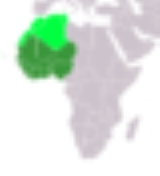
West Africa or
Western Africa is the
westWest is a noun, adjective, or adverb indicating direction or geography.West is one of the four cardinal directions or compass points. It is the opposite of east and is perpendicular to north and south.By convention, the left side of a map is west....
ernmost
regionRegion is most commonly found as a term used in terrestrial and astrophysics sciences also an area, notably among the different sub-disciplines of geography, studied by regional geographers. Regions consist of subregions that contain clusters of like areas that are distinctive by their uniformity...
of the
AfricaAfrica is the world's second largest and second most populous continent, after Asia. At about 30.2 million km² including adjacent islands, it covers 6% of the Earth's total surface area and 20.4% of the total land area...
n
continentA continent is one of several very large landmasses on Earth. They are generally identified by convention rather than any strict criteria, with seven regions commonly regarded as continents—they are : Asia, Africa, North America, South America, Antarctica, Europe, and Australia.Plate tectonics is...
. Geopolitically, the
UNThe United Nations is an international organization whose stated aims are facilitating cooperation in international law, international security, economic development, social progress, human rights, and achievement of world peace...
definitionA subregion is a conceptual unit which derives from a larger region or continent and is usually based on location. Cardinal directions, such as south or southern, are commonly used to define a subregion.- United Nations subregions :...
of Western Africa includes the following 16 countries and an area of approximately 5 million square km:
Flags of West Africa
With the exception of Mauritania, all of these countries are members of the ECOWAS or
Economic Community of West African StatesThe Economic Community of West African States is a regional group of fifteen West African countries. Founded on 28 May 1975, with the signing of the Treaty of Lagos, its mission is to promote economic integration across the region....
which was set up in May 1975. The UN region also includes the island of
Saint HelenaSaint Helena , named after St Helena of Constantinople, is an island of volcanic origin in the South Atlantic Ocean. It is part of the British overseas territory of Saint Helena, Ascension and Tristan da Cunha which also includes Ascension Island and the islands of Tristan da Cunha...
, a British overseas territory in the
South Atlantic OceanThe Atlantic Ocean is the second-largest of the world's oceanic divisions. With a total area of about , it covers approximately 20% of the Earth's surface and about 26% of its water surface area...
.
Background
West Africa is west of an imagined north-south axis lying close to
10° east longitudeThe meridian 10° east of Greenwich is a line of longitude that extends from the North Pole across the Arctic Ocean, Europe, Africa, the Atlantic Ocean, the Southern Ocean, and Antarctica to the South Pole....
. The Atlantic Ocean forms the western as well as the southern borders of the West African region. The northern border is the Sahara Desert, with the Ranishanu Bend generally considered the northernmost part of the region. The eastern border is less precise, with some placing it at the
Benue TroughThe Benue Trough is a major geological formation underlying a large part of Nigeria and extending about 1,000 km northeast from the Bight of Benin to Lake Chad.It is part of the broader Central African Rift System.-Location:...
, and others on a line running from Mount Cameroon to Lake Chad.
Colonial boundaries are reflected in the modern boundaries between contemporary West African nations, cutting across ethnic and cultural lines, often dividing single ethnic groups between two or more countries.
The inhabitants of West Africa are, in contrast to most of Southern and Middle Africa, non-
BantuThe Bantu languages constitute a traditional sub-branch of the Niger–Congo languages. There are about 250 Bantu languages by the criterion of mutual intelligibility, though the distinction between language and dialect is often unclear, and Ethnologue counts 535 languages...
speaking peoples.
Geography and climate
West Africa, if one includes the western portion of the
MaghrebThe Maghreb is the region of Northwest Africa, west of Egypt. It includes five countries: Morocco, Algeria, Tunisia, Libya, and Mauritania and the disputed territory of Western Sahara...
(
Western SaharaWestern Sahara is a disputed territory in North Africa, bordered by Morocco to the north, Algeria to the northeast, Mauritania to the east and south, and the Atlantic Ocean to the west. Its surface area amounts to . It is one of the most sparsely populated territories in the world, mainly...
,
MoroccoMorocco , officially the Kingdom of Morocco , is a country located in North Africa. It has a population of more than 32 million and an area of 710,850 km², and also primarily administers the disputed region of the Western Sahara...
,
AlgeriaAlgeria , officially the People's Democratic Republic of Algeria , also formally referred to as the Democratic and Popular Republic of Algeria, is a country in the Maghreb region of Northwest Africa with Algiers as its capital.In terms of land area, it is the largest country in Africa and the Arab...
, and
TunisiaTunisia , officially the Tunisian RepublicThe long name of Tunisia in other languages used in the country is: , is the northernmost country in Africa. It is a Maghreb country and is bordered by Algeria to the west, Libya to the southeast, and the Mediterranean Sea to the north and east. Its area...
), occupies an area in excess of 6,140,000 km
2, or approximately one-fifth of Africa. The vast majority of this land is plains lying less than 300 meters above sea level, though isolated high points exist in numerous countries along the southern shore of the region.
The northern section of West Africa is composed of semi-arid terrain known as
SahelThe Sahel is the ecoclimatic and biogeographic zone of transition between the Sahara desert in the North and the Sudanian Savannas in the south.It stretches across the North African continent between the Atlantic Ocean and the Red Sea....
, a transitional zone between the Sahara and the
savannaA savanna, or savannah, is a grassland ecosystem characterized by the trees being sufficiently small or widely spaced so that the canopy does not close. The open canopy allows sufficient light to reach the ground to support an unbroken herbaceous layer consisting primarily of C4 grasses.Some...
hs of the
western SudanThe Sudan is the name given to a geographic region to the south of the Sahara, stretching from Western to Eastern Africa. The name derives from the Arabic bilâd as-sûdân or "land of the Blacks"...
forestA forest, also referred to as a wood or the woods, is an area with a high density of trees. As with cities, depending where you are in the world, what is considered a forest may vary significantly in size and have various classification according to how and what of the forest is composed...
s form a third
beltRegion is most commonly found as a term used in terrestrial and astrophysics sciences also an area, notably among the different sub-disciplines of geography, studied by regional geographers. Regions consist of subregions that contain clusters of like areas that are distinctive by their uniformity...
between the savannas and the southern coast, ranging from 160 km to 240 km in width.
Culture
Despite the wide variety of cultures in West Africa, from
NigeriaNigeria , officially the Federal Republic of Nigeria, is a federal constitutional republic comprising 36 states and its Federal Capital Territory, Abuja. The country is located in West Africa and shares land borders with the Republic of Benin in the west, Chad and Cameroon in the east, and Niger in...
through to
SenegalSenegal , officially the Republic of Senegal , is a country in western Africa. It owes its name to the Sénégal River that borders it to the east and north...
, there are general similarities in dress,
cuisineWest African cuisine is a general term referring to many distinct regional and ethnic cuisines in West African nations, with climates ranging from desert to tropical...
,
musicWest Africa stretches from the Sahara Desert to the Atlantic Ocean. The region's musical heritage includes a variety of popular music styles, especially from the countries of Senegal, Ghana, Mali, Côte d'Ivoire, Niger, Sierra Leone and Nigeria...
and culture that are not shared extensively with grou the geographic region. This long history of cultural exchange predates the colonisation era of the region and can be approximately placed at the time of the
Ghana EmpireThe Ghana Empire or Wagadou Empire was located in what is now southeastern Mauritania, and Western Mali. Complex societies had existed in the region since about 1500 BCE, and around Ghana's core region since about 300 CE...
(proper: Wagadou Empire),
Mali EmpireThe Mali Empire or Mandingo Empire or Manden Kurufa was a West African empire of the Mandinka from c. 1230 to c. 1600. The empire was founded by Sundiata Keita and became renowned for the wealth of its rulers, especially Mansa Musa I...
or perhaps before such empires.
Cuisine
A large number of travellers such as traders, historians, emigrant, colonialists, missionaries, etc, have travelled the world to the West African Region and have benefited from the generosity of the native populations and left with a piece of the cultural heritage of region. Implicitly, West African cuisines have had a significant influence on the Western World for centuries. For example a large number of West African recipes are enjoyed in the West Indies, Australia,
LouisianaLouisiana is a state located in the southern region of the United States of America. Its capital is Baton Rouge and largest city is New Orleans. Louisiana is the only state in the U.S. with political subdivisions termed parishes, which are local governments equivalent to counties...
, Italy,
HaitiHaiti , officially the Republic of Haiti , is a Caribbean country. It occupies the western, smaller portion of the island of Hispaniola, in the Greater Antillean archipelago, which it shares with the Dominican Republic. Ayiti was the indigenous Taíno or Amerindian name for the island...
, and all over the world. Although some of these recipes have been altered to suit the other climates and tastes, nevertheless they still retain their West African fervours.
West Africans cuisine includes fish especially among the coastal areas, meat, vegetables and fruits most which are grown by farmers within the region. In spite of the obvious differences among the local cuisines in the region, there are more similarities than differences. The small difference may be in the ingredients used. Most foods are boiled or fried. Starchy vegetables including
yamYam or YAM may refer to:*Yam , common name for members of Dioscorea*Sweet potato, specifically its orange-fleshed cultivars, often marketed as 'yams' in North America and as 'kumara' in New Zealand...
,
plantainPlantain is the common name for herbaceous plants of the genus Musa. The fruit they produce is generally used for cooking, in contrast to the soft, sweet banana...
,
cassavaCassava , also called yuca or manioc, a woody shrub of the Euphorbiaceae native to South America, is extensively cultivated as an annual crop in tropical and subtropical regions for its edible starchy tuberous root, a major source of carbohydrates...
, sweet potatoes. Rice is also a staple food throughout the region, and so is the
Serer peopleThe Serer people along with the Jola people are acknowledged to be the oldest inhabitants of The Senegambia....
's
sorghumSorghum is a genus of numerous species of grasses, one of which is raised for grain and many of which are used as fodder plants either cultivated or as part of pasture. The plants are cultivated in warmer climates worldwide. Species are native to tropical and subtropical regions of all continents...
couscousCouscous is a Berber dish of semolina traditionally served with a meat or vegetable stew spooned over it. Couscous is a staple food throughout Algeria, Morocco and Tunisia.-Etymology:...
(called
"Chereh" in Serer) particularly in
SenegalSenegal , officially the Republic of Senegal , is a country in western Africa. It owes its name to the Sénégal River that borders it to the east and north...
and
The GambiaThe Republic of The Gambia, commonly referred to as The Gambia, or Gambia , is a country in West Africa. Gambia is the smallest country on mainland Africa, surrounded by Senegal except for a short coastline on the Atlantic Ocean in the west....
. Jolof rice originally from the the
Kingdom of JolofThe Kingdom of Jolof was a West African rump state located in what is today the nation of Senegal. For nearly two hundred years, the Serer rulers of the Jolof Empire collected tribute from vassal kings states who voluntarily agreed to the confederacy. At the Battle of Danki, the Buurba Jolof was...
(now part of modern day Senegal which spread to the Wolofs of Gambia), is enjoyed throughout West Africa and in the Western World;
MaféMaafe , or Groundnut Stew, is a stew common to much of West Africa. It originates from the Mandinka and Bambara people of Mali...
from
MaliMali , officially the Republic of Mali , is a landlocked country in Western Africa. Mali borders Algeria on the north, Niger on the east, Burkina Faso and the Côte d'Ivoire on the south, Guinea on the south-west, and Senegal and Mauritania on the west. Its size is just over 1,240,000 km² with...
(Note:
Mafé or
Maafe is a Wolof word for it, the proper name is
"Domodah" among the
Mandinka peopleThe Mandinka, Malinke are one of the largest ethnic groups in West Africa with an estimated population of eleven million ....
of Senegal and Gambia who are the originators of this dish or
"Tigh-dege-na" among the Bambara people or Mandinka people of Mali, "Domodah" is also used by all Senegambians borrowed from the
Mandinka languageThe Mandinka language is a Mandé language spoken by millions of Mandinka people in Mali, Senegal, The Gambia, Guinea, Côte d'Ivoire, Burkina Faso, Sierra Leone, Liberia, and Guinea-Bissau and Chad; it is the main language of The Gambia. It belongs to the Manding branch of Mandé, and is thus fairly...
) - a peanut butter stew served with rice;
Akara (fried bean balls seasoned with spices served with sauce and bread) from
NigeriaNigeria , officially the Federal Republic of Nigeria, is a federal constitutional republic comprising 36 states and its Federal Capital Territory, Abuja. The country is located in West Africa and shares land borders with the Republic of Benin in the west, Chad and Cameroon in the east, and Niger in...
is a favourite breakfast for Gambians and Senegalese, as well as a favourite side snack or side dish in
BrazilBrazil , officially the Federative Republic of Brazil , is the largest country in South America. It is the world's fifth largest country, both by geographical area and by population with over 192 million people...
and the
CaribbeanThe Caribbean is a crescent-shaped group of islands more than 2,000 miles long separating the Gulf of Mexico and the Caribbean Sea, to the west and south, from the Atlantic Ocean, to the east and north...
just as it is in West Africa. Its said that its exact origin may be from
YorubalandYorubaland, or Yorùbáland , is a cultural region in Nigeria, Benin, and Togo that includes the indigenous territory and cultural reach of the Yoruba people.- History :-Settlement:Oduduwa is regarded as the legendary progenitor of the Yoruba...
in Nigeria.
FufuFufu, , is a staple snack of West and Central Africa. It is a thick paste usually made by boiling starchy root vegetables in water and pounding with a mortar and pestle until the desired consistency is reached...
(from the Twi language, a dough served with a spicy stew or sauce for example
okraOkra is a flowering plant in the mallow family. It is valued for its edible green seed pods. The geographical origin of okra is disputed, with supporters of South Asian, Ethiopian and West African origins...
stew etc) from
GhanaGhana , officially the Republic of Ghana, is a country located in West Africa. It is bordered by Côte d'Ivoire to the west, Burkina Faso to the north, Togo to the east, and the Gulf of Guinea to the south...
is enjoyed throughout the region and beyond even in
Central AfricaCentral Africa is a core region of the African continent which includes Burundi, the Central African Republic, Chad, the Democratic Republic of the Congo, and Rwanda....
with their own versions of it.
Recreation
The board game
owareOware is an abstract strategy game of Akan origin. Part of the mancala family, it is played throughout West Africa and the Caribbean. Among its many names are Ayò , Awalé , Wari , Ouri, Ouril or Uril , Warri , Adji , and Awélé...
is quite popular in many parts of West Africa. The word
"Oware" originates from the
Akan peopleThe Akan people are an ethnic group found predominately in Ghana and The Ivory Coast. Akans are the majority in both of these countries and overall have a population of over 20 million people.The Akan speak Kwa languages-Origin and ethnogenesis:...
of Ghana. However, virtually all African peoples have a version of this board game. football is also a pastime enjoyed by many, either spectating or playing. The national teams of some West African nations, especially Nigeria, Ghana and the Ivory Coast regularly qualify for the
World CupThe FIFA World Cup, often simply the World Cup, is an international association football competition contested by the senior men's national teams of the members of Fédération Internationale de Football Association , the sport's global governing body...
.
Music
MbalaxMbalax is the national popular dance music of Senegal and The Gambia. Mbalax is a fusion of popular Western music and dance such as jazz, soul, Latin, and rock blended with sabar, the traditional drumming and dance music of Senegal...
,
HighlifeHighlife is a musical genre that originated in Ghana in the 1900s and spread to Sierra Leone, Nigeria and other West African countries by 1920...
,
FujiFuji is a popular Nigerian musical genre. It arose from the improvisation Ajisari/were music tradition, which is a kind of music performed to wake muslims before dawn during the Ramadan fasting season...
and
AfrobeatAfrobeat is a combination of traditional Yoruba music, jazz, highlife, funk and chanted vocals, fused with percussion and vocal styles, popularised in Africa in the 1970s. Its main creator was the Nigerian multi-instrumentalist and bandleader Fela Kuti, who gave it its name, who used it to...
are all modern musical genres which listeners enjoy in this region.
Old traditional
folk musicFolk music is an English term encompassing both traditional folk music and contemporary folk music. The term originated in the 19th century. Traditional folk music has been defined in several ways: as music transmitted by mouth, as music of the lower classes, and as music with unknown composers....
is also well preserved in this region. Some of these are religious in nature such as the "Tassou" tradition used in
Serer religionThe Serer religion, Fat Rog is the original religious beliefs, practices and teachings of the Serer people. The Serer people believe in a universal Supreme Deity called "Rog. "The Serer people are found throughout the Senegambia Region...
.
Griot Tradition
Traditionally, musical and oral history as conveyed over generations by Griots are typical of West African culture.
Clothing
A typical formal attire worn in this region are the knee to ankle-length flowing
BoubouThe Grand Boubou/Bubu is one of the names for a flowing wide sleeved robe worn by men in much of West Africa, and to a lesser extent in North Africa, related to the Dashiki suit...
robe,
DashikiThe dashiki is a colorful men's garment widely worn in West Africa that covers the top half of the body. It has formal and informal versions and varies from simple draped clothing to fully tailored suits. Traditional female attire is called a caftan, or kaftan...
and Senegalese
KaftanA kaftan is a man's coat usually reaching to the ankles with long sleeves, and which buttons down the front. It can be made of wool, cashmere, silk, or cotton. It is often worn with a sash....
(also known as
Agbada and
Babariga), which has its origins in the clothing of nobility of various West African empires in the 12th century.
Film Industry
Nollywood of Nigeria, is the the main film industry of West Africa. The Nigerian cinema industry is the second largest film industry in the world in terms of annual film production, even ahead of the
United StatesThe cinema of the United States, also known as Hollywood, has had a profound effect on cinema across the world since the early 20th century. Its history is sometimes separated into four main periods: the silent film era, classical Hollywood cinema, New Hollywood, and the contemporary period...
's Hollywood film industry. Senegal and Ghana also has long traditions of producing films.
Ousmane SembèneOusmane Sembène , often credited in the French style as Sembène Ousmane in articles and reference works, was a Senegalese film director, producer and writer...
, the Senegalese film director, producer and writer is from the region so is the Ghanaian
Shirley Frimpong-MansoShirley Frimpong-Manso is a Ghanaian film director, writer, and producer. Frimpong-Manso is a founder and CEO of the film, television, and advertising production company Sparrow Productions...
.
Islam
IslamIslam . The most common are and . : Arabic pronunciation varies regionally. The first vowel ranges from ~~. The second vowel ranges from ~~~...
is the predominant
religionReligion is a collection of cultural systems, belief systems, and worldviews that establishes symbols that relate humanity to spirituality and, sometimes, to moral values. Many religions have narratives, symbols, traditions and sacred histories that are intended to give meaning to life or to...
of the West African interior and the far west coast of the continent.
Christianity
ChristianityChristianity is a monotheistic religion based on the life and teachings of Jesus as presented in canonical gospels and other New Testament writings...
, a relative newcomer, has become the predominant religion in the
centralThe Middle Belt is a human geographical term designating the region of central Nigeria populated largely by minority ethnic groups and stretching across the country longitudinally. The Middle Belt is indeterminate in that it lacks designated "borders" and is charactized by a heterogeneity and...
and southern part of
NigeriaSeveral religions in Nigeria exist, helping to accentuate regional and ethnic distinctions. All religions represented in Nigeria were practiced in every major city in 1990. However, Islam dominated the north and had a number of supporters in the South Western, Yoruba part of the country...
, and the coastal regions stretching from southern
GhanaGhana , officially the Republic of Ghana, is a country located in West Africa. It is bordered by Côte d'Ivoire to the west, Burkina Faso to the north, Togo to the east, and the Gulf of Guinea to the south...
to coastal parts of
Sierra LeoneSierra Leone , officially the Republic of Sierra Leone, is a country in West Africa. It is bordered by Guinea to the north and east, Liberia to the southeast, and the Atlantic Ocean to the west and southwest. Sierra Leone covers a total area of and has an estimated population between 5.4 and 6.4...
. Like Islam, elements of Traditional African religion are mixed with Christianity. This religion was brought to the region by European missionaries during the colonial era.
African Traditional
Traditional African religion is the oldest and original religion of the native populations of this region, and includes Yoruba religion, Odinani,
Serer religionThe Serer religion, Fat Rog is the original religious beliefs, practices and teachings of the Serer people. The Serer people believe in a universal Supreme Deity called "Rog. "The Serer people are found throughout the Senegambia Region...
, etc. It is
spiritualSpiritual may refer to:*Spirituality, a concern with matters of the spirit*Spiritual , an African American song, usually with a Christian religious text...
but also linked to the historical and cultural heritage of the people.Before the arrival of other religions such as Islam and Christianity, West Africans, like most Africans, had a well-developed system of religious beliefs. The Traditional African religion is still practiced by the native populations. Although traditional beliefs varies from one place to the next, there are more similarities than differences. This belief system is a mojor religion of
BeninBenin , officially the Republic of Benin, is a country in West Africa. It borders Togo to the west, Nigeria to the east and Burkina Faso and Niger to the north. Its small southern coastline on the Bight of Benin is where a majority of the population is located...
.
History
The history of West Africa can be divided into five major periods: first, its prehistory, in which the first human settlers arrived, developed agriculture, and made contact with peoples to the north; the second, the Iron Age empires that consolidated both intra-African, and extra-African trade, and developed centralized states; third, Major polities flourished, which would undergo an extensive history of contact with non-Africans; fourth, the colonial period, in which Great Britain and France controlled nearly the whole of the region; fifth, the post-independence era, in which the current nations were formed.
Prehistory
Early
humanHumans are the only living species in the Homo genus...
settlers arrived in West Africa around 12,000 B.C. Sedentary farming began in, or around the fifth millennium B.C, as well as the domestication of cattle. By 400 B.C, ironworking technology allowed an expansion of agricultural productivity, and the first city-states formed.
The domestication of the
camelA camel is an even-toed ungulate within the genus Camelus, bearing distinctive fatty deposits known as humps on its back. There are two species of camels: the dromedary or Arabian camel has a single hump, and the bactrian has two humps. Dromedaries are native to the dry desert areas of West Asia,...
allowed the development of a cross-Saharan trade with cultures across the Sahara, including
CarthageCarthage , implying it was a 'new Tyre') is a major urban centre that has existed for nearly 3,000 years on the Gulf of Tunis, developing from a Phoenician colony of the 1st millennium BC...
and the
BerbersBerbers are the indigenous peoples of North Africa west of the Nile Valley. They are continuously distributed from the Atlantic to the Siwa oasis, in Egypt, and from the Mediterranean to the Niger River. Historically they spoke the Berber language or varieties of it, which together form a branch...
; major exports included
goldGold is a chemical element with the symbol Au and an atomic number of 79. Gold is a dense, soft, shiny, malleable and ductile metal. Pure gold has a bright yellow color and luster traditionally considered attractive, which it maintains without oxidizing in air or water. Chemically, gold is a...
, cotton cloth, metal ornaments and leather goods, which were then exchanged for
saltIn chemistry, salts are ionic compounds that result from the neutralization reaction of an acid and a base. They are composed of cations and anions so that the product is electrically neutral...
,
horseThe horse is one of two extant subspecies of Equus ferus, or the wild horse. It is a single-hooved mammal belonging to the taxonomic family Equidae. The horse has evolved over the past 45 to 55 million years from a small multi-toed creature into the large, single-toed animal of today...
s, textiles, and other such materials. Local leather, cloth, and gold also contributed to the abundancy of prosperity for many of the following empires.
Empires
The development of the region's economy allowed more centralized states and civilizations to form, beginning with the Nok culture which began 1000 B.C. and the
Ghana EmpireThe Ghana Empire or Wagadou Empire was located in what is now southeastern Mauritania, and Western Mali. Complex societies had existed in the region since about 1500 BCE, and around Ghana's core region since about 300 CE...
which first flourished between the 1st-3rd centuries which later gave way to the
Mali empireThe Mali Empire or Mandingo Empire or Manden Kurufa was a West African empire of the Mandinka from c. 1230 to c. 1600. The empire was founded by Sundiata Keita and became renowned for the wealth of its rulers, especially Mansa Musa I...
. In current day Mauritania, there exists archaeological sites in the towns of
TichitTichit is a partly abandoned village at the foot of the Tagant Plateau in central southern Mauritania that is known for its vernacular architecture...
and
OualataOualata or Walata is a small oasis town in south east Mauritania that was important in the thirteenth and fourteenth centuries as the southern terminus of a trans-Saharan trade route...
that were initially constructed around 2000 B.C., and was found to have originated from the
SoninkeThe Soninke are a Mandé people who descend from the Bafour and are closely related to the Imraguen of Mauritania. They speak the Soninke language, a Mande language. They were the founders of the ancient empire of Ghana c. 750-1240 CE...
branch of the Mandé peoples. Also, based on the archaeology of city of Kumbi Saleh in modern-day Mauritania, the Mali empire came to dominate much of the region until its defeat by Almoravid invaders in 1052.
The Sosso Empire sought to fill the void, but was defeated (c. 1240) by the
MandinkaThe Mandinka, Malinke are one of the largest ethnic groups in West Africa with an estimated population of eleven million ....
forces of
Sundiata KeitaSundiata Keita, Sundjata Keyita, Mari Djata I or just Sundiata was the founder of the Mali Empire and celebrated as a hero of the Malinke people of West Africa in the semi-historical Epic of Sundiata....
, founder of the new
Mali EmpireThe Mali Empire or Mandingo Empire or Manden Kurufa was a West African empire of the Mandinka from c. 1230 to c. 1600. The empire was founded by Sundiata Keita and became renowned for the wealth of its rulers, especially Mansa Musa I...
. The
Mali EmpireThe Mali Empire or Mandingo Empire or Manden Kurufa was a West African empire of the Mandinka from c. 1230 to c. 1600. The empire was founded by Sundiata Keita and became renowned for the wealth of its rulers, especially Mansa Musa I...
continued to flourish for several centuries, most particularly under Sundiata's grandnephew)
Musa IMusa I , commonly referred to as Mansa Musa, was the tenth mansa, which translates as "king of kings" or "emperor", of the Malian Empire...
, before a succession of weak rulers led to its collapse under Mossi, Tuareg and Songhai invaders. In the fifteenth century, the Songhai would form a new dominant state based on
GaoGao is a town in eastern Mali on the River Niger lying ESE of Timbuktu. Situated on the left bank of the river at the junction with the Tilemsi valley, it is the capital of the Gao Region and had a population of 86,663 in 2009....
, in the
Songhai EmpireThe Songhai Empire, also known as the Songhay Empire, was a state located in western Africa. From the early 15th to the late 16th century, Songhai was one of the largest Islamic empires in history. This empire bore the same name as its leading ethnic group, the Songhai. Its capital was the city...
, under the leadership of
Sonni AliSonni Ali, also known as Sunni Ali Ber or "Sunni Ali", was born Ali Kolon. He reigned from about 1464 to 1492. Sunni Ali was the first king of the Songhai Empire, located in west Africa and the 15th ruler of the Sonni dynasty...
and Askia Mohammed.
Meanwhile, south of the Sudan, strong city states arose in
IgbolandIgboland, or Igbo land , also known as the Ibo, Ebo, and Heebo Country, is a cultural region in Nigeria that includes the indigenous territory and cultural reach of the Igbo people...
, such as the
Kingdom of NriThe Kingdom of Nri was the West African medieval state of the Nri-Igbo, a subgroup of the Igbo people, and is the oldest kingdom in Nigeria. The Kingdom of Nri was unusual in the history of world government in that its leader exercised no military power over his subjects...
in the tenth century, Bono in the 12th century which eventually culminated in the formation the all-powerful
AkanThe Akan people are an ethnic group found predominately in Ghana and The Ivory Coast. Akans are the majority in both of these countries and overall have a population of over 20 million people.The Akan speak Kwa languages-Origin and ethnogenesis:...
Empire of Ashanti, while
IfeIfe is an ancient Yoruba city in south-western Nigeria. Evidence of inhabitation at the site has been discovered to date back to roughly 560 BC...
and
BeninBenin , officially the Republic of Benin, is a country in West Africa. It borders Togo to the west, Nigeria to the east and Burkina Faso and Niger to the north. Its small southern coastline on the Bight of Benin is where a majority of the population is located...
rose to prominence around the fourteenth century. Further east,
OyoThe Oyo Empire was a Yoruba empire of what is today southwestern Nigeria. The empire was established before the 14th century and grew to become one of the largest West African states encountered by European explorers. It rose to preeminence through its possession of a powerful cavalry and wealth...
arose as the dominant
YorubaThe Yoruba people are one of the largest ethnic groups in West Africa. The majority of the Yoruba speak the Yoruba language...
state and the
Aro ConfederacyThe Aro Confederacy was a political union orchestrated by the Igbo subgroup, the Aro people, centered in Arochukwu in present day Southeastern Nigeria. Their influence and presence was across Eastern Nigeria into parts of the Niger Delta and Southern Igala during the 18th and 19th centuries...
as a dominant
IgboIgbo people, also referred to as the Ibo, Ebo, Eboans or Heebo are an ethnic group living chiefly in southeastern Nigeria. They speak Igbo, which includes various Igboid languages and dialects; today, a majority of them speak English alongside Igbo as a result of British colonialism...
state in modern-day Nigeria.
Slavery and European contact
Following the 1591 destruction of the Songhai capital by
MoroccanMorocco , officially the Kingdom of Morocco , is a country located in North Africa. It has a population of more than 32 million and an area of 710,850 km², and also primarily administers the disputed region of the Western Sahara...
invaders, a number of smaller states arose across West Africa, including the
Bambara EmpireThe Bamana Empire was a large pre-colonial West African state based at Ségou, now in Mali. It was ruled by the Kulubali or Coulibaly dynasty established circa 1640 by Kaladian Coulibaly also known as Fa Sine or Biton-si-u...
of
SégouSégou is a city in south-central Mali, lying northeast of Bamako on the River Niger, in the region of Ségou. It was founded by the Bozo people, on a site about from the present town...
, the Bambara kingdom of
KaartaKaarta, or Ka'arta , was a short-lived Bambara kingdom in what is today the western half of Mali.As Bitòn Coulibaly tightened his control over Ségou, capital of his newly-founded Bambara Empire, a faction of Ségou Bambara dissatisfied with his rule fled west...
, the
FulaFula people or Fulani or Fulbe are an ethnic group spread over many countries, predominantly in West Africa, but found also in Central Africa and Sudanese North Africa...
/
MalinkéThe Mandinka, Malinke are one of the largest ethnic groups in West Africa with an estimated population of eleven million ....
kingdom of
KhassoKhasso or Xaaso was a West African kingdom of the 17th to 19th centuries, occupying territory in what is today Senegal and the Kayes Region of Mali. Its capital was at Medina until its fall....
, and the
Kénédougou EmpireThe Kénédougou Kingdom, also referred to as the Kenedugu Kingdom, was a pre-colonial West African state established in the southern portion of present-day Mali.-Traoré Dynasty:...
of
SikassoSikasso is a city in the south of Mali and the capital of the Sikasso Region. With 130,700 residents, Sikasso recently passed Ségou to become Mali's second-largest city.-Geography:...
.
Portuguese traders began establishing settlements along the coast in 1445, followed by the French and English; the
African slave tradeSystems of servitude and slavery were common in many parts of Africa, as they were in much of the ancient world. In some African societies, the enslaved people were also indentured servants and fully integrated; in others, they were treated much worse...
began not long after, which over the following centuries would debilitate the region's economy and population. The slave trade also encouraged the formation of states such as the Asante Empire,
Bambara EmpireThe Bamana Empire was a large pre-colonial West African state based at Ségou, now in Mali. It was ruled by the Kulubali or Coulibaly dynasty established circa 1640 by Kaladian Coulibaly also known as Fa Sine or Biton-si-u...
and
DahomeyDahomey was a country in west Africa in what is now the Republic of Benin. The Kingdom of Dahomey was a powerful west African state that was founded in the seventeenth century and survived until 1894. From 1894 until 1960 Dahomey was a part of French West Africa. The independent Republic of Dahomey...
, whose economic activities include but not limited to exchanging slaves for
EuropeEurope is, by convention, one of the world's seven continents. Comprising the westernmost peninsula of Eurasia, Europe is generally 'divided' from Asia to its east by the watershed divides of the Ural and Caucasus Mountains, the Ural River, the Caspian and Black Seas, and the waterways connecting...
an
firearmA firearm is a weapon that launches one, or many, projectile at high velocity through confined burning of a propellant. This subsonic burning process is technically known as deflagration, as opposed to supersonic combustion known as a detonation. In older firearms, the propellant was typically...
s.
The expanding
trans-Atlantic slave tradeThe Atlantic slave trade, also known as the trans-atlantic slave trade, refers to the trade in slaves that took place across the Atlantic ocean from the sixteenth through to the nineteenth centuries...
produced significant populations of West Africans living in the
New WorldThe New World is one of the names used for the Western Hemisphere, specifically America and sometimes Oceania . The term originated in the late 15th century, when America had been recently discovered by European explorers, expanding the geographical horizon of the people of the European middle...
, recently colonized by Europeans. The oldest known remains of African slaves in the Americas were found in
MexicoThe United Mexican States , commonly known as Mexico , is a federal constitutional republic in North America. It is bordered on the north by the United States; on the south and west by the Pacific Ocean; on the southeast by Guatemala, Belize, and the Caribbean Sea; and on the east by the Gulf of...
in early 2006; they are thought to date from the late 16th century and the mid-17th century.
European and American governments passed legislation prohibiting the Atlantic slave trade in the 19th century, though slavery in the Americas persisted in some capacity through the century; the last country to abolish the institution was
BrazilBrazil , officially the Federative Republic of Brazil , is the largest country in South America. It is the world's fifth largest country, both by geographical area and by population with over 192 million people...
in 1888. Descendants of West Africans make up large and important segments of the population in Brazil, the
CaribbeanThe Caribbean is a crescent-shaped group of islands more than 2,000 miles long separating the Gulf of Mexico and the Caribbean Sea, to the west and south, from the Atlantic Ocean, to the east and north...
,
Latin AmericaLatin America is a region of the Americas where Romance languages – particularly Spanish and Portuguese, and variably French – are primarily spoken. Latin America has an area of approximately 21,069,500 km² , almost 3.9% of the Earth's surface or 14.1% of its land surface area...
, and the
United StatesThe United States of America is a federal constitutional republic comprising fifty states and a federal district...
.
Colonialism
In the early nineteenth century, a series of Fulani reformist
jihadJihad , an Islamic term, is a religious duty of Muslims. In Arabic, the word jihād translates as a noun meaning "struggle". Jihad appears 41 times in the Quran and frequently in the idiomatic expression "striving in the way of God ". A person engaged in jihad is called a mujahid; the plural is...
s swept across Western Africa. The most notable include
Usman dan FodioShaihu Usman dan Fodio , born Usuman ɓii Foduye, was the founder of the Sokoto Caliphate in 1809, a religious teacher, writer and Islamic promoter. Dan Fodio was one of a class of urbanized ethnic Fulani living in the Hausa States in what is today northern Nigeria...
's
Fulani EmpireThe Sokoto Caliphate is an Islamic spiritual community in Nigeria, led by the Sultan of Sokoto, Sa’adu Abubakar. Founded during the Fulani Jihad in 1809 by Usuman dan Fodio, it was one of the most powerful empires in sub-Saharan Africa prior to European conquest and colonization...
, which replaced the
HausaThe Hausa are one of the largest ethnic groups in West Africa. They are a Sahelian people chiefly located in northern Nigeria and southeastern Niger, but having significant numbers living in regions of Cameroon, Ghana, Cote d'Ivoire, Chad and Sudan...
city-states,
Seku AmaduSeku Amadu was the founder of the Fula Massina Empire in what is now the Mopti Region of Mali...
's
Massina EmpireThe Massina Empire was an early nineteenth-century Fulbe Jihad state centered in the Macina and Inner Niger Delta area of what is now the Mopti and Ségou Regions of Mali...
, which defeated the Bambara, and El Hadj
Umar TallEl Hadj Umar ibn Sa'id Tall , , born in what is now actual Senegal was a West African political leader, Islamic scholar, and Toucouleur military commander who founded a brief empire encompassing much of what is now Guinea, Senegal, and Mali.-Name:Umar Tall's name is spelled variously: in...
's
Toucouleur EmpireThe Toucouleur Empire was founded in the nineteenth century by El Hadj Umar Tall of the Toucouleur people, in part of present-day Mali....
, which briefly conquered much of modern-day Mali.
However, the
FrenchThe French Republic , The French Republic , The French Republic , (commonly known as France , is a unitary semi-presidential republic in Western Europe with several overseas territories and islands located on other continents and in the Indian, Pacific, and Atlantic oceans. Metropolitan France...
and
BritishThe United Kingdom of Great Britain and Northern IrelandIn the United Kingdom and Dependencies, other languages have been officially recognised as legitimate autochthonous languages under the European Charter for Regional or Minority Languages...
continued to advance in the
Scramble for AfricaThe Scramble for Africa, also known as the Race for Africa or Partition of Africa was a process of invasion, occupation, colonization and annexation of African territory by European powers during the New Imperialism period, between 1881 and World War I in 1914...
, subjugating kingdom after kingdom. With the fall of Samory Ture's new-founded
Wassoulou EmpireThe Wassoulou Empire, sometimes referred to as the Mandinka Empire, was a short-lived empire of West Africa built from the conquests of Dyula ruler Samori Ture and destroyed by the French colonial army....
in 1898 and the Ashanti queen
Yaa AsantewaaYaa Asantewaa was appointed queen mother of Ejisu of the Ashanti Empire—now part of modern-day Ghana—by her brother Nana Akwasi Afrane Okpese, the Ejisuhene "ruler of Ejisu"...
in 1902, most West African military resistance to colonial rule came to an effective end.
Britain controlled The Gambia, Sierra Leone, Ghana, and Nigeria throughout the colonial era, while France unified Senegal, Guinea, Mali, Burkina Faso, Benin, Côte d'Ivoire and Niger into
French West AfricaFrench West Africa was a federation of eight French colonial territories in Africa: Mauritania, Senegal, French Sudan , French Guinea , Côte d'Ivoire , Upper Volta , Dahomey and Niger...
.
PortugalPortugal , officially the Portuguese Republic is a country situated in southwestern Europe on the Iberian Peninsula. Portugal is the westernmost country of Europe, and is bordered by the Atlantic Ocean to the West and South and by Spain to the North and East. The Atlantic archipelagos of the...
founded the colony of
Guinea-BissauThe Republic of Guinea-Bissau is a country in West Africa. It is bordered by Senegal to the north, and Guinea to the south and east, with the Atlantic Ocean to its west....
, while
GermanyGermany , officially the Federal Republic of Germany , is a federal parliamentary republic in Europe. The country consists of 16 states while the capital and largest city is Berlin. Germany covers an area of 357,021 km2 and has a largely temperate seasonal climate...
claimed
TogolandTogoland was a German protectorate in West Africa from 1884 to 1914, encompassing what is now the nation of Togo and most of what is now the Volta Region of Ghana. The colony was established during the period generally known as the "Scramble for Africa"...
, but was forced to divide it between France and Britain following First World War due to the
Treaty of VersaillesThe Treaty of Versailles was one of the peace treaties at the end of World War I. It ended the state of war between Germany and the Allied Powers. It was signed on 28 June 1919, exactly five years after the assassination of Archduke Franz Ferdinand. The other Central Powers on the German side of...
. Only
LiberiaLiberia , officially the Republic of Liberia, is a country in West Africa. It is bordered by Sierra Leone on the west, Guinea on the north and Côte d'Ivoire on the east. Liberia's coastline is composed of mostly mangrove forests while the more sparsely populated inland consists of forests that open...
retained its independence, at the price of major territorial concessions.
Postcolonial era
Following
World War IIWorld War II, or the Second World War , was a global conflict lasting from 1939 to 1945, involving most of the world's nations—including all of the great powers—eventually forming two opposing military alliances: the Allies and the Axis...
, nationalist movements arose across West Africa. In 1957, Ghana, under
Kwame NkrumahKwame Nkrumah was the leader of Ghana and its predecessor state, the Gold Coast, from 1952 to 1966. Overseeing the nation's independence from British colonial rule in 1957, Nkrumah was the first President of Ghana and the first Prime Minister of Ghana...
, became the first sub-Saharan colony to achieve its independence, followed the next year by France's colonies (Guinea in 1958 under the leadership of President Ahmed Sekou Touré); by 1974, West Africa's nations were entirely autonomous.
Since independence, many West African nations have been submerged under political instability, with notable civil wars in Nigeria, Sierra Leone, Liberia, and Côte d'Ivoire, and a succession of military coups in
GhanaThe Republic of Ghana is named after the medieval West African Ghana Empire, known to the dominant ethnic group the Soninke, as Wagadugu, which roughly translates to "Land of Herds." The Empire became known in Europe and Arabia as the Ghana Empire by the title of its emperor, the Ghana. The Empire...
and
Burkina Faso-Ancient and medieval history:Recent archeological discoveries at Bura in southwest Niger and in adjacent southwest Burkina Faso have documented the existence of the iron-age Bura culture from the 3rd century CE to the 13th century CE. The Bura-Asinda system of settlements apparently covered the...
.
Since the end of colonialism, the region has been the stage for some of the most brutal conflicts ever to erupt. Among the latter are:
- Nigerian Civil War
The Nigerian Civil War, also known as the Nigerian-Biafran War, 6 July 1967–15 January 1970, was a political conflict caused by the attempted secession of the southeastern provinces of Nigeria as the self-proclaimed Republic of Biafra...
- First Liberian Civil War
- Second Liberian Civil War
The Second Liberian Civil War began in 1999 when a rebel group backed by the government of neighbouring Guinea, the Liberians United for Reconciliation and Democracy , emerged in northern Liberia. In early 2003, a second rebel group, the Movement for Democracy in Liberia, emerged in the south, and...
- Guinea-Bissau Civil War
The Guinea-Bissau Civil War was triggered by an attempted coup d'état against the government of President João Bernardo Vieira led by Brigadier-General Ansumane Mané in June 1998...
- Ivorian Civil War
- Sierra Leone Civil War
The Sierra Leone Civil War began on 23 March 1991 when the Revolutionary United Front , with support from the special forces of Charles Taylor’s National Patriotic Front of Liberia , intervened in Sierra Leone in an attempt to overthrow the Joseph Momoh government...
Regional organizations
The
Economic Community of West African StatesThe Economic Community of West African States is a regional group of fifteen West African countries. Founded on 28 May 1975, with the signing of the Treaty of Lagos, its mission is to promote economic integration across the region....
(ECOWAS), founded by the 1975
Treaty of LagosThe Economic Community of West African States was created by the Treaty of Lagos on May 28, 1975 in Lagos, Lagos State, Nigeria. ECOWAS was established to promote cooperation and integration in order to create an economic and monetary union for promoting economic growth and development in West...
, is an organization of West African states which aims to promote the region's economy. The West African Monetary Union (or UEMOA from its name in French,
Union économique et monétaire ouest-africaine) is limited to the eight, mostly Francophone countries that employ the
CFA francThe CFA franc is the name of two currencies used in Africa which are guaranteed by the French treasury. The two CFA franc currencies are the West African CFA franc and the Central African CFA franc...
as their common currency. The
Liptako-Gourma AuthorityThe Liptako–Gourma Authority is a regional organization seeking to develop the contiguous areas of Mali, Burkina Faso, and Niger.Created in December 1970, the Authority has as its goal the promotion of the areas mineral, energy, hydraulic, and agricultural resources within a regional framework...
of Mali, Niger, and Burkina Faso seeks to jointly develop the contiguous areas of the three countries.
Women's peace movement
Since the adoption of the United Nations Security Council Resolution 1325 in 2000, women have been engaged in rebuilding war-torn Africa. Starting with the
Women of Liberia Mass Action for PeaceWomen of Liberia Mass Action for Peace is a peace movement started by women in Liberia, Africa thatbrought an end to the Second Liberian Civil War in 2003. Organized by social worker Leymah Gbowee, the movement started with local women praying and singing in a fish market...
and
Women in Peacebuilding Network (WIPNET), the
peace movementA peace movement is a social movement that seeks to achieve ideals such as the ending of a particular war , minimize inter-human violence in a particular place or type of situation, often linked to the goal of achieving world peace...
has grown to include women across West Africa.
Established on May 8, 2006,
Women Peace and Security Network - Africa (WIPSEN-Africa), is a women-focused, women-led Pan-African non-governmental organization based in
GhanaGhana , officially the Republic of Ghana, is a country located in West Africa. It is bordered by Côte d'Ivoire to the west, Burkina Faso to the north, Togo to the east, and the Gulf of Guinea to the south...
. The organization has a presence in Ghana,
NigeriaNigeria , officially the Federal Republic of Nigeria, is a federal constitutional republic comprising 36 states and its Federal Capital Territory, Abuja. The country is located in West Africa and shares land borders with the Republic of Benin in the west, Chad and Cameroon in the east, and Niger in...
, Cote d’Ivoire,
LiberiaLiberia , officially the Republic of Liberia, is a country in West Africa. It is bordered by Sierra Leone on the west, Guinea on the north and Côte d'Ivoire on the east. Liberia's coastline is composed of mostly mangrove forests while the more sparsely populated inland consists of forests that open...
and
Sierra LeoneSierra Leone , officially the Republic of Sierra Leone, is a country in West Africa. It is bordered by Guinea to the north and east, Liberia to the southeast, and the Atlantic Ocean to the west and southwest. Sierra Leone covers a total area of and has an estimated population between 5.4 and 6.4...
. Regional leaders of
nonviolent resistanceNonviolent resistance is the practice of achieving goals through symbolic protests, civil disobedience, economic or political noncooperation, and other methods, without using violence. It is largely synonymous with civil resistance...
include
Leymah GboweeLeymah Roberta Gbowee is a Liberian peace activist responsible for leading a women's peace movement that brought an end to the Second Liberian Civil War in 2003. This led to the election of Ellen Johnson Sirleaf in Liberia, the first African nation with a female president...
,
Comfort FreemanComfort M. Freeman is a peace activist in Liberia. She is head of the Liberian Women's Initiative for Peace, an anti-war women's group and the Lutheran Church Women's Committee...
, and
Aya Virginie ToureAya Virginie Toure is a peace activist in Côte d'Ivoire , West Africa. She became known for organizing women in nonviolent resistance against President Laurent Gbagbo who refused to step down since he lost the presidential election to Alassane Ouattara...
.
Pray the Devil Back to HellPray the Devil Back to Hell is a documentary film directed by Gini Reticker and produced by Abigail Disney. The film premiered at the 2008 Tribeca Film Festival, where it won the award for Best Documentary. The film had its theatrical release in New York City on November 7, 2008.The film documents...
is a
documentary filmDocumentary films constitute a broad category of nonfictional motion pictures intended to document some aspect of reality, primarily for the purposes of instruction or maintaining a historical record...
about the origin of this peace movement. The film has been used as an
advocacyAdvocacy is a political process by an individual or a large group which normally aims to influence public-policy and resource allocation decisions within political, economic, and social systems and institutions; it may be motivated from moral, ethical or faith principles or simply to protect an...
tool in post-conflict zones like
SudanSudan , officially the Republic of the Sudan , is a country in North Africa, sometimes considered part of the Middle East politically. It is bordered by Egypt to the north, the Red Sea to the northeast, Eritrea and Ethiopia to the east, South Sudan to the south, the Central African Republic to the...
and
ZimbabweZimbabwe is a landlocked country located in the southern part of the African continent, between the Zambezi and Limpopo rivers. It is bordered by South Africa to the south, Botswana to the southwest, Zambia and a tip of Namibia to the northwest and Mozambique to the east. Zimbabwe has three...
, mobilizing African women to petition for peace and security.
Script
- Nsibidi Script
Nsibidi is a system of symbols indigenous to what is now southeastern Nigeria that is apparently ideographic, though there have been suggestions that it includes logographic elements...
- An indigenously developed West African writing system
- Vai syllabary
External links