
All Topics  
Constitutional monarchy


   Email Print
   Bookmark   Link


Constitutional monarchy


A constitutional monarchy is a form of constitution
Constitution

A constitution is a system for government — often codified as a written document — that establishes the rules and principles of an autonomous political entity....
al government
Government

Government is the body within any organization that has the authority to make and the power to enforce laws, regulations, or rules. Typically, the government refers to a civil government -- local, provincial, or national -- but commercial, academic, religious, or other formal organizations are also administered by governing bodies....
, where in either an elected or hereditary monarch is the head of state
Head of State

Head of state is the generic term for the individual or collective office that serves as the chief public representative of a monarchic or republican nation-state, federation, commonwealth or any other political state....
, unlike in an absolute monarchy
Absolute monarchy

Absolute monarchy is a monarchy form of government where the king or queen has absolute power over all aspects of his/her subjects' lives. Although some religious authorities may be able to discourage the monarch from some acts and the sovereign is expected to act according to custom, in an absolute monarchy there is no constitution or legal...
, wherein the king or the queen is the sole source of political power, as he or she is not legally bound by the constitution. Most constitutional monarchies have a parliamentary system
Parliamentary system

Parliamentary systems are characterized by no clear-cut separation of powers between the executive and legislative branches, leading to a different set of checks and balances compared to those found in presidential systems....
 (Australia
Australia

Australia, officially the Commonwealth of Australia, is a country in the southern hemisphere comprising the Australia of the world's smallest continent, the major island of Tasmania, and numerous list of islands of Australia in the Indian Ocean and Pacific Oceans....
, Belgium
Belgium

* A small German-speaking Community of Belgium exists in eastern Wallonia. Belgium's linguistic diversity and related political and cultural conflicts are reflected in the history of Belgium and a complex Communities and regions of Belgium....
, Cambodia
Cambodia

The Kingdom of Cambodia is a country in South East Asia with a population of over 13 million people. The kingdom's capital and largest city is Phnom Penh....
, Canada
Canada

Canada is a country occupying most of northern North America, extending from the Atlantic Ocean in the east to the Pacific Ocean in the west and northward into the Arctic Ocean....
, Denmark
Denmark

Denmark is a Scandinavian country in northern Europe and the senior member of the Kingdom of Denmark. It is the southernmost of the Nordic countries....
, Japan
Japan

Japan is an island country in East Asia. Located in the Pacific Ocean, it lies to the east of the Sea of Japan, People's Republic of China, North Korea, South Korea and Russia, stretching from the Sea of Okhotsk in the north to the East China Sea and Taiwan in the south....
, Malaysia
Malaysia

Malaysia is a federation that consists of States of Malaysia in Southeast Asia with a total landmass of . The capital city is Kuala Lumpur, while Putrajaya is the seat of the federal government....
, Netherlands
Netherlands

The Netherlands is a country that is part of the Kingdom of the Netherlands. It is a parliamentary democratic constitutional monarchy. The Netherlands is located in North-West Europe, and bordered by the North Sea to the north and west, Belgium to the south, and Germany to the east....
, New Zealand
New Zealand

New Zealand is an island country in the south-western Pacific Ocean comprising two main landmasses , and numerous Islands of New Zealand, most notably Stewart Island/Rakiura and the Chatham Islands....
, Norway
Norway

Norway , officially the Kingdom of Norway, is a constitutional monarchy in Northern Europe that occupies the western portion of the Scandinavian Peninsula....
, Spain
Spain

Spain or the Kingdom of Spain , is a country located in Southern Europe on the Iberian Peninsula.The Spanish constitution does not establish any official denomination of the country, even though Espa?a , Estado espa?ol and Naci?n espa?ola are used interchangeably....
, Sweden
Sweden

Sweden , officially the Kingdom of Sweden , is a Nordic countries on the Scandinavian Peninsula in Northern Europe. Sweden has land borders with Norway to the west and Finland to the northeast, and it is connected to Denmark by the ?resund Bridge in the south....
, Thailand
Thailand

The Kingdom of Thailand is an independent country that lies in the heart of Southeast Asia. It is bordered to the north by Laos and Myanmar, to the east by Laos and Cambodia, to the south by the Gulf of Thailand and Malaysia, and to the west by the Andaman Sea and Myanmar....
, United Kingdom
United Kingdom

The United Kingdom of Great Britain and Northern Ireland, commonly known as the United Kingdom , the UK or Britain,is a sovereign state located off the northwestern coast of continental Europe....
) in which the monarch is the head of state, but a directly- or indirectly-elected prime minister
Prime minister

A prime minister is the most senior minister of Cabinet in the Executive branch of government in a parliamentary system. The position is usually held by, but need not always be held by, a politician....
 is head of government.


Discussion
Ask a question about 'Constitutional monarchy'
Start a new discussion about 'Constitutional monarchy'
Answer questions from other users
Full Discussion Forum


Recent Posts


Encyclopedia


A constitutional monarchy is a form of constitution
Constitution

A constitution is a system for government — often codified as a written document — that establishes the rules and principles of an autonomous political entity....
al government
Government

Government is the body within any organization that has the authority to make and the power to enforce laws, regulations, or rules. Typically, the government refers to a civil government -- local, provincial, or national -- but commercial, academic, religious, or other formal organizations are also administered by governing bodies....
, where in either an elected or hereditary monarch is the head of state
Head of State

Head of state is the generic term for the individual or collective office that serves as the chief public representative of a monarchic or republican nation-state, federation, commonwealth or any other political state....
, unlike in an absolute monarchy
Absolute monarchy

Absolute monarchy is a monarchy form of government where the king or queen has absolute power over all aspects of his/her subjects' lives. Although some religious authorities may be able to discourage the monarch from some acts and the sovereign is expected to act according to custom, in an absolute monarchy there is no constitution or legal...
, wherein the king or the queen is the sole source of political power, as he or she is not legally bound by the constitution. Most constitutional monarchies have a parliamentary system
Parliamentary system

Parliamentary systems are characterized by no clear-cut separation of powers between the executive and legislative branches, leading to a different set of checks and balances compared to those found in presidential systems....
 (Australia
Australia

Australia, officially the Commonwealth of Australia, is a country in the southern hemisphere comprising the Australia of the world's smallest continent, the major island of Tasmania, and numerous list of islands of Australia in the Indian Ocean and Pacific Oceans....
, Belgium
Belgium

* A small German-speaking Community of Belgium exists in eastern Wallonia. Belgium's linguistic diversity and related political and cultural conflicts are reflected in the history of Belgium and a complex Communities and regions of Belgium....
, Cambodia
Cambodia

The Kingdom of Cambodia is a country in South East Asia with a population of over 13 million people. The kingdom's capital and largest city is Phnom Penh....
, Canada
Canada

Canada is a country occupying most of northern North America, extending from the Atlantic Ocean in the east to the Pacific Ocean in the west and northward into the Arctic Ocean....
, Denmark
Denmark

Denmark is a Scandinavian country in northern Europe and the senior member of the Kingdom of Denmark. It is the southernmost of the Nordic countries....
, Japan
Japan

Japan is an island country in East Asia. Located in the Pacific Ocean, it lies to the east of the Sea of Japan, People's Republic of China, North Korea, South Korea and Russia, stretching from the Sea of Okhotsk in the north to the East China Sea and Taiwan in the south....
, Malaysia
Malaysia

Malaysia is a federation that consists of States of Malaysia in Southeast Asia with a total landmass of . The capital city is Kuala Lumpur, while Putrajaya is the seat of the federal government....
, Netherlands
Netherlands

The Netherlands is a country that is part of the Kingdom of the Netherlands. It is a parliamentary democratic constitutional monarchy. The Netherlands is located in North-West Europe, and bordered by the North Sea to the north and west, Belgium to the south, and Germany to the east....
, New Zealand
New Zealand

New Zealand is an island country in the south-western Pacific Ocean comprising two main landmasses , and numerous Islands of New Zealand, most notably Stewart Island/Rakiura and the Chatham Islands....
, Norway
Norway

Norway , officially the Kingdom of Norway, is a constitutional monarchy in Northern Europe that occupies the western portion of the Scandinavian Peninsula....
, Spain
Spain

Spain or the Kingdom of Spain , is a country located in Southern Europe on the Iberian Peninsula.The Spanish constitution does not establish any official denomination of the country, even though Espa?a , Estado espa?ol and Naci?n espa?ola are used interchangeably....
, Sweden
Sweden

Sweden , officially the Kingdom of Sweden , is a Nordic countries on the Scandinavian Peninsula in Northern Europe. Sweden has land borders with Norway to the west and Finland to the northeast, and it is connected to Denmark by the ?resund Bridge in the south....
, Thailand
Thailand

The Kingdom of Thailand is an independent country that lies in the heart of Southeast Asia. It is bordered to the north by Laos and Myanmar, to the east by Laos and Cambodia, to the south by the Gulf of Thailand and Malaysia, and to the west by the Andaman Sea and Myanmar....
, United Kingdom
United Kingdom

The United Kingdom of Great Britain and Northern Ireland, commonly known as the United Kingdom , the UK or Britain,is a sovereign state located off the northwestern coast of continental Europe....
) in which the monarch is the head of state, but a directly- or indirectly-elected prime minister
Prime minister

A prime minister is the most senior minister of Cabinet in the Executive branch of government in a parliamentary system. The position is usually held by, but need not always be held by, a politician....
 is head of government. Although contemporary constitutional monarchies mostly are representative, constitutional democratic monarchies, they have co-existed with fascist
Fascism

Fascism is a Political radicalism, Authoritarianism Nationalism ideology that aims to create a single-party state with a government led by a dictator who seeks national unity and development by requiring individuals to subordinate self-interest to the collective interest of the nation or Race ....
 and quasi-fascist constitutions (Italy, Spain) and with military dictatorship
Military dictatorship

A military dictatorship is a form of government wherein the political power resides with the military. It is similar but not identical to a stratocracy, a state ruled directly by the military....
s (Thailand).

Constitutional monarchies and absolute monarchies


Constitutional monarchy in the European tradition


In Britain, the Glorious Revolution
Glorious Revolution

The Glorious Revolution, also called the Revolution of 1688, was the overthrow of British monarchy James II of England in 1688 by a union of Parliament of England with an invading army led by the Dutch Republic stadtholder William III of England , who as a result ascended the English throne as William III of England....
 of 1688 led to a constitutional monarchy restricted by laws such as the Bill of Rights 1689
Bill of Rights 1689

The Bill of Rights is an Act of Parliament of the Parliament of England, whose long title is An Act Declaring the Rights and Liberties of the Subject and Settling the Succession of the Crown....
 and the Act of Settlement 1701
Act of Settlement 1701

The Act of Settlement is an act of the Parliament of England, originally filed in 1700, and passed in 1701, to settle the Order of succession to the List of English monarchs on the Electress Sophia of Hanover a granddaughter of James I of England and her Protestantism heirs....
, although limits on the power of the monarch are much older than that.

Constitutional monarchy occurred in continental Europe after the French revolution
French Revolution

The French Revolution was a period of political and social upheaval and radical change in the history of France, during which the French governmental structure, previously an absolute monarchy with feudalism for the aristocracy and Roman Catholic Church clergy, underwent radical change to forms based on Age of Enlightenment principles of cit...
. General Napoleon Bonaparte is considered the first monarch proclaiming himself as embodiment of the nation, rather than as a divinely-appointed ruler; this interpretation of monarchy is basic to continental constitutional monarchies. G.W.F. Hegel, in Philosophy of Right (1820) justified it philosophically, according well with evolving contemporary political theory and with the Protestant Christian view of Natural Law. Hegel forecast a constitutional monarch of limited powers, whose function is embodying the national character and constitutional continuity in emergencies, per the development of constitutional monarchy in Europe and Japan. Moreover, the ceremonial office of president (e.g. European and Israeli parliamentary democracies), is a contemporary type of Hegel's constitutional monarch (whether elected or appointed), yet, his forecast of the form of government suitable to the modern world might be perceived as prophetic. The Russian and French presidents, with their stronger powers, might be Hegelian, wielding power suited to the national will embodied.

Modern constitutional monarchy

As originally conceived, a constitutional monarch was quite a powerful figure, head of the executive branch even though his or her power was limited by the constitution and the elected parliament. Some of the framers of the US Constitution may have conceived of the president as being an elected constitutional monarch, as the term was understood in their time, following Montesquieu's account of the separation of powers in the United Kingdom, it was the democratically elected parliaments, and their leader, the prime minister
Prime minister

A prime minister is the most senior minister of Cabinet in the Executive branch of government in a parliamentary system. The position is usually held by, but need not always be held by, a politician....
, who had become those who exercised power. In many cases even the monarchs themselves, while still at the very top of the political and social hierarchy, were given the status of "servants of the people" to reflect the new, egalitarian view.

In present terms, the difference between a parliamentary democracy that is a constitutional monarchy, and one that is a republic
Republic

A republic is a state or country that is not led by a hereditary monarch but in which the people have an impact on its government. The word originates from the Latin term res publica....
, is considered more a difference of detail than of substance, particularly in the common case in which the head of state serves the traditional role of embodying and representing the nation. This is reflected, for example, in all but the most die-hard Spanish Republicans
Second Spanish Republic

The Second Spanish Republic was the system of government in Spain between April 14 1931, when King of Spain Alfonso XIII of Spain left the country following local and municipal elections in which republican candidates won the majority of votes in urban areas and April 1 1939, when the last of the Republican forces surrendered to Nationalist...
 accepting their country's returning to constitutional monarchy after the death of Francisco Franco
Francisco Franco

Francisco Paulino Hermenegildo Te?dulo Franco y Bahamonde, Salgado y Pardo de Andrade , commonly known as Francisco Franco or Francisco Franco y Bahamonde was the dictator and Head of State of Spain from October 1936, and de facto regent of the nominally restored Kingdom of Spain from 1947 until his death in 1975....
.

Constitutional monarchies today

Form of Government Constitutional Monarchy
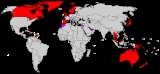
Today constitutional monarchies are mostly associated with Western European countries such as the United Kingdom
United Kingdom

The United Kingdom of Great Britain and Northern Ireland, commonly known as the United Kingdom , the UK or Britain,is a sovereign state located off the northwestern coast of continental Europe....
, The Netherlands, Belgium
Belgium

* A small German-speaking Community of Belgium exists in eastern Wallonia. Belgium's linguistic diversity and related political and cultural conflicts are reflected in the history of Belgium and a complex Communities and regions of Belgium....
, Norway
Norway

Norway , officially the Kingdom of Norway, is a constitutional monarchy in Northern Europe that occupies the western portion of the Scandinavian Peninsula....
, Denmark
Denmark

Denmark is a Scandinavian country in northern Europe and the senior member of the Kingdom of Denmark. It is the southernmost of the Nordic countries....
, Spain
Spain

Spain or the Kingdom of Spain , is a country located in Southern Europe on the Iberian Peninsula.The Spanish constitution does not establish any official denomination of the country, even though Espa?a , Estado espa?ol and Naci?n espa?ola are used interchangeably....
, Luxembourg
Luxembourg

Luxembourg , officially the Grand Duchy of Luxembourg , is a small landlocked country in western Europe, bordered by Belgium, France, and Germany....
, Monaco
Monaco

Monaco , officially the Principality of Monaco , is a small sovereign city-state located in South Western Europe . The territory lies on the northern coast of the Mediterranean Sea....
, Liechtenstein
Liechtenstein

The Principality of Liechtenstein is a Landlocked country#Doubly landlocked country alpine country microstate in Western Europe, bordered by Switzerland to the west and by Austria to the east....
, and Sweden
Sweden

Sweden , officially the Kingdom of Sweden , is a Nordic countries on the Scandinavian Peninsula in Northern Europe. Sweden has land borders with Norway to the west and Finland to the northeast, and it is connected to Denmark by the ?resund Bridge in the south....
. In such cases it is the prime minister
Prime minister

A prime minister is the most senior minister of Cabinet in the Executive branch of government in a parliamentary system. The position is usually held by, but need not always be held by, a politician....
 who holds the day-to-day powers of governance, while the King or Queen (or other monarch, such as a Grand Duke, in the case of Luxembourg, or Prince in the case of Monaco and Liechtenstein) retains only minor to no powers. Different nations grant different powers to their monarchs. In the Netherlands, Denmark and in Belgium, for example, the Monarch formally appoints a representative to preside over the creation of a coalition government
Coalition government

A coalition government is a Cabinet of a parliamentary system government in which several political party cooperate. The usual reason given for this arrangement is that no party on its own can achieve a majority in the parliament....
 following a parliamentary election, while in Norway
Norway

Norway , officially the Kingdom of Norway, is a constitutional monarchy in Northern Europe that occupies the western portion of the Scandinavian Peninsula....
 the King chairs special meetings of the cabinet. In nearly all cases, the monarch is still the nominal chief executive, but is bound by constitutional convention
Constitutional convention (political custom)

Alternative meaning: Constitutional convention A constitutional convention is an informal and uncodified procedural agreement that is followed by the institutions of a state....
 to act on the advice of the Cabinet. Only a few monarchies (most notably Japan
Japan

Japan is an island country in East Asia. Located in the Pacific Ocean, it lies to the east of the Sea of Japan, People's Republic of China, North Korea, South Korea and Russia, stretching from the Sea of Okhotsk in the north to the East China Sea and Taiwan in the south....
 and Sweden
Sweden

Sweden , officially the Kingdom of Sweden , is a Nordic countries on the Scandinavian Peninsula in Northern Europe. Sweden has land borders with Norway to the west and Finland to the northeast, and it is connected to Denmark by the ?resund Bridge in the south....
) have amended their constitutions so that the monarch is no longer even the nominal chief executive.

The most significant family of constitutional monarchies in the world today are the sixteen Commonwealth realm
Commonwealth Realm

A Commonwealth realm is any one of 16 Sovereignty states within the Commonwealth of Nations that each have Elizabeth II of the United Kingdom as their monarch....
s under Elizabeth II
Elizabeth II of the United Kingdom

Elizabeth II is the queen regnant of sixteen independent states known as the Commonwealth realms: Monarchy of the United Kingdom, Monarchy of Canada, Monarchy of Australia, Monarchy of New Zealand, Monarchy of Jamaica, Monarchy of Barbados, the Bahamas, Grenada, Papua New Guinea, the Monarchy of the Solomon Islands, Tuvalu, Saint Lucia, Sain...
. Unlike some of their continental European counterparts, the Monarch and her Governors-General in the Commonwealth Realm
Commonwealth Realm

A Commonwealth realm is any one of 16 Sovereignty states within the Commonwealth of Nations that each have Elizabeth II of the United Kingdom as their monarch....
s hold significant "reserve" or "prerogative" powers, to be wielded in times of extreme emergency or constitutional crises usually to uphold parliamentary government. An instance of a Governor General exercising his power was during the 1975 Australian constitutional crisis, when the Australian Prime Minister of the time, Gough Whitlam
Gough Whitlam

'Edward Gough Whitlam', Order of Australia, Queens Counsel , known as 'Gough Whitlam' , is an Australian former politician and 21st Prime Minister of Australia....
, was effectively fired from his position. This led to much speculation as to whether this use of the Governor General's reserve powers was appropriate, and whether Australia should become a republic.

In both the United Kingdom and elsewhere, a common debate centres around when it is appropriate for a monarch to use his or her political powers. When a monarch does act, political controversy can often ensue, partially because the neutrality of the crown is seen to be compromised in favour of a partisan
Partisan (political)

In politics, a partisan is a committed member of a party.In multi-party systems, the term is widely understood to carry a negative connotation - referring to those who wholly support their party's policies and are perhaps even reluctant to acknowledge correctness on the part of their political opponents in almost any situation....
 goal. While political scientists may champion the idea of an "interventionist monarch" as a check against possible illegal action by politicians, the monarchs themselves are often driven by a more pragmatic sense of self-preservation, in which avoiding political controversy can be seen as an important way to retain public legitimacy and popularity.

There also exist today several federal constitutional monarchies. In these countries, each subdivision has a distinct government and head of government, but all subdivisions share a monarch who is head of state of the federation as a united whole.

List of current reigning monarchies

StateLast constitution establishedType of monarchyMonarch selected by
1993Co-Principality
Principality

A principality is a monarchy feudatory or sovereign state, ruled or reigned over by a monarch with the title of prince or princess, or a monarch with another title within the generic use of the term prince....
Selection of Bishop of La Seu d'Urgell
La Seu d'Urgell

La Seu d'Urgell is the capital of the Comarques of Catalonia Alt Urgell, in the province of Lleida, in Catalonia, Spain. It will be the capital or cocapital of vegueria veguerie of Alt Pirineu i Aran , the new regional structure of Catalonia....
 and election of French President
President of the French Republic

The President of the French Republic colloquially referred to in English as the President of France, is France's elected Head of State....
2002KingdomHereditary succession directed by constitution
1831Kingdom; popular monarchy
Popular monarchy

Popular Monarchy is a system of Monarchism governance in which the monarch's title is linked with the people rather than a unitary state. It was the norm in some places from the Middle Ages, and was occasionally used in 19th- and 20th-century Europe, often reflecting the results of a populism revolution....
Hereditary succession directed by constitution
2007KingdomHereditary succession
1959Sultanate; Islamic absolute monarchy
Absolute monarchy

Absolute monarchy is a monarchy form of government where the king or queen has absolute power over all aspects of his/her subjects' lives. Although some religious authorities may be able to discourage the monarch from some acts and the sovereign is expected to act according to custom, in an absolute monarchy there is no constitution or legal...
Hereditary succession
1993KingdomHereditary succession directed by constitution
1953KingdomHereditary succession directed by constitution
1946Empire
Empire

Empire derives from the Latin word imperium, denoting ?military command? in Roman. Politically, an empire is a geographically extensive group of states and peoples united and ruled either by a monarch or an oligarchy....
Hereditary succession directed by constitution
1952KingdomHereditary succession directed by constitution
1962Emirate
Emirate

An emirate is a political territory that is ruled by a dynastic Arab Monarch styled emir....
Hereditary succession directed approval of al-Sabah
Al-Sabah

The House of Al-Sabah is the royal family of Kuwait. They are a clan from the Anizah tribe, which migrated to Kuwait in the early eighteenth century from Najd ....
 family and majority of National Assembly
1993KingdomHereditary succession directed approval of College of Chiefs
1862PrincipalityHereditary succession directed by constitution
1868Grand duchy
Grand duchy

A grand duchy is a territory whose head of state is a Grand Duke or Grand Duchess.The only grand duchy in existence today is Luxembourg. It has been a grand duchy since 1815 when the Netherlands became an independent kingdom and Luxembourg was handed over to the King of the Netherlands, William I of the Netherlands....
Hereditary succession directed by constitution
1957Elective monarchy
Elective monarchy

An elective monarchy is a monarchy ruled by someone, generally from a royal house, who is elected by a group.Some examples from history ...
Selected from nine hereditary Sultans
Malay Ruler

The Rulers of the Malay States in Malaysia are the seven Sultans of Kedah, Perak, Kelantan, Terengganu, Pahang, Selangor and Johor, the Yang di-Pertuan Besar of Negeri Sembilan and the Raja of Perlis....
 of the Malay states
Malay states

Within Malaysia, the Malay states are the nine states of Peninsular Malaysia that have hereditary Malay Ruler. In practice, these Rulers are figureheads and follow the principles of constitutional monarchy....
1911PrincipalityHereditary succession directed by constitution
1962KingdomHereditary succession directed by constitution
 1815KingdomHereditary succession directed by constitution
1814KingdomHereditary succession directed by constitution
1996Sultanate; Islamic absolute monarchyHereditary succession
2003Emirate; absolute monarchyHereditary succession
1992Kingdom; Islamic absolute monarchyHereditary succession
1978KingdomHereditary succession directed by constitution
1968Kingdom; absolute monarchyHereditary succession
1974KingdomHereditary succession directed by constitution
2007KingdomHereditary succession directed by constitution
1970KingdomHereditary succession directed by constitution
 1971Elective monarchy
Elective monarchy

An elective monarchy is a monarchy ruled by someone, generally from a royal house, who is elected by a group.Some examples from history ...
Chosen by Federal Supreme Council from rulers of Abu Dhabi
Abu Dhabi

Abu Dhabi is the capital city and second most populous city in the United Arab Emirates , after Dubai. It is also the seat of government of the emirate of Abu Dhabi , which is ruled by Khalifa bin Zayed Al Nahyan – the current ruling Emir of the UAE....
  Theocratic elective monarchyChosen by College of Cardinals
College of Cardinals

The Sacred College of Cardinals is the body of all Cardinal of the Roman Catholic Church. The College plays two roles in the church:*participating in Papal conclave when the Holy See is vacant, and...
 1688KingdomHereditary succession directed by constitution
1981KingdomHereditary succession directed by constitution
1901KingdomHereditary succession directed by constitution
1973KingdomHereditary succession directed by constitution
1966KingdomHereditary succession directed by constitution
1981KingdomHereditary succession directed by constitution
1867KingdomHereditary succession directed by constitution
1974KingdomHereditary succession directed by constitution
1962KingdomHereditary succession directed by constitution
1907KingdomHereditary succession directed by constitution
1975KingdomHereditary succession directed by constitution
1983KingdomHereditary succession directed by constitution
1979KingdomHereditary succession directed by constitution
 1978KingdomHereditary succession directed by constitution
1978KingdomHereditary succession directed by constitution


Previous monarchies

  • The Polish-Lithuanian Commonwealth
    Polish-Lithuanian Commonwealth

    The Polish?Lithuanian Commonwealth was one of the largest and most populous countries in 16th and 17th-century Europe, formed by a Union of Lublin of Kingdom of Poland and Grand Duchy of Lithuania in 1569....
    , formed after the Union of Lublin
    Union of Lublin

    The Union of Lublin replaced the personal union of the Crown of the Polish Kingdom and the Grand Duchy of Lithuania with a real union and an elective monarchy, since Sigismund II Augustus, the last of the Jagiellons, remained childless after three marriages....
     in 1569 and lasting until the final partition of the state in 1795, operated much like many modern European constitutional monarchies. The legislators of the unified state truly did not see it as a monarchy at all, but as a republic under the presidency of the King. Poland-Lithuania also followed the principle of "Rex regnat et non gubernat", had a bicameral parliament, and a collection of entrenched legal documents amounting to a constitution along the lines of the modern United Kingdom
    United Kingdom

    The United Kingdom of Great Britain and Northern Ireland, commonly known as the United Kingdom , the UK or Britain,is a sovereign state located off the northwestern coast of continental Europe....
    . The King was elected, and had the duty of maintaining the people's rights.
  • The Anglo-Corsican Kingdom
    Anglo-Corsican Kingdom

    The Anglo-Corsican Kingdom was a short-lived self-declared independent state on the island of Corsica during the mid-1790s....
     was a brief period in the history of Corsica
    History of Corsica

    That the history of Corsica has been influenced by its strategic position at the heart of the western Mediterranean and its maritime routes, only from Sardinia, from the Elba, from the coast of Tuscany and from the French port of Nice, was first proposed by the 19th-century German theorist, Friedrich Ratzel....
     (1794-1796) when the island broke with Revolutionary France and sought military protection from Great Britain
    Kingdom of Great Britain

    The Kingdom of Great Britain, also known as the United Kingdom of Great Britain, was a country in North-West Europe, in existence from 1707 to 1801....
    . Corsica became an independent kingdom under George III of England, but with its own elected parliament and a written constitution guaranteeing local autonomy and democratic rights.
  • France
    France

    France , officially the French Republic , is a country whose Metropolitan France is located in Western Europe and that also comprises various Overseas departments and territories of France....
     functioned briefly as a constitutional monarchy during the post-Napoleonic era, under the reign of Louis XVIII
    Louis XVIII of France

    Louis XVIII , Louis Stanislas Xavier de France, was a King of list of French monarchs and List of Navarrese monarchs. The brother of Louis XVI of France, and uncle of Louis XVII of France, he ruled the kingdom from 1814 until his death in 1824, with a brief break in 1815 due to his flight from Napoleon I of France during the Hundred Da...
     and Charles X
    Charles X of France

    Charles X ruled as List of French monarchs and List of Navarrese monarchs from 20 May 1824 until the July Revolution, when he Abdication. He was the last king of the senior House of Bourbon line to reign over France....
    , but the latter's attempt at reinstating absolute monarchy led to his fall. Louis-Philippe of France was also a constitutional monarch.
  • Napoléon Bonaparte
    Napoleon I of France

    Napoleon Bonaparte later known as Emperor Napoleon I, was a military and political leader of France whose actions shaped European politics in the early 19th century....
    , as Emperor of the French, was in theory a constitutional monarch, though he was ousted from France before his line could continue. In practice, however, he is often classed as a military dictator, whose power derived primarily from his command of the army.
  • The German Empire
    German Empire

    The German Empire is the name commonly used in English to describe Germany from the unification of Germany and proclamation of William I, German Emperor as German Emperor on 18 January 1871, to 1918, when it became Weimar republic after defeat in World War I and the abdication of William II, German Emperor ....
     from 1871 to 1918, (as well as earlier confederations, and the monarchies it consisted of) was also a constitutional monarchy—see Constitution of the German Empire
    Constitution of the German Empire

    File:Bundesarchiv Bild 102-11019, Verfassungsurkunde des Deutschen Reiches.jpgThe Constitution of the German Empire was the the basic law of the German Empire of 1871-1919....
    .
  • Prior to the Iranian Revolution
    Iranian Revolution

    The Iranian Revolution was the revolution that transformed Iran from a Iranian monarchy under Shah Mohammad Reza Pahlavi to an Islamic republic under Ayatollah Ruhollah Khomeini, the leader of the revolution and founder of the Islamic Republic....
     in 1979, Iran
    Iran

    Iran , officially the Islamic Republic of Iran and formerly known internationally as Persian Empire until 1935, is a country in Central Eurasia, located on the northeastern shore of the Persian Gulf and the southern shore of the Caspian Sea....
     was a constitutional monarchy under Mohammad Reza Shah Pahlavi
    Mohammad Reza Pahlavi

    Mohammad Reza Shah Pahlavi, List of kings of Persia, , styled His Imperial Majesty, and holding the imperial titles of Shahanshah , and Aryamehr , was the monarchy of Iran from September 16, 1941, until his overthrow by the Iranian Revolution on February 11, 1979....
    , which had been originally established during the Persian Constitutional Revolution in 1906.
  • Portugal
    Portugal

    Portugal , officially the Portuguese Republic , is a country on the Iberian Peninsula. Located in southwestern Europe, Portugal is the westernmost country of mainland Europe and is bordered by the Atlantic Ocean to the west and south and by Spain to the north and east....
     until 1910 was a constitutional monarchy; the last king was Manuel II of Portugal
    Manuel II of Portugal

    Manuel II , the Patriot or the Missed King , named Manuel Maria Filipe Carlos Am?lio Lu?s Miguel Rafael Gabriel Gonzaga Francisco de Assis Eug?nio de Saxe-Coburgo-Gotha e Bragan?a ? reigned as the 34th and last List of Portuguese monarchs from 1908 to 1910....
     until he was overthrown by a military coup.
  • Kingdom of Serbia
    Kingdom of Serbia

    The Kingdom of Serbia was created when Prince Milan Obrenovic, ruler of the Principality of Serbia, was crowned King in 1882. The Principality of Serbia was ruled by the Karadjordjevic dynasty from 1817 onwards ....
    , until 1918, when it merged with the State of Slovenes, Croats and Serbs into the unitary Yugoslav Kingdom, that was led by the Serbian dynasty of Karadjordjevic
  • Mexico
    Mexico

    The United Mexican States , commonly known as Mexico , is a federalism constitutionalism republic in North America. It is bordered on the north by the United States; on the south and west by the Pacific Ocean; on the southeast by Guatemala, Belize, and the Caribbean Sea; and on the east by the Gulf of Mexico....
     was twice an Empire
    Mexican Empire

    The Mexican Empire was the name of Mexico on two non-consecutive occasions in the 19th century when it was ruled by an Emperor....
    . First from July 21, 1822 to March 19, 1823 with Agustín de Iturbide
    Agustín de Iturbide

    Agust?n de Iturbide was born into a noble family in Valladolid, New Spain . He was commissioned into the colonial army when still in his teens....
     serving as emperor. Then, with the help of the Austrian and Spanish crowns, Napoleon III of France
    Napoleon III of France

    Napol?on III, also known as Louis-Napol?on Bonaparte was the first President of the French Republic and the only emperor of the Second French Empire....
     installed Maximilian of Habsburg as Emperor of Mexico. This attempt to create a European-style monarchy lasted three years, from 1864 to 1867.
  • Brazil
    Brazil

    Brazil , officially the Federative Republic of Brazil , is a country in South America. It is the List of countries and outlying territories by total area country by geographical area, occupying nearly half of South America, the List of countries by population country, and the fourth most populous democracy in the world....
     from 1815 (United Kingdom of Portugal, Brazil and Algarves) until 1822, with the proclamation of independence and rise of the Empire of Brazil by Pedro I of Brazil. After this the Empire had ended in 1889, during the reign of Pedro II of Brazil
    Pedro II of Brazil

    Pedro II, , or Dom Pedro de Alc?ntara; December 2, 1825 December 5, 1891) was the second and last Emperor of Brazil, having ruled for almost 50 years....
    , when the emperor was deposed by a military coup.
  • Hawaii
    Kingdom of Hawaii

    The Kingdom of Hawaii was established during the years 1795 to 1810 with the subjugation of the smaller independent chiefdoms of Oahu, Maui, Molokai, Lanai, Kauai and Niihau by the chiefdom of Hawaii into one unified government....
     was a constitutional monarchy from the unification of the smaller independent chiefdoms of Oahu, Maui, Molokai, Lanai, and the Hawaii (or the "Big Island") in 1810 until the overthrow of Queen Liliuokalani in 1893 by conspirators from United States that threatened her that, should she not resign, her people would suffer greatly.
  • The Grand Duchy of Finland
    Grand Duchy of Finland

    The Grand Duchy of Finland was the predecessor state of modern Finland that existed in its territory 1809–1917 as part of the Russian Empire....
     was a constitutional monarchy though its ruler, Alexander I
    Alexander I of Russia

    Alexander I of Russia , also known as Alexander the Blessed served as Tsar of Russia from 23 March 1801 to 1 December 1825 and Ruler of Poland from 1815 to 1825, as well as the first Russian Grand Duke of Finland....
    , was simultaneously an autocrat
    Autocracy

    An autocracy is a form of government in which the political power is held by a single, self-appointed ruler. The term autocrat is derived from the Greek language word 'a?t????t?? ....
     and absolute ruler
    Absolute monarchy

    Absolute monarchy is a monarchy form of government where the king or queen has absolute power over all aspects of his/her subjects' lives. Although some religious authorities may be able to discourage the monarch from some acts and the sovereign is expected to act according to custom, in an absolute monarchy there is no constitution or legal...
     in Russia
    Russia

    Russia , or the Russian Federation , is a list of countries spanning more than one continent country extending over much of northern Eurasia....
    .
  • The Kingdom of Hungary
    Kingdom of Hungary

    The Kingdom of Hungary , which existed from 1000 to 1918, and then from 1920 to 1946, was a considerable state in Central Europe....
     in 1848–1849 and 1867–1918 as part of Austria-Hungary
    Austria-Hungary

    Austria-Hungary, also known as the Austro-Hungarian Empire, the Dual Monarchy or the Kaiserlich und k?niglich Monarchy was a state in Central Europe ruled by the House of Habsburg, constitutionally a personal union between the crowns of the Austrian Empire and the Kingdom of Hungary....
    . In the interwar period (1920–1944) Hungary
    Hungary

    Hungary , officially in English the Republic of Hungary , is a landlocked country in the Carpathian Basin of Central Europe, bordered by Austria, Slovakia, Ukraine, Romania, Serbia, Croatia, and Slovenia....
     remained a constitutional monarchy without a reigning monarch.
  • The Korean Empire
    Korean Empire

    The Greater Korean Empire was a former empire of Korea that succeded the Joseon Dynasty that ruled the nation over the past 500 years.In 1897, Emperor Gojong of Korea proclaimed the new entity at Deoksugung Palace and oversaw the partially successful modernization of the military, economy, real property laws, education system, and various...
     from 1897 to 1910.
  • Montenegro
    Montenegro

    Montenegro , Montenegrin language/Serbian language: ???? ????, Crna Gora , ) is a country located in Balkans. It has a coast on the Adriatic Sea to the south and is bordered by Croatia to the west, Bosnia and Herzegovina to the northwest, Serbia to the north, Kosovo to the east and Albania to the south....
     until 1918 when it merged with Serbia
    Serbia

    Serbia , officially the Republic of Serbia , is a country in Central Europe and Balkans Europe, covering the southern part of the Pannonian Plain and the central part of the Balkans....
     and other areas to form Yugoslavia
    Yugoslavia

    File:LocationYugoslavia2.pngYugoslavia is a term that describes three political entities that existed successively on the Balkan Peninsula in Europe, during most of the 20th century....
    .
  • Yugoslavia
    Yugoslavia

    File:LocationYugoslavia2.pngYugoslavia is a term that describes three political entities that existed successively on the Balkan Peninsula in Europe, during most of the 20th century....
     until 1945 when King Peter
    Peter II of Yugoslavia

    Peter II , was the third and last King of the Kingdom of Yugoslavia, previously known as the Kingdom of Serbs, Croats and Slovenes before 1929....
     was deposed by the communist government without the consultation of the people, especially the Serbs
    Serbs

    Serbs are a South Slavs people living in the Balkans and Central Europe, mainly in Serbia, Montenegro, Bosnia-Herzegovina, and, to a lesser extent, in Croatia....
    .
  • Romania
    Romania

    Romania is a country located in Southeastern Europe Central Europe, North of the Balkan Peninsula, on the Lower Danube, within and outside the Carpathian Mountains, bordering on the Black Sea....
     until 1947 when King Michael
    Michael I of Romania

    Michael reigned as King of Romania from July 20, 1927 to June 8, 1930, and again from September 6, 1940, until forced to abdicate by the Communist Party of Romania backed up by orders of Stalin to the Soviet armies of occupation on December 30, 1947....
     was forced to abdicate at gunpoint by the communists.
  • Bulgaria
    Bulgaria

    The state of Bulgaria , Scientific transliteration Balgarija, officially the Republic of Bulgaria has played a significant role in the Balkans in south-eastern Europe for over fourteen centuries....
     until 1946 when Tsar Simeon
    Simeon Saxe-Coburg-Gotha

    Simeon of Saxe-Coburg and Gotha or Simeon II of Bulgaria was head of state as the Tsar of Bulgaria from 1943 to 1946, when the monarchy was overthrown....
     was deposed by the communist assembly without consultation of the people.
  • Greece
    Greece

    Greece , officially the Hellenic Republic , is a country in southeastern Europe, situated on the southern end of the Balkans. It has borders with Albania, Bulgaria and the former Yugoslav Republic of Macedonia to the north, and Turkey to the east....
     until 1967 when King Constantine
    Constantine II of Greece

    Constantine II was King of Greece from 1964 until deposed in 1974, the sixth and last monarch from the House of Gl?cksburg. In Greece, he is usually referred to as "the former King" , or "the Former" , or simply "Gl?cksburg" ....
     was deposed by the military government
    Greek military junta of 1967-1974

    The Greek military junta of 1967–1974, alternatively "The Regime of the Colonels" , or in Greece "The Junta", and "The Seven Years" are terms used to refer to a series of right-wing military governments that ruled Greece from 1967 to 1974....
    . The decision was formalised by a plebiscite
    Greek plebiscite, 1974

    The Greek plebiscite of 1974 resulted in the final abolition of monarchy in Greece and the establishment of the current Third Hellenic Republic....
     in 05/04/1974.
  • Italy
    Italy

    Italy , officially the Italian Republic , is a country located on the Italian Peninsula in Southern Europe and on the two largest islands in the Mediterranean Sea, Sicily and Sardinia....
     until 1947 when a referendum proclaimed the end of the Kingdom and the begin of the Republic.
  • Many Commonwealth republic
    Commonwealth republic

    A republic in the Commonwealth of Nations is any one of the 31 sovereign states of the Commonwealth of Nations with a republican form of government....
    s were constitutional monarchies for some period after their independence.
  • Nepal
    Nepal

    Nepal , officially the Federal Democratic Republic of Nepal, is a landlocked country in South Asia and is the world's youngest republic. It is bordered to the north by the People's Republic of China, and to the south, east, and west by India....
     until May 28, 2008, when King Gyanendra
    Gyanendra of Nepal

    Gyanendra Bir Bikram Shah Dev was the last Nepalese monarchy. He is the only king in Nepal who is throned as a king in his life twice. He reigned as "King Gyanendra" from his accession in 2001 until the Politics of Nepal of the monarchy in 2008, when he became a private citizen and was stripped of his royal titles and status....
     was deposed, and the Federal Democratic Republic of Nepal was declared.


Other situations


  • Japan
    Japan

    Japan is an island country in East Asia. Located in the Pacific Ocean, it lies to the east of the Sea of Japan, People's Republic of China, North Korea, South Korea and Russia, stretching from the Sea of Okhotsk in the north to the East China Sea and Taiwan in the south....
     is the only country with a reigning emperor.
  • Luxembourg
    Luxembourg

    Luxembourg , officially the Grand Duchy of Luxembourg , is a small landlocked country in western Europe, bordered by Belgium, France, and Germany....
     is the only country with a reigning Grand Duke
    Grand Duke

    The title grand duke is used in Western Europe and particularly in Germanic languages countries for provincial sovereigns. Grand duke is of a protocolary rank below Monarch but higher than a sovereign duke....
    .
  • Andorra
    Andorra

    Andorra , officially the Principality of Andorra , also called the Principality of the Valleys of Andorra, is a small landlocked country in western Europe, located in the eastern Pyrenees mountains and bordered by Spain and France....
    , Monaco
    Monaco

    Monaco , officially the Principality of Monaco , is a small sovereign city-state located in South Western Europe . The territory lies on the northern coast of the Mediterranean Sea....
     and Liechtenstein
    Liechtenstein

    The Principality of Liechtenstein is a Landlocked country#Doubly landlocked country alpine country microstate in Western Europe, bordered by Switzerland to the west and by Austria to the east....
     are the only countries with a reigning Prince
    Prince

    Prince, from the Latin root princeps, is a general term for a monarch, for a member of a monarch's or former monarch's family, and is a hereditary title in some members of Europe's highest nobility....
    .
  • Andorra
    Andorra

    Andorra , officially the Principality of Andorra , also called the Principality of the Valleys of Andorra, is a small landlocked country in western Europe, located in the eastern Pyrenees mountains and bordered by Spain and France....
     is the only monarchy where the head of state is vested jointly in two individuals (conversely, San Marino
    San Marino

    The Most Serene Republic of San Marino is a country in the Apennine Mountains. It is a landlocked country Enclave and exclave, completely surrounded by Italy....
     is the only republic where the head of state is vested jointly in two individuals: the Captains Regent).