


Iberian Union

Encyclopedia
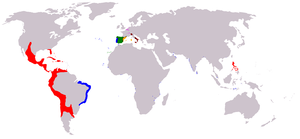
Iberian Peninsula
The Iberian Peninsula , sometimes called Iberia, is located in the extreme southwest of Europe and includes the modern-day sovereign states of Spain, Portugal and Andorra, as well as the British Overseas Territory of Gibraltar...
south of the Pyrenees
Pyrenees
The Pyrenees is a range of mountains in southwest Europe that forms a natural border between France and Spain...
from 1580–1640, through a dynastic union
Dynastic union
A dynastic union is the combination by which two different states are governed by the same dynasty, while their boundaries, their laws and their interests remain distinct...
between the monarchies of Portugal
Portugal
Portugal , officially the Portuguese Republic is a country situated in southwestern Europe on the Iberian Peninsula. Portugal is the westernmost country of Europe, and is bordered by the Atlantic Ocean to the West and South and by Spain to the North and East. The Atlantic archipelagos of the...
and Spain
Spanish Empire
The Spanish Empire comprised territories and colonies administered directly by Spain in Europe, in America, Africa, Asia and Oceania. It originated during the Age of Exploration and was therefore one of the first global empires. At the time of Habsburgs, Spain reached the peak of its world power....
after the War of the Portuguese Succession
War of the Portuguese Succession
The War of the Portuguese Succession was fought from 1580 to 1583 between the two main claimants to the Portuguese throne: António, Prior of Crato, proclaimed in several towns as King of Portugal, and Philip II of Spain, who eventually succeeded in claiming the crown reigning as Philip I of...
. Following the Portuguese crisis of succession, a dynastic union
Dynastic union
A dynastic union is the combination by which two different states are governed by the same dynasty, while their boundaries, their laws and their interests remain distinct...
joined both crowns, along with their respective colonial possessions, under the control of the Spanish monarchy. The term Iberian union is a creation of modern historians.
The unification of the peninsula had long been a goal of the region's monarchs. Sancho III of Navarre
Sancho III of Navarre
Sancho III Garcés , called the Great , succeeded as a minor to the Kingdom of Navarre in 1004, and through conquest and political maneuvering increased his power, until at the time of his death in 1035 he controlled the majority of Christian Iberia, bearing the title of rex Hispaniarum...
and Alfonso VII of León and Castile both took the title Imperator totius Hispaniae
Imperator totius Hispaniae
Imperator totius Hispaniae is a Latin title meaning "Emperor of all Spain". In Spain in the Middle Ages, the title "emperor" was used under a variety of circumstances from the ninth century onwards, but its usage peaked, as a formal and practical title, between 1086 and 1157...
, meaning "Emperor
Emperor
An emperor is a monarch, usually the sovereign ruler of an empire or another type of imperial realm. Empress, the female equivalent, may indicate an emperor's wife or a woman who rules in her own right...
of All Hispania
Hispania
Another theory holds that the name derives from Ezpanna, the Basque word for "border" or "edge", thus meaning the farthest area or place. Isidore of Sevilla considered Hispania derived from Hispalis....
" centuries before. The union could have been achieved earlier had Miguel da Paz (1498–1500), Prince of Portugal and Asturias
Prince of Asturias
Prince of Asturias is the historical title given to the heir to the Spanish throne. It was also the title under the earlier Kingdom of Castile. The current Prince of Asturias is Felipe, son of King Juan Carlos of Spain and Queen Sofía...
, become king. He died early in his childhood.
The history of Portugal
History of Portugal
The history of Portugal, a European and an Atlantic nation, dates back to the Early Middle Ages. In the 15th and 16th centuries, it ascended to the status of a world power during Europe's "Age of Discovery" as it built up a vast empire including possessions in South America, Africa, Asia and...
from the dynastic crisis in 1578 to the first Braganza Dynasty monarchs was a period of transition. The Portuguese Empire
Portuguese Empire
The Portuguese Empire , also known as the Portuguese Overseas Empire or the Portuguese Colonial Empire , was the first global empire in history...
's spice trade was peaking at the start of this period. It continued to enjoy widespread influence after Vasco da Gama
Vasco da Gama
Vasco da Gama, 1st Count of Vidigueira was a Portuguese explorer, one of the most successful in the Age of Discovery and the commander of the first ships to sail directly from Europe to India...
had finally reached the East by sailing around Africa in 1497–98. Vasco da Gama's achievement completed the exploratory efforts inaugurated by Henry the Navigator, and opened an oceanic route for the profitable spice trade
Spice trade
Civilizations of Asia were involved in spice trade from the ancient times, and the Greco-Roman world soon followed by trading along the Incense route and the Roman-India routes...
into Europe that bypassed the Middle East
Middle East
The Middle East is a region that encompasses Western Asia and Northern Africa. It is often used as a synonym for Near East, in opposition to Far East...
.
Throughout the 17th century, the increasing predations and surrounding of Portuguese trading posts in the East by the Dutch, English and French, and their rapidly growing intrusion into the Atlantic slave trade
Atlantic slave trade
The Atlantic slave trade, also known as the trans-atlantic slave trade, refers to the trade in slaves that took place across the Atlantic ocean from the sixteenth through to the nineteenth centuries...
, undermined Portugal's near monopoly on the lucrative oceanic spice and slave trades. This sent the Portuguese spice trade into a long decline. To a lesser extent the diversion of wealth from Portugal by the Habsburg monarchy to help support the Catholic side of the Thirty Years' War
Thirty Years' War
The Thirty Years' War was fought primarily in what is now Germany, and at various points involved most countries in Europe. It was one of the most destructive conflicts in European history....
, also created strains within the union, although Portugal did benefit from Spanish military power in helping to retain Brazil and in disrupting Dutch trade. These events, and those that occurred at the end of Aviz dynasty
House of Aviz
The House of Aviz is a dynasty of kings of Portugal. In 1385, the Interregnum of the 1383-1385 crisis ended with the acclamation of the Master of the Order of Aviz, John, natural son of king Peter I and Dona Teresa Lourenço as king...
and the period of Iberian Union, led Portugal to a state of dependency on its colonies, first India
India
India , officially the Republic of India , is a country in South Asia. It is the seventh-largest country by geographical area, the second-most populous country with over 1.2 billion people, and the most populous democracy in the world...
and then Brazil.
Establishment
The Battle of Ksar El Kebir in 1578 saw both the death of the young king SebastianSebastian of Portugal
Sebastian "the Desired" was the 16th king of Portugal and the Algarves. He was the son of Prince John of Portugal and his wife, Joan of Spain...
and the end of the House of Aviz
House of Aviz
The House of Aviz is a dynasty of kings of Portugal. In 1385, the Interregnum of the 1383-1385 crisis ended with the acclamation of the Master of the Order of Aviz, John, natural son of king Peter I and Dona Teresa Lourenço as king...
. Sebastian's successor, the Cardinal
Cardinal (Catholicism)
A cardinal is a senior ecclesiastical official, usually an ordained bishop, and ecclesiastical prince of the Catholic Church. They are collectively known as the College of Cardinals, which as a body elects a new pope. The duties of the cardinals include attending the meetings of the College and...
Henry of Portugal, was 70 years old at the time. Henry's death was followed by a succession crisis, with three grandchildren of Manuel I
Manuel I of Portugal
Manuel I , the Fortunate , 14th king of Portugal and the Algarves was the son of Infante Ferdinand, Duke of Viseu, , by his wife, Infanta Beatrice of Portugal...
claiming the throne: Infanta Catarina, Duchess of Braganza (married to John, 6th Duke of Braganza
John, 6th Duke of Braganza
John, Duke of Braganza may also mean John II, 8th Duke of BragançaJohn I, 6th Duke of Braganza KGF was the eldest son of Teodósio I, 5th Duke of Braganza....
), António, Prior of Crato
António, Prior of Crato
António, Prior of Crato , was a grandson of King Manuel I of Portugal, claimant of the Portuguese throne during the 1580 dynastic crisis, who was King of Portugal as António I of Portugal during 33 days in the continent in 1580, and, after the crowning of Philip II of Spain as King of Portugal,...
, and Philip II of Spain
Philip II of Spain
Philip II was King of Spain, Portugal, Naples, Sicily, and, while married to Mary I, King of England and Ireland. He was lord of the Seventeen Provinces from 1556 until 1581, holding various titles for the individual territories such as duke or count....
. António had been acclaimed King of Portugal by the people of Santarém
Santarém, Portugal
Santarém is a city in the Santarém Municipality in Portugal. The city itself has a population of 28,760 and the entire municipality has 64,124 inhabitants.It is the capital of Santarém District....
on July 24, 1580 and then in many cities and towns throughout the country. Some members of the Council of Governors of Portugal, who had supported Philip, escaped to Spain and declared him to be the legal successor of Henry. Philip II of Spain
Philip II of Spain
Philip II was King of Spain, Portugal, Naples, Sicily, and, while married to Mary I, King of England and Ireland. He was lord of the Seventeen Provinces from 1556 until 1581, holding various titles for the individual territories such as duke or count....
marched into Portugal and defeated the troops loyal to the Prior of Crato in the Battle of Alcântara
Battle of Alcântara (1580)
The Battle of Alcântara took place on August 25, 1580, near the brook of Alcântara, in the vicinity of Lisbon, Portugal, and was a decisive victory of the Spanish Habsburg King Philip II over the Portuguese pretender to the Portuguese throne, Dom António, Prior of Crato.-Background:In Portugal, the...
. The troops occupying the countryside (Tercio
Tercio
The tercio was a Renaissance era military formation made up of a mixed infantry formation of about 3,000 pikemen, swordsmen and arquebusiers or musketeers in a mutually supportive formation. It was also sometimes referred to as the Spanish Square...
s) commanded by the 3rd Duke of Alba, arrived in Lisbon. The Duke of Alba imposed on the Portuguese provinces a subjection of Philip before entering Lisbon, where he seized an immense treasure; meanwhile, he allowed his soldiers to sack the vicinity of the capital. Philip II of Spain was crowned Philip I of Portugal in 1581 (recognized as king by the Cortes of Tomar
Tomar
Tomar Municipality has a total area of 351.0 km² and a total population of 43,007 inhabitants.The municipality is composed of 16 parishes, and is located in Santarém District...
) and the Portuguese House of Habsburg (also called the Philippine Dynasty) began. When Philip left in 1583 to Madrid, he made his nephew Albert of Austria
Albert VII, Archduke of Austria
Archduke Albert VII of Austria was, jointly with his wife, the Infanta Isabella Clara Eugenia, sovereign of the Habsburg Netherlands between 1598 and 1621, ruling the Habsburg territories in the southern Low Countries and the north of modern France...
his viceroy in Lisbon. In Madrid he established a Council of Portugal to advise him on Portuguese affairs.
Portugal's status was maintained under the first two kings of the Iberian Union, Philip I and his son Philip II of Portugal and III of Spain
Philip III of Spain
Philip III , also known as Philip the Pious, was the King of Spain and King of Portugal and the Algarves, where he ruled as Philip II , from 1598 until his death...
. Both monarchs gave excellent positions to Portuguese nobles in the Spanish courts, and Portugal maintained an independent law, currency, and government. It was even proposed to move the Royal capital to Lisbon.
The continuity in the administrative system
Due to the complexity in the management of government, the Spanish Monarch needed some auxiliary bodies, as the Councils (Consejos), dedicated to the advice and resolution of problems, and submitted to the Monarch's knowledge and dictum.This complexity needed a permanent seat, and the king Philip II of Spain established in 1562 the permanent capital in Madrid, seat of the Royal Court and of the administrative staff, although transferred-in Valladolid, with the whole administrative staff, during a brief period (1601–1606).
As for the functioning, the administrative correspondence came to the different Councils, to Madrid, then the secretary of every Council arranged the material that had to deliver for the attention of the king, and later the King assembled with the secretaries requesting the opinion of the Council. After that, the Council answered afterwards a session to treat the issue and to raise the formal consultation to the monarch. The secretary raise the consultation to the king, and was returned to the Council with his response to be executed. The meetings of the Councils took place in the royal palace, and they did not count on the presence of the king habitually. In this polisynodial system, "Consejo de Estado" (Council of State) stood out for its importance. The Consejo de Estado in Madrid, entrusted to declare on the major decisions that concerned the organization and the defense of the ensemble of the Hispanic monarchy, and it had frequently that to get into Portuguese matters. Even, the Council of War (Consejo de Guerra) exercised its jurisdiction on the troops placed in the Castilian strongholds established on the Portuguese littoral.
And also, there were Councils of territorial character, which functions specialized in a concrete territorial space, the Council of Castile, Council of Aragon, Council of Navarre, Council of Italy, Council of The Indies, Council of Flanders, and the Council of Portugal. The Council of Portugal, established in 1582, was integrated with a president and six (later four) counselors, and it disappeared in 1668. The function of the Council consists in representing close to the king the courts of the Crown of Portugal for the matters that depend on the justice, grace, finally, the economy of the royal Portuguese domain. Any decision of the king who concerning his Kingdom must do the object of a consultation to the Council before being transmitted to the chancellery of Lisbon and to the concerned courts. The Council of Portugal knows two eclipses: in 1619, for the presence of the King in Lisbon, and between 1639–1658, replaced with the Junta of Portugal. From the Restauração, the Council continued existing, since Philip IV
Philip IV of Spain
Philip IV was King of Spain between 1621 and 1665, sovereign of the Spanish Netherlands, and King of Portugal until 1640...
had not recognized the independence of Portugal, and carried out the attending to the faithful Portuguese to the Spanish monarch, and the government of Ceuta.
Relating to the particular government of the kingdom of Portugal itself. During the union of the kingdom of Portugal to the Spanish monarchy, the Spanish Hasburgs on the whole respected the pledges made at Thomar in 1581 to allow considerable Portuguese autonomy and to respected the territories of its empire. Public offices were reserved for Portuguese subjects at home and overseas. The king was represented at Lisbon sometimes by a governor and sometimes by a viceroy. So, Spain left the administration of Portugal and its empire largely to the Portuguese themselves, under general supervision from Madrid channeled through a viceroy in Lisbon. Important matters, however, were referred to Madrid, where they came before the Council of Portugal. In the kingdom of Portugal, the polisynodial system is reinforced:
- Council of State. The Conselho de Estado of Lisbon is the King's private Council, entrusted of debating major issues related to the Crown, especially as for foreign policy. The counselors could send their remarks to the king, and the King consulted them through his Viceroy. Although the Conselho de Estado of Lisbon, worked as the great adviser Council of the King's delegate, this Council of State was without clearly defined administrative powers and actually it did not perform relevant role of coordination. The Spanish kings maintained the system of two secretaries of state, one for the kingdom and the other for "India", that is to say, for the colonies, despite several conflicts over jurisdiction, until the creation of the Conselho da India in 1604.
- In the same way, Spanish kings retained the Mesa da Consciência e Ordens, which was both tribunal and council for religious affairs and was responsible for administering ecclesiastical appintments and for the property of the military orders in the colonies as well as in the home country.
- Portuguese Inquisition remained independent from the Mesa da Consciência e Ordens. There were three major courts in Lisbon, Coimbra and Évora.
- Also preserved was the Desembargo do Paço. The pinnacle of the entire Portuguese judicial system was the Desembargo do Paço or Royal Board of Justice in Lisbon. This board, the highest court in the kingdom, controlled the appointment of all magistrates and judges and oversaw the Casa de Supplicação or Court of Appeals in Lisbon, as well as the high courts in the Portuguese overseas territories. The first function of the Desembargo do Paço was to control the recruitment of the magistrates (leitura de bachareis) and to monitor them in the exercise of their charge, its control spreads to the whole of the juridical professions. The Desembargo do Paço had to arbitrate conflicts between other courts of the kingdom. This court granted dispensations, acts of legitimization and another relevant issues about the justice and the grace, and which on occasions advised the king on political and economic as well as judicial matters. Moreover, a commission of jurists set up to reform the legal system produced a new code for Portugal, the Ordenações filipinas, promulgated in 1603.
- The Casa de Supplicação and the Casa do Civel, both are two royal courts of appeal for civil cases as criminal cases. The Casa do Civel exercised jurisdiction over the northern part of the kingdom, and the Casa de Supplicação over the rest on the realm including the islands and overseas.
- In 1591, the four Vedores da Fazenda (overseers of the Treasury) were replaced by a Conselho da Fazenda composed of one Vedor da Fazenda presiding over four counsillors (two of them lawyers) and four secretaries. The Conselho da Fazenda exercised a control over the officials of finance, administered the particular king's goods and exercised its jurisdiction over the customs and the arsenals, the court of accounts and the administration of the monopolistic trade with overseas.
- From 1604, the newly created Conselho da India was invested with powers for all overseas affairs, apart from matters concerning Madeira, the Azores and the strongholds of Morocco, and colonial officials were appointed and their dispatches handled by it. However, it was the Conselho da Fazenda which dealt with naval expeditions, the buying and selling of pepper and the collection of the royal revenues, in fact with all economic business. The Conselho da India, therefore, exercised only limited powers. As a creation of the Spanish king, it was regarded with disfavour by the Portuguese and because of the jealousy of the Mesa da Consciencia disappeared in 1614.
Nevertheless, the political conjuncture need urgent reactions, and in this context a system of meetings appeared for specific issues, as the Junta for the reform of the Council of Portugal (1606–1607, 1610), the Junta for the classification of the debts to the treasury (since 1627) or the Juntas for the organization of the navies of succor of Brazil (since 1637)...
The Portuguese Empire challenged
The joining of the two crowns deprived Portugal of a separate foreign policy, and Spain's enemies became Portugal's. EnglandEngland
England is a country that is part of the United Kingdom. It shares land borders with Scotland to the north and Wales to the west; the Irish Sea is to the north west, the Celtic Sea to the south west, with the North Sea to the east and the English Channel to the south separating it from continental...
had been an ally of Portugal since the Treaty of Windsor in 1386. War between Spain and England led to a deterioration of the relations with Portugal's oldest ally, and the loss of Hormuz
Ormus
The Kingdom of Ormus was a 10th to 17th century kingdom located within the Persian Gulf and extending as far as the Strait of Hormuz...
. English help provided by Elizabeth I of England
Elizabeth I of England
Elizabeth I was queen regnant of England and Ireland from 17 November 1558 until her death. Sometimes called The Virgin Queen, Gloriana, or Good Queen Bess, Elizabeth was the fifth and last monarch of the Tudor dynasty...
in a rebellion against the kings assured the survival of the alliance. War with the Dutch led to invasions of many countries in Asia
Asia
Asia is the world's largest and most populous continent, located primarily in the eastern and northern hemispheres. It covers 8.7% of the Earth's total surface area and with approximately 3.879 billion people, it hosts 60% of the world's current human population...
, including Ceylon (today's Sri Lanka
Sri Lanka
Sri Lanka, officially the Democratic Socialist Republic of Sri Lanka is a country off the southern coast of the Indian subcontinent. Known until 1972 as Ceylon , Sri Lanka is an island surrounded by the Indian Ocean, the Gulf of Mannar and the Palk Strait, and lies in the vicinity of India and the...
), and commercial interests in Japan
Japan
Japan is an island nation in East Asia. Located in the Pacific Ocean, it lies to the east of the Sea of Japan, China, North Korea, South Korea and Russia, stretching from the Sea of Okhotsk in the north to the East China Sea and Taiwan in the south...
, Africa
Africa
Africa is the world's second largest and second most populous continent, after Asia. At about 30.2 million km² including adjacent islands, it covers 6% of the Earth's total surface area and 20.4% of the total land area...
(Mina
History of Gabon
There is little written history of Gabon prior to European contact, but various Bantu peoples are known to have immigrated to the area beginning in the 14th century. Portuguese traders who arrived in the 15th century named the country after the Portuguese word gabão, a coat with sleeve and hood...
), and South America
South America
South America is a continent situated in the Western Hemisphere, mostly in the Southern Hemisphere, with a relatively small portion in the Northern Hemisphere. The continent is also considered a subcontinent of the Americas. It is bordered on the west by the Pacific Ocean and on the north and east...
. Even though Portuguese were unable to capture the entire island of Ceylon, they were able to keep the coastal regions of Ceylon under their control for a considerable time. Brazil was partially conquered by both France
France
The French Republic , The French Republic , The French Republic , (commonly known as France , is a unitary semi-presidential republic in Western Europe with several overseas territories and islands located on other continents and in the Indian, Pacific, and Atlantic oceans. Metropolitan France...
and the Seventeen Provinces
Seventeen Provinces
The Seventeen Provinces were a personal union of states in the Low Countries in the 15th century and 16th century, roughly covering the current Netherlands, Belgium, Luxembourg, a good part of the North of France , and a small part of Western Germany.The Seventeen Provinces were originally held by...
.
In the 17th Century, taking advantage of this period of Portuguese weakness, many Portuguese territories in Brazil were occupied by the Dutch
Netherlands
The Netherlands is a constituent country of the Kingdom of the Netherlands, located mainly in North-West Europe and with several islands in the Caribbean. Mainland Netherlands borders the North Sea to the north and west, Belgium to the south, and Germany to the east, and shares maritime borders...
who gained access to the sugarcane
Sugarcane
Sugarcane refers to any of six to 37 species of tall perennial grasses of the genus Saccharum . Native to the warm temperate to tropical regions of South Asia, they have stout, jointed, fibrous stalks that are rich in sugar, and measure two to six metres tall...
plantation
Plantation
A plantation is a long artificially established forest, farm or estate, where crops are grown for sale, often in distant markets rather than for local on-site consumption...
s. John Maurice, Prince of Nassau-Siegen was appointed as the governor of the Dutch possessions in Brazil in 1637 by the Dutch West India Company
Dutch West India Company
Dutch West India Company was a chartered company of Dutch merchants. Among its founding fathers was Willem Usselincx...
. He landed at Recife, the port of Pernambuco, in January 1637. By a series of successful expeditions, he gradually extended the Dutch possessions from Sergipe on the south to São Luís de Maranhão in the north. He likewise conquered the Portuguese possessions of Elmina Castle
Elmina Castle
Elmina Castle was erected by Portugal in 1482 as São Jorge da Mina Castle, also known simply as Mina or Feitoria da Mina) in present-day Elmina, Ghana . It was the first trading post built on the Gulf of Guinea, so is the oldest European building in existence below the Sahara...
, Saint Thomas, and Luanda
Luanda
Luanda, formerly named São Paulo da Assunção de Loanda, is the capital and largest city of Angola. Located on Angola's coast with the Atlantic Ocean, Luanda is both Angola's chief seaport and its administrative center. It has a population of at least 5 million...
, Angola, on the west coast of Africa. After the dissolution of the Iberian Union in 1640, Portugal would reestablish its authority over the lost territories of the Portuguese Empire
Portuguese Empire
The Portuguese Empire , also known as the Portuguese Overseas Empire or the Portuguese Colonial Empire , was the first global empire in history...
. The Dutch intrusion into Brazil was long lasting and troublesome to Portugal. The Seventeen Provinces captured a large portion of the Brazilian coast including Bahia
Bahia
Bahia is one of the 26 states of Brazil, and is located in the northeastern part of the country on the Atlantic coast. It is the fourth most populous Brazilian state after São Paulo, Minas Gerais and Rio de Janeiro, and the fifth-largest in size...
(and its capital Salvador
Salvador, Bahia
Salvador is the largest city on the northeast coast of Brazil and the capital of the Northeastern Brazilian state of Bahia. Salvador is also known as Brazil's capital of happiness due to its easygoing population and countless popular outdoor parties, including its street carnival. The first...
), Pernambuco
Pernambuco
Pernambuco is a state of Brazil, located in the Northeast region of the country. To the north are the states of Paraíba and Ceará, to the west is Piauí, to the south are Alagoas and Bahia, and to the east is the Atlantic Ocean. There are about of beaches, some of the most beautiful in the...
(and its capital Recife
Recife
Recife is the fifth-largest metropolitan area in Brazil with 4,136,506 inhabitants, the largest metropolitan area of the North/Northeast Regions, the 5th-largest metropolitan influence area in Brazil, and the capital and largest city of the state of Pernambuco. The population of the city proper...
), Paraíba
Paraíba
Paraíba Paraíba Paraíba (Tupi: pa'ra a'íba: "bad to navigation"; Brazilian Portuguese pronunciation: is a state of Brazil. It is located in the Brazilian Northeast, and is bordered by Rio Grande do Norte to the north, Ceará to the west, Pernambuco to the south and the Atlantic Ocean to the east...
, Rio Grande do Norte
Rio Grande do Norte
Rio Grande do Norte is one of the states of Brazil, located in the northeastern region of the country, occupying the northeasternmost tip of the South American continent. Because of its geographic position, Rio Grande do Norte has a strategic importance. The capital and largest city is Natal...
, Ceará
Ceará
Ceará is one of the 27 states of Brazil, located in the northeastern part of the country, on the Atlantic coast. It is currently the 8th largest Brazilian State by population and the 17th by area. It is also one of the main touristic destinations in Brazil. The state capital is the city of...
, and Sergipe
Sergipe
Sergipe , is the smallest state of the Brazilian Federation, located on the northeastern Atlantic coast of the country. It borders on two other states, Bahia to the south and west and Alagoas to the north, and to the east is the Atlantic Ocean...
, while Dutch privateers sacked Portuguese ships in both the Atlantic
Atlantic Ocean
The Atlantic Ocean is the second-largest of the world's oceanic divisions. With a total area of about , it covers approximately 20% of the Earth's surface and about 26% of its water surface area...
and Indian Ocean
Indian Ocean
The Indian Ocean is the third largest of the world's oceanic divisions, covering approximately 20% of the water on the Earth's surface. It is bounded on the north by the Indian Subcontinent and Arabian Peninsula ; on the west by eastern Africa; on the east by Indochina, the Sunda Islands, and...
s. The large area of Bahia and its city, the strategically important Salvador, was recovered quickly by a powerful Iberian military expedition in 1625. This laid the foundations for the recovery of remaining Dutch controlled areas. The other smaller, less developed areas were recovered in stages and relieved of Dutch piracy in the next two decades by local resistance and Portuguese expeditions.
On the other hand, the Iberian Union opened to both countries a worldwide span of control, as Portugal dominated the Africa
Africa
Africa is the world's second largest and second most populous continent, after Asia. At about 30.2 million km² including adjacent islands, it covers 6% of the Earth's total surface area and 20.4% of the total land area...
n and Asia
Asia
Asia is the world's largest and most populous continent, located primarily in the eastern and northern hemispheres. It covers 8.7% of the Earth's total surface area and with approximately 3.879 billion people, it hosts 60% of the world's current human population...
n coasts that surrounded the Indian Ocean
Indian Ocean
The Indian Ocean is the third largest of the world's oceanic divisions, covering approximately 20% of the water on the Earth's surface. It is bounded on the north by the Indian Subcontinent and Arabian Peninsula ; on the west by eastern Africa; on the east by Indochina, the Sunda Islands, and...
, and Spain the Pacific Ocean
Pacific Ocean
The Pacific Ocean is the largest of the Earth's oceanic divisions. It extends from the Arctic in the north to the Southern Ocean in the south, bounded by Asia and Australia in the west, and the Americas in the east.At 165.2 million square kilometres in area, this largest division of the World...
and both sides of Central
Central America
Central America is the central geographic region of the Americas. It is the southernmost, isthmian portion of the North American continent, which connects with South America on the southeast. When considered part of the unified continental model, it is considered a subcontinent...
and South America
South America
South America is a continent situated in the Western Hemisphere, mostly in the Southern Hemisphere, with a relatively small portion in the Northern Hemisphere. The continent is also considered a subcontinent of the Americas. It is bordered on the west by the Pacific Ocean and on the north and east...
, while both shared the Atlantic Ocean
Atlantic Ocean
The Atlantic Ocean is the second-largest of the world's oceanic divisions. With a total area of about , it covers approximately 20% of the Earth's surface and about 26% of its water surface area...
space.
Decline of the Union and revolt of Portugal

Philip IV of Spain
Philip IV was King of Spain between 1621 and 1665, sovereign of the Spanish Netherlands, and King of Portugal until 1640...
(and IV of Spain) who had a different approach on Portuguese issues. Taxes raised affected mainly the Portuguese merchants (Carmo Reis 1987). The Portuguese nobility began to lose its importance at the Spanish Cortes
Cortes Generales
The Cortes Generales is the legislature of Spain. It is a bicameral parliament, composed of the Congress of Deputies and the Senate . The Cortes has power to enact any law and to amend the constitution...
, and government posts in Portugal were occupied by Spaniards. Ultimately, Philip III tried to make Portugal a royal province, and Portuguese nobles lost all of their power.
Several other problems also damaged Portuguese support of their union with Spain. One of these was certainly the pressure from the center, especially from the Count-Duke of Olivares
Gaspar de Guzmán, Count-Duke of Olivares
Don Gaspar de Guzmán y Pimentel Ribera y Velasco de Tovar, Count-Duke of Olivares and Duke of San Lúcar la Mayor , was a Spanish royal favourite of Philip IV and minister. As prime minister from 1621 to 1643, he over-exerted Spain in foreign affairs and unsuccessfully attempted domestic reform...
, towards uniformity and sharing the financial and military burden of Castile's wars in Europe. However, the Portuguese were hardly inclined to help with that, as Spain had failed to prevent the Dutch occupation
Dutch West India Company
Dutch West India Company was a chartered company of Dutch merchants. Among its founding fathers was Willem Usselincx...
of several of Portugal's colonial holdings, despite the fact that both the Portuguese and the Dutch were nominally under the same crown.
This situation culminated in a revolution by the nobility and high bourgeoisie
Bourgeoisie
In sociology and political science, bourgeoisie describes a range of groups across history. In the Western world, between the late 18th century and the present day, the bourgeoisie is a social class "characterized by their ownership of capital and their related culture." A member of the...
on December 1, 1640, 60 years after the crowning of Philip I. This revolution, while foreseeable, was most immediately sparked by a popular Catalan Revolt
Catalan Revolt
The Catalan Revolt affected a large part of the Catalan Principality of Catalonia between the years of 1640 and 1659. It had an enduring effect in the Treaty of the Pyrenees , which ceded the county of Roussillon and the northern half of the county of Cerdanya to France , thereby splitting the...
against the Crown. The plot was planned by Antão Vaz de Almada, Miguel de Almeida and João Pinto Ribeiro. They, together with several associates, took advantage of the fact that the Castilian troops were occupied in the other side of the peninsula. The rebels killed Secretary of State
Secretary of State
Secretary of State or State Secretary is a commonly used title for a senior or mid-level post in governments around the world. The role varies between countries, and in some cases there are multiple Secretaries of State in the Government....
Miguel de Vasconcelos
Miguel de Vasconcelos
Miguel de Vasconcelos e Brito was the last Secretary of State of the Kingdom of Portugal, during the Iberian Union, in which both kingdoms of Portugal and Spain remained separated but united by the same king and foreign policy .He was in office from 1635 to...
and imprisoned the king's cousin, the Duchess of Mantua
Margarida of Savoy, Vicereine of Portugal
Margaret of Savoy, Duchess Consort of Mantua and Montferrat was best known as the last Spanish Vicereine of Portugal...
, who had governed Portugal in his name. The moment was well chosen, as Philip's troops were at the time fighting the Thirty Years' War
Thirty Years' War
The Thirty Years' War was fought primarily in what is now Germany, and at various points involved most countries in Europe. It was one of the most destructive conflicts in European history....
in addition to the previously mentioned revolution in Catalonia
Catalonia
Catalonia is an autonomous community in northeastern Spain, with the official status of a "nationality" of Spain. Catalonia comprises four provinces: Barcelona, Girona, Lleida, and Tarragona. Its capital and largest city is Barcelona. Catalonia covers an area of 32,114 km² and has an...
.
The support of the people became apparent almost immediately and soon John, 8th Duke of Braganza
John IV of Portugal
|-|John IV was the King of Portugal and the Algarves from 1640 to his death. He was the grandson of Catherine, Duchess of Braganza, who had in 1580 claimed the Portuguese crown and sparked the struggle for the throne of Portugal. John was nicknamed John the Restorer...
, was acclaimed King of Portugal throughout the country as John IV. By December 2, 1640, John had already sent a letter to the Municipal Chamber of Évora
Évora
Évora is a municipality in Portugal. It has total area of with a population of 55,619 inhabitants. It is the seat of the Évora District and capital of the Alentejo region. The municipality is composed of 19 civil parishes, and is located in Évora District....
as sovereign of the country.
Restoration War and the end of the Union
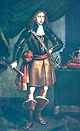
Portuguese Restoration War
Portuguese Restoration War was the name given by nineteenth-century 'romantic' historians to the war between Portugal and Spain that began with the Portuguese revolution of 1640 and ended with the Treaty of Lisbon . The revolution of 1640 ended the sixty-year period of dual monarchy in Portugal...
against Philip III consisted mainly of small skirmishes near the border. The most significant battles being the Battle of Montijo
Battle of Montijo
The Battle of Montijo was fought on May 26, 1644, in Montijo, Spain, between Portuguese and Spanish forces. Although the battle ended with a Portuguese victory, the Spanish saw it as a strategic success as they claimed to have prevented Matias de Albuquerque to capture Badajoz, despite Albuquerque...
on May 26, 1644, the Battle of the Lines of Elvas
Battle of the Lines of Elvas
The Battle of the Lines of Elvas , was fought on 14 January 1659, in Elvas, between Portugal and Spain.-History:In 1658 a Spanish army commanded by D. Luis de Haro, was camped in the frontier of the Caia River, with 14,000 infantry, 3,500 cavalry and several pieces of artillery...
(1659), the Battle of Ameixial
Battle of Ameixial
The Battle of Ameixial, was fought on June 8, 1663, near the village of Santa Vitória do Ameixial, some 10 km north-west of Estremoz, between Spanish and Portuguese as part of the Portuguese Restoration War....
(1663), the Battle of Castelo Rodrigo (1664), and the Battle of Montes Claros
Battle of Montes Claros
The Battle of Montes Claros, was fought on June 17, 1665, near Vila Viçosa, between Spanish and Portuguese as the last battle in the Portuguese Restoration War....
(1665); the Portuguese were victorious in all of these battles.
Several decisions made by John IV to strengthen his forces made these victories possible. On December 11, 1640, the Council of War was created to organize all the operations. Next, the king created the Junta of the Frontiers, to take care of the fortresses near the border, the hypothetical defense of Lisbon
Lisbon
Lisbon is the capital city and largest city of Portugal with a population of 545,245 within its administrative limits on a land area of . The urban area of Lisbon extends beyond the administrative city limits with a population of 3 million on an area of , making it the 9th most populous urban...
, and the garrisons and sea ports. In December 1641, a tenancy was created to assure upgrades on all fortresses that would be paid with regional taxes. John IV also organized the army, established the Military Laws of King Sebastian, and developed intense diplomatic activity focused on restoring good relations with England. Meanwhile, the best Spanish forces were pre-occupied with their battles against the French in Catalonia, along the Pyrenees, Italy and the Low Countries. The Spanish forces in Portugal never received adequate support. Nevertheless, Philip IV felt he could not give up what he regarded as his rightful inheritance. By the time the war with France ended in 1659, the Portuguese military were well established and ready to confront the last major attempt of a worn out Spanish regime to reclaim control.
After gaining several decisive victories, John quickly tried to make peace. His demand that Philip recognize the new ruling dynasty in Portugal was not fulfilled until the reign of his son Afonso VI during the regency of Peter of Braganza (another son of John and later King Peter II of Portugal).
Origins of the House of Braganza
The Portuguese Royal House of BraganzaHouse of Braganza
The Most Serene House of Braganza , an important Portuguese noble family, ruled the Kingdom of Portugal and its colonial Empire, from 1640 to 1910...
began with John IV. The Dukes of the House of Braganza were a branch of the House of Aviz
House of Aviz
The House of Aviz is a dynasty of kings of Portugal. In 1385, the Interregnum of the 1383-1385 crisis ended with the acclamation of the Master of the Order of Aviz, John, natural son of king Peter I and Dona Teresa Lourenço as king...
created by Afonso V
Afonso V of Portugal
Afonso V KG , called the African , was the twelfth King of Portugal and the Algarves. His sobriquet refers to his conquests in Northern Africa.-Early life:...
for his half-uncle Afonso, 1st Duke of Braganza
Afonso, 1st Duke of Braganza
Dom Afonso I, the 1st Duke of Braganza was the eighth Count of Barcelos, the 2nd Count of Neiva, 2nd Lord of Faria and the first Duke of Braganza.-Origins:...
, illegitimate son of John I
John I of Portugal
John I KG , called the Good or of Happy Memory, more rarely and outside Portugal the Bastard, was the tenth King of Portugal and the Algarve and the first to use the title Lord of Ceuta...
, first monarch of the House of Aviz. Duke Afonso married Beatriz Pereira de Alvim, daughter of Nun'Alvares Pereira, and as such the wealthiest heiress in the kingdom. The Braganzas soon became one of the most powerful families of the kingdom and for the next decades would inter-marry with the main line of the Portuguese royal family. In 1565, John, 6th Duke of Braganza
John, 6th Duke of Braganza
John, Duke of Braganza may also mean John II, 8th Duke of BragançaJohn I, 6th Duke of Braganza KGF was the eldest son of Teodósio I, 5th Duke of Braganza....
married Princess Catherine, granddaughter of King Manuel I
Manuel I of Portugal
Manuel I , the Fortunate , 14th king of Portugal and the Algarves was the son of Infante Ferdinand, Duke of Viseu, , by his wife, Infanta Beatrice of Portugal...
. This connection with the Royal Family proved determinant in the rise of the House of Braganza to a Royal House. Catherine was one of the strongest claimants of the throne during the succession crisis of 1580 but lost the struggle to her cousin Philip II of Spain. Eventually Catherine's grandson became John IV of Portugal as he was held to be the legitimate heir.
John IV was a beloved monarch, a patron of fine art and music, and a proficient composer and writer on musical subjects. He collected one of the largest libraries in the world. Among his writings is a defense of Palestrina
Giovanni Pierluigi da Palestrina
Giovanni Pierluigi da Palestrina was an Italian Renaissance composer of sacred music and the best-known 16th-century representative of the Roman School of musical composition...
and a Defense of Modern Music (Lisbon, 1649). Abroad, the Dutch took Malacca
Malacca
Malacca , dubbed The Historic State or Negeri Bersejarah among locals) is the third smallest Malaysian state, after Perlis and Penang. It is located in the southern region of the Malay Peninsula, on the Straits of Malacca. It borders Negeri Sembilan to the north and the state of Johor to the south...
(January 1641) and the Sultan of Oman
Sultan of Oman
-List of Imams :-Nabhan Dynasty :-Ya'ariba Dynasty :-Banu Ghafir Dynasty :-Ya'ariba Dynasty :-Al Said Dynasty :-See also:...
captured Muscat
Muscat, Oman
Muscat is the capital of Oman. It is also the seat of government and largest city in the Governorate of Muscat. As of 2008, the population of the Muscat metropolitan area was 1,090,797. The metropolitan area spans approximately and includes six provinces called wilayats...
(1648). By 1654, however, most of Brazil was back in Portuguese hands and had effectively ceased to be a viable Dutch colony. John died in 1656, and his widow, Luisa of Guzman, married their daughter Catherine of Braganza
Catherine of Braganza
Catherine of Braganza was a Portuguese infanta and queen consort of England, Scotland and Ireland as the wife of King Charles II.She married the king in 1662...
to Charles II of England
Charles II of England
Charles II was monarch of the three kingdoms of England, Scotland, and Ireland.Charles II's father, King Charles I, was executed at Whitehall on 30 January 1649, at the climax of the English Civil War...
in 1661 while she was regent for their son Afonso VI. Her dowry consisted of Tangier
Tangier
Tangier, also Tangiers is a city in northern Morocco with a population of about 700,000 . It lies on the North African coast at the western entrance to the Strait of Gibraltar where the Mediterranean meets the Atlantic Ocean off Cape Spartel...
, Bombay and £1,000,000 sterling, making it the largest dowry ever brought by a queen consort. John IV was succeeded by his son Afonso VI.