
Encyclopedia
The
Norman conquest of England was the
invasion of the
Kingdom of England by
William the Conqueror , in 1066 at the
Battle of Hastings and the subsequent
Norman control of England. It is an important watershed in English history for a number of reasons. The conquest linked England more closely with Continental
Europe and lessened
Scandinavian influence, created one of the most powerful monarchies in Europe, created the most sophisticated governmental system in Europe, changed the
English language and culture, and set the stage for
English-
French conflict that would last into the 19th century. It remains the last successful military conquest of England.
Origins
Normandy was a region in northwest France which in the 155 years prior to 1066 had experienced extensive
Viking settlement. In the year 911, French Carolingian ruler Charles the Simple had allowed a group of Vikings, under their leader
Rollo, to settle in northern France with the idea that they would provide protection along the coast against future Viking invaders. This proved successful and the Vikings in the region became known as the
Northmen from which
Normandy is derived. The
Normans quickly adapted to the indigenous culture, renouncing
paganism and converting to Christianity; adopting the langue d'oïl of their new home through the introduction of
Norse features, transforming it into the
Norman language, and intermarrying with the local populations. They also used the territory granted them as a base to extend the frontiers of the Duchy to the west, annexing territory including the Bessin, the Cotentin Peninsula and the
Channel Islands.
Meanwhile in England, the Viking attacks increased and in 991 the Anglo-Saxon king of England
Aethelred II agreed to marry
Emma, the daughter of the Duke of Normandy, to cement a blood-tie alliance for help against the raiders. The Viking attacks of England grew so bad that in 1013 the Anglo-Saxon kings fled and spent the next 30 years in Normandy, not returning to England until 1042.
When the Anglo-Saxon king
Edward the Confessor died a few years later in 1066 with no child, and thus no direct heir to the throne, it created a power vacuum into which three competing interests laid claim to the throne of England.
The first was
Harald III of Norway who had blood ties to the Anglo-Saxon family. The second was
William, Duke of Normandy because of his blood ties to
Aethelred. The third was an Anglo-Saxon by the name of
Harold Godwinson who had been elected in the traditional way by the Anglo-Saxon
Witenagemot of England to be king. The stage was set for a battle among the three.
Conquest of England
King Harald of Norway invaded northern England in September 1066 which left Harold of England little time to gather an army. Harold's forces marched north from London and surprised the Vikings at the
Battle of Stamford Bridge on September 25th. It was an Anglo-Saxon victory, King Harald was killed and the Norwegians were driven out — it was the last Viking invasion of England. The victory however came at a great cost: the Anglo-Saxon army was left in a battered and weakened state.
Meanwhile William had assembled an invasion fleet of around 600 ships and an army of 7000 men. This was far greater than the reserves of men in Normandy alone: William recruited soldiers from all of Northern France, the low countries, and Germany. Many soldiers in his army were second- and third-born sons who had little or no inheritance under the laws of primogeniture. William promised that if they brought their own horse, armour, and weapons to join him, they would be rewarded with lands and titles in the new realm.
At this daunting task, William showed his best side: that of a supremely able administrator, a skill which was to help bring England under his heel once he was crowned.
After being delayed for a few weeks by unfavourable winds and weather, he finally arrived in the south of England just days after Harold's victory over the Norwegians. The delay turned out to be crucial: had he landed in August when he originally planned, Harold would have been waiting with a fresh and numerically superior force. William finally landed at
Pevensey in
Sussex on September 28, 1066 and assembled a prefabricated wooden castle near Hastings as a base.
The choice of landing was a direct provocation to Harold Godwinson as this area of Sussex was Harold's own personal domain. William began immediately to lay waste to the land. It may have prompted Harold to respond immediately and in haste rather than to pause and await reinforcements in London. Again, it was an event that favoured William. Had he marched inland, he may have outstretched his supply lines, and possibly have been surrounded by Harold's forces.
They fought at the
Battle of Hastings on October 14. It was a close battle but in the final hours Harold was killed and the Saxon army fled. With no living contender for the throne of England to oppose William, this was the defining moment of what is now known as the Norman Conquest.
After his victory at Hastings, William marched through Kent to London but met fierce resistance at
Southwark. He then marched down the old
Roman Road of
Stane Street to link up with another Norman army on the
Pilgrims' Way near
Dorking,
Surrey. The combined armies then avoided London altogether and went up the Thames valley to the major fortified Saxon town of
Wallingford,
Oxfordshire, whose Saxon lord, Wigod, had supported William's cause. While there, he received the submission of Stigand, the
Archbishop of Canterbury. One of William's favourites, Robert D'Oyley of Lisieux, also married Wigod's daughter, no doubt to secure the lord's continued allegiance. William then travelled north east along the Chiltern
escarpment to the Saxon fort at
Berkhamstead,
Hertfordshire and waited there to receive the submission of London. The remaining Saxon noblemen surrendered to William there, and he was acclaimed King of England around the end of October and crowned on December 25, 1066 in
Westminster Abbey.
Although the south of England submitted quickly to Norman rule, resistance continued, especially in the North, for six more years until 1072 when William moved north, subduing rebellions by the Anglo-Saxons and installing Norman lords along the way. However, particularly in Yorkshire, he made agreements with local Saxon Lords to keep control of their land in exchange for avoidance of battle and loss of any controlling share.
Hereward the Wake led an uprising in the fens and sacked
Peterborough . Harold's sons attempted an invasion of the south-west peninsula. Risings also occurred in the Welsh Marches and at
Stafford. Most seriously William faced separate attempts at invasion by the Danes and the Scots. William's defeat of these led to what became known as
The Harrying of the North in which
Northumbria was laid waste to deny his enemies its resources.
The conquest of
Wales took place piecemeal and finished only in 1282, during the reign of King
Edward I. Edward also subdued
Scotland but did not truly conquer it as it retained a separate monarchy until 1603 and remained an independent kingdom until 1707.
Control of England
Once England had been conquered, the Normans faced a number of challenges in maintaining control. The Anglo-Norman speaking Normans were in very small numbers compared to the native English population. Historians estimate their number at 5,000 armoured knights. The Anglo-Saxon lords were accustomed to being fully independent from centralised government, contrary to the Normans who had a centralised system, which the Anglo-Saxons resented. Revolts had sprung up almost at once from the time of William's coronation, led either by members of Harold's family or disaffected English nobles. William dealt with these challenges in a number of ways. New Norman lords constructed a variety of forts and
castles in order to provide a stronghold against a popular revolt and to dominate the nearby town and countryside. Any of the remaining Anglo-Saxon lords who refused to acknowledge the legitimacy of William's accession to the throne or who rose in revolt were summarily stripped of titles and lands, which were then re-distributed to Norman favourites of William. If an Anglo-Saxon lord died without issue the Normans would always choose a successor from Normandy. In this way the Normans displaced the native aristocracy and took control of the top ranks of power.
Keeping the Norman lords together and loyal as a group was just as important, as any friction could easily give the English-speaking natives a chance to divide and conquer their minority Anglo-French speaking lords. One way William accomplished this was by giving out land in a piece-meal fashion. A Norman lord typically had property spread out all over England and Normandy, and not in a single geographic block. Thus, if the lord tried to break away from the King, he could only defend a small number of his holdings at any one time. This proved a very effective deterrent from rebellion and kept the Norman nobility loyal to the King.
Over the longer range, however, the same policy greatly facilitated contacts between the nobility of different regions and encouraged the nobility to organise and act as a class, rather than on an individual or regional base which was the normal way in other feudal countries. Further, the existence of a strong centralised monarchy encouraged the nobility to form ties with the city dwellers, which was eventually manifested in the rise of English
parliamentarianism.
William disliked the Anglo-Saxon
Archbishop of Canterbury, Stigand and in 1070 manoeuvred to get him replaced with the Italian Lanfranc and proceeded to appoint Normans to church positions.
Significance
The changes that took place because of the Norman Conquest were significant for both English and European development.
One of the most obvious changes was the introduction of the Latin-based Anglo-Norman language as the language of the ruling classes in England, displacing the Germanic-based
Anglo-Saxon language. Anglo-Norman retained the status of a prestige language for nearly 300 years and has had a significant influence on modern English. It is through this, the first of several major influxes of Latin or Romance languages, that the predominant spoken tongue of England began to lose much of its Germanic and Norse vocabulary, although it retained Germanic sentence structure in many cases.
Another direct consequence of the invasion was the near total loss of Anglo-Saxon aristocracy, and Anglo-Saxon control over the Church in England. As William subdued rebels, he confiscated their lands and gave them to his Norman supporters. By the time of the
Domesday Book, only two English landowners of any note survived the purges. By 1096, no church See or Bishopric was held by any native Englishman, but by Normans.
No other medieval European conquest had such disastrous consequences for the defeated ruling class. William's prestige among his followers gained a tremendous boost, however, for he was able to award them vast tracts of land with little cost to himself. His awards also had a basis in consolidating his own control: with each gift of land and titles, the newly-created Lord would have to build a castle and subdue the natives. Thus was the conquest self-perpetuating.
Governmental systems
Even before the Normans arrived, the Anglo-Saxons had one of the most sophisticated governmental systems in Western Europe for the time. All of England had been divided into administrative units called shires of roughly uniform size and shape and were run by an official known as a "shire reeve" or "
sheriff". The shires tended to be somewhat autonomous and lacked co-ordinated control. Anglo-Saxons made heavy use of written documentation which was unusual for kings in Western Europe at the time and made for more efficient governance than word of mouth.
The Anglo-Saxons also established permanent physical locations of government. Most medieval governments were always on the move, holding court wherever the weather and food or other matters were best at the moment. This practice, however, limited the potential size and sophistication of a government body to whatever could be packed on a horse and cart, including the treasury and library. The Anglo-Saxons established a permanent treasury at
Winchester, from which a permanent government bureaucracy and document archive had begun to grow.
This sophisticated medieval form of government was handed over to the Normans and grew even stronger. The Normans centralised the autonomous shire system. The
Domesday Book exemplifies the practical codification which enabled Norman assimilation of conquered territories through central control of a
census. It was the first kingdom-wide census taken in Europe since the time of the
Romans, and enabled more efficient taxation of the Norman's new realm.
Systems of accounting grew in sophistication. A government accounting office called the exchequer was established by
Henry I; from 1150 onward this was located in
Westminster.
Anglo-Norman and French relations
Anglo-Norman and French political relations became very complicated and somewhat hostile after the Norman Conquest. The Normans still retained control of the holdings in Normandy and were thus still vassals to the King of France. At the same time, they were the equals as King of England. On the one hand they owed
fealty to the King of France, and on the other hand they did not, as they were peers. In the 1150s with the creation of the Angevin Empire the Normans controlled half of France and all of England, dwarfing the power of France. Yet the Normans were still technically vassals to France. A crisis came in 1204 when the French king
Philip II seized all Norman and Angevin holdings in mainland France except
Gascony. This would later lead to the
Hundred Years War when Anglo-Norman English kings tried to regain their dynastic holdings in France.
During William's lifetime, his vast land gains were a source of great alarm by not only the King of France, but the Counts of Anjou and Flanders. Each did his best to diminish Normandy's holdings and power, creating centuries of skirmishes and battles in the region.
English cultural development
One interpretation of the Conquest maintains that England became a cultural and economic backwater for almost 150 years. Few kings of England actually resided for any length of time in England, preferring to rule from cities in
Normandy such as
Rouen and concentrate on their more lucrative French holdings. Indeed, a mere four months after the Battle of Hastings, William left his brother-in-law in charge of the country while he returned to Normandy. The country remained an unimportant appendage of Norman lands and later the Angevin fiefs of
Henry II.
Another interpretation has it that the Norman Duke-Kings neglected their continental territories, where they in theory owed fealty to the Kings of France, in favour of consolidating their power in their new sovereign realm of England. The resources poured into the construction of
cathedrals,
castles and the administration of the new realm arguably diverted energy and concentration away from the need to defend Normandy, alienating the local nobility and weakening Norman control over the borders of the territory, while at the same time the power of the Kings of France grew.
The eventual loss of control of continental Normandy divided landed families as members chose loyalty over land or vice-versa.
The Saints Rule!!!!
Legacy
The extent to which the conquerors remained ethnically distinct from the native population of England varied regionally and along class lines, but as early as the twelfth century, the Dialogue on the Exchequer attests to considerable intermarriage between the native English and Norman immigrants. Over the centuries, particularly after 1348 when the
Black Death pandemic carried off a significant number of the English nobility, the two groups merged and became barely distinguishable.
The Norman conquest was the most recent successful invasion of Great Britain from outside. The last real attempt at a full-scale invasion was the
Spanish Armada, which was squashed at sea by the British Navy.
Napoleon and
Hitler both made plans to invade Great Britain, but neither got to try . Some minor military expeditions to Great Britain were successful within their limited scope-such as the small 1595 Spanish military raid on Cornwall, or small scale raids on Cornwall by Arab slavers in the 17th and 18th centuries.
For the importance of the concept in mass culture, note the spoof history book
1066 and All That as well as the iconic status of the
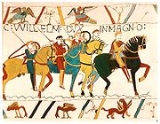
Bayeux Tapestry.
Similar conquests include the Norman conquests of
Apulia,
Sicily, the
Principality of Antioch, and
Ireland.
Alan Ayckbourn wrote a series of plays entitled
The Norman Conquests. Their subject matter has nothing to do with the Norman conquest of England.
See also
- Norman conquest of Sicily
References
Bibliography
External links