
All Topics  
Zhou Dynasty

 
Zhou Dynasty

   Email Print
   Bookmark   Link


Zhou Dynasty


The Zhou Dynasty (; POJ: Chiu Tiau; 1045 BC to 256 BC) was preceded by the Shang Dynasty
Shang Dynasty

The Shang Dynasty or Yin Dynasty was according to traditional sources the first Dynasties in Chinese history. They ruled in the northeastern region of the area known as "China proper", in the Yellow River valley....
 and followed by the Qin Dynasty
Qin Dynasty

The Qin Dynasty was preceded by the feudal Zhou Dynasty and followed by the Han Dynasty in China. The unification of China in 221 BCE under the Qin Shi Huang marked the beginning of Imperial China, a period which lasted until the fall of the Qing Dynasty in 1912 CE....
 in China
China

China is a Culture of China, an ancient civilization, and, depending on perspective, a national or multinational entity extending over a large area in East Asia....
. The Zhou dynasty lasted longer than any other dynasty in Chinese
China

China is a Culture of China, an ancient civilization, and, depending on perspective, a national or multinational entity extending over a large area in East Asia....
 history
HIStory

HIStory: Past, Present and Future, Book I is a double album by Michael Jackson, released on June 20, 1995, and is Jackson's ninth. The first disc, named "HIStory Begins" consists of a selection of Jackson's greatest hits from the singer's past fifteen years, while the second, named "HIStory Continues" features new songs, with the...
—though the actual political and military control of China by the dynasty only lasted during the Western Zhou. During the Zhou, the use of iron
Iron Age

In archaeology, the Iron Age was the stage in the development of any people in which tools and weapons whose main ingredient was iron were prominent....
 was introduced to China, while this period of Chinese history produced what many consider the zenith of Chinese bronze
Bronze

Bronze is a metal alloy consisting primarily of copper, usually with tin as the main additive, but sometimes with other chemical element such as phosphorus, manganese, aluminium, or silicon....
-ware making.


Discussion
Ask a question about 'Zhou Dynasty'
Start a new discussion about 'Zhou Dynasty'
Answer questions from other users
Full Discussion Forum


Encyclopedia


The Zhou Dynasty (; POJ: Chiu Tiau; 1045 BC to 256 BC) was preceded by the Shang Dynasty
Shang Dynasty

The Shang Dynasty or Yin Dynasty was according to traditional sources the first Dynasties in Chinese history. They ruled in the northeastern region of the area known as "China proper", in the Yellow River valley....
 and followed by the Qin Dynasty
Qin Dynasty

The Qin Dynasty was preceded by the feudal Zhou Dynasty and followed by the Han Dynasty in China. The unification of China in 221 BCE under the Qin Shi Huang marked the beginning of Imperial China, a period which lasted until the fall of the Qing Dynasty in 1912 CE....
 in China
China

China is a Culture of China, an ancient civilization, and, depending on perspective, a national or multinational entity extending over a large area in East Asia....
. The Zhou dynasty lasted longer than any other dynasty in Chinese
China

China is a Culture of China, an ancient civilization, and, depending on perspective, a national or multinational entity extending over a large area in East Asia....
 history
HIStory

HIStory: Past, Present and Future, Book I is a double album by Michael Jackson, released on June 20, 1995, and is Jackson's ninth. The first disc, named "HIStory Begins" consists of a selection of Jackson's greatest hits from the singer's past fifteen years, while the second, named "HIStory Continues" features new songs, with the...
—though the actual political and military control of China by the dynasty only lasted during the Western Zhou. During the Zhou, the use of iron
Iron Age

In archaeology, the Iron Age was the stage in the development of any people in which tools and weapons whose main ingredient was iron were prominent....
 was introduced to China, while this period of Chinese history produced what many consider the zenith of Chinese bronze
Bronze

Bronze is a metal alloy consisting primarily of copper, usually with tin as the main additive, but sometimes with other chemical element such as phosphorus, manganese, aluminium, or silicon....
-ware making. The dynasty also spans the period in which the written script evolved from the ancient stage as seen in early Western Zhou bronze inscriptions, to the beginnings of the modern stage, in the form of the archaic clerical script of the late Warring States period
Warring States Period

The Warring States Period , also known as the Era of Warring States, covers the period from 476 BCE to the unification of China by the Qin Dynasty in 221 BCE....
.

During the Zhou Dynasty, the origins of native Chinese philosophy
Chinese philosophy

Chinese philosophy is philosophy written in the China Chinese culture of thought. Chinese philosophy has a history of several thousand years; its origins are often traced back to the I Ching , an ancient compendium of divination, which uses a system of 64 hexagrams to guide action....
 developed, its initial stages beginning in the 6th century BC. The greatest Chinese philosophers, those who made the greatest impact on later generations of Chinese, were Kong Fuzi (Latin: Confucius), founder of Confucianism
Confucianism

Confucianism is a China Ethics and Philosophy developed from the teachings of the Chinese philosopher Confucius . It focuses on human morality and right action....
, and Laozi
Laozi

Laozi was a Chinese philosophy of Ancient history China and is a central figure in Taoism . Laozi literally means "Old Master" and is generally considered an honorific....
, founder of Daoism. Other philosophers, theorists, and schools of thought in this era were Mozi
Mozi

Mozi , was a philosopher who lived in China during the Hundred Schools of Thought period . He founded the school of Mohism and argued strongly against Confucianism and Daoism....
 (Latin: Micius), founder of Mohism
Mohism

Mohism or Moism was a Chinese philosophy developed by the followers of Mozi , 470 BCE–c.391 BC. It evolved at about the same time as Confucianism, Taoism and Legalism and was one of the four main Hundred Schools of Thought during the Spring and Autumn Period and the Warring States Period ....
, Mengzi
Mengzi

Mengzi may refer to:*Mencius, 372 ? 289 BCE, Chinese philosopher*Mengzi County, in Yunnan, China...
 (Latin: Mencius), a famous Confucian who expanded upon Kong Fuzi's legacy, Shang Yang
Shang Yang

Shang Yang was an important statesman of Qin in the Warring States Period of ancient China. With the support of Duke Xiao of Qin, Shang enacted numerous reforms in the state of Qin that helped to change Qin from a peripheral state into a militarily powerful and strongly centralized kingdom, changing the administration by emphasizing mer...
 and Han Feizi, responsible for the development of ancient Chinese Legalism
Legalism (Chinese philosophy)

In History of China, Legalism was one of the four main philosophic schools during the Spring and Autumn Period and the Warring States Period ....
 (the core philosophy of the Qin Dynasty
Qin Dynasty

The Qin Dynasty was preceded by the feudal Zhou Dynasty and followed by the Han Dynasty in China. The unification of China in 221 BCE under the Qin Shi Huang marked the beginning of Imperial China, a period which lasted until the fall of the Qing Dynasty in 1912 CE....
), and Xunzi, who was arguably the center of ancient Chinese intellectual life during his time, even more so than iconic intellectual figures such as Mencius
Mencius

Mencius , most accepted dates: 372 ? 289 BCE; other possible dates: 385 ? 303/302 BCE) was a Chinese philosophy who was arguably the most famous Confucian after Confucius himself....
.

Mandate of Heaven

In the Chinese historical tradition, the Zhou defeated the Shang and oriented the Shang system of ancestor worship
Ancestor worship

Ancestor worship or ancestor veneration is a practice based on the belief that deceased family members have a continued existence, take an interest in the affairs of the world, and/or possess the ability to influence the fortune of the living....
 toward a universalized worship away from the worship of Di
Shangdi

Shangdi is the Supreme God in the original religious system of the Han Chinese people , a term used from the second millennium BC to the present day, as pronounced according to the modern Mandarin dialect....
 and to that of Tian
Tian

Tian is one of the oldest Chinese terms for the cosmos and a key concept in Chinese mythology, Chinese philosophy, and Religion in China. During the Shang Dynasty the Chinese called god Shangdi or Di , and during the Zhou Dynasty Tian "heaven; god" became synonymous with Shangdi....
 or "heaven". They legitimized their rule by invoking the Mandate of Heaven
Mandate of Heaven

The Mandate of Heaven is a traditional Chinese philosophy concept concerning the legitimacy of rulers. Heaven would bless the authority of a just ruler, but would be displeased with a despotic ruler and would withdraw their mandate....
, the notion that the ruler (the "Son of Heaven
Son of Heaven

Son of Heaven may refer to:* Emperor of China* Son of God...
") governed by divine right but that his dethronement would prove that he had lost the mandate. Such things that proved the ruling family had lost the Mandate were natural disasters and rebellions. The doctrine explained and justified the demise of the Xia
Xia Dynasty

The Xia Dynasty of China is the first dynasty to be described in ancient historical records such as Records of the Grand Historian and Bamboo Annals....
 and Shang Dynasties and at the same time supported the legitimacy of present and future rulers. The Zhou dynasty was founded by the Ji
Ji (surname)

Ji is the family name of the family in control of the Zhou Dynasty , which followed the Shang Dynasty and preceded the Qin Dynasty in China....
 family and operated from four capitals throughout its history. Sharing the language and culture of the Shang, the early Zhou rulers, through conquest and colonization, established a large imperial territory wherein states as far as Shandong
Shandong

For the people of Shandong, see Shandong people is a coastal political divisions of China of eastern People's Republic of China. Its abbreviation is 'Lu', after the state of Lu that existed here during the Spring and Autumn Period....
 acknowledged Zhou rulership and took part in elite culture. The spread of Zhou bronzes, though, was concurrent with the continued use of Shang style pottery in the distant regions and these states were the last to recede during the late Western war.

Capitals of Zhou

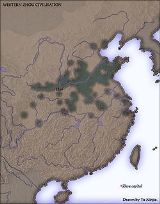
After moving from their ancstral homeland called Bi located in modern Wugogn Coungy, Shaanxi, the Zhou established four successive capitals. The three Western Zhou capitals are located near the present-day city of Xi'an
Xi'an

Xi'an , is the Capital of the Shaanxi Provinces of China in the People's Republic of China and a sub-provincial city. As one of the oldest cities in Chinese history, Xi'an is one of the Historical capitals of China because it has been the capital of some of the most important Dynasties in Chinese history in Chinese history, including the Zh...
 in the Wei River
Wei River

The Wei River is a river in west-central China and is the largest tributary of the Yellow River. The source of the Wei River is close to Weiyuan County in Gansu province, at less than 200 kilometres from the Yellow River at Lanzhou....
 valley), whereas the final Eastern Zhou capital, Chengzhou was farther to the east in the Shang Dynasty heartland. Given in chronological order:
  • Qi also Zhongzhou, Qi Yi, Qi Zhou, Qi Xia. Founded by Gugong Danfu at the base of Mt. Qi. Located in Fengchu Township of Fufeng County of Shaanxi Province.
  • Feng also Fang, Fangjing. Founded by Xi Bo Chang on the eastern bank of the Feng River. Located in Zhangjiapo Township of Shaanxi Province.
  • Hao (Pinyin: Hào, Chinese: ?) Founded by King Wu on the shore of Lake Hao 25 li east of Feng.
  • Chengzhou also Jingshi, Luo. Founded by King Cheng. Located in Luoyang.


Zhou military

The early Western Zhou supported a strong army split into two major units: “The Six Armies of the west” and “The Eight Armies of Chengzhou”. The armies campaigned in the northern Loess Plateau
Loess Plateau

The Loess Plateau , also known as the Huangtu Plateau, is a plateau that covers an area of some 1 E11 m? in the upper and middle of China's Yellow River and China proper ....
, modern Ningxia
Ningxia

Ningxia , full name Ningxia Hui Autonomous Region , is a Hui Chinese autonomous region of China of the People's Republic of China, located on the Northwestern China Loess Plateau, the Yellow River flows through a vast area of its land....
 and the Huanghe floodplain. The military prowess of Zhou peaked during the 19th year of King Zhao
King Zhao of Zhou

King Zhao of Zhou or King Chao of Chou was the fourth sovereign of the Chinese Zhou Dynasty .Zhao's reign occurred at a point when the Zhou Dynasty had expanded across the central plains of China and turned its attention to South China....
's reign, when the Six Armies were wiped out along with King Zhao on a campaign around the Han River
Han River (Hanshui)

The Han River in China was often referred to as H?nshui in antiquity. It is a left tributary of the Yangtze River with a length of 1532 km....
. Early Zhou kings were true commanders-in-chief. They were in constant wars with barbarians on behalf of the fiefs called 'guo', namely, statelet or principality. Charles Hucker noted that Zhou had 14 standing royal armies, with 6 stationed in Haojing, near today's Xian, and 8 armies stationed in the east along with others in the west. Zhou Zhaowang (r. 1052–1001 BC) was famous for repeated campaigns in the Yangtze areas and died in his last action. Zhou Muwang (r. 1001–946 BC) was a legendary figure famous for fighting in the west and maybe today's Central Asia where he met on Kunlun Mountain with so-called Xi Wang Mu, namely, Queen Mother of the West, rumored by some western historians, including Charles Hucker, to be Queen of Sheba
Queen of Sheba

The Queen of Sheba , was the woman who ruled the ancient kingdom of Sheba and is referred to in Habeshan history, the Hebrew Bible, the New Testament, and the Qur'an....
. (The actual place for Kunlun Mountains would be somewhere close to today's Jiuquan County, Gansu
Gansu

or , is a political divisions of China located in the northwest of the People's Republic of China. It lies between Qinghai, Inner Mongolia, and the Loess Plateau, and borders Mongolia to the north and Xinjiang to the west....
 Province. Mt Kunlun, extending for almost 2000 miles from Kara-Kunlun bordering Tibet in the west to Qilian
Qilian

The Qilian Mountains is a northern outlier of the Kunlun Mountains, forming the border between the Qinghai and the Gansu provinces of northern China....
 Mountain in the east, was a source of many Chinese myths and legends.) Later kings' campaigns were less effective. King Liwang (r. 878–7 BC) led 14 armies against barbarians in the south but failed to achieve any victory. King Xuanwang (r 827–782 BC) fought the Jiangrong nomads in vain. King Youwang was killed by Quanrong, and capital Haojing was sacked. Although chariots had been introduced to China since the Shang Dynasty, the Zhou period saw the use of massed chariot
Chariot

The chariot is the earliest and simplest type of carriage, used in both peace and war as the chief vehicle of many ancient peoples. Chariots were built in Mesopotamia by the Mesopotamians as early as 3000 BC and in China during the 2nd millennium BC....
s in battle, a technology imported from Central Asia.

Fengjian Feudalism

In the West, the Zhou period is often described as feudal
Feudalism

Feudalism, a term first used in the early modern period , in its most classic sense refers to a Middle Ages European political system composed of a set of reciprocal law and military obligations among the warrior nobility, revolving around the three key concepts of lords, vassals, and fiefs....
 because the Zhou's early rule invites comparison with medieval rule in Europe
Middle Ages

File:Karl 1 mit papst gelasius gregor1 sacramentar v karl d kahlen.jpgThe Middle Ages of European history are a period in history which lasted for roughly a millennium, commonly dated from the fall of the Roman Empire in the 5th century to the beginning of the Early Modern Period in the 16th century, marked by the division of Western Christi...
. However, historians debate whether or not this description is valid; the more appropriate term for the Zhou Dynasty's political arrangement would be from the Chinese language itself: the Fengjiàn
Fengjian

Fengji?n is the political ideology of the Zhou Dynasty of ancient China. Fengjian is a "decentralized enfiefment system of government," comparable to European feudalism, though recent scholarship has suggested that fengjian lacks some of the fundamental aspects of feudalism....
  system. The Zhou amalgam of city-states became progressively centralized and established increasingly impersonal political and economic institutions. These developments, which probably occurred in the later Zhou period, were manifested in greater central control over local governments and a more routinized agrarian taxation. Zhou officials were not paid a salary but instead were given semi-regular gifts by the King, which often included land in the Wei River valley. Imperial stability was ensured through marriages between the Zhou court and local lords as well as the installment of Zhou lords into command over distant regions.

Western and Eastern Zhou

Initially the Ji family was able to control the country firmly. In 771 BC, after King You
King You of Zhou

King You of Zhou was the twelfth sovereign of the Chinese Zhou Dynasty and the last of Western Zhou Dynasty.In 780 BC, an earthquake hit Guanzhong....
 had replaced his queen with a concubine Baosi
Baosi

Baosi was one of the most beautiful Chinese women ever. She was taken to King You of Zhou's palace to be his concubine....
, the capital was sacked by the joint force of the queen's father, who was the powerful Marquess
Marquess

A marquess or marquis is a nobleman of hereditary rank in various European monarchies and some of their colonies. The term is also used to render equivalent oriental styles as in imperial China and Japan....
 of Shen
Shen

Shen can refer to:*Shen ?, a central word in Chinese philosophy, Chinese religion, Chinese terms for God, and Traditional Chinese Medicine.*Shen ?, a shapeshifting Chinese dragon believed to create mirages...
, and a nomadic tribe, the Quanrong. The queen's son Ji Yijiu
King Ping of Zhou

King Ping of Zhou , also referred to as Crown Prince Yijiu or King P'ing of Chou was the thirteenth sovereign of the Chinese Zhou Dynasty and the first of Eastern Zhou Dynasty....
 was proclaimed the new king by the nobles from the states of Zheng
Zheng (state)

Zheng was a Zhou dynasty city-state in the middle of ancient China, modern Henan Province. Its ruling house had the surname Ji, making them a branch of the Zhou royal house, and were given the rank of Chinese nobility, corresponding roughly to an earl....
,
Lu (state)

Lu was an ancient state in China during the Spring and Autumn Period. Founded in the 10th century BC, its dukes used Ji as their family name. The first duke was Ji Boqin, son of Ji Dan, the then Prime Minister of Zhou....
, Qin
Qin (state)

Q?n or Ch'in , was a state during the Spring and Autumn Period and Warring States Periods of China. It eventually grew to dominate the country and unite it in 221 BC, after which it is referred to as the Qin Dynasty....
 and the Marquess of Shen. The capital was moved eastward in 722 BC to Luoyang
Luoyang

Luoyang is a prefecture-level city in western Henan province of China, People's Republic of China. It borders the provincial capital of Zhengzhou to the east, Pingdingshan to the southeast, Nanyang to the south, Sanmenxia to the west, Jiyuan to the north, and Jiaozuo to the northeast....
 in present-day Henan
Henan

Henan , is a Province of the People's Republic of China, located in the central part of the country. Its one-Chinese character abbreviation is ? , named after Yuzhou , a Han Dynasty province that included parts of Henan....
 Province. Because of this shift, historians divide the Zhou era into the Western Zhou (??, pinyin
Pinyin

Pinyin, more formally Hanyu pinyin, is the most commonly used Romanization system for Standard Mandarin. Hanyu is the Chinese Language, and pinyin means "phonetics", or more literally, "spelling sound" or "spelled sound"....
 Xi Zhou), lasting up until 771 BC, and the Eastern Zhou (Traditional Chinese: ??, Simplified Chinese: ??, pinyin
Pinyin

Pinyin, more formally Hanyu pinyin, is the most commonly used Romanization system for Standard Mandarin. Hanyu is the Chinese Language, and pinyin means "phonetics", or more literally, "spelling sound" or "spelled sound"....
: Dong Zhou) from 770 up to 256 BC. The beginning year of the Western Zhou has been disputed — 1122 BC, 1027 BC and other years within the hundred years from late 12th century BC to late 11th century BC have been proposed. Chinese historians take 841 BC as the first year of consecutive annual dating of the history of China, based on the Records of the Grand Historian
Records of the Grand Historian

The Records of the Grand Historian, also known in English language by the Chinese name Shiji , written from 109 BC to 91 BC, was the magnum opus of Sima Qian, in which he recounted China history from the time of the Yellow Emperor until his own time....
 by Sima Qian
Sima Qian

Sima Qian was a Prefect of the Grand Scribes of the Han Dynasty. He is regarded as the father of Chinese historiography because of his highly praised work, Records of the Grand Historian , an overview of the history of China covering more than two thousand years from the Yellow Emperor to Emperor Wu of Han China ....
. The Eastern Zhou corresponds roughly to two subperiods. The first, from 722 to 481 BC, is called the Spring and Autumn Period
Spring and Autumn Period

The Spring and Autumn Period was a period in Chinese history, which roughly corresponds to the first half of the Eastern Zhou dynasty . Its name comes from the Spring and Autumn Annals, a chronicle of the state of Lu between 722 BC and 481 BC, which tradition associates with Confucius....
, after a famous historical chronicle of the time; the second is known as the Warring States Period
Warring States Period

The Warring States Period , also known as the Era of Warring States, covers the period from 476 BCE to the unification of China by the Qin Dynasty in 221 BCE....
 (403 to 221 BC), after another famous chronicle and initiated by the partitioning of Jin
Jin (state)

Jin was one of the most powerful states in the Spring and Autumn Period, based in Shanxi, China. Jin was founded by Tang Shuyu, a descendant of the Zhou Dynasty royal family....
. The Warring States Period extends slightly past the 256 BC end date of the Eastern Zhou; this discrepancy is due to the fact that the last Zhou king's reign ended in 256, 35 years before the beginning of the Qin dynasty
Qin Dynasty

The Qin Dynasty was preceded by the feudal Zhou Dynasty and followed by the Han Dynasty in China. The unification of China in 221 BCE under the Qin Shi Huang marked the beginning of Imperial China, a period which lasted until the fall of the Qing Dynasty in 1912 CE....
 which ended the Warring States period. The Eastern Zhou period is also designated as a period of a hundred schools
Hundred Schools of Thought

The Hundred Schools of Thought were philosophers and schools that had flourished from 770 to 221 BC, an era of great cultural and intellectual expansion in China....
. This is a reference to the different schools of historical Chinese intellectual thought. There were four main distinct schools which were the Ru, Mohist, Daoist, and Legalists. These schools of thought contributed to social, philosophical and political change which played a large part in the decline of the Zhou dynasty. The ruling families of the Zhou, Shang, Qin, and (possibly)Xia dynasties coexisted together as rulers of independent kingdoms until 286 BC, because that was up to when the Sung principality was conquered, which the Shang ruling family ruled while the Zhou king ruled at his independent kingdom and the Kings of the state of Yue
Yue (state)

Yue was a state in China which existed during the Spring and Autumn Period and the Warring States Period, in the modern province of Zhejiang. During the Spring and Autumn Period, its capital was in Guiji , near the modern city of Shaoxing....
 also claimed to be descended from Yu the Great
Yu the Great

Yu , often regarded with legendary status as Yu the Great , was the first ruler and founder of the Xia Dynasty. He was born the year 2059 BCE, said to be on the Year of the Tiger....
 of the Xia Dynasty
Xia Dynasty

The Xia Dynasty of China is the first dynasty to be described in ancient historical records such as Records of the Grand Historian and Bamboo Annals....
, while the Kings of Qin ruled over the State of Qin.

Decline

With the royal line broken, the power of the Zhou court gradually diminished, and the fragmentation of the kingdom accelerated. From Ping Wang onwards, the Zhou kings ruled in name only, with true power lying in the hands of powerful nobles. Towards the end of the Zhou Dynasty, the nobles did not even bother to acknowledge the Ji family symbolically, rebelled and declared themselves to be kings. The dynasty was ended in 256 BC, before Qin Shi Huang
Qin Shi Huang

Qin Shi Huang , personal name Ying Zheng , was king of the Chinese Qin from 246 BCE to 221 BCE during the Warring States Period. He became the first emperor of a unified China in 221 BCE....
's unification of China in 221 BC, when the last king of Zhou died and his sons did not proclaim the nominal titles of King of China.

Agriculture

Zhouvase
Agriculture in the Zhou Dynasty was very intensive and in many cases directed by the government. All farming lands were owned by nobles, who then gave their land to their serfs, a situation similar to European feudalism
Feudalism

Feudalism, a term first used in the early modern period , in its most classic sense refers to a Middle Ages European political system composed of a set of reciprocal law and military obligations among the warrior nobility, revolving around the three key concepts of lords, vassals, and fiefs....
. For example, a piece of land was divided into nine squares in the well-field system
Well-field system

The well-field system was a China land distribution method since at least 9th century BC . It is named after the Chinese character for well , which looks like the number sign and represents the theoretical appearance for a piece of land under such an organization: the eight surrounding outer blocks being private , and the central one b...
, with the grain from the middle square taken by the government and that of surrounding squares kept by individual farmers. This way, the government was able to store surplus food and distribute it in times of famine or bad harvest. Some important manufacturing sectors during this period included bronze
Bronze

Bronze is a metal alloy consisting primarily of copper, usually with tin as the main additive, but sometimes with other chemical element such as phosphorus, manganese, aluminium, or silicon....
 smelting, which was integral to making weapons and farming tools. Again, these industries were dominated by the nobility who directed the production of such materials.

China's first projects of hydraulic engineering
Hydraulic engineering

Hydraulic engineering is a sub-discipline of civil engineering concerned with the flow and conveyance of fluids, principally water. This area of engineering is intimately related to the design of bridges, dams, Channel s, canals, levees, elevators, and to both sanitary and environmental engineering....
 were founded during the Zhou Dynasty, ultimately for means to aid agricultural irrigation
Irrigation

Irrigation is an artificial application of water to the soil usually for assisting in growing crops. In crop production it is mainly used in dry areas and in periods of rainfall shortfalls, but also to protect plants against frost....
. The Prime Minister
Prime minister

A prime minister is the most senior minister of Cabinet in the Executive branch of government in a parliamentary system. The position is usually held by, but need not always be held by, a politician....
 of Wei
Wei (state)

The Wei was a state during the Warring States Period in China. Its territory lay between the states of Qin and Qi and included modern areas in Henan, Hebei and Shanxi and Shandong....
, Sunshu Ao
Sunshu Ao

Sunshu Ao was an ancient Chinese people court minister serving the administration of Duke Zhuang of Chu during the reign of King Ding of Zhou , during the Eastern Zhou Dynasty....
, who served King Zhuang of Chu
King Zhuang of Chu

King Zhuang of Chu was leader in the state of Chu and one of the Five Hegemons in the Spring and Autumn Period of Chinese history. His name was Mi Lu ....
(died 591 BC) dammed a river to create an enormous irrigation reservoir in modern-day northern Anhui
Anhui

Anhui is a province of China of the People's Republic of China. Located in eastern China across the basins of the Yangtze River and the Huaihe River, it borders Jiangsu to the east, Zhejiang to the southeast, Jiangxi to the south, Hubei to the southwest, Henan to the northwest, and Shandong for a tiny section in the north....
 province. For this Sunshu is credited as China's first hydraulic engineer. The later Wei statesman Ximen Bao
Ximen Bao

Ximen Bao was an ancient Chinese government minister and court advisor to Marquis Wen of Wei during the Warring States period of China. He was known as an early rationalist, who had the Wei abolish by law the inhumane practice of sacrificing people to river deities....
, who served Marquis Wen of Wei (445 BC-396 BC), is the first hydraulic engineer of China to have created a large irrigation canal system. As the main focus of his grandiose project, his canal work eventually diverted the waters of the entire Zhang River to a spot further up the Huang He River.

Zhou dynasty kings


Art

Image:Defang Ding.jpg|Defang bronze
Bronze

Bronze is a metal alloy consisting primarily of copper, usually with tin as the main additive, but sometimes with other chemical element such as phosphorus, manganese, aluminium, or silicon....
 ritual vessel, Western Zhou Dynasty Image:Dake Ding.jpg|Dake bronze ritual vessel, Western Zhou Dynasty Image:You with zigzag thunder pattern.jpg|You bronze ritual vessel, Western Zhou Dynasty Image:Qizhong Hu.jpg|Qizhong Hu bronze vessel, Western Zhou Dynasty Image:Dou with an inland hunting scene.jpg|Dou vessel with a hunting scene, Eastern Zhou Dynasty Image:Bo of Duke of Qin.jpg|A bo bell of the Duke of Qin, Eastern Zhou Dynasty Image:Pu with openwork interlaced dragons design.jpg|Pu vessel with dragon designs, Eastern Zhou Dynasty Image:Bi with two dragons and grain pattern.jpg|A jade
Jade

Jade is an ornamental stone.The term jade is applied to two different metamorphic rocks that are made up of different silicate minerals:...
 bi
Bi (jade)

The bi is a form of circular jade artifact from ancient China. The earliest bi were produced in the Neolithic period, particularly by the Liangzhu culture ....
 with two dragons, Eastern Zhou Dynasty Image:Zhou ritual food vessel p1070295.jpg|Eastern Zhou bronze ritual food vessel (ding) with lacquer
Lacquer

In a general sense, lacquer is a clear or coloured varnish that dries by solvent evaporation and often a curing process as well that produces a hard, durable finish, in any sheen level from ultra matte to high Gloss and that can be further polished as required....
 design, 5th-4th century BC Image:Freer 005.jpg|An Eastern Zhou Dynasty bronze ding vessel Image:Freer 007.jpg|An Eastern Zhou Dynasty bronze musical bell Image:Freer 009.jpg|Western and Eastern Zhou Dynasty bronze vessels Image:3rd century BC Eastern Zhou bronze and silver flask.jpg|An Eastern Zhou Dynasty bronze and silver
Silver

Silver is a chemical element with the chemical symbol Ag and atomic number 47. A soft, white, lustrous transition metal, it has the highest electrical conductivity of any element and the highest thermal conductivity of any metal....
 canteen Image:CMOC Treasures of Ancient China exhibit - square bronze hu.jpg|A square bronze hu vessel, Eastern Zhou Dynasty Image:Freer 032.jpg|An Eastern Zhou Dynasty bronze bird-shaped wine server Image:Western Zhou Gui Vessel.jpg|A Western Zhou bronze gui vessel, c. 1000 BC


Image:Chinese silk, 4th Century BC.JPG|Embroidered silk gauze garment from a 4th century BC, Zhou era tomb at Mashan, Hubei province. Image:Changshadragon.jpg|Silk painting of a man riding a dragon
Chinese dragon

The China dragon or Oriental dragon is a mythical creature in East Asian culture with a China origin. It is visualized these days as a long, scaled, snake-like creature with four legs and five claws on each ....
.


See also

  • Four occupations
    Four occupations

    The four occupations or "four categories of the people" was a hierarchic social class structure developed in History of China by either Confucianism or Legalism scholars as far back as the late Zhou Dynasty ....
  • Family tree of the Zhou Dynasty
    Family tree of the Zhou Dynasty

    This is a family tree of Chinese kings in the ancient periods of the Shang and Zhou dynasties before the rise of the First Emperor.Chinese emperors family tree --> Chinese emperors family tree --> Chinese emperors family tree --> Chinese emperors family tree ...
  • Tomb of Marquis Yi of Zeng
    Tomb of Marquis Yi of Zeng

    The Tomb of Marquis Yi of Zeng is an important archaeological site in Suizhou, Hubei, China, dated sometime after 433 BCE. The tomb contained the remains of Marquis Yi of Zeng....
  • Xia Shang Zhou Chronology Project
    Xia Shang Zhou Chronology Project

    The Xia Shang Zhou Chronology Project was a multi-discipline project commissioned by the People's Republic of China in 1996 to determine with accuracy the location and time frame of the Xia Dynasty, the Shang Dynasty and the Zhou Dynasty....


External links

  • - with links to their occurrences in pre-Qin and Han texts.