


William I of Sicily

Encyclopedia

Roger II of Sicily
Roger II was King of Sicily, son of Roger I of Sicily and successor to his brother Simon. He began his rule as Count of Sicily in 1105, later became Duke of Apulia and Calabria , then King of Sicily...
and Elvira of Castile
Elvira of Castile (Sicilian queen)
Elvira of Castile was the first Queen of Sicily.- Background and upbringing :She was a daughter of Alfonso VI of Castile by his fourth queen, Isabella...
.
William's title "the Bad" seems little merited and expresses the bias of the historian Hugo Falcandus
Hugo Falcandus
Hugo Falcandus was an Italian historian who chronicled the reign of William I of Sicily and the minority of his son William II in a highly critical work entitled The History of the Tyrants of Sicily . There is some doubt as to whether "Hugo Falcandus" is a real name or a pseudonym. Evelyn Jamison...
and the baronial class against the king and the official class by whom he was guided. It is obvious, however, that William was far inferior in character and energy to his father, and was attached to the semi-Muslim life of his gorgeous palaces of Palermo
Palermo
Palermo is a city in Southern Italy, the capital of both the autonomous region of Sicily and the Province of Palermo. The city is noted for its history, culture, architecture and gastronomy, playing an important role throughout much of its existence; it is over 2,700 years old...
.
Early life
He grew up with little expectation of ruling. The deaths of his three older brothers RogerRoger III, Duke of Apulia
Roger III was the Norman duke of Apulia from 1135. He was the eldest son of King Roger II of Sicily and Elvira of Castile....
, Tancred
Tancred, Prince of Bari
Tancred of Hauteville , one of many of that name, was the Prince of Bari and Taranto from 1132 to 1138.He was the second son of Roger II of Sicily and his first wife Elvira of Castile...
, and Alfonso
Alfonso of Hauteville
Alfonso of Hauteville , third son of Roger II of Sicily and Elvira of Castile, was the prince of Capua from 1135 to his death.He was named after his maternal grandfather, Alfonso VI of Castile...
between 1138 and 1148 changed matters, though when his father died William was still not well-prepared to take his place.
Kingship

Thomas Brun
Thomas Brun, also le Brun or Brown, was son or nephew of William Brun , a clerk of Henry I of England. He travelled to Sicily as a child in the entourage of Robert of Selby about the year 1130...
was removed, and the chancellor
Chancellor
Chancellor is the title of various official positions in the governments of many nations. The original chancellors were the Cancellarii of Roman courts of justice—ushers who sat at the cancelli or lattice work screens of a basilica or law court, which separated the judge and counsel from the...
Maio of Bari
Maio of Bari
Maio of Bari , a Lombard merchant's son from Bari, was the third of the great admirals of Sicily. An ammiratus ammiratorum, or "Emir of Emirs," he was the most important man in the kingdom save the king himself. After the deposition and execution of Philip of Mahdia , the admiralcy was vacant for...
was promoted. The real power in the kingdom was at first exercised by this Maio, a man of low birth, whose title ammiratus ammiratorum
Admiral
Admiral is the rank, or part of the name of the ranks, of the highest naval officers. It is usually considered a full admiral and above vice admiral and below admiral of the fleet . It is usually abbreviated to "Adm" or "ADM"...
was the highest in the realm. Maio continued Roger's policy of excluding the nobles from the administration, and sought also to curtail the liberties of the towns. The barons, always chafing against the royal power, were encouraged to revolt by Pope Adrian IV
Pope Adrian IV
Pope Adrian IV , born Nicholas Breakspear or Breakspeare, was Pope from 1154 to 1159.Adrian IV is the only Englishman who has occupied the papal chair...
, whose recognition William had not yet sought, by the Byzantine Emperor Manuel I Comnenus, and by the Holy Roman Emperor
Holy Roman Emperor
The Holy Roman Emperor is a term used by historians to denote a medieval ruler who, as German King, had also received the title of "Emperor of the Romans" from the Pope...
Frederick I
Frederick I, Holy Roman Emperor
Frederick I Barbarossa was a German Holy Roman Emperor. He was elected King of Germany at Frankfurt on 4 March 1152 and crowned in Aachen on 9 March, crowned King of Italy in Pavia in 1155, and finally crowned Roman Emperor by Pope Adrian IV, on 18 June 1155, and two years later in 1157 the term...
.
At the end of 1155, Greek troops recovered Bari
Bari
Bari is the capital city of the province of Bari and of the Apulia region, on the Adriatic Sea, in Italy. It is the second most important economic centre of mainland Southern Italy after Naples, and is well known as a port and university city, as well as the city of Saint Nicholas...
, Trani
Trani
Trani is a seaport of Apulia, southern Italy, on the Adriatic Sea, in the new Province of Barletta-Andria-Trani , and 40 km by railway West-Northwest of Bari.- History :...
, Giovinazzo
Giovinazzo
Giovinazzo is a port city situated on the Adriatic coast in the region of Apulia, southern Italy. Giovinazzo lies 18 km WNW of the provincial capital of Bari, and is adjacent to the city ofMolfetta.-History:...
, Andria
Andria
-Places:Italy*Andria, a city in the Province of Barletta-Andria-Trani*Roman Catholic Diocese of Andria, a Roman Catholic diocese...
, Taranto
Taranto
Taranto is a coastal city in Apulia, Southern Italy. It is the capital of the Province of Taranto and is an important commercial port as well as the main Italian naval base....
and began to besiege Brindisi
Brindisi
Brindisi is a city in the Apulia region of Italy, the capital of the province of Brindisi, off the coast of the Adriatic Sea.Historically, the city has played an important role in commerce and culture, due to its position on the Italian Peninsula and its natural port on the Adriatic Sea. The city...
. Landing on the peninsula, William's army destroyed the Greek fleet (4 ships) and army at Brindisi (May 28, 1156) and recovered Bari. Adrian came to terms at Benevento
Benevento
Benevento is a town and comune of Campania, Italy, capital of the province of Benevento, 50 km northeast of Naples. It is situated on a hill 130 m above sea-level at the confluence of the Calore Irpino and Sabato...
in a treaty of the same name
Treaty of Benevento
The Treaty of Benevento was an important treaty between the papacy of Adrian IV and the Norman Kingdom of Sicily. After years of turbulent relations, the popes finally settled down to a peace with the Hauteville kings....
(June 18), abandoning the rebels and confirming William as king. During the summer of AD 1157, he sent a fleet of 164 ships carrying 10,000 men to sack Euboea
Euboea
Euboea is the second largest Greek island in area and population, after Crete. The narrow Euripus Strait separates it from Boeotia in mainland Greece. In general outline it is a long and narrow, seahorse-shaped island; it is about long, and varies in breadth from to...
and Almira
Almyros
Almyros is a town and a municipality of the peripheral unit of Magnesia, periphery of Thessaly, Greece. It lies in the center of prosperous fertile plain known as 'Krokio Pedio', which is crossed by torrents, and produces wheat, tobacco, and other crops. Almyros is an important agricultural and...
. In 1158 William made peace with the Greeks.
These diplomatic successes were probably due to Maio; on the other hand, the African dominions
Kingdom of Africa
The Kingdom of Africa was an ephemeral frontier zone of the Siculo-Norman state in the former Roman province of Africa , corresponding to parts of Algeria, Tunisia and Libya today. The main primary sources for the kingdom are Arabic ; the Latin sources are scanter...
were lost to the Almohad
Almohad
The Almohad Dynasty , was a Moroccan Berber-Muslim dynasty founded in the 12th century that established a Berber state in Tinmel in the Atlas Mountains in roughly 1120.The movement was started by Ibn Tumart in the Masmuda tribe, followed by Abd al-Mu'min al-Gumi between 1130 and his...
s, and it is possible that he advised their abandonment in face of the dangers threatening the kingdom down from the north. In 1156, a revolt began in Sfax
Sfax
Sfax is a city in Tunisia, located southeast of Tunis. The city, founded in AD 849 on the ruins of Taparura and Thaenae, is the capital of the Sfax Governorate , and a Mediterranean port. Sfax has population of 340,000...
and quickly spread. Nothing was done to put it down. In 1159, the admiral Peter
Ahmed es-Sikeli
Ahmed es-Sikeli , baptised a Christian under the name Peter, was a eunuch and kaid of the Diwan of the Kingdom of Sicily during the reign of William I. His story was recorded by his Christian contemporaries Romuald Guarna and Hugo Falcandus from Sicily and the Muslim historian Ibn Khaldun.Peter...
led a raiding expedition against the Saracen-held Balearic Islands
Balearic Islands
The Balearic Islands are an archipelago of Spain in the western Mediterranean Sea, near the eastern coast of the Iberian Peninsula.The four largest islands are: Majorca, Minorca, Ibiza and Formentera. The archipelago forms an autonomous community and a province of Spain with Palma as the capital...
with 160 ships. He tried to relieve besieged Mahdia
Mahdia
Mahdia is a provincial centre north of Sfax. It is important for the associated fish-processing industry, as well as weaving. It is the capital of Mahdia Governorate.- History :...
with the same fleet, but turned around just after engaging in battle. Peter did not fall out of favour, but no further assistance was sent to the Christians holding out in Mahdia and the city surrendered on 11 January 1160, ending the "African empire."
The policy of Maio led to a general conspiracy, and in November 1160 Maio was murdered in Palermo by Matthew Bonello, leader of the Sicilian nobles. The barons, however, had long been plotting to overthrow the king. Desiring a weak power on the throne, they had been eyeing the king's eldest son, Roger, Duke of Apulia
Roger IV, Duke of Apulia
Roger IV was the eldest son of William I of Sicily and Margaret of Navarre. Twice in his short life he was the object of the barons' intent to replace his father as king...
, as a possible replacement for his father.
After the assassination of Maio, the royal palace was stormed by two of the king's own relatives: Simon
Simon, Prince of Taranto
Simon, bastard son of Roger II of Sicily, was created by his father Prince of Taranto in 1144, on the death of Roger III, Duke of Apulia, the eldest legitimate son of Roger II....
, his illegitimate half-brother, whom he had dispossessed of Taranto
Taranto
Taranto is a coastal city in Apulia, Southern Italy. It is the capital of the Province of Taranto and is an important commercial port as well as the main Italian naval base....
early in his reign, and Tancred
Tancred of Sicily
Tancred was King of Sicily from 1189 to 1194. He was an illegitimate son of Roger III, Duke of Apulia, the eldest son of King Roger II, and of Emma, daughter of Achard II, Count of Lecce...
, his bastard nephew, the count of Lecce
Lecce
Lecce is a historic city of 95,200 inhabitants in southern Italy, the capital of the province of Lecce, the second province in the region by population, as well as one of the most important cities of Puglia...
. The king was captured along with his whole family, his life being barely spared by one Richard of Mandra
Richard, Count of Molise
Richard of Mandra was a Norman nobleman in the Kingdom of Sicily appointed count of Molise and chancellor by the queen regent Margaret of Navarre.In 1157, as the constable of Robert II of Bassunvilla, he was captured by King William I...
. Roger was then paraded through the streets and it was announced that he would be crowned in the cathedral three days thence.
Butera
Butera is an Italian town and comune in the province of Caltanissetta, in the southwestern part of the island of Sicily. It is bounded by the comuni of Gela, Licata, Mazzarino, Ravanusa and Riesi. It has population of 5,063 and is far from Caltanissetta, the province's capital....
. Sadly, during the initial assault on the palace, to release the captive king, the king's son Roger was killed by a wayward arrow (though Falcandus, seemingly ever-ready to impugn the royal character, has the king kicking his "faithless" son dead).
Later years
Thus freed from feudal revolts, William confided the government to men trained in Maio's school, creating a triumvirate: the grand protonotary, Matthew of AjelloMatthew of Ajello
Matthew of Ajello was a high-ranking member of the Norman court of the Kingdom of Sicily in the 12th century.He first appears as the notary of the Admiral Maio of Bari who drew up the Treaty of Benevento of 1156...
; Count Sylvester of Marsico
Sylvester of Marsico
Sylvester , count of Marsico, was a Norman nobleman of the Kingdom of Sicily.Second son of Godfrey of Ragusa, second eldest son of Roger I of Sicily, he was not a young man when he first rose to importance in the realm. He immediately seized all the property of the Admiral Maio of Bari in Palermo...
, who had inherited Maio's property; and the Bishop Palmer of Syracuse
Syracuse, Italy
Syracuse is a historic city in Sicily, the capital of the province of Syracuse. The city is notable for its rich Greek history, culture, amphitheatres, architecture, and as the birthplace of the preeminent mathematician and engineer Archimedes. This 2,700-year-old city played a key role in...
, elect, but not consecrated. His latter years were peaceful; he was now the champion of the true pope against the emperor, and Alexander III
Pope Alexander III
Pope Alexander III , born Rolando of Siena, was Pope from 1159 to 1181. He is noted in history for laying the foundation stone for the Notre Dame de Paris.-Church career:...
was installed in the Lateran Palace
Lateran Palace
The Lateran Palace , formally the Apostolic Palace of the Lateran , is an ancient palace of the Roman Empire and later the main Papal residence....
in November 1165 by a guard of Normans
Normans
The Normans were the people who gave their name to Normandy, a region in northern France. They were descended from Norse Viking conquerors of the territory and the native population of Frankish and Gallo-Roman stock...
.
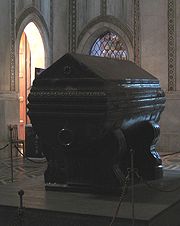
William died on May 7, 1166 and was interred in Monreale Cathedral. By his wife, Margaret of Navarre, daughter of García Ramírez of Navarre, he had four sons:
- Roger IV, Duke of ApuliaRoger IV, Duke of ApuliaRoger IV was the eldest son of William I of Sicily and Margaret of Navarre. Twice in his short life he was the object of the barons' intent to replace his father as king...
(b. 1152 - d. 1161). - Robert, Prince of Capua (b. 1153 - d. 1158).
- William II of SicilyWilliam II of SicilyWilliam II , called the Good, was king of Sicily from 1166 to 1189. William's character is very indistinct. Lacking in military enterprise, secluded and pleasure-loving, he seldom emerged from his palace life at Palermo. Yet his reign is marked by an ambitious foreign policy and a vigorous diplomacy...
(b. 1155 - d. 1189). - Henry, Prince of Capua (b. 1158 - d. 1172).