

Sankore University

Encyclopedia
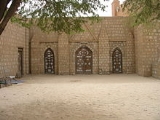
Sankoré Madrasah, The University of Sankoré, or Sankore Masjid is one of three ancient centers of learning located in Timbuktu
, Mali
, West Africa
. The three mosque
s of Sankoré, Djinguereber Mosque
and Sidi Yahya
compose the famous University of Timbuktu
. Madrasah means school/university in Arabic and also in other languages associated with Muslim people.
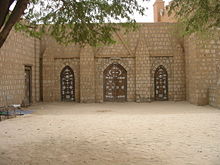
gained direct control over the city of Timbuktu in 1324 during the reign of Mansa Kankou Musa. He designed and saw the construction of one of Sankore's first great mosques and the Jingeray Ber Masjid in 1327.
The foundations of the previous structure were laid around 988 A.D. on the orders of the city's chief judge Al-Qadi Aqib ibn Mahmud ibn Umar
. A local Mandinka
lady, esteemed for her wealth, financed his plans to turn Sankoré into a world class learning institution with professors on par with any outside of Africa. He had the Mosque's courtyard built to the exact dimensions of the Ka'abah in Mecca
, using a rope for precise measurements.
and North Africa
. It wasn't long before ideas as well as merchandise began passing through the fabled city. Since most if not all these traders were Muslim
, the mosque would see visitors constantly. The temple accumulated a wealth of books from throughout the Muslim world becoming not only a center of worship but a center of learning. Books became more valuable than any other commodity in the city, and private libraries sprouted up in the homes of local scholars.
. The level of learning at Timbuktu's Sankoré University was superior to that of all other Islamic centers in the world. The Sankoré Masjid was capable of housing 25,000 students and had one of the largest libraries in the world with between 400,000 to 700,000 manuscripts.
ic scholarly community, the University was very different in organization from the universities of medieval Europe
. It had no central administration other than the Emperor. It had no student registers but kept copies of its student publishings. It was composed of several entirely independent schools or colleges, each run by a single master or imam
. Students associated themselves with a single teacher, and courses took place in the open courtyard of the mosque or at private residences.
, mathematics
) were included and stressed to develop well-rounded individuals.
Timbuktu
Timbuktu , formerly also spelled Timbuctoo, is a town in the West African nation of Mali situated north of the River Niger on the southern edge of the Sahara Desert. The town is the capital of the Timbuktu Region, one of the eight administrative regions of Mali...
, Mali
Mali
Mali , officially the Republic of Mali , is a landlocked country in Western Africa. Mali borders Algeria on the north, Niger on the east, Burkina Faso and the Côte d'Ivoire on the south, Guinea on the south-west, and Senegal and Mauritania on the west. Its size is just over 1,240,000 km² with...
, West Africa
West Africa
West Africa or Western Africa is the westernmost region of the African continent. Geopolitically, the UN definition of Western Africa includes the following 16 countries and an area of approximately 5 million square km:-Flags of West Africa:...
. The three mosque
Mosque
A mosque is a place of worship for followers of Islam. The word is likely to have entered the English language through French , from Portuguese , from Spanish , and from Berber , ultimately originating in — . The Arabic word masjid literally means a place of prostration...
s of Sankoré, Djinguereber Mosque
Djinguereber Mosque
The Djinguereber Mosque in Timbuktu is a famous learning center of Mali built in 1327, and cited as Djingareyber or Djingarey Ber in various languages. Its design is accredited to Abu Es Haq es Saheli who was paid 200 kg of gold by Mansa Kankan Musa, emperor of the Mali Empire...
and Sidi Yahya
Sidi Yahya
Sidi Yahya is a mosque and madrassa of Timbuktu in the West African country of Mali which finished construction in 1440. Sidi Yahya along with Djinguereber and Sankore compose the "University" of Timbuktu.-History:...
compose the famous University of Timbuktu
University of Timbuktu
The University of Timbuktu was a medieval University in Mali, West Africa which comprised three schools; namely the Masajid of Djinguereber, the Masajid of Sidi Yahya, and the Masajid of Sankore. During its zenith, the university at Timbuktu had an average attendance of around 25,000 students...
. Madrasah means school/university in Arabic and also in other languages associated with Muslim people.
Construction
The Mali EmpireMali Empire
The Mali Empire or Mandingo Empire or Manden Kurufa was a West African empire of the Mandinka from c. 1230 to c. 1600. The empire was founded by Sundiata Keita and became renowned for the wealth of its rulers, especially Mansa Musa I...
gained direct control over the city of Timbuktu in 1324 during the reign of Mansa Kankou Musa. He designed and saw the construction of one of Sankore's first great mosques and the Jingeray Ber Masjid in 1327.
The foundations of the previous structure were laid around 988 A.D. on the orders of the city's chief judge Al-Qadi Aqib ibn Mahmud ibn Umar
Al-Qadi Aqib ibn Mahmud ibn Umar
Sheik Sidi Abu Al Barakaat Mahmud ibn Umar ibn Aqit was also known as Sheik Al Islam Abu Al Barakaat. He was the Supreme Judge of Timbuktu, Imam and the Dean of Sankore University, in Mali.- External links :*...
. A local Mandinka
Mandinka people
The Mandinka, Malinke are one of the largest ethnic groups in West Africa with an estimated population of eleven million ....
lady, esteemed for her wealth, financed his plans to turn Sankoré into a world class learning institution with professors on par with any outside of Africa. He had the Mosque's courtyard built to the exact dimensions of the Ka'abah in Mecca
Mecca
Mecca is a city in the Hijaz and the capital of Makkah province in Saudi Arabia. The city is located inland from Jeddah in a narrow valley at a height of above sea level...
, using a rope for precise measurements.
Growth as a Center of Learning
Timbuktu had long been a destination or stop for merchants from the Middle EastMiddle East
The Middle East is a region that encompasses Western Asia and Northern Africa. It is often used as a synonym for Near East, in opposition to Far East...
and North Africa
North Africa
North Africa or Northern Africa is the northernmost region of the African continent, linked by the Sahara to Sub-Saharan Africa. Geopolitically, the United Nations definition of Northern Africa includes eight countries or territories; Algeria, Egypt, Libya, Morocco, South Sudan, Sudan, Tunisia, and...
. It wasn't long before ideas as well as merchandise began passing through the fabled city. Since most if not all these traders were Muslim
Muslim
A Muslim, also spelled Moslem, is an adherent of Islam, a monotheistic, Abrahamic religion based on the Quran, which Muslims consider the verbatim word of God as revealed to prophet Muhammad. "Muslim" is the Arabic term for "submitter" .Muslims believe that God is one and incomparable...
, the mosque would see visitors constantly. The temple accumulated a wealth of books from throughout the Muslim world becoming not only a center of worship but a center of learning. Books became more valuable than any other commodity in the city, and private libraries sprouted up in the homes of local scholars.
Apex
By the end of Mansa Musa's reign (early 14th c. CE), the Sankoré Masjid had been converted into a fully staffed Madrassa (Islamic school or in this case university) with the largest collections of books in Africa since the Library of AlexandriaLibrary of Alexandria
The Royal Library of Alexandria, or Ancient Library of Alexandria, in Alexandria, Egypt, was the largest and most significant great library of the ancient world. It flourished under the patronage of the Ptolemaic dynasty and functioned as a major center of scholarship from its construction in the...
. The level of learning at Timbuktu's Sankoré University was superior to that of all other Islamic centers in the world. The Sankoré Masjid was capable of housing 25,000 students and had one of the largest libraries in the world with between 400,000 to 700,000 manuscripts.
Organization
As the center of an IslamIslam
Islam . The most common are and . : Arabic pronunciation varies regionally. The first vowel ranges from ~~. The second vowel ranges from ~~~...
ic scholarly community, the University was very different in organization from the universities of medieval Europe
Europe
Europe is, by convention, one of the world's seven continents. Comprising the westernmost peninsula of Eurasia, Europe is generally 'divided' from Asia to its east by the watershed divides of the Ural and Caucasus Mountains, the Ural River, the Caspian and Black Seas, and the waterways connecting...
. It had no central administration other than the Emperor. It had no student registers but kept copies of its student publishings. It was composed of several entirely independent schools or colleges, each run by a single master or imam
Imam
An imam is an Islamic leadership position, often the worship leader of a mosque and the Muslim community. Similar to spiritual leaders, the imam is the one who leads Islamic worship services. More often, the community turns to the mosque imam if they have a religious question...
. Students associated themselves with a single teacher, and courses took place in the open courtyard of the mosque or at private residences.
Curriculum
The curriculum of Sankoré and other masjids in the area had four levels of schooling or "degrees". On graduating from each level, students would receive a turban symbolizing their mastery. The schooling was not secular as arguments that could not be backed by the Qu'ran were inadmissible in debates. However, secular teaching (geometryGeometry
Geometry arose as the field of knowledge dealing with spatial relationships. Geometry was one of the two fields of pre-modern mathematics, the other being the study of numbers ....
, mathematics
Mathematics
Mathematics is the study of quantity, space, structure, and change. Mathematicians seek out patterns and formulate new conjectures. Mathematicians resolve the truth or falsity of conjectures by mathematical proofs, which are arguments sufficient to convince other mathematicians of their validity...
) were included and stressed to develop well-rounded individuals.
Qu'ranic School
The first or primary degree (Qur'anic school) required a mastery of Arabic language and writing along with complete memorization of the Qur'an. Students were also introduced to basic sciences at this level.General Studies
The secondary degree or General Studies degree focused on full emersement in the basic sciences. Students learned grammar, mathematics, geography, history, physics, astronomy, chemistry alongside more advanced learnings of the Qu'ran. At this level they learned Hadiths, jurisprudence and the sciences of spiritual purification according to Islam. Finally, they began an introduction to trade school and business ethics. On graduation day, students were given turbans symbolizing Divine light, wisdom, knowledge and excellent moral conduct. After receiving their diplomas the students would gather outside the examination building or the main campus library and throw their turbans high into the air cheering and holding each other's hands to show that they were all brothers and sisters,.Superior Degree
The Superior degree required students to study under specialized professors doing research work. Much of the learning centered on debates to philosophic or religious questions. Before graduating from this level, students attached themselves to a Sheik (Islamic teacher) and demonstrated a strong character.Alumni Level
The last level of learning at Sankoré or any of the Masjids was the level of Judge or Professor. These men worked mainly as judges for the city and eventually the region dispersing learned men to all the principal cities in Mali. A third level student who had impressed his Sheihk enough was admitted into a "circle of knowledge" and valued as a truly learned individual and expert in his field. The members of this scholar's club were the equivalent of tenured professors. Those who did not leave Timbuktu remained there to teach or council the Who's Who of the region on important legal and religious matters. They would receive questions from the region's powerful (kings or governors) and distribute them to the third level students as research assignments. After discussing the findings among themselves, the scholars would issue a fatwa on the best way to deal with the problem at hand.Scholars of Sankoré
Scholars wrote their own books as part of a socioeconomic model. Students were charged with copying these books and any other books they could get their hands on. Today there are over 700,000 manuscripts in Timbuktu with many dating back to West Africa's Golden Age (12th-16th centuries).- Ahmed BabaAhmad Baba al MassufiAhmad Baba al-Massufi al-Tinbukti, full name Abu al-Abbas Ahmad ibn Ahmad al-Takruri Al-Massufi al-Timbukti , was a medieval West African writer, scholar, and political provocateur in the area then known as the Western Sudan...
- Mohammed BagayogoMohammed BagayogoMohammed Bagayogo Es Sudane Al Wangari Al Timbukti was an eminent scholar from Timbuktu, Mali. He was the Sheik and professor of highly esteemed scholar, Ahmed Baba and teacher at the University of Sankore, one of three philosophical schools in Mali during West Africa's golden age ; the other two...
- Modibo Mohammed Al KaburiModibo Mohammed Al KaburiModibo Mohammed Al Kaburi was an esteemed scholar of Fula descent from Timbuktu, Mali. A Cadi and Jurist, as well as a professor at the University of Sankore, he was celebrated for his piety, becoming a companion with many of the most devout scholars at Sankore. He is remembereded for having...
- Sheik Sidi Abu Al Barakaat Mahmud ibn Umar
- Abu Al Baraaka
- Abu Bakr ibn Ahmad Biru
- Mohammed ibn Mohammed Kara
- Ag Mohammed
- Al Aqib ibn Faqi Muhmud
- Abd Arahman ibn Faqi Mahmud
- Al Moctar Ag Mohammed ibn Utman
Literature
- Elias N. Saad, Social History of Timbuktu: The Role of Muslim Scholars and Notables 1400-1900. Cambridge - London - New York 1985.
Internet Sources
External links
- Ancient Manuscripts from the Desert Libraries of Timbuktu, Library of Congress — exhibition of manuscripts from the Mamma Haidara Commemorative Library
See also
- Timbuktu Manuscripts ProjectTimbuktu Manuscripts ProjectThe term Timbuktu Manuscripts applies to 700,000 medieval African documents, ranging from scholarly works to short letters, that have been preserved by private households in Timbuktu. The manuscripts were passed down in Timbuktu families and are mostly in poor condition. Some of the manuscripts...
- Medieval universityMedieval universityMedieval university is an institution of higher learning which was established during High Middle Ages period and is a corporation.The first institutions generally considered to be universities were established in Italy, France, and England in the late 11th and the 12th centuries for the study of...
- Ancient universityAncient universityAncient university is a term used to describe seven medieval and renaissance universities of the United Kingdom and Ireland that exist today. Six of those universities are currently located in the United Kingdom and one in the Republic of Ireland...
- List of oldest universities in continuous operation