


Greater Khorasan

Encyclopedia
Greater Khorasan or Ancient Khorasan (also written Khurasan) is a historical
region
of Greater Iran
mentioned in sources from Sassanid
and Islamic eras which "frequently" had a denotation wider than current three provinces of Khorasan in Iran. It also included parts of Afghanistan
, Turkmenistan
, Uzbekistan
and Tajikstan
Khorasan in its proper sense comprised principally the cities of Balkh
, Herat
and Ghazni
(now in Afghanistan), Nishapur
and Tus (now in Iran), Merv
(now in Turkmenistan), and Samarqand and Bukhara
(now in Uzbekistan
). However, the name has been used in the past to cover a larger region that encompassed most of Transoxiana
and Soghdiana in the north, extended westward to the Caspian Sea
, southward to include the Sistan
desert and eastward to the Hindu Kush
mountains in Afghanistan. Arab geographers even spoke of its extending to the boundaries of ancient India
, possibly as far as the Indus valley
, in what is now Pakistan
. Sources from the 14th to the 16th century report that Kandahar
, Ghazni
and Kabulistan
in Afghanistan formed the eastern part of Khorasan, overlapping with Hindustan
.
In the Islamic period
, Persian Iraq
and Khorasan were the two important territories. The boundary between these two was the region surrounding the cities of Gurgan
and Damghan
. In particular, the Ghaznavids, Seljuqs
and Timurids
divided their empires into Iraqi and Khorasani regions. The adjective Greater is added these days to distinguish the historical region from the Khorasan province of Iran, which roughly encompasses the western half of the historical Khorasan. It is also used to indicate that ancient Khorasan encompassed a loose collection of territories individually known by other popular names, such as Bactria
, Khwarezmia, Sogdiana
, Transoxiana
, and Sistan
or Arachosia
.
khor (meaning "sun") and asan (or ayan literally meaning "to come" or "coming"), hence meaning "land where the sun rises". The Persian word Khāvar-zamīn , meaning "the eastern land", has also been used as an equivalent term.
, Herat, Merv, Faryab
, Taloqan
, Balkh
, Bukhara
, Badghis
, Abiward
, Gharjistan
, Tus or Susia, Sarakhs
and Gurgan
.
It acquired its greatest extent under the Caliphs
, for whom "Khorasan" was the name of one of the three political zones under their dominion (the other two being Eraq-e Arab "Arabic Iraq" and Eraq-e Ajam "Non-Arabic Iraq or Persian Iraq"). Under the Umayyad and Abbasid caliphates, Khorasan was divided into four major sections and each section based on a single major city. The four principal cities were Nishapur, Merv, Herat and Balkh.
In the Middle Ages, the term was loosely applied in Persia to all its territories that lay east and north east of Dasht-e Kavir
and therefore were subjected to change as the size of empire changed. According to Ghulam Mohammad Ghobar
, Afghanistan's current territories formed the major portion of Khorasan, as two of the four main capitals of Khorasan (Balkh, Merv, Nishapur and Herat) are now located in Afghanistan. Ghobar uses the terms Proper Khorasan and Improper Khorasan in his book to distinguish between the usage of Khorasan in its strict sense and its usage in a loose sense. According to him, Proper Khorasan contained regions lying between Balkh in the east, Merv in the north, Sistan
in the south, Nishapur in the west and Herat, known as the Pearl of Khorasan, in the center. Improper Khorasan's boundaries extended to Kabulistan
and Hazarajat
in the east, Sistan and Zabulistan
in the south, Transoxiana and Khwarezm in the north, and Damghan
and Gorgan
in the west. It is mentioned in the Memoirs of Babur
that:
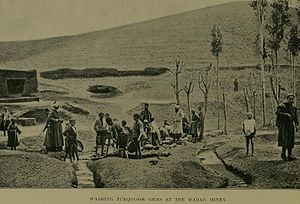 Before the region was conquered by Alexander the Great in 330 BC, it was part of the Achaemenid Empire
and prior to that it was occupied by the Medes
. The region that became known as Khorasan in geography of Eratosthenes
was called Ariana
at that time, which made up part of Greater Iran
or the land where Zoroastrianism
was the dominant religion. The southeastern region of Ariana fell to the Kushan Empire
in the 1st century AD. The Kushan rulers introduced Buddhism
in the Hindu Kush
and nearby areas, in what is now Afghanistan. Numerous Buddhist temple
s and buried cities have been found in Afghanistan. However, the region of Ariana (or Khorasan) remained predominantly Zoroastrian. One of the three great fire-temples of the Sassanids "Azar-burzin Mehr" is situated near sabzevar
in Iran. The boundary of the region began changing until the Kushans and Sassanids merged together to form the Kushano-Sassanian civilization.
During the Sassanid era, the Persian Empire was divided into four quarters, Khvarvaran
in the west, Bakhtar in the north, Nīmrūz
in the south and Khorasan in the east next to Sind
or Hind
. Khorasan in the east saw some conflict with the Hephthalite
s who became the new rulers in the area but the borders remained stable. Being the eastern parts of the Sassanids and further away from Arabia, Khorasan quarter was conquered after the remaining Persia. The last Sassanid king of Persia, Yazdgerd III
, moved the throne to Khorasan following the Arab invasion in the western parts of the empire. After the assassination of the king, Khorasan was conquered by Muslim troops in 647 AD. Like other provinces of Persia it became one of the provinces of Umayad dynasty
.
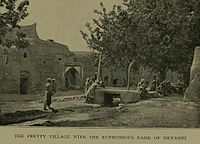 The first movement against the Arab invasions was led by Abu Muslim Khorasani between 747 and 750. He helped the Abbasid
s come to power but was later killed by Al-Mansur, an Abbasid Caliph. The first independent kingdom from Arab rule was established in Khorasan by Tahir Phoshanji
in 821, but it seems that it was more a matter of political and territorial gain. In fact Tahir had helped the Caliph subdue other nationalistic movements in other parts of Persia such as Maziar
's movement in Tabaristan.
Other major independent dynasties in Khorasan were the Saffarids
(861-1003,) Samanid
s (875-999), Ghaznavids (963-1167), Seljuqs
(1037–1194), Khwarezmids
(1077–1231), Ghurids (1149–1212), and Timurids
(1370–1506). It should be mentioned that some of these dynasties were not Persian by ethnicity, nonetheless they were the advocates of Persian language
and were praised by the poets as the kings of Iran
.
Among them, the periods of the Ghaznavids of Ghazni
and Timurids of Herat are considered as the most brilliant eras of Khorasan's history. During these periods, there was a great cultural awakening. Many famous Persian poets, scientists and scholars lived in this period. Numerous valuable works in Persian literature
were written. Nishapur, Herat, Ghazni and Merv were the centers of all these cultural developments.
From the 16th century to the early 18th century, Khorasan was ruled by the Shia Safavid dynasty
while the region to the east by the Sunni
Khanate of Bukhara
and the southeast by the Sunni Mughul Empire. It was conquered in 1717, along with the rest of Persia, by the Ghilzai
Afghans from Kandahar
and became part of the Hotaki dynasty. Following the assassination of Nader Shah
Afshar
in 1747, Khorasan was annexed with the Durrani Empire
or modern-day Afghanistan
. In the early 19th century, much of Khorasan's western territory fell to the Qajar dynasty
of Persia and remained as Iranian territory until modern day. Some of its northern areas were left under the Tsardom of Russia
or later the Soviet Union
.
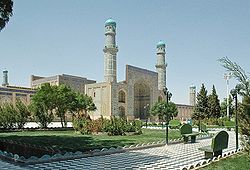 Khorasan has had a great cultural importance among other regions in Greater Iran
. The literary New Persian language developed in Khorasan and Transoxiana and gradually supplanted the Parthian language
. The New Persian literature
arose and flourished in Khorasan and Transoxiana where the early Iranian dynasties such as Tahirids, Samanids and Ghaznavids were based.The early Persian poets such as Rudaki
, Shahid Balkhi
, Abu al-Abbas Marwazi, Abu Hafas Sughdi, and others were from Khorasan. Moreover, Ferdowsi
, the author of Shahnameh
, the national epic of Greater Iran
, and Rumi, the famous Sufi poet, were also from Khorasan.
Until the devastating Mongol invasion of the thirteenth century, Khorasan remained the cultural capital of Persia. It has produced scientists such as Avicenna
, Al-Farabi
, Al-Biruni
, Omar Khayyám
, Al-Khwarizmi, Abu Ma'shar al-Balkhi (known as Albumasar or Albuxar in the west), Alfraganus, Abu Wafa, Nasir al-Din al-Tusi
, Sharaf al-Dīn al-Ṭūsī, and many others who are widely well-known for their significant contributions in various domains such as mathematics
, astronomy
, medicine
, physics
, geography
, and geology
.
In Islamic theology
, jurisprudence
and philosophy
, and in Hadith collection
, many of the greatest Islamic scholars came from Khorasan, namely Ahmad ibn Hanbal
, Abu Hanifa, Imam Bukhari, Imam Muslim
, Abu Dawood, Al-Tirmidhi
, Al-Nasa'i
, Al-Ghazali
, Al-Juwayni
, Abu Mansur Maturidi, Fakhruddin al-Razi
, and others. Shaykh Tusi
, a Shi'a
scholar and Al-Zamakhshari
, the famous Mutazilite
scholar, also lived in Khorasan.
who migrated from the north to the Bactria–Margiana Archaeological Complex in around 2000 BC. The BMAC was a Bronze Age
culture situated in the upper Amu Darya
region of Khorasan. Airyanem Vaejah
(Land of Aryans), which is mentioned in the Zoroastrian Avesta
, is also believed by some scholars to be situated in the territories of Khorasan.
The Persian people
appear to have been the first ethnic group to populate the region, but they began mixing with an increasing number of foreign invaders and as a result their proportionate number was reduced. Significant immigrants such as Arabs from the west since the 7th century and Turkic peoples
after the Turkic migration
from the north in the Middle Ages
settled in the region.
The land that used to be referred to as Khorasan in the past is inhabited by a multiethnic society
today. The majority are Persians (including Tajiks and some Lurs
) and the rest are Pashtuns, Uzbeks
, Turkmens
, Hazaras, Aymāqs, Baluch, Kurds, Arabs, and others.
History
History is the discovery, collection, organization, and presentation of information about past events. History can also mean the period of time after writing was invented. Scholars who write about history are called historians...
region
Region
Region is most commonly found as a term used in terrestrial and astrophysics sciences also an area, notably among the different sub-disciplines of geography, studied by regional geographers. Regions consist of subregions that contain clusters of like areas that are distinctive by their uniformity...
of Greater Iran
Greater Iran
Greater Iran refers to the regions that have significant Iranian cultural influence. It roughly corresponds to the territory on the Iranian plateau and its bordering plains, stretching from Iraq, the Caucasus, and Turkey in the west to the Indus River in the east...
mentioned in sources from Sassanid
Sassanid Empire
The Sassanid Empire , known to its inhabitants as Ērānshahr and Ērān in Middle Persian and resulting in the New Persian terms Iranshahr and Iran , was the last pre-Islamic Persian Empire, ruled by the Sasanian Dynasty from 224 to 651...
and Islamic eras which "frequently" had a denotation wider than current three provinces of Khorasan in Iran. It also included parts of Afghanistan
Afghanistan
Afghanistan , officially the Islamic Republic of Afghanistan, is a landlocked country located in the centre of Asia, forming South Asia, Central Asia and the Middle East. With a population of about 29 million, it has an area of , making it the 42nd most populous and 41st largest nation in the world...
, Turkmenistan
Turkmenistan
Turkmenistan , formerly also known as Turkmenia is one of the Turkic states in Central Asia. Until 1991, it was a constituent republic of the Soviet Union, the Turkmen Soviet Socialist Republic . Turkmenistan is one of the six independent Turkic states...
, Uzbekistan
Uzbekistan
Uzbekistan , officially the Republic of Uzbekistan is a doubly landlocked country in Central Asia and one of the six independent Turkic states. It shares borders with Kazakhstan to the west and to the north, Kyrgyzstan and Tajikistan to the east, and Afghanistan and Turkmenistan to the south....
and Tajikstan
Khorasan in its proper sense comprised principally the cities of Balkh
Balkh
Balkh , was an ancient city and centre of Zoroastrianism in what is now northern Afghanistan. Today it is a small town in the province of Balkh, about 20 kilometers northwest of the provincial capital, Mazar-e Sharif, and some south of the Amu Darya. It was one of the major cities of Khorasan...
, Herat
Herat
Herāt is the capital of Herat province in Afghanistan. It is the third largest city of Afghanistan, with a population of about 397,456 as of 2006. It is situated in the valley of the Hari River, which flows from the mountains of central Afghanistan to the Karakum Desert in Turkmenistan...
and Ghazni
Ghazni
For the Province of Ghazni see Ghazni ProvinceGhazni is a city in central-east Afghanistan with a population of about 141,000 people...
(now in Afghanistan), Nishapur
Nishapur
Nishapur or Nishabur , is a city in the Razavi Khorasan province in northeastern Iran, situated in a fertile plain at the foot of the Binalud Mountains, near the regional capital of Mashhad...
and Tus (now in Iran), Merv
Merv
Merv , formerly Achaemenid Satrapy of Margiana, and later Alexandria and Antiochia in Margiana , was a major oasis-city in Central Asia, on the historical Silk Road, located near today's Mary in Turkmenistan. Several cities have existed on this site, which is significant for the interchange of...
(now in Turkmenistan), and Samarqand and Bukhara
Bukhara
Bukhara , from the Soghdian βuxārak , is the capital of the Bukhara Province of Uzbekistan. The nation's fifth-largest city, it has a population of 263,400 . The region around Bukhara has been inhabited for at least five millennia, and the city has existed for half that time...
(now in Uzbekistan
Uzbekistan
Uzbekistan , officially the Republic of Uzbekistan is a doubly landlocked country in Central Asia and one of the six independent Turkic states. It shares borders with Kazakhstan to the west and to the north, Kyrgyzstan and Tajikistan to the east, and Afghanistan and Turkmenistan to the south....
). However, the name has been used in the past to cover a larger region that encompassed most of Transoxiana
Transoxiana
Transoxiana is the ancient name used for the portion of Central Asia corresponding approximately with modern-day Uzbekistan, Tajikistan, southern Kyrgystan and southwest Kazakhstan. Geographically, it is the region between the Amu Darya and Syr Darya rivers...
and Soghdiana in the north, extended westward to the Caspian Sea
Caspian Sea
The Caspian Sea is the largest enclosed body of water on Earth by area, variously classed as the world's largest lake or a full-fledged sea. The sea has a surface area of and a volume of...
, southward to include the Sistan
Sistan
Sīstān is a border region in eastern Iran , southwestern Afghanistan and northern tip of Southwestern Pakistan .-Etymology:...
desert and eastward to the Hindu Kush
Hindu Kush
The Hindu Kush is an mountain range that stretches between central Afghanistan and northern Pakistan. The highest point in the Hindu Kush is Tirich Mir in the Chitral region of Khyber-Pakhtunkhwa, Pakistan.It is the westernmost extension of the Pamir Mountains, the Karakoram Range, and is a...
mountains in Afghanistan. Arab geographers even spoke of its extending to the boundaries of ancient India
Indian subcontinent
The Indian subcontinent, also Indian Subcontinent, Indo-Pak Subcontinent or South Asian Subcontinent is a region of the Asian continent on the Indian tectonic plate from the Hindu Kush or Hindu Koh, Himalayas and including the Kuen Lun and Karakoram ranges, forming a land mass which extends...
, possibly as far as the Indus valley
Indus River
The Indus River is a major river which flows through Pakistan. It also has courses through China and India.Originating in the Tibetan plateau of western China in the vicinity of Lake Mansarovar in Tibet Autonomous Region, the river runs a course through the Ladakh district of Jammu and Kashmir and...
, in what is now Pakistan
Pakistan
Pakistan , officially the Islamic Republic of Pakistan is a sovereign state in South Asia. It has a coastline along the Arabian Sea and the Gulf of Oman in the south and is bordered by Afghanistan and Iran in the west, India in the east and China in the far northeast. In the north, Tajikistan...
. Sources from the 14th to the 16th century report that Kandahar
Kandahar
Kandahar is the second largest city in Afghanistan, with a population of about 512,200 as of 2011. It is the capital of Kandahar Province, located in the south of the country at about 1,005 m above sea level...
, Ghazni
Ghazni
For the Province of Ghazni see Ghazni ProvinceGhazni is a city in central-east Afghanistan with a population of about 141,000 people...
and Kabulistan
Kabulistan
Kabulistan is a historical term referring to the eastern territories of Greater Khorasan that is centered around present-day Kabul, Afghanistan...
in Afghanistan formed the eastern part of Khorasan, overlapping with Hindustan
Hindustan
Hindustan or Indostan, literal translation "Land of River Sindhu ", is one of the popular names of South Asia. It can also mean "the land of the Hindus"...
.
In the Islamic period
Muslim history
Muslim history is the history of Muslim people. In the history of Islam the followers of the religion of Islam have impacted political history, economic history, and military history...
, Persian Iraq
Persian Iraq
Persian Iraq , also spelled Persian Irak, is an obsolete term for the central region of Iran, including cities such as Isfahan, Ray, Qazvin, and Kashan. From the 11th to 16th centuries, the term Iraq referred to two distinct regions: Arabian Iraq and Persian Iraq...
and Khorasan were the two important territories. The boundary between these two was the region surrounding the cities of Gurgan
Gürgan
Gürgan is a village in Baku, Azerbaijan. It forms part of the municipality of Gürgən-Pirallahı....
and Damghan
Damghan
Damghan is a city in and capital of Damghan County, Semnan Province, Iran. At the 2006 census, its population was 57,331, in 15,849 families.Damghan is situated from Tehran on the high-road to Mashad, at an elevation of...
. In particular, the Ghaznavids, Seljuqs
Seljuq dynasty
The Seljuq ; were a Turco-Persian Sunni Muslim dynasty that ruled parts of Central Asia and the Middle East from the 11th to 14th centuries...
and Timurids
Timurid Dynasty
The Timurids , self-designated Gurkānī , were a Persianate, Central Asian Sunni Muslim dynasty of Turko-Mongol descent whose empire included the whole of Iran, modern Afghanistan, and modern Uzbekistan, as well as large parts of contemporary Pakistan, North India, Mesopotamia, Anatolia and the...
divided their empires into Iraqi and Khorasani regions. The adjective Greater is added these days to distinguish the historical region from the Khorasan province of Iran, which roughly encompasses the western half of the historical Khorasan. It is also used to indicate that ancient Khorasan encompassed a loose collection of territories individually known by other popular names, such as Bactria
Bactria
Bactria and also appears in the Zend Avesta as Bukhdi. It is the ancient name of a historical region located between south of the Amu Darya and west of the Indus River...
, Khwarezmia, Sogdiana
Sogdiana
Sogdiana or Sogdia was the ancient civilization of an Iranian people and a province of the Achaemenid Empire, eighteenth in the list on the Behistun Inscription of Darius the Great . Sogdiana is "listed" as the second of the "good lands and countries" that Ahura Mazda created...
, Transoxiana
Transoxiana
Transoxiana is the ancient name used for the portion of Central Asia corresponding approximately with modern-day Uzbekistan, Tajikistan, southern Kyrgystan and southwest Kazakhstan. Geographically, it is the region between the Amu Darya and Syr Darya rivers...
, and Sistan
Sistan
Sīstān is a border region in eastern Iran , southwestern Afghanistan and northern tip of Southwestern Pakistan .-Etymology:...
or Arachosia
Arachosia
Arachosia is the Latinized form of the Greek name of an Achaemenid and Seleucid governorate in the eastern part of their respective empires, around modern-day southern Afghanistan. The Greek term "Arachosia" corresponds to the Iranian land of Harauti which was between Kandahar in Afghanistan and...
.
Name
The name "Khorasan" is derived from Middle PersianMiddle Persian
Middle Persian , indigenously known as "Pârsig" sometimes referred to as Pahlavi or Pehlevi, is the Middle Iranian language/ethnolect of Southwestern Iran that during Sassanid times became a prestige dialect and so came to be spoken in other regions as well. Middle Persian is classified as a...
khor (meaning "sun") and asan (or ayan literally meaning "to come" or "coming"), hence meaning "land where the sun rises". The Persian word Khāvar-zamīn , meaning "the eastern land", has also been used as an equivalent term.
Geographical distribution
First established as a political entity by the Sassanids in the 3rd century AD, the borders of the region have varied considerably during its 1600-year history. Initially the Khorasan province of Sassanid empire included the cities of NishapurNishapur
Nishapur or Nishabur , is a city in the Razavi Khorasan province in northeastern Iran, situated in a fertile plain at the foot of the Binalud Mountains, near the regional capital of Mashhad...
, Herat, Merv, Faryab
Faryab Province
Fāryāb is one of the thirty-four provinces of Afghanistan. It is in the north of the country. Its capital is Maymana. The majority of the population is Uzbek.-History:...
, Taloqan
Taloqan
Tāloqān is the capital of Takhar Province, in northern Afghanistan. It is located in the Taluqan District. The population was estimated as 196,400 in 2006.-History:The old city to the west on the riverside was described by Marco Polo in 1275 CE as:...
, Balkh
Balkh
Balkh , was an ancient city and centre of Zoroastrianism in what is now northern Afghanistan. Today it is a small town in the province of Balkh, about 20 kilometers northwest of the provincial capital, Mazar-e Sharif, and some south of the Amu Darya. It was one of the major cities of Khorasan...
, Bukhara
Bukhara
Bukhara , from the Soghdian βuxārak , is the capital of the Bukhara Province of Uzbekistan. The nation's fifth-largest city, it has a population of 263,400 . The region around Bukhara has been inhabited for at least five millennia, and the city has existed for half that time...
, Badghis
Badghis Province
Bādghīs is one of the thirty-four provinces of Afghanistan. It is located in northwestern Afghanistan, between the Murghab and Hari rivers, extending as far northward as the edge of the desert of Sarakhs. It includes the Chul formations through which the Turkmen-Afghan boundary runs...
, Abiward
Abiward
Abiward or Abi-ward, was an ancient Sassanid city in modern-day Turkmenistan.Archaeological excavations at the ancient city of Abiward have been made in the last century to about 8 km west of the Kahka station in an area of 12,000 m2. The central tell is 60 feet high and 700 feet round.- External...
, Gharjistan
Gharjistan
Gharjistan or Gharshistan refers to the region around the Badghis Province in Afghanistan or more specifically to the rising place of Murghab river. It was part of Greater Khorasan. Gharjistan is mentioned by name in the 16th century Baburnama, describing Babur's visit to the area in early 1507...
, Tus or Susia, Sarakhs
Sarakhs
Sarakhs is a city in and capital of Sarakhs County, Razavi Khorasan Province, Iran. Sarakhs was once a stopping point along the Silk Road, and in its 11th century heyday had many libraries and a famous school of architects. Much of the original city site is now just across the border at Saraghs...
and Gurgan
Gürgan
Gürgan is a village in Baku, Azerbaijan. It forms part of the municipality of Gürgən-Pirallahı....
.
It acquired its greatest extent under the Caliphs
Caliphate
The term caliphate, "dominion of a caliph " , refers to the first system of government established in Islam and represented the political unity of the Muslim Ummah...
, for whom "Khorasan" was the name of one of the three political zones under their dominion (the other two being Eraq-e Arab "Arabic Iraq" and Eraq-e Ajam "Non-Arabic Iraq or Persian Iraq"). Under the Umayyad and Abbasid caliphates, Khorasan was divided into four major sections and each section based on a single major city. The four principal cities were Nishapur, Merv, Herat and Balkh.
In the Middle Ages, the term was loosely applied in Persia to all its territories that lay east and north east of Dasht-e Kavir
Dasht-e Kavir
Dasht-e Kavir , also known as Kavir-e Namak or Great Salt Desert is a large desert lying in the middle of the Iranian plateau. It is about 800 kilometers long and 320 kilometers wide with a total surface area of about 77,600 square kilometers , making it the Earth's 23rd largest desert...
and therefore were subjected to change as the size of empire changed. According to Ghulam Mohammad Ghobar
Ghulam Mohammad Ghobar
Mir Ghulam Mohammad Ghobar was a famous historian, journalist, political figure, and a poet from Afghanistan. He is the author of a number of books, including Afghanistan's history book called Afghanistan in the Course of History...
, Afghanistan's current territories formed the major portion of Khorasan, as two of the four main capitals of Khorasan (Balkh, Merv, Nishapur and Herat) are now located in Afghanistan. Ghobar uses the terms Proper Khorasan and Improper Khorasan in his book to distinguish between the usage of Khorasan in its strict sense and its usage in a loose sense. According to him, Proper Khorasan contained regions lying between Balkh in the east, Merv in the north, Sistan
Sistan
Sīstān is a border region in eastern Iran , southwestern Afghanistan and northern tip of Southwestern Pakistan .-Etymology:...
in the south, Nishapur in the west and Herat, known as the Pearl of Khorasan, in the center. Improper Khorasan's boundaries extended to Kabulistan
Kabulistan
Kabulistan is a historical term referring to the eastern territories of Greater Khorasan that is centered around present-day Kabul, Afghanistan...
and Hazarajat
Hazarajat
The Hazarajat is the original homeland of the Hazara people, and lies in the central highlands of Afghanistan, among the Koh-i-Baba mountains and the western extremities of the Hindu Kush. Its physical boundaries, however, are roughly marked by the Bamiyan Basin to the north, the headwaters of...
in the east, Sistan and Zabulistan
Zabulistan
Zabulistan , also spelled Zabolestan, is a historical region in the border area of today's Iran and Afghanistan.-History of Zabulistan:...
in the south, Transoxiana and Khwarezm in the north, and Damghan
Damghan
Damghan is a city in and capital of Damghan County, Semnan Province, Iran. At the 2006 census, its population was 57,331, in 15,849 families.Damghan is situated from Tehran on the high-road to Mashad, at an elevation of...
and Gorgan
Gorgan
Gorgan Some east of Gorgan is the Golestan National Park. The city has a regional airport and several universities. Gorgan Airport was opened in September 2005.-Etymology:...
in the west. It is mentioned in the Memoirs of Babur
Baburnama
Bāburnāma is the name given to the memoirs of Ẓahīr ud-Dīn Muḥammad Bābur , founder of the Mughal Empire and a great-great-great-grandson of Timur...
that:
History
Achaemenid Empire
The Achaemenid Empire , sometimes known as First Persian Empire and/or Persian Empire, was founded in the 6th century BCE by Cyrus the Great who overthrew the Median confederation...
and prior to that it was occupied by the Medes
Medes
The MedesThe Medes...
. The region that became known as Khorasan in geography of Eratosthenes
Eratosthenes
Eratosthenes of Cyrene was a Greek mathematician, poet, athlete, geographer, astronomer, and music theorist.He was the first person to use the word "geography" and invented the discipline of geography as we understand it...
was called Ariana
Ariana
Ariana was a region of the eastern countries of ancient Iran, next to India.Ariana may also refer to:* Ariana In places:*Ariana Governorate, a governorate in Tunisia*Ariana, Tunisia*Lake Ariana, a lake in Sofia, Bulgaria...
at that time, which made up part of Greater Iran
Greater Iran
Greater Iran refers to the regions that have significant Iranian cultural influence. It roughly corresponds to the territory on the Iranian plateau and its bordering plains, stretching from Iraq, the Caucasus, and Turkey in the west to the Indus River in the east...
or the land where Zoroastrianism
Zoroastrianism
Zoroastrianism is a religion and philosophy based on the teachings of prophet Zoroaster and was formerly among the world's largest religions. It was probably founded some time before the 6th century BCE in Greater Iran.In Zoroastrianism, the Creator Ahura Mazda is all good, and no evil...
was the dominant religion. The southeastern region of Ariana fell to the Kushan Empire
Kushan Empire
The Kushan Empire originally formed in the early 1st century AD under Kujula Kadphises in the territories of ancient Bactria on either side of the middle course of the Oxus in what is now northern Afghanistan, Pakistan, and southern Tajikistan and Uzbekistan.During the 1st and early 2nd centuries...
in the 1st century AD. The Kushan rulers introduced Buddhism
Buddhism
Buddhism is a religion and philosophy encompassing a variety of traditions, beliefs and practices, largely based on teachings attributed to Siddhartha Gautama, commonly known as the Buddha . The Buddha lived and taught in the northeastern Indian subcontinent some time between the 6th and 4th...
in the Hindu Kush
Hindu Kush
The Hindu Kush is an mountain range that stretches between central Afghanistan and northern Pakistan. The highest point in the Hindu Kush is Tirich Mir in the Chitral region of Khyber-Pakhtunkhwa, Pakistan.It is the westernmost extension of the Pamir Mountains, the Karakoram Range, and is a...
and nearby areas, in what is now Afghanistan. Numerous Buddhist temple
Stupa
A stupa is a mound-like structure containing Buddhist relics, typically the remains of Buddha, used by Buddhists as a place of worship....
s and buried cities have been found in Afghanistan. However, the region of Ariana (or Khorasan) remained predominantly Zoroastrian. One of the three great fire-temples of the Sassanids "Azar-burzin Mehr" is situated near sabzevar
Sabzevar
Sabzevar is a city in, and the capital of Sabzevar County, in Razavi Khorasan Province in northeastern Iran. At the 2006 census, its population was 208,172, in 57,024 families.It is approximately 220 kilometres west of Mashhad, the provincial capital...
in Iran. The boundary of the region began changing until the Kushans and Sassanids merged together to form the Kushano-Sassanian civilization.
During the Sassanid era, the Persian Empire was divided into four quarters, Khvarvaran
Khvarvaran
Khvārvarān, also known as Iraq or Mesopotamia, was a province of the Iranian Persian Empire, which ruled the region since the time of Cyrus the Great...
in the west, Bakhtar in the north, Nīmrūz
Arachosia
Arachosia is the Latinized form of the Greek name of an Achaemenid and Seleucid governorate in the eastern part of their respective empires, around modern-day southern Afghanistan. The Greek term "Arachosia" corresponds to the Iranian land of Harauti which was between Kandahar in Afghanistan and...
in the south and Khorasan in the east next to Sind
Indian subcontinent
The Indian subcontinent, also Indian Subcontinent, Indo-Pak Subcontinent or South Asian Subcontinent is a region of the Asian continent on the Indian tectonic plate from the Hindu Kush or Hindu Koh, Himalayas and including the Kuen Lun and Karakoram ranges, forming a land mass which extends...
or Hind
Hindu Kush
The Hindu Kush is an mountain range that stretches between central Afghanistan and northern Pakistan. The highest point in the Hindu Kush is Tirich Mir in the Chitral region of Khyber-Pakhtunkhwa, Pakistan.It is the westernmost extension of the Pamir Mountains, the Karakoram Range, and is a...
. Khorasan in the east saw some conflict with the Hephthalite
Hephthalite
The Hephthalites or Hephthalite is a pre-Islamic Greek term for local Abdali Afghans, who's famous ruler was Nazak Abdali . Hephthalites were a Central Asian nomadic confederation of the AD 5th-6th centuries whose precise origins and composition remain obscure...
s who became the new rulers in the area but the borders remained stable. Being the eastern parts of the Sassanids and further away from Arabia, Khorasan quarter was conquered after the remaining Persia. The last Sassanid king of Persia, Yazdgerd III
Yazdgerd III
Yazdegerd III or Yazdgerd III was the twenty-ninth and last king of the Sassanid dynasty of Iran and a grandson of Khosrau II . His father was Shahryar, whose mother was Miriam, the daughter of the Byzantine Emperor Maurice...
, moved the throne to Khorasan following the Arab invasion in the western parts of the empire. After the assassination of the king, Khorasan was conquered by Muslim troops in 647 AD. Like other provinces of Persia it became one of the provinces of Umayad dynasty
Umayyad
The Umayyad Caliphate was the second of the four major Arab caliphates established after the death of Muhammad. It was ruled by the Umayyad dynasty, whose name derives from Umayya ibn Abd Shams, the great-grandfather of the first Umayyad caliph. Although the Umayyad family originally came from the...
.
Abbasid
The Abbasid Caliphate or, more simply, the Abbasids , was the third of the Islamic caliphates. It was ruled by the Abbasid dynasty of caliphs, who built their capital in Baghdad after overthrowing the Umayyad caliphate from all but the al-Andalus region....
s come to power but was later killed by Al-Mansur, an Abbasid Caliph. The first independent kingdom from Arab rule was established in Khorasan by Tahir Phoshanji
Tahir ibn Husayn
Tahir ibn Husayn was a general and governor during the Abbasid caliphate. Specifically, he served under al-Ma'mun and led the armies that would defeat al-Amin, making al-Ma'mun the caliph...
in 821, but it seems that it was more a matter of political and territorial gain. In fact Tahir had helped the Caliph subdue other nationalistic movements in other parts of Persia such as Maziar
Maziar
Maziar was an Iranian aristocrat of the House of Karen and feudal ruler of the mountainous region of Tabaristan...
's movement in Tabaristan.
Other major independent dynasties in Khorasan were the Saffarids
Saffarid dynasty
The Saffarids or the Saffarid dynasty was a Persian empire which ruled in Sistan , a historical region in southeastern Iran, southwestern Afghanistan and northwestern Pakistan...
(861-1003,) Samanid
Samanid
The Samani dynasty , also known as the Samanid Empire, or simply Samanids was a Persian state and empire in Central Asia and Greater Iran, named after its founder Saman Khuda, who converted to Sunni Islam despite being from Zoroastrian theocratic nobility...
s (875-999), Ghaznavids (963-1167), Seljuqs
Seljuq dynasty
The Seljuq ; were a Turco-Persian Sunni Muslim dynasty that ruled parts of Central Asia and the Middle East from the 11th to 14th centuries...
(1037–1194), Khwarezmids
Khwarezmian Empire
The Khwarazmian dynasty or Khwarezmian dynasty, also known as Khwarezmids, dynasty of Khwarazm Shahs or Khwarezm-Shah dynasty was a Persianate Sunni Muslim dynasty of Turkic mamluk origin.They ruled Greater Iran in the High Middle Ages, in the period of about 1077 to 1231, first as vassals of...
(1077–1231), Ghurids (1149–1212), and Timurids
Timurid Dynasty
The Timurids , self-designated Gurkānī , were a Persianate, Central Asian Sunni Muslim dynasty of Turko-Mongol descent whose empire included the whole of Iran, modern Afghanistan, and modern Uzbekistan, as well as large parts of contemporary Pakistan, North India, Mesopotamia, Anatolia and the...
(1370–1506). It should be mentioned that some of these dynasties were not Persian by ethnicity, nonetheless they were the advocates of Persian language
Persian language
Persian is an Iranian language within the Indo-Iranian branch of the Indo-European languages. It is primarily spoken in Iran, Afghanistan, Tajikistan and countries which historically came under Persian influence...
and were praised by the poets as the kings of Iran
Greater Iran
Greater Iran refers to the regions that have significant Iranian cultural influence. It roughly corresponds to the territory on the Iranian plateau and its bordering plains, stretching from Iraq, the Caucasus, and Turkey in the west to the Indus River in the east...
.
Among them, the periods of the Ghaznavids of Ghazni
Ghazni
For the Province of Ghazni see Ghazni ProvinceGhazni is a city in central-east Afghanistan with a population of about 141,000 people...
and Timurids of Herat are considered as the most brilliant eras of Khorasan's history. During these periods, there was a great cultural awakening. Many famous Persian poets, scientists and scholars lived in this period. Numerous valuable works in Persian literature
Persian literature
Persian literature spans two-and-a-half millennia, though much of the pre-Islamic material has been lost. Its sources have been within historical Persia including present-day Iran as well as regions of Central Asia where the Persian language has historically been the national language...
were written. Nishapur, Herat, Ghazni and Merv were the centers of all these cultural developments.
From the 16th century to the early 18th century, Khorasan was ruled by the Shia Safavid dynasty
Safavid dynasty
The Safavid dynasty was one of the most significant ruling dynasties of Iran. They ruled one of the greatest Persian empires since the Muslim conquest of Persia and established the Twelver school of Shi'a Islam as the official religion of their empire, marking one of the most important turning...
while the region to the east by the Sunni
Sunni Islam
Sunni Islam is the largest branch of Islam. Sunni Muslims are referred to in Arabic as ʾAhl ūs-Sunnah wa āl-Ǧamāʿah or ʾAhl ūs-Sunnah for short; in English, they are known as Sunni Muslims, Sunnis or Sunnites....
Khanate of Bukhara
Khanate of Bukhara
Khanate of Bukhara was a significant state in Central Asia from the second quarter of 16th century to the late–18th century. Bukhara became the capital of the short-lived Shaybanid empire during the reign of Ubaydallah Khan . The khanate reached its greatest extent and influence under its...
and the southeast by the Sunni Mughul Empire. It was conquered in 1717, along with the rest of Persia, by the Ghilzai
Ghilzai
Ghilzai are the largest Pashtun tribal confederacy found in Afghanistan and Pakistan. They are also known historically as Ghilji, Khilji, Ghalji, Ghilzye, and possibly Gharzai...
Afghans from Kandahar
Kandahar
Kandahar is the second largest city in Afghanistan, with a population of about 512,200 as of 2011. It is the capital of Kandahar Province, located in the south of the country at about 1,005 m above sea level...
and became part of the Hotaki dynasty. Following the assassination of Nader Shah
Nader Shah
Nāder Shāh Afshār ruled as Shah of Iran and was the founder of the Afsharid dynasty. Because of his military genius, some historians have described him as the Napoleon of Persia or the Second Alexander...
Afshar
Afsharid dynasty
The Afsharids were members of an Iranian dynasty of Turkmen origin from Khorasan who ruled Persia in the 18th century. The dynasty was founded in 1736 by the military commander Nader Shah who deposed the last member of the Safavid dynasty and proclaimed himself King of Iran. During Nader's reign,...
in 1747, Khorasan was annexed with the Durrani Empire
Durrani Empire
The Durrani Empire was a Pashtun dynasty centered in Afghanistan and included northeastern Iran, the Kashmir region, the modern state of Pakistan, and northwestern India. It was established at Kandahar in 1747 by Ahmad Shah Durrani, an Afghan military commander under Nader Shah of Persia and chief...
or modern-day Afghanistan
Afghanistan
Afghanistan , officially the Islamic Republic of Afghanistan, is a landlocked country located in the centre of Asia, forming South Asia, Central Asia and the Middle East. With a population of about 29 million, it has an area of , making it the 42nd most populous and 41st largest nation in the world...
. In the early 19th century, much of Khorasan's western territory fell to the Qajar dynasty
Qajar dynasty
The Qajar dynasty was an Iranian royal family of Turkic descent who ruled Persia from 1785 to 1925....
of Persia and remained as Iranian territory until modern day. Some of its northern areas were left under the Tsardom of Russia
Tsardom of Russia
The Tsardom of Russia was the name of the centralized Russian state from Ivan IV's assumption of the title of Tsar in 1547 till Peter the Great's foundation of the Russian Empire in 1721.From 1550 to 1700, Russia grew 35,000 km2 a year...
or later the Soviet Union
Soviet Union
The Soviet Union , officially the Union of Soviet Socialist Republics , was a constitutionally socialist state that existed in Eurasia between 1922 and 1991....
.
Cultural importance
Greater Iran
Greater Iran refers to the regions that have significant Iranian cultural influence. It roughly corresponds to the territory on the Iranian plateau and its bordering plains, stretching from Iraq, the Caucasus, and Turkey in the west to the Indus River in the east...
. The literary New Persian language developed in Khorasan and Transoxiana and gradually supplanted the Parthian language
Parthian language
The Parthian language, also known as Arsacid Pahlavi and Pahlavanik, is a now-extinct ancient Northwestern Iranian language spoken in Parthia, a region of northeastern ancient Persia during the rule of the Parthian empire....
. The New Persian literature
Persian literature
Persian literature spans two-and-a-half millennia, though much of the pre-Islamic material has been lost. Its sources have been within historical Persia including present-day Iran as well as regions of Central Asia where the Persian language has historically been the national language...
arose and flourished in Khorasan and Transoxiana where the early Iranian dynasties such as Tahirids, Samanids and Ghaznavids were based.The early Persian poets such as Rudaki
Rudaki
Abu Abdollah Jafar ibn Mohammad Rudaki , also written as Rudagi , was a Persian poet, and is regarded as the first great literary genius of the Modern Persian, who composed poems in the "New Persian" alphabet. Rudaki is considered as a founder of Persian classical literature.He was born in 858 in...
, Shahid Balkhi
Shahid Balkhi
' was a Persian theologian, philosopher, poet and sufi. Famous persian poet Rudaki has a poem in Balkhi's elegy. He was born in Balkh. Shahid Balkhi was contemporary to Ahmed ibn Sahl al-Balkhi and they had connections...
, Abu al-Abbas Marwazi, Abu Hafas Sughdi, and others were from Khorasan. Moreover, Ferdowsi
Ferdowsi
Ferdowsi was a highly revered Persian poet. He was the author of the Shahnameh, the national epic of Iran and related societies.The Shahnameh was originally composed by Ferdowsi for the princes of the Samanid dynasty, who were responsible for a revival of Persian cultural traditions after the...
, the author of Shahnameh
Shahnameh
The Shahnameh or Shah-nama is a long epic poem written by the Persian poet Ferdowsi between c.977 and 1010 AD and is the national epic of Iran and related societies...
, the national epic of Greater Iran
Greater Iran
Greater Iran refers to the regions that have significant Iranian cultural influence. It roughly corresponds to the territory on the Iranian plateau and its bordering plains, stretching from Iraq, the Caucasus, and Turkey in the west to the Indus River in the east...
, and Rumi, the famous Sufi poet, were also from Khorasan.
Until the devastating Mongol invasion of the thirteenth century, Khorasan remained the cultural capital of Persia. It has produced scientists such as Avicenna
Avicenna
Abū ʿAlī al-Ḥusayn ibn ʿAbd Allāh ibn Sīnā , commonly known as Ibn Sīnā or by his Latinized name Avicenna, was a Persian polymath, who wrote almost 450 treatises on a wide range of subjects, of which around 240 have survived...
, Al-Farabi
Al-Farabi
' known in the West as Alpharabius , was a scientist and philosopher of the Islamic world...
, Al-Biruni
Al-Biruni
Abū al-Rayḥān Muḥammad ibn Aḥmad al-BīrūnīArabic spelling. . The intermediate form Abū Rayḥān al-Bīrūnī is often used in academic literature...
, Omar Khayyám
Omar Khayyám
Omar Khayyám was aPersian polymath: philosopher, mathematician, astronomer and poet. He also wrote treatises on mechanics, geography, mineralogy, music, climatology and theology....
, Al-Khwarizmi, Abu Ma'shar al-Balkhi (known as Albumasar or Albuxar in the west), Alfraganus, Abu Wafa, Nasir al-Din al-Tusi
Nasir al-Din al-Tusi
Khawaja Muḥammad ibn Muḥammad ibn Ḥasan Ṭūsī , better known as Naṣīr al-Dīn al-Ṭūsī , was a Persian polymath and prolific writer: an astronomer, biologist, chemist, mathematician, philosopher, physician, physicist, scientist, theologian and Marja Taqleed...
, Sharaf al-Dīn al-Ṭūsī, and many others who are widely well-known for their significant contributions in various domains such as mathematics
Mathematics
Mathematics is the study of quantity, space, structure, and change. Mathematicians seek out patterns and formulate new conjectures. Mathematicians resolve the truth or falsity of conjectures by mathematical proofs, which are arguments sufficient to convince other mathematicians of their validity...
, astronomy
Astronomy
Astronomy is a natural science that deals with the study of celestial objects and phenomena that originate outside the atmosphere of Earth...
, medicine
Medicine
Medicine is the science and art of healing. It encompasses a variety of health care practices evolved to maintain and restore health by the prevention and treatment of illness....
, physics
Physics
Physics is a natural science that involves the study of matter and its motion through spacetime, along with related concepts such as energy and force. More broadly, it is the general analysis of nature, conducted in order to understand how the universe behaves.Physics is one of the oldest academic...
, geography
Geography
Geography is the science that studies the lands, features, inhabitants, and phenomena of Earth. A literal translation would be "to describe or write about the Earth". The first person to use the word "geography" was Eratosthenes...
, and geology
Geology
Geology is the science comprising the study of solid Earth, the rocks of which it is composed, and the processes by which it evolves. Geology gives insight into the history of the Earth, as it provides the primary evidence for plate tectonics, the evolutionary history of life, and past climates...
.
In Islamic theology
Kalam
ʿIlm al-Kalām is the Islamic philosophical discipline of seeking theological principles through dialectic. Kalām in Islamic practice relates to the discipline of seeking theological knowledge through debate and argument. A scholar of kalām is referred to as a mutakallim...
, jurisprudence
Fiqh
Fiqh is Islamic jurisprudence. Fiqh is an expansion of the code of conduct expounded in the Quran, often supplemented by tradition and implemented by the rulings and interpretations of Islamic jurists....
and philosophy
Islamic philosophy
Islamic philosophy is a branch of Islamic studies. It is the continuous search for Hekma in the light of Islamic view of life, universe, ethics, society, and so on...
, and in Hadith collection
History of Hadith
Traditions regarding the life of Muhammad and the early history of Islam were passed down both orally and written for more than a hundred years after the death of Muhammad in 632....
, many of the greatest Islamic scholars came from Khorasan, namely Ahmad ibn Hanbal
Ahmad ibn Hanbal
Ahmad bin Muhammad bin Hanbal Abu `Abd Allah al-Shaybani was an important Muslim scholar and theologian. He is considered the founder of the Hanbali school of fiqh...
, Abu Hanifa, Imam Bukhari, Imam Muslim
Muslim ibn al-Hajjaj
Abul Husayn Muslim ibn al-Hajjaj ibn Muslim ibn Warat al-Qushayri al-Nisaburi was the author of the second authentic sahih collection of hadith in Sunni Islam, Sahih Muslim.-Biography:...
, Abu Dawood, Al-Tirmidhi
Al-Tirmidhi
Tirmidhī , also transliterated as Tirmizi, full name Abū ‛Īsá Muḥammad ibn ‛Īsá ibn Sawrah ibn Mūsá ibn al Ḍaḥḥāk al-Sulamī al-Sulamī al-Tirmidhī Tirmidhī , also transliterated as Tirmizi, full name Abū ‛Īsá Muḥammad ibn ‛Īsá ibn Sawrah ibn Mūsá ibn al Ḍaḥḥāk al-Sulamī al-Sulamī al-Tirmidhī...
, Al-Nasa'i
Al-Nasa'i
Al-Nasā'ī , full name Aḥmad ibn Shu`ayb ibn Alī ibn Sīnān Abū `Abd ar-Raḥmān al-Nasā'ī, was a noted collector of hadith , and wrote one of the six canonical hadith collections recognized by Sunni Muslims, Sunan al-Sughra, or "Al-Mujtaba", which he selected from his "As-Sunan al-Kubra"...
, Al-Ghazali
Al-Ghazali
Abu Hāmed Mohammad ibn Mohammad al-Ghazzālī , known as Algazel to the western medieval world, born and died in Tus, in the Khorasan province of Persia was a Persian Muslim theologian, jurist, philosopher, and mystic....
, Al-Juwayni
Al-Juwayni
Imam al-Haramayn Dhia' ul-Din Abd al-Malik ibn Yusuf al-Juwayni al-Shafi'i was a Sunni Shafi'i hadith and Kalam scholar...
, Abu Mansur Maturidi, Fakhruddin al-Razi
Fakhr al-Din al-Razi
Abu Abdullah Muhammad ibn Umar ibn al-Husayn al-Taymi al-Bakri al-Tabaristani Fakhr al-Din al-Razi , most commonly known as Fakhruddin Razi was a well-known Persian Sunni Muslim theologian and philosopher....
, and others. Shaykh Tusi
Shaykh Tusi
Shaykh Tusi , full name: Abu Jafar Muhammad Ibn Hassan Tusi , known as Shaykh al-Taʾifah was a prominent Persian scholar of the Shi'a Twelver Islamic belief.-Birth:...
, a Shi'a
Shi'a Islam
Shia Islam is the second largest denomination of Islam. The followers of Shia Islam are called Shi'ites or Shias. "Shia" is the short form of the historic phrase Shīʻatu ʻAlī , meaning "followers of Ali", "faction of Ali", or "party of Ali".Like other schools of thought in Islam, Shia Islam is...
scholar and Al-Zamakhshari
Al-Zamakhshari
Abu al-Qasim Mahmud ibn Umar al-Zamakhshari. Known widely as al-Zamakhshari . Also called Jar Allah was a medieval Muslim scholar of Chorasmian-Iranian origin, who subscribed to the Muʿtazilite theological doctrine, who was born in Khwarezmia, but lived most of his life in Bukhara, Samarkand, and...
, the famous Mutazilite
Mu'tazili
' is an Islamic school of speculative theology that flourished in the cities of Basra and Baghdad, both in present-day Iraq, during the 8th–10th centuries. The adherents of the Mu'tazili school are best known for their having asserted that, because of the perfect unity and eternal nature of God,...
scholar, also lived in Khorasan.
Demographics
Khorasan was originally inhabited by the ancient Indo-IraniansIndo-Iranians
Indo-Iranian peoples are a linguistic group consisting of the Indo-Aryan, Iranian, Dardic and Nuristani peoples; that is, speakers of Indo-Iranian languages, a major branch of the Indo-European language family....
who migrated from the north to the Bactria–Margiana Archaeological Complex in around 2000 BC. The BMAC was a Bronze Age
Bronze Age
The Bronze Age is a period characterized by the use of copper and its alloy bronze as the chief hard materials in the manufacture of some implements and weapons. Chronologically, it stands between the Stone Age and Iron Age...
culture situated in the upper Amu Darya
Amu Darya
The Amu Darya , also called Oxus and Amu River, is a major river in Central Asia. It is formed by the junction of the Vakhsh and Panj rivers...
region of Khorasan. Airyanem Vaejah
Airyanem Vaejah
Airyanəm Vaējah, which approximately means "expanse of the Aryans, i.e. Iranians" is the "mythical homeland" of early Iranians and a reference in the Zoroastrian Avesta Airyanəm Vaējah, which approximately means "expanse of the Aryans, i.e. Iranians" is the "mythical homeland" of early Iranians and...
(Land of Aryans), which is mentioned in the Zoroastrian Avesta
Avesta
The Avesta is the primary collection of sacred texts of Zoroastrianism, composed in the Avestan language.-Early transmission:The texts of the Avesta — which are all in the Avestan language — were composed over the course of several hundred years. The most important portion, the Gathas,...
, is also believed by some scholars to be situated in the territories of Khorasan.
The Persian people
Persian people
The Persian people are part of the Iranian peoples who speak the modern Persian language and closely akin Iranian dialects and languages. The origin of the ethnic Iranian/Persian peoples are traced to the Ancient Iranian peoples, who were part of the ancient Indo-Iranians and themselves part of...
appear to have been the first ethnic group to populate the region, but they began mixing with an increasing number of foreign invaders and as a result their proportionate number was reduced. Significant immigrants such as Arabs from the west since the 7th century and Turkic peoples
Turkic peoples
The Turkic peoples are peoples residing in northern, central and western Asia, southern Siberia and northwestern China and parts of eastern Europe. They speak languages belonging to the Turkic language family. They share, to varying degrees, certain cultural traits and historical backgrounds...
after the Turkic migration
Turkic migration
The Turkic migration as defined in this article was the expansion of the Turkic peoples across most of Central Asia into Europe and the Middle East between the 6th and 11th centuries AD . Tribes less certainly identified as Turkic began their expansion centuries earlier as the predominant element...
from the north in the Middle Ages
Middle Ages
The Middle Ages is a periodization of European history from the 5th century to the 15th century. The Middle Ages follows the fall of the Western Roman Empire in 476 and precedes the Early Modern Era. It is the middle period of a three-period division of Western history: Classic, Medieval and Modern...
settled in the region.
The land that used to be referred to as Khorasan in the past is inhabited by a multiethnic society
Multiethnic society
A multiethnic society is one with members belonging to more than one ethnic group, in contrast to societies which are ethnically homogenous. In practice, virtually all contemporary national societies are multiethnic...
today. The majority are Persians (including Tajiks and some Lurs
Lurs
Lurs are an Iranic people living mainly in south-western Iran. Their population is estimated at above two million. They occupy Lorestan, Bakhtiari, and Kuh-Gilu-Boir Ahmed. "....
) and the rest are Pashtuns, Uzbeks
Uzbeks
The Uzbeks are a Turkic ethnic group in Central Asia. They comprise the majority population of Uzbekistan, and large populations can also be found in Afghanistan, Tajikstan, Kyrgyzstan, Turkmenistan, Kazakhstan, Russia, Pakistan, Mongolia and the Xinjiang Uyghur Autonomous Region of China...
, Turkmens
Turkmen people
The Turkmen are a Turkic people located primarily in the Central Asian states of Turkmenistan, Afghanistan, and northeastern Iran. They speak the Turkmen language, which is classified as a part of the Western Oghuz branch of the Turkic languages family together with Turkish, Azerbaijani, Qashqai,...
, Hazaras, Aymāqs, Baluch, Kurds, Arabs, and others.