

Phoenicia

Encyclopedia
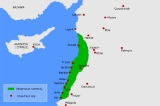
Phoenicia was an ancient civilization in Canaan
which covered most of the western, coastal part of the Fertile Crescent
. Several major Phoenician cities were built on the coastline of the Mediterranean. It was an enterprising maritime trading culture
that spread across the Mediterranean from 1550 BC to 300 BC. The Phoenicians used the galley, a man-powered sailing vessel, and are credited with the invention of the bireme
. They were famed in Classical Greece and Rome as 'traders in purple', referring to their monopoly on the precious purple dye of the Murex
snail, used, among other things, for royal clothing, and for their spread of the alphabet
(or abjad
), upon which all major modern alphabets are derived.
In the Amarna tablets
of the 14th century BC, people from the region called themselves Kenaani or Kinaani (Canaanites), although these letters predate the invasion of the Sea Peoples
by over a century. Much later, in the 6th century BC, Hecataeus of Miletus writes that Phoenicia was formerly called χνα, a name Philo of Byblos
later adopted into his mythology as his eponym for the Phoenicians: "Khna who was afterwards called Phoinix". Egyptian seafaring expeditions had already been made to Byblos
to bring back "cedars of Lebanon
" as early as the third millennium BC.
"Phoenicia" is really a Classical Greek term used to refer to the region of the major Canaanite port towns, and does not correspond exactly to a cultural identity that would have been recognised by the Phoenicians themselves. It is uncertain to what extent the Phoenicians viewed themselves as a single ethnicity. Their civilization was organized in city-states, similar to ancient Greece
. However in terms of archaeology, language, life style and religion, there is little to set the Phoenicians apart as markedly different from other cultures of Canaan. As Canaanites, they were unique in their remarkable seafaring achievements.
Each of their cities was a city-state which was politically an independent unit. They could come into conflict and one city might be dominated by another city-state, although they would collaborate in leagues or alliances. Though ancient boundaries of such city-centered cultures fluctuated, the city of Tyre seems to have been the southernmost. Sarepta
(modern day Sarafand) between Sidon
and Tyre is the most thoroughly excavated city of the Phoenician homeland. The Phoenicians were the first state-level society to make extensive use of the alphabet. The Phoenician phonetic alphabet
is generally believed to be the ancestor of almost all modern alphabets, although it did not contain any vowels (these were added later by the Greeks). From a traditional linguistic perspective, they spoke Phoenician, a Canaanite dialect. However, due to the very slight differences in language, and the insufficient records of the time, whether Phoenician formed a separate and united dialect, or was merely a superficially defined part of a broader language continuum, is unclear. Through their maritime trade, the Phoenicians spread the use of the alphabet to North Africa and Europe, where it was adopted by the Greeks
, who later passed it on to the Etruscans, who in turn transmitted it to the Romans
. In addition to their many inscriptions, the Phoenicians were believed to have left numerous other types of written sources, but most have not survived. Evangelical Preparation by Eusebius of Caesarea
quotes extensively from Philo of Byblos
and Sanchuniathon
.
's account (written c. 440 BC) refers to the Io and Europa myths. (History, I:1).
Strabo
, the Greek historian, geographer and philosopher mentioned that the Phoenicians came from the eastern part of the Arabia peninsula where they have similar gods, cemeteries and temples.
 Spencer Wells
of the Genographic Project has conducted genetic
studies that demonstrate that male populations of Lebanon, Palestine, Syria, Malta
, Spain, and other areas settled by Phoenicians, as well as those of the Ashkenazim and other Jewish populations in Europe and elsewhere, including the modern State of Israel, share a common m89 chromosome
Y type. Male populations in areas associated with Minoan or with the Sea People settlement have completely different genetic markers. This implies that Minoans and Sea Peoples probably did not have ancestral relation with the Phoenicians.
Zalloua and Wells (2004), under the auspices of a grant from National Geographic Magazine
examined the origins of the Phoenicians.
The debate between Wells and Zalloua was whether haplogroup
J2
(M172) should be identified as that of the Phoenicians or that of its "parent" haplogroup
M89 on the YDNA phylogenetic tree.
Initial consensus suggested that J2
be identified with the Canaanite-Phoenician (Northwest Semitic) population, with avenues open for future research. As Wells commented, "The Phoenicians were the Canaanites"
It was reported in the PBS
description of the National Geographic TV Special on this study entitled "Quest for the Phoenicians" that ancient DNA
was included in this study as extracted from the tooth of a 2500 year-old Phoenician mummy
.
Wells identified the haplogroup of the Canaanites as haplogroup J2
. The National Geographic Genographic Project linked haplogroup J2 to the site of Jericho
, Tel el-Sultan, ca. 8500 BCE and indicated that in modern populations, haplogroup J2 is found in North Africa, Southern Europe, and the Middle East, with especially high distribution among present-day Jewish populations (30%), Southern Italians (20%), and lower frequencies in Southern Spain (10%).
remarked in The Perspective of the World that Phoenicia was an early example of a "world-economy" surrounded by empires. The high point of Phoenician culture and seapower is usually placed ca. 1200–800 BC.
Many of the most important Phoenician settlements had been established long before this: Byblos
, Tyre, Sidon
, Simyra, Arwad
, and Berytus
, all appear in the Amarna tablets. Archeology has identified cultural elements of the Phoenician zenith as early as the third millennium BC.
The league of independent city-state ports, with others on the islands and along other coasts of the Mediterranean Sea, was ideally suited for trade between the Levant
area, rich in natural resources, and the rest of the ancient world. During the early Iron Age
, in around 1200 BC an unknown event
occurred, historically associated with the appearance of the Sea Peoples
from the north. They weakened and destroyed the Egypt
ians and the Hittites
respectively. In the resulting power vacuum, a number of Phoenician cities rose as significant maritime powers.
The societies rested on three power-bases: the king; the temple and its priests; and councils of elders. Byblos
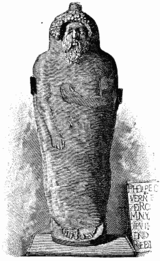
first became the predominant center from where the Phoenicians dominated the Mediterranean and Erythraean (Red) Sea routes. It was here that the first inscription in the Phoenician alphabet was found, on the sarcophagus of Ahiram
(ca. 1200 BC). Later, Tyre gained in power. One of its kings, the priest Ithobaal
(887–856 BC) ruled Phoenicia as far north as Beirut, and part of Cyprus. Carthage
was founded in 814 BC under Pygmalion
of Tyre (820–774 BC). The collection of city-states constituting Phoenicia came to be characterized by outsiders and the Phoenicians as Sidonia or Tyria. Phoenicians and Canaanites alike were called Zidonians or Tyrians, as one Phoenician city came to prominence after another.
.jpg)
Cyrus the Great
conquered Phoenicia in 539 BC. The Persians divided Phoenicia into four vassal kingdoms: Sidon
, Tyre, Arwad
, and Byblos
. They prospered, furnishing fleets for the Persian kings. Phoenician influence declined after this. It is likely that much of the Phoenician population migrated to Carthage
and other colonies following the Persian conquest. In 350 or 345 BC a rebellion in Sidon led by Tennes was crushed by Artaxerxes III. Its destruction was described by Diodorus Siculus
.
Alexander the Great took Tyre in 332 BC after the Siege of Tyre
. Alexander was exceptionally harsh to Tyre, executing 2,000 of the leading citizens, but he maintained the king in power. He gained control of the other cities peacefully: the ruler of Aradus submitted; the king of Sidon was overthrown. The rise of Hellenistic Greece
gradually ousted the remnants of Phoenicia's former dominance over the Eastern Mediterranean trade routes. Phoenician culture disappeared entirely in the motherland. Carthage continued to flourish in North Africa. It oversaw the mining of iron and precious metal
s from Iberia, and used its considerable naval power and mercenary armies to protect commercial interests. Rome finally destroyed it in 146 BC, at the end of the Punic Wars
.
Following Alexander, the Phoenician homeland was controlled by a succession of Hellenistic rulers: Laomedon
(323 BC), Ptolemy I (320), Antigonus II
(315), Demetrius
(301), and Seleucus
(296). Between 286 and 197 BC, Phoenicia (except for Aradus) fell to the Ptolemies of Egypt, who installed the high priests of Astarte
as vassal rulers in Sidon (Eshmunazar I, Tabnit, Eshmunazar II).
In 197 BC, Phoenicia along with Syria reverted to the Seleucids. The region became increasingly Hellenized, although Tyre became autonomous in 126 BC, followed by Sidon in 111. Syria, including Phoenicia, were seized by king Tigranes the Great
of Armenia
from 82 until 69 BC, when he was defeated by Lucullus
. In 65 BC Pompey
finally incorporated the territory as part of the Roman province of Syria.
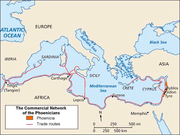 The Phoenicians were among the greatest traders of their time and owed much of their prosperity to trade. At first, they traded mainly with the Greeks, trading wood
, slaves, glass
and powdered Tyrian purple
. Tyrian purple was a violet-purple dye used by the Greek elite
to color garments. In fact, the word Phoenician derives from the ancient Greek
word phoínios meaning "purple". As trading and colonizing spread over the Mediterranean, Phoenicians and Greeks seemed to have unconsciously split that sea in two: the Phoenicians sailed along and eventually dominating the southern shore, while the Greeks were active along the northern shores. The two cultures clashed rarely, mainly in Sicily
, which eventually settled into two spheres of influence, the Phoenician southwest and the Greek northeast.
In the centuries after 1200 BC, the Phoenicians were the major naval and trading power of the region. Phoenician trade was founded on the Tyrian purple dye, a violet-purple dye derived from the shell of the Murex
sea-snail, once profusely available in coastal waters of the eastern Mediterranean Sea but exploited to local extinction. James B. Pritchard
's excavations at Sarepta
in present-day Lebanon revealed crushed Murex shells and pottery containers stained with the dye that was being produced at the site. The Phoenicians established a second production center for the dye in Mogador, in present day Morocco
. Brilliant textiles were a part of Phoenician wealth, and Phoenician glass
was another export ware. They traded unrefined, prick-eared hunting dogs of Asian or African origin which locally they had developed into many breeds such as the Basenji
, Ibizan Hound
, Pharaoh Hound
, Cirneco dell'Etna
, Cretan Hound
, Canary Islands Hound, and Portuguese Podengo
. To Egypt, where grapevines would not grow, the 8th-century Phoenicians sold wine
: the wine trade with Egypt is vividly documented by the shipwrecks located in 1997 in the open sea 30 miles west of Ascalon
; pottery kilns at Tyre and Sarepta
produced the big terracotta jars used for transporting wine. From Egypt, they bought Nubia
n gold.
From elsewhere, they obtained other materials, perhaps the most important being silver
from Iberian Peninsula
and tin
from Great Britain, the latter of which when smelted with copper
(from Cyprus
) created the durable metal alloy
bronze
. Strabo
states that there was a highly lucrative Phoenician trade with Britain for tin.
The Phoenicians established commercial outposts throughout the Mediterranean, the most strategically important being Carthage
in North Africa, directly across the narrow straits. Ancient Gaelic mythologies attribute a Phoenician/Scythian influx to Ireland by a leader called Fenius Farsa
. Others also sailed south along the coast of Africa. A Carthaginian expedition led by Hanno the Navigator
explored and colonized the Atlantic coast of Africa as far as the Gulf of Guinea
; and according to Herodotus, a Phoenician expedition sent down the Red Sea
by pharaoh Necho II
of Egypt (c. 600 BC) even circumnavigated
Africa and returned through the Pillars of Hercules
after three years. Using gold obtained by expansion of the African coastal trade following the Hanno expedition, Carthage minted gold staters in 350 BC bearing a pattern, in the reverse exergue of the coins, interpreted as a map of the Mediterranean with America shown to the west.
In the Second Millennium BC
, the Phoenicians traded with the Somalis and other related peoples in the Horn of Africa
. Through the Somali city-states of Mosylon, Opone, Malao, Sarapion, Mundus and Tabae
, trade flourished.
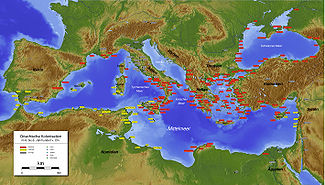 From the 10th century BC, their expansive culture established cities and colonies throughout the Mediterranean. Canaanite deities like Baal
and Astarte were being worshipped from Cyprus to Sardinia, Malta, Sicily, Spain, Portugal, and most notably at Carthage in modern Tunisia.
In the Phoenician homeland:
Phoenician colonies, including some of lesser importance (this list might be incomplete):
from the southern Levant resemble Egyptian hieroglyphs, or more specifically an early alphabetic writing system found at Wadi-el-Hol in central Egypt. In addition to being preceded by proto-Canaanite, the Phoenician alphabet was also preceded by an alphabetic script of Mesopotamian origin called Ugaritic. The development of the Phoenician alphabet from the Proto-Canaanite coincided with the rise of the Iron Age in the 11th century BC.
This alphabet has been termed an abjad
or a script that contains no vowels
. The first two letters aleph and beth gave the name to the alphabet.
 The oldest known representation of the Phoenician alphabet is inscribed on the sarcophagus of King Ahiram
of Byblos, dating to the 11th century BC at the latest. Phoenician inscriptions are found in Lebanon, Syria, Israel, Cyprus and other locations, as late as the early centuries of the Christian Era. The Phoenicians are credited with spreading the Phoenician alphabet
throughout the Mediterranean world. Phoenician traders disseminated this writing system along Aegean trade routes, to Creta and Greece. The Greeks adopted the majority of these letters but changed some of them to vowels which were significable in their language, giving rise to the first true alphabet.
The Phoenician language
is classified in the Canaanite
subgroup of Northwest Semitic
. Its later descendant in North Africa
is termed Punic. In Phoenician colonies around the western Mediterranean, beginning in the 9th century BC, Phoenician evolved into Punic. Punic Phoenician was still spoken in the 5th century AD: St. Augustine
, for example, grew up in North Africa
and was familiar with the language.
, Greece and Assyria
. Phoenicians who were taught on the banks of the Nile
and the Euphrates
gained a wide artistic experience and finally came to create their own art, which was an amalgam of foreign models and perspectives. In an article from The New York Times
published on January 5, 1879, Phoenician art was described by the following:
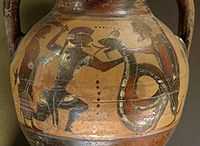 Phoenician culture had a huge effect upon the cultures of the Mediterranean basin in the early Iron Age, and had also been affected in reverse. For example, in Phoenicia, the tripartite division between Baal
, Mot and Yam
seems to have been influenced by the Greek division between Zeus
, Hades
and Poseidon
. Phoenician temples in various Mediterranean ports sacred to Phoenician Melkart, during the classical period, were recognized as sacred to Hercules
. Stories like the Rape of Europa, and the coming of Cadmus
also draw upon Phoenician influence.
The recovery of the Mediterranean economy after the late Bronze Age collapse
, seems to have been largely due to the work of Phoenician traders and merchant princes, who re-established long distance trade between Egypt and Mesopotamia in the 10th century BC. The Ionian revolution was, at least in legend, led by philosophers
such as Thales of Miletus or Pythagoras
, both of whom had Phoenician fathers. Phoenician motifs are also present in the Orientalising period of Greek art
, and Phoenicians also played a formative role in Etruscan civilisation in Tuscany.
There are many countries and cities around the world that derive their names from the Phoenician Language. Below is a list with the respective meanings:
This is the architect of the Temple, Hiram Abiff
of Masonic lore. They are vastly famous for their purple dye.
Later, reforming prophets railed against the practice of drawing royal wives from among foreigners: Elijah execrated Jezebel, the princess from Tyre who became a consort of King Ahab
and introduced the worship of her gods
Baal.
Long after Phoenician culture had flourished, or Phoenicia had existed as any political entity, Hellenized natives of the region where Canaanites still lived were referred to as "Syro-Phoenician", as in the Gospel of Mark
7:26: "The woman was a Greek, a Syrophoenician by birth…"
The word Bible
itself ultimately derives through Greek from the word "biblion" which means "book", and not from the Hellenised Phoenician city of Byblos (which was called Gebal), before it was named by the Greeks as Byblos
. The Greeks called it Byblos because it was through Gebal that bublos (Bύβλος ["Egyptian papyrus"]) was imported into Greece. Present day Byblos is under the current Arabic name of Jbeil (جبيل Ǧubayl) derived from Gebal.
poenicus (later punicus), comes from Greek
phoinikes, attested since Homer and influenced by phoînix "Tyrian purple
, crimson; murex
" (itself from phoinos "blood red"). The word stems from Linear B
po-ni-ki-jo, ultimately borrowed from Ancient Egyptian Fenkhu (Fnkhw) "Syrian people". The association of phoinikes with phoînix mirrors an older folk etymology present in Phoenician which tied Kina'ahu "Canaan; Phoenicia" with kinahu "crimson". The land was natively known as Kina'ahu, reported in the 6th century BC by Hecataeus under the Greek-influenced form Khna (χνα), and its people as the Kena'ani.
, an Assyrian king, near Nimrud. They are made of bronze, and they portray ships coming to honor Shalmaneser.
The Khorsabad bas-relief (7th Century BC) shows the transportation of timber (most likely cedar) from Lebanon. It is found in the palace built specifically for Sargon II
, another Assyrian king, at Khorsabad, now northern Iraq.
The height of Phoenician trade was around the 7th and 8th centuries. There is a dispersal of imports (ceramic, stone, and faience) from the Levant that traces a Phoenician commercial channel to the Greek mainland via the central Aegean. Athens shows little evidence of this trade with few eastern imports, but other Greek coastal cities are rich with eastern imports that evidence this trade.
Al Mina is a specific example of the trade that took place between the Greeks and the Phoenicians. It has been theorized that by the 8th century BC, Euboean traders established a commercial enterprise with the Levantine coast and were using Al Mina (in Syria) as a base for this enterprise. There is still some question about the veracity of these claims concerning Al Mina. The Phoenicians even got their name from the Greeks due to their trade. Their most famous trading product was purple dye, the Greek word for which is phoenos.
Cadmus
is credited with bringing the alphabet to Greece, but it is more plausible that it was brought by Phoenician emigrants to Crete
, whence it gradually diffused northwards.
"So these Phoenicians, including the Gephyraians, came with Kadmos and settled this land, and they transmitted much lore to the Hellenes, and in particular, taught them the alphabet which, I believe the Hellenes did not have previously, but which was originally used by all Phoenicians"
– The Landmark Herodotus: The Histories, Book 5.58, translated by Andrea L. Purvis
Ugarit is an ancient city state of Phoenicia. Yamm is the Ugaritic god of the sea. Yamm and Baal, the storm god of Ugaritic myth and often associated with Zeus, have an epic battle for power over the universe. While Yamm is the god of the sea, he truly represents vast chaos. Baal, on the other hand, is a representative for order. In Ugaritic myth, Baal overcomes Yamm's power. In some versions of this myth, Baal kills Yamm with a mace fashioned for him, and in others, the goddess Athtart saves Yamm and says that since defeated, he should stay in his own province. Yamm is the brother of the god of death, Mot.
Some scholars have identified Yamm with Poseidon, although he has also been identified with Pontus
.
Canaan
Canaan is a historical region roughly corresponding to modern-day Israel, Palestine, Lebanon, and the western parts of Jordan...
which covered most of the western, coastal part of the Fertile Crescent
Fertile Crescent
The Fertile Crescent, nicknamed "The Cradle of Civilization" for the fact the first civilizations started there, is a crescent-shaped region containing the comparatively moist and fertile land of otherwise arid and semi-arid Western Asia. The term was first used by University of Chicago...
. Several major Phoenician cities were built on the coastline of the Mediterranean. It was an enterprising maritime trading culture
Thalassocracy
The term thalassocracy refers to a state with primarily maritime realms—an empire at sea, such as Athens or the Phoenician network of merchant cities...
that spread across the Mediterranean from 1550 BC to 300 BC. The Phoenicians used the galley, a man-powered sailing vessel, and are credited with the invention of the bireme
Bireme
A bireme is an ancient Hellenistic-era warship with two decks of oars, probably invented by the Phoenicians. It typically was about long with a maximum beam width of around . It was modified from the penteconter, a ship that had only one set of oars on each side, the bireme having two sets of oars...
. They were famed in Classical Greece and Rome as 'traders in purple', referring to their monopoly on the precious purple dye of the Murex
Murex
Murex is a genus of medium to large sized predatory tropical sea snails. These are carnivorous marine gastropod molluscs in the family Muricidae, commonly calle "murexes" or "rock snails"...
snail, used, among other things, for royal clothing, and for their spread of the alphabet
Alphabet
An alphabet is a standard set of letters—basic written symbols or graphemes—each of which represents a phoneme in a spoken language, either as it exists now or as it was in the past. There are other systems, such as logographies, in which each character represents a word, morpheme, or semantic...
(or abjad
Abjad
An abjad is a type of writing system in which each symbol always or usually stands for a consonant; the reader must supply the appropriate vowel....
), upon which all major modern alphabets are derived.
In the Amarna tablets
Amarna letters
The Amarna letters are an archive of correspondence on clay tablets, mostly diplomatic, between the Egyptian administration and its representatives in Canaan and Amurru during the New Kingdom...
of the 14th century BC, people from the region called themselves Kenaani or Kinaani (Canaanites), although these letters predate the invasion of the Sea Peoples
Sea Peoples
The Sea Peoples were a confederacy of seafaring raiders of the second millennium BC who sailed into the eastern Mediterranean, caused political unrest, and attempted to enter or control Egyptian territory during the late 19th dynasty and especially during year 8 of Ramesses III of the 20th Dynasty...
by over a century. Much later, in the 6th century BC, Hecataeus of Miletus writes that Phoenicia was formerly called χνα, a name Philo of Byblos
Philo of Byblos
Philo of Byblos was an antiquarian writer of grammatical, lexical and historical works in Greek. He is chiefly known for his Phoenician history assembled from the writings of Sanchuniathon.-Life:...
later adopted into his mythology as his eponym for the Phoenicians: "Khna who was afterwards called Phoinix". Egyptian seafaring expeditions had already been made to Byblos
Byblos
Byblos is the Greek name of the Phoenician city Gebal . It is a Mediterranean city in the Mount Lebanon Governorate of present-day Lebanon under the current Arabic name of Jubayl and was also referred to as Gibelet during the Crusades...
to bring back "cedars of Lebanon
Lebanon Cedar
Cedrus libani is a species of cedar native to the mountains of the Mediterranean region.There are two distinct types that are considered to be different subspecies or varieties. Lebanon cedar or Cedar of Lebanon Cedrus libani is a species of cedar native to the mountains of the Mediterranean...
" as early as the third millennium BC.
"Phoenicia" is really a Classical Greek term used to refer to the region of the major Canaanite port towns, and does not correspond exactly to a cultural identity that would have been recognised by the Phoenicians themselves. It is uncertain to what extent the Phoenicians viewed themselves as a single ethnicity. Their civilization was organized in city-states, similar to ancient Greece
Ancient Greece
Ancient Greece is a civilization belonging to a period of Greek history that lasted from the Archaic period of the 8th to 6th centuries BC to the end of antiquity. Immediately following this period was the beginning of the Early Middle Ages and the Byzantine era. Included in Ancient Greece is the...
. However in terms of archaeology, language, life style and religion, there is little to set the Phoenicians apart as markedly different from other cultures of Canaan. As Canaanites, they were unique in their remarkable seafaring achievements.
Each of their cities was a city-state which was politically an independent unit. They could come into conflict and one city might be dominated by another city-state, although they would collaborate in leagues or alliances. Though ancient boundaries of such city-centered cultures fluctuated, the city of Tyre seems to have been the southernmost. Sarepta
Sarepta
Sarepta was a Phoenician city on the Mediterranean coast between Sidon and Tyre. Most of the objects by which we characterise Phoenician culture are those that have been recovered scattered among Phoenician colonies and trading posts; such carefully excavated colonial sites are in Spain, Sicily,...
(modern day Sarafand) between Sidon
Sidon
Sidon or Saïda is the third-largest city in Lebanon. It is located in the South Governorate of Lebanon, on the Mediterranean coast, about 40 km north of Tyre and 40 km south of the capital Beirut. In Genesis, Sidon is the son of Canaan the grandson of Noah...
and Tyre is the most thoroughly excavated city of the Phoenician homeland. The Phoenicians were the first state-level society to make extensive use of the alphabet. The Phoenician phonetic alphabet
Phoenician alphabet
The Phoenician alphabet, called by convention the Proto-Canaanite alphabet for inscriptions older than around 1050 BC, was a non-pictographic consonantal alphabet, or abjad. It was used for the writing of Phoenician, a Northern Semitic language, used by the civilization of Phoenicia...
is generally believed to be the ancestor of almost all modern alphabets, although it did not contain any vowels (these were added later by the Greeks). From a traditional linguistic perspective, they spoke Phoenician, a Canaanite dialect. However, due to the very slight differences in language, and the insufficient records of the time, whether Phoenician formed a separate and united dialect, or was merely a superficially defined part of a broader language continuum, is unclear. Through their maritime trade, the Phoenicians spread the use of the alphabet to North Africa and Europe, where it was adopted by the Greeks
Ancient Greece
Ancient Greece is a civilization belonging to a period of Greek history that lasted from the Archaic period of the 8th to 6th centuries BC to the end of antiquity. Immediately following this period was the beginning of the Early Middle Ages and the Byzantine era. Included in Ancient Greece is the...
, who later passed it on to the Etruscans, who in turn transmitted it to the Romans
Ancient Rome
Ancient Rome was a thriving civilization that grew on the Italian Peninsula as early as the 8th century BC. Located along the Mediterranean Sea and centered on the city of Rome, it expanded to one of the largest empires in the ancient world....
. In addition to their many inscriptions, the Phoenicians were believed to have left numerous other types of written sources, but most have not survived. Evangelical Preparation by Eusebius of Caesarea
Eusebius of Caesarea
Eusebius of Caesarea also called Eusebius Pamphili, was a Roman historian, exegete and Christian polemicist. He became the Bishop of Caesarea in Palestine about the year 314. Together with Pamphilus, he was a scholar of the Biblical canon...
quotes extensively from Philo of Byblos
Philo of Byblos
Philo of Byblos was an antiquarian writer of grammatical, lexical and historical works in Greek. He is chiefly known for his Phoenician history assembled from the writings of Sanchuniathon.-Life:...
and Sanchuniathon
Sanchuniathon
Sanchuniathon is the purported Phoenician author of three lost works originally in the Phoenician language, surviving only in partial paraphrase and summary of a Greek translation by Philo of Byblos, according to the Christian bishop Eusebius of Caesarea...
.
Origins: 2300–1200 BC
HerodotusHerodotus
Herodotus was an ancient Greek historian who was born in Halicarnassus, Caria and lived in the 5th century BC . He has been called the "Father of History", and was the first historian known to collect his materials systematically, test their accuracy to a certain extent and arrange them in a...
's account (written c. 440 BC) refers to the Io and Europa myths. (History, I:1).
Strabo
Strabo
Strabo, also written Strabon was a Greek historian, geographer and philosopher.-Life:Strabo was born to an affluent family from Amaseia in Pontus , a city which he said was situated the approximate equivalent of 75 km from the Black Sea...
, the Greek historian, geographer and philosopher mentioned that the Phoenicians came from the eastern part of the Arabia peninsula where they have similar gods, cemeteries and temples.
Genetic studies
Spencer Wells
Spencer Wells is a geneticist and anthropologist, an at the National Geographic Society, and Frank H.T. Rhodes Class of '56 Professor at Cornell University. He leads The Genographic Project.-Education:...
of the Genographic Project has conducted genetic
Genetics
Genetics , a discipline of biology, is the science of genes, heredity, and variation in living organisms....
studies that demonstrate that male populations of Lebanon, Palestine, Syria, Malta
Malta
Malta , officially known as the Republic of Malta , is a Southern European country consisting of an archipelago situated in the centre of the Mediterranean, south of Sicily, east of Tunisia and north of Libya, with Gibraltar to the west and Alexandria to the east.Malta covers just over in...
, Spain, and other areas settled by Phoenicians, as well as those of the Ashkenazim and other Jewish populations in Europe and elsewhere, including the modern State of Israel, share a common m89 chromosome
Chromosome
A chromosome is an organized structure of DNA and protein found in cells. It is a single piece of coiled DNA containing many genes, regulatory elements and other nucleotide sequences. Chromosomes also contain DNA-bound proteins, which serve to package the DNA and control its functions.Chromosomes...
Y type. Male populations in areas associated with Minoan or with the Sea People settlement have completely different genetic markers. This implies that Minoans and Sea Peoples probably did not have ancestral relation with the Phoenicians.
Zalloua and Wells (2004), under the auspices of a grant from National Geographic Magazine
National Geographic Magazine
National Geographic, formerly the National Geographic Magazine, is the official journal of the National Geographic Society. It published its first issue in 1888, just nine months after the Society itself was founded...
examined the origins of the Phoenicians.
The debate between Wells and Zalloua was whether haplogroup
Haplogroup
In the study of molecular evolution, a haplogroup is a group of similar haplotypes that share a common ancestor having the same single nucleotide polymorphism mutation in both haplotypes. Because a haplogroup consists of similar haplotypes, this is what makes it possible to predict a haplogroup...
J2
Haplogroup J2 (Y-DNA)
In human genetics, Haplogroup J2 is a Y-chromosome haplogroup which is a subdivision of haplogroup J. It is further divided into two complementary clades, J2a-M410 and J2b-M12.-Origins:...
(M172) should be identified as that of the Phoenicians or that of its "parent" haplogroup
Haplogroup
In the study of molecular evolution, a haplogroup is a group of similar haplotypes that share a common ancestor having the same single nucleotide polymorphism mutation in both haplotypes. Because a haplogroup consists of similar haplotypes, this is what makes it possible to predict a haplogroup...
M89 on the YDNA phylogenetic tree.
Initial consensus suggested that J2
Haplogroup J2 (Y-DNA)
In human genetics, Haplogroup J2 is a Y-chromosome haplogroup which is a subdivision of haplogroup J. It is further divided into two complementary clades, J2a-M410 and J2b-M12.-Origins:...
be identified with the Canaanite-Phoenician (Northwest Semitic) population, with avenues open for future research. As Wells commented, "The Phoenicians were the Canaanites"
It was reported in the PBS
Public Broadcasting Service
The Public Broadcasting Service is an American non-profit public broadcasting television network with 354 member TV stations in the United States which hold collective ownership. Its headquarters is in Arlington, Virginia....
description of the National Geographic TV Special on this study entitled "Quest for the Phoenicians" that ancient DNA
Ancient DNA
Ancient DNA is DNA isolated from ancient specimens. It can be also loosely described as any DNA recovered from biological samples that have not been preserved specifically for later DNA analyses...
was included in this study as extracted from the tooth of a 2500 year-old Phoenician mummy
Mummy
A mummy is a body, human or animal, whose skin and organs have been preserved by either intentional or incidental exposure to chemicals, extreme coldness , very low humidity, or lack of air when bodies are submerged in bogs, so that the recovered body will not decay further if kept in cool and dry...
.
Wells identified the haplogroup of the Canaanites as haplogroup J2
Haplogroup J2 (Y-DNA)
In human genetics, Haplogroup J2 is a Y-chromosome haplogroup which is a subdivision of haplogroup J. It is further divided into two complementary clades, J2a-M410 and J2b-M12.-Origins:...
. The National Geographic Genographic Project linked haplogroup J2 to the site of Jericho
Jericho
Jericho ; is a city located near the Jordan River in the West Bank of the Palestinian territories. It is the capital of the Jericho Governorate and has a population of more than 20,000. Situated well below sea level on an east-west route north of the Dead Sea, Jericho is the lowest permanently...
, Tel el-Sultan, ca. 8500 BCE and indicated that in modern populations, haplogroup J2 is found in North Africa, Southern Europe, and the Middle East, with especially high distribution among present-day Jewish populations (30%), Southern Italians (20%), and lower frequencies in Southern Spain (10%).
High point: 1200–800 BC
Fernand BraudelFernand Braudel
Fernand Braudel was a French historian and a leader of the Annales School. His scholarship focused on three main projects, each representing several decades of intense study: The Mediterranean , Civilization and Capitalism , and the unfinished Identity of France...
remarked in The Perspective of the World that Phoenicia was an early example of a "world-economy" surrounded by empires. The high point of Phoenician culture and seapower is usually placed ca. 1200–800 BC.
Many of the most important Phoenician settlements had been established long before this: Byblos
Byblos
Byblos is the Greek name of the Phoenician city Gebal . It is a Mediterranean city in the Mount Lebanon Governorate of present-day Lebanon under the current Arabic name of Jubayl and was also referred to as Gibelet during the Crusades...
, Tyre, Sidon
Sidon
Sidon or Saïda is the third-largest city in Lebanon. It is located in the South Governorate of Lebanon, on the Mediterranean coast, about 40 km north of Tyre and 40 km south of the capital Beirut. In Genesis, Sidon is the son of Canaan the grandson of Noah...
, Simyra, Arwad
Arwad
Arwad – formerly known as Arado , Arados , Arvad, Arpad, Arphad, and Antiochia in Pieria , also called Ruad Island – located in the Mediterranean Sea, is the only inhabited island in Syria. The town of Arwad takes up the entire island...
, and Berytus
Beirut
Beirut is the capital and largest city of Lebanon, with a population ranging from 1 million to more than 2 million . Located on a peninsula at the midpoint of Lebanon's Mediterranean coastline, it serves as the country's largest and main seaport, and also forms the Beirut Metropolitan...
, all appear in the Amarna tablets. Archeology has identified cultural elements of the Phoenician zenith as early as the third millennium BC.
The league of independent city-state ports, with others on the islands and along other coasts of the Mediterranean Sea, was ideally suited for trade between the Levant
Levant
The Levant or ) is the geographic region and culture zone of the "eastern Mediterranean littoral between Anatolia and Egypt" . The Levant includes most of modern Lebanon, Syria, Jordan, Israel, the Palestinian territories, and sometimes parts of Turkey and Iraq, and corresponds roughly to the...
area, rich in natural resources, and the rest of the ancient world. During the early Iron Age
Iron Age
The Iron Age is the archaeological period generally occurring after the Bronze Age, marked by the prevalent use of iron. The early period of the age is characterized by the widespread use of iron or steel. The adoption of such material coincided with other changes in society, including differing...
, in around 1200 BC an unknown event
Bronze Age collapse
The Bronze Age collapse is a transition in southwestern Asia and the Eastern Mediterranean from the Late Bronze Age to the Early Iron Age that some historians believe was violent, sudden and culturally disruptive...
occurred, historically associated with the appearance of the Sea Peoples
Sea Peoples
The Sea Peoples were a confederacy of seafaring raiders of the second millennium BC who sailed into the eastern Mediterranean, caused political unrest, and attempted to enter or control Egyptian territory during the late 19th dynasty and especially during year 8 of Ramesses III of the 20th Dynasty...
from the north. They weakened and destroyed the Egypt
Egypt
Egypt , officially the Arab Republic of Egypt, Arabic: , is a country mainly in North Africa, with the Sinai Peninsula forming a land bridge in Southwest Asia. Egypt is thus a transcontinental country, and a major power in Africa, the Mediterranean Basin, the Middle East and the Muslim world...
ians and the Hittites
Hittites
The Hittites were a Bronze Age people of Anatolia.They established a kingdom centered at Hattusa in north-central Anatolia c. the 18th century BC. The Hittite empire reached its height c...
respectively. In the resulting power vacuum, a number of Phoenician cities rose as significant maritime powers.
The societies rested on three power-bases: the king; the temple and its priests; and councils of elders. Byblos
Byblos
Byblos is the Greek name of the Phoenician city Gebal . It is a Mediterranean city in the Mount Lebanon Governorate of present-day Lebanon under the current Arabic name of Jubayl and was also referred to as Gibelet during the Crusades...
first became the predominant center from where the Phoenicians dominated the Mediterranean and Erythraean (Red) Sea routes. It was here that the first inscription in the Phoenician alphabet was found, on the sarcophagus of Ahiram
Ahiram
Ahiram or, more correctly, Ahirom was a Phoenician king of Byblos Ahirom is not attested in any other Ancient Oriental source. He became famous only by his Phoenician inscribed sarcophagus which was discovered in 1923 by the French excavator Pierre Montet in tomb V of the royal necropolis of Byblos...
(ca. 1200 BC). Later, Tyre gained in power. One of its kings, the priest Ithobaal
Ithobaal I
Ithobaal I was a king of Tyre who founded a new dynasty. During his reign, Tyre expanded its power on the mainland, making all of Phoenicia its territory as far north as Beirut, including Sidon, and even a part of the island of Cyprus...
(887–856 BC) ruled Phoenicia as far north as Beirut, and part of Cyprus. Carthage
Carthage
Carthage , implying it was a 'new Tyre') is a major urban centre that has existed for nearly 3,000 years on the Gulf of Tunis, developing from a Phoenician colony of the 1st millennium BC...
was founded in 814 BC under Pygmalion
Pygmalion of Tyre
Pygmalion was king of Tyre from 831 to 785 BC and a son of King Mattan I .During Pygmalion's reign, Tyre seems to have shifted the heart of its trading empire from the Middle East to the Mediterranean, as can be judged from the building of new colonies including Kition on Cyprus, Sardinia , and,...
of Tyre (820–774 BC). The collection of city-states constituting Phoenicia came to be characterized by outsiders and the Phoenicians as Sidonia or Tyria. Phoenicians and Canaanites alike were called Zidonians or Tyrians, as one Phoenician city came to prominence after another.
Decline: 539–65 BC
Cyrus the Great
Cyrus the Great
Cyrus II of Persia , commonly known as Cyrus the Great, also known as Cyrus the Elder, was the founder of the Achaemenid Empire. Under his rule, the empire embraced all the previous civilized states of the ancient Near East, expanded vastly and eventually conquered most of Southwest Asia and much...
conquered Phoenicia in 539 BC. The Persians divided Phoenicia into four vassal kingdoms: Sidon
Sidon
Sidon or Saïda is the third-largest city in Lebanon. It is located in the South Governorate of Lebanon, on the Mediterranean coast, about 40 km north of Tyre and 40 km south of the capital Beirut. In Genesis, Sidon is the son of Canaan the grandson of Noah...
, Tyre, Arwad
Arwad
Arwad – formerly known as Arado , Arados , Arvad, Arpad, Arphad, and Antiochia in Pieria , also called Ruad Island – located in the Mediterranean Sea, is the only inhabited island in Syria. The town of Arwad takes up the entire island...
, and Byblos
Byblos
Byblos is the Greek name of the Phoenician city Gebal . It is a Mediterranean city in the Mount Lebanon Governorate of present-day Lebanon under the current Arabic name of Jubayl and was also referred to as Gibelet during the Crusades...
. They prospered, furnishing fleets for the Persian kings. Phoenician influence declined after this. It is likely that much of the Phoenician population migrated to Carthage
Carthage
Carthage , implying it was a 'new Tyre') is a major urban centre that has existed for nearly 3,000 years on the Gulf of Tunis, developing from a Phoenician colony of the 1st millennium BC...
and other colonies following the Persian conquest. In 350 or 345 BC a rebellion in Sidon led by Tennes was crushed by Artaxerxes III. Its destruction was described by Diodorus Siculus
Diodorus Siculus
Diodorus Siculus was a Greek historian who flourished between 60 and 30 BC. According to Diodorus' own work, he was born at Agyrium in Sicily . With one exception, antiquity affords no further information about Diodorus' life and doings beyond what is to be found in his own work, Bibliotheca...
.
Alexander the Great took Tyre in 332 BC after the Siege of Tyre
Siege of Tyre
The Siege of Tyre was a siege of the city of Tyre, a strategic coastal base on the Mediterranean Sea, orchestrated by Alexander the Great in 332 BC during his campaigns against the Persians. The Macedonian army was unable to capture the city through conventional means because it was on an island...
. Alexander was exceptionally harsh to Tyre, executing 2,000 of the leading citizens, but he maintained the king in power. He gained control of the other cities peacefully: the ruler of Aradus submitted; the king of Sidon was overthrown. The rise of Hellenistic Greece
Hellenistic Greece
In the context of Ancient Greek art, architecture, and culture, Hellenistic Greece corresponds to the period between the death of Alexander the Great in 323 BC and the annexation of the classical Greek heartlands by Rome in 146 BC...
gradually ousted the remnants of Phoenicia's former dominance over the Eastern Mediterranean trade routes. Phoenician culture disappeared entirely in the motherland. Carthage continued to flourish in North Africa. It oversaw the mining of iron and precious metal
Precious metal
A precious metal is a rare, naturally occurring metallic chemical element of high economic value.Chemically, the precious metals are less reactive than most elements, have high lustre, are softer or more ductile, and have higher melting points than other metals...
s from Iberia, and used its considerable naval power and mercenary armies to protect commercial interests. Rome finally destroyed it in 146 BC, at the end of the Punic Wars
Punic Wars
The Punic Wars were a series of three wars fought between Rome and Carthage from 264 B.C.E. to 146 B.C.E. At the time, they were probably the largest wars that had ever taken place...
.
Following Alexander, the Phoenician homeland was controlled by a succession of Hellenistic rulers: Laomedon
Laomedon of Mytilene
Laomedon , native of Mytilene and son of Larichus, was one of Alexander the Great's generals, and appears to have enjoyed a high place in his confidence even before the death of Philip II, as he was one of those banished by that monarch for taking part in the intrigues of the...
(323 BC), Ptolemy I (320), Antigonus II
Antigonus II Gonatas
Antigonus II Gonatas was a powerful ruler who firmly established the Antigonid dynasty in Macedonia and acquired fame for his victory over the Gauls who had invaded the Balkans.-Birth and family:...
(315), Demetrius
Demetrius I of Macedon
Demetrius I , called Poliorcetes , son of Antigonus I Monophthalmus and Stratonice, was a king of Macedon...
(301), and Seleucus
Seleucus I Nicator
Seleucus I was a Macedonian officer of Alexander the Great and one of the Diadochi. In the Wars of the Diadochi that took place after Alexander's death, Seleucus established the Seleucid dynasty and the Seleucid Empire...
(296). Between 286 and 197 BC, Phoenicia (except for Aradus) fell to the Ptolemies of Egypt, who installed the high priests of Astarte
Astarte
Astarte is the Greek name of a goddess known throughout the Eastern Mediterranean from the Bronze Age to Classical times...
as vassal rulers in Sidon (Eshmunazar I, Tabnit, Eshmunazar II).
In 197 BC, Phoenicia along with Syria reverted to the Seleucids. The region became increasingly Hellenized, although Tyre became autonomous in 126 BC, followed by Sidon in 111. Syria, including Phoenicia, were seized by king Tigranes the Great
Tigranes the Great
Tigranes the Great was emperor of Armenia under whom the country became, for a short time, the strongest state east of the Roman Republic. He was a member of the Artaxiad Royal House...
of Armenia
Armenia
Armenia , officially the Republic of Armenia , is a landlocked mountainous country in the Caucasus region of Eurasia...
from 82 until 69 BC, when he was defeated by Lucullus
Lucullus
Lucius Licinius Lucullus , was an optimate politician of the late Roman Republic, closely connected with Sulla Felix...
. In 65 BC Pompey
Pompey
Gnaeus Pompeius Magnus, also known as Pompey or Pompey the Great , was a military and political leader of the late Roman Republic...
finally incorporated the territory as part of the Roman province of Syria.
Trade
Wood
Wood is a hard, fibrous tissue found in many trees. It has been used for hundreds of thousands of years for both fuel and as a construction material. It is an organic material, a natural composite of cellulose fibers embedded in a matrix of lignin which resists compression...
, slaves, glass
Glass
Glass is an amorphous solid material. Glasses are typically brittle and optically transparent.The most familiar type of glass, used for centuries in windows and drinking vessels, is soda-lime glass, composed of about 75% silica plus Na2O, CaO, and several minor additives...
and powdered Tyrian purple
Tyrian purple
Tyrian purple , also known as royal purple, imperial purple or imperial dye, is a purple-red natural dye, which is extracted from sea snails, and which was possibly first produced by the ancient Phoenicians...
. Tyrian purple was a violet-purple dye used by the Greek elite
Elite
Elite refers to an exceptional or privileged group that wields considerable power within its sphere of influence...
to color garments. In fact, the word Phoenician derives from the ancient Greek
Ancient Greek
Ancient Greek is the stage of the Greek language in the periods spanning the times c. 9th–6th centuries BC, , c. 5th–4th centuries BC , and the c. 3rd century BC – 6th century AD of ancient Greece and the ancient world; being predated in the 2nd millennium BC by Mycenaean Greek...
word phoínios meaning "purple". As trading and colonizing spread over the Mediterranean, Phoenicians and Greeks seemed to have unconsciously split that sea in two: the Phoenicians sailed along and eventually dominating the southern shore, while the Greeks were active along the northern shores. The two cultures clashed rarely, mainly in Sicily
Sicily
Sicily is a region of Italy, and is the largest island in the Mediterranean Sea. Along with the surrounding minor islands, it constitutes an autonomous region of Italy, the Regione Autonoma Siciliana Sicily has a rich and unique culture, especially with regard to the arts, music, literature,...
, which eventually settled into two spheres of influence, the Phoenician southwest and the Greek northeast.
In the centuries after 1200 BC, the Phoenicians were the major naval and trading power of the region. Phoenician trade was founded on the Tyrian purple dye, a violet-purple dye derived from the shell of the Murex
Murex
Murex is a genus of medium to large sized predatory tropical sea snails. These are carnivorous marine gastropod molluscs in the family Muricidae, commonly calle "murexes" or "rock snails"...
sea-snail, once profusely available in coastal waters of the eastern Mediterranean Sea but exploited to local extinction. James B. Pritchard
James B. Pritchard
James Bennett Pritchard was an American archeologist whose work explicated the interrelationships of the religions of ancient Israel, Canaan, Egypt, Assyria, and Babylon...
's excavations at Sarepta
Sarepta
Sarepta was a Phoenician city on the Mediterranean coast between Sidon and Tyre. Most of the objects by which we characterise Phoenician culture are those that have been recovered scattered among Phoenician colonies and trading posts; such carefully excavated colonial sites are in Spain, Sicily,...
in present-day Lebanon revealed crushed Murex shells and pottery containers stained with the dye that was being produced at the site. The Phoenicians established a second production center for the dye in Mogador, in present day Morocco
Morocco
Morocco , officially the Kingdom of Morocco , is a country located in North Africa. It has a population of more than 32 million and an area of 710,850 km², and also primarily administers the disputed region of the Western Sahara...
. Brilliant textiles were a part of Phoenician wealth, and Phoenician glass
Glass
Glass is an amorphous solid material. Glasses are typically brittle and optically transparent.The most familiar type of glass, used for centuries in windows and drinking vessels, is soda-lime glass, composed of about 75% silica plus Na2O, CaO, and several minor additives...
was another export ware. They traded unrefined, prick-eared hunting dogs of Asian or African origin which locally they had developed into many breeds such as the Basenji
Basenji
The Basenji is a breed of hunting dog that was bred from stock originating in central Africa. Most of the major kennel clubs in the English-speaking world place the breed in the Hound Group; more specifically, it may be classified as belonging to the sighthound type...
, Ibizan Hound
Ibizan Hound
The Ibizan Hound , pronounced "I-bee-zan" or "I-beeth-an", is a lean, agile dog of the hound family. There are two hair types of the breed: smooth and wire. The more commonly seen type is the smooth...
, Pharaoh Hound
Pharaoh Hound
The Pharaoh Hound is a breed of dog and the national hound of the Mediterranean nation of Malta. Its native name is Kelb tal-Fenek in Maltese, which means "rabbit hound". The dog is the traditional hunting companion of Maltese outdoorsmen. The breed has no conclusive links with Ancient Egypt and...
, Cirneco dell'Etna
Cirneco dell'Etna
The Cirneco dell'Etna is a small breed of dog originally from Sicily. This hound was historically used to hunt rabbits and can work for hours without food or water. The breed also has a keen sense of smell and is primarily built for endurance over harsh terrain such as that of Mount Etna...
, Cretan Hound
Cretan Hound
A Kritikos Ichnilatis is a hunting breed of dog from the island of Crete, in Greece. It is consideredto be one of the oldest hunting breeds in Europe, with a history that goes back to 4,000 years ago....
, Canary Islands Hound, and Portuguese Podengo
Portuguese Podengo
The Portuguese Podengo is an ancient multi-sensory hound breed of dog from Portugal. The Podengo comes in three sizes that are not interbred - small , medium and large , each size with two hair coats and its own unique temperament.All three sizes love to hunt, its tradition in their native...
. To Egypt, where grapevines would not grow, the 8th-century Phoenicians sold wine
Wine
Wine is an alcoholic beverage, made of fermented fruit juice, usually from grapes. The natural chemical balance of grapes lets them ferment without the addition of sugars, acids, enzymes, or other nutrients. Grape wine is produced by fermenting crushed grapes using various types of yeast. Yeast...
: the wine trade with Egypt is vividly documented by the shipwrecks located in 1997 in the open sea 30 miles west of Ascalon
Ashkelon
Ashkelon is a coastal city in the South District of Israel on the Mediterranean coast, south of Tel Aviv, and north of the border with the Gaza Strip. The ancient seaport of Ashkelon dates back to the Neolithic Age...
; pottery kilns at Tyre and Sarepta
Sarepta
Sarepta was a Phoenician city on the Mediterranean coast between Sidon and Tyre. Most of the objects by which we characterise Phoenician culture are those that have been recovered scattered among Phoenician colonies and trading posts; such carefully excavated colonial sites are in Spain, Sicily,...
produced the big terracotta jars used for transporting wine. From Egypt, they bought Nubia
Nubia
Nubia is a region along the Nile river, which is located in northern Sudan and southern Egypt.There were a number of small Nubian kingdoms throughout the Middle Ages, the last of which collapsed in 1504, when Nubia became divided between Egypt and the Sennar sultanate resulting in the Arabization...
n gold.
From elsewhere, they obtained other materials, perhaps the most important being silver
Silver
Silver is a metallic chemical element with the chemical symbol Ag and atomic number 47. A soft, white, lustrous transition metal, it has the highest electrical conductivity of any element and the highest thermal conductivity of any metal...
from Iberian Peninsula
Iberian Peninsula
The Iberian Peninsula , sometimes called Iberia, is located in the extreme southwest of Europe and includes the modern-day sovereign states of Spain, Portugal and Andorra, as well as the British Overseas Territory of Gibraltar...
and tin
Tin
Tin is a chemical element with the symbol Sn and atomic number 50. It is a main group metal in group 14 of the periodic table. Tin shows chemical similarity to both neighboring group 14 elements, germanium and lead and has two possible oxidation states, +2 and the slightly more stable +4...
from Great Britain, the latter of which when smelted with copper
Copper
Copper is a chemical element with the symbol Cu and atomic number 29. It is a ductile metal with very high thermal and electrical conductivity. Pure copper is soft and malleable; an exposed surface has a reddish-orange tarnish...
(from Cyprus
Cyprus
Cyprus , officially the Republic of Cyprus , is a Eurasian island country, member of the European Union, in the Eastern Mediterranean, east of Greece, south of Turkey, west of Syria and north of Egypt. It is the third largest island in the Mediterranean Sea.The earliest known human activity on the...
) created the durable metal alloy
Alloy
An alloy is a mixture or metallic solid solution composed of two or more elements. Complete solid solution alloys give single solid phase microstructure, while partial solutions give two or more phases that may or may not be homogeneous in distribution, depending on thermal history...
bronze
Bronze
Bronze is a metal alloy consisting primarily of copper, usually with tin as the main additive. It is hard and brittle, and it was particularly significant in antiquity, so much so that the Bronze Age was named after the metal...
. Strabo
Strabo
Strabo, also written Strabon was a Greek historian, geographer and philosopher.-Life:Strabo was born to an affluent family from Amaseia in Pontus , a city which he said was situated the approximate equivalent of 75 km from the Black Sea...
states that there was a highly lucrative Phoenician trade with Britain for tin.
The Phoenicians established commercial outposts throughout the Mediterranean, the most strategically important being Carthage
Carthage
Carthage , implying it was a 'new Tyre') is a major urban centre that has existed for nearly 3,000 years on the Gulf of Tunis, developing from a Phoenician colony of the 1st millennium BC...
in North Africa, directly across the narrow straits. Ancient Gaelic mythologies attribute a Phoenician/Scythian influx to Ireland by a leader called Fenius Farsa
Fenius Farsa
Fénius Farsaid is a legendary king of Scythia who shows up in different versions of Irish folklore. He was the son of Bathath who was a son of Magog...
. Others also sailed south along the coast of Africa. A Carthaginian expedition led by Hanno the Navigator
Hanno the Navigator
Hanno the Navigator was a Carthaginian explorer c. 500 BC, best known for his naval exploration of the African coast...
explored and colonized the Atlantic coast of Africa as far as the Gulf of Guinea
Gulf of Guinea
The Gulf of Guinea is the northeasternmost part of the tropical Atlantic Ocean between Cape Lopez in Gabon, north and west to Cape Palmas in Liberia. The intersection of the Equator and Prime Meridian is in the gulf....
; and according to Herodotus, a Phoenician expedition sent down the Red Sea
Red Sea
The Red Sea is a seawater inlet of the Indian Ocean, lying between Africa and Asia. The connection to the ocean is in the south through the Bab el Mandeb strait and the Gulf of Aden. In the north, there is the Sinai Peninsula, the Gulf of Aqaba, and the Gulf of Suez...
by pharaoh Necho II
Necho II
Necho II was a king of the Twenty-sixth dynasty of Egypt .Necho II is most likely the pharaoh mentioned in several books of the Bible . The Book of Kings states that Necho met King Josiah of the Kingdom of Judah at Megiddo and killed him...
of Egypt (c. 600 BC) even circumnavigated
Circumnavigation
Circumnavigation – literally, "navigation of a circumference" – refers to travelling all the way around an island, a continent, or the entire planet Earth.- Global circumnavigation :...
Africa and returned through the Pillars of Hercules
Pillars of Hercules
The Pillars of Hercules was the phrase that was applied in Antiquity to the promontories that flank the entrance to the Strait of Gibraltar. The northern Pillar is the Rock of Gibraltar in the British overseas territory of Gibraltar...
after three years. Using gold obtained by expansion of the African coastal trade following the Hanno expedition, Carthage minted gold staters in 350 BC bearing a pattern, in the reverse exergue of the coins, interpreted as a map of the Mediterranean with America shown to the west.
In the Second Millennium BC
2nd millennium BC
The 2nd millennium BC marks the transition from the Middle to the Late Bronze Age.Its first half is dominated by the Middle Kingdom of Egypt and Babylonia. The alphabet develops. Indo-Iranian migration onto the Iranian plateau and onto the Indian subcontinent propagates the use of the chariot...
, the Phoenicians traded with the Somalis and other related peoples in the Horn of Africa
Horn of Africa
The Horn of Africa is a peninsula in East Africa that juts hundreds of kilometers into the Arabian Sea and lies along the southern side of the Gulf of Aden. It is the easternmost projection of the African continent...
. Through the Somali city-states of Mosylon, Opone, Malao, Sarapion, Mundus and Tabae
Tabae
Tabae is a Catholic titular see. The original diocese was in Caria, a suffragan of Stauropolis; according to Strabo it was located in a plain in Phrygia on the boundaries of Caria. The place is now Tavas, near Kale, Denizli in Turkey; some inscriptions and numerous ancient remains have been...
, trade flourished.
Important cities and colonies
Baal
Baʿal is a Northwest Semitic title and honorific meaning "master" or "lord" that is used for various gods who were patrons of cities in the Levant and Asia Minor, cognate to Akkadian Bēlu...
and Astarte were being worshipped from Cyprus to Sardinia, Malta, Sicily, Spain, Portugal, and most notably at Carthage in modern Tunisia.
In the Phoenician homeland:
- AkkāAcre, IsraelAcre , is a city in the Western Galilee region of northern Israel at the northern extremity of Haifa Bay. Acre is one of the oldest continuously inhabited sites in the country....
(Hebrew עַכּוֹ; Arabic عكّا) - AmiaAmiounAmioun in and other scripts of the name, are most probably transliterated from the original Amyūn. It is the capital town of the predominantly Greek Orthodox area Koura District in the North of Lebanon.-Name:...
- Haifa, Israel
- Jaffa, Israel
- Caesarea, Israel
- ArkaArqaArqa is a village near Miniara in Akkar District of the North Governorate in Lebanon, 22 km northeast of Tripoli, near the coast...
- ArwadArwadArwad – formerly known as Arado , Arados , Arvad, Arpad, Arphad, and Antiochia in Pieria , also called Ruad Island – located in the Mediterranean Sea, is the only inhabited island in Syria. The town of Arwad takes up the entire island...
(Classical Aradus) - BerutBeirutBeirut is the capital and largest city of Lebanon, with a population ranging from 1 million to more than 2 million . Located on a peninsula at the midpoint of Lebanon's Mediterranean coastline, it serves as the country's largest and main seaport, and also forms the Beirut Metropolitan...
(Greek Βηρυτός; Latin Berytus;
Arabic بيروت; English Beirut) - Botrys (modern BatrounBatrounThe coastal city of Batroun located in northern Lebanon is one of the oldest cities of the world. Batroun is home to a Lebanese Red Cross First Aid Center.- Etymology :...
) - Dor (English Tantura; Arabic الطنطورة; Hebrew דוֹר)
- Gebal (Greek ByblosByblosByblos is the Greek name of the Phoenician city Gebal . It is a Mediterranean city in the Mount Lebanon Governorate of present-day Lebanon under the current Arabic name of Jubayl and was also referred to as Gibelet during the Crusades...
) - PorphyreonJiehJieh is a seaside town in Lebanon with an estimated population of 5000, 23 km south of Beirut, in the Chouf district via a 20 minute drive along the Beirut to Sidon highway south of the capital. In Phoenician times it was known as Porphyreon and was a thriving natural seaport, which still...
- SafitaSafitaSafita is a city in northwestern Syria, located to the southeast of Tartous and to the northwest of Krak des Chevaliers. The city has a population of 33,000. It's situated atop three hills and the valleys between them, in the Syrian Coastal Mountain Range...
- SareptaSareptaSarepta was a Phoenician city on the Mediterranean coast between Sidon and Tyre. Most of the objects by which we characterise Phoenician culture are those that have been recovered scattered among Phoenician colonies and trading posts; such carefully excavated colonial sites are in Spain, Sicily,...
(modern Sarafand) - SidonSidonSidon or Saïda is the third-largest city in Lebanon. It is located in the South Governorate of Lebanon, on the Mediterranean coast, about 40 km north of Tyre and 40 km south of the capital Beirut. In Genesis, Sidon is the son of Canaan the grandson of Noah...
- TripoliTripoli, LebanonTripoli is the largest city in northern Lebanon and the second-largest city in Lebanon. Situated 85 km north of the capital Beirut, Tripoli is the capital of the North Governorate and the Tripoli District. Geographically located on the east of the Mediterranean, the city's history dates back...
- Tyre
- UgaritUgaritUgarit was an ancient port city in the eastern Mediterranean at the Ras Shamra headland near Latakia, Syria. It is located near Minet el-Beida in northern Syria. It is some seven miles north of Laodicea ad Mare and approximately fifty miles east of Cyprus...
- ZemarZemarZemar was a Phoenician city in what is now Syria. Zemar was a major trade center....
(Sumur)
Phoenician colonies, including some of lesser importance (this list might be incomplete):
- Located in modern AlgeriaAlgeriaAlgeria , officially the People's Democratic Republic of Algeria , also formally referred to as the Democratic and Popular Republic of Algeria, is a country in the Maghreb region of Northwest Africa with Algiers as its capital.In terms of land area, it is the largest country in Africa and the Arab...
- CirtaCirtaCirta was the capital city of the ancient Kingdom of Numidia in northern Africa . Its strategically important port city was Russicada...
(modern ConstantineConstantine, AlgeriaConstantine is the capital of Constantine Province in north-eastern Algeria. It was the capital of the same-named French département until 1962. Slightly inland, it is about 80 kilometres from the Mediterranean coast, on the banks of Rhumel river...
) - Malaca (modern GuelmaGuelmaGuelma is the capital of Guelma Province and Guelma District, located in northeastern Algeria, about 65 kilometers from the Mediterranean coast...
) - Igigili (modern JijelJijelJijel is the capital of Jijel Province in northeastern Algeria. It is flanked by the Mediterranean Sea in the region of Corniche Jijelienne, and has an estimated population of 148,000 inhabitants .Jijel is the administrative and trade centre for a region specializing in cork processing, leather...
) - HippoHippo RegiusHippo Regius is the ancient name of the modern city of Annaba, in Algeria. Under this name, it was a major city in Roman Africa, hosting several early Christian councils, and was the home of the philosopher and theologian Augustine of Hippo...
(modern AnnabaAnnabaAnnaba is a city in the northeastern corner of Algeria near the river Seybouse. It is located in Annaba Province. With a population of 257,359 , it is the fourth largest city in Algeria. It is a leading industrial centre in eastern Algeria....
) - IcosiumIcosiumIcosium was first a Phoenician, then a Roman city whose site is currently occupied by the casbah area of the modern city of Algiers. According to Greek legend, Icosium was founded by 20 companions of Hercules, the Greek name, Ικοσιον, being claimed to derive from εικοσι, the Greek word for...
(modern AlgiersAlgiers' is the capital and largest city of Algeria. According to the 1998 census, the population of the city proper was 1,519,570 and that of the urban agglomeration was 2,135,630. In 2009, the population was about 3,500,000...
) - Iol (modern CherchellCherchellCherchell is a seaport town in the Province of Tipaza, Algeria, 55 miles west of Algiers. It is the district seat of Cherchell District. As of 1998, it had a population of 24,400.-Ancient history:...
) - Tipasa (modern Tipaza)
- Cirta
- Located in modern CyprusCyprusCyprus , officially the Republic of Cyprus , is a Eurasian island country, member of the European Union, in the Eastern Mediterranean, east of Greece, south of Turkey, west of Syria and north of Egypt. It is the third largest island in the Mediterranean Sea.The earliest known human activity on the...
- Kition (modern LarnacaLarnacaLarnaca, is the third largest city on the southern coast of Cyprus after Nicosia and Limassol. It has a population of 72,000 and is the island's second largest commercial port and an important tourist resort...
) - Dhali (modern Dali, CyprusDali, CyprusDali is a large village in Cyprus, located south east of the capital Nicosia and close to the ancient city of Idalion. By the 2001 census it had a total population of 5,834.Now in 2007 Dali has reached the population of 7,564....
) - MarionMarion, Cyprusthumb|right|250px|Map showing the ancient city Kingdoms of CyprusMarion was one of the Ten city-kingdoms of Cyprus. It was situated in the north-west of the island in the Akamas region, close to the present town of Polis. Both Strabo and Pliny the Elder mention the city in their writings.The city...
(modern Polis, CyprusPolis, CyprusPolis is a small town at the north-west end of the island of Cyprus, at the centre of Chrysochous Bay, and on the edge of the Akamas peninsula nature reserve...
)
- Kition (modern Larnaca
- Located in modern Italy
- Mainland
- GenoaGenoaGenoa |Ligurian]] Zena ; Latin and, archaically, English Genua) is a city and an important seaport in northern Italy, the capital of the Province of Genoa and of the region of Liguria....
- Genoa
- SardiniaSardiniaSardinia is the second-largest island in the Mediterranean Sea . It is an autonomous region of Italy, and the nearest land masses are the French island of Corsica, the Italian Peninsula, Sicily, Tunisia and the Spanish Balearic Islands.The name Sardinia is from the pre-Roman noun *sard[],...
- Karalis (modern CagliariCagliariCagliari is the capital of the island of Sardinia, a region of Italy. Cagliari's Sardinian name Casteddu literally means castle. It has about 156,000 inhabitants, or about 480,000 including the outlying townships : Elmas, Assemini, Capoterra, Selargius, Sestu, Monserrato, Quartucciu, Quartu...
) - NoraNora, Italythumb|250px|The Punic Quarter in the archaeological site of Nora.Nora is an ancient Roman and pre-Roman town placed on a peninsula near Pula, near to Cagliari in Sardinia. According with the legend, Nora was founded by a group of Iberians led by Norax, a mythological hero son of Eriteide and the...
- OlbiaOlbiaOlbia is a town and comune of 56,231 inhabitants in northeastern Sardinia , in the Gallura sub-region. Called Olbia in the Roman age, Civita in the Middle Ages and Terranova Pausania before the 1940s, Olbia was again the official name of the town after the period of Fascism.-Geography:It is the...
- SulciSulciThis article refers to Sulci the city. For the anatomical feature, see Sulcus .Sulci |Paus.]]), was one of the most considerable cities of ancient Sardinia, situated in the southwest corner of the island, on a small island, now called Isola di Sant'Antioco, which is, however, joined to the mainland...
- TharrosTharrosTharros was an ancient city on the west coast of Sardinia, Italy, and is currently an archaeological site near the village of San Giovanni di Sinis, municipality of Cabras, in the Province of Oristano...
- Karalis (modern Cagliari
- SicilySicilySicily is a region of Italy, and is the largest island in the Mediterranean Sea. Along with the surrounding minor islands, it constitutes an autonomous region of Italy, the Regione Autonoma Siciliana Sicily has a rich and unique culture, especially with regard to the arts, music, literature,...
- Zyz (modern PalermoPalermoPalermo is a city in Southern Italy, the capital of both the autonomous region of Sicily and the Province of Palermo. The city is noted for its history, culture, architecture and gastronomy, playing an important role throughout much of its existence; it is over 2,700 years old...
) - Lilybaeaum (modern MarsalaMarsalaMarsala is a seaport city located in the Province of Trapani on the island of Sicily in Italy. The low coast on which it is situated is the westernmost point of the island...
) - MotyaMotyaMotya , was an ancient and powerful city on an island off the west coast of Sicily, between Drepanum and Lilybaeum...
- Solus (modern Solunto)
- Zyz (modern Palermo
- Mainland
- Located in modern LibyaLibyaLibya is an African country in the Maghreb region of North Africa bordered by the Mediterranean Sea to the north, Egypt to the east, Sudan to the southeast, Chad and Niger to the south, and Algeria and Tunisia to the west....
- Leptis MagnaLeptis MagnaLeptis Magna also known as Lectis Magna , also called Lpqy, Neapolis, Lebida or Lebda to modern-day residents of Libya, was a prominent city of the Roman Empire. Its ruins are located in Khoms, Libya, east of Tripoli, on the coast where the Wadi Lebda meets the sea...
- Oea (modern TripoliTripoliTripoli is the capital and largest city in Libya. It is also known as Western Tripoli , to distinguish it from Tripoli, Lebanon. It is affectionately called The Mermaid of the Mediterranean , describing its turquoise waters and its whitewashed buildings. Tripoli is a Greek name that means "Three...
) - SabrathaSabrathaSabratha, Sabratah or Siburata , in the Zawiya District in the northwestern corner of modern Libya, was the westernmost of the "three cities" of Tripolis. From 2001 to 2007 it was the capital of the former Sabratha wa Sorman District. It lies on the Mediterranean coast about west of Tripoli...
- Leptis Magna
- The Mediterranean islands of Malat (modern MaltaMaltaMalta , officially known as the Republic of Malta , is a Southern European country consisting of an archipelago situated in the centre of the Mediterranean, south of Sicily, east of Tunisia and north of Libya, with Gibraltar to the west and Alexandria to the east.Malta covers just over in...
)- Maleth (modern MdinaMdinaMdina, Città Vecchia, or Città Notabile, is the old capital of Malta. Mdina is a medieval walled town situated on a hill in the centre of the island. Punic remains uncovered beyond the city’s walls suggest the importance of the general region to Malta’s Phoenician settlers. Mdina is commonly...
) - Għajn Qajjet
- Tas-SilġTas-SilġThe Tas-Silġ is a rounded hilltop in Zejtun, Malta, overlooking the head of Marsaxlokk-Bay. Tas-Silġ is a multi-period sanctuary site covering all eras from Neolithic to the fourth century AD.-Description:...
- MtarfaMtarfaImtarfa, or Mtarfa is a small town close to Rabat and Mdina in the north of Malta, with a population of 2,430 people .-History:...
- Qallilija
- Ras il-Wardija in GozoGozoGozo is a small island of the Maltese archipelago in the Mediterranean Sea. The island is part of the Southern European country of Malta; after the island of Malta itself, it is the second-largest island in the archipelago...
- Maleth (modern Mdina
- Located in modern MauritaniaMauritaniaMauritania is a country in the Maghreb and West Africa. It is bordered by the Atlantic Ocean in the west, by Western Sahara in the north, by Algeria in the northeast, by Mali in the east and southeast, and by Senegal in the southwest...
- Cerne
- Located in modern MoroccoMoroccoMorocco , officially the Kingdom of Morocco , is a country located in North Africa. It has a population of more than 32 million and an area of 710,850 km², and also primarily administers the disputed region of the Western Sahara...
- Acra
- Arambys (Mogador)
- Caricus Murus
- Abyla (modern CeutaCeutaCeuta is an autonomous city of Spain and an exclave located on the north coast of North Africa surrounded by Morocco. Separated from the Iberian peninsula by the Strait of Gibraltar, Ceuta lies on the border of the Mediterranean Sea and the Atlantic Ocean. Ceuta along with the other Spanish...
) - Rusadir (modern MelillaMelillaMelilla is a autonomous city of Spain and an exclave on the north coast of Morocco. Melilla, along with the Spanish exclave Ceuta, is one of the two Spanish territories located in mainland Africa...
) - Gytta
- LixusLixus (ancient city)Lixus is the site of an ancient city located in Morocco just north of the modern seaport of Larache on the bank of the Loukkos River. The location was one of the main cities of the Roman province Mauretania Tingitana.-Geography:...
(modern LaracheLaracheLarache is an important harbour town in the region Tanger-Tétouan in northern Morocco. It was founded in the 7th century when a group of Muslim soldiers from Arabia extended their camp at Lixus onto the south bank of the Loukkos River.In 1471, the Portuguese settlers from Asilah and Tangier drove...
) - Tingis (modern TangierTangierTangier, also Tangiers is a city in northern Morocco with a population of about 700,000 . It lies on the North African coast at the western entrance to the Strait of Gibraltar where the Mediterranean meets the Atlantic Ocean off Cape Spartel...
)
- Located in modern Portugal
- Baal Saphon or Baal Shamen, latter romanized as BalsaBalsa (Roman town)Balsa was a Roman coastal town in Hispania, province of Lusitania, Conventus Pacensis .The modern location is in the rural estates of Torre d'Aires, Antas and Arroio, parish of Luz de Tavira, county of Tavira, district of Faro, in Algarve, Southern Portugal.- Name origin:BALSA is a pre-Roman...
(modern TaviraTaviraTavira is a Portuguese city, situated at 37°07' north, 7°39' west in the east of the Algarve on the south coast of Portugal. It is 30 km east of Faro and 160 km west of Seville in Spain. The Gilão River meets the Atlantic Ocean in Tavira....
, in the Algarve)
- Baal Saphon or Baal Shamen, latter romanized as Balsa
- Located in modern Spain
- AbderaAbdera, SpainAbdera was an ancient seaport town on the south coast of Spain, between Malaca and Carthago Nova , in the district inhabited by the Bastuli....
(modern AdraAdra, Spain-Culture in Adra:Adra Museum, Visitors can spend their free time in the three exhibition halls of the museum, which show the cultural legacy of the Phoenician, Punic and Roman civilizations, and which educate and entertain at the same time. Important exhibitions of national prestige are...
) - Akra Leuke (modern AlicanteAlicanteAlicante or Alacant is a city in Spain, the capital of the province of Alicante and of the comarca of Alacantí, in the south of the Valencian Community. It is also a historic Mediterranean port. The population of the city of Alicante proper was 334,418, estimated , ranking as the second-largest...
) - Gadir (modern CádizCádizCadiz is a city and port in southwestern Spain. It is the capital of the homonymous province, one of eight which make up the autonomous community of Andalusia....
) - Ibossim (modern IbizaIbizaIbiza or Eivissa is a Spanish island in the Mediterranean Sea 79 km off the coast of the city of Valencia in Spain. It is the third largest of the Balearic Islands, an autonomous community of Spain. With Formentera, it is one of the two Pine Islands or Pityuses. Its largest cities are Ibiza...
) - Malaka or mlk (modern MálagaMálagaMálaga is a city and a municipality in the Autonomous Community of Andalusia, Spain. With a population of 568,507 in 2010, it is the second most populous city of Andalusia and the sixth largest in Spain. This is the southernmost large city in Europe...
) - Onoba (modern HuelvaHuelvaHuelva is a city in southwestern Spain, the capital of the province of Huelva in the autonomous region of Andalusia. It is located along the Gulf of Cadiz coast, at the confluence of the Odiel and Tinto rivers. According to the 2010 census, the city has a population of 149,410 inhabitants. The...
) - Qart HadaštCartagena, SpainCartagena is a Spanish city and a major naval station located in the Region of Murcia, by the Mediterranean coast, south-eastern Spain. As of January 2011, it has a population of 218,210 inhabitants being the Region’s second largest municipality and the country’s 6th non-Province capital...
(Greek Νέα Καρχηδόνα; Latin Carthago Nova; Spanish Cartagena) - Sexi (modern AlmuñécarAlmuñécarAlmuñécar is a municipality in the Spanish Autonomous Region of Andalusia on the Costa Tropical between Nerja and Motril . It has a subtropical climate...
)
- Abdera
- Located in modern TunisiaTunisiaTunisia , officially the Tunisian RepublicThe long name of Tunisia in other languages used in the country is: , is the northernmost country in Africa. It is a Maghreb country and is bordered by Algeria to the west, Libya to the southeast, and the Mediterranean Sea to the north and east. Its area...
- HadrumetumHadrumetumHadrumetum was a Phoenician colony that pre-dated Carthage and stood on the site of modern-day Sousse, Tunisia.-Ancient history:...
(modern SusatSousseSousse is a city in Tunisia. Located 140 km south of the capital Tunis, the city has 173,047 inhabitants . Sousse is in the central-east of the country, on the Gulf of Hammamet, which is a part of the Mediterranean Sea. The name may be of Berber origin: similar names are found in Libya and in...
) - Hippo Diarrhytos (modern BizerteBizerteBizerte or Benzert , is the capital city of Bizerte Governorate in Tunisia and the northernmost city in Africa. It has a population of 230,879 .-History:...
) - Qart HadaštCarthageCarthage , implying it was a 'new Tyre') is a major urban centre that has existed for nearly 3,000 years on the Gulf of Tunis, developing from a Phoenician colony of the 1st millennium BC...
(Greek Καρχηδόνα; Latin Carthago; English Carthage) - ThapsusThapsusThapsus was an ancient city in what is modern day Tunisia. Its ruins exist at Ras Dimas near Bekalta, approximately 200 km southeast of Carthage. Originally founded by Phoenicians, it served as a marketplace on the coast of the province Byzacena in Africa Propria...
(near modern BekaltaBekaltaBekalta, Arabic: البقالطة , is a Tunisian coastal town , around 30 km. south of Monastir and around 14 km. northeast of Mahdia. The main activities of the local population are agriculture and fishing.- External links :...
) - UticaUtica, TunisiaUtica is an ancient city northwest of Carthage near the outflow of the Medjerda River into the Mediterranean Sea, traditionally considered to be the first colony founded by the Phoenicians in North Africa...
- Hadrumetum
- Located in modern TurkeyTurkeyTurkey , known officially as the Republic of Turkey , is a Eurasian country located in Western Asia and in East Thrace in Southeastern Europe...
- Phoenicus (modern FinikeFinikeFinike, the ancient Phoenicus , is a district on the Mediterranean coast of Antalya Province of Turkey, 90 minutes west of the city of Antalya.Finike is located in the south of the Teke peninsula, and the coast here is a popular tourist destination...
)
- Phoenicus (modern Finike
- Other colonies
- Calpe (modern GibraltarGibraltarGibraltar is a British overseas territory located on the southern end of the Iberian Peninsula at the entrance of the Mediterranean. A peninsula with an area of , it has a northern border with Andalusia, Spain. The Rock of Gibraltar is the major landmark of the region...
) - Gunugu
- Thenae
- Tipassa
- Sundar
- Surya
- Shobina
- Tara
- Calpe (modern Gibraltar
Language and literature
The Phoenician alphabet was one of the first alphabets with a strict and consistent form. It is assumed that it adopted its simplified linear characters from an as-yet unattested early pictorial Semitic alphabet developed some centuries earlier in the southern Levant. The precursor to the Phoenician alphabet was likely of Egyptian origin as Middle Bronze Age alphabetsMiddle Bronze Age alphabets
Proto-Sinaitic is a Middle Bronze Age script attested in a very small collection of inscriptions at Serabit el-Khadim in the Sinai Peninsula. Due to the extreme scarcity of Proto-Sinaitic signs, very little is known with certainty about the nature of the script...
from the southern Levant resemble Egyptian hieroglyphs, or more specifically an early alphabetic writing system found at Wadi-el-Hol in central Egypt. In addition to being preceded by proto-Canaanite, the Phoenician alphabet was also preceded by an alphabetic script of Mesopotamian origin called Ugaritic. The development of the Phoenician alphabet from the Proto-Canaanite coincided with the rise of the Iron Age in the 11th century BC.
This alphabet has been termed an abjad
Abjad
An abjad is a type of writing system in which each symbol always or usually stands for a consonant; the reader must supply the appropriate vowel....
or a script that contains no vowels
Vowel
In phonetics, a vowel is a sound in spoken language, such as English ah! or oh! , pronounced with an open vocal tract so that there is no build-up of air pressure at any point above the glottis. This contrasts with consonants, such as English sh! , where there is a constriction or closure at some...
. The first two letters aleph and beth gave the name to the alphabet.
Ahiram
Ahiram or, more correctly, Ahirom was a Phoenician king of Byblos Ahirom is not attested in any other Ancient Oriental source. He became famous only by his Phoenician inscribed sarcophagus which was discovered in 1923 by the French excavator Pierre Montet in tomb V of the royal necropolis of Byblos...
of Byblos, dating to the 11th century BC at the latest. Phoenician inscriptions are found in Lebanon, Syria, Israel, Cyprus and other locations, as late as the early centuries of the Christian Era. The Phoenicians are credited with spreading the Phoenician alphabet
Phoenician alphabet
The Phoenician alphabet, called by convention the Proto-Canaanite alphabet for inscriptions older than around 1050 BC, was a non-pictographic consonantal alphabet, or abjad. It was used for the writing of Phoenician, a Northern Semitic language, used by the civilization of Phoenicia...
throughout the Mediterranean world. Phoenician traders disseminated this writing system along Aegean trade routes, to Creta and Greece. The Greeks adopted the majority of these letters but changed some of them to vowels which were significable in their language, giving rise to the first true alphabet.
The Phoenician language
Phoenician languages
Phoenician was a language originally spoken in the coastal region then called "Canaan" in Phoenician, Arabic, Hebrew, and Aramaic, "Phoenicia" in Greek and Latin, and "Pūt" in Ancient Egyptian. Phoenician is a Semitic language of the Canaanite subgroup; its closest living relative is Hebrew, to...
is classified in the Canaanite
Canaanite languages
The Canaanite languages are a subfamily of the Semitic languages, which were spoken by the ancient peoples of the Canaan region, including Canaanites, Israelites and Phoenicians...
subgroup of Northwest Semitic
Semitic languages
The Semitic languages are a group of related languages whose living representatives are spoken by more than 270 million people across much of the Middle East, North Africa and the Horn of Africa...
. Its later descendant in North Africa
North Africa
North Africa or Northern Africa is the northernmost region of the African continent, linked by the Sahara to Sub-Saharan Africa. Geopolitically, the United Nations definition of Northern Africa includes eight countries or territories; Algeria, Egypt, Libya, Morocco, South Sudan, Sudan, Tunisia, and...
is termed Punic. In Phoenician colonies around the western Mediterranean, beginning in the 9th century BC, Phoenician evolved into Punic. Punic Phoenician was still spoken in the 5th century AD: St. Augustine
Augustine of Hippo
Augustine of Hippo , also known as Augustine, St. Augustine, St. Austin, St. Augoustinos, Blessed Augustine, or St. Augustine the Blessed, was Bishop of Hippo Regius . He was a Latin-speaking philosopher and theologian who lived in the Roman Africa Province...
, for example, grew up in North Africa
North Africa
North Africa or Northern Africa is the northernmost region of the African continent, linked by the Sahara to Sub-Saharan Africa. Geopolitically, the United Nations definition of Northern Africa includes eight countries or territories; Algeria, Egypt, Libya, Morocco, South Sudan, Sudan, Tunisia, and...
and was familiar with the language.
Art
Phoenician art lacks unique characteristics that might distinguish it from its contemporaries. This is due to its being highly influenced by foreign artistic cultures: primarily EgyptEgypt
Egypt , officially the Arab Republic of Egypt, Arabic: , is a country mainly in North Africa, with the Sinai Peninsula forming a land bridge in Southwest Asia. Egypt is thus a transcontinental country, and a major power in Africa, the Mediterranean Basin, the Middle East and the Muslim world...
, Greece and Assyria
Assyria
Assyria was a Semitic Akkadian kingdom, extant as a nation state from the mid–23rd century BC to 608 BC centred on the Upper Tigris river, in northern Mesopotamia , that came to rule regional empires a number of times through history. It was named for its original capital, the ancient city of Assur...
. Phoenicians who were taught on the banks of the Nile
Nile
The Nile is a major north-flowing river in North Africa, generally regarded as the longest river in the world. It is long. It runs through the ten countries of Sudan, South Sudan, Burundi, Rwanda, Democratic Republic of the Congo, Tanzania, Kenya, Ethiopia, Uganda and Egypt.The Nile has two major...
and the Euphrates
Euphrates
The Euphrates is the longest and one of the most historically important rivers of Western Asia. Together with the Tigris, it is one of the two defining rivers of Mesopotamia...
gained a wide artistic experience and finally came to create their own art, which was an amalgam of foreign models and perspectives. In an article from The New York Times
The New York Times
The New York Times is an American daily newspaper founded and continuously published in New York City since 1851. The New York Times has won 106 Pulitzer Prizes, the most of any news organization...
published on January 5, 1879, Phoenician art was described by the following:
He entered into other men's labors and made most of his heritage. The SphinxSphinxA sphinx is a mythical creature with a lion's body and a human head or a cat head.The sphinx, in Greek tradition, has the haunches of a lion, the wings of a great bird, and the face of a woman. She is mythicised as treacherous and merciless...
of Egypt became AsiaticAsian peopleAsian people or Asiatic people is a term with multiple meanings that refers to people who descend from a portion of Asia's population.- Central Asia :...
, and its new form was transplanted to NinevehNinevehNineveh was an ancient Assyrian city on the eastern bank of the Tigris River, and capital of the Neo Assyrian Empire. Its ruins are across the river from the modern-day major city of Mosul, in the Ninawa Governorate of Iraq....
on the one side and to Greece on the other. The rosettes and other patterns of the Babylonian cylinders were introduced into the handiwork of Phoenicia, and so passed on to the West, while the hero of the ancient ChaldeaChaldeaChaldea or Chaldaea , from Greek , Chaldaia; Akkadian ; Hebrew כשדים, Kaśdim; Aramaic: ܟܐܠܕܘ, Kaldo) was a marshy land located in modern-day southern Iraq which came to briefly rule Babylon...
n epic became first the Tyrian Melkarth, and then the Herakles of Hellas.
Attested 2nd Millennium
- AdonisAdonisAdonis , in Greek mythology, the god of beauty and desire, is a figure with Northwest Semitic antecedents, where he is a central figure in various mystery religions. The Greek , Adōnis is a variation of the Semitic word Adonai, "lord", which is also one of the names used to refer to God in the Old...
- Amen (AmunAmunAmun, reconstructed Egyptian Yamānu , was a god in Egyptian mythology who in the form of Amun-Ra became the focus of the most complex system of theology in Ancient Egypt...
) - AstarteAstarteAstarte is the Greek name of a goddess known throughout the Eastern Mediterranean from the Bronze Age to Classical times...
- Baal Saphon
- Baalat Gebal "Lady of Byblos"
- Baal Shemen consort of Baalat Gebal
- El
- EshmunEshmunEshmun was a Phoenician god of healing and the tutelary god of Sidon.This god was known at least from the Iron Age period at Sidon and was worshipped also in Tyre, Beirut, Cyprus, Sardinia, and in Carthage where the site of Eshmun's temple is now occupied by the chapel of Saint Louis.According to...
- Hail
- IsisIsisIsis or in original more likely Aset is a goddess in Ancient Egyptian religious beliefs, whose worship spread throughout the Greco-Roman world. She was worshipped as the ideal mother and wife as well as the matron of nature and magic...
- MelqartMelqartMelqart, properly Phoenician Milk-Qart "King of the City", less accurately Melkart, Melkarth or Melgart , Akkadian Milqartu, was tutelary god of the Phoenician city of Tyre as Eshmun protected Sidon. Melqart was often titled Ba‘l Ṣūr "Lord of Tyre", the ancestral king of the royal line...
- OsirisOsirisOsiris is an Egyptian god, usually identified as the god of the afterlife, the underworld and the dead. He is classically depicted as a green-skinned man with a pharaoh's beard, partially mummy-wrapped at the legs, wearing a distinctive crown with two large ostrich feathers at either side, and...
- ShedShed (deity)Shed is an Ancient Egyptian deity, popularly called, 'the savior' and is first recorded after the Amarna Period. Representing the concept of salvation he is identified with Horus and in particular "Horus the Child"...
- Venerable Reshef (Reshef of the Arrow)
- YHWY
- Gebory-Kon
Attested 1st Millennium
- Chusor
- Dagon
- Eshmun-Melqart
- Milkashtart
- Reshef-Shed
- Shed-Horon
- Tanit-Astarte
Influence in the Mediterranean region
Baal
Baʿal is a Northwest Semitic title and honorific meaning "master" or "lord" that is used for various gods who were patrons of cities in the Levant and Asia Minor, cognate to Akkadian Bēlu...
, Mot and Yam
Yam (god)
Yam, from the Canaanite word Yam, meaning "Sea", also written "Yaw", is one name of the Ugaritic god of Rivers and Sea. Also titled Judge Nahar , he is also one of the 'ilhm or sons of El, the name given to the Levantine pantheon...
seems to have been influenced by the Greek division between Zeus
Zeus
In the ancient Greek religion, Zeus was the "Father of Gods and men" who ruled the Olympians of Mount Olympus as a father ruled the family. He was the god of sky and thunder in Greek mythology. His Roman counterpart is Jupiter and his Etruscan counterpart is Tinia.Zeus was the child of Cronus...
, Hades
Hades
Hades , Hadēs, originally , Haidēs or , Aidēs , meaning "the unseen") was the ancient Greek god of the underworld. The genitive , Haidou, was an elision to denote locality: "[the house/dominion] of Hades". Eventually, the nominative came to designate the abode of the dead.In Greek mythology, Hades...
and Poseidon
Poseidon
Poseidon was the god of the sea, and, as "Earth-Shaker," of the earthquakes in Greek mythology. The name of the sea-god Nethuns in Etruscan was adopted in Latin for Neptune in Roman mythology: both were sea gods analogous to Poseidon...
. Phoenician temples in various Mediterranean ports sacred to Phoenician Melkart, during the classical period, were recognized as sacred to Hercules
Hercules
Hercules is the Roman name for Greek demigod Heracles, son of Zeus , and the mortal Alcmene...
. Stories like the Rape of Europa, and the coming of Cadmus
Cadmus
Cadmus or Kadmos , in Greek mythology was a Phoenician prince, the son of king Agenor and queen Telephassa of Tyre and the brother of Phoenix, Cilix and Europa. He was originally sent by his royal parents to seek out and escort his sister Europa back to Tyre after she was abducted from the shores...
also draw upon Phoenician influence.
The recovery of the Mediterranean economy after the late Bronze Age collapse
Bronze Age collapse
The Bronze Age collapse is a transition in southwestern Asia and the Eastern Mediterranean from the Late Bronze Age to the Early Iron Age that some historians believe was violent, sudden and culturally disruptive...
, seems to have been largely due to the work of Phoenician traders and merchant princes, who re-established long distance trade between Egypt and Mesopotamia in the 10th century BC. The Ionian revolution was, at least in legend, led by philosophers
History of philosophy
The history of philosophy is the study of philosophical ideas and concepts through time. Issues specifically related to history of philosophy might include : How can changes in philosophy be accounted for historically? What drives the development of thought in its historical context? To what...
such as Thales of Miletus or Pythagoras
Pythagoras
Pythagoras of Samos was an Ionian Greek philosopher, mathematician, and founder of the religious movement called Pythagoreanism. Most of the information about Pythagoras was written down centuries after he lived, so very little reliable information is known about him...
, both of whom had Phoenician fathers. Phoenician motifs are also present in the Orientalising period of Greek art
Greek art
Greek art began in the Cycladic and Minoan prehistorical civilization, and gave birth to Western classical art in the ancient period...
, and Phoenicians also played a formative role in Etruscan civilisation in Tuscany.
There are many countries and cities around the world that derive their names from the Phoenician Language. Below is a list with the respective meanings:
- Altiburus: City in Algeria, SW of Carthage. From Phoenician: "Iltabrush"
- Bosa: City in Sardinia: From Phoenician "Bis'en"
- CádizCádizCadiz is a city and port in southwestern Spain. It is the capital of the homonymous province, one of eight which make up the autonomous community of Andalusia....
: City in Spain: From Phoenician "Gadir" - Dhali (Idalion): City in Central Cyprus: From Phoenician "Idyal"
- EriceEriceErice is a historic town and comune in the province of Trapani in Sicily, Italy.Erice is located on top of Mount Erice, at around 750m above sea level, overlooking the city of Trapani, the low western coast towards Marsala, the dramatic Punta del Saraceno and Capo san Vito to the north-east, and...
: City in Sicily: From Phoenician "Eryx" - MaltaMaltaMalta , officially known as the Republic of Malta , is a Southern European country consisting of an archipelago situated in the centre of the Mediterranean, south of Sicily, east of Tunisia and north of Libya, with Gibraltar to the west and Alexandria to the east.Malta covers just over in...
: Island in the Mediterranean: From Phoenician "Malat" ('refuge') - MarionMarion, Cyprusthumb|right|250px|Map showing the ancient city Kingdoms of CyprusMarion was one of the Ten city-kingdoms of Cyprus. It was situated in the north-west of the island in the Akamas region, close to the present town of Polis. Both Strabo and Pliny the Elder mention the city in their writings.The city...
: City in West Cyprus: From Phoenician "Aymar" - Oed Dekri: City in Algeria: From Phoenician: "Idiqra"
- Spain: From Phoenician: "I-Shaphan", meaning "Land of Hyraxes". Later Latinized as "HispaniaHispaniaAnother theory holds that the name derives from Ezpanna, the Basque word for "border" or "edge", thus meaning the farthest area or place. Isidore of Sevilla considered Hispania derived from Hispalis....
" - CarthageCarthageCarthage , implying it was a 'new Tyre') is a major urban centre that has existed for nearly 3,000 years on the Gulf of Tunis, developing from a Phoenician colony of the 1st millennium BC...
: City in Tunisia: From Phoenician "Qart Hadašt" meaning "New City", - CartagenaCartagena, SpainCartagena is a Spanish city and a major naval station located in the Region of Murcia, by the Mediterranean coast, south-eastern Spain. As of January 2011, it has a population of 218,210 inhabitants being the Region’s second largest municipality and the country’s 6th non-Province capital...
: City in Spain (Greek Νέα Καρχηδόνα; Latin Carthago Nova; Spanish CartagenaCartagena, SpainCartagena is a Spanish city and a major naval station located in the Region of Murcia, by the Mediterranean coast, south-eastern Spain. As of January 2011, it has a population of 218,210 inhabitants being the Region’s second largest municipality and the country’s 6th non-Province capital...
) A colony of Carthage. Which also gave rise to Cartagena, Venezuela.
In the Bible
Hiram (also spelled Huran) associated with the building of the temple.This is the architect of the Temple, Hiram Abiff
Hiram Abiff
Hiram Abiff is a character who figures prominently in an allegorical play that is presented during the third degree of Craft Freemasonry...
of Masonic lore. They are vastly famous for their purple dye.
Later, reforming prophets railed against the practice of drawing royal wives from among foreigners: Elijah execrated Jezebel, the princess from Tyre who became a consort of King Ahab
Ahab
Ahab or Ach'av or Achab in Douay-Rheims was king of Israel and the son and successor of Omri according to the Hebrew Bible. His wife was Jezebel....
and introduced the worship of her gods
Polytheism
Polytheism is the belief of multiple deities also usually assembled into a pantheon of gods and goddesses, along with their own mythologies and rituals....
Baal.
Long after Phoenician culture had flourished, or Phoenicia had existed as any political entity, Hellenized natives of the region where Canaanites still lived were referred to as "Syro-Phoenician", as in the Gospel of Mark
Gospel of Mark
The Gospel According to Mark , commonly shortened to the Gospel of Mark or simply Mark, is the second book of the New Testament. This canonical account of the life of Jesus of Nazareth is one of the three synoptic gospels. It was thought to be an epitome, which accounts for its place as the second...
7:26: "The woman was a Greek, a Syrophoenician by birth…"
The word Bible
Bible
The Bible refers to any one of the collections of the primary religious texts of Judaism and Christianity. There is no common version of the Bible, as the individual books , their contents and their order vary among denominations...
itself ultimately derives through Greek from the word "biblion" which means "book", and not from the Hellenised Phoenician city of Byblos (which was called Gebal), before it was named by the Greeks as Byblos
Byblos
Byblos is the Greek name of the Phoenician city Gebal . It is a Mediterranean city in the Mount Lebanon Governorate of present-day Lebanon under the current Arabic name of Jubayl and was also referred to as Gibelet during the Crusades...
. The Greeks called it Byblos because it was through Gebal that bublos (Bύβλος ["Egyptian papyrus"]) was imported into Greece. Present day Byblos is under the current Arabic name of Jbeil (جبيل Ǧubayl) derived from Gebal.
Etymology
The name Phoenician, through LatinLatin
Latin is an Italic language originally spoken in Latium and Ancient Rome. It, along with most European languages, is a descendant of the ancient Proto-Indo-European language. Although it is considered a dead language, a number of scholars and members of the Christian clergy speak it fluently, and...
poenicus (later punicus), comes from Greek
Ancient Greek
Ancient Greek is the stage of the Greek language in the periods spanning the times c. 9th–6th centuries BC, , c. 5th–4th centuries BC , and the c. 3rd century BC – 6th century AD of ancient Greece and the ancient world; being predated in the 2nd millennium BC by Mycenaean Greek...
phoinikes, attested since Homer and influenced by phoînix "Tyrian purple
Tyrian purple
Tyrian purple , also known as royal purple, imperial purple or imperial dye, is a purple-red natural dye, which is extracted from sea snails, and which was possibly first produced by the ancient Phoenicians...
, crimson; murex
Murex
Murex is a genus of medium to large sized predatory tropical sea snails. These are carnivorous marine gastropod molluscs in the family Muricidae, commonly calle "murexes" or "rock snails"...
" (itself from phoinos "blood red"). The word stems from Linear B
Linear B
Linear B is a syllabic script that was used for writing Mycenaean Greek, an early form of Greek. It pre-dated the Greek alphabet by several centuries and seems to have died out with the fall of Mycenaean civilization...
po-ni-ki-jo, ultimately borrowed from Ancient Egyptian Fenkhu (Fnkhw) "Syrian people". The association of phoinikes with phoînix mirrors an older folk etymology present in Phoenician which tied Kina'ahu "Canaan; Phoenicia" with kinahu "crimson". The land was natively known as Kina'ahu, reported in the 6th century BC by Hecataeus under the Greek-influenced form Khna (χνα), and its people as the Kena'ani.
Hippoi
The Greeks had two names for Phoenician ships: hippoi and galloi. Galloi means tubs and hippoi means horses. These names are readily explained by depictions of Phoenician ships in the palaces of Assyrian kings from the 7th and 8th centuries, as the ships in these images are tub shaped (galloi) and have horse heads on the ends of them (hippoi). It is possible that these hippoi come from Phoenician connections with the Greek god Poseidon.Depictions
The Tel Balawat gates (850 BC) are found in the palace of Shalmaneser IIIShalmaneser III
Shalmaneser III was king of Assyria , and son of the previous ruler, Ashurnasirpal II....
, an Assyrian king, near Nimrud. They are made of bronze, and they portray ships coming to honor Shalmaneser.
The Khorsabad bas-relief (7th Century BC) shows the transportation of timber (most likely cedar) from Lebanon. It is found in the palace built specifically for Sargon II
Sargon II
Sargon II was an Assyrian king. Sargon II became co-regent with Shalmaneser V in 722 BC, and became the sole ruler of the kingdom of Assyria in 722 BC after the death of Shalmaneser V. It is not clear whether he was the son of Tiglath-Pileser III or a usurper unrelated to the royal family...
, another Assyrian king, at Khorsabad, now northern Iraq.
Trade
In the Late Bronze Age (around 1200 BC) there was trade between the Canaanites (early Phoenicians), Egypt, Cyprus, and Greece. In a shipwreck found off of the coast of Turkey, the Ulu Bulurun wreck, Canaanite storage pottery along with pottery from Cyprus and Greece was found. The Phoenicians were famous metalworkers, and by the end of the 8th Century BC, Greek city-states were sending out envoys to the Levant (the eastern Mediterranean) for metal goods.The height of Phoenician trade was around the 7th and 8th centuries. There is a dispersal of imports (ceramic, stone, and faience) from the Levant that traces a Phoenician commercial channel to the Greek mainland via the central Aegean. Athens shows little evidence of this trade with few eastern imports, but other Greek coastal cities are rich with eastern imports that evidence this trade.
Al Mina is a specific example of the trade that took place between the Greeks and the Phoenicians. It has been theorized that by the 8th century BC, Euboean traders established a commercial enterprise with the Levantine coast and were using Al Mina (in Syria) as a base for this enterprise. There is still some question about the veracity of these claims concerning Al Mina. The Phoenicians even got their name from the Greeks due to their trade. Their most famous trading product was purple dye, the Greek word for which is phoenos.
Alphabet
The Phoenician phonetic alphabet was adopted and modified by the Greeks probably at the 8th century BC (around the time of the hippoi depictions). This most likely did not come from a single instance but from a culmination of commercial exchange. This means that before the 8th century, there was a relationship between the Greeks and the Phoenicians. It would be very possible in this time that there was also an adoptation of some religious ideas as well. Herodotus cited the city of Thebes (a city in central Greece) as the place of the importation of the alphabet. The legendary Phoenician heroHero
A hero , in Greek mythology and folklore, was originally a demigod, their cult being one of the most distinctive features of ancient Greek religion...
Cadmus
Cadmus
Cadmus or Kadmos , in Greek mythology was a Phoenician prince, the son of king Agenor and queen Telephassa of Tyre and the brother of Phoenix, Cilix and Europa. He was originally sent by his royal parents to seek out and escort his sister Europa back to Tyre after she was abducted from the shores...
is credited with bringing the alphabet to Greece, but it is more plausible that it was brought by Phoenician emigrants to Crete
Crete
Crete is the largest and most populous of the Greek islands, the fifth largest island in the Mediterranean Sea, and one of the thirteen administrative regions of Greece. It forms a significant part of the economy and cultural heritage of Greece while retaining its own local cultural traits...
, whence it gradually diffused northwards.
Kadmos
In both Phoenician and Greek mythologies, Kadmos is a Phoenician prince, the son of Agenor, the king of Tyre. Herodotus credits Kadmos for bringing the Phoenician alphabet to Greece approximately sixteen hundred years before Herodotus' time, or around 2000 BC as he attested."So these Phoenicians, including the Gephyraians, came with Kadmos and settled this land, and they transmitted much lore to the Hellenes, and in particular, taught them the alphabet which, I believe the Hellenes did not have previously, but which was originally used by all Phoenicians"
– The Landmark Herodotus: The Histories, Book 5.58, translated by Andrea L. Purvis
Phoenician gods of the sea
Due to the number of deities similar to the “Lord of the Sea” in classical mythology, there have been many difficulties attributing one specific name to the sea deity or the “Poseidon–Neptune” figure of Phoenician religion. This figure of “Poseidon-Neptune” is mentioned by authors and in various inscriptions as being very important to merchants and sailors, but a singular name has yet to be found. There are, however, names for sea gods from individual city-states.Ugarit is an ancient city state of Phoenicia. Yamm is the Ugaritic god of the sea. Yamm and Baal, the storm god of Ugaritic myth and often associated with Zeus, have an epic battle for power over the universe. While Yamm is the god of the sea, he truly represents vast chaos. Baal, on the other hand, is a representative for order. In Ugaritic myth, Baal overcomes Yamm's power. In some versions of this myth, Baal kills Yamm with a mace fashioned for him, and in others, the goddess Athtart saves Yamm and says that since defeated, he should stay in his own province. Yamm is the brother of the god of death, Mot.
Some scholars have identified Yamm with Poseidon, although he has also been identified with Pontus
Pontus (mythology)
In Greek mythology, Pontus or Pontos was an ancient, pre-Olympian sea-god, one of the protogenoi, the "first-born". Pontus was the son of Gaia and according to the Greek poet Hesiod brought forth without coupling...
.
See also
- PhoenicianismPhoenicianismPhoenicianism is a form of Lebanese nationalism, especially popular from the 1920s through the 1950s. It promotes the theory that Lebanese people are not Arabs and that the Lebanese speak a distinct language and have their own culture, separate from that of the surrounding Middle Eastern countries...
- CarthageCarthageCarthage , implying it was a 'new Tyre') is a major urban centre that has existed for nearly 3,000 years on the Gulf of Tunis, developing from a Phoenician colony of the 1st millennium BC...
- Names of the LevantNames of the LevantOver recorded history, there have been many names of the Levant, a large area in the Middle East. These names have applied to a part or the whole of the Levant. On occasion, two or more of these names have been used at the same time by different cultures or sects. As a natural result, some of...
- Punic
- Sea PeoplesSea PeoplesThe Sea Peoples were a confederacy of seafaring raiders of the second millennium BC who sailed into the eastern Mediterranean, caused political unrest, and attempted to enter or control Egyptian territory during the late 19th dynasty and especially during year 8 of Ramesses III of the 20th Dynasty...
- Tarut Island
Sources
- Assyria: Khorsabad (Room10c). http://www.britishmuseum.org/explore/galleries/middle_east/room_10c_assyria_khorsabad.aspx. (2 May 2009
- Boardman, J. 1964. The Greeks Overseas. London: Thames and Hudson Limited
- Bondi, S. F. 1988. "The Course of History." In The Phoenicians, edited by Sabatino Moscati, 38–45. Milan: Gruppo Editoriale Fabbri.
- Gordon, C. H. 1966. Ugarit and Minoan Crete. New York: W.W. Norton & Company
- Habel, N.C. 1964. Yahweh Versus Baal: A Conflict of Religious Cultures. New York: Bookman Associates
- Heard, C. Yahwism and Baalism in Israel & Judah (3 May 2009).
- Herodotus. 440 BC. The Histories. Translated by Andrea L. Purvis. New York: Pantheon Books
- Homer. 6th century BC (perhaps 700 BC). The Odyssey. Translated by Stanley Lombardo. Indianapolis: Hackett Publishing Company.
- Markoe, G. E. 2000. Peoples of the Past: Phoenicians. Los Angeles: University of California Press
- Mikalson, J.D. 2005. Ancient Greek Religion. Malden: Blackwell publishing
- Moscati, S. 1965. The World of the Phoenicians. New York: Frederick A. Praeger, Inc., Publishers
- Ovid. 1st Cent AD. Metamorphoses. Translated by Rolfe Humphries. Bloomington: Indiana University Press.
- Ribichini, S. 1988. "Beliefs and Religious Life." In The Phoenicians, edited by Sabatino Moscati, 104–125. Milan: Gruppo Editoriale Fabbri.
- Ringgren, H. 1917. Religions of the Ancient Near East. Philadelphia: The Westminster Press
- 1999. Canaan and Ancient Israel. http://www.museum.upenn.edu/Canaan/index.html