
All Topics  
Justinian I

 
Justinian I

   Email Print
   Bookmark   Link


Justinian I


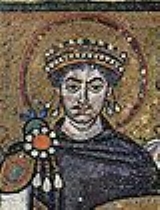
Flavius Petrus Sabbatius Iustinianus (; known in English as Justinian I or Justinian the Great), AD 482 or 483 – 13 or 14 November 565, was the second member of the Justinian Dynasty
Justinian Dynasty

The Justinian Dynasty is a family who ruled over the Byzantine Empire from 518 to 602. It originated with Justin I and ended with Maurice .* Justin I - ...
 (after his uncle, Justin I
Justin I

Flavius Iustinus , known in English as Justin I, was a List of Byzantine Emperors , who rose through the ranks of the army of the Byzantine Empire and ultimately became its emperor, in spite of the fact he was illiterate and almost seventy years old at the time of accession....
) and Eastern Roman Emperor
List of Roman Emperors

The title of Roman Emperor, although in some ways a modern concept, effectively summarises the position held by those individuals who wielded power in the Roman Empire....
 from 527 until his death. He is considered a saint
Saint

A saint in Christianity is a human being who has been called to holiness. The term is used differently by various denominations, with some, such as the Anglicans, Methodists, and Lutherans distinguishing between Saints and saints....
 amongst Eastern Orthodox Christians, and is also commemorated by some Lutheran Churches.

One of the most important figures of Late Antiquity
Late Antiquity

Late Antiquity is a periodization used by historians to describe the transitional centuries from Classical antiquity to the Middle Ages, in both mainland Europe and the Mediterranean world: generally from the end of the Roman Empire's Crisis of the Third Century to the Islamic conquests and the re-organization of the Byzantine Empire under...
, Justinian's rule constitutes a distinct epoch in the history of the Byzantine Empire
Byzantine Empire

Byzantine Empire and Eastern Roman Empire are conventional names used to describe the Roman Empire during the Middle Ages, centered on its capital of Constantinople....
.


Discussion
Ask a question about 'Justinian I'
Start a new discussion about 'Justinian I'
Answer questions from other users
Full Discussion Forum


Recent Posts


Timeline

483   Born

521   Future Byzantine emperor Justinian becomes consul. Ma`adikarib Ya`fur's campaign to Mesopotamia

523   Justinian, later Byzantine emperor, marries Theodora.

527   Byzantine Emperor Justin I names his nephew Justinian I as co-ruler and successor to the throne.

527   Justin I of the Eastern Roman Empire dies and Justinian I remains the sole Emperor.

528   Justinian appoints a commission (including the jurist Tribonian) to codify all imperial laws that were still in force from Hadrian to the current date. (This becomes the ''Corpus Juris Civilis''.)

529   first draft of Corpus Juris Civilis (a fundamental work in jurisprudence) is issued by Justinian I

530   Justinian I selects a second commission to excerpt and codify the writings of the jurists on Roman Law. This becomes the ''Pandects (Digest)''.

532   Justinian I orders the building of a new cathedral - begin of the construction of the Hagia Sophia.

535   Justinian I orders Belisarius to start the reconquest of Italy; Mundus simultaneously invades Dalmatia.


Encyclopedia


Flavius Petrus Sabbatius Iustinianus (; known in English as Justinian I or Justinian the Great), AD 482 or 483 – 13 or 14 November 565, was the second member of the Justinian Dynasty
Justinian Dynasty

The Justinian Dynasty is a family who ruled over the Byzantine Empire from 518 to 602. It originated with Justin I and ended with Maurice .* Justin I - ...
 (after his uncle, Justin I
Justin I

Flavius Iustinus , known in English as Justin I, was a List of Byzantine Emperors , who rose through the ranks of the army of the Byzantine Empire and ultimately became its emperor, in spite of the fact he was illiterate and almost seventy years old at the time of accession....
) and Eastern Roman Emperor
List of Roman Emperors

The title of Roman Emperor, although in some ways a modern concept, effectively summarises the position held by those individuals who wielded power in the Roman Empire....
 from 527 until his death. He is considered a saint
Saint

A saint in Christianity is a human being who has been called to holiness. The term is used differently by various denominations, with some, such as the Anglicans, Methodists, and Lutherans distinguishing between Saints and saints....
 amongst Eastern Orthodox Christians, and is also commemorated by some Lutheran Churches.

One of the most important figures of Late Antiquity
Late Antiquity

Late Antiquity is a periodization used by historians to describe the transitional centuries from Classical antiquity to the Middle Ages, in both mainland Europe and the Mediterranean world: generally from the end of the Roman Empire's Crisis of the Third Century to the Islamic conquests and the re-organization of the Byzantine Empire under...
, Justinian's rule constitutes a distinct epoch in the history of the Byzantine Empire
Byzantine Empire

Byzantine Empire and Eastern Roman Empire are conventional names used to describe the Roman Empire during the Middle Ages, centered on its capital of Constantinople....
. The impact of his administration extended far beyond the boundaries of his time and empire. Justinian's reign is marked by the ambitious but ultimately failed renovatio imperii, or "restoration of the empire". This ambition was expressed in the partial recovery of the territories of the Western Roman Empire
Western Roman Empire

The Western Roman Empire refers to the western half of the Roman Empire, from its division by Diocletian in 285; the other half of the Roman Empire was the Eastern Roman Empire, today widely known as the Byzantine Empire....
, including the city of Rome
Rome

Rome is the capital city of Italy and Lazio, and is Italy's largest and most populous city, with 2,724,347 residents in an urban area of some ....
 itself. A still more resonant aspect of his legacy was the uniform rewriting of Roman law, the Corpus Juris Civilis
Corpus Juris Civilis

The Corpus Juris Civilis is the modern name for a collection of fundamental works in jurisprudence, issued from 529 to 534 by order of Justinian I, Byzantine Emperors....
, which is still the basis of civil law
Civil law (legal system)

Civil law is a most prevalent legal system in the modern world and the oldest in human history. It is based on a code, or "a systematic collection of interrelated articles written in a terse, staccato style." The two other major legal systems in the world are common law and Islamic law....
 in many modern states. His reign also marked a blossoming of Byzantine culture, and his building program yielded such masterpieces as the church of Hagia Sophia
Hagia Sophia

Hagia Sophia is a former Patriarchate basilica, later a mosque, now a museum in Istanbul, Turkey. Famous in particular for its massive dome, it is considered the epitome of Byzantine architecture....
, which was to be the center of Eastern Orthodox Christianity
Eastern Orthodox Church

The Eastern Orthodox Church is the second largest single Christian communion in the world with an estimated 225 million members worldwide. It is considered by its adherents to be the Four Marks of the Church established by Jesus Christ and his Apostles nearly 2000 years ago....
 for many centuries.

A devastating outbreak
Plague of Justinian

The Plague of Justinian was a pandemic that afflicted the Byzantine Empire, including its capital Constantinople, in the years 541?542 AD. The most commonly accepted cause of the pandemic is bubonic plague, which later became infamous for either causing or contributing to the Black Death of the 14th century....
 of bubonic plague
Bubonic plague

Plague is a deadly infectious disease caused by the Enterobacteriaceae Yersinia pestis . Plague is a zoonotic, primarily carried by rodents and spread to humans via fleas....
 in the early 540s marked the end of an age of splendor. The empire entered a period of territorial decline not to be reversed until the ninth century.

Procopius
Procopius

Procopius of Caesarea was a prominent Byzantine Empire scholar of the family Procopius . A participant himself in the wars of the Emperor Justinian I, he was the major historian of the 6th century, writing the Wars of Justinian, the Buildings of Justinian and the celebrated Secret History....
 provides our primary source for the history of Justinian's reign. The Syriac chronicle of John of Ephesus
John of Ephesus

John of Ephesus was a leader of the Oriental Orthodoxy Syriac-speaking Church in the sixth century, and one of the earliest and most important of historians who wrote in Syriac....
, which does not survive, was used as a source for later chronicles, contributing many additional details of value. Both historians became very bitter towards Justinian and his empress, Theodora
Theodora (6th century)

Theodora , was empress of the Byzantine Empire and the wife of Emperor Justinian I. Like her husband, she is a saint in the Eastern Orthodoxy, commemorated on November 14....
. Procopius also wrote the Anekdota
Procopius

Procopius of Caesarea was a prominent Byzantine Empire scholar of the family Procopius . A participant himself in the wars of the Emperor Justinian I, he was the major historian of the 6th century, writing the Wars of Justinian, the Buildings of Justinian and the celebrated Secret History....
 (the so-called Secret History), which reports on various scandals at Justinian's court. Other sources include the histories of Agathias
Agathias

Agathias or Agathias Scholasticus , of Myrina , an Aeolian city in western Asia Minor, was a Greece poet and the historian who is a principal source for that part of the reign of Justinian I covered in his history....
, Menander Protector
Menander Protector

Menander Protector, Byzantine Empire historian, was born in Constantinople in the middle of the 6th century AD. The little that is known of his life is contained in the account of himself quoted by Suidas....
, John Malalas
John Malalas

John Malalas or Ioannes Malalas was a , Byzantine Empire chronicler. He was born at Antioch....
, the Paschal Chronicle, the chronicles of Marcellinus Comes
Marcellinus Comes

Marcellinus Comes was a Byzantine Empire chronicler....
 and Victor of Tunnuna
Victor of Tunnuna

Victor of Tunnuna was bishop of the Africa Province town of Tunnuna and a chronicler from Late Antiquity.What little information we have on his life is derived from entries in his own chronicle....
.

Life

Justinian was born Petrus Sabbatius at Tauresium
Tauresium

Tauresium is a fortified settlement from the Early Byzantine empire period . The ancient town was the birthplace of Emperor Justinian I. It is located in Zelenikovo Municipality near Skopje, Republic of Macedonia and it was later renamed "Justiniana Prima" in his honor....
 in the Roman province
Roman province

In Ancient Rome, a province was the basic, and until the Tetrarchy , largest territorial and administrative unit of the empire's territorial possessions outside of the Italia ....
 of Dardani
Dardani

The Dardani were an ancient Balkan tribe, of mixed Thraco-Illyrian origin. In the 1st century BC, they invaded the Roman Empire province of Macedonia together with the Scordisci and the Maedi....
a around AD 481–483. His Latin
Latin

Latin is an Italic language, historically spoken in Latium and Ancient Rome. Through the Military history of the Roman Empire, Latin spread throughout the Mediterranean and a large part of Europe....
-speaking peasant
Peasant

A peasant is an agriculture worker who subsists by working a small plot of ground. The word is derived from 15th century French language pa?sant meaning one from the pays, or rural, ultimately from the Latin pagus, or outlying administrative district ....
 family is believed to have been of Thraco-Roman
Thraco-Roman

The term Thraco-Roman refers to the culture and language of the Thracians peoples who were incorporated into the Roman Empire and ultimately fell under the Ancient Rome and Latin language sphere of influence....
 or Illyro-Roman
Illyro-Roman

Illyro-Roman is a term used to describe the Romanized Illyrian population within the ancient Roman provinces of Illyricum, Moesia and Dardania....
 origins. The cognomen
Cognomen

The cognomen was originally a middle name of a citizen of Ancient Rome, under Roman naming conventions. The cognomen started as a nickname, but lost that purpose when it became hereditary ....
 Iustinianus which he took later is indicative of adoption by his uncle Justin
Justin I

Flavius Iustinus , known in English as Justin I, was a List of Byzantine Emperors , who rose through the ranks of the army of the Byzantine Empire and ultimately became its emperor, in spite of the fact he was illiterate and almost seventy years old at the time of accession....
. During his reign, he founded Justiniana Prima
Justiniana Prima

Justiniana Prima was a Byzantine Empire city. Its location is not known: it could have been in today southern Serbia near today's Leskovac, or near Skopje in the Republic of Macedonia....
 not far from his birthplace. His mother was Vigilantia, the sister of Justin. Justin, who was in the imperial guard (the Excubitors
Excubitors

The Excubitors were the imperial guards of the early Byzantine emperors, and later one of the elite Tagmata units....
) before he became emperor, adopted Justinian, brought him to Constantinople
Constantinople

Constantinople was the empire capital of the Roman Empire , the Byzantine Empire , the Latin Empire , and the Ottoman Empire . Strategically located between the Golden Horn and the Sea of Marmara at the point where Europe meets Asia, Byzantine Constantinople had been the capital of a Christendom empire, successor to ancient ancient Greece...
, and ensured the boy's education. As a result, Justinian was well educated in jurisprudence
Jurisprudence

Jurisprudence is the theory and philosophy of law. Scholars of jurisprudence, or legal philosophers, hope to obtain a deeper understanding of the nature of law, of legal reasoning, legal systems and of legal institutions....
, theology
Theology

Theology is the study of the existence or attributes of a deity or gods, or more generally the study of religion or spirituality. It is sometimes contrasted with religious studies: theology is understood as the study of religion from an internal perspective , and religious studies as the study of religion from an external perspective....
 and Roman history. Justinian served for some time with the Excubitors but the details of his early career are unknown.

When Emperor Anastasius
Anastasius I (emperor)

Flavius Anastasius or Anastasius I was Byzantine Emperor from 11 April 491 until his death. He was born at Dyrrhachium not later than 430/431....
 died in 518, Justin was proclaimed the new emperor, with significant help from Justinian. During Justin's reign (518-527), Justinian was the emperor's close confidant. Justinian showed much ambition, and it has been thought that he was functioning as virtual regent long before Justin made him associate emperor on 1 April 527, although there is no conclusive evidence for this. As Justin became senile near the end of his reign, Justinian became the de facto ruler. Justinian was appointed consul
Consul

Consul was the highest elected office of the Roman Republic and an appointive office under the Roman Empire. The title was also used in other city states, and revived in modern states, notably French Republic before the Napoleon I of Franceic counter-revolution....
 in 521, and later commander of the army of the east. Upon Justin I
Justin I

Flavius Iustinus , known in English as Justin I, was a List of Byzantine Emperors , who rose through the ranks of the army of the Byzantine Empire and ultimately became its emperor, in spite of the fact he was illiterate and almost seventy years old at the time of accession....
's death on 1 August 527, Justinian became the sole sovereign.

Diptych Barberini Louvre Oa9063 Whole
As a ruler, Justinian showed great energy. He was known as "the Emperor who never sleeps" on account of his work habits. Nevertheless, he seems to have been amenable and easy to approach. Justinian's family came from a lowly and provincial background, and therefore he had no power base in the traditional aristocracy of Constantinople. Instead, he surrounded himself with men and women of extraordinary talent, whom he selected not on the basis of aristocratic origin, but on the basis of merit. Around 525 he married in Constantinople Theodora
Theodora (6th century)

Theodora , was empress of the Byzantine Empire and the wife of Emperor Justinian I. Like her husband, she is a saint in the Eastern Orthodoxy, commemorated on November 14....
, who was by profession a courtesan
Courtesan

A courtesan is mainly what one may call a high-class prostitute. A courtesan would offer her charms and sexual pleasures, generally and more usually to people of substantial wealth, in return for a good and respectable living, especially during hard times of poverty....
 about 20 years his junior. Justinian would have, in earlier times, been unable to marry her because of her class, but his uncle Emperor Justin I had passed a law allowing intermarriage between social classes. Theodora would become very influential in the politics of the Empire, and later emperors would follow Justinian's precedent in marrying outside the aristocratic class. The marriage caused a scandal, but Theodora would prove to be very intelligent, "street smart", a good judge of character and Justinian's greatest supporter. Other talented individuals included Tribonian
Tribonian

File:Tribonian bas-relief in the U.S. House of Representatives chamber.jpgTribonian was a jurist during the reign of the Byzantine emperor Justinian I, who revised the Roman Law of the Roman Empire....
, his legal adviser; his finance ministers John the Cappadocian
John the Cappadocian

A different John the Cappadocian was List of Patriarchs of Constantinople from 518-520. See John of Cappadocia.John the Cappadocian was a praetorian prefect in the Byzantine Empire under Emperor Justinian I....
 and Peter Barsymes, who managed to collect taxes more efficiently than any before, thereby funding Justinian's wars; and finally, his prodigiously talented general Belisarius
Belisarius

Flavius Belisarius is often described as one of the greatest generals of the Byzantine Empire. He was instrumental to Byzantine Emperor Justinian I's ambitious project of reconquering much of the Western Roman Empire, which had been lost just under a century previously....
.

Justinian's rule was not universally popular; early in his reign he almost lost his throne during the Nika riots
Nika riots

The Nika riots , or Nika revolt, took place over the course of a week in Constantinople in 532. It was the most violent riot that Constantinople had ever seen to that point, with nearly half the city being burned or destroyed and tens of thousands of people killed....
, and a conspiracy against the emperor's life by dissatisfied businessmen was discovered as late as 562.

Justinian was struck by the plague
Plague of Justinian

The Plague of Justinian was a pandemic that afflicted the Byzantine Empire, including its capital Constantinople, in the years 541?542 AD. The most commonly accepted cause of the pandemic is bubonic plague, which later became infamous for either causing or contributing to the Black Death of the 14th century....
 in the early 540s, but recovered. Theodora died, perhaps of cancer, in 548, at a relatively young age, and Justinian outlived her by almost twenty years. Justinian, who had always had a keen interest in theological matters and actively participated in debates on Christian doctrine, became even more devoted to religion during the later years of his life. When he died, on the night of November 13-14 of the year 565, he left no children. He was succeeded by Justin II
Justin II

Flavius Iustinus Augustus was Eastern Roman emperor from 565 to 578. He was the nephew of Justinian I, and husband of Sophia , the niece of the late empress Theodora , and therefore member of the Justinian Dynasty....
, the son of his sister Vigilantia, who was married to Sophia, the niece of Empress Theodora. Justinian's body was entombed in a specially built mausoleum in the Church of the Holy Apostles
Church of the Holy Apostles

The Church of the Holy Apostles , also known as the Imperial Polyandreion, was a Christian basilica built in Constantinople in 550. It was second only to the Hagia Sophia among the great churches of the Eastern Empire....
.

Legislative activities

Justinian achieved lasting fame through his judicial reforms, particularly through the complete revision of all Roman law
Roman law

Roman law is the law system of ancient Rome. As used in the West the term commonly refers to legal developments prior to the Roman/Byzantine state's adopting Greek language as its official language in the 7th century....
, something that had not previously been attempted. The total of Justinian's legislature is known today as the Corpus juris civilis
Corpus Juris Civilis

The Corpus Juris Civilis is the modern name for a collection of fundamental works in jurisprudence, issued from 529 to 534 by order of Justinian I, Byzantine Emperors....
. It consists of the Codex Justinianus, the Digesta or Pandectae, the Institutiones, and the Novellae.

Early in his reign, Justinian appointed the quaestor
Quaestor

Quaestor is a type of public official.In the Roman Republic a quaestor was an elected official who supervised the treasury and financial affairs of the state, its armies and its officers....
 Tribonian
Tribonian

File:Tribonian bas-relief in the U.S. House of Representatives chamber.jpgTribonian was a jurist during the reign of the Byzantine emperor Justinian I, who revised the Roman Law of the Roman Empire....
 to oversee this task. The first draft of the Codex Justinianus, a codification of imperial constitutions from the 2nd century onward, was issued on 7 April 529. (The final version appeared in 534.) It was followed by the Digesta (or Pandectae), a compilation of older legal texts, in 533, and by the Institutiones, a textbook explaining the principles of law. The Novellae, a collection of new laws issued during Justinian's reign, supplements the Corpus. As opposed to the rest of the corpus, the Novellae appeared in Greek
Greek language

Greek is an Indo-European languages native to the southern Balkan peninsula, the language of the Greek people. It forms an independent branch within Indo-European....
, the common language of the Eastern Empire; Latin
Latin

Latin is an Italic language, historically spoken in Latium and Ancient Rome. Through the Military history of the Roman Empire, Latin spread throughout the Mediterranean and a large part of Europe....
, the traditional language of the Roman Empire
Roman Empire

The Roman Empire was the Roman Republic phase of the Ancient Rome, characterised by an autocracy form of government and large territorial holdings in Europe and around the Mediterranean....
, was only poorly understood by most citizens of the Eastern Empire.

The Corpus forms the basis of Latin jurisprudence (including ecclesiastical Canon Law
Canon law (Catholic Church)

Canon Law, the ecclesiastical law of the Catholic Church, is a fully developed legal system, with all the necessary elements: courts, lawyers, judges, a fully articulated legal code and principles of legal interpretation....
) and, for historians, provides a valuable insight into the concerns and activities of the later Roman Empire. As a collection it gathers together the many sources in which the leges (laws) and the other rules were expressed or published: proper laws, senatorial
Roman Senate

The Senate of the Roman Republic was a political institution in the ancient Roman Republic. According to the Greek historian Polybius, our principal source on the Constitution of the Roman Republic, the Roman Senate was the predominant branch of government....
 consults (senatusconsulta), imperial decrees, case law
Case law

Case law is the general term for the principles and rules of law set forth in judge legal opinion from courts of law. Case law incorporates courts' decisions from individual legal case and encompasses courts' interpretations of statutes, constitution provisions, administrative law regulations and, in some cases, law originating solely f...
, and jurists' opinions and interpretations (responsa prudentum).

Tribonian's code ensured the survival of Roman law. It formed the basis of later Byzantine law, as expressed in the Basilika
Basilika

The Basilika is the name which is used to indicate a code of law issued by the Byzantine emperor Leo VI the Wise. It is an adaptation, written in Greek, of the late classical Codex Justinianus to the conditions of the 9th- and 10th-century Byzantine Empire, or Byzantine Empire, Empire....
 of Basil I
Basil I

Basil I, called the Macedonian was a Byzantine Empire. He was perceived by Byzantines as one of their greatest emperors, the founder of one the most splendid imperial dynasties of Byzantium, the Macedonian dynasty , and the initiator of a Macedonian Renaissance of Byzantine art....
 and Leo VI the Wise
Leo VI the Wise

Leo VI "the Wise" or "the Philosopher" , was Byzantine emperor from 886 to 912 during one of the most brilliant periods of the state's history...
. The only western province where the Justinianic code was introduced was Italy (after the conquest, by the so-called Pragmatic Sanction
Pragmatic sanction

A pragmatic sanction is a sovereign's solemn decree on a matter of primary importance and has the force of fundamental law. In the late history of the Holy Roman Empire it referred more specifically to an edict issued by the Emperor....
 of 554), from where it was to pass to Western Europe
Western Europe

Western Europe refers to the countries in the western most half of Europe. This concept has had different meanings, political and cultural as well as geographical issues have influenced the area....
 in the 12th century and become the basis of much European law code. It eventually passed to Eastern Europe
Eastern Europe

Eastern Europe is a term that applies to the geopolitical region encompassing the easternmost part of the Europe. Throughout history and to a lesser extent today, parts of Eastern Europe has been distinguishable from Western Europe and other regions due to cultural, religious, economic, and historical reasons, even though there i...
 where it appeared in Slavic editions, and it also passed on to Russia
Russia

Russia , or the Russian Federation , is a list of countries spanning more than one continent country extending over much of northern Eurasia....
. It remains influential to this day.

Nika riots

Justinian's habit of choosing efficient, but unpopular advisors nearly cost him his throne early in his reign. In January 532, partisans of the chariot racing
Chariot racing

Chariot racing was one of the most popular Ancient Greece, Roman Empire and Byzantine empire sports. Chariot racing was often dangerous to both driver and horse?they frequently suffered serious injury and even death?but generated strong spectator enthusiasm....
 factions in Constantinople, normally divided among themselves, united against Justinian in a revolt that has become known as the Nika riots
Nika riots

The Nika riots , or Nika revolt, took place over the course of a week in Constantinople in 532. It was the most violent riot that Constantinople had ever seen to that point, with nearly half the city being burned or destroyed and tens of thousands of people killed....
. They forced him to dismiss Tribonian
Tribonian

File:Tribonian bas-relief in the U.S. House of Representatives chamber.jpgTribonian was a jurist during the reign of the Byzantine emperor Justinian I, who revised the Roman Law of the Roman Empire....
 and two of his other ministers, and then attempted to overthrow Justinian himself and replace him by the senator Hypatius
Hypatius

Hypatius was a Byzantine empire noble of Imperial descent who held the position of commander in the east during the reign of Justin I.Hypatius was the nephew of Anastasius I of the Byzantine Empire who ruled before Justin and he also was associated by marriage to Anicii Juliana Anicia, which gave him a serious claim to the diadem....
, who was a nephew of the late emperor Anastasius
Anastasius I (emperor)

Flavius Anastasius or Anastasius I was Byzantine Emperor from 11 April 491 until his death. He was born at Dyrrhachium not later than 430/431....
. While the crowd was rioting in the streets, Justinian considered fleeing the capital, but he remained in the city on the stirring words of Theodora
Theodora (6th century)

Theodora , was empress of the Byzantine Empire and the wife of Emperor Justinian I. Like her husband, she is a saint in the Eastern Orthodoxy, commemorated on November 14....
. In the next two days, he ordered the brutal suppression of the riots by his generals Belisarius
Belisarius

Flavius Belisarius is often described as one of the greatest generals of the Byzantine Empire. He was instrumental to Byzantine Emperor Justinian I's ambitious project of reconquering much of the Western Roman Empire, which had been lost just under a century previously....
 and Mundus. Procopius relates that 30,000 unarmed civilians were killed in the Hippodrome. On Theodora's insistence, and apparently against his own judgment, Justinian had Anastasius' nephews executed.

The destruction that had taken place during the revolt provided Justinian with an opportunity to tie his name to a series of splendid new buildings, most notably the architectural innovation of the domed Hagia Sophia
Hagia Sophia

Hagia Sophia is a former Patriarchate basilica, later a mosque, now a museum in Istanbul, Turkey. Famous in particular for its massive dome, it is considered the epitome of Byzantine architecture....
.

Military activities

One of the most spectacular features of Justinian's reign was the recovery of large stretches of land around the Western Mediterranean basin which had slipped out of imperial control in the 5th century. As a Christian Roman emperor, Justinian considered it his divine duty to restore the Roman Empire
Roman Empire

The Roman Empire was the Roman Republic phase of the Ancient Rome, characterised by an autocracy form of government and large territorial holdings in Europe and around the Mediterranean....
 to its ancient boundaries. Although he never personally took part in military campaigns, he boasted of his successes in the prefaces to his laws and had them commemorated in art. The reconquests were in large part carried out by his general Belisarius
Belisarius

Flavius Belisarius is often described as one of the greatest generals of the Byzantine Empire. He was instrumental to Byzantine Emperor Justinian I's ambitious project of reconquering much of the Western Roman Empire, which had been lost just under a century previously....
.

War with the Sassanid Empire, 527-532

From his uncle, Justinian inherited ongoing hostilities with the Sassanid Empire
Sassanid Empire

The Sassanid Empire or Sassanian Dynasty is the name of the last pre-Islamic Iranian empire. It was one of the two main powers in Western Asia for a period of more than 400 years....
. In 530 a Persian army was defeated at Daraa, but the next year saw the defeat of Roman forces under Belisarius near Callinicum
Battle of Callinicum

The Battle of Callinicum took place between the armies of the Eastern Roman Empire under the command of General Belisarius and Sassanid Empire under Azarethes on 19 April AD 531 during the Iberian War....
. When king Kavadh I of Persia died (September 531), Justinian concluded an "Eternal Peace" (which cost him 11,000 pounds of gold) with his successor Khosrau I
Khosrau I

Khosrau I or Khosrow I , also known as Anushiravan the Just , was the favourite son and successor of Kavadh I , twentieth Sassanid Empire Emperor of Persia, and the most famous and celebrated of the Sassanid Emperors....
 (532). Having thus secured his eastern frontier, Justinian turned his attention to the West, where Arian
Arianism

Arianism is the theological teaching of Arius , a Christian priest, who was first ruled a heresy at the First Council of Nicea, later exonerated and then pronounced a heretic again after his death....
 Germanic
Germanic peoples

File:Germanische-ratsversammlung 1-1250x715.jpgThe Germanic peoples are a historical Ethnolinguistics group, originating in Northern Europe and identified by their use of the Indo-European languages Germanic languages which diversified out of Common Germanic in the course of the Pre-Roman Iron Age....
 kingdoms had been established in the territories of the former Western Roman Empire
Western Roman Empire

The Western Roman Empire refers to the western half of the Roman Empire, from its division by Diocletian in 285; the other half of the Roman Empire was the Eastern Roman Empire, today widely known as the Byzantine Empire....
.

Conquest of North Africa, 533–534

The first of the western kingdoms Justinian attacked was that of the Vandals
Vandals

The Vandals were an East Germanic tribe that entered the late Roman Empire during the 5th century. The Goths Theodoric the Great, king of the Ostrogoths and regent of the Visigoths, was allied by marriage with the Vandals as well as with the Burgundians and the Franks under Clovis I....
 in North Africa
North Africa

North Africa or Northern Africa is the northernmost region of the African continent, separated by the Sahara from Sub-Saharan Africa.Geopolitically, the United Nations subregion of Northern Africa includes the following seven countries or territories:...
. King Hilderic
Hilderic

Hilderic, King of the Vandals and Alans was the pentultimate ruler of the North Africa during the Classical Period Kingdom of the Vandals. Although dead by the time the Vandal Kingdom was overthrown in 534, he nevertheless played a key role in that event....
, who had maintained good relations with Justinian and the North African Catholic
Roman Catholic Church

The Roman Catholic Church, officially known as the Catholic Church is the world's largest Christianity Ecclesia , representing over half of all Christians and one-sixth of the world population....
 clergy, had been overthrown by his cousin Gelimer
Gelimer

Gelimer , King of the Vandals and Alans from 530 to 534, was the last ruler of the North Africa during the Classical Period Kingdom of the Vandals....
 in 530. Imprisoned, the deposed king appealed to Justinian.

In 533, Belisarius
Belisarius

Flavius Belisarius is often described as one of the greatest generals of the Byzantine Empire. He was instrumental to Byzantine Emperor Justinian I's ambitious project of reconquering much of the Western Roman Empire, which had been lost just under a century previously....
 with a fleet of 92 dromons escorting 500 transports, landed at Caput Vada (modern Ras Kaboudia) in modern Tunisia
Tunisia

Tunisia , officially the Tunisian Republic , is a country located in North Africa. It is bordered by Algeria to the west and Libya to the southeast....
 with an army of about 15,000 men, as well as a number of barbarian troops. They defeated the Vandals, who were caught completely off-guard, at Ad Decimum on 14 September 533 and Tricamarum in December; Belisarius took Carthage
Carthage

Carthage refers both to an ancient city in present-day Tunisia, and a modern-day suburb of Tunis. The civilization that developed within the city's sphere of influence is referred to as Punic or Carthaginian....
. King Gelimer
Gelimer

Gelimer , King of the Vandals and Alans from 530 to 534, was the last ruler of the North Africa during the Classical Period Kingdom of the Vandals....
 fled to Mount Pappua in Numidia
Numidia

Numidia was an ancient Berber people kingdom in present-day Algeria and part of Tunisia that later alternated between being a Roman province and being a Roman client state, and is no longer in existence today....
, but surrendered the next spring. He was taken to Constantinople, where he was paraded in a triumph
Roman triumph

A Roman triumph was a civil religion and religious rite of ancient Rome, held to publically celebrate the achievements of an army commander who had won great military successes, originally and traditionally, who had successfully completed a war....
. Sardinia
Sardinia

Sardinia is the Mediterranean islands#By area island in the Mediterranean Sea . The area of Sardinia is . The island is surrounded by the France island of Corsica, the Italian Peninsula, Tunisia and the Balearic Islands....
 and Corsica
Corsica

Corsica is the Mediterranean islands#By area in the Mediterranean Sea . It is located west of Italy, southeast of the France mainland, and north of the island of Sardinia....
, the Balearic Islands
Balearic Islands

The Balearic Islands are an archipelago in the western Mediterranean Sea, near the eastern coast of the Iberian Peninsula.The four largest islands are Majorca, Minorca, Ibiza, and Formentera....
, and the stronghold Septem near Gibraltar
Gibraltar

Gibraltar is a British overseas territory located near the southernmost tip of the Iberian Peninsula overlooking the Strait of Gibraltar. The territory shares a border with Spain to the north....
 were recovered in the same campaign.

An African prefecture
Praetorian prefecture of Africa

The Praetorian prefecture of Africa was a major administrative division of the Eastern Roman Empire, established after the reconquest of northwestern Africa from the Vandals in 533-534 by emperor Justinian I....
 was established in April 534, but it would teeter on the brink of collapse during the next 15 years, amidst warfare with the Moors
Moors

In the Spanish language, the term for Moors is Moro; in Portuguese language the word is mouro. There seems to have been some confusion about the relationship of the word moro/mouro to the word moreno , both from Greek language ma?ros, i.e....
 and military mutinies. The area was not completely pacified until 548, but remained peaceful thereafter and enjoyed a measure of prosperity. The recovery of Africa cost the empire about 100,000 pounds of gold.

War in Italy, first phase, 535–540

As in Africa, dynastic struggles in Ostrogothic Italy provided an opportunity for intervention. The young king Athalaric
Athalaric

Athalaric was the King of the Ostrogoths in Italy. The grandson of Theodoric the Great, he became king upon his grandfather's death in 526.As Athalaric was only ten years old, the regency was assumed by his mother, Amalasuntha....
 had died on 2 October 534, and an usurper, Theodahad
Theodahad

File:Theodahad.jpgFile:Theodahad_534_536_Ostrogoth_minted_in_Rome.jpgTheodahad was the King of the Ostrogoths from 534 to 536 and a nephew of Theodoric the Great through his sister....
, had imprisoned queen Amalasuntha
Amalasuntha

Amalasuntha was a queen of the Ostrogoths from 516 to 534.A daughter of Ostrogothic king Theodoric the Great, she secretly married a slave named Traguilla....
, Theodoric
Theodoric

Theodoric is a Germanic languages given name frequently encountered in early medieval European history. Variant spellings include forms such as Theoderic, Theudoric, Theuderic, or Theuderich....
's daughter and mother of Athalaric, on an island in Lake Bolsena
Lake Bolsena

Lake Bolsena is a crater lake of central Italy, of volcano origin, which was formed 370,000 years ago following the collapse of a caldera of the Vulsini volcanic complex ....
, where he had her assassinated in 535. Thereupon Belisarius
Belisarius

Flavius Belisarius is often described as one of the greatest generals of the Byzantine Empire. He was instrumental to Byzantine Emperor Justinian I's ambitious project of reconquering much of the Western Roman Empire, which had been lost just under a century previously....
 with 7,500 men invaded Sicily
Sicily

Sicily is an Autonomous regions with special statute of Italy. Of all the regions of Italy, Sicily covers the largest land area at 25,708 km? and currently has just over five million inhabitants....
 (535) and advanced into Italy, sacking Naples
Naples

Naples is a city in southern Italy, the capital of the region of Campania and of the province of Naples. The city is known for its rich history, art, culture and gastronomy, playing an important role throughout much of its existence; it is over 2,800 years old....
 and capturing Rome
Rome

Rome is the capital city of Italy and Lazio, and is Italy's largest and most populous city, with 2,724,347 residents in an urban area of some ....
 on 9 December 536. By that time Theodahad
Theodahad

File:Theodahad.jpgFile:Theodahad_534_536_Ostrogoth_minted_in_Rome.jpgTheodahad was the King of the Ostrogoths from 534 to 536 and a nephew of Theodoric the Great through his sister....
 had been deposed by the Ostrogothic army, who had elected Vitigis as their new king. He gathered a large army and besieged Rome
Rome

Rome is the capital city of Italy and Lazio, and is Italy's largest and most populous city, with 2,724,347 residents in an urban area of some ....
 from February 537 to March 538 without being able to retake the city. Justinian sent another general, Narses
Narses

Narses was, with Belisarius, one of the great generals in the service of the Eastern Roman Emperor Justinian I during the so-called "Reconquest" that took place during Justinian's reign....
, to Italy, but tensions between Narses and Belisarius hampered the progress of the campaign. Milan
Milan

Milan is the second largest city of Italy, located in the plains of Lombardy. It is the capital in the Province of Milan, as well as the Regions of Italy capital of Lombardy....
 was taken, but was soon recaptured and razed by the Ostrogoths. Justinian recalled Narses
Narses

Narses was, with Belisarius, one of the great generals in the service of the Eastern Roman Emperor Justinian I during the so-called "Reconquest" that took place during Justinian's reign....
 in 539. By then the military situation had turned in favour of the Romans, and in 540 Belisarius reached the Ostrogothic capital Ravenna
Ravenna

Ravenna is a city and comune in the Emilia-Romagna region of Italy. The city is inland, but is connected to the Adriatic Sea by a canal. Ravenna once served as the seat of the Western Roman Empire and later the Ostrogoths and the Exarchate of Ravenna....
. There he was offered the title of Western Roman Emperor by the Ostrogoths at the same time that envoys of Justinian were arriving to negotiate a peace which would leave the region north of the Po River
Po River

The Po is a river that flows 652 km eastward across northern Italy, from Monviso to the Adriatic Sea near Venice. It has a drainage area of 71,000 km? and is the longest river in Italy....
 in Gothic hands. Belisarius feigned to accept the offer, entered the city in May 540, and reclaimed it for the Empire. Then, having been recalled by Justinian, Belisarius returned to Constantinople, taking the captured Vitigis and his wife Matasuentha with him.

War with the Sassanid Empire, 540–562

Belisarius had been recalled in the face of renewed hostilities by the Persians
Sassanid Empire

The Sassanid Empire or Sassanian Dynasty is the name of the last pre-Islamic Iranian empire. It was one of the two main powers in Western Asia for a period of more than 400 years....
. Following a revolt against Byzantium in Armenia
Marzpanate Period

Marzpanate period refers to the period in History of Armenia after the fall of the Arshakuni Dynasty of Armenia in 428, when Marzpans , nominated by the Sassanid Persian King, governed the eastern part of Armenia....
 in the late 530s and possibly motivated by the pleas of Ostrogothic ambassadors, King Khosrau I
Khosrau I

Khosrau I or Khosrow I , also known as Anushiravan the Just , was the favourite son and successor of Kavadh I , twentieth Sassanid Empire Emperor of Persia, and the most famous and celebrated of the Sassanid Emperors....
 broke the "Eternal Peace" and invaded Roman territory in the spring of 540. He first sacked Beroea
Aleppo

Aleppo is a city in northern Syria, capital of the Aleppo Governorate; the Governorate extends around the city for over 16,000 km? and has a population of 4,393,000, making it the largest Governorate in Syria by population....
 and then Antioch
Antioch

Antioch on the Orontes was an ancient city on the eastern side of the Orontes River. It is near the modern city of Antakya, Turkey.Founded near the end of the 4th century BC by Seleucus I Nicator, one of Alexander the Great's generals, Antioch eventually rivaled Alexandria as the chief city of the nearer East and was a cradle of gentile hi...
 (allowing the garrison of 6,000 men to leave the city), besieged Daras, and then went on to attack the small but strategically significant satellite kingdom of Lazica
Lazic War

The Lazic War also known as the Great War of Egrisi in Georgian historiography and the Colchian War, was fought between the Byzantine Empire and Sassanid Empire for controlling the region of Lazica locally known as Egrisi, what is now western Georgia ....
 near the Black Sea
Black Sea

The Black Sea is an inland sea sea bounded by southeastern Europe, the Caucasus and the Anatolia and is ultimately connected to the Atlantic Ocean via the Mediterranean Sea and Aegean Seas and various straits....
, exacting tribute from the towns he passed along his way. He forced Justinian I to pay him 5,000 pounds of gold, plus 500 pounds of gold more each year.

Belisarius arrived in the East in 541, but, after some success, was again recalled to Constantinople in 542. The reasons for his withdrawal are not known, but it may have been instigated by rumours of disloyalty on behalf of the general reaching the court. The outbreak of the plague
Plague of Justinian

The Plague of Justinian was a pandemic that afflicted the Byzantine Empire, including its capital Constantinople, in the years 541?542 AD. The most commonly accepted cause of the pandemic is bubonic plague, which later became infamous for either causing or contributing to the Black Death of the 14th century....
 caused a lull in the fighting during the year 543. The following year Khosrau defeated a Byzantine army of 30,000 men, but unsuccessfully besieged the major city of Edessa
Edessa, Mesopotamia

Edessa is the historical name of a Assyrian/Chaldean/Syriac people town in northern Mesopotamia, refounded on an ancient site by Seleucus I Nicator....
. Both parties made little headway, and in 545 a truce was agreed upon for the southern part of the Roman-Persian frontier. After that the Lazic War
Lazic War

The Lazic War also known as the Great War of Egrisi in Georgian historiography and the Colchian War, was fought between the Byzantine Empire and Sassanid Empire for controlling the region of Lazica locally known as Egrisi, what is now western Georgia ....
 in the North continued for several years, until a second truce in 557, followed by a Fifty Years' Peace in 562. Under its terms, the Persians agreed to abandon Lazica in exchange for an annual tribute of 400 or 500 pounds of gold (30,000 solidi) to be paid by the Romans.

War in Italy, second phase, 541–554

While military efforts were directed to the East, the situation in Italy took a turn for the worse. Under their respective kings Ildibad
Ildibad

Ildibad was a king of the Ostrogoths in Italy, being chosen to replace Witiges, who had been engaged in complicated schemes with Belisarius and had left Ravenna....
 and Eraric
Eraric

Eraric was briefly King of the Ostrogoths. He was killed by a member of his royal guard....
 (both murdered in 541) and especially Totila
Totila

Totila was king of the Ostrogoths from 541 until his death. He waged the Gothic War against the Byzantine Empire for the mastery of Italy. Most of the historical evidence for Totila consists of chronicles by the Byzantine historian Procopius, who accompanied the Byzantine general Belisarius during the Gothic War....
, the Ostrogoths made quick gains. After a victory at Faenza
Faenza

Faenza is an Italy city and comune, in the province of Ravenna, Emilia-Romagna, situated 50 km southeast of Bologna.Faenza is noted for its manufacture of majolica ware glazed earthenware pottery, known from the name of the town as "faience"....
 in 542, they reconquered the major cities of Southern Italy and soon held almost the entire peninsula. Belisarius was sent back to Italy late in 544, but lacked sufficient troops. Making no headway, he was relieved of his command in 548. Belisarius succeeded in defeating a Gothic
Goths

The Goths were East Germanic tribes who, in the 3rd and 4th centuries, invasion the Roman Empire and later adopted Arian Christianity. In the 5th and 6th centuries, divided as the Visigoths and the Ostrogoths, they established powerful successor-states of the Roman Empire in the Iberian peninsula and Italy....
 fleet with 200 ships. During this period the city of Rome
Rome

Rome is the capital city of Italy and Lazio, and is Italy's largest and most populous city, with 2,724,347 residents in an urban area of some ....
 changed hands three more times, first taken and depopulated by the Ostrogoths in December 546, then reconquered by the Byzantines in 547, and then again by the Goths in January 550. Totila also plundered Sicily
Sicily

Sicily is an Autonomous regions with special statute of Italy. Of all the regions of Italy, Sicily covers the largest land area at 25,708 km? and currently has just over five million inhabitants....
 and attacked the Greek coastlines. Finally, Justinian dispatched a force of approximately 35,000 men (2,000 men were detached and sent to invade southern Visigothic Spain
Spain

Spain or the Kingdom of Spain , is a country located in Southern Europe on the Iberian Peninsula.The Spanish constitution does not establish any official denomination of the country, even though Espa?a , Estado espa?ol and Naci?n espa?ola are used interchangeably....
) under the command of Narses
Narses

Narses was, with Belisarius, one of the great generals in the service of the Eastern Roman Emperor Justinian I during the so-called "Reconquest" that took place during Justinian's reign....
. The army reached Ravenna in June 552, and defeated the Ostrogoths decisively within a month at the battle of Busta Gallorum in the Apennines
Apennine mountains

The Apennines or Apennine Mountains is a mountain range stretching 1000 km from the north to the south of Italy along its east coast, traversing the entire peninsula, and forming the backbone of the country....
, where Totila was slain. After a second battle at Mons Lactarius
Battle of Mons Lactarius

The Battle of Mons Lactarius took place in 553 during the Gothic War waged on behalf of Justinian I against the Ostrogoths in Italy.After the Battle of Taginae, in which the Ostrogoth king Totila was killed, the Byzantine Empire general Narses captured Rome and besieged Cumae....
 in October that year, the resistance of the Ostrogoths was finally broken. In 554, a large-scale Frankish
Franks

The Franks or Frankish people were a West Germanic ethnic group first identified in the 3rd century as living north and east of the Lower Rhine River....
 invasion was defeated at Casilinum, and Italy secured for the Empire, even though it would take Narses several years to reduce the remaining Gothic strongholds. At the end of the war, Italy was garrisoned with an army of 16,000 men. The recovery of Italy cost the empire about 300,000 pounds of gold.

Other campaigns

In addition to the other conquests, the Eastern Empire established a presence in Visigothic Spain
Spain

Spain or the Kingdom of Spain , is a country located in Southern Europe on the Iberian Peninsula.The Spanish constitution does not establish any official denomination of the country, even though Espa?a , Estado espa?ol and Naci?n espa?ola are used interchangeably....
, when the usurper Athanagild
Athanagild

Athanagild was Visigoths Visigothic Kingdom of Hispania .With the help of a Byzantine Empire force, including a fleet to watch the coasts, sent from Gaul in 551 by the emperor of the eastern Roman empire, Emperor Justinian, Athanagild defeated and killed his predecessor, King Agila, near Seville in 554....
 requested assistance in his rebellion against king Agila
Agila

Agila I was Visigoths Visigothic Kingdom of Hispania . During his reign, in 551, a rival to the throne, Athanagild, arranged that Justinian I, the Byzantine Emperor, should send a Roman Empire force from Gaul to seize lands in southern Hispania, forming the province of Spania....
. In 552, Justinian dispatched a force of 2,000 men under the octogenarian Liberius
Liberius (praetorian prefect)

Petrus Marcellinus Felix Liberius was a Late Roman aristocrat and official, whose career spanned seven decades in the highest offices of both the Ostrogothic Kingdom and the Eastern Roman Empire....
, who had served under the Ostrogoth kings of Italy since the 490s. The Byzantines took Cartagena
Cartagena, Spain

Cartagena is a Spanish Mediterranean city and Spanish Navy in the southeast of the Iberian Peninsula in the Region of Murcia.Cartagena has been the capital of the Naval Structure of the Spanish Navy in the New Millennium since the arrival of the House of Bourbon in the eighteenth century....
 and other cities on the southeastern coast and founded the new province of Spania
Spania

Spania was a Roman province of the Byzantine Empire from 552 until 624 in the south of the Iberian Peninsula and the Balearic Islands. It was a part of the conquests of Justinian I in an effort to restore the Western Roman Empire....
 before being checked by their former ally Athanagild, who had by now become king. This campaign marked the apogee of Byzantine expansion.

During Justinian's reign, the Balkans
Balkans

The Balkans is the historical name of a geographic subregion of southeastern Europe. The region takes its name from the Balkan Mountains, which run through the centre of Bulgaria into eastern Serbia....
 suffered from several incursions by the Turkic
Turkic peoples

The Turkic peoples are Eurasian peoples residing in northern, central and western Eurasia, and who mostly speak languages belonging to the Turkic languages....
 and Slavic peoples
Slavic peoples

The Slavic Peoples are a linguistic branch of Indo-European peoples, living mainly in eastern Europe. From the early 6th century they spread from their original homeland to inhabit most of eastern Central Europe, Eastern Europe and the Balkans....
 who lived north of the Danube
Danube

The Danube is the longest river in the European Union and Europe's second longest river after the Volga.The river originates in the Black Forest in Germany as the much smaller Brigach and Breg River rivers which join at the eponymously named German town Donaueschingen, after which it is known as the Danube and flows eastwards for a distance...
. Here, Justinian resorted mainly to a combination of diplomacy and a system of defensive works. In 559 a particularly dangerous invasion of Sklavinoi
Slavic peoples

The Slavic Peoples are a linguistic branch of Indo-European peoples, living mainly in eastern Europe. From the early 6th century they spread from their original homeland to inhabit most of eastern Central Europe, Eastern Europe and the Balkans....
 and Kutrigurs
Kutrigurs

The Kutrigurs were a horde of equestrian nomads later known as part of the Bulgars that inhabited the Eurasian plains during the Dark Ages. They came into existence when the Eurasian Avars conquered half of the Hunno-Bulgars, whilst the remaining group, who were free were called Utigurs....
 under their khan Zabergan
Zabergan

Zabergan, Samur Khan, or Sam-Or Khan , associated with the Pseudo-Avars either under orders or in revolt from them, led the Cozarigs in attacks against Justinian I's northern frontier in 559....
 threatened Constantinople, but they were repulsed by the aged general Belisarius.

Results

Justinien 527 565
Justinian's ambition to restore the Roman Empire to its former glory was only partly realised. In the West, the brilliant early military successes of the 530s were followed by years of stagnation. The dragging war with the Goths was a disaster for Italy, even though its long-lasting effects may have been less severe than is sometimes thought. The heavy taxes that the administration imposed upon its population were deeply resented. While the final victory in Italy and the conquest of the coast of southern Spain significantly enlarged the area over which Byzantium could project its power and influence, and while they must have contributed to the empire's prestige, most of the conquests proved ephemeral. The greater part of Italy would be lost to the invading Lombards
Lombards

The Lombards were a Germanic peoples originally from Northern Europe who settled in the valley of the Danube and from there invaded Byzantine Italian peninsula in 568 under the leadership of Alboin....
 three years after Justinian's death (568), and within a century and a half Africa and Spain were forever lost for the empire.

Events of the later years of the reign showed that Constantinople itself was not safe from barbarian incursions from the north, and even the relatively benevolent historian Menander Protector
Menander Protector

Menander Protector, Byzantine Empire historian, was born in Constantinople in the middle of the 6th century AD. The little that is known of his life is contained in the account of himself quoted by Suidas....
 felt the need to explain the emperor's failure to protect the capital from the weakness of his body in his old age. In his efforts to renew the old Roman Empire, Justinian dangerously stretched the resources of the Eastern Empire while failing to take into account the changed realities of 6th-century Europe. Paradoxically, Justinian's military successes probably contributed to the empire's subsequent decline.

Religious activities

Justinian saw the orthodoxy of his empire threatened by diverging religious currents, especially Monophysitism
Monophysitism

Monophysitism , or Monophysiticism, is the christology position that Christ has only one nature , as opposed to the Chalcedonian position which holds that Christ has two natures, one divine and one human....
, which had many adherents in the eastern provinces of Syria and Egypt. Monophysite doctrine had been condemned as a heresy
Heresy

Heresy is an introduced change to some system of belief, especially a religion, that conflicts with the previously established canon of that belief....
 by the Council of Chalcedon
Council of Chalcedon

The Council of Chalcedon is believed to have been the fourth ecumenical council by the Eastern Orthodox Church and the Roman Catholic Church. It was held from 8 October to 1 November 451 at Chalcedon , today the district of Kadik?y on the Asian side of the Bosphorus, incorporated into the city of Istanbul....
 in 451, and the tolerant policies towards Monophysitism of Zeno I and Anastasius
Anastasius I (emperor)

Flavius Anastasius or Anastasius I was Byzantine Emperor from 11 April 491 until his death. He was born at Dyrrhachium not later than 430/431....
 had been a source of tension in the relationship with the bishops of Rome. Justin reversed this trend and confirmed the Chalcedonian doctrine, openly condemning the Monophysites. Justinian, who continued this policy, tried to impose religious unity on his subjects by forcing them to accept doctrinal compromises that might appeal to all parties, a policy which proved unsuccessful as he satisfied none of them. Near the end of his life, Justinian became ever more inclined towards the Monophysite doctrine, especially in the form of Aphthartodocetism
Aphthartodocetae

The Aphthartodocetae were members of a 6th century Monophysite sect. Their leader Julian, Bishop of Halicarnassus taught that Christ's body was always incorruptible....
, but he died before being able to issue any legislation which would have elevated its teachings to the status of dogma. The empress Theodora sympathised with the Monophysites and is said to have been a constant source of pro-Monophysite intrigues at the court in Constantinople in the earlier years. In the course of his reign Justinian, who had a genuine interest in matters of theology, authored a small number of theological treatises.

Religious policy

Justinian
As with his secular administration, despotism
Despotism

Despotism is a form of government by a single authority, either an autocracy or oligarchy, which rules with absolute political power. In its classical form, a despotism is a state where a single individual wields all the power and authority embodying the state, and everyone else is a subsidiary person....
 appeared also in the emperor's ecclesiastical policy. He regulated everything, both in religion and in law.

At the very beginning of his reign, he deemed it proper to promulgate by law the Church's belief in the Trinity
Trinity

In Christianity doctrine, the Trinity is the unity of God the Father, God the Son, and Holy Spirit as three persons in monotheism. The doctrine states that God is the Triune God, existing as three persons, or in the Greek hypostasis , but one being....
 and the Incarnation
Incarnation

Incarnation which literally means embodied in flesh, refers to the Conception and birth of a Sentience creature who is the material manifestation of an entity or force whose original nature is immaterial....
; and to threaten all heretics
Christian heresy

Heresy is the rejection of one or more established beliefs of a religious body, or adherence to "other beliefs." Christian heresy refers to unorthodox practices and beliefs that were deemed to be heretical by one or more of the Christian churches....
 with the appropriate penalties; whereas he subsequently declared that he intended to deprive all disturbers of orthodoxy of the opportunity for such offense by due process
Due process

Due process is the principle that the government must respect all of the legal rights that are owed to a person according to the law of the land, instead of respecting merely some or most of those legal rights....
 of law. He made the Nicaeno-Constantinopolitan creed the sole symbol of the Church, and accorded legal force to the canon
Canon law

Canon law is internal ecclesiastical law governing the Roman Catholic Church, the Eastern Orthodox Church churches, and the Anglicanism of churches....
s of the four ecumenical councils. The bishops in attendance at the Second Council of Constantinople
Second Council of Constantinople

The Second Council of Constantinople is believed to have been the Fifth Ecumenical Council by the Eastern Orthodox, the Roman Catholics, the Old Catholics, and a number of other Western Christian groups....
 in 553 recognized that nothing could be done in the Church contrary to the emperor's will and command; while, on his side, the emperor, in the case of the Patriarch Anthimus
Patriarch Anthimus I of Constantinople

Anthimus I was a Monophysite patriarch of Constantinople from 535-536. He was the bishop ? or archbishop ? of Trebizond before accession to the Constantinople see....
, reinforced the ban of the Church with temporal proscription. Justinian protected the purity of the church by suppressing heretics. He neglected no opportunity for securing the rights of the Church and clergy
Clergy

Clergy is the generic term used to describe the formal religious leadership within a given religion. The term comes from the Greek language ?????? - kleros, "a lot", "that which is assigned by lot" or metaphorically, "heritage"....
, for protecting and extending monasticism
Monasticism

Monasticism is the religion practice in which one renounces world pursuits in order to fully devote one's life to spiritual work. The origin of the word is from Ancient Greek, and the idea was originally related to Christian monks....
. He granted the monks the right to inherit property from private citizens and the right to receive solemnia or annual gifts from the imperial treasury or from the taxes of certain provinces and he prohibited lay confiscation on monastic estates.

Although the despotic character of his measures is contrary to modern sensibilities, he was indeed a "nursing father" of the Church. Both the Codex and the Novellae contain many enactments regarding donations, foundations, and the administration of ecclesiastical property; election and rights of bishops, priests and abbots; monastic life, residential obligations of the clergy, conduct of divine service, episcopal jurisdiction, etc. Justinian also rebuilt the Church of Hagia Sophia
Hagia Sophia

Hagia Sophia is a former Patriarchate basilica, later a mosque, now a museum in Istanbul, Turkey. Famous in particular for its massive dome, it is considered the epitome of Byzantine architecture....
 (which cost 20,000 pounds of gold), the original site having been destroyed during the Nika riots. The new Hagia Sophia, with its numerous chapels and shrines, gilded octagonal dome, and mosaic
Mosaic

Mosaic is the art of creating images with an assemblage of small pieces of colored glass, stone, or other material. It may be a technique of Decorative arts, an aspect of interior decoration or of cultural and spiritual significance as in a cathedral....
s, became the centre and most visible monument of Eastern Orthodoxy in Constantinople.

Religious relations with Rome

From the middle of the fifth century onward increasingly arduous tasks confronted the emperors of the East in ecclesiastical matters. For one thing, the radicals on all sides felt themselves constantly repelled by the creed adopted by the Council of Chalcedon
Council of Chalcedon

The Council of Chalcedon is believed to have been the fourth ecumenical council by the Eastern Orthodox Church and the Roman Catholic Church. It was held from 8 October to 1 November 451 at Chalcedon , today the district of Kadik?y on the Asian side of the Bosphorus, incorporated into the city of Istanbul....
 to defend the biblical doctrine of the nature of Christ and bridge the gap between the dogma
Dogma

Dogma is the established belief or doctrine held by a religion, ideology or any kind of organization: it is authority and not to be disputed, doubted or heresy....
tic parties. The letter of Pope Leo I
Pope Leo I

Pope Leo I, or Pope Saint Leo the Great, was pope from 29 September, 440 to 10 November, 461.He was an Italian aristocrat, and is the earliest pope of the Roman Catholic Church to have received the title "the Great"....
 to Flavian of Constantinople was widely considered in the East as the work of Satan
Satan

Satan is a term that originates from the Abrahamic religions, being traditionally applied to an angel in Judeo-Christian belief, and to a Genie in Islamic belief....
; so that nobody cared to hear of the Church of Rome. The emperors, however, had a policy of preserving the unity between Constantinople and Rome
Rome

Rome is the capital city of Italy and Lazio, and is Italy's largest and most populous city, with 2,724,347 residents in an urban area of some ....
; and this remained possible only if they did not swerve from the line defined at Chalcedon
Council of Chalcedon

The Council of Chalcedon is believed to have been the fourth ecumenical council by the Eastern Orthodox Church and the Roman Catholic Church. It was held from 8 October to 1 November 451 at Chalcedon , today the district of Kadik?y on the Asian side of the Bosphorus, incorporated into the city of Istanbul....
. In addition, the factions in the East which had become stirred up and disaffected because of Chalcedon needed restraining and pacifying. This problem proved the more difficult because, in the East, the dissenting groups exceeded supporters of Chalcedon both in numerical strength and in intellectual ability. Tension from the incompatibility of the two aims grew: whoever chose Rome and the West must renounce the East, and vice versa.

Justinian entered the arena of ecclesiastical statecraft shortly after his uncle's accession in 518, and put an end to the Monophysite
Monophysitism

Monophysitism , or Monophysiticism, is the christology position that Christ has only one nature , as opposed to the Chalcedonian position which holds that Christ has two natures, one divine and one human....
 schism
Schism (religion)

The word schism , from the Greek language s??s?a, skh?sma , means a split or a division, usually in an organization or a movement. A schismatic is a person who creates or incites schism in an organization or who is a member of a splinter group....
 that had prevailed between Rome and Byzantium since 483. The recognition of the Roman see
Holy See

The Holy See is the episcopal jurisdiction of the Bishop of Rome, commonly known as the Pope, and is the preeminent episcopal see of the Roman Catholic Church, forming the central government of the Church....
 as the highest ecclesiastical authority remained the cornerstone of his Western policy. Offensive as it was to many in the East, nonetheless Justinian felt himself entirely free to take a Despotic stance toward the pope
Pope

The Pope is the Bishop of Rome, the leader of the Roman Catholic Church and head of state of Vatican City. The current pope is Pope Benedict XVI, who was elected April 19, 2005 in Papal conclave, 2005....
s such as Silverius and Vigilius. While no compromise could ever be accepted by the dogmatic wing of the church, his sincere efforts at reconciliation gained him the approval of the major body of the church. A signal proof was his attitude in the Theopaschite controversy
Scythian monks

Scythian Monks were a community of monks from the region around the mouth of the Danube, who played an influential role in Christian life between the fourth Century and the sixth century, shaping modern Christian dogma and the Christian calendar through their works....
. At the outset he was of the opinion that the question turned on a quibble of words. By degrees, however, Justinian came to understand that the formula at issue not only appeared orthodox, but might also serve as a conciliatory measure toward the Monophysites, and he made a vain attempt to do this in the religious conference with the followers of Severus of Antioch
Severus of Antioch

Severus, Patriarch of Antioch , born approximately 465 in Sozopolis, Pisidia in Pisidia, was by birth and education a Paganism, who was baptized in the martyrium of Leontius at Tripolis....
, in 533.

Again, Justinian moved toward compromise in the religious edict of 15 March 533, and congratulated himself that Pope John II
Pope John II

Pope John II was pope from 533 to 535.He was the son of a certain Projectus, born in Rome and a priest of the Basilica di San Clemente on the Caelian Hill....
 admitted the orthodoxy of the imperial confession. The serious blunder that he had made at the beginning by abetting a severe persecution of the Monophysite bishops and monks and thereby embittering the population of vast regions and provinces, he remedied eventually. His constant aim now remained to win over the Monophysites, yet not to surrender the Chalcedonian faith. For many at court, he did not go far enough: Theodora especially would have rejoiced to see the Monophysites favored unreservedly. Justinian, however, felt restrained by the complications that would have ensued with the West. But in the condemnation of the Three Chapters
Three-Chapter Controversy

The Three-Chapter Controversy was a phase in the Monophysite controversy, was an attempt to reconcile the Christians of Syriac Orthodox Church and Coptic Orthodox with Orthodox Christianity, following the failure of the Henotikon....
 Justinian tried to satisfy both the East and the West, but succeeded in satisfying neither. Although the pope assented to the condemnation, the West believed that the emperor had acted contrary to the decrees of Chalcedon. Though many delegates emerged in the East subservient to Justinian, many, especially the Monophysites, remained unsatisfied; all the more bitter for him because during his last years he took an even greater interest in theological matters.

Suppression of non-Christian religions

Half Follis Justinian I Sb0165
Justinian's religious policy reflected the imperial conviction that the unity of the Empire unconditionally presupposed unity of faith; and it appeared to him obvious that this faith could be only the Orthodox
Eastern Orthodox Church

The Eastern Orthodox Church is the second largest single Christian communion in the world with an estimated 225 million members worldwide. It is considered by its adherents to be the Four Marks of the Church established by Jesus Christ and his Apostles nearly 2000 years ago....
 (Nicaean). Those of a different belief had to recognize that the process of consolidation, which imperial legislation had effected from the time of Constantius II
Constantius II

Flavius Iulius Constantius, known in English as Constantius II was a Roman Emperor of the Constantinian dynasty....
, would now vigorously continue. The Codex contained two statute
Statute

A statute is a formal written enactment of a legislative authority that governs a country, state, city, or county. Typically, statutes command or prohibit something, or declare policy....
s which decreed the total destruction of paganism
Paganism

Paganism is the blanket term given to describe religions and spiritual practices of pre-Christian Europe, and by extension a term for polytheistic?traditions or folk religion?worldwide seen from a Western or Christian viewpoint....
, even in private life; these provisions were zealously enforced. Contemporary sources (John Malalas
John Malalas

John Malalas or Ioannes Malalas was a , Byzantine Empire chronicler. He was born at Antioch....
, Theophanes
Theophanes

Theophanes may refer to:* St. Theophanes, the name of several saints, including:**Theophan the Recluse **Theodorus and Theophanes , called the Grapti, remembered as proponents of the veneration of images during the second Iconoclastic controversy...
, John of Ephesus
John of Ephesus

John of Ephesus was a leader of the Oriental Orthodoxy Syriac-speaking Church in the sixth century, and one of the earliest and most important of historians who wrote in Syriac....
) tell of severe persecutions, even of men in high position.

Perhaps the most noteworthy event occurred in 529 when the Neoplatonic Academy of Athens
Athens

Athens , the Capital and largest city of Greece, dominates the Attica periphery; as one of the List of cities by time of continuous habitation, its recorded history spans around 3,400 years....
 was placed under state control by order of Justinian, effectively strangling this training-school for Hellenism. Paganism
Paganism

Paganism is the blanket term given to describe religions and spiritual practices of pre-Christian Europe, and by extension a term for polytheistic?traditions or folk religion?worldwide seen from a Western or Christian viewpoint....
 was actively suppressed. In Asia Minor alone, John of Ephesus claimed to have converted
Christianization

The historical phenomenon of Christianization, the religious conversion of individuals to Christianity or the conversion of entire peoples at once, also includes the practice of converting native Paganism practices and culture, pagan religious imagery, pagan sites and the pagan calendar to Christian uses, due to the Christian efforts at Ch...
 70,000 pagans. Other peoples also accepted Christianity: the Heruli
Heruli

The Heruli were a nomadic Germanic people, who were subjugated by the Ostrogoths, Huns, and Byzantine Empires in the 3rd to 5th centuries. The name is related to earl and was probably an honorific military title....
, the Huns
Huns

The Huns were a confederation of Central Asian Eurasian nomads or semi-nomads, who had established an empire in Eurasia. The Huns may have stimulated the Migration Period, a contributing factor in the collapse of the Roman Empire....
 dwelling near the Don, the Abasgi, and the Tzani in Caucasia.

The worship of Amun
Amun

Amun, reconstructed Egyptian language Yamanu , was the name of a deity in Egyptian mythology who gradually rose from being an abstract concept to the patron deity of Thebes, Egypt and one of the most important deities in Ancient Egypt before fading into obscurity....
 at Augila in the Libya
Libya

Libya , officially the Great Socialist People's Libyan Arab Jamahiriya , is a country located in North Africa. Bordering the Mediterranean Sea to the north, Libya lies between Egypt to the east, Sudan to the southeast, Chad and Niger to the south, and Algeria and Tunisia to the west....
n desert was abolished; and so were the remnants of the worship of Isis
ISIS

ISIS is an industry standard interface for technologies, developed by Pixel Translations in 1990 .ISIS is an open standard for scanner control and a complete image-processing framework....
 on the island of Philae
Philae

Philae or Pilak or P'aaleq or Arabic language: Anas el Wagud, is an island in the Nile River and the previous site of an Ancient Egyptian temple complex in southern Egypt....
, at the first cataract
Cataract

A cataract is a clouding that develops in the lens of the eye or in its envelope, varying in degree from slight to complete Opacity and obstructing the passage of light....
 of the Nile
Nile

The Nile is a major north-flowing river in Africa, generally regarded as the List of rivers by length in the world.The Nile has two major tributary, the White Nile and Blue Nile, the latter being the source of most of the Nile's water and silt, but the former being the longer of the two....
. The Presbyter Julian and the Bishop Longinus conducted a mission among the Nabataeans, and Justinian attempted to strengthen Christianity
Christianity

Christianity is a Monotheistic religion #Christian view religion centered on the life and teachings of Jesus as New Testament view on Jesus' life....
 in Yemen
Yemen

Yemen , officially the Republic of Yemen is an Arab country located on the Arabian Peninsula in Southwest Asia. Yemen has an estimated population of more than 23 million people and is bordered by Saudi Arabia to the North, the Red Sea to the West, the Arabian Sea and Gulf of Aden to the South, and Oman to the east....
 by despatching a bishop from Egypt
Egypt

Egypt is a country mainly in North Africa, with the Sinai Peninsula forming a land bridge in Western Asia. Covering an area of about , Egypt borders the Mediterranean Sea to the north, the Gaza Strip and Israel to the northeast, the Red Sea to the east, Sudan to the south and Libya to the west....
.

The Jew
Jew

A Jew is a member of the Jewish people, an ethnoreligious group that traces its ancestry to the Israelites or Hebrews of the Ancient Near East....
s, too, had to suffer; for not only did the authorities restrict their civil rights, and threaten their religious privileges, but the emperor interfered in the internal affairs of the synagogue
Synagogue

A synagogue is a Jewish house of prayer.Synagogues usually have a large hall for prayer , smaller rooms for study and sometimes a social hall and offices....
, and forbade, for instance, the use of the Hebrew language
Hebrew language

Hebrew is a Semitic languages of the Afro-Asiatic languages. Modern Hebrew is spoken by more than seven million people in Israel and Classical Hebrew is used for prayer or study in Jews communities around the world....
 in divine worship. The recalcitrant were threatened with corporal penalties, exile, and loss of property. The Jews at Borium, not far from Syrtis Major, who resisted Belisarius in his Vandal campaign, had to embrace Christianity; their synagogue became a church.

The emperor had much trouble with the Samaritan
Samaritan

The Samaritans , known in the Talmud as Cuthim , are an ethnoreligious group of the Levant. Ancestrally, they claim descent from a group of Israelite inhabitants who have connections to ancient Samaria from the beginning of the Babylonian Exile up to the beginning of the Common Era....
s, resisting conversion to Christianity and repeatedly in insurrection. He opposed them with rigorous edicts, but yet could not prevent hostilities towards Christians from taking place in Samaria
Samaria

Samaria, or the Shomron is a term used for the mountainous region in northern Israel roughly corresponding to the northern part of the West Bank....
 toward the close of his reign. The consistency of Justinian's policy meant that the Manicheans too suffered severe persecution, experiencing both exile and threat of capital punishment. At Constantinople
Constantinople

Constantinople was the empire capital of the Roman Empire , the Byzantine Empire , the Latin Empire , and the Ottoman Empire . Strategically located between the Golden Horn and the Sea of Marmara at the point where Europe meets Asia, Byzantine Constantinople had been the capital of a Christendom empire, successor to ancient ancient Greece...
, on one occasion, not a few Manicheans, after strict inquisition, were executed in the emperor's very presence: some by burning, others by drowning
Drowning

Drowning is death from suffocation caused by a liquid entering the lungs and preventing the absorption of oxygen leading to cerebral Hypoxia and cardiac arrest....
.

Building activities, learning, art and literature

Justinian was a prolific builder; the historian Procopius bears witness to his activities in this area. Under Justinian's patronage the San Vitale in Ravenna, which features two famous mosaics representing Justinian and Theodora, was completed. Most notably, he had the Hagia Sophia
Hagia Sophia

Hagia Sophia is a former Patriarchate basilica, later a mosque, now a museum in Istanbul, Turkey. Famous in particular for its massive dome, it is considered the epitome of Byzantine architecture....
, originally a basilica
Basilica

The Latin word basilica , was originally used to describe a ancient Rome public building , usually located in the Forum of a Roman town. In Hellenistic cities, public basilicas appeared in the 2nd century BC....
 style church that had been burnt down during the Nika riots
Nika riots

The Nika riots , or Nika revolt, took place over the course of a week in Constantinople in 532. It was the most violent riot that Constantinople had ever seen to that point, with nearly half the city being burned or destroyed and tens of thousands of people killed....
, splendidly rebuilt according to a completely different ground plan. This new cathedral, with its magnificent dome filled with mosaics, remained the centre of eastern Christianity for centuries. Another prominent church in the capital, the Church of the Holy Apostles
Church of the Holy Apostles

The Church of the Holy Apostles , also known as the Imperial Polyandreion, was a Christian basilica built in Constantinople in 550. It was second only to the Hagia Sophia among the great churches of the Eastern Empire....
, which had been in a very poor state near the end of the 5th century, was likewise rebuilt. Works of embellishment were not confined to churches alone: excavations at the site of the Great Palace of Constantinople
Great Palace of Constantinople

The Byzantine Empire Great Palace of Constantinople, , also known as the Sacred Palace , was a large palace complex, located in the south-eastern end of the peninsula where the city lies....
 have yielded several high-quality mosaics dating from Justinian's reign, and a column topped by a bronze statue
Column of Justinian

The Column of Justinian was a monument triumphal column erected in Constantinople by the Byzantine emperor Justinian I in honour of his victories in 543....
 of Justinian on horseback and dressed in a military costume was erected in the Augustaeum in Constantinople in 543. Rivalry with other, more established patrons from the Constantinopolitan and exiled Roman aristocracy (like Anicia Juliana
Anicia Juliana

Anicia Juliana was a Roman imperial princess, the daughter of the Western Roman Emperor Olybrius, of the House of Anicii, by Placidia. Her maternal grandparents were Valentinian III and Licinia Eudoxia....
) may have enforced Justinian's building activities in the capital as a means of strengthening his dynasty's prestige.

Justinian also strengthened the borders of the empire from Africa to the East through the construction of fortifications, and ensured Constantinople of its water supply through construction of underground cisterns. During his reign the large Sangarius Bridge
Sangarius Bridge

The Sangarius Bridge or Bridge of Justinian is a late Roman bridge over the river Sakarya in Anatolia, in modern-day Turkey. It was built by the Byzantine Empire Justinian I to improve communications between the capital Constantinople and the Praetorian prefecture of the East of his empire....
 was built in Bithynia
Bithynia

Bithynia was an ancient region, kingdom and Roman province in the northwest of Asia Minor, adjoining the Propontis, the Thrace Bosporus and the Euxine ....
, securing a major military supply route to the east. Furthermore, Justinian restored cities damaged by earthquake or war and built a new city near his place of birth called Justiniana Prima
Justiniana Prima

Justiniana Prima was a Byzantine Empire city. Its location is not known: it could have been in today southern Serbia near today's Leskovac, or near Skopje in the Republic of Macedonia....
, which was intended to replace Thessalonica as the political and religious center of the Illyricum
Praetorian prefecture of Illyricum

The praetorian prefecture of Illyricum was one of four large praetorian prefectures into which the Late Roman Empire was divided. The administrative centre of the prefecture was initially Sirmium, and after 379 Thessalonica....
.

In Justinian's era, and partly under his patronage, Byzantine culture produced noteworthy historians, including Procopius
Procopius

Procopius of Caesarea was a prominent Byzantine Empire scholar of the family Procopius . A participant himself in the wars of the Emperor Justinian I, he was the major historian of the 6th century, writing the Wars of Justinian, the Buildings of Justinian and the celebrated Secret History....
 and Agathias
Agathias

Agathias or Agathias Scholasticus , of Myrina , an Aeolian city in western Asia Minor, was a Greece poet and the historian who is a principal source for that part of the reign of Justinian I covered in his history....
, and poets such as Paul the Silentiary
Paul the Silentiary

File:Hagia Sophia interior March 2008.jpgPaul the Silentiary, also known as Paulus Silentiarius , was an epigrammatist and an officer in the imperial household of the Byzantine empire emperor Justinian I, responsible for the silence in the imperial palace....
 and Romanus the Melodist flourished during his reign. On the other hand, centers of learning as the Platonic Academy in Athens and the famous law school of Beirut
Beirut

Beirut is the Capital and largest city of Lebanon with a population of over 2.1 million as of 2007. Located on a peninsula at the midpoint of Lebanon's coastline with the Mediterranean sea, it serves as the country's largest and main seaport and also forms the Beirut District area, which consists of the city and its suburbs....
 lost their importance during his reign. Despite Justinian's passion for the glorious Roman past, the practice of choosing Roman consul
Roman consul

Consul was the highest elected political office of the Roman Republic and the Roman Empire.During the time of ancient Rome as a Republic, the Consuls were the highest civil and military magistrates, serving as the head of government for the Republic....
, was allowed to lapse after 541.

Economy and administration

As was the case under Justinian's predecessors, the empire's economic health rested primarily on agriculture. In addition long-distance trade flourished, reaching as far north as Cornwall
Cornwall

Cornwall , constitutional Duchy and palatine, is a metropolitan and non-metropolitan counties of England of England, United Kingdom, located at the tip of the south-western peninsula of Great Britain....
 where tin
Tin

Tin is a chemical element with the symbol Sn and atomic number 50. Tin is obtained chiefly from the mineral cassiterite, where it occurs as an oxide, SnO2....
 was exchanged for Roman wheat. Within the empire, convoys sailing from Alexandria
Alexandria

Alexandria , with a population of 4.1 million, is the second-largest city in Egypt, and is the country's largest seaport, serving about 80% of Egypt's imports and exports....
 provided Constantinople with wheat and grains, and Justinian made the traffic more efficient by building a large granary on the island of Tenedos
Tenedos

Tenedos, officially referred to as Bozcaada in Turkey is a small island in the Aegean Sea, part of the Bozcaada Districts of Turkey of ?anakkale Province Provinces of Turkey in Turkey....
 for storage and further transport to Constantinople. Justinian also tried to find new routes for the eastern trade, which was suffering badly from the wars with the Persians. One important luxury product was silk
Silk

Silk is a natural protein fiber, some forms of which can be weaving into textiles. The best-known type of silk is obtained from Pupa#Cocoons made by the larvae of the mulberry silkworm Bombyx mori reared in captivity ....
, which was imported and then processed in the empire. In order to protect the manufacture of silk products, Justinian granted a monopoly to the imperial factories in 541. In order to bypass the Persian landroute, Justinian established friendly relations with the Abyssinians
Habesha people

The term Habesha refers to a South Semitic group of people whose cultural, linguistic, and in certain cases, ancestral origins trace back to the tribes of the Axumite Kingdom and the D'mt....
, whom he wanted to act as trade mediators by transporting Indian silk to the empire; the Abyssinians, however, were unable to compete with the Persian merchants in India. Then, in the early 550s, two monks succeeded in smuggling eggs of silk worms from Central Asia
Central Asia

Central Asia is a region of Asia from the Caspian Sea in the west to central China in the east, and from southern Russia in the north to northern India in the south....
 back to Constantinople, and silk became an indigenous Byzantine product.

At the start of Justinian I's reign he had inherited a surplus 28,800,000 solidi (400,000 pounds of gold) in the imperial treasury from Anastasius I
Anastasius I

Anastasius I or Anastasios I could refer to:*Anastasius I *Pope Anastasius I...
 and Justin I
Justin I

Flavius Iustinus , known in English as Justin I, was a List of Byzantine Emperors , who rose through the ranks of the army of the Byzantine Empire and ultimately became its emperor, in spite of the fact he was illiterate and almost seventy years old at the time of accession....
. Under Justinian's rule, measures were taken to counter corruption in the provinces and to make tax collection more efficient. Greater administrative power was given to both the leaders of the prefectures and of the provinces, while power was taken away from the vicariates
Vicarius

Vicarius is a Latin word, meaning substitute or deputy. It is the root and origin of the English word "vicar" and cognate to the Persian word most familiar in the variant vizier....
 of the dioceses, of which a number were abolished. The overall trend was towards a simplification of administrative infrastructure. According to Brown (1971), the increased professionalisation of tax collection did much to destroy the traditional structures of provincial life, as it weakened the autonomy of the town councils in the Greek towns. It has been estimated that before Justinian I's reconquests the state had an annual revenue of 5,000,000 solidi in AD 530, but after his reconquests, the annual revenue was increased to 6,000,000 solidi in AD 550.

Throughout Justinian's reign, the cities and villages of the East prospered, although Antioch
Antioch

Antioch on the Orontes was an ancient city on the eastern side of the Orontes River. It is near the modern city of Antakya, Turkey.Founded near the end of the 4th century BC by Seleucus I Nicator, one of Alexander the Great's generals, Antioch eventually rivaled Alexandria as the chief city of the nearer East and was a cradle of gentile hi...
 was struck by two earthquakes (526, 528) and sacked and evacuated by the Persians (540). Justinian had the city rebuilt, but on a slightly smaller scale.

Despite all these measures, the empire suffered several major setbacks in the course of the 6th century. The first one was the plague
Plague of Justinian

The Plague of Justinian was a pandemic that afflicted the Byzantine Empire, including its capital Constantinople, in the years 541?542 AD. The most commonly accepted cause of the pandemic is bubonic plague, which later became infamous for either causing or contributing to the Black Death of the 14th century....
, which lasted from 541 to 543 and, by decimating the empire's population, probably created a scarcity of labour and a rising of wages. The lack of manpower also led to a significant increase in the number of "barbarians" in the Byzantine armies after the early 540s. The protracted war in Italy and the wars with the Persians themselves laid a heavy burden on the empire's resources, and Justinian was criticized for curtailing the government-run post service, which he limited to only one eastern route of military importance.

See also

  • Plague of Justinian
    Plague of Justinian

    The Plague of Justinian was a pandemic that afflicted the Byzantine Empire, including its capital Constantinople, in the years 541?542 AD. The most commonly accepted cause of the pandemic is bubonic plague, which later became infamous for either causing or contributing to the Black Death of the 14th century....
  • History of the Roman Empire
    Roman Empire

    The Roman Empire was the Roman Republic phase of the Ancient Rome, characterised by an autocracy form of government and large territorial holdings in Europe and around the Mediterranean....


Primary sources

  • Procopii Caesariensis opera omnia. Edited by J. Haury; revised by G. Wirth. 3 vols. Leipzig: Teubner, 1976-64. Greek text.
  • Procopius. Edited by H. B. Dewing. 7 vols. Loeb Classical Library. Cambridge, Mass.: Harvard University Press and London, Hutchinson, 1914-40. Greek text and English translation.
  • Procopius, The Secret History, translated by G.A. Williamson. Harmondsworth: Penguin Books, 1966. A readable and accessible English translation of the Anecdota.
  • Elizabeth Jeffreys, Michael Jeffreys, Roger Scott et al. 1986, The Chronicle of John Malalas: A Translation, Byzantina Australiensia 4 (Melbourne: Australian Association for Byzantine Studies) ISBN 0959362622
  • Edward Walford, translator (1846) The Ecclesiastical History of Evagrius: A History of the Church from AD 431 to AD 594, Reprinted 2008. Evolution Publishing, ISBN 978-1-889758-88-6.


Bibliography

  • Bury, J. B.
    J. B. Bury

    John Bagnell Bury , known as J.B. Bury, was an eminent Ireland historian, classics, :Category:Byzantinists and philologist....
     (1958). History of the later Roman Empire, Vol. 2. New York (reprint).
  • Cameron, Averil et al.(eds.). The Cambridge Ancient History, Vol. 14, Second Edition, Cambridge 2000.
  • Evans, James Allan. The Emperor Justinian and the Byzantine Empire. Westport, CT: Greenwood Press, 2005 (hardcover, ISBN 0-313-32582-0).
  • Maas, Michael (ed.). The Cambridge Companion to the Age of Justinian, Cambridge 2005.
  • Meier, Mischa. Das andere Zeitalter Justinians. Kontingenzerfahrung und Kontingenzbewältigung im 6. Jahrhundert n. Chr. Göttingen, 2003.
  • Meier, Mischa. Justinian. Herrschaft, Reich, und Religion. Munich, 2004.
  • Moorhead, John. Justinian, London 1994.
  • Rosen, William. Justinian's Flea: Plague, Empire, and the Birth of Europe, Viking Adult, 2007. ISBN 978-0670038558.
  • Rubin, Berthold (1960). Das Zeitalter Iustinians. Berlin. German standard work; partially obsolete, but still useful.
  • Sarris, Peter. Economy and society in the age of Justinian. Cambridge, 2006.
  • Vasiliev, A. A.
    Alexander Vasiliev

    Alexander Alexandrovich Vasiliev was considered the foremost authority on Byzantine history and culture in the mid-20th century. His History of the Byzantine Empire remains one of a few comprehensive accounts of the entire Byzantine history, on the par with those authored by Edward Gibbon and Fyodor Uspensky....
     History of the Byzantine Empire, 324-1453. Second edition. Madison, 1952.
  • Continuité des élites à Byzance durante les siècles obscurs. Les princes caucasiens et l'Empire du VIe au IXe siècle, 2006


External links

  • - by Lars Brownworth