
|
|
|
|
Saladin
|
| |
|
| |
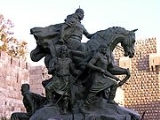
ala ad-Din Yusuf ibn Ayyub (Kurdish: ?? ???? ??? ?? ???? Selah'edînê Eyubî; ; c. 1138 - March 4, 1193), better known as Saladin in medieval Europe, was the Sultan of Egypt and Syria. He led the Islamic opposition to the Second and Third Crusade. At the height of his power, the Ayyubid dynasty he founded ruled over Egypt, Syria, Iraq, Hejaz, and Yemen. He led the Muslims against the Crusaders and eventually recaptured Palestine from the Kingdom of Jerusalem after his victory in the Battle of Hattin.

Discussion
Ask a question about 'Saladin'
Start a new discussion about 'Saladin'
Answer questions from other users
|
Recent Posts

Timeline

Encyclopedia
ala ad-Din Yusuf ibn Ayyub (Kurdish: ?? ???? ??? ?? ???? Selah'edînê Eyubî; ; c. 1138 - March 4, 1193), better known as Saladin in medieval Europe, was the Sultan of Egypt and Syria. He led the Islamic opposition to the Second and Third Crusade. At the height of his power, the Ayyubid dynasty he founded ruled over Egypt, Syria, Iraq, Hejaz, and Yemen. He led the Muslims against the Crusaders and eventually recaptured Palestine from the Kingdom of Jerusalem after his victory in the Battle of Hattin. As such, he is a notable figure in Arab, Kurdish, and Muslim culture. Saladin was a strict practitioner of Sunni Islam.
He did not maim, kill or retaliate against those whom he defeated, with the notable exception of certain events following the Battle of Hattin. His generally chivalrous behavior was noted by Christian chroniclers, especially in the accounts of the siege of Kerak in Moab.
Early life
Saladin was born in Tikrit, in modern-day central Iraq. His family was of Kurdish background and ancestry, and had originated from the city of Dvin, in Medieval Armenia. His father, Najm ad-Din Ayyub, was banished from Tikrit and in 1139 and he, with his brother Asad al-Din Shirkuh, moved to Mosul. He later joined the service of Imad ad-Din Zengi who made him commander of his fortress in Baalbek. After the death of Zengi in 1146, his son, Nur ad-Din, became the regent of Aleppo.
Saladin was reported to have a particular fondness of the city, but information on his early childhood is scarce. It is known that while an adolescent, he was drawn to women and wine, like many others of his age at the time. About education, Saladin wrote "children are brought up in the way in which their elders were brought up." According to one of his biographers, al-Wahrani, Saladin was able to answer questions on Euclid, the Almagest, arithmetic, and law, but this was an academic ideal and it was study of the Qur'an and the "sciences of religion" that linked him to his contemporaries. Several sources claim that during his studies he was more interested in religion than joining the military. Another factor which may have affected his interest in religion was that during the First Crusade, Jerusalem was taken in a surprise attack by the Christians. In addition to Islam, Saladin had a knowledge of the genealogies, biographies, and histories of the Arabs, as well as the bloodlines of Arabian horses. More significantly, he knew the Hamasah of Abu Tammam by heart.
Early expeditions
Saladin's military career began when his uncle Asad al-Din Shirkuh, an important military commander under Nur al-Din, started training him. In 1163, the vizier to the Fatimid caliph al-Adid, Shawar, had been driven out of Egypt by rival Dirgham, a member of the powerful Banu Ruzzaik tribe. He asked for military backing from Nur al-Din, who complied and in 1164, sent Shirkuh to aid Shawar in his expedition against Dirgham. Saladin, at age 26, went along with them. After Shawar was successfully reinstated as vizier, he demanded that Shikruh withdraw his army from Egypt for a sum of 30,000 dinars, but he refused insisting it was Nur al-Din's will that he remain. Saladin's role in this expedition was minor, and it is known that he was ordered by Shirkuh to collect stores from Bilbais prior to its siege by a combined force of Crusaders and Shawar's troops.
After the sacking of Bilbais, the Crusader-Egyptian force and Shirkuh's army were to engage in a battle on the desert border of the Nile River, just west of Giza. Saladin played a major role, commanding the right wing of the Zengid army, while a force of Kurds commanded the left, and Shirkuh stationed in the center. Muslim sources at the time, however, put Saladin in the "baggage of the center" with orders to lure the enemy into a trap by staging a false retreat. The Crusader force enjoyed early success against Shirkuh's troops, but the terrain was too steep and sandy for their horses, and commander Hugh of Caesarea was captured while attacking Saladin's unit. After scattered fighting in little valleys to the south of the main position, the Zengid central force returned to the offensive; Saladin joined in from the rear.
The battle ended in a Zengid victory, and Saladin is credited to have helped Shirkuh in one of the "most remarkable victories in recorded history", according to Ibn al-Athir, although more of Shirkuh's men were killed and the battle is considered by most sources as not a total victory. Saladin and Shirkuh moved towards Alexandria where they were welcomed, given money, arms, and provided a base. Faced by a superior Crusader-Egyptian force who attempted to besiege the city, Shirkuh split his army. He and the bulk of his force withdrew from Alexandria, while Saladin was left with the task of guarding the city.
Vizier of Egypt
Shirkuh and Shawar and Amalric I of the Kingdom of Jerusalem engaged in a power struggle over Egypt, in which Shawar requested Amalric's assistance. In 1169, Shawar was reportedly assassinated by Saladin and Shirkuh died later that year. Nur al-Din chose a successor for Shirkuh, but al-Adid appointed Saladin to replace Shawar as vizier.
The reasoning behind the Shia al-Adid's selection of Saladin, a Sunni, varies. Ibn al-Athir claims that the caliph chose him after being told by his advisers that "there is no one weaker or younger" than Saladin, and "not one of the emirs obeyed him or served him". However, according to this version, after some bargaining he was eventually accepted by the majority. His advisers were also suspected of attempting to split the Syria-based Zengid ranks. Al-Wahrani wrote that Saladin was selected because of the reputation of his family in their "generosity and military prowess". Imad ad-Din wrote that after the brief mourning period of Shirkuh, during which "opinions differed", the Zengid emirs decided upon Saladin and forced the caliph to "invest him as vizier". Although positions were complicated by rival Muslim leaders, the bulk of the Syrian rulers supported Saladin due to his role in an Egyptian expedition, in which he gained a record impeccable military qualifications.
Inaugurated as vizier on March 26, Saladin repented "wine-drinking and turned from frivolity to assume the dress of religion". Having gained more power and independence that ever before in his career, he still faced the issue of ultimate loyalty between al-Adid and Nur al-Din. The latter was rumored to be clandestinely hostile towards Saladin's appointment and was quoted as saying, "how dare he [Saladin] do anything without my orders?" He wrote several letters to Saladin, who dismissed them without abandoning his allegiance Nur al-Din.
Later in the year, a group of Egyptian soldiers and emirs attempted to assassinate him, but having already known of their intentions, Saladin had the chief conspirator, Mu'tamin al-Khilafa—the civilian controller of the Fatimid Palace—killed. The day after, 50,000 black African soldiers from the regiments of the Fatimid army opposed to Saladin's rule along with a number of Egyptian emirs and commoners staged a revolt. By August 23, Saladin had decisively quelled the uprising, and never again had to face a military challenge from Cairo.
Towards the end of 1169, Saladin with reinforcements from Nur al-Din defeated a massive Crusader-Byzantine force near Damietta. Afterward, in the spring of 1170, Nur al-Din sent Saladin's father to Egypt to comply with Saladin's request, as well as encouragement from the Baghdad-based Abbasid caliph, al-Mustanjid, who aimed to pressure Saladin in deposing his rival Caliph al-Adid. Saladin, himself, had been strengthening his hold on Egypt and widening his support base there. He began granting family members high-ranking positions in the region and increased Sunni influence in Cairo; he ordered the construction of a college for the Maliki branch of Sunni Islam in the city, as well as one for the Shafi'i denomination to which he belonged in al-Fustat.
After establishing himself in Egypt, Saladin launched a campaign against the Crusaders, besieging Darum in 1170. Amalric withdrew his Templar garrison from Gaza to assist him in defending Darum, but Saladin evaded their force and befell on Gaza instead. He destroyed the town built outside the city's castle and killed most of its inhabitants after they were refused entry into the castle. It is unclear exactly when, but during that same year, he attacked and captured the Crusader castle of Eilat, built on an island off the head of the Gulf of Aqaba. It did not pose a threat to the passage of the Muslim navy, but could harass smaller parties of Muslim ships and Saladin decided to clear it from his path.
Sultan of Egypt and Syria
According to Imad ad-Din, Nur al-Din wrote to Saladin in June 1171, telling him to reestablish the Abbasid caliphate in Egypt, which Saladin coordinated two months later after additional encouragement by Najm ad-Din al-Khabushani, the Shafi'i faqih, who vehemently opposed Shia rule in the country. Several Egyptian emirs were killed and the caliph al-Adid was told that they were rebelling against him. Al-Adid then fell ill, or was poisoned according to one account. While ill, he asked Saladin to pay him a visit to request that he take care of his young children, but Saladin refused, fearing treachery against the Abbasids, and is said to have regretted his action afterwards. Al-Adid died on September 13 and five days later, the Abbasid khutba was pronounced in Cairo and al-Fustat, proclaiming al-Mustadi as caliph.
On September 25, Saladin left Cairo to take part in a joint attack on the desert castles of the Kingdom of Jersualem, Kerak and Montreal with Nur al-Din who would attack from Syria. Prior to arriving at Montreal, Saladin withdrew, realizing that if he met Nur al-Din at Shaubak, he would be refused return to Egypt because of Nur al-Din's reluctance to consolidate such massive territorial control to Saladin. Also, there was a chance that the Crusader kingdom—which acted as a buffer state between Syria and Egypt—could have fallen had the two men attacked it from the east and the coast. This would have gave Nur al-Din the opportunity to annex Egypt. Saladin claimed he withdrew amid Fatimid plots against him, but Nur al-Din did not accept "the excuse".
In 1172, Saladin's father died after falling from a horse. In early 1174, Nur al-Din mustered an army to invade Saladin's Egypt, but on May 15, he died and his power was handed to his eleven-year-old son as-Salih Ismail al-Malik.
Immediately after Nur ad-Din's death, Saladin marched on Damascus and was welcomed into the city. He reinforced his legitimacy there in the time-honored way, by marrying Nur ad-Din's widow Ismat ad-Din Khatun. Aleppo and Mosul, on the other hand, the two other largest cities that Nur ad-Din had ruled, were never taken but Saladin managed to impose his influence and authority on them in 1176 and 1186 respectively. While he was occupied in besieging Aleppo, on May 22, 1176, the shadowy Ismaili assassin group, the Hashshashin, attempted to murder him. They made two attempts on his life, the second time coming close enough to inflict wounds.
While Saladin was consolidating his power in Syria, he usually left the Crusader kingdom alone. On November 25, 1177 Saladin was defeated at the Battle of Montgisard. He was defeated by Baldwin IV of Jerusalem, Baldwin was only 16.
Crusades Saladin spent the subsequent year recovering from his defeat and rebuilding his army, renewing his attacks in 1179 when he defeated the Crusaders at the Battle of Jacob's Ford. after which a truce was declared between Saladin and the Crusader States in 1180. However, Crusader counter-attacks provoked further responses by Saladin. Raynald of Chatillon, in particular, harassed Muslim trading and pilgrimage routes with a fleet on the Red Sea, a water route that Saladin needed to keep open. In response, Saladin built a fleet of 30 galleys to attack Beirut in 1182. Raynald threatened to attack the holy cities of Mecca and Medina. In retaliation, Saladin twice besieged Kerak, Raynald's fortress in Oultrejordain, in 1183 and 1184. Raynald responded by looting a caravan of pilgrims on the Hajj in 1185. According to the later thirteenth century Old French Continuation of William of Tyre, Raynald captured Saladin's sister in a raid on a caravan, although this claim is not attested in contemporary sources, Muslim or Frankish, rather stating that Raynald had attacked a preceding caravan, and Saladin set guards to ensure the safety of his sister and her son, who came to no harm.
Following the failure of his Kerak sieges, Saladin temporarily turned his attention back to another long-term project and resumed attacks on the territory of ?Izz ad-Din (Mas?ud ibn Mawdud ibn Zangi), around Mosul, which he had begun with some success in 1182. However, since then, Mas?ud had allied himself with the powerful governor of Azerbaijan and Jibal, who in 1185 began moving his troops across the Zagros Mountains, causing Saladin to hesitate in his attacks. The defenders of Mosul, when they became aware that help was on the way, increased their efforts, and Saladin subsequently fell ill, so in March 1186 a peace treaty was signed.
In July 1187 Saladin captured most of the Kingdom of Jerusalem. On July 4, 1187, he faced at the Battle of Hattin the combined forces of Guy of Lusignan, King Consort of Jerusalem and Raymond III of Tripoli. In this battle alone the Crusader army was largely annihilated by the motivated army of Saladin in what was a major disaster for the Crusaders and a turning point in the history of the Crusades. Saladin captured Raynald de Chatillon and was personally responsible for his execution in retaliation for his attacking Muslim caravans, who when in vain besought his mercy reciting the truce between the Muslims and Crusaders, he insulted their prophet Muhammad before murdering and torturing a number of them. Upon hearing this, Saladin swore an oath to personally execute Raynald.
Guy of Lusignan was also captured. Seeing the execution of Raynald, feared he would be next. But his life was spared by Saladin with the words;
Capture of Jerusalem
Saladin had almost captured every Crusader city. Jerusalem capitulated to his forces on October 2, 1187 after a siege. Before the siege, Saladin had offered generous terms of surrender, which were rejected. After the siege had started, he was unwilling to promise terms of quarter to the Frankish inhabitants of Jerusalem until Balian of Ibelin threatened to kill every Muslim hostage, estimated at 5000, and to destroy Islam’s holy shrines of the Dome of the Rock and the al-Aqsa Mosque if quarter was not given. Saladin consulted his council and these terms were accepted. Ransom was to be paid for each Frank in the city whether man, woman or child. Saladin allowed many to leave without having the required amount for ransom for others. Though Saladin’s offer included the poor, several thousand apparently were not redeemed and probably were sold into slavery.
Tyre, on the coast of modern-day Lebanon was the last major Crusader city that was not captured by Muslim forces (strategically, it would have made more sense for Saladin to capture Tyre before Jerusalem--however, Saladin chose to pursue Jerusalem first because of the importance of the city to Islam). The city was now commanded by Conrad of Montferrat, who strengthened Tyre's defences and withstood two sieges by Saladin. In 1188, at Tortosa, Saladin released Guy of Lusignan and returned him to his wife, Queen Sibylla of Jerusalem. They went first to Tripoli, then to Antioch. In 1189, they sought to reclaim Tyre for their kingdom, but were refused admission by Conrad, who did not recognize Guy as king. Guy then set about besieging Acre.
Upon the capture of Jerusalem, Saladin summoned the Jews and permitted them to resettle in the city in particular the Jews of Ashkelon which was a large Jewish settlement responded his request.
Third Crusade Hattin and the fall of Jerusalem prompted the Third Crusade, financed in England by a special "Saladin tithe". Richard I of England led Guy's siege of Acre, conquered the city and executed 3000 Muslim prisoners including women and children. Saladin retaliated by killing all Franks captured from August 28 - September 10. Baha' ad-Din writes, "Whilst we were there they brought two Franks to the Sultan (Saladin) who had been made prisoners by the advance guard. He had them beheaded on the spot."
The armies of Saladin engaged in combat with the army of King Richard I of England at the Battle of Arsuf on September 7, 1191, at which Saladin was defeated. All attempts made by Richard the Lionheart to re-take Jerusalem failed. However, Saladin's relationship with Richard was one of chivalrous mutual respect as well as military rivalry. When Richard became ill with fever, Saladin offered the services of his personal physician. Saladin also sent him fresh fruit with snow, to chill the drink, as treatment. At Arsuf, when Richard lost his horse, Saladin sent him two replacements. Richard suggested to Saladin that Palestine, Christian and Muslim, could be united through the marriage of his sister Joan of England, Queen of Sicily to Saladin's brother, and that Jerusalem could be their wedding gift. However, the two men never met face to face and communication was either written or by messenger.
As leaders of their respective factions, the two men came to an agreement in the Treaty of Ramla in 1192, whereby Jerusalem would remain in Muslim hands but would be open to Christian pilgrimages. The treaty reduced the Latin Kingdom to a strip along the coast from Tyre to Jaffa. This treaty was supposed to last three years.
Death
Saladin died of a fever on March 4, 1193, at Damascus, not long after Richard's departure. Since Saladin had given most of his money away for charity when they opened his treasury, they found there was not enough money to pay for his funeral. And so Saladin was buried in a magnificent mausoleum in the garden outside the Umayyad Mosque in Damascus, Syria. Seven centuries later, Emperor Wilhelm II of Germany donated a new marble sarcophagus to the mausoleum. Saladin was, however, not placed in it. Instead the mausoleum, which is open to visitors, now has two sarcophagi: one empty in marble and the original in which Saladin is placed, made of wood. The reason why he was not placed in the tomb would most likely to have been as a result of respect, and not to disturb Saladin's body.
Recognition and legacy
His fierce struggle against the crusaders was where Saladin achieved a great reputation in Europe as a chivalrous knight, so much so that there existed by the fourteenth century an epic poem about his exploits. Saladin appears in a sympathetic light in Sir Walter Scott's The Talisman (1825). Despite the Crusaders' slaughter when they originally conquered Jerusalem in 1099, Saladin granted amnesty and free passage to all common Catholics and even to the defeated Christian army, as long as they were able to pay the aforementioned ransom (the Greek Orthodox Christians were treated even better, because they often opposed the western Crusaders). An interesting view of Saladin and the world in which he lived is provided by Tariq Ali's novel The Book of Saladin.
Notwithstanding the differences in beliefs, the Muslim Saladin was respected by Christian lords, Richard especially. Richard once praised Saladin as a great prince, saying that he was without doubt the greatest and most powerful leader in the Islamic world. Saladin in turn stated that there was not a more honorable Christian lord than Richard. After the treaty, Saladin and Richard sent each other many gifts as tokens of respect, but never met face to face again.
In April 1191, a Frankish woman's three month old baby had been stolen from her camp and had been sold on the market. The Franks urged her to approach Saladin herself with her grievance. After Saladin used his own money to buy the child, "he gave it to the mother and she took it; with tears streaming down her face, and hugged it to her breast. The people were watching her and weeping and I (Ibn Shaddad) was standing amongst them. She suckled it for some time and then Saladin ordered a horse to be fetched for her and she went back to camp."
The name ?ala? ad-Din means "Righteousness of Faith", and through the ages Saladin has been an inspiration for Muslims in many respects. Modern Muslim rulers have sought to commemorate Saladin through various measures. A governorate centered around Tikrit and Samarra in modern-day Iraq, Salah ad Din Governorate, is named after him, as is Salahaddin University in Arbil. A suburb community of Arbil, Masif Salahaddin, is also named after him.
Few structures associated with Saladin survive within modern cities. Saladin first fortified the Citadel of Cairo (1175 - 1183), which had been a domed pleasure pavilion with a fine view in more peaceful times. In Syria, even the smallest city is centred on a defensible citadel, and Saladin introduced this essential feature to Egypt.
Among the forts he built was Qalaat al-Gindi, a mountaintop fortress and caravanserai in the Sinai. The fortress overlooks a large wadi which was the convergence of several caravan routes that linked Egypt and the Middle East. Inside the structure are a number of large vaulted rooms hewn out of rock, including the remains of shops and a water cistern. A notable archaeological site, it was investigated in 1909 by a French team under Jules Barthoux.
The Ayyubid dynasty he founded continued fifty-seven years after his death. The legacy of Saladin within the Arab World continues to this day. With the rise of Arab nationalism in the Twentieth Century, particularly with regard to the Arab-Israeli conflict, Saladin's heroism and leadership gained a new significance. The glory and comparative unity of the Arab World under Saladin was seen as the perfect symbol for the new unity sought by Arab nationalists, such as Gamal Abdel Nasser. For this reason, the Eagle of Saladin became the symbol of revolutionary Egypt, and was subsequently adopted by several other Arab states (Iraq, Palestine, and Yemen).
In 1963 an Egyptian film about Saladin was directed by Youssef Chahine and was released, titled Al Nasser Salah Ad-Din. In the 1965 Doctor Who serial The Crusade he was played by Bernard Kay. 2005's Kingdom of Heaven, directed by Ridley Scott, has Saladin portrayed by Syrian actor Ghassan Massoud. In the 2007 Swedish film Arn – The Knight Templar (Arn – Tempelriddaren), Saladin is portrayed by the British Asian actor and supermodel Milind Soman. An animated television series based on Saladin, entitled Saladin: The Animated Series, has been produced in Malaysia and will begin airing in 2009. The crusades from the point of view of Saladin and the Saracens is one of the campaigns in the computer game Age of Empires II: The Age of Kings.
See also
- List of rulers of Damascus
- List of rulers of Egypt
- History of Arab Egypt
Bibliography
External links
-
-
-
- A European account of Saladin's conquests of the Crusader states.
-
|
| |
|
|