

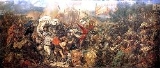
Battle of Grunwald

Encyclopedia
The Battle of Grunwald or 1st Battle of Tannenberg was fought on 15 July 1410, during the Polish–Lithuanian–Teutonic War. The alliance of the Kingdom of Poland and the Grand Duchy of Lithuania
, led respectively by King Jogaila
(Władysław Jagiełło) and Grand Duke Vytautas (Witold), decisively defeated the Teutonic Knights
, led by Grand Master Ulrich von Jungingen
. Most of the Teutonic Knights' leadership were killed or taken prisoner. While defeated, the Teutonic Knights withstood the siege
on their fortress in Marienburg (Malbork
) and suffered only minimal territorial losses at the Peace of Thorn (1411) (Toruń
). Territorial disputes continued until the Peace of Melno was concluded in 1422. However, the Knights never recovered their former power and the financial burden of war reparations
caused internal conflicts and an economic downturn in their lands. The battle shifted the balance of power in Eastern Europe and marked the rise of the Polish–Lithuanian union as the dominant political and military force in the region.
The battle was one of the largest battles in Medieval Europe and is regarded as the most important victory in the history of Poland and Lithuania. It was surrounded by romantic legends
and nationalistic propaganda
, becoming a larger symbol of struggle against invaders and a source of national pride. During the 20th century, the battle was used in Nazi
and Soviet propaganda campaigns. Only in recent decades have historians made progress towards a dispassionate, scholarly assessment of the battle reconciling the previous narratives, which differed widely by nation.
) to the west, Tannenberg (Stębark
) to the northeast, and Ludwigsdorf (Łodwigowo, Ludwikowice) to the south. Jogaila referred to the site in Latin as in loco conflictus nostri, quem cum Cruciferis de Prusia habuimus, dicto Grunenvelt. Later Polish chroniclers interpreted the word Grunenvelt as Grünwald, meaning "green forest" in German. The Lithuanians followed suit and translated the name as Žalgiris. The Germans named the battle after Tannenberg ("fir" or "pine" "hill" in German). Thus there are three commonly used names for the battle: , , . Its names in the languages of other involved peoples include , , , , .
Mikołaj Trąba and Jogaila's secretary Zbigniew Oleśnicki. While the original Cronica conflictus did not survive, a short summary has been preserved from the 16th century. Another important source is Historiae Polonicae by Polish historian Jan Długosz (1415–1480). It is a comprehensive and detailed account written several decades after the battle. The reliability of this source suffers not only from the long gap between the events and the chronicle, but also Długosz's biases against the Lithuanians. Banderia Prutenorum
is a mid-15th century manuscript with images and Latin descriptions of the Teutonic battle flags captured during the battle and displayed in Wawel Cathedral
. Other Polish sources include two letters written by Jogaila to his wife Anne of Cilli and Bishop of Poznań Wojciech Jastrzębiec
and letters sent by Jastrzębiec to Poles in the Holy See
. German sources include a concise account in the chronicle of Johann von Posilge
. An anonymous letter, written between 1411 and 1413, was discovered by Swedish historian Sven Ekdahl and provided important details on Lithuanian maneuvers.
, a crusading military order
, moved to Chełmno Land
and launched the Prussian Crusade
against the pagan
Prussian clans
. With support from the Pope and Holy Roman Emperor
, the Teutons conquered and converted the Prussians by 1280s and shifted their attention to the pagan Grand Duchy of Lithuania
. For about a hundred years the Knights raided Lithuanian lands, particularly Samogitia
as it separated the Knights in Prussia from their branch in Livonia
. While the border regions became an uninhabited wilderness, the Knights gained very little territory. The Lithuanians first gave up Samogitia during the Lithuanian Civil War (1381–1384)
in the Treaty of Dubysa
. The territory was used as a bargaining chip to ensure Teutonic support for one of the sides in the internal power struggle.
In 1385 Grand Duke Jogaila of Lithuania agreed to marry reigning Queen Jadwiga of Poland
in the Union of Kreva. Jogaila converted to Christianity and was crowned as the King of Poland thus creating a personal union
between the Kingdom of Poland and Grand Duchy of Lithuania. The official Lithuanian conversion to Christianity
removed the religious rationale for the Order's activities in the area. Its Grand Master, Conrad Zöllner von Rothenstein, supported by the Hungarian king Sigismund of Luxemburg, responded by publicly contesting the sincerity of Jogaila's conversion, bringing the charge to a papal court
. The territorial disputes continued over Samogitia, which had been in Teutonic hands since the Peace of Raciąż
of 1404. Poland also had territorial claims against the Knights in Dobrzyń Land
and Danzig (Gdańsk
), but the two states had been largely at peace since the Treaty of Kalisz (1343). The conflict was also motivated by trade considerations: the Knights controlled lower reaches of the three largest rivers (Neman
, Vistula
and Daugava) in Poland and Lithuania.
started. Lithuania supported the uprising and the Knights threatened to invade. Poland announced its support for the Lithuanian cause and threatened to invade Prussia in return. As Prussian troops evacuated Samogitia, the Teutonic Grand Master Ulrich von Jungingen
declared war on the Kingdom of Poland and Grand Duchy of Lithuania on 6 August 1409. The Knights hoped to defeat Poland and Lithuania separately and began by invading Greater Poland
and Kuyavia
, catching the Poles by surprise. The Knights burned the castle at Dobrin (Dobrzyń nad Wisłą), captured Bobrowniki
after a fourteen-day siege, conquered Bydgoszcz (Bromberg), and sacked several towns. The Poles organized counterattacks and recaptured Bydgoszcz. The Samogitians attacked Memel (Klaipėda
). However, neither side was ready for a full-scale war.
Wenceslaus, King of the Romans
, agreed to mediate the dispute. A truce was signed on 8 October 1409; it was set to expire on 24 June 1410. Both sides used this time to prepare for war, gathering troops and engaging in diplomatic maneuvers. Both sides sent letters and envoys accusing each other of various wrongdoings and threats to Christendom. Wenceslaus, who received a gift of 60,000 florins from the Knights, declared that Samogitia rightfully belonged to the Knights and only Dobrzyń Land should be returned to Poland. The Knights also paid 300,000 ducat
s to Sigismund of Hungary, who had ambitions for the principality of Moldova, for his military assistance. Sigismund attempted to break the Polish–Lithuanian alliance by offering Vytautas a king's crown; Vytautas's acceptance of such a crown would have violated the terms of the Ostrów Agreement
and have created Polish-Lithuanian discord. At the same time Vytautas managed to obtain a truce from the Livonian Order
.
By December 1409, Jogaila and Vytautas had agreed on a common strategy: their armies would unite into a single massive force and march together towards Marienburg (Malbork
), capital of the Teutonic Knights. The Knights, who took a defensive position, did not expect a joint attack and were preparing for a dual invasion – by the Poles along the Vistula River towards Danzig (Gdańsk
) and by the Lithuanians along the Neman River
towards Ragnit (Neman
). To counter this perceived threat, Ulrich von Jungingen concentrated his forces in Schwetz (Świecie
), a central location from where troops could respond to an invasion from any direction rather quickly. Sizable garrisons were left in the eastern castles of Ragnit, Rhein (Ryn
) near Lötzen (Giżycko
), and Memel (Klaipėda
). To keep the plans secret and misguide the Knights, Jogaila and Vytautas organised several raids into border territories, thus forcing the Knights to keep their troops in place.
The precise number of soldiers involved has proven difficult to establish. None of the contemporary sources provided reliable troop counts. Jan Długosz provided the number of the banners, the principal unit of each cavalry: 51 for the Knights, 50 for the Poles, and 40 for the Lithuanians. However, it is unclear how many men were under each banner. The structure and number of infantry units (pikemen, archers
, crossbow
men) and artillery units is unknown. Estimates, often biased by political and nationalistic considerations, were produced by various historians. German historians tend to present lower numbers, while Polish historians tend to use higher estimates. The high-end estimates by Polish historian Stefan Kuczyński of 39,000 Polish–Lithuanian and 27,000 Teutonic men have been cited in western literature as "commonly accepted".
While less numerous, the Teutonic army had advantages in discipline, military training, and superior military equipment. Their heavy cavalry was one of the best in Europe. The Teutonic army was also equipped with bombard
s that could shoot lead and stone projectiles.
Both forces were composed of troops from several states and lands, including numerous mercenaries; for example, Bohemia
n mercenaries fought on each side. The Knights also invited guest crusaders. Twenty-two different peoples, mostly Germanic, joined the Teutonic side. Teutonic recruits included soldiers from Westphalia
, Frisia
, Austria
, Swabia
, Stettin (Szczecin
). Two Hungarian nobles, Nicholas II Garay
and Stibor of Stiboricz
, brought 200 men for the Knights, but support from Sigismund of Hungary was disappointing.
Poland brought mercenaries from Moravia
and Bohemia. The Czechs produced two full banners, under command of Jan Sokol of Lamberk. Serving among the Czechs was Jan Žižka
, future commander of the Hussite
forces. Alexander the Good commanded Moldavian troops. Vytautas gathered troops from Lithuanian and Ruthenia
n (modern Belarus
and Ukraine
) lands. The Lithuanian army included three banners from Smolensk
, under the command of Jogaila's brother Lengvenis
, and a contingent of Tatars of the Golden Horde
, under the command of the exiled Khan Jalal ad-Din
. The overall commander of the joint Polish–Lithuanian forces was King Jogaila; however, he did not directly participate in the battle. The Lithuanian units were commanded directly by Grand Duke Vytautas, who was second in command and helped design the grand strategy
of the campaign. Vytautas actively participated in the battle, managing both Lithuanian and Polish units. Jan Długosz stated that the low-ranking Sword Bearer
of the Crown Zyndram of Maszkowice commanded the Polish army, but that is highly doubtful. More likely Marshal of the Crown Zbigniew of Brzezie commanded the Polish troops in the field.
over a pontoon bridge
. This maneuver, which required precision and intense coordination among multi-ethnic forces, was accomplished in about a week from 24 June to 30 June 1410. Polish soldiers from Greater Poland
gathered in Poznań
and those from Lesser Poland
in Wolbórz
. On 24 June 1410, Jogaila and Czech mercenaries arrived in Wolbórz
. Three days later, the Polish army was already at the meeting point. The Lithuanian army marched out from Vilnius
on 3 June and joined up with the Ruthenian regiments in Hrodna
. They arrived in Czerwinsk on the same day as the Poles crossed the river. After the crossing, Masovian troops under Siemowit IV
and Janusz I joined the Polish–Lithuanian army. The massive force began its march north towards Marienburg (Malbork
), capital of Prussia, on 3 July. The Prussian border was crossed on 9 July.
The river crossing remained secret until Hungarian envoys, who were attempting to negotiate a peace, revealed it to the Teutonic Grand Master. As soon as Ulrich von Jungingen grasped Polish–Lithuanian intentions, he left 3,000 men at Schwetz (Świecie
) under Heinrich von Plauen and marched the main forces to organise a line of defence on the Drewenz River (Drwęca
) near Kauernik (Kurzętnik
). The river crossing was fortified with stockade
s. On 11 July, after meeting with his eight-member war council, Jogaila decided against crossing the river at such a strong defensible position. The army would instead bypass the river crossing by turning east, towards its sources, where no other major rivers separated his army from Marienburg. The march continued east towards Soldau (Działdowo), although no attempt was made to capture the town. The Teutonic army followed the Drewenz River north, crossed it near Löbau (Lubawa
), and then moved east in parallel with the Polish–Lithuanian army. The latter ravaged the village of Gilgenburg (Dąbrówno
). Von Jungingen was so enraged by the atrocities that he swore to defeat the invaders in battle.
, Tannenberg (Stębark
) and Ludwigsdorf (Łodwigowo). Both armies formed opposing lines along a northeast–southwest axis. The Polish–Lithuanian army was positioned in front and east of Ludwigsdorf and Tannenberg. Polish heavy cavalry formed the left flank, Lithuanian light cavalry formed the right flank, while various mercenary troops formed the center. Their men were organized in three lines of wedge-shaped formations about 20 men deep. The Teutonic forces concentrated their elite heavy cavalry, commanded by Grand Marshal Frederic von Wallenrode, against the Lithuanians. The Knights, who were the first to organize their army for the battle, hoped to provoke Poles or Lithuanians to attack first. Their troops, wearing heavy armor, had to stand in scorching sun for several hours waiting for an attack. One chronicle suggested that they had dug pits that an attacking army would fall into. They also attempted to use field artillery
, but a light rain dampened their powder and only two cannon shots were fired. As Jogaila delayed, Grand Master sent messengers with two swords to "assist Jogaila and Vytautas in battle". The swords were meant as an insult and provocation. Known as the Grunwald Swords
, they became one of the national symbols of Poland.
. The same false retreat was used in the Battle of the Vorskla River
of 1399, where the Lithuanian army was dealt a crushing defeat and Vytautas himself barely escaped alive. This theory gained wider acceptance after the discovery and publication of a German letter by Swedish historian Sven Ekdahl in 1963. The letter, written a couple years after the battle, cautions the new Grand Master to look out for false retreats of the kind that were used in the Great Battle. Stephen Turnbull asserted that the Lithuanian retreat did not quite fit the tried formula of a false retreat. Such a retreat was usually staged by one or two units (as opposed to almost an entire army) and was swiftly followed by a counterattack (whereas the Lithuanians returned late in the battle).
. It seemed that the Knights were gaining the upper hand and at one point the royal standard-bearer
Marcin of Wrocimowice
lost the Kraków banner. However, it was soon recaptured and fighting continued. Jogaila deployed his reserves – the second line of his army. Grand Master Ulrich von Jungingen
then personally led 16 banners, almost a third of the original Teutonic strength, to the right Polish flank and Jogaila deployed his last reserves, the third line of his army. The melee reached the Polish command and one Knight, identified as Lupold or Diepold of Kökeritz, charged directly against King Jogaila. Jogaila's secretary, Zbigniew Oleśnicki, saved the king's life, gaining royal favor and becoming one of the most influential people in Poland.
as the killer. Surrounded and leaderless, the Teutonic Knights began to retreat. Part of the routed units retreated towards their camp. This move backfired when the camp followers turned against their masters and joined the manhunt. The knights attempted to build a wagon fort
: the camp was surrounded by wagons serving as an improvised fortification. However, the defense was soon broken and the camp was ravaged. According to Cronica conflictus, more Knights died there than in the battlefield. The battle lasted for about ten hours.
The Teutonic Knights attributed the defeat to treason on the part of Nikolaus von Renys (Mikołaj of Ryńsk), commander of the Culm (Chełmno) banner, and he was beheaded without a trial. He was the founder and leader of the Lizard Union, a group of Knights sympathetic to Poland. According to the Knights, von Renys lowered his banner, which was taken as a signal of surrender and led to the panicked retreat. The legend that the Knights were "stabbed in the back" was echoed in the post-World War I stab-in-the-back legend and preoccupied German historiography of the battle until 1945.
, Grand Marshal Friedrich von Wallenrode, Grand Komtur Kuno von Lichtenstein, Grand Treasurer Thomas von Merheim, Marshal of Supply Forces Albrecht von Schwartzburg, and ten of the komtur
s. Markward von Salzbach, Komtur of Brandenburg (Ushakovo), and Heinrich Schaumburg, voigt
of Sambia
, were executed by order of Vytautas after the battle. The bodies of von Jungingen and other high-ranking officials were transported to Marienburg Castle
for burial on 19 July. Bodies of lower-ranking Teutonic officials and twelve Polish knights were buried at the church in Tannenberg. The rest of the dead were buried in several mass graves. The highest- ranking Teutonic official to escape the battle was Werner von Tettinger, Komtur of Elbing (Elbląg
).
Polish and Lithuanian forces took several thousand captives. Among those taken were Dukes Konrad VII
of Oels (Oleśnica
) and Casimir V
of Pomerania
. Most of the commoners and mercenaries were released shortly after the battle on condition that they report to Kraków
on 11 November 1410. Only those that were expected to pay ransom were kept in captivity. Considerable ransoms were recorded; for example, the mercenary Holbracht von Loym had to pay sixty times the number of 150 Prague groschen, amounting to more than 30 kilograms of silver.
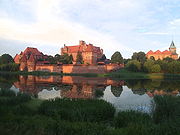 After the battle, the Polish and Lithuanian forces delayed their attack on the Teutonic capital in Marienburg (Malbork
) by staying on the battlefield for three days and then marching an average of only about 15 km (9.3 mi) per day. The main forces did not reach heavily fortified Marienburg until 26 July. This delay gave Heinrich von Plauen enough time to organize a defense. Jogaila also sent his troops to other Teutonic fortresses, which often surrendered without resistance, including the major cities of Danzig (Gdańsk
), Thorn (Toruń
), and Elbing (Elbląg
). Only eight castles remained in Teutonic hands. The besiegers of Marienburg expected a speedy capitulation and were not prepared for a long-term engagement, suffering from lack of ammunition, low morale, and an epidemic of dysentery
. The Knights appealed to their allies for help and Sigismund of Hungary, Wenceslaus, King of the Romans
, and the Livonian Order
promised financial aid and reinforcements. The siege of Marienburg was lifted on September 19. The Polish–Lithuanian forces left garrisons in fortresses that were captured or surrendered and returned home. However, the Knights quickly recaptured most of the castles. By the end of October, only four Teutonic castles along the border remained in Polish hands. Jogaila raised a fresh army and dealt another defeat to the Knights in the Battle of Koronowo
on 10 October 1410. Following other brief engagements, both sides agreed to negotiate.
The Peace of Thorn was signed in February 1411. Under its terms, the Knights ceded the Dobrin Land (Dobrzyń Land
) to Poland and agreed to resign their claims to Samogitia
during the lifetimes of Jogaila and Vytautas, although another two wars — the Hunger War of 1414 and the Gollub War
of 1422 — would be waged before the Treaty of Melno
permanently resolved the territorial disputes. The Poles and Lithuanians were unable to translate the military victory into territorial or diplomatic gains. However, the Peace of Thorn imposed a heavy financial burden on the Knights from which they never recovered. They had to pay an indemnity in silver, estimated at ten times the annual income of the King of England, in four annual installments. To meet these payments, the Knights borrowed heavily, confiscated gold and silver from churches, and increased taxes. Two major Prussian cities, Danzig (Gdańsk
) and Thorn (Toruń
), revolted against the tax increases. The defeat at Grunwald left the Teutonic Knights with few forces to defend their remaining territories. Since both Poland and Lithuania were now Christian countries, the Knights had difficulties recruiting new volunteer crusaders. The Grand Masters then needed to rely on mercenary troops, which proved an expensive drain on their already depleted budget. The internal conflicts, economic decline, and tax increases led to unrest and the foundation of the Prussian Confederation
, or Alliance against Lordship, in 1441. This in turn led to a series of conflicts that culminated in the Thirteen Years' War (1454).
and inspired resistance to the Germanization and Russification
policies of the German
and Russian Empire
s. The Knights were portrayed as bloodthirsty invaders and Grunwald as a just victory achieved by a small oppressed nation. In 1910, to mark the 500th anniversary of the battle, a monument by Antoni Wiwulski
was unveiled in Kraków
during a three-day celebration, attended by some 150,000 people. About 60 other towns and villages in Galicia erected Grunwald monuments for the anniversary. About the same time, Nobel Prize
winner Henryk Sienkiewicz
wrote the novel The Knights of the Cross (Polish: Krzyżacy), prominently featuring the battle in one of the chapters. In 1960, Polish filmmaker Aleksander Ford
used the book as the basis for his film, Knights of the Teutonic Order
. A museum, monuments, and memorials were constructed at the battlefield in 1960. The battle has lent its name to military decorations (Cross of Grunwald
), sport teams (BC Žalgiris
, FK Žalgiris), and various organizations.
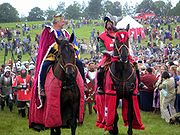 An annual battle reenactment
takes place on 15 July. A pageant was held in 2010 reenacting the event and commemorating the battle's 600th anniversary. It attracted 200,000 spectators who watched 2,200 participants playing the role of knights in a reenactment of the battle. An additional 3,800 participants played peasants and camp-followers. The pageant's organisers believe that the event has become the largest reenactment of medieval combat in Europe.
, Germany won a battle against Russia near the site. When the Germans realized its propaganda potential, they named the 1914 battle the Battle of Tannenberg
. The 1914 battle was framed as revenge for the Polish–Lithuanian victory 504 years earlier. Nazi Germany
later exploited the sentiment by portraying their Lebensraum
policies as a continuation of the Knights' historical mission.
Due to the participation of the three Smolensk
regiments in the battle, Russians saw the battle as a Polish–Lithuanian–Russian coalition against invading Germans. Chronicler Jan Długosz praised the Smolensk banners, who fought bravely and were the only banners from the Grand Duchy of Lithuania not to retreat. In Soviet historiography
, the battle of Grunwald was styled as a racial struggle between Slavs and Germans. The Teutonic Knights were portrayed as the medieval forerunners of Hitler's armies, while the battle itself was seen as the medieval counterpart to the Battle of Stalingrad
.
In William Urban
's summary, almost all accounts of the battle made before the 1960s were more influenced by romantic legends and nationalistic propaganda than by fact. Historians have since made progress towards dispassionate scholarship and reconciliation of the various national accounts of the battle.
Grand Duchy of Lithuania
The Grand Duchy of Lithuania was a European state from the 12th /13th century until 1569 and then as a constituent part of Polish-Lithuanian Commonwealth until 1791 when Constitution of May 3, 1791 abolished it in favor of unitary state. It was founded by the Lithuanians, one of the polytheistic...
, led respectively by King Jogaila
Jogaila
Jogaila, later 'He is known under a number of names: ; ; . See also: Jogaila : names and titles. was Grand Duke of Lithuania , king consort of Kingdom of Poland , and sole King of Poland . He ruled in Lithuania from 1377, at first with his uncle Kęstutis...
(Władysław Jagiełło) and Grand Duke Vytautas (Witold), decisively defeated the Teutonic Knights
Teutonic Knights
The Order of Brothers of the German House of Saint Mary in Jerusalem , commonly the Teutonic Order , is a German medieval military order, in modern times a purely religious Catholic order...
, led by Grand Master Ulrich von Jungingen
Ulrich von Jungingen
Ulrich von Jungingen was the 26th Grand Master of the Teutonic Knights, serving from 1407 to 1410. His policy of confrontation with the Grand Duchy of Lithuania and the Kingdom of Poland sparked the Polish–Lithuanian–Teutonic War and led to disaster for the Order in the Battle of Grunwald.- Life...
. Most of the Teutonic Knights' leadership were killed or taken prisoner. While defeated, the Teutonic Knights withstood the siege
Siege of Marienburg (1410)
The Siege of Marienburg was an unsuccessful two-month siege of the castle in Marienburg , the capital of the monastic state of the Teutonic Knights...
on their fortress in Marienburg (Malbork
Malbork
Malbork is a town in northern Poland in the Żuławy region , with 38,478 inhabitants . Situated in the Pomeranian Voivodeship since 1999, it was previously assigned to Elbląg Voivodeship...
) and suffered only minimal territorial losses at the Peace of Thorn (1411) (Toruń
Torun
Toruń is an ancient city in northern Poland, on the Vistula River. Its population is more than 205,934 as of June 2009. Toruń is one of the oldest cities in Poland. The medieval old town of Toruń is the birthplace of the astronomer Nicolaus Copernicus....
). Territorial disputes continued until the Peace of Melno was concluded in 1422. However, the Knights never recovered their former power and the financial burden of war reparations
War reparations
War reparations are payments intended to cover damage or injury during a war. Generally, the term war reparations refers to money or goods changing hands, rather than such property transfers as the annexation of land.- History :...
caused internal conflicts and an economic downturn in their lands. The battle shifted the balance of power in Eastern Europe and marked the rise of the Polish–Lithuanian union as the dominant political and military force in the region.
The battle was one of the largest battles in Medieval Europe and is regarded as the most important victory in the history of Poland and Lithuania. It was surrounded by romantic legends
Romantic nationalism
Romantic nationalism is the form of nationalism in which the state derives its political legitimacy as an organic consequence of the unity of those it governs...
and nationalistic propaganda
Nationalism
Nationalism is a political ideology that involves a strong identification of a group of individuals with a political entity defined in national terms, i.e. a nation. In the 'modernist' image of the nation, it is nationalism that creates national identity. There are various definitions for what...
, becoming a larger symbol of struggle against invaders and a source of national pride. During the 20th century, the battle was used in Nazi
Nazi propaganda
Propaganda, the coordinated attempt to influence public opinion through the use of media, was skillfully used by the NSDAP in the years leading up to and during Adolf Hitler's leadership of Germany...
and Soviet propaganda campaigns. Only in recent decades have historians made progress towards a dispassionate, scholarly assessment of the battle reconciling the previous narratives, which differed widely by nation.
Names
The battle was fought in the territory of the Monastic state of the Teutonic Order, on the plains between three villages: Grünfelde (GrunwaldGrunwald, Warmian-Masurian Voivodeship
Grunwald is a village in the administrative district of Gmina Grunwald, within Ostróda County, Warmian-Masurian Voivodeship, in northern Poland. It lies approximately south of Ostróda and south-west of the regional capital Olsztyn...
) to the west, Tannenberg (Stębark
Stebark
Stębark is a village in the administrative district of Gmina Grunwald, within Ostróda County, Warmian-Masurian Voivodeship, in northern Poland. It lies approximately south-east of Ostróda and south-west of the regional capital Olsztyn. The village has a population of 630...
) to the northeast, and Ludwigsdorf (Łodwigowo, Ludwikowice) to the south. Jogaila referred to the site in Latin as in loco conflictus nostri, quem cum Cruciferis de Prusia habuimus, dicto Grunenvelt. Later Polish chroniclers interpreted the word Grunenvelt as Grünwald, meaning "green forest" in German. The Lithuanians followed suit and translated the name as Žalgiris. The Germans named the battle after Tannenberg ("fir" or "pine" "hill" in German). Thus there are three commonly used names for the battle: , , . Its names in the languages of other involved peoples include , , , , .
Sources
There are few contemporary, reliable, sources about the battle, and most were produced by Poles. The most important and trustworthy source is Cronica conflictus Wladislai regis Poloniae cum Cruciferis anno Christi 1410, which was written within a year of the battle by an eyewitness. Its authorship is uncertain but several candidates have been proposed: Polish deputy chancellorKanclerz
Kanclerz was one of the highest officials in the historic Poland. This office functioned from the early Polish kingdom of the 12th century until the end of the Polish-Lithuanian Commonwealth in 1795. A respective office also existed in the Grand Duchy of Lithuania since the 16th...
Mikołaj Trąba and Jogaila's secretary Zbigniew Oleśnicki. While the original Cronica conflictus did not survive, a short summary has been preserved from the 16th century. Another important source is Historiae Polonicae by Polish historian Jan Długosz (1415–1480). It is a comprehensive and detailed account written several decades after the battle. The reliability of this source suffers not only from the long gap between the events and the chronicle, but also Długosz's biases against the Lithuanians. Banderia Prutenorum
Banderia Prutenorum
The Banderia Prutenorum is a manuscript of 48 parchment sheets, 18.6 by 29.3 cm , composed by Jan Długosz and illuminated by Stanisław Durink, listing 56 vexillae, or banners, of the Order of the Teutonic Knights. The title means Blazons of the Prussians...
is a mid-15th century manuscript with images and Latin descriptions of the Teutonic battle flags captured during the battle and displayed in Wawel Cathedral
Wawel Cathedral
The Wawel Cathedral, also known as the Cathedral Basilica of Sts. Stanisław and Vaclav, is a church located on Wawel Hill in Kraków–Poland's national sanctuary. It has a 1,000-year history and was the traditional coronation site of Polish monarchs. It is the Cathedral of the Archdiocese of Kraków...
. Other Polish sources include two letters written by Jogaila to his wife Anne of Cilli and Bishop of Poznań Wojciech Jastrzębiec
Wojciech Jastrzebiec
Wojciech of Jastrzębiec was a Polish mediaeval politician and religious leader. A bishop of Cracow and Poznań, he also held prominent posts at the court of the king Władysław II of Poland. Initially a chancellor to king Jadwiga of Poland and one of the advisors to the king Władysław, on 26 April...
and letters sent by Jastrzębiec to Poles in the Holy See
Holy See
The Holy See is the episcopal jurisdiction of the Catholic Church in Rome, in which its Bishop is commonly known as the Pope. It is the preeminent episcopal see of the Catholic Church, forming the central government of the Church. As such, diplomatically, and in other spheres the Holy See acts and...
. German sources include a concise account in the chronicle of Johann von Posilge
Johann von Posilge
Johann von Posilge was a parish priest of Deutsch Eylau and later assistant to Bishop of Pomesania. He is better known as the author of Chronik des Landes Preussen, a chronicle detailing events in Prussia from around 1360. It is one of the most important sources on the history of the Teutonic...
. An anonymous letter, written between 1411 and 1413, was discovered by Swedish historian Sven Ekdahl and provided important details on Lithuanian maneuvers.
Lithuanian Crusade and Polish–Lithuanian union
In 1230, the Teutonic KnightsTeutonic Knights
The Order of Brothers of the German House of Saint Mary in Jerusalem , commonly the Teutonic Order , is a German medieval military order, in modern times a purely religious Catholic order...
, a crusading military order
Military order
A military order is a Christian society of knights that was founded for crusading, i.e. propagating or defending the faith , either in the Holy Land or against Islam or pagans in Europe...
, moved to Chełmno Land
Chełmno Land
Chełmno land or Chełmno region is a historical region of Poland, located in central Poland, bounded by the Vistula and Drwęca rivers....
and launched the Prussian Crusade
Prussian Crusade
The Prussian Crusade was a series of 13th-century campaigns of Roman Catholic crusaders, primarily led by the Teutonic Knights, to Christianize the pagan Old Prussians. Invited after earlier unsuccessful expeditions against the Prussians by Polish princes, the Teutonic Knights began campaigning...
against the pagan
Paganism
Paganism is a blanket term, typically used to refer to non-Abrahamic, indigenous polytheistic religious traditions....
Prussian clans
Old Prussians
The Old Prussians or Baltic Prussians were an ethnic group, autochthonous Baltic tribes that inhabited Prussia, the lands of the southeastern Baltic Sea in the area around the Vistula and Curonian Lagoons...
. With support from the Pope and Holy Roman Emperor
Holy Roman Emperor
The Holy Roman Emperor is a term used by historians to denote a medieval ruler who, as German King, had also received the title of "Emperor of the Romans" from the Pope...
, the Teutons conquered and converted the Prussians by 1280s and shifted their attention to the pagan Grand Duchy of Lithuania
Grand Duchy of Lithuania
The Grand Duchy of Lithuania was a European state from the 12th /13th century until 1569 and then as a constituent part of Polish-Lithuanian Commonwealth until 1791 when Constitution of May 3, 1791 abolished it in favor of unitary state. It was founded by the Lithuanians, one of the polytheistic...
. For about a hundred years the Knights raided Lithuanian lands, particularly Samogitia
Samogitia
Samogitia is one of the five ethnographic regions of Lithuania. It is located in northwestern Lithuania. Its largest city is Šiauliai/Šiaulē. The region has a long and distinct cultural history, reflected in the existence of the Samogitian dialect...
as it separated the Knights in Prussia from their branch in Livonia
Livonian Order
The Livonian Order was an autonomous Livonian branch of the Teutonic Order and a member of the Livonian Confederation from 1435–1561. After being defeated by Samogitians in the 1236 Battle of Schaulen , the remnants of the Livonian Brothers of the Sword were incorporated into the Teutonic Knights...
. While the border regions became an uninhabited wilderness, the Knights gained very little territory. The Lithuanians first gave up Samogitia during the Lithuanian Civil War (1381–1384)
Lithuanian Civil War (1381–1384)
The Lithuanian Civil War of 1381–1384 was the first struggle for power between the cousins Jogaila, Grand Duke of Lithuania and later King of Poland, and Vytautas the Great. It began after Jogaila signed the Treaty of Dovydiškės with the Teutonic Knights which was aimed against his uncle Kęstutis,...
in the Treaty of Dubysa
Treaty of Dubysa
The Treaty of Dubysa or Treaty of Dubissa consisted of three legal acts formulated on October 31, 1382 between Jogaila, Grand Duke of Lithuania, with his brother Skirgaila and Konrad von Wallenrode, Marshal of the Teutonic Knights. During the Lithuanian Civil War , Teutonic Knights helped Jogaila...
. The territory was used as a bargaining chip to ensure Teutonic support for one of the sides in the internal power struggle.
In 1385 Grand Duke Jogaila of Lithuania agreed to marry reigning Queen Jadwiga of Poland
Jadwiga of Poland
Jadwiga was monarch of Poland from 1384 to her death. Her official title was 'king' rather than 'queen', reflecting that she was a sovereign in her own right and not merely a royal consort. She was a member of the Capetian House of Anjou, the daughter of King Louis I of Hungary and Elizabeth of...
in the Union of Kreva. Jogaila converted to Christianity and was crowned as the King of Poland thus creating a personal union
Personal union
A personal union is the combination by which two or more different states have the same monarch while their boundaries, their laws and their interests remain distinct. It should not be confused with a federation which is internationally considered a single state...
between the Kingdom of Poland and Grand Duchy of Lithuania. The official Lithuanian conversion to Christianity
Christianization of Lithuania
The Christianization of Lithuania – Christianization of the Grand Duchy of Lithuania that took place in 1387, initiated by the King of Poland and Grand Duke of Lithuania Jogaila and his cousin Vytautas, that signified the official adoption of Christianity by Lithuanians, one of the last pagan...
removed the religious rationale for the Order's activities in the area. Its Grand Master, Conrad Zöllner von Rothenstein, supported by the Hungarian king Sigismund of Luxemburg, responded by publicly contesting the sincerity of Jogaila's conversion, bringing the charge to a papal court
Papal court
The Papal Household or Pontifical Household , called until 1968 the Papal Court , consists of dignitaries who assist the Pope in carrying out particular ceremonies of either a religious or a civil character....
. The territorial disputes continued over Samogitia, which had been in Teutonic hands since the Peace of Raciąż
Peace of Raciaz
Peace of Raciąż was a treaty signed on May 22, 1404, between Kingdom of Poland, Grand Duchy of Lithuania, and the Teutonic Knights, regarding the control of the Dobrzyń Land and Samogitia. Poland in essence confirmed the Treaty of Kalisz of 1342 and Lithuania – the Treaty of Salynas of 1398...
of 1404. Poland also had territorial claims against the Knights in Dobrzyń Land
Dobrzyn Land
Dobrzyń Land is a historic region around the town of Dobrzyń nad Wisłą in Poland, east of the Vistula River and south of the Drwęca, where it borders on the Kulmerland...
and Danzig (Gdańsk
Gdansk
Gdańsk is a Polish city on the Baltic coast, at the centre of the country's fourth-largest metropolitan area.The city lies on the southern edge of Gdańsk Bay , in a conurbation with the city of Gdynia, spa town of Sopot, and suburban communities, which together form a metropolitan area called the...
), but the two states had been largely at peace since the Treaty of Kalisz (1343). The conflict was also motivated by trade considerations: the Knights controlled lower reaches of the three largest rivers (Neman
Neman River
Neman or Niemen or Nemunas, is a major Eastern European river rising in Belarus and flowing through Lithuania before draining into the Curonian Lagoon and then into the Baltic Sea at Klaipėda. It is the northern border between Lithuania and Russia's Kaliningrad Oblast in its lower reaches...
, Vistula
Vistula
The Vistula is the longest and the most important river in Poland, at 1,047 km in length. The watershed area of the Vistula is , of which lies within Poland ....
and Daugava) in Poland and Lithuania.
War, truce, and preparations
In May 1409 an uprising in Teutonic-held SamogitiaSamogitian uprisings
Samogitian uprisings refer to two uprisings by the Samogitians against the Teutonic Knights in 1401–1404 and 1409. Samogitia was granted to the Teutonic Knights by Vytautas the Great, Grand Duke of Lithuania, several times in order to enlist Knights' support for his other military affairs. Local...
started. Lithuania supported the uprising and the Knights threatened to invade. Poland announced its support for the Lithuanian cause and threatened to invade Prussia in return. As Prussian troops evacuated Samogitia, the Teutonic Grand Master Ulrich von Jungingen
Ulrich von Jungingen
Ulrich von Jungingen was the 26th Grand Master of the Teutonic Knights, serving from 1407 to 1410. His policy of confrontation with the Grand Duchy of Lithuania and the Kingdom of Poland sparked the Polish–Lithuanian–Teutonic War and led to disaster for the Order in the Battle of Grunwald.- Life...
declared war on the Kingdom of Poland and Grand Duchy of Lithuania on 6 August 1409. The Knights hoped to defeat Poland and Lithuania separately and began by invading Greater Poland
Greater Poland
Greater Poland or Great Poland, often known by its Polish name Wielkopolska is a historical region of west-central Poland. Its chief city is Poznań.The boundaries of Greater Poland have varied somewhat throughout history...
and Kuyavia
Kuyavia
Kujawy , is a historical and ethnographic region in the north-central Poland, situated in the basin of the middle Vistula and upper Noteć Rivers, with its capital in Włocławek.-Etymology:The origin of the name Kujawy was seen differently in history...
, catching the Poles by surprise. The Knights burned the castle at Dobrin (Dobrzyń nad Wisłą), captured Bobrowniki
Bobrowniki
Bobrowniki is a village in Lipno County, Kuyavian-Pomeranian Voivodeship, in north-central Poland. It is the seat of the gmina called Gmina Bobrowniki. It lies approximately south-west of Lipno and south-east of Toruń...
after a fourteen-day siege, conquered Bydgoszcz (Bromberg), and sacked several towns. The Poles organized counterattacks and recaptured Bydgoszcz. The Samogitians attacked Memel (Klaipėda
Klaipeda
Klaipėda is a city in Lithuania situated at the mouth of the Nemunas River where it flows into the Baltic Sea. It is the third largest city in Lithuania and the capital of Klaipėda County....
). However, neither side was ready for a full-scale war.
Wenceslaus, King of the Romans
Wenceslaus, King of the Romans
Wenceslaus ) was, by election, German King from 1376 and, by inheritance, King of Bohemia from 1378. He was the third Bohemian and second German monarch of the Luxembourg dynasty...
, agreed to mediate the dispute. A truce was signed on 8 October 1409; it was set to expire on 24 June 1410. Both sides used this time to prepare for war, gathering troops and engaging in diplomatic maneuvers. Both sides sent letters and envoys accusing each other of various wrongdoings and threats to Christendom. Wenceslaus, who received a gift of 60,000 florins from the Knights, declared that Samogitia rightfully belonged to the Knights and only Dobrzyń Land should be returned to Poland. The Knights also paid 300,000 ducat
Ducat
The ducat is a gold coin that was used as a trade coin throughout Europe before World War I. Its weight is 3.4909 grams of .986 gold, which is 0.1107 troy ounce, actual gold weight...
s to Sigismund of Hungary, who had ambitions for the principality of Moldova, for his military assistance. Sigismund attempted to break the Polish–Lithuanian alliance by offering Vytautas a king's crown; Vytautas's acceptance of such a crown would have violated the terms of the Ostrów Agreement
Ostrów Agreement
The Ostrów or Astrava Agreement was a treaty between Jogaila , King of Poland and Grand Duke of Lithuania, and his cousin Vytautas the Great, signed on August 4, 1392...
and have created Polish-Lithuanian discord. At the same time Vytautas managed to obtain a truce from the Livonian Order
Livonian Order
The Livonian Order was an autonomous Livonian branch of the Teutonic Order and a member of the Livonian Confederation from 1435–1561. After being defeated by Samogitians in the 1236 Battle of Schaulen , the remnants of the Livonian Brothers of the Sword were incorporated into the Teutonic Knights...
.
By December 1409, Jogaila and Vytautas had agreed on a common strategy: their armies would unite into a single massive force and march together towards Marienburg (Malbork
Malbork
Malbork is a town in northern Poland in the Żuławy region , with 38,478 inhabitants . Situated in the Pomeranian Voivodeship since 1999, it was previously assigned to Elbląg Voivodeship...
), capital of the Teutonic Knights. The Knights, who took a defensive position, did not expect a joint attack and were preparing for a dual invasion – by the Poles along the Vistula River towards Danzig (Gdańsk
Gdansk
Gdańsk is a Polish city on the Baltic coast, at the centre of the country's fourth-largest metropolitan area.The city lies on the southern edge of Gdańsk Bay , in a conurbation with the city of Gdynia, spa town of Sopot, and suburban communities, which together form a metropolitan area called the...
) and by the Lithuanians along the Neman River
Neman River
Neman or Niemen or Nemunas, is a major Eastern European river rising in Belarus and flowing through Lithuania before draining into the Curonian Lagoon and then into the Baltic Sea at Klaipėda. It is the northern border between Lithuania and Russia's Kaliningrad Oblast in its lower reaches...
towards Ragnit (Neman
Neman (town)
Neman is a town and the administrative center of Nemansky District of Kaliningrad Oblast, Russia. It is located in the historic Prussia region, east of the town of Sovetsk, on the steep southern bank of the Neman River, where it currently forms the border with the Klaipėda Region in...
). To counter this perceived threat, Ulrich von Jungingen concentrated his forces in Schwetz (Świecie
Swiecie
Świecie is a town in northern Poland with 25,968 inhabitants , situated in Kuyavian-Pomeranian Voivodeship ; it was previously in Bydgoszcz Voivodeship . It is the capital of Świecie County.-History:...
), a central location from where troops could respond to an invasion from any direction rather quickly. Sizable garrisons were left in the eastern castles of Ragnit, Rhein (Ryn
Ryn
Ryn is a town in Poland located 19 km southwest of Giżycko, in the Warmian-Masurian Voivodeship. Until the reorganization of 1999 it had been assigned to Suwałki Voivodeship. It had a population of 3,062 inhabitants as of December 31, 2004....
) near Lötzen (Giżycko
Gizycko
Giżycko is a town in northeastern Poland with 29,796 inhabitants . It is situated in the Warmian-Masurian Voivodeship , having previously been in the Suwałki Voivodeship . It is the seat of Giżycko County.-History:...
), and Memel (Klaipėda
Klaipeda
Klaipėda is a city in Lithuania situated at the mouth of the Nemunas River where it flows into the Baltic Sea. It is the third largest city in Lithuania and the capital of Klaipėda County....
). To keep the plans secret and misguide the Knights, Jogaila and Vytautas organised several raids into border territories, thus forcing the Knights to keep their troops in place.
Opposing forces
| Historian | Polish | Lithuanian | Teutonic |
|---|---|---|---|
| Karl Heveker and Hans Delbrück Hans Delbrück Hans Delbrück was a German historian. Delbrück was one of the first modern military historians, basing his method of research on the critical examination of ancient sources, the use of auxiliary disciplines, like demography and economics, to complete the analysis and the comparison between... |
16,500 | 11,000 | |
| Eugene Razin | 16,000–17,000 | 11,000 | |
| Max Oehler Max Oehler Max Oehler was a German army officer and archivist for the "Nietzsche-Archiv." Oehler pursued his career in the German Empire's military until the end of World War I and the German November Revolution. Under the Weimar Republic, which he opposed, he served as an archivist in his cousin Elisabeth... |
23,000 | 15,000 | |
| Jerzy Ochmański | 22,000–27,000 | 12,000 | |
| Sven Ekdahl | 20,000–25,000 | 12,000–15,000 | |
| Andrzej Nadolski Andrzej Nadolski Andrzej Nadolski was a Polish historian, specializing in Polish military history, an archaeologist, and professor. During World War II he was a member of Armia Krajowa. Rector of University of Łódź from 1968 to 1969, he resigned in protest over the 1968 Polish political crisis.... |
20,000 | 10,000 | 15,000 |
| Jan Dąbrowski | 15,000–18,000 | 8,000–11,000 | 19,000 |
| Zigmantas Kiaupa Zigmantas Kiaupa Zigmantas Kiaupa is a Lithuanian historian, archivist, and professor. His specialty is political history of the Grand Duchy of Lithuania, history of cities and city dwellers, and study of historical sources.... |
18,000 | 11,000 | 15,000–21,000 |
| Marian Biskup Marian Biskup Professor Marian Biskup is a Polish Author on the history of Toruń and Copernicus.-Biography:Biskup was born in Inowroclaw. He has written on a number of historical subjects and particularly Nicholas Copernicus. Professor Biskup is known for his work on the history of Toruń... |
19,000–20,000 | 10,000–11,000 | 21,000 |
| Daniel Stone | 27,000 | 11,000 | 21,000 |
| Stefan Kuczyński | 39,000 | 27,000 | |
The precise number of soldiers involved has proven difficult to establish. None of the contemporary sources provided reliable troop counts. Jan Długosz provided the number of the banners, the principal unit of each cavalry: 51 for the Knights, 50 for the Poles, and 40 for the Lithuanians. However, it is unclear how many men were under each banner. The structure and number of infantry units (pikemen, archers
Archery
Archery is the art, practice, or skill of propelling arrows with the use of a bow, from Latin arcus. Archery has historically been used for hunting and combat; in modern times, however, its main use is that of a recreational activity...
, crossbow
Crossbow
A crossbow is a weapon consisting of a bow mounted on a stock that shoots projectiles, often called bolts or quarrels. The medieval crossbow was called by many names, most of which derived from the word ballista, a torsion engine resembling a crossbow in appearance.Historically, crossbows played a...
men) and artillery units is unknown. Estimates, often biased by political and nationalistic considerations, were produced by various historians. German historians tend to present lower numbers, while Polish historians tend to use higher estimates. The high-end estimates by Polish historian Stefan Kuczyński of 39,000 Polish–Lithuanian and 27,000 Teutonic men have been cited in western literature as "commonly accepted".
While less numerous, the Teutonic army had advantages in discipline, military training, and superior military equipment. Their heavy cavalry was one of the best in Europe. The Teutonic army was also equipped with bombard
Bombard (weapon)
A bombard is a large-caliber, muzzle-loading medieval cannon or mortar, used chiefly in sieges for throwing heavy stone balls. The name bombarde was first noted and sketched in a French historical text around 1380. The modern term bombardment derives from this.Bombards were usually used during...
s that could shoot lead and stone projectiles.
Both forces were composed of troops from several states and lands, including numerous mercenaries; for example, Bohemia
Bohemia
Bohemia is a historical region in central Europe, occupying the western two-thirds of the traditional Czech Lands. It is located in the contemporary Czech Republic with its capital in Prague...
n mercenaries fought on each side. The Knights also invited guest crusaders. Twenty-two different peoples, mostly Germanic, joined the Teutonic side. Teutonic recruits included soldiers from Westphalia
Westphalia
Westphalia is a region in Germany, centred on the cities of Arnsberg, Bielefeld, Dortmund, Minden and Münster.Westphalia is roughly the region between the rivers Rhine and Weser, located north and south of the Ruhr River. No exact definition of borders can be given, because the name "Westphalia"...
, Frisia
Frisia
Frisia is a coastal region along the southeastern corner of the North Sea, i.e. the German Bight. Frisia is the traditional homeland of the Frisians, a Germanic people who speak Frisian, a language group closely related to the English language...
, Austria
Austria
Austria , officially the Republic of Austria , is a landlocked country of roughly 8.4 million people in Central Europe. It is bordered by the Czech Republic and Germany to the north, Slovakia and Hungary to the east, Slovenia and Italy to the south, and Switzerland and Liechtenstein to the...
, Swabia
Swabia
Swabia is a cultural, historic and linguistic region in southwestern Germany.-Geography:Like many cultural regions of Europe, Swabia's borders are not clearly defined...
, Stettin (Szczecin
Szczecin
Szczecin , is the capital city of the West Pomeranian Voivodeship in Poland. It is the country's seventh-largest city and the largest seaport in Poland on the Baltic Sea. As of June 2009 the population was 406,427....
). Two Hungarian nobles, Nicholas II Garay
Nicholas II Garay
Nicholas II Garay was the ban of Mačva, Usora, Soli , Slavonia, Croatia, and Dalmatia. He also ruled Braničevo, Syrmia, Bačka, Banat and Baranya regions through vassals. In 1416 Sigismund extended their armorial bearings showing the Order of the Dragon and the Order of the Scarf...
and Stibor of Stiboricz
Stibor of Stiboricz
Stibor of Stiboricz of Ostoja coat of arms was an aristocrat of Polish origin in the Kingdom of Hungary. He was a close friend of King Sigismund of Hungary who appointed him to several offices during his reign. For instance, between 1395 and 1401, then from 1409 to 1414 he was the voivode of...
, brought 200 men for the Knights, but support from Sigismund of Hungary was disappointing.
Poland brought mercenaries from Moravia
Moravia
Moravia is a historical region in Central Europe in the east of the Czech Republic, and one of the former Czech lands, together with Bohemia and Silesia. It takes its name from the Morava River which rises in the northwest of the region...
and Bohemia. The Czechs produced two full banners, under command of Jan Sokol of Lamberk. Serving among the Czechs was Jan Žižka
Jan Žižka
Jan Žižka z Trocnova a Kalicha , Czech general and Hussite leader, follower of Jan Hus, was born at small village Trocnov in Bohemia, into a gentried family. He was nicknamed "One-eyed Žižka"...
, future commander of the Hussite
Hussite
The Hussites were a Christian movement following the teachings of Czech reformer Jan Hus , who became one of the forerunners of the Protestant Reformation...
forces. Alexander the Good commanded Moldavian troops. Vytautas gathered troops from Lithuanian and Ruthenia
Ruthenia
Ruthenia is the Latin word used onwards from the 13th century, describing lands of the Ancient Rus in European manuscripts. Its geographic and culturo-ethnic name at that time was applied to the parts of Eastern Europe. Essentially, the word is a false Latin rendering of the ancient place name Rus...
n (modern Belarus
Belarus
Belarus , officially the Republic of Belarus, is a landlocked country in Eastern Europe, bordered clockwise by Russia to the northeast, Ukraine to the south, Poland to the west, and Lithuania and Latvia to the northwest. Its capital is Minsk; other major cities include Brest, Grodno , Gomel ,...
and Ukraine
Ukraine
Ukraine is a country in Eastern Europe. It has an area of 603,628 km², making it the second largest contiguous country on the European continent, after Russia...
) lands. The Lithuanian army included three banners from Smolensk
Smolensk
Smolensk is a city and the administrative center of Smolensk Oblast, Russia, located on the Dnieper River. Situated west-southwest of Moscow, this walled city was destroyed several times throughout its long history since it was on the invasion routes of both Napoleon and Hitler. Today, Smolensk...
, under the command of Jogaila's brother Lengvenis
Lengvenis
Lengvenis was one of the sons of Algirdas, Grand Duke of Lithuania, and the ruler of Great Novgorod Republic . He was known for his skills as a military leader....
, and a contingent of Tatars of the Golden Horde
Golden Horde
The Golden Horde was a Mongol and later Turkicized khanate that formed the north-western sector of the Mongol Empire...
, under the command of the exiled Khan Jalal ad-Din
Jalal ad-Din khan
Jalal ad-Din was the khan of the Golden Horde in 1411–1412. He was the son of Tokhtamysh Khan. He is also famous for his written history of the Mongol Empire....
. The overall commander of the joint Polish–Lithuanian forces was King Jogaila; however, he did not directly participate in the battle. The Lithuanian units were commanded directly by Grand Duke Vytautas, who was second in command and helped design the grand strategy
Grand strategy
Grand strategy comprises the "purposeful employment of all instruments of power available to a security community". Military historian B. H. Liddell Hart says about grand strategy:...
of the campaign. Vytautas actively participated in the battle, managing both Lithuanian and Polish units. Jan Długosz stated that the low-ranking Sword Bearer
Miecznik
Miecznik was a court office in Poland. Responsible for the arsenal of the King and for carrying his sword.Since the 14th Century an honorable title of district office, in Kingdom of Poland and after Union of Lublin in Polish-Lithuanian Commonwealth....
of the Crown Zyndram of Maszkowice commanded the Polish army, but that is highly doubtful. More likely Marshal of the Crown Zbigniew of Brzezie commanded the Polish troops in the field.
March into Prussia
The first stage of the Grunwald campaign was gathering all Polish–Lithuanian troops at Czerwinsk, a designated meeting point about 80 km (49.7 mi) from the Prussian border, where the joint army crossed the VistulaVistula
The Vistula is the longest and the most important river in Poland, at 1,047 km in length. The watershed area of the Vistula is , of which lies within Poland ....
over a pontoon bridge
Pontoon bridge
A pontoon bridge or floating bridge is a bridge that floats on water and in which barge- or boat-like pontoons support the bridge deck and its dynamic loads. While pontoon bridges are usually temporary structures, some are used for long periods of time...
. This maneuver, which required precision and intense coordination among multi-ethnic forces, was accomplished in about a week from 24 June to 30 June 1410. Polish soldiers from Greater Poland
Greater Poland
Greater Poland or Great Poland, often known by its Polish name Wielkopolska is a historical region of west-central Poland. Its chief city is Poznań.The boundaries of Greater Poland have varied somewhat throughout history...
gathered in Poznań
Poznan
Poznań is a city on the Warta river in west-central Poland, with a population of 556,022 in June 2009. It is among the oldest cities in Poland, and was one of the most important centres in the early Polish state, whose first rulers were buried at Poznań's cathedral. It is sometimes claimed to be...
and those from Lesser Poland
Lesser Poland
Lesser Poland is one of the historical regions of Poland, with its capital in the city of Kraków. It forms the southeastern corner of the country, and should not be confused with the modern Lesser Poland Voivodeship, which covers only a small, southern part of Lesser Poland...
in Wolbórz
Wolbórz
Wolbórz is a town in Piotrków County, Łódź Voivodeship, in central Poland. It is the seat of the gmina called Gmina Wolbórz. It lies approximately north-east of Piotrków Trybunalski and south-east of the regional capital Łódź....
. On 24 June 1410, Jogaila and Czech mercenaries arrived in Wolbórz
Wolbórz
Wolbórz is a town in Piotrków County, Łódź Voivodeship, in central Poland. It is the seat of the gmina called Gmina Wolbórz. It lies approximately north-east of Piotrków Trybunalski and south-east of the regional capital Łódź....
. Three days later, the Polish army was already at the meeting point. The Lithuanian army marched out from Vilnius
Vilnius
Vilnius is the capital of Lithuania, and its largest city, with a population of 560,190 as of 2010. It is the seat of the Vilnius city municipality and of the Vilnius district municipality. It is also the capital of Vilnius County...
on 3 June and joined up with the Ruthenian regiments in Hrodna
Hrodna
Grodno or Hrodna , is a city in Belarus. It is located on the Neman River , close to the borders of Poland and Lithuania . It has 327,540 inhabitants...
. They arrived in Czerwinsk on the same day as the Poles crossed the river. After the crossing, Masovian troops under Siemowit IV
Siemowit IV, Duke of Masovia
Siemowit IV was one of the Dukes of Masovia of the old Polish Piast royal family. His domain included the lands of Czersk, Rawa, Sochaczew, Płock and Gostynin. In 1381 he inherited Wisz and in 1387 Bełz.-Life:Siemowit IV was a son of Siemowit III...
and Janusz I joined the Polish–Lithuanian army. The massive force began its march north towards Marienburg (Malbork
Malbork
Malbork is a town in northern Poland in the Żuławy region , with 38,478 inhabitants . Situated in the Pomeranian Voivodeship since 1999, it was previously assigned to Elbląg Voivodeship...
), capital of Prussia, on 3 July. The Prussian border was crossed on 9 July.
The river crossing remained secret until Hungarian envoys, who were attempting to negotiate a peace, revealed it to the Teutonic Grand Master. As soon as Ulrich von Jungingen grasped Polish–Lithuanian intentions, he left 3,000 men at Schwetz (Świecie
Swiecie
Świecie is a town in northern Poland with 25,968 inhabitants , situated in Kuyavian-Pomeranian Voivodeship ; it was previously in Bydgoszcz Voivodeship . It is the capital of Świecie County.-History:...
) under Heinrich von Plauen and marched the main forces to organise a line of defence on the Drewenz River (Drwęca
Drweca
The Drwęca is a river in northern Poland and a tributary of the Vistula river near Toruń, forming a part of the city's administrative boundary. It has a length of 207 km and a basin area of 5,344 km², all in Poland.Towns:...
) near Kauernik (Kurzętnik
Kurzetnik
Kurzętnik is a village in Nowe Miasto County, Warmian-Masurian Voivodeship, in northern Poland. It is the seat of the gmina called Gmina Kurzętnik. It lies approximately south of Nowe Miasto Lubawskie and south-west of the regional capital Olsztyn.The village has a population of...
). The river crossing was fortified with stockade
Stockade
A stockade is an enclosure of palisades and tall walls made of logs placed side by side vertically with the tops sharpened to provide security.-Stockade as a security fence:...
s. On 11 July, after meeting with his eight-member war council, Jogaila decided against crossing the river at such a strong defensible position. The army would instead bypass the river crossing by turning east, towards its sources, where no other major rivers separated his army from Marienburg. The march continued east towards Soldau (Działdowo), although no attempt was made to capture the town. The Teutonic army followed the Drewenz River north, crossed it near Löbau (Lubawa
Lubawa
Lubawa is a town in the Warmian-Masurian Voivodeship, Poland. It is located in Iława County on the Sandela River, some 18 km southeast of Iława.-History:...
), and then moved east in parallel with the Polish–Lithuanian army. The latter ravaged the village of Gilgenburg (Dąbrówno
Dabrówno
Dąbrówno is a village and the seat of a gmina in Ostróda County, Warmian-Masurian Voivodeship in northern Poland. It lies approximately south of Ostróda and south-west of the regional capital Olsztyn....
). Von Jungingen was so enraged by the atrocities that he swore to defeat the invaders in battle.
Battle preparations
In the early morning of 15 July 1410, both armies met in an area covering approximately 4 km² (1.5 sq mi) between the villages of GrunwaldGrunwald, Warmian-Masurian Voivodeship
Grunwald is a village in the administrative district of Gmina Grunwald, within Ostróda County, Warmian-Masurian Voivodeship, in northern Poland. It lies approximately south of Ostróda and south-west of the regional capital Olsztyn...
, Tannenberg (Stębark
Stebark
Stębark is a village in the administrative district of Gmina Grunwald, within Ostróda County, Warmian-Masurian Voivodeship, in northern Poland. It lies approximately south-east of Ostróda and south-west of the regional capital Olsztyn. The village has a population of 630...
) and Ludwigsdorf (Łodwigowo). Both armies formed opposing lines along a northeast–southwest axis. The Polish–Lithuanian army was positioned in front and east of Ludwigsdorf and Tannenberg. Polish heavy cavalry formed the left flank, Lithuanian light cavalry formed the right flank, while various mercenary troops formed the center. Their men were organized in three lines of wedge-shaped formations about 20 men deep. The Teutonic forces concentrated their elite heavy cavalry, commanded by Grand Marshal Frederic von Wallenrode, against the Lithuanians. The Knights, who were the first to organize their army for the battle, hoped to provoke Poles or Lithuanians to attack first. Their troops, wearing heavy armor, had to stand in scorching sun for several hours waiting for an attack. One chronicle suggested that they had dug pits that an attacking army would fall into. They also attempted to use field artillery
Field artillery
Field artillery is a category of mobile artillery used to support armies in the field. These weapons are specialized for mobility, tactical proficiency, long range, short range and extremely long range target engagement....
, but a light rain dampened their powder and only two cannon shots were fired. As Jogaila delayed, Grand Master sent messengers with two swords to "assist Jogaila and Vytautas in battle". The swords were meant as an insult and provocation. Known as the Grunwald Swords
Grunwald Swords
The Grunwald Swords were a gift presented by Ulrich von Jungingen, the Grand Master of the Order of Teutonic Knights, to King Vladislaus II of Poland and Grand Duke Vytautas the Great of Lithuania on 15 July 1410, just before the Battle of Grunwald . The gift, a pair of simple bare swords, was a...
, they became one of the national symbols of Poland.
Battle begins: Lithuanian attack and retreat
Vytautas, supported by a few Polish banners, started an assault on the left flank of the Teutonic forces. After more than an hour of heavy fighting, the Lithuanian light cavalry started a full retreat. Jan Długosz described this development as a complete annihilation of the entire Lithuanian army. According to Długosz, the Knights assumed that victory was theirs, broke their formation for a disorganized pursuit of the retreating Lithuanians, and gathered much loot before returning to the battlefield to face the Polish troops. He made no mention of the Lithuanians that later returned to the battlefield. Thus Długosz portrayed the battle as a single-handed Polish victory. This view contradicted Cronica conflictus and has been challenged by modern historians. Starting with an article by Vaclaw Lastowski in 1909, they proposed that the retreat was a planned, strategic maneuver, borrowed from the Golden HordeGolden Horde
The Golden Horde was a Mongol and later Turkicized khanate that formed the north-western sector of the Mongol Empire...
. The same false retreat was used in the Battle of the Vorskla River
Battle of the Vorskla River
The Battle of the Vorskla River was a great battle in the medieval history of Eastern Europe. It was fought on August 12, 1399, between the Tatars, under Edigu and Temur Qutlugh, and the armies of Tokhtamysh and Grand Duke Vytautas of Lithuania...
of 1399, where the Lithuanian army was dealt a crushing defeat and Vytautas himself barely escaped alive. This theory gained wider acceptance after the discovery and publication of a German letter by Swedish historian Sven Ekdahl in 1963. The letter, written a couple years after the battle, cautions the new Grand Master to look out for false retreats of the kind that were used in the Great Battle. Stephen Turnbull asserted that the Lithuanian retreat did not quite fit the tried formula of a false retreat. Such a retreat was usually staged by one or two units (as opposed to almost an entire army) and was swiftly followed by a counterattack (whereas the Lithuanians returned late in the battle).
Battle continues: Polish–Teutonic fight
While the Lithuanians were retreating, heavy fighting began between Polish and Teutonic forces. Teutonic forces, commanded by Grand Komtur Kuno von Lichtenstein, concentrated on the Polish right flank. Six of the von Walenrode banners did not pursue the retreating Lithuanians and joined the attack on the right flank. A particularly high-value target was the royal banner of KrakówKraków
Kraków also Krakow, or Cracow , is the second largest and one of the oldest cities in Poland. Situated on the Vistula River in the Lesser Poland region, the city dates back to the 7th century. Kraków has traditionally been one of the leading centres of Polish academic, cultural, and artistic life...
. It seemed that the Knights were gaining the upper hand and at one point the royal standard-bearer
Standard-bearer
A standard-bearer is a person who bears an emblem called an ensign or standard, i.e. either a type of flag or an inflexible but mobile image, which is used as a formal, visual symbol of a state, prince, military unit, etc.This can either be an occasional duty, often seen as an honour , or a...
Marcin of Wrocimowice
Marcin of Wrocimowice
Marcin of Wrocimowice was a Polish knight and diplomat from the Półkozic clan.He served as Starosta of Łowicz and as Standard-Bearer of the Territory of Kraków...
lost the Kraków banner. However, it was soon recaptured and fighting continued. Jogaila deployed his reserves – the second line of his army. Grand Master Ulrich von Jungingen
Ulrich von Jungingen
Ulrich von Jungingen was the 26th Grand Master of the Teutonic Knights, serving from 1407 to 1410. His policy of confrontation with the Grand Duchy of Lithuania and the Kingdom of Poland sparked the Polish–Lithuanian–Teutonic War and led to disaster for the Order in the Battle of Grunwald.- Life...
then personally led 16 banners, almost a third of the original Teutonic strength, to the right Polish flank and Jogaila deployed his last reserves, the third line of his army. The melee reached the Polish command and one Knight, identified as Lupold or Diepold of Kökeritz, charged directly against King Jogaila. Jogaila's secretary, Zbigniew Oleśnicki, saved the king's life, gaining royal favor and becoming one of the most influential people in Poland.
Battle ends: Teutonic Knights defeated
At that time, the reorganized Lithuanians returned to the battle, attacking von Jungingen from the rear. The Teutonic forces were by then becoming outnumbered by the mass of Polish knights and the advancing Lithuanian cavalry. As von Jungingen attempted to break through the Lithuanian lines, he was killed. According to Cronica conflictus, Dobiesław of Oleśnica thrust a lance through Grand Master's neck, while Długosz presented Mszczuj of SkrzynnoMszczuj of Skrzynno
Mszczuj of Skrzynno was one of the Polish knights of Władysław Jagiełło who took part on July 15, 1410 in the Battle of Grunwald against the Teutonic Knights. He was a knight of the royal household regiment of the King of Poland...
as the killer. Surrounded and leaderless, the Teutonic Knights began to retreat. Part of the routed units retreated towards their camp. This move backfired when the camp followers turned against their masters and joined the manhunt. The knights attempted to build a wagon fort
Wagon fort
A Laager, also known as a wagon fort, is a mobile fortification made of wagons arranged into a rectangle, a circle or other shape and possibly joined with each other, an improvised military camp....
: the camp was surrounded by wagons serving as an improvised fortification. However, the defense was soon broken and the camp was ravaged. According to Cronica conflictus, more Knights died there than in the battlefield. The battle lasted for about ten hours.
The Teutonic Knights attributed the defeat to treason on the part of Nikolaus von Renys (Mikołaj of Ryńsk), commander of the Culm (Chełmno) banner, and he was beheaded without a trial. He was the founder and leader of the Lizard Union, a group of Knights sympathetic to Poland. According to the Knights, von Renys lowered his banner, which was taken as a signal of surrender and led to the panicked retreat. The legend that the Knights were "stabbed in the back" was echoed in the post-World War I stab-in-the-back legend and preoccupied German historiography of the battle until 1945.
Casualties and captives
The defeat of the Teutonic Knights was resounding. About 8,000 Teuton soldiers were killed and an additional 14,000 were taken captive. According to Teutonic payroll records, only 1,427 men reported back to Marienburg to claim their pay. Of 1,200 men sent from Danzig, only 300 returned. According to different sources, some 200 or 400 brothers of the Order were killed, including much of the Teutonic leadership – Grand Master Ulrich von JungingenUlrich von Jungingen
Ulrich von Jungingen was the 26th Grand Master of the Teutonic Knights, serving from 1407 to 1410. His policy of confrontation with the Grand Duchy of Lithuania and the Kingdom of Poland sparked the Polish–Lithuanian–Teutonic War and led to disaster for the Order in the Battle of Grunwald.- Life...
, Grand Marshal Friedrich von Wallenrode, Grand Komtur Kuno von Lichtenstein, Grand Treasurer Thomas von Merheim, Marshal of Supply Forces Albrecht von Schwartzburg, and ten of the komtur
Komtur
Komtur was a rank within military orders, especially the Teutonic Knights. In the State of the Teutonic Order, the Komtur was the commander of a basic administrative division called Kommende . A Komtur was responsible for the alimentation of the Knights by the yield from the local estates, he...
s. Markward von Salzbach, Komtur of Brandenburg (Ushakovo), and Heinrich Schaumburg, voigt
Voigt
Voigt is a German surname, and may refer to:* Angela Voigt, East German long jumper* Alexander Voigt, German football player* Andreas J...
of Sambia
Sambia
Sambia or Samland is a peninsula in the Kaliningrad Oblast of Russia, on the southeastern shore of the Baltic Sea. The Curonian Lagoon and the Vistula Lagoon demarcate the peninsula. Prior to 1945 it formed an important part of East Prussia.-Names:Sambia is named after the Sambians, an extinct...
, were executed by order of Vytautas after the battle. The bodies of von Jungingen and other high-ranking officials were transported to Marienburg Castle
Malbork Castle
The Marienburg Castle in Malbork is by area the largest castle in the world. It was built in Prussia by the Teutonic Knights, a German Roman Catholic religious order of crusaders, in a form of an Ordensburg fortress. The Order named it Marienburg...
for burial on 19 July. Bodies of lower-ranking Teutonic officials and twelve Polish knights were buried at the church in Tannenberg. The rest of the dead were buried in several mass graves. The highest- ranking Teutonic official to escape the battle was Werner von Tettinger, Komtur of Elbing (Elbląg
Elblag
Elbląg is a city in northern Poland with 127,892 inhabitants . It is the capital of Elbląg County and has been assigned to the Warmian-Masurian Voivodeship since 1999. Before then it was the capital of Elbląg Voivodeship and a county seat in Gdańsk Voivodeship...
).
Polish and Lithuanian forces took several thousand captives. Among those taken were Dukes Konrad VII
Konrad VII the White
Konrad VII the White , was a Duke of Oleśnica, Koźle, half of Bytom and half of Ścinawa during 1416-1427 , sole Duke of Koźle and half of Bytom during 1427-1450, Duke of Oleśnica during 1421-1450 and sole Duke of half of Ścinawa during 1447-1450.He was the fourth son of Konrad III the Old, Duke of...
of Oels (Oleśnica
Olesnica
Oleśnica is a town in the Trzebnickie Hills in southwestern Poland with 36,951 inhabitants . It is situated in Lower Silesian Voivodeship...
) and Casimir V
Casimir V, Duke of Pomerania
Duke Casimir V of Pomerania was a member of the House of Griffins and a Duke of Pomerania. He ruled in Pomerania-Stettin together with his brother Otto II from 1413 to 1428...
of Pomerania
Duchy of Pomerania
The Duchy of Pomerania was a duchy in Pomerania on the southern coast of the Baltic Sea, ruled by dukes of the House of Pomerania ....
. Most of the commoners and mercenaries were released shortly after the battle on condition that they report to Kraków
Kraków
Kraków also Krakow, or Cracow , is the second largest and one of the oldest cities in Poland. Situated on the Vistula River in the Lesser Poland region, the city dates back to the 7th century. Kraków has traditionally been one of the leading centres of Polish academic, cultural, and artistic life...
on 11 November 1410. Only those that were expected to pay ransom were kept in captivity. Considerable ransoms were recorded; for example, the mercenary Holbracht von Loym had to pay sixty times the number of 150 Prague groschen, amounting to more than 30 kilograms of silver.
Further campaign and peace
Malbork
Malbork is a town in northern Poland in the Żuławy region , with 38,478 inhabitants . Situated in the Pomeranian Voivodeship since 1999, it was previously assigned to Elbląg Voivodeship...
) by staying on the battlefield for three days and then marching an average of only about 15 km (9.3 mi) per day. The main forces did not reach heavily fortified Marienburg until 26 July. This delay gave Heinrich von Plauen enough time to organize a defense. Jogaila also sent his troops to other Teutonic fortresses, which often surrendered without resistance, including the major cities of Danzig (Gdańsk
Gdansk
Gdańsk is a Polish city on the Baltic coast, at the centre of the country's fourth-largest metropolitan area.The city lies on the southern edge of Gdańsk Bay , in a conurbation with the city of Gdynia, spa town of Sopot, and suburban communities, which together form a metropolitan area called the...
), Thorn (Toruń
Torun
Toruń is an ancient city in northern Poland, on the Vistula River. Its population is more than 205,934 as of June 2009. Toruń is one of the oldest cities in Poland. The medieval old town of Toruń is the birthplace of the astronomer Nicolaus Copernicus....
), and Elbing (Elbląg
Elblag
Elbląg is a city in northern Poland with 127,892 inhabitants . It is the capital of Elbląg County and has been assigned to the Warmian-Masurian Voivodeship since 1999. Before then it was the capital of Elbląg Voivodeship and a county seat in Gdańsk Voivodeship...
). Only eight castles remained in Teutonic hands. The besiegers of Marienburg expected a speedy capitulation and were not prepared for a long-term engagement, suffering from lack of ammunition, low morale, and an epidemic of dysentery
Dysentery
Dysentery is an inflammatory disorder of the intestine, especially of the colon, that results in severe diarrhea containing mucus and/or blood in the faeces with fever and abdominal pain. If left untreated, dysentery can be fatal.There are differences between dysentery and normal bloody diarrhoea...
. The Knights appealed to their allies for help and Sigismund of Hungary, Wenceslaus, King of the Romans
Wenceslaus, King of the Romans
Wenceslaus ) was, by election, German King from 1376 and, by inheritance, King of Bohemia from 1378. He was the third Bohemian and second German monarch of the Luxembourg dynasty...
, and the Livonian Order
Livonian Order
The Livonian Order was an autonomous Livonian branch of the Teutonic Order and a member of the Livonian Confederation from 1435–1561. After being defeated by Samogitians in the 1236 Battle of Schaulen , the remnants of the Livonian Brothers of the Sword were incorporated into the Teutonic Knights...
promised financial aid and reinforcements. The siege of Marienburg was lifted on September 19. The Polish–Lithuanian forces left garrisons in fortresses that were captured or surrendered and returned home. However, the Knights quickly recaptured most of the castles. By the end of October, only four Teutonic castles along the border remained in Polish hands. Jogaila raised a fresh army and dealt another defeat to the Knights in the Battle of Koronowo
Battle of Koronowo
The Battle of Koronowo was a battle of the Polish-Lithuanian-Teutonic War. It took place on October 10, 1410, near the village of Łąsko Wielkie and ended in Polish-Lithuanian alliance victory.- External links :...
on 10 October 1410. Following other brief engagements, both sides agreed to negotiate.
The Peace of Thorn was signed in February 1411. Under its terms, the Knights ceded the Dobrin Land (Dobrzyń Land
Dobrzyn Land
Dobrzyń Land is a historic region around the town of Dobrzyń nad Wisłą in Poland, east of the Vistula River and south of the Drwęca, where it borders on the Kulmerland...
) to Poland and agreed to resign their claims to Samogitia
Samogitia
Samogitia is one of the five ethnographic regions of Lithuania. It is located in northwestern Lithuania. Its largest city is Šiauliai/Šiaulē. The region has a long and distinct cultural history, reflected in the existence of the Samogitian dialect...
during the lifetimes of Jogaila and Vytautas, although another two wars — the Hunger War of 1414 and the Gollub War
Gollub War
The Gollub War was a two-month war of the Teutonic Knights against the Kingdom of Poland and the Grand Duchy of Lithuania in 1422. It ended by signing the Treaty of Melno, which resolved territorial disputes, dragging since 1398, between the Knights and Lithuania over Samogitia.-Background:The...
of 1422 — would be waged before the Treaty of Melno
Treaty of Melno
The Treaty of Melno or Treaty of Lake Melno was a peace treaty ending the Gollub War. It was signed on September 27, 1422, between the Teutonic Knights and an alliance of the Kingdom of Poland and the Grand Duchy of Lithuania at Lake Melno , east of Graudenz...
permanently resolved the territorial disputes. The Poles and Lithuanians were unable to translate the military victory into territorial or diplomatic gains. However, the Peace of Thorn imposed a heavy financial burden on the Knights from which they never recovered. They had to pay an indemnity in silver, estimated at ten times the annual income of the King of England, in four annual installments. To meet these payments, the Knights borrowed heavily, confiscated gold and silver from churches, and increased taxes. Two major Prussian cities, Danzig (Gdańsk
Gdansk
Gdańsk is a Polish city on the Baltic coast, at the centre of the country's fourth-largest metropolitan area.The city lies on the southern edge of Gdańsk Bay , in a conurbation with the city of Gdynia, spa town of Sopot, and suburban communities, which together form a metropolitan area called the...
) and Thorn (Toruń
Torun
Toruń is an ancient city in northern Poland, on the Vistula River. Its population is more than 205,934 as of June 2009. Toruń is one of the oldest cities in Poland. The medieval old town of Toruń is the birthplace of the astronomer Nicolaus Copernicus....
), revolted against the tax increases. The defeat at Grunwald left the Teutonic Knights with few forces to defend their remaining territories. Since both Poland and Lithuania were now Christian countries, the Knights had difficulties recruiting new volunteer crusaders. The Grand Masters then needed to rely on mercenary troops, which proved an expensive drain on their already depleted budget. The internal conflicts, economic decline, and tax increases led to unrest and the foundation of the Prussian Confederation
Prussian Confederation
The Prussian Confederation was an organization formed in 1440 by a group of 53 gentry and clergy and 19 cities in Prussia to oppose the monastic state of the Teutonic Knights. It was based on the basis of an earlier similar organization, the Lizard Union...
, or Alliance against Lordship, in 1441. This in turn led to a series of conflicts that culminated in the Thirteen Years' War (1454).
Poland, Lithuania and Belarus
The battle of Grunwald is regarded as one of the most important battles in Polish, Lithuanian history. In Lithuania, the victory at the Battle of Grunwald is synonymous with the Grand Duchy's political and military peak. It was a source of national pride during the age of Romantic nationalismRomantic nationalism
Romantic nationalism is the form of nationalism in which the state derives its political legitimacy as an organic consequence of the unity of those it governs...
and inspired resistance to the Germanization and Russification
Russification
Russification is an adoption of the Russian language or some other Russian attributes by non-Russian communities...
policies of the German
German Empire
The German Empire refers to Germany during the "Second Reich" period from the unification of Germany and proclamation of Wilhelm I as German Emperor on 18 January 1871, to 1918, when it became a federal republic after defeat in World War I and the abdication of the Emperor, Wilhelm II.The German...
and Russian Empire
Russian Empire
The Russian Empire was a state that existed from 1721 until the Russian Revolution of 1917. It was the successor to the Tsardom of Russia and the predecessor of the Soviet Union...
s. The Knights were portrayed as bloodthirsty invaders and Grunwald as a just victory achieved by a small oppressed nation. In 1910, to mark the 500th anniversary of the battle, a monument by Antoni Wiwulski
Antoni Wiwulski
Antoni Wiwulski was a Polish- Lithuanian architect and sculptor.He was born February 20, 1877 in Totma near Vologda in Imperial Russia, where his father, of Lithuanian origin, served as a forest superintendent...
was unveiled in Kraków
Kraków
Kraków also Krakow, or Cracow , is the second largest and one of the oldest cities in Poland. Situated on the Vistula River in the Lesser Poland region, the city dates back to the 7th century. Kraków has traditionally been one of the leading centres of Polish academic, cultural, and artistic life...
during a three-day celebration, attended by some 150,000 people. About 60 other towns and villages in Galicia erected Grunwald monuments for the anniversary. About the same time, Nobel Prize
Nobel Prize
The Nobel Prizes are annual international awards bestowed by Scandinavian committees in recognition of cultural and scientific advances. The will of the Swedish chemist Alfred Nobel, the inventor of dynamite, established the prizes in 1895...
winner Henryk Sienkiewicz
Henryk Sienkiewicz
Henryk Adam Aleksander Pius Sienkiewicz was a Polish journalist and Nobel Prize-winning novelist. A Polish szlachcic of the Oszyk coat of arms, he was one of the most popular Polish writers at the turn of the 19th and 20th centuries, and received the Nobel Prize in Literature in 1905 for his...
wrote the novel The Knights of the Cross (Polish: Krzyżacy), prominently featuring the battle in one of the chapters. In 1960, Polish filmmaker Aleksander Ford
Aleksander Ford
Aleksander Ford born Mosze Lifszyc was a Polish film director; and head of the Polish People's Army Film Crew in the Soviet Union. Ford became director of the nationalized "Film Polski" company at the end of World War II...
used the book as the basis for his film, Knights of the Teutonic Order
Knights of the Teutonic Order (film)
Knights of the Teutonic Order is a 1960 Polish film directed by Aleksander Ford based on the novel of the same name by Henryk Sienkiewicz....
. A museum, monuments, and memorials were constructed at the battlefield in 1960. The battle has lent its name to military decorations (Cross of Grunwald
Cross of Grunwald
Order Krzyża Grunwaldu 1943-1960, Krzyż Grunwaldu 1960-1992 was a military decoration created in November 1943 by the High Command of Gwardia Ludowa, a World War II Polish resistance movement in Poland organised by the Polish Workers Party...
), sport teams (BC Žalgiris
BC Žalgiris
BC Žalgiris is a professional basketball team that is based in Kaunas, Lithuania. It is one of the oldest teams in the Euroleague and plays domestically in the Lietuvos krepšinio lyga , and regionally in the VTB United League...
, FK Žalgiris), and various organizations.
Medieval reenactment
Medieval reenactment is a form of historical reenactment that focuses on re-enacting European history in the period from the fall of Rome to about the end of the 15th century. The second half of this period is often called the Middle Ages...
takes place on 15 July. A pageant was held in 2010 reenacting the event and commemorating the battle's 600th anniversary. It attracted 200,000 spectators who watched 2,200 participants playing the role of knights in a reenactment of the battle. An additional 3,800 participants played peasants and camp-followers. The pageant's organisers believe that the event has become the largest reenactment of medieval combat in Europe.
Germany and Russia
The Germans generally saw the Knights as heroic and noble men, who brought Christianity and civilization to the east. In August 1914, during World War IWorld War I
World War I , which was predominantly called the World War or the Great War from its occurrence until 1939, and the First World War or World War I thereafter, was a major war centred in Europe that began on 28 July 1914 and lasted until 11 November 1918...
, Germany won a battle against Russia near the site. When the Germans realized its propaganda potential, they named the 1914 battle the Battle of Tannenberg
Battle of Tannenberg (1914)
The Battle of Tannenberg was an engagement between the Russian Empire and the German Empire in the first days of World War I. It was fought by the Russian First and Second Armies against the German Eighth Army between 23 August and 30 August 1914. The battle resulted in the almost complete...
. The 1914 battle was framed as revenge for the Polish–Lithuanian victory 504 years earlier. Nazi Germany
Nazi Germany
Nazi Germany , also known as the Third Reich , but officially called German Reich from 1933 to 1943 and Greater German Reich from 26 June 1943 onward, is the name commonly used to refer to the state of Germany from 1933 to 1945, when it was a totalitarian dictatorship ruled by...
later exploited the sentiment by portraying their Lebensraum
Lebensraum
was one of the major political ideas of Adolf Hitler, and an important component of Nazi ideology. It served as the motivation for the expansionist policies of Nazi Germany, aiming to provide extra space for the growth of the German population, for a Greater Germany...
policies as a continuation of the Knights' historical mission.
Due to the participation of the three Smolensk
Smolensk
Smolensk is a city and the administrative center of Smolensk Oblast, Russia, located on the Dnieper River. Situated west-southwest of Moscow, this walled city was destroyed several times throughout its long history since it was on the invasion routes of both Napoleon and Hitler. Today, Smolensk...
regiments in the battle, Russians saw the battle as a Polish–Lithuanian–Russian coalition against invading Germans. Chronicler Jan Długosz praised the Smolensk banners, who fought bravely and were the only banners from the Grand Duchy of Lithuania not to retreat. In Soviet historiography
Soviet historiography
Soviet historiography is the methodology of history studies by historians in the Soviet Union . In the USSR, the study of history was marked by alternating periods of freedom allowed and restrictions imposed by the Communist Party of the Soviet Union , and also by the struggle of historians to...
, the battle of Grunwald was styled as a racial struggle between Slavs and Germans. The Teutonic Knights were portrayed as the medieval forerunners of Hitler's armies, while the battle itself was seen as the medieval counterpart to the Battle of Stalingrad
Battle of Stalingrad
The Battle of Stalingrad was a major battle of World War II in which Nazi Germany and its allies fought the Soviet Union for control of the city of Stalingrad in southwestern Russia. The battle took place between 23 August 1942 and 2 February 1943...
.
In William Urban
William Urban
William Urban is a crusader historian specialising in Baltic Crusades and the Teutonic knights, and is one of the leading experts on the matter in the US. He is the Lee L. Morgan Professor of History and International studies at Monmouth College. In 2000, for his efforts on the crusades, Urban won...
's summary, almost all accounts of the battle made before the 1960s were more influenced by romantic legends and nationalistic propaganda than by fact. Historians have since made progress towards dispassionate scholarship and reconciliation of the various national accounts of the battle.
External links
- Virtual trip - 360VR panoramic images from Grunwald
- Account by Jan Dlugosz, written sixty years after the battle
- 600th anniversary celebrations in 2010 Battle of Grunwald reenactment (every year on 15 July) Photos of Banderia PrutenorumBanderia PrutenorumThe Banderia Prutenorum is a manuscript of 48 parchment sheets, 18.6 by 29.3 cm , composed by Jan Długosz and illuminated by Stanisław Durink, listing 56 vexillae, or banners, of the Order of the Teutonic Knights. The title means Blazons of the Prussians...
, a catalog of captured Teutonic banners - Festival to mark the 600th anniversary of the Battle of Grunwald in pictures on the official website of Belarus