

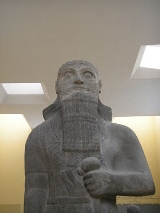
Shalmaneser III

Encyclopedia
Shalmaneser III was king of Assyria
(859 BC – 824 BC), and son of the previous ruler, Ashurnasirpal IIhttp://mcadams.posc.mu.edu/txt/ah/Assyria/Inscra01.html.
His long reign was a constant series of campaigns against the eastern tribes, the Babylon
ians, the nations of Mesopotamia
and Syria
, as well as Kizzuwadna and Urartu
. His armies penetrated to Lake Van
and the Taurus Mountains
; the Hittites
of Carchemish
were compelled to pay tribute, and the kingdoms of Hamath and Aram Damascus
were subdued.
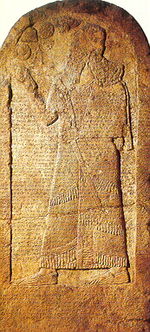 In 853 BC a coalition which was formed by the kingdoms of Egypt
, Hamath, Arvad, the Ammonites, "Ahab
of Israel" and other neighboring states, under the leadership of king Hadadezer
of Damascus
, fought the Assyrian king at Battle of Qarqar
. However, the Assyrian king persevered in his attempts to subjugate Israel and Syria. Other battles soon followed in 849 BC and 846 BC.
 In 842 BC, Shalmaneser campaigned against Hadadezer's successor Hazael
, forcing him to take refuge within the walls of his capital. While Shalmaneser was unable to capture Damascus, he devastated its territory, and Jehu
of Israel (whose ambassadors are represented on the Black Obelisk
now in the British Museum
), together with the Phoenicia
n cities, prudently sent tribute to him in 841 BC. Babylon
ia had already been conquered as far as the marshes of the Chaldaeans in the south, and the Babylonian king put to death.
It was the Assyrian king who defeated the Western coalition at Qarqar.
) which was followed by one against Cappadocia
, and in 832 BC came another campaign against Urartu
. In the following year, age required the king to hand over the command of his armies to the Tartan (turtānu commander-in-chief) Dayyan-Assur
, and six years later, Nineveh
and other cities revolted against him under his rebel son Assur-danin-pal
. Civil war
continued for two years; but the rebellion was at last crushed by Shamshi-Adad V
, another son of Shalmaneser. Shalmaneser died soon afterwards.
(See: Hebrew Bible
/ Old Testament
) because two of his monuments name Biblical figures. The Black Obelisk
names Jehu
son of Omri
and the Kurkh Monolith
names king Ahab
in reference to the Battle of Karkar.
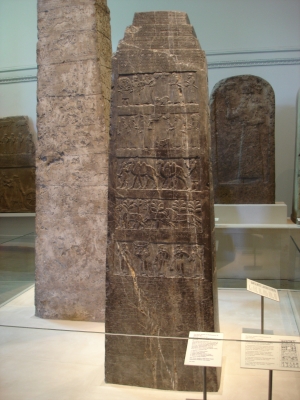 He had built a palace at Calah, and left several editions of the royal annals
recording his military campaigns, the last of which is engraved on the Black Obelisk
from Calah.
The Black Obelisk is a significant artifact from his reign. It is a black limestone
, bas-relief sculpture
from Nimrud
(ancient Kalhu), in northern Iraq
. It is the most complete Assyrian obelisk
yet discovered, and is historically significant because it displays the earliest ancient depiction of an Israelite
. On the top and the bottom of the reliefs there is a long cuneiform inscription recording the annals of Shalmaneser III. It lists the military campaigns which the king and his commander-in-chief headed every year, until the thirty-first year of reign. Some features might suggest that the work had been commissioned by the commander-in-chief, Dayyan-Assur.
The second register
from the top includes the earliest surviving picture of an Israelite: the Biblical Jehu
, king of Israel. Jehu
severed Israel’s alliances with Phoenicia
and Judah
, and became subject to Assyria
. It describes how Jehu brought or sent his tribute in or around 841 BC. The caption above the scene, written in Assyrian cuneiform, can be translated:
It was erected as a public monument in 825 BC at a time of civil war. It was discovered by archaeologist Sir Austen Henry Layard
in 1846.
Assyria
Assyria was a Semitic Akkadian kingdom, extant as a nation state from the mid–23rd century BC to 608 BC centred on the Upper Tigris river, in northern Mesopotamia , that came to rule regional empires a number of times through history. It was named for its original capital, the ancient city of Assur...
(859 BC – 824 BC), and son of the previous ruler, Ashurnasirpal IIhttp://mcadams.posc.mu.edu/txt/ah/Assyria/Inscra01.html.
His long reign was a constant series of campaigns against the eastern tribes, the Babylon
Babylon
Babylon was an Akkadian city-state of ancient Mesopotamia, the remains of which are found in present-day Al Hillah, Babil Province, Iraq, about 85 kilometers south of Baghdad...
ians, the nations of Mesopotamia
Mesopotamia
Mesopotamia is a toponym for the area of the Tigris–Euphrates river system, largely corresponding to modern-day Iraq, northeastern Syria, southeastern Turkey and southwestern Iran.Widely considered to be the cradle of civilization, Bronze Age Mesopotamia included Sumer and the...
and Syria
Syria
Syria , officially the Syrian Arab Republic , is a country in Western Asia, bordering Lebanon and the Mediterranean Sea to the West, Turkey to the north, Iraq to the east, Jordan to the south, and Israel to the southwest....
, as well as Kizzuwadna and Urartu
Urartu
Urartu , corresponding to Ararat or Kingdom of Van was an Iron Age kingdom centered around Lake Van in the Armenian Highland....
. His armies penetrated to Lake Van
Lake Van
Lake Van is the largest lake in Turkey, located in the far east of the country in Van district. It is a saline and soda lake, receiving water from numerous small streams that descend from the surrounding mountains. Lake Van is one of the world's largest endorheic lakes . The original outlet from...
and the Taurus Mountains
Taurus Mountains
Taurus Mountains are a mountain complex in southern Turkey, dividing the Mediterranean coastal region of southern Turkey from the central Anatolian Plateau. The system extends along a curve from Lake Eğirdir in the west to the upper reaches of the Euphrates and Tigris rivers in the east...
; the Hittites
Hittites
The Hittites were a Bronze Age people of Anatolia.They established a kingdom centered at Hattusa in north-central Anatolia c. the 18th century BC. The Hittite empire reached its height c...
of Carchemish
Carchemish
Carchemish or Kargamış was an important ancient city of the Mitanni, Hittite and Neo Assyrian Empires, now on the frontier between Turkey and Syria. It was the location of an important battle between the Babylonians and Egyptians, mentioned in the Bible...
were compelled to pay tribute, and the kingdoms of Hamath and Aram Damascus
Aram Damascus
Aram Damascus was an Aramaean state around Damascus in Syria, from the late 12th century BCE to 734 BCE.Sources for this state come from texts that can be divided into three categories: Assyrian annals, Aramaean texts, and the Hebrew Bible....
were subdued.
Reign
Egypt
Egypt , officially the Arab Republic of Egypt, Arabic: , is a country mainly in North Africa, with the Sinai Peninsula forming a land bridge in Southwest Asia. Egypt is thus a transcontinental country, and a major power in Africa, the Mediterranean Basin, the Middle East and the Muslim world...
, Hamath, Arvad, the Ammonites, "Ahab
Ahab
Ahab or Ach'av or Achab in Douay-Rheims was king of Israel and the son and successor of Omri according to the Hebrew Bible. His wife was Jezebel....
of Israel" and other neighboring states, under the leadership of king Hadadezer
Hadadezer
Hadadezer ; also known as Adad-Idri and possibly the same as Bar-Hadad II ; Ben-Hadad II , was the king of Aram Damascus at the time of the battle of Qarqar against the Assyrian king Shalmaneser III in 853 BCE. He and Irhuleni of Hamath led a coalition of eleven kings at Qarqar...
of Damascus
Damascus
Damascus , commonly known in Syria as Al Sham , and as the City of Jasmine , is the capital and the second largest city of Syria after Aleppo, both are part of the country's 14 governorates. In addition to being one of the oldest continuously inhabited cities in the world, Damascus is a major...
, fought the Assyrian king at Battle of Qarqar
Battle of Qarqar
The Battle of Qarqar was fought in 853 BC when the army of Assyria led by king Shalmaneser III encountered an allied army of 12 kings at Qarqar led by Hadadezer of Damascus and King Ahab of Israel...
. However, the Assyrian king persevered in his attempts to subjugate Israel and Syria. Other battles soon followed in 849 BC and 846 BC.
Against Israel
Hazael
Hazael was a court official and later an Aramean king who is mentioned in the Bible. Under his reign, Aram-Damascus became an empire that ruled over large parts of Syria and Palestine....
, forcing him to take refuge within the walls of his capital. While Shalmaneser was unable to capture Damascus, he devastated its territory, and Jehu
Jehu
Jehu was a king of Israel. He was the son of Jehoshaphat, and grandson of Nimshi.William F. Albright has dated his reign to 842-815 BC, while E. R. Thiele offers the dates 841-814 BC...
of Israel (whose ambassadors are represented on the Black Obelisk
Black Obelisk
The "Black Obelisk of Shalmaneser III" is a black limestone Neo-Assyrian bas-relief sculpture from Nimrud , in northern Iraq, commemorating the deeds of King Shalmaneser III . It is the most complete Assyrian obelisk yet discovered, and is historically significant because it displays the earliest...
now in the British Museum
British Museum
The British Museum is a museum of human history and culture in London. Its collections, which number more than seven million objects, are amongst the largest and most comprehensive in the world and originate from all continents, illustrating and documenting the story of human culture from its...
), together with the Phoenicia
Phoenicia
Phoenicia , was an ancient civilization in Canaan which covered most of the western, coastal part of the Fertile Crescent. Several major Phoenician cities were built on the coastline of the Mediterranean. It was an enterprising maritime trading culture that spread across the Mediterranean from 1550...
n cities, prudently sent tribute to him in 841 BC. Babylon
Babylon
Babylon was an Akkadian city-state of ancient Mesopotamia, the remains of which are found in present-day Al Hillah, Babil Province, Iraq, about 85 kilometers south of Baghdad...
ia had already been conquered as far as the marshes of the Chaldaeans in the south, and the Babylonian king put to death.
It was the Assyrian king who defeated the Western coalition at Qarqar.
Against Tibareni
In 836 BC, Shalmaneser sent an expedition against the Tibareni (TabalTabal
Tabal was a Luwian speaking Neo-Hittite kingdom of South Central Anatolia. According to archaeologist Kurt Bittel, the kingdom of Tabal first appeared after the collapse of the Hittite Empire....
) which was followed by one against Cappadocia
Cappadocia
Cappadocia is a historical region in Central Anatolia, largely in Nevşehir Province.In the time of Herodotus, the Cappadocians were reported as occupying the whole region from Mount Taurus to the vicinity of the Euxine...
, and in 832 BC came another campaign against Urartu
Urartu
Urartu , corresponding to Ararat or Kingdom of Van was an Iron Age kingdom centered around Lake Van in the Armenian Highland....
. In the following year, age required the king to hand over the command of his armies to the Tartan (turtānu commander-in-chief) Dayyan-Assur
Dayyan-Assur
Dayyan-Assur was commander-in-chief, or Tartan , of the Assyrian army during the reign of Shalmaneser III .According to the Black Obelisk, he personally led some of the military campaigns outside Assyria, which is rather unusual for a tartan. He was involved in the strife for the succession of the...
, and six years later, Nineveh
Nineveh
Nineveh was an ancient Assyrian city on the eastern bank of the Tigris River, and capital of the Neo Assyrian Empire. Its ruins are across the river from the modern-day major city of Mosul, in the Ninawa Governorate of Iraq....
and other cities revolted against him under his rebel son Assur-danin-pal
Assur-danin-pal
Assur danin Pal was the son of the king of Assyria, Shalmaneser III. He rebelled against his father in an attempt to seize the throne. However, Shalmaneser III's younger son Shamshi-Ramman II crushed his rebellion.Assur danin Pal had sought the alliance of the Babylonian King Marduk-balatsuiqbi,...
. Civil war
Civil war
A civil war is a war between organized groups within the same nation state or republic, or, less commonly, between two countries created from a formerly-united nation state....
continued for two years; but the rebellion was at last crushed by Shamshi-Adad V
Shamshi-Adad V
Shamshi-Adad V was the King of Assyria from 824 to 811 BC.-Biography:He was the son and successor of Shalmaneser III, the husband of Shammuramat , and the father of Adad-nirari III, who succeeded him as king....
, another son of Shalmaneser. Shalmaneser died soon afterwards.
Significance to the Bible
His reign is significant to the BibleBible
The Bible refers to any one of the collections of the primary religious texts of Judaism and Christianity. There is no common version of the Bible, as the individual books , their contents and their order vary among denominations...
(See: Hebrew Bible
Hebrew Bible
The Hebrew Bible is a term used by biblical scholars outside of Judaism to refer to the Tanakh , a canonical collection of Jewish texts, and the common textual antecedent of the several canonical editions of the Christian Old Testament...
/ Old Testament
Old Testament
The Old Testament, of which Christians hold different views, is a Christian term for the religious writings of ancient Israel held sacred and inspired by Christians which overlaps with the 24-book canon of the Masoretic Text of Judaism...
) because two of his monuments name Biblical figures. The Black Obelisk
Black Obelisk
The "Black Obelisk of Shalmaneser III" is a black limestone Neo-Assyrian bas-relief sculpture from Nimrud , in northern Iraq, commemorating the deeds of King Shalmaneser III . It is the most complete Assyrian obelisk yet discovered, and is historically significant because it displays the earliest...
names Jehu
Jehu
Jehu was a king of Israel. He was the son of Jehoshaphat, and grandson of Nimshi.William F. Albright has dated his reign to 842-815 BC, while E. R. Thiele offers the dates 841-814 BC...
son of Omri
Omri
Omri was a king of Israel, successful military campaigner and first in the line of Omride kings that included Ahab, Ahaziah and Joram.He was "commander of the army" of king Elah when Zimri murdered Elah and made himself king. Instead, the troops at Gibbethon chose Omri as king, and he led them to...
and the Kurkh Monolith
Kurkh Monolith
The Kurkh Monolith is an Assyrian document that contains a description of the Battle of Qarqar at the end. Today it stands in the British Museum but it was originally found at the Kurdish village of Kurkh , near the town of Bismil in the province of Diyarbakır, Turkey...
names king Ahab
Ahab
Ahab or Ach'av or Achab in Douay-Rheims was king of Israel and the son and successor of Omri according to the Hebrew Bible. His wife was Jezebel....
in reference to the Battle of Karkar.
Construction and the Black Obelisk
Annals
Annals are a concise form of historical representation which record events chronologically, year by year. The Oxford English Dictionary defines annals as "a narrative of events written year by year"...
recording his military campaigns, the last of which is engraved on the Black Obelisk
Black Obelisk
The "Black Obelisk of Shalmaneser III" is a black limestone Neo-Assyrian bas-relief sculpture from Nimrud , in northern Iraq, commemorating the deeds of King Shalmaneser III . It is the most complete Assyrian obelisk yet discovered, and is historically significant because it displays the earliest...
from Calah.
The Black Obelisk is a significant artifact from his reign. It is a black limestone
Limestone
Limestone is a sedimentary rock composed largely of the minerals calcite and aragonite, which are different crystal forms of calcium carbonate . Many limestones are composed from skeletal fragments of marine organisms such as coral or foraminifera....
, bas-relief sculpture
Sculpture
Sculpture is three-dimensional artwork created by shaping or combining hard materials—typically stone such as marble—or metal, glass, or wood. Softer materials can also be used, such as clay, textiles, plastics, polymers and softer metals...
from Nimrud
Nimrud
Nimrud is an ancient Assyrian city located south of Nineveh on the river Tigris in modern Ninawa Governorate Iraq. In ancient times the city was called Kalḫu. The Arabs called the city Nimrud after the Biblical Nimrod, a legendary hunting hero .The city covered an area of around . Ruins of the city...
(ancient Kalhu), in northern Iraq
Iraq
Iraq ; officially the Republic of Iraq is a country in Western Asia spanning most of the northwestern end of the Zagros mountain range, the eastern part of the Syrian Desert and the northern part of the Arabian Desert....
. It is the most complete Assyrian obelisk
Obelisk
An obelisk is a tall, four-sided, narrow tapering monument which ends in a pyramid-like shape at the top, and is said to resemble a petrified ray of the sun-disk. A pair of obelisks usually stood in front of a pylon...
yet discovered, and is historically significant because it displays the earliest ancient depiction of an Israelite
Israelite
According to the Bible the Israelites were a Hebrew-speaking people of the Ancient Near East who inhabited the Land of Canaan during the monarchic period .The word "Israelite" derives from the Biblical Hebrew ישראל...
. On the top and the bottom of the reliefs there is a long cuneiform inscription recording the annals of Shalmaneser III. It lists the military campaigns which the king and his commander-in-chief headed every year, until the thirty-first year of reign. Some features might suggest that the work had been commissioned by the commander-in-chief, Dayyan-Assur.
The second register
Register (sculpture)
In art and archaeology, a register is a vertical level in a work that consists of several levels, especially where the levels are clearly separated by lines; modern comic books typically use similar conventions...
from the top includes the earliest surviving picture of an Israelite: the Biblical Jehu
Jehu
Jehu was a king of Israel. He was the son of Jehoshaphat, and grandson of Nimshi.William F. Albright has dated his reign to 842-815 BC, while E. R. Thiele offers the dates 841-814 BC...
, king of Israel. Jehu
Jehu
Jehu was a king of Israel. He was the son of Jehoshaphat, and grandson of Nimshi.William F. Albright has dated his reign to 842-815 BC, while E. R. Thiele offers the dates 841-814 BC...
severed Israel’s alliances with Phoenicia
Phoenicia
Phoenicia , was an ancient civilization in Canaan which covered most of the western, coastal part of the Fertile Crescent. Several major Phoenician cities were built on the coastline of the Mediterranean. It was an enterprising maritime trading culture that spread across the Mediterranean from 1550...
and Judah
Kingdom of Judah
The Kingdom of Judah was a Jewish state established in the Southern Levant during the Iron Age. It is often referred to as the "Southern Kingdom" to distinguish it from the northern Kingdom of Israel....
, and became subject to Assyria
Assyria
Assyria was a Semitic Akkadian kingdom, extant as a nation state from the mid–23rd century BC to 608 BC centred on the Upper Tigris river, in northern Mesopotamia , that came to rule regional empires a number of times through history. It was named for its original capital, the ancient city of Assur...
. It describes how Jehu brought or sent his tribute in or around 841 BC. The caption above the scene, written in Assyrian cuneiform, can be translated:
“The tribute of JehuJehuJehu was a king of Israel. He was the son of Jehoshaphat, and grandson of Nimshi.William F. Albright has dated his reign to 842-815 BC, while E. R. Thiele offers the dates 841-814 BC...
, son of OmriOmriOmri was a king of Israel, successful military campaigner and first in the line of Omride kings that included Ahab, Ahaziah and Joram.He was "commander of the army" of king Elah when Zimri murdered Elah and made himself king. Instead, the troops at Gibbethon chose Omri as king, and he led them to...
: I received from him silver, gold, a golden bowl, a golden vase with pointed bottom, golden tumblers, golden buckets, tin, a staff for a king [and] spears."
It was erected as a public monument in 825 BC at a time of civil war. It was discovered by archaeologist Sir Austen Henry Layard
Austen Henry Layard
Sir Austen Henry Layard GCB, PC was a British traveller, archaeologist, cuneiformist, art historian, draughtsman, collector, author, politician and diplomat, best known as the excavator of Nimrud.-Family:...
in 1846.
See also
- List of artifacts significant to the Bible
- Black Obelisk of Shalmaneser III
- Short chronology timelineShort chronology timelineThe short chronology is one chronology of the Near Eastern Bronze and Early Iron Age, which fixes the reign of Hammurabi to 1728 BC – 1686 BC and the sack of Babylon to 1531 BC....