
All Topics  
Tigris


   Email Print
   Bookmark   Link


Tigris


The Tigris (Arabic
Arabic language

Arabic is a Central Semitic language, thus related to and classified alongside other Semitic languages languages such as Hebrew language and Aramaic language....
: , ) is the eastern member of the two great river
River

A river is a natural stream of water, usually freshwater, flowing toward an ocean, a lake, or another stream. In some cases a river flows into the ground or dries up completely before reaching another body of water....
s that define Mesopotamia
Mesopotamia

Mesopotamia is the area of the Tigris-Euphrates river system, along the Tigris and Euphrates rivers, largely corresponding to modern Iraq, as well as some parts of northeastern Syria, some parts of southeastern Turkey, and some parts of the Khuzestan Province of southwestern Iran....
, along with the Euphrates
Euphrates

The Euphrates is the western of the two great rivers that define Mesopotamia which flows from Anatolia....
, which flows from the mountains of southeastern Turkey
Turkey

Turkey , known officially as the Republic of Turkey , is a Eurasian country that stretches across the Anatolian peninsula in southwest Asia and Thrace in the Balkans region of Southern Europe....
 through Iraq
Iraq

Iraq , officially the Republic of Iraq , is a country in Western Asia spanning most of the northwestern end of the Zagros Mountains, the eastern part of the Syrian Desert and the northern part of the Arabian Desert....
.

original Sumerian
Sumerian language

Sumerian was the language of ancient Sumer, spoken in Southern Mesopotamia since at least the 4th millennium BC. It was gradually replaced by Akkadian language as a spoken language somewhere around the turn of the 3rd and the 2nd millennium BC , but continued to be used as a sacred, ceremonial, literary and scientific language in Mesopotamia...
 name was Idigna or Idigina, probably from *id (i)gina "running water", which can be interpreted as "the swift river", contrasted to its neighbor, the Euphrates, whose leisurely pace caused it to deposit more silt and build up a higher bed than the Tigris.


Discussion
Ask a question about 'Tigris'
Start a new discussion about 'Tigris'
Answer questions from other users
Full Discussion Forum


Recent Posts


Encyclopedia


The Tigris (Arabic
Arabic language

Arabic is a Central Semitic language, thus related to and classified alongside other Semitic languages languages such as Hebrew language and Aramaic language....
: , ) is the eastern member of the two great river
River

A river is a natural stream of water, usually freshwater, flowing toward an ocean, a lake, or another stream. In some cases a river flows into the ground or dries up completely before reaching another body of water....
s that define Mesopotamia
Mesopotamia

Mesopotamia is the area of the Tigris-Euphrates river system, along the Tigris and Euphrates rivers, largely corresponding to modern Iraq, as well as some parts of northeastern Syria, some parts of southeastern Turkey, and some parts of the Khuzestan Province of southwestern Iran....
, along with the Euphrates
Euphrates

The Euphrates is the western of the two great rivers that define Mesopotamia which flows from Anatolia....
, which flows from the mountains of southeastern Turkey
Turkey

Turkey , known officially as the Republic of Turkey , is a Eurasian country that stretches across the Anatolian peninsula in southwest Asia and Thrace in the Balkans region of Southern Europe....
 through Iraq
Iraq

Iraq , officially the Republic of Iraq , is a country in Western Asia spanning most of the northwestern end of the Zagros Mountains, the eastern part of the Syrian Desert and the northern part of the Arabian Desert....
.

Etymology

The original Sumerian
Sumerian language

Sumerian was the language of ancient Sumer, spoken in Southern Mesopotamia since at least the 4th millennium BC. It was gradually replaced by Akkadian language as a spoken language somewhere around the turn of the 3rd and the 2nd millennium BC , but continued to be used as a sacred, ceremonial, literary and scientific language in Mesopotamia...
 name was Idigna or Idigina, probably from *id (i)gina "running water", which can be interpreted as "the swift river", contrasted to its neighbor, the Euphrates, whose leisurely pace caused it to deposit more silt and build up a higher bed than the Tigris. This form was borrowed and gave rise to Akkadian Idiqlat. Either through a Persian
Persian language

name=Persian|nativename=|pronunciation=[f??r'si]|image=|caption=Farsi in Perso-Arabic script |states= Iran, Afghanistan, Tajikistan, Uzbekistan, and Bahrain....
 intermediary or directly from Akkadian, the word was adopted into Greek as Tigris ("??????" which is also Greek for "tiger
Tiger

The tiger is a member of the Felidae family; the largest of the four "big cats" in the genus Panthera. Native to much of eastern and southern Asia, the tiger is an apex predator and an Carnivore#Obligate carnivores....
"). In the Hebrew Bible
Hebrew Bible

The term Hebrew Bible is a generic reference to those books of the Bible originally written mostly in Biblical Hebrew with some Biblical Aramaic....
, the river was called ???????? (?idd?qel, KJV
King James Version of the Bible

The Authorized King James Version is an English language translation of the Christian Bible begun in 1604 and first published in 1611 by the Church of England....
 Hiddekel)

Pahlavi tigr means "arrow", in the same family as Old Persian tigra- "pointed" (compare tigra-xauda
Orthocorybantians

The Orthocorybantians were a tribe of the Scythians. They were settling in the eleventh satrapy of Achaemenid Persia . A delegation of Orthocorybantians paying tribute is depicted on the Apadana relief....
), Modern Persian
Persian language

name=Persian|nativename=|pronunciation=[f??r'si]|image=|caption=Farsi in Perso-Arabic script |states= Iran, Afghanistan, Tajikistan, Uzbekistan, and Bahrain....
 têz "sharp". However, it does not appear that this was the original name of the river, but that it (like the Semitic
Semitic languages

File:Amarna Akkadian letter.pngThe Semitic languages are a group of related languages whose living representatives are spoken by more than 467 million people across much of the Middle East, North Africa and the Horn of Africa....
 forms of the name) was coined as an imitation of the indigenous Sumerian name. This is similar to the Persian name of the Euphrates, Ufratu, which does have a meaning in Persian, but is still modeled after the Sumerian name Purattu.

Another name for the Tigris, used from the time of the Persian Empire
Persian Empire

The 'Persian Empire' was a series of successive Iranian or Persianization empires that ruled over the Iranian plateau, the original Persian homeland, and beyond in Southwest Asia, South Asia, Central Asia and the Caucasus....
, is Arvand Rud, literally Arvand River. Today the name Arvand Rud is the Persian
Persian language

name=Persian|nativename=|pronunciation=[f??r'si]|image=|caption=Farsi in Perso-Arabic script |states= Iran, Afghanistan, Tajikistan, Uzbekistan, and Bahrain....
 name for the confluence of the Euphrates
Euphrates

The Euphrates is the western of the two great rivers that define Mesopotamia which flows from Anatolia....
 and Tigris rivers which in Arabic is called Shatt al-Arab.

The name of the Tigris in languages that have been important to the region:
Tigrisdiyarbakir
,
LanguageName for Tigris
Akkadian
Akkadian language

Akkadian or Assyrian-Babylonian is a Semitic language that was spoken in ancient Mesopotamia. The earliest attested Semitic language, it used the cuneiform writing system derived ultimately from ancient Sumerian language, an unrelated language isolate....
Arabic
Arabic language

Arabic is a Central Semitic language, thus related to and classified alongside other Semitic languages languages such as Hebrew language and Aramaic language....
Aramaic
Aramaic language

Aramaic is a Semitic languages with a 3,000-year history. It has been the language of administration of empires and the language of divine worship....
Armenian
Armenian language

The 'Armenian language' is an Indo-European language spoken by the Armenians. It is the official language of the Armenia as well as in the region of Nagorno-Karabakh....
Greek
Ancient Greek

Ancient Greek is the historical stage in the development of the Greek language spanning across the Archaic Greece , Classical Greece , and Hellenistic civilization periods of ancient Greece and the classical antiquity....
;
Hebrew
Hebrew language

Hebrew is a Semitic languages of the Afro-Asiatic languages. Modern Hebrew is spoken by more than seven million people in Israel and Classical Hebrew is used for prayer or study in Jews communities around the world....
Hurrian
Hurrian language

Hurrian is a conventional name for the language of the Hurrians , a people who entered northern Mesopotamia around 2300 BC and had mostly vanished by 1000 BC....
Kurdish
Kurdish language

The Kurdish language is a term used for the language spoken by Kurdish people. It is mainly concentrated in the parts of Iran, Iraq, Syria and Turkey....
Persian
Persian language

name=Persian|nativename=|pronunciation=[f??r'si]|image=|caption=Farsi in Perso-Arabic script |states= Iran, Afghanistan, Tajikistan, Uzbekistan, and Bahrain....
Old Persian:; Middle Persian
Middle Persian

Middle Persian is the Iranian languages language/ethnolect of Southwestern Iran that during Sassanid times became a prestige dialect and so came to be spoken in other regions as well....
:; Modern Persian:
Sumerian
Sumerian language

Sumerian was the language of ancient Sumer, spoken in Southern Mesopotamia since at least the 4th millennium BC. It was gradually replaced by Akkadian language as a spoken language somewhere around the turn of the 3rd and the 2nd millennium BC , but continued to be used as a sacred, ceremonial, literary and scientific language in Mesopotamia...
Syriac
Syriac language

Syriac is a dialect of Middle Aramaic that was once spoken across much of the Fertile Crescent. Classical Syriac became a major literary language throughout the Middle East from the 4th to the 8th centuries, the classical language of Edessa, Mesopotamia, preserved in a large body of Syriac literature....
Turkish
Turkish language

Turkish is a language spoken by over 63 million people worldwide, making it the most commonly spoken of the Turkic languages. Its speakers are located predominantly in Turkey and Cyprus, with smaller groups in Iraq, Greece, Bulgaria, the Republic of Macedonia, Kosovo, Albania and other parts of Eastern Europe....

Description

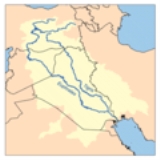
The Tigris is approximately 1,900 km (1,200 miles) long, rising in the Taurus Mountains
Taurus Mountains

Taurus Mountains are a mountain range in southern Turkey, from which the Euphrates and Tigris descend into Syria and Iraq. It divides the Mediterranean Region, Turkey of southern Turkey from the central Anatolia#Anatolian plateau....
 of eastern Turkey
Turkey

Turkey , known officially as the Republic of Turkey , is a Eurasian country that stretches across the Anatolian peninsula in southwest Asia and Thrace in the Balkans region of Southern Europe....
 about 25 km (15 mi) SE of the city of Elazig and just a few miles from the source of the Euphrates River, flowing in a generally southeasterly direction until it joins the Euphrates near al-Qurnah
Al-Qurnah

Al-Qurnah is a small village in southern Iraq about 74 km northwest of Basra, within the town of Nahairat. Qurna is located at the point where the Tigris and Euphrates rivers join to form the Shatt al-Arab....
 in southern Iraq. The two rivers together form the Shatt al-Arab waterway, which empties into the Persian Gulf
Persian Gulf

The Persian Gulf, in the Southwest Asian region, is an extension of the Indian Ocean located between Iran and the Arabian Peninsula. Historically and commonly known as the Persian Gulf, this body of water is sometimes Persian Gulf naming dispute referred to as the Arabian Gulf by certain Arab countries or simply The Gulf, although nei...
. The Tigris is fed from the east by four tributary streams: the Great Zab, the Little Zab, the ?Adhaim, and the Diyala.

The Tigris unites with the Euphrates near Basra, and from this junction to the Persian Gulf the stream is known as the Shatt-al-Arab. According to Pliny and other ancient historians, the Euphrates originally had its outlet into the sea separate from that of the Tigris.

Baghdad
Baghdad

Baghdad is the Capital of Iraq and of Baghdad Governorate, with which it is also coterminous. With a municipal population estimated at 6.5 million, it is the largest city in Iraq, and the second largest city in the Arab World....
, the capital of Iraq
Iraq

Iraq , officially the Republic of Iraq , is a country in Western Asia spanning most of the northwestern end of the Zagros Mountains, the eastern part of the Syrian Desert and the northern part of the Arabian Desert....
, stands on the banks of the Tigris. The port city of Basra
Basra

Al-Ba?rah is the capital of Basra Province, and had an estimated population of 1,052,200 as of 2003. Basra is also Iraq's main port. The city is the historic location of Sumer, the home of Sinbad the Sailor, and a proposed location of the Garden of Eden....
 straddles the Shatt al-Arab. In ancient times, many of the great cities of Mesopotamia stood on or near the Tigris, drawing water from it to irrigate the civilization of the Sumerians. Notable Tigris-side cities included Nineveh
Nineveh

Nineveh , an "exceeding great city", as it is called in the Book of Jonah, lay on the eastern bank of the Tigris in ancient Assyria, across the river from the modern-day major city of Mosul, Iraq....
, Ctesiphon
Ctesiphon

Ctesiphon was one of the great cities of the Persian Empire, located on the east bank of the Tigris.Ctesiphon was an imperial capital of the Arsacids and of their successors, the Sassanids....
, and Seleucia
Seleucia on the Tigris

Seleucia was one of the great cities of the world during Hellenistic and Roman Empire times. It stood in Mesopotamia, on the west bank of the Tigris River, opposite the smaller town of Opis ....
, while the city of Lagash
Lagash

Lagash is located northwest of the junction of the Euphrates and Tigris rivers and east of Uruk, Lagash was one of the oldest cities of Sumer and later Babylonia....
 was irrigated by Tigris water delivered to it via a canal dug around 2400 BC. Saddam Hussein
Saddam Hussein

Saddam Hussein Abd al-Majid al-Tikriti was the President of Iraq of Iraq from 16 July 1979 until 9 April 2003.A leading member of the revolutionary Ba'ath Party, which espoused secular pan-Arabism, economic modernization, and Arab socialism, Saddam played a key role in the 1968 coup that brought the party to long-term power....
's hometown, Tikrit
Tikrit

Tikrit is a town in Iraq, located 140 km northwest of Baghdad on the Tigris river . The town, with an estimated population in 2002 of about 260,000 is the administrative center of the province of Salah ad Din ....
, is also located on the river and derives its name from it.

The Tigris has long been an important transport route in a largely desert country. It is navigable as far as Baghdad by shallow-draft vessels, but rafts are needed for transport upstream to Mosul
Mosul

Mosul is a city in northern Iraq and the capital of the Ninawa Governorate, some 400 km northwest of Baghdad. The original city stands on the west bank of the Tigris River, opposite the ancient city of Nineveh on the east bank, but the metropolitan area has now grown to encompass substantial areas on both banks, with five bridges linkin...
. River trade declined in importance during the 20th century as the Basra-Baghdad-Mosul railway and roads took over much of the freight traffic.

Management and water quality

Tigris River Mosul
The Tigris is heavily dammed in Iraq and Turkey, to provide water for irrigating the arid and semi-desert regions bordering the river valley. Damming has also been important for averting floods in Iraq, to which the Tigris has historically been notoriously prone following snowmelt in the Turkish mountains around April. Recent Turkish damming of the river has been the subject of some controversy, both for its environmental effects within Turkey and its potential to reduce the flow of water downstream. Mosul Dam
Mosul Dam

Mosul Dam , formerly known as Saddam Dam , is the largest dam in Iraq. It is located on the Tigris River in the western governorate of Ninawa Governorate, upstream of the city of Mosul....
, located on the Tigris, is the largest dam in Iraq. Some problems with the Tigris water quality include the number of dead bodies being dumped into it. The bodies are mainly from explosions of cargo ships carrying ammunition. This effects the economy because people are not eating some fish that come from the Tigris. The people are not eating them for fear that the fish may have eaten human cadaver.

Religion

The Tigris appears twice in the Bible. In the Book of Genesis, the Tigris is the third of the four rivers branching off the river issuing out of the Garden of Eden
Garden of Eden

The Garden of Eden is a location described in the Book of Genesis as being the place where the first man, Adam , and his wife, Eve , lived after they were created by God....
. Daniel
Daniel

Daniel is a figure appearing in the Hebrew Bible and the central protagonist of the Book of Daniel. The name "Daniel" means "Judged by El ". "Dan" = judge and "i" = a suffix conjugating the verb such that its action applies to the speaker....
 received one of his visions "when I was by that great river the Tigris".

Mythology

In Sumerian mythology, the Tigris was created by the god Enki
Enki

Enki was a deity in Mesopotamian mythology, later known as Ea in Babylonian mythology. He was originally chief god of the city of Eridu, but later the influence of his cult spread throughout Mesopotamia and also to Hittite and Hurrian areas....
, who ejaculated and filled the river with flowing water.

See also

  • Assyria
    Assyria

    Assyria was a political state centered on the Upper Tigris river, in Mesopotamia , that came to rule regional empires a number of times in history....
  • Cradle of civilization
    Cradle of Civilization

    The cradle of civilization is any of the possible locations for the emergence of civilization.It is usually applied to the Ancient Near Eastern Chalcolithic , especially in the Fertile Crescent , but also extended to sites in Anatolia and the Persian Plateau,...
  • Euphrates
    Euphrates

    The Euphrates is the western of the two great rivers that define Mesopotamia which flows from Anatolia....
  • Ilisu Dam Campaign
    Ilisu Dam Campaign

    The Ilisu Dam Campaign is a United Kingdom based campaign working to stop the construction of the Ilisu Dam on the river Tigris in south east Turkey....
     campaign against a planned dam on Tigris in Turkey
  • List of places in Iraq
    List of places in Iraq

    This is a list of places in Iraq. Governorates of Iraq lists the regional administrative provinces, and Districts of Iraq lists the subdivisions of those provinces....
  • Mesopotamia
    Mesopotamia

    Mesopotamia is the area of the Tigris-Euphrates river system, along the Tigris and Euphrates rivers, largely corresponding to modern Iraq, as well as some parts of northeastern Syria, some parts of southeastern Turkey, and some parts of the Khuzestan Province of southwestern Iran....
  • Tigris-Euphrates alluvial salt marsh
  • al-Qurnah
    Al-Qurnah

    Al-Qurnah is a small village in southern Iraq about 74 km northwest of Basra, within the town of Nahairat. Qurna is located at the point where the Tigris and Euphrates rivers join to form the Shatt al-Arab....


External links

  • Peace Palace Library