
All Topics  
Charles Martel

 
Charles Martel

   Email Print
   Bookmark   Link


Charles Martel


Charles "The Hammer" Martel () (ca. 688 - 22 October 741) was proclaimed Mayor of the Palace and ruled the Franks
Franks

The Franks or Frankish people were a West Germanic ethnic group first identified in the 3rd century as living north and east of the Lower Rhine River....
 in the name of a titular King. Late in his reign he proclaimed himself Duke of the Franks
Duke of the Franks

The title dux et princeps Francorum, or duke and prince of the Franks, was the title adopted by Pepin of Heristal after his epoch-making victory at the Battle of Tertry in 687....
 (the last four years of his reign he did not even bother with the façade of a King) and by any name was de facto ruler of the Frankish Realms. In 739 he was offered an office of Roman consul
Roman consul

Consul was the highest elected political office of the Roman Republic and the Roman Empire.During the time of ancient Rome as a Republic, the Consuls were the highest civil and military magistrates, serving as the head of government for the Republic....
 by the Pope, which he rejected possibly not to conflict with Theodatus Ursus who already occupied the office by appointment of the Byzantine emperor Leo III the Isaurian
Leo III the Isaurian

Leo III the Isaurian or the Syrian , was List of Byzantine Emperors from 717 until his death in 741. He put an end to a period of instability, successfully defended the empire against the invading Umayyads, and forbade the veneration of icons ....
.


Discussion
Ask a question about 'Charles Martel'
Start a new discussion about 'Charles Martel'
Answer questions from other users
Full Discussion Forum


Recent Posts


Timeline

686   Born

714   King Radbod of the Frisians defeats Charles Martel. Frisia becomes independent.

714   On the death of Pepin II his illegitimate son Charles Martel becomes mayor of the Austrasian palace and effective power behind the Frankish throne.

716   Charles Martel defeats the Neustrians at the Battle of Amblève.

717   Battle of Vincy between Charles Martel and Ragenfrid.

719   Charles Martel defeats king Radbod of the Frisians. Frisia becomes a part of the Frankish Empire.

724   Died

730   Charles Martel defeats the last independent dukedom of the Alamanni and launches raids on the Saxons beyond the Rhine.

732   Battle of Tours: Near Poitiers, France, leader of the Franks Charles Martel and his men, defeat a large army of Moors, stopping the Muslims from spreading into Western Europe. The governor of Cordoba, Abdul Rahman Al Ghafiqi, is killed during the battle.

737   Gaul - Following the death of Theuderic IV the throne is left vacant temporarily by Charles Martel, Mayor of the Palace and effective ruler.


Encyclopedia


Charles "The Hammer" Martel () (ca. 688 - 22 October 741) was proclaimed Mayor of the Palace and ruled the Franks
Franks

The Franks or Frankish people were a West Germanic ethnic group first identified in the 3rd century as living north and east of the Lower Rhine River....
 in the name of a titular King. Late in his reign he proclaimed himself Duke of the Franks
Duke of the Franks

The title dux et princeps Francorum, or duke and prince of the Franks, was the title adopted by Pepin of Heristal after his epoch-making victory at the Battle of Tertry in 687....
 (the last four years of his reign he did not even bother with the façade of a King) and by any name was de facto ruler of the Frankish Realms. In 739 he was offered an office of Roman consul
Roman consul

Consul was the highest elected political office of the Roman Republic and the Roman Empire.During the time of ancient Rome as a Republic, the Consuls were the highest civil and military magistrates, serving as the head of government for the Republic....
 by the Pope, which he rejected possibly not to conflict with Theodatus Ursus who already occupied the office by appointment of the Byzantine emperor Leo III the Isaurian
Leo III the Isaurian

Leo III the Isaurian or the Syrian , was List of Byzantine Emperors from 717 until his death in 741. He put an end to a period of instability, successfully defended the empire against the invading Umayyads, and forbade the veneration of icons ....
. He expanded his rule over all three of the Frankish
Franks

The Franks or Frankish people were a West Germanic ethnic group first identified in the 3rd century as living north and east of the Lower Rhine River....
 kingdoms: Austrasia
Austrasia

Austrasia formed the north-eastern portion of the Kingdom of the Merovingian Franks, comprising parts of the territory of present-day eastern France, western Germany, Belgium, Luxembourg and the Netherlands....
, Neustria
Neustria

The territory of Neustria or Neustrasia, meaning "new [western] land", originated in 511, made up of the regions from Aquitaine to the English Channel, approximating most of the north of present-day France, with Paris and Soissons as its main cities....
 and Burgundy.

Martel was born in Herstal
Herstal

Herstal is a municipality of Belgium. It lies in the country's Walloon Region and Liege along the Meuse river. Herstal is included in the "Greater Li?ge " agglomeration, which counts about 600,000 inhabitants....
, in present-day Belgium
Belgium

* A small German-speaking Community of Belgium exists in eastern Wallonia. Belgium's linguistic diversity and related political and cultural conflicts are reflected in the history of Belgium and a complex Communities and regions of Belgium....
, the illegitimate son of Pippin the Middle
Pippin of Herstal

Pepin of Herstal was the Mayor of the Palace of Austrasia from 680 to his death and of Neustria and Kingdom of Burgundy from 687 to 695....
 and his concubine Alpaida
Alpaida

Alpaida was Pippin of Herstal's concubine and mother to Pepin II's illegitimate son, Charles Martel .External links...
 (or Chalpaida). He was described by Gustave Louis Maurice Strauss in his book "Moslem and Frank; or, Charles Martel and the rescue of Europe" as a tall, powerfully built man, who was more agile than his size would lead men to believe.

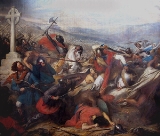
He is best remembered for winning the Battle of Tours
Battle of Tours

The Battle of Tours , also called the Battle of Poitiers and in Battle of Court of The Martyrs, was fought in an area between the cities of Poitiers and Tours, near the village of Moussais-la-Bataille about north of Poitiers....
 (also known as the Battle of Poitiers
Battle of Poitiers

Battle of Poitiers may refer to one of the following battles:* Battle of Tours , also known as Battle of Poitiers between Frankish and Islamic armies...
) in 732, which has traditionally been characterized as an event that halted the Islamic expansionism in Europe
Europe

Europe is, conventionally, one of the world's seven continents. Comprising the westernmost peninsula of Eurasia, Europe is generally divided from Asia to its east by the water divide of the Ural Mountains, the Ural , the Caspian Sea, and by the Caucasus Mountains to the southeast....
 that had conquered Iberia
Iberian Peninsula

The Iberian Peninsula, or Iberia, is located in the extreme southwest of Europe and includes modern-day Spain, Portugal, Andorra and Gibraltar and a very small area of France....
. "Charles's victory has often been regarded as decisive for world history, since it preserved western Europe from Muslim conquest and Islamization."

In addition to being the leader of the army that prevailed at Tours, Charles Martel was a truly giant figure of the Middle Ages
Middle Ages

File:Karl 1 mit papst gelasius gregor1 sacramentar v karl d kahlen.jpgThe Middle Ages of European history are a period in history which lasted for roughly a millennium, commonly dated from the fall of the Roman Empire in the 5th century to the beginning of the Early Modern Period in the 16th century, marked by the division of Western Christi...
. A brilliant general, he is considered the forefather of western heavy cavalry
Heavy cavalry

Heavy cavalry is a term referring to a class of cavalry whose primary role was to engage in direct combat with enemy forces . Although their equipment differed greatly depending on region and historical period, they were generally mounted on large powerful horses and armed with some kind of sword....
, chivalry
Chivalry

Chivalry is a term relating to the medieval institution of knighthood. It is usually associated with ideals of knightly virtues, honor and courtly love....
, founder of the Carolingian Empire
Carolingian Empire

Carolingian Empire is a historiography term sometimes used to refer to the Francia under the Carolingian dynasty. This dynasty is seen as the founders of France and Germany....
 (which was named after him), and a catalyst for the feudal system
Feudalism

Feudalism, a term first used in the early modern period , in its most classic sense refers to a Middle Ages European political system composed of a set of reciprocal law and military obligations among the warrior nobility, revolving around the three key concepts of lords, vassals, and fiefs....
, which would see Europe through the Middle Ages. Although some recent scholars have suggested he was more of a beneficiary of the feudal system than a knowing agent for social change, others continue to see him as the primary catalyst for the feudal system
Feudalism

Feudalism, a term first used in the early modern period , in its most classic sense refers to a Middle Ages European political system composed of a set of reciprocal law and military obligations among the warrior nobility, revolving around the three key concepts of lords, vassals, and fiefs....
.

Birth and youth

The following tale is told of Charles and of the origins of his name: in 676, Pepin of Herstal and his wife Plectrude
Plectrude

Plectrude or Plectrudis was the wife of Pepin of Herstal, the mayor of the palace and duke of the Franks, from about 670. She was the daughter of Hugobert, seneschal of Clovis IV, and Irmina d'Oeren....
 were talking together in a room when they were intruded upon by a messenger, bringing news that the Mayor's mistress, Alpaida
Alpaida

Alpaida was Pippin of Herstal's concubine and mother to Pepin II's illegitimate son, Charles Martel .External links...
, had given birth to a son at Herstal.The messenger, fearful of arousing the wrath of Plectrude, decided not to announce the news directly. Instead, he said: "Long live the king, it is a carl" ('man'). Pippin, equally cautious of his wife, dismissed the messenger as follows: "A carl, is it? Then let him be called that." This was done, and, so legend claims, the child was named "Carl". In Germany he's still called "Karl Martell". Alpaida also bore Pippin another son, Childebrand.

Contesting for power

In December 714, Pepin of Heristal died. Prior to his death, he had, at his wife Plectrude's urging, designated Theudoald
Theudoald

Theudoald or Theodald was the mayor of the palace, briefly unopposed in 714 until Ragenfrid was acclaimed in Neustria and Charles Martel in Austrasia by the nobles, after the death of his grandfather, Pepin of Heristal....
, his grandson by their son Grimoald, his heir in the entire realm. This was immediately opposed by the nobles because Theudoald was a child of only eight years of age. To prevent Charles using this unrest to his own advantage, Plectrude had him gaoled (jailed) in Cologne
Cologne

Cologne is Germany's fourth-largest city , and is the largest city both in the German Federal State of North Rhine-Westphalia and within the Rhine-Ruhr, one of the major European metropolitan areas with more than ten million inhabitants....
, the city which was destined to be her capital. This prevented an uprising on his behalf in Austrasia
Austrasia

Austrasia formed the north-eastern portion of the Kingdom of the Merovingian Franks, comprising parts of the territory of present-day eastern France, western Germany, Belgium, Luxembourg and the Netherlands....
, but not in Neustria
Neustria

The territory of Neustria or Neustrasia, meaning "new [western] land", originated in 511, made up of the regions from Aquitaine to the English Channel, approximating most of the north of present-day France, with Paris and Soissons as its main cities....
.

Civil war of 715-718

In 715, the Neustrian noblesse proclaimed Ragenfrid
Ragenfrid

Ragenfrid was the mayor of the palace of Neustria and Kingdom of Burgundy from 715, when he filled the vacuum in Neustria caused by the death of Pepin of Heristal, until 718, when Charles Martel finally established himself over the whole Frankish kingdom....
 mayor of their palace on behalf of, and apparently with the support of, Dagobert III
Dagobert III

Dagobert III was Merovingian king of the Franks .He was a son of Childebert III and Edonne. He succeeded his father as the head of the three Frankish kingdoms—Neustria and Austrasia, unified since Pippin's victory at Tertry in 687, and the Kingdom of Burgundy—in 711, at the age of twelve....
, the young king, who in theory had the legal authority to select a mayor, though by this time the Merovingian dynasty had lost most such powers.

The Austrasians were not to be left supporting a woman and her young son for long. Before the end of the year, Charles Martel had escaped from prison and been acclaimed mayor by the nobles of that kingdom. The Neustrians had been attacking Austrasia and the nobles were waiting for a strong man to lead them against their invading countrymen. That year, Dagobert died and the Neustrians proclaimed Chilperic II
Chilperic II

Chilperic II , born Daniel, the youngest son of Childeric II, was king of Neustria from 715 and sole king of the Franks from 718 until his death....
 king without the support of the rest of the Frankish people.

In 716, Chilperic and Ragenfrid together led an army into Austrasia. The Neustrians allied with another invading force under Radbod, King of the Frisians
Radbod, King of the Frisians

Radbod or Redbad was the Rulers of Frisia from c. 680 until his death. He is often considered the last independent ruler of Frisia before Frankish domination....
 and met Charles in battle near Cologne, which was still held by Plectrude. Charles had little time to gather men, or prepare, and the result was his only defeat. According to Strauss and Gustave, Martel fought a brilliant battle, but realized he could not prevail because he was outnumbered so badly, and retreated. In fact, he fled the field as soon as he realized he did not have the time or the men to prevail, retreating to the mountains of the Eifel
Eifel

The Eifel is a low mountain range in western Germany. It occupies parts of southwestern North Rhine-Westphalia and northwestern Rhineland-Palatinate....
 to gather men, and train them. The king and his mayor then turned to besiege their other rival in the city and took it and the treasury, and received the recognition of both Chilperic as king and Ragenfrid as mayor. Plectrude surrendered on Theudoald's behalf.

Magnanimous in victory

At this juncture, however, events turned in favour of Charles. Having made the proper preparations, he fell upon the triumphant army near Malmedy
Malmedy

Malmedy is a municipality of Belgium. It lies in the country's Walloon Region and Liege . It belongs to the French Community of Belgium. On January 1, 2006 Malmedy had a total population of 11,829....
 as it was returning to its own province, and, in the ensuing Battle of Amblève
Battle of Amblève

The Battle of Ambl?ve took place in 716 near Amel. The mayor of the palace of Austrasia, Charles Martel, defeated his Neustrian and Frisians rivals who were led by King Chilperic II, his mayor Ragenfrid, and Radbod, King of the Frisians....
, routed it and it fled. Several things were notable about this battle, in which Charles set the pattern for the remainder of his military career: First, he appeared where his enemies least expected him, while they were marching triumphantly home and far outnumbered him. He also attacked when least expected, at midday, when armies of that era traditionally were resting. Finally, he attacked them how they least expected it, by feigning a retreat to draw his opponents into a trap. The feigned retreat, next to unknown in Western Europe at that time—it was a traditionally eastern tactic—required both extraordinary discipline on the part of the troops and exact timing on the part of their commander. Charles, in this battle, had begun demonstrating the military genius that would mark his rule, in that he never attacked his enemies where, when, or how they expected, and the result was an unbroken victory streak that lasted until his death.

In Spring 717, Charles returned to Neustria with an army and confirmed his supremacy with a victory at the Battle of Vincy
Battle of Vincy

The Battle of Vincy was fought at Vincy, near Cambrai, in the modern Departments of France of Nord . It was a contest between Charles Martel and the Austrasians on one side and the king of the Franks, Chilperic II, and his mayor of the palace, Ragenfrid, on the other....
, near Cambrai
Cambrai

Cambrai is a Communes of France in the Nord Departments of France in northern France. It is a Subprefectures in France of the department.Cambrai is the seat of Archdiocese of Cambrai whose jurisdiction was immense during the Middle Ages....
. He chased the fleeing king and mayor to Paris
Paris

Paris is the Capital of France and the country's largest city. It is situated on the river Seine, in northern France, at the heart of the ?le-de-France Regions of France ....
, before turning back to deal with Plectrude and Cologne. He took her city and dispersed her adherents. However, he allowed both Plectrude and the young Theudoald to live and treated them with kindness—unusual for those Dark Ages
Dark Ages

Dark Age or Dark Ages is a term in historiography referring to a period of cultural decline or societal collapse that took place in Western Europe between the Decline of the Roman Empire and the eventual recovery of learning....
, when mercy to a former jailer, or a potential rival, was rare. On this success, he proclaimed Clotaire IV
Clotaire IV

Chlothar IV , king of Austrasia , was installed by the mayor of the palace, Charles Martel, as an ally during the civil war that was then raging....
 king of Austrasia
Austrasia

Austrasia formed the north-eastern portion of the Kingdom of the Merovingian Franks, comprising parts of the territory of present-day eastern France, western Germany, Belgium, Luxembourg and the Netherlands....
 in opposition to Chilperic and deposed the archbishop of Rheims, Rigobert, replacing him with Milo, a lifelong supporter.

Consolidation of power

After subjugating all Austrasia, he marched against Radbod and pushed him back into his territory, even forcing the concession of West Frisia (later Holland
Holland

Holland is a name in common usage given to two regions in the western part of Netherlands. The name 'Holland' is also often mistakenly used to refer to the whole of The Netherlands....
). He also sent the Saxons
Saxons

The Saxons were a confederation of Germanic peoples. Their modern-day descendants in Saxony are considered ethnic Germans; those in the eastern Netherlands are considered to be ethnic Dutch people; those in north eastern Belgium are considered to be ethnic Flemish people; and those in southern England ethnic English people ....
 back over the Weser and thus secured his borders—in the name of the new king Clotaire, of course. In 718, Chilperic responded to Charles' new ascendancy by making an alliance with Odo the Great (or Eudes, as he is sometimes known), the duke of Aquitaine
Duke of Aquitaine

The Duke of Aquitaine ruled the historical region of Aquitaine under the supremacy of the List of Frankish kings and later the List of French monarchs....
, who had made himself independent during the civil war in 715, but was again defeated, at the Battle of Soissons
Battle of Soissons (718)

The Battle of Soissons of 718 was the last of the great pitched battles of the civil war between the heirs of Pepin of Heristal. Since Pepin's death in December 714, his grandson and heir Theudoald, his widow Plectrude, his bastard son Charles Martel, his successor as mayor of the palace in Neustria Ragenfrid, and the new king Chilperic II ha...
, by Charles. The king fled with his ducal ally to the land south of the Loire
Loire

Loire is an departments of France in the east-central part of France occupying the River Loire's upper reaches....
 and Ragenfrid fled to Angers
Angers

Angers is a city in the Maine-et-Loire Departments of France in northwestern France about south-west of Paris. Angers is located in the French region known by its pre-revolutionary, provincial name, Anjou, and its inhabitants are called Angevins....
. Soon Clotaire IV died and Odo gave up on Chilperic and, in exchange for recognising his dukedom, surrendered the king to Charles, who recognised his kingship over all the Franks in return for legitimate royal affirmation of his mayoralty, likewise over all the kingdoms (718).

Foreign wars from 718-732

The ensuing years were full of strife. Between 718 and 723, Charles secured his power through a series of victories: he won the loyalty of several important bishops and abbots (by donating lands and money for the foundation of abbeys such as Echternach
Echternach

Echternach is a Communes of Luxembourg with List of cities in Luxembourg in the canton of Echternach , which is part of the district of Grevenmacher , in eastern Luxembourg....
), he subjugated Bavaria
Bavaria

Bavaria , with an area of and almost 12.5 million inhabitants, is a region located in the southeast of Germany and is the largest States of Germany of Germany by area....
 and Alemannia, and he defeated the pagan Saxons
Saxons

The Saxons were a confederation of Germanic peoples. Their modern-day descendants in Saxony are considered ethnic Germans; those in the eastern Netherlands are considered to be ethnic Dutch people; those in north eastern Belgium are considered to be ethnic Flemish people; and those in southern England ethnic English people ....
.

Having unified the Franks under his banner, Charles was determined to punish the Saxons who had invaded Austrasia. Therefore, late in 718, he laid waste their country to the banks of the Weser, the Lippe
Lippe

This article is about the district Lippe. For the like-named river see Lippe River. For the historic country see Principality of LippeLippe is a Kreis in the east of North Rhine-Westphalia, Germany....
, and the Ruhr
Ruhr

The Ruhr is a medium-size river in western Germany , a right tributary of the Rhine....
. He defeated them in the Teutoburg Forest
Teutoburg Forest

The Teutoburg Forest is a range of low, forested mountains in the Germany states of Lower Saxony and North Rhine-Westphalia which was believed to be the scene of Battle of the Teutoburg Forest in AD 9....
. In 719, Charles seized West Frisia without any great resistance on the part of the Frisians
Frisians

The Frisians are an ethnic group of Germanic people living in coastal parts of The Netherlands and Germany. They are concentrated in the Dutch provinces of Friesland and Groningen and, in Germany, East Frisia and North Frisia....
, who had been subjects of the Franks but had seized control upon the death of Pippin. Although Charles did not trust the pagans, their ruler, Aldegisel
Adgillis II

Adgillis II was an obscure historical figure who may have been List of rulers of Frisia of Frisia between 734 and 741. No contemporary accounts of his rule exist, but the scanty information available suggests that King Poppo was succeeded by someone called Adgillis....
, accepted Christianity, and Charles sent Willibrord
Willibrord

Saint Willibrord was a Northumbrian missionary, known as the "Apostle to the Frisians" in the modern Netherlands. He became the first Bishop of Utrecht and died at Echternach, Luxembourg....
, bishop of Utrecht, the famous "Apostle to the Frisians" to convert the people. Charles also did much to support Winfrid, later Saint Boniface
Saint Boniface

Saint Boniface , the Apostle of the Germans, born Winfrid or Wynfrith at Crediton in the kingdom of Wessex , was a missionary who propagated Christianity in the Frankish Empire during the 8th century....
, the "Apostle of the Germans."

When Chilperic II died the following year (720), Charles appointed as his successor the son of Dagobert III, Theuderic IV
Theuderic IV

Theuderic IV or Theuderich, Theoderic, or Theodoric; in French language, Thierry was the Merovingian List of Frankish Kings from 721 until his death....
, who was still a minor, and who occupied the throne from 720 to 737. Charles was now appointing the kings whom he supposedly served, rois fainéants who were mere puppets in his hands; by the end of his reign they were so useless that he didn't even bother appointing one. At this time, Charles again marched against the Saxons. Then the Neustrians rebelled under Ragenfrid, who had left the county of Anjou. They were easily defeated (724), but Ragenfrid gave up his sons as hostages in turn for keeping his county. This ended the civil wars of Charles' reign.

The next six years were devoted in their entirety to assuring Frankish authority over the dependent Germanic tribes. Between 720 and 723, Charles was fighting in Bavaria, where the Agilolfing dukes had gradually evolved into independent rulers, recently in alliance with Liutprand the Lombard. He forced the Alemanni to accompany him, and Duke Hugbert
Hugbert of Bavaria

Hugbert of the Agilolfings was duke of Bavaria from 725 to 736 . He was son of the duke Theudebert of Bavaria and Regintrud, the probable daughter of the Seneschal Hugobert and Irmina of Oeren....
 submitted to Frankish suzerainty. In 725 and 728, he again entered Bavaria and the ties of lordship seemed strong. From his first campaign, he brought back the Agilolfing princess Swanachild, who apparently became his concubine. In 730, he marched against Lantfrid
Lantfrid

Lantfrid was duke of Alamannia under Franks sovereignty from 709 until his death. He was the son of duke Gotfrid. Lantfrid's brother was Theudebald ....
, duke of Alemannia, who had also become independent, and killed him in battle. He forced the Alemanni capitulation to Frankish suzerainty and did not appoint a successor to Lantfrid. Thus, southern Germany once more became part of the Frankish kingdom, as had northern Germany during the first years of the reign.

But by 730, his own realm secure, Charles began to prepare exclusively for the coming storm from the south and west.

In 721, the emir of Córdoba had built up a strong army from Morocco
Morocco

Morocco , officially the Kingdom of Morocco , is a country located in North Africa with a population of nearly 34 million and an area just under 447,000 km2....
, Yemen
Yemen

Yemen , officially the Republic of Yemen is an Arab country located on the Arabian Peninsula in Southwest Asia. Yemen has an estimated population of more than 23 million people and is bordered by Saudi Arabia to the North, the Red Sea to the West, the Arabian Sea and Gulf of Aden to the South, and Oman to the east....
, and Syria
Syria

Syria , officially the Syrian Arab Republic , is an Arab-majority country in Southwest Asia, bordering Lebanon and the Mediterranean Sea to the west, Israel to the southwest, Jordan to the south, Iraq to the east, and Turkey to the north....
 to conquer Aquitaine, the large duchy in the southwest of Gaul, nominally under Frankish sovereignty, but in practice almost independent in the hands of the Odo the Great, the Duke of Aquitaine, since the Merovingian kings had lost power. The invading Muslims besieged the city of Toulouse, then Aquitaine's most important city, and Odo (also called Eudes, or Eudo) immediately left to find help. He returned three months later just before the city was about to surrender and defeated the Muslim invaders on June 9, 721, at what is now known as the Battle of Toulouse
Battle of Toulouse (721)

The Battle of Toulouse was a victory of a Franks army led by Duke Odo of Aquitaine over an Umayyad Caliphate army besieging the city of Toulouse, and led by the governor of Al-Andalus, Al-Samh ibn Malik al-Khawlani....
. This critical defeat was essentially the result of a classic enveloping movement by Odo's forces. (After Odo originally fled, the Muslims became overconfident and, instead of maintaining strong outer defenses around their siege camp and continuous scouting, they did neither.) Thus, when Odo returned, he was able to launch a near complete surprise attack on the besieging force, scattering it at the first attack, and slaughtering units caught resting or that fled without weapons or armour.

Due to the situation in Iberia, Martel believed he needed a virtually fulltime army --one he could train intensely-- as a core of veteran Franks who would be augmented with the usual conscripts called up in time of war. (During the Early Middle Ages
Early Middle Ages

The Early Middle Ages is a period in the history of Europe following the fall of the Western Roman Empire spanning roughly five centuries from AD 500 to 1000....
, troops were only available after the crops had been planted and before harvesting time.) To train the kind of infantry that could withstand the Muslim heavy cavalry, Charles needed them year-round, and he needed to pay them so their families could buy the food they would have otherwise grown. To obtain money he seized church lands and property, and used the funds to pay his soldiers. The same Charles who had secured the support of the ecclesia by donating land, seized some of it back between 724 and 732. Of course, Church officials were enraged, and, for a time, it looked as though Charles might even be excommunicated for his actions. But then came a significant invasion.

Eve of Tours

Historian Paul K. Davis
Paul K. Davis

Paul K. Davis is an historian specializing in military history. He earned his PhD from King's College London. He currently teaches at T.M.I.?The Episcopal School of Texas....
 said in 100 Decisive Battles "Having defeated Eudes, he turned to the Rhine to strengthen his northeastern borders - but in 725 was diverted south with the activity of the Muslims in Acquitane." Martel then concentrated his attention to the Umayyads, virtually for the remainder of his life. Indeed, 12 years later, when he had thrice rescued Gaul from Umayyad invasions, Antonio Santosuosso
Antonio Santosuosso

Antonio Santosuosso is a Professor Emeritus of History at the University of Western Ontario in London, Ontario....
 noted when he destroyed an Umayyad army sent to reinforce the invasion forces of the 735 campaigns, "Charles Martel again came to the rescue". It has been noted that Charles Martel could have pursued the wars against the Saxons—but he was determined to prepare for what he thought was a greater danger.

It is also vital to note that the Muslims were not aware, at that time, of the true strength of the Franks, or the fact that they were building a real army instead of the typical barbarian hordes that had dominated Europe after Rome's fall. They considered the Germanic tribes, including the Franks, simply barbarians and were not particularly concerned about them. The Arab Chronicles, the history of that age, show that Arab awareness of the Franks as a growing military power came only after the Battle of Tours when the Caliph expressed shock at his army's catastrophic defeat.

Battle of Tours


Leadup and importance


The Cordoba
Córdoba, Spain

viktor chucchuc he sucsuck my dick||-||-|File:Cordoba Water Wheel.jpg|}Cordova is a city in Andalusia, southern Spain, and the capital of the C?rdoba ....
n emirate
Emirate

An emirate is a political territory that is ruled by a dynastic Arab Monarch styled emir....
 had previously invaded Gaul
Gaul

Gaul is the name used for the region of Western Europe comprising part of present day northern Italy, France, Belgium, western Switzerland and the parts of the Netherlands and Germany on the west bank of the River Rhine....
 and had been stopped in its northward sweep at the Battle of Toulouse
Battle of Toulouse (721)

The Battle of Toulouse was a victory of a Franks army led by Duke Odo of Aquitaine over an Umayyad Caliphate army besieging the city of Toulouse, and led by the governor of Al-Andalus, Al-Samh ibn Malik al-Khawlani....
, in 721. The hero of that less celebrated event had been Odo the Great, Duke of Aquitaine, who was not the progenitor of a race of kings and patron of chroniclers. It has previously been explained how Odo defeated the invading Muslims, but when they returned, things were far different. The arrival in the interim of a new emir of Cordoba, Abdul Rahman Al Ghafiqi
Abdul Rahman Al Ghafiqi

Abdul Rahman Al Ghafiqi , also known as Abd er Rahman, Abdderrahman, Abderame, and Abd el-Rahman, led the Andalusian Islam into battle against the forces of Charles Martel in the Battle of Tours on October 10, 732 A.D....
, who brought with him a huge force of Arabs and Berber
Berber people

Berbers are the indigenous ethnic groups of North Africa west of the Nile Valley. They are discontinuously distributed from the Atlantic to the Siwa oasis, in Egypt, and from the Mediterranean to the Niger River....
 horsemen, triggered a far greater invasion. Abdul Rahman Al Ghafiqi had been at Toulouse, and the Arab Chronicles make clear he had strongly opposed the Emir's decision not to secure outer defenses against a relief force, which allowed Odo and his relief force to attack with impunity before the Islamic cavalry could assemble or mount. Abdul Rahman Al Ghafiqi had no intention of permitting such a disaster again. This time the Umayyad horsemen were ready for battle, and the results were horrific for the Aquitanians. Odo, hero of Toulouse, was badly defeated in the Muslim invasion of 732 at the battle prior to the Muslim sacking of Bordeaux, and when he gathered a second army, at the Battle of the River Garonne
Battle of the River Garonne

The Battle of the River Garonne was fought in 732 between an Umayyad army led by Abdul Rahman Al Ghafiqi, governor of Al-Andalus, and Franks forces led by Duke Odo of Aquitaine....
—where the western chroniclers state, "God alone knows the number of the slain"— and the city of Bordeaux was sacked and looted. Odo fled to Charles, seeking help. Charles agreed to come to Odo's rescue, provided Odo acknowledged Charles and his house as his Overlords, which Odo did formally at once. Thus, Odo faded into history while Charles marched into it. It is interesting to note that Charles was pragmatic; while most commanders would never use their enemies in battle, Odo and his remaining Aquitanian nobles formed the right flank of Charles' forces at Tours.

The Battle of Tours
Battle of Tours

The Battle of Tours , also called the Battle of Poitiers and in Battle of Court of The Martyrs, was fought in an area between the cities of Poitiers and Tours, near the village of Moussais-la-Bataille about north of Poitiers....
 earned Charles the cognomen
Cognomen

The cognomen was originally a middle name of a citizen of Ancient Rome, under Roman naming conventions. The cognomen started as a nickname, but lost that purpose when it became hereditary ....
 "Martel" ('Hammer'), for the merciless way he hammered his enemies. Many historians, including the great military historian Sir Edward Creasy
Edward Shepherd Creasy

Sir Edward Shepherd Creasy was a United Kingdom historian. He was educated at Eton College and King's College, Cambridge and called to the Bar in 1837....
, believe that had he failed at Tours, Islam
Islam

Islam is a Monotheism, Abrahamic religion originating with the teachings of the Prophets of Islam Muhammad, a 7th century Arab religious and political figure....
 would probably have overrun Gaul
Gaul

Gaul is the name used for the region of Western Europe comprising part of present day northern Italy, France, Belgium, western Switzerland and the parts of the Netherlands and Germany on the west bank of the River Rhine....
, and perhaps the remainder of western Christian Europe. Gibbon
Edward Gibbon

Edward Gibbon was an English historian and Member of Parliament. His most important work, The History of the Decline and Fall of the Roman Empire, was published in six volumes between 1776 and 1788....
 made clear his belief that the Umayyad armies would have conquered from Rome to the Rhine, and even England, having the English Channel for protection, with ease, had Martel not prevailed. Creasy said "the great victory won by Charles Martel ... gave a decisive check to the career of Arab conquest in Western Europe, rescued Christendom from Islam, [and] preserved the relics of ancient and the germs of modern civilization." Gibbon's belief that the fate of Christianity hinged on this battle is echoed by other historians including John B. Bury, and was very popular for most of modern historiography. It fell somewhat out of style in the twentieth century, when historians such as Bernard Lewis contended that Arabs had little intention of occupying northern France. More recently, however, many historians have tended once again to view the Battle of Tours as a very significant event in the history of Europe and Christianity. Equally, many, such as William Watson, still believe this battle was one of macrohistorical world-changing importance, if they do not go so far as Gibbon does rhetorically.

In the modern era, Matthew Bennett and his co-authors of "Fighting Techniques of the Medieval World", published in 2005, argue that "few battles are remembered 1,000 years after they are fought...but the Battle of Poitiers, (Tours) is an exception...Charles Martel turned back a Muslim raid that had it been allowed to continue, might have conquered Gaul." Michael Grant, author of "History of Rome", grants the Battle of Tours such importance that he lists it in the macrohistorical dates of the Roman era.

It is important to note however that modern western historians, military historians, and writers, essentially fall into three camps. The first, those who believe Gibbon was right in his assessment that Martel saved Christianity and western civilization by this Battle are typified by Bennett, Paul Davis, Robert Martin, and educationalist Dexter B. Wakefield
Dexter B. Wakefield

'Dexter B. Wakefield' is an assistant professor in the Department of Plant, Soil, and Agricultural Systems at the Southern Illinois University in Carbondale, Illinois....
 who writes in An Islamic Europe

The second camp of contemporary historians believe that a failure by Martel at Tours could have been a disaster, destroying what would become western civilization after the Renaissance
Renaissance

The Renaissance was a cultural movement that spanned roughly the 14th to the 17th century, beginning in Italy in the late Middle Ages and later spreading to the rest of Europe....
. Certainly all historians agree that no power would have remained in Europe able to halt Islamic expansion had the Franks failed. William E. Watson, one of the most respected historians of this era, strongly supports Tours as a macrohistorical event, but distances himself from the rhetoric of Gibbon and Drubeck, writing, for example, of the battle's importance in Frankish, and world, history in 1993:

The final camp of western historians believe that Tours was vastly overrated. This view is typified by Alessandro Barbero, who writes, "Today, historians tend to play down the significance of the battle of Poitiers, pointing out that the purpose of the Arab force defeated by Charles Martel was not to conquer the Frankish kingdom, but simply to pillage the wealthy monastery of St-Martin of Tours". Similarly, Tomaž Mastnak writes:

However, it is vital to note, when assessing Charles Martel's life, that even those historians who dispute the significance of this one Battle as the event that saved Christianity, do not dispute that Martel himself had a huge effect on western history. Modern military historian Victor Davis Hanson
Victor Davis Hanson

Victor Davis Hanson is a military historian, columnist, political essayist and former classics professor, notable as a scholar of ancient warfare....
 acknowledges the debate on this battle, citing historians both for and against its macrohistorical placement:

After Tours

In the subsequent decade, Charles led the Frankish army against the eastern duchies, Bavaria and Alemannia, and the southern duchies, Aquitaine
Aquitaine

Aquitaine , archaic Guyenne/Guienne , is one of the 26 regions of France, in the south-western part of metropolitan France, along the Atlantic Ocean and the Pyrenees mountain range on the border with Spain....
 and Provence
Provence

Provence is a region of southeastern France on the Mediterranean adjacent to Italy. It is part of the administrative regions of France of Provence-Alpes-C?te d'Azur....
. He dealt with the ongoing conflict with the Frisia
Frisia

Frisia is a coastal region along the southeastern corner of the North Sea, i.e. the German Bight. Frisia is the traditional homeland of the Frisians, a Germanic people who speak Frisian languages, a language group closely related to the English language....
ns and Saxons
Saxons

The Saxons were a confederation of Germanic peoples. Their modern-day descendants in Saxony are considered ethnic Germans; those in the eastern Netherlands are considered to be ethnic Dutch people; those in north eastern Belgium are considered to be ethnic Flemish people; and those in southern England ethnic English people ....
 to his northeast with some success, but full conquest of the Saxons and their incorporation into the Frankish empire would wait for his grandson Charlemagne, primarily because Martel concentrated the bulk of his efforts against Muslim expansion.

So instead of concentrating on conquest to his east, he continued expanding Frankish authority in the west, and denying the Emirate of Córdoba a foothold in Europe beyond Al-Andalus. After his victory at Tours, Martel continued on in campaigns in 736 and 737 to drive other Muslim armies from bases in Gaul after they again attempted to get a foothold in Europe beyond Al-Andalus.

Wars from 732-737

Between his victory of 732 and 735, Charles reorganized the kingdom of Burgundy, replacing the counts and dukes with his loyal supporters, thus strengthening his hold on power. He was forced, by the ventures of Radbod
Radbod, King of the Frisians

Radbod or Redbad was the Rulers of Frisia from c. 680 until his death. He is often considered the last independent ruler of Frisia before Frankish domination....
, duke of the Frisians
Rulers of Frisia

Of the first historically verifiable rulers of Frisia, whether they are called dukes or monarchs, the last royal dynasty below is established by the chronicles of Merovingian kings of the Franks, with whom they were contemporaries....
 (719-734), son of the Duke Aldegisel who had accepted the missionaries
Missionary

A 'missionary' is a member of a religion who works to convert those who do not share the missionary's faith; someone who Proselytism. The word "mission" is derived from the Latin missioninimus...
 Willibrord and Boniface, to invade independence-minded Frisia again in 734. In that year, he slew the duke, who had expelled the Christian missionaries, in the battle of the Boarn
Battle of the Boarn

The Battle of the Boarn was an eighth century battle between the Franks and the Frisians near the mouth of the river Boarn in what is now the Dutch province of Friesland....
 and so wholly subjugated the populace (he destroyed every pagan shrine) that the people were peaceful for twenty years after.

The dynamic changed in 735 because of the death of Odo the Great, who had been forced to acknowledge, albeit reservedly, the suzerainty of Charles in 719. Though Charles wished to unite the duchy directly to himself and went there to elicit the proper homage of the Aquitainians, the nobility proclaimed Odo's son, Hunold, whose dukedom Charles recognised when the Umayyads invaded Provence the next year, and who equally was forced to acknowledge Charles as overlord as he had no hope of holding off the Muslims alone.

This naval Arab invasion was headed by Abdul Rahman's son. It landed in Narbonne
Narbonne

Narbonne is a commune in France in southern France in the Languedoc-Roussillon r?gion in France. It lies from Paris in the Aude d?partement in France, of which it is a sous-pr?fecture....
 in 736 and moved at once to reinforce Arles
Arles

Arles is a city in the south of France, in the Bouches-du-Rh?ne Departments of France, of which it is a Subprefectures in France, in the former Provinces of France of Provence....
 and move inland. Charles temporarily put the conflict with Hunold on hold, and descended on the Provençal strongholds of the Umayyads. In 736, he retook Montfrin
Montfrin

Montfrin is a Communes of France in the Gard Departments of France in southern France.The residents are called Montfrinois....
 and Avignon
Avignon

Avignon is a Communes of France in the Vaucluse Departments of France in southeastern France with an estimated mid-2004 population of 89,300 in the city itself and a population of 290,466 in the aire urbaine at the 1999 census....
, and Arles and Aix-en-Provence
Aix-en-Provence

Aix or Aix-en-Provence , to distinguish it from other cities built over hot springs, is a communes of France in southern France, some north of Marseille....
 with the help of Liutprand, King of the Lombards
Liutprand, King of the Lombards

Liutprand was the king of the Lombards from 712 to 744 and is chiefly remembered for his Donation of Sutri, in 728, and his long reign, which brought him into a series of conflicts, mostly successful, with most of Italy....
. Nîmes
Nîmes

N?mes is a city in southern France. It is the capital of the Gard Departments of France. N?mes has a rich history, dating back to the Roman Empire, and it is a popular tourist destination....
, Agde
Agde

Agde is the commune in France in the H?rault Departments of France in southern France that is the Mediterranean Sea port of the Canal du Midi....
, and Béziers
Béziers

B?ziers is a town in Languedoc in the southwest of France. It is a commune in France and a sub-prefecture of the H?rault Departments of France....
, held by Islam since 725, fell to him and their fortresses were destroyed. He crushed one Umayyad army at Arles, as that force sallied out of the city, and then took the city itself by a direct and brutal frontal attack, and burned it to the ground to prevent its use again as a stronghold for Umayyad expansion. He then moved swiftly and defeated a mighty host outside of Narbonnea at the River Berre, but failed to take the city. Military historians believe he could have taken it, had he chosen to tie up all his resources to do so—but he believed his life was coming to a close, and he had much work to do to prepare for his sons to take control of the Frankish realm. A direct frontal assault, such as took Arles, using rope ladders and rams, plus a few catapults, simply was not sufficient to take Narbonne without horrific loss of life for the Franks, troops Martel felt he could not lose. Nor could he spare years to starve the city into submission, years he needed to set up the administration of an empire his heirs would reign over. He left Narbonne therefore, isolated and surrounded, and his son would return to liberate it for Christianity.

Notable about these campaigns was Charles' incorporation, for the first time, of heavy cavalry with stirrups to augment his phalanx
Phalanx formation

The phalanx is a rectangular mass military tactical formation, usually composed entirely of heavy infantry armed with spears, pike , or similar weapons....
. His ability to coordinate infantry and cavalry veterans was unequaled in that era and enabled him to face superior numbers of invaders, and to decisively defeat them again and again. Some historians believe the Battle against the main Muslim force at the River Berre, near Narbonne, in particular was as important a victory for Christian Europe as Tours. In Barbarians, Marauders, and Infidels, Antonio Santosuosso
Antonio Santosuosso

Antonio Santosuosso is a Professor Emeritus of History at the University of Western Ontario in London, Ontario....
, Professor Emeritus of History at the University of Western Ontario
University of Western Ontario

The University of Western Ontario is a public research university located in London, Ontario. It is one of Canada's oldest universities, founded in 1878 by Bishop Isaac Hellmuth and the Anglican Diocese of Huron as The Western University of London Ontario....
, and considered an expert historian in the era in dispute, puts forth an interesting modern opinion on Martel, Tours, and the subsequent campaigns against Rahman's son in 736-737. Santosuosso presents a compelling case that these later defeats of invading Muslim armies were at least as important as Tours in their defence of Western Christendom and the preservation of Western monasticism
Christian monasticism

Monasticism began to develop early in the history of the Church, modeled upon scriptural examples and ideals, including those in the Old Testament, but not mandated as an institution in the scriptures....
, the monasteries of which were the centers of learning which ultimately led Europe out of her Middle Ages
Middle Ages

File:Karl 1 mit papst gelasius gregor1 sacramentar v karl d kahlen.jpgThe Middle Ages of European history are a period in history which lasted for roughly a millennium, commonly dated from the fall of the Roman Empire in the 5th century to the beginning of the Early Modern Period in the 16th century, marked by the division of Western Christi...
. He also makes a compelling argument, after studying the Arab histories of the period, that these were clearly armies of invasion, sent by the Caliph not just to avenge Tours, but to begin the conquest of Christian Europe and bring it into the Caliphate.

Further, unlike his father at Tours, Rahman's son in 736-737 knew that the Franks were a real power, and that Martel personally was a force to be reckoned with. He had no intention of allowing Martel to catch him unawares and dictate the time and place of battle, as his father had, and concentrated instead on seizing a substantial portion of the coastal plains around Narbonne
Narbonne

Narbonne is a commune in France in southern France in the Languedoc-Roussillon r?gion in France. It lies from Paris in the Aude d?partement in France, of which it is a sous-pr?fecture....
 in 736 and heavily reinforced Arles
Arles

Arles is a city in the south of France, in the Bouches-du-Rh?ne Departments of France, of which it is a Subprefectures in France, in the former Provinces of France of Provence....
 as he advanced inland. They planned from there to move from city to city, fortifying as they went, and if Martel wished to stop them from making a permanent enclave for expansion of the Caliphate, he would have to come to them, in the open, where, he, unlike his father, would dictate the place of battle. All worked as he had planned, until Martel arrived, albeit more swiftly than the Moors believed he could call up his entire army. Unfortunately for Rahman's son, however, he had overestimated the time it would take Martel to develop heavy cavalry equal to that of the Muslims. The Caliphate believed it would take a generation, but Martel managed it in five short years. Prepared to face the Frankish phalanx, the Muslims were totally unprepared to face a mixed force of heavy cavalry and infantry in a phalanx. Thus, Charles again championed Christianity and halted Muslim expansion into Europe, as the window was closing on Islamic ability to do so. These defeats, plus those at the hands of Leo in Anatolia were the last great attempt at expansion by the Umayyad Caliphate before the destruction of the dynasty at the Battle of the Zab
Battle of the Zab

The Battle of the Zab took place on the banks of the Zab river river in what is now Iraq on January 25, 750. It spelled the end of the Umayyad Caliphate and the rise of the Abbasids, a dynasty that would last until the 13th century....
, and the rending of the Caliphate forever, especially the utter destruction of the Umayyad army at River Berre near Narbonne in 737.

Interregnum

In 737, at the tail end of his campaigning in Provence and Septimania
Septimania

Septimania was the western region of the Roman province of Gallia Narbonensis that passed under the control of the Visigoths in 462, when Septimania was ceded to their king, Theodoric II....
, the king, Theuderic IV, died. Martel, titling himself maior domus and princeps et dux Francorum, did not appoint a new king and nobody acclaimed one. The throne lay vacant until Martel's death. As the historian Charles Oman
Charles Oman

Sir Charles William Chadwick Oman was a British Military history of the early 20th century. His reconstructions of medieval battles from the fragmentary and distorted accounts left by chroniclers were pioneering....
 says (The Dark Ages, pg 297), "he cared not for name or style so long as the real power was in his hands."

Gibbon has said Martel was "content with the titles of Mayor or Duke of the Franks, but he deserved to become the father of a line of kings," which he did. Gibbon also says of him, "in the public danger, he was summoned by the voice of his country."

The interregnum, the final four years of Charles' life, was more peaceful than most of it had been and much of his time was now spent on administrative and organisational plans to create a more efficient state. Though, in 738, he compelled the Saxons of Westphalia
Westphalia

Westphalia is a region in Germany, centred on the cities of Bielefeld, Bochum, Dortmund, Gelsenkirchen, M?nster, and Osnabr?ck and included in the states of North Rhine-Westphalia and Lower Saxony....
 to do him homage and pay tribute, and in 739 checked an uprising in Provence, the rebels being under the leadership of Maurontus. Charles set about integrating the outlying realms of his empire into the Frankish church. He erected four dioceses in Bavaria (Salzburg, Regensburg
Diocese of Regensburg

The Diocese of Regensburg is a diocese of the Catholic Church seated in Regensburg. Its district covers parts of northeastern Bavaria; it is subordinate to the archbishop of Munich and Freising....
, Freising, and Passau) and gave them Boniface as archbishop
Archbishop

In Christianity, an archbishop is an elevated bishop. In the Roman Catholic Church, the Anglican Communion and others, this means that they lead a diocese of particular importance called an archdiocese, or in the Anglican Communion an Ecclesiastical Province, but this is not always the case....
 and metropolitan
Metropolitan bishop

In Christian churches with episcopal polity, the rank of metropolitan bishop, or simply metropolitan, pertains to the diocesan bishop or archbishop of a metropolis ; that is, the chief city of a historical Roman province, ecclesiastical province, or regional capital....
 over all Germany east of the Rhine, with his seat at Mainz
Mainz

Mainz is a city in Germany and the capital of the Germany States of Germany of Rhineland-Palatinate. It was a politically important seat of the Prince-elector of Mainz under the Holy Roman Empire, and previously was a Roman Empire fort city which commanded the west bank of the Rhine River and formed part of the northernmost frontier of th...
. Boniface had been under his protection from 723 on; indeed the saint himself explained to his old friend, Daniel of Winchester, that without it he could neither administer his church, defend his clergy, nor prevent idolatry. It was Boniface who had defended Charles most stoutly for his deeds in seizing ecclesiastical lands to pay his army in the days leading to Tours, as one doing what he must to defend Christianity. In 739, Pope Gregory III
Pope Gregory III

Gregory III was pope from 731 to 741.A Syriacs by birth, he succeeded Pope Gregory II in March 731. His pontificate, like that of his predecessor, was disturbed by the Iconoclasm controversy in the Byzantine Empire, in which he vainly invoked the intervention of Charles Martel....
 begged Charles for his aid against Liutprand, but Charles was loathe to fight his onetime ally and ignored the Papal plea. Nonetheless, the Papal applications for Frankish protection showed how far Martel had come from the days he was tottering on excommunication, and set the stage for his son and grandson to rearrange Italian political boundaries to suit the Papacy, and protect it.

Death

Charles Martel died on October 22, 741, at Quierzy-sur-Oise
Quierzy-sur-Oise

Quierzy is a Communes of the Aisne department in the Aisne Departments of France in Picardie in northern France, straddling the Oise River between Noyon and Chauny....
 in what is today the Aisne
Aisne

Aisne is a departments of France in the northern part of France named after the Aisne River....
 département
Départements of France

In the context of the political and geographic organization of France and many of its former colonies, a department is an administrative division roughly analogous to an Districts of England, a Counties of the United States or a Regions and districts of Scotland....
 in the Picardy
Picardy

This article is about the historical French province. For other uses, see Picardy .Picardy is a historical province of France, in the north of France....
 region of France. He was buried at Saint Denis Basilica
Saint Denis Basilica

The Basilica of Saint Denis is the List of cemeteries of almost all the List of French monarchs since Clovis I . Saved and restored by the architect Viollet le Duc, the basilica is located in Saint-Denis, now a northern suburb of Paris....
 in Paris
Paris

Paris is the Capital of France and the country's largest city. It is situated on the river Seine, in northern France, at the heart of the ?le-de-France Regions of France ....
. His territories were divided among his adult sons a year earlier: to Carloman
Carloman, son of Charles Martel

Carloman was the eldest son of Charles Martel, major domo or mayor of the palace and duke of the Franks, and his wife Chrotrud. On Charles' death , Carloman and his brother Pippin the Short succeeded to their father's legal positions, Carloman in Austrasia, and Pippin in Neustria....
 he gave Austrasia and Alemannia (with Bavaria as a vassal), to Pippin the Younger
Pippin the Younger

Pepin or Pippin , called the Short, and often known as Pepin the Younger or Pepin III, was the Mayor of the Palace and Duke of the Franks from 741 and King of the Franks from 751 to 768....
 Neustria and Burgundy (with Aquitaine as a vassal), and to Grifo
Grifo

Grifo was the son of the Frankish major domo Charles Martel and his second wife Swanachild.After the death of Charles Martel power may well have been intended to be divided among Grifo and his half-brothers Pepin the Younger and Carloman, son of Charles Martel....
 nothing, though some sources indicate he intended to give him a strip of land between Neustria and Austrasia.

Gibbon called him "the hero of the age" and declared "Christendom ... delivered ... by the genius and good fortune of one man, Charles Martel."

Legacy

At the beginning of Charles Martel's career, he had many internal opponents and felt the need to appoint his own kingly claimant, Clotaire IV. By his end, however, the dynamics of rulership in Francia had changed, no hallowed Meroving was needed, neither for defence nor legitimacy: Charles divided his realm between his sons without opposition (though he ignored his young son Bernard). In between, he strengthened the Frankish state by consistently defeating, through superior generalship, the host of hostile foreign nations which beset it on all sides, including the heathen Saxons, which his grandson Charlemagne would fully subdue, and Moors, which he halted on a path of continental domination.

Though he never cared about titles, his son Pippin
Pippin the Younger

Pepin or Pippin , called the Short, and often known as Pepin the Younger or Pepin III, was the Mayor of the Palace and Duke of the Franks from 741 and King of the Franks from 751 to 768....
 did, and finally asked the Pope
Pope

The Pope is the Bishop of Rome, the leader of the Roman Catholic Church and head of state of Vatican City. The current pope is Pope Benedict XVI, who was elected April 19, 2005 in Papal conclave, 2005....
 "who should be King, he who has the title, or he who has the power?" The Pope, highly dependent on Frankish armies for his independence from Lombard and Byzantine
Byzantine Empire

Byzantine Empire and Eastern Roman Empire are conventional names used to describe the Roman Empire during the Middle Ages, centered on its capital of Constantinople....
 power (the Byzantine Emperor still considered himself to be the only legitimate "Roman Emperor
Roman Emperor

The Roman Emperor was the ruler of the Roman Empire during the imperial period . The Romans had no single term for the office: Latin language titles such as imperator , Augustus , Caesar and princeps were all associated with it....
", and thus, ruler of all of the provinces of the ancient empire
Roman Empire

The Roman Empire was the Roman Republic phase of the Ancient Rome, characterised by an autocracy form of government and large territorial holdings in Europe and around the Mediterranean....
, whether recognised or not), declared for "he who had the power" and immediately crowned Pippin.

Decades later, in 800, Pippin's son Charlemagne
Charlemagne

Charlemagne was List of Frankish kings from 768 to his death. He expanded the Franks kingdoms into a Carolingian Empire that incorporated much of Western Europe and Central Europe....
 was crowned emperor by the Pope, further extending the principle by delegitimising the nominal authority of the Byzantine Emperor in the Italian peninsula (which had, by then, shrunk to encompass little more than Apulia
Apulia

Apulia is a region in southeastern Italy bordering the Adriatic Sea in the east, the Ionian Sea to the southeast, and the Strait of Otranto and Gulf of Taranto in the south....
 and Calabria
Calabria

Calabria , is a Regions of Italy in Southern Italy Italy, south of Naples, located at the "toe" of the Italian peninsula. It is bounded to the north by the region of Basilicata, to the south-west by the region of Sicily, to the west by the Tyrrhenian Sea, and to the east by the Ionian Sea....
 at best) and ancient Roman Gaul, including the Iberian outposts Charlemagne had established in the Marca Hispanica
Marca Hispanica

The Marca Hispanica was a buffer zone beyond the province of Septimania, created by Charlemagne in 795 as a defensive barrier between the Umayyad Moors of Al-Andalus and the Franks....
 across the Pyrenees
Pyrenees

The Pyrenees are a mountain range in southwest Europe that form a natural border between France and Spain. They separate the Iberian Peninsula from the rest of continental Europe, and extend for about from the Bay of Biscay to the Mediterranean Sea ....
, what today forms Catalonia
Catalonia

Catalonia , is an Autonomous Community in northeast Spain.Catalonia covers an area of 32,114 km? and has an official population of 7,210,508. It borders France and Andorra to the north, Aragon to the west, the Valencian Community to the south, and the Mediterranean Sea to the east ....
. In short, though the Byzantine Emperor claimed authority over all the old Roman Empire
Roman Empire

The Roman Empire was the Roman Republic phase of the Ancient Rome, characterised by an autocracy form of government and large territorial holdings in Europe and around the Mediterranean....
, as the legitimate "Roman" Emperor, it was simply not reality. The bulk of the Western Roman Empire
Western Roman Empire

The Western Roman Empire refers to the western half of the Roman Empire, from its division by Diocletian in 285; the other half of the Roman Empire was the Eastern Roman Empire, today widely known as the Byzantine Empire....
 had come under Carolingian rule, the Byzantine Emperor having had almost no authority in the West since the sixth century, though Charlemagne, a consummate politician, preferred to avoid an open breach with Constantinople. An institution unique in history was being born: the Holy Roman Empire
Holy Roman Empire

The Holy Roman Empire was a union of territories in Central Europe during the Middle Ages and the Early modern Europe under a Holy Roman Emperor....
. Though the sardonic Voltaire
Voltaire

Fran?ois-Marie Arouet , better known by the pen name Voltaire, was a French Age of Enlightenment writer, essayist, and philosophy known for his wit, philosophical sport, and defense of civil liberty, including freedom of religion and free trade....
 ridiculed its nomenclature, saying that the Holy Roman Empire was "neither Holy, nor Roman, nor an Empire," it constituted an enormous political power for a time, especially under the Saxon and Salian dynasties
Salian dynasty

The Salian dynasty was a dynasty in the High Middle Ages of four List of German Kings and Emperors#Kings , also known as the Frankish dynasty after the family's origin and role as dukes of Franconia....
 and, to a lesser, extent, the Hohenstaufen. It lasted until 1806, by then it was a nonentity. Though his grandson became its first emperor, the "empire" such as it was, was largely born during the reign of Charles Martel.

Charles was that rarest of commodities in the Middle Ages: a brilliant strategic general, who also was a tactical commander par excellence, able in the heat of battle to adapt his plans to his foe's forces and movement — and amazingly, to defeat them repeatedly, especially when, as at Tours, they were far superior in men and weaponry, and at Berre and Narbonne, when they were superior in numbers of fighting men. Charles had the last quality which defines genuine greatness in a military commander: he foresaw the dangers of his foes, and prepared for them with care; he used ground, time, place, and fierce loyalty of his troops to offset his foe's superior weaponry and tactics; third, he adapted, again and again, to the enemy on the battlefield, shifting to compensate for the unforeseen and unforeseeable.

Gibbon, whose tribute to Martel has been noted, was not alone among the great mid era historians in fervently praising Martel; Thomas Arnold ranks the victory of Charles Martel even higher than the victory of Arminius
Arminius

Arminius, also known as Armin or Hermann was a chieftain of the Cherusci who defeated a Roman army in the Battle of the Teutoburg Forest....
 in the Battle of the Teutoburg Forest
Battle of the Teutoburg Forest

The Battle of the Teutoburg Forest took place in 9 A.D. when an alliance of Germanic tribes led by Arminius, the son of Segimer of the Cherusci, ambushed and destroyed three Roman Empire Roman legions led by Publius Quinctilius Varus....
 in its impact on all of modern history:

"Charles Martel's victory at Tours was among those signal deliverances which have affected for centuries the happiness of mankind." [History of the later Roman Commonwealth, vol ii. p. 317.]

German historians are especially ardent in their praise of Martel and in their belief that he saved Europe and Christianity from then all-conquering Islam, praising him also for driving back the ferocious Saxon barbarians on his borders. Schlegel speaks of this " mighty victory " in terms of fervent gratitude, and tells how " the arm of Charles Martel saved and delivered the Christian nations of the West from the deadly grasp of all-destroying Islam", and Ranke points out, "as one of the most important epochs in the history of the world, the commencement of the eighth century, when on the one side Mohammedanism threatened to overspread Italy and Gaul, and on the other the ancient idolatry of Saxony and Friesland once more forced its way across the Rhine. In this peril of Christian institutions, a youthful prince of Germanic race, Karl Martell, arose as their champion, maintained them with all the energy which the necessity for self-defence calls forth, and finally extended them into new regions."

In 1922 and 1923, Belgian historian Henri Pirenne
Henri Pirenne

Henri Pirenne was a leading Belgium historian. He also became prominent in the non-violent resistance to the Germany who occupied Belgium in World War I....
 published a series of papers, known collectively as the "Pirenne Thesis", which remain influential to this day. Pirenne held that the Roman Empire continued, in the Frankish realms, up until the time of the Arab conquests in the 7th century. These conquests disrupted Mediterranean trade routes leading to a decline in the European economy. Such continued disruption would have meant complete disaster except for Charles Martel's halting of Islamic expansion into Europe from 732 on. What he managed to preserve led to the Carolingian Renaissance
Carolingian Renaissance

The Carolingian Renaissance was a period of intellectual and cultural revival occurring in the late Eighth century and Ninth century centuries, with the peak of the activities occurring during the reigns of the Carolingian rulers Charlemagne and Louis the Pious....
, named after him.

Professor Santosuosso perhaps sums up Martel best when he talks about his coming to the rescue of his Christian allies in Provence, and driving the Muslims back into the Iberian Peninsula forever in the mid and late 730's "After assembling forces at Saragossa the Muslims entered French territory in 735, crossed the River Rhone and captured and looted Arles. From there they struck into the heart of Provence, ending with the capture of Avignon, despite strong resistance. Islamic forces remained in French territory for about four years, carrying raids to Lyon, Burgundy, and Piedmont. Again Charles Martel came to the rescue, reconquering most of the lost territories in two campaigns in 736 and 739, except for the city of Narbonne, which finally fell in 759. The second (Muslim) expedition was probably more dangerous than the first to Poiters. Yet its failure (at Martel's hands) put an end to any serious Muslim expedition across the Pyrenees (forever)."

In the Netherlands, a vital part of the Carolingian Empire, and in the low countries, he is considered a hero. In France and Germany, he is revered as a hero of epic proportions.

Skilled as an administrator and ruler, Martel organized what would become the medieval European government: a system of fiefdoms, loyal to barons, counts, dukes and ultimately the King, or in his case, simply maior domus and princeps et dux Francorum. ("First or Dominant Mayor and Prince of the Franks") His close coordination of church with state began the medieval pattern for such government. He created what would become the first western standing army since the fall of Rome by his maintaining a core of loyal veterans around which he organized the normal feudal levies. In essence, he changed Europe from a horde of barbarians fighting with one another, to an organized state.

Beginning of the Reconquista

Although it took another two generations for the Franks to drive all the Arab garrisons out of Septimania
Septimania

Septimania was the western region of the Roman province of Gallia Narbonensis that passed under the control of the Visigoths in 462, when Septimania was ceded to their king, Theodoric II....
 and across the Pyrenees
Pyrenees

The Pyrenees are a mountain range in southwest Europe that form a natural border between France and Spain. They separate the Iberian Peninsula from the rest of continental Europe, and extend for about from the Bay of Biscay to the Mediterranean Sea ....
, Charles Martel's halt of the invasion of French soil turned the tide of Islamic advances, and the unification of the Frankish kingdoms under Martel, his son Pippin the Younger, and his grandson Charlemagne created a western power which prevented the Emirate of Córdoba from expanding over the Pyrenees. Martel, who in 732 was on the verge of excommunication, instead was recognised by the Church as its paramount defender. Pope Gregory II
Pope Gregory II

Pope Saint Gregory II served as pope from May 19, 715 to his death on February 11, 731, succeeding Pope Constantine. Having, it is said, bought off the Lombards for thirty pounds of gold, he used the tranquillity thus obtained for vigorous missionary efforts among the Germanic tribes, and for strengthening the papal authority in the churches...
 wrote him more than once, asking his protection and aid, and he remained, till his death, fixated on stopping the Muslims. Martel's son Pippin the Younger
Pippin the Younger

Pepin or Pippin , called the Short, and often known as Pepin the Younger or Pepin III, was the Mayor of the Palace and Duke of the Franks from 741 and King of the Franks from 751 to 768....
 kept his father's promise and returned and took Narbonne by siege in 759, and his grandson, Charlemagne
Charlemagne

Charlemagne was List of Frankish kings from 768 to his death. He expanded the Franks kingdoms into a Carolingian Empire that incorporated much of Western Europe and Central Europe....
, actually established the Marca Hispanica across the Pyrenees in part of what today is Catalonia, reconquering Girona in 785 and Barcelona in 801. This sector of what is now Spain was then called "The Moorish Marches" by the Carolingians, who saw it as not just a check on the Muslims in Hispania, but the beginning of taking the entire country back. This formed a permanent buffer zone against Islam, which became the basis, along with the King of Asturias, named Pelayo (718-737, who started his fight against the Moors in the mountains of Covadonga
Covadonga

Covadonga is a village in Asturias, northwestern Spain, among the Picos de Europa mountains where Iberian Christians won the Battle of Covadonga over the Moors in 722 AD....
, 722) and his descendants, for the Reconquista until all of the Muslims were expelled from the Iberian Peninsula.

Military legacy


Heavy infantry and permanent army

Victor Davis Hanson
Victor Davis Hanson

Victor Davis Hanson is a military historian, columnist, political essayist and former classics professor, notable as a scholar of ancient warfare....
 argues that Charles Martel launched "the thousand year struggle" between European heavy infantry and Muslim cavalry. Of course, Martel is also the father of heavy cavalry in Europe, as he integrated heavy armoured cavalry into his forces. This creation of a real army would continue all through his reign, and that of his son, Pepin the Short, until his Grandson, Charlemagne, would possess the world's largest and finest army since the peak of Rome. Equally, the Muslims used infantry - indeed, at the Battle of Toulouse most of their forces were light infantry. It was not till Abdul Rahman Al Ghafiqi brought a huge force of Arab and Berber cavalry with him when he assumed the emirate of Al-Andulus that the Muslim forces became primarily cavalry.

Martel's army was known primarily for being the first standing permanent army since Rome's fall in 476, and for the core of tough, seasoned heavy infantry who stood so stoutly at Tours. The Frankish infantry wore as much as 70 pounds of armour, including their heavy wooden shields with an iron boss. Standing close together, and well disciplined, they were unbreakable at Tours. Martel had taken the money and property he had seized from the church and paid local nobles to supply trained ready infantry year round. This was the core of veterans who served with him on a permanent basis, and as Hanson says, "provided a steady supply of dependable troops year around." This was the first permanent army since Rome. " While other Germanic cultures, such as the Visigoths or Vandals, had a proud martial tradition, and the Franks themselves had an annual muster of military aged men, such tribes were only able to field armies around planting and harvest. It was Martel's creation of a system whereby he could call on troops year round that gave the Carolingians the first standing and permanent army since Rome's fall in the west.

And, first and foremost, Charles Martel will always be remembered for his victory at Tours. Creasy argues that the Martel victory "preserved the relics of ancient and the germs of modern civilizations." Gibbon called those eight days in 732, the week leading up to Tours, and the battle itself, "the events that rescued our ancestors of Britain, and our neighbors of Gaul [France], from the civil and religious yoke of the Koran." Paul Akers, in his editorial on Charles Martel, says for those who value life and freedom "you might spare a minute sometime today, and every October, to say a silent 'thank you' to a gang of half-savage Germans and especially to their leader, Charles 'The Hammer' Martel."

In his vision of what would be necessary for him to withstand a larger force and superior technology (the Muslim horsemen had adopted the armour and accoutrements of heavy cavalry from the Sassanid Warrior Class, which made the first knights possible), he, daring not to send his few horsemen against the Islamic cavalry, used his army to fight in a formation used by the ancient Greeks
Ancient Greece

The term Ancient Greece refers to the period of History of Greece lasting from the Greek Dark Ages ca. 1100 BC and the Dorian invasion, to 146 BC and the Roman Republic conquest of Greece after the Battle of Corinth ....
 to withstand superior numbers and weapons by discipline, courage, and a willingness to die for their cause: a phalanx. He had trained a core of his men year round, using mostly Church funds, and some had literally been with him since his earliest days after his father's death. It was this hard core of disciplined veterans that won the day for him at Tours. Hanson emphasizes that Martel's greatest accomplishment as a General may have been his ability to keep his troops under control. This absolute iron discipline saved his infantry from the fate of so many infantrymen - such as the Saxons at Hastings - who broke formation and were slaughtered piecemeal. After using this infantry force by itself at Tours, he studied the foe's forces and further adapted to them, initially using stirrups and saddles recovered from the foe's dead horses, and armour from the dead horsemen.

Development of heavy cavalry

After 732, he began the integration into his army of heavy cavalry, using the armour and accoutrements of heavy armoured horsemen, training his infantry to fight in conjunction with cavalry, a tactic which stood him in good stead during his campaigns of 736-737, especially at the Battle of Narbonne. His incorporation of heavy armoured cavalry into the western forces created the first "knights" in the west.

Brilliant generalship

Martel earned his reputation for brilliant generalship, in an age generally bereft of same, by his ability to use what he had and by integrating new ideas and technology. As a consequence, he was undefeated from 716 to his death against a wide range of opponents, including the Muslim cavalry (at that time, the world's best) and the fierce barbarian Saxons on his own borders -- and all this in spite of virtually always being outnumbered. He was the only general in the Middle Ages in Europe to use the eastern battle technique of feigned retreat. His ability to attack where he was least expected and when he was least expected was legendary. The process of the development of the famous chivalry of France continued in the Edict of Pistres
Edict of Pistres

The Edict of Pistres or Edictum Pistensis was a capitulary promulgated, as its name suggests, at Pistres on 25 July 864. It is often cited by historians as one of the rare examples of successful government action on the part of Charles the Bald, King of West Francia....
 of his great-great-grandson and namesake Charles the Bald
Charles the Bald

File:Charles le Chauve denier Bourges after 848.jpgCharles the Bald , Holy Roman Emperor and King of West Francia , was the youngest son of the Emperor Louis the Pious by his second wife Judith, daughter of Welf....
.

The defeats Martel inflicted on the Muslims were vital in that the split in the Islamic world left the Caliphate
Caliphate

The caliphate represented the political leadership of the Muslim ummah in classical and medieval Islamic history and juristic theory. The head of state's position is based on the notion of a successor to the Prophets of Islam Muhammad's political authority....
 unable to mount an all out attack on Europe via its Iberian stronghold after 750. His ability to meet this challenge, until the Muslims self-destructed, is considered by most historians to be of macrohistorical importance, and is why Dante
DANTE

DANTE is a not-for-profit organisation that plans, builds and operates the international networks that interconnect the various National Research and Education Networks in Europe and surrounding regions....
 writes of him in Heaven as one of the "Defenders of the Faith." After 750, the door to western Europe, the Iberian emirate, was in the hands of the Umayyads, while most of the remainder of the Muslim world came under the control of the Abbasids, making an invasion of Europe a logistical impossibility while the two Muslim empires battled. This put off Islamic invasion of Europe until the Turkish
Ottoman Empire

The Ottoman Empire , also known by its contemporaries as the Turkish Empire or Turkey , was an empire that lasted from 1299?1923. It was Treaty of Lausanne by the Republic of Turkey, which was officially proclaimed on October 29, 1923....
 conquest of the Balkans
Balkans

The Balkans is the historical name of a geographic subregion of southeastern Europe. The region takes its name from the Balkan Mountains, which run through the centre of Bulgaria into eastern Serbia....
 half a millennium later.

H. G. Wells
H. G. Wells

Herbert George Wells , known by his pen name H. G. Wells, was an England author, best known for his work in the science fiction genre. Wells and Jules Verne are each sometimes referred to as "The Father of Science Fiction"....
 says of Charles Martel's decisive defeat of the Muslims in his "Short History of the World: "The Moslim when they crossed the Pyrenees in 720 found this Frankish kingdom under the practical rule of Charles Martel, the Mayor of the Palace of a degenerate descendant of Clovis, and experienced the decisive defeat of Poitiers (732) at his hands. This Charles Martel was practically overlord of Europe north of the Alps from the Pyrenees to Hungary."

John H. Haaren says in “Famous Men of the Middle Ages” ”The battle of Tours, or Poitiers, as it should be called, is regarded as one of the decisive battles of the world. It decided that Christians, and not Moslems, should be the ruling power in Europe. Charles Martel is especially celebrated as the hero of this battle.”

Just as his grandson, Charlemagne, would become famous for his swift and unexpected movements in his campaigns, Charles was legendary for never doing what his enemies forecast he would do. It was this ability to do the unforeseen, and move far faster than his opponents believed he could, that characterized the military career of Charles Martel.

It is notable that the Northmen did not begin their European raids until after the death of Martel's grandson, Charlemagne. They had the naval capacity to begin those raids at least three generations earlier, but chose not to challenge Martel, his son Pippin, or his grandson, Charlemagne. This was probably fortunate for Martel, who despite his enormous gifts, would probably not have been able to repel the Vikings in addition to the Muslims, Saxons, and everyone else he defeated. However, it is notable that again, despite the ability to do so, (the Danes had constructed defenses to defend from counterattacks by land, and had the ability to launch their wholesale sea raids as early as Martel's reign), they chose not to challenge Charles Martel.

Conclusion

J.M. Roberts says of Charles Martel in his note on the Carolingians on page 315 of his 1993 History of the World: It (the Carolingian line) produced Charles Martel, the soldier who turned the Arabs back at Tours, and the supporter of Saint Boniface, the Evangelizer of Germany. This is a considerable double mark to have left on the history of Europe."

Gibbon perhaps summarized Charles Martel's legacy most eloquently: "in a laborious administration of 24 years he had restored and supported the dignity of the throne..by the activity of a warrior who in the same campaign could display his banner on the Elbe, the Rhone, and shores of the ocean."

Family and children


Charles Martel married twice:

His first wife was Rotrude of Treves, (690-724) (daughter of St. Leutwinus, Bishop of Treves). They had the following children:

  • Hiltrud
    Hiltrud

    Hiltrud is a daughter of Charles Martel and Rotrude of Treves.She married Odilo of Bavaria of Bavaria. After his death in 748, she became regent for her son Tassilo III of Bavaria. She died in 754....
     (d. 754), married Odilo I
    Odilo of Bavaria

    Odilo , a son of Gotfrid of the house of Agilolfing, ruled Bavaria from 736 until his death in 748, succeeding Duke Hugbert of Bavaria. Odilo presided over the establishment of bishoprics in Bavaria in 739, when the dioceses of diocese of Regensburg, diocese of Freising, diocese of Passau, and diocese of Salzburg were established by St....
    , Duke of Bavaria
  • Carloman
    Carloman, son of Charles Martel

    Carloman was the eldest son of Charles Martel, major domo or mayor of the palace and duke of the Franks, and his wife Chrotrud. On Charles' death , Carloman and his brother Pippin the Short succeeded to their father's legal positions, Carloman in Austrasia, and Pippin in Neustria....
  • Landrade (Landres), married Sigrand, Count of Hesbania
  • Auda, Aldana, or Alane, married Thierry IV, Count of Autun and Toulouse
  • Pippin the Short


His second wife was Swanhild
Swanachild

Swanachild was the second wife of Charles Martel, who brought her back from his first campaign in Bavaria in 725, along with her uncle Grimoald of Bavaria's wife, Biltrude....
. They had the following child:

  • Grifo
    Grifo

    Grifo was the son of the Frankish major domo Charles Martel and his second wife Swanachild.After the death of Charles Martel power may well have been intended to be divided among Grifo and his half-brothers Pepin the Younger and Carloman, son of Charles Martel....


Charles Martel also had a mistress, Ruodhaid
Ruodhaid

Ruodhaid was a concubine or mistress of Charles Martel with whom she had the following children:* Bernhard, son of Charles Martel * Hieronymus, son of Charles Martel ...
. They had the following children:

  • Bernard (b. before 732-787)
  • Hieronymus
  • Remigius
    Remigius of Rouen

    Remigius or Remedius was the illegitimate son of Charles Martel and probably Ruodhaid. He was also the third archbishop of Rouen from 755 to 762....
    , archbishop of Rouen
    Archbishop of Rouen

    The Roman Catholic Archdiocese of Rouen is an Archdiocese of the Latin Rite of the Roman Catholic Church in France. As one of the fifteen Archbishops of France, the archdiocese comprises the majority of Normandy....
     (d. 771)
  • Ian
    Ian

    "Ian" or "Iain" is the Scottish Gaelic version of John . It is a very common name in much of the English-speaking world. In the United Kingdom, Ian was the 19th most common male name, taking account of the whole population ....
     (d. 783)


Ancestors


External links

  • : A sketch giving the context of the conflict from the Arab point of view.
  • Poke's edition of Creasy's "15 Most Important Battles Ever Fought According to Edward Shepherd Creasy" Chapter VII. The Battle of Tours, A.D. 732.
  • Richard Hooker,
  • , from the "Jewish Virtual Library
    Jewish Virtual Library

    The Jewish Virtual Library is an online encyclopedia published by the American-Israeli Cooperative Enterprise . It was established in 1993 and is a comprehensive Web site covering Israel, the Jewish people and Jewish culture....
    " website: A division of the American-Israeli Cooperative.
  • , from "Leaders and Battles Database" online.
  • Robert W. Martin, , from about.com
    About.com

    About.com is an online source for original information and advice,and was among the top 15 US Websites . It is written in English, and is aimed primarily at North Americans....
  • from the Internet Medieval Sourcebook