
All Topics  
Roman Senate

 
Roman Senate

   Email Print
   Bookmark   Link


Roman Senate


The Senate of the Roman Republic was a political institution in the ancient Roman Republic
Roman Republic

The Roman Republic was the phase of the Ancient Rome characterized by a republican form of government; a period which began with the overthrow of the Roman Roman Kingdom, c....
. According to the Greek historian Polybius
Polybius

Polybius was a Greek historian of the Hellenistic Period noted for his book called The Histories covering in detail the period of 220–146 BC....
, our principal source on the Constitution of the Roman Republic
Constitution of the Roman Republic

The Constitution of the Roman Republic or also known as mos maiorum was an unwritten set of guidelines and principles passed down mainly through precedent....
, the Roman Senate
Roman Senate

The Senate of the Roman Republic was a political institution in the ancient Roman Republic. According to the Greek historian Polybius, our principal source on the Constitution of the Roman Republic, the Roman Senate was the predominant branch of government....
 was the predominant branch of government. Polybius noted that it was the consuls
Roman consul

Consul was the highest elected political office of the Roman Republic and the Roman Empire.During the time of ancient Rome as a Republic, the Consuls were the highest civil and military magistrates, serving as the head of government for the Republic....
 (the highest-ranking of the regular Roman magistrates) who lead the armies and the civil government in Rome, and it was the Roman assemblies
Roman assemblies

The Legislative Assemblies of the Roman Republic were political institutions in the ancient Roman Republic. According to the contemporary historian Polybius, it was the people who had the final say regarding the election of magistrates, the enactment of new Roman laws, the carrying out of capital punishment, the declaration of war and peace...
 which had the ultimate authority over elections, legislation, and criminal trials.


Discussion
Ask a question about 'Roman Senate'
Start a new discussion about 'Roman Senate'
Answer questions from other users
Full Discussion Forum


Recent Posts


Timeline

55 BC   Julius Caesar commands the first Roman invasion of Britain. Due to bad weather and revolts in Gaul the expedition achieves little, but the Roman Senate decrees twenty days of thanksgiving.

49 BC   The Roman Senate receives a proposal from Julius Caesar that he and Pompey should lay down their commands simultaneously. The Senate responds that Caesar must immediately surrender his command.

49 BC   Julius Caesar leads his army across the Rubicon, which separates his jurisdiction (Cisalpine Gaul) from that of the Senate (Italy), and thus initiates a civil war. In response, the Roman senate invokes the ''senatus consultum ultimum''.

49 BC   Pompey's flight to Epirus (in Western Greece) with most of the Senate.

32 BC   The Roman Senate declares war upon Marc Antony and Cleopatra; Caesar Augustus is proclaimed dux and the West swears an oath of loyalty to him. In order to assure this oath, Octavian publishes what is purported to be Antony's will and which bequeaths all Eastern lands to Cleopatra.

27 BC   The Roman Senate votes Octavian the title of '''Augustus'''. He accepts this honor, having declined the alternative title of '''Romulus'''. He is known as Augustus afterwards.

15   In Rome, the selection of civil servants passes from the people to the Emperor and the Senate.

23   Aelius Sejanus begins to dominate the Roman Senate and Tiberius, after the death of Julius Caesar Drusus.

37   Caligula's attempt to have himself deified creates friction between himself and the Senate

37   The Roman Senate annuls Tiberius' will and proclaims Caligula Roman Emperor.


Encyclopedia


The Senate of the Roman Republic was a political institution in the ancient Roman Republic
Roman Republic

The Roman Republic was the phase of the Ancient Rome characterized by a republican form of government; a period which began with the overthrow of the Roman Roman Kingdom, c....
. According to the Greek historian Polybius
Polybius

Polybius was a Greek historian of the Hellenistic Period noted for his book called The Histories covering in detail the period of 220–146 BC....
, our principal source on the Constitution of the Roman Republic
Constitution of the Roman Republic

The Constitution of the Roman Republic or also known as mos maiorum was an unwritten set of guidelines and principles passed down mainly through precedent....
, the Roman Senate
Roman Senate

The Senate of the Roman Republic was a political institution in the ancient Roman Republic. According to the Greek historian Polybius, our principal source on the Constitution of the Roman Republic, the Roman Senate was the predominant branch of government....
 was the predominant branch of government. Polybius noted that it was the consuls
Roman consul

Consul was the highest elected political office of the Roman Republic and the Roman Empire.During the time of ancient Rome as a Republic, the Consuls were the highest civil and military magistrates, serving as the head of government for the Republic....
 (the highest-ranking of the regular Roman magistrates) who lead the armies and the civil government in Rome, and it was the Roman assemblies
Roman assemblies

The Legislative Assemblies of the Roman Republic were political institutions in the ancient Roman Republic. According to the contemporary historian Polybius, it was the people who had the final say regarding the election of magistrates, the enactment of new Roman laws, the carrying out of capital punishment, the declaration of war and peace...
 which had the ultimate authority over elections, legislation, and criminal trials. However, since the Senate
Senate

A senate is a deliberative assembly, often the upper house or chamber of a legislature or Parliament. There have been many such bodies in history, the first of which was the Roman Senate....
 controlled money, administration, and the details of foreign policy, it had the most control over day-to-day life. The power and authority of the Senate derived from precedent, the high caliber and prestige of the senators, and the Senate's unbroken lineage, which dated back to the founding of the Republic in 509 BC.

Originally the chief-magistrates, the consul
Consul

Consul was the highest elected office of the Roman Republic and an appointive office under the Roman Empire. The title was also used in other city states, and revived in modern states, notably French Republic before the Napoleon I of Franceic counter-revolution....
s
, appointed all new senators. They also had the power to remove individuals from the Senate. Around the year 318 BC, a law was passed (the "Ovinian Plebiscite" or plebiscitum Ovinium) which gave this power to another Roman Magistrate, the Roman Censor, who retained this power until the overthrow of the Roman Republic
Roman Republic

The Roman Republic was the phase of the Ancient Rome characterized by a republican form of government; a period which began with the overthrow of the Roman Roman Kingdom, c....
 in 27 BC. This law also required the censors to appoint any newly elected Magistrate to the Senate. Thus, after this point in time, election to magisterial office resulted in automatic Senate membership. The appointment was for life, although the Censor could impeach any senator at any time.

The Senate directed the magistrates, especially the consuls, in their prosecution of military conflicts. The Senate also had an enormous degree of power over the civil government in Rome. This was especially the case with regards to its management of state finances, as only it could authorize the disbursal of public monies from the treasury. In addition, the Senate passed decrees called senatus consultum, which was officially "advice" from the Senate to a magistrate. While technically these decrees did not have to be obeyed, in practice, they usually were. During an emergency, the Senate (and only the Senate) could authorize the appointment of a Roman dictator
Roman dictator

Dictator was a political office of the Roman Republic. The dictator was above the three branches of government in the constitution of the Roman Republic as no other body or officer could check his power....
. The last ordinary dictator, however, was appointed in 202 BC. After 202 BC, the Senate responded to emergencies by passing the senatus consultum ultimum
Senatus consultum ultimum

Senatus consultum ultimum , more properly senatus consultum de re publica defendenda is the modern term given to a decree of the Roman Senate during the late Roman Republic passed in times of emergency....
 ("Ultimate Decree of the Senate"), which suspended civil government declared something analogous to martial law.

Venue and ethical standards

The rules and procedures of the Roman Senate were both complex and ancient. Many of these rules and procedures originated in the early years of the Republic, and were upheld over the centuries under the principle of mos maiorum
Mos maiorum

Mos Maiorum, literally translated as the ?custom of the fathers/ancestors,? is the core concept of Roman traditionalism. The mos maiorum , was an unwritten code from which the Romans derived their societal norms....
 ("customs of the ancestors"). While Senate meetings could take place either inside or outside of the formal boundary of the city (the pomerium
Pomerium

The pomerium , from post + moerium>murum , was the sacred boundary of the city of Rome. In legal terms, Rome existed only within the pomerium; everything beyond it was simply land belonging to Rome....
), no meeting could take place more than a mile outside of the pomerium. Senate meetings might take place outside of the formal boundary of the city for several reasons. For example, the Senate might wish to meet with an individual, such as a foreign ambassador, whom they did not wish to allow inside the city.

At the beginning of the year, the first Senate meeting always took place at the Temple of Jupiter Capitolinus. Other venues could include the Temple of Fides or the Temple of Concord
Temple of Concord

The Temple of Concord in the Rome, Italy was the city's primary temple dedicated to the Roman gods Concordia . It was situated at the western end of the Roman Forum....
, or, if the meeting was outside of the formal boundary of the city, at the Temple of Apollo
Temple of Apollo

Temple of Apollo can refer to:*Temple of Apollo , in Greece*Temple of Apollo at Bassae, in Greece*Temple of Apollo Patroos, in Greece*Temple of Apollo Palatinus, in Rome...
 or (if a war meeting) at the Temple of Bellona
Temple of Bellona (Rome)

The temple of Bellona was an ancient Roman temple dedicated to the goddess Bellona and sited next to the Temple of Apollo Sosianus and the Theatre of Marcellus in Rome....
. In addition, the Senate operated while under various religious restrictions. For example, before any meeting could begin, a sacrifice to the gods was made, and a search for divine omens (the auspices) was taken. The auspices were taken in order to determine whether that particular Senate meeting held favor with the gods. The Senate was only allowed to meet in a building of religious significance, such as the Curia Hostilia.

The ethical requirements of senators were significant. Senators could not engage in banking or any form of public contract. They could not own a ship that was large enough to participate in foreign commerce, and they could not leave Italy without permission from the Senate. In addition, since they were not paid, individuals usually sought to become a senator only if they were independently wealthy.

Roman Censors were the magistrates
Magister

Magister may refer to:* The Magister , an academic degreePositions or titles* A Master of the Horse* A Magister officiorum , a civilian post of the Roman Empire...
 who enforced the ethical standards of the Senate. Whenever a censor punished a senator, they had to allege some specific failing. Possible reasons for punishing a member included corruption, abuse of capital punishment, or the disregard of a colleague's veto, constitutional precedent, or the auspices. Senators who failed to obey various laws could also be punished. While punishment could include impeachment (expulsion) from the Senate, often a punishment was less severe than outright expulsion. While the standard was high for expelling a member from the Senate, it was easier to deny a citizen the right to join the Senate. Various moral failings could result in one not being allowed to join the Senate, including bankruptcy, prostitution, or a prior history of having been a gladiator. One law (the lex repetundarum of 123 BC) made it illegal for a citizen to become a senator if they had been convicted of a criminal offense. Many of these laws were enacted in the last century of the Republic, as public corruption began reaching unprecedented levels.

Debates


Meetings usually began at dawn, although occasionally certain events (such as festivals) might delay the beginning of a meeting. A magistrate who wished to summon the Senate had to issue a compulsory order (a cogere), and senators could be punished if they failed to appear without reasonable cause. In 44 BC for example, consul Mark Antony
Mark Antony

Marcus Antonius , known in English as Marc Antony, was a Roman Republic politician and General. He was an important supporter and the best friend of Julius Caesar as a military commander and administrator, being Caesar's second cousin, once removed, by his mother Julia Antonia....
 threatened to demolish the house of the former consul Cicero
Cicero

Marcus Tullius Cicero was a Ancient Rome philosopher, statesman, lawyer, political theorist, and Constitution of the Roman Republic. Cicero is widely considered one of Rome's greatest rhetoric and prose stylists....
 for this very reason. The Senate meetings were technically public because the doors were usually left open, which allowed people to look in. The Senate was directed by a presiding magistrate, who was usually either a Consul
Roman consul

Consul was the highest elected political office of the Roman Republic and the Roman Empire.During the time of ancient Rome as a Republic, the Consuls were the highest civil and military magistrates, serving as the head of government for the Republic....
 (the highest-ranking Roman Magistrate) or, if the consul was unavailable, a Praetor
Praetor

Praetor was a Title#Titles_for_heads_of_state granted by the government of Ancient Rome to men acting in one of two official capacities: the commander of an army, either before it was mustered or more typically in the field, or an elected Magistratus assigned duties that varied depending on the historical period....
 (the second-highest ranking magistrate). By the late Republic, another type of magistrate, a Plebeian Tribune, would sometimes preside.

While in session, the Senate had the power to act on its own, and even against the will of the presiding magistrate if it wished. The presiding magistrate began each meeting with a speech (the verba fecit), which was usually brief, but was sometimes a lengthy oration. The presiding magistrate would then begin a discussion by referring an issue to the senators, who would discuss the issue, one at a time, by order of seniority. The first to speak was usually the most senior senator (the princeps senatus
Princeps senatus

The princeps senatus was the first member by precedence of the Roman Senate. Although officially out of the cursus honorum and owning no imperium, this office brought enormous prestige to the senator holding it....
 or "first senator"), who was then followed by ex-consuls (consulares), and then the praetors and ex-praetors (praetorii). This continued, until the most junior senators had spoken. Senators who had held magisterial office always spoke before those who had not, and if a Patrician
Patrician

The term "patrician" originally referred to a group of elitism citizens in ancient Rome, including both their natural and adopted members. In the late Roman empire, the class was broadened to include high council officials, and after the fall of the Western Empire became a term for Byzantine Imperial governors in the West....
 (an individual of aristocratic ancestry) was of equal seniority as a Plebeian (an individual not of aristocratic ancestry), the patrician would always speak first.

A senator could make a brief statement, discuss the matter in detail, or talk about an unrelated topic. All senators had to speak before a vote could be held, and since all meetings had to end by nightfall, a senator could talk a proposal to death (a filibuster or diem consumere) if they could keep the debate going until nightfall. It is known, for example, that the senator Cato the Younger
Cato the Younger

File:Silver_denarius_of_Cato_47_46_BCE.jpgMarcus Porcius Cato Uticensis , known as Cato the Younger to distinguish him from his great-grandfather , was a politician and statesman in the late Roman Republic, and a follower of the Stoicism philosophy....
 once filibustered in an attempt to prevent the Senate from granting Julius Caesar
Julius Caesar

'Gaius Julius Caesar' , July 13, 100 BC ? March 15, 44 BC,) was a Roman Republic military and political leader. He played a critical role in the transformation of the Roman Republic into the Roman Empire....
 the military command of a province after his consulship in 59 BC.

Delaying and obstructive tactics

Senators had several ways in which they could influence (or frustrate) a presiding magistrate. When a presiding magistrate was proposing a motion, for example, the senators could call "consult" (consule), which required the magistrate to ask for the opinions of the senators. Any senator could demand a quorum call
Quorum call

A quorum call or call to quorum is a parliamentary procedure used to summon absent members of a deliberative body if a quorum is not present....
 (with the cry of numera), which required a count of the senators present. Like modern quorum calls, this was usually a delaying tactic. Senators could also demand that a motion be divided into smaller motions. Acts such as applause, booing, or heckling often played a major role in a debate, and, in part because all senators had an absolute right to free speech, any senator could respond at any point if they were attacked personally. Once debates were underway, they were usually difficult for the presiding magistrate to control. The presiding magistrate typically only regained some control once the debating had ended, and a vote was about to be taken.
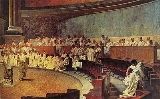
Maccari Cicero
In the later years of the Republic, attempts were made by the aristocracy to limit the increasing level of chaos associated with the obstructive tendencies and democratic impulses of some of the senators. Laws were enacted to prevent the inclusion of extraneous material in bills before the Senate. Other laws were enacted to outlaw the so-called "omnibus bills
Omnibus spending bill

An omnibus spending bill is a bill that sets the budget of many departments of the United States government of the United States at once. It is one possible outcome of the budget process in the U.S....
", which are bills, usually enacted by a single vote, that contain a large volume of often unrelated material.

Laws were also enacted to strengthen the requirement that three days pass between the proposal of a bill, and the vote on that bill. During his term as Roman Dictator
Roman dictator

Dictator was a political office of the Roman Republic. The dictator was above the three branches of government in the constitution of the Roman Republic as no other body or officer could check his power....
, Julius Caesar enacted laws that required the publication of Senate resolutions. This publication, called the acta diurna
Acta Senatus

Acta Senatus, or Commentarii Senatus, are minutes of the discussions and decisions of the Roman Senate. Before the first consulship of Julius Caesar , minutes of the proceedings of the Senate were written and occasionally published, but unofficially; Caesar, desiring to tear away the veil of mystery which gave an unreal importance to th...
, or "daily proceedings", was meant to increase transparency and minimize the potential for abuse. This publication was posted in the Roman Forum
Roman Forum

The Roman Forum , sometimes known by its original Latin name, is located between the Palatine hill and the Capitoline hill of the city of Rome. It is the central area around which the Ancient Rome developed....
, and then sent by messengers throughout the provinces.

Votes and the Tribune's veto


When it was time to call a vote, the presiding magistrate could bring up whatever proposals (in whatever order) he wished, and every vote was between a proposal and its negative. Quorums were required for votes to be held, and it is known that in 67 BC the size of a quorum was set at 200 senators (by the lex Cornelia de privilegiis). At any point before a motion passed, the proposed motion could be vetoed. Usually, vetoes were handed down by plebeian tribunes. If the Senate proposed a bill that the plebeian tribune (the Roman Magistrate who was the chief representative of the people) did not agree with, he issued a veto
Veto

A veto, Latin for "I forbid", is used to denote that a certain party has the right to stop unilaterally a piece of legislation. In practice, the veto can be absolute or limited ...
, which was backed by the promise to literally "'interpose the sacrosanctity of his person'" (or intercessio) if the Senate did not comply. If the Senate did not comply, he could physically prevent the Senate from acting, and any resistance could be criminally prosecuted as constituting a violation of his sacrosanctity. If the vetoed motion was proposed the next day, and the Plebeian Tribune who had vetoed it the day before was not present to interpose himself, the motion could be passed. In general, the Plebeian Tribune had to physically be present at the Senate meeting, otherwise his physical threat of interposing his person had no meaning. Ultimately, the plebeian tribune's veto was based in a promise of physical force.

Once a vote occurred, and a measure passed, he could do nothing, since his promise to physically interpose his person against the senators was now meaningless. In addition, during a couple of instances between the end of the Second Punic War
Second Punic War

The Second Punic War lasted from 218 BC to 201 BC and involved combatants in the western and eastern Mediterranean. It was the second of three major wars between Carthage and the Roman Republic....
 in 201 BC and the beginning of the Social War in 91 BC, although they had no legal power to do so, several Consuls were known to have vetoed acts of the Senate. Ultimately, if there was no veto, and the matter was of minor importance, it could be voted on by a voice vote or by a show of hands. If there was no veto, and the matter was of a significant nature, there was usually a physical division of the house, were senators voted by taking a place on either side of the chamber.

Any motion that had the support of the Senate but was vetoed was recorded in the annals as a senatus auctoritas, while any motion that was passed and not vetoed was recorded as a senatus consultum. After the vote, each senatus consultum and each senatus auctoritas was transcribed into a final document by the presiding magistrate. This document included the name of the presiding magistrate, the place of the assembly, the dates involved, the number of senators who were present at time the motion was passed, the names of witnesses to the drafting of the motion, and the substance of the act. In addition, if the motion was a senatus consultum, a capital letter "C" was stamped on the document, to verify that the motion had been approved by the Senate.

The document was then deposited in the temple that housed the Treasury (the aerarium
Aerarium

Aerarium was the name given in Ancient Rome to the Treasury, and in a secondary sense to the public finances.The treasury contained the monies and accounts of the state Roman finance....
). While a senatus auctoritas (vetoed Senate motion) had no legal value, it did serve to show the opinion of the Senate. If a senatus consultum conflicted with a law (lex) that was passed by a Roman Assembly
Roman assemblies

The Legislative Assemblies of the Roman Republic were political institutions in the ancient Roman Republic. According to the contemporary historian Polybius, it was the people who had the final say regarding the election of magistrates, the enactment of new Roman laws, the carrying out of capital punishment, the declaration of war and peace...
, the law overrode the senatus consultum, because the senatus consultum had its authority based in precedent, and not in law. A senatus consultum, however, could serve to interpret a law.

See also


Further reading


External links