


Balkans

Unanswered Questions

Timeline
193 Septimius Severus is proclaimed Roman Emperor by the army in Illyricum (in the Balkans).
1346 The Serbian Empire is proclaimed in Skopje by Dusan Silni, occupying much of the Balkans.
1878 Treaty of Berlin: the European powers redraw the map of the Balkans. Serbia, Montenegro and Romania become completely independent of the Ottoman empire.
1913 The Balkan States signs an armistice at Bucharest.
Quotations
A gay peninsula filled with sprightly people who ate peppered food, drank strong liquor|liquors, wore flamboyant clothes, loved and murdered easily and had a splendid talent for starting war|wars".
A Long Row of Candles by C. J. Sulzberger
Encyclopedia
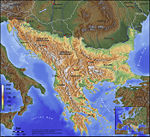
Europe
Europe is, by convention, one of the world's seven continents. Comprising the westernmost peninsula of Eurasia, Europe is generally 'divided' from Asia to its east by the watershed divides of the Ural and Caucasus Mountains, the Ural River, the Caspian and Black Seas, and the waterways connecting...
. The peninsula has a combined area of 550000 km² (212,356.2 sq mi) and a population of over 50 million people.
The region takes its name from the Balkan Mountains
Balkan Mountains
The Balkan mountain range is a mountain range in the eastern part of the Balkan Peninsula. The Balkan range runs 560 km from the Vrashka Chuka Peak on the border between Bulgaria and eastern Serbia eastward through central Bulgaria to Cape Emine on the Black Sea...
, which are uplifting from the eastern end of Bulgaria
Bulgaria
Bulgaria , officially the Republic of Bulgaria , is a parliamentary democracy within a unitary constitutional republic in Southeast Europe. The country borders Romania to the north, Serbia and Macedonia to the west, Greece and Turkey to the south, as well as the Black Sea to the east...
to the Bulgarian-Serbia
Serbia
Serbia , officially the Republic of Serbia , is a landlocked country located at the crossroads of Central and Southeast Europe, covering the southern part of the Carpathian basin and the central part of the Balkans...
n border westwards. "" in Turkish
Turkish language
Turkish is a language spoken as a native language by over 83 million people worldwide, making it the most commonly spoken of the Turkic languages. Its speakers are located predominantly in Turkey and Northern Cyprus with smaller groups in Iraq, Greece, Bulgaria, the Republic of Macedonia, Kosovo,...
means "a chain of wooded mountains". The ancient name of the peninsula, itself a Thracian
Thracian language
The Thracian language was the Indo-European language spoken in ancient times in Southeastern Europe by the Thracians, the northern neighbors of the Ancient Greeks. The Thracian language exhibits satemization: it either belonged to the Satem group of Indo-European languages or it was strongly...
one, was the Peninsula of Haemus
Haemus
In Greek mythology, King Haemus of Thrace was the son of Boreas. He was vain and haughty and compared himself and his wife, Queen Rhodope, to Zeus and Hera. The gods changed him and his wife into mountains...
, a name also deriving from the Balkan Mountains, known as the "Haemus Mountains" in the period. The Romans
Roman Empire
The Roman Empire was the post-Republican period of the ancient Roman civilization, characterised by an autocratic form of government and large territorial holdings in Europe and around the Mediterranean....
considered the Rhodope Mountains
Rhodope Mountains
The Rhodopes are a mountain range in Southeastern Europe, with over 83% of its area in southern Bulgaria and the remainder in Greece. Its highest peak, Golyam Perelik , is the seventh highest Bulgarian mountain...
to be the northern limit of the Peninsula of Haemus and the same limit applied approximately to the border between Greek and Latin use in the region (later called the Jireček Line
Jirecek Line
The Jireček Line is an imaginary line through the ancient Balkans that divided the influences of the Latin and Greek languages until the 4th century...
). The Balkans are highly mountainous; the highest peak in the peninsula is Musala
Musala
Musala is the highest peak in Bulgaria and the entire Balkan Peninsula, standing at 2,925 m . The summit of the Rila mountain in southwestern Bulgaria, Musala is the highest peak between the Alps and the Caucasus and the highest in Eastern Europe bar the Caucasus.Between 1949–1962 the peak was...
, (2925 m) located in the Rila mountains
Rila
Rila is a mountain range in southwestern Bulgaria and the highest mountain range of Bulgaria and the Balkans, with its highest peak being Musala at 2,925 m...
in Bulgaria. The Balkans are also referred to as Southeastern Europe.
The region is well-known for fierce nationalism and ethnic disputes.
The Balkan Peninsula
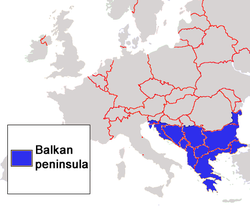
Adriatic Sea
The Adriatic Sea is a body of water separating the Italian Peninsula from the Balkan peninsula, and the system of the Apennine Mountains from that of the Dinaric Alps and adjacent ranges...
to the west, the Mediterranean Sea
Mediterranean Sea
The Mediterranean Sea is a sea connected to the Atlantic Ocean surrounded by the Mediterranean region and almost completely enclosed by land: on the north by Anatolia and Europe, on the south by North Africa, and on the east by the Levant...
(including the Ionian
Ionian Sea
The Ionian Sea , is an arm of the Mediterranean Sea, south of the Adriatic Sea. It is bounded by southern Italy including Calabria, Sicily and the Salento peninsula to the west, southern Albania to the north, and a large number of Greek islands, including Corfu, Zante, Kephalonia, Ithaka, and...
and Aegean
Aegean Sea
The Aegean Sea[p] is an elongated embayment of the Mediterranean Sea located between the southern Balkan and Anatolian peninsulas, i.e., between the mainlands of Greece and Turkey. In the north, it is connected to the Marmara Sea and Black Sea by the Dardanelles and Bosporus...
seas) to the south and the Black Sea
Black Sea
The Black Sea is bounded by Europe, Anatolia and the Caucasus and is ultimately connected to the Atlantic Ocean via the Mediterranean and the Aegean seas and various straits. The Bosphorus strait connects it to the Sea of Marmara, and the strait of the Dardanelles connects that sea to the Aegean...
to the east. Its northern boundary is often given as the Danube
Danube
The Danube is a river in the Central Europe and the Europe's second longest river after the Volga. It is classified as an international waterway....
, Sava and Kupa
Kupa
Kupa may refer to:*Kupa River, a river in Croatia and Slovenia*Kupa River , a river in Lithuania*Kupa River in Siberia, see Kuta River*Kupa Synagogue, a synagogue in Krakow*Kupa, Hungary, a village in Northern Hungary...
rivers.
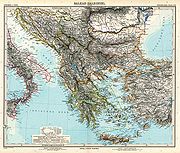
Countries that have a significant portion of their land located within the peninsula:
(Including Kosovo, for those that recognize the Serbian sovereignty over Kosovo.)
Countries that have only a small portion of their land located within the peninsula:
The Balkans
The term "The Balkans" covers not only those countries which lie within the boundaries of the "Balkan Peninsula", but may also include SloveniaSlovenia
Slovenia , officially the Republic of Slovenia , is a country in Central and Southeastern Europe touching the Alps and bordering the Mediterranean. Slovenia borders Italy to the west, Croatia to the south and east, Hungary to the northeast, and Austria to the north, and also has a small portion of...
and Romania
Romania
Romania is a country located at the crossroads of Central and Southeastern Europe, on the Lower Danube, within and outside the Carpathian arch, bordering on the Black Sea...
. Slovenia, which was part of Yugoslavia
Yugoslavia
Yugoslavia refers to three political entities that existed successively on the western part of the Balkans during most of the 20th century....
from 1919 to 1991, lies partially south of the Danube-Sava line, and thus it's partially in the Balkans. Prior to 1991 the whole of Yugoslavia was considered to be part of the Balkans. The man who coined the term "the Balkans," August Zeune
August Zeune
Johann August Zeune was a German teacher of geography and Germanic languages, as well as the founder of the Berlin Foundation for the Blind.- Life :...
, defined it in 1808 as encompassing areas that remained under Turkish rule
Ottoman Empire
The Ottoman EmpireIt was usually referred to as the "Ottoman Empire", the "Turkish Empire", the "Ottoman Caliphate" or more commonly "Turkey" by its contemporaries...
after 1699.
Italy
Italy
Italy , officially the Italian Republic languages]] under the European Charter for Regional or Minority Languages. In each of these, Italy's official name is as follows:;;;;;;;;), is a unitary parliamentary republic in South-Central Europe. To the north it borders France, Switzerland, Austria and...
until World War II
World War II
World War II, or the Second World War , was a global conflict lasting from 1939 to 1945, involving most of the world's nations—including all of the great powers—eventually forming two opposing military alliances: the Allies and the Axis...
included Istria
Istria
Istria , formerly Histria , is the largest peninsula in the Adriatic Sea. The peninsula is located at the head of the Adriatic between the Gulf of Trieste and the Bay of Kvarner...
and some Dalmatian areas
Dalmatia
Dalmatia is a historical region on the eastern coast of the Adriatic Sea. It stretches from the island of Rab in the northwest to the Bay of Kotor in the southeast. The hinterland, the Dalmatian Zagora, ranges from fifty kilometers in width in the north to just a few kilometers in the south....
(like Zara, known as Zadar
Zadar
Zadar is a city in Croatia on the Adriatic Sea. It is the centre of Zadar county and the wider northern Dalmatian region. Population of the city is 75,082 citizens...
), but now it has only the small area of the Province of Trieste
Province of Trieste
The Province of Trieste is a province in the autonomous Friuli-Venezia Giulia region of Italy. Its capital is the city of Trieste.It has an area of 212 km², and a total population of 236,520...
inside the Balkan region. However, Trieste and Istria are usually considered not part of the Balkans by Italian geographers, due to a definition of the Balkans that limits its western border to the Kupa river.
Etymology and evolving meaning
The region takes its name from the Stara Planina (Old Mountain) mountain range in BulgariaBulgaria
Bulgaria , officially the Republic of Bulgaria , is a parliamentary democracy within a unitary constitutional republic in Southeast Europe. The country borders Romania to the north, Serbia and Macedonia to the west, Greece and Turkey to the south, as well as the Black Sea to the east...
and partly in Serbia
Serbia
Serbia , officially the Republic of Serbia , is a landlocked country located at the crossroads of Central and Southeast Europe, covering the southern part of the Carpathian basin and the central part of the Balkans...
, commonly known as the Balkan Mountains
Balkan Mountains
The Balkan mountain range is a mountain range in the eastern part of the Balkan Peninsula. The Balkan range runs 560 km from the Vrashka Chuka Peak on the border between Bulgaria and eastern Serbia eastward through central Bulgaria to Cape Emine on the Black Sea...
(from the Turkish
Turkish language
Turkish is a language spoken as a native language by over 83 million people worldwide, making it the most commonly spoken of the Turkic languages. Its speakers are located predominantly in Turkey and Northern Cyprus with smaller groups in Iraq, Greece, Bulgaria, the Republic of Macedonia, Kosovo,...
meaning "a chain of wooded mountains"). The name is still preserved in Central Asia
Central Asia
Central Asia is a core region of the Asian continent from the Caspian Sea in the west, China in the east, Afghanistan in the south, and Russia in the north...
where there exist the Balkan Mountains
Balkan Daglary
Mount Arlan is an 1,880 metre peak in the western plains of Turkmenistan in Balkan Province. Mount Arlan stands about 2,000 metres above the shore of the below-sea level Caspian Sea....
and the Balkan Province
Balkan Province
Balkan Province is one of the Welayat of Turkmenistan. It is in the far west of the country, bordering Uzbekistan, Kazakhstan, the Caspian Sea, and Iran. Its capital is Balkanabat, formerly known as Nebit Dag. It has an area of 139,270 square kilometers and a population of approximately 553,500...
of Turkmenistan
Turkmenistan
Turkmenistan , formerly also known as Turkmenia is one of the Turkic states in Central Asia. Until 1991, it was a constituent republic of the Soviet Union, the Turkmen Soviet Socialist Republic . Turkmenistan is one of the six independent Turkic states...
. On a larger scale, the mountains are only one part of a long continuous chain of mountains crossing the region in the form of a reversed letter S, from the Carpathians
Carpathian Mountains
The Carpathian Mountains or Carpathians are a range of mountains forming an arc roughly long across Central and Eastern Europe, making them the second-longest mountain range in Europe...
south to the Balkan range proper, before marching away east into Anatolia
Anatolia
Anatolia is a geographic and historical term denoting the westernmost protrusion of Asia, comprising the majority of the Republic of Turkey...
n Turkey. On the west coast, an offshoot of the Dinaric Alps
Dinaric Alps
The Dinaric Alps or Dinarides form a mountain chain in Southern Europe, spanning areas of Slovenia, Croatia, Bosnia and Herzegovina, Serbia, Kosovo, Albania and Montenegro....
follows the coast south through Dalmatia
Dalmatia
Dalmatia is a historical region on the eastern coast of the Adriatic Sea. It stretches from the island of Rab in the northwest to the Bay of Kotor in the southeast. The hinterland, the Dalmatian Zagora, ranges from fifty kilometers in width in the north to just a few kilometers in the south....
and Albania
Albania
Albania , officially known as the Republic of Albania , is a country in Southeastern Europe, in the Balkans region. It is bordered by Montenegro to the northwest, Kosovo to the northeast, the Republic of Macedonia to the east and Greece to the south and southeast. It has a coast on the Adriatic Sea...
, crosses Greece and continues into the sea in the form of various islands.
The first attested time the name "Balkan" was used in the West for the mountain range in Bulgaria was in a letter sent in 1490 to Pope Innocent VIII by Buonaccorsi Callimaco, an Italian humanist, writer and diplomat. English traveler John Morritt introduced this term into the English literature at the end of the 18th century, and other authors started applying the name to the wider area between the Adriatic and the Black Sea. The concept of the “Balkan peninsula” was created by the German geographer August Zeune in 1808.
As time passed, the term gradually obtained political connotations far from its initial geographic meaning, arising from political changes from the late 19th century to the creation of post–World War I
World War I
World War I , which was predominantly called the World War or the Great War from its occurrence until 1939, and the First World War or World War I thereafter, was a major war centred in Europe that began on 28 July 1914 and lasted until 11 November 1918...
Yugoslavia
Yugoslavia
Yugoslavia refers to three political entities that existed successively on the western part of the Balkans during most of the 20th century....
(initially the Kingdom of Serbs, Croats and Slovenes). Zeune's goal was to have a geographical parallel term to the Italic
Italian Peninsula
The Italian Peninsula or Apennine Peninsula is one of the three large peninsulas of Southern Europe , spanning from the Po Valley in the north to the central Mediterranean Sea in the south. The peninsula's shape gives it the nickname Lo Stivale...
and Iberian Peninsula
Iberian Peninsula
The Iberian Peninsula , sometimes called Iberia, is located in the extreme southwest of Europe and includes the modern-day sovereign states of Spain, Portugal and Andorra, as well as the British Overseas Territory of Gibraltar...
, and seemingly nothing more. The gradually acquired political connotations are newer, and, to a large extent, due to oscillating political circumstances.
The term Balkans is generally used to describe areas that remained under Turkish rule after 1699, namely: Moesia
Moesia
Moesia was an ancient region and later Roman province situated in the Balkans, along the south bank of the Danube River. It included territories of modern-day Southern Serbia , Northern Republic of Macedonia, Northern Bulgaria, Romanian Dobrudja, Southern Moldova, and Budjak .-History:In ancient...
, Macedonia
Macedonia (region)
Macedonia is a geographical and historical region of the Balkan peninsula in southeastern Europe. Its boundaries have changed considerably over time, but nowadays the region is considered to include parts of five Balkan countries: Greece, the Republic of Macedonia, Bulgaria, Albania, Serbia, as...
, Thrace
Thrace
Thrace is a historical and geographic area in southeast Europe. As a geographical concept, Thrace designates a region bounded by the Balkan Mountains on the north, Rhodope Mountains and the Aegean Sea on the south, and by the Black Sea and the Sea of Marmara on the east...
, Albania
Albania
Albania , officially known as the Republic of Albania , is a country in Southeastern Europe, in the Balkans region. It is bordered by Montenegro to the northwest, Kosovo to the northeast, the Republic of Macedonia to the east and Greece to the south and southeast. It has a coast on the Adriatic Sea...
, Valahia, Moldavia
Moldavia
Moldavia is a geographic and historical region and former principality in Eastern Europe, corresponding to the territory between the Eastern Carpathians and the Dniester river...
, Epirus
Epirus
The name Epirus, from the Greek "Ήπειρος" meaning continent may refer to:-Geographical:* Epirus - a historical and geographical region of the southwestern Balkans, straddling modern Greece and Albania...
, Bosnia and Herzegovina
Bosnia and Herzegovina
Bosnia and Herzegovina , sometimes called Bosnia-Herzegovina or simply Bosnia, is a country in Southern Europe, on the Balkan Peninsula. Bordered by Croatia to the north, west and south, Serbia to the east, and Montenegro to the southeast, Bosnia and Herzegovina is almost landlocked, except for the...
, Montenegro
Montenegro
Montenegro Montenegrin: Crna Gora Црна Гора , meaning "Black Mountain") is a country located in Southeastern Europe. It has a coast on the Adriatic Sea to the south-west and is bordered by Croatia to the west, Bosnia and Herzegovina to the northwest, Serbia to the northeast and Albania to the...
(except for the Boka Bay and Budva), central Greece
Central Greece
Continental Greece or Central Greece , colloquially known as Roúmeli , is a geographical region of Greece. Its territory is divided into the administrative regions of Central Greece, Attica, and part of West Greece...
and the Peloponnese
Peloponnese
The Peloponnese, Peloponnesos or Peloponnesus , is a large peninsula , located in a region of southern Greece, forming the part of the country south of the Gulf of Corinth...
. Vojvodina
Vojvodina
Vojvodina, officially called Autonomous Province of Vojvodina is an autonomous province of Serbia. Its capital and largest city is Novi Sad...
and Transylvania
Transylvania
Transylvania is a historical region in the central part of Romania. Bounded on the east and south by the Carpathian mountain range, historical Transylvania extended in the west to the Apuseni Mountains; however, the term sometimes encompasses not only Transylvania proper, but also the historical...
, it is argued, do not belong to Balkans. After the split of Yugoslavia
Yugoslavia
Yugoslavia refers to three political entities that existed successively on the western part of the Balkans during most of the 20th century....
beginning in June 1991, the term 'Balkans' again received a negative meaning, even in casual usage (see Balkanization
Balkanization
Balkanization, or Balkanisation, is a geopolitical term, originally used to describe the process of fragmentation or division of a region or state into smaller regions or states that are often hostile or non-cooperative with each other, and it is considered pejorative.The term refers to the...
). Over the last decade, in the wake of the former Yugoslav split, many Slovenians
Slovenians
The Slovenes, Slovene people, Slovenians, or Slovenian people are a South Slavic people primarily associated with Slovenia and the Slovene language.-Population:Most Slovenes today live within the borders of the independent Slovenia...
and Croatians, as well as Serbs of Vojvodina
Serbs of Vojvodina
The Serbs are the largest ethnic group in the Vojvodina province of Serbia. For centuries, they lived under foreign rule, but despite many attempts that aimed to assimilate them, Vojvodinian Serbs preserved their national consciousness, language, religion, culture as well as the rich folklore,...
have attempted to reject their label as 'Balkan nations'.
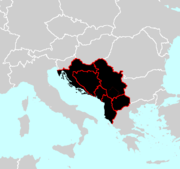
Slovenia
Slovenia , officially the Republic of Slovenia , is a country in Central and Southeastern Europe touching the Alps and bordering the Mediterranean. Slovenia borders Italy to the west, Croatia to the south and east, Hungary to the northeast, and Austria to the north, and also has a small portion of...
and Croatia
Croatia
Croatia , officially the Republic of Croatia , is a unitary democratic parliamentary republic in Europe at the crossroads of the Mitteleuropa, the Balkans, and the Mediterranean. Its capital and largest city is Zagreb. The country is divided into 20 counties and the city of Zagreb. Croatia covers ...
, 'Central Europe
Central Europe
Central Europe or alternatively Middle Europe is a region of the European continent lying between the variously defined areas of Eastern and Western Europe...
' and Greece has almost exclusively been regarded and referred to as a 'Southern Europe
Southern Europe
The term Southern Europe, at its most general definition, is used to mean "all countries in the south of Europe". However, the concept, at different times, has had different meanings, providing additional political, linguistic and cultural context to the definition in addition to the typical...
an' country.
Southeastern Europe
Because of the negative connotations of the term "Balkan", the use of the term Southeastern Europe has become increasingly popular even though it refers to a much larger area and thus isn't as precise. A European UnionEuropean Union
The European Union is an economic and political union of 27 independent member states which are located primarily in Europe. The EU traces its origins from the European Coal and Steel Community and the European Economic Community , formed by six countries in 1958...
initiative of 1999 is called the Stability Pact for South Eastern Europe
Stability Pact for South Eastern Europe
The Stability Pact for South Eastern Europe was an institution aimed at strengthening peace, democracy, human rights and economy in the countries of South Eastern Europe from 1999-2008. It was replaced by the Regional Co-operation Council in February 2008...
, and the online newspaper Balkan Times renamed itself Southeast European Times
Southeast European Times
Southeast European Times is a United States European Command-sponsored news website dedicated to coverage of Southeast Europe and Turkey. The countries covered include Albania, Bosnia-Herzegovina, Bulgaria, Croatia, Greece, Macedonia, Montenegro, Romania, Serbia, and TurkeyThe primary address of...
in 2003.
Western Balkans
European UnionEuropean Union
The European Union is an economic and political union of 27 independent member states which are located primarily in Europe. The EU traces its origins from the European Coal and Steel Community and the European Economic Community , formed by six countries in 1958...
institutions and member states define the "Western Balkans" as Albania and the former Yugoslavia, minus Slovenia. The European Bank for Reconstruction and Development
European Bank for Reconstruction and Development
Founded in 1991, the European Bank for Reconstruction and Development uses the tools of investment to help build market economies and democracies in 30 countries from central Europe to central Asia. Its mission was to support the formerly communist countries in the process of establishing their...
uses "Western Balkans" to refer to the above states, minus Croatia. Today Western Balkans is more of a political than geographic definition for the region of Southeast Europe that is not yet in the European Union.
Regional organizations
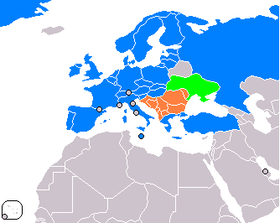 |
|
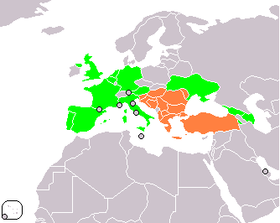 |
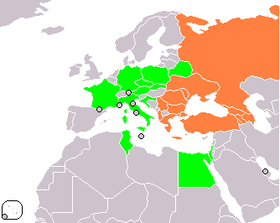 |
See also the Black Sea Regional organizations
Nature and natural resources
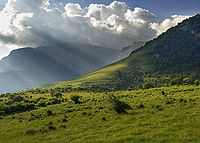
Dinaric Alps
The Dinaric Alps or Dinarides form a mountain chain in Southern Europe, spanning areas of Slovenia, Croatia, Bosnia and Herzegovina, Serbia, Kosovo, Albania and Montenegro....
in Slovenia, Croatia, Hercegovina and Montenegro, the Šar massif which spreads from Albania to Macedonia,the Pindus
Pindus
The Pindus mountain range is located in northern Greece and southern Albania. It is roughly 160 km long, with a maximum elevation of 2637 m . Because it runs along the border of Thessaly and Epirus, the Pindus range is often called the "spine of Greece"...
range, spanning from southern Albania into central Greece and the Albanian Alps. In Bulgaria there are ranges running from east to west: the Balkan mountains
Balkan Mountains
The Balkan mountain range is a mountain range in the eastern part of the Balkan Peninsula. The Balkan range runs 560 km from the Vrashka Chuka Peak on the border between Bulgaria and eastern Serbia eastward through central Bulgaria to Cape Emine on the Black Sea...
and the Rhodope mountains
Rhodope Mountains
The Rhodopes are a mountain range in Southeastern Europe, with over 83% of its area in southern Bulgaria and the remainder in Greece. Its highest peak, Golyam Perelik , is the seventh highest Bulgarian mountain...
at the border with Greece. The highest mountain of the region is Rila
Rila
Rila is a mountain range in southwestern Bulgaria and the highest mountain range of Bulgaria and the Balkans, with its highest peak being Musala at 2,925 m...
in Bulgaria
Bulgaria
Bulgaria , officially the Republic of Bulgaria , is a parliamentary democracy within a unitary constitutional republic in Southeast Europe. The country borders Romania to the north, Serbia and Macedonia to the west, Greece and Turkey to the south, as well as the Black Sea to the east...
, with Musala
Musala
Musala is the highest peak in Bulgaria and the entire Balkan Peninsula, standing at 2,925 m . The summit of the Rila mountain in southwestern Bulgaria, Musala is the highest peak between the Alps and the Caucasus and the highest in Eastern Europe bar the Caucasus.Between 1949–1962 the peak was...
at 2925 m, with Mount Olympus in Greece, the throne of Zeus, being second at 2919 m and Vihren
Vihren
Vihren is the highest peak of Bulgaria's Pirin Mountains. Reaching 2914 m, it is Bulgaria's second and the Balkans' third highest, after Musala and Mount Olympus. The peak is located in Pirin's northern parts. The easiest route is from the Vihren chalet , reaching the summit from the south...
in Bulgaria being the third at 2914 m. The karst field or polje
Polje
A polje is a large flat plain in karst territory, with areas usually 5 to 400 km². The name derives from the Slavic languages and is a cognate with the English word field.-In geology:...
is a common feature of the landscape.
On the Adriatic
Adriatic Sea
The Adriatic Sea is a body of water separating the Italian Peninsula from the Balkan peninsula, and the system of the Apennine Mountains from that of the Dinaric Alps and adjacent ranges...
and Aegean
Aegean Sea
The Aegean Sea[p] is an elongated embayment of the Mediterranean Sea located between the southern Balkan and Anatolian peninsulas, i.e., between the mainlands of Greece and Turkey. In the north, it is connected to the Marmara Sea and Black Sea by the Dardanelles and Bosporus...
coasts the climate is Mediterranean
Mediterranean climate
A Mediterranean climate is the climate typical of most of the lands in the Mediterranean Basin, and is a particular variety of subtropical climate...
, on the Black Sea
Black Sea
The Black Sea is bounded by Europe, Anatolia and the Caucasus and is ultimately connected to the Atlantic Ocean via the Mediterranean and the Aegean seas and various straits. The Bosphorus strait connects it to the Sea of Marmara, and the strait of the Dardanelles connects that sea to the Aegean...
coast the climate is humid subtropical
Humid subtropical climate
A humid subtropical climate is a climate zone characterized by hot, humid summers and mild to cool winters...
and oceanic
Oceanic climate
An oceanic climate, also called marine west coast climate, maritime climate, Cascadian climate and British climate for Köppen climate classification Cfb and subtropical highland for Köppen Cfb or Cwb, is a type of climate typically found along the west coasts at the middle latitudes of some of the...
, and in the inland it is humid continental
Humid continental climate
A humid continental climate is a climatic region typified by large seasonal temperature differences, with warm to hot summers and cold winters....
. In the northern part of the peninsula and on the mountains, winters are frosty and snowy, while summers are hot and dry. In the southern part winters are milder.
During the centuries many woods have been cut down and replaced with bush. In the southern part and on the coast there is evergreen vegetation. In the inland there are woods typical of Central Europe
Central Europe
Central Europe or alternatively Middle Europe is a region of the European continent lying between the variously defined areas of Eastern and Western Europe...
(oak
Oak
An oak is a tree or shrub in the genus Quercus , of which about 600 species exist. "Oak" may also appear in the names of species in related genera, notably Lithocarpus...
and beech
Beech
Beech is a genus of ten species of deciduous trees in the family Fagaceae, native to temperate Europe, Asia and North America.-Habit:...
, and in the mountains, spruce
Spruce
A spruce is a tree of the genus Picea , a genus of about 35 species of coniferous evergreen trees in the Family Pinaceae, found in the northern temperate and boreal regions of the earth. Spruces are large trees, from tall when mature, and can be distinguished by their whorled branches and conical...
, fir
Fir
Firs are a genus of 48–55 species of evergreen conifers in the family Pinaceae. They are found through much of North and Central America, Europe, Asia, and North Africa, occurring in mountains over most of the range...
and pine
Pine
Pines are trees in the genus Pinus ,in the family Pinaceae. They make up the monotypic subfamily Pinoideae. There are about 115 species of pine, although different authorities accept between 105 and 125 species.-Etymology:...
). The tree line in the mountains lies at the height of 1800–2300 m. The landscape provides habitats for numerous endemic species, including extraordinarily abundant insects and reptiles that serve as food for a variety of birds of prey and rare vultures.
The soils are generally poor, except on the plains where are as with natural grass, fertile soils and warm summers provide an opportunity for tillage. Elsewhere, land cultivation is mostly unsuccessful because of the mountains, hot summers and poor soils, although certain cultures such as olive
Olive
The olive , Olea europaea), is a species of a small tree in the family Oleaceae, native to the coastal areas of the eastern Mediterranean Basin as well as northern Iran at the south end of the Caspian Sea.Its fruit, also called the olive, is of major agricultural importance in the...
s and grape
Grape
A grape is a non-climacteric fruit, specifically a berry, that grows on the perennial and deciduous woody vines of the genus Vitis. Grapes can be eaten raw or they can be used for making jam, juice, jelly, vinegar, wine, grape seed extracts, raisins, molasses and grape seed oil. Grapes are also...
s flourish.
Resources of energy are scarce, except in the territory of Kosovo, where considerable coal, lead, zinc, chromium, silver deposits are located. Other deposits of coal
Coal
Coal is a combustible black or brownish-black sedimentary rock usually occurring in rock strata in layers or veins called coal beds or coal seams. The harder forms, such as anthracite coal, can be regarded as metamorphic rock because of later exposure to elevated temperature and pressure...
, especially in Romania, Bulgaria, Serbia and Bosnia also exist. Lignite
Lignite
Lignite, often referred to as brown coal, or Rosebud coal by Northern Pacific Railroad,is a soft brown fuel with characteristics that put it somewhere between coal and peat...
deposits are widespread in Greece. Petroleum
Petroleum
Petroleum or crude oil is a naturally occurring, flammable liquid consisting of a complex mixture of hydrocarbons of various molecular weights and other liquid organic compounds, that are found in geologic formations beneath the Earth's surface. Petroleum is recovered mostly through oil drilling...
is most notably present in Romania, although scarce reserves exist in Greece, Serbia, Albania and Croatia. Natural gas
Natural gas
Natural gas is a naturally occurring gas mixture consisting primarily of methane, typically with 0–20% higher hydrocarbons . It is found associated with other hydrocarbon fuel, in coal beds, as methane clathrates, and is an important fuel source and a major feedstock for fertilizers.Most natural...
deposits are scarce. Hydropower is in wide use, with over 1,000 dams. The often relentless bora wind is also being harnessed for power generation.
Metal ores are more usual than other raw materials. Iron ore is rare but in some countries there is a considerable amount of copper
Copper
Copper is a chemical element with the symbol Cu and atomic number 29. It is a ductile metal with very high thermal and electrical conductivity. Pure copper is soft and malleable; an exposed surface has a reddish-orange tarnish...
, zinc
Zinc
Zinc , or spelter , is a metallic chemical element; it has the symbol Zn and atomic number 30. It is the first element in group 12 of the periodic table. Zinc is, in some respects, chemically similar to magnesium, because its ion is of similar size and its only common oxidation state is +2...
, tin
Tin
Tin is a chemical element with the symbol Sn and atomic number 50. It is a main group metal in group 14 of the periodic table. Tin shows chemical similarity to both neighboring group 14 elements, germanium and lead and has two possible oxidation states, +2 and the slightly more stable +4...
, chromite
Chromite
Chromite is an iron chromium oxide: FeCr2O4. It is an oxide mineral belonging to the spinel group. Magnesium can substitute for iron in variable amounts as it forms a solid solution with magnesiochromite ; substitution of aluminium occurs leading to hercynite .-Occurrence:Chromite is found in...
, manganese
Manganese
Manganese is a chemical element, designated by the symbol Mn. It has the atomic number 25. It is found as a free element in nature , and in many minerals...
, magnesite
Magnesite
Magnesite is magnesium carbonate, MgCO3. Iron substitutes for magnesium with a complete solution series with siderite, FeCO3. Calcium, manganese, cobalt, and nickel may also occur in small amounts...
and bauxite
Bauxite
Bauxite is an aluminium ore and is the main source of aluminium. This form of rock consists mostly of the minerals gibbsite Al3, boehmite γ-AlO, and diaspore α-AlO, in a mixture with the two iron oxides goethite and hematite, the clay mineral kaolinite, and small amounts of anatase TiO2...
. Some metals are exported.
History and geopolitical significance
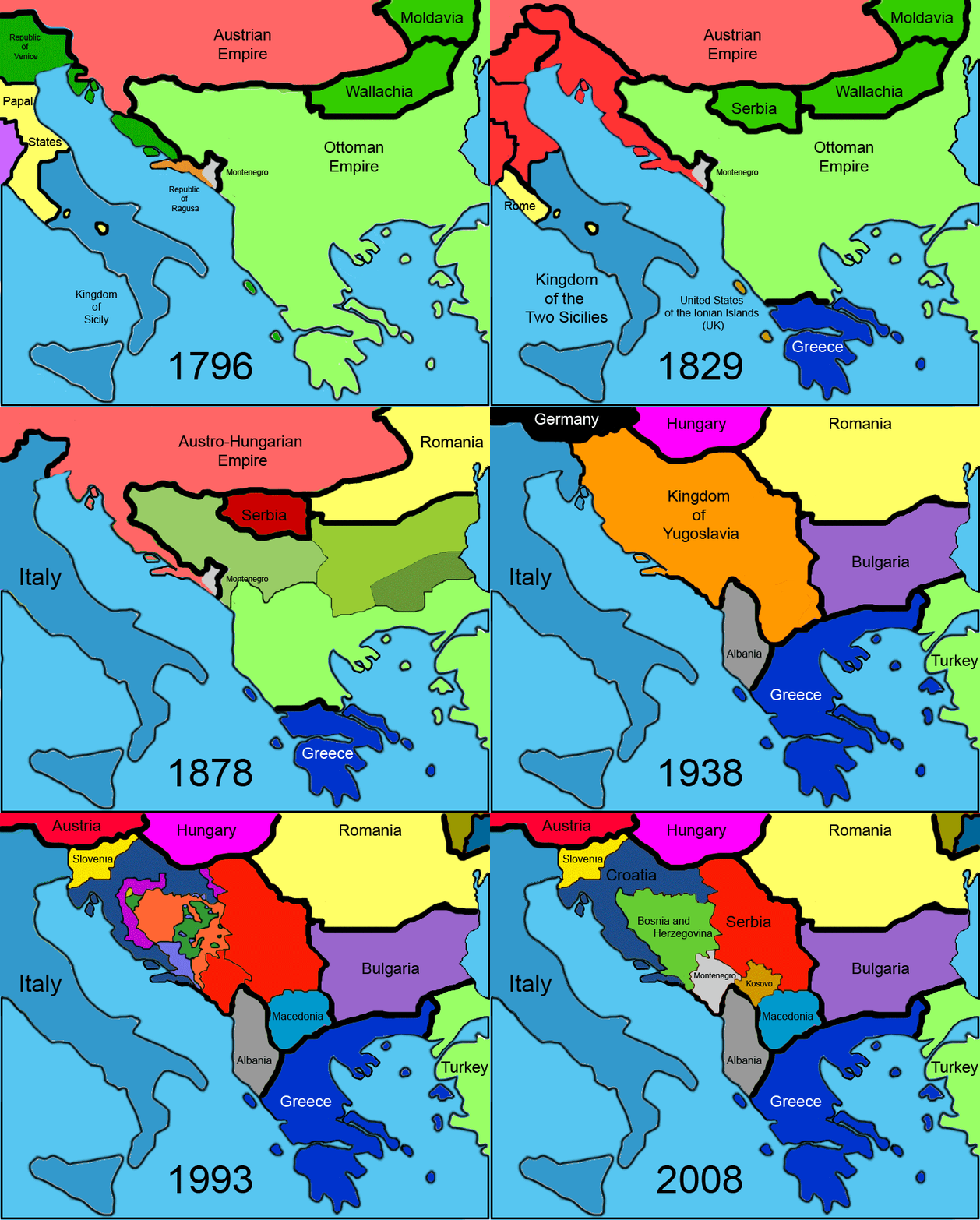
Neolithic
The Neolithic Age, Era, or Period, or New Stone Age, was a period in the development of human technology, beginning about 9500 BC in some parts of the Middle East, and later in other parts of the world. It is traditionally considered as the last part of the Stone Age...
era. The practices of growing grain and raising livestock arrived in the Balkans from the Fertile Crescent
Fertile Crescent
The Fertile Crescent, nicknamed "The Cradle of Civilization" for the fact the first civilizations started there, is a crescent-shaped region containing the comparatively moist and fertile land of otherwise arid and semi-arid Western Asia. The term was first used by University of Chicago...
by way of Anatolia
Anatolia
Anatolia is a geographic and historical term denoting the westernmost protrusion of Asia, comprising the majority of the Republic of Turkey...
, and spread west and north into Pannonia
Pannonia
Pannonia was an ancient province of the Roman Empire bounded north and east by the Danube, coterminous westward with Noricum and upper Italy, and southward with Dalmatia and upper Moesia....
and Central Europe
Central Europe
Central Europe or alternatively Middle Europe is a region of the European continent lying between the variously defined areas of Eastern and Western Europe...
.
The identity of the Balkans is dominated by its geographical position; historically the area was known as a crossroads of various cultures. It has been a juncture between the Latin
Latin
Latin is an Italic language originally spoken in Latium and Ancient Rome. It, along with most European languages, is a descendant of the ancient Proto-Indo-European language. Although it is considered a dead language, a number of scholars and members of the Christian clergy speak it fluently, and...
and Greek
Greek language
Greek is an independent branch of the Indo-European family of languages. Native to the southern Balkans, it has the longest documented history of any Indo-European language, spanning 34 centuries of written records. Its writing system has been the Greek alphabet for the majority of its history;...
bodies of the Roman Empire
Roman Empire
The Roman Empire was the post-Republican period of the ancient Roman civilization, characterised by an autocratic form of government and large territorial holdings in Europe and around the Mediterranean....
, the destination of a massive influx of pagan Slavs, an area where Orthodox
Eastern Orthodox Church
The Orthodox Church, officially called the Orthodox Catholic Church and commonly referred to as the Eastern Orthodox Church, is the second largest Christian denomination in the world, with an estimated 300 million adherents mainly in the countries of Belarus, Bulgaria, Cyprus, Georgia, Greece,...
and Catholic
Catholic
The word catholic comes from the Greek phrase , meaning "on the whole," "according to the whole" or "in general", and is a combination of the Greek words meaning "about" and meaning "whole"...
Christianity met, as well as the meeting point between Islam
Islam
Islam . The most common are and . : Arabic pronunciation varies regionally. The first vowel ranges from ~~. The second vowel ranges from ~~~...
and Christianity
Christianity
Christianity is a monotheistic religion based on the life and teachings of Jesus as presented in canonical gospels and other New Testament writings...
.
In pre-classical and classical antiquity
Classical antiquity
Classical antiquity is a broad term for a long period of cultural history centered on the Mediterranean Sea, comprising the interlocking civilizations of ancient Greece and ancient Rome, collectively known as the Greco-Roman world...
, this region was home to Greeks
Greeks
The Greeks, also known as the Hellenes , are a nation and ethnic group native to Greece, Cyprus and neighboring regions. They also form a significant diaspora, with Greek communities established around the world....
, Illyrians
Illyrians
The Illyrians were a group of tribes who inhabited part of the western Balkans in antiquity and the south-eastern coasts of the Italian peninsula...
, Paeonians, Thracians
Thracians
The ancient Thracians were a group of Indo-European tribes inhabiting areas including Thrace in Southeastern Europe. They spoke the Thracian language – a scarcely attested branch of the Indo-European language family...
, Dacians
Dacians
The Dacians were an Indo-European people, very close or part of the Thracians. Dacians were the ancient inhabitants of Dacia...
and other ancient groups. Later the Roman Empire
Roman Empire
The Roman Empire was the post-Republican period of the ancient Roman civilization, characterised by an autocratic form of government and large territorial holdings in Europe and around the Mediterranean....
conquered most of the region and spread Roman culture and the Latin
Latin
Latin is an Italic language originally spoken in Latium and Ancient Rome. It, along with most European languages, is a descendant of the ancient Proto-Indo-European language. Although it is considered a dead language, a number of scholars and members of the Christian clergy speak it fluently, and...
language but significant parts still remained under classical Greek
Ancient Greece
Ancient Greece is a civilization belonging to a period of Greek history that lasted from the Archaic period of the 8th to 6th centuries BC to the end of antiquity. Immediately following this period was the beginning of the Early Middle Ages and the Byzantine era. Included in Ancient Greece is the...
influence. The Slavs arrived in the 6th century and began assimilating and displacing the older inhabitants of the northern and central Balkans. During the Middle Ages
Middle Ages
The Middle Ages is a periodization of European history from the 5th century to the 15th century. The Middle Ages follows the fall of the Western Roman Empire in 476 and precedes the Early Modern Era. It is the middle period of a three-period division of Western history: Classic, Medieval and Modern...
, the Balkans became the stage for a series of wars between the Byzantine
Byzantine Empire
The Byzantine Empire was the Eastern Roman Empire during the periods of Late Antiquity and the Middle Ages, centred on the capital of Constantinople. Known simply as the Roman Empire or Romania to its inhabitants and neighbours, the Empire was the direct continuation of the Ancient Roman State...
, Bulgarian
History of Bulgaria
The history of Bulgaria spans from the first settlements on the lands of modern Bulgaria to its formation as a nation-state and includes the history of the Bulgarian people and their origin. The first traces of human presence on what is today Bulgaria date from 44,000 BC...
and Serbian
Serbian Empire
The Serbian Empire was a short-lived medieval empire in the Balkans that emerged from the Serbian Kingdom. Stephen Uroš IV Dušan was crowned Emperor of Serbs and Greeks on 16 April, 1346, a title signifying a successorship to the Eastern Roman Empire...
Empires.
By the end of the 16th century, the Ottoman Empire
Ottoman Empire
The Ottoman EmpireIt was usually referred to as the "Ottoman Empire", the "Turkish Empire", the "Ottoman Caliphate" or more commonly "Turkey" by its contemporaries...
had become the controlling force in the region after expanding from Anatolia
Anatolia
Anatolia is a geographic and historical term denoting the westernmost protrusion of Asia, comprising the majority of the Republic of Turkey...
through Thrace
Thrace
Thrace is a historical and geographic area in southeast Europe. As a geographical concept, Thrace designates a region bounded by the Balkan Mountains on the north, Rhodope Mountains and the Aegean Sea on the south, and by the Black Sea and the Sea of Marmara on the east...
to the Balkans. Many people in the Balkans and Carpathians place their greatest folk heroes in the era of either the onslaught or the retreat of the Ottoman Empire. As examples, for Croats
Croats
Croats are a South Slavic ethnic group mostly living in Croatia, Bosnia and Herzegovina and nearby countries. There are around 4 million Croats living inside Croatia and up to 4.5 million throughout the rest of the world. Responding to political, social and economic pressure, many Croats have...
, Nikola Šubić Zrinski
Nikola Šubic Zrinski
Nikola Šubić Zrinski , was a Croatian nobleman and general in service of Habsburg Monarchy, ban of Croatia from 1542 to 1556, and member of the Zrinski noble family...
and Petar Kružić
Petar Kružić
Petar Kružić was a Croatian knez, captain, soldier and defender of Klis, and the captain of Senj.In the early 16th century Petar Kružić defended the Klis Fortress against Turk invasion...
; for Greeks Constantine XI Palaiologos and Kolokotronis for Serbs
Serbs
The Serbs are a South Slavic ethnic group of the Balkans and southern Central Europe. Serbs are located mainly in Serbia, Montenegro and Bosnia and Herzegovina, and form a sizable minority in Croatia, the Republic of Macedonia and Slovenia. Likewise, Serbs are an officially recognized minority in...
, Miloš Obilić
Miloš Obilic
Miloš Obilić was a medieval Serbian knight in the service of Prince Lazar, during the invasion of the Ottoman Empire. He is not mentioned in contemporary sources, but he features prominently in later accounts of the Serbian defeat at the Battle of Kosovo as the legendary assassin of the Ottoman...
and Tzar Lazar; for Montenegrins, Đurađ I Balšić and Ivan Crnojević; for Albanians
Albanians
Albanians are a nation and ethnic group native to Albania and neighbouring countries. They speak the Albanian language. More than half of all Albanians live in Albania and Kosovo...
, George Kastrioti Skanderbeg; for ethnic Macedonians, Nikola Karev
Nikola Karev
Nikola Janakiev Karev was a revolutionary in Ottoman-ruled Macedonia. He was born 23 November 1877 in Kruševo and died 27 April 1905 in the village of Rajčani, both today in the Republic of Macedonia. Karev was a local leader of what later became known as the Internal Macedonian Revolutionary...
and Goce Delčev; for Bosniaks
Bosniaks
The Bosniaks or Bosniacs are a South Slavic ethnic group, living mainly in Bosnia and Herzegovina, with a smaller minority also present in other lands of the Balkan Peninsula especially in Serbia, Montenegro and Croatia...
, Husein Gradaščević
Husein Gradašcevic
Husein-kapetan Gradaščević was a Bosnian Muslim general who fought for Bosnian autonomy in the Ottoman Empire. He is often referred to as "Zmaj od Bosne", meaning "Dragon of Bosnia"...
and for Bulgarians
Bulgarians
The Bulgarians are a South Slavic nation and ethnic group native to Bulgaria and neighbouring regions. Emigration has resulted in immigrant communities in a number of other countries.-History and ethnogenesis:...
, Vasil Levski
Vasil Levski
Vasil Levski, born Vasil Ivanov Kunchev, , is a Bulgarian revolutionary and a national hero of Bulgaria. Dubbed the Apostle of Freedom, Levski ideologised and strategised a revolutionary movement to liberate Bulgaria from Ottoman rule...
, Georgi Sava Rakovski
Georgi Sava Rakovski
Georgi Stoykov Rakovski , known also Georgi Sava Rakovski , born Sabi Stoykov Popovich , was a 19th-century Bulgarian revolutionary and writer and an important figure of the Bulgarian National Revival and resistance against Ottoman rule.- Early life:Born in Kotel to a wealthy and patriotic...
and Hristo Botev
Hristo Botev
Hristo Botev , born Hristo Botyov Petkov , was a Bulgarian poet and national revolutionary. Botev is widely considered by Bulgarians to be a symbolic historical figure and national hero.-Early years:...
.
In the past several centuries, because of the frequent Ottoman wars in Europe
Ottoman wars in Europe
The wars of the Ottoman Empire in Europe are also sometimes referred to as the Ottoman Wars or as Turkish Wars, particularly in older, European texts.- Rise :...
fought in and around the Balkans, and the comparative Ottoman isolation from the mainstream of economic advance (reflecting the shift of Europe's commercial and political centre of gravity towards the Atlantic
Atlantic Ocean
The Atlantic Ocean is the second-largest of the world's oceanic divisions. With a total area of about , it covers approximately 20% of the Earth's surface and about 26% of its water surface area...
), the Balkans has been the least developed part of Europe. According to Suraiya Faroqhi and Donald Quataert, "The population of the Balkans, according to one estimate, fell from a high of 8 millions in the late 16th century to only 3 million by the mid-eighteenth. This estimate is in harmony with the first findings based on Ottoman documentary evidence."

20th century
In 1912–1913 the First Balkan WarFirst Balkan War
The First Balkan War, which lasted from October 1912 to May 1913, pitted the Balkan League against the Ottoman Empire. The combined armies of the Balkan states overcame the numerically inferior and strategically disadvantaged Ottoman armies and achieved rapid success...
broke out when the nation-states of Greece, Serbia, Bulgaria and Montenegro united in an alliance
Balkan League
The Balkan League was an alliance formed by a series of bilateral treaties concluded in 1912 between the Balkan states of Bulgaria, Greece, Montenegro and Serbia, and directed against the Ottoman Empire, which at the time still controlled much of the Balkan peninsula...
against the Ottoman Empire and after a five months war essentially terminated five centuries of Ottoman' presence in Europe. Two months after the end of the war, a Second Balkan War
Second Balkan War
The Second Balkan War was a conflict which broke out when Bulgaria, dissatisfied with its share of the spoils of the First Balkan War, attacked its former allies, Serbia and Greece, on 29 June 1913. Bulgaria had a prewar agreement about the division of region of Macedonia...
broke out when Bulgaria, dissatisfied by its share, attacked its allies Serbia and Greece. The Serbs and the Greeks repelled them and after the Greek army invaded Bulgaria following by a Romanian intervention, Bulgaria collapsed. The Ottoman empire used the opportunity to recapture Eastern Thrace, establishing its new western borders that stand until today.
The First World War
World War I
World War I , which was predominantly called the World War or the Great War from its occurrence until 1939, and the First World War or World War I thereafter, was a major war centred in Europe that began on 28 July 1914 and lasted until 11 November 1918...
was sparked in the Balkans in 1914 when a Black hand
Black Hand
Unification or Death , unofficially known as the Black Hand , was a secret military society formed by members of the Serbian army in the Kingdom of Serbia, which was founded on September 6, 1901. It was intent on uniting all of the territories containing significant Serb populations annexed by...
revolutionary organization with predominately Serbian and pro Yugoslav oriented members assassinated in Bosnia and Herzegovina
Bosnia and Herzegovina
Bosnia and Herzegovina , sometimes called Bosnia-Herzegovina or simply Bosnia, is a country in Southern Europe, on the Balkan Peninsula. Bordered by Croatia to the north, west and south, Serbia to the east, and Montenegro to the southeast, Bosnia and Herzegovina is almost landlocked, except for the...
's capital Sarajevo
Sarajevo
Sarajevo |Bosnia]], surrounded by the Dinaric Alps and situated along the Miljacka River in the heart of Southeastern Europe and the Balkans....
the Austro-Hungarian heir Archduke Franz Ferdinand of Austria
Archduke Franz Ferdinand of Austria
Franz Ferdinand was an Archduke of Austria-Este, Austro-Hungarian and Royal Prince of Hungary and of Bohemia, and from 1889 until his death, heir presumptive to the Austro-Hungarian throne. His assassination in Sarajevo precipitated Austria-Hungary's declaration of war against Serbia...
. That caused a war between the two countries which—through the existing chains of alliances
Allies of World War I
The Entente Powers were the countries at war with the Central Powers during World War I. The members of the Triple Entente were the United Kingdom, France, and the Russian Empire; Italy entered the war on their side in 1915...
-- led to the First World War. The Ottoman empire soon joined the Central powers
Central Powers
The Central Powers were one of the two warring factions in World War I , composed of the German Empire, the Austro-Hungarian Empire, the Ottoman Empire, and the Kingdom of Bulgaria...
becoming one of the three empires participating in that alliance. The next year Bulgaria joined the Central Powers
Central Powers
The Central Powers were one of the two warring factions in World War I , composed of the German Empire, the Austro-Hungarian Empire, the Ottoman Empire, and the Kingdom of Bulgaria...
attacking Serbia which was successfully fighting Austro-Hungary to the north for a year. That led to Serbia's defeat and the intervention of the Entente
Allies of World War I
The Entente Powers were the countries at war with the Central Powers during World War I. The members of the Triple Entente were the United Kingdom, France, and the Russian Empire; Italy entered the war on their side in 1915...
in the Balkans which sent an expeditionary force to establish a new front, the third one of that war, which soon also became static. The participation of Greece in the war three years later, in 1918, on the part of the Entente finally altered the balance between the opponents leading to the collapse of the common German-Bulgarian front there which caused the exit of Bulgaria from the war, and in turn the collapse of the Austro-Hungarian Empire ending the First World War.
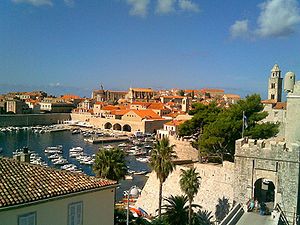
Nazi Germany
Nazi Germany , also known as the Third Reich , but officially called German Reich from 1933 to 1943 and Greater German Reich from 26 June 1943 onward, is the name commonly used to refer to the state of Germany from 1933 to 1945, when it was a totalitarian dictatorship ruled by...
having bilateral military agreements or being part of the Axis Pact. Fascist Italy
Kingdom of Italy (1861–1946)
The Kingdom of Italy was a state forged in 1861 by the unification of Italy under the influence of the Kingdom of Sardinia, which was its legal predecessor state...
expanded the war in Balkans by using its protectorate Albania to invade Greece
Greco-Italian War
The Greco-Italian War was a conflict between Italy and Greece which lasted from 28 October 1940 to 23 April 1941. It marked the beginning of the Balkans Campaign of World War II...
. After repelling the attack the Greeks counterattacked, invading Italy-held Albania and causing Nazi Germany's intervention in the Balkans in order to help its ally. Days before the German invasion a successful coup d'état
Coup d'état
A coup d'état state, literally: strike/blow of state)—also known as a coup, putsch, and overthrow—is the sudden, extrajudicial deposition of a government, usually by a small group of the existing state establishment—typically the military—to replace the deposed government with another body; either...
in Belgrade
Belgrade
Belgrade is the capital and largest city of Serbia. It is located at the confluence of the Sava and Danube rivers, where the Pannonian Plain meets the Balkans. According to official results of Census 2011, the city has a population of 1,639,121. It is one of the 15 largest cities in Europe...
by neutral military personnel seized power.
Although the new government reaffirmed Serbia's intentions to fulfil its obligations as member of the Axis, Germany using its other two allied countries in the region, Bulgaria and Romania, invaded both Greece and Yugoslavia. Yugoslavia immediately disintegrated when those loyal to the Serbian King and the Croatian units mutinied. Greece resisted, but, after two months of fighting, collapsed and was occupied. The two countries were partitioned between the three Axis allies, Bulgaria, Germany and Italy, and two independent states, Croatia
Croatia
Croatia , officially the Republic of Croatia , is a unitary democratic parliamentary republic in Europe at the crossroads of the Mitteleuropa, the Balkans, and the Mediterranean. Its capital and largest city is Zagreb. The country is divided into 20 counties and the city of Zagreb. Croatia covers ...
and Montenegro
Montenegro
Montenegro Montenegrin: Crna Gora Црна Гора , meaning "Black Mountain") is a country located in Southeastern Europe. It has a coast on the Adriatic Sea to the south-west and is bordered by Croatia to the west, Bosnia and Herzegovina to the northwest, Serbia to the northeast and Albania to the...
were created.
During the occupation the population suffered considerable hardship due to ethnic cleansing policies
Ethnic cleansing
Ethnic cleansing is a purposeful policy designed by one ethnic or religious group to remove by violent and terror-inspiring means the civilian population of another ethnic orreligious group from certain geographic areas....
, repression and starvation, to which the population reacted by creating a mass resistance movement. Together with the early and extremely heavy winter of that year (which caused hundreds of thousands deaths among the poorly fed population), the German invasion had disastrous effects in the timetable of the planned invasion in Russia
Operation Barbarossa
Operation Barbarossa was the code name for Germany's invasion of the Soviet Union during World War II that began on 22 June 1941. Over 4.5 million troops of the Axis powers invaded the USSR along a front., the largest invasion in the history of warfare...
causing a significant delay which had key consequences to the route of the war.
Finally at the end of 1944, the Soviets invaded Romania and Bulgaria while the Germans evacuated the Balkans. They left behind a region largely ruined as a result of war-time exploitation, but by making use of the post-war separation of Germany into two independent entities, the German states successfully and legally avoided paying any reparations or repaying the forced taken loans to the occupied countries. The official Yugoslav post-war estimate of victims
World War II casualties
World War II was the deadliest military conflict in history. Over 60 million people were killed, which was over 2.5% of the world population. The tables below give a detailed country-by-country count of human losses.-Total dead:...
in Yugoslavia during World War II
World War II
World War II, or the Second World War , was a global conflict lasting from 1939 to 1945, involving most of the world's nations—including all of the great powers—eventually forming two opposing military alliances: the Allies and the Axis...
is 1,704,000. Subsequent data gathering in the 1980s by historians Vladimir Žerjavić
Vladimir Žerjavic
Vladimir Žerjavić was a Croatian economist and a United Nations expert. He published a series of historical articles and books during the 1980s and 1990s in which he argued that the scope of the Holocaust in World War II-era territory of Yugoslavia was intentionally exaggerated...
and Bogoljub Kočović
Bogoljub Kocovic
Bogoljub Kočović is a Bosnian jurist and statistician, Yugoslav by ethnic affiliation.Kočović was born in Sarajevo; his father was a Serb and mother French by origin. He obtained a MA in economy at the Roosevelt University in Chicago, and a Ph. D. in law in Paris...
showed that the actual number of dead was about 1 million. Greece suffered more than 300,000 casualties during the occupation.
Cold War
During the Cold WarCold War
The Cold War was the continuing state from roughly 1946 to 1991 of political conflict, military tension, proxy wars, and economic competition between the Communist World—primarily the Soviet Union and its satellite states and allies—and the powers of the Western world, primarily the United States...
, most of the countries on the Balkans were governed by communist governments. Greece became the first battleground of the emerging Cold War. The Truman Doctrine
Truman Doctrine
The Truman Doctrine was a policy set forth by U.S. President Harry S Truman in a speech on March 12, 1947 stating that the U.S. would support Greece and Turkey with economic and military aid to prevent their falling into the Soviet sphere...
was the US response to the civil war
Greek Civil War
The Greek Civil War was fought from 1946 to 1949 between the Greek governmental army, backed by the United Kingdom and United States, and the Democratic Army of Greece , the military branch of the Greek Communist Party , backed by Bulgaria, Yugoslavia and Albania...
, which raged from 1944-49. The Civil War, unleashed by the local communist party, backed by communist volunteers from neighboring countries (Albania, Bulgaria and Yugoslavia), led to massive American assistance for the non-communist Greek government. With this backing, Greece managed to defeat the partisans and, ultimately, remained the only non-Communist country in the region.
However, despite being under communist governments, Yugoslavia
Socialist Federal Republic of Yugoslavia
The Socialist Federal Republic of Yugoslavia was the Yugoslav state that existed from the abolition of the Yugoslav monarchy until it was dissolved in 1992 amid the Yugoslav Wars. It was a socialist state and a federation made up of six socialist republics: Bosnia and Herzegovina, Croatia,...
(1948) and Albania
Albania
Albania , officially known as the Republic of Albania , is a country in Southeastern Europe, in the Balkans region. It is bordered by Montenegro to the northwest, Kosovo to the northeast, the Republic of Macedonia to the east and Greece to the south and southeast. It has a coast on the Adriatic Sea...
(1961) fell out with the Soviet Union. Yugoslavia, led by marshal Josip Broz Tito
Josip Broz Tito
Marshal Josip Broz Tito – 4 May 1980) was a Yugoslav revolutionary and statesman. While his presidency has been criticized as authoritarian, Tito was a popular public figure both in Yugoslavia and abroad, viewed as a unifying symbol for the nations of the Yugoslav federation...
(1892–1980), first propped up then rejected the idea of merging with Bulgaria
Bulgaria
Bulgaria , officially the Republic of Bulgaria , is a parliamentary democracy within a unitary constitutional republic in Southeast Europe. The country borders Romania to the north, Serbia and Macedonia to the west, Greece and Turkey to the south, as well as the Black Sea to the east...
, and instead sought closer relations with the West
Western world
The Western world, also known as the West and the Occident , is a term referring to the countries of Western Europe , the countries of the Americas, as well all countries of Northern and Central Europe, Australia and New Zealand...
, later even spearheaded, together with India and Egypt the Non-Aligned Movement
Non-Aligned Movement
The Non-Aligned Movement is a group of states considering themselves not aligned formally with or against any major power bloc. As of 2011, the movement had 120 members and 17 observer countries...
. Albania on the other hand gravitated toward Communist China
People's Republic of China
China , officially the People's Republic of China , is the most populous country in the world, with over 1.3 billion citizens. Located in East Asia, the country covers approximately 9.6 million square kilometres...
, later adopting an isolationist
Isolationism
Isolationism is the policy or doctrine of isolating one's country from the affairs of other nations by declining to enter into alliances, foreign economic commitments, international agreements, etc., seeking to devote the entire efforts of one's country to its own advancement and remain at peace by...
position.
As the only non-communist countries, Greece
Greece
Greece , officially the Hellenic Republic , and historically Hellas or the Republic of Greece in English, is a country in southeastern Europe....
and Turkey
Turkey
Turkey , known officially as the Republic of Turkey , is a Eurasian country located in Western Asia and in East Thrace in Southeastern Europe...
were (and still are) part of NATO consisting the South-eastern wing of the alliance.
Post–Cold War
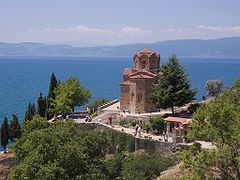
Yugoslav wars
The Yugoslav Wars were a series of wars, fought throughout the former Yugoslavia between 1991 and 1995. The wars were complex: characterized by bitter ethnic conflicts among the peoples of the former Yugoslavia, mostly between Serbs on the one side and Croats and Bosniaks on the other; but also...
broken out after Croatia and Slovenia's attempt to change the status of equality between the Yugoslav federated Republics to proportionate status. Serbia in turn declared the dissolution of the union as unconstitutional and the Yugoslavian army
Yugoslav People's Army
The Yugoslav People's Army , also referred to as the Yugoslav National Army , was the military of the Socialist Federal Republic of Yugoslavia.-Origins:The origins of the JNA can...
unsuccessfully tried to maintain status quo, while Croatia
Croatia
Croatia , officially the Republic of Croatia , is a unitary democratic parliamentary republic in Europe at the crossroads of the Mitteleuropa, the Balkans, and the Mediterranean. Its capital and largest city is Zagreb. The country is divided into 20 counties and the city of Zagreb. Croatia covers ...
together with Slovenia
Slovenia
Slovenia , officially the Republic of Slovenia , is a country in Central and Southeastern Europe touching the Alps and bordering the Mediterranean. Slovenia borders Italy to the west, Croatia to the south and east, Hungary to the northeast, and Austria to the north, and also has a small portion of...
had declared independence. The Army eventually slowly withdrew from both nations by 1992 and in Croatia the war
Croatian War of Independence
The Croatian War of Independence was fought from 1991 to 1995 between forces loyal to the government of Croatia—which had declared independence from the Socialist Federal Republic of Yugoslavia —and the Serb-controlled Yugoslav People's Army and local Serb forces, with the JNA ending its combat...
between the Croatian government and local Serbs would continue until 1995
Operation Storm
Operation Storm is the code name given to a large-scale military operation carried out by Croatian Armed Forces, in conjunction with the Army of the Republic of Bosnia and Herzegovina, to gain back control of parts of Croatia which had been claimed by separatist ethnic Serbs, since early...
. In the ensuing 10 years armed confrontation, gradually all the other Republics declared independence, with Bosnia being the most affected
Bosnian War
The Bosnian War or the War in Bosnia and Herzegovina was an international armed conflict that took place in Bosnia and Herzegovina between April 1992 and December 1995. The war involved several sides...
by the fighting. The long lasting wars resulted in a United Nations
United Nations
The United Nations is an international organization whose stated aims are facilitating cooperation in international law, international security, economic development, social progress, human rights, and achievement of world peace...
intervention and NATO
NATO intervention in Bosnia
The NATO intervention in Bosnia consisted of a series of actions undertaken by NATO to establish and then preserve peace during and after the Bosnian War...
ground and air forces took action against Serb forces in Bosnia and Herzegovina
Bosnia and Herzegovina
Bosnia and Herzegovina , sometimes called Bosnia-Herzegovina or simply Bosnia, is a country in Southern Europe, on the Balkan Peninsula. Bordered by Croatia to the north, west and south, Serbia to the east, and Montenegro to the southeast, Bosnia and Herzegovina is almost landlocked, except for the...
and Serbia
1999 NATO bombing of Yugoslavia
The NATO bombing of Yugoslavia was NATO's military operation against the Federal Republic of Yugoslavia during the Kosovo War. The strikes lasted from March 24, 1999 to June 10, 1999...
(including its southern province of Kosovo
Kosovo
Kosovo is a region in southeastern Europe. Part of the Ottoman Empire for more than five centuries, later the Autonomous Province of Kosovo and Metohija within Serbia...
).
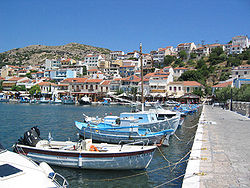
Slovenia
Slovenia , officially the Republic of Slovenia , is a country in Central and Southeastern Europe touching the Alps and bordering the Mediterranean. Slovenia borders Italy to the west, Croatia to the south and east, Hungary to the northeast, and Austria to the north, and also has a small portion of...
, Croatia
Croatia
Croatia , officially the Republic of Croatia , is a unitary democratic parliamentary republic in Europe at the crossroads of the Mitteleuropa, the Balkans, and the Mediterranean. Its capital and largest city is Zagreb. The country is divided into 20 counties and the city of Zagreb. Croatia covers ...
, Bosnia and Herzegovina
Bosnia and Herzegovina
Bosnia and Herzegovina , sometimes called Bosnia-Herzegovina or simply Bosnia, is a country in Southern Europe, on the Balkan Peninsula. Bordered by Croatia to the north, west and south, Serbia to the east, and Montenegro to the southeast, Bosnia and Herzegovina is almost landlocked, except for the...
, Macedonia
Republic of Macedonia
Macedonia , officially the Republic of Macedonia , is a country located in the central Balkan peninsula in Southeast Europe. It is one of the successor states of the former Yugoslavia, from which it declared independence in 1991...
, Montenegro
Montenegro
Montenegro Montenegrin: Crna Gora Црна Гора , meaning "Black Mountain") is a country located in Southeastern Europe. It has a coast on the Adriatic Sea to the south-west and is bordered by Croatia to the west, Bosnia and Herzegovina to the northwest, Serbia to the northeast and Albania to the...
and Serbia
Serbia
Serbia , officially the Republic of Serbia , is a landlocked country located at the crossroads of Central and Southeast Europe, covering the southern part of the Carpathian basin and the central part of the Balkans...
. The Albanian institutions in Kosovo
Kosovo
Kosovo is a region in southeastern Europe. Part of the Ottoman Empire for more than five centuries, later the Autonomous Province of Kosovo and Metohija within Serbia...
, currently under UN administration, declared independence in 2008 (according to the official Serbian policy, Kosovo is still an internal autonomous region). In July 2010, the International Court of Justice
International Court of Justice
The International Court of Justice is the primary judicial organ of the United Nations. It is based in the Peace Palace in The Hague, Netherlands...
, after a UN General Assembly's request, opined that, since there is not an active rule in international law
International law
Public international law concerns the structure and conduct of sovereign states; analogous entities, such as the Holy See; and intergovernmental organizations. To a lesser degree, international law also may affect multinational corporations and individuals, an impact increasingly evolving beyond...
limiting the declarations of independence, the unilateral Kosovar proclamation does not violate it (leaving unanswered the questions about the consequences of said act, including whether with said declaration Kosovo achieved the status of a State). The international community is still divided on the matter and while the majority of the UN members do not recognize it as independent, most NATO and EU countries do. After the end of the wars a revolution
October Revolution
The October Revolution , also known as the Great October Socialist Revolution , Red October, the October Uprising or the Bolshevik Revolution, was a political revolution and a part of the Russian Revolution of 1917...
broke in Serbia and Slobodan Milošević
Slobodan Milošević
Slobodan Milošević was President of Serbia and Yugoslavia. He served as the President of Socialist Republic of Serbia and Republic of Serbia from 1989 until 1997 in three terms and as President of the Federal Republic of Yugoslavia from 1997 to 2000...
, the Serbian communist leader (elected president between 1989–2000), was overthrown and handed for trial to the International Criminal Tribunal
International Criminal Tribunal for the former Yugoslavia
The International Tribunal for the Prosecution of Persons Responsible for Serious Violations of International Humanitarian Law Committed in the Territory of the Former Yugoslavia since 1991, more commonly referred to as the International Criminal Tribunal for the former Yugoslavia or ICTY, is a...
for crimes against the International Humanitarian Law
International humanitarian law
International humanitarian law , often referred to as the laws of war, the laws and customs of war or the law of armed conflict, is the legal corpus that comprises "the Geneva Conventions and the Hague Conventions, as well as subsequent treaties, case law, and customary international law." It...
during the Yugoslav wars. Milošević died of a heart attack in 2006 before a verdict could have been released. Ιn 2001 an Albanian uprising
Insurgency in the Republic of Macedonia
The insurgency in the Republic of Macedonia was an armed conflict which began when the ethnic Albanian National Liberation Army militant group attacked the security forces of the Republic of Macedonia at the beginning of January 2001...
in Macedonia
Republic of Macedonia
Macedonia , officially the Republic of Macedonia , is a country located in the central Balkan peninsula in Southeast Europe. It is one of the successor states of the former Yugoslavia, from which it declared independence in 1991...
forced the country to give local autonomy to the ethnic Albanians in the areas where they predominate.
With the dissolution of Yugoslavia
Yugoslavia
Yugoslavia refers to three political entities that existed successively on the western part of the Balkans during most of the 20th century....
an issue emerged over the name under which the former (federated) republic of Macedonia would internationally be recognized, between the new country and Greece. Being the Macedonian part of Yugoslavia
Macedonia (region)
Macedonia is a geographical and historical region of the Balkan peninsula in southeastern Europe. Its boundaries have changed considerably over time, but nowadays the region is considered to include parts of five Balkan countries: Greece, the Republic of Macedonia, Bulgaria, Albania, Serbia, as...
(see Vardar Macedonia
Vardar Macedonia
Vardar Macedonia is an area in the north of the Macedonia . The borders of the area are those of the Republic of Macedonia. It covers an area of...
), the federated Republic under the Yugoslav identity had the name Republic of Macedonia
Socialist Republic of Macedonia
The Socialist Republic of Macedonia was a socialist state that was a constituent country of the former Socialist Federal Republic of Yugoslavia...
on which it declared its sovereignty in 1991. Greece, having a large region (see Macedonia (Greece)
Macedonia (Greece)
Macedonia is a geographical and historical region of Greece in Southern Europe. Macedonia is the largest and second most populous Greek region...
) also under the same name opposed to the usage of this name as an indication of a nationality. The issue
Macedonia naming dispute
A diplomatic dispute over the use of the name Macedonia has been an ongoing issue in the bilateral relations between Greece and the Republic of Macedonia since the latter became independent from former Yugoslavia in 1991...
is currently under negotiations after a UN initiation.
Balkan countries control the direct land routes between Western Europe
Western Europe
Western Europe is a loose term for the collection of countries in the western most region of the European continents, though this definition is context-dependent and carries cultural and political connotations. One definition describes Western Europe as a geographic entity—the region lying in the...
and South West Asia
Asia
Asia is the world's largest and most populous continent, located primarily in the eastern and northern hemispheres. It covers 8.7% of the Earth's total surface area and with approximately 3.879 billion people, it hosts 60% of the world's current human population...
(Asia Minor
Asia Minor
Asia Minor is a geographical location at the westernmost protrusion of Asia, also called Anatolia, and corresponds to the western two thirds of the Asian part of Turkey...
and the Middle East
Middle East
The Middle East is a region that encompasses Western Asia and Northern Africa. It is often used as a synonym for Near East, in opposition to Far East...
). Since 2000, all Balkan countries are friendly towards the EU
European Union
The European Union is an economic and political union of 27 independent member states which are located primarily in Europe. The EU traces its origins from the European Coal and Steel Community and the European Economic Community , formed by six countries in 1958...
and the USA
United States
The United States of America is a federal constitutional republic comprising fifty states and a federal district...
.
Greece
Greece
Greece , officially the Hellenic Republic , and historically Hellas or the Republic of Greece in English, is a country in southeastern Europe....
has been a member of the European Union
European Union
The European Union is an economic and political union of 27 independent member states which are located primarily in Europe. The EU traces its origins from the European Coal and Steel Community and the European Economic Community , formed by six countries in 1958...
since 1981; Slovenia
Slovenia
Slovenia , officially the Republic of Slovenia , is a country in Central and Southeastern Europe touching the Alps and bordering the Mediterranean. Slovenia borders Italy to the west, Croatia to the south and east, Hungary to the northeast, and Austria to the north, and also has a small portion of...
and Cyprus
Cyprus
Cyprus , officially the Republic of Cyprus , is a Eurasian island country, member of the European Union, in the Eastern Mediterranean, east of Greece, south of Turkey, west of Syria and north of Egypt. It is the third largest island in the Mediterranean Sea.The earliest known human activity on the...
since 2004. Bulgaria
Bulgaria
Bulgaria , officially the Republic of Bulgaria , is a parliamentary democracy within a unitary constitutional republic in Southeast Europe. The country borders Romania to the north, Serbia and Macedonia to the west, Greece and Turkey to the south, as well as the Black Sea to the east...
and Romania
Romania
Romania is a country located at the crossroads of Central and Southeastern Europe, on the Lower Danube, within and outside the Carpathian arch, bordering on the Black Sea...
joined in 2007. In 2005, the European Union decided to start accession negotiations with candidate countries; Croatia
Croatia
Croatia , officially the Republic of Croatia , is a unitary democratic parliamentary republic in Europe at the crossroads of the Mitteleuropa, the Balkans, and the Mediterranean. Its capital and largest city is Zagreb. The country is divided into 20 counties and the city of Zagreb. Croatia covers ...
, Turkey
Turkey
Turkey , known officially as the Republic of Turkey , is a Eurasian country located in Western Asia and in East Thrace in Southeastern Europe...
, and Macedonia
Republic of Macedonia
Macedonia , officially the Republic of Macedonia , is a country located in the central Balkan peninsula in Southeast Europe. It is one of the successor states of the former Yugoslavia, from which it declared independence in 1991...
were accepted as candidates for European Union membership. As of April 2009, Albania
Albania
Albania , officially known as the Republic of Albania , is a country in Southeastern Europe, in the Balkans region. It is bordered by Montenegro to the northwest, Kosovo to the northeast, the Republic of Macedonia to the east and Greece to the south and southeast. It has a coast on the Adriatic Sea...
, Bulgaria
Bulgaria
Bulgaria , officially the Republic of Bulgaria , is a parliamentary democracy within a unitary constitutional republic in Southeast Europe. The country borders Romania to the north, Serbia and Macedonia to the west, Greece and Turkey to the south, as well as the Black Sea to the east...
, Croatia
Croatia
Croatia , officially the Republic of Croatia , is a unitary democratic parliamentary republic in Europe at the crossroads of the Mitteleuropa, the Balkans, and the Mediterranean. Its capital and largest city is Zagreb. The country is divided into 20 counties and the city of Zagreb. Croatia covers ...
, Romania
Romania
Romania is a country located at the crossroads of Central and Southeastern Europe, on the Lower Danube, within and outside the Carpathian arch, bordering on the Black Sea...
and Slovenia
Slovenia
Slovenia , officially the Republic of Slovenia , is a country in Central and Southeastern Europe touching the Alps and bordering the Mediterranean. Slovenia borders Italy to the west, Croatia to the south and east, Hungary to the northeast, and Austria to the north, and also has a small portion of...
are also members of NATO. Bosnia and Herzegovina
Bosnia and Herzegovina
Bosnia and Herzegovina , sometimes called Bosnia-Herzegovina or simply Bosnia, is a country in Southern Europe, on the Balkan Peninsula. Bordered by Croatia to the north, west and south, Serbia to the east, and Montenegro to the southeast, Bosnia and Herzegovina is almost landlocked, except for the...
and what was then Serbia and Montenegro
Serbia and Montenegro
Serbia and Montenegro was a country in southeastern Europe, formed from two former republics of the Socialist Federal Republic of Yugoslavia : Serbia and Montenegro. Following the breakup of Yugoslavia, it was established in 1992 as a federation called the Federal Republic of Yugoslavia...
started negotiations with the EU over the Stabilization and Accession Agreements, although shortly after they started, negotiations with Serbia and Montenegro were suspended for lack of co-operation with the International Criminal Tribunal for the Former Yugoslavia
International Criminal Tribunal for the former Yugoslavia
The International Tribunal for the Prosecution of Persons Responsible for Serious Violations of International Humanitarian Law Committed in the Territory of the Former Yugoslavia since 1991, more commonly referred to as the International Criminal Tribunal for the former Yugoslavia or ICTY, is a...
. In 2008
2008 Bucharest summit
The 2008 Bucharest Summit or the 20th NATO Summit was a NATO summit organized in Bucharest, Romania on 2 – 4 April 2008. Among other business, Croatia and Albania were invited to join the alliance. Republic of Macedonia was not invited due to its ongoing naming dispute with Greece...
Greece vetoed Macedonia's NATO membership bid over the Macedonia naming dispute
Macedonia naming dispute
A diplomatic dispute over the use of the name Macedonia has been an ongoing issue in the bilateral relations between Greece and the Republic of Macedonia since the latter became independent from former Yugoslavia in 1991...
between the two countries.
All other countries have expressed a desire to join the EU but at some date in the future.
The Balkans today is a very diverse ethno-linguistic region, being home to multiple Slavic
Slavic languages
The Slavic languages , a group of closely related languages of the Slavic peoples and a subgroup of Indo-European languages, have speakers in most of Eastern Europe, in much of the Balkans, in parts of Central Europe, and in the northern part of Asia.-Branches:Scholars traditionally divide Slavic...
, Romance
Romance languages
The Romance languages are a branch of the Indo-European language family, more precisely of the Italic languages subfamily, comprising all the languages that descend from Vulgar Latin, the language of ancient Rome...
, and Turkic languages
Turkic languages
The Turkic languages constitute a language family of at least thirty five languages, spoken by Turkic peoples across a vast area from Eastern Europe and the Mediterranean to Siberia and Western China, and are considered to be part of the proposed Altaic language family.Turkic languages are spoken...
, as well as Greek
Greek language
Greek is an independent branch of the Indo-European family of languages. Native to the southern Balkans, it has the longest documented history of any Indo-European language, spanning 34 centuries of written records. Its writing system has been the Greek alphabet for the majority of its history;...
, Albanian
Albanian language
Albanian is an Indo-European language spoken by approximately 7.6 million people, primarily in Albania and Kosovo but also in other areas of the Balkans in which there is an Albanian population, including western Macedonia, southern Montenegro, southern Serbia and northwestern Greece...
and others. Through its history many other ethnic groups with their own languages lived in the area, among them Thracians
Thracians
The ancient Thracians were a group of Indo-European tribes inhabiting areas including Thrace in Southeastern Europe. They spoke the Thracian language – a scarcely attested branch of the Indo-European language family...
, Illyrians
Illyrians
The Illyrians were a group of tribes who inhabited part of the western Balkans in antiquity and the south-eastern coasts of the Italian peninsula...
, Romans
Ancient Rome
Ancient Rome was a thriving civilization that grew on the Italian Peninsula as early as the 8th century BC. Located along the Mediterranean Sea and centered on the city of Rome, it expanded to one of the largest empires in the ancient world....
, Pechenegs, Cumans
Cumans
The Cumans were Turkic nomadic people comprising the western branch of the Cuman-Kipchak confederation. After Mongol invasion , they decided to seek asylum in Hungary, and subsequently to Bulgaria...
, Avars
Eurasian Avars
The Eurasian Avars or Ancient Avars were a highly organized nomadic confederacy of mixed origins. They were ruled by a khagan, who was surrounded by a tight-knit entourage of nomad warriors, an organization characteristic of Turko-Mongol groups...
, Celts and various Germanic tribes
Germanic peoples
The Germanic peoples are an Indo-European ethno-linguistic group of Northern European origin, identified by their use of the Indo-European Germanic languages which diversified out of Proto-Germanic during the Pre-Roman Iron Age.Originating about 1800 BCE from the Corded Ware Culture on the North...
.
Demographics
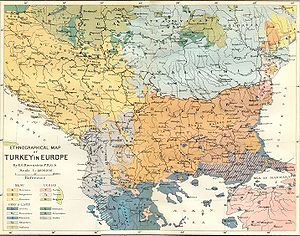
.jpg)
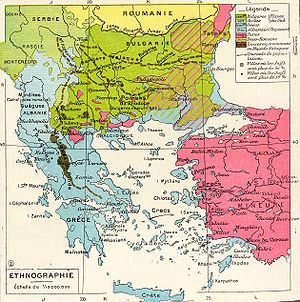
| State | Population | Coverage |
|---|---|---|
 Albania Albania |
3,194,972 Demographics of Albania This article is about the demographic features of the population of Albania, including population density, ethnicity, education level, health of the populace, economic status, religious affiliations and other aspects of the population.-Ethnic groups:... |
State's total population |
 Bosnia and Herzegovina Bosnia and Herzegovina |
3,839,737 Demographics of Bosnia and Herzegovina This article is about the demographic features of the population of Bosnia and Herzegovina, including population density, ethnicity, education level, health of the populace, economic status, religious affiliations and other aspects of the population.... |
State's total population |
 Kingdom of Bulgaria Kingdom of Bulgaria |
7,364,570 Demographics of Bulgaria This article is about the demographic features of the population of Bulgaria, including population density, ethnicity, education level, health of the populace, economic status, religious affiliations and other aspects of the population.... |
State's total population |
 Independent State of Croatia Independent State of Croatia |
4,290,612 Demographics of Croatia The demographic features of the population of Croatia include statistical data collected through censuses, normally conducted in ten-year intervals and analysed by various statistical bureaus since the 1850s. The Croatian Bureau of Statistics performs this task since the 1990s. The latest census in... ^ |
State's total population |
 Greece Greece |
10,787,690 Demographics of Greece This article is about the demographic features of the population of Greece, including population density, ethnicity, education level, health of the populace, economic status, religious affiliations and other aspects of the population.... |
State's total population |
 Italy Italy |
236,520 Demographics of Italy This article is about the demographic features of the population of Italy, including population density, ethnicity, education level, health of the populace, economic status, religious affiliations and other aspects of the population.-Population:... |
In Province of Trieste Province of Trieste The Province of Trieste is a province in the autonomous Friuli-Venezia Giulia region of Italy. Its capital is the city of Trieste.It has an area of 212 km², and a total population of 236,520... |
|1,733,872
|Figure excludes North Kosovo
North Kosovo
North or Northern Kosovo refers to a region in the northern part of Kosovo with an ethnic Serb majority that functions largely autonomously from the remainder of the disputed territory, which has an ethnic Albanian majority. Ibarian Kolashin , a toponym that pre-dates the political partition, is...
|-
|
 Republic of Macedonia
|2,055,004
Demographics of the Republic of Macedonia
This article is about the demographic features of the population of Republic of Macedonia, including population density, ethnicity, education level, health of the populous, economic status, religious affiliations and other aspects of the population....
|State's total population
|-
|
 Kingdom of Montenegro
|625,266
Demographics of Montenegro
This article is about the demographic features of the population of Montenegro, including population density, ethnicity, education level, health of the populace, economic status, religious affiliations and other aspects of the population.- Total population:...
|State's total population
|-
|
 Kingdom of Romania
|971,643
Demographics of Romania
This article is about the demographic features of the population of Romania, including population density, ethnicity, education level, health of the populace, economic status, religious affiliations and other aspects of the population....
|In Northern Dobruja
Northern Dobruja
Northern Dobruja is the part of Dobruja within the borders of Romania. It lies between the lower Danube river and the Black Sea, bordered in south by Bulgarian Southern Dobruja.-Geography:...
|-
|
 Serbia
|7,120,666
Demographics of Serbia
The demographics of Serbia have been shaped by its unique geographic location. Situated in the middle of the Balkans, many different ethnic groups are citizens of Serbia. Serbs are overwhelmingly the largest ethnic group in the country. Furthermore, Albanians have represented the largest minority...
^
|Excluding Kosovo
Kosovo
Kosovo is a region in southeastern Europe. Part of the Ottoman Empire for more than five centuries, later the Autonomous Province of Kosovo and Metohija within Serbia...
, yet its population is shown above
|-
|
 Slovenia
|2,048,951
Demographics of Slovenia
This article is about the demographic features of the population of Slovenia, including population density, ethnicity, education level, health of the populace, economic status, religious affiliations and other aspects of the population.-Vital statistics :...
^
|State's total population
|-
|
 Turkey
|9,799,745
Demographics of Turkey
This article is about the demographic features of the population of Turkey, including population density, ethnicity, education level, health of the populace, economic status, religious affiliations and other aspects of the population....
(8,232,439 are concentrated in Istanbul Municipality
Istanbul Province
Istanbul Province is a province located in north-west Turkey. It has an area of 5,196 km² and a population of 13,255,685. The population was 10,018,735 in 2000. It is surrounded by the provinces of Tekirdağ to the west, Kocaeli to the east, the Black Sea to the northern part and the Sea of...
)
|In European Turkey
East Thrace
East Thrace or Eastern Thrace , also known as Turkish Thrace, is the part of the modern republic of Turkey that is geographically part of Europe, all in the eastern part of the historical region of Thrace; most of Turkey is in Anatolia, also known as Asia Minor. Turkish Thrace is also called...
|}
^ Figures that include population outside the Balkan Peninsula - parts of Serbia and Croatia and most of Slovenia. Yet the total population of these 3 countries including these parts is shown in the table.
Religion
The region's principal religions are ChristianityChristianity
Christianity is a monotheistic religion based on the life and teachings of Jesus as presented in canonical gospels and other New Testament writings...
(Eastern Orthodox and Roman Catholic) and Islam
Islam
Islam . The most common are and . : Arabic pronunciation varies regionally. The first vowel ranges from ~~. The second vowel ranges from ~~~...
. A variety of different traditions of each faith are practiced, with each of the Eastern Orthodox countries having its own national church.
Eastern Orthodoxy is a principal religion in the following countries:
- Bosnia and Herzegovina: (Serbian Orthodox ChurchSerbian Orthodox ChurchThe Serbian Orthodox Church is one of the autocephalous Orthodox Christian churches, ranking sixth in order of seniority after Constantinople, Alexandria, Antioch, Jerusalem, and Russia...
) - Bulgaria (Bulgarian Orthodox ChurchBulgarian Orthodox ChurchThe Bulgarian Orthodox Church - Bulgarian Patriarchate is an autocephalous Eastern Orthodox Church with some 6.5 million members in the Republic of Bulgaria and between 1.5 and 2.0 million members in a number of European countries, the Americas and Australia...
) - Greece (Greek Orthodox ChurchGreek Orthodox ChurchThe Greek Orthodox Church is the body of several churches within the larger communion of Eastern Orthodox Christianity sharing a common cultural tradition whose liturgy is also traditionally conducted in Koine Greek, the original language of the New Testament...
) - Macedonia (Macedonian Orthodox ChurchMacedonian Orthodox ChurchThe Macedonian Orthodox Church – Ohrid Archbishopric or just Macedonian Orthodox Church is the body of Christians who are united under the Archbishop of Ohrid and Macedonia, exercising jurisdiction over Macedonian Orthodox Christians in the Republic of Macedonia and in exarchates in the Macedonian...
) - Montenegro (Serbian Orthodox ChurchSerbian Orthodox ChurchThe Serbian Orthodox Church is one of the autocephalous Orthodox Christian churches, ranking sixth in order of seniority after Constantinople, Alexandria, Antioch, Jerusalem, and Russia...
and Montenegrin Orthodox ChurchMontenegrin Orthodox ChurchThe Montenegrin Orthodox Church is an Orthodox Christian organization acting in Montenegro and Montenegrin emigration circles - e.g. the village of Lovćenac and the Montenegrin emigration colony in Argentina...
) - Romania (Romanian Orthodox ChurchRomanian Orthodox ChurchThe Romanian Orthodox Church is an autocephalous Eastern Orthodox church. It is in full communion with other Eastern Orthodox churches, and is ranked seventh in order of precedence. The Primate of the church has the title of Patriarch...
) - Serbia (Serbian Orthodox ChurchSerbian Orthodox ChurchThe Serbian Orthodox Church is one of the autocephalous Orthodox Christian churches, ranking sixth in order of seniority after Constantinople, Alexandria, Antioch, Jerusalem, and Russia...
)
Roman Catholicism is a principal religion in the following countries:
- Croatia (87.83% Catholics (3 897 332); according to 2001 census official data)
- Slovenia (57.80% Catholics (1 135 626); according to 2002 census official data)
Islam
Islam
Islam . The most common are and . : Arabic pronunciation varies regionally. The first vowel ranges from ~~. The second vowel ranges from ~~~...
is a principal religion in the following countries:
- Albania (relative majority)
- Bosnia and Herzegovina (majority below 50%)
- Kosovo (relative majority)
- Turkey (absolute majority)
The following countries have minority religious groups of the following denominations:
- Albania: OrthodoxyAlbanian Orthodox ChurchThe Autocephalous Orthodox Church of Albania is one of the newest autocephalous Eastern Orthodox churches. It declared its autocephaly in 1922, and gained recognition from the Patriarch of Constantinople in 1937....
, Catholicism - Bosnia and Herzegovina: Catholicism
- Bulgaria: Islam
- Croatia: Orthodoxy
- Greece: Islam
- Kosovo: Orthodoxy
- Macedonia: Islam
- Montenegro: Islam
- Serbia: Catholicism, mainly in Province of Vojvodina, and Islam, mainly in Province of Kosovo and Raška/Sandžak
- Romania: Catholicism
The Jewish
Judaism
Judaism ) is the "religion, philosophy, and way of life" of the Jewish people...
communities of the Balkans were some of the oldest in Europe and date back to ancient times. The Jewish communities of the Balkans were Sephardi Jews, except in Slovenia
Slovenia
Slovenia , officially the Republic of Slovenia , is a country in Central and Southeastern Europe touching the Alps and bordering the Mediterranean. Slovenia borders Italy to the west, Croatia to the south and east, Hungary to the northeast, and Austria to the north, and also has a small portion of...
, Croatia
Croatia
Croatia , officially the Republic of Croatia , is a unitary democratic parliamentary republic in Europe at the crossroads of the Mitteleuropa, the Balkans, and the Mediterranean. Its capital and largest city is Zagreb. The country is divided into 20 counties and the city of Zagreb. Croatia covers ...
and Romania
Romania
Romania is a country located at the crossroads of Central and Southeastern Europe, on the Lower Danube, within and outside the Carpathian arch, bordering on the Black Sea...
where the Jewish communities were Ashkenazi Jews. In Slovenia, there were Jewish immigrants dating back to Roman times pre-dating the 6th century settlement of the region by the Slavic peoples. In Bosnia and Herzegovina
Bosnia and Herzegovina
Bosnia and Herzegovina , sometimes called Bosnia-Herzegovina or simply Bosnia, is a country in Southern Europe, on the Balkan Peninsula. Bordered by Croatia to the north, west and south, Serbia to the east, and Montenegro to the southeast, Bosnia and Herzegovina is almost landlocked, except for the...
, the tiny and fast disappearing Jewish community is 90% Sephardic and Ladino is still spoken among the elderly. The Sephardi Jewish cemetery in Sarajevo
Sarajevo
Sarajevo |Bosnia]], surrounded by the Dinaric Alps and situated along the Miljacka River in the heart of Southeastern Europe and the Balkans....
has tombstones of a unique shape, inscribed in ancient Ladino. Sephardi Jews used to have a large presence in the city of Thessaloniki
Thessaloniki
Thessaloniki , historically also known as Thessalonica, Salonika or Salonica, is the second-largest city in Greece and the capital of the region of Central Macedonia as well as the capital of the Decentralized Administration of Macedonia and Thrace...
, and by 1900, some 80,000, or more than half of the population, were Jews.
However the Jewish communities in the Balkans suffered immensely during World War II
World War II
World War II, or the Second World War , was a global conflict lasting from 1939 to 1945, involving most of the world's nations—including all of the great powers—eventually forming two opposing military alliances: the Allies and the Axis...
and the vast majority were killed during the Holocaust
The Holocaust
The Holocaust , also known as the Shoah , was the genocide of approximately six million European Jews and millions of others during World War II, a programme of systematic state-sponsored murder by Nazi...
. However an exception were the Bulgarian Jews many of whom were saved by Boris III of Bulgaria
Boris III of Bulgaria
Boris III the Unifier, Tsar of Bulgaria , originally Boris Klemens Robert Maria Pius Ludwig Stanislaus Xaver , son of Ferdinand I, came to the throne in 1918 upon the abdication of his father, following the defeat of the Kingdom of Bulgaria during World War I...
, who resisted Adolf Hitler
Adolf Hitler
Adolf Hitler was an Austrian-born German politician and the leader of the National Socialist German Workers Party , commonly referred to as the Nazi Party). He was Chancellor of Germany from 1933 to 1945, and head of state from 1934 to 1945...
for their deportation to concentration camps. Almost all of the few survivors have
emigrated to the (then) newly founded state of Israel
Israel
The State of Israel is a parliamentary republic located in the Middle East, along the eastern shore of the Mediterranean Sea...
and elsewhere. No Balkan country today has a significant Jewish minority.
Cities
A list of cities with population of over 200,000 inhabitants:See also
- Balkan InsightBalkan InsightBalkan Insight is a publication of the Balkan Investigative Reporting Network , that focusses on news, analysis, commentary and investigative reporting from southeast Europe...
- Balkan languagesBalkan languagesThis is a list of languages spoken in regions ruled by Balkan countries. With the exception of several Turkic languages, Hungarian, and Circassian, all of them belong to the Indo-European family...
- Balkan sprachbund
- BalkanizationBalkanizationBalkanization, or Balkanisation, is a geopolitical term, originally used to describe the process of fragmentation or division of a region or state into smaller regions or states that are often hostile or non-cooperative with each other, and it is considered pejorative.The term refers to the...
- Balkan Universities NetworkBalkan Universities NetworkThe Balkan Universities Network or BUN in its present form was created after the end of the SFR Yugoslavia, the founding of new universities, and the implementation of the Bologna Process in Balkan Universities...
- History of the BalkansHistory of the BalkansThe Balkans is an area of southeastern Europe situated at a major crossroads between mainland Europe and the Near East. The distinct identity and fragmentation of the Balkans owes much to its common and often violent history and to its very mountainous geography.-Neolithic:Archaeologists have...
- Balkan warsBalkan WarsThe Balkan Wars were two conflicts that took place in the Balkans in south-eastern Europe in 1912 and 1913.By the early 20th century, Montenegro, Bulgaria, Greece and Serbia, the countries of the Balkan League, had achieved their independence from the Ottoman Empire, but large parts of their ethnic...
- Historical regions of the Balkan PeninsulaHistorical regions of the Balkan PeninsulaThis is a list of major historical regions of the Balkan Peninsula. Note that these regions come from different time periods - from ancient to modern era - and may often overlap. National borders have been drawn across those regions multiple times over centuries so usually they cannot be assigned...
- Balkan wars
- Music of Southeastern EuropeMusic of Southeastern EuropeThe music of Southeastern Europe or Balkan music is a type of music distinct from others in Europe. This is mainly because it was influenced by traditional music of Southeastern European ethnic groups and mutual music influences of these ethnic groups in the period of the Ottoman Empire...
- Orient ExpressOrient ExpressThe Orient Express is the name of a long-distance passenger train service originally operated by the Compagnie Internationale des Wagons-Lits. It ran from 1883 to 2009 and is not to be confused with the Venice-Simplon Orient Express train service, which continues to run.The route and rolling stock...
External links
- Western Balkans Photos and tourism information about: Croatia, Serbia, BiH and Montenegro
- South-East Europe Review
- Introduction to Tourism in the Area
- Balkan History by Steven W. Sowards
- SEEurope.net—news coverage on Southeastern Europe
- Southeast European Times
- The Centre for South East European Studies
- Balkans region: Oil and Gas Fact Sheet—United States Department of EnergyUnited States Department of EnergyThe United States Department of Energy is a Cabinet-level department of the United States government concerned with the United States' policies regarding energy and safety in handling nuclear material...
Analysis Brief - Balkans urged to curb trafficking—BBC
- News from Balkans
- Analysis from Balkans
- Balkan Business News
- Balkanalysis.com- Objective Analysis, Research and News on the Balkans