

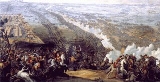
Battle of Poltava

Encyclopedia
The Battle of Poltava on 27 June 1709 (8 July, N.S.) was the decisive victory of Peter I of Russia
over the Swedish
forces under Field Marshal
Carl Gustav Rehnskiöld
in one of the battles of the Great Northern War
. It is widely believed to have been the beginning of Sweden's
decline as a Great Power
; the Russians took their place as the leading nation of northern Europe. This also meant the rise of Imperial Russia and a temporary end to the independence ambitions of Ukraine
.
in 1700 when he knocked both Denmark-Norway and Russia
temporarily out of the war. However, he was unable to bring the war to a conclusion, and it would take six years before he had dealt with the remaining combatant Augustus II
of Saxony
-Poland
.
During this time Peter I of Russia rebuilt his army into modern form, basing it primarily on infantry trained to use linear tactics and modern firearms properly. He then achieved a stunning propaganda victory when he established the city of Saint Petersburg
on Swedish territory, in Ingria
.
In an attempt to finally end the war, Charles ordered a final attack
on the Russian heartland with a possible assault on Moscow
from his campaign base in Poland. The Swedish army of almost 44,000 men left Saxony
on 22 August 1707 and marched slowly eastwards. When they reached the Vistula River they waited for it to freeze and didn't cross until 30 December, then continued through a hostile Masuria
and took Grodno
on 28 January 1708 after the Russians had left without a fight. At that time, the Russians had been dealing with a large rebellion of Don Cossacks
, known as Bulavin Rebellion
. The mutiny was contained in part by the forces of the Cossack Hetmanate
led by Hetman
Ivan Mazepa
. The Swedes continued to the area around Smorgon
and Minsk
where the army went into winter quarters. Left in western Poland were 8,000 dragoons under major-general von Krassow.
The Swedish army, which had suffered badly from different epidemic diseases during the winter, left its quarters in early June 1708 and marched towards Smolensk
. During the spring General Lewenhaupt
in Courland
had been ordered to gather supplies and march with his army of about 12,000 men to join Charles' army, although he didn't leave Mitau
until late June and couldn't join Charles' forces until 11 October.
At one point they were only 130 kilometres apart, but Charles gave up because he needed supplies, and turned south into Ukraine
in search of grain and better weather. According to the Russian history the Ukrainian forces, under the command of Cossack hetman Ivan Mazepa
, had been in discussions with Charles for some time, and at this point he, Mazepa, officially allied himself to the Swedes in order to gain independence from Russia. However there is no direct evidence or documentary proof of any preliminary negotiations between Mazepa and Charles. Mazepa, however, had sent most of his Cossacks to Belarus and Right-bank Ukraine to contain Polish forces, and Charles's decision to turn to Ukraine, according to Hrushevsky, was unexpected for Mazepa. His plans were that Charles's forces would move forward to Moscow and then he could create his own uprising in Ukraine.
As Charles forces were moving towards Ukraine, Peter sent his Moscow reserves to intercept them at Starodub
and asked Mazepa to supply some reinforcements. Lewenhaupt followed south and was attacked while crossing a river near a small village that gave name to the Battle of Lesnaya
. His forces met the Russian attack, but they were amazed to find that the new Russian army gave them a serious fight. Lewenhaupt, seeing that he was about to lose, decided to rejoin Charles with all speed, so he abandoned the cannon, the cattle and most of the food, driving the soldiers to mutiny
. Stealing all of the alcohol, the soldiers became drunk, and Lewenhaupt was forced to leave about 1,000 men drunk in the woods. By the time they finally reached Charles and the main force in the winter, only 6,000 men without supplies remained. Mazepa was hesitant and gathered the Starshyna Council to decide the further course of actions. The council approved the negotiations with Charles. He left his last Cossack reserves in Baturyn
and moved to Desna
river for negotiations with Charles. When Peter heard of that move he sent Aleksandr Menshikov to Baturyn and mercilessly razed the city. A series of repressions spread throughout the Cossack Hetmanate
along with claims that Mazepa had deserted to the Swedes in order to subjugate Ukraine to Poland, provide Unia
, and root Orthodoxy
out of Ukraine. Tsar decrees were sent to strashyna inviting them to Hlukhiv
. In Hlukhiv Mazepa was figuratively dismissed as Hetman and replaced with the Starodub Colonel Ivan Skoropadsky
.
In the spring Charles resumed his advance, but his army had been reduced by about one-third due to starvation, frostbite and other effects of the weather. The wet weather had also seriously depleted the army's supplies of gunpowder; the cannon were also essentially out of action, due to a lack of usable ammunition. Charles's first action was to lay siege to the fort of Poltava
on the Vorskla River in Ukraine. Peter had already organized a huge force to protect it, and he quickly arrived. On 27 June, Charles received information that large Kalmyk
forces were going to join Peter and cut off all supplies to the Swedish Army. The Zaporizhian Host that was in opposition to Mazepa decided after some hesitation to side with Mazepa and Charles. Moscow forces with the help of the Cossack starshyna Halahan, who disclosed Mazepa's intentions, conducted a pre-emptive strike and destroyed the Sich
, thus denying any possible reinforcements to Swedish troops.
and General Adam Ludwig Lewenhaupt
. This was made all the more unfortunate by the divergent personalities of the two generals. The change in command was not communicated to the subordinate commanders when the battle was planned. Also the Russians managed to weaken the Cossacks who had decided to join the Swedes against them. The Russian army occupied and destroyed the Zaporozhian Host with the help of Galagan, a former Cossack officer. The rest of the Cossacks moved their Host down the Dnieper River for the next 19 years.
The battle began before dawn at 3:45 a.m. on 28 June (Swedish calendar), with the Swedes advancing boldly against the Russian fortified lines just north of Poltava. At first, the battle started off in a traditional fashion, with the better trained Swedes pressing in on the Russians' redoubts, overrunning a few Russian defensive redoubts within the first 15 minutes. The Swedish seemed to possess an advantage, but this was quickly nullified. By dawn (at around 4:30 a.m.), the weather was unusually very hot and humid with the rising sun obscured by smoke from cannon and musket fire. The Swedish infantry, commanded by General Lewenhaupt, attempted to attack the Russians in their fortified camp just north of Poltava. But the Swedish advance soon faltered, partly because the infantry had been ordered to withdraw and reorganise. To make matters worse, one Swedish detachment, commanded by General Roos, had not been told about the overall plan and became isolated in the Russian defensive redoubts when a column of about 4,000 Russian reinforcements reoccupied the fortified positions, trapping Roos and his 2,600-man force at 6:15 a.m. With over 1,000 casualties and ammunition running low, Roos was forced to surrender his command at 9:30 a.m.
At 8:30 a.m. the bulk of the Swedish army moved north to attack the Russian fortified camp, but waited for Roos to return, unaware of his defeat. As time went by, the Russian infantry, led by Peter himself, moved out of its fortified camp and formed two battle lines facing the Swedes massing just west of their camp, supported by overhead cannon fire from its camp. At 9:45 a.m., Lewenhaupt ordered the Swedish line to move forward; 4,000 Swedish infantry against 20,000 Russian infantry. They advanced and the Russians opened fire on them with their cannons creating a firestorm of shells. When the Swedes were 100 meters from the Russian line, the Russians aimed and fired their muskets. When they were 30 meters from the Russian line, the Swedes fired one volley and charged with their musket and pikesmen, actually pushing the Russians back slowly towards their camp despite suffering heavy casualties. The Swedes were on the verge of a breakthrough and needed the cavalry of General Cruetz; unfortunately for the Swedes, it was disorganised. The Russian line was longer than the Swedish line, and the Russian right flank, led by Menshikov, soon flanked the Swedish infantry. Several Swede regiments were surrounded in a classic Cannae
-style battle as Bauer's Russian cavalry swarmed around the Swedish army and attacked the Swedish rear guard. Cruetz and the cavalry tried to buy the infantry time to get away; several units attacked the Russians head on despite them forming into squares. By this stage, the Swedes had no organised bodies of troops to oppose the Russian infantry or cavalry. Small groups of foot soldiers managed to break through and escape to the south while most of the rest were overwhelmed and ridden down. Seeing the defeat of his army from a stretcher in the rear, Charles ordered the army to retreat at 11:00 a.m. By noon, the battle was over as Russian cavalry had mopped up the stragglers on the battlefield and returned to their own lines. Charles then gathered the remainder of his troops and baggage train, and retreated to the south later that same day, abandoning the siege of Poltava. Rehnskiöld was captured. Lewenhaupt led the surviving Swedes and some of the Cossack forces to the Dnieper River
, but was doggedly pursued by the Russian regular cavalry and 3,000 Kalmyks and forced to surrender three days later at Perevolochna
, on 1 July.
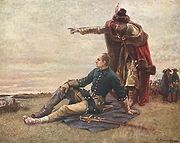
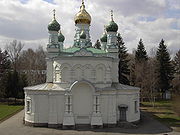 Almost the entire surviving Swedish army amounting to several thousands capitulated at Perevolochna
on 30 June 1709 (O.S.) / 1 July 1709 (Swedish calendar) / 11 July 1709 (N.S.). Prisoners were put to work building the new city of Saint Petersburg
. Charles and Mazepa were allowed to escape with about 1,500 men to Bendery, Moldavia, then controlled by the Ottoman Empire
. Charles spent five years in exile there before he was able to return to Sweden.
film Karl XII with Gösta Ekman
as king Charles XII and the Russian emigrant actor Nicolai de Seversky as Peter I. Recently the battle was also portrayed in the 2007 Russian
film The Sovereign's Servant
. The story of the battle, told from the point of view of a dying soldier, is related in the Al Stewart
song The Coldest Winter in Memory.
Peter I of Russia
Peter the Great, Peter I or Pyotr Alexeyevich Romanov Dates indicated by the letters "O.S." are Old Style. All other dates in this article are New Style. ruled the Tsardom of Russia and later the Russian Empire from until his death, jointly ruling before 1696 with his half-brother, Ivan V...
over the Swedish
Swedish Empire
The Swedish Empire refers to the Kingdom of Sweden between 1561 and 1721 . During this time, Sweden was one of the great European powers. In Swedish, the period is called Stormaktstiden, literally meaning "the Great Power Era"...
forces under Field Marshal
Field Marshal
Field Marshal is a military rank. Traditionally, it is the highest military rank in an army.-Etymology:The origin of the rank of field marshal dates to the early Middle Ages, originally meaning the keeper of the king's horses , from the time of the early Frankish kings.-Usage and hierarchical...
Carl Gustav Rehnskiöld
Carl Gustav Rehnskiöld
Count Carl Gustav Rehnskiöld was a Swedish Field Marshal under the command of King Charles XII of Sweden. Despite being choleric and irritable, Rehnskiöld's military skills made him the chief military advisor and second-in-command to King Charles and earned him the epithet the "Parmenio of the...
in one of the battles of the Great Northern War
Great Northern War
The Great Northern War was a conflict in which a coalition led by the Tsardom of Russia successfully contested the supremacy of the Swedish Empire in northern Central Europe and Eastern Europe. The initial leaders of the anti-Swedish alliance were Peter I the Great of Russia, Frederick IV of...
. It is widely believed to have been the beginning of Sweden's
Sweden
Sweden , officially the Kingdom of Sweden , is a Nordic country on the Scandinavian Peninsula in Northern Europe. Sweden borders with Norway and Finland and is connected to Denmark by a bridge-tunnel across the Öresund....
decline as a Great Power
Great power
A great power is a nation or state that has the ability to exert its influence on a global scale. Great powers characteristically possess military and economic strength and diplomatic and cultural influence which may cause small powers to consider the opinions of great powers before taking actions...
; the Russians took their place as the leading nation of northern Europe. This also meant the rise of Imperial Russia and a temporary end to the independence ambitions of Ukraine
Cossack Hetmanate
The Hetmanate or Zaporizhian Host was the Ruthenian Cossack state in the Central Ukraine between 1649 and 1782.The Hetmanate was founded by first Ukrainian hetman Bohdan Khmelnytsky during the Khmelnytsky Uprising . In 1654 it pledged its allegiance to Muscovy during the Council of Pereyaslav,...
.
Prelude
Charles XII led early Swedish victories at Copenhagen and at the Battle of NarvaBattle of Narva (1700)
The Battle of Narva on 19 November 1700 was an early battle in the Great Northern War. A Swedish relief army under Charles XII of Sweden defeated a Russian siege force three times its size. Before, Charles XII had forced Denmark-Norway to sign the Treaty of Travendal...
in 1700 when he knocked both Denmark-Norway and Russia
Russia
Russia or , officially known as both Russia and the Russian Federation , is a country in northern Eurasia. It is a federal semi-presidential republic, comprising 83 federal subjects...
temporarily out of the war. However, he was unable to bring the war to a conclusion, and it would take six years before he had dealt with the remaining combatant Augustus II
Augustus II the Strong
Frederick Augustus I or Augustus II the Strong was Elector of Saxony and King of Poland and Grand Duke of Lithuania ....
of Saxony
Saxony
The Free State of Saxony is a landlocked state of Germany, contingent with Brandenburg, Saxony Anhalt, Thuringia, Bavaria, the Czech Republic and Poland. It is the tenth-largest German state in area, with of Germany's sixteen states....
-Poland
Poland
Poland , officially the Republic of Poland , is a country in Central Europe bordered by Germany to the west; the Czech Republic and Slovakia to the south; Ukraine, Belarus and Lithuania to the east; and the Baltic Sea and Kaliningrad Oblast, a Russian exclave, to the north...
.
During this time Peter I of Russia rebuilt his army into modern form, basing it primarily on infantry trained to use linear tactics and modern firearms properly. He then achieved a stunning propaganda victory when he established the city of Saint Petersburg
Saint Petersburg
Saint Petersburg is a city and a federal subject of Russia located on the Neva River at the head of the Gulf of Finland on the Baltic Sea...
on Swedish territory, in Ingria
Ingria
Ingria is a historical region in the eastern Baltic, now part of Russia, comprising the southern bank of the river Neva, between the Gulf of Finland, the Narva River, Lake Peipus in the west, and Lake Ladoga and the western bank of the Volkhov river in the east...
.
In an attempt to finally end the war, Charles ordered a final attack
Charles XII invasion of Russia
The invasion of Russia by Charles XII of Sweden was a campaign undertaken during the Great Northern War between Sweden and the allied states of Russia, Poland, and Denmark...
on the Russian heartland with a possible assault on Moscow
Moscow
Moscow is the capital, the most populous city, and the most populous federal subject of Russia. The city is a major political, economic, cultural, scientific, religious, financial, educational, and transportation centre of Russia and the continent...
from his campaign base in Poland. The Swedish army of almost 44,000 men left Saxony
Saxony
The Free State of Saxony is a landlocked state of Germany, contingent with Brandenburg, Saxony Anhalt, Thuringia, Bavaria, the Czech Republic and Poland. It is the tenth-largest German state in area, with of Germany's sixteen states....
on 22 August 1707 and marched slowly eastwards. When they reached the Vistula River they waited for it to freeze and didn't cross until 30 December, then continued through a hostile Masuria
Masuria
Masuria is an area in northeastern Poland famous for its 2,000 lakes. Geographically, Masuria is part of two adjacent lakeland districts, the Masurian Lake District and the Iława Lake District...
and took Grodno
Hrodna
Grodno or Hrodna , is a city in Belarus. It is located on the Neman River , close to the borders of Poland and Lithuania . It has 327,540 inhabitants...
on 28 January 1708 after the Russians had left without a fight. At that time, the Russians had been dealing with a large rebellion of Don Cossacks
Don Cossacks
Don Cossacks were Cossacks who settled along the middle and lower Don.- Etymology and origins :The Don Cossack Host was a frontier military organization from the end of the 16th until the early 20th century....
, known as Bulavin Rebellion
Bulavin Rebellion
The Bulavin Rebellion ' is the name given to a violent civil uprising in Imperial Russia between the years 1707 and 1708. It takes its name from the Don Cossack Kondraty Bulavin who rose to its forefront as a sort of figurehead...
. The mutiny was contained in part by the forces of the Cossack Hetmanate
Cossack Hetmanate
The Hetmanate or Zaporizhian Host was the Ruthenian Cossack state in the Central Ukraine between 1649 and 1782.The Hetmanate was founded by first Ukrainian hetman Bohdan Khmelnytsky during the Khmelnytsky Uprising . In 1654 it pledged its allegiance to Muscovy during the Council of Pereyaslav,...
led by Hetman
Hetman
Hetman was the title of the second-highest military commander in 15th- to 18th-century Poland and the Grand Duchy of Lithuania, which together, from 1569 to 1795, comprised the Polish-Lithuanian Commonwealth, or Rzeczpospolita....
Ivan Mazepa
Ivan Mazepa
Ivan Stepanovych Mazepa , Cossack Hetman of the Hetmanate in Left-bank Ukraine, from 1687–1708. He was famous as a patron of the arts, and also played an important role in the Battle of Poltava where after learning of Peter I's intent to relieve him as acting Hetman of Ukraine and replace him...
. The Swedes continued to the area around Smorgon
Smarhoń
Smarhoń is a city in Hrodna Voblast, Belarus. It is located at . It was the site of Smarhoń air base, now mostly abandoned. Smarhoń is located 107 km from the capital, Minsk....
and Minsk
Minsk
- Ecological situation :The ecological situation is monitored by Republican Center of Radioactive and Environmental Control .During 2003–2008 the overall weight of contaminants increased from 186,000 to 247,400 tons. The change of gas as industrial fuel to mazut for financial reasons has worsened...
where the army went into winter quarters. Left in western Poland were 8,000 dragoons under major-general von Krassow.
The Swedish army, which had suffered badly from different epidemic diseases during the winter, left its quarters in early June 1708 and marched towards Smolensk
Smolensk
Smolensk is a city and the administrative center of Smolensk Oblast, Russia, located on the Dnieper River. Situated west-southwest of Moscow, this walled city was destroyed several times throughout its long history since it was on the invasion routes of both Napoleon and Hitler. Today, Smolensk...
. During the spring General Lewenhaupt
Adam Ludwig Lewenhaupt
Adam Ludwig Lewenhaupt was a Swedish general.-Biography:Educated at Lund University, Rostock, Wittenberg and Uppsala, he originally pursued a career in the diplomatic arena, but found this occupation quite undesirable. He then became a soldier, served in the Austrian army against the Turks, and...
in Courland
Courland
Courland is one of the historical and cultural regions of Latvia. The regions of Semigallia and Selonia are sometimes considered as part of Courland.- Geography and climate :...
had been ordered to gather supplies and march with his army of about 12,000 men to join Charles' army, although he didn't leave Mitau
Jelgava
-Sports:The city's main football team, FK Jelgava, plays in the Latvian Higher League and won the 2009/2010 Latvian Football Cup.- Notable people :*August Johann Gottfried Bielenstein - linguist, folklorist, ethnographer...
until late June and couldn't join Charles' forces until 11 October.
At one point they were only 130 kilometres apart, but Charles gave up because he needed supplies, and turned south into Ukraine
Ukraine
Ukraine is a country in Eastern Europe. It has an area of 603,628 km², making it the second largest contiguous country on the European continent, after Russia...
in search of grain and better weather. According to the Russian history the Ukrainian forces, under the command of Cossack hetman Ivan Mazepa
Ivan Mazepa
Ivan Stepanovych Mazepa , Cossack Hetman of the Hetmanate in Left-bank Ukraine, from 1687–1708. He was famous as a patron of the arts, and also played an important role in the Battle of Poltava where after learning of Peter I's intent to relieve him as acting Hetman of Ukraine and replace him...
, had been in discussions with Charles for some time, and at this point he, Mazepa, officially allied himself to the Swedes in order to gain independence from Russia. However there is no direct evidence or documentary proof of any preliminary negotiations between Mazepa and Charles. Mazepa, however, had sent most of his Cossacks to Belarus and Right-bank Ukraine to contain Polish forces, and Charles's decision to turn to Ukraine, according to Hrushevsky, was unexpected for Mazepa. His plans were that Charles's forces would move forward to Moscow and then he could create his own uprising in Ukraine.
As Charles forces were moving towards Ukraine, Peter sent his Moscow reserves to intercept them at Starodub
Starodub
Starodub is a town and the administrative center of Starodubsky District of Bryansk Oblast, Russia. It is located on the Babinets River , southwest of Bryansk. Population: 16,000 .-History:...
and asked Mazepa to supply some reinforcements. Lewenhaupt followed south and was attacked while crossing a river near a small village that gave name to the Battle of Lesnaya
Battle of Lesnaya
The Battle of Lesnaya , was one of the major battles of the Great Northern War. It took place on September 28, 1708 / September 29, 1708 / October 9, 1708 between a Russian army of 18,000 men commanded by the Princes Repnin and Menshikov, and a Swedish force of about 13,000 men, under the...
. His forces met the Russian attack, but they were amazed to find that the new Russian army gave them a serious fight. Lewenhaupt, seeing that he was about to lose, decided to rejoin Charles with all speed, so he abandoned the cannon, the cattle and most of the food, driving the soldiers to mutiny
Mutiny
Mutiny is a conspiracy among members of a group of similarly situated individuals to openly oppose, change or overthrow an authority to which they are subject...
. Stealing all of the alcohol, the soldiers became drunk, and Lewenhaupt was forced to leave about 1,000 men drunk in the woods. By the time they finally reached Charles and the main force in the winter, only 6,000 men without supplies remained. Mazepa was hesitant and gathered the Starshyna Council to decide the further course of actions. The council approved the negotiations with Charles. He left his last Cossack reserves in Baturyn
Baturyn
Baturyn , is a historic town in the Chernihiv Oblast of northern Ukraine. It is located in the Bakhmatskyi Raion of the oblast, on the banks of the Seym River...
and moved to Desna
Desna
-Towns and villages:* Dešná , a village in the South Bohemian Region of the Czech Republic * Dešná , a village in the Zlín Region of the Czech Republic...
river for negotiations with Charles. When Peter heard of that move he sent Aleksandr Menshikov to Baturyn and mercilessly razed the city. A series of repressions spread throughout the Cossack Hetmanate
Cossack Hetmanate
The Hetmanate or Zaporizhian Host was the Ruthenian Cossack state in the Central Ukraine between 1649 and 1782.The Hetmanate was founded by first Ukrainian hetman Bohdan Khmelnytsky during the Khmelnytsky Uprising . In 1654 it pledged its allegiance to Muscovy during the Council of Pereyaslav,...
along with claims that Mazepa had deserted to the Swedes in order to subjugate Ukraine to Poland, provide Unia
Union of Brest
Union of Brest or Union of Brześć refers to the 1595-1596 decision of the Church of Rus', the "Metropolia of Kiev-Halych and all Rus'", to break relations with the Patriarch of Constantinople and place themselves under the Pope of Rome. At the time, this church included most Ukrainians and...
, and root Orthodoxy
Orthodoxy
The word orthodox, from Greek orthos + doxa , is generally used to mean the adherence to accepted norms, more specifically to creeds, especially in religion...
out of Ukraine. Tsar decrees were sent to strashyna inviting them to Hlukhiv
Hlukhiv
Hlukhiv or Glukhov is a historic town in Sumy region of Ukraine, just south from the Russian border . As of 2001, the city's population is 35,800...
. In Hlukhiv Mazepa was figuratively dismissed as Hetman and replaced with the Starodub Colonel Ivan Skoropadsky
Ivan Skoropadsky
Ivan Skoropadsky was a Hetman of the Ukrainian Cossacks, and the successor to the famous Hetman Ivan Mazepa.- Biography:...
.
In the spring Charles resumed his advance, but his army had been reduced by about one-third due to starvation, frostbite and other effects of the weather. The wet weather had also seriously depleted the army's supplies of gunpowder; the cannon were also essentially out of action, due to a lack of usable ammunition. Charles's first action was to lay siege to the fort of Poltava
Poltava
Poltava is a city in located on the Vorskla River in central Ukraine. It is the administrative center of the Poltava Oblast , as well as the surrounding Poltava Raion of the oblast. Poltava's estimated population is 298,652 ....
on the Vorskla River in Ukraine. Peter had already organized a huge force to protect it, and he quickly arrived. On 27 June, Charles received information that large Kalmyk
Kalmyk people
Kalmyk people is the name given to the Oirats, western Mongols in Russia, whose descendants migrated from Dzhungaria in 1607. Today they form a majority in the autonomous Republic of Kalmykia on the western shore of the Caspian Sea. Kalmykia is Europe's only Buddhist government...
forces were going to join Peter and cut off all supplies to the Swedish Army. The Zaporizhian Host that was in opposition to Mazepa decided after some hesitation to side with Mazepa and Charles. Moscow forces with the help of the Cossack starshyna Halahan, who disclosed Mazepa's intentions, conducted a pre-emptive strike and destroyed the Sich
Sich
A sich is the administrative and military centre for Cossacks and especially the Zaporizhian Cossacks. It is derived from the Ukrainian word siktý, "to chop", meaning to clear a forest for an encampment, or to build a fortification with the trees that have been chopped down.The Zaporizhian Sich...
, thus denying any possible reinforcements to Swedish troops.
Battle
When the battle opened, Charles had about 14,000 men, while Peter commanded about 45,000. However, although Charles had faced great odds before, his expertise could not be brought forth during the actual battle, as he had been wounded during the siege on 17 June, when he was hit in the foot while taking part in a small engagement during an inspection of the Swedish outposts on the banks of the Vorskla. He had to turn over command to Field Marshal Carl Gustav RehnskiöldCarl Gustav Rehnskiöld
Count Carl Gustav Rehnskiöld was a Swedish Field Marshal under the command of King Charles XII of Sweden. Despite being choleric and irritable, Rehnskiöld's military skills made him the chief military advisor and second-in-command to King Charles and earned him the epithet the "Parmenio of the...
and General Adam Ludwig Lewenhaupt
Adam Ludwig Lewenhaupt
Adam Ludwig Lewenhaupt was a Swedish general.-Biography:Educated at Lund University, Rostock, Wittenberg and Uppsala, he originally pursued a career in the diplomatic arena, but found this occupation quite undesirable. He then became a soldier, served in the Austrian army against the Turks, and...
. This was made all the more unfortunate by the divergent personalities of the two generals. The change in command was not communicated to the subordinate commanders when the battle was planned. Also the Russians managed to weaken the Cossacks who had decided to join the Swedes against them. The Russian army occupied and destroyed the Zaporozhian Host with the help of Galagan, a former Cossack officer. The rest of the Cossacks moved their Host down the Dnieper River for the next 19 years.
The battle began before dawn at 3:45 a.m. on 28 June (Swedish calendar), with the Swedes advancing boldly against the Russian fortified lines just north of Poltava. At first, the battle started off in a traditional fashion, with the better trained Swedes pressing in on the Russians' redoubts, overrunning a few Russian defensive redoubts within the first 15 minutes. The Swedish seemed to possess an advantage, but this was quickly nullified. By dawn (at around 4:30 a.m.), the weather was unusually very hot and humid with the rising sun obscured by smoke from cannon and musket fire. The Swedish infantry, commanded by General Lewenhaupt, attempted to attack the Russians in their fortified camp just north of Poltava. But the Swedish advance soon faltered, partly because the infantry had been ordered to withdraw and reorganise. To make matters worse, one Swedish detachment, commanded by General Roos, had not been told about the overall plan and became isolated in the Russian defensive redoubts when a column of about 4,000 Russian reinforcements reoccupied the fortified positions, trapping Roos and his 2,600-man force at 6:15 a.m. With over 1,000 casualties and ammunition running low, Roos was forced to surrender his command at 9:30 a.m.
At 8:30 a.m. the bulk of the Swedish army moved north to attack the Russian fortified camp, but waited for Roos to return, unaware of his defeat. As time went by, the Russian infantry, led by Peter himself, moved out of its fortified camp and formed two battle lines facing the Swedes massing just west of their camp, supported by overhead cannon fire from its camp. At 9:45 a.m., Lewenhaupt ordered the Swedish line to move forward; 4,000 Swedish infantry against 20,000 Russian infantry. They advanced and the Russians opened fire on them with their cannons creating a firestorm of shells. When the Swedes were 100 meters from the Russian line, the Russians aimed and fired their muskets. When they were 30 meters from the Russian line, the Swedes fired one volley and charged with their musket and pikesmen, actually pushing the Russians back slowly towards their camp despite suffering heavy casualties. The Swedes were on the verge of a breakthrough and needed the cavalry of General Cruetz; unfortunately for the Swedes, it was disorganised. The Russian line was longer than the Swedish line, and the Russian right flank, led by Menshikov, soon flanked the Swedish infantry. Several Swede regiments were surrounded in a classic Cannae
Battle of Cannae
The Battle of Cannae was a major battle of the Second Punic War, which took place on August 2, 216 BC near the town of Cannae in Apulia in southeast Italy. The army of Carthage under Hannibal decisively defeated a numerically superior army of the Roman Republic under command of the consuls Lucius...
-style battle as Bauer's Russian cavalry swarmed around the Swedish army and attacked the Swedish rear guard. Cruetz and the cavalry tried to buy the infantry time to get away; several units attacked the Russians head on despite them forming into squares. By this stage, the Swedes had no organised bodies of troops to oppose the Russian infantry or cavalry. Small groups of foot soldiers managed to break through and escape to the south while most of the rest were overwhelmed and ridden down. Seeing the defeat of his army from a stretcher in the rear, Charles ordered the army to retreat at 11:00 a.m. By noon, the battle was over as Russian cavalry had mopped up the stragglers on the battlefield and returned to their own lines. Charles then gathered the remainder of his troops and baggage train, and retreated to the south later that same day, abandoning the siege of Poltava. Rehnskiöld was captured. Lewenhaupt led the surviving Swedes and some of the Cossack forces to the Dnieper River
Dnieper River
The Dnieper River is one of the major rivers of Europe that flows from Russia, through Belarus and Ukraine, to the Black Sea.The total length is and has a drainage basin of .The river is noted for its dams and hydroelectric stations...
, but was doggedly pursued by the Russian regular cavalry and 3,000 Kalmyks and forced to surrender three days later at Perevolochna
Surrender at Perevolochna
The surrender at Perevolochna was the capitulation of almost the entire Swedish army on June 30, 1709 / July 1, 1709 / July 11, 1709...
, on 1 July.
Aftermath
Surrender at Perevolochna
The surrender at Perevolochna was the capitulation of almost the entire Swedish army on June 30, 1709 / July 1, 1709 / July 11, 1709...
on 30 June 1709 (O.S.) / 1 July 1709 (Swedish calendar) / 11 July 1709 (N.S.). Prisoners were put to work building the new city of Saint Petersburg
Saint Petersburg
Saint Petersburg is a city and a federal subject of Russia located on the Neva River at the head of the Gulf of Finland on the Baltic Sea...
. Charles and Mazepa were allowed to escape with about 1,500 men to Bendery, Moldavia, then controlled by the Ottoman Empire
Ottoman Empire
The Ottoman EmpireIt was usually referred to as the "Ottoman Empire", the "Turkish Empire", the "Ottoman Caliphate" or more commonly "Turkey" by its contemporaries...
. Charles spent five years in exile there before he was able to return to Sweden.
Popular culture
The battle was portrayed in the monumental 1925 SwedishSweden
Sweden , officially the Kingdom of Sweden , is a Nordic country on the Scandinavian Peninsula in Northern Europe. Sweden borders with Norway and Finland and is connected to Denmark by a bridge-tunnel across the Öresund....
film Karl XII with Gösta Ekman
Gösta Ekman (senior)
Gösta Ekman, Sr. , born Frans Gösta Viktor Ekman, was a Swedish actor. Generally spoken of as Swedish theatre's most legendary stage actor, Gösta Ekman enjoyed a prolific stage career during his short life, becoming the first real star of Swedish theatre...
as king Charles XII and the Russian emigrant actor Nicolai de Seversky as Peter I. Recently the battle was also portrayed in the 2007 Russian
Russians
The Russian people are an East Slavic ethnic group native to Russia, speaking the Russian language and primarily living in Russia and neighboring countries....
film The Sovereign's Servant
The Sovereign's Servant
The Sovereign's Servant , is a 2007 Russian war film, depicting the Great Northern War, and particularly events focusing around the Battle of Poltava.-Criticism:...
. The story of the battle, told from the point of view of a dying soldier, is related in the Al Stewart
Al Stewart
Al Stewart is a Scottish singer-songwriter and folk-rock musician.Stewart came to stardom as part of the British folk revival in the 1960s and 1970s, and developed his own unique style of combining folk-rock songs with delicately woven tales of the great characters and events from history.He is...
song The Coldest Winter in Memory.
External links
- Sequel to Poltava: Diplomacy to contain Russia 1709-1714 By Bertil Haggman
- Battle of Poltava on the Encyclopedia of Ukraine
- Russian Order at Battle
- Swedish Order at Battle
- Battle of Poltava animated battle map by Jonathan Webb