
All Topics  
Arabian Peninsula

 
Arabian Peninsula

   Email Print
   Bookmark   Link


Arabian Peninsula


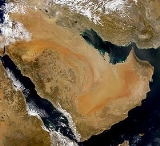
The Arabian Peninsula (in Arabic
Arabic language

Arabic is a Central Semitic language, thus related to and classified alongside other Semitic languages languages such as Hebrew language and Aramaic language....
: ??? ??????? ??????? šibh al-jazira al-arabiya or ????? ????? jazirat al-arab), Arabia, Arabistan, and the Arabian subcontinent is a peninsula
Peninsula

A peninsula is a piece of Landform that is nearly surrounded by water but connected to mainland via an isthmus. Word origin: Latin paeninsula : paene, almost + insula, island....
 in Southwest Asia
Southwest Asia

Southwest Asia or Southwestern Asia is the southwestern subregion of Asia. The term West Asia is sometimes used in the United Nations subregion geoscheme and in writings about the archeology and the late prehistory of the region....
 at the junction of Africa
Africa

Africa is the world's second-largest and second most-populous continent, after Asia. At about 30.2 million km? including adjacent islands, it covers 6% of the Earth's total surface area and 20.4% of the total land area....
 and Asia
Asia

Asia is the world's largest and most populous continent. It covers 8.6% of the Earth's total surface area and, with over 4 billion people, it contains more than 60% of the world's current human population....
. The area is an important part of the Middle East
Middle East

File:GreaterMiddleEast1.pngThe Middle East is a region that spans southwestern Asia, western Asia, and northeastern Africa. It has no clear boundaries, often used as a synonym to Near East, in opposition to Far East....
 and plays a critically important geopolitical
Geopolitics

Geopolitics is the art and practice of using international political power. Traditionally, the term has applied primarily to the impact of geography on politics, but its usage has evolved over the past century to encompass a wider connotation....
 role because of its vast reserves of oil
Petroleum

Petroleum or crude oil is a naturally occurring, flammable liquid found in rock formations in the Earth consisting of a complex mixture of hydrocarbons of various molecular weights, plus other organic compounds....
 and natural gas
Natural gas

Natural gas is a gas consisting primarily of methane. It is found associated with fossil fuels, in coal beds, as methane clathrates, and is created by methanogenic organisms in marshes, bogs, and landfills....
.

peninsula and the Syrian Desert
Syrian Desert

The Syrian Desert , also known as the Syro-Arabian desert is a combination of steppe and true desert that is located in the northern Arabian Peninsula....
 have no clear line of demarcation, but the commonly accepted boundary is the northern border of Saudi Arabia and Kuwait..


Discussion
Ask a question about 'Arabian Peninsula'
Start a new discussion about 'Arabian Peninsula'
Answer questions from other users
Full Discussion Forum


Recent Posts


Encyclopedia


The Arabian Peninsula (in Arabic
Arabic language

Arabic is a Central Semitic language, thus related to and classified alongside other Semitic languages languages such as Hebrew language and Aramaic language....
: ??? ??????? ??????? šibh al-jazira al-arabiya or ????? ????? jazirat al-arab), Arabia, Arabistan, and the Arabian subcontinent is a peninsula
Peninsula

A peninsula is a piece of Landform that is nearly surrounded by water but connected to mainland via an isthmus. Word origin: Latin paeninsula : paene, almost + insula, island....
 in Southwest Asia
Southwest Asia

Southwest Asia or Southwestern Asia is the southwestern subregion of Asia. The term West Asia is sometimes used in the United Nations subregion geoscheme and in writings about the archeology and the late prehistory of the region....
 at the junction of Africa
Africa

Africa is the world's second-largest and second most-populous continent, after Asia. At about 30.2 million km? including adjacent islands, it covers 6% of the Earth's total surface area and 20.4% of the total land area....
 and Asia
Asia

Asia is the world's largest and most populous continent. It covers 8.6% of the Earth's total surface area and, with over 4 billion people, it contains more than 60% of the world's current human population....
. The area is an important part of the Middle East
Middle East

File:GreaterMiddleEast1.pngThe Middle East is a region that spans southwestern Asia, western Asia, and northeastern Africa. It has no clear boundaries, often used as a synonym to Near East, in opposition to Far East....
 and plays a critically important geopolitical
Geopolitics

Geopolitics is the art and practice of using international political power. Traditionally, the term has applied primarily to the impact of geography on politics, but its usage has evolved over the past century to encompass a wider connotation....
 role because of its vast reserves of oil
Petroleum

Petroleum or crude oil is a naturally occurring, flammable liquid found in rock formations in the Earth consisting of a complex mixture of hydrocarbons of various molecular weights, plus other organic compounds....
 and natural gas
Natural gas

Natural gas is a gas consisting primarily of methane. It is found associated with fossil fuels, in coal beds, as methane clathrates, and is created by methanogenic organisms in marshes, bogs, and landfills....
.

Geography


The coasts of the peninsula are, on the west the Red Sea
Red Sea

The Red Sea is a salt water inlet of the Indian Ocean between Africa and Asia. The connection to the ocean is in the south through the Bab el Mandeb sound and the Gulf of Aden....
 and the Gulf of Aqaba
Gulf of Aqaba

The Gulf of Aqaba , in Israel known as the Gulf of Eilat is a large Headlands and bays of the Red Sea. It is located to the east of the Sinai peninsula and west of the Arabian peninsula....
, on the southeast the Arabian Sea
Arabian Sea

The Arabian Sea is a region of the Indian Ocean bounded on the east by India, on the north by Pakistan and Iran, on the west by Arabian Peninsula, on the south, approximately, by a line between Cape Guardafui, the north-east point of Somalia, Socotra, Kanyakumari in India, and the western coast of Sri Lanka....
 (part of the Indian Ocean
Indian Ocean

The Indian Ocean is the third largest of the world's oceanic divisions, covering about 20% of the water on the Earth's surface. It is bounded on the north by Asia ; on the west by Africa; on the east by Indochina, the Sunda Islands, and Australia; and on the south by the Southern Ocean ....
), and on the northeast, the Gulf of Oman
Gulf of Oman

The Gulf of Oman or Sea of Oman , or Gulf of Makran , is a strait that connects the Arabian Sea with the Strait of Hormuz, which then runs to the Persian Gulf....
, the Strait of Hormuz
Strait of Hormuz

The Strait of Hormuz is a narrow, strategically important waterway between the Gulf of Oman in the southeast and the Persian Gulf in the southwest....
, and the Persian Gulf
Persian Gulf

The Persian Gulf, in the Southwest Asian region, is an extension of the Indian Ocean located between Iran and the Arabian Peninsula. Historically and commonly known as the Persian Gulf, this body of water is sometimes Persian Gulf naming dispute referred to as the Arabian Gulf by certain Arab countries or simply The Gulf, although nei...
. The peninsula and the Syrian Desert
Syrian Desert

The Syrian Desert , also known as the Syro-Arabian desert is a combination of steppe and true desert that is located in the northern Arabian Peninsula....
 have no clear line of demarcation, but the commonly accepted boundary is the northern border of Saudi Arabia and Kuwait.. The most prominent feature of the peninsula is desert, but in the southwest there are mountain ranges which receive greater rainfall than the rest of the Arabian Peninsula.

The peninsula's constituent countries are Bahrain
Bahrain

The Kingdom of Bahrain, in , , literally Kingdom of the Two Seas).Bahrain is an Arabic island country in the Persian Gulf ruled by the Al Khalifa regime....
, Kuwait
Kuwait

The State of Kuwait is a sovereign Arab emirate on the coast of the Persian Gulf, enclosed by Saudi Arabia to the south and Iraq to the north and west....
, Oman
Oman

Oman , officially the Sultanate of Oman , is an Arab country in southwest Asia on the southeast coast of the Arabian Peninsula. It borders the United Arab Emirates on the northwest, Saudi Arabia on the west and Yemen on the southwest....
, Qatar
Qatar

Qatar , officially the State of Qatar , is an Arab emirate in Southwest Asia, occupying the small Qatar Peninsula on the northeasterly coast of the larger Arabian Peninsula....
, the United Arab Emirates
United Arab Emirates

The United Arab Emirates is a federation of seven states situated in the southeast of the Arabian Peninsula in Southwest Asia on the Persian Gulf, bordering Oman and Saudi Arabia....
, Yemen
Yemen

Yemen , officially the Republic of Yemen is an Arab country located on the Arabian Peninsula in Southwest Asia. Yemen has an estimated population of more than 23 million people and is bordered by Saudi Arabia to the North, the Red Sea to the West, the Arabian Sea and Gulf of Aden to the South, and Oman to the east....
 and Saudi Arabia
Saudi Arabia

The Kingdom of Saudi Arabia, KSA , is an Arab country and the largest country of the Arabian Peninsula. It is bordered by Jordan on the northwest, Iraq on the north and northeast, Kuwait, Qatar, Bahrain, and the United Arab Emirates on the east, Oman on the southeast, and Yemen on the south....
. The northern part of the peninsula is the Syrian Desert
Syrian Desert

The Syrian Desert , also known as the Syro-Arabian desert is a combination of steppe and true desert that is located in the northern Arabian Peninsula....
, which also includes northeastern Jordan
Jordan

Jordan , officially the Hashemite Kingdom of Jordan, is an Arab country in Southwest Asia spanning the southern part of the Syrian Desert down to the Gulf of Aqaba....
, southeastern Syria
Syria

Syria , officially the Syrian Arab Republic , is an Arab-majority country in Southwest Asia, bordering Lebanon and the Mediterranean Sea to the west, Israel to the southwest, Jordan to the south, Iraq to the east, and Turkey to the north....
, and western Iraq
Iraq

Iraq , officially the Republic of Iraq , is a country in Western Asia spanning most of the northwestern end of the Zagros Mountains, the eastern part of the Syrian Desert and the northern part of the Arabian Desert....
. Some usage includes the entire subcontinent
Subcontinent

A subcontinent is a large, relatively self-contained landmass forming a subdivision of a continent.The phrase the Subcontinent, used on its own in English, commonly means the Indian subcontinent, i.e....
 of Arabia.

Six countries of the list above, excluding Yemen, form the Gulf Cooperation Council (GCC), mainly known as the Arab gulf states. The Kingdom of Saudi Arabia covers the greater part of the peninsula. The majority of the population of the peninsula live in Saudi Arabia
Saudi Arabia

The Kingdom of Saudi Arabia, KSA , is an Arab country and the largest country of the Arabian Peninsula. It is bordered by Jordan on the northwest, Iraq on the north and northeast, Kuwait, Qatar, Bahrain, and the United Arab Emirates on the east, Oman on the southeast, and Yemen on the south....
 and in Yemen
Yemen

Yemen , officially the Republic of Yemen is an Arab country located on the Arabian Peninsula in Southwest Asia. Yemen has an estimated population of more than 23 million people and is bordered by Saudi Arabia to the North, the Red Sea to the West, the Arabian Sea and Gulf of Aden to the South, and Oman to the east....
. The peninsula contains the world's largest reserves of oil
Petroleum

Petroleum or crude oil is a naturally occurring, flammable liquid found in rock formations in the Earth consisting of a complex mixture of hydrocarbons of various molecular weights, plus other organic compounds....
. It is home to the Islam
Islam

Islam is a Monotheism, Abrahamic religion originating with the teachings of the Prophets of Islam Muhammad, a 7th century Arab religious and political figure....
ic holy cities of Mecca
Mecca

Mecca , also spelled Makkah , Makka is a city in Saudi Arabia. Home to the Masjid al-Haram, it is the holy city in Islam and plays an important role in the faith....
 and Medina
Medina

Medina is a city in the Hejaz region of western Saudi Arabia, and serves as the capital of the Al Madinah Province. It is the second holiest city in Islam, and the burial place of the Prophet Muhammad....
, both of which are in Saudi Arabia. The UAE and Saudi Arabia
Saudi Arabia

The Kingdom of Saudi Arabia, KSA , is an Arab country and the largest country of the Arabian Peninsula. It is bordered by Jordan on the northwest, Iraq on the north and northeast, Kuwait, Qatar, Bahrain, and the United Arab Emirates on the east, Oman on the southeast, and Yemen on the south....
 are economically the wealthiest in the region. Qatar
Qatar

Qatar , officially the State of Qatar , is an Arab emirate in Southwest Asia, occupying the small Qatar Peninsula on the northeasterly coast of the larger Arabian Peninsula....
, a small peninsula in the Persian Gulf on the larger peninsula, is home of the famous Arabic-language
Arabic language

Arabic is a Central Semitic language, thus related to and classified alongside other Semitic languages languages such as Hebrew language and Aramaic language....
 television station Al Jazeera
Al Jazeera

Al Jazeera , which usually means "The Island" in Arabic language but more commonly known in Gulf Arabic as "The Peninsula" ? referring to the Qatar Peninsula in the Persian Gulf region, is a television network headquartered in Doha, Qatar....
 and its English-language subsidiary Al Jazeera English. Kuwait
Kuwait

The State of Kuwait is a sovereign Arab emirate on the coast of the Persian Gulf, enclosed by Saudi Arabia to the south and Iraq to the north and west....
, on the border with Iraq
Iraq

Iraq , officially the Republic of Iraq , is a country in Western Asia spanning most of the northwestern end of the Zagros Mountains, the eastern part of the Syrian Desert and the northern part of the Arabian Desert....
, was claimed as an Iraqi province and invaded by Saddam Hussein
Saddam Hussein

Saddam Hussein Abd al-Majid al-Tikriti was the President of Iraq of Iraq from 16 July 1979 until 9 April 2003.A leading member of the revolutionary Ba'ath Party, which espoused secular pan-Arabism, economic modernization, and Arab socialism, Saddam played a key role in the 1968 coup that brought the party to long-term power....
 during the first Persian Gulf War
Gulf War

"Persian Gulf War" and "First Gulf War" redirect here. For other uses, see Persian Gulf War .The Persian Gulf War was a United Nations-authorized military conflict between Iraq and a Coalition of Gulf War from 34 nations commissioned with expelling Iraqi forces from Kuwait after Iraq's Invasion of Kuwait of Kuwait in August 1990....
; it is an important country strategically, forming one of the main staging grounds for coalition forces mounting the invasion of Iraq in 2003.

Population

As of 2008, the estimated population of the Arabian Peninsula is 77,983,936.. In the Gulf states there are many residents who are non-nationals: in Saudi Arabia
Saudi Arabia

The Kingdom of Saudi Arabia, KSA , is an Arab country and the largest country of the Arabian Peninsula. It is bordered by Jordan on the northwest, Iraq on the north and northeast, Kuwait, Qatar, Bahrain, and the United Arab Emirates on the east, Oman on the southeast, and Yemen on the south....
 it is 20% and in the United Arab Emirates
United Arab Emirates

The United Arab Emirates is a federation of seven states situated in the southeast of the Arabian Peninsula in Southwest Asia on the Persian Gulf, bordering Oman and Saudi Arabia....
 it is 75%.

Landscape

Geologically, this region is perhaps more appropriately called the Arabian subcontinent because it lies on a tectonic plate
Tectonic Plate

#REDIRECT Plate tectonics...
 of its own, the Arabian Plate
Arabian Plate

The Arabian Plate is one of three tectonic plates which have been moving northward over millions of years toward an inevitable collision with Eurasia....
, which has been moving incrementally away from northeast Africa
Africa

Africa is the world's second-largest and second most-populous continent, after Asia. At about 30.2 million km? including adjacent islands, it covers 6% of the Earth's total surface area and 20.4% of the total land area....
 (forming the Red Sea
Red Sea

The Red Sea is a salt water inlet of the Indian Ocean between Africa and Asia. The connection to the ocean is in the south through the Bab el Mandeb sound and the Gulf of Aden....
) and north into the Eurasian plate
Eurasian Plate

The Eurasian Plate is a tectonic plate which includes most of the continent of Eurasia , with the notable exceptions of the Indian subcontinent, the Arabian subcontinent, and the area east of the Chersky Range in East Siberia....
 (forming the Zagros mountains
Zagros Mountains

The Zagros , are the largest mountain range in Iran and Iraq. They have a total length of 1 500 km from western Iran, on the border with Iraq to the southern parts of the Persian Gulf....
). The rocks exposed vary systematically across Arabia, with the oldest rocks exposed in the Arabian-Nubian Shield
Arabian-Nubian Shield

The Arabian-Nubian Shield is an exposure of Precambrian crystalline rocks on the flanks of the Red Sea. The crystalline rocks are mostly Neoproterozoic in age....
 near the Red Sea, overlain by earlier sediments that become younger towards the Persian Gulf. Perhaps the best-preserved ophiolite on Earth, Semail ophiolite, lies exposed in the mountains of the UAE and northern Oman.

The peninsula consists of:
  1. a central plateau, known as Nejd, with fertile valleys and pastures used for the grazing of sheep
    Sheep

    #REDIRECT Domestic sheep...
     and other livestock.
  2. a range of deserts, the Nefud
    Nefud

    Al-Nefud or The Nefud is a desert in the northern part of the Arabian Peninsula, occupying a great oval depression. It is 180 miles long and 140 miles wide, with an area of 40,000 square miles ....
     in the north, stony; the Rub' Al-Khali or Great Arabian Desert, in the south, with sand estimated to extend 600 ft. below the surface; and between them, the Dahna.
  3. stretches of dry or marshy coastland with coral reefs on the Red Sea
    Red Sea

    The Red Sea is a salt water inlet of the Indian Ocean between Africa and Asia. The connection to the ocean is in the south through the Bab el Mandeb sound and the Gulf of Aden....
     side (Tihamah
    Tihamah

    Tihamah or Tihama is a narrow coastal region of Arabia on the Red Sea. It is currently divided between Saudi Arabia and Yemen. In a broad sense, Tihamah refers to the entire coastline from the Gulf of Aqaba to the Bab el Mandeb Strait but it more often refers only to its southern half, starting just south of Jeddah and running paral...
    ).
  4. ranges of mountains, primarily paralleling the Red Sea
    Red Sea

    The Red Sea is a salt water inlet of the Indian Ocean between Africa and Asia. The connection to the ocean is in the south through the Bab el Mandeb sound and the Gulf of Aden....
     on the western (e.g. Asir province) and southeastern end (Oman). The highest, Jabal Al-Nabi Sho'aib in Yemen, is 3666 m high.


Arabia has few lakes or permanent rivers. Most are drained by ephemeral watercourses called wadi
Wadi

Wadi is the Arabic term traditionally referring to a valley; in some cases it may refer to a dry Stream bed that contains water only during times of heavy rain....
s, which are dry except during the rainy season. Plentiful ancient aquifers exist beneath much of the peninsula, however, and where this water surfaces, oases form (e.g. Al-Hasa
Al-Hasa

Al-Ahsa is the largest Governorates of Saudi Arabia in Saudi Arabia's Eastern Province, Saudi Arabia, named after Al-Hasa. The name Al-Ahsa is also given to the biggest city in the region, Hofuf....
 and Qatif
Qatif

Qatif or Al-Qatif is a historic, coastal oasis region located on the western shore of the Persian Gulf in the Eastern Province, Saudi Arabia of Saudi Arabia....
, two of the worlds largest oases) and permit agriculture, especially palm trees, which allowed the peninsula to produce more dates
Date Palm

Phoenix dactylifera, commonly known as the Date Palm, is a Arecaceae in the genus Phoenix , extensively cultivated for its edible sweet fruit....
 than any other region in the world. The climate being extremely hot and arid
Désert

?D?sert? is ?milie Simon's debut single, released in October 2002. The song was a huge success both critically and commercially in her homeland....
, the peninsula has no forests, although desert-adapted wildlife is present throughout the region.

A plateau more than 2,500 feet high extends across much of the Arabian Peninsula. The plateau slopes eastwards from the massive, rifted escarpment along the coast of the Red Sea, to the shallow waters of The Gulf. The interior is characterised by cuestas and valleys, drained by a system of wadis. A crescent of sand and gravel
Gravel

Gravel is rock that is of a specific particle size range. Specifically, it is is any loose rock that is larger than two millimeters in its largest dimension and no more than 64 millimeters ....
 deserts lies to the east.

Land and sea

Most of the Arabian Peninsula is unsuited to settled agriculture, making irrigation and land reclamation projects essential. The narrow coastal plain and isolated oases, amounting to less than 1% of the land area, are used to cultivate grains, coffee and exotic fruits. Goats, sheep, and camels are widespread throughout the region.

The fertile soils of Yemen have encouraged settlement of almost all of the land from sea level up to the mountains at 10,000 feet. In the higher reaches elaborate terraces have been constructed to facilitate crop cultivation.

History of the term


The Romans
Ancient Rome

Ancient Rome was a civilization that grew out of a small agricultural community founded on the Italian Peninsula as early as the 10th century BC....
 named three regions with the prefix "arabia", encompassing a larger area than the current term "Arabian Peninsula":
  • Arabia Petraea
    Arabia Petraea

    For the Achaemenid satrapy of Arabia, see Arabia Arabia Petraea, also called Provincia Arabia or simply Arabia, was a frontier Roman province of the Roman Empire beginning in the second century; it consisted of the former Nabataean kingdom in modern Jordan, southern modern Syria, the Sinai Peninsula and northwestern Saud...
    : for the area that is today southern modern Syria
    Syria

    Syria , officially the Syrian Arab Republic , is an Arab-majority country in Southwest Asia, bordering Lebanon and the Mediterranean Sea to the west, Israel to the southwest, Jordan to the south, Iraq to the east, and Turkey to the north....
    , Jordan
    Jordan

    Jordan , officially the Hashemite Kingdom of Jordan, is an Arab country in Southwest Asia spanning the southern part of the Syrian Desert down to the Gulf of Aqaba....
    , the Sinai Peninsula
    Sinai Peninsula

    The Sinai Peninsula or Sinai is a triangular peninsula in Egypt. It lies between the Mediterranean Sea to the north and the Red Sea to the south, forming a land bridge between Africa and Southwest Asia....
     and northwestern Saudi Arabia
    Saudi Arabia

    The Kingdom of Saudi Arabia, KSA , is an Arab country and the largest country of the Arabian Peninsula. It is bordered by Jordan on the northwest, Iraq on the north and northeast, Kuwait, Qatar, Bahrain, and the United Arab Emirates on the east, Oman on the southeast, and Yemen on the south....
    . It was the only one that became a province
    Roman province

    In Ancient Rome, a province was the basic, and until the Tetrarchy , largest territorial and administrative unit of the empire's territorial possessions outside of the Italia ....
     with Petra
    Petra

    Petra is an Archaeology site in the Arabah, Ma'an Governorate, Jordan, lying on the slope of Mount Hor in a Depression among the mountains which form the eastern flank of Arabah , the large valley running from the Dead Sea to the Gulf of Aqaba....
     as its capital.
  • Arabia Deserta
    Arabia Deserta

    Arabia Deserta in Latin signified the desert interior of the Arabian peninsula. In ancient times, this land was populated by nomadic tribes who frequently invaded richer lands, such as Mesopotamia and Arabia Felix....
     ("Desert Arabia"): signified the desert
    Désert

    ?D?sert? is ?milie Simon's debut single, released in October 2002. The song was a huge success both critically and commercially in her homeland....
     interior of the Arabian peninsula. As a name for the region, it remained popular into the 19th and 20th centuries, and was used in Charles M. Doughty's Travels in Arabia Deserta
    Travels in Arabia Deserta

    Travels in Arabia Deserta was written by Charles Montagu Doughty who was an England poet, writer, and traveller....
     (1888).
  • Arabia Felix ("Happy Arabia"): was used by geographers to describe what is now modern-day Yemen
    Yemen

    Yemen , officially the Republic of Yemen is an Arab country located on the Arabian Peninsula in Southwest Asia. Yemen has an estimated population of more than 23 million people and is bordered by Saudi Arabia to the North, the Red Sea to the West, the Arabian Sea and Gulf of Aden to the South, and Oman to the east....
    , which enjoys more rainfall, is much greener than the rest of the peninsula and has long enjoyed much more productive fields.


The Arab inhabitants used a north-south division of Arabia: Al Sham-Al Yaman, or Arabia Deserta-Arabia Felix. Arabia Felix had originally been used for the whole peninsula, and at other times only for the southern region. Because its use became limited to the south, the whole peninsula was simply called Arabia. Arabia Deserta was the entire desert region extending north from Arabia Felix to Palmyra and the Euphrates, including all the area between Pelusium on the Nile and Babylon. This area was also called Arabia and not sharply distinguished from the peninsula..

The Arabs and the Ottoman Empire considered the entire region where the Arabs lived 'the land of the Arabs' - bilad al-Arab (Arabia or Arabistan). The Ottomans used the term Arabistan in a broad sense for the subcontinent itself starting from Cilicia
Cilicia

In antiquity, Cilicia now known as ?ukurova, was a commonly used name of the south coastal region of the Anatolian peninsula, and a political entity in Roman times....
, where the Euphrates river makes its descent into Syria
Syria

Syria , officially the Syrian Arab Republic , is an Arab-majority country in Southwest Asia, bordering Lebanon and the Mediterranean Sea to the west, Israel to the southwest, Jordan to the south, Iraq to the east, and Turkey to the north....
, through Palestine
Palestine

Palestine is a name which has been widely used since Roman times to refer to the region between the Mediterranean Sea and the Jordan River. It is derived from a name used already much earlier for a narrower geographical region, mainly along the coastal region....
, and on through the remainder of the Sinai and Arabian peninsulas.

The provinces of Arabia were: Al Tih, the Sinai peninsula, Hedjaz, Asir, Yemen, Hadramaut, Mahra and Shilu, Oman, Hasa, Bahrian, Dahna, Nejd, Nufud, the Hammad, which included the deserts of Syria, Mesopotamia and Babylonia.

Ancient history

Until comparatively recent times knowledge of the Arabian Peninsula was limited to that provided by ancient Greek and Roman writers and by early Arab geographers; much of this material was unreliable. In the 20th century, however, archaeological exploration has added considerably to the knowledge of the area.

In his book, 'The Real Eve', Oppenheimer
Stephen Oppenheimer

Stephen Oppenheimer , a British physician, a member of Green College, Oxford and an honorary fellow of Liverpool School of Tropical Medicine, carries out and publishes research in the field of genetics....
 claims based on mitochondrial evidence in conjunction with the contemporary environment (ie glaciation, sea levels) corresponding to these molecular clock
Molecular clock

The molecular clock is a technique in molecular evolution to relate the time that two species speciation to the number of molecular differences measured between the species' DNA sequences or proteins....
 timelines that the first humans to leave Africa crossed the virtually dry mouth of the Red Sea onto the Arabian peninsula. They travelled along the coastline of the peninsula before crossing into Southern Asia.

Sanaa
The peninsula is one of the possible original homelands of the Proto-Semitic language
Proto-Semitic language

Proto-Semitic is the hypothetical proto-language of the Semitic languages. The earliest attestations of a Semitic language are in Akkadian language, dating to ca....
 ancestors of all the Semitic
Semitic languages

File:Amarna Akkadian letter.pngThe Semitic languages are a group of related languages whose living representatives are spoken by more than 467 million people across much of the Middle East, North Africa and the Horn of Africa....
-speaking peoples in the region — the Akkadians, Arabs, Assyrians
Assyrian people

The Assyrian/Chaldean/Syriac people are an ethnic group whose origins lie in the Fertile Crescent, their Assyrian/Syriac homeland today being divided between Northern Iraq, Syria, Western Iran, and Turkey's Southeastern Anatolia....
, Babylonia
Babylonia

Babylonia was a state in Lower Mesopotamia , Babylon as its franklin. Babylonia emerged when Hammurabi created an empire out of the territories of the former kingdoms of Sumer and Akkad....
ns, Hebrews
Hebrews

Hebrews are an ancient people defined as descendants of biblical Patriarch Abraham , a descendent of Noah.In the Bible, the patriarch Abraham is referred to a single time as the ivri, which is the singular form of the Hebrew-language word for Hebrew ....
, etc. Linguistically, the peninsula was the cradle of the Arabic language
Arabic language

Arabic is a Central Semitic language, thus related to and classified alongside other Semitic languages languages such as Hebrew language and Aramaic language....
 (spread beyond the peninsula with the Islamic religion during the expansion of Islam
Islam

Islam is a Monotheism, Abrahamic religion originating with the teachings of the Prophets of Islam Muhammad, a 7th century Arab religious and political figure....
 beginning in the 7th century AD) and still maintains tiny populations of speakers of Semitic
Semitic

In linguistics and ethnology, Semitic was first used to refer to a language family of largely Middle Eastern origin, now called the Semitic languages....
 languages such as Mehri and Shehri, remnants of the language family that was spoken in earlier historical periods to the East of the kingdoms of Sheba
Sheba

Sheba was a southern kingdom mentioned in the Tanakh and the Qur'an. The actual location of the historical kingdom is disputed between southern Arabia and the Horn of Africa; the kingdom may have been situated in either present-day Ethiopia or present-day Yemen, or both....
 and Hadramout which flourished in the southern part of the peninsula (modern-day Yemen
Yemen

Yemen , officially the Republic of Yemen is an Arab country located on the Arabian Peninsula in Southwest Asia. Yemen has an estimated population of more than 23 million people and is bordered by Saudi Arabia to the North, the Red Sea to the West, the Arabian Sea and Gulf of Aden to the South, and Oman to the east....
 and Oman
Oman

Oman , officially the Sultanate of Oman , is an Arab country in southwest Asia on the southeast coast of the Arabian Peninsula. It borders the United Arab Emirates on the northwest, Saudi Arabia on the west and Yemen on the southwest....
). Bernard Lewis
Bernard Lewis

Bernard Lewis is a British-American historian, Orientalist, and pundit . He is the Cleveland E. Dodge Emeritus of Near Eastern Studies at Princeton University....
 mentions in his book The Arabs in History
The Arabs in History

The Arabs in History is a non-scholarly book authored by Middle-east historian Bernard Lewis, published in 1950. The book was well-received by the general public owing in part to its accessibility to non-historians....
:
"According to this, Arabia was originally a land of great fertility and the first home of the Semitic peoples. Through the millennia it has been undergoing a process of steady desiccation, a drying up of wealth and waterways and a spread of the desert at the expense of the cultivable land. The declining productivity of the peninsula, together with the increase in the number of the inhabitants, led to a series of crises of overpopulation and consequently to a recurring cycle of invasions of the neighbouring countries by the Semitic peoples of the peninsula. It was these crises that carried the Assyrians, Aramaeans, Canaanites (including the Phoenicians and Hebrews), and finally the Arabs themselves into the Fertile Crescent."


The better-watered, higher portions of the extreme south-west portion of the Arabian Peninsula supported three early kingdoms. The first, the Minaean, was centered in the interior of what is now Yemen, but probably embraced most of southern Arabia. Although dating is difficult, it is generally believed that the Minaean Kingdom existed from 1200 to 650 BC The second kingdom, the Sabaean (see Sheba
Sheba

Sheba was a southern kingdom mentioned in the Tanakh and the Qur'an. The actual location of the historical kingdom is disputed between southern Arabia and the Horn of Africa; the kingdom may have been situated in either present-day Ethiopia or present-day Yemen, or both....
), was founded around 930 BC and lasted until around 115 BC; it probably supplanted the Minaean Kingdom and occupied substantially the same territory. The Sabaean capital and chief city, Ma’rib, probably flourished as did no other city of ancient Arabia, partly because of its controlling position on the caravan routes linking the seaports of the Mediterranean with the frankincense-growing region of the Hadhramaut
Hadhramaut

Hadhramaut, Hadhramout, or Hadramawt is a historical region of the south Arabian Peninsula along the Gulf of Aden in the Arabian Sea, extending eastwards from Yemen to the Dhofar region of Oman....
 and partly because a large nearby dam provided water for irrigation. The Sabaean Kingdom was widely referred to as Saba, and it has been suggested that the Queen of Sheba
Queen of Sheba

The Queen of Sheba , was the woman who ruled the ancient kingdom of Sheba and is referred to in Habeshan history, the Hebrew Bible, the New Testament, and the Qur'an....
 mentioned in the Bible and the Quran, who visited King Solomon of Israel in Jerusalem in the 10th century BC, was Sabaean. Both the Bible and the Quran mention that under Soloman's rule the Kingdom of Israel
United Monarchy

The united Kingdom of Israel was a kingdom in the Land of Israel which according to the Bible existed from c. 1050 BCE until c. 930 BCE, a period referred to by scholars as the United Monarchy....
 included territories on the peninsula east of the Jordan river. The Islamic view of Solomon holds that those territories reached as far south as Yemen. The Himyarites followed the Sabaeans as the leaders in southern Arabia; the Himyarite Kingdom lasted from around 115 BC to around AD 525. In 24 BC the Roman emperor Augustus sent the prefect of Egypt, Aelius Gallus, against the Himyarites, but his army of 10,000, which was unsuccessful, returned to Egypt. The Himyarites prospered in the frankincense, myrrh, and spice trade until the Romans began to open the sea routes through the Red Sea.

During the Roman period the peninsula was divided by three districts: Arabia Felix, Arabia Deserta
Arabia Deserta

Arabia Deserta in Latin signified the desert interior of the Arabian peninsula. In ancient times, this land was populated by nomadic tribes who frequently invaded richer lands, such as Mesopotamia and Arabia Felix....
, and Arabia Petraea
Arabia Petraea

For the Achaemenid satrapy of Arabia, see Arabia Arabia Petraea, also called Provincia Arabia or simply Arabia, was a frontier Roman province of the Roman Empire beginning in the second century; it consisted of the former Nabataean kingdom in modern Jordan, southern modern Syria, the Sinai Peninsula and northwestern Saud...
. The latter included the Sinai Peninsula
Sinai Peninsula

The Sinai Peninsula or Sinai is a triangular peninsula in Egypt. It lies between the Mediterranean Sea to the north and the Red Sea to the south, forming a land bridge between Africa and Southwest Asia....
, which is no longer considered part of the modern Arabian Peninsula.

In the 3rd century, The East African Christian Kingdom of Aksum began interfering in South Arabian affairs, controlling at times the western Tihama region among other areas. The Kingdom of Aksum at its height extended its territory in Arabia across most of Yemen
Yemen

Yemen , officially the Republic of Yemen is an Arab country located on the Arabian Peninsula in Southwest Asia. Yemen has an estimated population of more than 23 million people and is bordered by Saudi Arabia to the North, the Red Sea to the West, the Arabian Sea and Gulf of Aden to the South, and Oman to the east....
 and southern and western Saudi Arabia
Saudi Arabia

The Kingdom of Saudi Arabia, KSA , is an Arab country and the largest country of the Arabian Peninsula. It is bordered by Jordan on the northwest, Iraq on the north and northeast, Kuwait, Qatar, Bahrain, and the United Arab Emirates on the east, Oman on the southeast, and Yemen on the south....
 before being eventually driven out by the Persians. There is evidence of a Sabaean inscription about the alliance between the Himyar
Himyar

The Himyarite Kingdom or Himyar , anciently called Homerite Kingdom by the Greeks and the Romans, was a state in ancient Yemen dating from 110 BC Taking the modern date city of Sanaa as its capital after the anciant city of Zafar....
ite king Shamir Yuhahmid and Aksum under King `DBH
`DBH

`DBH [vocalized as `Azaba or `Adhebah] was a king of Kingdom of Axum, on the territory of modern-day Ethiopia, who ruled c. 230–240....
 in the first quarter of the 3rd century AD. They have been living alongside the Sabaeans who lived across the Red Sea from them for many centuries:

Shamir of Dhu-Raydan and Himyar had called in the help of the clans of Habashat for war against the kings of Saba; but Ilmuqah granted . . . the submission of Shamir of Dhu-Raydan and the clans of Habashat.


The ruins of Siraf
Siraf

Siraf was a legendary ancient Sassanid port, destroyed around 970 AD, which was located on the north shore of the Persian Gulf in what is now the Iranian province of Bushehr....
, a legendary ancient port, are located on the north shore of the Iranian
Iran

Iran , officially the Islamic Republic of Iran and formerly known internationally as Persian Empire until 1935, is a country in Central Eurasia, located on the northeastern shore of the Persian Gulf and the southern shore of the Caspian Sea....
  coast on the Persian Gulf
Persian Gulf

The Persian Gulf, in the Southwest Asian region, is an extension of the Indian Ocean located between Iran and the Arabian Peninsula. Historically and commonly known as the Persian Gulf, this body of water is sometimes Persian Gulf naming dispute referred to as the Arabian Gulf by certain Arab countries or simply The Gulf, although nei...
. The Persian Gulf was a boat route between the Arabian Peninsula and India
India

India, officially the Republic of India , is a country in South Asia. It is the List of countries and outlying territories by total area country by geographical area, the List of countries by population country, and the most populous liberal democracy in the world....
 made feasible for small boats by staying close to the coast with land always in sight. The historical importance of Siraf to ancient trade is only now being realised. Discovered there in past archaeological excavations are ivory objects from east Africa
Africa

Africa is the world's second-largest and second most-populous continent, after Asia. At about 30.2 million km? including adjacent islands, it covers 6% of the Earth's total surface area and 20.4% of the total land area....
, pieces of stone from India
India

India, officially the Republic of India , is a country in South Asia. It is the List of countries and outlying territories by total area country by geographical area, the List of countries by population country, and the most populous liberal democracy in the world....
, and lapis from Afghanistan
Afghanistan

Afghanistan , officially the Islamic republic of Afghanistan, is a landlocked country that is located approximately in the center of Asia....
. Sirif dates back to the Parthian
Parthia

Parthia is a region of north-eastern Iran, best known for having been the political and cultural base of the Arsacid dynasty, after which the Arsacid Empire is then also known as the 'Parthian Empire'....
 era.

There is a lost city
Lost city

In the popular imagination lost cities were real, prosperous, well-populated areas of human habitation that fell into terminal decline and whose location was later lost....
 in The Empty Quarter
Empty Quarter

File:Empty quarter Arabia.PNGFile:Rub al Khali 002.JPGFile:Rub al Khali 001.JPGFile:Rub' al Khali sand dunes imaged by Terra .jpgThe Rub' al Khali , which translates as Empty Quarter in English language, is one of the largest sand deserts in the world, encompassing most of the southern third of the Arabian Peninsula, including sout...
 known as Iram of the Pillars
Iram of the Pillars

Iram of the Pillars , also called Aram, Iram, Irum, Irem, Erum, Ubar, Wabar, or the City of a Thousand Pillars, is a lost city on the Arabian Peninsula....
 and Thamud
Thamud

The Thamud were a people of ancient Arabia who were known from the 1st millennium BC to near the time of Muhammad. Although they are thought to have originated in southern Arabia, Arabic tradition has them moving north to settle on the slopes of Mount Athlab near Meda'in Saleh....
. It is estimated that it lasted from around 3000 BC to the first century AD.

Medieval history


The seventh century saw the introduction of Islam in the Arabian Peninsula. The Islamic prophet Muhammad
Muhammad

Muhammad Patronymic#Arabic Abd Allah ibn Abd al Muttalib , is the founder of the Major religious groups of Islam and is regarded by Muslims as a Rasul and prophet of , the last and the greatest law-bearer in a series of prophets....
 established a new unified political polity in the Arabian peninsula
Arabian Peninsula

The Arabian Peninsula , Arabia, Arabistan, and the Arabian subcontinent is a peninsula in Southwest Asia at the junction of Africa and Asia. The area is an important part of the Middle East and plays a critically important geopolitics role because of its vast reserves of petroleum and natural gas....
 which under the subsequent Rashidun
Rashidun

The Rightly Guided Caliphs or The Righteous Caliphs is a term used in Sunni Islam to refer to the first four Caliphs who established the Rashidun Empire....
 and Umayyad Caliphate
Caliphate

The caliphate represented the political leadership of the Muslim ummah in classical and medieval Islamic history and juristic theory. The head of state's position is based on the notion of a successor to the Prophets of Islam Muhammad's political authority....
s saw a century of rapid expansion of Arab
Arab

An Arab is a person who Identity as such on linguistic or cultural grounds. The plural form, Arabs , refers to the Ethnocultural group at large....
 power well beyond the Arabian peninsula in the form of a vast Muslim
Muslim

:A Muslim , , is an adherent of the religion of Islam. The feminine form is Muslimah . Literally, the word means "one who submits "....
 Arab Empire
Arab Empire

Islamic Empire may refer to*the Caliphates of the early Middle Ages:**Rashidun Caliphate **Umayyad Caliphate - Successor of the Rashidun Caliphate...
 with an area of influence that stretched from northwest India
India (disambiguation)

India may refer to:In politics:* Contemporary India In geography and culture:*the Indian subcontinent *the region east of the Indus river and south of the Himalaya , see "Hindustan"...
, across Central Asia
Central Asia

Central Asia is a region of Asia from the Caspian Sea in the west to central China in the east, and from southern Russia in the north to northern India in the south....
, the Middle East
Middle East

File:GreaterMiddleEast1.pngThe Middle East is a region that spans southwestern Asia, western Asia, and northeastern Africa. It has no clear boundaries, often used as a synonym to Near East, in opposition to Far East....
, North Africa
North Africa

North Africa or Northern Africa is the northernmost region of the African continent, separated by the Sahara from Sub-Saharan Africa.Geopolitically, the United Nations subregion of Northern Africa includes the following seven countries or territories:...
, southern Italy
Italy

Italy , officially the Italian Republic , is a country located on the Italian Peninsula in Southern Europe and on the two largest islands in the Mediterranean Sea, Sicily and Sardinia....
, and the Iberian Peninsula
Iberian Peninsula

The Iberian Peninsula, or Iberia, is located in the extreme southwest of Europe and includes modern-day Spain, Portugal, Andorra and Gibraltar and a very small area of France....
, to the Pyrenees
Pyrenees

The Pyrenees are a mountain range in southwest Europe that form a natural border between France and Spain. They separate the Iberian Peninsula from the rest of continental Europe, and extend for about from the Bay of Biscay to the Mediterranean Sea ....
.

Muhammad began preaching Islam at Mecca
Mecca

Mecca , also spelled Makkah , Makka is a city in Saudi Arabia. Home to the Masjid al-Haram, it is the holy city in Islam and plays an important role in the faith....
 before migrating
Hijra (Islam)

The Hijra is the migration of the Islamic prophet Muhammad and his followers to the city of Medina in 622 . Alternate spellings of this Arabic language word in the Latin alphabet are Hijrah, or Hegira in Latin....
 to Medina
Medina

Medina is a city in the Hejaz region of western Saudi Arabia, and serves as the capital of the Al Madinah Province. It is the second holiest city in Islam, and the burial place of the Prophet Muhammad....
, from where he united the tribes of Arabia
Tribes of Arabia

Arabs are a semitic people, descending from various Old North Arabian tribes.Much of the lineage provided before Ma'ad relies on biblical genealogy and therefore its accuracy from that link uses the bible as a genealogical historical record....
 into a singular Arab Muslim religious polity. With Muhammad's death in 632, disagreement broke out over who would succeed him as leader of the Muslim community. Umar ibn al-Khattab, a prominent companion
Sahaba

In Islam, the abah "Companions" were the companions of the Prophets of Islam Muhammad. This form is plural; the singular is masculine ?a?abiyy, feminine ?a?abiyyah....
 of Muhammad, nominated Abu Bakr
Abu Bakr

Abu Bakr Abdallah ibn Abi Quhafa As-Siddiq was an early convert to Islam and a senior companion of the Prophets of Islam Muhammad. Throughout his life, Abu Bakr remained a friend and confidante of Muhammad....
, who was Muhammad's intimate friend and collaborator. Others added their support and Abu Bakr was made the first caliph
Caliph

The Caliph is the head of state in a Caliphate, and the title for the leader of the Islamic Ummah, an Islamic community ruled by the Shari'ah....
. This choice was disputed by some of Muhammad's companions, who held that Ali ibn Abi Talib, his cousin and son-in-law, had been designated his successor. Abu Bakr's immediate task was to avenge a recent defeat by Byzantine
Byzantine

The word Byzantine may refer to:Topics directly related to the Byzantine Empire* A citizen of Byzantine Empire, or native Greeks during the Middle Ages ....
 (or Eastern Roman Empire) forces, although he first had to put down a rebellion by Arab tribes in an episode known as the Ridda wars
Ridda wars

The Ridda wars , also known as the Wars of Apostasy, were a set of military campaigns against the rebellion of several Arabic tribes against the Caliph Abu Bakr during 632 and 633 AD, following the death of Muhammad....
, or "Wars of Apostasy".

His death in 634 resulted in the succession of Umar as the caliph, followed by Uthman ibn al-Affan and Ali ibn Abi Talib. These four are known as al-khulafa' ar-rashidun ("Rightly Guided Caliphs"). Under them, the territory under Muslim rule expanded deeply into Persian
Persian Empire

The 'Persian Empire' was a series of successive Iranian or Persianization empires that ruled over the Iranian plateau, the original Persian homeland, and beyond in Southwest Asia, South Asia, Central Asia and the Caucasus....
 and Byzantine
Byzantine

The word Byzantine may refer to:Topics directly related to the Byzantine Empire* A citizen of Byzantine Empire, or native Greeks during the Middle Ages ....
 territories.

Modern history

The provincial Ottoman Army for Arabia (Arabistan Ordusu) was headquartered in Syria, which included Lebanon, Palestine, and the Transjordan region. It was put in charge of Syria, Cilicia, Iraq, and the remainder of the Arabian Peninsula.

The Damascus Protocol
Damascus Protocol

The Damascus Protocol was a document given to Faisal I of Iraq by the Arab secret societies al-Fatat and Al-'Ahd on his second visit to Damascus during a mission to consult Turkish officials in Constantinople ....
 of 1914 provides an illustration of the regional relationships. Arabs living in one of the existing districts of the Arabian peninsula, the Emirate of Hejaz
Hejaz

al-Hejaz is a region in the west of present-day Saudi Arabia. Defined mostly by the Red Sea, it extends from Haql on the Gulf of Aqaba to Jizan....
, asked for a British guarantee of independence on behalf of 'the whole Arab nation'. Their proposal included all Arab lands south of a line roughly corresponding to the northern frontiers of present-day Syria and Iraq. They envisioned a new Arab state, or confederation of states, adjoining the southern Arabian Peninsula. It would have been comprised of Cilicia
Cilicia

In antiquity, Cilicia now known as ?ukurova, was a commonly used name of the south coastal region of the Anatolian peninsula, and a political entity in Roman times....
 - Iskenderun
Iskenderun

Iskenderun, also Iskenderon , is a city and district in the province of Hatay Province on the Mediterranean coast of Turkey....
 and Mersin
Mersin

This article is about the city of Mersin, see Mersin Province, , for information about the surrounding area.Mersin is a large city and a busy port on the Mediterranean coast of southern Turkey and is the capital of the Mersin Province....
, Iraq
Iraq

Iraq , officially the Republic of Iraq , is a country in Western Asia spanning most of the northwestern end of the Zagros Mountains, the eastern part of the Syrian Desert and the northern part of the Arabian Desert....
, Syria
Syria

Syria , officially the Syrian Arab Republic , is an Arab-majority country in Southwest Asia, bordering Lebanon and the Mediterranean Sea to the west, Israel to the southwest, Jordan to the south, Iraq to the east, and Turkey to the north....
, Lebanon
Lebanon

Lebanon , officially the Republic of Lebanon or Lebanese Republic , is a country in Western Asia, on the eastern shore of the Mediterranean Sea....
, Jordan
Jordan

Jordan , officially the Hashemite Kingdom of Jordan, is an Arab country in Southwest Asia spanning the southern part of the Syrian Desert down to the Gulf of Aqaba....
, and Palestine
Palestine

Palestine is a name which has been widely used since Roman times to refer to the region between the Mediterranean Sea and the Jordan River. It is derived from a name used already much earlier for a narrower geographical region, mainly along the coastal region....
.

In the modern era, the term bilad al-Yaman came to refer specifically to the southwestern parts of the peninsula. Arab geographers started to refer to the whole peninsula as 'jazirat al-Arab', or the peninsula of the Arabs.
Late Ottoman rule and the Hejaz Railway

In the beginning of the 20th century, the Ottomans embarked on an ambitious project: the construction of a railway connecting Istanbul
Istanbul

Istanbul is the largest city in Turkey, List of metropolitan areas in Europe by population, and List of cities proper by population in the world with a population of 12.6 million....
, the capital of the Ottoman Empire
Ottoman Empire

The Ottoman Empire , also known by its contemporaries as the Turkish Empire or Turkey , was an empire that lasted from 1299?1923. It was Treaty of Lausanne by the Republic of Turkey, which was officially proclaimed on October 29, 1923....
 and the seat of the Islamic Caliphate
Caliphate

The caliphate represented the political leadership of the Muslim ummah in classical and medieval Islamic history and juristic theory. The head of state's position is based on the notion of a successor to the Prophets of Islam Muhammad's political authority....
, and Hejaz
Hejaz

al-Hejaz is a region in the west of present-day Saudi Arabia. Defined mostly by the Red Sea, it extends from Haql on the Gulf of Aqaba to Jizan....
 with its holiest shrines of Islam
Islam

Islam is a Monotheism, Abrahamic religion originating with the teachings of the Prophets of Islam Muhammad, a 7th century Arab religious and political figure....
 which are the yearly pilgrimage destination of the Hajj
Hajj

The Hajj is a pilgrimage to Mecca . It is the largest annual pilgrimage in the world, and is the fifth pillar of Islam, an obligation that must be carried out at least once in their lifetime by every able-bodied Muslim who can afford to do so....
. Another important goal was to improve the economic and political integration of the distant Arabian provinces into the Ottoman state, and to facilitate the transportation of military troops in case of need.

The Hejaz Railway
Hejaz railway

|}The Hejaz Railway was a narrow gauge railway that ran from Damascus to Medina, through the Hejaz region of Arabia, with Jezreel Valley railway, on the Mediterranean Sea....
 was a narrow gauge railway (1050 mm) that ran from Damascus
Damascus

Damascus is the capital and largest city of Syria. It is List of oldest continuously inhabited cities and its current population is estimated at about 4,000,000....
 to Medina
Medina

Medina is a city in the Hejaz region of western Saudi Arabia, and serves as the capital of the Al Madinah Province. It is the second holiest city in Islam, and the burial place of the Prophet Muhammad....
, through the Hejaz
Hejaz

al-Hejaz is a region in the west of present-day Saudi Arabia. Defined mostly by the Red Sea, it extends from Haql on the Gulf of Aqaba to Jizan....
 region of Arabia. It was a part of the Ottoman railway
Turkish State Railways

State Railways of the Republic of Turkey is the state corporation that operates the public railway system in Turkey. The organization was founded in 1927 to take over the operation of railways that were left within the borders of the Republic of Turkey after the dissolution of the Ottoman Empire, whose railway network had been run and financ...
 network and was built in order to extend the previously existing line between Istanbul
Istanbul

Istanbul is the largest city in Turkey, List of metropolitan areas in Europe by population, and List of cities proper by population in the world with a population of 12.6 million....
 and Damascus
Damascus

Damascus is the capital and largest city of Syria. It is List of oldest continuously inhabited cities and its current population is estimated at about 4,000,000....
 (which began from the Haydarpasa Terminal
Haydarpasa Terminal

Istanbul Haydarpasa is a terminus main station of the Turkish State Railways in Haydarpasa, Istanbul close to Kadik?y at the Anatolian part of Istanbul, Turkey....
) all the way to the holy city of Mecca
Mecca

Mecca , also spelled Makkah , Makka is a city in Saudi Arabia. Home to the Masjid al-Haram, it is the holy city in Islam and plays an important role in the faith....
 (eventually being able to reach only Medina
Medina

Medina is a city in the Hejaz region of western Saudi Arabia, and serves as the capital of the Al Madinah Province. It is the second holiest city in Islam, and the burial place of the Prophet Muhammad....
 due to the interruption of the construction works caused by the outbreak of World War I
World War I

World War I, or the First World War , was a global military conflict which involved the Great powers, organized into two opposing military alliances: the Allies of World War I and the Central Powers....
).

The railway was started in 1900 at the behest of the Ottoman Sultan Abdul Hamid II
Abdul Hamid II

Abd?lhamid II, Abdul Hamid II or Abd Al-Hamid II Khan Ghazi, His Imperial Majesty, Sultan of the Ottoman Empire was the 34th sultan of the Ottoman Empire....
 and was built largely by the Turk
Turkey

Turkey , known officially as the Republic of Turkey , is a Eurasian country that stretches across the Anatolian peninsula in southwest Asia and Thrace in the Balkans region of Southern Europe....
s, with German
German Empire

The German Empire is the name commonly used in English to describe Germany from the unification of Germany and proclamation of William I, German Emperor as German Emperor on 18 January 1871, to 1918, when it became Weimar republic after defeat in World War I and the abdication of William II, German Emperor ....
 advice and support. A public subscription was opened throughout the Islamic world to fund the construction. The railway was to be a waqf
Waqf

A waqf is an inalienable religious endowment in Islam, typically denoting a building or plot of land for Muslim religious or Charitable trust. It is conceptually similar to the common law trust law....
, an inalienable religious endowment or charitable trust.

The Arab Revolt and The Unification of Saudi Arabia
The major developments of the early 20th century were the Arab Revolt
Arab Revolt

The Arab Revolt was initiated by the Sherif Hussein ibn Ali with the aim of securing independence from the ruling Ottoman Turks and creating a single unified Arab state spanning from Aleppo in Syria to Aden in Yemen....
 during World War I
World War I

World War I, or the First World War , was a global military conflict which involved the Great powers, organized into two opposing military alliances: the Allies of World War I and the Central Powers....
 and the subsequent collapse and partitioning of the Ottoman Empire
Partitioning of the Ottoman Empire

The Partitioning of the Ottoman Empire was a political event that occurred after World War I. The huge conglomeration of territories and peoples formerly ruled by the Sultan of the Ottoman Empire was divided into several new nations....
. The Arab Revolt (1916–1918) was initiated by the Sherif Hussein ibn Ali with the aim of securing independence from the ruling Ottoman Empire
Ottoman Empire

The Ottoman Empire , also known by its contemporaries as the Turkish Empire or Turkey , was an empire that lasted from 1299?1923. It was Treaty of Lausanne by the Republic of Turkey, which was officially proclaimed on October 29, 1923....
 and creating a single unified Arab
Arab

An Arab is a person who Identity as such on linguistic or cultural grounds. The plural form, Arabs , refers to the Ethnocultural group at large....
 state spanning from Aleppo
Aleppo

Aleppo is a city in northern Syria, capital of the Aleppo Governorate; the Governorate extends around the city for over 16,000 km? and has a population of 4,393,000, making it the largest Governorate in Syria by population....
 in Syria
Syria

Syria , officially the Syrian Arab Republic , is an Arab-majority country in Southwest Asia, bordering Lebanon and the Mediterranean Sea to the west, Israel to the southwest, Jordan to the south, Iraq to the east, and Turkey to the north....
 to Aden
Aden

Aden is a city in Yemen, 170 kilometers east of Bab-el-Mandeb.Aden's ancient, natural harbour lies in the crater of an extinct volcano which now forms a peninsula, joined to the mainland by a low isthmus....
 in Yemen
Yemen

Yemen , officially the Republic of Yemen is an Arab country located on the Arabian Peninsula in Southwest Asia. Yemen has an estimated population of more than 23 million people and is bordered by Saudi Arabia to the North, the Red Sea to the West, the Arabian Sea and Gulf of Aden to the South, and Oman to the east....
. During World War One, the Sharif Hussein entered into an alliance with the United Kingdom
United Kingdom

The United Kingdom of Great Britain and Northern Ireland, commonly known as the United Kingdom , the UK or Britain,is a sovereign state located off the northwestern coast of continental Europe....
 and France
France

France , officially the French Republic , is a country whose Metropolitan France is located in Western Europe and that also comprises various Overseas departments and territories of France....
 against the Ottomans in June 1916.

These events were followed by the unification of Saudi Arabia
Unification of Saudi Arabia

After the fall of the previous First Saudi State and the Second Saudi State, The Third Saudi state was founded by the late King Ibn Saud of Saudi Arabia....
 under King Abdulaziz Ibn Saud
Ibn Saud of Saudi Arabia

*Saud of Saudi Arabia*Faisal of Saudi Arabia*Muhammad bin Abdul Aziz Al Saud*Khalid of Saudi Arabia*Nasr*Saad*Fahd of Saudi Arabia*Mansur*Abdullah of Saudi Arabia...
. In 1902 Ibn Saud had captured Riyadh
Riyadh

Riyadh is the Capital of Saudi Arabia and its largest city. It is also the capital of Riyadh Province, and belongs to the historical regions of Nejd and Al-Yamama....
. Continuing his conquests, Abdul Aziz subdued Al-Hasa
Al-Hasa

Al-Ahsa is the largest Governorates of Saudi Arabia in Saudi Arabia's Eastern Province, Saudi Arabia, named after Al-Hasa. The name Al-Ahsa is also given to the biggest city in the region, Hofuf....
, the rest of Nejd, and the Hejaz
Hejaz

al-Hejaz is a region in the west of present-day Saudi Arabia. Defined mostly by the Red Sea, it extends from Haql on the Gulf of Aqaba to Jizan....
 between 1913 and 1926, defeating the Sherif Hussein ibn Ali, and founded the modern state of Saudi Arabia
Saudi Arabia

The Kingdom of Saudi Arabia, KSA , is an Arab country and the largest country of the Arabian Peninsula. It is bordered by Jordan on the northwest, Iraq on the north and northeast, Kuwait, Qatar, Bahrain, and the United Arab Emirates on the east, Oman on the southeast, and Yemen on the south....
.

Oil Reserves

The second major development has been the discovery of vast reserves of oil the 1930's. Its production brought great wealth to all countries of the region, with the exception of Yemen
Yemen

Yemen , officially the Republic of Yemen is an Arab country located on the Arabian Peninsula in Southwest Asia. Yemen has an estimated population of more than 23 million people and is bordered by Saudi Arabia to the North, the Red Sea to the West, the Arabian Sea and Gulf of Aden to the South, and Oman to the east....
.
Kuwait City Skyline

Arab–Israeli conflict
The adoption of the United Nations Partition Plan for Palestine led to armed conflict between the Arab and Jewish communities of Palestine and to the invasion by neighboring Arab countries, with volunteer Saudi and Yemenite forces. That led to a series of conflicts between the newly established State of Israel
Israel

Israel officially the State of Israel , is a country in the Middle East located on the eastern shore of the Mediterranean Sea. It borders Lebanon in the north, Syria in the northeast, Jordan in the east, and Egypt on the southwest, and contains geographically diverse features within its relatively small area....
 and many of the Arab States of the peninsula, starting with the 1948 Arab–Israeli War.

Civil War in Yemen

The North Yemen Civil War
North Yemen Civil War

The North Yemen Civil War was fought in North Yemen between royalists of the Mutawakkilite Kingdom of Yemen and factions of the Yemen Arab Republic from 1962 to 1970....
 was fought in North Yemen
North Yemen

North Yemen is a term currently used to designate both the Yemen Arab Republic and its predecessor, the Mutawakkilite Kingdom of Yemen , that exercised sovereignty over the territory that is now the northern part of the state of Yemen in southern Arabia....
 between royalists of the Mutawakkilite Kingdom of Yemen
Mutawakkilite Kingdom of Yemen

The Mutawakkilite Kingdom of Yemen , sometimes spelled Mutawakelite Kingdom of Yemen, also known as the Kingdom of Yemen or as North Yemen, was a country from 1918 to 1962 in the northern part of what is now Yemen....
 and factions of the Yemen Arab Republic
Yemen Arab Republic

The Yemen Arab Republic , also known as North Yemen or Yemen , was a country from 1962 to 1990 in the northern part of what is now Yemen....
 from 1962 to 1970. The war began with a coup d'etat
Coup d'état

A coup d??tat , often simply called a coup, is the sudden unconstitutional overthrow of a government by a part of the state establishment – usually the military – to replace the branch of the stricken government, either with another civil government or with a military government....
 carried out by the republican leader, Abdullah as-Sallal
Abdullah as-Sallal

Abdullah al-Sallal was the President of North Yemen of the Yemen Arab Republic from 27 September 1962 to 5 November 1967.Al-Sallal led revolutionary forces that deposed Muhammad al-Badr and forced the Mutawakkalite Kingdom of Yemen into exile....
, which dethroned the newly crowned Imam Al-Badr and declare Yemen a republic under his presidency. The Imam escaped to the Saudi Arabia
Saudi Arabia

The Kingdom of Saudi Arabia, KSA , is an Arab country and the largest country of the Arabian Peninsula. It is bordered by Jordan on the northwest, Iraq on the north and northeast, Kuwait, Qatar, Bahrain, and the United Arab Emirates on the east, Oman on the southeast, and Yemen on the south....
n border and rallied popular support.

The royalist side received support from Saudi Arabia, while the republicans were supported by Egypt
Egypt

Egypt is a country mainly in North Africa, with the Sinai Peninsula forming a land bridge in Western Asia. Covering an area of about , Egypt borders the Mediterranean Sea to the north, the Gaza Strip and Israel to the northeast, the Red Sea to the east, Sudan to the south and Libya to the west....
 and the Soviet Union
Soviet Union

The Union of Soviet Socialist Republics was a Constitution of the Soviet Union socialist state that existed in Eurasia from 1922 to 1991.The name is a translation of the , romanization of Russian Soyuz Sovetskikh Sotsialisticheskikh Respublik, abbreviated ????, SSSR....
. Both foreign irregular and conventional forces were also involved. The Egyptian President, Gamal Abdel Nasser
Gamal Abdel Nasser

Gamal Abdel Nasser was the second President of Egypt from 1956 until his death in 1970. Along with Muhammad Naguib, he led the Egyptian Revolution of 1952, which removed Farouk of Egypt and heralded a new period of industrialization in Egypt, together with a profound advancement of Arab nationalism, including a short-lived United Arab Republ...
, supported the republicans with as many as 70,000 troops. Despite several military moves and peace conferences, the war sank into a stalemate. Egypt's commitment to the war is considered to have been detrimental to its performance in the Six-Day War
Six-Day War

In the Six-Day War of June 5-10, 1967, Israel defeated the armies of the neighboring states of Egypt, Jordan, and Syria. In Arabic, the war is called ....
 of June 1967, after which Nasser found it increasingly difficult to maintain his army's involvement and began to pull his forces out of Yemen.

By 1970, King Faisal of Saudi Arabia
Faisal of Saudi Arabia

*Abdullah al Faisal*Muhammad bin Faisal al Saud*Sara al Faisal*Luluwa al Faisal*Khalid al Faisal*Saud bin Faisal bin Abdul Aziz*Sa'd bin Faisal...
 recognized the republic and a truce was signed. Egyptian military historians refer to the war in Yemen as their Vietnam,.

Kuwait and the Gulf War

The British proposed a treaty with the Ottoman Empire in 1913 to establish Kuwait
Kuwait

The State of Kuwait is a sovereign Arab emirate on the coast of the Persian Gulf, enclosed by Saudi Arabia to the south and Iraq to the north and west....
 as an autonomous kaza. It was a district of the vilayet of Basra
Basra

Al-Ba?rah is the capital of Basra Province, and had an estimated population of 1,052,200 as of 2003. Basra is also Iraq's main port. The city is the historic location of Sumer, the home of Sinbad the Sailor, and a proposed location of the Garden of Eden....
. The treaty was never ratified due to the outbreak of WWI. In 1990 Iraq
Iraq

Iraq , officially the Republic of Iraq , is a country in Western Asia spanning most of the northwestern end of the Zagros Mountains, the eastern part of the Syrian Desert and the northern part of the Arabian Desert....
 made claims upon Kuwaiti territory, and insisted that the borders had never been properly delimited by the British in 1951.

The invasion of Kuwait by Iraq forces, led to the 1990-91 Gulf War
Gulf War

"Persian Gulf War" and "First Gulf War" redirect here. For other uses, see Persian Gulf War .The Persian Gulf War was a United Nations-authorized military conflict between Iraq and a Coalition of Gulf War from 34 nations commissioned with expelling Iraqi forces from Kuwait after Iraq's Invasion of Kuwait of Kuwait in August 1990....
. Egypt
Egypt

Egypt is a country mainly in North Africa, with the Sinai Peninsula forming a land bridge in Western Asia. Covering an area of about , Egypt borders the Mediterranean Sea to the north, the Gaza Strip and Israel to the northeast, the Red Sea to the east, Sudan to the south and Libya to the west....
, Syria
Syria

Syria , officially the Syrian Arab Republic , is an Arab-majority country in Southwest Asia, bordering Lebanon and the Mediterranean Sea to the west, Israel to the southwest, Jordan to the south, Iraq to the east, and Turkey to the north....
 and Saudi Arabia
Saudi Arabia

The Kingdom of Saudi Arabia, KSA , is an Arab country and the largest country of the Arabian Peninsula. It is bordered by Jordan on the northwest, Iraq on the north and northeast, Kuwait, Qatar, Bahrain, and the United Arab Emirates on the east, Oman on the southeast, and Yemen on the south....
 joined a multinational coalition that opposed Iraq. Displays of support for Iraq
Iraq

Iraq , officially the Republic of Iraq , is a country in Western Asia spanning most of the northwestern end of the Zagros Mountains, the eastern part of the Syrian Desert and the northern part of the Arabian Desert....
 by Jordan
Jordan

Jordan , officially the Hashemite Kingdom of Jordan, is an Arab country in Southwest Asia spanning the southern part of the Syrian Desert down to the Gulf of Aqaba....
 and the Palestinians resulted in strained relations between many of the Arab states. After the war, a so-called "Damascus Declaration" formalized an alliance for future joint Arab defensive actions between Egypt, Syria, and the GCC states.

Transport and industry

The extraction and refining of oil and gas are the major industrial activities in the Arabian Peninsula. The region also has an active construction sector, with many cities reflecting the wealth generated by the oil industry. The service sector is dominated by financial and technical institutions, which, like the construction sector, mainly serve the oil industry. Traditional handicrafts such as carpet-weaving are found in rural areas.

External links


See also

  • Ancient history of Yemen
    Ancient history of Yemen

    The 'ancient history of Yemen' is especially important because Yemen is one of the oldest centers of civilization in the Near East. Its relatively fertile land and adequate rainfall in a moister climate helped sustain a stable population, a feature recognized by the ancient Greek geographer Ptolemy, who described Yemen as Eudaimon Arabia...
  • Iram of the Pillars
    Iram of the Pillars

    Iram of the Pillars , also called Aram, Iram, Irum, Irem, Erum, Ubar, Wabar, or the City of a Thousand Pillars, is a lost city on the Arabian Peninsula....
  • Arab World
    Arab world

    The Arab World refers to Arabic-speaking countries stretching from the Atlantic Ocean in the west to the Arabian Sea in the east, and from the Mediterranean Sea in the north to the Horn of Africa and the Indian Ocean in the southeast....
  • Araby
    Araby

    Araby comprises the fictional or romanticised traditional counterpart to Arabia or to the Arab world. In the context of Edward Said's view of Orientalism, Araby exemplifies the exotic and mysterious nature of the Middle East....
  • Arab League
    Arab League

    The Arab League , officially called the League of Arab States , is a regional organization of Arab states in Southwest Asia, and North Africa and Horn of Africa....
  • European exploration of Arabia
    European exploration of Arabia

    The Arabian Peninsula, much of which now comprises the Kingdom of Saudi Arabia, has always held a mysterious attraction for Europe. Until modern times it was uncharted, inaccessible, dangerous and forbidden....
  • Rub' al Khali (desert
    Désert

    ?D?sert? is ?milie Simon's debut single, released in October 2002. The song was a huge success both critically and commercially in her homeland....
    )
  • Arabia Deserta
    Arabia Deserta

    Arabia Deserta in Latin signified the desert interior of the Arabian peninsula. In ancient times, this land was populated by nomadic tribes who frequently invaded richer lands, such as Mesopotamia and Arabia Felix....
  • Arabia Petraea
    Arabia Petraea

    For the Achaemenid satrapy of Arabia, see Arabia Arabia Petraea, also called Provincia Arabia or simply Arabia, was a frontier Roman province of the Roman Empire beginning in the second century; it consisted of the former Nabataean kingdom in modern Jordan, southern modern Syria, the Sinai Peninsula and northwestern Saud...
  • Arabia Felix
  • Arabian Desert and East Sahero-Arabian xeric shrublands
  • History of the Jews in the Arabian Peninsula
    History of the Jews in the Arabian Peninsula

    The history of the Jews in the Arabian Peninsula reaches back to Biblical times. The Arabian Peninsula is defined as including parts of:*Iraq and Jordan in Geography terms....
  • Mashreq
  • Kingdom of Aksum