
All Topics  
Baghdad


   Email Print
   Bookmark   Link


Baghdad


NameAlthough there is no dispute over its IranianIranian languages Overview

The Iranian languages are a branch of the Indo-European language family with an estimated number of 150-200 million native s...
 origin, there have been several rival proposals as to its specific etymology. The most reliable and most widely accepted among these is that the name is a Middle PersianMiddle Persian

Middle Persian or Pahlavi is the Iranian language spoken during Sassanian times....
 compound of BagBhaga

In Hinduism, Bhaga is an ancient god of wealth and marriage, and one of the Adityas....
"god" + dad "given", translating to "god-given" or "God's gift", whence Modern Persian . Another leading proposal is that the name comes from Middle Persian Bagh-dad "The Given Garden". The name is pre-Islamic and the origins are unclear, but it is related to previous settlements, which did not have any political or commercial power, making it a virtually new foundation in the time of the Abbasids . Mansur called the city “Madinat as-Salam”, or “City of Peace”, as a reference to paradise .


Discussion
Ask a question about 'Baghdad'
Start a new discussion about 'Baghdad'
Answer questions from other users
Full Discussion Forum


Timeline

762   Abbasid caliph al-Mansur founds new capital at Baghdad, Iraq

773   The concept of the number zero was introduced to the city of Baghdad (modern day Iraq)

775   Estimation: Baghdad, capital of the Abbasid Empire, becomes the largest city of the world, taking the lead from Chang'an, capital of China.

808   The Abbasid capital is moved north from Baghdad to Samarra.

819   The Abbasid capital is moved back to Baghdad

921   Embassy of Ahmad ibn Fadlan from Baghdad to the king of the Volga Bulgars on behalf of the Abbasid Caliph al-Muqtadir

935   Estimation: Córdoba, capital of Al-Andalus becomes the largest city of the world, taking the lead from Baghdad, capital of Abbasid caliph Ar-Radi.

945   Buwayhid dynasty takes control of Baghdad. (It does not supplant the local caliphate.)

974   Al-Ta'i succeeds Al-Muti as Abbasid caliph of Baghdad.

1055   Seljuk Turks capture Baghdad.


Encyclopedia


Name

Although there is no dispute over its IranianIranian languages Overview

The Iranian languages are a branch of the Indo-European language family with an estimated number of 150-200 million native s...
 origin, there have been several rival proposals as to its specific etymology. The most reliable and most widely accepted among these is that the name is a Middle PersianMiddle Persian

Middle Persian or Pahlavi is the Iranian language spoken during Sassanian times....
 compound of BagBhaga

In Hinduism, Bhaga is an ancient god of wealth and marriage, and one of the Adityas....
"god" + dad "given", translating to "god-given" or "God's gift", whence Modern Persian . Another leading proposal is that the name comes from Middle Persian Bagh-dad "The Given Garden". The name is pre-Islamic and the origins are unclear, but it is related to previous settlements, which did not have any political or commercial power, making it a virtually new foundation in the time of the Abbasids . Mansur called the city “Madinat as-Salam”, or “City of Peace”, as a reference to paradise . This was the official name on coins, weights, and other things.

History

Foundation

Founding of Baghdad
Baghdad is a city within Iraq that is near the TigrisTigris

The Tigris is the eastern member of the pair of great rivers that define Mesopotamia, along with the Euphrates, which flows ...
 and EuphratesEuphrates

The Euphrates is the westernmost of the two great rivers that define Mesopotamia ....
 Rivers. In 764 CE, the caliphCaliph

Caliph is the title for the Islamic leader of the Ummah, or community of Islam....
 Abu Ja'far Al-Mansur founded the city . Mansur believed that Baghdad was the perfect city to be the capital of the Islamic empire under the Abbasids. Mansur loved the site so much he is quoted saying, “This is indeed the city that I am to found, where I am to live, and where my descendants will reign afterward". This transformation of Baghdad to the capital city contained all necessary conditions for the security and development of a political and economic capital, mostly because the location gave it control over strategic and commercial routes. Also, it was a trade route for the Khurasans where caravans met and traded. Also, one of its' first accomplishments was to pave their streets with a tarTAR

TAR can mean:*TAR is the ICAO code for Tunisair...
 substance, in the year 800 CE. Monthly fairs for trading were also held in this area. Another reason why Baghdad provided an excellent location was due to the abundance of water and its healthy climate. Water exists on both north and south ends of the city gates, allowing all households to have a plentiful supply, which was very uncommon during this time. Baghdad came into its prime about 800CE during the reign of the caliph Harun al-RashidHarun al-Rashid

Harun al-Rashid was the fifth and most famous Abbasid Caliph....
.

Baghdad eclipsed CtesiphonCtesiphon Summary

Ctesiphon is one of the great cities of ancient Mesopotamia and the capital of the Parthian Empire and its successor, the S...
, the capital of the Persian EmpirePersian Empire

The Persian Empire was a series of historical empires that ruled over the Iranian plateau and beyond....
, which was located some 30 km (20 miles) to the southeast, which had been under Muslim control since 637, and which became quickly deserted after the foundation of Baghdad. The site of BabylonBabylon

Babylon was an ancient city in Mesopotamia, the ruins of which can be found in present-day Babil Province, Iraq, about 50 mi...
, which had been deserted since the 2nd century BC, lies some 90 km (55 miles) to the south.
The Making of Baghdad
In its beginning years the city was known as a deliberate reminder of an expression in the Koran, when it refers to Paradise . In the year 758 CE, Mansur assembled engineers, surveyors, and art constructionists from around the world to come together and draw up plans for the city. Over 100,000 construction workers come to survey the plans; many were distributed salaries to start the building of the grand city. The construction started in July 23, 762 CE; the framework of the city itself is two large semicircles about twelve miles (19 km) in diameter. July was chosen as the starting time because two astronomers, Naubaknt and MashallahMashallah

Masha'allah ibn Athari was an eighth century Jewish astrologer and astronomer from the city of Basra who became the leading ...
, believed that the city should be built under the sign of the lion, LeoLEO

LEO as an acronym may refer to:* Low Earth orbit...
 . Leo is significant because he is the element of fire and symbolizes productivity, proud ness, and expansion. The bricks used to make the city were 18” on all four sides. Abu Hanifa was the counter of the bricks and he developed a canal, which brought water to the work site for the use of both human consumption and the manufacturing of the bricks. Also, throughout the city marble was used to make the buildings and marble steps led down to the river’s edge. Within the city there were many parks, gardens, villas, and beautiful promenades which gave the city an elegant and classy finish .
The city was designed as a circle about 2 km in diameter, leading it to be known as the "Round City". The original design shows a ring of residential and commercial structures along the inside of the city walls, but the final construction added another ring, inside the first. In the center of the city lay the mosque, as well as headquarters for guards. The purpose or use of the remaining space in the center is unknown. The circular design of the city was a direct reflection of the traditional Persian Sasanian urban design. The ancient Sasanian city of Gur/FirouzabadFirouzabad

Firouzabad or Firuzabad is a city in Iran....
 is nearly identical in its general circular design, radiating avenues, and the government buildings and temples at the center of the city.
The Surrounding Wall
The four surrounding walls of Baghdad were named KufaKufa

Kufa is a city in modern Iraq, about 170 km south of Baghdad, and 10 km northeast of Najaf....
, BasraBasra

Basra is the second largest city of Iraq with an estimated population of c....
, Khurasan, and SyriaSyria Summary

Syria , officially the Syrian Arab Republic , is a country in the Middle East....
; these names were given to the gates because they granted access to these destinations . The distance between these gates was a little less than a mile and a half. Each gate had double doors that were made of iron, because the doors were so heavy it took several men to open and close them. The wall, itself, was about thick at the base and about thick at the top. Also, the wall was high, which included the merlons, a solid part of an embattled parapet usually pierced by embrasures. This wall was surrounded by another impressive wall that consisted of and was extremely thick. The second wall had towers and rounded merlons, which surrounded the towers. This outer wall was protected by solid glacisGlacis Overview

Glacis A glacis in military engineering is an artificial slope of earth in the front of works such as fortifications, so ...
, which is made out of bricks and quicklime. Beyond the outer wall was a water filled moat .
Golden Gate Palace
In the middle of Baghdad, in the central square was the Golden Gate Palace. The Palace was the residence of the caliph and his family. In the central part of the building was a green dome that was high. On top of this dome was a horseman holding a lamp. This horseman was believed to have magical powers that leaving a mysterious presence to visitors of the caliph. Surrounding the palace was an esplanadeEsplanade

An esplanade or promenade is a raised walkway area....
, a waterside building, in which only the caliph could come riding on horseback. In addition, the palace was near other mansions and officer’s residences. Near the Gate of Syria a building served as the home for the guards. It was made of brick and marble. The palace governor lived in the latter part of the building and the commander of the guards in the front. In 813, after the death of the caliph AminAmin

Amin may refer to different people....
 the palace was no longer used as the home for the caliph and his family .
The roundness points to the fact that it was based on Persian precedents such as FirouzabadFirouzabad

Firouzabad or Firuzabad is a city in Iran....
 in PersiaIran

'Throughout history, Iran has been of great geostrategic importance because of its central location in Eurasia....
. The two designers who were hired by al-MansurAl-Mansur Overview

Abu Ja'far Abdallah ibn Muhammad al-Mansur was the second Abbasid Caliph....
 to plan the city's design were NaubakhtNaubakht

Nobakht Ahvazi and his sons were astrologers from Ahvaz in Persia....
, a former Persian Zoroastrian who also determined that the date of the foundation of the city would be astrologically auspicious, and MashallahMashallah

Masha'allah ibn Athari was an eighth century Jewish astrologer and astronomer from the city of Basra who became the leading ...
, a Jew from Khorasan, IranIran

'Throughout history, Iran has been of great geostrategic importance because of its central location in Eurasia....
.
The Abbasids and the Round City
The Abbasid Caliphate was based on them being the descendants of the uncle of MuhammadMuhammad

Muhammad 570-632 CE, was an Arab religious and political leader and the historical founder of Islam....
 and being part of the QurayshQuraysh

Quraysh or Quraish was the dominant tribe of Mecca upon the appearance of the religion of Islam....
 tribe. They used Shi’a resentment, Khurasanian movement, and appeals to the ambitions and traditions of the newly conquered PersianPersian Empire

The Persian Empire was a series of historical empires that ruled over the Iranian plateau and beyond....
 aristocracy to overthrow the Umayyads .
The Abbasids sought to combine the hegemony of the Arabic tribes with the imperial court ceremonial and administrative structures of the Persians. The Abbasids considered themselves the inheritors of two traditions: the Arabian-Islamic (bearers of the mantle of Muhammad) and the Persian (successors to the Sassanid monarchs). These two things are evident from the construction, which is modeled after Persian structures and the need of Mansur to place the capital in a place that was representative of Arab-Islamic identity by building the House of WisdomHouse of Wisdom

The House of Wisdom was a library and translation institute in Abbassid-era Baghdad....
, where ancient texts were translated from their original language, such as Greek, to Arabic. Mansur is responsible for the “Translation Movement” for this. The Persian structures are exemplified in how the city was built: round, which is why it is called the “Round City”. It is also near the ancient Sassanid imperial seat of CtesiphonCtesiphon

Ctesiphon is one of the great cities of ancient Mesopotamia and the capital of the Parthian Empire and its successor, the S...
 on the Tigris River .
The End of the Abbasids in Baghdad
The Seljuqs were a clan of the Oghuz TurksOghuz Turks

The Oghuz Turks are regarded as one of the major branches of Turkic peoples....
 from the Siberian steppes that converted to the Sunni branch of Islam. In 1040, they destroyed the Ghaznavids, taking over their land and in 1055, Tughril Beg, the leader of the Seljuqs, took over Baghdad. The Seljuqs expelled the Buyids dynasty of Shiites that ruled for some time and took over power and control of Baghdad. They ruled as Sultans in the name of the Abbasid caliphs (they saw themselves as being part of the Abbasid regime) Tughril Beg saw himself as the protector of the Abbasid Caliphs .
On February 10, 1258, Baghdad was invaded by the MongolsMongols

Mongols are an ethnic group that originated in what is now Mongolia, Russia, and China or more specifically on the Central ...
 led by Hulegu, a grandson of Chingiz Khan. Caliph al-Mustasim made an unconditional surrender, and people were killed indiscriminately for over a week. Many quarters were ruined by fire, siege, or looting. The Abbasids fled to CairoCairo

Cairo translated the "land of Ra'" It comes from two Coptic words "Kahi"...
 where they were installed as caliphs there by the Mamluks, although they were not widely recognized outside the MamlukMamluk

A mamluk was a slave soldier who converted to Islam and served the Muslim caliphs and the Ayyubid sultans during the Middle ...
 territories .

A center of learning (8th to 9th c.)

Within a generation of its founding, Baghdad became a hub of learningLearning

Learning is the process of acquiring knowledge, skills, attitudes, or values, through study, experience, or teaching....
 and commerceCommerce

Commerce is the trading of something of economic value such as goods, services, information or money between two or more ent...
. The House of WisdomHouse of Wisdom

The House of Wisdom was a library and translation institute in Abbassid-era Baghdad....
 was an establishment dedicated to the translation of GreekGreek language

Greek has a documented history of 3,500 years, the longest of any single language within the Indo-European family....
, Middle PersianMiddle Persian

Middle Persian or Pahlavi is the Iranian language spoken during Sassanian times....
 and Syriac works. Scholars headed to Baghdad from all over the AbbasidAbbasid

Abbasid is the dynastic name generally given to the caliph of Baghdad, the second of the two great Sunni dynasties of the I...
 empire, facilitating the introduction of Greek and Indian scienceScience and technology in ancient India

Science and technology in ancient India covered all the major branches of human knowledge and activities, including mathemat...
 into the Arabic and Islamic world at that time. Baghdad was likely the largest city in the worldHistorical urban community sizes Summary

Estimated population numbers of historical cities....
 from shortly after its foundation until the 930s, when it was tied by CórdobaCórdoba, Spain

Crdoba, also called Crdova, is a city in Andaluca, southern Spain, and the capital of the province of Crdoba....
.
Several estimates suggest that the city contained over a million inhabitants at its peak. Many of the One Thousand and One Nights tales are set in Baghdad during this period. A portion of the population of Baghdad were non-Arabs such as Persians, Arameans  and GreeksGreeks

The Greeks are an ethnic group mostly found in the southern Balkan peninsula of southeastern Europe and are primarily assoc...
. These communities gradually adapted Arabic languageArabic language Summary

The Arabic language , or simply Arabic , is the largest member of the Semitic branch of the Afro-Asiatic language fami...
.

Stagnation and invasions (10th to 16th c.)

By the 10th century, the city's population was between 300,000 and 500,000. Baghdad's early meteoric growth slowed due to troubles within the CaliphFacts About Caliph

Caliph is the title for the Islamic leader of the Ummah, or community of Islam....
ate, including relocations of the capital to SamarraFacts About Samarra

Samarra is a town in Iraq.It stands on the east bank of the Tigris in the Salah ad Din Governorate, 125 km north of Baghdad...
 (during 808–819 and 836–892), the loss of the western and easternmost provinces, and periods of political domination by the IranIran

'Throughout history, Iran has been of great geostrategic importance because of its central location in Eurasia....
ian BuwayhidBuwayhid

The Buwayhids, also found as Buwaihids, Buyyids, or Al-i Buyeh, were a Zaydi Shi'ite tribal confederation ...
s (945–1055) and Seljuk Turks (1055–1135). Nevertheless, the city remained one of the cultural and commercial hubs of the Islamic world until February 10 1258, when it was sacked by the MongolsMongols

Mongols are an ethnic group that originated in what is now Mongolia, Russia, and China or more specifically on the Central ...
 under Hulagu KhanHulagu Khan Overview

Hulagu Khan was a Mongol ruler who conquered much of Southwest Asia....
 during the sack of BaghdadBattle of Baghdad (1258)

The Battle of Baghdad in 1258 was a victory for the Mongol leader Hulagu Khan, a grandson of Genghis Khan....
. The Mongols massacred most of the city's inhabitants, including the Abbasid Caliph Al-Musta'simAl-Musta'sim

Al-Musta'sim was the last Abbasid Caliph in Baghdad; he ruled from 1242 to 1258....
, and destroyed large sections of the city. The canalCanal

Canals are man-made waterways, usually connecting existing lakes, rivers, or oceans....
s and dykes forming the city's irrigationIrrigation

Irrigation is the replacement or supplementation of rainfall with water from another source in order to grow crops or plants...
 system were also destroyed. The sack of Baghdad put an end to the Abbasid Caliphate, a blow from which the Islamic civilization never fully recovered.

At this point Baghdad was ruled by the Il-Khanids, the Mongol emperors of IranIran

'Throughout history, Iran has been of great geostrategic importance because of its central location in Eurasia....
. In 1401, Baghdad was again sacked, by TimurTimur

Timur bin Taraghay Barlas was a 14th century warlord of Turco-Mongol descent, conqueror of much of Western and central Asia,...
 ("Tamerlane"). It became a provincial capital controlled by the Jalayirid (1400–1411), Qara Quyunlu (1411–1469), Aq Quyunlu (1469–1508), and Safavid (1508–1534) dynasties.

Ottoman Baghdad (16th to 19th c.)

In 1534, Baghdad was conquered by the Ottoman TurksOttoman Empire

The Ottoman Empire , is also sometimes known in the West as the Turkish Empire....
. Under the OttomansOttoman Empire

The Ottoman Empire , is also sometimes known in the West as the Turkish Empire....
, Baghdad fell into a period of decline, partially as a result of the enmity between its rulers and PersiaIran

'Throughout history, Iran has been of great geostrategic importance because of its central location in Eurasia....
. For a time, Baghdad had been the largest city in the Middle EastMiddle East

The Middle East is a subcontinent for the historical and cultural subregion of Africa-Eurasia traditionally held to be count...
. The city saw relative revival in the latter part of the 18th century under the MamlukMamluk rule in Iraq

The Mamluks were mostly Christian slaves converted to Islam, trained in a special school, and then assigned to military and ...
 rule. The Nuttall Encyclopedia reports the 1907 population of Baghdad as 185,000.

20th century


Baghdad remained under OttomanOttoman Empire

The Ottoman Empire , is also sometimes known in the West as the Turkish Empire....
 rule until the establishment of the kingdom of IraqIraq

The Republic of Iraq, is a Middle Eastern country in southwestern Asia encompassing most of Mesopotamia as well as the north...
 under BritishUnited Kingdom

The United Kingdom of Great Britain and Northern Ireland is a country and sovereign state that lies off the northwest coast...
 control in 1921. British control was established by a systematic suppression of Iraqi ArabArab

The Arabs are predominantly speakers of the Arabic language, rather than a pure ethnic group, mainly found throughout the ...
 and KurdishKurdistan

Kurdistan is the name of a geographic and cultural region in the Middle East, inhabited traditionally predominantly by the ...
 national aspirations. Iraq was given formal independence in 1932, and increased autonomy in 1946. In 1958 the Iraqi Army deposed the grandson of the British-installed monarch, Faisal II. The city's population grew from an estimated 145,000 in 1900 to 580,000 in 1950 of which 140,000 were Jewish. During the 1970s Baghdad experienced a period of prosperity and growth because of a sharp increase in the price of petroleumPrice of petroleum

Several topics relate to the price of petroleum or gasoline:...
, Iraq's main exportExport

In economics, an export is any good or commodity, transported out of a country, province or town to another part of the ...
. New infrastructureInfrastructure

Infrastructure, most generally, is a set of interconnected structural elements that provide the framework supporting an enti...
 including modern sewageSewage

Sewage is the liquid waste produced by humans which typically contains washing water, laundry waste, faeces, urine and other...
, waterWater

Water is a tasteless, odorless substance that is essential to all known forms of life and is known as the universal solve...
, and highwayHighway

Highway is a term commonly used to designate major roads intended for travel by the public between important destinations, s...
 facilities were built during this period. However, the Iran-Iraq WarIran-Iraq War Overview

The Iran-Iraq War, also known as the Imposed War in Iran, and Saddam's Qadisiyyah in Iraq, was a war between t...
 of the 1980s was a difficult time for the city, as money flowed into the army and thousands of residents were killed. Iran launched a number of missileMissile

A missile is a projectile propelled as a weapon at a target. ...
 attacks against Baghdad, although they caused relatively little damage and few casualties. In 1991 the Gulf WarGulf War

The Gulf War was a conflict between Iraq and a coalition force of approximately 20 nations led by the United States and mand...
 caused damage to Baghdad's transportation, powerElectricity generation

Electricity generation is the first process in the delivery of electricity to consumers....
, and sanitary infrastructure.

2003 Invasion of Iraq


Baghdad was bombed very heavily in March and April 2003 in the 2003 invasion of Iraq2003 invasion of Iraq

The 2003 invasion of Iraq, termed "Operation Iraqi Freedom" by the US administration, began on March 20....
 and fell under US control by April 7-April 9. Additional damage was caused by the severe lootingLooting

Looting, sacking, or plundering is the indiscriminate taking of goods by force as part of a military or politica...
 during the days following the end of the war. With the deposition of Saddam HusseinSaddam Hussein

Saddam Hussein Abd al-Majid al-Tikriti , was the President of Iraq from July 16, 1979 until April 9, 2003, when he was depos...
's regime, the city was occupied by U.S. troopsUnited States Army

The United States Army is the largest branch of the United States armed forces and has primary responsibility for land-based...
. The Coalition Provisional AuthorityCoalition Provisional Authority

The Coalition Provisional Authority was established as a transitional government following the invasion of Iraq by the Unite...
 established a three-square-mile (8 km²) "Green ZoneGreen Zone

The Green Zone is a 10 km area in central Baghdad that is the main base for coalition officials in Iraq....
" within the heart of the city from which it governed Iraq during the period before the new Iraqi government was established. The Coalition Provisional AuthorityCoalition Provisional Authority

The Coalition Provisional Authority was established as a transitional government following the invasion of Iraq by the Unite...
 ceded power to the interim government at the end of June 2004 and thereafter dissolved itself.

On September 23 2003, a GallupGallup

Gallup can refer to:*Gallup poll...
 poll indicated that about two-thirds of Baghdad residents said that the removal of Hussein was worth the hardships they encountered, and that they expected a better life in five years. As time passed, however, support for the occupation declined dramatically. By April 2004, USA TodayUSA Today

USA Today is a national American newspaper published by the Gannett Corporation....
reported that a follow-up GallupGallup

Gallup can refer to:*Gallup poll...
 poll in Baghdad indicated that "only 13 percent of the people now say the invasion of Iraq was morally justifiable. In the 2003 poll, more than twice that number saw it as the right thing to do."

Most residents of Baghdad became impatient with the United States because essential services like electricityElectricity

Electricity is a general term for the variety of phenomena resulting from the presence and flow of electric charge....
 were still unreliable more than a year after the invasion. In the hot summer of 2004, electricity was only available intermittently in most areas of the city. The lack of security was another pressing concern. The curfewCurfew

A curfew can be one of the following:...
 imposed immediately after the invasion was lifted in the winter of 2003, but the city with a once-vibrant night life was still considered too dangerous after dark for many citizens. Those dangers included kidnappingKidnapping

Kidnapping, a word derived from kid = 'child' and nap = 'snatch', recorded since 1673, originally meant stealing children fo...
 and the risk of being caught in fighting between security forces and insurgents.

On April 10, 2007, the United StatesUnited States

The United States of America, also known as the United States, the U.S., the U.S.A., and America, is...
 military began construction of a three mile (5 km) long, 3.5 metre tall wallBaghdad Wall

The Baghdad Wall is the name being given by some media outlets to a 5 km long separation barrier being built by the 2nd Bri...
 around the Sunni district of Baghdad. On April 23, the IraqFacts About Iraq

The Republic of Iraq, is a Middle Eastern country in southwestern Asia encompassing most of Mesopotamia as well as the north...
i Prime Minister, Nouri Maliki, called for construction to be halted on the wall.

In 1950, 90 percent of the Baghdad's population were Sunnis Muslims. Now Shi'ite Muslims make up 40 percent of Baghdad's population and most of the rest are Sunni. A sizeable ChristianChristian

A Christian is a follower of Jesus of Nazareth, referred to as Christ....
 community also has a presence in Baghdad.

The capital is now in the middle of a power struggle with insurgents forcing Shi'ite residents out of some areas in western Baghdad where the Sunni sect is in the majority. After the bombing of a Shi'ite shrine in SamarraSamarra

Samarra is a town in Iraq.It stands on the east bank of the Tigris in the Salah ad Din Governorate, 125 km north of Baghdad...
, north of Baghdad, Shi'ite militias retaliated and forced out 26,000 Sunni families from predominantly Shi'ite areas.

Geography and climate

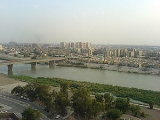
The city is located on a vast plain bisected by the Tigris River. The Tigris splits Baghdad in half, with the Eastern half being called 'Risafa' and the Western half known as 'KarkhKarkh

Karkh or Al-Karkh is historically the name of the western half of Baghdad, Iraq, or alternatively, the western shore o...
'. The land on which the city is built is almost entirely flat and low-lying, being of alluvialAlluvium

Alluvium is soil or sediments deposited by a river or other running water....
 origin due to the periodic large floodFlood

A flood is an overflow of water, an expanse of water submerging land, a deluge....
s which have occurred on the river.

Baghdad has a hot aridArid

An arid environment has a high precipitation deficit, receiving much less precipitation annually than would satisfy the cli...
 climate and is, in terms of maximum temperatures, one of the hottest cities in the world. In the summer from June to August, the average maximum temperature is as high as 44 °C (111 °F) accompanied by blazing sunshine: rainfall is almost completely unknown at this time of year. Temperatures exceeding 50 °C (122 °F) in the shade are by no means unheard of, and even at night temperatures in summer are seldom below 24 °C (75 °F) Though the humidityFacts About Humidity

Humidity is the amount of water in the air....
 is very low (usually under 10%) due to Baghdad's distance from the marshy Persian GulfPersian Gulf

The Persian Gulf , in the Southwest Asian region, is an extension of the Gulf of Oman located between Iran and the Arabian ...
, dust stormDust storm

A dust storm is a meteorological phenomenon common in dry, arid and semi-arid regions....
s from the deserts to the west are a normal occurrence during the summer.

In the winter, from December to February, by contrast, Baghdad has maximum temperatures averaging 15 to 16 °C (59 to 61 °F). Minima can indeed be very cold: the average January minimum is around 4 °C (39 °F) but temperatures below 0 °C (32 °F) are not uncommon during this season.

Annual rainfall, almost entirely confined to the period from November to March, averages around 140 millimetreMillimetre

A millimetre is one thousandth of a metre, which is the International System of Units base unit of length....
s (5.5 inInch

An inch is the name of a unit of length in a number of different systems, including English units, Imperial units, and Unit...
), but has been as high as 575 millimetres (23 in) and as low as 23 millimetres (~1 in). On January 11th of 2008, light snow fell across Baghdad for the first time in memory, caused by temperatures falling below zero degrees Celsius (32 degrees Fahrenheit).

Reconstruction efforts

Most Iraqi reconstructionReconstruction of Iraq

Reconstruction of Iraq is the term used for attempts to both improve upon and make repairs to the infrastructure of Iraq dam...
 efforts have been devoted to the restoration and repair of badly damaged urban infrastructure. More visible efforts at reconstruction through private development, like architect and urban designer Hisham N. AshkouriHisham N. Ashkouri Summary

Hisham N. Ashkouri is a Boston and New York-based architect....
's Baghdad Renaissance PlanReconstruction of Iraq

Reconstruction of Iraq is the term used for attempts to both improve upon and make repairs to the infrastructure of Iraq dam...
 and Sindbad Hotel Complex and Conference CenterSindbad Hotel Complex and Conference Center

The Sindbad Hotel Complex and Conference Center was designed by architect Hisham N....
, garnered early interest but remain undeveloped due to the instability of the region.

Government

The City of Baghdad has 89 official neighborhoods within 9 districts. These official subdivisions of the city served as administrative centers for the delivery of municipal services but until 2003 had no political function. Beginning in April 2003, the U.S. controlled Coalition Provisional Authority (CPA) began the process of creating new functions for these. The process initially focused on the election of neighborhood councils in the official neighborhoods, elected by neighborhood caucuses. CPA convened a series of meetings in each neighborhood to explain local government, to describe the caucus election process and to encourage participants to spread the word and bring friends, relatives and neighbors to subsequent meetings. Each neighborhood process ultimately ended with a final meeting where candidates for the new neighborhood councils identified themselves and asked their neighbors to vote for them. Once all 88 (later increased to 89) neighborhood councils were in place, each neighborhood council elected representatives from among their members to serve on one of the city's nine district councils. The number of neighborhood representatives on a district council is based upon the neighborhood’s population. The next step was to have each of the nine district councils elect representatives from their membership to serve on the 37 member Baghdad City Council. This three tier system of local government connected the people of Baghdad to the central government through their representatives from the neighborhood, through the district, and up to the city council.

The same process was used to provide representative councils for the other communities in Baghdad Province outside of the City itself. There, local councils were elected from 20 neighborhoods (Nahia) and these councils elected representatives from their members to serve on six district councils (Qada). As within the City, the district councils then elected representatives from among their members to serve on the 35 member Baghdad Regional Council.

The final step in the establishment of the system of local government for Baghdad Province was the election of the Baghdad Provincial Council. As before, the representatives to the Provincial Council were elected by their peers from the lower councils in numbers proportional to the population of the districts they represent. The 41 member Provincial Council took office in February, 2004 and served until National elections held in January 2005, when a new Provincial Council was elected.

This system of 127 separate councils may seem overly cumbersome but Baghdad Province is home to approximately seven million people. At the lowest level, the neighborhood councils, each council represents an average of 74,000 people.

The nine District Advisory Councils (DAC) are as follows:
  • AdhamiyahAdhamiyah Overview

    Adhamiyah is a suburb of Baghdad, Iraq....
  • KarkhKarkh

    Karkh or Al-Karkh is historically the name of the western half of Baghdad, Iraq, or alternatively, the western shore o...
  • KaradahKaradah

    Karadah, also spelled Karada or Kharadah, is one of nine administrative districts in Baghdad, Iraq....
  • Kadhimyah
  • MansourMansour

    Mansour is a common male name in Arabic, which means victorious. ...
  • Sadr CityFacts About Sadr City

    Sadr City is a vast low-income neighbourhood in northeastern Baghdad, home to some two million mainly Shi'a Muslims....
  • RasheedRasheed

    Rasheed is one of nine administrative districts in Baghdad, Iraq....
  • RusafaRusafa

    Al Rusafa or Rasafa is the eastern side of Baghdad, Iraq, or the eastern shore of the river Tigris....
  • Tisaa Nissan (9th of April)

Culture


Baghdad has always played an important role in Arab cultural life and has been the home of noted writers, musicians and visual artists.

The dialect of Arabic spoken in Baghdad today differs from that of other large urban centers in Iraq, having features more characteristic of nomadic Arabic dialects (Verseegh, The Arabic Language). It is possible that this was caused by the repopulating of the city with rural residents after the multiple sacks of the late Middle Ages.

Institutions

Some of the important cultural institutions in the city include:
  • Iraqi National Orchestra Rehearsals and performances were briefly interrupted during the second Gulf WarIraq War

    The Iraq War, also known alternatively as the Second or Third Gulf War, is a military engagement encompassing th...
    , but have since returned to normal.
  • National Theatre of Iraq The theatreTheatre

    Theatre or theater is the branch of the performing arts concerned with acting out stories in front of an audience usi...
     was lootedLooting

    Looting, sacking, or plundering is the indiscriminate taking of goods by force as part of a military or politica...
     during the 2003 Invasion of Iraq2003 invasion of Iraq

    The 2003 invasion of Iraq, termed "Operation Iraqi Freedom" by the US administration, began on March 20....
    , but efforts are underway to restore the theatre.


The live theatreTheatre Summary

Theatre or theater is the branch of the performing arts concerned with acting out stories in front of an audience usi...
 scene received a boost during the 1990s when UN sanctionsEconomic sanctions

Economic sanctions are economic penalties applied by one country on another for a variety of reasons....
 limited the import of foreign filmFilm

Film is a term that encompasses motion pictures as individual projects, as well as the field in general....
s. As many as 30 movie theatres were reported to have been converted to live stages, producing a wide range of comediesComedy

Comedy has a classical meaning and a popular one ....
 and dramaFacts About Drama

Drama is a literary form involving parts written for actors to perform....
tic productions.

Institutions offering cultural education in Baghdad include the Academy of MusicAcademy of Music

Academy of Music may mean:* Academy of Music, a musice school in Israel...
, Institute of Fine Arts and the Music and Ballet School. Baghdad is also home to a number of museumMuseum

A museum is typically a "permanent institution in the service of society and of its development, open to the public, whi...
s which housed artifactsArtifact (archaeology)

In archaeology, an artifact or artefact is any object made or modified by a human culture, and often one later recove...
 and relics of ancient civilizationAncient civilization

In ancient history, ancient civilizations cover:...
s; many of these were stolen, and the museums looted, during the widespread chaos immediately after U.S.United States

The United States of America, also known as the United States, the U.S., the U.S.A., and America, is...
 forces entered the city.

During the 2003 occupation of Iraq, AFN IraqAFN Iraq Summary

AFN Iraq is the American Forces Network of radio stations within Iraq....
 ("Freedom Radio") broadcast news and entertainment within Baghdad, among other locations. There is also a private radio station called "Dijlah" (named after the Arabic word for the Tigris River) that was created in 2004 as Iraq's first independent talk radio station. Radio Dijlah offices, in the JamiaJamia

Jamia is the Arabic word for gathering....
 neighborhood of Baghdad, have been attacked on several occasions.

Sights and monuments


Points of interest include the National Museum of IraqFacts About National Museum of Iraq

The National Museum of Iraq is located in Baghdad, Iraq. ...
 whose priceless collection of artifacts was looted during the 2003 invasion, and the iconic Hands of Victory arches. Multiple Iraqi parties are in discussions as to whether the arches should remain as historical monuments or be dismantled. Thousands of ancient manuscripts in the National LibraryIraq National Library and Archive

The Iraq National Library and Archive is the national library and legal deposit and copyright of Iraq. ...
 were destroyed when the building burnt down during the 2003 invasion of Iraq. The Al Kadhimain Shrine in the northwest of Baghdad (in Kadhimiya) is one of the most important Shi'ite religious sites in Iraq. It was finished in 1515 and the 7th and the 9th ImamImam Overview

Imam is an Arabic word meaning "Leader"....
s were buried there. One of the oldest buildings is the 12th century or 13th century Abbasid Palace. The palace is part of the central historical area of the city and close to other historically important buildings such as the Saray Building and Al-Mustansiriyah School (From the Abbasid Period). There are other landmarks in Baghdad, each of which marks a certain historical era:

  • Baghdad Tower (used to be known as Saddam Tower): before its partial destruction due to the USA bombing of the Ma'amoon Telecommunication Center next to it, the tower used to be the highest point in the city and from where all Baghdad can be seen. The construction of the tower marks a period of the post-Gulf-war of 1991 reconstruction efforts.


  • The Two Level Bridge in Jadriyah (Jisr Abul Tabqain). Even though planing for this bridge began before Saddam's take over, the bridge was never built. As part of recent reconstruction efforts, the long planned bridge was built. It connects Al-Doura area with the rest of the Baghdad and complements the 14th of July Bridge.


  • Sahat Al Tahrir (Liberation Square) downtown Baghdad.


  • Saray souq


  • Baghdadi Museum (wax museum)


  • Mustansiriya SchoolMustansiriya School

    Mustansiriya School is one of the oldest Islamic universities in the world, established in 1233 by the Abbasid Caliph al-...
    , a 13th century Abbasid structure


  • Al-Zawra'a Park in Al-Mansour Area and almost in a central location of Baghdad.


  • Kahramana and the 40 Thieves Square.


  • Al Jundi Al Majhool Monument (The unknown soldier).


  • Al Shaheed Monument. Monument to the Iraqi soldiers killed in the Iran-Iraq warIran-Iraq War

    The Iran-Iraq War, also known as the Imposed War in Iran, and Saddam's Qadisiyyah in Iraq, was a war between t...
    , located on the east bank of the Tigris.


  • A wide road built under Saddam as a parade route, and across it is the Hands of VictoryHands of Victory

    The Swords of Qadisiyyah, also called the Hands of Victory, is a pair of triumphal arches in central Baghdad, Iraq....
    , which is a pair of enormous crossed swordSword

    Sword is a term for a long edged weapon, used by various civilizations throughout Eurasia and North Africa....
    s cast from weapons of soldiers who died in the Iran-Iraq WarIran-Iraq War

    The Iran-Iraq War, also known as the Imposed War in Iran, and Saddam's Qadisiyyah in Iraq, was a war between t...
     under SaddamSaddam

    Saddam is an Arabic name, literally means "Someone who frequently Causes Collisions" or "powerful collider" Other meanings ...
    's command.

Baghdad Zoo

The Baghdad ZooBaghdad zoo

Located in the heart of al-Zawra entertainment park in Baghdad, Iraq, the Baghdad zoo once housed 650 animals. ...
 was the largest zoo in the Middle East. Within eight days following the 2003 invasion, however, only 35 of the 650 to 700 animals in the facility survived. This was a result of bombing, theft of some animals for human food, and starvation of caged animals that had no food or water. Survivors included larger animals like bears, lions, and tigers. Notwithstanding the chaos brought by the invasion, South African Lawrence AnthonyLawrence Anthony

Lawrence Anthony international conservationist and environmentalist, born Johannesburg, South Africa, 1950, raised in rural ...
 and some of the zoo keepers cared for the animals and fed the carnivores donkeyDonkey Summary

The donkey or ass, Equus asinus, is a domesticated animal of the horse family, Equidae. ...
s they had bought locally. Eventually, BremerL. Paul Bremer

Lewis Paul Bremer III, known as Paul Bremer, was named Director of Reconstruction and Humanitarian Assistance for post...
 ordered protection of the zoo, and American engineers helped reopen the facility.

Sport

Baghdad is home to some of the most successful footballFootball (soccer)

Football is a team sport played between two teams, of 11 players each, and is widely considered to be the most popular spor...
 teams in Iraq, the biggest being Al Quwa Al JawiyaAl Quwa Al Jawiya

Al Quwa Al Jawiya is a football club based in Baghdad, Iraq....
 (Airforce club), Al Zawra, Al ShurtaAl Shurta

Al Shurta is an Iraqi football club based in Baghdad....
 (Police) and Al TalabaAl Talaba

Al Talaba is an Iraqi football club based in Baghdad....
 (Students). The largest stadium in Baghdad is Al Shaab StadiumAl Shaab Stadium

Al Shaab Stadium is a multi-use stadium in Baghdad, Iraq....
 which was opened in 1966. Another. Much larger stadium, are still in the opening stages of construction.

The city has also had a strong tradition of horse racingFacts About Horse racing

Horse racing is an equestrian sport which has been practiced over the centuries; the chariot races of Roman times are an ear...
 ever since World War IWorld War I Summary

World War I, also known as the First World War, the Great War and "The War to End All Wars" was a global m...
, known to Baghdadis simply as 'Races'. There are reports of pressures by the Islamists to stop this tradition due to the associated gambling.

Baghdad's major neighborhoods


  • AdhamiyahAdhamiyah Summary

    Adhamiyah is a suburb of Baghdad, Iraq....
  • Al-Kadhimya
  • Al-GhazaliyaGhazaliya

    Ghazaliya is a neighborhood in Baghdad, Iraq....
  • Al-A'amiriya
  • DoraDora (Baghdad)

    Dora is a neighborhood in Rasheed administrative district, southern Baghdad, Iraq....
  • KarradaKarrada

    Karrada is a major affluent district of the city Baghdad, Iraq....
  • Al-JadriyaAl-Jadriya

    Al-Jadriya is a neighborhood in Baghdad, Iraq along the Tigris river....
     Area
  • Al-Mansour
  • Zayouna
  • Sadr CitySadr City

    Sadr City is a vast low-income neighbourhood in northeastern Baghdad, home to some two million mainly Shi'a Muslims....
  • Al-Saydiya
  • HurriyaHurriya

    Hurriya is a neighborhood in Baghdad....
     City
  • Baghdad Al-Jadida(New BaghdadNew Baghdad

    New Baghdad or Baghdad Al-Jidida is one of nine administrative districts in Baghdad, Iraq....
    )
  • Al Baladeyat - Tisaa Nisan (9th of April)
  • Al-Sa'adoon area
  • Al-Shu'ala
  • Bab Al-Moatham
  • Bab Al-Sharqi
  • Al-Baya'Baiyaa

    Baiyaa is a middle-class district in western Baghdad, Iraq along the Baghdad Airport Road....
  • Al-Za'franiya
  • Hayy Ur
  • Sha'ab
  • Hayy Al-Jami'aJamia

    Jamia is the Arabic word for gathering....
  • Al-Adel
  • Al:Khadhraa
  • Hayy Al-Jihad
  • Hayy Al-A'amel
  • Hayy Al-Mansor
  • Hayy Aoor
  • Al-Horaya
  • Hayy Al-Shurtta
  • YarmoukYarmouk

    * Yarmouk River** Battle of Yarmouk* Yarmouk University in Jordan...
  • Al-Saydiya
  • Jesr Diyala
  • Abu Disher
  • Raghiba Khatoun
  • Arab Jijur
  • Al-Awashosh
  • Al-Fathel
  • hoor Rajab
  • Al-Ubedy
  • Hifah Street
  • Al-Wazireya

Baghdad's major streets

Source:

  • Haifa StreetHaifa Street

    Haifa Street is a two-mile-long street in Baghdad, Iraq....
  • Hilla Road -- Runs from the South into Baghdad via Yarmouk (Baghdad)Yarmouk (Baghdad)

    Yarmouk is a neighborhood in Southern Baghdad, Iraq near the Mansour district just north of the intersection of ?Baghdad Air...
  • Caliphs Street  -- site of historical mosques and churches.
  • Sadoun Street -- stretching from Liberation SquareLiberation Square

    Liberation Square is located in central Baghdad....
     to Masbah
  • Mohammed Al-Qassim highway near AdhamiyahAdhamiyah

    Adhamiyah is a suburb of Baghdad, Iraq....
  • Abu Nuwas Street -- runs along the Tigris from the from Jumhouriya Bridge to the 14 July Suspended Bridge
  • Damascus Street -- goes from Damascus Square to the International Airport Road
  • Mutanabbi StreetMutanabbi Street

    Mutanabbi Street is located in Baghdad, near the old Jewish quarter of Baghdad; at Al Rasheed Street....
     -- A street with numerous bookshops, named after the 10th century Iraqi poet Al-Mutanaby
  • Rabia Street
  • Arbataash Tamuz (14th July) Street
  • Muthana al-Shaibani Street
  • Bor Saeed (Port Said) Street
  • Thawra Street
  • Al Qanat Street -- runs through Baghdad north-south
  • Al Khat al Sare'a - Mohammed al Qasim (High Speed lane) - runs through bagdhad, north -south
  • Al Sinaa Street (Industry St.) runs by the University of Technology - center of computers trade in Baghdad.
  • Al Nidhal Street
  • Al Rasheed StreetAl Rasheed Street

    Al Rasheed Street or Al Rashid Street is located in Downtown Baghdad and is one of the city's main street, stretching ...
     -- Downtown Baghdad
  • Al Jamhuriah Street -- Downtown Baghdad
  • Falastin (Palestine) Street
  • Tariq el Muaskar -- (Al Rasheed Camp Road)
  • Matar Baghdad Al-Dawli (Airport Road)

Town twinning (sister cities)

|valign="top" |
  • CairoCairo

    Cairo translated the "land of Ra'" It comes from two Coptic words "Kahi"...
    , EgyptEgypt

    Egypt , officially the Arab Republic of Egypt, is a Middle Eastern country in North Africa....
     (1978)
  • AmmanAmman

    Amman, sometimes spelled Ammann , is the capital city of the Kingdom of Jordan, a city of more than 1.6 million inhabi...
    , JordanJordan

    Jordan , officially the Hashemite Kingdom of Jordan , is an Arab country in the Middle East....
     (1989)

See also

  • Reconstruction of IraqReconstruction of Iraq

    Reconstruction of Iraq is the term used for attempts to both improve upon and make repairs to the infrastructure of Iraq dam...
  • List of places in IraqList of places in Iraq Summary

    This is a list of places in Iraq. See also: Provinces of Iraq. ...
  • Firdus Square
  • Baghdad ArabicBaghdad Arabic

    Baghdad Arabic or the Baghdadi Arabic is the Arabic variety spoken in Baghdad, the capital of Iraq....
  • ?Baghdad Airport Road
  • ?Baghdad bridge stampede
  • Baghdad Security Plan
  • Reconstruction of IraqReconstruction of Iraq

    Reconstruction of Iraq is the term used for attempts to both improve upon and make repairs to the infrastructure of Iraq dam...
  • Baghdad Renaissance Plan
  • Sindbad Hotel Complex and Conference CenterSindbad Hotel Complex and Conference Center

    The Sindbad Hotel Complex and Conference Center was designed by architect Hisham N....


Further reading

  • , by Louisa Jebb (Mrs. Roland Wilkins), 1908 (1909 ed) (a searchable facsimile at the University of Georgia Libraries; DjVuDjVu

    DjVu is a computer file format designed primarily to store ...
     & *, being the adventures of an official artist in the garden of Eden, by Donald Maxwell, 1921
    (a searchable facsimile at the University of Georgia Libraries; DjVuDjVu

    DjVu is a computer file format designed primarily to store ...
     &

External links