


Hanseatic League

Encyclopedia
The Hanseatic League was an economic alliance of trading
cities and their merchant guild
s that dominated trade along the coast of Northern Europe
. It stretched from the Baltic
to the North Sea
and inland during the Late Middle Ages
and early modern period
(c. 13th–17th centuries).
The League was created to protect commercial interests and privileges granted by foreign rulers in cities and countries the merchants visited. The Hanseatic cities had their own legal system and furnished their own protection and mutual aid. Despite this, the organization was not a city-state, nor can it be called a confederation of city-states; only a very small number of the cities within the league enjoyed autonomy and liberties comparable to those of a free imperial city
.
The legacy of the Hansa is remembered today in several names, for example the German airline Lufthansa
(i.e., 'Air Hansa'), Hansa Rostock and the Hanze University Groningen in the Netherlands
.
town of Lübeck
in 1159 by Henry the Lion
, Duke of Saxony
, after Henry had captured the area from Count Adolf II
, Count of Schauenburg and Holstein.
Exploratory trading adventures, raids
and piracy
had happened earlier throughout the Baltic (see Viking
s)—the sailor
s of Gotland
sailed up rivers as far away as Novgorod, for example—but the scale of international trade
economy
in the Baltic area remained insignificant before the growth of the Hanseatic League.
German cities achieved domination of trade in the Baltic with striking speed over 13th century, and Lübeck became a central node in the seaborne trade that linked the areas around the North
and Baltic Sea
s. The 15th century saw the peak of Lübeck's hegemony
.
 Lübeck became a base for merchant
s from Saxony and Westphalia
trading eastward and northward. Well before the term Hanse appeared in a document (1267), merchants in different cities began to form guilds or Hansa with the intention of trading with towns overseas, especially in the economically less-developed eastern Baltic. This area was a source of timber
, wax
, amber
, resin
s, fur
s, along with rye
and wheat
brought down on barge
s from the hinterland
to port markets. The towns raised their own armies, with each guild being required to provide levies when needed. The Hanseatic cities came to each other's aid, and commercial ships often had to be used to carry soldiers and their arms.
Visby
functioned as the leading centre in the Baltic before the Hansa. Sailing east, Visby merchants established a branch at Novgorod. To begin with they used the Gotlandic Gutagard. With the influx of too many merchants, the Gotlanders arranged their own trading stations for the Peterhof
further up from the river. Before the foundation of the League in 1356 the word Hanse did not occur in the Baltic language. The Gotlanders used the word varjag.
Hansa societies worked to remove restrictions to trade for their members. For example, the merchants of the Cologne
Hansa convinced Henry II, King of England
to free them (1157) from all tolls in London
and allow them to trade at fairs throughout England
. The "Queen of the Hansa", Lübeck, where traders were required to trans-ship goods between the North Sea and the Baltic, gained the Imperial privilege of becoming a free imperial city
in 1227, the only such city east of the River Elbe
.
In 1241, Lübeck, which had access to the Baltic and North Sea fishing grounds, formed an alliance — a precursor of the League — with Hamburg
, another trading city, which controlled access to salt-trade routes from Lüneburg
. The allied cities gained control over most of the salt-fish
trade, especially the Scania Market
; and Cologne
joined them in the Diet
of 1260. In 1266, Henry III
granted the Lübeck and Hamburg Hansa a charter for operations in England, and the Cologne Hansa joined them in 1282 to form the most powerful Hanseatic colony in London. Much of the drive for this co-operation came from the fragmented nature of existing territorial government, which failed to provide security for trade. Over the next 50 years the Hansa itself emerged with formal agreements for confederation and co-operation covering the west and east trade route
s. The chief city and linchpin remained Lübeck; with the first general Diet of the Hansa held there in 1356, the Hanseatic League acquired an official structure.
 Lübeck's location on the Baltic provided access for trade with Scandinavia
and Kiev Rus, putting it in direct competition with the Scandinavians who had previously controlled most of the Baltic trade routes. A treaty with the Visby Hansa put an end to competition: through this treaty the Lübeck merchants also gained access to the inland Russian port of Novgorod
, where they built a trading post or Kontor
. Other such alliances formed throughout the Holy Roman Empire
. Yet the League never became a closely managed formal organisation. Assemblies of the Hanseatic towns met irregularly in Lübeck for a Hansetag (Hanseatic Diet
), from 1356 onwards, but many towns chose not to send representatives and decisions were not binding on individual cities. Over time, the network of alliances grew to include a flexible roster of 70 to 170 cities.
The league succeeded in establishing additional Kontors in Bruges
(Flanders
), Bergen (Norway), and London
(Kingdom of England). These trading post
s became significant enclaves. The London Kontor, established in 1320, stood west of London Bridge
near Upper Thames Street, the site now occupied by Cannon Street station
. It grew significantly over time into a walled community with its own warehouses, weighhouse, church, offices and houses, reflecting the importance and scale of the activity carried on. The first reference to it as the Steelyard
(der Stahlhof) occurs in 1422. Starting with trade in coarse woolen fabrics, the Hanseatic League had the effect of bringing both commerce and industry to northern Germany. As trade increased newer and even finer woolen and linen fabrics, and even silks, were manufactured in Northern Germany. The same refinement of the products of industry occurred in other fields, e.g. etching, wood carving, armorer production and engraving of metals and wood-turning. In short, the century long monopolization of the sea navigation and trade by the Hanseatic League ensured that the "renaissance" would arrive in Northern Germany long before the rest of Europe.
In addition to the major Kontors, individual Hanseatic ports had a representative merchant and warehouse. In England this happened in Boston
, Bristol
, Bishop's Lynn (now King's Lynn
, which features the sole remaining Hanseatic warehouse in England), Hull
, Ipswich
, Norwich
, Yarmouth (now Great Yarmouth
), and York
.
The League primarily traded timber, furs, resin (or tar), flax, honey, wheat, and rye from the east to Flanders and England with cloth (and, increasingly, manufactured goods
) going in the other direction. Metal ore (principally copper and iron) and herring came southwards from Sweden.
German colonists in the 12th and 13th centuries settled in numerous cities on and near the east Baltic coast, such as Elbing (Elbląg
), Thorn (Toruń
), Reval (Tallinn
), Riga
, and Dorpat (Tartu
), which became members of the Hanseatic League, and some of which still retain many Hansa buildings and bear the style of their Hanseatic days. Most were granted Lübeck law
(Lübisches Recht), which provided that they had to appeal in all legal matters to Lübeck's city council. The Livonian Confederation
incorporated modern-day Estonia
and parts of Latvia
and had its own Hanseatic parliament (diet); all of its major towns became members of the Hanseatic League. The dominant language of trade was Middle Low German
, a dialect with significant impact for countries involved in the trade, particularly the larger Scandinavian languages, Estonian
, and Latvian
.
or gained independence through the collective bargaining power of the League, though such independence remained limited. The Hanseatic free cities
owed allegiance directly to the Holy Roman Emperor
, without any intermediate tie to the local nobility.
 Another similarity involved the cities' strategic locations along trade routes. At the height of its power in the late 14th century, the merchants of the Hanseatic League succeeded in using their economic clout and sometimes their military might—trade routes needed protecting and the League's ships sailed well-armed—to influence imperial policy.
The League also wielded power abroad. Between 1361 and 1370, the League waged war against Denmark
. Initially unsuccessful, Hanseatic towns in 1368 allied in the Confederation of Cologne
, sacked Copenhagen
and Helsingborg
, and forced Valdemar IV King of Denmark
, and his son-in-law Haakon VI, King of Norway
, to grant the League 15% of the profits from Danish trade in the subsequent peace treaty of Stralsund in 1370, thus gaining an effective trade and political monopoly in Scandinavia. This favourable treaty was the high-water mark of Hanseatic power. The commercial privileges were renewed in the Treaty of Vordingborg, 1435.
The Hansa also waged a vigorous campaign against pirates. Between 1392 and 1440, maritime trade of the League faced danger from raids of the Victual Brothers
and their descendants, privateer
s hired in 1392 by Albert of Mecklenburg, King of Sweden against Margaret I, Queen of Denmark
. In the Dutch–Hanseatic War (1438—41), the merchants of Amsterdam
sought and eventually won free access to the Baltic and broke the Hansa monopoly. As an essential part of protecting their investment in trade and ships, the League trained pilots and erected lighthouses.
Most foreign cities confined the Hansa traders to certain trading areas and to their own trading posts. They seldom interacted with the local inhabitants, except when doing business. Many locals, merchant and noble alike, envied the power of the League and tried to diminish it. For example, in London the local merchants exerted continuing pressure for the revocation of the privileges of the League. The refusal of the Hansa to offer reciprocal arrangements to their English counterparts exacerbated the tension. King Edward IV of England
reconfirmed the league's privileges in the Treaty of Utrecht (1474)
despite this hostility, in part thanks to the significant financial contribution the League made to the Yorkist side during The Wars of the Roses. In 1597, Queen Elizabeth I of England
expelled the League from London and the Steelyard
closed the following year. Ivan III of Russia
closed the Hanseatic Kontor at Novgorod in 1494. The very existence of the League and its privileges and monopolies created economic and social tensions that often crept over into rivalry between League members.
in 1466; Ivan III, Grand Prince of Moscow
, ended the entrepreneurial independence of Hansa's Novgorod Kontor of Peterhof
in 1478. New vehicles of credit
imported from Italy
outpaced the Hansa economy, in which silver coin
changed hands rather than bills of exchange.
In the 15th century, tensions between the Prussian region
and the "Wendish" cities (Lübeck and its eastern neighbours) increased. Lübeck was dependent on its role as centre of the Hansa, being on the shore of the sea without a major river. It was on the entrance of the land route to Hamburg, but this land route could be bypassed by sea travel around Denmark and through the Sound. Prussia's main interest, on the other hand, was primarily the export of bulk products like grain and timber, which were very important for England, the Low Countries
, and later on also for Spain and Italy.
In 1454, the year of the marriage of Elisabeth of Austria to the Jagiellonian king, the towns of the Prussian Confederation
rose against the dominance of the Teutonic Order and asked Casimir IV, King of Poland
for help. Danzig, Thorn, and Elbing became part of the Kingdom of Poland
, (1466–1569 referred to as Royal Prussia
) by the Second Peace of Thorn (1466). Poland in turn was heavily supported by the Holy Roman Empire
through family connections and by military assistance under the Habsburg
s. Kraków
, then the capital of Poland, had a loose association with Hansa. The lack of customs borders on the River Vistula
after 1466 helped to gradually increase Polish grain export, transported to the sea down the Vistula, from 10,000 tonnes per year in the late 15th century to over 200,000 tonnes in the 17th century. The Hansa-dominated maritime grain trade
made Poland one of the main areas of its activity, helping Danzig to become the Hansa's largest city.
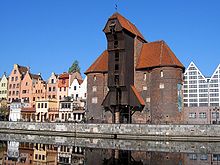 The member cities took responsibility for their own protection. In 1567, a Hanseatic League Agreement reconfirmed previous obligations and rights of League members, such as common protection and defense against enemies. The Prussian Quartier cities of Thorn, Elbing, Königsberg and Riga and Dorpat also signed. When pressed by the king of Poland–Lithuania, Danzig remained neutral and would not allow ships running for Poland into its territory. They had to anchor somewhere else, such as at Pautzke (now Puck, Poland
).
A major benefit for the Hansa was its control of the shipbuilding market, mainly in Lübeck and in Danzig. The Hansa sold ships everywhere in Europe, including Italy. They drove out the Dutch, because Holland wanted to favour Bruges as a huge staple market at the end of a trade route. When the Dutch started to become competitors of the Hansa in shipbuilding, the Hansa tried to stop the flow of shipbuilding technology from Hansa towns to Holland. Danzig, a trading partner of Amsterdam, tried to stall the decision. Dutch ships sailed to Danzig to take grain from the city directly, to the dismay of Lübeck. Hollanders also circumvented the Hansa towns by trading directly with North German princes in non-Hansa towns. Dutch freight costs were much lower than those of the Hansa, and the Hansa were excluded as middlemen.
When Bruges, Antwerp and Holland all became part of the Duchy of Burgundy
they actively tried to take over the monopoly of trade from the Hansa, and the staples market from Bruges was transferred to Amsterdam. The Dutch merchants aggressively challenged the Hansa and met with much success. Hanseatic cities in Prussia, Livonia supported the Dutch against the core cities of the Hansa in northern Germany. After several naval wars between Burgundy and the Hanseatic fleets, Amsterdam gained the position of leading port for Polish and Baltic grain from the late 15th century onwards. The Dutch regarded Amsterdam's grain trade as the mother of all trades (Moedernegotie). Denmark and England tried to destroy the Netherlands
in the First Navigation War
(1652–54). The war ended in a truce, but the Anglo-Dutch rivalry continued. A Second Dutch Navigation War
(1665–67) broke out which also ended inconclusively. Later, there was a Third Navigation War
(1672–74), which also resulted in another failed attempt to destroy Holland.
Nuremberg
in Franconia
developed an overland route to sell formerly Hansa-monopolised products from Frankfurt
via Nuremberg and Leipzig
to Poland and Russia, trading Flemish cloth and French wine
in exchange for grain and furs from the east. The Hansa profited from the Nuremberg trade by allowing Nurembergers to settle in Hansa towns, which the Franconians exploited by taking over trade with Sweden as well. The Nuremberger merchant Albrecht Moldenhauer was influential in developing the trade with Sweden and Norway, and his sons Wolf and Burghard established themselves in Bergen and Stockholm, becoming leaders of the Hanseatic activities locally.
had taken control of much of the Baltic. Denmark had regained control over its own trade, the Kontor in Novgorod had closed, and the Kontor in Bruges
had become effectively moribund. The individual cities which made up the League had also started to put self-interest before their common Hanseatic interests. Finally, the political authority of the German princes had started to grow—and so to constrain the independence of action which the merchants and Hanseatic towns had enjoyed.
 The League attempted to deal with some of these issues. It created the post of Syndic
in 1556 and elected Heinrich Sudermann
as a permanent official with legal training, who worked to protect and extend the diplomatic agreements of the member towns. In 1557 and 1579 revised agreements spelled out the duties of towns and some progress was made. The Bruges Kontor moved to Antwerp and the Hansa attempted to pioneer new routes. However, the League proved unable to halt the progress around it and so a long decline commenced. The Antwerp Kontor closed in 1593, followed by the London Kontor in 1598. The Bergen Kontor continued until 1754; its buildings alone of all the Kontore survive (see Bryggen
).
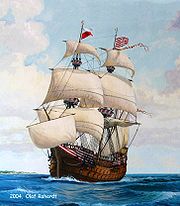
The gigantic Adler von Lübeck
warship, which was constructed for military use against Sweden during the Northern Seven Years' War
(1563–70), but never put to military use, epitomized the vain attempts of Lübeck to uphold its long-privileged commercial position in a changed economic and political climate.
By the late 16th century, the League had imploded and could no longer deal with its own internal struggles, the social and political changes that accompanied the Protestant Reformation
, the rise of Dutch and English merchants, and the incursion of the Ottoman Empire
upon its trade routes and upon the Holy Roman Empire itself. Only nine members attended the last formal meeting in 1669 and only three (Lübeck, Hamburg and Bremen) remained as members until its final demise in 1862.
 Despite its collapse, several cities still maintain the link to the Hanseatic League . The Dutch cities of Deventer
, Kampen
, Zutphen, and the ten German cities Bremen
, Demmin
, Greifswald
, Hamburg
, Lübeck
, Lüneburg
, Rostock
, Stade
, Stralsund
and Wismar
still call themselves Hanse cities. Lübeck, Hamburg, and Bremen continue to style themselves officially as "Free (and) Hanseatic Cities." (Rostock's football team is named F.C. Hansa Rostock in memory of the city's trading past.) For Lübeck in particular, this anachronistic tie to a glorious past remained especially important in the 20th century. In 1937 the Nazi Party removed this privilege through the Greater Hamburg Act after the Senat of Lübeck did not permit Adolf Hitler
to speak in Lübeck during his election campaign. He held the speech in Bad Schwartau
, a small village on the outskirts of Lübeck. Subsequently, he referred to Lübeck as "the small city close to Bad Schwartau."
After the EU enlargement to the East in May 2004 there are some experts who wrote about the resurrection of the Baltic Hansa.
, these merchants held citizenship. Not all towns with Low German merchant communities were members of the league, e.g. Emden
, Memel (Klaipėda
), Vyborg
and Narva
never joined. On the other hand, Hanseatic merchants could also come from settlements without German town law
— the premise for league membership was birth to German parents, subjection to German law, and a commercial education. The league served to further and defend the common interests of its heterogeneous members: commercial ambitions such as enhancement of trade, and political ambitions such as ensuring maximum independence from the noble territorial rulers.
Decisions and actions of the Hanseatic League were the consequence of a consensus-based procedure. If an issue arose, the league's members were invited to participate in a central meeting, the Tagfahrt (lit.
"meeting ride," sometimes also referred to as Hansetag, since 1358). The member communities then chose envoys (Ratssendeboten) to represent their local consensus on the issue at the Tagfahrt. Not every community sent an own envoy, delegates were often entitled to represent a set of communities. Consensus-building on local and Tagfahrt levels followed the Low Saxon tradition of Einung, where consensus was defined as absence of protest: after a discussion, the proposals which gained sufficient support were dictated aloud to the scribe and passed as binding Rezess if the attendees did not object; those favouring alternative proposals unlikely to get sufficient support were obliged to remain silent during this procedure. If consensus could not be established on a certain issue, consensus was established instead on the appointment of a number of league members who were then empowered to work out a solution.
The Hanseatic kontors each had an own treasury, court and seal. Like the guilds, the kontors were led by Ältermänner (sing.
Ältermann, lit. "elderman," cf.
English aldermen). The Stalhof kontor, as a special case, had a Hanseatic and an English Ältermann. In 1347, the kontor of Brussels
modified its statute to ensure an equal representation of the league's members. To that end, member communities from different regions were pooled into three circles (Drittel, lit. "third [part]"): the Wendish
and Saxon
Drittel, the Westphalia
n and Prussian
Drittel as well as the Gothlandian, Livonia
n and Swedish
Drittel. The merchants from the respective Drittel would then each choose two Ältermänner and six members of the Eighteen Men's Council (Achtzehnmännerrat) to administer the kontor for a set period of time. In 1356, during a Hanseatic meeting in preparation of the first Tagfahrt, the league confirmed this statute. The division into Drittel was gradually adopted and insitutionalized by the league in general (see table).
The Tagfahrt or Hansetag was the only central institution of the Hanseatic league. However, with the division in Drittel, the members of the respective subdivisions frequently held Dritteltage (lit. "Drittel meeting") to work out common positions which could then be presented at a Tagfahrt. On a more local level, league members also met, and while such regional meetings were never formalized into a Hanseatic institution, they gradually gained importance in the process of preparing and implementing Tagfahrt decisions.
Since 1554, the division into Drittel was modified to reduce the circles' heterogeneity, enhance the collaboration of the members on a local level and thus make the league's decision making process more efficient. The number of circles rose to four, accordingly they were called Quartiere (quarters):
This division was however not adopted by the depots (Kontore), who for their purposes (like Ältermänner elections) grouped the league members in different ways; e.g. the division adopted by the Stahlhof in London in 1554 grouped the league members into Drittel, whereby Lübeck merchants represented the Wendish, Pomeranian Saxon and several Westphalian towns, Cologne merchants represented the Cleves
, Mark, Berg
and Dutch towns, while Danzig merchants represented the Prussian and Livonian towns.
The column "Territory" indicates the jurisdiction to which the city was, at the time, subject; the column "Now" indicates the modern nation-state in which the city may be found.


, the "City League The HANSE". This league is open to all former Hanseatic League members and cities that once hosted a Hanseatic kontor
. The latter include twelve Russian cities, most notably Novgorod, which was a major Russian trade partner of the Hansa in the Middle Ages. The "new Hanse" fosters and develops business links, tourism and cultural exchange.
The headquarters of the New Hansa is in Lübeck
, Germany
. The current President of the Hanseatic League of New Time is Bernd Saxe, Mayor of Lübeck.
Each year one of the member cities of the New Hansa hosts the Hanseatic Days of New Time
international festival.
In 2006 King's Lynn
became the only English member of the newly formed modern Hanseatic League.
Trade
Trade is the transfer of ownership of goods and services from one person or entity to another. Trade is sometimes loosely called commerce or financial transaction or barter. A network that allows trade is called a market. The original form of trade was barter, the direct exchange of goods and...
cities and their merchant guild
Guild
A guild is an association of craftsmen in a particular trade. The earliest types of guild were formed as confraternities of workers. They were organized in a manner something between a trade union, a cartel, and a secret society...
s that dominated trade along the coast of Northern Europe
Northern Europe
Northern Europe is the northern part or region of Europe. Northern Europe typically refers to the seven countries in the northern part of the European subcontinent which includes Denmark, Estonia, Latvia, Lithuania, Norway, Finland and Sweden...
. It stretched from the Baltic
Baltic Sea
The Baltic Sea is a brackish mediterranean sea located in Northern Europe, from 53°N to 66°N latitude and from 20°E to 26°E longitude. It is bounded by the Scandinavian Peninsula, the mainland of Europe, and the Danish islands. It drains into the Kattegat by way of the Øresund, the Great Belt and...
to the North Sea
North Sea
In the southwest, beyond the Straits of Dover, the North Sea becomes the English Channel connecting to the Atlantic Ocean. In the east, it connects to the Baltic Sea via the Skagerrak and Kattegat, narrow straits that separate Denmark from Norway and Sweden respectively...
and inland during the Late Middle Ages
Late Middle Ages
The Late Middle Ages was the period of European history generally comprising the 14th to the 16th century . The Late Middle Ages followed the High Middle Ages and preceded the onset of the early modern era ....
and early modern period
Early modern period
In history, the early modern period of modern history follows the late Middle Ages. Although the chronological limits of the period are open to debate, the timeframe spans the period after the late portion of the Middle Ages through the beginning of the Age of Revolutions...
(c. 13th–17th centuries).
The League was created to protect commercial interests and privileges granted by foreign rulers in cities and countries the merchants visited. The Hanseatic cities had their own legal system and furnished their own protection and mutual aid. Despite this, the organization was not a city-state, nor can it be called a confederation of city-states; only a very small number of the cities within the league enjoyed autonomy and liberties comparable to those of a free imperial city
Free Imperial City
In the Holy Roman Empire, a free imperial city was a city formally ruled by the emperor only — as opposed to the majority of cities in the Empire, which were governed by one of the many princes of the Empire, such as dukes or prince-bishops...
.
The legacy of the Hansa is remembered today in several names, for example the German airline Lufthansa
Lufthansa
Deutsche Lufthansa AG is the flag carrier of Germany and the largest airline in Europe in terms of overall passengers carried. The name of the company is derived from Luft , and Hansa .The airline is the world's fourth-largest airline in terms of overall passengers carried, operating...
(i.e., 'Air Hansa'), Hansa Rostock and the Hanze University Groningen in the Netherlands
Netherlands
The Netherlands is a constituent country of the Kingdom of the Netherlands, located mainly in North-West Europe and with several islands in the Caribbean. Mainland Netherlands borders the North Sea to the north and west, Belgium to the south, and Germany to the east, and shares maritime borders...
.
History
Historians generally trace the origins of the League to the rebuilding of the North GermanNorthern Germany
- Geography :The key terrain features of North Germany are the marshes along the coastline of the North Sea and Baltic Sea, and the geest and heaths inland. Also prominent are the low hills of the Baltic Uplands, the ground moraines, end moraines, sandur, glacial valleys, bogs, and Luch...
town of Lübeck
Lübeck
The Hanseatic City of Lübeck is the second-largest city in Schleswig-Holstein, in northern Germany, and one of the major ports of Germany. It was for several centuries the "capital" of the Hanseatic League and, because of its Brick Gothic architectural heritage, is listed by UNESCO as a World...
in 1159 by Henry the Lion
Henry the Lion
Henry the Lion was a member of the Welf dynasty and Duke of Saxony, as Henry III, from 1142, and Duke of Bavaria, as Henry XII, from 1156, which duchies he held until 1180....
, Duke of Saxony
Duchy of Saxony
The medieval Duchy of Saxony was a late Early Middle Ages "Carolingian stem duchy" covering the greater part of Northern Germany. It covered the area of the modern German states of Bremen, Hamburg, Lower Saxony, North Rhine-Westphalia, and Saxony-Anhalt and most of Schleswig-Holstein...
, after Henry had captured the area from Count Adolf II
Adolf II of Holstein
Adolf II was the Count of Schauenburg and Holstein from 1130 until his death, though he was briefly out of Holstein from 1137 until 1142. He succeeded his father Adolf I under the regency of his mother, Hildewa....
, Count of Schauenburg and Holstein.
Exploratory trading adventures, raids
Raid (military)
Raid, also known as depredation, is a military tactic or operational warfare mission which has a specific purpose and is not normally intended to capture and hold terrain, but instead finish with the raiding force quickly retreating to a previous defended position prior to the enemy forces being...
and piracy
Piracy
Piracy is an act of robbery or criminal violence at sea. The term can include acts committed on land, in the air, or in other major bodies of water or on a shore. It does not normally include crimes committed against persons traveling on the same vessel as the perpetrator...
had happened earlier throughout the Baltic (see Viking
Viking
The term Viking is customarily used to refer to the Norse explorers, warriors, merchants, and pirates who raided, traded, explored and settled in wide areas of Europe, Asia and the North Atlantic islands from the late 8th to the mid-11th century.These Norsemen used their famed longships to...
s)—the sailor
Sailor
A sailor, mariner, or seaman is a person who navigates water-borne vessels or assists in their operation, maintenance, or service. The term can apply to professional mariners, military personnel, and recreational sailors as well as a plethora of other uses...
s of Gotland
Gotland
Gotland is a county, province, municipality and diocese of Sweden; it is Sweden's largest island and the largest island in the Baltic Sea. At 3,140 square kilometers in area, the region makes up less than one percent of Sweden's total land area...
sailed up rivers as far away as Novgorod, for example—but the scale of international trade
International trade
International trade is the exchange of capital, goods, and services across international borders or territories. In most countries, such trade represents a significant share of gross domestic product...
economy
Economic system
An economic system is the combination of the various agencies, entities that provide the economic structure that defines the social community. These agencies are joined by lines of trade and exchange along which goods, money etc. are continuously flowing. An example of such a system for a closed...
in the Baltic area remained insignificant before the growth of the Hanseatic League.
German cities achieved domination of trade in the Baltic with striking speed over 13th century, and Lübeck became a central node in the seaborne trade that linked the areas around the North
North Sea
In the southwest, beyond the Straits of Dover, the North Sea becomes the English Channel connecting to the Atlantic Ocean. In the east, it connects to the Baltic Sea via the Skagerrak and Kattegat, narrow straits that separate Denmark from Norway and Sweden respectively...
and Baltic Sea
Baltic Sea
The Baltic Sea is a brackish mediterranean sea located in Northern Europe, from 53°N to 66°N latitude and from 20°E to 26°E longitude. It is bounded by the Scandinavian Peninsula, the mainland of Europe, and the Danish islands. It drains into the Kattegat by way of the Øresund, the Great Belt and...
s. The 15th century saw the peak of Lübeck's hegemony
Hegemony
Hegemony is an indirect form of imperial dominance in which the hegemon rules sub-ordinate states by the implied means of power rather than direct military force. In Ancient Greece , hegemony denoted the politico–military dominance of a city-state over other city-states...
.
Foundation and formation
Merchant
A merchant is a businessperson who trades in commodities that were produced by others, in order to earn a profit.Merchants can be one of two types:# A wholesale merchant operates in the chain between producer and retail merchant...
s from Saxony and Westphalia
Westphalia
Westphalia is a region in Germany, centred on the cities of Arnsberg, Bielefeld, Dortmund, Minden and Münster.Westphalia is roughly the region between the rivers Rhine and Weser, located north and south of the Ruhr River. No exact definition of borders can be given, because the name "Westphalia"...
trading eastward and northward. Well before the term Hanse appeared in a document (1267), merchants in different cities began to form guilds or Hansa with the intention of trading with towns overseas, especially in the economically less-developed eastern Baltic. This area was a source of timber
Timber
Timber may refer to:* Timber, a term common in the United Kingdom and Australia for wood materials * Timber, Oregon, an unincorporated community in the U.S...
, wax
Wax
thumb|right|[[Cetyl palmitate]], a typical wax ester.Wax refers to a class of chemical compounds that are plastic near ambient temperatures. Characteristically, they melt above 45 °C to give a low viscosity liquid. Waxes are insoluble in water but soluble in organic, nonpolar solvents...
, amber
Amber
Amber is fossilized tree resin , which has been appreciated for its color and natural beauty since Neolithic times. Amber is used as an ingredient in perfumes, as a healing agent in folk medicine, and as jewelry. There are five classes of amber, defined on the basis of their chemical constituents...
, resin
Resin
Resin in the most specific use of the term is a hydrocarbon secretion of many plants, particularly coniferous trees. Resins are valued for their chemical properties and associated uses, such as the production of varnishes, adhesives, and food glazing agents; as an important source of raw materials...
s, fur
Fur
Fur is a synonym for hair, used more in reference to non-human animals, usually mammals; particularly those with extensives body hair coverage. The term is sometimes used to refer to the body hair of an animal as a complete coat, also known as the "pelage". Fur is also used to refer to animal...
s, along with rye
Rye
Rye is a grass grown extensively as a grain and as a forage crop. It is a member of the wheat tribe and is closely related to barley and wheat. Rye grain is used for flour, rye bread, rye beer, some whiskeys, some vodkas, and animal fodder...
and wheat
Wheat
Wheat is a cereal grain, originally from the Levant region of the Near East, but now cultivated worldwide. In 2007 world production of wheat was 607 million tons, making it the third most-produced cereal after maize and rice...
brought down on barge
Barge
A barge is a flat-bottomed boat, built mainly for river and canal transport of heavy goods. Some barges are not self-propelled and need to be towed by tugboats or pushed by towboats...
s from the hinterland
Hinterland
The hinterland is the land or district behind a coast or the shoreline of a river. Specifically, by the doctrine of the hinterland, the word is applied to the inland region lying behind a port, claimed by the state that owns the coast. The area from which products are delivered to a port for...
to port markets. The towns raised their own armies, with each guild being required to provide levies when needed. The Hanseatic cities came to each other's aid, and commercial ships often had to be used to carry soldiers and their arms.
Visby
Visby
-See also:* Battle of Visby* Gotland University College* List of governors of Gotland County-External links:* - Visby*...
functioned as the leading centre in the Baltic before the Hansa. Sailing east, Visby merchants established a branch at Novgorod. To begin with they used the Gotlandic Gutagard. With the influx of too many merchants, the Gotlanders arranged their own trading stations for the Peterhof
Peterhof
Petergof or Peterhof , known as Petrodvorets from 1944 to 1997, is a municipal town in Petrodvortsovy District of the federal city of St. Petersburg, located on the southern shore of the Gulf of Finland...
further up from the river. Before the foundation of the League in 1356 the word Hanse did not occur in the Baltic language. The Gotlanders used the word varjag.
Hansa societies worked to remove restrictions to trade for their members. For example, the merchants of the Cologne
Cologne
Cologne is Germany's fourth-largest city , and is the largest city both in the Germany Federal State of North Rhine-Westphalia and within the Rhine-Ruhr Metropolitan Area, one of the major European metropolitan areas with more than ten million inhabitants.Cologne is located on both sides of the...
Hansa convinced Henry II, King of England
Henry II of England
Henry II ruled as King of England , Count of Anjou, Count of Maine, Duke of Normandy, Duke of Aquitaine, Duke of Gascony, Count of Nantes, Lord of Ireland and, at various times, controlled parts of Wales, Scotland and western France. Henry, the great-grandson of William the Conqueror, was the...
to free them (1157) from all tolls in London
London
London is the capital city of :England and the :United Kingdom, the largest metropolitan area in the United Kingdom, and the largest urban zone in the European Union by most measures. Located on the River Thames, London has been a major settlement for two millennia, its history going back to its...
and allow them to trade at fairs throughout England
England
England is a country that is part of the United Kingdom. It shares land borders with Scotland to the north and Wales to the west; the Irish Sea is to the north west, the Celtic Sea to the south west, with the North Sea to the east and the English Channel to the south separating it from continental...
. The "Queen of the Hansa", Lübeck, where traders were required to trans-ship goods between the North Sea and the Baltic, gained the Imperial privilege of becoming a free imperial city
Free Imperial City
In the Holy Roman Empire, a free imperial city was a city formally ruled by the emperor only — as opposed to the majority of cities in the Empire, which were governed by one of the many princes of the Empire, such as dukes or prince-bishops...
in 1227, the only such city east of the River Elbe
Elbe
The Elbe is one of the major rivers of Central Europe. It rises in the Krkonoše Mountains of the northwestern Czech Republic before traversing much of Bohemia , then Germany and flowing into the North Sea at Cuxhaven, 110 km northwest of Hamburg...
.
In 1241, Lübeck, which had access to the Baltic and North Sea fishing grounds, formed an alliance — a precursor of the League — with Hamburg
Hamburg
-History:The first historic name for the city was, according to Claudius Ptolemy's reports, Treva.But the city takes its modern name, Hamburg, from the first permanent building on the site, a castle whose construction was ordered by the Emperor Charlemagne in AD 808...
, another trading city, which controlled access to salt-trade routes from Lüneburg
Lüneburg
Lüneburg is a town in the German state of Lower Saxony. It is located about southeast of fellow Hanseatic city Hamburg. It is part of the Hamburg Metropolitan Region, and one of Hamburg's inner suburbs...
. The allied cities gained control over most of the salt-fish
Curing (food preservation)
Curing refers to various food preservation and flavoring processes, especially of meat or fish, by the addition of a combination of salt, nitrates, nitrite or sugar. Many curing processes also involve smoking, the process of flavoring, or cooking...
trade, especially the Scania Market
Scania Market
Scania Market was a major fish market for herring which took place annually in Scania during the Middle Ages. From around 1200, it became one of the most important events for trade around the Baltic Sea and made Scania into a major distribution center for West-European goods bound for eastern...
; and Cologne
Cologne
Cologne is Germany's fourth-largest city , and is the largest city both in the Germany Federal State of North Rhine-Westphalia and within the Rhine-Ruhr Metropolitan Area, one of the major European metropolitan areas with more than ten million inhabitants.Cologne is located on both sides of the...
joined them in the Diet
Diet (assembly)
In politics, a diet is a formal deliberative assembly. The term is mainly used historically for the Imperial Diet, the general assembly of the Imperial Estates of the Holy Roman Empire, and for the legislative bodies of certain countries.-Etymology:...
of 1260. In 1266, Henry III
Henry III of England
Henry III was the son and successor of John as King of England, reigning for 56 years from 1216 until his death. His contemporaries knew him as Henry of Winchester. He was the first child king in England since the reign of Æthelred the Unready...
granted the Lübeck and Hamburg Hansa a charter for operations in England, and the Cologne Hansa joined them in 1282 to form the most powerful Hanseatic colony in London. Much of the drive for this co-operation came from the fragmented nature of existing territorial government, which failed to provide security for trade. Over the next 50 years the Hansa itself emerged with formal agreements for confederation and co-operation covering the west and east trade route
Trade route
A trade route is a logistical network identified as a series of pathways and stoppages used for the commercial transport of cargo. Allowing goods to reach distant markets, a single trade route contains long distance arteries which may further be connected to several smaller networks of commercial...
s. The chief city and linchpin remained Lübeck; with the first general Diet of the Hansa held there in 1356, the Hanseatic League acquired an official structure.
Expansion
Scandinavia
Scandinavia is a cultural, historical and ethno-linguistic region in northern Europe that includes the three kingdoms of Denmark, Norway and Sweden, characterized by their common ethno-cultural heritage and language. Modern Norway and Sweden proper are situated on the Scandinavian Peninsula,...
and Kiev Rus, putting it in direct competition with the Scandinavians who had previously controlled most of the Baltic trade routes. A treaty with the Visby Hansa put an end to competition: through this treaty the Lübeck merchants also gained access to the inland Russian port of Novgorod
Novgorod Republic
The Novgorod Republic was a large medieval Russian state which stretched from the Baltic Sea to the Ural Mountains between the 12th and 15th centuries, centred on the city of Novgorod...
, where they built a trading post or Kontor
Kontor
A kontor was a foreign trading post of the Hanseatic League. The word kontor means office in Norwegian and other Scandinavian languages....
. Other such alliances formed throughout the Holy Roman Empire
Holy Roman Empire
The Holy Roman Empire was a realm that existed from 962 to 1806 in Central Europe.It was ruled by the Holy Roman Emperor. Its character changed during the Middle Ages and the Early Modern period, when the power of the emperor gradually weakened in favour of the princes...
. Yet the League never became a closely managed formal organisation. Assemblies of the Hanseatic towns met irregularly in Lübeck for a Hansetag (Hanseatic Diet
Diet (assembly)
In politics, a diet is a formal deliberative assembly. The term is mainly used historically for the Imperial Diet, the general assembly of the Imperial Estates of the Holy Roman Empire, and for the legislative bodies of certain countries.-Etymology:...
), from 1356 onwards, but many towns chose not to send representatives and decisions were not binding on individual cities. Over time, the network of alliances grew to include a flexible roster of 70 to 170 cities.
The league succeeded in establishing additional Kontors in Bruges
Bruges
Bruges is the capital and largest city of the province of West Flanders in the Flemish Region of Belgium. It is located in the northwest of the country....
(Flanders
County of Flanders
The County of Flanders was one of the territories constituting the Low Countries. The county existed from 862 to 1795. It was one of the original secular fiefs of France and for centuries was one of the most affluent regions in Europe....
), Bergen (Norway), and London
London
London is the capital city of :England and the :United Kingdom, the largest metropolitan area in the United Kingdom, and the largest urban zone in the European Union by most measures. Located on the River Thames, London has been a major settlement for two millennia, its history going back to its...
(Kingdom of England). These trading post
Trading post
A trading post was a place or establishment in historic Northern America where the trading of goods took place. The preferred travel route to a trading post or between trading posts, was known as a trade route....
s became significant enclaves. The London Kontor, established in 1320, stood west of London Bridge
London Bridge
London Bridge is a bridge over the River Thames, connecting the City of London and Southwark, in central London. Situated between Cannon Street Railway Bridge and Tower Bridge, it forms the western end of the Pool of London...
near Upper Thames Street, the site now occupied by Cannon Street station
Cannon Street station
Cannon Street station, also known as London Cannon Street, is a central London railway terminus and London Underground complex in the City of London, England. It is built on the site of the medieval Steelyard, the trading base in England of the Hanseatic League...
. It grew significantly over time into a walled community with its own warehouses, weighhouse, church, offices and houses, reflecting the importance and scale of the activity carried on. The first reference to it as the Steelyard
Steelyard
The Steelyard, from the German Stalhof, was in the Middle Ages the main trading base of the Hanseatic League in London.-Location:It lay on the north bank of the Thames by the outflow of the Walbrook, in the Dowgate ward of the City of London. The site is now covered by Cannon Street station and...
(der Stahlhof) occurs in 1422. Starting with trade in coarse woolen fabrics, the Hanseatic League had the effect of bringing both commerce and industry to northern Germany. As trade increased newer and even finer woolen and linen fabrics, and even silks, were manufactured in Northern Germany. The same refinement of the products of industry occurred in other fields, e.g. etching, wood carving, armorer production and engraving of metals and wood-turning. In short, the century long monopolization of the sea navigation and trade by the Hanseatic League ensured that the "renaissance" would arrive in Northern Germany long before the rest of Europe.
In addition to the major Kontors, individual Hanseatic ports had a representative merchant and warehouse. In England this happened in Boston
Boston, Lincolnshire
Boston is a town and small port in Lincolnshire, on the east coast of England. It is the largest town of the wider Borough of Boston local government district and had a total population of 55,750 at the 2001 census...
, Bristol
Bristol
Bristol is a city, unitary authority area and ceremonial county in South West England, with an estimated population of 433,100 for the unitary authority in 2009, and a surrounding Larger Urban Zone with an estimated 1,070,000 residents in 2007...
, Bishop's Lynn (now King's Lynn
King's Lynn
King's Lynn is a sea port and market town in the ceremonial county of Norfolk in the East of England. It is situated north of London and west of Norwich. The population of the town is 42,800....
, which features the sole remaining Hanseatic warehouse in England), Hull
Kingston upon Hull
Kingston upon Hull , usually referred to as Hull, is a city and unitary authority area in the ceremonial county of the East Riding of Yorkshire, England. It stands on the River Hull at its junction with the Humber estuary, 25 miles inland from the North Sea. Hull has a resident population of...
, Ipswich
Ipswich
Ipswich is a large town and a non-metropolitan district. It is the county town of Suffolk, England. Ipswich is located on the estuary of the River Orwell...
, Norwich
Norwich
Norwich is a city in England. It is the regional administrative centre and county town of Norfolk. During the 11th century, Norwich was the largest city in England after London, and one of the most important places in the kingdom...
, Yarmouth (now Great Yarmouth
Great Yarmouth
Great Yarmouth, often known to locals as Yarmouth, is a coastal town in Norfolk, England. It is at the mouth of the River Yare, east of Norwich.It has been a seaside resort since 1760, and is the gateway from the Norfolk Broads to the sea...
), and York
York
York is a walled city, situated at the confluence of the Rivers Ouse and Foss in North Yorkshire, England. The city has a rich heritage and has provided the backdrop to major political events throughout much of its two millennia of existence...
.
The League primarily traded timber, furs, resin (or tar), flax, honey, wheat, and rye from the east to Flanders and England with cloth (and, increasingly, manufactured goods
Final good
In economics final goods are goods that are ultimately consumed rather than used in the production of another good. For example, a car sold to a consumer is a final good; the components such as tires sold to the car manufacturer are not; they are intermediate goods used to make the final good.When...
) going in the other direction. Metal ore (principally copper and iron) and herring came southwards from Sweden.
German colonists in the 12th and 13th centuries settled in numerous cities on and near the east Baltic coast, such as Elbing (Elbląg
Elblag
Elbląg is a city in northern Poland with 127,892 inhabitants . It is the capital of Elbląg County and has been assigned to the Warmian-Masurian Voivodeship since 1999. Before then it was the capital of Elbląg Voivodeship and a county seat in Gdańsk Voivodeship...
), Thorn (Toruń
Torun
Toruń is an ancient city in northern Poland, on the Vistula River. Its population is more than 205,934 as of June 2009. Toruń is one of the oldest cities in Poland. The medieval old town of Toruń is the birthplace of the astronomer Nicolaus Copernicus....
), Reval (Tallinn
Tallinn
Tallinn is the capital and largest city of Estonia. It occupies an area of with a population of 414,940. It is situated on the northern coast of the country, on the banks of the Gulf of Finland, south of Helsinki, east of Stockholm and west of Saint Petersburg. Tallinn's Old Town is in the list...
), Riga
Riga
Riga is the capital and largest city of Latvia. With 702,891 inhabitants Riga is the largest city of the Baltic states, one of the largest cities in Northern Europe and home to more than one third of Latvia's population. The city is an important seaport and a major industrial, commercial,...
, and Dorpat (Tartu
Tartu
Tartu is the second largest city of Estonia. In contrast to Estonia's political and financial capital Tallinn, Tartu is often considered the intellectual and cultural hub, especially since it is home to Estonia's oldest and most renowned university. Situated 186 km southeast of Tallinn, the...
), which became members of the Hanseatic League, and some of which still retain many Hansa buildings and bear the style of their Hanseatic days. Most were granted Lübeck law
Lübeck law
The Lübeck law was the constitution of a municipal form of government developed at Lübeck in Schleswig-Holstein after it was made a free city in 1226. The law provides for self-government. It replaced the personal rule of tribal monarchs descending from ancient times or the rule of the regional...
(Lübisches Recht), which provided that they had to appeal in all legal matters to Lübeck's city council. The Livonian Confederation
Livonian Confederation
Terra Mariana was the official name for Medieval Livonia or Old Livonia which was formed in the aftermath of the Livonian Crusade in the territories comprising present day Estonia and Latvia...
incorporated modern-day Estonia
Estonia
Estonia , officially the Republic of Estonia , is a state in the Baltic region of Northern Europe. It is bordered to the north by the Gulf of Finland, to the west by the Baltic Sea, to the south by Latvia , and to the east by Lake Peipsi and the Russian Federation . Across the Baltic Sea lies...
and parts of Latvia
Latvia
Latvia , officially the Republic of Latvia , is a country in the Baltic region of Northern Europe. It is bordered to the north by Estonia , to the south by Lithuania , to the east by the Russian Federation , to the southeast by Belarus and shares maritime borders to the west with Sweden...
and had its own Hanseatic parliament (diet); all of its major towns became members of the Hanseatic League. The dominant language of trade was Middle Low German
Middle Low German
Middle Low German is a language that is the descendant of Old Saxon and is the ancestor of modern Low German. It served as the international lingua franca of the Hanseatic League...
, a dialect with significant impact for countries involved in the trade, particularly the larger Scandinavian languages, Estonian
Estonian language
Estonian is the official language of Estonia, spoken by about 1.1 million people in Estonia and tens of thousands in various émigré communities...
, and Latvian
Latvian language
Latvian is the official state language of Latvia. It is also sometimes referred to as Lettish. There are about 1.4 million native Latvian speakers in Latvia and about 150,000 abroad. The Latvian language has a relatively large number of non-native speakers, atypical for a small language...
.
Zenith
The League had a fluid structure, but its members shared some characteristics. First, most of the Hansa cities either started as independent citiesIndependent city
An independent city is a city that does not form part of another general-purpose local government entity. These type of cities should not be confused with city-states , which are fully sovereign cities that are not part of any other sovereign state.-Historical precursors:In the Holy Roman Empire,...
or gained independence through the collective bargaining power of the League, though such independence remained limited. The Hanseatic free cities
Free Imperial City
In the Holy Roman Empire, a free imperial city was a city formally ruled by the emperor only — as opposed to the majority of cities in the Empire, which were governed by one of the many princes of the Empire, such as dukes or prince-bishops...
owed allegiance directly to the Holy Roman Emperor
Holy Roman Emperor
The Holy Roman Emperor is a term used by historians to denote a medieval ruler who, as German King, had also received the title of "Emperor of the Romans" from the Pope...
, without any intermediate tie to the local nobility.
The League also wielded power abroad. Between 1361 and 1370, the League waged war against Denmark
Denmark
Denmark is a Scandinavian country in Northern Europe. The countries of Denmark and Greenland, as well as the Faroe Islands, constitute the Kingdom of Denmark . It is the southernmost of the Nordic countries, southwest of Sweden and south of Norway, and bordered to the south by Germany. Denmark...
. Initially unsuccessful, Hanseatic towns in 1368 allied in the Confederation of Cologne
Confederation of Cologne
The Confederation of Cologne was a mediaeval military alliance against Denmark signed 1367 by cities of the Hanseatic League on their meeting called Hansetag in Cologne....
, sacked Copenhagen
Copenhagen
Copenhagen is the capital and largest city of Denmark, with an urban population of 1,199,224 and a metropolitan population of 1,930,260 . With the completion of the transnational Øresund Bridge in 2000, Copenhagen has become the centre of the increasingly integrating Øresund Region...
and Helsingborg
Helsingborg
Helsingborg is a city and the seat of Helsingborg Municipality, Skåne County, Sweden with 97,122 inhabitants in 2010. Helsingborg is the centre of an area in the Øresund region of about 320,000 inhabitants in north-west Scania, and is Sweden's closest point to Denmark, with the Danish city...
, and forced Valdemar IV King of Denmark
Valdemar IV of Denmark
Valdemar IV of Denmark or Waldemar ; , was King of Denmark from 1340 to 1375.-Ascension to the throne:...
, and his son-in-law Haakon VI, King of Norway
Haakon VI of Norway
Haakon VI of Norway was King of Norway from 1343 until his death and King of Sweden from 1362 until 1364, when he was deposed by Albert of Mecklenburg in Sweden.-Background:...
, to grant the League 15% of the profits from Danish trade in the subsequent peace treaty of Stralsund in 1370, thus gaining an effective trade and political monopoly in Scandinavia. This favourable treaty was the high-water mark of Hanseatic power. The commercial privileges were renewed in the Treaty of Vordingborg, 1435.
The Hansa also waged a vigorous campaign against pirates. Between 1392 and 1440, maritime trade of the League faced danger from raids of the Victual Brothers
Victual Brothers
The Victual Brothers were a companionship of privateers who later turned to piracy. They were hired in 1392 by the Dukes of Mecklenburg to fight against Denmark, because the Danish Queen Margaret I had imprisoned Albrecht of Mecklenburg and his son in order to subdue the kingdom of Sweden...
and their descendants, privateer
Privateer
A privateer is a private person or ship authorized by a government by letters of marque to attack foreign shipping during wartime. Privateering was a way of mobilizing armed ships and sailors without having to spend public money or commit naval officers...
s hired in 1392 by Albert of Mecklenburg, King of Sweden against Margaret I, Queen of Denmark
Margaret I of Denmark
Margaret I was Queen of Denmark, Norway and Sweden and founder of the Kalmar Union, which united the Scandinavian countries for over a century. Although she acted as queen regnant, the laws of contemporary Danish succession denied her formal queenship. Her title in Denmark was derived from her...
. In the Dutch–Hanseatic War (1438—41), the merchants of Amsterdam
Amsterdam
Amsterdam is the largest city and the capital of the Netherlands. The current position of Amsterdam as capital city of the Kingdom of the Netherlands is governed by the constitution of August 24, 1815 and its successors. Amsterdam has a population of 783,364 within city limits, an urban population...
sought and eventually won free access to the Baltic and broke the Hansa monopoly. As an essential part of protecting their investment in trade and ships, the League trained pilots and erected lighthouses.
Most foreign cities confined the Hansa traders to certain trading areas and to their own trading posts. They seldom interacted with the local inhabitants, except when doing business. Many locals, merchant and noble alike, envied the power of the League and tried to diminish it. For example, in London the local merchants exerted continuing pressure for the revocation of the privileges of the League. The refusal of the Hansa to offer reciprocal arrangements to their English counterparts exacerbated the tension. King Edward IV of England
Edward IV of England
Edward IV was King of England from 4 March 1461 until 3 October 1470, and again from 11 April 1471 until his death. He was the first Yorkist King of England...
reconfirmed the league's privileges in the Treaty of Utrecht (1474)
Treaty of Utrecht (1474)
The Treaty of Utrecht was signed in 1474 after the Anglo-Hanseatic War between England and the Hanseatic League.This naval war had begun in 1470 using the naval strategy of commerce raiding in the North sea and the Channel. One of the most successful Man of war was the Peter von Danzig...
despite this hostility, in part thanks to the significant financial contribution the League made to the Yorkist side during The Wars of the Roses. In 1597, Queen Elizabeth I of England
Elizabeth I of England
Elizabeth I was queen regnant of England and Ireland from 17 November 1558 until her death. Sometimes called The Virgin Queen, Gloriana, or Good Queen Bess, Elizabeth was the fifth and last monarch of the Tudor dynasty...
expelled the League from London and the Steelyard
Steelyard
The Steelyard, from the German Stalhof, was in the Middle Ages the main trading base of the Hanseatic League in London.-Location:It lay on the north bank of the Thames by the outflow of the Walbrook, in the Dowgate ward of the City of London. The site is now covered by Cannon Street station and...
closed the following year. Ivan III of Russia
Ivan III of Russia
Ivan III Vasilyevich , also known as Ivan the Great, was a Grand Prince of Moscow and "Grand Prince of all Rus"...
closed the Hanseatic Kontor at Novgorod in 1494. The very existence of the League and its privileges and monopolies created economic and social tensions that often crept over into rivalry between League members.
Rise of rival powers
The economic crises of the late 15th century did not spare the Hansa. Nevertheless, its eventual rivals emerged in the form of the territorial states, whether new or revived, and not just in the west: Poland triumphed over the Teutonic KnightsTeutonic Knights
The Order of Brothers of the German House of Saint Mary in Jerusalem , commonly the Teutonic Order , is a German medieval military order, in modern times a purely religious Catholic order...
in 1466; Ivan III, Grand Prince of Moscow
Ivan III of Russia
Ivan III Vasilyevich , also known as Ivan the Great, was a Grand Prince of Moscow and "Grand Prince of all Rus"...
, ended the entrepreneurial independence of Hansa's Novgorod Kontor of Peterhof
Peterhof
Petergof or Peterhof , known as Petrodvorets from 1944 to 1997, is a municipal town in Petrodvortsovy District of the federal city of St. Petersburg, located on the southern shore of the Gulf of Finland...
in 1478. New vehicles of credit
Medium of exchange
A medium of exchange is an intermediary used in trade to avoid the inconveniences of a pure barter system.By contrast, as William Stanley Jevons argued, in a barter system there must be a coincidence of wants before two people can trade – one must want exactly what the other has to offer, when and...
imported from Italy
Italy
Italy , officially the Italian Republic languages]] under the European Charter for Regional or Minority Languages. In each of these, Italy's official name is as follows:;;;;;;;;), is a unitary parliamentary republic in South-Central Europe. To the north it borders France, Switzerland, Austria and...
outpaced the Hansa economy, in which silver coin
Silver coin
Silver coins are possibly the oldest mass produced form of coinage. Silver has been used as a coinage metal since the times of the Greeks. Their silver drachmas were popular trade coins....
changed hands rather than bills of exchange.
In the 15th century, tensions between the Prussian region
Prussia (region)
Prussia is a historical region in Central Europe extending from the south-eastern coast of the Baltic Sea to the Masurian Lake District. It is now divided between Poland, Russia, and Lithuania...
and the "Wendish" cities (Lübeck and its eastern neighbours) increased. Lübeck was dependent on its role as centre of the Hansa, being on the shore of the sea without a major river. It was on the entrance of the land route to Hamburg, but this land route could be bypassed by sea travel around Denmark and through the Sound. Prussia's main interest, on the other hand, was primarily the export of bulk products like grain and timber, which were very important for England, the Low Countries
Low Countries
The Low Countries are the historical lands around the low-lying delta of the Rhine, Scheldt, and Meuse rivers, including the modern countries of Belgium, the Netherlands, Luxembourg and parts of northern France and western Germany....
, and later on also for Spain and Italy.
In 1454, the year of the marriage of Elisabeth of Austria to the Jagiellonian king, the towns of the Prussian Confederation
Prussian Confederation
The Prussian Confederation was an organization formed in 1440 by a group of 53 gentry and clergy and 19 cities in Prussia to oppose the monastic state of the Teutonic Knights. It was based on the basis of an earlier similar organization, the Lizard Union...
rose against the dominance of the Teutonic Order and asked Casimir IV, King of Poland
Casimir IV Jagiellon
Casimir IV KG of the House of Jagiellon was Grand Duke of Lithuania from 1440, and King of Poland from 1447, until his death.Casimir was the second son of King Władysław II Jagiełło , and the younger brother of Władysław III of Varna....
for help. Danzig, Thorn, and Elbing became part of the Kingdom of Poland
Kingdom of Poland (1385–1569)
The Kingdom of Poland of the Jagiellons was the Polish state created by the accession of Jogaila , Grand Duke of Lithuania, to the Polish throne in 1386. The Union of Krewo or Krėva Act, united Poland and Lithuania under the rule of a single monarch...
, (1466–1569 referred to as Royal Prussia
Royal Prussia
Royal Prussia was a Region of the Kingdom of Poland and of the Polish-Lithuanian Commonwealth . Polish Prussia included Pomerelia, Chełmno Land , Malbork Voivodeship , Gdańsk , Toruń , and Elbląg . It is distinguished from Ducal Prussia...
) by the Second Peace of Thorn (1466). Poland in turn was heavily supported by the Holy Roman Empire
Holy Roman Empire
The Holy Roman Empire was a realm that existed from 962 to 1806 in Central Europe.It was ruled by the Holy Roman Emperor. Its character changed during the Middle Ages and the Early Modern period, when the power of the emperor gradually weakened in favour of the princes...
through family connections and by military assistance under the Habsburg
Habsburg
The House of Habsburg , also found as Hapsburg, and also known as House of Austria is one of the most important royal houses of Europe and is best known for being an origin of all of the formally elected Holy Roman Emperors between 1438 and 1740, as well as rulers of the Austrian Empire and...
s. Kraków
Kraków
Kraków also Krakow, or Cracow , is the second largest and one of the oldest cities in Poland. Situated on the Vistula River in the Lesser Poland region, the city dates back to the 7th century. Kraków has traditionally been one of the leading centres of Polish academic, cultural, and artistic life...
, then the capital of Poland, had a loose association with Hansa. The lack of customs borders on the River Vistula
Vistula
The Vistula is the longest and the most important river in Poland, at 1,047 km in length. The watershed area of the Vistula is , of which lies within Poland ....
after 1466 helped to gradually increase Polish grain export, transported to the sea down the Vistula, from 10,000 tonnes per year in the late 15th century to over 200,000 tonnes in the 17th century. The Hansa-dominated maritime grain trade
Grain trade
The grain trade refers the local and international trade in cereals and other food grains such as wheat, maize, and rice.-History:The grain trade is probably nearly as old as grain growing, going back the Neolithic Revolution . Wherever there is a scarcity of land The grain trade refers the local...
made Poland one of the main areas of its activity, helping Danzig to become the Hansa's largest city.
Puck, Poland
Puck is a town in northwestern Poland with 11,350 inhabitants. It is in Gdańsk Pomerania on the south coast of the Baltic Sea . Previously in the Gdańsk Voivodeship , Puck has been the capital of Puck County in the Pomeranian Voivodeship since 1999.-History:The settlement became a marketplace...
).
A major benefit for the Hansa was its control of the shipbuilding market, mainly in Lübeck and in Danzig. The Hansa sold ships everywhere in Europe, including Italy. They drove out the Dutch, because Holland wanted to favour Bruges as a huge staple market at the end of a trade route. When the Dutch started to become competitors of the Hansa in shipbuilding, the Hansa tried to stop the flow of shipbuilding technology from Hansa towns to Holland. Danzig, a trading partner of Amsterdam, tried to stall the decision. Dutch ships sailed to Danzig to take grain from the city directly, to the dismay of Lübeck. Hollanders also circumvented the Hansa towns by trading directly with North German princes in non-Hansa towns. Dutch freight costs were much lower than those of the Hansa, and the Hansa were excluded as middlemen.
When Bruges, Antwerp and Holland all became part of the Duchy of Burgundy
Burgundian Netherlands
In the history of the Low Countries, the Burgundian Netherlands refers to a number of Imperial and French fiefs ruled in personal union by the House of Valois-Burgundy and their Habsburg heirs in the period from 1384 to 1482...
they actively tried to take over the monopoly of trade from the Hansa, and the staples market from Bruges was transferred to Amsterdam. The Dutch merchants aggressively challenged the Hansa and met with much success. Hanseatic cities in Prussia, Livonia supported the Dutch against the core cities of the Hansa in northern Germany. After several naval wars between Burgundy and the Hanseatic fleets, Amsterdam gained the position of leading port for Polish and Baltic grain from the late 15th century onwards. The Dutch regarded Amsterdam's grain trade as the mother of all trades (Moedernegotie). Denmark and England tried to destroy the Netherlands
Seventeen Provinces
The Seventeen Provinces were a personal union of states in the Low Countries in the 15th century and 16th century, roughly covering the current Netherlands, Belgium, Luxembourg, a good part of the North of France , and a small part of Western Germany.The Seventeen Provinces were originally held by...
in the First Navigation War
First Anglo-Dutch War
The First Anglo–Dutch War was the first of the four Anglo–Dutch Wars. It was fought entirely at sea between the navies of the Commonwealth of England and the United Provinces of the Netherlands. Caused by disputes over trade, the war began with English attacks on Dutch merchant shipping, but...
(1652–54). The war ended in a truce, but the Anglo-Dutch rivalry continued. A Second Dutch Navigation War
Second Anglo-Dutch War
The Second Anglo–Dutch War was part of a series of four Anglo–Dutch Wars fought between the English and the Dutch in the 17th and 18th centuries for control over the seas and trade routes....
(1665–67) broke out which also ended inconclusively. Later, there was a Third Navigation War
Third Anglo-Dutch War
The Third Anglo–Dutch War or Third Dutch War was a military conflict between England and the Dutch Republic lasting from 1672 to 1674. It was part of the larger Franco-Dutch War...
(1672–74), which also resulted in another failed attempt to destroy Holland.
Nuremberg
Nuremberg
Nuremberg[p] is a city in the German state of Bavaria, in the administrative region of Middle Franconia. Situated on the Pegnitz river and the Rhine–Main–Danube Canal, it is located about north of Munich and is Franconia's largest city. The population is 505,664...
in Franconia
Franconia
Franconia is a region of Germany comprising the northern parts of the modern state of Bavaria, a small part of southern Thuringia, and a region in northeastern Baden-Württemberg called Tauberfranken...
developed an overland route to sell formerly Hansa-monopolised products from Frankfurt
Frankfurt
Frankfurt am Main , commonly known simply as Frankfurt, is the largest city in the German state of Hesse and the fifth-largest city in Germany, with a 2010 population of 688,249. The urban area had an estimated population of 2,300,000 in 2010...
via Nuremberg and Leipzig
Leipzig
Leipzig Leipzig has always been a trade city, situated during the time of the Holy Roman Empire at the intersection of the Via Regia and Via Imperii, two important trade routes. At one time, Leipzig was one of the major European centres of learning and culture in fields such as music and publishing...
to Poland and Russia, trading Flemish cloth and French wine
French wine
French wine is produced in several regions throughout France, in quantities between 50 and 60 million hectolitres per year, or 7–8 billion bottles. France has the world's second-largest total vineyard area, behind Spain, and is in the position of being the world's largest wine producer...
in exchange for grain and furs from the east. The Hansa profited from the Nuremberg trade by allowing Nurembergers to settle in Hansa towns, which the Franconians exploited by taking over trade with Sweden as well. The Nuremberger merchant Albrecht Moldenhauer was influential in developing the trade with Sweden and Norway, and his sons Wolf and Burghard established themselves in Bergen and Stockholm, becoming leaders of the Hanseatic activities locally.
End of the Hansa
At the start of the 16th century, the League found itself in a weaker position than it had known for many years. The rising Swedish EmpireSwedish Empire
The Swedish Empire refers to the Kingdom of Sweden between 1561 and 1721 . During this time, Sweden was one of the great European powers. In Swedish, the period is called Stormaktstiden, literally meaning "the Great Power Era"...
had taken control of much of the Baltic. Denmark had regained control over its own trade, the Kontor in Novgorod had closed, and the Kontor in Bruges
Bruges
Bruges is the capital and largest city of the province of West Flanders in the Flemish Region of Belgium. It is located in the northwest of the country....
had become effectively moribund. The individual cities which made up the League had also started to put self-interest before their common Hanseatic interests. Finally, the political authority of the German princes had started to grow—and so to constrain the independence of action which the merchants and Hanseatic towns had enjoyed.
Syndic
Syndic , a term applied in certain countries to an officer of government with varying powers, and secondly to a representative or delegate of a university, institution or other corporation, entrusted with special functions or powers.The meaning which underlies both applications is that of...
in 1556 and elected Heinrich Sudermann
Heinrich Sudermann
Heinrich Sudermann was an official of the Hanseatic League from Cologne. When the post of Syndic was created in 1556, Sudermann was elected as permanent official with legal training who worked to protect and extend the diplomatic agreements of the Hansa member towns...
as a permanent official with legal training, who worked to protect and extend the diplomatic agreements of the member towns. In 1557 and 1579 revised agreements spelled out the duties of towns and some progress was made. The Bruges Kontor moved to Antwerp and the Hansa attempted to pioneer new routes. However, the League proved unable to halt the progress around it and so a long decline commenced. The Antwerp Kontor closed in 1593, followed by the London Kontor in 1598. The Bergen Kontor continued until 1754; its buildings alone of all the Kontore survive (see Bryggen
Bryggen
Bryggen , also known as Tyskebryggen is a series of Hanseatic commercial buildings lining the eastern side of the fjord coming into Bergen, Norway. Bryggen has since 1979 been on the UNESCO list for World Cultural Heritage sites. The name has the same origin as the Flemish city of Brugge.The city...
).
The gigantic Adler von Lübeck
Adler von Lübeck
The Adler von Lübeck , also called Der Große Adler or Lübscher Adler, was a 16th century warship of the Hanseatic city of Lübeck, Germany...
warship, which was constructed for military use against Sweden during the Northern Seven Years' War
Northern Seven Years' War
The Northern Seven Years' War was the war between Kingdom of Sweden and a coalition of Denmark–Norway, Lübeck and the Polish–Lithuanian union, fought between 1563 and 1570...
(1563–70), but never put to military use, epitomized the vain attempts of Lübeck to uphold its long-privileged commercial position in a changed economic and political climate.
By the late 16th century, the League had imploded and could no longer deal with its own internal struggles, the social and political changes that accompanied the Protestant Reformation
Protestant Reformation
The Protestant Reformation was a 16th-century split within Western Christianity initiated by Martin Luther, John Calvin and other early Protestants. The efforts of the self-described "reformers", who objected to the doctrines, rituals and ecclesiastical structure of the Roman Catholic Church, led...
, the rise of Dutch and English merchants, and the incursion of the Ottoman Empire
Ottoman Empire
The Ottoman EmpireIt was usually referred to as the "Ottoman Empire", the "Turkish Empire", the "Ottoman Caliphate" or more commonly "Turkey" by its contemporaries...
upon its trade routes and upon the Holy Roman Empire itself. Only nine members attended the last formal meeting in 1669 and only three (Lübeck, Hamburg and Bremen) remained as members until its final demise in 1862.
Deventer
Deventer is a municipality and city in the Salland region of the Dutch province of Overijssel. Deventer is largely situated on the east bank of the river IJssel, but also has a small part of its territory on the west bank. In 2005 the municipality of Bathmen Deventer is a municipality and city in...
, Kampen
Kampen (Overijssel)
Kampen is a municipality, a city and an old Hanseatic city at the lower reaches of the river IJssel in the Dutch province of Overijssel.The municipality of Kampen counts 50,073 inhabitants in an area of approximately 162 km² . Kampen is located in the North West of Overijssel and is the...
, Zutphen, and the ten German cities Bremen
Bremen
The City Municipality of Bremen is a Hanseatic city in northwestern Germany. A commercial and industrial city with a major port on the river Weser, Bremen is part of the Bremen-Oldenburg metropolitan area . Bremen is the second most populous city in North Germany and tenth in Germany.Bremen is...
, Demmin
Demmin
Demmin is a town in the Mecklenburgische Seenplatte district, Mecklenburg-Western Pomerania, Germany. It was the capital of the former district Demmin.- Name :...
, Greifswald
Greifswald
Greifswald , officially, the University and Hanseatic City of Greifswald is a town in northeastern Germany. It is situated in the state of Mecklenburg-Vorpommern, at an equal distance of about from Germany's two largest cities, Berlin and Hamburg. The town borders the Baltic Sea, and is crossed...
, Hamburg
Hamburg
-History:The first historic name for the city was, according to Claudius Ptolemy's reports, Treva.But the city takes its modern name, Hamburg, from the first permanent building on the site, a castle whose construction was ordered by the Emperor Charlemagne in AD 808...
, Lübeck
Lübeck
The Hanseatic City of Lübeck is the second-largest city in Schleswig-Holstein, in northern Germany, and one of the major ports of Germany. It was for several centuries the "capital" of the Hanseatic League and, because of its Brick Gothic architectural heritage, is listed by UNESCO as a World...
, Lüneburg
Lüneburg
Lüneburg is a town in the German state of Lower Saxony. It is located about southeast of fellow Hanseatic city Hamburg. It is part of the Hamburg Metropolitan Region, and one of Hamburg's inner suburbs...
, Rostock
Rostock
Rostock -Early history:In the 11th century Polabian Slavs founded a settlement at the Warnow river called Roztoc ; the name Rostock is derived from that designation. The Danish king Valdemar I set the town aflame in 1161.Afterwards the place was settled by German traders...
, Stade
Stade
Stade is a city in Lower Saxony, Germany and part of the Hamburg Metropolitan Region . It is the seat of the district named after it...
, Stralsund
Stralsund
- Main sights :* The Brick Gothic historic centre is a UNESCO World Heritage Site.* The heart of the old town is the Old Market Square , with the Gothic Town Hall . Behind the town hall stands the imposing Nikolaikirche , built in 1270-1360...
and Wismar
Wismar
Wismar , is a small port and Hanseatic League town in northern Germany on the Baltic Sea, in the state of Mecklenburg-Vorpommern,about 45 km due east of Lübeck, and 30 km due north of Schwerin. Its natural harbour, located in the Bay of Wismar is well-protected by a promontory. The...
still call themselves Hanse cities. Lübeck, Hamburg, and Bremen continue to style themselves officially as "Free (and) Hanseatic Cities." (Rostock's football team is named F.C. Hansa Rostock in memory of the city's trading past.) For Lübeck in particular, this anachronistic tie to a glorious past remained especially important in the 20th century. In 1937 the Nazi Party removed this privilege through the Greater Hamburg Act after the Senat of Lübeck did not permit Adolf Hitler
Adolf Hitler
Adolf Hitler was an Austrian-born German politician and the leader of the National Socialist German Workers Party , commonly referred to as the Nazi Party). He was Chancellor of Germany from 1933 to 1945, and head of state from 1934 to 1945...
to speak in Lübeck during his election campaign. He held the speech in Bad Schwartau
Bad Schwartau
Bad Schwartau is a town in the district of Ostholstein, in Schleswig-Holstein, Germany. It is situated on the river Trave and the Schwartau creek, approx. 5 km north of Lübeck. Bad Schwartau is a spa, well known for its iodide saline waters....
, a small village on the outskirts of Lübeck. Subsequently, he referred to Lübeck as "the small city close to Bad Schwartau."
After the EU enlargement to the East in May 2004 there are some experts who wrote about the resurrection of the Baltic Hansa.
Organization
The members of the Hanseatic League were Low German merchants as well as the towns where, with the exception of DinantDinant
Dinant is a Walloon city and municipality located on the River Meuse in the Belgian province of Namur, Belgium. The Dinant municipality includes the old communes of Anseremme, Bouvignes-sur-Meuse, Dréhance, Falmagne, Falmignoul, Foy-Notre-Dame, Furfooz, Lisogne, Sorinnes, and Thynes.-Origins to...
, these merchants held citizenship. Not all towns with Low German merchant communities were members of the league, e.g. Emden
Emden
Emden is a city and seaport in the northwest of Germany, on the river Ems. It is the main city of the region of East Frisia; in 2006, the city had a total population of 51,692.-History:...
, Memel (Klaipėda
Klaipeda
Klaipėda is a city in Lithuania situated at the mouth of the Nemunas River where it flows into the Baltic Sea. It is the third largest city in Lithuania and the capital of Klaipėda County....
), Vyborg
Vyborg
Vyborg is a town in Leningrad Oblast, Russia, situated on the Karelian Isthmus near the head of the Bay of Vyborg, to the northwest of St. Petersburg and south from Russia's border with Finland, where the Saimaa Canal enters the Gulf of Finland...
and Narva
Narva
Narva is the third largest city in Estonia. It is located at the eastern extreme point of Estonia, by the Russian border, on the Narva River which drains Lake Peipus.-Early history:...
never joined. On the other hand, Hanseatic merchants could also come from settlements without German town law
German town law
German town law or German municipal concerns concerns town privileges used by many cities, towns, and villages throughout Central and Eastern Europe during the Middle Ages.- Town law in Germany :...
— the premise for league membership was birth to German parents, subjection to German law, and a commercial education. The league served to further and defend the common interests of its heterogeneous members: commercial ambitions such as enhancement of trade, and political ambitions such as ensuring maximum independence from the noble territorial rulers.
Decisions and actions of the Hanseatic League were the consequence of a consensus-based procedure. If an issue arose, the league's members were invited to participate in a central meeting, the Tagfahrt (lit.
Literal translation
Literal translation, or direct translation, is the rendering of text from one language to another "word-for-word" rather than conveying the sense of the original...
"meeting ride," sometimes also referred to as Hansetag, since 1358). The member communities then chose envoys (Ratssendeboten) to represent their local consensus on the issue at the Tagfahrt. Not every community sent an own envoy, delegates were often entitled to represent a set of communities. Consensus-building on local and Tagfahrt levels followed the Low Saxon tradition of Einung, where consensus was defined as absence of protest: after a discussion, the proposals which gained sufficient support were dictated aloud to the scribe and passed as binding Rezess if the attendees did not object; those favouring alternative proposals unlikely to get sufficient support were obliged to remain silent during this procedure. If consensus could not be established on a certain issue, consensus was established instead on the appointment of a number of league members who were then empowered to work out a solution.
The Hanseatic kontors each had an own treasury, court and seal. Like the guilds, the kontors were led by Ältermänner (sing.
Grammatical number
In linguistics, grammatical number is a grammatical category of nouns, pronouns, and adjective and verb agreement that expresses count distinctions ....
Ältermann, lit. "elderman," cf.
Cf.
cf., an abbreviation for the Latin word confer , literally meaning "bring together", is used to refer to other material or ideas which may provide similar or different information or arguments. It is mainly used in scholarly contexts, such as in academic or legal texts...
English aldermen). The Stalhof kontor, as a special case, had a Hanseatic and an English Ältermann. In 1347, the kontor of Brussels
Brussels
Brussels , officially the Brussels Region or Brussels-Capital Region , is the capital of Belgium and the de facto capital of the European Union...
modified its statute to ensure an equal representation of the league's members. To that end, member communities from different regions were pooled into three circles (Drittel, lit. "third [part]"): the Wendish
Germania Slavica
Germania Slavica is a historiographic term used since the 1950s to denote the medieval contact zone between Germans and Slavs in East Central Europe...
and Saxon
Duchy of Saxony
The medieval Duchy of Saxony was a late Early Middle Ages "Carolingian stem duchy" covering the greater part of Northern Germany. It covered the area of the modern German states of Bremen, Hamburg, Lower Saxony, North Rhine-Westphalia, and Saxony-Anhalt and most of Schleswig-Holstein...
Drittel, the Westphalia
Westphalia
Westphalia is a region in Germany, centred on the cities of Arnsberg, Bielefeld, Dortmund, Minden and Münster.Westphalia is roughly the region between the rivers Rhine and Weser, located north and south of the Ruhr River. No exact definition of borders can be given, because the name "Westphalia"...
n and Prussian
Prussia (region)
Prussia is a historical region in Central Europe extending from the south-eastern coast of the Baltic Sea to the Masurian Lake District. It is now divided between Poland, Russia, and Lithuania...
Drittel as well as the Gothlandian, Livonia
Livonia
Livonia is a historic region along the eastern shores of the Baltic Sea. It was once the land of the Finnic Livonians inhabiting the principal ancient Livonian County Metsepole with its center at Turaida...
n and Swedish
History of Sweden
Modern Sweden started out of the Kalmar Union formed in 1397 and by the unification of the country by King Gustav Vasa in the 16th century. In the 17th century Sweden expanded its territories to form the Swedish empire. Most of these conquered territories had to be given up during the 18th century...
Drittel. The merchants from the respective Drittel would then each choose two Ältermänner and six members of the Eighteen Men's Council (Achtzehnmännerrat) to administer the kontor for a set period of time. In 1356, during a Hanseatic meeting in preparation of the first Tagfahrt, the league confirmed this statute. The division into Drittel was gradually adopted and insitutionalized by the league in general (see table).
| Drittel (1356–1554) | Regions | Chief city (Vorort) |
|---|---|---|
| Wendish-Saxon | Holstein, Saxony Duchy of Saxony The medieval Duchy of Saxony was a late Early Middle Ages "Carolingian stem duchy" covering the greater part of Northern Germany. It covered the area of the modern German states of Bremen, Hamburg, Lower Saxony, North Rhine-Westphalia, and Saxony-Anhalt and most of Schleswig-Holstein... , Mecklenburg, Pomerania Duchy of Pomerania The Duchy of Pomerania was a duchy in Pomerania on the southern coast of the Baltic Sea, ruled by dukes of the House of Pomerania .... , Brandenburg Margraviate of Brandenburg The Margraviate of Brandenburg was a major principality of the Holy Roman Empire from 1157 to 1806. Also known as the March of Brandenburg , it played a pivotal role in the history of Germany and Central Europe.... |
Lübeck Lübeck The Hanseatic City of Lübeck is the second-largest city in Schleswig-Holstein, in northern Germany, and one of the major ports of Germany. It was for several centuries the "capital" of the Hanseatic League and, because of its Brick Gothic architectural heritage, is listed by UNESCO as a World... |
| Westphalian-Prussian | Westphalia Westphalia Westphalia is a region in Germany, centred on the cities of Arnsberg, Bielefeld, Dortmund, Minden and Münster.Westphalia is roughly the region between the rivers Rhine and Weser, located north and south of the Ruhr River. No exact definition of borders can be given, because the name "Westphalia"... , Rhineland Rhineland Historically, the Rhinelands refers to a loosely-defined region embracing the land on either bank of the River Rhine in central Europe.... , Prussia Prussia (region) Prussia is a historical region in Central Europe extending from the south-eastern coast of the Baltic Sea to the Masurian Lake District. It is now divided between Poland, Russia, and Lithuania... |
Cologne Cologne Cologne is Germany's fourth-largest city , and is the largest city both in the Germany Federal State of North Rhine-Westphalia and within the Rhine-Ruhr Metropolitan Area, one of the major European metropolitan areas with more than ten million inhabitants.Cologne is located on both sides of the... , for some time Dortmund Dortmund Dortmund is a city in Germany. It is located in the Bundesland of North Rhine-Westphalia, in the Ruhr area. Its population of 585,045 makes it the 7th largest city in Germany and the 34th largest in the European Union.... |
| Gothlandian-Livonian-Swedish | Gothland, Livonia Livonia Livonia is a historic region along the eastern shores of the Baltic Sea. It was once the land of the Finnic Livonians inhabiting the principal ancient Livonian County Metsepole with its center at Turaida... , Sweden History of Sweden Modern Sweden started out of the Kalmar Union formed in 1397 and by the unification of the country by King Gustav Vasa in the 16th century. In the 17th century Sweden expanded its territories to form the Swedish empire. Most of these conquered territories had to be given up during the 18th century... |
Visby Visby -See also:* Battle of Visby* Gotland University College* List of governors of Gotland County-External links:* - Visby*... , later Rīga Riga Riga is the capital and largest city of Latvia. With 702,891 inhabitants Riga is the largest city of the Baltic states, one of the largest cities in Northern Europe and home to more than one third of Latvia's population. The city is an important seaport and a major industrial, commercial,... |
The Tagfahrt or Hansetag was the only central institution of the Hanseatic league. However, with the division in Drittel, the members of the respective subdivisions frequently held Dritteltage (lit. "Drittel meeting") to work out common positions which could then be presented at a Tagfahrt. On a more local level, league members also met, and while such regional meetings were never formalized into a Hanseatic institution, they gradually gained importance in the process of preparing and implementing Tagfahrt decisions.
Since 1554, the division into Drittel was modified to reduce the circles' heterogeneity, enhance the collaboration of the members on a local level and thus make the league's decision making process more efficient. The number of circles rose to four, accordingly they were called Quartiere (quarters):
| Quartier (since 1554) | Chief city (Vorort) |
|---|---|
| Wendish and Pomeranian | Lübeck |
| Saxon, Thuringian and Brandenburg | Brunswick Braunschweig Braunschweig , is a city of 247,400 people, located in the federal-state of Lower Saxony, Germany. It is located north of the Harz mountains at the farthest navigable point of the Oker river, which connects to the North Sea via the rivers Aller and Weser.... , Magdeburg Magdeburg Magdeburg , is the largest city and the capital city of the Bundesland of Saxony-Anhalt, Germany. Magdeburg is situated on the Elbe River and was one of the most important medieval cities of Europe.... |
| Prussia, Livonia and Sweden — or East Baltic | Danzig (now Gdańsk) |
| Rhine, Westphalia and Netherlands | Cologne |
This division was however not adopted by the depots (Kontore), who for their purposes (like Ältermänner elections) grouped the league members in different ways; e.g. the division adopted by the Stahlhof in London in 1554 grouped the league members into Drittel, whereby Lübeck merchants represented the Wendish, Pomeranian Saxon and several Westphalian towns, Cologne merchants represented the Cleves
Duchy of Cleves
The Duchy of Cleves was a State of the Holy Roman Empire. It was situated in the northern Rhineland on both sides of the Lower Rhine, around its capital Cleves and the town of Wesel, bordering the lands of the Prince-Bishopric of Münster in the east and the Duchy of Brabant in the west...
, Mark, Berg
Berg (state)
Berg was a state – originally a county, later a duchy – in the Rhineland of Germany. Its capital was Düsseldorf. It existed from the early 12th to the 19th centuries.-Ascent:...
and Dutch towns, while Danzig merchants represented the Prussian and Livonian towns.
Lists of former Hansa cities
The names of the Quarters have been abbreviated in the following table:- Wendish: Wendish and Pomeranian (or just Wendish) Quarter
- Saxon: Saxon, Thuringian and Brandenburg (or just Saxon) Quarter
- Baltic: Prussian, Livonian and Swedish (or East Baltic) Quarter
- Westphalian: Rhine-Westphalian and Netherlands (or Rhineland) Quarter
- Kontor: The KontorKontorA kontor was a foreign trading post of the Hanseatic League. The word kontor means office in Norwegian and other Scandinavian languages....
e were not cities that were Hanseatic members, but rather foreign trading posts of the League.
The column "Territory" indicates the jurisdiction to which the city was, at the time, subject; the column "Now" indicates the modern nation-state in which the city may be found.
| Quarter | City | Territory | Now | Joined | Left | Notes | Refs |
|---|---|---|---|---|---|---|---|
| Wendish | Capital of the Hanseatic League, capital of the Wendish and Pomeranian Circle | ||||||
| Wendish | |||||||
| Wendish | |||||||
| Wendish | Joined the 10-year Rostocker Landfrieden in 1283, which was the predecessor of the federation of Wendish towns (1293 onwards). | ||||||
| Wendish | Joined the 10-year Rostocker Landfrieden in 1283, which was the predecessor of the federation of Wendish towns (1293 onwards). | ||||||
| Wendish | Rügen was a fief of the Danish crown to 1325. Stralsund joined the 10-year Rostocker Landfrieden in 1283, which was the predecessor of the federation of Wendish towns (1293 onwards). From 1339 to the 17th century, Stralsund was a member of the Vierstädtebund with Greifswald, Demmin and Anklam. | ||||||
| Wendish | Joined the 10-year Rostocker Landfrieden in 1283, which was the predecessor of the federation of Wendish towns (1293 onwards). From 1339 to the 17th century, Demmin was a member of the Vierstädtebund with Stralsund, Greifswald and Anklam. | ||||||
| Wendish | Joined the 10-year Rostocker Landfrieden in 1283, which was the predecessor of the federation of Wendish towns (1293 onwards). From 1339 to the 17th century, Griefswald was a member of the Vierstädtebund with Stralsund, Demmin and Anklam. | ||||||
| Wendish | Joined the 10-year Rostocker Landfrieden in 1283, which was the predecessor of the federation of Wendish towns (1293 onwards). From 1339 to the 17th century, Anklam was a member of the Vierstädtebund with Stralsund, Greifswald and Demmin. | ||||||
| Wendish | 1,278 | Joined the 10-year Rostocker Landfrieden in 1283, which was the predecessor of the federation of Wendish towns (1293 onwards); since the 14th century gradually adopted the role of a chief city for the Pomeranian Hanseatic towns to its east | |||||
| Wendish | |||||||
| Wendish | |||||||
| Wendish | |||||||
| Wendish | 1,470 | In 1285 at Kalmar Kalmar Kalmar is a city in Småland in the south-east of Sweden, situated by the Baltic Sea. It had 62,767 inhabitants in 2010 and is the seat of Kalmar Municipality. It is also the capital of Kalmar County, which comprises 12 municipalities with a total of 233,776 inhabitants .From the thirteenth to the... , the League agreed with Magnus III, King of Sweden Magnus III of Sweden Magnus III Ladulås of Sweden, Swedish: Magnus Birgersson or Magnus Ladulås was King of Sweden from 1275 until his death in 1290.... , that Gotland Gotland Gotland is a county, province, municipality and diocese of Sweden; it is Sweden's largest island and the largest island in the Baltic Sea. At 3,140 square kilometers in area, the region makes up less than one percent of Sweden's total land area... be joined with Sweden Sweden Sweden , officially the Kingdom of Sweden , is a Nordic country on the Scandinavian Peninsula in Northern Europe. Sweden borders with Norway and Finland and is connected to Denmark by a bridge-tunnel across the Öresund.... . In 1470, Visby's status was rescinded by the League, with Lübeck razing the city's churches in May 1525. |
|||||
| Wendish | |||||||
| Saxon | 1,200 13th century | 1,600 17th century | Capital of the Saxon, Thuringian and Brandenburg Circle | ||||
| Saxon | 1,260 | ||||||
| Saxon | 1,200 13th century | Capital of the Saxon, Thuringian and Brandenburg Circle | |||||
| Saxon | 1,267 | 1,566 | Goslar was a fief of Saxony Duchy of Saxony The medieval Duchy of Saxony was a late Early Middle Ages "Carolingian stem duchy" covering the greater part of Northern Germany. It covered the area of the modern German states of Bremen, Hamburg, Lower Saxony, North Rhine-Westphalia, and Saxony-Anhalt and most of Schleswig-Holstein... until 1280. |
||||
| Saxon | |||||||
| Saxon | |||||||
| Saxon | 1,442 | Brandenburg was raised to an Electorate in 1356. Elector Frederick II Frederick II, Elector of Brandenburg Frederick II of Brandenburg , nicknamed "the Iron" and sometimes "Irontooth" , was a Prince-elector of the Margraviate of Brandenburg from 1440 until his abdication in 1470, and was a member of the House of Hohenzollern.-Biography:Frederick II was born in Tangermünde to Frederick I, Brandenburg's... caused all the Brandenburg cities to leave the League in 1442. |
|||||
| Saxon | 1,430 | 1,442 | Elector Frederick II Frederick II, Elector of Brandenburg Frederick II of Brandenburg , nicknamed "the Iron" and sometimes "Irontooth" , was a Prince-elector of the Margraviate of Brandenburg from 1440 until his abdication in 1470, and was a member of the House of Hohenzollern.-Biography:Frederick II was born in Tangermünde to Frederick I, Brandenburg's... caused all the Brandenburg cities to leave the League in 1442. |
||||
| Baltic | 1,358 | Capital of the Prussian, Livonian and Swedish (or East Baltic) Circle. Danzig had been first a part of the Duchy of Pomerelia, then part of the State of the Teutonic Order from 1308 until 1457. After the Second Peace of Thorn (1466), Royal Prussia Royal Prussia Royal Prussia was a Region of the Kingdom of Poland and of the Polish-Lithuanian Commonwealth . Polish Prussia included Pomerelia, Chełmno Land , Malbork Voivodeship , Gdańsk , Toruń , and Elbląg . It is distinguished from Ducal Prussia... including Gdańsk was part of the Kingdom of Poland Kingdom of Poland (1385–1569) The Kingdom of Poland of the Jagiellons was the Polish state created by the accession of Jogaila , Grand Duke of Lithuania, to the Polish throne in 1386. The Union of Krewo or Krėva Act, united Poland and Lithuania under the rule of a single monarch... . |
|||||
| Baltic | 1,358 | Elbing had originally been part of the territory of the Old Prussians Old Prussians The Old Prussians or Baltic Prussians were an ethnic group, autochthonous Baltic tribes that inhabited Prussia, the lands of the southeastern Baltic Sea in the area around the Vistula and Curonian Lagoons... , until 1230s when it became part of the State of the Teutonic Order. After the Second Peace of Thorn (1466), Royal Prussia Royal Prussia Royal Prussia was a Region of the Kingdom of Poland and of the Polish-Lithuanian Commonwealth . Polish Prussia included Pomerelia, Chełmno Land , Malbork Voivodeship , Gdańsk , Toruń , and Elbląg . It is distinguished from Ducal Prussia... , including Elbląg was part of the Kingdom of Poland Kingdom of Poland (1385–1569) The Kingdom of Poland of the Jagiellons was the Polish state created by the accession of Jogaila , Grand Duke of Lithuania, to the Polish throne in 1386. The Union of Krewo or Krėva Act, united Poland and Lithuania under the rule of a single monarch... . |
|||||
| Baltic | 1,280 | Toruń had been first a part of the Kingdom of Poland, then part of the State of the Teutonic Order from 1230 until 1466. After the Second Peace of Thorn (1466), Royal Prussia Royal Prussia Royal Prussia was a Region of the Kingdom of Poland and of the Polish-Lithuanian Commonwealth . Polish Prussia included Pomerelia, Chełmno Land , Malbork Voivodeship , Gdańsk , Toruń , and Elbląg . It is distinguished from Ducal Prussia... , including Toruń was part of the Kingdom of Poland Kingdom of Poland (1385–1569) The Kingdom of Poland of the Jagiellons was the Polish state created by the accession of Jogaila , Grand Duke of Lithuania, to the Polish throne in 1386. The Union of Krewo or Krėva Act, united Poland and Lithuania under the rule of a single monarch... |
|||||
| Baltic | 1,370 | 1,500 | Kraków was the capital of the Kingdom of Poland Kingdom of Poland (1385–1569) The Kingdom of Poland of the Jagiellons was the Polish state created by the accession of Jogaila , Grand Duke of Lithuania, to the Polish throne in 1386. The Union of Krewo or Krėva Act, united Poland and Lithuania under the rule of a single monarch... , 1038–1596/1611. It adopted Magdeburg town law Magdeburg rights Magdeburg Rights or Magdeburg Law were a set of German town laws regulating the degree of internal autonomy within cities and villages granted by a local ruler. Modelled and named after the laws of the German city of Magdeburg and developed during many centuries of the Holy Roman Empire, it was... and 5000 Poles and 3500 Germans lived within the city proper in the 15th century; Poles steadily rose in the ranks of guild memberships reaching 41% of guild members in 1500. It was very loosely associated with Hansa, and paid no membership fees, nor sent representatives to League meetings. |
||||
| Baltic | 1,387 | 1,474 | Breslau, a part of the Duchy of Breslau Duchies of Silesia The Duchies of Silesia resulted from divisions of the original Duchy of Silesia after 1138.In accordance with the last will and testament of Duke Bolesław III Wrymouth, the Kingdom of Poland was, upon his death in 1138, divided into five hereditary provinces distributed among his sons, including... and the Kingdom of Bohemia Kingdom of Bohemia The Kingdom of Bohemia was a country located in the region of Bohemia in Central Europe, most of whose territory is currently located in the modern-day Czech Republic. The King was Elector of Holy Roman Empire until its dissolution in 1806, whereupon it became part of the Austrian Empire, and... , was only loosely connected to the League and paid no membership fees nor did its representatives take part in Hansa meetings |
||||
| Baltic | 1,340 | Königsberg was the capital of the Teutonic Order, becoming the capital of Ducal Prussia Ducal Prussia The Duchy of Prussia or Ducal Prussia was a duchy in the eastern part of Prussia from 1525–1701. It was the first Protestant duchy with a dominant German-speaking population, as well as Polish and Lithuanian minorities... on the Order's secularisation in 1466. Ducal Prussia was a German principality that was a fief of the Polish crown Kingdom of Poland (1385–1569) The Kingdom of Poland of the Jagiellons was the Polish state created by the accession of Jogaila , Grand Duke of Lithuania, to the Polish throne in 1386. The Union of Krewo or Krėva Act, united Poland and Lithuania under the rule of a single monarch... until gaining its independence in the 1660 Treaty of Oliva Treaty of Oliva The Treaty or Peace of Oliva of 23 April /3 May 1660 was one of the peace treaties ending the Second Northern War... . The city was renamed Kaliningrad Kaliningrad Kaliningrad is a seaport and the administrative center of Kaliningrad Oblast, the Russian exclave between Poland and Lithuania on the Baltic Sea... in 1946 after East Prussia East Prussia East Prussia is the main part of the region of Prussia along the southeastern Baltic Coast from the 13th century to the end of World War II in May 1945. From 1772–1829 and 1878–1945, the Province of East Prussia was part of the German state of Prussia. The capital city was Königsberg.East Prussia... was divided between the People's Republic of Poland People's Republic of Poland The People's Republic of Poland was the official name of Poland from 1952 to 1990. Although the Soviet Union took control of the country immediately after the liberation from Nazi Germany in 1944, the name of the state was not changed until eight years later... and the Soviet Union Soviet Union The Soviet Union , officially the Union of Soviet Socialist Republics , was a constitutionally socialist state that existed in Eurasia between 1922 and 1991.... at the Potsdam Conference Potsdam Conference The Potsdam Conference was held at Cecilienhof, the home of Crown Prince Wilhelm Hohenzollern, in Potsdam, occupied Germany, from 16 July to 2 August 1945. Participants were the Soviet Union, the United Kingdom, and the United States... . |
|||||
| Baltic | 1,282 | During the Livonian War Livonian War The Livonian War was fought for control of Old Livonia in the territory of present-day Estonia and Latvia when the Tsardom of Russia faced a varying coalition of Denmark–Norway, the Kingdom of Sweden, the Union of the Grand Duchy of Lithuania and the Kingdom of Poland.During the period 1558–1578,... (1558–83), Riga became a Free imperial city Free Imperial City In the Holy Roman Empire, a free imperial city was a city formally ruled by the emperor only — as opposed to the majority of cities in the Empire, which were governed by one of the many princes of the Empire, such as dukes or prince-bishops... until the 1581 Treaty of Drohiczyn Treaty of Drohiczyn The Treaty of Drohiczyn was concluded on 14 January 1581, during the Livonian War, between the city of Riga and the Polish-Lithuanian Commonwealth. The former Free imperial city Riga was added to Polish-Lithuanian Livonia. Its freedoms and privileges were in part confirmed in the Corpus... ceded Livonia to the Polish–Lithuanian Commonwealth until the city was captured by Sweden Swedish Empire The Swedish Empire refers to the Kingdom of Sweden between 1561 and 1721 . During this time, Sweden was one of the great European powers. In Swedish, the period is called Stormaktstiden, literally meaning "the Great Power Era"... in the Polish–Swedish War (1621–1625). |
|||||
| Baltic | 1,285 | On joining the Hanseatic League, Reval was a Danish fief, but was sold, with the rest of northern Estonia, to the Teutonic Order in 1346. After the Livonian War Livonian War The Livonian War was fought for control of Old Livonia in the territory of present-day Estonia and Latvia when the Tsardom of Russia faced a varying coalition of Denmark–Norway, the Kingdom of Sweden, the Union of the Grand Duchy of Lithuania and the Kingdom of Poland.During the period 1558–1578,... (1558–83), northern Estonia became a part of the Swedish Empire Swedish Empire The Swedish Empire refers to the Kingdom of Sweden between 1561 and 1721 . During this time, Sweden was one of the great European powers. In Swedish, the period is called Stormaktstiden, literally meaning "the Great Power Era"... . |
|||||
| Baltic | 1,280 1280s | The Bishopric of Dorpat Bishopric of Dorpat The Bishopric of Dorpat was a medieval principality and a catholic diocese which existed from 1224 to 1558, generally encompassing what are now Tartu, Põlva, Võru and Jõgeva counties in Estonia. The Bishopric was part of Livonian Confederation... gained increasing autonomy within the Terra Mariana. During the Livonian War Livonian War The Livonian War was fought for control of Old Livonia in the territory of present-day Estonia and Latvia when the Tsardom of Russia faced a varying coalition of Denmark–Norway, the Kingdom of Sweden, the Union of the Grand Duchy of Lithuania and the Kingdom of Poland.During the period 1558–1578,... (1558–83), Dorpat fell under the rule of the Grand Duchy of Lithuania Grand Duchy of Lithuania The Grand Duchy of Lithuania was a European state from the 12th /13th century until 1569 and then as a constituent part of Polish-Lithuanian Commonwealth until 1791 when Constitution of May 3, 1791 abolished it in favor of unitary state. It was founded by the Lithuanians, one of the polytheistic... , with the 1581 Treaty of Drohiczyn Treaty of Drohiczyn The Treaty of Drohiczyn was concluded on 14 January 1581, during the Livonian War, between the city of Riga and the Polish-Lithuanian Commonwealth. The former Free imperial city Riga was added to Polish-Lithuanian Livonia. Its freedoms and privileges were in part confirmed in the Corpus... definitively ceding Livonia to the Polish–Lithuanian Commonwealth until the city was captured by Sweden Swedish Empire The Swedish Empire refers to the Kingdom of Sweden between 1561 and 1721 . During this time, Sweden was one of the great European powers. In Swedish, the period is called Stormaktstiden, literally meaning "the Great Power Era"... in the Polish–Swedish War (1621–1625). |
|||||
| Westphalian | 1,475 | Capital of the Rhine-Westphalian and Netherlands Circle until after the Anglo-Hanseatic War Anglo-Hanseatic War The Anglo-Hanseatic War lasted from 1470-1474 between England and the Hanseatic League led by the cities of Danzig and Lübeck. Causes of the war include increasing English pressure against the trade of the Hanseatic cities on the southern coast of the Baltic Sea.The war was fought mainly by the... (1470–74), when the city was excluded for having supported England Kingdom of England The Kingdom of England was, from 927 to 1707, a sovereign state to the northwest of continental Europe. At its height, the Kingdom of England spanned the southern two-thirds of the island of Great Britain and several smaller outlying islands; what today comprises the legal jurisdiction of England... , and Dortmund Dortmund Dortmund is a city in Germany. It is located in the Bundesland of North Rhine-Westphalia, in the Ruhr area. Its population of 585,045 makes it the 7th largest city in Germany and the 34th largest in the European Union.... was made capital of the Circle. |
|||||
| Westphalian | After Cologne Cologne Cologne is Germany's fourth-largest city , and is the largest city both in the Germany Federal State of North Rhine-Westphalia and within the Rhine-Ruhr Metropolitan Area, one of the major European metropolitan areas with more than ten million inhabitants.Cologne is located on both sides of the... was excluded after the Anglo-Hanseatic War Anglo-Hanseatic War The Anglo-Hanseatic War lasted from 1470-1474 between England and the Hanseatic League led by the cities of Danzig and Lübeck. Causes of the war include increasing English pressure against the trade of the Hanseatic cities on the southern coast of the Baltic Sea.The war was fought mainly by the... (1470–74), Dortmund was made capital of the Rhine-Westphalian and Netherlands Circle. |
||||||
| Westphalian | 1,000 | 1,500 | |||||
| Westphalian | 1,441 | ||||||
| Westphalian | Friesland Friesland Friesland is a province in the north of the Netherlands and part of the ancient region of Frisia.Until the end of 1996, the province bore Friesland as its official name. In 1997 this Dutch name lost its official status to the Frisian Fryslân... was de facto independent through much of the Middle Ages. |
||||||
| Westphalian | |||||||
| Westphalian | 1,100 12th century | ||||||
| Westphalian | 1,609 | The city was a part of the Electorate of Cologne until acquiring its freedom in 1444–49, after which it aligned with the Duchy of Cleves Duchy of Cleves The Duchy of Cleves was a State of the Holy Roman Empire. It was situated in the northern Rhineland on both sides of the Lower Rhine, around its capital Cleves and the town of Wesel, bordering the lands of the Prince-Bishopric of Münster in the east and the Duchy of Brabant in the west... . |
|||||
| Kontor | 1,500 1500s | Novgorod was one of the principal Kontore of the League and the easternmost. In 1499, Ivan III, Grand Prince of Moscow Ivan III of Russia Ivan III Vasilyevich , also known as Ivan the Great, was a Grand Prince of Moscow and "Grand Prince of all Rus"... , closed the Peterhof; it was reopened a few years later, but the League's Russian trade never recovered. |
|||||
| Kontor | 1,360 | 1,775 | Bryggen was one of the principal Kontore of the League. It was razed by accidental fire in 1476. In 1560, administration of Bryggen was placed under Norwegian administration. | ||||
| Kontor | Bruges was one of the principal Kontore of the League until the 15th century, when the seaway to the city silted up; trade from Antwerp benefiting from Bruge's loss. | ||||||
| Kontor | 1,303 | 1,853 | The Steelyard was one of the principal Kontore of the League. King Edward I Edward I of England Edward I , also known as Edward Longshanks and the Hammer of the Scots, was King of England from 1272 to 1307. The first son of Henry III, Edward was involved early in the political intrigues of his father's reign, which included an outright rebellion by the English barons... granted a Carta Mercatoria Carta Mercatoria The Carta Mercatoria, meaning 'the charter of the merchants', was a 1303 charter granted by Edward I to foreign merchants in England. It guaranteed them freedom to trade, protection under the law, and exemption from tolls on bridges, roads and cities... in 1303. The Steelyard was destroyed in 1469 and Edward IV Edward IV of England Edward IV was King of England from 4 March 1461 until 3 October 1470, and again from 11 April 1471 until his death. He was the first Yorkist King of England... exempted Cologne Cologne Cologne is Germany's fourth-largest city , and is the largest city both in the Germany Federal State of North Rhine-Westphalia and within the Rhine-Ruhr Metropolitan Area, one of the major European metropolitan areas with more than ten million inhabitants.Cologne is located on both sides of the... merchants, leading to the Anglo-Hanseatic War Anglo-Hanseatic War The Anglo-Hanseatic War lasted from 1470-1474 between England and the Hanseatic League led by the cities of Danzig and Lübeck. Causes of the war include increasing English pressure against the trade of the Hanseatic cities on the southern coast of the Baltic Sea.The war was fought mainly by the... (1470–74). The Treaty of Utrecht Treaty of Utrecht (1474) The Treaty of Utrecht was signed in 1474 after the Anglo-Hanseatic War between England and the Hanseatic League.This naval war had begun in 1470 using the naval strategy of commerce raiding in the North sea and the Channel. One of the most successful Man of war was the Peter von Danzig... , sealing the peace, led to the League purchasing the Steelyard outright in 1475, with Edward having renewed the League's privileges without insisting on reciprocal rights for English merchants in the Baltic. London merchants persuaded Elizabeth I Elizabeth I of England Elizabeth I was queen regnant of England and Ireland from 17 November 1558 until her death. Sometimes called The Virgin Queen, Gloriana, or Good Queen Bess, Elizabeth was the fifth and last monarch of the Tudor dynasty... to rescind the League's privileges on 13 January 1598; while the Steelyard was re-established by James I James I of England James VI and I was King of Scots as James VI from 24 July 1567 and King of England and Ireland as James I from the union of the English and Scottish crowns on 24 March 1603... , the advantage never returned. Consulates continued however, providing communication during the Napoleonic Wars Napoleonic Wars The Napoleonic Wars were a series of wars declared against Napoleon's French Empire by opposing coalitions that ran from 1803 to 1815. As a continuation of the wars sparked by the French Revolution of 1789, they revolutionised European armies and played out on an unprecedented scale, mainly due to... , and the Hanseatic interest was only sold in 1853. |
||||
| Kontor | Antwerp became a major Kontor of the League, particularly after the seaway to Bruges silted up in the 15th century, leading to its fortunes waning in Antwerp's favour, despite Antwerp's refusal to grant special privileges to the League's merchants. Between 1312 and 1406, Antwerp was a margraviate, independent of Brabant. | ||||||
| Kontor | 1,751 | The Hanseatic Warehouse was constructed in 1475 as part of the Treaty of Utrecht Treaty of Utrecht (1474) The Treaty of Utrecht was signed in 1474 after the Anglo-Hanseatic War between England and the Hanseatic League.This naval war had begun in 1470 using the naval strategy of commerce raiding in the North sea and the Channel. One of the most successful Man of war was the Peter von Danzig... , allowing the League to establish a trading depot in Lynn for the first time. It is the only surviving League building in England. |
|||||
| Kontor | |||||||
| Kontor | 1,400 15th century | Skåne (Scania) was Danish until ceded to Sweden Swedish Empire The Swedish Empire refers to the Kingdom of Sweden between 1561 and 1721 . During this time, Sweden was one of the great European powers. In Swedish, the period is called Stormaktstiden, literally meaning "the Great Power Era"... by the 1658 Treaty of Roskilde Treaty of Roskilde The Treaty of Roskilde was concluded on 26 February or 8 March 1658 during the Second Northern War between Frederick III of Denmark–Norway and Charles X Gustav of Sweden in the Danish city of Roskilde... , during the Second Northern War Second Northern War The Second Northern War was fought between Sweden and its adversaries the Polish–Lithuanian Commonwealth , Russia , Brandenburg-Prussia , the Habsburg Monarchy and Denmark–Norway... . |
|||||
| Kontor | 1,400 15th century | Skåne was Danish until ceded to Sweden Swedish Empire The Swedish Empire refers to the Kingdom of Sweden between 1561 and 1721 . During this time, Sweden was one of the great European powers. In Swedish, the period is called Stormaktstiden, literally meaning "the Great Power Era"... by the 1658 Treaty of Roskilde Treaty of Roskilde The Treaty of Roskilde was concluded on 26 February or 8 March 1658 during the Second Northern War between Frederick III of Denmark–Norway and Charles X Gustav of Sweden in the Danish city of Roskilde... , during the Second Northern War Second Northern War The Second Northern War was fought between Sweden and its adversaries the Polish–Lithuanian Commonwealth , Russia , Brandenburg-Prussia , the Habsburg Monarchy and Denmark–Norway... . |
|||||
| Kontor | |||||||
| Kontor | In the 12th and 13th centuries, Pskov adhered to the Novgorod Republic Novgorod Republic The Novgorod Republic was a large medieval Russian state which stretched from the Baltic Sea to the Ural Mountains between the 12th and 15th centuries, centred on the city of Novgorod... . It was captured by the Teutonic Order in 1241 and liberated by a Lithuania Lithuania Lithuania , officially the Republic of Lithuania is a country in Northern Europe, the biggest of the three Baltic states. It is situated along the southeastern shore of the Baltic Sea, whereby to the west lie Sweden and Denmark... n prince, becoming a de facto sovereign republic by the 14th century. |
||||||
| Kontor | Polotsk was an autonomous principality of Kievan Rus' Kievan Rus' Kievan Rus was a medieval polity in Eastern Europe, from the late 9th to the mid 13th century, when it disintegrated under the pressure of the Mongol invasion of 1237–1240.... until gaining its independence in 1021. From 1240, it became a vassal of the Grand Duchy of Lithuania Grand Duchy of Lithuania The Grand Duchy of Lithuania was a European state from the 12th /13th century until 1569 and then as a constituent part of Polish-Lithuanian Commonwealth until 1791 when Constitution of May 3, 1791 abolished it in favor of unitary state. It was founded by the Lithuanians, one of the polytheistic... , being fully integrated into the Grand Duchy in 1307. |
Subsidiary Hanseatic settlements
- Berwick-upon-TweedBerwick-upon-TweedBerwick-upon-Tweed or simply Berwick is a town in the county of Northumberland and is the northernmost town in England, on the east coast at the mouth of the River Tweed. It is situated 2.5 miles south of the Scottish border....
- BristolBristolBristol is a city, unitary authority area and ceremonial county in South West England, with an estimated population of 433,100 for the unitary authority in 2009, and a surrounding Larger Urban Zone with an estimated 1,070,000 residents in 2007...
- BostonBoston, LincolnshireBoston is a town and small port in Lincolnshire, on the east coast of England. It is the largest town of the wider Borough of Boston local government district and had a total population of 55,750 at the 2001 census...
- DammeDammeDamme is a municipality located in the Belgian province of West Flanders, six kilometres northeast of Brugge . The municipality comprises the city of Damme proper and the towns of Hoeke, Lapscheure, Moerkerke, Oostkerke, Sijsele, Vivenkapelle, and Sint-Rita. On 1 January 2006, the municipality had...
- LeithLeith-South Leith v. North Leith:Up until the late 16th century Leith , comprised two separate towns on either side of the river....
- HullKingston upon HullKingston upon Hull , usually referred to as Hull, is a city and unitary authority area in the ceremonial county of the East Riding of Yorkshire, England. It stands on the River Hull at its junction with the Humber estuary, 25 miles inland from the North Sea. Hull has a resident population of...
- NewcastleNewcastle upon TyneNewcastle upon Tyne is a city and metropolitan borough of Tyne and Wear, in North East England. Historically a part of Northumberland, it is situated on the north bank of the River Tyne...
- Great YarmouthGreat YarmouthGreat Yarmouth, often known to locals as Yarmouth, is a coastal town in Norfolk, England. It is at the mouth of the River Yare, east of Norwich.It has been a seaside resort since 1760, and is the gateway from the Norfolk Broads to the sea...
- YorkYorkYork is a walled city, situated at the confluence of the Rivers Ouse and Foss in North Yorkshire, England. The city has a rich heritage and has provided the backdrop to major political events throughout much of its two millennia of existence...
Other cities with a Hansa community
- AberdeenAberdeenAberdeen is Scotland's third most populous city, one of Scotland's 32 local government council areas and the United Kingdom's 25th most populous city, with an official population estimate of ....
- Åbo (TurkuTurkuTurku is a city situated on the southwest coast of Finland at the mouth of the Aura River. It is located in the region of Finland Proper. It is believed that Turku came into existence during the end of the 13th century which makes it the oldest city in Finland...
) - ArnhemArnhemArnhem is a city and municipality, situated in the eastern part of the Netherlands. It is the capital of the province of Gelderland and located near the river Nederrijn as well as near the St. Jansbeek, which was the source of the city's development. Arnhem has 146,095 residents as one of the...
- AvaldsnesAvaldsnesAvaldsnes was an ancient centre of power on the west coast of Norway and is the site of one of Norway’s more important areas of cultural history...
- BolswardBolswardBolsward is a city in Súdwest Fryslân in the province of Friesland, the Netherlands. Bolsward is just short of a population of 10,000.- History :The town is founded on three artificial dwelling hills, of which the first was built some time before Christ....
- BordeauxBordeauxBordeaux is a port city on the Garonne River in the Gironde department in southwestern France.The Bordeaux-Arcachon-Libourne metropolitan area, has a population of 1,010,000 and constitutes the sixth-largest urban area in France. It is the capital of the Aquitaine region, as well as the prefecture...
- BraeBraeBrae is a settlement on the mainland of the Shetland Islands in Scotland. It is located at the northeast end of Busta Voe, on the narrow isthmus that separates the mainland from Northmavine...
- DoesburgDoesburgDoesburg Doesburg Doesburg (Dutch is a municipality and a city in the eastern Netherlands in the province of Gelderland. Doesburg received city rights in 1237 and currently has 11,602 inhabitants (1 January 2007, source: CBS). The city is situated on the right bank of river IJssel, at the...
- Fellin (ViljandiViljandiViljandi is a town and municipality in southern Estonia with a population of 19,150 . It is the capital of Viljandi County. The town was first mentioned in 1283, upon being granted its town charter by Wilhelm von Endorpe....
) - Goldingen (KuldīgaKuldigaKuldīga is a town in western Latvia. It is the center of Kuldīga municipality with a population of approximately 13,500.Kuldīga was first mentioned in 1242. It joined the Hanseatic League in 1368...
) - GöttingenGöttingenGöttingen is a university town in Lower Saxony, Germany. It is the capital of the district of Göttingen. The Leine river runs through the town. In 2006 the population was 129,686.-General information:...
- GrindavíkGrindavíkGrindavík is a fishing town at the peninsula of Reykjanes at the south-western coast of Iceland.It is one of the few cities with a harbour at this coast. Most of the 2,800 inhabitants work in the fishing industry...
- GrundarfjörðurGrundarfjörðurGrundarfjörður is a small town, situated in the north of the Snæfellsnes peninsula in the west of Iceland.The town had 938 inhabitants in 2004 and 974 inhabitants in 2005. The town is situated in front of an impressive mountain range which has a slightly alpine look. On the sea side, there is a ...
- GunnisterGunnisterGunnister is a small 'abandoned' village at the North-West Mainland in Shetland. It is most commonly known for the Gunnister Man - the remains of a man from the late 17th century which were found by some peat cutters in a peat bog not far from the junction of A970 road....
- HaapsaluHaapsaluHaapsalu is a seaside resort town located on the west coast of Estonia. It's the administrative centre of Lääne County and has a population of 11,618 ....
- HafnarfjörðurHafnarfjörðurHafnarfjörður is a port town and municipality located on the south-west coast of Iceland, about 10 km south of Reykjavík....
- HamelinHamelinHamelin is a town on the river Weser in Lower Saxony, Germany. It is the capital of the district of Hamelin-Pyrmont and has a population of 58,696 ....
- HanoverHanoverHanover or Hannover, on the river Leine, is the capital of the federal state of Lower Saxony , Germany and was once by personal union the family seat of the Hanoverian Kings of Great Britain, under their title as the dukes of Brunswick-Lüneburg...
- Harlingen
- HaroldswickHaroldswickHaroldswick or Harold's Wick , is on Unst, Shetland Islands, and is one of the most northerly settlements in the British Isles.-History:...
- HasseltHasseltHasselt is a Belgian city and municipality, and capital of the Flemish province of Limburg...
- HattemHattemHattem is a municipality and a city in the eastern Netherlands. The city population is 11,797. The name “Hattem” is a typical farmyard name. The exact origin of “Hattem” is yet unclear. In general two explanation exist. Hattem would be the ‘heem’ of a people who belong to the tribe of Chattuarii...
- HerfordHerfordHerford is a town in North Rhine-Westphalia, Germany, located in the lowlands between the hill chains of the Wiehen Hills and the Teutoburg Forest. It is the capital of the district of Herford.- Geographic location :...
- HildesheimHildesheimHildesheim is a city in Lower Saxony, Germany. It is located in the district of Hildesheim, about 30 km southeast of Hanover on the banks of the Innerste river, which is a small tributary of the Leine river...
- HindeloopenHindeloopen-External links:* Museum Hindeloopen: Hindelooper schilderkunst, klederdracht, stads- en scheepvaarthistorie.*...
(Hylpen) - KalmarKalmarKalmar is a city in Småland in the south-east of Sweden, situated by the Baltic Sea. It had 62,767 inhabitants in 2010 and is the seat of Kalmar Municipality. It is also the capital of Kalmar County, which comprises 12 municipalities with a total of 233,776 inhabitants .From the thirteenth to the...
- Kokenhusen (KokneseKokneseKoknese is a historic town in Latvia, the administrative centre of Koknese municipality on the right bank of the Daugava River. It has a population of nearly 3,000.-History:...
) - á KrambatangiKrambatangiKrambatangi is the ferry port of Suðuroy in the Faroe Islands. The ferry Smyril M/F disembarks 2-3 times daily from Krambatangi to Tórshavn. Krambatangi is located on the southern side of Trongisvágsfjørður halfway between Trongisvágur and Øravík, opposite of Tvøroyri. The ferry port was earlier on...
- KumbaravogurSnæfellsnesThe Snæfellsnes is a peninsula situated to the west of Borgarfjörður, in western of Iceland.It has been named Iceland in Miniature, as many national sights can be found in the area, including the Snæfellsjökull volcano, regarded as one of the symbols of Iceland. With its height of 1446 m, it...
- Kulm (Chełmno)
- LemgoLemgoLemgo is a city in the Lippe district of North Rhine-Westphalia, Germany, with a population of c. 42,000.It was founded in the 12th century by Bernhard II at the crossroad of two merchant routes. Lemgo was a member of the Hanseatic League, a medieval trading association of free cities in several...
- Lemsal (LimbažiLimbažiLimbaži is a town in the Vidzeme region of northern Latvia. Limbaži is located 90 km northeast of the capital Riga. The population is 8705 people. During the Middle Ages, as part of Livonia, Limbazi was a fortified town with stone walls, second in importance only to Riga.-Etymology:The name...
) - LippeLippeLippe is a Kreis in the east of North Rhine-Westphalia, Germany. Neighboring districts are Herford, Minden-Lübbecke, Höxter, Paderborn, Gütersloh, and district-free Bielefeld, which forms the region Ostwestfalen-Lippe....
- Lunna WickLunna NessLunna Ness is a peninsula in the north east of Mainland, Shetland, in the parish of Lunnasting near Vidlin. The island of Lunna Holm is nearby. The Shetland Bus operation during WWII used this area as a base....
- MindenMindenMinden is a town of about 83,000 inhabitants in the north-east of North Rhine-Westphalia, Germany. The town extends along both sides of the river Weser. It is the capital of the Kreis of Minden-Lübbecke, which is part of the region of Detmold. Minden is the historic political centre of the...
- NaplesNaplesNaples is a city in Southern Italy, situated on the country's west coast by the Gulf of Naples. Lying between two notable volcanic regions, Mount Vesuvius and the Phlegraean Fields, it is the capital of the region of Campania and of the province of Naples...
- NantesNantesNantes is a city in western France, located on the Loire River, from the Atlantic coast. The city is the 6th largest in France, while its metropolitan area ranks 8th with over 800,000 inhabitants....
- NarvaNarvaNarva is the third largest city in Estonia. It is located at the eastern extreme point of Estonia, by the Russian border, on the Narva River which drains Lake Peipus.-Early history:...
- Nijmegen
- NordhausenNordhausenNordhausen is a town at the southern edge of the Harz Mountains, in the state of Thuringia, Germany. It is the capital of the district of Nordhausen...
- NyborgNyborgNyborg is a city in central Denmark, located in Nyborg Municipality on the island of Funen and with a population of 16,492 . Nyborg is one of the 14 large municipalities created on 1 January 2007...
- NyköpingNyköpingNyköping is a locality and the seat of Nyköping Municipality, Södermanland County, Sweden with 32,427 inhabitants in 2005. The city is also the capital of Södermanland County.- History :...
- Oldenzaal
- PaderbornPaderbornPaderborn is a city in North Rhine-Westphalia, Germany, capital of the Paderborn district. The name of the city derives from the river Pader, which originates in more than 200 springs near Paderborn Cathedral, where St. Liborius is buried.-History:...
- Pernau (PärnuPärnuPärnu is a city in southwestern Estonia on the coast of Pärnu Bay, an inlet of the Gulf of Riga in the Baltic Sea. It is a popular summer vacation resort with many hotels, restaurants, and large beaches. The Pärnu River flows through the city and drains into the Gulf of Riga...
) - RoermondRoermondRoermond is a city, a municipality, and a diocese in the southeastern part of the Netherlands.The city of Roermond is a historically important town, on the lower Roer at the east bank of the Meuse river. It received city rights in 1231...
- Roop (StraupeStraupeStraupe is a village in the Pārgauja municipality of Latvia. Until the thirteenth century it was a part of the ancient Idumea country, later became the trade center known in German as Roop, and received its town privileges in 1374. During the fourteenth century, Straupe flourished as part of the...
) - ScallowayScallowayScalloway is the largest settlement on the North Atlantic coast of Mainland, Shetland with a population of approximately 812, at the 2001 census...
- SmolenskSmolenskSmolensk is a city and the administrative center of Smolensk Oblast, Russia, located on the Dnieper River. Situated west-southwest of Moscow, this walled city was destroyed several times throughout its long history since it was on the invasion routes of both Napoleon and Hitler. Today, Smolensk...
- Stargard (Stargard SzczecińskiStargard SzczecinskiStargard Szczeciński is a city in northwestern Poland, with a population of 71,017 . Situated on the Ina River it is the capital of Stargard County and since 1999 has been in the West Pomeranian Voivodeship; prior to that it was in the Szczecin Voivodeship...
) - StavorenStavorenStavoren is a small town on the coast of the IJsselmeer, about 5 km south of Hindeloopen. It lies within the municipality of Súdwest-Fryslân. Stavoren was granted city rights in 1118, making it the oldest city in Friesland...
(Starum) - TórshavnTórshavnTórshavn is the capital and largest town of the Faroe Islands. It is located in the southern part on the east coast of Streymoy. To the north west of the town lies the high mountain Húsareyn, and to the southwest, the high Kirkjubøreyn...
- TrondheimTrondheimTrondheim , historically, Nidaros and Trondhjem, is a city and municipality in Sør-Trøndelag county, Norway. With a population of 173,486, it is the third most populous municipality and city in the country, although the fourth largest metropolitan area. It is the administrative centre of...
- TverTverTver is a city and the administrative center of Tver Oblast, Russia. Population: 403,726 ; 408,903 ;...
- Walk (ValkaValkaValka is a town in northern Latvia, on the border with Estonia.Valka and the Estonian town Valga are twins, separated by the Estonian/Latvian border but using the slogan "One Town, Two States". The border dividing the Livonian town of Walk was marked out in 1920 by an international jury headed by...
) - Weißenstein (PaidePaidePaide is the capital of Järva County, Estonia.A castle built by the Livonian Brothers of the Sword is located here. The town was formally founded 30 September 1291 by Halt, master of the Livonian Order....
) - Wenden (CēsisCesisCēsis , is a town in Latvia located in the northern part of the Central Vidzeme Upland. Cēsis is on the Gauja River valley, and is built on a series of ridges above the river overlooking the woods below...
) - WeselWeselWesel is a city in North Rhine-Westphalia, Germany. It is the capital of the Wesel district.-Division of the town:Suburbs of Wesel include Lackhausen, Obrighoven, Ginderich, Feldmark,Fusternberg, Büderich, Flüren and Blumenkamp.-History:...
- Wesenberg (RakvereRakvereRakvere is a town in northern Estonia and the county seat of Lääne-Viru County, 20 km south of the Gulf of Finland.-History:The earliest signs of human settlement dating back to the 3rd-5th centuries AD have been found on the present theatre hill. Probably to protect that settlement, a wooden...
) - Wilno (VilniusVilniusVilnius is the capital of Lithuania, and its largest city, with a population of 560,190 as of 2010. It is the seat of the Vilnius city municipality and of the Vilnius district municipality. It is also the capital of Vilnius County...
) - Windau (VentspilsVentspilsVentspils is a city in northwestern Latvia in the Courland historical region of Latvia, the sixth largest city in the country. As of 2006, Ventspils had a population of 43,806. Ventspils is situated on the Venta River and the Baltic Sea, and has an ice-free port...
) - Wolmar (ValmieraValmieraValmiera is the largest city of the historical Vidzeme region, Latvia, with a total area of 18.1 km². It is the center of the Valmiera District. As of 2002, Valmiera had a population of 27,323, and in 2008 – 27,569....
) - Zutphen
- ZwolleZwolleZwolle is a municipality and the capital city of the province of Overijssel, Netherlands, 120 kilometers northeast of Amsterdam. Zwolle has about 120,000 citizens.-History:...
Modern "City League The HANSE"
In 1980, former Hanseatic League members established a "new Hanse" in ZwolleZwolle
Zwolle is a municipality and the capital city of the province of Overijssel, Netherlands, 120 kilometers northeast of Amsterdam. Zwolle has about 120,000 citizens.-History:...
, the "City League The HANSE". This league is open to all former Hanseatic League members and cities that once hosted a Hanseatic kontor
Kontor
A kontor was a foreign trading post of the Hanseatic League. The word kontor means office in Norwegian and other Scandinavian languages....
. The latter include twelve Russian cities, most notably Novgorod, which was a major Russian trade partner of the Hansa in the Middle Ages. The "new Hanse" fosters and develops business links, tourism and cultural exchange.
The headquarters of the New Hansa is in Lübeck
Lübeck
The Hanseatic City of Lübeck is the second-largest city in Schleswig-Holstein, in northern Germany, and one of the major ports of Germany. It was for several centuries the "capital" of the Hanseatic League and, because of its Brick Gothic architectural heritage, is listed by UNESCO as a World...
, Germany
Germany
Germany , officially the Federal Republic of Germany , is a federal parliamentary republic in Europe. The country consists of 16 states while the capital and largest city is Berlin. Germany covers an area of 357,021 km2 and has a largely temperate seasonal climate...
. The current President of the Hanseatic League of New Time is Bernd Saxe, Mayor of Lübeck.
Each year one of the member cities of the New Hansa hosts the Hanseatic Days of New Time
Hanseatic Days of New Time
The Hanseatic Days of New Time or the Hansa Days of New Time is an annual international festival of member cities of the Hanseatic League of New Time ....
international festival.
In 2006 King's Lynn
King's Lynn
King's Lynn is a sea port and market town in the ceremonial county of Norfolk in the East of England. It is situated north of London and west of Norwich. The population of the town is 42,800....
became the only English member of the newly formed modern Hanseatic League.
See also
- Company of Merchant Adventurers of LondonCompany of Merchant Adventurers of LondonThe Company of Merchant Adventurers of London brought together London's leading overseas merchants in a regulated company, in the nature of a guild. Its members' main business was the export of cloth, especially white broadcloth...
- Hanseatic CrossHanseatic CrossThe Hanseatic Cross was a decoration of the three Hanseatic Cities of Bremen, Hamburg and Lübeck, who were member states of the German Empire during World War I...
- Hanseatic Days of New TimeHanseatic Days of New TimeThe Hanseatic Days of New Time or the Hansa Days of New Time is an annual international festival of member cities of the Hanseatic League of New Time ....
- Hanseatic flagsHanseatic flagsHanseatic flags are the banners of Hanseatic cities, that were flown by cogs and other ships of the Hanseatic league - as illustrated on the 1350 seal of Elbing shown here.-History:...
- Hanseatic Museum and Schøtstuene
- List of ships of the Hanseatic League
- LufthansaLufthansaDeutsche Lufthansa AG is the flag carrier of Germany and the largest airline in Europe in terms of overall passengers carried. The name of the company is derived from Luft , and Hansa .The airline is the world's fourth-largest airline in terms of overall passengers carried, operating...
- Naval historyNaval historyNaval history is the area of military history concerning war at sea and the subject is also a sub-discipline of the broad field of maritime history....
- ThalassocracyThalassocracyThe term thalassocracy refers to a state with primarily maritime realms—an empire at sea, such as Athens or the Phoenician network of merchant cities...
External links
- 29th International Hansa Days in Novgorod
- 30th International Hansa Days 2010 in Parnu-Estonia
- NPG Social & Cultural Struggle for an Hanseatic Revival
- Chronology of the Hanseatic League
- Hanseatic Cities in The Netherlands
- Hanseatic League Historical Re-enactors
- Hanseatic Towns Network
- Hanseatic League related sources in the German Wikisource
- Colchester: a Hanseatic port – Gresham
- The Lost Port of Sutton: Maritime trade