

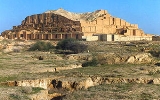
Elam

Encyclopedia
Elam was an ancient civilization located in what is now southwest Iran
. Elam was centered in the far west and the southwest of modern-day Iran, stretching from the lowlands of Khuzestan and Ilam Province
, as well as a small part of southern Iraq
. The modern name Elam is a transcription from Biblical Hebrew, corresponding to the Sumerian
elam(a), the Akkadian elamtu, and the Elamite haltamti. Elamite states were among the leading political forces of the ancient near east.
Situated just to the east of Mesopotamia
, Elam was part of the early urbanization
during the Chalcolithic period (Copper Age). The emergence of written records from around 3000 BC also parallels Mesopotamian history where writing was used slightly earlier. In the Old Elamite period (Middle Bronze Age), Elam consisted of kingdoms on the Iranian plateau
, centered in Anshan
, and from the mid-2nd millennium BC, it was centered in Susa
in the Khuzestan lowlands. Its culture played a crucial role in the Gutian Empire, especially during the Achaemenid dynasty that succeeded it, when the Elamite language
remained among those in official use. Elamite is generally treated as an isolate language.
ELAM, Akkadian
Elamû, female Elamītu "resident of Susiana, Elamite". Additionally, it is known as Elam in the Hebrew Bible
, where they are called the offspring of Elam, eldest son of Shem
(see Elam in the Bible; Genesis 10:22, Ezra
4:9).
The high country of Elam was increasingly identified by its low-lying later capital, Susa
. Geographers after Ptolemy
called it Susiana. The Elamite civilization was primarily centered in the province of what is modern-day Khuzestān and Ilam
in prehistoric times. The modern provincial name Khuzestān is derived from Persian: Old Persian Hūjiya "Elam" became Middle Persian Huź "Susiana" and New Persian Xuz, gaining the common New Persian location ending -stån "place" (cf. Sistan "Saka-land").
n (Sumer
ian, Akkadian, Assyrian
and Babylonian) sources. The history of Elam is conventionally divided into three periods, spanning more than two millennia. The period before the first Elamite period is known as the proto-Elamite period:
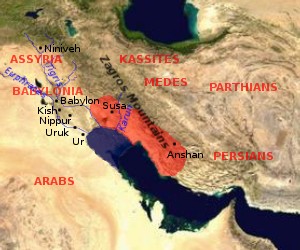 Proto-Elamite civilization grew up east of the Tigris
and Euphrates
alluvial plains; it was a combination of the lowlands and the immediate highland areas to the north and east. At least three proto-Elamite states merged to form Elam: Anshan
(modern Fars), Awan
(probably modern Luristan), and Shimashki (modern Kerman
). References to Awan are generally older than those to Anshan, and some scholars suggest that both states encompassed the same territory, in different eras. (see Hanson, Encyclopedia Iranica). To this core Shushiana
(modern Khuzestan) was periodically annexed and broken off. In addition, some Proto-Elamite sites are found well outside this area, spread out on the Iranian plateau
; such as Warakshe, Sialk (now a suburb of the modern city of Kashan
) and Jiroft
in Kerman Province. The state of Elam was formed from these lesser states as a response to invasion from Sumer during the Old Elamite period. Elamite strength was based on an ability to hold these various areas together under a coordinated government that permitted the maximum interchange of the natural resources unique to each region. Traditionally, this was done through a federated governmental structure.
The Proto-Elamite city of Susa was founded around 4000 BC in the watershed of the river Karun
. It is considered to be the site of Proto-Elamite cultural formation. During its early history, it fluctuated between submission to Mesopotamian and Elamite power. The earliest levels (22–17 in the excavations conducted by Le Brun, 1978) exhibit pottery that has no equivalent in Mesopotamia, but for the succeeding period, the excavated material allows identification with the culture of Sumer of the Uruk period
. Proto-Elamite
influence from the Persian plateau in Susa becomes visible from about 3200 BC, and texts in the still undeciphered Proto-Elamite writing system continue to be present until about 2700 BC. The Proto-Elamite period ends with the establishment of the Awan dynasty
. The earliest known historical figure connected with Elam is the king Enmebaragesi
of Kish
(c. 2650 BC?), who subdued it, according to the Sumerian king list
. Elamite history can only be traced from records dating to beginning of the Akkadian Empire in around 2300 BC onwards.
The Proto-Elamite states in Jiroft and Zabol, present a special case because of their great antiquity. Archaeologists have suggested that a close relationship between the Jiroft civilisation and the Elamite civilisation is evidenced by striking similarities in art and culture, as well as by Elamite language writings found in Jiroft—possibly extending the Elamite presence to as early as 7000 BC.
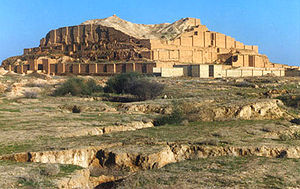
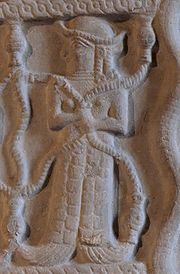

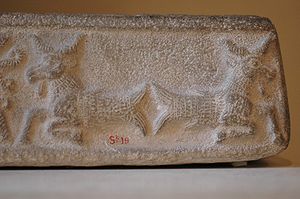
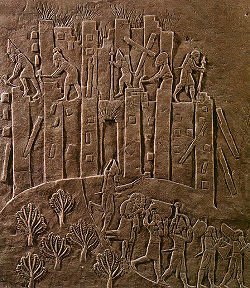
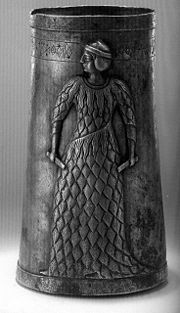 The Old Elamite period began around 2700 BC. Historical records mention the conquest of Elam by Enmebaragesi the Sumerian king of Kish. Three dynasties ruled during this period. We know of twelve kings of each of the first two dynasties, those of Awan (or Avan; c. 2400–2100 BC) and Simash (c. 2100–1970 BC), from a list from Susa dating to the Old Babylonian period
. Two Elamite dynasties said to have exercised brief control over parts of Sumer in very early times include Awan and Hamazi
; and likewise, several of the stronger Sumerian rulers, such as Eannatum
of Lagash and Lugal-anne-mundu
of Adab
, are recorded as temporarily dominating Elam.
The Avan dynasty was partly contemporary with that of Sargon of Akkad
, who not only defeated the Awan king Luhi-ishan and subjected Susa, but attempted to make Akkadian the official language there. From this time, Mesopotamian sources concerning Elam become more frequent, since the Mesopotamians had developed an interest in resources (such as wood, stone, and metal) from the Iranian plateau, and military expeditions to the area became more common. With the collapse of Akkad under Sargon's great-grandson, Shar-kali-sharri
, Elam declared independence under the last Avan king, Kutik-Inshushinak
(c. 2240–2220 BC), and threw off the Akkadian language, promoting in its place the brief Linear Elamite
script. Kutik-Inshushinnak conquered Susa and Anshan, and seems to have achieved some sort of political unity. Following his reign, the Awan dynasty collapsed as Elam was temporarily overrun by the Guti
.
About a century later, the Sumerian king, Shulgi
of Ur
retook the city of Susa and the surrounding region. During the first part of the rule of the Simashki dynasty, Elam was under intermittent attack from Mesopotamians and Gutians, alternating with periods of peace and diplomatic approaches. Shu-Sin
of Ur, for example, gave one of his daughters in marriage to a prince of Anshan. But the power of the Sumerians was waning; Ibbi-Sin
in the 21st century did not manage to penetrate far into Elam, and in 2004 BC, the Elamites, allied with the people of Susa and led by king Kindattu, the sixth king of Simashk, managed to sack Ur and lead Ibbi-Sin into captivity—thus ending the third dynasty of Ur
. The kings of Isin
, successor state to Ur, did manage to drive the Elamites out of Ur, rebuild the city, and to return the statue of Nanna
that the Elamites had plundered.
The succeeding dynasty, the Eparti (c. 1970–1770 BC), also called "of the sukkalmahs" because of the title borne by its members, was contemporary with the Old Babylonian period in Mesopotamia. This period is confusing and difficult to reconstruct. It was apparently founded by Eparti I. During this time, Susa was under Elamite control, but Mesopotamian states such as Larsa
continually tried to retake the city. Around 1850 BC Kudur-mabug, apparently king of another Sumerian state to the north of Larsa, managed to install his son, Warad-Sin
, on the throne of Larsa, and Warad-Sin's brother, Rim-Sin, succeeded him and conquered much of Mesopotamia for Larsa.
Notable Eparti dynasty rulers in Elam during this time include Sirukdukh (c. 1850 BC), who entered various military coalitions to contain the rising power of Babylon
; Siwe-Palar-Khuppak, who for some time was the most powerful person in the area, respectfully addressed as "Father" by Mesopotamian kings such as Zimrilim
of Mari
, and even Hammurabi
of Babylon, and Kudur-Nahhunte, who plundered the temples of Akkad. But Elamite influence in Mesopotamia did not last. Around 1760 BC, Hammurabi drove out the Elamites, overthrew Rim-Sin of Larsa, and established Babylonian dominance in Mesopotamia. Little is known about the latter part of this dynasty, since sources again become sparse with the Kassite
rule of Babylon (from c. 1595 BC).
temporarily occupied Elam c. 1320 BC, and later (c. 1230) another Kassite king, Kashtiliash IV
, fought Elam unsuccessfully. Kiddin-Khutran I of Elam repulsed the Kassites by defeating Enlil-nadin-shumi in 1224 and Adad-shuma-iddina around 1222–1217. Under the Igehalkids, Akkadian inscriptions were rare, and Elamite highland gods became firmly established in Susa.
, the Stele of Hammurabi
and the stele
of Naram-Sin. In 1158 BC, Shutruk-Nakhkhunte defeated the Kassites permanently, killing the Kassite king of Babylon, Zababa-shuma-iddina, and replacing him with his eldest son, Kutir-Nakhkhunte, who held it no more than three years.
Kutir-Nakhkhunte's son Khutelutush-In-Shushinak was probably of an incestuous relation of Kutir-Nakhkhunte's with his own daughter, Nakhkhunte-utu. He was defeated by Nebuchadnezzar I of Babylon, who sacked Susa and returned the statue of Marduk. He fled to Anshan, but later returned to Susa, and his brother Shilhana-Hamru-Lagamar may have succeeded him as last king of the Shutrukid dynasty. Following Khutelutush-In-Shushinak, the power of the Elamite empire began to wane seriously, for with this ruler, Elam disappears into obscurity for more than three centuries.
(823–811).
to the Iranian plateau. Assyrian sources beginning around 800 BC distinguish the "powerful Medes", i.e. the actual Medes
,(Parthians, Sagartians, Margians, Bactrians
, Sogdians etc.). Among these pressuring tribes were the Parsu
, first recorded in 844 BC as living on the southeastern shore of Lake Urmiah, but who by the end of this period would cause the Elamites' original home, the Iranian Plateau, to be renamed Persia proper. These newly arrived Iranic peoples were largely regarded as vassals of the Neo-Assyrian Empire until the late 7th Century BC.
More details are known from the late 8th century BC, when the Elamites were allied with the Chaldea
n chieftain Merodach-baladan to defend the cause of Babylonian independence from Assyria. Khumbanigash (743–717) supported Merodach-baladan against Sargon II
, apparently without success; while his successor, Shutruk-Nakhkhunte II (716–699), was routed by Sargon's troops during an expedition in 710, and another Elamite defeat by Sargon's troops is recorded for 708. The Assyrian dominion over Babylon was underlined by Sargon's son Sennacherib
, who defeated the Elamites and Babylonians and dethroned Merodach-baladan for a second time, finally installing his own son Ashur-nadin-shumi
on the Babylonian throne in 700.
Shutruk-Nakhkhunte II, the last Elamite to claim the old title "king of Anshan and Susa", was murdered by his brother Khallushu, who managed to capture the Assyrian governor of Babylonia Ashur-nadin-shumi and the city Babylon in 694. Sennacherib
avenged this by ravaging Elam in 694 BC. Khallushu was in turn assassinated by Kutir-Nakhkhunte, who succeeded him, but soon abdicated in favor of Khumma-Menanu III (692–689). Khumma-Menanu recruited a new army to help the Babylonians against the Assyrians at the battle of Halule
in 691 BC. Both sides claimed the victory in their annals, but Babylon was destroyed by Sennacherib only two years later, and their Elamite allies defeated in the process.
The reigns of Khumma-Khaldash I (688–681) and Khumma-Khaldash II (680–675) saw a deterioration of Elamite-Babylonian relations, and both of them raided Sippar
. At the beginning of Esarhaddon
's reign in Assyria (681–669), Nabu-zer-kitti-lišir, an ethnically Elamite governor in the south of Babylonia, revolted and besieged Ur, but was routed by the Assyrians fled to Elam where the king of Elam, fearing Assyrian reprecussions, took him prisoner and put him to the sword (ABC 1 Col.3:39–42).
Urtaku
(674–664) for some time maintained good relations with Ashurbanipal
(668–627), who sent wheat to Susiana during a famine. But these friendly relations were only temporary, and Urtaku was killed in battle during a failed Elamite attack on Assyria.
His successor Tempti-Khumma-In-Shushinak (664–653) attacked Assyria, but was defeated and killed by Ashurbanipal
following the battle of the Ulaï
in 653 BC; and Susa
was sacked and occupied by the Assyrians. In this same year the Assyrian vassal Mede state to the north fell to the Scythians under Madius, immediately displacing another Assyrian vassal people, the Parsu (Persian) tribe to Anshan which their king Teispes captured that same year, turning it for the first time into an Indo-Iranian
kingdom under Assyrian dominance that would a century later become the nucleus of the Achaemenid dynasty. The Assyrians successfully drove the Scythians from their Iranian colonies.
During a brief respite provided by the civil war between Ashurbanipal and his brother Shamash-shum-ukin
, the Elamites too indulged in fighting among themselves, so weakening the Elamite kingdom that in 646 BC Ashurbanipal devastated Susiana with ease, and sacked Susa. A succession of brief reigns continued in Elam from 651 to 640, each of them ended either due to usurpation, or because of capture of their king by the Assyrians. In this manner, the last Elamite king, Khumma-Khaldash III, was captured in 640 BC by Ashurbanipal, who annexed and destroyed the country.
In a tablet unearthed in 1854 by Henry Austin Layard, Ashurbanipal boasts of the destruction he had wrought:
in 587 BC:
Their successors Khumma-Menanu and Shilhak-In-Shushinak II bore the simple title "king", and the final king Tempti-Khumma-In-Shushinak boasted no title altogether. In 540 BC, Achaemenid rule begins in Susa.
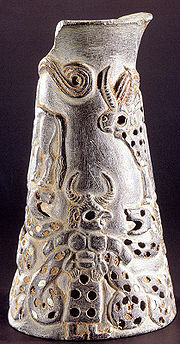 The Elamites practised polytheism
. Knowledge about their religion is scant, but at one point they had a pantheon of gods headed by the god Khumban
. Other deities included the goddess Kiririsha
and the gods Inshushinak
and Jabru
. There is a mention of Susha as a beautiful city of Varuna
in Matsya Purana
. Moreover, in Rig Veda it is mentioned that Sage Vasishta visited by sea a great thousand gated temple of Varuna (called Susha). Some scholars believe that there was a cultural and religious exchange between Elam and India.
, and completely unrelated to the neighbouring Semitic
, Sumerian, and the later Iranian languages
that came to dominate the region. It was written in a cuneiform adapted from the Semitic Akkadian script, although the very earliest documents were written in the quite different "Linear Elamite" script. In 2006, two even older inscriptions in a similar script were discovered at Jiroft to the east, leading archaeologists to speculate that Linear Elamite had spread from there to Susa. It seems to have developed from an even earlier writing known as "proto-Elamite", but scholars are not unanimous on whether or not this script was used to write Elamite or another language, and it has not yet been deciphered. Several stages of the language are attested; the earliest date back to the third millennium BC, the latest to the Achaemenid Empire.
The Elamite language may have survived as late as the early Islamic period. Ibn al-Nadim
among other Islamic medieval historians, for instance, wrote that "The Iranian languages are Fahlavi (Pahlavi), Dari, Khuzi, Persian and Suryani (Assyrian
/Syriac)", and Ibn Moqaffa
noted that Khuzi was the unofficial language of the royalty of Persia, "Khuz" being the corrupted name for Elam.
languages, in contrast to those who denote it as a language isolate. David McAlpine believes Elamite may be related to the living Dravidian languages. The hypothesis is considered under the rubric of Elamo-Dravidian languages
.
 The Assyrians had utterly destroyed the Elamite nation, but new polities emerged in the area after Assyrian power faded. Among the nations that benefited from the decline of the Assyrians were the Iranian tribes, whose presence around Lake Urmia
to the north of Elam is attested from the 9th century BC in Assyrian texts. Some time after that region fell to Madius the Scythian (653 BC), Teispes son of Achaemenes
conquered Elamite Anshan in the mid 7th century BC, forming a nucleus that would expand into the Persian Empire. They were largely regarded as vassals of the Assyrians, and the Medes, Mannaeans
and Persians paid tribute to Assyria from the 10th century BC until the death of Ashurbanipal
in 627 BC. After his death the Medes played a major role in the destruction of the weakened Assyrian Empire in 612 BC.
The rise of the Achaemenids in the 6th century BC brought an end to the existence of Elam as an independent political power "but not as a cultural entity" (Encyclopædia Iranica, Columbia University
). Indigenous Elamite traditions, such as the use of the title "king of Anshan" by Cyrus the Great
; the "Elamite robe" worn by Cambyses I of Anshan
and seen on the famous winged genii at Pasargadae
; some glyptic styles; the use of Elamite as the first of three official languages of the empire used in thousands of administrative texts found at Darius’ city of Persepolis
; the continued worship of Elamite deities; and the persistence of Elamite religious personnel and cults supported by the crown, formed an essential part of the newly emerging Achaemenid culture in Persian Iran. The Elamites thus became the conduit by which achievements of the Mesopotamian civilizations were introduced to the tribes of the Iranian plateau.
Conversely, Elamites had "absorbed Iranian influences in both structure and vocabulary" by 500 BC,
suggesting a form of cultural continuity or fusion connecting the Elamite and the Persian periods.
The name of "Elam" survived into the Hellenistic period
and beyond. In its Greek form, Elymais
, it emerges as designating a semi-independent state under Parthia
n suzerainty during the 2nd century BC to the early 3rd century AD. In Acts
2:8-9 in the New Testament
, the language of the Elamitēs is one of the languages heard at the Pentecost
. From 410 onwards Elam
(Beth Huzaye) was the senior metropolitan province of the Church of the East
, surviving into the 14th century.
Iran
Iran , officially the Islamic Republic of Iran , is a country in Southern and Western Asia. The name "Iran" has been in use natively since the Sassanian era and came into use internationally in 1935, before which the country was known to the Western world as Persia...
. Elam was centered in the far west and the southwest of modern-day Iran, stretching from the lowlands of Khuzestan and Ilam Province
Ilam Province
Ilam Province is one of the 31 provinces of Iran. It is in the south-west of the country, bordering Iraq. Its provincial center is the city of Ilam. Covering an area of 19,086 square kilometers, the cities of the province are Ilam, Mehran, Dehloran, Dareh Shahr, Sarable, Eyvan, Abdanan and Arkwaz...
, as well as a small part of southern Iraq
Iraq
Iraq ; officially the Republic of Iraq is a country in Western Asia spanning most of the northwestern end of the Zagros mountain range, the eastern part of the Syrian Desert and the northern part of the Arabian Desert....
. The modern name Elam is a transcription from Biblical Hebrew, corresponding to the Sumerian
Sumerian language
Sumerian is the language of ancient Sumer, which was spoken in southern Mesopotamia since at least the 4th millennium BC. During the 3rd millennium BC, there developed a very intimate cultural symbiosis between the Sumerians and the Akkadians, which included widespread bilingualism...
elam(a), the Akkadian elamtu, and the Elamite haltamti. Elamite states were among the leading political forces of the ancient near east.
Situated just to the east of Mesopotamia
Mesopotamia
Mesopotamia is a toponym for the area of the Tigris–Euphrates river system, largely corresponding to modern-day Iraq, northeastern Syria, southeastern Turkey and southwestern Iran.Widely considered to be the cradle of civilization, Bronze Age Mesopotamia included Sumer and the...
, Elam was part of the early urbanization
Cities of the ancient Near East
The largest cities in the Bronze Age ancient Near East housed several tens of thousands. Memphis in the Early Bronze Age with some 30,000 inhabitants was the largest city of the time by far...
during the Chalcolithic period (Copper Age). The emergence of written records from around 3000 BC also parallels Mesopotamian history where writing was used slightly earlier. In the Old Elamite period (Middle Bronze Age), Elam consisted of kingdoms on the Iranian plateau
Iranian plateau
The Iranian plateau, or Iranic plateau, is a geological formation in Southwest Asia. It is the part of the Eurasian Plate wedged between the Arabian and Indian plates, situated between the Zagros mountains to the west, the Caspian Sea and the Kopet Dag to the north, the Hormuz Strait and Persian...
, centered in Anshan
Anshan (Persia)
Anshan - History :Before 1973, when it was identified as Tall-i Malyan, Anshan had been assumed by scholars to be somewhere in the central Zagros mountain range....
, and from the mid-2nd millennium BC, it was centered in Susa
Susa
Susa was an ancient city of the Elamite, Persian and Parthian empires of Iran. It is located in the lower Zagros Mountains about east of the Tigris River, between the Karkheh and Dez Rivers....
in the Khuzestan lowlands. Its culture played a crucial role in the Gutian Empire, especially during the Achaemenid dynasty that succeeded it, when the Elamite language
Elamite language
Elamite is an extinct language spoken by the ancient Elamites. Elamite was the primary language in present day Iran from 2800–550 BCE. The last written records in Elamite appear about the time of the conquest of the Persian Empire by Alexander the Great....
remained among those in official use. Elamite is generally treated as an isolate language.
Etymology
The Elamites called their country Haltamti, SumerianSumerian language
Sumerian is the language of ancient Sumer, which was spoken in southern Mesopotamia since at least the 4th millennium BC. During the 3rd millennium BC, there developed a very intimate cultural symbiosis between the Sumerians and the Akkadians, which included widespread bilingualism...
ELAM, Akkadian
Akkadian language
Akkadian is an extinct Semitic language that was spoken in ancient Mesopotamia. The earliest attested Semitic language, it used the cuneiform writing system derived ultimately from ancient Sumerian, an unrelated language isolate...
Elamû, female Elamītu "resident of Susiana, Elamite". Additionally, it is known as Elam in the Hebrew Bible
Hebrew Bible
The Hebrew Bible is a term used by biblical scholars outside of Judaism to refer to the Tanakh , a canonical collection of Jewish texts, and the common textual antecedent of the several canonical editions of the Christian Old Testament...
, where they are called the offspring of Elam, eldest son of Shem
Shem
Shem was one of the sons of Noah in the Hebrew Bible as well as in Islamic literature. He is most popularly regarded as the eldest son, though some traditions regard him as the second son. Genesis 10:21 refers to relative ages of Shem and his brother Japheth, but with sufficient ambiguity in each...
(see Elam in the Bible; Genesis 10:22, Ezra
Book of Ezra
The Book of Ezra is a book of the Hebrew Bible. Originally combined with the Book of Nehemiah in a single book of Ezra-Nehemiah, the two became separated in the early centuries of the Christian era...
4:9).
The high country of Elam was increasingly identified by its low-lying later capital, Susa
Susa
Susa was an ancient city of the Elamite, Persian and Parthian empires of Iran. It is located in the lower Zagros Mountains about east of the Tigris River, between the Karkheh and Dez Rivers....
. Geographers after Ptolemy
Ptolemy
Claudius Ptolemy , was a Roman citizen of Egypt who wrote in Greek. He was a mathematician, astronomer, geographer, astrologer, and poet of a single epigram in the Greek Anthology. He lived in Egypt under Roman rule, and is believed to have been born in the town of Ptolemais Hermiou in the...
called it Susiana. The Elamite civilization was primarily centered in the province of what is modern-day Khuzestān and Ilam
Ilam Province
Ilam Province is one of the 31 provinces of Iran. It is in the south-west of the country, bordering Iraq. Its provincial center is the city of Ilam. Covering an area of 19,086 square kilometers, the cities of the province are Ilam, Mehran, Dehloran, Dareh Shahr, Sarable, Eyvan, Abdanan and Arkwaz...
in prehistoric times. The modern provincial name Khuzestān is derived from Persian: Old Persian Hūjiya "Elam" became Middle Persian Huź "Susiana" and New Persian Xuz, gaining the common New Persian location ending -stån "place" (cf. Sistan "Saka-land").
History
Knowledge of Elamite history remains largely fragmentary, reconstruction being based on mainly MesopotamiaMesopotamia
Mesopotamia is a toponym for the area of the Tigris–Euphrates river system, largely corresponding to modern-day Iraq, northeastern Syria, southeastern Turkey and southwestern Iran.Widely considered to be the cradle of civilization, Bronze Age Mesopotamia included Sumer and the...
n (Sumer
Sumer
Sumer was a civilization and historical region in southern Mesopotamia, modern Iraq during the Chalcolithic and Early Bronze Age....
ian, Akkadian, Assyrian
Assyria
Assyria was a Semitic Akkadian kingdom, extant as a nation state from the mid–23rd century BC to 608 BC centred on the Upper Tigris river, in northern Mesopotamia , that came to rule regional empires a number of times through history. It was named for its original capital, the ancient city of Assur...
and Babylonian) sources. The history of Elam is conventionally divided into three periods, spanning more than two millennia. The period before the first Elamite period is known as the proto-Elamite period:
- Proto-Elamite: c. 3200 BC – 2700 BC (Proto-Elamite script in Susa)
- Old Elamite period: c. 2700 BC – 1600 BC (earliest documents until the Eparti dynasty)
- Middle Elamite period: c. 1500 BC – 1100 BC (Anzanite dynasty until the Babylonian invasion of Susa)
- Neo-Elamite period: c. 1100 BC – 539 BC (characterized Assyrian and Median influence. 539 BC marks the beginning of the Achaemenid period)
Proto-Elamite
Tigris
The Tigris River is the eastern member of the two great rivers that define Mesopotamia, the other being the Euphrates. The river flows south from the mountains of southeastern Turkey through Iraq.-Geography:...
and Euphrates
Euphrates
The Euphrates is the longest and one of the most historically important rivers of Western Asia. Together with the Tigris, it is one of the two defining rivers of Mesopotamia...
alluvial plains; it was a combination of the lowlands and the immediate highland areas to the north and east. At least three proto-Elamite states merged to form Elam: Anshan
Anshan (Persia)
Anshan - History :Before 1973, when it was identified as Tall-i Malyan, Anshan had been assumed by scholars to be somewhere in the central Zagros mountain range....
(modern Fars), Awan
Awan dynasty
The Awan Dynasty was the first dynasty of Elam of which anything is known today, appearing at the dawn of historical record. The Elamites were likely major rivals of neighboring Sumer from remotest antiquity; they were said to have been defeated by Enmebaragesi of Kish The Awan Dynasty was the...
(probably modern Luristan), and Shimashki (modern Kerman
Kerman
- Geological characteristics :For the Iranian paleontologists, Kerman has always been considered a fossil paradise. Finding new dinosaur footprints in 2005 has now revealed new hopes for paleontologists to better understand the history of this area.- Economy :...
). References to Awan are generally older than those to Anshan, and some scholars suggest that both states encompassed the same territory, in different eras. (see Hanson, Encyclopedia Iranica). To this core Shushiana
Susa
Susa was an ancient city of the Elamite, Persian and Parthian empires of Iran. It is located in the lower Zagros Mountains about east of the Tigris River, between the Karkheh and Dez Rivers....
(modern Khuzestan) was periodically annexed and broken off. In addition, some Proto-Elamite sites are found well outside this area, spread out on the Iranian plateau
Iranian plateau
The Iranian plateau, or Iranic plateau, is a geological formation in Southwest Asia. It is the part of the Eurasian Plate wedged between the Arabian and Indian plates, situated between the Zagros mountains to the west, the Caspian Sea and the Kopet Dag to the north, the Hormuz Strait and Persian...
; such as Warakshe, Sialk (now a suburb of the modern city of Kashan
Kashan
Kashan is a city in and the capital of Kashan County, in the province of Isfahan, Iran. At the 2006 census, its population was 248,789, in 67,464 families....
) and Jiroft
Jiroft
Jiroft is a city in and the capital of Jiroft County, Kerman Province, Iran. At the 2006 census, its population was 95,031, in 19,926 families. It is located south of the city of Kerman, and south of Tehran along Road 91...
in Kerman Province. The state of Elam was formed from these lesser states as a response to invasion from Sumer during the Old Elamite period. Elamite strength was based on an ability to hold these various areas together under a coordinated government that permitted the maximum interchange of the natural resources unique to each region. Traditionally, this was done through a federated governmental structure.
The Proto-Elamite city of Susa was founded around 4000 BC in the watershed of the river Karun
Karun
The Kārun is Iran's most effluent, and the only navigable, river. It is 450 miles long. It rises in the Zard Kuh mountains of the Bakhtiari district in the Zagros Range, receiving many tributaries, such as the Dez and the Kuhrang, before passing through the capital of the Khuzestan Province of...
. It is considered to be the site of Proto-Elamite cultural formation. During its early history, it fluctuated between submission to Mesopotamian and Elamite power. The earliest levels (22–17 in the excavations conducted by Le Brun, 1978) exhibit pottery that has no equivalent in Mesopotamia, but for the succeeding period, the excavated material allows identification with the culture of Sumer of the Uruk period
Uruk period
The Uruk period existed from the protohistoric Chalcolithic to Early Bronze Age period in the history of Mesopotamia, following the Ubaid period and succeeded by the Jemdet Nasr period. Named after the Sumerian city of Uruk, this period saw the emergence of urban life in Mesopotamia. It was...
. Proto-Elamite
Proto-Elamite
The Proto-Elamite period is the time of ca. 3200 BC to 2700 BC when Susa, the later capital of the Elamites, began to receive influence from the cultures of the Iranian plateau. In archaeological terms this corresponds to the late Banesh period...
influence from the Persian plateau in Susa becomes visible from about 3200 BC, and texts in the still undeciphered Proto-Elamite writing system continue to be present until about 2700 BC. The Proto-Elamite period ends with the establishment of the Awan dynasty
Awan dynasty
The Awan Dynasty was the first dynasty of Elam of which anything is known today, appearing at the dawn of historical record. The Elamites were likely major rivals of neighboring Sumer from remotest antiquity; they were said to have been defeated by Enmebaragesi of Kish The Awan Dynasty was the...
. The earliest known historical figure connected with Elam is the king Enmebaragesi
Enmebaragesi
Enmebaragesi was a king of Kish, according to the Sumerian king list. The list states that he subdued Elam, reigned 900 years, and was captured single-handedly by Dumuzid "the fisherman" of Kuara, predecessor of Gilgamesh.He is the earliest ruler on the king list whose name is attested directly...
of Kish
Kish (Sumer)
Kish is modern Tell al-Uhaymir , and was an ancient city of Sumer. Kish is located some 12 km east of Babylon, and 80 km south of Baghdad ....
(c. 2650 BC?), who subdued it, according to the Sumerian king list
Sumerian king list
The Sumerian King List is an ancient manuscript originally recorded in the Sumerian language, listing kings of Sumer from Sumerian and neighboring dynasties, their supposed reign lengths, and the locations of "official" kingship...
. Elamite history can only be traced from records dating to beginning of the Akkadian Empire in around 2300 BC onwards.
The Proto-Elamite states in Jiroft and Zabol, present a special case because of their great antiquity. Archaeologists have suggested that a close relationship between the Jiroft civilisation and the Elamite civilisation is evidenced by striking similarities in art and culture, as well as by Elamite language writings found in Jiroft—possibly extending the Elamite presence to as early as 7000 BC.
Old Elamite Period
First Babylonian Dynasty
The chronology of the first dynasty of Babylonia is debated as there is a Babylonian King List A and a Babylonian King List B. In this chronology, the regnal years of List A are used due to their wide usage...
. Two Elamite dynasties said to have exercised brief control over parts of Sumer in very early times include Awan and Hamazi
Hamazi
Hamazi or Khamazi was an ancient kingdom or city-state of some importance that reached its peak ca. 2500-2400 BC...
; and likewise, several of the stronger Sumerian rulers, such as Eannatum
Eannatum
Eannatum was a Sumerian king of Lagash who established one of the first verifiable empires in history. One inscription of his, found on a boulder, states that Eannatum was his Sumerian name, while his "Tidnu" name was Lumma.-Conquest of Sumer:...
of Lagash and Lugal-anne-mundu
Lugal-Anne-Mundu
Lugal-Anne-Mundu was the most important king of the city-state Adab in Sumer. The Sumerian king list claims he reigned for 90 years, following the defeat of Meskiaj-nanna of Ur...
of Adab
Adab
Adab or Udab was an ancient Sumerian city between Telloh and Nippur. It was located at the site of modern Bismaya or Bismya in the Wasit Governorate of Iraq.-History:...
, are recorded as temporarily dominating Elam.
The Avan dynasty was partly contemporary with that of Sargon of Akkad
Sargon of Akkad
Sargon of Akkad, also known as Sargon the Great "the Great King" , was an Akkadian emperor famous for his conquest of the Sumerian city-states in the 23rd and 22nd centuries BC. The founder of the Dynasty of Akkad, Sargon reigned in the last quarter of the third millennium BC...
, who not only defeated the Awan king Luhi-ishan and subjected Susa, but attempted to make Akkadian the official language there. From this time, Mesopotamian sources concerning Elam become more frequent, since the Mesopotamians had developed an interest in resources (such as wood, stone, and metal) from the Iranian plateau, and military expeditions to the area became more common. With the collapse of Akkad under Sargon's great-grandson, Shar-kali-sharri
Shar-Kali-Sharri
Shar-Kali-Sharri was a king of the Akkadian Empire.According to the Sumerian king list, he was the son of Naram-sin and reigned for 25 years - around 2100 BC...
, Elam declared independence under the last Avan king, Kutik-Inshushinak
Kutik-Inshushinak
Kutik-Inshushinak was king of Elam from about 2240 to 2220 BC , and the last from the Awan dynasty....
(c. 2240–2220 BC), and threw off the Akkadian language, promoting in its place the brief Linear Elamite
Linear Elamite
Linear Elamite is a Bronze Age writing system used in Elam, known from a few monumental inscriptions only. It was used contemporarily with Elamite Cuneiform and likely records the Elamite language....
script. Kutik-Inshushinnak conquered Susa and Anshan, and seems to have achieved some sort of political unity. Following his reign, the Awan dynasty collapsed as Elam was temporarily overrun by the Guti
Guti (Mesopotamia)
The Gutian dynasty came to power in Mesopotamia around 2150 BC , by destabilising Akkad, according to the Sumerian kinglist at the end of the reign of king Ur-Utu of Uruk. They reigned for perhaps around one century...
.
About a century later, the Sumerian king, Shulgi
Shulgi
Shulgi of Urim was the second king of the "Sumerian Renaissance". He reigned for 48 years, dated to 2029 BCE–1982 BCE...
of Ur
Ur
Ur was an important city-state in ancient Sumer located at the site of modern Tell el-Muqayyar in Iraq's Dhi Qar Governorate...
retook the city of Susa and the surrounding region. During the first part of the rule of the Simashki dynasty, Elam was under intermittent attack from Mesopotamians and Gutians, alternating with periods of peace and diplomatic approaches. Shu-Sin
Shu-Sin
Shu-sin was king of Sumer and Akkad, and was the penultimate king of the Ur III dynasty. He succeeded his brother Amar-Sin, and reigned circa 1972-1964 BC....
of Ur, for example, gave one of his daughters in marriage to a prince of Anshan. But the power of the Sumerians was waning; Ibbi-Sin
Ibbi-Sin
Ibbi-Sin, son of Shu-Sin, was king of Sumer and Akkad and last king of the Ur III dynasty, and reigned circa 1963 BC-1940 BC . During his reign, the Sumerian empire was attacked repeatedly by Amorites...
in the 21st century did not manage to penetrate far into Elam, and in 2004 BC, the Elamites, allied with the people of Susa and led by king Kindattu, the sixth king of Simashk, managed to sack Ur and lead Ibbi-Sin into captivity—thus ending the third dynasty of Ur
Third Dynasty of Ur
The Third Dynasty of Ur, also known as the Neo-Sumerian Empire or the Ur III Empire refers simultaneously to a 21st to 20th century BC Sumerian ruling dynasty based in the city of Ur and a short-lived territorial-political state that some historians regard as a nascent empire...
. The kings of Isin
Isin
Isin was an ancient city-state of lower Mesopotamia about 20 miles south of Nippur at the site of modern Ishan al-Bahriyat in Iraq's Al-Qādisiyyah Governorate.-History:...
, successor state to Ur, did manage to drive the Elamites out of Ur, rebuild the city, and to return the statue of Nanna
Nanna
-Mythology:* Nanna or Sin , god of the moon in Sumerian mythology, also called Suen* Nanna , goddess and wife of the god Baldr in Norse mythology-People:* Nanna , a Scandinavian female name...
that the Elamites had plundered.
The succeeding dynasty, the Eparti (c. 1970–1770 BC), also called "of the sukkalmahs" because of the title borne by its members, was contemporary with the Old Babylonian period in Mesopotamia. This period is confusing and difficult to reconstruct. It was apparently founded by Eparti I. During this time, Susa was under Elamite control, but Mesopotamian states such as Larsa
Larsa
Larsa was an important city of ancient Sumer, the center of the cult of the sun god Utu. It lies some 25 km southeast of Uruk in Iraq's Dhi Qar Governorate, near the east bank of the Shatt-en-Nil canal at the site of the modern settlement Tell as-Senkereh or Sankarah.-History:According to...
continually tried to retake the city. Around 1850 BC Kudur-mabug, apparently king of another Sumerian state to the north of Larsa, managed to install his son, Warad-Sin
Warad-Sin
Warad-Sin ruled the ancient Near East city-stateof Larsa from 1770 BC to 1758 BC. There are indications that hisfather Kudur-Mabuk was co-regent or at very least the power behind thethrone. His sister En-ane-du was high priestess of the moon god in Ur....
, on the throne of Larsa, and Warad-Sin's brother, Rim-Sin, succeeded him and conquered much of Mesopotamia for Larsa.
Notable Eparti dynasty rulers in Elam during this time include Sirukdukh (c. 1850 BC), who entered various military coalitions to contain the rising power of Babylon
Babylon
Babylon was an Akkadian city-state of ancient Mesopotamia, the remains of which are found in present-day Al Hillah, Babil Province, Iraq, about 85 kilometers south of Baghdad...
; Siwe-Palar-Khuppak, who for some time was the most powerful person in the area, respectfully addressed as "Father" by Mesopotamian kings such as Zimrilim
Zimrilim
Zimrilim was king of Mari from about 1775 to 1761 BCE.He was the son or grandson of Iakhdunlim, but was forced to flee to Yamkhad when his father was assassinated by his own servants during a coup. The city was occupied by Shamshi-Adad I, the king of Assur, who put his own son Yasmah-Adad on the...
of Mari
Mari, Syria
Mari was an ancient Sumerian and Amorite city, located 11 kilometers north-west of the modern town of Abu Kamal on the western bank of Euphrates river, some 120 km southeast of Deir ez-Zor, Syria...
, and even Hammurabi
Hammurabi
Hammurabi Hammurabi Hammurabi (Akkadian from Amorite ʻAmmurāpi, "the kinsman is a healer", from ʻAmmu, "paternal kinsman", and Rāpi, "healer"; (died c...
of Babylon, and Kudur-Nahhunte, who plundered the temples of Akkad. But Elamite influence in Mesopotamia did not last. Around 1760 BC, Hammurabi drove out the Elamites, overthrew Rim-Sin of Larsa, and established Babylonian dominance in Mesopotamia. Little is known about the latter part of this dynasty, since sources again become sparse with the Kassite
Kassites
The Kassites were an ancient Near Eastern people who gained control of Babylonia after the fall of the Old Babylonian Empire after ca. 1531 BC to ca. 1155 BC...
rule of Babylon (from c. 1595 BC).
Anshan and Susa
The Middle Elamite period began with the rise of the Anshanite dynasties around 1500 BC. Their rule was characterized by an "Elamisation" of Susa, and the kings took the title "king of Anshan and Susa". While the first of these dynasties, the Kidinuids continued to use the Akkadian language frequently in their inscriptions, the succeeding Igihalkids and Shutrukids used Elamite with increasing regularity. Likewise, Elamite language and culture grew in importance in Susiana. The Kidinuids (c. 1500–1400) are a group of five rulers of uncertain affiliation. They are identified by their use of the older title, "king of Susa and of Anshan", and by calling themselves "servant of Kirwashir", an Elamite deity, thereby introducing the pantheon of the highlands to Susiana.Kassite invasions
Of the Igehalkids (c. 1400–1210), ten rulers are known, and there were possibly more. Some of them married Kassite princesses. The Kassite king of Babylon Kurigalzu IIKurigalzu II
Kurigalzu II was the twenty second king of the Kassite dynasty that ruled over Babylon. In more than twelve inscriptions, Kurigalzu names Burna-Buriaš II as his father...
temporarily occupied Elam c. 1320 BC, and later (c. 1230) another Kassite king, Kashtiliash IV
Kaštiliaš IV
Kaštiliašu IV was the twenty-eighth Kassite king of Babylon and the kingdom contemporarily known as Kar-Duniaš, ca. 1232 BC – 1225 BC...
, fought Elam unsuccessfully. Kiddin-Khutran I of Elam repulsed the Kassites by defeating Enlil-nadin-shumi in 1224 and Adad-shuma-iddina around 1222–1217. Under the Igehalkids, Akkadian inscriptions were rare, and Elamite highland gods became firmly established in Susa.
Elamite Empire
Under the Shutrukids (c. 1210–1100), the Elamite empire reached the height of its power. Shutruk-Nakhkhunte and his three sons, Kutir-Nakhkhunte II, Shilhak-In-Shushinak, and Khutelutush-In-Shushinak were capable of frequent military campaigns into Kassite Babylonia, and at the same time were exhibiting vigorous construction activity—building and restoring luxurious temples in Susa and across their Empire. Shutruk-Nakhkhunte raided Babylonia, carrying home to Susa trophies like the statues of Marduk and Manishtushu, the Manishtushu ObeliskManishtushu Obelisk
The Manishtushu Obelisk is a diorite, four-sided stele. The stele is obelisk-shaped, as well as it narrows upward to its top, in a pyramidal-form...
, the Stele of Hammurabi
Code of Hammurabi
The Code of Hammurabi is a well-preserved Babylonian law code, dating to ca. 1780 BC . It is one of the oldest deciphered writings of significant length in the world. The sixth Babylonian king, Hammurabi, enacted the code, and partial copies exist on a human-sized stone stele and various clay...
and the stele
Stele
A stele , also stela , is a stone or wooden slab, generally taller than it is wide, erected for funerals or commemorative purposes, most usually decorated with the names and titles of the deceased or living — inscribed, carved in relief , or painted onto the slab...
of Naram-Sin. In 1158 BC, Shutruk-Nakhkhunte defeated the Kassites permanently, killing the Kassite king of Babylon, Zababa-shuma-iddina, and replacing him with his eldest son, Kutir-Nakhkhunte, who held it no more than three years.
Kutir-Nakhkhunte's son Khutelutush-In-Shushinak was probably of an incestuous relation of Kutir-Nakhkhunte's with his own daughter, Nakhkhunte-utu. He was defeated by Nebuchadnezzar I of Babylon, who sacked Susa and returned the statue of Marduk. He fled to Anshan, but later returned to Susa, and his brother Shilhana-Hamru-Lagamar may have succeeded him as last king of the Shutrukid dynasty. Following Khutelutush-In-Shushinak, the power of the Elamite empire began to wane seriously, for with this ruler, Elam disappears into obscurity for more than three centuries.
Neo-Elamite I (c. 1100–770)
Very little is known of this period. Anshan was still at least partially Elamite. There appear to have been alliances of Elam and Babylonia against the powerful Assyrians; the Babylonian king Mar-biti-apla-ushur (984–979) was of Elamite origin, and Elamites are recorded to have fought unsuccessfully with the Babylonian king Marduk-balassu-iqbi against the Assyrian forces under Shamshi-Adad VShamshi-Adad V
Shamshi-Adad V was the King of Assyria from 824 to 811 BC.-Biography:He was the son and successor of Shalmaneser III, the husband of Shammuramat , and the father of Adad-nirari III, who succeeded him as king....
(823–811).
Neo-Elamite II (c. 770–646)
The later Neo-Elamite period is characterized by a significant migration of IraniansIranian peoples
The Iranian peoples are an Indo-European ethnic-linguistic group, consisting of the speakers of Iranian languages, a major branch of the Indo-European language family, as such forming a branch of Indo-European-speaking peoples...
to the Iranian plateau. Assyrian sources beginning around 800 BC distinguish the "powerful Medes", i.e. the actual Medes
Medes
The MedesThe Medes...
,(Parthians, Sagartians, Margians, Bactrians
Bactrians
The Bactrians were the inhabitants of Bactria.Several important trade routes from India and China passed through Bactria and, as early as the Bronze Age, this had allowed the accumulation of vast amounts of wealth by the mostly nomadic population. The first proto-urban civilization in the area...
, Sogdians etc.). Among these pressuring tribes were the Parsu
Persian people
The Persian people are part of the Iranian peoples who speak the modern Persian language and closely akin Iranian dialects and languages. The origin of the ethnic Iranian/Persian peoples are traced to the Ancient Iranian peoples, who were part of the ancient Indo-Iranians and themselves part of...
, first recorded in 844 BC as living on the southeastern shore of Lake Urmiah, but who by the end of this period would cause the Elamites' original home, the Iranian Plateau, to be renamed Persia proper. These newly arrived Iranic peoples were largely regarded as vassals of the Neo-Assyrian Empire until the late 7th Century BC.
More details are known from the late 8th century BC, when the Elamites were allied with the Chaldea
Chaldea
Chaldea or Chaldaea , from Greek , Chaldaia; Akkadian ; Hebrew כשדים, Kaśdim; Aramaic: ܟܐܠܕܘ, Kaldo) was a marshy land located in modern-day southern Iraq which came to briefly rule Babylon...
n chieftain Merodach-baladan to defend the cause of Babylonian independence from Assyria. Khumbanigash (743–717) supported Merodach-baladan against Sargon II
Sargon II
Sargon II was an Assyrian king. Sargon II became co-regent with Shalmaneser V in 722 BC, and became the sole ruler of the kingdom of Assyria in 722 BC after the death of Shalmaneser V. It is not clear whether he was the son of Tiglath-Pileser III or a usurper unrelated to the royal family...
, apparently without success; while his successor, Shutruk-Nakhkhunte II (716–699), was routed by Sargon's troops during an expedition in 710, and another Elamite defeat by Sargon's troops is recorded for 708. The Assyrian dominion over Babylon was underlined by Sargon's son Sennacherib
Sennacherib
Sennacherib |Sîn]] has replaced brothers for me"; Aramaic: ) was the son of Sargon II, whom he succeeded on the throne of Assyria .-Rise to power:...
, who defeated the Elamites and Babylonians and dethroned Merodach-baladan for a second time, finally installing his own son Ashur-nadin-shumi
Ashur-nadin-shumi
Ashur-nadin-shumi was an ancient King of Babylon. The son of the Assyrian king Sennacherib, Ashur-nadin-shumi was installed by his father as King of Babylon in 700 BC. He reigned for six years, until he was murdered by the Elamites following their capture of the city in 694 BC....
on the Babylonian throne in 700.
Shutruk-Nakhkhunte II, the last Elamite to claim the old title "king of Anshan and Susa", was murdered by his brother Khallushu, who managed to capture the Assyrian governor of Babylonia Ashur-nadin-shumi and the city Babylon in 694. Sennacherib
Sennacherib
Sennacherib |Sîn]] has replaced brothers for me"; Aramaic: ) was the son of Sargon II, whom he succeeded on the throne of Assyria .-Rise to power:...
avenged this by ravaging Elam in 694 BC. Khallushu was in turn assassinated by Kutir-Nakhkhunte, who succeeded him, but soon abdicated in favor of Khumma-Menanu III (692–689). Khumma-Menanu recruited a new army to help the Babylonians against the Assyrians at the battle of Halule
Battle of Halule
The Battle of Halule took place in 691 BC between the Assyrian empire and the rebelling forces of the Babylonians, Chaldeans, and Aramaic tribes.- Background :During the reign of king Sennacherib of Assyria Babylonia was in a constant state of revolt...
in 691 BC. Both sides claimed the victory in their annals, but Babylon was destroyed by Sennacherib only two years later, and their Elamite allies defeated in the process.
The reigns of Khumma-Khaldash I (688–681) and Khumma-Khaldash II (680–675) saw a deterioration of Elamite-Babylonian relations, and both of them raided Sippar
Sippar
Sippar was an ancient Near Eastern city on the east bank of the Euphrates river, located at the site of modern Tell Abu Habbah in Iraq's Babil Governorate, some 60 km north of Babylon and 30 km southeast of Baghdad....
. At the beginning of Esarhaddon
Esarhaddon
Esarhaddon , was a king of Assyria who reigned 681 – 669 BC. He was the youngest son of Sennacherib and the Aramean queen Naqi'a , Sennacherib's second wife....
's reign in Assyria (681–669), Nabu-zer-kitti-lišir, an ethnically Elamite governor in the south of Babylonia, revolted and besieged Ur, but was routed by the Assyrians fled to Elam where the king of Elam, fearing Assyrian reprecussions, took him prisoner and put him to the sword (ABC 1 Col.3:39–42).
Urtaku
Urtaku
Urtaku was an Elamite king who reigned from 676 - 664 BCE. Under his reign, relations between Elam and Babylonia became weaker, and after his death during an attack on Mesopotamia, the Assyrian king Assurbanipal launched a counter-attack, leading to the occupation of Elam by the Assyrians....
(674–664) for some time maintained good relations with Ashurbanipal
Ashurbanipal
Ashurbanipal |Ashur]] is creator of an heir"; 685 BC – c. 627 BC), also spelled Assurbanipal or Ashshurbanipal, was an Assyrian king, the son of Esarhaddon and the last great king of the Neo-Assyrian Empire...
(668–627), who sent wheat to Susiana during a famine. But these friendly relations were only temporary, and Urtaku was killed in battle during a failed Elamite attack on Assyria.
His successor Tempti-Khumma-In-Shushinak (664–653) attacked Assyria, but was defeated and killed by Ashurbanipal
Ashurbanipal
Ashurbanipal |Ashur]] is creator of an heir"; 685 BC – c. 627 BC), also spelled Assurbanipal or Ashshurbanipal, was an Assyrian king, the son of Esarhaddon and the last great king of the Neo-Assyrian Empire...
following the battle of the Ulaï
Ulai
Ulai was the Hebrew name for a river near the city of Susa. It is mentioned twice in the Bible:*Daniel 8:2 – "I had a second vision in which I was in Susa, the chief city of Babylonia`s Elam province...
in 653 BC; and Susa
Susa
Susa was an ancient city of the Elamite, Persian and Parthian empires of Iran. It is located in the lower Zagros Mountains about east of the Tigris River, between the Karkheh and Dez Rivers....
was sacked and occupied by the Assyrians. In this same year the Assyrian vassal Mede state to the north fell to the Scythians under Madius, immediately displacing another Assyrian vassal people, the Parsu (Persian) tribe to Anshan which their king Teispes captured that same year, turning it for the first time into an Indo-Iranian
Indo-Iranian
Indo-Iranian can refer to:* Indo-Iranian languages* Prehistoric Indo-Iranians * Indo-European languages* Proto-Indo-Iranian religion* Proto-Indo-Iranian language...
kingdom under Assyrian dominance that would a century later become the nucleus of the Achaemenid dynasty. The Assyrians successfully drove the Scythians from their Iranian colonies.
During a brief respite provided by the civil war between Ashurbanipal and his brother Shamash-shum-ukin
Shamash-shum-ukin
Shamash-shum-ukin was the Assyrian king of Babylon from 668-648 BC.He was the second son of the Assyrian King Esarhaddon. His elder brother, crown prince Sin-iddina-apla had died in 672, and in his stead the third son Ashurbanipal was invested as crown prince and later king of Assyria, while...
, the Elamites too indulged in fighting among themselves, so weakening the Elamite kingdom that in 646 BC Ashurbanipal devastated Susiana with ease, and sacked Susa. A succession of brief reigns continued in Elam from 651 to 640, each of them ended either due to usurpation, or because of capture of their king by the Assyrians. In this manner, the last Elamite king, Khumma-Khaldash III, was captured in 640 BC by Ashurbanipal, who annexed and destroyed the country.
In a tablet unearthed in 1854 by Henry Austin Layard, Ashurbanipal boasts of the destruction he had wrought:
Neo-Elamite III (646–539)
The devastation was less complete than Assurbanipal boasted, and a fragmented Elamite rule was resurrected soon after with Shuttir-Nakhkhunte, son of III (not to be confused with Shuttir-Nakhkhunte, son of Indada, a petty king in the first half of the 6th century). Elamite royalty in the final century preceding the Achaemenids was fragmented among different small kingdoms, the united Elamite nation having been destroyed by the Assyrians. The three kings at the close of the 7th century (Shuttir-Nakhkhunte, Khallutush-In-Shushinak and Atta-Khumma-In-Shushinak ) still called themselves "king of Anzan and of Susa" or "enlarger of the kingdom of Anzan and of Susa", at a time when the Achaemenids were already ruling Anshan. The prophet Ezekiel describes the status of their power in the 12th year of the Hebrew Babylonian CaptivityBabylonian captivity
The Babylonian captivity was the period in Jewish history during which the Jews of the ancient Kingdom of Judah were captives in Babylon—conventionally 587–538 BCE....
in 587 BC:
Their successors Khumma-Menanu and Shilhak-In-Shushinak II bore the simple title "king", and the final king Tempti-Khumma-In-Shushinak boasted no title altogether. In 540 BC, Achaemenid rule begins in Susa.
Elamite religion
Polytheism
Polytheism is the belief of multiple deities also usually assembled into a pantheon of gods and goddesses, along with their own mythologies and rituals....
. Knowledge about their religion is scant, but at one point they had a pantheon of gods headed by the god Khumban
Khumban
Khumban is the Elamite god of the sky. His sumerian equivalent is Anu.Several Elamite kings, mostly from the Neo-Elamite period, were named in honour of Khumban....
. Other deities included the goddess Kiririsha
Kiririsha
Kiririsha at one stage became the most important goddess of Elam, ranked second only to her husband the god, Humban. Along with Humban and another god, Inshushinak, she formed part of the supreme triad of the Elamite pantheon....
and the gods Inshushinak
Inshushinak
Inshushinak was one of the major gods of the Elamites and the protector deity of Susa. The ziggurat at Choqa Zanbil is dedicated to him.-References:* ISBN 0-521-563585*...
and Jabru
Jabru
Jabru was the Elamite god of the underworld. He was the father of all Elamite gods.Jabru's Akkadian counterpart was Anu....
. There is a mention of Susha as a beautiful city of Varuna
Varuna
In Vedic religion, Varuna is a god of the sky, of water and of the celestial ocean, as well as a god of law and of the underworld...
in Matsya Purana
Matsya Purana
Matsya Purana is the sixteenth purana of the Hindu scriptures. During the period of mahapralaya, Lord Vishnu had taken Matsya Avatar to save the seeds of all lives and Manu...
. Moreover, in Rig Veda it is mentioned that Sage Vasishta visited by sea a great thousand gated temple of Varuna (called Susha). Some scholars believe that there was a cultural and religious exchange between Elam and India.
Elamite language
Elamite has traditionally been thought a language isolateLanguage isolate
A language isolate, in the absolute sense, is a natural language with no demonstrable genealogical relationship with other languages; that is, one that has not been demonstrated to descend from an ancestor common with any other language. They are in effect language families consisting of a single...
, and completely unrelated to the neighbouring Semitic
Semitic languages
The Semitic languages are a group of related languages whose living representatives are spoken by more than 270 million people across much of the Middle East, North Africa and the Horn of Africa...
, Sumerian, and the later Iranian languages
Iranian languages
The Iranian languages form a subfamily of the Indo-Iranian languages which in turn is a subgroup of Indo-European language family. They have been and are spoken by Iranian peoples....
that came to dominate the region. It was written in a cuneiform adapted from the Semitic Akkadian script, although the very earliest documents were written in the quite different "Linear Elamite" script. In 2006, two even older inscriptions in a similar script were discovered at Jiroft to the east, leading archaeologists to speculate that Linear Elamite had spread from there to Susa. It seems to have developed from an even earlier writing known as "proto-Elamite", but scholars are not unanimous on whether or not this script was used to write Elamite or another language, and it has not yet been deciphered. Several stages of the language are attested; the earliest date back to the third millennium BC, the latest to the Achaemenid Empire.
The Elamite language may have survived as late as the early Islamic period. Ibn al-Nadim
Ibn al-Nadim
Abu'l-Faraj Muhammad bin Is'hāq al-Nadim , whose father was known as al-Warrāq was a Shia Muslim scholar and bibliographer. Some scholars regard him as a Persian, but this is not certain. He is famous as the author of the Kitāb al-Fihrist...
among other Islamic medieval historians, for instance, wrote that "The Iranian languages are Fahlavi (Pahlavi), Dari, Khuzi, Persian and Suryani (Assyrian
Assyrian
-In antiquity:*ancient Assyria**the Old Assyrian period **the Middle Assyrian period **the Neo-Assyrian period *Either of two provinces of the Persian Empire:**Achaemenid Assyria...
/Syriac)", and Ibn Moqaffa
Abdullah Ibn al-Muqaffa
Abū-Muhammad Abd-Allāh Rūzbeh ibn Dādūya/Dādōē , known as Ibn al-Muqaffaʿ , Ibn Muqaffa/Ebn-e Moghaffa , or Rūzbeh pūr-e Dādūya , was a Persian thinker and a Zoroastrian convert to Islam.-Biography:...
noted that Khuzi was the unofficial language of the royalty of Persia, "Khuz" being the corrupted name for Elam.
Suggested relations to other language families
Some scholars have proposed that the Elamite language could be related to the Munda Language of India, some to Mon–Khmer and some to DravidianDravidian languages
The Dravidian language family includes approximately 85 genetically related languages, spoken by about 217 million people. They are mainly spoken in southern India and parts of eastern and central India as well as in northeastern Sri Lanka, Pakistan, Nepal, Bangladesh, Afghanistan, Iran, and...
languages, in contrast to those who denote it as a language isolate. David McAlpine believes Elamite may be related to the living Dravidian languages. The hypothesis is considered under the rubric of Elamo-Dravidian languages
Elamo-Dravidian languages
The Elamo-Dravidian languages are a hypothesised language family which links the living or proto Dravidian languages of India to the extinct Elamite language of ancient Elam . Linguist David McAlpin has been a chief proponent of the Elamo-Dravidian Hypothesis...
.
Legacy
Lake Urmia
Lake Urmia , ancient name: Lake Matiene) is a salt lake in northwestern Iran, near Iran's border with Turkey. The lake is between the Iranian provinces of East Azerbaijan and West Azerbaijan, west of the southern portion of the similarly shaped Caspian Sea...
to the north of Elam is attested from the 9th century BC in Assyrian texts. Some time after that region fell to Madius the Scythian (653 BC), Teispes son of Achaemenes
Achaemenes
Achaemenēs was the eponymous ancestor of the Achaemenid Dynasty, who ruled Persia between 705 BC and 675 BC.The name is a bahuvrihi compound literally translating to "having a friend's mind", or "characterized by a follower's spirit"....
conquered Elamite Anshan in the mid 7th century BC, forming a nucleus that would expand into the Persian Empire. They were largely regarded as vassals of the Assyrians, and the Medes, Mannaeans
Mannaeans
The Mannaeans were an ancient people who lived in the territory of present-day Iran and Azerbaijan, around the 10th to 7th centuries BC...
and Persians paid tribute to Assyria from the 10th century BC until the death of Ashurbanipal
Ashurbanipal
Ashurbanipal |Ashur]] is creator of an heir"; 685 BC – c. 627 BC), also spelled Assurbanipal or Ashshurbanipal, was an Assyrian king, the son of Esarhaddon and the last great king of the Neo-Assyrian Empire...
in 627 BC. After his death the Medes played a major role in the destruction of the weakened Assyrian Empire in 612 BC.
The rise of the Achaemenids in the 6th century BC brought an end to the existence of Elam as an independent political power "but not as a cultural entity" (Encyclopædia Iranica, Columbia University
Columbia University
Columbia University in the City of New York is a private, Ivy League university in Manhattan, New York City. Columbia is the oldest institution of higher learning in the state of New York, the fifth oldest in the United States, and one of the country's nine Colonial Colleges founded before the...
). Indigenous Elamite traditions, such as the use of the title "king of Anshan" by Cyrus the Great
Cyrus the Great
Cyrus II of Persia , commonly known as Cyrus the Great, also known as Cyrus the Elder, was the founder of the Achaemenid Empire. Under his rule, the empire embraced all the previous civilized states of the ancient Near East, expanded vastly and eventually conquered most of Southwest Asia and much...
; the "Elamite robe" worn by Cambyses I of Anshan
Cambyses I of Anshan
Cambyses I or Cambyses the Elder was king of Anshan in Iran from c. 580 to 559 BC and the father of Cyrus the Great . He should not be confused with his better-known grandson Cambyses II.Cambyses was an early member of the Achaemenid dynasty...
and seen on the famous winged genii at Pasargadae
Pasargadae
Pasargadae , the capital of Cyrus the Great and also his last resting place, was a city in ancient Persia, and is today an archaeological site and one of Iran's UNESCO World Heritage Sites.-History:...
; some glyptic styles; the use of Elamite as the first of three official languages of the empire used in thousands of administrative texts found at Darius’ city of Persepolis
Persepolis
Perspolis was the ceremonial capital of the Achaemenid Empire . Persepolis is situated northeast of the modern city of Shiraz in the Fars Province of modern Iran. In contemporary Persian, the site is known as Takht-e Jamshid...
; the continued worship of Elamite deities; and the persistence of Elamite religious personnel and cults supported by the crown, formed an essential part of the newly emerging Achaemenid culture in Persian Iran. The Elamites thus became the conduit by which achievements of the Mesopotamian civilizations were introduced to the tribes of the Iranian plateau.
Conversely, Elamites had "absorbed Iranian influences in both structure and vocabulary" by 500 BC,
suggesting a form of cultural continuity or fusion connecting the Elamite and the Persian periods.
The name of "Elam" survived into the Hellenistic period
Hellenistic period
The Hellenistic period or Hellenistic era describes the time which followed the conquests of Alexander the Great. It was so named by the historian J. G. Droysen. During this time, Greek cultural influence and power was at its zenith in Europe and Asia...
and beyond. In its Greek form, Elymais
Elymais
Elymais or Elamais was a semi-independent state of the 2nd century BC to the early 3rd century AD, frequently a vassalary under Parthian control, and located at the head of the Persian Gulf in the present-day region of Khuzestan, Iran...
, it emerges as designating a semi-independent state under Parthia
Parthia
Parthia is a region of north-eastern Iran, best known for having been the political and cultural base of the Arsacid dynasty, rulers of the Parthian Empire....
n suzerainty during the 2nd century BC to the early 3rd century AD. In Acts
Acts of the Apostles
The Acts of the Apostles , usually referred to simply as Acts, is the fifth book of the New Testament; Acts outlines the history of the Apostolic Age...
2:8-9 in the New Testament
New Testament
The New Testament is the second major division of the Christian biblical canon, the first such division being the much longer Old Testament....
, the language of the Elamitēs is one of the languages heard at the Pentecost
Pentecost
Pentecost is a prominent feast in the calendar of Ancient Israel celebrating the giving of the Law on Sinai, and also later in the Christian liturgical year commemorating the descent of the Holy Spirit upon the disciples of Christ after the Resurrection of Jesus...
. From 410 onwards Elam
Beth Huzaye (East Syrian Ecclesiastical Province)
Beth Huzaye was a metropolitan province of the Church of the East between the fifth and fourteenth centuries. The metropolitans of Beth Huzaye sat at Beth Lapat . The province of Beth Huzaye had a number of suffragan dioceses at different periods in its history, including Karka d’Ledan, Hormizd...
(Beth Huzaye) was the senior metropolitan province of the Church of the East
Assyrian Church of the East
The Assyrian Church of the East, officially the Holy Apostolic Catholic Assyrian Church of the East ʻIttā Qaddishtā w-Shlikhāitā Qattoliqi d-Madnĕkhā d-Āturāyē), is a Syriac Church historically centered in Mesopotamia. It is one of the churches that claim continuity with the historical...
, surviving into the 14th century.
See also
- List of rulers of Elam
- List of rulers of Pre-Achaemenid kingdoms of Iran
- Full list of Iranian Kingdoms
- Roman GhirshmanRoman GhirshmanRoman Ghirshman was a Ukrainian-born French archeologist who specialized in ancient Iran.A native of Kharkiv, Ghirshman moved to Paris in 1917 to study Archeology and Ancient Languages...
Further reading
- Quintana Cifuentes, E., Historia de Elam el vecino mesopotámico, Murcia, 1997. Estudios Orientales. IPOA-Murcia.
- Quintana Cifuentes, E., Textos y Fuentes para el estudio del Elam, Murcia, 2000.Estudios Orientales. IPOA-Murcia.
- Quintana Cifuentes, E., La Lengua Elamita (Irán pre-persa), Madrid, 2010. Gram Ediciones. ISBN 978-84-88519-17-7
- Khačikjan, Margaret: The Elamite Language, Documenta Asiana IV, Consiglio Nazionale delle Ricerche Istituto per gli Studi Micenei ed Egeo-Anatolici, 1998 ISBN 88-87345-01-5
- Persians: Masters of Empire, Time-Life Books, Alexandria, Virginia (1995) ISBN 0-8094-9104-4
- Potts, Daniel T.: The Archaeology of Elam: Formation and Transformation of an Ancient Iranian State, Cambridge University Press (1999) ISBN 0-521-56496-4 and ISBN 0-521-56358-5
- McAlpin, David W., Proto Elamo Dravidian: The Evidence and Its Implications, American Philosophy Society (1981) ISBN 0-87169-713-0
External links
- Lengua e historia elamita, por Enrique Quintana
- History of the Elamite Empire
- Elamite Art
- All Empires – The Elamite Empire
- Elam in Ancient Southwest Iran
- Persepolis Fortification Archive Project
- Scholars see Telugu, Mesopotamia link
- Iran Before Iranians
- Encyclopedia Iranica: Elam
- Modelling population dispersal and language origins during the last 120,000 years
- Hamid-Reza Hosseini, Shush at the foot of LouvreLouvreThe Musée du Louvre – in English, the Louvre Museum or simply the Louvre – is one of the world's largest museums, the most visited art museum in the world and a historic monument. A central landmark of Paris, it is located on the Right Bank of the Seine in the 1st arrondissement...
(Shush dar dāman-e Louvre), in Persian, Jadid Online, 10 March 2009, http://www.jadidonline.com/story/10032009/frnk/susa_shush.
Audio slideshow: http://www.jadidonline.com/images/stories/flash_multimedia/Susa_shush_test/susa_high.html (6 min 31 sec).* - http://www.elamit.net/