
All Topics  
Otto von Bismarck

 
Otto Von Bismarck

   Email Print
   Bookmark   Link


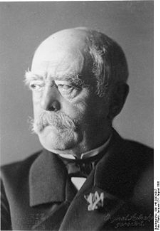
Otto von Bismarck


Otto Eduard Leopold von Bismarck, Count of Bismarck-Schönhausen, Duke of Lauenburg, Prince of Bismarck, (1 April 1815 30 July 1898), was a Prussian
Kingdom of Prussia

The Kingdom of Prussia was a Germany monarchy from 1701 to 1918 and, from 1871, was the leading state of the German Empire, comprising almost two-thirds of the area of the empire....
 and German
Germany

Germany , officially the Federal Republic of Germany , is a country in Central Europe. It is bordered to the north by the North Sea, Denmark, and the Baltic Sea; to the east by Poland and the Czech Republic; to the south by Austria and Switzerland; and to the west by France, Luxembourg, Belgium, and the Netherlands....
 statesman
Statesman

A statesman or stateswoman or statesperson is usually a politician or other notable figure of state who has had a long and respected career in politics at the national and international level....
 and aristocrat of the 19th century. As Minister-President of Prussia
Prime Minister of Prussia

The office of Minister President or Prime Minister of Prussia existed in one form or another from 1792 until the dissolution of Prussia in 1947....
 from 1862–1890, he oversaw the unification of Germany
Unification of Germany

The unification of Germany took place on January 18, 1871, when Otto von Bismarck, the Prime Minister of Prussia, managed to unify a number of independent German people states into a nation-state, and thus create the German Empire, from which all of the states since that time bearing the name of Germany descend....
. In 1867 he became Chancellor
Chancellor

Chancellor or chancellour is an official title used in countries whose civilization has arisen directly or indirectly out of the Roman Empire....
 of the North German Confederation
North German Confederation

The North German Confederation , came into existence in August 1866 as a military alliance of 22 states of northern Germany with the Kingdom of Prussia as the leading state....
. When the second German Empire
German Empire

The German Empire is the name commonly used in English to describe Germany from the unification of Germany and proclamation of William I, German Emperor as German Emperor on 18 January 1871, to 1918, when it became Weimar republic after defeat in World War I and the abdication of William II, German Emperor ....
 was formed in 1871, he served as its first Chancellor
Chancellor of Germany (German Reich)

The head of government of the German Reich was called Reich Chancellor or short Chancellor from 1871 until 1945. This designation stems from the German chancellor tradition from the Middle Ages and the early modern era....
 until 1890 and practiced Realpolitik
Realpolitik

Realpolitik refers to politics or diplomacy based primarily on practical considerations, rather than ideological notions. The term realpolitik is often used pejoratively to imply politics that are coercive, amoral, or Machiavellian....
, which gained him the nickname "The Iron Chancellor".


Discussion
Ask a question about 'Otto von Bismarck'
Start a new discussion about 'Otto von Bismarck'
Answer questions from other users
Full Discussion Forum


Recent Posts


Quotations


A conquering army on the border will not be stopped by eloquence.

Speech to North German Reichstag (24 September 1867)

He who has his thumb on the purse has the power.

Speech to North German Reichstag (21 May 1869)

Politics is not an exact science . . . but an art.

Speech (15 March 1884)

Politics is the art of the possible.

Otto Von Bismarck, remark, Aug. 11, 1867

The luxury of one's own opinion.

Speech to the Prussian Diet (17 December 1873)

With bad laws and good civil servants it's still possible to govern. But with bad civil servants even the best laws can't help.


Encyclopedia


Otto Eduard Leopold von Bismarck, Count of Bismarck-Schönhausen, Duke of Lauenburg, Prince of Bismarck, (1 April 1815 30 July 1898), was a Prussian
Kingdom of Prussia

The Kingdom of Prussia was a Germany monarchy from 1701 to 1918 and, from 1871, was the leading state of the German Empire, comprising almost two-thirds of the area of the empire....
 and German
Germany

Germany , officially the Federal Republic of Germany , is a country in Central Europe. It is bordered to the north by the North Sea, Denmark, and the Baltic Sea; to the east by Poland and the Czech Republic; to the south by Austria and Switzerland; and to the west by France, Luxembourg, Belgium, and the Netherlands....
 statesman
Statesman

A statesman or stateswoman or statesperson is usually a politician or other notable figure of state who has had a long and respected career in politics at the national and international level....
 and aristocrat of the 19th century. As Minister-President of Prussia
Prime Minister of Prussia

The office of Minister President or Prime Minister of Prussia existed in one form or another from 1792 until the dissolution of Prussia in 1947....
 from 1862–1890, he oversaw the unification of Germany
Unification of Germany

The unification of Germany took place on January 18, 1871, when Otto von Bismarck, the Prime Minister of Prussia, managed to unify a number of independent German people states into a nation-state, and thus create the German Empire, from which all of the states since that time bearing the name of Germany descend....
. In 1867 he became Chancellor
Chancellor

Chancellor or chancellour is an official title used in countries whose civilization has arisen directly or indirectly out of the Roman Empire....
 of the North German Confederation
North German Confederation

The North German Confederation , came into existence in August 1866 as a military alliance of 22 states of northern Germany with the Kingdom of Prussia as the leading state....
. When the second German Empire
German Empire

The German Empire is the name commonly used in English to describe Germany from the unification of Germany and proclamation of William I, German Emperor as German Emperor on 18 January 1871, to 1918, when it became Weimar republic after defeat in World War I and the abdication of William II, German Emperor ....
 was formed in 1871, he served as its first Chancellor
Chancellor of Germany (German Reich)

The head of government of the German Reich was called Reich Chancellor or short Chancellor from 1871 until 1945. This designation stems from the German chancellor tradition from the Middle Ages and the early modern era....
 until 1890 and practiced Realpolitik
Realpolitik

Realpolitik refers to politics or diplomacy based primarily on practical considerations, rather than ideological notions. The term realpolitik is often used pejoratively to imply politics that are coercive, amoral, or Machiavellian....
, which gained him the nickname "The Iron Chancellor". As Chancellor, Bismarck held an important role in the German government and greatly influenced German and international politics both during and after his time of service.

Early years

Bismarck1836
Bismarck was born in Schönhausen
Schönhausen

Sch?nhausen is a municipality in the district of Stendal in Saxony-Anhalt in Germany, located 70km north of the state capital of Magdeburg. It is the seat of the Verwaltungsgemeinschaft Elbe-Havel-Land....
, the wealthy family estate situated west of Berlin in the Prussian Province of Saxony
Province of Saxony

The Province of Saxony was a Provinces of Prussia of the Kingdom of Prussia and later the Free State of Prussia from 1816 until 1945. Its capital was Magdeburg....
. His father, Karl Wilhelm Ferdinand von Bismarck (Schönhausen, 13 November 1771 - 22 November 1845), was a landowner
Landowner

Landholder or landowner is a holder of the estate in land with considerable rights of ownership or, simply put, an owner of land.In the old Europe a landholder was usually a nobleman, see landed nobility....
 and a former Prussian military officer; his mother, Wilhelmine Luise Mencken (Potsdam
Potsdam

Potsdam is the capital city of the Germany States of Germany of Brandenburg and is part of the Metropolitan area of Berlin/Brandenburg. It is situated on the River Havel, some 25 kilometres southwest of the center of Berlin....
, 24 February 1789 - Berlin), the educated daughter of a politician. A.J.P. Taylor later remarked on the importance of this dual heritage: although Bismarck physically resembled his father, and appeared as a Prussian Junker
Junker

Junkers were the landed nobility of Prussia and eastern Germany. These families were mostly part of the German Uradel and carried on the colonization and Christianization of the northeastern European territories during the medieval Ostsiedlung....
 to the outside world - an image which he often encouraged by wearing military uniform, even though he was not a regular officer - he was also more cosmopolitan and highly educated than was normal for men of such background. He spoke English fluently, and as a young man would often quote Shakespeare
William Shakespeare

William Shakespeare was an English people poet and playwright, widely regarded as the greatest writer in the English language and the world's preeminent dramatist....
 or Byron
George Gordon Byron, 6th Baron Byron

George Gordon Byron, later Noel, 6th Baron Byron Royal Society was a United Kingdom poet and a leading figure in Romanticism. Amongst Byron's best-known works are the brief poems She Walks in Beauty, When We Two Parted, and So, we'll go no more a roving, in addition to the narrative poems Childe Harold's Pilgrimage and...
 in letters to his wife.

Bismarck was educated at the Friedrich-Wilhelm and the Graues Kloster. From 1832-33 he studied law at the University of Göttingen, where he spent only a year as a member of the Corps Hannovera
Corps Hannovera Göttingen

The Corps Hannovera G?ttingen is one of the oldest German Student Corps, a Studentenverbindung or corporation founded 18 January 1809 at the Georg August University of G?ttingen....
 before enrolling in the University of Berlin
Humboldt University of Berlin

The Humboldt University of Berlin is Berlin's oldest university, founded in 1810 as the University of Berlin by the liberal Prussian educational reformer and linguist Wilhelm von Humboldt, whose university model has strongly influenced other European and Western universities....
 (1833-35).

Whilst at Göttingen, Bismarck had become the lifelong friend of an American student John Lothrop Motley
John Lothrop Motley

John Lothrop Motley was an United States historian....
, who described Bismarck as Otto v. Rabenmark in his novel Morton's Hope, or the Memoirs of a Provincial (1839). Motley was later an eminent historian.

Although Bismarck hoped to become a diplomat, he started his practical training as a lawyer in Aachen
Aachen

is a historic spa town in North Rhine-Westphalia, Germany. It is the westernmost city of Germany, located along its borders with Belgium and the Netherlands, 65 km west of Cologne....
 and Potsdam
Potsdam

Potsdam is the capital city of the Germany States of Germany of Brandenburg and is part of the Metropolitan area of Berlin/Brandenburg. It is situated on the River Havel, some 25 kilometres southwest of the center of Berlin....
, and soon resigned, having first placed his career in jeopardy by taking unauthorised leave to pursue two English girls, first Laura Russell, niece of the Duke of Cleveland
Duke of Cleveland

Duke of Cleveland is a title that has been created twice, once in the Peerage of England and once in the Peerage of the United Kingdom. The dukedoms were named after Cleveland, England in northern England....
, and then Isabella Loraine-Smith, daughter of a wealthy clergyman. He did not succeed in marrying either. He also served in the army for a year and became an officer in the Landwehr
Landwehr

Landwehr, or Landeswehr, is a German language term used in referring to certain national army, or militias found in nineteenth- and early twentieth-century Europe....
 (reserve), before returning to run the family estates at Schönhausen on his mother's death in his mid-twenties.

Around the age of thirty Bismarck had an intense friendship with Marie von Thadden, newly-married to a friend of his. Under her influence, he became a Pietist
Pietism

Pietism was a movement within Lutheranism, lasting from the late 17th century to the mid-18th century and later. It proved to be very influential throughout Protestantism and Anabaptist, inspiring not only Anglicanism priest John Wesley to begin the Methodism, but also Alexander Mack to begin the Schwarzenau Brethren movement....
 Lutheran
Lutheranism

Lutheranism is a major branch of Western Christianity that identifies with the teachings of the sixteenth-century Germans Reformer Martin Luther....
, and later recorded that at Marie's deathbed (from typhoid) he prayed for the first time since his childhood. Bismarck married Marie's cousin, the noblewoman Johanna von Puttkamer
Johanna von Puttkamer

Johanna von Puttkamer was a Prussian noblewoman, also known as Johanna von Bismarck. She was the sister of statesman Robert von Puttkamer.She married Otto von Bismarck in 1847....
 (Viartlum, 11 April 1824 - Varzin, 27 November 1894) at Alt-Kolziglow on 28 July 1847. Their long and happy marriage produced two sons, Herbert
Herbert von Bismarck

Herbert, Prince von Bismarck was born in Berlin, the oldest son of Chancellor Otto von Bismarck and his wife Johanna von Puttkamer, n?e von Puttkamer....
 (b. 1849) and Wilhelm (b. 1852), and one daughter, Marie (b. 1847), all of whom survived into adulthood. Johanna was a shy, retiring and deeply religious woman - although famed for her sharp tongue in later life - and in his public life Bismarck was sometimes accompanied by his sister Malwine ("Malle") von Arnim.

Whilst on holiday alone in Biarritz in the summer of 1862 (prior to becoming Prime Minister of Prussia), Bismarck would later have a romantic liaison with Kathy Orlov, the twenty-two year old wife of a Russian diplomat - it is not known whether or not their relationship was sexual. Bismarck kept his wife informed of his new friendship by letter, and in a subsequent year Kathy broke off plans to meet Bismarck on holiday again on learning that his wife and family would be accompanying him this time. They continued to write to one another until Kathy's premature death in 1874.

Early political career

In the year of his marriage, 1847, at age 32, Bismarck was chosen as a representative to the newly created Prussian legislature, the Vereinigter Landtag
Landtag

A Landtag is a representative assembly or parliament in German-speaking countries with some legislative authority.The German word "Landtag" is composed of the words Land which names a political entity comparable to a federal state and the word Tag....
. There, he gained a reputation as a royalist and reactionary
Reactionary

Reactionary refers to any movement or ideology that opposes change or progress in society, and which seeks a return to a previous state . The term originated in the French Revolution, to denote the Counter-revolutionary who wanted to restore the real or imagined conditions of the Monarchy Ancien R?gime....
 politician with a gift for stinging rhetoric; he openly advocated the idea that the monarch had a divine right to rule
Divine Right of Kings

The Divine Right of Kings is a politics and religion doctrine of royal absolutism. It asserts that a monarch is subject to no earthly authority, deriving his right to rule directly from the will of God....
. His election was arranged by the Gerlach brothers, who were also Pietist Lutherans and whose ultra-conservative faction was known as the "Kreuzzeitung" after their newspaper, which featured an Iron Cross on its cover.

In March 1848, Prussia
Prussia

Prussia was, most recently, a historic state originating out of the Duchy of Prussia and the Margraviate of Brandenburg. This state had for centuries substantial influence on Germany and European history....
 faced a revolution (one of the revolutions of 1848 in various European nations), which completely overwhelmed King Frederick William IV
Frederick William IV of Prussia

King Frederick William IV of Prussia , the eldest son and successor of Frederick William III of Prussia, reigned as King of Prussia from 1840 to 1861....
. The monarch, though initially inclined to use armed forces to suppress the rebellion, ultimately declined to leave Berlin for the safety of military headquarters at Potsdam (Bismarck later recorded that there had been a "rattling of sabres in their scabbards" from Prussian officers when they learned that the King would not suppress the revolution by force). He offered numerous concessions to the liberals: he wore the red-yellow-and black revolutionary colors (as seen on the flag of today's democratic Germany), promised to promulgate a constitution, agreed that Prussia and other German states should merge into a single nation, and appointed a liberal, Ludolf Cam, as Minister-President.

Bismarck had at first tried to rouse the peasants of his estate into an army to march on Berlin in the King's name. He traveled to Berlin in disguise to offer his services, but was instead told to make himself useful by arranging food supplies for the Army from his estates in case they were needed. The King's brother Prince William (the future King and Emperor William I
William I, German Emperor

Wilhelm I, also known as Wilhelm the Great of the House of Hohenzollern was the monarch of Kingdom of Prussia and the first German Emperor ....
) had fled to England, and Bismarck intrigued with William's wife Augusta to place their teenage son (the future Frederick III) on the Prussian throne in King Frederick William IV
Frederick William IV of Prussia

King Frederick William IV of Prussia , the eldest son and successor of Frederick William III of Prussia, reigned as King of Prussia from 1840 to 1861....
's place - Augusta would have none of it, and detested Bismarck thereafter, although Bismarck did later help to restore a working relationship between the King and his brother, who were on poor terms. Bismarck was not a member of the Landtag elected that year. But the liberal victory perished by the end of the year. The movement became weak due to internal fighting, while the conservatives regrouped, formed an inner group of advisers - including the Gerlach brothers - known as the "Camarilla" around the King, and retook control of Berlin. Although a constitution was granted, its provisions fell far short of the demands of the revolutionaries.

In 1849, Bismarck was elected to the Landtag, the lower house of the new Prussian legislature. At this stage in his career, he opposed the unification of Germany, arguing that Prussia would lose its independence in the process. He accepted his appointment as one of Prussia's representatives at the Erfurt Parliament, an assembly of German states that met to discuss plans for union, but only in order to oppose that body's proposals more effectively. The Parliament failed to bring about unification, for it lacked the support of the two most important German states, Prussia and Austria
Austrian Empire

The Austrian Empire was a periodization successor state empire founded on a remnant of the Holy Roman Empire centered on what is today's Austria that officially lasted from 1804 to 1867....
. In 1850, after a dispute over Hesse, Prussia was humiliated and forced to back down by Austria (supported by Russia) in the so-called Punctation of Olmutz
Punctation of Olmütz

The Punctation of Olm?tz , also called the Agreement of Olm?tz, was a treaty between Kingdom of Prussia and Austrian Empire, dated November 29, 1850, by which Prussia abandoned the Erfurt Union and accepted the revival of the German Confederation under Austrian leadership....
; a plan for the unification of Germany under Prussian leadership, proposed by Prussia's Prime Ministers Radowitz, was also abandoned.

In 1851, Frederick William appointed Bismarck as Prussia's envoy to the Diet of the German Confederation in Frankfurt
Diet (assembly)

In politics, a diet is a formal deliberative assembly. The term is derived from Medieval Latin dietas, and ultimately comes from the Latin dies, "day"....
. Bismarck gave up his elected seat in the Landtag, but was appointed to the Prussian House of Lords a few years later. In Frankfurt he engaged in a battle of wills with the Austrian representative Count Thun, insisting on being treated as an equal by petty tactics such as insisting on doing the same when Thun claimed the privileges of smoking and removing his jacket in meetings.

Bismarck's eight years in Frankfurt were marked by changes in his political opinions, detailed in the numerous lengthy memoranda which he sent to his ministerial superiors in Berlin. No longer under the influence of his ultraconservative Prussian friends, Bismarck became less reactionary and more pragmatic. He became convinced that in order to countervail Austria's newly-restored influence, Prussia would not only have to ally herself with other German states - thus, he grew more accepting of the notion of a united German nation - but also maintain the friendship of Russia and a working relationship with Napoleon III's France - the latter being anathema to his conservative friends the Gerlachs, but necessary both to threaten Austria and to prevent France allying herself to Russia. In a famous letter to Leopold von Gerlach, Bismarck wrote that it was foolish to play chess having first put 16 of the 64 squares out-of-bounds, an ironic observation as after 1871 France would indeed become Germany's permanent enemy and would indeed eventually ally with Russia against Germany in the 1890s.

Bismarck was also horrified by Prussia's isolation during the Crimean War of the mid-1850s (in which Austria sided with Britain and France against Russia - Prussia was almost not invited to the peace talks in Paris). In the Eastern crisis of the 1870s, fear of a repetition of this turn of events would later be a factor in Bismarck's signing the Dual Alliance with Austria-Hungary in 1879. However, in the 1850s Bismarck correctly foresaw that by failing to support Russia (after Russian help in crushing the Hungarian Revolt in 1849, and at Olmutz in 1850, the Austrian leader Schwarzenberg had said that "Austria would astonish the world by the depth of her ingratitude") Austria could no longer count on Russian support in Italy and Germany, and had thus exposed herself to attack by France and Prussia.

In 1858, Frederick William IV suffered a stroke that paralyzed and mentally disabled him. His brother, William
William I, German Emperor

Wilhelm I, also known as Wilhelm the Great of the House of Hohenzollern was the monarch of Kingdom of Prussia and the first German Emperor ....
, took over the government of Prussia as regent. At first William was seen as a moderate ruler, whose friendship with liberal Britain was symbolised by the recent marriage of his son (the future Frederick III) to Queen Victoria's eldest daughter Vicky; their son (the future Wilhelm II) was born in 1859. As part of William's "New Course" he brought in new ministers, moderate conservatives known as the "Wochenblatt" party after their newspaper.

Soon the Regent replaced Bismarck as envoy in Frankfurt and made him Prussia's ambassador to the Russian Empire. In theory this was a promotion as Russia was one of the two most powerful neighbors of Prussia (the other was Austria). In reality Bismarck was sidelined ("on ice") from events in Germany, watching impotently as France drove Austria out of Lombardy during the Italian War of 1859. Bismarck proposed that Prussia should exploit Austria's weakness to move her frontiers "as far south as Lake Constance" on the Swiss border; instead Prussia mobilised troops in the Rhineland to deter further French advances into Venetia. As a further snub, the Regent, who scorned Bismarck as a "Landwehrleutnant" (reserve lieutenant), had declined to promote him to the rank of major-general, normal for the ambassador to St Petersburg (and important as Prussia and Russia were close military allies, whose heads of state often communicated through military contacts rather than diplomatic channels). Bismarck stayed in Saint Petersburg
Saint Petersburg

Saint Petersburg is a types of inhabited localities in Russia and a federal subjects of Russia of Russia located on the Neva River at the head of the Gulf of Finland on the Baltic Sea....
 for four years, during which he almost lost his leg to botched medical treatment and once again met his future adversary, the Russian Prince Gorchakov, who had been Russian representative in Frankfurt in the early 1850s. The Regent also appointed Helmuth von Moltke
Helmuth von Moltke the Elder

Helmuth Karl Bernhard Graf von Moltke was a Germany Generalfeldmarschall. The chief of staff of the Prussian Army for thirty years, he is widely regarded as one of the great strategists of the latter half of the 1800s, and the creator of a new, more modern method, of directing armies in the field....
 as the new Chief of Staff for the Prussian Army, and Albrecht von Roon as Prussian Minister of War and to the job of reorganizing the army. These three people over the next twelve years transformed Prussia.

Despite his lengthy stay abroad, Bismarck was not entirely detached from German domestic affairs; he remained well-informed due to his friendship with Roon, and they formed a lasting political alliance. Interestingly, in 1862 Bismark was offered a place in the Russian diplomatic service after the Czar misunderstood a comment about his likelihood to miss St. Petersburg. Bismark courteously declined the offer. In June 1862, he was sent to Paris, so that he could serve as ambassador to France. He also visited England that summer. These visits enabled him to meet and get the measure of his adversaries Napoleon III, and the British Prime Minister Palmerston and Foreign Secretary Earl Russell, and also of the British Conservative politician Disraeli, later to be Prime Minister in the 1870s - who later claimed to have said of Bismarck's visit "be careful of that man - he means what he says".

Ministerpräsident (Prime Minister) of Prussia

The regent became King William I
William I, German Emperor

Wilhelm I, also known as Wilhelm the Great of the House of Hohenzollern was the monarch of Kingdom of Prussia and the first German Emperor ....
 upon his brother's death in 1861. The new monarch was often in conflict with the increasingly liberal Prussian Diet. A crisis arose in 1862, when the Diet refused to authorise funding for a proposed re-organization of the army. The King's ministers could not convince legislators to pass the budget, and the King was unwilling to make concessions. Wilhelm threatened to abdicate (his son would not hear of it) and believed that Bismarck was the only politician capable of handling the crisis, but was ambivalent about appointing a person who demanded unfettered control over foreign affairs. When, in September 1862, the Abgeordnetenhaus (House of Deputies) overwhelmingly rejected the proposed budget, Wilhelm was persuaded to recall Bismarck to Prussia on the advice of Roon. On 23 September 1862, Wilhelm appointed Bismarck Minister-President
Prime Minister of Prussia

The office of Minister President or Prime Minister of Prussia existed in one form or another from 1792 until the dissolution of Prussia in 1947....
 and Foreign Minister
Foreign Minister of Prussia

This page lists Foreign Ministers of Prussia. See also Foreign Minister of Germany and Prime Minister of Prussia....
.

The convergence of Bismarck, Roon and Moltke occurred at a time when relations among the Great Powers--Great Britain, France, Austria and Russia--had been shattered by the Crimean War
Crimean War

The Crimean War, also known in Russia as the Oriental War was fought between the Russian Empire on one side and an alliance of France, the United Kingdom of Great Britain and Ireland, the Kingdom of Sardinia, and the Ottoman Empire on the other....
 of 1854-55 and the Italian War of 1859
Second Italian War of Independence

The Second War of Italian Independence, Franco-Austrian War, or Austro-Sardinian War was fought by Napoleon III of France and the Kingdom of Piedmont-Sardinia against the Austrian Empire in 1859....
. In the midst of this disarray, the European balance of power was restructured with the creation of the German Empire
German Empire

The German Empire is the name commonly used in English to describe Germany from the unification of Germany and proclamation of William I, German Emperor as German Emperor on 18 January 1871, to 1918, when it became Weimar republic after defeat in World War I and the abdication of William II, German Emperor ....
 as the dominant power in Europe. This was achieved by Bismarck's diplomacy, by Roon's reorganization of the army, and by Moltke's military strategy.

Despite the initial distrust of the King and Crown Prince, and the loathing of Queen Augusta, Bismarck soon acquired a powerful hold over the King by force of personality and powers of persuasion. Bismarck was intent on maintaining royal supremacy by ending the budget deadlock in the King's favour, even if he had to use extralegal means to do so. He contended that, since the Constitution did not provide for cases in which legislators failed to approve a budget, he could merely apply the previous year's budget. Thus, on the basis of the budget of 1861, tax collection continued for four years.

Bismarck's conflict with the legislators grew more heated during the following years. In 1863, the House of Deputies passed a resolution declaring that it could no longer come to terms with Bismarck; in response, the King dissolved the Diet, accusing it of trying to obtain unconstitutional control over the ministry. Bismarck then issued an edict restricting the freedom of the press; this policy even gained the public opposition of the Crown Prince, Friedrich Wilhelm (the future King Friedrich III). Despite attempts to silence critics, Bismarck remained a largely unpopular politician. His supporters fared poorly in the elections of October 1863, in which a liberal coalition (whose primary member was the Progress Party
German Progress Party

The German Progress Party was the first modern political party with a program in Germany, founded by the liberal members of the Prussian Lower House in 6 June, 1861....
) won over two-thirds of the seats in the House. The House made repeated calls to the King to dismiss Bismarck, but the King supported him as he feared that if he dismissed him, a liberal ministry would follow.

German unification


Iron and Blood Speech

German unification had been one of the major objectives during the widespread revolutions of 1848-49
Revolutions of 1848

The European Revolutions of 1848, known in some countries as the Spring of Nations or the Year of Revolution, were a series of political upheavals throughout the European continent....
, when representatives of the German states met in Frankfurt
Frankfurt Parliament

The Frankfurt Parliament was the first freely elected parliament for all of Germany. It was in session from 18 May 1848 until 31 May 1849 in the Paulskirche, Frankfurt at Frankfurt am Main....
 and drafted a constitution creating a federal union with a national parliament to be elected by universal male suffrage. In April 1849, the Frankfurt Parliament
Frankfurt Parliament

The Frankfurt Parliament was the first freely elected parliament for all of Germany. It was in session from 18 May 1848 until 31 May 1849 in the Paulskirche, Frankfurt at Frankfurt am Main....
 offered the title of Emperor to the Prussia
Prussia

Prussia was, most recently, a historic state originating out of the Duchy of Prussia and the Margraviate of Brandenburg. This state had for centuries substantial influence on Germany and European history....
n king Friedrich Wilhelm IV. The Prussian king, fearing the opposition of the other German princes and the military intervention of Austria and Russia, lacked the resolve to accept this popular mandate. Thus, the Frankfurt Parliament
Frankfurt Parliament

The Frankfurt Parliament was the first freely elected parliament for all of Germany. It was in session from 18 May 1848 until 31 May 1849 in the Paulskirche, Frankfurt at Frankfurt am Main....
 ended in failure for the German liberals. On September 30, 1862, Bismarck made a speech to the Budget Committee of the Prussian Chamber of Deputies, at the end of which "One of Bismarck's most famous utterances is also one of the most imperfectly recorded."

Defeat of Denmark and Austria-Hungary

Germany consisted of a multitude of principalities loosely bound together as members of the German Confederation
German Confederation

The German Confederation was the association of Central European states created by the Congress of Vienna in 1815 to serve as the successor to the Holy Roman Empire, which had been abolished in 1806....
. Bismarck used both diplomacy and the Prussian military to achieve unification, excluding Austria from unified Germany. Not only did he make Prussia the most powerful and dominant component of the new Germany, but he also ensured that Prussia would remain an authoritarian state, rather than a liberal parliamentary regime.

Bismarckroonmoltke
Bismarck faced a diplomatic crisis when Frederick VII of Denmark
Frederick VII of Denmark

Frederick VII was King of Denmark. He reigned from 1848 until his death. He was the last Danish monarch of the older Royal branch of the House of Oldenburg, and also the last monarch of Denmark to rule as an absolute monarch....
 died in November 1863. Succession to the duchies
Duchy

A duchy is a territory, fiefdom, or domain ruled by a duke or duchess.Some duchies were sovereignty in areas that would become unified realms only during the Modern era ....
 of Schleswig
Schleswig

Schleswig or South Jutland is a region covering the area about 60 km north and 70 km south of the border between Germany and Denmark. The region is also known archaically in English language as Sleswick....
 and Holstein
Holstein

Holstein is the region between the rivers Elbe and Eider River. It is part of Schleswig-Holstein, the northernmost state of Germany.Holstein once existed as the County of Holstein , the later Duchy of Holstein , and was the northernmost territory of the Holy Roman Empire....
 was disputed; they were claimed by Christian IX
Christian IX of Denmark

Christian IX was King of Denmark from November 16, 1863 to January 29, 1906....
 (Frederick VII's heir as King) and by Frederick von Augustenburg (a German duke). Prussian public opinion strongly favoured Augustenburg's claim, as Holstein and southern Schleswig were (and are) German-speaking. Bismarck took an unpopular step by insisting that the territories legally belonged to the Danish monarch under the London Protocol
London Protocol

London Protocol is a name used to describe several different documents....
 signed a decade earlier. Nonetheless, Bismarck did denounce Christian's decision to completely annex Schleswig to Denmark. With support from Austria, he issued an ultimatum for Christian IX to return Schleswig to its former status; when Denmark refused, Austria and Prussia invaded, commencing the Second war of Schleswig
Second War of Schleswig

The Second Schleswig War was the second war due to the Schleswig-Holstein Question. The war began on February 1 1864 when Prussian forces crossed the border into Schleswig....
 and Denmark was forced to cede both duchies. Britain under Prime Minister Palmerston and Foreign Secretary Earl Russell was humiliated and left impotent, as she was unwilling to commit ground troops to Denmark.

At first this seemed like a victory for Augustenberg, but Bismarck soon bullied him out of the picture by making impossible demands, namely that Prussia should have control over the army and navy of the Duchies. Originally, it was proposed that the Diet of the German Confederation (in which all the states of Germany were represented) should determine the fate of the duchies; but before this scheme could be effected, Bismarck induced Austria to agree to the Gastein Convention
Gastein Convention

In diplomacy, the Gastein Convention, a treaty signed at Bad Gastein in Austria on August 14, 1865, embodied agreements between the two principal powers of the German Confederation, Kingdom of Prussia and Austrian Empire, over the governing of the provinces of Schleswig and Holstein....
. Under this agreement signed 20 August 1865, Prussia received Schleswig, while Austria received Holstein. In that year he was made Graf (Count) von Bismarck-Schönhausen.

But in 1866, Austria reneged on the prior agreement by demanding that the Diet determine the Schleswig-Holstein issue. Bismarck used this as an excuse to start a war with Austria by charging that the Austrians had violated the Convention of Gastein. Bismarck sent Prussian troops to occupy Holstein. Provoked, Austria called for the aid of other German states, who quickly became involved in the Austro-Prussian War
Austro-Prussian War

The Austro-Prussian War was a war fought in 1866 between the Austrian Empire and its German allies on one side and the Kingdom of Prussia with its German allies and Kingdom of Italy on the other, that resulted in Prussian dominance over the German states....
. With the aid of Albrecht von Roon's army reorganization, the Prussian army was nearly equal in numbers to the Austrian army. With the organizational genius of Helmuth von Moltke the Elder
Helmuth von Moltke the Elder

Helmuth Karl Bernhard Graf von Moltke was a Germany Generalfeldmarschall. The chief of staff of the Prussian Army for thirty years, he is widely regarded as one of the great strategists of the latter half of the 1800s, and the creator of a new, more modern method, of directing armies in the field....
, the Prussian army fought battles it was able to win. Bismarck had also made a secret alliance with Italy, who desired Austrian-controlled Venetia. Italy's entry into the war forced the Austrians to divide their forces.

To the surprise of the rest of Europe, Prussia quickly defeated Austria and its allies, at the Battle of Königgrätz
Battle of Königgrätz

The Battle of K?niggr?tz , also known as the Battle of Sadowa, Sadov?, or Hradec Kr?lov?, was the decisive battle of the Austro-Prussian War, in which the Kingdom of Prussia defeated the Austrian Empire....
 (aka "Battle of Sadowa"), the largest battle fought in Europe up until that time (involving 427,000 combatants). The King and his generals wanted to push on, conquer Bohemia and march to Vienna, but Bismarck, worried that Prussian military luck might change or that France might intervene on Austria's side, enlisted the help of the Crown Prince (who had opposed the war but had commanded one of the Prussian armies at Sadowa) to change his father's mind after stormy meetings.

As a result of the Peace of Prague (1866)
Peace of Prague (1866)

The Peace of Prague was a peace treaty signed at Prague on 23 August, 1866, which ended the Austro-Prussian War. The treaty was lenient toward the Austrian Empire due to the fact that Otto von Bismarck had persuaded William I, German Emperor that maintaining Austria's place in Europe would be better in the future for Prussia than harsh terms....
, the German Confederation was dissolved; Prussia annexed Schleswig, Holstein, Frankfurt
Frankfurt

is the largest city in the German States of Germany of Hesse and the List of cities in Germany with more than 100,000 inhabitants in Germany, with a 2008 population of 670,000....
, Hanover
Kingdom of Hanover

The Kingdom of Hanover was established in October of 1814 by the Congress of Vienna, with the restoration of George III of the United Kingdom to his Hanoverian territories after the Napoleonic wars....
, Hesse-Kassel
Hesse-Kassel

The Landgraviate of Hessen-Kassel or Hesse-Cassel was a Reichsfrei principality of the Holy Roman Empire that came into existence when the Landgraviate of Hesse was divided in 1567 upon the death of Philip I, Landgrave of Hesse....
 (or Hesse-Cassel), and Nassau
Nassau (state)

Nassau was a Germany state within the Holy Roman Empire and later in the German Confederation. Its ruling dynasty, now extinct in male line, was the House of Nassau....
; and Austria promised not to intervene in German affairs. To solidify Prussian hegemony, Prussia and several other North German states joined the North German Confederation
North German Confederation

The North German Confederation , came into existence in August 1866 as a military alliance of 22 states of northern Germany with the Kingdom of Prussia as the leading state....
 in 1867; King Wilhelm I served as its President, and Bismarck as its Chancellor. From this point on begins what historians refer to as "The Misery of Austria", in which Austria served as a mere vassal
Vassal

A vassal in the terminology that both preceded and accompanied the feudal of medieval Europe, is one who enters into mutual obligations with a monarch, usually of military support and mutual protection, in exchange for certain guarantees, which came to include the terrain held as a fiefdom....
 to the superior Germany, a relationship that was to shape history up to the two World Wars.

Bismarck, who by now held the rank of major in the Landwehr, wore this uniform during the campaign, and was at last promoted to the rank of major-general in the Landwehr cavalry after the war. Although he never personally commanded troops in the field, he usually wore a general's uniform in public for the rest of his life, as seen in numerous paintings and photographs. He was also given a cash grant by the Prussian Landtag, which he used to buy a new country estate, Varzin, larger than his existing estates combined.

Military success brought Bismarck tremendous political support in Prussia. In the elections to the House of Deputies in 1866, liberals suffered a major defeat, losing their large majority. The new, largely conservative House was on much better terms with Bismarck than previous bodies; at the Minister-President's request, it retroactively approved the budgets of the past four years, which had been implemented without parliamentary consent. Hence, Bismarck is considered one of the most talented statesmen in history.

The Reptiles Slush Fund

Following the 1866 war, Prussia annexed the Kingdom of Hanover, which had been allied with Austria against Prussia. An agreement was reached whereby the deposed King George V of Hanover was allowed to keep about 50% of the crown assets. The rest were deemed to be state assets and were transferred to the national treasury. Subsequently Bismarck accused George of organizing a plot against the state and sequestered his share (16 million thaler
Thaler

The Thaler was a silver coin used throughout Europe for almost four hundred years. Its name lives on in various currencies as the dollar or Slovenian tolar....
s) in early 1868. Bismarck used this money to set up a secret slush fund (the "Reptilienfonds" or Reptiles Fund), which he used to bribe journalists and to discredit his political enemies. In 1870 he used some of these funds to win the support of King Ludwig II of Bavaria for making William I German Emperor.

Bismarck also used these funds to place informers in the household of Crown Prince Frederick and his wife Vicky. Some of the bogus stories that Bismarck planted in newspapers accused the royal couple of acting as British agents by revealing state secrets to the British government. Frederick and Victoria were great admirers of her father Prince Albert of Saxe-Coburg-Gotha. They planned to rule as consorts, like Albert and Queen Victoria. Frederick "described the Imperial Constitution as ingeniously contrived chaos." The office of Chancellor responsible to the Kaiser would be replaced with a British-style cabinet, with ministers responsible to the Reichstag. Government policy would be based on the consensus of the cabinet.

"The Crown Prince and Princess shared the outlook of the Progressive Party, and Bismarck was haunted by the fear that should the old Emperor die--and he was now in his seventies--they would call on one of the Progressive leaders to become Chancellor. He sought to guard against such a turn by keeping the Crown Prince from a position of any influence and by using foul means as well as fair to make him unpopular."


In order to undermine the royal couple, when the future Kaiser William II was still a teenager, Bismarck would separate him from his parents and would place him under his tutelage. Bismarck planned to use William as a weapon against his parents in order to retain his own power. Bismarck would drill William on his prerogatives and would teach him to be insubordinate to his parents. Consequently, William II developed a dysfunctional relationship with his father and especially with his English mother.

In 1892, after Bismarck's dismissal, Kaiser William II stopped the abuse of the fund by releasing the interest payments into the official budget.

Establishment of the German Empire

Prussia
Prussia

Prussia was, most recently, a historic state originating out of the Duchy of Prussia and the Margraviate of Brandenburg. This state had for centuries substantial influence on Germany and European history....
's victory over Austria increased tensions with France. The French Emperor, Napoleon III
Napoleon III of France

Napol?on III, also known as Louis-Napol?on Bonaparte was the first President of the French Republic and the only emperor of the Second French Empire....
, feared that a powerful Germany would change the balance of power
Balance of power in international relations

In international relations, a balance of power exists when there is parity or stability between competing forces. As a term in international law for a 'just equilibrium' between the members of the family of nations, it expresses the doctrine intended to prevent any one nation from becoming sufficiently strong so as to enable it to enforce it...
 in Europe (the French opposition politician Adolphe Thiers
Adolphe Thiers

Louis-Adolphe was a France politician and historian. was a prime minister under King Louis-Philippe of France. Following the overthrow of the Second French Empire he again came to prominence as the French leader who suppressed the revolutionary Paris Commune of 1871....
 had correctly observed that it had really been France who had been defeated at Sadowa). Bismarck, at the same time, did not avoid war with France. He believed that if the German states perceived France as the aggressor, they would unite behind the King of Prussia, and kept Napoleon III involved in various intrigues whereby France might gain territory from Luxembourg or Belgium - France never achieved any such gain, but was made to look greedy and untrustworthy.

A suitable premise for war arose in 1870, when the German Prince Leopold of Hohenzollern-Sigmaringen
Hohenzollern-Sigmaringen

The House of Hohenzollern-Sigmaringen is the cadet branch of the senior Swabian branch of the Hohenzollern dynasty, less known than the Franconian branch which became Burgrave of Nuremberg and later ruled Brandenburg-Prussia and the German Empire....
 was offered the Spanish throne, which had been vacant since a revolution in 1868. France blocked the candidacy and demanded assurances that no member of the House of Hohenzollern
Hohenzollern-Sigmaringen

The House of Hohenzollern-Sigmaringen is the cadet branch of the senior Swabian branch of the Hohenzollern dynasty, less known than the Franconian branch which became Burgrave of Nuremberg and later ruled Brandenburg-Prussia and the German Empire....
 become King of Spain. To provoke France into declaring war with Prussia, Bismarck published the Ems Dispatch
Ems Dispatch

The Ems Dispatch , sometimes called the Ems Telegram, is the document that was used by France as a pretext to declare the Franco-Prussian War in 1870....
, a carefully edited version of a conversation between King Wilhelm and the French ambassador to Prussia, Count Benedetti.

France mobilized and declared war on 19 July, five days after the dispatch was published in Paris. It was seen as the aggressor and German states, swept up by nationalism and patriotic zeal, rallied to Prussia's side and provided troops. Russia remained aloof and used the opportunity to remilitarise the Black Sea, demilitarised after the Crimean War of the 1850s. Both of Bismarck's sons served as officers in the Prussian cavalry. The Franco-Prussian War
Franco-Prussian War

The Franco-Prussian War or Franco-German War, often referred to in France as the 1870 War was a conflict between Second French Empire and Kingdom of Prussia, while Prussia was backed by the North German Confederation, of which it was a member, and the South German states of Grand Duchy of Baden, History of W?rttemberg#The Kingdom...
 (1870) was a great success for Prussia. The German army, under nominal command of the King but controlled by Chief of Staff Helmuth von Moltke the Elder
Helmuth von Moltke the Elder

Helmuth Karl Bernhard Graf von Moltke was a Germany Generalfeldmarschall. The chief of staff of the Prussian Army for thirty years, he is widely regarded as one of the great strategists of the latter half of the 1800s, and the creator of a new, more modern method, of directing armies in the field....
, won victory after victory. The major battles were all fought in one month (7 August till 1 September), and both the two French
French people

French people can refer to:* The legal residents and citizens of France, regardless of ancestry. For a legal discussion, see French nationality law....
 armies were captured at Sedan (Napoleon III was taken prisoner along with the former and kept in Germany for a while in case Bismarck had need of him to head a puppet regime; he later died in England in 1873) and Metz, the latter after a siege of some weeks. The remainder of the war featured a siege of Paris, which the Prussians shocked world opinion by bombarding and which the new French republican regime tried to relieve with various hastily-assembled armies and increasingly bitter partisan warfare.

Bismarck acted immediately to secure the unification of Germany. He negotiated with representatives of southern German states, offering special concessions if they agreed to unification. The negotiations succeeded; while the war was still going on King Wilhelm
William I, German Emperor

Wilhelm I, also known as Wilhelm the Great of the House of Hohenzollern was the monarch of Kingdom of Prussia and the first German Emperor ....
 was proclaimed as a 'German Emperor' on 18 January 1871 in the Hall of Mirrors in the Château de Versailles. The new German Empire
German Empire

The German Empire is the name commonly used in English to describe Germany from the unification of Germany and proclamation of William I, German Emperor as German Emperor on 18 January 1871, to 1918, when it became Weimar republic after defeat in World War I and the abdication of William II, German Emperor ....
 was a federation
Federation

A federation is a Political union comprising a number of partially self-governing states or regions united by a central government. In a federation, the self-governing status of the state is typically constitutionally entrenched and may not be altered by a Unilateralism decision of the central government....
: each of its 25 constituent states (kingdoms, grand duchies, duchies, principalities, and free cities) retained some autonomy. The King of Prussia, as German Emperor, was not sovereign over the entirety of Germany; he was only primus inter pares
Primus inter pares

Primus inter pares , the first among equals, or first among peers is a phrase which indicates that a person is the most senior of a group of people sharing the same rank or office....
, or first amongst equals. But he held the presidency of the Bundesrat
Bundesrat

Bundesrat means federal council and may refer to:* Bundesrat of Germany* Federal Council of Austria* Swiss Federal Council...
, which met to discuss policy presented from the Chancellor (whom the president appointed.)

At the end, France was asked to surrender Alsace and part of Lorraine
Alsace-Lorraine

Alsace-Lorraine was a territorial entity created by the German Empire in 1871 after the annexation of most of Alsace and the Moselle region of Lorraine in the Franco-Prussian War....
, because Moltke and his generals insisted that it was needed to keep France defensive.. Bismarck opposed the annexation because he did not wish to make a permanent enemy of France. France was also required to pay a large indemnity.

In his later years Bismarck claimed that Prussia's wars against Austria and France had come about through his manipulation of surrounding states according to his "master plan". However Bismarck himself once said "man cannot create the current of events. He can only float with them, and steer". This view was widely accepted by contemporaries and historians up to the 1950s. However, this view was largely based upon his Memoirs written after his resignation in which Bismarck's role is unsurprisingly placed in the foreground of events. The idea that Bismarck actually controlled major events is disputed by some historians such as the controversial Briton A.J.P. Taylor. Taylor challenged previous interpretations by claiming Bismarck to be a "flawed leader with little control of events." Bismarck's greatest talent as a statesman, according to this view, was the skill with which he reacted to events as they unfolded, successfully turning them to his advantage.

Chancellor of the German Empire

Bismarck Pickelhaube
In 1871, Otto von Bismarck was raised to the rank of Fürst
Fürst

is a German nobility, usually translated into English language as Prince.The term refers to the head of a principality and is distinguished from the son of a monarch, which is referred to as Prinz....
 (Prince) von Bismarck
. He was also appointed Imperial Chancellor of the German Empire, but retained his Prussian offices (including those of Minister-President and Foreign Minister). He was also promoted to the rank of lieutenant-general, and given another country estate, Friedrichsruh, near Hamburg, which was larger than Varzin, making him a very wealthy landowner. Because of both the imperial and the Prussian offices that he held, Bismarck had a large amount of control over domestic and foreign policy. The office of Minister-President (M-P) of Prussia was temporarily separated from that of Chancellor in 1873, when Albrecht von Roon was appointed to the former office. But by the end of the year, Roon resigned due to ill health, and Bismarck again became M-P.

In the following years, one of Bismarck's primary political objectives was to reduce the influence of the Catholic church in Germany. This may have been due to the anti-liberal message of Pope Pius IX
Pope Pius IX

Blessed Pope Pius IX , born Giovanni Maria Mastai-Ferretti, was Pope from June 16, 1846 until his death. His was the longest reign in Church history, lasting 32 years....
 in the Syllabus of Errors
Syllabus of Errors

The Syllabus of Errors was a document issued by Holy See under Pope Pius IX on December 8 1864, Feast of the Immaculate Conception, on the same day as the Pope's encyclical Quanta Cura....
 of 1864, and especially to the dogma of Papal infallibility
Papal infallibility

File:Gregorythegreat.jpgPapal infallibility is the dogma in Christian theology# Catholic theology that, by action of the Holy Spirit, the Pope is preserved from even the possibility of error when he solemnly declaration or promulgation to the Catholic Church a dogmatic teaching on faith or morals as being contained in divine revelation, or a...
 (1870). Bismarck feared that Pope Pius IX and future popes would use the definition of the doctrine of their infallibility as a political weapon for creating instability by driving a wedge between Catholics and Protestants. To prevent this, Bismarck attempted, without success, to reach an understanding with other European governments, whereby future papal elections would be manipulated. The European governments would agree on unsuitable papal candidates, and then instruct their national cardinals to vote in the appropriate manner. Prussia (except Rhineland) and most other northern German states were predominantly Protestant
Protestantism

Protestantism is a movement within Christianity that originated in the sixteenth-century Protestant Reformation. It is considered to be one of the three principal traditions of Christianity, together with Roman Catholicism and Eastern Orthodoxy....
, but many Catholics lived in the southern German states (especially Bavaria
Bavaria

Bavaria , with an area of and almost 12.5 million inhabitants, is a region located in the southeast of Germany and is the largest States of Germany of Germany by area....
). In total, one third of the population was Catholic. Bismarck believed that the Roman Catholic Church held too much political power, and was also concerned about the emergence of the Catholic Centre Party
Centre Party (Germany)

The German Centre Party was a Catholic political party in Germany during the German Empire and the Weimar Republic. The party dissolved itself on 5 July, 1933 as a condition of the conclusion of Reichskonkordat between the Holy See and Germany....
 (organised in 1870).

Accordingly, he began an anti-Catholic campaign known as the Kulturkampf
Kulturkampf

The German language term refers to German policies in relation to secularity and the influence of the Roman Catholic Church, enacted from 1871 to 1878 by the Chancellor of the German Empire, Otto von Bismarck....
. In 1871, the Catholic Department of the Prussian Ministry of Culture was abolished. In 1872, the Jesuits
Society of Jesus

The Society of Jesus is a Roman Catholic religious order of clerks regular whose members are called Jesuits, Soldiers of Jesus Christ, and Foot soldiers of the Pope, because the founder, Saint Ignatius of Loyola, was a knight before becoming a Holy Orders....
 were expelled from Germany. Bismarck somewhat supported the emerging anti-Roman Old Catholic Church
Old Catholic Church

The Old Catholic Church is a Christianity denomination originating with mainly German language-speaking groups that split from the Holy See in the 1870s because they disagreed with the solemn declaration of the doctrine of papal infallibility promulgated by the First Vatican Council ....
es and Lutheranism
Lutheranism

Lutheranism is a major branch of Western Christianity that identifies with the teachings of the sixteenth-century Germans Reformer Martin Luther....
. More severe anti-Roman Catholic laws of 1873 allowed the government to supervise the education of the Roman Catholic clergy, and curtailed the disciplinary powers of the Church. In 1875, civil ceremonies were required for weddings, which could hitherto be performed in churches. However, these efforts only ended up strengthening the Catholic Centre Party, and Bismarck abandoned the Kulturkampf in 1878 to preserve what political capital he had left. Pius died that same year, replaced by a more pragmatic Pope Leo XIII
Pope Leo XIII

Pope Leo XIII , born Count Vincenzo Gioacchino Raffaele Luigi Pecci, was the 256th Pope of the Roman Catholic Church, reigning from 1878 to 1903, succeeding Pope Pius IX....
 who would eventually establish a better relationship with Bismarck. The Kulturkampf had won Bismarck a new supporter in the secular National Liberal Party
National Liberal Party (Germany)

The National Liberal Party was a Germany political party which flourished between 1867 and 1918. It was formed by those Prussian liberals who put aside their differences with Otto von Bismarck over domestic policy due to their support for his highly successful foreign policy, which resulted in the unification of Germany....
, which had become Bismarck's chief ally in the Reichstag. But in 1873, Germany and much of Europe had entered the Long Depression
Long Depression

The Long Depression was a depression that affected much of the world and was contemporary with the Second Industrial Revolution. At the time it was regarded as the Great Depression, remaining so until the Great Depression of the 1930s....
 beginning with the crash of the Vienna Stock Exchange in 1873, the Gründerkrise. A downturn hit the German economy for the first time since vast industrial development in the 1850s after the 1848–49 revolutions. To aid faltering industries, the Chancellor abandoned free trade
Free trade

Free trade is a type of trade policy that allows traders to act and transact without coercive interference from government. Thus, the policy permits trading partners mutual gains from trade, with goods and services produced according to the law of comparative advantage....
 and established protectionist tariff
Tariff

A tariff is a tax imposed on goods when they are moved across a political boundary. They are usually associated with protectionism, the economic policy of restraining trade between nations....
s, which alienated the National Liberals who supported free trade. The Kulturkampf and its effects also stirred up public opinion against the party that supported it, and Bismarck used this opportunity to distance himself from the National Liberals. This marked a rapid decline in the support of the National Liberals, and by 1879 their close ties with Bismarck had all but ended. Bismarck instead returned to conservative factions — including the Centre Party — for support.

To prevent the Austro-Hungarian problems of different nationalities within one state, the government tried to Germanize the state's national minorities, situated mainly in the borders of the empire, such as the Danes in the North of Germany, the French of Alsace-Lorraine and the Poles in the East of Germany
Germanisation of Poles during Partitions

After Partitions of Poland in the end of 18th century, the Kingdom of Prussia and later German Empire imposed a number of Germanisation policies and measures in the newly gained territories, aimed at limiting the Polish ethnic presence in these areas....
.

His policies concerning the Poles
Poles

The Polish people, or Poles , are a West Slavs ethnic group of Central Europe, living predominantly in Poland. Poles are sometimes defined as people who share a common Polish culture and are of Polish descent....
 of Prussia were generally unfavourable to them, and anti-Polish, furthering enmity between the German and Polish peoples. The policies were usually motivated by Bismarck's view that Polish existence was a threat to German state; Bismarck, who himself spoke Polish, wrote about Poles: "One shoots the wolves if one can."

Bismarck worried about the growth of the socialist
Socialism

Socialism refers to a broad set of economic theories of social organization advocating public or state ownership and administration of the means of production and distribution of goods, and a society characterized by equality for all individuals, with a fair or Egalitarianism method of compensation....
 movement — in particular, that of the Social Democratic Party
Social Democratic Party of Germany

The Social Democratic Party of Germany is Germany's oldest political party. After World War II, under the leadership of Kurt Schumacher, the SPD reestablished itself as an ideological party, representing the interests of the working class and the trade unions....
. In 1878, he instituted the Anti-Socialist Laws
Anti-Socialist Laws

The Anti-Socialist Laws or Socialist Laws were a series of Act of Parliament, the first of which was passed on October 19 1878 by the German Empire Reichstag for a limited term, and the later ones regularly extending the term of its application....
. Socialist organizations and meetings were forbidden, as was the circulation of socialist literature. Socialist leaders were arrested and tried by police courts. But despite these efforts, the movement steadily gained supporters and seats in the Reichstag. Socialists won seats in the Reichstag by running as independent candidates, unaffiliated with any party, which was allowed by the German Constitution.

Then the Chancellor tried to reduce the appeal of socialism to the public, by trying to appease the working class. He enacted a variety of paternalistic social reforms, which can be considered the first European labor laws. The Health Insurance Act of 1883 entitled workers to health insurance; the worker paid two-thirds of the premiums and the employer one-third. Accident insurance was provided in 1884, and old age pensions and disability insurance in 1889. Other laws restricted the employment of women and children. Still, these efforts were not very successful; the working class largely remained unreconciled with Bismarck's conservative government.

Foreign policies

Bismarck devoted himself to keeping peace in Europe, so that the strength of the German Empire would not be threatened. He was forced to contend with French revanchism
Revanchism

Revanchism is a term used since the 1870s to describe a political manifestation of the will to reverse territorial losses incurred by a country, often following a war....
 — the desire to avenge the loss in the Franco-Prussian War. Bismarck adopted a policy of diplomatically isolating France, while maintaining cordial relations with other nations in Europe. In order to avoid aggravating the United Kingdom, he initially declined to seek a colonial empire or an expansion of the navy. In 1872, he offered friendship to the Austro-Hungarian Empire and Russia, whose rulers joined Wilhelm I in the League of the Three Emperors
League of the Three Emperors

The League of the Three Emperors, also known as the Three Emperors' League , was an 1873 Military alliance among the emperors of German Empire, Austria-Hungary, and Russian Empire, the three largest powers in Eastern Europe and Central Europe at the time....
, also known as the Dreikaiserbund.

In 1875 Bismarck tried to browbeat France by forbidding her to buy German saddles for her cavalry and encouraging a friendly newspaper to ask "Is War in Sight?", but was forced to back down when Russia (under Gorchakov) and Britain made it clear that they would support France. He also quarrelled at this time with Harry von Arnim, German Ambassador to France - a member of a prominent Prussian family, a relative of Bismarck, and someone who saw himself as a rival to Bismarck - who was eventually tried and imprisoned for misappropriating official documents.

Bismarck also maintained good relations with Italy. He can be seen as partially responsible for Italian Unification
Italian unification

Italian Unification was the political and social movement that annexed different states of the Italian peninsula into the single state of Italy in the 19th century....
. His role in pursuing the 1866, Austro-Prussian War
Austro-Prussian War

The Austro-Prussian War was a war fought in 1866 between the Austrian Empire and its German allies on one side and the Kingdom of Prussia with its German allies and Kingdom of Italy on the other, that resulted in Prussian dominance over the German states....
 against Austria allowed Italy to truly annex Lombardy-Venetia, which had been a kingdom of the Austrian Empire since 1815, and the Congress of Vienna
Congress of Vienna

The Congress of Vienna was a conference of ambassadors of European states chaired by the Austrian statesman Klemens Wenzel von Metternich, and held in Vienna from September, 1814 to June, 1815....
. Bismarck's pursuit of the 1870 Franco-Prussian War
Franco-Prussian War

The Franco-Prussian War or Franco-German War, often referred to in France as the 1870 War was a conflict between Second French Empire and Kingdom of Prussia, while Prussia was backed by the North German Confederation, of which it was a member, and the South German states of Grand Duchy of Baden, History of W?rttemberg#The Kingdom...
, made it necessary for Napoleon III to remove the French troops, which had been guarding the Pope
Pope

The Pope is the Bishop of Rome, the leader of the Roman Catholic Church and head of state of Vatican City. The current pope is Pope Benedict XVI, who was elected April 19, 2005 in Papal conclave, 2005....
, from Rome and The Papal States. Without both of these actions, the process of Italian Unification
Italian unification

Italian Unification was the political and social movement that annexed different states of the Italian peninsula into the single state of Italy in the 19th century....
 would have been hindered.

But after Russia's victory over the Ottoman Empire
Ottoman Empire

The Ottoman Empire , also known by its contemporaries as the Turkish Empire or Turkey , was an empire that lasted from 1299?1923. It was Treaty of Lausanne by the Republic of Turkey, which was officially proclaimed on October 29, 1923....
 in the Russo-Turkish War (1877-1878), Bismarck helped negotiate a settlement at the Congress of Berlin
Congress of Berlin

The Congress of Berlin was a meeting of the European Great Powers' and the Ottoman Empire's leading statesmen in Berlin in 1878. In the wake of the Russo-Turkish War, 1877?78, the meeting's aim was to reorganize the countries of the Balkans....
. The Treaty of Berlin, 1878
Treaty of Berlin, 1878

The Treaty of Berlin was the final act of the Congress of Berlin , by which the United Kingdom of Great Britain and Ireland, Austria-Hungary, French Third Republic, German Empire, Kingdom of Italy , Russian Empire and the Ottoman Empire under Abdul Hamid II revised the Treaty of San Stefano signed on March 3 of the same year....
, revised the earlier Treaty of San Stefano
Treaty of San Stefano

The Preliminary Treaty of San Stefano was a treaty between Russian Empire and the Ottoman Empire signed at the end of the Russo-Turkish War, 1877?78....
, reducing the size of the newly-independent Bulgaria (a pro-Russian state at that time). Bismarck and other European leaders opposed the growth of Russian influence, and so tried to protect the power of the Ottoman Empire (see Eastern Question
Eastern Question

The "Eastern Question", in History of Europe, encompasses the diplomacy and politics problems posed by the decay of the Ottoman Empire. The expression does not apply to any one particular problem, but instead includes a variety of issues raised during the 18th, 19th, and 20th centuries, including instability in the European territories ruled...
). As a result, Russo-German relations suffered; the Russian Prince Gorchakov denounced Bismarck for compromising his nation's victory. The relationship further suffered due to Germany's protectionist policies.

The League of the Three Emperors having fallen apart, Bismarck negotiated the Dual Alliance (1879) with Austria-Hungary, in which each guaranteed the other against Russian attack. This became the Triple Alliance
Triple Alliance (1882)

The Triple Alliance was a military alliance among German Empire, Austria-Hungary, and Kingdom of Italy that lasted from 1882 until the start of World War I in 1914....
 in 1882 with the addition of Italy, while Italy and Austria-Hungary soon reached the "Mediterranean Agreement" with Britain. Attempts to reconcile Germany and Russia did not have lasting effect: the Three Emperors' League was re-established in 1881, but quickly fell apart (the end of the Russian-Austrian-Prussian solidarity which had existed in various forms since 1813), and the Reinsurance Treaty
Reinsurance Treaty

The Reinsurance Treaty was an attempt by Otto von Bismarck to continue to rally with Russian Empire after the League of the Three Emperors broke down....
 of 1887 (in which both powers promised to remain neutral towards one another unless Russia attacked Austria-Hungary) was allowed to expire in 1890 - by this time German generals such as Waldersee were increasingly calling for conflict with Russia.

At first, Bismarck opposed the idea of seeking colonies, arguing that the burden of obtaining and defending them would outweigh the potential benefits. But during the late 1870s public opinion shifted to favour the idea of a colonial empire, and Bismarck was perhaps motivated by the desire to stir up Anglo-German friction ahead of the imminent accession to the throne of the pro-British Crown Prince. Other European nations also began to rapidly acquire colonies (see New Imperialism
New Imperialism

New Imperialism refers to the colony expansion adopted by Europe's power and, later, Japan and the United States, during the 19th and early 20th centuries; approximately from the Franco-Prussian War to World War I ....
). During the early 1880s, Germany joined other European powers in the Scramble for Africa
Scramble for Africa

The Scramble for Africa, also known as the Race for Africa, was the proliferation of conflicting European claims to African territory during the New Imperialism period, between the 1880s and the World War I in 1914....
. Among Germany's colonies were Togoland (now part of Ghana
Ghana

The Republic of Ghana is a country in West Africa. It borders C?te d'Ivoire to the west, Burkina Faso to the north, Togo to the east, and the Gulf of Guinea to the south....
 and Togo
Togo

Togo is a narrow country in West Africa bordering Ghana to the west, Benin to the east and Burkina Faso to the north. It extends south to the Gulf of Guinea, on which the capital Lom? is located....
), Cameroon
Cameroon

The Republic of Cameroon is a unitary state of central and western Africa. It is bordered by Nigeria to the west; Chad to the northeast; the Central African Republic to the east; and Equatorial Guinea, Gabon, and the Republic of the Congo to the south....
, German East Africa
German East Africa

German East Africa was a German Empire colony in East Africa, including what is now Burundi, Rwanda and Tanganyika . It measured 994,996 km? in size or nearly three times the size of re-united Germany today....
 (now Rwanda
Rwanda

The Republic of Rwanda is a small landlocked country in the Great Lakes region of east-central Africa, bordered by Uganda, Burundi, the Democratic Republic of the Congo and Tanzania....
, Burundi
Burundi

Burundi , officially the Republic of Burundi, is a small country in the Great Lakes region of Eastern Africa bordered by Rwanda to the north, Tanzania to the south and east, and the Democratic Republic of the Congo to the west....
, and Tanzania
Tanzania

Tanzania , officially the United Republic of Tanzania , is a country in East Africa that is bordered by Kenya and Uganda on the north, Rwanda, Burundi and the Democratic Republic of the Congo on the west, and Zambia, Malawi and Mozambique on the south....
), and German South-West Africa
German South-West Africa

German South West Africa was a colony of German Empire from 1884 until 1915, when it was taken over by South Africa and administered as South West Africa, finally becoming Namibia in 1990....
 (now Namibia
Namibia

Namibia, officially the Republic of Namibia, is a country in southern Africa on the Atlantic Ocean coast. It shares borders with Angola and Zambia to the north, Botswana to the east, and South Africa to the south....
). The Berlin Conference
Berlin Conference

The Berlin Conference of 1884–85 regulated colonialism and trade in Africa during the New Imperialism period, and coincided with Germany's sudden emergence as an imperial power....
 (1884–1885) established regulations for the acquisition of African colonies; in particular, it protected free trade in certain parts of the Congo basin
Congo River

The Congo River is the largest river in Western Central Africa. Its overall length of 4,700 km makes it the second longest in Africa ....
.

In February 1888, during a Bulgarian crisis, Bismarck addressed the Reichstag on the dangers of a European war.

Bismarck also repeated his emphatic warning against any German military involvement in Balkan disputes.

Bismarck had first made this famous comment to the Reichstag in December 1876, when the Balkan revolts against the Ottoman Empire threatened to extend to a war between Austria and Russia.

According to Taylor, "The more familiar grenadier took the musketeer's place in a speech of 1888."

Last years

Bismarck80jahre
In 1888, the German Emperor, Wilhelm I, died leaving the throne to his son, Friedrich III. But the new monarch was already suffering from an incurable throat cancer
Cancer

Cancer is a class of diseases in which a group of cell display uncontrolled growth , invasion , and sometimes metastasis . These three malignant properties of cancers differentiate them from benign tumors, which are self-limited, do not invade or metastasize....
 and died after reigning for only three months. He was replaced by his son, Wilhelm II. The new Emperor opposed Bismarck's careful foreign policy, preferring vigorous and rapid expansion to protect Germany's "place in the sun."

Conflicts between Wilhelm II and his chancellor soon poisoned their relationship. Bismarck believed that he could dominate Wilhelm, and showed little respect for his policies in the late 1880s. Their final split occurred after Bismarck tried to implement far-reaching anti-Socialist laws in early 1890. Kartell majority in the Reichstag, of the amalgamated Conservative Party and the National Liberal Party, was willing to make most of the laws permanent. But it was split about the law allowing the police the power to expel socialist agitators from their homes, a power used excessively at times against political opponents. The National Liberals refused to make this law permanent, while the Conservatives supported only the entirety of the bill and threatened to and eventually vetoed the entire bill in session because Bismarck wouldn't agree to a modified bill.

As the debate continued, Wilhelm became increasingly interested in social problems, especially the treatment of mine workers who went on strike in 1889, and keeping with his active policy in government, routinely interrupted Bismarck in Council to make clear his social policy. Bismarck sharply disagreed with Wilhelm's policy and worked to circumvent it. Even though Wilhelm supported the altered anti-socialist bill, Bismarck pushed for his support to veto the bill in its entirety. But when his arguments couldn't convince Wilhelm, Bismarck became excited and agitated until uncharacteristically blurting out his motive to see the bill fail: to have the socialists agitate until a violent clash occurred that could be used as a pretext to crush them. Wilhelm replied that he was not willing to open his reign with a bloody campaign against his own subjects. The next day, after realizing his blunder, Bismarck attempted to reach a compromise with Wilhelm by agreeing to his social policy towards industrial workers, and even suggested a European council to discuss working conditions, presided by the German Emperor.

Despite this, a turn of events eventually led to his distancing from Wilhelm. Bismarck, feeling pressured and unappreciated by the Emperor and undermined by ambitious advisers, refused to sign a proclamation regarding the protection of workers along with Wilhelm, as was required by the German Constitution, to protest Wilhelm's ever increasing interference to Bismarck's previously unquestioned authority. Bismarck also worked behind the scenes to break the Continental labour council on which Wilhelm had set his heart.

The final break came as Bismarck searched for a new parliamentary majority, with his Kartell voted from power due to the anti-socialist bill fiasco. The remaining forces in the Reichstag were the Catholic Centre Party and the Conservative Party. Bismarck wished to form a new block with the Centre Party, and invited Ludwig Windthorst
Ludwig Windthorst

Ludwig Windthorst , was a Germany politician....
, the parliamentary leader to discuss an alliance. This would be Bismarck's last political manoeuvre. Wilhelm was furious to hear about Windthorst's visit. In a parliamentary state, the head of government depends on the confidence of the parliamentary majority, and certainly has the right to form coalitions to ensure his policies a majority. However, in Germany, the Chancellor
Chancellor

Chancellor or chancellour is an official title used in countries whose civilization has arisen directly or indirectly out of the Roman Empire....
 depended on the confidence of the Emperor alone, and Wilhelm believed that the Emperor had the right to be informed before his minister's meeting. After a heated argument in Bismarck's office Wilhelm, whom Bismarck had allowed to see a letter from Tsar Alexander III describing him as a "badly brought-up boy", stormed out, after first ordering the rescinding of the Cabinet Order of 1851, which had forbidden Prussian Cabinet Ministers to report directly to the King of Prussia, requiring them instead to report via the Prime Minister. Bismarck, forced for the first time into a situation he could not use to his advantage, wrote a blistering letter of resignation, decrying Wilhelm's interference in foreign and domestic policy, which was only published after Bismarck's death. As it turned out, Bismarck became the first victim of his own creation, and when he realized that his dismissal was imminent:
All Bismarck’s resources were deployed; he even asked Empress Frederick to use her influence with her son on his behalf. But the wizard had lost his magic; his spells were powerless because they were exerted on people who did not respect them, and he who had so signally disregarded Kant’s command to use people as ends in themselves had too small a stock of loyalty to draw on. As Lord Salisbury told Queen Victoria: 'The very qualities which Bismarck fostered in the Emperor in order to strengthen himself when the Emperor Frederick should come to the throne have been the qualities by which he has been overthrown.' The Empress, with what must have been a mixture of pity and triumph, told him that her influence with her son could not save him for he himself had destroyed it.


1890 Bismarcks Ruecktritt
Bismarck resigned at Wilhelm II's insistence in 1890, at age 75, to be succeeded as Chancellor of Germany and Minister-President of Prussia by Leo von Caprivi
Leo von Caprivi

Georg Leo Graf von Caprivi de Caprera de Montecuccoli was a Germany major general and statesman, who succeeded Otto von Bismarck as Chancellor of Germany ....
. Bismarck was discarded ("dropping the pilot" in the words of the famous Punch cartoon), promoted to the rank of "Colonel-General with the Dignity of Field Marshal" (so-called because the German Army did not appoint full Field Marshals in peacetime) and given a new title, Duke of Lauenburg, which he joked would be useful when travelling incognito. He was soon elected as a National Liberal to the Reichstag for Bennigsen's old and supposedly safe Hamburg seat, but was embarrassed by being forced to a second ballot by a Social Democrat rival, and never actually took up his seat. He entered into restless, resentful retirement to his estates at Varzin (in today's Poland). Within one month after his wife died on 27 November 1894, he moved to Friedrichsruh
Friedrichsruh

Friedrichsruh is a district in the municipality of Aum?hle, Schleswig-Holstein, northern Germany....
 near Hamburg
Hamburg

Hamburg is the second-largest city in Germany , and is the Largest cities of the European Union by population within city limits. The city is home to approximately 1.8 million people, while the Hamburg metropolitan area has more than 4.3 million inhabitants....
, waiting in vain to be petitioned for advice and counsel.

As soon as he had to leave his office, citizens started to praise him, collecting money to build monuments like the Bismarck Memorial
Bismarck Memorial

The Bismarck Memorial , located in the Tiergarten in Berlin, is a prominent memorial statue dedicated to Prince Otto von Bismarck, Prime Minister of Prussia of the Kingdom of Prussia and the first Chancellor of Germany of the German Empire....
 or towers dedicated to him. Much honour was given to him in Germany, many buildings have his name, books about him were best-sellers, and he was often painted, e.g., by Franz von Lenbach
Franz von Lenbach

Franz von Lenbach was a Germany Painting....
 and C.W. Allers
Christian Wilhelm Allers

Christian Wilhelm Allers was a Germany Painting and printmaker....
.

Bismarck spent his final years gathering his memoirs (Gedanken und Erinnerungen, or Thoughts and Memories), which criticized and discredited the Emperor. He died in 1898 (at the age of 83) at Friedrichsruh, where he is entombed in the Bismarck-Mausoleum. He was succeeded as Fürst von Bismarck-Schönhausen by Herbert.

On his gravestone it is written "Loyal German Servant of Kaiser William I".

Last warning and prediction


In December 1897, Wilhelm II visited Bismarck for the last time. Bismarck again warned the Kaiser about the dangers of improvising government policy based on the intrigues of courtiers and militarists. Bismarck’s last warning was:

Subsequently, Bismarck made these accurate predictions:

Bismarck's social legislation


The 1880s were a period when Germany started on its long road towards the welfare state
Welfare State

The Welfare State of the United Kingdom was prefigured in the William Beveridge Report in 1942, which identified five "Giant Evils" in society: squalor, ignorance, want, idleness and disease....
 it is today. The Social Democratic, National Liberal
National Liberal Party (Germany)

The National Liberal Party was a Germany political party which flourished between 1867 and 1918. It was formed by those Prussian liberals who put aside their differences with Otto von Bismarck over domestic policy due to their support for his highly successful foreign policy, which resulted in the unification of Germany....
 and Center
Centre Party (Germany)

The German Centre Party was a Catholic political party in Germany during the German Empire and the Weimar Republic. The party dissolved itself on 5 July, 1933 as a condition of the conclusion of Reichskonkordat between the Holy See and Germany....
 parties were all involved in the beginnings of social legislation, but it was Bismarck who established the first practical aspects of this program. The program of the Social Democrats included all of the programs that Bismarck eventually implemented, but also included programs designed to preempt the programs championed by Karl Marx
Karl Marx

Karl Heinrich Marx was a Germanphilosophy, political economy, historian, sociologist, humanism, political theorist and revolutionary credited as the founder of communism....
 and Friedrich Engels
Friedrich Engels

Friedrich Engels was a German Social science and Philosophy, who developed Communism alongside his better-known collaborator, Karl Marx, co-authoring The Communist Manifesto ....
. Bismarck’s idea was to implement the minimum aspects of these programs that were acceptable to the German government without any of the overtly Socialistic aspects.

Bismarck opened debate on the subject on 17 November 1881 in the Imperial Message to the Reichstag
Reichstag (institution)

The Reichstag was the parliament of the Holy Roman Empire, the North German Confederation, and of Germany until 1945. The main chamber of the German parliament is now called Bundestag , but the building in which it meets is still called "Reichstag" ....
, using the term practical Christianity to describe his program. In 1881 Bismarck had also referred to this program as Staatssozialismus, when he made the following accurate prediction to a colleague:
"It is possible that all our politics will come to nothing when I am dead but state socialism will drub[force] itself in. (Der Staatssozialismus paukt sich durch.)"


Bismarck’s program centered squarely on insurance programs designed to increase productivity, and focus the political attentions of German workers on supporting the Junker's government. The program included Health Insurance; Accident Insurance (Workman’s Compensation); Disability Insurance; and an Old-age Retirement Pension, none of which were then currently in existence to any great degree.

Based on Bismarck’s message, The Reichstag filed three bills designed to deal with the concept of Accident insurance, and one for Health Insurance. The subjects of Retirement pensions and Disability Insurance were placed on the back burner for the time being.

Health Insurance Bill of 1883

The first bill that had success was the Health Insurance bill, which was passed in 1883. The program was considered the least important from Bismarck’s point of view, and the least politically troublesome. The program was established to provide health care for the largest segment of the German workers. The health service was established on a local basis, with the cost divided between employers and the employed. The employers contributed 1/3rd, while the workers contributed 2/3rds . The minimum payments for medical treatment and Sick Pay for up to 13 weeks were legally fixed. The individual local health bureaus were administered by a committee elected by the members of each bureau, and this move had the unintended effect of establishing a majority representation for the workers on account of their large financial contribution. This worked to the advantage of the Social Democrats who – through heavy Worker membership – achieved their first small foothold in public administration.

Accident Insurance Bill of 1884

Bismarck’s government had to submit three draft bills before they could get one passed by the Reichstag in 1884. Bismarck had originally proposed that the Federal Government pay a portion of the Accident Insurance contribution. Bismarck’s motive was a demonstration of the willingness of the German government to lessen the hardship experienced by the German workers as a means of weaning them away from the various left-wing parties, most importantly the Social Democrats. The National Liberals took this program to be an expression of State Socialism
State socialism

State socialism, broadly speaking, is any variety of socialism which relies on control of the means of production by the state, either through state ownership or regulation....
, which they were dead set against. The Center party was afraid of the expansion of Federal Power at the expense of States Rights. As a result, the only way the program could be passed at all was for the entire expense to be underwritten by the Employers. To facilitate this, Bismarck arranged for the administration of this program to be placed in the hands of “Der Arbeitgeberverband in den beruflichen Korporationen”, which translates as “The organization of employers in occupational corporations”. This organization established central and bureaucratic insurance offices on the Federal, and in some cases the State level to perform the actual administration. The program kicked in to replace the health insurance program as of the 14th week. It paid for medical treatment and a Pension of up to 2/3rds of earned wages if the worker was fully disabled. This program was expanded in 1886 to include Agricultural workers.

Old Age and Disability Insurance Bill of 1889

The Old Age Pension program, financed by a tax on workers, was designed to provide a pension annuity for workers who reached the age of 70 years. At the time, the life expectancy
Life expectancy

Life expectancy is the average number of years of life remaining at a given age. It is the average expected lifespan of an individual. Life expectancy is heavily dependent on the criteria used to select the group....
 for the average Prussian was 45 years. Unlike the Accident Insurance and Health Insurance programs, this program covered Industrial, Agrarian, Artisans and Servants from the start. Also, unlike the other two programs, the principle that the Federal Government should contribute a portion of the underwriting cost, with the other two portions prorated accordingly, was accepted without question. The Disability Insurance program was intended to be used by those permanently disabled. This time, the State or Province supervised the programs directly.

Legacy

Hideousbismarckmemorial
Bismarck's most important legacy is the unification of Germany. Germany had existed as a collection of hundreds of separate principalities and Free Cities since the formation of the Holy Roman Empire
Holy Roman Empire

The Holy Roman Empire was a union of territories in Central Europe during the Middle Ages and the Early modern Europe under a Holy Roman Emperor....
. Over the next thousand years various kings and rulers had tried to unify the German states without success until Bismarck. Largely as a result of Bismarck's efforts, the various German kingdoms were united into a single country. Following unification, Germany became one of the most powerful nations in Europe. Bismarck's astute, cautious, and pragmatic foreign policies allowed Germany to retain peacefully the powerful position into which he had brought it; maintaining amiable diplomacy with almost all European nations. France, the main exception, was devastated by Bismarck's wars and his harsh subsequent policies towards it; France became one of Germany's most bitter enemies in Europe. Austria, too, was weakened by the creation of a German Empire, though to a much lesser extent than France. Bismarck's diplomatic feats were accidentally undone, however, by Kaiser Wilhelm II
William II, German Emperor

Wilhelm II was the last German Emperor and King of Prussia , ruling both the German Empire and the Prussia from 15 June 1888 to 9 November 1918....
, whose policies unified other European powers against Germany in time for World War I
World War I

World War I, or the First World War , was a global military conflict which involved the Great powers, organized into two opposing military alliances: the Allies of World War I and the Central Powers....
.

In British writing (eg. the biographies by Taylor, Palmer or Crankshaw) Bismarck is often seen as an ambivalent figure, undoubtedly a man of great skill but who left no lasting system in place to guide successors less skilled than himself. It is often argued by such historians that his unification of Germany by force of arms, arresting of the development of liberal parliamentary rule in Prussia and diplomacy of secret treaties set Germany and Europe on the path to the First World War and ultimately the Third Reich [ambiguous].

During most of his nearly 30 year-long tenure, Bismarck held undisputed control over the government's policies. He was well supported by his friend Albrecht von Roon, the war minister, as well as the leader of the Prussian army Helmuth von Moltke
Helmuth von Moltke the Elder

Helmuth Karl Bernhard Graf von Moltke was a Germany Generalfeldmarschall. The chief of staff of the Prussian Army for thirty years, he is widely regarded as one of the great strategists of the latter half of the 1800s, and the creator of a new, more modern method, of directing armies in the field....
. Bismarck's diplomatic moves relied on a victorious Prussian military, and these two people gave Bismarck the victories he needed to convince the smaller German states to join Prussia.

Rudelsburg Junger Bismarck 2
Bismarck took steps to silence or restrain political opposition, as evidenced by laws restricting the freedom of the press, the Kulturkampf, and the anti-socialist laws. His king (later Emperor) Wilhelm I rarely challenged the Chancellor's decisions; on several occasions, Bismarck obtained his monarch's approval by threatening to resign. However, Wilhelm II intended to govern the country himself, making the ousting of Bismarck one of his first tasks as Kaiser. Bismarck's successors as Chancellor were much less influential, as power was concentrated in the Emperor's hands.

Two ships of the German Imperial Navy (Kaiserliche Marine
Kaiserliche Marine

The Kaiserliche Marine or Imperial Navy was the German Navy created by the formation of the German Empire. It existed between 1871 and 1919, growing out of the Prussian Navy and Norddeutsche Bundesmarine....
), as well as the German battleship Bismarck
German battleship Bismarck

Hide header=|Header caption=|Ship class=|Ship displacement=41,700 tonnes standard 50,900 tonnes full load|Ship length= overall waterline...
 from the World War II-era, were named after him.

Numerous statues and memorials dot the cities, towns, and countryside of Germany, including numerous Bismarck tower
Bismarck tower

Bismarck Towers are a unique German culture monument genre, to honor the ex-chancellor Otto von Bismarck. Approximately 250 of these towers were built between the German unification and the National Socialist takeover, between 1869 and 1934....
s on four continents, and the famous Bismarck Memorial
Bismarck Memorial

The Bismarck Memorial , located in the Tiergarten in Berlin, is a prominent memorial statue dedicated to Prince Otto von Bismarck, Prime Minister of Prussia of the Kingdom of Prussia and the first Chancellor of Germany of the German Empire....
 in Berlin. The only memorial showing him as a student at Göttingen University (together with his dog Ariel) and as a member of his Corps Hannovera
Corps Hannovera Göttingen

The Corps Hannovera G?ttingen is one of the oldest German Student Corps, a Studentenverbindung or corporation founded 18 January 1809 at the Georg August University of G?ttingen....
 was re-erected in 2006 at the Rudelsburg
Rudelsburg

The castle ruin Rudelsburg lies on the east bank of the river Saale atop a rocky shell limestone ridge, approximately above the river and above Saaleck, a suburb of the town of Bad K?sen in the Burgenlandkreis district in Saxony-Anhalt, Germany....
. The gleaming white The Bismarck-Denkmal (German for Bismarck monument) is a monument in the city of Hamburg
Hamburg

Hamburg is the second-largest city in Germany , and is the Largest cities of the European Union by population within city limits. The city is home to approximately 1.8 million people, while the Hamburg metropolitan area has more than 4.3 million inhabitants....
. It stands in the centre of the St. Pauli
St. Pauli

St. Pauli located in the Hamburg-Mitte borough is one of the 105 Quarter s of the city of Hamburg, Germany. Situated on the right bank of the Elbe river, the Landungsbr?cken are a northern part of the port of Hamburg....
 district. Built in 1906, it is the largest and probably most well-known memorial to Bismarck worldwide.

Documentaries

  • Bismarck - Chancellor and Demon, a two-part German documentary from 2007 which sheds light on Bismarck's contradictory personality. Written and directed by Christoph Weinert.


Place names

  • Bismarck Archipelago
    Bismarck Archipelago

    The Bismarck Archipelago is a group of islands off the northeastern coast of New Guinea in the western Pacific Ocean and part of Papua New Guinea....
    , near the former German colony of New Guinea
    New Guinea

    New Guinea, located just north of Australia, is the List of islands by area, having become separated from the Australian mainland when the area now known as the Torres Strait flooded after the last glacial period....
  • Bismarck, Illinois
    Bismarck, Illinois

    Bismarck is a village in Newell Township, Vermilion County, Illinois, Vermilion County, Illinois, Illinois, United States. It is part of the 'Danville, Illinois Metropolitan Statistical Area'....
  • Bismarck, North Dakota
    Bismarck, North Dakota

    Bismarck is the Capital of the U.S. state of North Dakota, the county seat of Burleigh County, North Dakota, and the second most populous city in North Dakota after Fargo, North Dakota....
    , a city and state capital in the United States.
  • Bismarck Sea
    Bismarck Sea

    The Bismarck Sea lies in the southwestern Pacific Ocean to the north of the island of Papua New Guinea and to the south of the Bismarck Archipelago and Admiralty Islands....


Titles from birth to death

  • 1865-30 July 1898: High Born Count Otto of Bismarck-Schönhausen
  • 1871-30 July 1898: His Serene Highness The Prince of Bismarck
  • 1890-30 July 1898: His Serene Highness The Prince of Bismarck, Duke of Lauenburg


Quotes


"There is a Providence that protects idiots, drunkards, children, and the United States of America."

"The Americans have contrived to be surrounded on two sides by weak neighbors and on two sides - by fish!"

"Anyone who has ever looked into the glazed eyes of a soldier dying on the battlefield will think hard before starting a war."

“History is simply a piece of paper covered with print; the main thing is still to make history, not to write it.”

"I am bored, all of the great things have been done."

"The Balkans start in the slums of Vienna"-

Footnotes


See also

  • Wilhelm Stieber
    Wilhelm Stieber

    Wilhelm Johann Carl Eduard Stieber was Otto von Bismarck's master spy and director of the Kingdom of Prussia Feldgendarmerie. Stieber was both an agent of domestic surveillance and an external agent....


External links


|- |- |- |- |- |- |- |-