
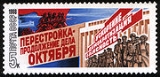
Glasnost was the policy of maximal publicity, openness, and transparency in the activities of all government institutions in the
Soviet UnionThe Soviet Union , officially the Union of Soviet Socialist Republics , was a constitutionally socialist state that existed in Eurasia between 1922 and 1991....
, together with
freedom of informationFreedom of information refers to the protection of the right to freedom of expression with regards to the Internet and information technology . Freedom of information may also concern censorship in an information technology context, i.e...
, introduced by
Mikhail GorbachevMikhail Sergeyevich Gorbachev is a former Soviet statesman, having served as General Secretary of the Communist Party of the Soviet Union from 1985 until 1991, and as the last head of state of the USSR, having served from 1988 until its dissolution in 1991...
in the second half of the 1980s. The word "glasnost" is used in Russian at least since the end of the 18th century.
The word was frequently used by Gorbachev to specify the policies he believed might help reduce the corruption at the top of the Communist Party and the Soviet government, and moderate the abuse of administrative power in the
Central CommitteeCentral Committee was the common designation of a standing administrative body of communist parties, analogous to a board of directors, whether ruling or non-ruling in the twentieth century and of the surviving, mostly Trotskyist, states in the early twenty first. In such party organizations the...
. Russian
human rightsHuman rights are "commonly understood as inalienable fundamental rights to which a person is inherently entitled simply because she or he is a human being." Human rights are thus conceived as universal and egalitarian . These rights may exist as natural rights or as legal rights, in both national...
activist and dissident
Lyudmila AlexeyevaLyudmila Mikhailovna Alexeyeva is a Russian historian, human rights activist, founding member of the Moscow Helsinki Watch Group, and one of the few veterans of the Soviet dissident movement still active in modern Russia.-Soviet period:...
explained glasnost as a word that "had been in the Russian language for centuries. It was in the dictionaries and lawbooks as long as there had been dictionaries and lawbooks. It was an ordinary, hardworking, nondescript word that was used to refer to a process, any process of justice of governance, being conducted in the open."
Glasnost can also refer to the specific period in the history of the USSR during the 1980s when there was less
censorshipthumb|[[Book burning]] following the [[1973 Chilean coup d'état|1973 coup]] that installed the [[Military government of Chile |Pinochet regime]] in Chile...
and greater freedom of information.
Areas of concern
While "glasnost" is associated with
freedom of speechFreedom of speech is the freedom to speak freely without censorship. The term freedom of expression is sometimes used synonymously, but includes any act of seeking, receiving and imparting information or ideas, regardless of the medium used...
, the main goal of this policy was to make the country's management transparent and open to debate, thus circumventing the narrow circle of
apparatchikApparatchik is a Russian colloquial term for a full-time, professional functionary of the Communist Party or government; i.e., an agent of the governmental or party "apparat" that held any position of bureaucratic or political responsibility, with the exception of the higher ranks of management...
s who previously exercised complete control of the economy. Through reviewing the past or by opening up the censored literature in the libraries and a greater freedom of speech: a radical change, as control of speech and suppression of government criticism had previously been a central part of the Soviet system. There was also a greater degree of freedom within the media.
In the late 1980s, the Soviet government came under increased criticism, as did
Leninist ideologyIn Marxist philosophy, Leninism is the body of political theory for the democratic organisation of a revolutionary vanguard party, and the achievement of a direct-democracy dictatorship of the proletariat, as political prelude to the establishment of socialism...
(which Gorbachev had attempted to preserve as the foundation for reform), and members of the Soviet population were more outspoken in their view that the Soviet government had become a failure. Glasnost did indeed provide freedom of expression, far beyond what Gorbachev had intended, and changed citizens' views towards the government, which played a key role in the dissolution of the Soviet Union.
Effects
Relaxation of
censorshipthumb|[[Book burning]] following the [[1973 Chilean coup d'état|1973 coup]] that installed the [[Military government of Chile |Pinochet regime]] in Chile...
resulted in the Communist Party losing its grip on the
mediaThe news media are those elements of the mass media that focus on delivering news to the general public or a target public.These include print media , broadcast news , and more recently the Internet .-Etymology:A medium is a carrier of something...
. Before long, much to the embarrassment of the authorities, the media began to expose severe social and economic problems which the Soviet government had long denied and covered up. Long-denied problems such as poor housing, food shortages,
alcoholismAlcoholism is a broad term for problems with alcohol, and is generally used to mean compulsive and uncontrolled consumption of alcoholic beverages, usually to the detriment of the drinker's health, personal relationships, and social standing...
, widespread pollution, creeping mortality rates and the second-rate position of women were now receiving increased attention, as well as the history of Soviet state crimes against the population.
Moreover, under glasnost, the people were able to learn significantly more about the doings of the administration of
Joseph StalinJoseph Vissarionovich Stalin was the Premier of the Soviet Union from 6 May 1941 to 5 March 1953. He was among the Bolshevik revolutionaries who brought about the October Revolution and had held the position of first General Secretary of the Communist Party of the Soviet Union's Central Committee...
, including the purges and other previously classified activities. Although
Nikita KhrushchevNikita Sergeyevich Khrushchev led the Soviet Union during part of the Cold War. He served as First Secretary of the Communist Party of the Soviet Union from 1953 to 1964, and as Chairman of the Council of Ministers, or Premier, from 1958 to 1964...
denounced Stalin's personality cult, information about the true proportions of his atrocities was still suppressed. In all, the very positive view of Soviet life which had long been presented to the public by the official media was being rapidly dismantled, and the negative aspects of life in the Soviet Union were brought into the spotlight. This began to undermine the faith of the public in the Soviet system.
Political openness continued to produce
unintended consequenceIn the social sciences, unintended consequences are outcomes that are not the outcomes intended by a purposeful action. The concept has long existed but was named and popularised in the 20th century by American sociologist Robert K. Merton...
s. In
electionAn election is a formal decision-making process by which a population chooses an individual to hold public office. Elections have been the usual mechanism by which modern representative democracy operates since the 17th century. Elections may fill offices in the legislature, sometimes in the...
s to the regional assemblies of the Soviet Union's
constituent republicsThe Republics of the Soviet Union or the Union Republics of the Soviet Union were ethnically-based administrative units that were subordinated directly to the Government of the Soviet Union...
,
nationalistsNationalism is a political ideology that involves a strong identification of a group of individuals with a political entity defined in national terms, i.e. a nation. In the 'modernist' image of the nation, it is nationalism that creates national identity. There are various definitions for what...
swept the board. As Gorbachev had weakened the system of internal political repression, the ability of the USSR's central Moscow government to impose its will on the USSR's constituent republics had been largely undermined. During the 1980s, calls for greater independence from Moscow's rule grew louder. This was especially marked in the Baltic Republics of
EstoniaEstonia , officially the Republic of Estonia , is a state in the Baltic region of Northern Europe. It is bordered to the north by the Gulf of Finland, to the west by the Baltic Sea, to the south by Latvia , and to the east by Lake Peipsi and the Russian Federation . Across the Baltic Sea lies...
,
LithuaniaLithuania , officially the Republic of Lithuania is a country in Northern Europe, the biggest of the three Baltic states. It is situated along the southeastern shore of the Baltic Sea, whereby to the west lie Sweden and Denmark...
and
LatviaLatvia , officially the Republic of Latvia , is a country in the Baltic region of Northern Europe. It is bordered to the north by Estonia , to the south by Lithuania , to the east by the Russian Federation , to the southeast by Belarus and shares maritime borders to the west with Sweden...
, which had been annexed into the Soviet Union by
Joseph StalinJoseph Vissarionovich Stalin was the Premier of the Soviet Union from 6 May 1941 to 5 March 1953. He was among the Bolshevik revolutionaries who brought about the October Revolution and had held the position of first General Secretary of the Communist Party of the Soviet Union's Central Committee...
in 1940. Nationalist feeling also took hold in other Soviet republics such as
UkraineThe Ukrainian Soviet Socialist Republic or in short, the Ukrainian SSR was a sovereign Soviet Socialist state and one of the fifteen constituent republics of the Soviet Union lasting from its inception in 1922 to the breakup in 1991...
,
Georgia and
AzerbaijanThe Azerbaijan Soviet Socialist Republic , also known as the Azerbaijan SSR for short, was one of the republics that made up the former Soviet Union....
.
Starting in the mid-1980s, the Baltic states used the reforms provided by glasnost to assert their rights to protect their environment (for example during the
Phosphorite WarThe Phosphorite War is the name given to a late-1980s environmental campaign in the then-Estonian Soviet Socialist Republic, against the opening of large phosphorite mines in the Virumaa region...
) and their historic monuments and, later, their claims to sovereignty and independence. When the Balts withstood outside threats, they exposed an irresolute
KremlinThe Moscow Kremlin , sometimes referred to as simply The Kremlin, is a historic fortified complex at the heart of Moscow, overlooking the Moskva River , Saint Basil's Cathedral and Red Square and the Alexander Garden...
. Bolstering separatism in other Soviet republics, the Balts triggered multiple challenges to the
Soviet UnionThe Soviet Union , officially the Union of Soviet Socialist Republics , was a constitutionally socialist state that existed in Eurasia between 1922 and 1991....
. Supported by Russian leader
Boris YeltsinBoris Nikolayevich Yeltsin was the first President of the Russian Federation, serving from 1991 to 1999.Originally a supporter of Mikhail Gorbachev, Yeltsin emerged under the perestroika reforms as one of Gorbachev's most powerful political opponents. On 29 May 1990 he was elected the chairman of...
, the Baltic republics asserted their sovereignty.
The rise of nationalism under glasnost also reawakened simmering ethnic tensions throughout the union. For example, in February 1988,
Nagorno-KarabakhNagorno-Karabakh is a landlocked region in the South Caucasus, lying between Lower Karabakh and Zangezur and covering the southeastern range of the Lesser Caucasus mountains...
, a predominantly ethnic Armenian region in the Azerbaijan SSR, passed a resolution calling for unification with the
Armenian SSRThe Armenian Soviet Socialist Republic The Armenian Soviet Socialist Republic The Armenian Soviet Socialist Republic The Armenian Soviet Socialist Republic The Armenian Soviet Socialist Republic The Armenian Soviet Socialist Republic The Armenian Soviet Socialist Republic The Armenian Soviet...
, which sparked the
Nagorno-Karabakh WarThe Nagorno-Karabakh War was an armed conflict that took place from February 1988 to May 1994, in the small enclave of Nagorno-Karabakh in southwestern Azerbaijan, between the majority ethnic Armenians of Nagorno-Karabakh backed by the Republic of Armenia, and the Republic of Azerbaijan...
.
The freedoms generated under glasnost enabled increased contact between Soviet citizens and the western world, particularly with the
United StatesThe United States of America is a federal constitutional republic comprising fifty states and a federal district...
. Restrictions on travel were loosened, allowing increased business and cultural contact. For example, one key meeting location was in the U.S. at the
Dakin BuildingThe Dakin Building is an architectural award-winning class A office building on the San Francisco Bay in Brisbane, California. Serving as a corporate headquarters building for several companies of national prominence, it was built from the profits of the Garfield character whose licensed products...
, then owned by American
philanthropistA philanthropist is someone who engages in philanthropy; that is, someone who donates his or her time, money, and/or reputation to charitable causes...
Henry Dakin, who had extensive Russian contacts:
During the late 1980s, as glasnost and perestroikaPerestroika was a political movement within the Communist Party of the Soviet Union during 1980s, widely associated with the Soviet leader Mikhail Gorbachev...
led to the liquidation of the Soviet empire, the Dakin building was the location for a series of groups facilitating United States-Russian contacts. They included the Center for U.S.-U.S.S.R. Initiatives, which helped more than 1000 Americans visit the Soviet Union and more than 100 then-Soviet citizens visit the U.S.
While thousands of
political prisonerAccording to the Longman Dictionary of Contemporary English, a political prisoner is ‘someone who is in prison because they have opposed or criticized the government of their own country’....
s and many
dissidentA dissident, broadly defined, is a person who actively challenges an established doctrine, policy, or institution. When dissidents unite for a common cause they often effect a dissident movement....
s were released in the spirit of glasnost, Gorbachev's original goal of using glasnost and perestroika to reform the
Soviet UnionThe Soviet Union , officially the Union of Soviet Socialist Republics , was a constitutionally socialist state that existed in Eurasia between 1922 and 1991....
was not achieved. In 1991,
the Soviet Union was dissolvedThe dissolution of the Soviet Union was the disintegration of the federal political structures and central government of the Union of Soviet Socialist Republics , resulting in the independence of all fifteen republics of the Soviet Union between March 11, 1990 and December 25, 1991...
following a
failed coupThe 1991 Soviet coup d'état attempt , also known as the August Putsch or August Coup , was an attempt by a group of members of the Soviet Union's government to take control of the country from Soviet president Mikhail Gorbachev...
by conservative elements who were opposed to Gorbachev's reforms.
In the world of professional sports, Glasnost led to the ability for athletes to be freed from the shackles of playing only for their country in tournament events and seek professional employment opportunities elsewhere, provided they still played for the Soviet Union in international tournaments. The most visible area where this occurred was in professional hockey. Until now, any player from one of the Soviet countries wishing to play in the
National Hockey LeagueThe National Hockey League is an unincorporated not-for-profit association which operates a major professional ice hockey league of 30 franchised member clubs, of which 7 are currently located in Canada and 23 in the United States...
had to defect and seek political asylum in the United States or
CanadaCanada is a North American country consisting of ten provinces and three territories. Located in the northern part of the continent, it extends from the Atlantic Ocean in the east to the Pacific Ocean in the west, and northward into the Arctic Ocean...
. The most infamous example of this was
Alexander MogilnyAlexander Gennadevitch Mogilny is a former Russian professional ice hockey player, currently the team consultant of the KHL team Amur Khabarovsk. Mogilny was best known for his lightning quick speed and lethal wrist shot in his early years, which led to his career year of 76 goals in the 1992–93...
in 1989.
But thanks to Glasnost, many of the top players from the Soviet Union's Central Red Army team were allowed to compete with NHL teams. Though this came too late for super goalkeepers
Vladislav TretiakVladislav Aleksandrovich Tretiak, MSM is a former goaltender for the Soviet Union's national ice hockey team. Considered to be one of the greatest goaltenders in the history of the sport, he was voted one of six players to the International Ice Hockey Federation's Centennial All-Star Team in a...
, many greats such as
Viacheslav FetisovViacheslav "Slava" Alexandrovich Fetisov is a retired professional ice hockey defenseman...
,
Sergei MakarovSergei Mikhailovich Makarov is a Russian former ice hockey right wing and two-time Olympic gold medalist, regarded as one of the greatest players to play the sport...
,
Pavel BurePavel Vladimirovich Bure is a retired Russian professional ice hockey right winger. Nicknamed "The Russian Rocket" for his speed, Bure played for 12 seasons in the National Hockey League with the Vancouver Canucks, Florida Panthers and New York Rangers...
,
Alexei KasatonovAlexei Viktorovich Kasatonov is a retired ice hockey defenceman, a long-time member of the Soviet Union national team.On the international stage, Kasatonov won two golds and one silver in the Olympics, and five golds in the World Championships...
, and
Igor LarionovIgor Nikolayevich Larionov is a Russian retired professional ice hockey player, known as The Professor. Along with Viacheslav Fetisov, he was instrumental in breaking the barrier that stopped Soviet players from joining the National Hockey League . He primarily played the centre position, and is...
would migrate to North America to play in the NHL, while also returning to Russia to play in international tournaments. This opened the door for eventual play of top players in the Winter Olympics from all countries with the NHL suspending league play during that tournament every four years.