
All Topics  
Constantinople


   Email Print
   Bookmark   Link


Constantinople


Constantinople (Greek
Greek language

Greek is an Indo-European languages native to the southern Balkan peninsula, the language of the Greek people. It forms an independent branch within Indo-European....
: , Konstantinoúpolis, or he Pólis, Latin
Latin

Latin is an Italic language, historically spoken in Latium and Ancient Rome. Through the Military history of the Roman Empire, Latin spread throughout the Mediterranean and a large part of Europe....
: , in formal Ottoman Turkish
Ottoman Turkish language

Ottoman Turkish is the variety of the Turkish language that was used as the administrative and literary language of the Ottoman Empire. It contains extensive borrowings from Arabic language and Persian language languages and was written in a variant of the Arabic script....
: ????????? Konstantiniyye) was the imperial
Empire

Empire derives from the Latin word imperium, denoting ?military command? in Roman. Politically, an empire is a geographically extensive group of states and peoples united and ruled either by a monarch or an oligarchy....
 capital (Gr
Greek language

Greek is an Indo-European languages native to the southern Balkan peninsula, the language of the Greek people. It forms an independent branch within Indo-European....
: , Basileúousa) of the Roman Empire
Roman Empire

The Roman Empire was the Roman Republic phase of the Ancient Rome, characterised by an autocracy form of government and large territorial holdings in Europe and around the Mediterranean....
 (330–395), the Byzantine/Eastern Roman Empire
Byzantine Empire

Byzantine Empire and Eastern Roman Empire are conventional names used to describe the Roman Empire during the Middle Ages, centered on its capital of Constantinople....
 (395–1204 and 1261–1453), the Latin Empire
Latin Empire

The Latin Empire or Latin Empire of Constantinople is the name given by historians to the Crusader state founded by the leaders of the Fourth Crusade on lands captured from the Byzantine Empire after their sack of Constantinople in 1204 and ended in 1261....
 (1204–1261), and the Ottoman Empire
Ottoman Empire

The Ottoman Empire , also known by its contemporaries as the Turkish Empire or Turkey , was an empire that lasted from 1299?1923. It was Treaty of Lausanne by the Republic of Turkey, which was officially proclaimed on October 29, 1923....
 (1453–1922). Strategically located between the Golden Horn
Golden Horn

The Golden Horn is an inlet of the Bosphorus dividing the city of Istanbul and forming a natural harbor....
 and the Sea of Marmara
Sea of Marmara

The Sea of Marmara , also known as the Sea of Marmora or the Marmara Sea, and in the context of classical antiquity as Propontis , is the inland sea that connects the Black Sea to the Aegean Sea, thus separating Turkey's Asian and European parts....
 at the point where Europe
Europe

Europe is, conventionally, one of the world's seven continents. Comprising the westernmost peninsula of Eurasia, Europe is generally divided from Asia to its east by the water divide of the Ural Mountains, the Ural , the Caspian Sea, and by the Caucasus Mountains to the southeast....
 meets Asia
Asia

Asia is the world's largest and most populous continent. It covers 8.6% of the Earth's total surface area and, with over 4 billion people, it contains more than 60% of the world's current human population....
, Byzantine Constantinople had been the capital of a Christian
Christendom

Christendom usually refers to Christianity as a territorial phenomenon. It can also refer to the part of the world in which Christianity prevails....
 empire, successor to ancient Greece
Ancient Greece

The term Ancient Greece refers to the period of History of Greece lasting from the Greek Dark Ages ca. 1100 BC and the Dorian invasion, to 146 BC and the Roman Republic conquest of Greece after the Battle of Corinth ....
 and Rome
Ancient Rome

Ancient Rome was a civilization that grew out of a small agricultural community founded on the Italian Peninsula as early as the 10th century BC....
.


Discussion
Ask a question about 'Constantinople'
Start a new discussion about 'Constantinople'
Answer questions from other users
Full Discussion Forum


Recent Posts


Timeline

326   Constantine I founds Constantinople and incorporates Byzantium into the new city.

330   Constantine I refounds Byzantium, renames it ''New Rome'', and moves the capital of the Roman Empire there from Rome. It is later known as Constantinople.

335   Athanasius is banished to Trier, on the charge that he prevented the corn fleet from sailing to Constantinople.

340   Constantinople, capital of Emperor Constantius II becomes the largest city of the world, taking the lead from Rome, capital of Emperor Constans.

342   The original Hagia Sophia is dedicated in Constantinople.

344   Bishop Eustorgius I brings relics of the Three Magi from Constantinople to Milan according to a legend from the 12th century.

357   Foundation of the Imperial library of Constantinople.

359   The first known Prefect of the City of Constantinople, Honoratus, took offi

365   Procopius bribes two legions passing by Constantinople, proclaims himself Roman emperor, and takes control of Thrace and Bithynia.

378   Valens completed the aqueduct of Constantinople begun by Constantine I


Encyclopedia


Constantinople (Greek
Greek language

Greek is an Indo-European languages native to the southern Balkan peninsula, the language of the Greek people. It forms an independent branch within Indo-European....
: , Konstantinoúpolis, or he Pólis, Latin
Latin

Latin is an Italic language, historically spoken in Latium and Ancient Rome. Through the Military history of the Roman Empire, Latin spread throughout the Mediterranean and a large part of Europe....
: , in formal Ottoman Turkish
Ottoman Turkish language

Ottoman Turkish is the variety of the Turkish language that was used as the administrative and literary language of the Ottoman Empire. It contains extensive borrowings from Arabic language and Persian language languages and was written in a variant of the Arabic script....
: ????????? Konstantiniyye) was the imperial
Empire

Empire derives from the Latin word imperium, denoting ?military command? in Roman. Politically, an empire is a geographically extensive group of states and peoples united and ruled either by a monarch or an oligarchy....
 capital (Gr
Greek language

Greek is an Indo-European languages native to the southern Balkan peninsula, the language of the Greek people. It forms an independent branch within Indo-European....
: , Basileúousa) of the Roman Empire
Roman Empire

The Roman Empire was the Roman Republic phase of the Ancient Rome, characterised by an autocracy form of government and large territorial holdings in Europe and around the Mediterranean....
 (330–395), the Byzantine/Eastern Roman Empire
Byzantine Empire

Byzantine Empire and Eastern Roman Empire are conventional names used to describe the Roman Empire during the Middle Ages, centered on its capital of Constantinople....
 (395–1204 and 1261–1453), the Latin Empire
Latin Empire

The Latin Empire or Latin Empire of Constantinople is the name given by historians to the Crusader state founded by the leaders of the Fourth Crusade on lands captured from the Byzantine Empire after their sack of Constantinople in 1204 and ended in 1261....
 (1204–1261), and the Ottoman Empire
Ottoman Empire

The Ottoman Empire , also known by its contemporaries as the Turkish Empire or Turkey , was an empire that lasted from 1299?1923. It was Treaty of Lausanne by the Republic of Turkey, which was officially proclaimed on October 29, 1923....
 (1453–1922). Strategically located between the Golden Horn
Golden Horn

The Golden Horn is an inlet of the Bosphorus dividing the city of Istanbul and forming a natural harbor....
 and the Sea of Marmara
Sea of Marmara

The Sea of Marmara , also known as the Sea of Marmora or the Marmara Sea, and in the context of classical antiquity as Propontis , is the inland sea that connects the Black Sea to the Aegean Sea, thus separating Turkey's Asian and European parts....
 at the point where Europe
Europe

Europe is, conventionally, one of the world's seven continents. Comprising the westernmost peninsula of Eurasia, Europe is generally divided from Asia to its east by the water divide of the Ural Mountains, the Ural , the Caspian Sea, and by the Caucasus Mountains to the southeast....
 meets Asia
Asia

Asia is the world's largest and most populous continent. It covers 8.6% of the Earth's total surface area and, with over 4 billion people, it contains more than 60% of the world's current human population....
, Byzantine Constantinople had been the capital of a Christian
Christendom

Christendom usually refers to Christianity as a territorial phenomenon. It can also refer to the part of the world in which Christianity prevails....
 empire, successor to ancient Greece
Ancient Greece

The term Ancient Greece refers to the period of History of Greece lasting from the Greek Dark Ages ca. 1100 BC and the Dorian invasion, to 146 BC and the Roman Republic conquest of Greece after the Battle of Corinth ....
 and Rome
Ancient Rome

Ancient Rome was a civilization that grew out of a small agricultural community founded on the Italian Peninsula as early as the 10th century BC....
. Throughout the Middle Ages
Middle Ages

File:Karl 1 mit papst gelasius gregor1 sacramentar v karl d kahlen.jpgThe Middle Ages of European history are a period in history which lasted for roughly a millennium, commonly dated from the fall of the Roman Empire in the 5th century to the beginning of the Early Modern Period in the 16th century, marked by the division of Western Christi...
 Constantinople was Europe's largest and wealthiest city.

Depending on the background of its rulers, it often had several different names at any given time; among the most common were Byzantium
Byzantium

Byzantium was an Ancient Greece city, which was founded by Greeks colonists from Megara in 667 BC and named after their king Byzas or Byzantas ....
 (Gr.
Greek language

Greek is an Indo-European languages native to the southern Balkan peninsula, the language of the Greek people. It forms an independent branch within Indo-European....
:, Byzántion), New Rome
New Rome

The term "New Rome" has been used in the following contexts.* It was a common name applied to Constantinople, the city founded by Roman Emperor Constantine the Great in 324 ....
 (Gr.
Greek language

Greek is an Indo-European languages native to the southern Balkan peninsula, the language of the Greek people. It forms an independent branch within Indo-European....
: Néa Rhome, ), Constantinople, and Stamboul. It was also called Tsargrad
Tsargrad

Tsargrad is a historic Slavic languages name for the city of Constantinople, the capital of the Roman Empire and eventually its eastern half, the Byzantine Empire, which is modern-day Istanbul in Turkey....
 ("City of the Emperors") by the Slavs, while to the Viking
Viking

A Viking is one of the Norsemen explorers, warriors, merchants, and Piracy who raided and colonized wide areas of Europe from the late eighth to the early eleventh century....
s it was known as Miklagård, "the Great City", similar to the common Greek appellation "the City" (he Pólis).

It was officially renamed to its modern Turkish name Istanbul
Istanbul

Istanbul is the largest city in Turkey, List of metropolitan areas in Europe by population, and List of cities proper by population in the world with a population of 12.6 million....
 in 1930 with the Turkish Postal Service Law, as part of Atatürk's
Mustafa Kemal Atatürk

Mustafa Kemal Atat?rk was a Turkish people army officer, revolutionary statesman, and Father of the Nation Turkey as well as its List of Presidents of Turkey....
 national reforms.

History

Siege of Constantinople

Byzantium

Constantinople was founded by the Roman emperor
Roman Emperor

The Roman Emperor was the ruler of the Roman Empire during the imperial period . The Romans had no single term for the office: Latin language titles such as imperator , Augustus , Caesar and princeps were all associated with it....
 Constantine I
Constantine I

Flavius Valerius Aurelius Constantinus , commonly known in English_language as Constantine I, Constantine the Great, or Saint Constantine , was Roman Emperor from 306, and the undisputed holder of that office from 324 until his death in 337....
 on the site of an already existing city, Byzantium
Byzantium

Byzantium was an Ancient Greece city, which was founded by Greeks colonists from Megara in 667 BC and named after their king Byzas or Byzantas ....
, settled in the early days of Greek colonial expansion, probably around 671-662 BC. The site lay astride the land route from Europe to Asia and the seaway from the Black Sea to the Mediterranean, and had in the Golden Horn
Golden Horn

The Golden Horn is an inlet of the Bosphorus dividing the city of Istanbul and forming a natural harbor....
 an excellent and spacious harbour.

Constantine the Great (306–337)

Byzantinischer Mosaizist Um 1000 002
Constantine had altogether more ambitious plans. Having restored the unity of the Empire, and being in course of major governmental reforms as well as of sponsoring the consolidation of the Christian church, he was well aware that Rome was an unsatisfactory capital. Rome was too far from the frontiers, and hence from the armies and the Imperial courts, and it offered an undesirable playground for disaffected politicians. Yet it had been the capital of the state for over a thousand years, and it will have seemed unthinkable to suggest that the capital be moved to a different location. Nevertheless, he identified the site of Byzantium as the right place: a place where an emperor could sit, readily defended, with easy access to the Danube
Danube

The Danube is the longest river in the European Union and Europe's second longest river after the Volga.The river originates in the Black Forest in Germany as the much smaller Brigach and Breg River rivers which join at the eponymously named German town Donaueschingen, after which it is known as the Danube and flows eastwards for a distance...
 or the Euphrates
Euphrates

The Euphrates is the western of the two great rivers that define Mesopotamia which flows from Anatolia....
 frontiers, his court supplied from the rich gardens and sophisticated workshops of Roman Asia, his treasuries filled by the wealthiest provinces of the Empire.

Constantinople was built over six years, and consecrated on 11 May 330. Although the city was essentially Greek-speaking, Latin was the language of government. It became known as Constantinopolis, "Constantine's City". and ornamented it with public works worthy of an imperial metropolis. Yet initially Constantine's new Rome did not have all the dignities of old Rome. It possessed a proconsul
Proconsul

Ancient RomeIn the Roman Republic, a proconsul was a promagistrate who, after serving as consul, spent a year as a Roman governor of a Roman province....
, rather than an urban prefect. It had no praetors, tribunes or quaestors. Although it did have senators, they held the title clarus, not clarissimus, like those of Rome. It also lacked the panoply of other administrative offices regulating the food supply, police, statues, temples, sewers, aqueducts or other public works. The new programme of building was carried out in great haste: columns, marbles, doors and tiles were taken wholesale from the temples of the Empire and moved to the new city. Similarly, many of the greatest works of Greek and Roman art were soon to be seen in its squares and streets. The Emperor stimulated private building by promising householders gifts of land from the Imperial estates in Asiana
Diocese of Asia

The Diocese of Asia was a Roman diocese of the later Roman Empire, incorporating the provinces of western Asia Minor and the islands of the eastern Aegean Sea....
 and Pontica
Diocese of Pontus

The Diocese of Pontus was a Roman diocese of the later Roman Empire, incorporating the provinces of northern and northeastern Asia Minor up to the border with the Sassanid Empire....
, and on 18 May 332 he announced that, as in Rome, free distributions of food would be made to the citizens. At the time the amount is said to have been 80,000 rations a day, doled out from 117 distribution points around the city.

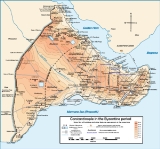
Constantine laid out a new square at the centre of old Byzantium, naming it the Augustaeum. The new senate-house (or Curia) was housed in a basilica on the east side. On the south side of the great square was erected the Great Palace
Great Palace of Constantinople

The Byzantine Empire Great Palace of Constantinople, , also known as the Sacred Palace , was a large palace complex, located in the south-eastern end of the peninsula where the city lies....
 of the emperor with its imposing entrance, the Chalke, and its ceremonial suite known as the Palace of Daphne. Nearby was the vast Hippodrome
Hippodrome of Constantinople

The Hippodrome of Constantinople was a Race track that was the sporting and social centre of Constantinople, capital of the Byzantine Empire and the largest city in Europe....
 for chariot-races, seating over 80,000 spectators, and the famed Baths of Zeuxippus
Baths of Zeuxippus

The Baths of Zeuxippus, built sometime between 100 to 200, destroyed by the Nika revolt of 532 and then rebuilt several years later, were popular public baths in the city of Constantinople, the capital of the Byzantine Empire....
. At the western entrance to the Augustaeum was the Milion
Milion

The Milion , was a monument in Constantinople. It was the origin and start of measurement of distances for all the Roman road leading to the cities of the Byzantine Empire, and had the same function which the Milliarium Aureum of Rome still has today....
, a vaulted monument from which distances were measured across the Eastern Roman Empire.

From the Augustaeum led a great street, the Mese (Greek: ??s? (?d??) lit. "Middle Street"), lined with colonnades. As it descended the First Hill of the city and climbed the Second Hill, it passed on the left the Praetorium
Praetorium

Praetorium was originally the name of the headquarters of a Ancient Rome army. The praetorium was the commander's tent or building in a Roman fortification, a castra or castellum....
 or law-court. Then it passed through the oval Forum of Constantine
Forum of Constantine

The Forum of Constantine was built at the foundation of Constantinople immediately outside of the Walls of Constantinople#Walls of Byzantium and Constantine....
 where there was a second Senate-house and a high column
Column of Constantine

The Column of Constantine is a monumental column constructed on the orders of the Roman Empire emperor Constantine the Great in 330 AD. It commemorates the declaration of Byzantium as the new capital city of the Roman Empire....
 with a statue of Constantine himself in the guise of Helios
Helios

Helios is the god of sun.In Greek mythology the sun was personified as Helios . Homer often calls him simply Titan or Hyperion , while Hesiod and the Homeric Hymn separate him as a son of the Titans Hyperion and Theia or Euryphaessa and brother of the goddesses Selene, the moon, and Eos, the dawn....
, crowned with a halo of seven rays and looking towards the rising sun. From there the Mese passed on and through the Forum of Taurus and then the Forum of Bous, and finally up the Seventh Hill (or Xerolophus) and through to the Golden Gate in the Constantinian Wall
Walls of Constantinople

The Walls of Constantinople are a series of stone walls that have surrounded and protected the city of Constantinople since its founding as the capital of the Eastern Roman Empire by Constantine the Great....
. After the construction of the Theodosian Walls in the early 5th century, it would be extended to the new Golden Gate, reaching a total length of seven Roman miles.

Divided empire, 395–527

Theodosius Colum, Istanbul
The first known Prefect of the City of Constantinople was Honoratus, who took office on 11 December 359 and held it until 361. The emperor Valens
Valens

Flamin Julius Valens was Roman Emperor , after he was given the Eastern part of the empire by his brother Valentinian I. Valens, sometimes known as the Last of the Romans, was defeated and killed in the Battle of Adrianople, which marked the beginning of the fall of the Western Roman Empire....
 built the Palace of Hebdomon on the shore of the Propontis
Sea of Marmara

The Sea of Marmara , also known as the Sea of Marmora or the Marmara Sea, and in the context of classical antiquity as Propontis , is the inland sea that connects the Black Sea to the Aegean Sea, thus separating Turkey's Asian and European parts....
 near the Golden Gate, probably for use when reviewing troops. All the emperors up to Zeno
Zeno (emperor)

Flavius Zeno Perpetuus, original name Tarasicodissa or Trascalissaeus, Eastern Roman Empire was one of the more prominent of the early Byzantine Emperors....
 and Basiliscus
Basiliscus

Flavius Basiliscus was an Eastern Roman Emperor of the House of Leo, who ruled briefly , when Emperor Zeno had been forced out of Constantinople by a revolt....
 were crowned and acclaimed at the Hebdomon. Theodosius I
Theodosius I

Flavius Theodosius , also called Theodosius I and Theodosius the Great , was Roman Emperor from 379 to 395. Reuniting the eastern and western portions of the empire, Theodosius was the last emperor of both the Eastern Roman Empire and Western Roman Empire....
 founded the Church of John the Baptist to house the skull of the saint (today preserved at the Topkapi Palace
Topkapi Palace

The Topkapi Palace or in Ottoman Turkish language: ?????? ?????, usually spelled "Topkapi" in English)is a palace in Istanbul, Turkey, which was the official and primary residence in the city of the Ottoman Sultans, from 1465 to 1853....
 in Istanbul, Turkey), put up a memorial pillar to himself in the Forum of Taurus, and turned the ruined temple of Aphrodite
Aphrodite

Aphrodite is the classical Greek mythology goddess of love, sex, and beauty. According to Greek oral poet Hesiod, she was born when Uranus was castrated by his son Cronus....
 into a coach house for the Praetorian Prefect
Praetorian prefecture of the East

The praetorian prefecture of the East or of Oriens was one of four large praetorian prefectures into which the Late Roman Empire was divided....
; Arcadius
Arcadius

Flavius Arcadius was Roman Emperors in the Eastern half of the Roman Empire from 395 until his death.Arcadius was born in Spain, the elder son of Theodosius I and Aelia Flaccilla, and brother of Flavius Augustus Honorius, who would become a Western Roman Emperor....
 built a new forum named after himself on the Mese, near the walls of Constantine.

Gradually the importance of Constantinople increased. After the shock of the Battle of Adrianople
Battle of Adrianople

The second Battle of Adrianople , sometimes known as the Battle of Hadrianopolis, was fought between a Roman Empire army led by the Roman Emperor Valens and Goths rebels led by Fritigern....
 in 378, in which the emperor Valens
Valens

Flamin Julius Valens was Roman Emperor , after he was given the Eastern part of the empire by his brother Valentinian I. Valens, sometimes known as the Last of the Romans, was defeated and killed in the Battle of Adrianople, which marked the beginning of the fall of the Western Roman Empire....
 with the flower of the Roman armies was destroyed by the Visigoths within a few days' march, the city looked to its defenses, and Theodosius II
Theodosius II

Flavius Theodosius , called the Calligrapher, known in English as Theodosius II, was an Eastern Roman Empire , mostly known for the law code bearing his name, the Codex Theodosianus, and the Walls of Constantinople#The Theodosian Walls of Constantinople built during his reign....
 built in 413–414 the 18 metre (60 ft) tall triple-wall fortifications
Walls of Constantinople

The Walls of Constantinople are a series of stone walls that have surrounded and protected the city of Constantinople since its founding as the capital of the Eastern Roman Empire by Constantine the Great....
 which were never to be breached until the coming of gunpowder. Theodosius also founded a University
University of Constantinople

The University of Constantinople, sometimes known as the University of the palace hall of Magnaura in the Byzantine Empire was recognised as a University in 848, although it had been founded in 425 and is considered by several scholars to be the first university in the world....
 near the Forum of Taurus, on 27 February 425.

Uldin
Uldin

Uldin was one of the primary chieftains of the Huns located beyond the Danube during the reigns of Arcadius and Theodosius II . He did not, however have total control of the Hunnic people....
, a prince of the Huns
Huns

The Huns were a confederation of Central Asian Eurasian nomads or semi-nomads, who had established an empire in Eurasia. The Huns may have stimulated the Migration Period, a contributing factor in the collapse of the Roman Empire....
, appeared on the Danube about this time and advanced into Thrace, but he was deserted by many of his followers, who joined with the Romans in driving their king back north of the river. Subsequently new walls were built to defend the city, and the fleet on the Danube improved.

In due course the barbarian
Barbarian

"Barbarian" is a pejorative term for an uncivilized person, either in a general reference to a member of a nation or ethnos, typically a tribal society as seen by an urban civilization either viewed as inferior, or admired as a noble savage....
s overran the Western Roman Empire: its emperors retreated to Ravenna
Ravenna

Ravenna is a city and comune in the Emilia-Romagna region of Italy. The city is inland, but is connected to the Adriatic Sea by a canal. Ravenna once served as the seat of the Western Roman Empire and later the Ostrogoths and the Exarchate of Ravenna....
, and it diminished to nothing. Thereafter, Constantinople became in truth the largest city of the Roman Empire and of the world. Emperors were no longer peripatetic between various court capitals and palaces. They remained in their palace in the Great City, and sent generals to command their armies. The wealth of the eastern Mediterranean and western Asia flowed into Constantinople.

Justinian, 527–565


The emperor Justinian I
Justinian I

Flavius Petrus Sabbatius Iustinianus , AD 482 or 483 ? 13 or 14 November 565, was the second member of the Justinian Dynasty and List of Roman Emperors from 527 until his death....
 (527–565) was known for his successes in war, for his legal reforms and for his public works. It was from Constantinople that his expedition for the reconquest of the former Diocese of Africa set sail on or about 21 June 533. Before their departure the ship of the commander Belisarius
Belisarius

Flavius Belisarius is often described as one of the greatest generals of the Byzantine Empire. He was instrumental to Byzantine Emperor Justinian I's ambitious project of reconquering much of the Western Roman Empire, which had been lost just under a century previously....
 anchored in front of the Imperial palace, and the Patriarch offered prayers for the success of the enterprise. After the victory, in 534, the Temple treasure of Jerusalem, looted by the Romans in 70 AD and taken to Carthage
Carthage

Carthage refers both to an ancient city in present-day Tunisia, and a modern-day suburb of Tunis. The civilization that developed within the city's sphere of influence is referred to as Punic or Carthaginian....
 by the Vandals
Vandals

The Vandals were an East Germanic tribe that entered the late Roman Empire during the 5th century. The Goths Theodoric the Great, king of the Ostrogoths and regent of the Visigoths, was allied by marriage with the Vandals as well as with the Burgundians and the Franks under Clovis I....
 after their sack of Rome in 455, was brought to Constantinople and deposited for a time, perhaps in the church of St Polyeuctus, before being returned to Jerusalem in either the Church of the Resurrection or the New Church.

Hagia Sophia Bw
Chariot-racing had been important in Rome for centuries. In Constantinople, the hippodrome became over time increasingly a place of political significance. It was where (as a shadow of the popular elections of old Rome) the people by acclamation showed their approval of a new emperor; and also where they openly criticized the government, or clamoured for the removal of unpopular ministers. In the time of Justinian, public order in Constantinople became a critical political issue.

The entire late Roman and early Byzantine period was one where Christianity was resolving fundamental questions of identity, and the dispute between the orthodox and the monophysites became the cause of serious disorder, expressed through allegiance to the horse-racing parties of the Blues and the Greens. The partisans of the Blues and the Greens were said to affect untrimmed facial hair, head hair shaved at the front and grown long at the back, and wide-sleeved tunics tight at the wrist; and to form gangs to engage in night-time muggings and street violence. At last these disorders took the form of a major rebellion of 532, known as the "Nika" riots
Nika riots

The Nika riots , or Nika revolt, took place over the course of a week in Constantinople in 532. It was the most violent riot that Constantinople had ever seen to that point, with nearly half the city being burned or destroyed and tens of thousands of people killed....
 (from the battle-cry of "Victory!" of those involved).

Fires started by the Nika rioters consumed Constantine's basilica of St Sophia, the city's principal church, which lay to the north of the Augustaeum. Justinian commissioned Anthemius of Tralles
Anthemius of Tralles

Anthemius of Tralles was a Greeks professor of Geometry in Constantinople and architect, who collaborated with Isidore of Miletus to build the church of Hagia Sophia by the order of Justinian I....
 and Isidore of Miletus
Isidore of Miletus

Isidore of Miletus was one of the two Greeks architects who designed the church of Hagia Sophia in Constantinople .The Emperor Justinian I decided to rebuild the 4th century basilica in Constantinople which was destroyed during the Nika riots of 532....
 to replace it with a new and incomparable St Sophia
Hagia Sophia

Hagia Sophia is a former Patriarchate basilica, later a mosque, now a museum in Istanbul, Turkey. Famous in particular for its massive dome, it is considered the epitome of Byzantine architecture....
. This was the great cathedral of the Orthodox Church, whose dome was said to be held aloft by God alone, and which was directly connected to the palace so that the imperial family could attend services without passing through the streets. The dedication took place on 26 December 537 in the presence of the emperor, who exclaimed, "O Solomon, I have outdone thee!" St Sophia was served by 600 people including 80 priests, and cost 20,000 pounds of gold to build.

Justinian also had Anthemius and Isidore demolish and replace the original Church of the Holy Apostles built by Constantine with a new church
Church of the Holy Apostles

The Church of the Holy Apostles , also known as the Imperial Polyandreion, was a Christian basilica built in Constantinople in 550. It was second only to the Hagia Sophia among the great churches of the Eastern Empire....
 under the same dedication. This was designed in the form of an equally-armed cross with five domes, and ornamented with beautiful mosaics. This church was to remain the burial place of the emperors from Constantine himself until the eleventh century. When the city fell to the Turks in 1453, the church was demolished to make room for the tomb of Mehmet II the Conqueror. Justinian was also concerned with other aspects of the city's built environment, legislating against the abuse of laws prohibiting building within of the sea front, in order to protect the view.

During Justinian I's reign, the city's population reached about 500,000 people. However, the social fabric of Constantinople was also damaged by the onset of Plague of Justinian
Plague of Justinian

The Plague of Justinian was a pandemic that afflicted the Byzantine Empire, including its capital Constantinople, in the years 541?542 AD. The most commonly accepted cause of the pandemic is bubonic plague, which later became infamous for either causing or contributing to the Black Death of the 14th century....
 between 541–542 AD. It killed perhaps 40% of the city's inhabitants.

Walls of Constantinople

Survival, 565–717

In the early 7th century the Avars
Eurasian Avars

The 'Avars' were a highly organized and powerful Turkic confederation. They were ruled by a khagan, who was surrounded by a tight-knit retinue of nomad warriors, an organization characteristic of Turkic peoples groups....
 and later the Bulgars
Bulgars

The Bulgars were a seminomadic people, probably of Turkic peoples descent, originally from Southern Central Asia, who from the 2nd century onwards dwelled in the steppes north of the Caucasus and around the banks of river Volga ....
 overwhelmed much of the Balkans
Balkans

The Balkans is the historical name of a geographic subregion of southeastern Europe. The region takes its name from the Balkan Mountains, which run through the centre of Bulgaria into eastern Serbia....
, threatening Constantinople from the west. Simultaneously the Persian Sassanids overwhelmed the Prefecture of the East and penetrated deep into Anatolia. Heraclius
Heraclius

Flavius Heraclius was a Byzantine Emperor, who ruled the Byzantine Empire for over thirty years, from October 5, 610 to February 11, 641. His rise to power began in 608, when he and his Heraclius the Elder, the viceregal Exarchate of Africa, successfully led a revolt against the unpopular usurper Phocas....
, son to the exarch
Exarch

In the Byzantine Empire, an exarch, from Greek language , was governor with extended authority of a province at some remove from the capital Constantinople....
 of Africa
Africa

Africa is the world's second-largest and second most-populous continent, after Asia. At about 30.2 million km? including adjacent islands, it covers 6% of the Earth's total surface area and 20.4% of the total land area....
, set sail for the city and assumed the purple. He found the military situation so dire that he is said at first to have contemplated withdrawing the imperial capital to Carthage
Carthage

Carthage refers both to an ancient city in present-day Tunisia, and a modern-day suburb of Tunis. The civilization that developed within the city's sphere of influence is referred to as Punic or Carthaginian....
, but relented after the people of Constantinople begged him to stay. While the Great City withstood a siege
Siege of Constantinople (626)

The Siege of Constantinople in 626 AD by the Sassanid Empire ended in a decisive victory for the Byzantine Empire which, with other victories achieved by Heraclius the previous year and in 627 AD, enabled Byzantium to regain her territories and enforce a favorable treaty with borders status quo c.590 AD....
, Heraclius launched a flank attack against the Persians, invading Armenia
Armenia

Armenia , officially the Republic of Armenia , is a landlocked mountainous country in South Caucasus between the Black Sea and the Caspian Sea....
 and Media
Medes

The Medes were an Ancient Iranian peoples who lived in the northwestern portions of present-day Iran. This area was known in Greek as Media or Medea ....
. The Emperor's victories restored the previous status quo and the Roman eastern frontier, but the prolonged warfare left both empires severely weakened.

The newly ascendant religion of Islam
Islam

Islam is a Monotheism, Abrahamic religion originating with the teachings of the Prophets of Islam Muhammad, a 7th century Arab religious and political figure....
 arose in the power vacuum left by the two exhausted empires. It quickly overran the Sassanid Empire, and seized the Roman Near Eastern provinces in quick succession. The centuries-long Byzantine-Arab Wars
Byzantine-Arab Wars

The Byzantine?Arab Wars were a series of wars between the Caliphate and the Byzantine Empire between the 7th and 12th centuries AD. These started during the initial Muslim conquests under the Rashidun Caliphate and Umayyad Caliphate caliphs and continued in the form of an enduring border tussle until the beginning of the Crusades....
 followed, creating a new balance of power in the Mediterranean world. During these wars, the Muslims attempted twice to strike at the heart of the Byzantine Empire, Constantinople. The first siege lasted from 674 to 678, and the second from 717 to 718. While the Theodosian Walls made the city impregnable from the land, the newly discovered incendiary substance known as "Greek Fire
Greek fire

Greek fire was a primitive incendiary device weapon used by the Byzantine Empire. The Byzantines typically used it in naval battles to great effect as it could continue burning even on water....
" allowed the Byzantine navy
Byzantine navy

The Byzantine navy comprised the navy of the Byzantine Empire. Like the empire it served, it developed directly from its earlier Roman Navy, but in comparison with its precursor played a far greater role in the defense and survival of the state....
 to destroy the Arab fleets and keep the city supplied. In the second siege, decisive help was rendered by the Bulgars
First Bulgarian Empire

The First Bulgarian Empire was a medieval Bulgarian state founded in AD 632 in the lands near the Danube Delta and disintegrated in AD 1018 after its annexation to the Byzantine Empire....
, who attacked the Arab army. The failure of this siege was a severe blow to the Umayyad Caliphate, and resulted in the stabilization of the Byzantine-Arab equilibrium, opening the way for the Empire's gradual recovery under the Isaurian dynasty
Byzantium under the Isaurians

The Byzantine Empire or Byzantium is the term conventionally used since the 19th century to describe the Greek-speaking Roman Empire of the Middle Ages, centered around its capital of Constantinople....
.

Recovery, 717–1025

In the 730s Leo III carried out extensive repairs of the Theodosian walls, which had been damaged by frequent and violent attacks; this work was financed by a special tax on all the subjects of the Empire.

Theodora, widow of the emperor Theophilus
Theophilus

Various people have been known by the name Theophilus or Theophilos, which means "Friend of God" in Greek , and is thus similar to the Latin word Amadeus ....
 (d. 842) acted as regent during the minority of her son Michael III
Michael III

Michael III the Drunkard , , Byzantine Emperor from 842 to 867. Michael III was the third and traditionally last member of the Phrygian Dynasty....
, who was said to have been introduced to dissolute habits by her brother Bardas. When Michael assumed power in 856 he became known for excessive drunkenness, appeared in the hippodrome as a charioteer and burlesqued the religious processions of the clergy. He removed Theodora from the Great Palace to the Carian Palace and later to the monastery of Gastria
Sancaktar Hayrettin Mosque

Sancaktar Hayrettin Mosque is part of a former Eastern Orthodox monastery converted into a mosque by the Ottoman Empire. It is generally believed that the small building belonged to the Byzantine Empire Monastery of Gastria ....
, but after the death of Bardas she was released to live in the palace of St Mamas; she also had a rural residence at the Anthemian Palace, where Michael was assassinated in 867.

In 865 an attack was made on the city by a new principality set up a few years earlier at Novgorod by Rurik
Rurik

Rurik or Riurik was a Varangian chieftain who gained control of Staraya Ladoga in 862, built the Holmgard settlement near Novgorod, and founded the Rurik Dynasty which ruled Kievan Rus and then Galicia-Volhynia 14th and Muscovy until the 16th century....
, a Varangian chief: two hundred small Russian vessels passed through the Bosporus and plundered the monasteries and other properties on the suburban Prince's Islands. Oryphas
Niketas Oryphas

Niketas Oryphas or O?ryphas was a distinguished Byzantine Empire official, patrician and admiral under the Emperors Michael III and Basil I the Macedonian....
, the admiral of the Byzantine fleet, alerted the emperor Michael, who promptly put the invaders to flight; but the suddenness and savagery of the onslaught made a deep impression on the citizens.

In 980 the emperor Basil II
Basil II

Basil II, surnamed the Bulgar-slayer , also known as Basil the Porphyrogenitus and Basil the Young to distinguish him from Basil I the Macedonian, was a Byzantine emperor from the Macedonian dynasty who reigned from January 10 976 to December 15, 1025....
 received an unusual gift from Prince Vladimir of Kiev: 6,000 Varangian warriors which Basil formed into a new bodyguard known as the Varangian Guard. They were known for their ferocity, honour and loyalty. It is said that in 1038 they were dispersed in winter quarters in the Thracesian theme when one of their number attempted to violate a countrywoman, but in the struggle she seized his sword and killed him; instead of taking revenge, however, his comrades applauded her conduct, compensated her with all his possessions, and exposed his body without burial as if he had committed suicide. However, following the death of an emperor, they became known also for plunder in the imperial palaces. Later in the 11th Century the Varangian Guard became dominated by Anglo-Saxons
Anglo-Saxons

Anglo-Saxons is the term usually used to describe the invading tribes in the south and east of Great Britain starting from the early 5th century AD, and their creation of the English nation, lasting until the Norman conquest of England of 1066....
 who preferred this way of life to subjugation by the new Norman kings of England.

The Book of the Eparch, which dates to the 10th century, gives a detailed picture of the city's commercial life and its organization at that time. The corporations in which the tradesmen of Constantinople were organised were supervised by the Eparch, who regulated such matters as production, prices, import and export. Each guild had its own monopoly, and tradesmen might not belong to more than one. It is an impressive testament to the strength of tradition how little these arrangements had changed since the office, then known by the Latin version of its title, had been set up in 330 to mirror the urban prefecture of Rome.

In the 9th and 10th centuries, the Constantinople had a population of between 500,000 and 800,000.

The Iconoclast controversy, 730–787, 814–842
In the eighth and ninth centuries the iconoclast
Iconoclast

An iconoclast is someone who performs iconoclasm ? destruction of religious symbols, or, by extension, established dogma or conventions.Iconoclast may also refer to:...
 movement caused serious political unrest throughout the Empire. The emperor Leo III
Leo III the Isaurian

Leo III the Isaurian or the Syrian , was List of Byzantine Emperors from 717 until his death in 741. He put an end to a period of instability, successfully defended the empire against the invading Umayyads, and forbade the veneration of icons ....
 issued a decree in 726 against images, and ordered the destruction of a statue of Christ over one of the doors of the Chalke, an act which was fiercely resisted by the citizens. Constantine V
Constantine V

Constantine V was List of Byzantine Emperors from 741 to 775; ); ....
 convoked a church council in 754 which condemned the worship of images, after which many treasures were broken, burned, or painted over with depictions of trees, birds or animals: one source refers to the church of the Holy Virgin
Church of St. Mary of Blachernae (Istanbul)

Saint Mary of Blachernae is an Eastern Orthodox church in Istanbul. The little edifice, built in 1867, got the same dedication as the shrine erected in this place in the fifth century which, until its destruction in 1434, was one of the most important sanctuaries of Greek Orthodox Church Orthodox Church....
 at Blachernae
Blachernae

Blachernae was a suburb in the northwestern section of Constantinople. It was the site of a spring and a Church of St. Mary of Blachernae were built there, notably by Pulcheria in the 5th century and by Justinian I in the 6th century....
 as having been transformed into a "fruit store and aviary". Following the death of his son Leo IV
Leo IV the Khazar

Leo IV the Khazars , , was Byzantine Empire from 775 to 780.Leo was the son of Emperor Constantine V by his first wife, Irene of Khazaria ....
 in 780, the empress Irene
Irene (empress)

Irene Serantapechaina, known as Irene of Athens or Irene the Athenian was a Byzantine emperor regnant from 797 to 802, having previously been Empress consort from 775-780, and empress mother and regent from 780-797....
 restored the veneration of images through the agency of the Second Council of Nicaea
Second Council of Nicaea

The Second Council of Nicaea was the seventh ecumenical council of Christianity , and the last to be accepted by both Eastern and Western churches....
 in 787.

The iconoclast controversy returned in the early 9th century, only to be resolved once more in 843 during the regency of Empress Theodora
Theodora (9th century)

Theodora was the wife of the Byzantine emperor Theophilus ....
, who restored the icons. These controversies contributed to the deterioration of relations between the Western
Catholicism

Catholicism is a broad term for the body of the Catholic faith, its Theology and doctrines, its Catholic liturgy, Ethics, spiritual, and behavioral characteristics, as well as a religious people as a whole....
 and the Eastern
Eastern Orthodox Church

The Eastern Orthodox Church is the second largest single Christian communion in the world with an estimated 225 million members worldwide. It is considered by its adherents to be the Four Marks of the Church established by Jesus Christ and his Apostles nearly 2000 years ago....
 Churches.

Prelude to the Comnenian period, 1025–1081

In the late 11th century catastrophe struck with the unexpected and calamitous defeat of the imperial armies at the Battle of Manzikert
Battle of Manzikert

The Battle of Manzikert, or Malazgirt, was fought between the Byzantine Empire and Great Seljuq Empire forces led by Alp Arslan on August 26, 1071 near Manzikert ....
 in Armenia in 1071. The Emperor Romanus
Romanos IV

Romanos IV Diogenes or Romanus IV Diogenes was List of Byzantine Emperors from 1068 to 1071....
 Diogenes was captured. The peace terms demanded by Alp Arslan
Alp Arslan

Alp Arslan was the second sultan of the Seljuk dynasty and great-grandson of Seljuk, the eponym of the dynasty. He assumed the name of Muhammad bin Da'ud Chaghri when he embraced Islam, and for his military prowess, personal valour, and fighting skills he obtained the surname Alp Arslan, which means "a valiant lion" in Turkish lang...
, sultan of the Seljuk Turks, were not excessive, and Romanus accepted them. On his release, however, Romanus found that enemies had placed their own candidate on the throne in his absence; he surrendered to them and suffered death by torture, and the new ruler, Michael VII
Michael VII

Michael VII Doukas or Ducas , nicknamed Parapinakes, Byzantine emperor from 1071 to 1078....
 Ducas, refused to honour the treaty. In response, the Turks began to move into Anatolia in 1073. The collapse of the old defensive system meant that they met no opposition, and the empire's resources were distracted and squandered in a series of civil wars. Thousands of Turkoman
Turkmen people

The Turkmen are a Turkic people found primarily in the Central Asian states of Turkmenistan and Afghanistan and in northeastern Iran. They speak the Turkmen language which is classified as part of the Western Oghuz languages branch of Turkic languages family together with Turkish language, Azerbaijani language, Gagauz language, Salar languag...
 tribesmen crossed the unguarded frontier and moved into Anatolia. By 1080, a huge area had been lost to the empire, and the Turks were within striking distance of Constantinople.

The Comneni, 1081–1185

Byzantium@1180
Under the Comnenian dynasty (1081–1185), Byzantium staged a remarkable military, financial and territorial recovery. In what is sometimes called the Comnenian Restoration, with the establishment of a new military system
Komnenian army

The Komnenian army was the force established by Byzantine Empire emperor Alexios I Komnenos during the late eleventh/early twelfth century, and perfected by his successors John II Komnenos and Manuel I Komnenos during the 12th century....
, the Empire recovered nearly half of the lost Anatolian lands. In 1090–91, the nomadic Pechenegs
Pechenegs

The Pechenegs or Patzinaks were a nomad Turkic peoples people of the Central Asian steppes speaking the Pecheneg language which belonged to the Turkic languages....
 reached the walls of Constantinople, where Emperor Alexius I with the aid of the Kipchaks
Kipchaks

Kipchaks were an ancient Turkic people who originally formed part of the group of Kimek in Siberia along the middle reaches of Irtysh or along the Ob....
 annihilated their army. The battle of Levounion
Battle of Levounion

The Battle of Levounion was the first decisive Byzantine victory of the Komnenian restoration. On April 29 1091, an invading force of Pechenegs was heavily defeated by the combined forces of the Byzantine Empire under Alexios I Komnenos and his Cuman allies....
 in 1091 marked the beginning of a resurgence of Byzantine power and influence that would last for a hundred years. In response to a call for aid from Alexius I Comnenus
Alexios I Komnenos

Alexios I Komnenos, or Comnenus , Byzantine Empire List of Byzantine Emperors , was the son of Ioannis Komnenos and Anna Dalassena, and the nephew of Isaac I Komnenos ....
, the First Crusade
First Crusade

The First Crusade was launched in 1095 by Pope Urban II with the primary goal of responding to the appeal from Byzantine Emperor Alexius I. The Emperor requested that western volunteers come to their aid and repel the Seljuk Turks in Anatolia, Modern day Turkey....
 assembled at Constantinople in 1096, but declining to put itself under Byzantine command set out for Jerusalem
Jerusalem

Jerusalem is the capital of Israel and its List of Israeli cities in both population and area, with a population of 747,600 residents over an area of if Positions on Jerusalem East Jerusalem is included....
 on its own account. John II
John II Komnenos

John II Komnenos or Comnenus was Byzantine emperor from 1118 to 1143. Also known as Kalo?oannes , he was the eldest son of emperor Alexios I Komnenos and Irene Doukaina....
 built the monastery of the Pantocrator (Almighty) with a hospital for the poor of 50 beds.

With the restoration of firm central government, the empire became fabulously wealthy. The population was rising (estimates for Constantinople in the twelfth century vary from approximately 100,000 to 500,000), and towns and cities across the realm flourished. Meanwhile, the volume of money in circulation dramatically increased. This was reflected in Constantinople by the construction of the Blachernae palace, the creation of brilliant new works of art, and general prosperity at this time: an increase in trade, made possible by the growth of the Italian city-states, may have helped the growth of the economy. Certainly, the Venetians
Venice

Venice is a city in northern Italy, the capital city of the Italian regions Veneto, a population of 271,251 . Together with Padua, Italy, the city is included in the Padua-Venice Metropolitan Area ....
 and others were active traders in Constantinople, making a living out of shipping goods between the Crusader Kingdoms of Outremer
Outremer

Outremer, French language for "overseas", was the general name given to the Crusader states established after the First Crusade: the County of Edessa, the Principality of Antioch, the County of Tripoli and especially the Kingdom of Jerusalem....
 and the West while also trading extensively with Byzantium and Egypt
Egypt

Egypt is a country mainly in North Africa, with the Sinai Peninsula forming a land bridge in Western Asia. Covering an area of about , Egypt borders the Mediterranean Sea to the north, the Gaza Strip and Israel to the northeast, the Red Sea to the east, Sudan to the south and Libya to the west....
. The Venetians had factories on the north side of the Golden Horn, and large numbers of westerners were present in the city throughout the twelfth century. Towards the end of Manuel I's reign, the number of foreigners in the city reached about 60,000-80,000 people out of a total population of about 400,000 people. In 1171, Constantinople also contained a small community of 2,500 Jews.

In artistic terms, the 12th century was a very productive period. There was a revival in the mosaic
Mosaic

Mosaic is the art of creating images with an assemblage of small pieces of colored glass, stone, or other material. It may be a technique of Decorative arts, an aspect of interior decoration or of cultural and spiritual significance as in a cathedral....
 art, for example: mosaics became more realistic and vivid, with an increased emphasis on depicting three-dimensional forms. There was an increased demand for art, with more people having access to the necessary wealth to commission and pay for such work. According to N.H. Baynes (Byzantium, An Introduction to East Roman Civilization):

"With its love of luxury and passion for colour, the art of this age delighted in the production of masterpieces that spread the fame of Byzantium throughout the whole of the Christian world. Beautiful silks from the work-shops of Constantinople also portrayed in dazzling colour animals - lions, elephants, eagles, and griffins - confronting each other, or represented Emperors gorgeously arrayed on horseback or engaged in the chase."


"From the tenth to the twelfth century Byzantium was the main source of inspiration for the West. By their style, arrangement, and iconography the mosaics of St. Mark's at Venice and of the cathedral at Torcello
Torcello

Torcello is a quiet and sparsely populated island at the northern end of the Venetian Lagoon. It is considered the oldest continuously populated region of Venice, and once held the largest population of the Republic of Venice....
 clearly reveal their Byzantine origin. Similarly those of the Palatine Chapel
Cappella Palatina

The Palatine Chapel is the royal chapel of the Italo-Normans kings of Sicily situated on the ground floor at the center of the Palazzo dei Normanni in Palermo....
, the Martorana
Martorana

La Martorana, also known as Santa Maria dell'Ammiraglio , is a church in Palermo . The church is annexed to the next-door church of San Cataldo, Palermo and overlooks the Piazza Bellini in central Palermo....
 at Palermo
Palermo

Palermo is a historic city in southern Italy, the Capital of the autonomous region Sicily and the province of Palermo. The city is noted for its rich history, culture, architecture and gastronomy, playing an important role throughout much of its existence; it is over 2,700 years old....
, and the cathedral of Cefalù, together with the vast decoration of the cathedral at Monreale, demonstrate the influence of Byzantium on the Norman Court of Sicily
Sicily

Sicily is an Autonomous regions with special statute of Italy. Of all the regions of Italy, Sicily covers the largest land area at 25,708 km? and currently has just over five million inhabitants....
 in the twelfth century. Hispano-Moorish art was unquestionably derived from the Byzantine. Romanesque art
Romanesque art

Romanesque art refers to the art of Western Europe from approximately 1000 AD to the rise of the Gothic Art in the 13th century, or later, depending on region....
 owes much to the East, from which it borrowed not only its decorative forms but the plan of some of its buildings, as is proved, for instance, by the domed churches of south-western France. Princes of Kiev
Kiev

Kiev, also known as Kyiv , is the Capital and the largest city of Ukraine, located in the north central part of the country on the Dnieper River....
, Venetian doges
Doge of Venice

The Doge was the chief magistrate and leader of the Republic of Venice for over a thousand years. Doges of Venice were elected for life by the city-state's aristocracy....
, abbots of Monte Cassino
Monte Cassino

Monte Cassino is a rocky hill about 130 km southeast of Rome, Italy, c. 2 km to the west of the town of Cassino, Italy and 520 m altitude....
, merchants of Amalfi
Amalfi

Amalfi is a town and commune in the province of Salerno, in the region of Campania, Italy, on the Gulf of Salerno, southeast of Naples. It lies at the mouth of a deep ravine, at the foot of Monte Cerreto , surrounded by dramatic cliffs and coastal scenery....
, and the kings of Sicily all looked to Byzantium for artists or works of art. Such was the influence of Byzantine art in the twelfth century, that Russia, Venice, southern Italy and Sicily all virtually became provincial centres dedicated to its production."


The Angelids and the Latin Empire, 1185–1261


In the course of a plot between Philip of Swabia
Philip of Swabia

Philip of Swabia was king of Germany and duke of Swabia, the rival of the emperor Otto IV, Holy Roman Emperor....
, Boniface of Montferrat
Boniface of Montferrat

Boniface of Montferrat , was Marquess of Montferrat and the leader of the Fourth Crusade. He was the third son of William V, Marquess of Montferrat and Judith of Babenberg, born after his father's return from the Second Crusade....
 and the Doge of Venice
Enrico Dandolo

Enrico Dandolo was the thirty-ninth Doge of Venice from 1193 until his death. Remembered for his blindness, piety, longevity, and shrewdness, he is infamous for his role in the Fourth Crusade which he, at age ninety, directed against the Byzantine Empire, sacking Constantinople....
, the Fourth Crusade was, despite papal excommunication, diverted in 1203 against Constantinople, ostensibly promoting the claims of Alexius son of the deposed emperor Isaac. The reigning emperor Alexius III had made no preparation. The Crusaders occupied Galata
Galata

Galata or Galatae is a district in Istanbul, the largest city of Turkey. Galata is located at the northern shore of the Golden Horn, the inlet which separates it from the Constantinople....
, broke the chain protecting the Golden Horn
Golden Horn

The Golden Horn is an inlet of the Bosphorus dividing the city of Istanbul and forming a natural harbor....
 and entered the harbour, where on 27 July they breached the sea walls: Alexius III fled. But the new Alexius IV found the Treasury inadequate, and was unable to make good the rewards he had promised to his western allies. Tension between the citizens and the Latin soldiers increased. In January 1204 the protovestiarius Alexius Murzuphlus provoked a riot, probably to intimidate Alexius IV, but whose only result was the destruction of the great statue of Athena, the work of Phidias
Phidias

Phidias or Pheidias; ; circa 480 BC 430 BC), was a Hellenic civilization sculptor, painter and architect, who lived in the Classical Greece, in the 5th century BC, and is commonly regarded as one of the greatest of all Classical sculptors....
, which stood in the principal forum facing west.

In February the people rose again: Alexius IV was imprisoned and executed, and Murzuphlus took the purple as Alexius V. He made some attempt to repair the walls and organise the citizenry, but there had been no opportunity to bring in troops from the provinces and the guards were demoralised by the revolution. An attack by the Crusaders on 6 April failed, but a second from the Golden Horn on 12 April succeeded, and the invaders poured in. Alexius V fled. The Senate met in St Sophia and offered the crown to Theodore Lascaris, who had married into the Angelid family, but it was too late. He came out with the Patriarch to the Golden Milestone
Milion

The Milion , was a monument in Constantinople. It was the origin and start of measurement of distances for all the Roman road leading to the cities of the Byzantine Empire, and had the same function which the Milliarium Aureum of Rome still has today....
 before the Great Palace and addressed the Varangian Guard. Then the two of them slipped away with many of the nobility and embarked for Asia. By the next day the Doge and the leading Franks were installed in the Great Palace, and the city was given over to pillage for three days.

The great historian of the Crusades, Sir Steven Runciman, wrote that the sack of Constantinople is “unparalleled in history”.
“For nine centuries,” he goes on, “the great city had been the capital of Christian civilisation. It was filled with works of art that had survived from ancient Greece and with the masterpieces of its own exquisite craftsmen. The Venetians wherever they could seized treasures and carried them off. But the Frenchmen and Flemings were filled with a lust for destruction: they rushed in a howling mob down the streets and through the houses, snatching up everything that glittered and destroying whatever they could not carry, pausing only to murder or to rape, or to break open the wine-cellars. Neither monasteries nor churches nor libraries were spared. In St Sophia itself drunken soldiers could be seen tearing down the silken hangings and pulling the silver iconostasis to pieces, while sacred books and icons were trampled under foot. While they drank from the altar-vessels a prostitute sang a ribald French song on the Patriarch’s throne. Nuns were ravished in their convents. Palaces and hovels alike were wrecked. Wounded women and children lay dying in the streets. For three days the ghastly scenes continued until the huge and beautiful city was a shambles. Even after order was restored, citizens were tortured to make them reveal treasures they had hidden."


For the next half-century, Constantinople was the seat of the Latin Empire
Latin Empire

The Latin Empire or Latin Empire of Constantinople is the name given by historians to the Crusader state founded by the leaders of the Fourth Crusade on lands captured from the Byzantine Empire after their sack of Constantinople in 1204 and ended in 1261....
. The Byzantine nobility were scattered. Many went to Nicaea
Iznik

Iznik is a city in Turkey which is known primarily as the site of the First Council of Nicaea and Second Council of Nicaea Councils of Nicaea, the first and seventh Ecumenical councils in the early history of the Christianity church, the Nicene Creed, and as the capital city of the Empire of Nicaea....
, where Theodore Lascaris set up an imperial court, or to Epirus
Despotate of Epirus

The Despotate or Principality of Epirus was one of the Byzantine Greeks successor states of the Byzantine Empire that emerged in the aftermath of the Fourth Crusade in 1204....
, where Theodore Angelus did the same; others fled to Trebizond
Empire of Trebizond

The Empire of Trebizond , founded in April 1204, was one of three Byzantine Empire successor states of the Byzantine Empire. However, the creation of the Empire of Trebizond was not directly related to the capture of Constantinople by the Fourth Crusade, rather it had broken away from the Byzantine Empire a few weeks prior to that event....
, where one of the Comneni had already with Georgian support established an independent seat of empire. Nicaea and Epirus both vied for the imperial title, and tried to recover Constantinople. In 1261, Constantinople was captured
Alexios Strategopoulos

Alexios Strategopoulos was a Byzantine Empire general during the reign of Michael VIII Palaiologos, rising to the rank of megas domestikos and Caesar ....
 from its last Latin ruler, Baldwin II
Baldwin II of Constantinople

Baldwin II of Courtenay was the last emperor of the Latin Empire of Constantinople.He was a younger son of Yolanda of Flanders, sister of the first two emperors, Baldwin I of Constantinople and Henry of Flanders....
, by the forces of the Nicaean emperor Michael VIII Palaeologus.

The Palaeologi, 1261–1453

Although Constantinople was retaken by Michael VIII, the Empire had lost many of its key economic resources, and struggled to survive. The palace of Blachernae
Blachernae

Blachernae was a suburb in the northwestern section of Constantinople. It was the site of a spring and a Church of St. Mary of Blachernae were built there, notably by Pulcheria in the 5th century and by Justinian I in the 6th century....
 in the north-west of the city became the main Imperial residence, with the old Great Palace on the shores of the Bosporus
Bosporus

The Bosporus or Bosphorus , also known as the Istanbul Strait , is a strait that forms the boundary between the European part of Turkey and its Asian part ....
 going into decline. When Michael VIII captured the city, its population was 35,000 people, but by the end of his reign, he had succeeded in increasing the population to about 70,000 people. The Emperor achieved this by summoning former residents, who had fled the city when the Crusaders
Fourth Crusade

The Fourth Crusade was originally designed to conquer Islam Jerusalem by means of an invasion through Egypt. Instead, in April 1204, the Crusaders of Western Europe invaded and conquered the Christianity city of Constantinople, capital of the Byzantine Empire....
 captured it, back, and by relocating Greeks from the recently reconquered Peloponnese
Peloponnese

The Peloponnese or Peloponnesus is a large peninsula and Regions of Greece in southern Greece, forming the part of the country south of the Gulf of Corinth....
 to the capital. In 1347, the Black Death
Black Death

The Black Death, was one of the deadliest pandemics in human history, widely thought to have been caused by a bacterium named Yersinia pestis , but recently attributed by some factors to other diseases....
spread to Constantinople. In 1453, when the Ottoman Turks captured the city
Fall of Constantinople

The Fall of Constantinople was a siege in which the Ottoman Empire under the command of Sultan Mehmed II attempted to capture the capital of the Byzantine Empire, Constantinople which was defended by the army of Emperor Constantine XI....
, it contained approximately 50,000 people.

Importance


Culture

Constantinople was the largest and richest urban center in the Eastern Mediterranean during the late Roman Empire
Roman Empire

The Roman Empire was the Roman Republic phase of the Ancient Rome, characterised by an autocracy form of government and large territorial holdings in Europe and around the Mediterranean....
, mostly as a result of its strategic position commanding the trade routes between the Aegean
Aegean Sea

The Aegean Sea is an elongated embayment of the Mediterranean Sea located between the southern Balkans and Anatolian peninsulas, i.e., between the mainlands of Greece and Turkey respectively....
 and the Black Sea
Black Sea

The Black Sea is an inland sea sea bounded by southeastern Europe, the Caucasus and the Anatolia and is ultimately connected to the Atlantic Ocean via the Mediterranean Sea and Aegean Seas and various straits....
. It would remain the capital of the eastern, Greek speaking empire for over a thousand years. In its heyday, roughly corresponding to the Middle Ages
Middle Ages

File:Karl 1 mit papst gelasius gregor1 sacramentar v karl d kahlen.jpgThe Middle Ages of European history are a period in history which lasted for roughly a millennium, commonly dated from the fall of the Roman Empire in the 5th century to the beginning of the Early Modern Period in the 16th century, marked by the division of Western Christi...
, it was the richest and largest European city, exerting a powerful cultural pull and dominating economic life in the Mediterranean. Visitors and merchants were especially struck by the beautiful monasteries and churches of the city, particularly Hagia Sophia
Hagia Sophia

Hagia Sophia is a former Patriarchate basilica, later a mosque, now a museum in Istanbul, Turkey. Famous in particular for its massive dome, it is considered the epitome of Byzantine architecture....
, or the Church of Holy Wisdom: a Russian 14th-century traveller, Stephen of Novgorod, wrote, "As for St Sophia, the human mind can neither tell it nor make description of it."

It was especially important for preserving in its libraries manuscripts of Greek and Latin authors throughout a period when instability and disorder caused their mass destruction in western Europe and north Africa: on the city's fall thousands of these were brought by refugees to Italy, and played a key part in stimulating the Renaissance, and the transition to the modern world. The cumulative influence of the city on the west, over the many centuries of its existence, is incalculable. In terms of technology, art and culture, as well as sheer size, Constantinople was without parallel anywhere in Europe for a thousand years.

Politics


The city provided a defense for the eastern provinces of the old Roman Empire against the barbarian invasions of the 5th century. The 18 metre (60 ft) tall walls built by Theodosius II
Theodosius II

Flavius Theodosius , called the Calligrapher, known in English as Theodosius II, was an Eastern Roman Empire , mostly known for the law code bearing his name, the Codex Theodosianus, and the Walls of Constantinople#The Theodosian Walls of Constantinople built during his reign....
 (413-414) were essentially impregnable to the barbarians who, coming from the Lower Danube
Danube

The Danube is the longest river in the European Union and Europe's second longest river after the Volga.The river originates in the Black Forest in Germany as the much smaller Brigach and Breg River rivers which join at the eponymously named German town Donaueschingen, after which it is known as the Danube and flows eastwards for a distance...
, found easier targets to the west than the richer provinces to the east in Asia. From the 5th century the city was also protected by the Long Walls
Anastasian Wall

The Anastasian Wall or the Long Walls of Thrace is an ancient, stone and turf fortification located west of Istanbul, Turkey built by the Byzantine Empire during the late 5th century....
, a 60 kilometre (37 mi) chain of walls across the Thracian
Thrace

Thrace is a historical and geographic area in southeast Europe. Today the name Thrace designates a region spread over southern Bulgaria , northeastern Greece , and European Turkey ....
 peninsula
Peninsula

A peninsula is a piece of Landform that is nearly surrounded by water but connected to mainland via an isthmus. Word origin: Latin paeninsula : paene, almost + insula, island....
. Many scholars argue that these sophisticated fortifications allowed the east to develop relatively unmolested, while Rome
Rome

Rome is the capital city of Italy and Lazio, and is Italy's largest and most populous city, with 2,724,347 residents in an urban area of some ....
 and the west collapsed. With the emergence of Christianity and the rise of Islam, Constantinople became the veritable gates to Christian Europe that stood at the fore of Islamic expansion. As the Byzantine Empire was situated in-between the Islamic world and the Christian west, so did Constantinople act as Europe’s first line-of-defense against Arab advances in the 7th and 8th centuries. The city, and the empire, would ultimately fall to the Ottomans by 1453, but its enduring legacy had provided Europe centuries of resurgence following the collapse of Rome.

Architecture

The influence of Byzantine architecture and art can be seen in the copies taken from it throughout Europe. Particular examples include St. Mark's
St. Mark's

St. Mark's could refer to:...
 in Venice, the basilicas of Ravenna
Ravenna

Ravenna is a city and comune in the Emilia-Romagna region of Italy. The city is inland, but is connected to the Adriatic Sea by a canal. Ravenna once served as the seat of the Western Roman Empire and later the Ostrogoths and the Exarchate of Ravenna....
, and many churches throughout the Slavic East. Also, alone in Europe until the 13th century Italian florin
Italian coin florin

The Italy florin was a coin struck from 1252 to 1523 with no significant change in its design or metal content standard. It had 54 grain of gold ....
, the Empire continued to produce sound gold coinage, the solidus
Solidus (coin)

The solidus was originally a gold coin issued by the Ancient Rome.The solidus was first introduced by Diocletian around 301, struck at 60 to the Roman pound of pure gold and with an initial value equal to 1000 denarius....
 of Diocletian
Diocletian

Gaius Aurelius Valerius Diocletianus , born Diocles and commonly known as Diocletian , was Roman Emperor from November 20, 284 to May 1, 305....
 becoming the bezant
Bezant

Bezant is a medieval name for a gold coin. Gold coins were not minted in early medieval Western Europe, silver and bronze being the currency of choice, but they did circulate there in small numbers, originating from the Mediterranean region....
 prized throughout the Middle Ages. Its city walls were much imitated (for example, see Caernarfon Castle
Caernarfon Castle

Caernarfon Castle was constructed at Caernarfon in Gwynedd, north-west Wales, by King Edward I of England, following his conquest of Gwynedd in 1283....
) and its urban infrastructure was moreover a marvel throughout the Middle Ages, keeping alive the art, skill and technical expertise of the Roman Empire.

Religious

Constantine's foundation gave prestige to the Bishop of Constantinople, who eventually came to be known as the Ecumenical Patriarch
Patriarch of Constantinople

The Ecumenical Patriarch of Constantinople is the Archbishop of Constantinople ? New Rome ? ranking as primus inter pares in the Eastern Orthodox Church organization, which is seen by followers as the One, Holy, Catholic, and Apostolic Church....
, vying for honour with the Pope
Bishop of Rome

The Bishop of Rome is the Bishop of the Holy See, more often referred to in the Catholic Church tradition as the Pope. The first Bishop of Rome to bear the title of "Pope" was Pope Boniface III in 607, the first to assume the title of "Universal Bishop" by decree of Phocas....
, a situation which contributed to the Great Schism
East-West Schism

The East-West Schism, or the Great Schism, divided medieval Christendom into Eastern and Western branches, which later became known as the Eastern Orthodox Church and the Roman Catholic Church, respectively....
 that divided Western Catholicism
Roman Catholic Church

The Roman Catholic Church, officially known as the Catholic Church is the world's largest Christianity Ecclesia , representing over half of all Christians and one-sixth of the world population....
 from Eastern Orthodoxy from 1054 onwards.

Popularity

Schedel Konstantinopel
* Constantinople appears as a city of wondrous majesty, beauty, remoteness, and nostalgia in William Butler Yeats
William Butler Yeats

File:William Butler Yeat by George Charles Beresford.jpgWilliam Butler Yeats was an Irish people poet and dramatist and one of the foremost figures of 20th century in literature....
' 1926 poem "Sailing to Byzantium
Sailing to Byzantium

"Sailing to Byzantium" is a poem by William Butler Yeats, first published in the 1927 collection The Tower . It comprises four stanzas in ottava rima, each made up of eight ten-syllable lines....
".
  • Robert Graves
    Robert Graves

    Robert Ranke Graves was an England poet, translator and novelist. During his long life, he produced more than 140 works. He was the son of the Anglo-Irish writer Alfred Perceval Graves and Amalie von Ranke, a niece of the famous German historian Leopold von Ranke....
    , author of I, Claudius
    I, Claudius

    For other uses see I, Claudius .I, Claudius is a novel by England writer Robert Graves, first published in 1934 in literature, that deals sympathetically with the life of the Roman Emperor Claudius and cynically with the history of the Julio-Claudian Dynasty and Roman Empire, from Julius Caesar's assassination in 44 BC to Caligula...
    , also wrote Count Belisarius
    Count Belisarius

    Count Belisarius is a historical novel by Robert Graves, first published in 1938, recounting the life of the Byzantine Empire general Belisarius....
    , a historical novel about Belisarius, much of which is set in Constantinople under Justinian I.
  • Constantinople is the setting of much of the action in Umberto Eco
    Umberto Eco

    Umberto Eco is an Italy medievalist, Semiotics, philosopher, Literary criticism and novelist, best known for his novel The Name of the Rose , an intellectual mystery combining semiotics in fiction, biblical analysis, medieval studies and literary theory....
    's 2000 novel Baudolino
    Baudolino

    Baudolino is a 2000 novel by Umberto Eco about the adventures of a young man named Baudolino in the known and mythical Christianity world of the 12th century....
    .
  • Constantinople's change of name was the theme for a song made famous by The Four Lads
    The Four Lads

    The Four Lads is a Canada male singing quartet. They grew up together in Toronto, Ontario, and were members of St. Michael's Choir School, where they learned to sing....
     and later covered by They Might Be Giants
    They Might Be Giants

    They Might Be Giants is a Grammy Award-winning Music of the United States alternative rock band which began as a duo of John Flansburgh and John Linnell, and currently also includes Marty Beller, Dan Miller , and Danny Weinkauf....
     and many others entitled "Istanbul (Not Constantinople)
    Istanbul (Not Constantinople)

    "Istanbul " is a Swing -style song, with lyrics by Jimmy Arnold and music by Nat Simon. The tune is similar to and possibly based on the music for "Puttin' on the Ritz", written by Irving Berlin in 1929....
    ".
  • "Constantinople" was also the title of the opening track of The Residents
    The Residents

    The Residents are an United States avant-garde music and visual arts group who have created over sixty albums, created numerous musical short films, designed three CD-ROM projects and ten DVDs, and undertaken seven major world tours....
    ' EP
    Extended play

    An extended play is a vinyl record, Compact disc, or music download which contains more music than a Single , but is too short to qualify as an LP album....
     Duck Stab!
    Duck Stab/Buster & Glen

    Duck Stab redirects here. For the 1978 EP, see Duck Stab!Duck Stab/Buster & Glen is an album released in 1978 by The Residents. It is often called Duck Stab, after Duck Stab!, a seven-song Extended play released earlier in 1978 featuring shorter songs similar to the first side of Fingerprince....
    , released in 1978.
  • Constantinople under Justinian is the scene of "A Flame in Byzantium" by Chelsea Quinn Yarbro
    Chelsea Quinn Yarbro

    Chelsea Quinn Yarbro is an American writer....
     released in 1987.
  • "Constantinople" is the title of a song by The Decemberists.
  • Stephen Lawhead's novel Byzantium (1996) is set in 9th century Constantinople.
  • Filmmaker Peter Jackson
    Peter Jackson

    Peter Robert Jackson, New Zealand Order of Merit is a three-time Academy Award-winning New Zealand filmmaker, film producer and screenwriter, best known for The Lord of the Rings film trilogy trilogy adapted from the The Lord of the Rings by J....
     said he wanted images of Minas Tirith
    Minas Tirith

    Minas Tirith , originally named Minas Anor, is a fictional city in J. R. R. Tolkien's Middle-earth writings. It became the heavily fortified capital city of Gondor in the second half of the Third Age....
     in his The Lord of the Rings
    The Lord of the Rings

    The Lord of the Rings is an Epic poetry high fantasy novel written by Philology J.R.R. Tolkien. The story began as a sequel to Tolkien's earlier, less complex children's fantasy novel The Hobbit , but eventually developed into a much larger work....
     trilogy to look like "Constantinople in the morning."
  • Folk Metal band Turisas
    Turisas

    Turisas are a Finland viking metal band from H?meenlinna. They were founded in 1997 by Mathias Nyg?rd and Jussi Wickstr?m and named after an Iku-Turso....
     makes multiple references to Constantinople in their song "Miklagard Overture", referring to it as Konstantinopolis, Tsargrad, and Miklagard.


Notable people


Further reading


See also


External links

  • , from History of the Later Roman Empire, by J.B. Bury
  • from the "New Advent Catholic Encyclopedia."
  • - Pantokrator Monastery of Constantinople
  • Select internet resources on the history and culture
  • from the Foundation for the Advancement of Sephardic Studies and Culture
  • , documenting the monuments of Byzantine Constantinople