
All Topics  
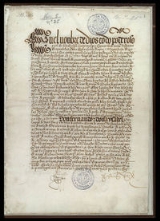
Treaty of Tordesillas

 
Treaty of Tordesillas

   Email Print
   Bookmark   Link


Treaty of Tordesillas


The Treaty of Tordesillas (Portuguese
Portuguese language

Portuguese is a Romance language that originated in what is now Galicia and Portugal. It is derived from the Latin language spoken by the Romanization Pre-Roman peoples of the Iberian Peninsula around 2000 years ago....
: Tratado de Tordesilhas, Spanish
Spanish language

Spanish or Castilian is a Romance languages that originated in northern Spain, and gradually spread in the Kingdom of Castile and evolved into the principal language of government and trade....
: Tratado de Tordesillas), signed at Tordesillas
Tordesillas

Tordesillas is a town and municipality in the province of Valladolid , part of the autonomous community of Castile-Leon in central Spain.It is located 25 km southwest of the provincial capital, Valladolid at an elevation of 702 meters....
 (now in Valladolid province
Valladolid (province)

Valladolid is a Provinces of Spain of central/northwest Spain, in the central part of the Autonomous communities of Spain of Castile-Leon. It is bordered by the provinces of Zamora , Le?n , Palencia , Burgos , Segovia , ?vila , and Salamanca ....
, Spain
Spain

Spain or the Kingdom of Spain , is a country located in Southern Europe on the Iberian Peninsula.The Spanish constitution does not establish any official denomination of the country, even though Espa?a , Estado espa?ol and Naci?n espa?ola are used interchangeably....
), June 7, 1494, divided the "newly discovered" lands outside Europe
Europe

Europe is, conventionally, one of the world's seven continents. Comprising the westernmost peninsula of Eurasia, Europe is generally divided from Asia to its east by the water divide of the Ural Mountains, the Ural , the Caspian Sea, and by the Caucasus Mountains to the southeast....
 between Spain
Spanish Empire

The Spanish Empire was one of the largest empires in world history, and one of the first global empires. It included territories and colonies ruled by Spain in Europe, the Americas, Africa, Asia and Oceania between the 15th and late 19th centuries....
 and Portugal
Portuguese Empire

The Portuguese Empire was the first global empire in history and also the earliest and longest lived of the modern European Colonialism empires, spanning almost six centuries, from the capture of Ceuta in 1415 to the handover of Macau in 1999....
 along a north-south meridian
Meridian (geography)

A meridian is an imaginary arc on the Earth's surface from the North Pole to the South Pole that connects all locations running along it with a given longitude....
 370 leagues
League (unit)

A league is a Units of measurement of length or area long common in Europe and Latin America, although no longer an official unit in any nation....
 west of the Cape Verde
Cape Verde

The Republic of Cape Verde , is an archipelago nation located in the Macaronesia ecoregion of the North Atlantic Ocean, off the western coast of Africa....
 islands (off the west coast of Africa). This was about halfway between the Cape Verde Islands (already Portuguese) and the islands discovered by Christopher Columbus
Christopher Columbus

Christopher Columbus was a Republic of Genoa navigator, colonialist and explorer whose voyages across the Atlantic Ocean?funded by Queen Isabella of Spain?led to general European awareness of the America in the Western Hemisphere....
 on his first voyage (claimed for Spain), named in the treaty as Cipangu
Names of Japan

The English language word Japan is not the name used for their country by the Japanese while speaking the Japanese language: it is an exonym. The Japanese language names for Japan are Nippon and Nihon ....
 and Antilia (Cuba
Cuba

The Republic of Cuba is a country in the Caribbean. It consists of the island of Cuba , the island of Isla de la Juventud, and several adjacent small islands....
 and Hispaniola
Hispaniola

Hispaniola is the second-largest and most populous island of the Antilles, lying between the islands of Cuba to the west, and Puerto Rico to the east....
).


Discussion
Ask a question about 'Treaty of Tordesillas'
Start a new discussion about 'Treaty of Tordesillas'
Answer questions from other users
Full Discussion Forum


Encyclopedia


The Treaty of Tordesillas (Portuguese
Portuguese language

Portuguese is a Romance language that originated in what is now Galicia and Portugal. It is derived from the Latin language spoken by the Romanization Pre-Roman peoples of the Iberian Peninsula around 2000 years ago....
: Tratado de Tordesilhas, Spanish
Spanish language

Spanish or Castilian is a Romance languages that originated in northern Spain, and gradually spread in the Kingdom of Castile and evolved into the principal language of government and trade....
: Tratado de Tordesillas), signed at Tordesillas
Tordesillas

Tordesillas is a town and municipality in the province of Valladolid , part of the autonomous community of Castile-Leon in central Spain.It is located 25 km southwest of the provincial capital, Valladolid at an elevation of 702 meters....
 (now in Valladolid province
Valladolid (province)

Valladolid is a Provinces of Spain of central/northwest Spain, in the central part of the Autonomous communities of Spain of Castile-Leon. It is bordered by the provinces of Zamora , Le?n , Palencia , Burgos , Segovia , ?vila , and Salamanca ....
, Spain
Spain

Spain or the Kingdom of Spain , is a country located in Southern Europe on the Iberian Peninsula.The Spanish constitution does not establish any official denomination of the country, even though Espa?a , Estado espa?ol and Naci?n espa?ola are used interchangeably....
), June 7, 1494, divided the "newly discovered" lands outside Europe
Europe

Europe is, conventionally, one of the world's seven continents. Comprising the westernmost peninsula of Eurasia, Europe is generally divided from Asia to its east by the water divide of the Ural Mountains, the Ural , the Caspian Sea, and by the Caucasus Mountains to the southeast....
 between Spain
Spanish Empire

The Spanish Empire was one of the largest empires in world history, and one of the first global empires. It included territories and colonies ruled by Spain in Europe, the Americas, Africa, Asia and Oceania between the 15th and late 19th centuries....
 and Portugal
Portuguese Empire

The Portuguese Empire was the first global empire in history and also the earliest and longest lived of the modern European Colonialism empires, spanning almost six centuries, from the capture of Ceuta in 1415 to the handover of Macau in 1999....
 along a north-south meridian
Meridian (geography)

A meridian is an imaginary arc on the Earth's surface from the North Pole to the South Pole that connects all locations running along it with a given longitude....
 370 leagues
League (unit)

A league is a Units of measurement of length or area long common in Europe and Latin America, although no longer an official unit in any nation....
 west of the Cape Verde
Cape Verde

The Republic of Cape Verde , is an archipelago nation located in the Macaronesia ecoregion of the North Atlantic Ocean, off the western coast of Africa....
 islands (off the west coast of Africa). This was about halfway between the Cape Verde Islands (already Portuguese) and the islands discovered by Christopher Columbus
Christopher Columbus

Christopher Columbus was a Republic of Genoa navigator, colonialist and explorer whose voyages across the Atlantic Ocean?funded by Queen Isabella of Spain?led to general European awareness of the America in the Western Hemisphere....
 on his first voyage (claimed for Spain), named in the treaty as Cipangu
Names of Japan

The English language word Japan is not the name used for their country by the Japanese while speaking the Japanese language: it is an exonym. The Japanese language names for Japan are Nippon and Nihon ....
 and Antilia (Cuba
Cuba

The Republic of Cuba is a country in the Caribbean. It consists of the island of Cuba , the island of Isla de la Juventud, and several adjacent small islands....
 and Hispaniola
Hispaniola

Hispaniola is the second-largest and most populous island of the Antilles, lying between the islands of Cuba to the west, and Puerto Rico to the east....
). The lands to the east would belong to Portugal and the lands to the west to Spain. The treaty was ratified by Spain (at the time, the Crowns of Castile
Crown of Castile

The Crown of Castile, as a historic entity, is usually considered to have begun in 1230 with the third and definitive union of the two kingdoms of Kingdom of Le?n and Kingdom of Castile, or more concretely, with the union of their parliaments a few decades later....
 and Aragon
Crown of Aragon

The Crown of Aragon was a permanent union of multiple titles and states in the hands of the King of Aragon.At the height of its power by the 14th and 15th centuries, the Crown of Aragon was a thalassocracy controlling a large portion of the present-day eastern Spain, Northern Catalonia, as well as some of the major islands and mainland...
), July 2, 1494 and by Portugal, September 5, 1494. The other side of the world would be divided a few decades later by the Treaty of Saragossa or Treaty of Zaragoza, signed on April 22, 1529, which specified the anti-meridian to the line of demarcation specified in the Treaty of Tordesillas. Originals of both treaties are kept at the Archivo General de Indias
Archivo General de Indias

The Archivo General de Indias is the document repository, housed in Seville in the ancient merchants' exchange, the Casa Lonja de Mercaderes, of extremely valuable archival documents illustrating the history of the Spanish Empire in the Americas and the Philippines....
 in Spain and at the Arquivo Nacional da Torre do Tombo
Arquivo Nacional da Torre do Tombo

The Arquivo Nacional da Torre do Tombo is the Portugal national archive established in 1378. It is located in Lisbon.External links...
 in Portugal.

Signing and enforcement


The Treaty of Tordesillas was intended to resolve the dispute that had been created following the return of Christopher Columbus. In 1481 the papal Bull
Papal bull

A Papal bull is a particular type of letters patent or charter issued by a pope. It is named after the bulla that was appended to the end to authenticate it....
 Aeterni regis
Aeterni regis

The Papal Bull Aeterni regis was issued on 21 June 1481 by Pope Sixtus IV, simply confirmed the substance of the Treaty of Alca?ovas, thereby reiterating that treaty's confirmation of Crown of Castile in its possession of the Canary Islands and its granting of all further acquisitions made by Christian powers in Africa to Portugal....
 had granted all land south of the Canary Islands
Canary Islands

The Canary Islands are a Spain archipelago which, in turn, forms one of the Spanish Autonomous Communities and an Outermost Region of the European Union....
 to Portugal. On May 4, 1493 the Spanish-born Pope Alexander VI
Pope Alexander VI

Pope Alexander VI , born Roderic Llan?ol, later Roderic de Borja i Borja was Pope from 1492 to 1503. He is the most controversial of the Secularism popes of the Renaissance, and his surname became a byword for the debased standards of the papacy of that era....
 decreed in the bull Inter caetera
Inter caetera

Inter caetera was a papal bull issued by Pope Alexander VI on 4 May 1493, which granted to Spain all lands to the "west and south" of a pole-to-pole line 100 League s west and south of any of the islands of the Azores or the Cape Verde Islands....
 that all lands west and south of a pole-to-pole line 100 leagues west and south of any of the islands of the Azores
Azores

The Azores is a Portugal archipelago in the Atlantic Ocean, about 1,500 km from Lisbon and about 3,900 km from the east coast of North America....
 or the Cape Verde Islands should belong to Spain, although territory under Christian rule as of Christmas 1492 would remain untouched. The bull did not mention Portugal or its lands, so Portugal couldn't claim newly discovered lands even if they were east of the line. Another bull, Dudum siquidem, entitled Extension of the Apostolic Grant and Donation of the Indies and dated September 25, 1493, gave all mainlands and islands then belonging to India
India

India, officially the Republic of India , is a country in South Asia. It is the List of countries and outlying territories by total area country by geographical area, the List of countries by population country, and the most populous liberal democracy in the world....
 to Spain, even if east of the line. The Portuguese King John II
John II of Portugal

Jo?o II , the Perfect Prince , was the thirteenth List of Portuguese monarchs. He was born in Lisbon, the son of king Afonso V of Portugal by his wife, Isabel of Coimbra, princess of Portugal....
 was not pleased with that arrangement, feeling that it gave him far too little land — it prevented him from possessing India, his near term goal (as of 1493, Portuguese explorers had only reached the east coast of Africa). He opened negotiations with King Ferdinand
Ferdinand II of Aragon

Ferdinand the Catholic was king of Aragon , Sicily , Naples , Valencia , Sardinia and Navarre, Count of Barcelona, de jure uxoris King of Crown of Castile and then Regent of that country also from 1508 to his death, in the name of his mentally unstable daughter Joanna the Mad....
 and Queen Isabella
Isabella I of Castile

Isabella I was Kings of Castile. She and her husband, Ferdinand II of Aragon, laid the foundation for the political unification of Spain under their grandson, Charles V, Holy Roman Emperor....
 of Spain to move the line to the west and allow him to claim newly discovered lands east of the line. The treaty effectively countered the bulls of Alexander VI and was sanctioned by Pope Julius II
Pope Julius II

Pope Julius II , nicknamed Il Papa Terribile , was born Giuliano della Rovere. He was Pope from 1503 to 1513. His reign was marked by an aggressive foreign policy, ambitious building projects, and patronage for the arts....
 via the bull Ea quae of January 24, 1506.

Very little of the newly divided area had actually been seen by Europeans, as it was only divided via the treaty. Spain gained lands including most of the Americas. The easternmost part of current Brazil
Brazil

Brazil , officially the Federative Republic of Brazil , is a country in South America. It is the List of countries and outlying territories by total area country by geographical area, occupying nearly half of South America, the List of countries by population country, and the fourth most populous democracy in the world....
, when it was discovered accidentally in 1500 by Pedro Álvares Cabral
Pedro Álvares Cabral

Pedro ?lvares Cabral was a Portugal navigator and List of explorers. Cabral is generally regarded as the European discoverer of Brazil .Cabral is thought to have been born in Belmonte , in the Beira Baixa province of Portugal....
, while on route to India, was granted to Portugal. However some historians contend that the Portuguese knew of the South American bulge that makes up most of Brazil before this time, so his landing in Brazil was not an accident. The line was not strictly enforced — the Spanish did not resist the Portuguese expansion of Brazil
Portuguese colonization of the Americas

Portugal was the leading country in the European exploration of the world in the 15th century. The Treaty of Tordesillas split the New World into Spain and Portugal zones in 1494....
 across the meridian. The treaty was rendered meaningless between 1580 and 1640 while the Spanish King was also King of Portugal. It was superseded by the 1750 Treaty of Madrid
Treaty of Madrid (1750)

The Treaty of Madrid was a document signed by Ferdinand VI of Spain and John V of Portugal on January 13 1750, concerning their empires and status of their territories in what is now Brazil....
 which granted Portugal control of the lands it occupied in South America. However, the latter treaty was immediately repudiated by Spain.

Lines of demarcation

The Treaty of Tordesillas only specified its demarcation line in leagues from the Cape Verde Islands. It did not specify the line in degrees, nor did it identify the specific island or the specific length of its league. Instead, the treaty stated that these matters were to be settled by a joint voyage, which never occurred. The number of degrees can be determined via a ratio of marine leagues to degrees which applies to any sized Earth or via a specific marine league applied to the true size of the Earth.
  • The earliest Spanish opinion was provided by Jaime Ferrer in 1495 at the request of and to the Spanish king and queen. He stated that the demarcation line was 18° west of the most central island of the Cape Verde Islands, which is Fogo
    Fogo, Cape Verde

    Fogo is an island in the Sotavento group of Cape Verde. It is the most prominent of the group, rising to nearly 3,000 m above sea level at Mount Fogo....
     according to Harrisse, having a longitude of 24°25'W of Greenwich
    Royal Observatory, Greenwich

    The Royal Observatory, Greenwich was commissioned in 1675 by Charles II of England, with the foundation stone being laid on 10 August. At this time the king also created the position of Astronomer Royal , to serve as the director of the observatory and to "apply himself with the most exact care and diligence to the rectifying of the tab...
    , hence Ferrer placed the line at 42°25'W on his sphere, which was 21.1% larger than our sphere. Ferrer also stated that his league contained 32 Olympic stade
    Stade

    Stade is a city in Lower Saxony, Germany and part of the Hamburg Metropolitan Region . It is the seat of the Stade named after it. The city was first mentioned in a document from 994....
    s, or 6.15264 km according to Harrisse, thus Ferrer's line was 2,276.5 km west of Fogo at 47°37'W on our sphere.
  • The earliest surviving Portuguese opinion is on the Cantino planisphere
    Cantino planisphere

    The Cantino planisphere is the earliest surviving map showing History of Portugal in the east and west. It is named after Alberto Cantino, an agent for the Duke of Ferrara, who successfully smuggled it from Portugal to Italy in 1502....
     of 1502. Because its demarcation line was midway between Cape Saint Roque (northeast cape of South America) and the mouth of the Amazon River
    Amazon River

    The Amazon River of South America is the list of rivers by length in the world by volume, with a total river flow greater than the next top eight largest rivers combined....
     (its estuary is marked Todo este mar he de agua doçe (All of this sea is fresh water) and its river is marked Rio grande (great river)), Harrisse concluded that the line was at 42°30'W on our sphere. Harrisse believed the large estuary just west of the line on the Cantino map was that of the Rio Marañhao (this estuary is now the Baía de São Marcos
    Baía de São Marcos

    The Ba?a de S?o Marcos is a bay of the Atlantic Ocean in Maranh?o state of northeastern Brazil.The bay is an estuary approximately 100 kilometers long and up to 16 kilometers wide....
     and the river is now the Mearim
    Mearim River

    The Mearim River is a river in Maranh?o state of northern Brazil. The river originates in the southern part of Maranh?o, and drains north into the Ba?a de S?o Marcos, an estuary that also receives the Pindar? River and Graja? River rivers, which are sometimes considered tributaries of the Mearim....
    ), whose flow is so weak that its gulf does not contain fresh water.
  • In 1518 another Spanish opinion was provided by Martin Fernandez de Enciso. Harrisse concluded that Enciso placed his line at 47°24'W on his sphere (7.7% smaller than ours), but at 45°38'W on our sphere using Enciso's numerical data. Enciso also described the coastal features near which the line passed in a very confused manner. Harrisse concluded from this description that Enciso's line could also be near the mouth of the Amazon between 49° and 50°W.
  • In 1524 the Spanish pilots (ships' captains) Thomas Duran, Sebastian Cabot (son of John Cabot
    John Cabot

    Giovanni Caboto , known in English as John Cabot, was an Italy navigator and exploration commonly credited as the first European to discover North America, in 1497, notwithstanding Norsemen Leif Ericson's landing ....
    ), and Juan Vespuccius (nephew of Amerigo Vespucci
    Amerigo Vespucci

    Amerigo Vespucci was an Italian explorer and cartographer. The continents of The Americas are popularly understood to derive their name from the Grammatical gender Latin version of his given name ....
    ) gave their opinion to the Badajoz Junta, whose failure to resolve the dispute led to the Treaty of Saragasso. They specified that the line was 22° plus nearly 9 miles west of the center of Santo Antão
    Santo Antão

    Santo Ant?o , or Sontonton in Cape Verdean Creole, is the westernmost and largest of the Barlavento islands of Cape Verde. The nearest main island is S?o Vicente, Cape Verde to the southeast, separated by a channel named Canal de S?o Vicente....
     (the westernmost Cape Verde island), which Harrisse concluded was 47°17'W on their sphere (3.1% smaller than ours) and 46°36'W on our sphere.
  • In 1524 the Portuguese presented a globe to the Badajoz Junta on which the line was marked 21°30' west of Santo Antão (22°6'36" on our sphere).


Anti-meridian

Initially, the line of demarcation did not encircle the Earth. Instead, Spain and Portugal could conquer any new lands they were the first to discover, Spain to the west and Portugal to the east, even if they passed each other on the other side of the globe. But Portugal's discovery of the highly valued Moluccas in 1512 caused Spain to argue in 1518 that the Treaty of Tordesillas divided the Earth into two equal hemispheres. After the surviving ships of Magellan
Ferdinand Magellan

Ferdinand Magellan was a Portuguese people List of maritime explorers who, while in the service of the Spanish Crown, tried to find a westward route to the Spice Islands of Indonesia....
's fleet visited the Moluccas in 1521, Spain claimed that those islands were within its western hemisphere. In 1523, the Treaty of Vitoria called for the Badajoz Junta to meet in 1524, at which the two countries tried to reach an agreement on the anti-meridian but failed. They finally agreed via the 1529 Treaty of Saragossa (or Zaragoza) that Spain would relinquish its claims to the Moluccas upon the payment of 350,000 ducat
Ducat

The ducat is a gold coin that was used as a trade currency throughout Europe before World War I. Its weight is 3.4909 grams of .986 gold, which is 0.1107 troy ounce, actual gold weight, actual gold weight....
s of gold by Portugal to Spain. To prevent Spain from encroaching upon Portugal's Moluccas, the anti-meridian was to be 297.5 leagues or 17° to the east of the Moluccas, passing through the islands of las Velas and Santo Thome. This distance is slightly smaller than the 300 leagues determined by Magellan as the westward distance from los Ladrones to the Philippine island of Samar, which is just west of due north of the Moluccas.

The Moluccas are a group of islands just west of New Guinea
New Guinea

New Guinea, located just north of Australia, is the List of islands by area, having become separated from the Australian mainland when the area now known as the Torres Strait flooded after the last glacial period....
. However, unlike the large modern Indonesia
Indonesia

The Republic of Indonesia , is a transcontinental country in Southeast Asia and Oceania. Comprising Islands of Indonesia, it is the world's largest Archipelago state....
n archipelago
Archipelago

An archipelago is a chain or cluster of islands that are formed tectonically. The word archipelago literally means "chief sea", from Italian language arcipelago , derived ultimately from Greek language arkhon and pelagos ....
 of the Maluku Islands
Maluku Islands

The Maluku Islands are an archipelago in Indonesia, and part of the larger Malay Archipelago. They are located on the Australian Plate, lying east of Sulawesi , west of New Guinea, and north of Timor....
, to sixteenth-century Europeans the Moluccas were a small chain of islands, the only place on Earth where clove
Clove

Cloves are the aromatic dried flower buds of a tree in the family Myrtaceae. Cloves are native to Indonesia and used as a spice in cuisine all over the world....
s grew, just west of the large north Malukan island of Halmahera
Halmahera

Halmahera is the largest island in the Maluku Islands. It is part of the North Maluku province of Indonesia.Halmahera has a land area of 17,780 km? and a population in 1995 of 162,728....
 (called Gilolo at the time). Cloves were so prized by Europeans for their medicinal uses that they were worth their weight in gold. Sixteenth- and seventeenth-century maps and descriptions indicate that the main islands were Ternate
Ternate

Ternate is an island and town in the Maluku Islands of eastern Indonesia, located off the west coast of the larger island of Halmahera, the center of the powerful former Sultanate of Ternate....
, Tidore
Tidore

Tidore is in the Maluku Islands of eastern Indonesia, west of the larger island of Halmahera. It is a city, island, and archipelago. In the In the pre-colonial era, the kingdom of Tidore was a major regional political and economic power, and a fierce rival of nearby Ternate, just to the north....
, Moti
Moti Island

Moti or Motir is a volcanic island in the western side of Halmahera island, Indonesia. The 5 km wide of island is surrounded by coral reefs....
, Makian
Makian

Makian is one of the Maluku Islands in Indonesia. It lies to the south of Tidore and to the north of Bacan. Since its first recorded eruption in the 1550s it has erupted seven more times, four of which caused fatalities....
 and Bacan
Bacan

Bacan refers to a group of islands in the Maluku Islands of Indonesia and to that group's largest island. The islands are mountainous and forested....
, although the last was often ignored even though it was by far the largest island. The principal island was Ternate at the chain's northern end (0°47'N, only 11 km (7 mi) in diameter) on whose southwest coast the Portuguese built a stone fort (São João Bautista) during 1522–23, which could only be repaired, not modified, according to the Treaty of Saragossa. This north-south chain occupies two degrees of latitude
Latitude

Latitude, usually denoted symbolically by the Greek letter phi gives the location of a place on Earth north or south of the equator. Lines of Latitude are the horizontal lines shown running east-to-west on maps ....
 bisected by the equator at about 127°24'E, with Ternate, Tidore, Moti, and Makian north of the equator and Bacan south of it.

Although the treaty's Santo Thome island has not been identified, its "Islas de las Velas" (Islands of the Sails) appear in a 1585 Spanish history of China, on the 1594 world map of Petrus Plancius
Petrus Plancius

Petrus Plancius , was a Netherlands astronomer, Cartography and clergyman. He was born as Pieter Platevoet in Dranouter, now in Heuvelland, West Flanders....
, on an anonymous map of the Moluccas in the 1598 London edition of Linschoten
Jan Huyghen van Linschoten

Jan Huyghen van Linschoten was a Netherlands Protestant merchant, traveller and historian. An alternate spelling of second name is Huijgen....
, and on the 1607 world map of Petro Kærio, identified as a north-south chain of islands in the northwest Pacific, which were also called the "Islas de los Ladrones" (Islands of the Thieves) during that period. Their name was changed by Spain in 1667 to "Islas de las Marianas" (Mariana Islands
Mariana Islands

The Mariana Islands are an archipelago made up by the summits of 15 volcanic mountains in the north-western Pacific Ocean between the 12th and 21st parallels north and along the 145th meridian east....
), which include Guam
Guam

Guam , officially the Territory of Guam, is an island in the western Pacific Ocean and is an organized, unincorporated insular area of the United States....
 at their southern end. Guam's longitude of 144°45'E is east of the Moluccas' longitude of 127°24'E by 17°21', which is remarkably close by sixteenth-century standards to the treaty's 17° east. This longitude passes through the eastern end of the main north Japan
Japan

Japan is an island country in East Asia. Located in the Pacific Ocean, it lies to the east of the Sea of Japan, People's Republic of China, North Korea, South Korea and Russia, stretching from the Sea of Okhotsk in the north to the East China Sea and Taiwan in the south....
ese island of Hokkaido
Hokkaido

, formerly known as Ezo, Yezo, Yeso, or Yesso, is Japan's second largest island and the largest, northernmost of its 47 prefectures of Japan....
 and through the eastern end of New Guinea, which is where Frédéric Durand placed the demarcation line. Moriarty and Keistman placed the demarcation line at 147°E by measuring 16.4° east from the western end of New Guinea (or 17° east of 130°E). Despite the treaty's clear statement that the demarcation line passes 17° east of the Moluccas, some sources place the line just east of the Moluccas.

The Treaty of Saragossa did not modify or clarify the line of demarcation in the Treaty of Tordesillas, nor did it validate Spain's claim to equal hemispheres (180° each), so the two lines divided the Earth into unequal hemispheres. Portugal's portion was roughly 191° whereas Spain's portion was roughly 169°. Both portions have a large uncertainty of ±4° due to the wide variation in the opinions regarding the location of the Tordesillas line.

Portugal gained control of all lands and seas west of the Saragossa line, including all of Asia and its neighboring islands so far "discovered," leaving Spain most of the Pacific Ocean
Pacific Ocean

The Pacific Ocean is the largest of the Earth's oceanic divisions. Its name is derived from the Latin name Mare Pacificum, "peaceful sea", bestowed upon it by the Portugal explorer Ferdinand Magellan....
. Although the Philippines
Philippines

The Philippines, officially known as the Republic of the Philippines, is a country in Southeast Asia with Manila as its capital city. It comprises 7,107 islands in the western Pacific Ocean....
 were not named in the treaty, Spain implicitly relinquished any claim to them because they were well west of the line. Nevertheless, by 1542, King Charles V
Charles V, Holy Roman Emperor

Charles V was ruler of the Holy Roman Empire from 1519 and, as Charles I of Spain, of the Spanish realms from 1516 until his abdication in 1556....
 decided to colonize the Philippines, judging that Portugal would not protest too vigorously because the archipelago had no spice, but he failed in his attempt. King Philip II
Philip II of Spain

Philip II was King of Spain from 1556 until 1598, List of monarchs of Naples from 1554 until 1598, king consort of England, as husband of Mary I of England, from 1554 to 1558, lord of the Seventeen Provinces from 1556 until 1581, holding various titles for the individual territories, such as Duke or Count; and King of Portugal as Philip I...
 succeeded in 1565, establishing the initial Spanish trading post at Manila
Manila

The 'City of Manila' , or simply 'Manila', is the Capital of the Philippines and one of the 17 cities and municipalities that make up Metro Manila....
.

Besides Brazil and the Moluccas, Portugal would eventually control Angola
Angola

Angola, officially the Republic of Angola , is a country in south-central Africa bordering Namibia to the south, Democratic Republic of the Congo to the north, and Zambia to the east, and with a west coast along the Atlantic Ocean....
, Mozambique
Mozambique

Mozambique, officially the Republic of Mozambique , is a country in southeastern Africa bordered by the Indian Ocean to the east, Tanzania to the north, Malawi and Zambia to the northwest, Zimbabwe to the west and Swaziland and South Africa to the southwest....
, Guinea-Bissau
Guinea-Bissau

The Republic of Guinea-Bissau is a country in western Africa, and one of the smallest states in continental Africa. It is bordered by Senegal to the north, and Guinea to the south and east, with the Atlantic Ocean to its west....
, and São Tomé and Príncipe
São Tomé and Príncipe

S?o Tom? and Pr?ncipe, officially the Democratic Republic of S?o Tom? and Pr?ncipe, is a Portuguese-speaking island nation in the Gulf of Guinea, off the western equatorial coast of Africa....
 in Africa
Africa

Africa is the world's second-largest and second most-populous continent, after Asia. At about 30.2 million km? including adjacent islands, it covers 6% of the Earth's total surface area and 20.4% of the total land area....
; Goa
Goa

Goa is India's smallest states and territories of India in terms of area and the List of states and territories of India by population. Located on the west coast of India in the region known as the Konkan, it is bounded by the state of Maharashtra to the north, and by Karnataka to the east and south, while the Arabian Sea forms its western...
 and Daman and Diu
Daman and Diu

Daman and Diu is a union territory in India.For over 450 years, these coastal enclaves on the Arabian Sea coast were part of Portuguese India, along with Goa and Dadra and Nagar Haveli....
 in India
India

India, officially the Republic of India , is a country in South Asia. It is the List of countries and outlying territories by total area country by geographical area, the List of countries by population country, and the most populous liberal democracy in the world....
; and East Timor
East Timor

East Timor, also known as Timor-Leste is a country in Southeast Asia. It comprises the eastern half of the island of Timor, the nearby islands of Atauro Island and Jaco , and Oecussi-Ambeno, an exclave on the northwestern side of the island, within Indonesian West Timor....
 and Macau
Macau

The Macau Special Administrative Region, , commonly known as Macau or Macao , is one of the two special administrative region of the People's Republic of China, the other being Hong Kong....
 in the Far East.

Use for claims to Antarctica


The Treaty of Tordesillas has been invoked by Chile
Chile

Chile, officially the Republic of Chile , is a country in South America occupying a long and narrow coastal strip wedged between the Andes mountains and the Pacific Ocean....
 in the 20th century to defend the principle of an Antarctic
Antarctica

Antarctica is Earth's southernmost continent, overlying the South Pole. It is situated in the Antarctica of the southern hemisphere, almost entirely south of the Antarctic Circle, and is surrounded by the Southern Ocean....
 sector extending along a meridian to the South Pole
South Pole

The South Pole, also known as the Geographic South Pole or Terrestrial South Pole, is one of the two points where the Earth's rotation intersects the surface....
, as well as the assertion that the treaty made Spanish (or Portuguese) all undiscovered land south to the Pole.

The Treaty of Tordesillas has been invoked by Argentina
Argentina

Argentina, officially the Argentine Republic , is a country in South America, constituted as a federation of 23 provinces and an autonomous city....
 in the 20th century to justify its claim to the Falkland Islands
Falkland Islands

The Falkland Islands are an archipelago in the South Atlantic Ocean, located from the coast of Argentina, west of the Shag Rocks , and north of the British Antarctic Territory ....
.

See also

  • List of treaties
    List of treaties

    This list of treaties contains historic agreements, pacts, peaces, and major contracts between states, armies, governments, and tribal groups....
  • Portugal in the Age of Discovery
    Portugal in the Age of Discovery

    During the history of Portugal , Portugal discovered an eastern route to India that rounded the Cape of Good Hope, Colonial Brazil#Early colonial history Brazil, established trading routes throughout most of southern Asia, colonized selected areas of Africa, and sent the first direct European maritime trade and diplomatic missions to China....


kkkkkkkkkkkkkkkkkkkkPortugal]]