

Macedon

Encyclopedia
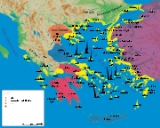
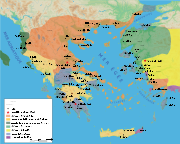
Macedonia or Macedon was an ancient kingdom
, centered in the northeastern part of the Greek peninsula, bordered by Epirus
to the west, Paeonia to the north, the region of Thrace
to the east and Thessaly
to the south.
The rise of Macedon
, from a small kingdom at the periphery of Classical Greek
affairs, to one which came to dominate the entire Hellenic world, occurred under the reign of Philip II
. For a brief period, after the conquests of Alexander the Great, it became the most powerful state in the world, controlling a territory that included the former Persian empire, stretching as far as the Indus River
; at that time it inaugurated the Hellenistic period
of Ancient Greek civilization
.
. The shorter English name variant Macedon developed in Middle English, based on a borrowing from the French form of the name, Macédoine.
According to Herodotus
, it was Dorus, the son of Hellen who led his people to Histaeotis, whence they were driven off by the Cadmeians into Pindus, where they settled as Macedonians. Later, a branch would migrate further south to be called Dorians.
It seems that the first Macedonian
state emerged in the 8th or early 7th century BC under the Argead Dynasty
, who, according to legend, migrated to the region from the Greek city
of Argos
in Peloponnesus (thus the name Argead). The Macedonian tribe ruled by the Argeads, was itself called Argead (which translates as "descended from Argos").
The kingdom was situated in the fertile alluvial plain, watered by the rivers Haliacmon
and Axius
, called Lower Macedonia, north of the mountain Olympus
. Around the time of Alexander I of Macedon
, the Argead Macedonians started to expand into Upper Macedonia
, lands inhabited by independent Macedonian tribes like the Lyncestae and the Elmiotae and to the West, beyond Axius river, into Eordaia
, Bottiaea
, Mygdonia, and Almopia
, regions settled by, among others, many Thracian tribes.
To the north of Macedonia lay various non-Greek peoples such as the Paeonians due north, the Thracians
to the northeast, and the Illyrians
, with whom the Macedonians were frequently in conflict, to the northwest. To the south lay Thessaly
, with whose inhabitants the Macedonians had much in common both culturally and politically, while to west lay Epirus
, with whom the Macedonians had a peaceful relationship and in the 4th century BC formed an alliance against Illyrian raids.
Near the modern city of Veria
, Perdiccas I (or, more likely, his son, Argaeus I
) built his capital, Aigai (modern Vergina
). After a brief period under Persian rule under Darius Hystaspes
, the state regained its independence under King Alexander I
(495
–450 BC
). In the Peloponnesian War
Macedon was a secondary power that alternated in support between Sparta and Athens.
parts of province of Macedonia
in modern Greece
. A unified Macedonian state was eventually established by King Amyntas III (c. 393
–370 BC
), though it still retained strong contrasts between the cattle-rich coastal plain and the fierce isolated tribal hinterland, allied to the king by marriage ties. They controlled the passes through which barbarian invasions came from Illyria
to the north and northwest. It became increasingly Atticised
during this period, though prominent Athenians
appear to have regarded the Macedonians as uncouth. Before the establishment of the League of Corinth
, even though the Macedonians apparently spoke a dialect of the Greek language and claimed proudly that they were Greeks, they were not considered to fully share the classical Greek
culture by many of the inhabitants of the southern city states, because they did not share the polis
based style of government of the southerners. Herodotus
, being one of the foremost biographers in antiquity who lived in Greece at the time when the Macedonian king Alexander I
was in power, mentioned:
Over the 4th century Macedon became more politically involved with the south-central city-states of Ancient Greece
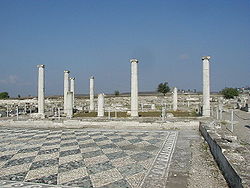
, but it also retained more archaic features like the palace-culture, first at Aegae (modern Vergina) then at Pella
, resembling Mycenaean
culture more than classic Hellenic
city-states, and other archaic customs, like Philip's multiple wives in addition to his Epirote queen Olympias
, mother of Alexander.
Another archaic remnant was the very persistence of a hereditary monarchy
which wielded formidable sometimes absolute power, although this was at times checked by the landed aristocracy, and often disturbed by power struggles within the royal family itself. This contrasted sharply with the Greek cultures further south, where the ubiquitous city-states mostly possessed aristocratic or democratic institutions; the de facto
monarchy of tyrant
s, in which heredity was usually more of an ambition rather than the accepted rule; and the limited, predominantly military and sacerdotal, power of the twin hereditary Sparta
n kings. The same might have held true of feudal institutions like serfdom
, which may have persisted in Macedon well into historical times. Such institutions were abolished by city-states well before Macedon's rise (most notably by the Athenian legislator Solon
's famous seisachtheia
laws).
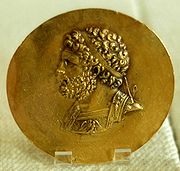 Amyntas had three sons; the first two, Alexander II
and Perdiccas III reigned only briefly. Perdiccas III's infant heir was deposed by Amyntas' third son, Philip II of Macedon
, who made himself king and ushered in a period of Macedonian dominance of Greece. Under Philip II, (359
–336 BC
), Macedon expanded into the territory of the Paeonians, Thracians
, and Illyrians
. Among other conquests, he annexed the regions of Pelagonia
and Southern Paeonia
.
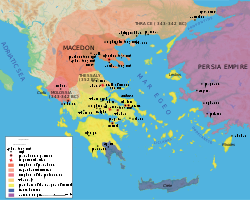 Philip redesigned the army of Macedon adding a number of variations to the traditional hoplite
force to make it far more effective. He added the hetairoi, a well armoured heavy cavalry, and more light infantry, both of which added greater flexibility and responsiveness to the force. He also lengthened the spear and shrank the shield of the main infantry force, increasing its offensive capabilities.
Philip began to rapidly expand the borders of his kingdom. He first campaigned in the north against non-Greek peoples such as the Illyrians
, securing his northern border and gaining much prestige as a warrior. He next turned east, to the territory along the northern shore of the Aegean. The most important city in this area was Amphipolis
, which controlled the way into Thrace
and also was near valuable silver mines. This region had been part of the Athenian Empire, and Athens still considered it as in their sphere. The Athenians attempted to curb the growing power of Macedonia, but were limited by the outbreak of the Social War. They could also do little to halt Philip when he turned his armies south and took over most of Thessaly
.
Control of Thessaly meant Philip was now closely involved in the politics of central Greece. 356 BCE saw the outbreak of the Third Sacred War
that pitted Phocis
against Thebes
and its allies. Thebes recruited the Macedonians to join them and at the Battle of Crocus Field
Phillip decisively defeated Phocis and its Athenian allies. As a result Macedonia became the leading state in the Amphictyonic League
and Phillip became head of the Pythian Games, firmly putting the Macedonian leader at the centre of the Greek political world.
In the continuing conflict with Athens Philip marched east through Thrace in an attempt to capture Byzantium
and the Bosphorus, thus cutting off the Black Sea grain supply that provided Athens with much of its food. The siege of Byzantium failed, but Athens realized the grave danger the rise of Macedon presented and under Demosthenes
built a coalition of many of the major states to oppose the Macedonians. Most importantly Thebes, which had the strongest ground force of any of the city states, joined the effort. The allies met the Macedonians at the Battle of Chaeronea
and were decisively defeated, leaving Philip and the Macedonians the unquestioned master of Greece.

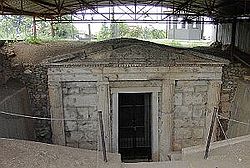 Philip's son, Alexander the Great (356
–323 BC
), managed to briefly extend Macedonian power not only over the central Greek city-states, but also to the Persian empire, including Egypt
and lands as far east as the fringes of India
. Alexander's adoption of the styles of government of the conquered territories was accompanied by the spread of Greek culture and learning through his vast empire. Although the empire fractured into multiple Hellenic regimes shortly after his death, his conquests left a lasting legacy, not least in the new Greek-speaking cities founded across Persia's western territories, heralding the Hellenistic
period. In the partition of Alexander's empire among the Diadochi
, Macedonia fell to the Antipatrid dynasty
, which was overthrown by the Antigonid dynasty
after only a few years, in 294 BC.
and his son Cassander
gained control of Macedonia but it slid into a long period of civil strife following Cassander's death in 297 BC
. It was ruled for a while by Demetrius I
(294
–288 BC
) but fell into civil war.
Demetrius' son, Antigonus II (277
–239 BC
), defeated a Galatian
invasion as a condottiere, and regained his family's position in Macedonia; he successfully restored order and prosperity there, though he lost control of many of the Greek city-states. He established a stable monarchy under the Antigonid dynasty
. Antigonus III (239
–221 BC
) built on these gains by re-establishing Macedonian power across the region.
What is notable about the Macedonian regime during the Hellenistic times is that it was the only successor state to the Empire that maintained the old archaic perception of Kingship, and never adopted the ways of the Hellenistic Monarchy. Thus the king was never deified in the same way that Ptolemies and Seleucids were in Egypt and Asia respectively, and never adopted the custom of Proskynesis
. The ancient Macedonians during the Hellenistic times were still addressing their kings in a far more casual way than the subjects of the rest of the Diadochi, and the Kings were still consulting with their aristocracy (Philoi) in the process of making their decisions.
 Under Philip V of Macedon
(221
–179 BC
) and his son Perseus of Macedon
(179
–168 BC
), the kingdom clashed with the rising power of the Roman Republic
. During the 2nd and 1st centuries BC, Macedon fought a series of wars
with Rome. Two major losses that led to the end of the kingdom were in 197 BC
when Rome defeated Philip V, and 168 BC
when Rome defeated Perseus. The overall losses resulted in the defeat of Macedon, the deposition of the Antigonid dynasty and the dismantling of the Macedonian kingdom. Andriscus
' brief success at reestablishing the monarchy in 149 BC
was quickly followed by his defeat the following year and the establishment of direct Roman
rule and the organization of Macedon as the Roman province of Macedonia.
, which has given us the possibility to reread the indications given us by ancient literary sources such as Livy
and Polybius
. They show that the Macedonian institutions were near to those of the Greek federal states, like the Aetolian
and Achaean
leagues, whose unity was reinforced by the presence of the king.

headed the central administration: he led the kingdom from its capital, Pella, and in his royal palace was conserved the state's archive. He was helped in carrying out his work by the Royal Secretary
, whose work was of primary importance, and by the Council
. The title "king" (basileús) may have not officially been used by the Macedonian regents until Alexander the Great, whose "usage of it may have been influenced by his ambivalent position in Persia."
The king was commander of the army, head of the Macedonian religion, and director of diplomacy. Also, only he could conclude treaties, and, until Philip V
, mint coins.
The number of civil servants was limited: the king directed his kingdom mostly in an indirect way, supporting himself principally through the local magistrates, the epistates, with whom he constantly kept in touch.
. There was also an elective element: when the king died, his designated heir, generally but not always the eldest son, had first to be accepted by the council and then presented to the general Assembly to be acclaimed king and obtain the oath of fidelity.
As can be seen, the succession was far from being automatic, more so considering that many Macedonian kings died violently, without having made dispositions for the succession, or having assured themselves that these would be respected. This can be seen with Perdiccas III
, slain by the Illyria
ns, Philip II
assassinated by Pausanias of Orestis, Alexander the Great, suddenly died of malady, etc. Succession crises were frequent, especially up to the 4th century BC, when the magnate families of Upper Macedonia still cultivated the ambition of overthrowing the Argaead dynasty and to ascend to the throne.
tells us that during the mutiny
of Alexander's soldiers at Opis
in 324 BC
, Alexander detailed the possessions of his father at his death to prove he had not abused his charge.
It is known from Livy and Polybius that the basiliká included the following sources of income:
The most common way to exploit these different sources of income was by leasing: the Pseudo-Aristotle
reports in the Oeconomica
that Amyntas III
(or maybe Philip II) doubled the kingdom's port revenues with the help of Callistratus
, who had taken refuge in Macedon, bringing them from 20 to 40 talents
per year. To do this, the exploitation of the harbour taxes was given every year at the private offering the highest bidding. It is also known from Livy that the mines and the forests were leased for a fixed sum under Philip V, and it appears that the same happened under the Argaead dynasty: from here possibly comes the leasing system that was used in Ptolemaic Egypt.
Except for the king's properties, land in Macedon was free: Macedonians were free men and did not pay land taxes on private grounds. Even extraordinary taxes like those paid by the Athenians in times of war did not exist. Even in conditions of economic peril, like what happened to Alexander in 334 BC
and Perseus in 168 BC
, the monarchy did not tax its subjects but raised funds through loans, first of all by his Companions, or raised the cost of the leases.
The king could grant the atelíē , a privilege of tax exemption, as Alexander did with those Macedonian families which had losses in the battle of the Granicus
in May 334
: they were exempted from paying tribute for leasing royal grounds and commercial taxes.
Extraordinary incomes came from the spoils of war, which were divided between the king and his men. At the time of Philip II and Alexander, this was a considerable source of income. A considerable part of the gold and silver objects taken at the time of the European and Asian campaigns were melted in ingots and then sent to the monetary foundries of Pella
and Amphipolis
, most active of the kingdom at that time: an estimate judges that during the reign of Alexander only the mint of Amphipolis struck about 13 million silver tetradrachms
.
This assembly ( or ), of the army in times of war, of the people in times of peace, is called by the king and plays a significant role through the acclamation of the kings and in capital trials; it can be consulted (without obligation) for the foreign politics (declarations of war, treaties) and for the appointment of high state officials. In the majority of these occasions, the Assembly does nothing but ratify the proposals of a smaller body, the Council. It is also the Assembly which votes the honors, sends embassies, during its two annual meetings. It was abolished by the Romans
at the time of their reorganization of Macedonia in 167 BC
, to prevent, according to Livy
, that a demagogue could make use of it as a mean to revolt against their authority.
The members of the Council (synedroi) belong to three categories:
The king had in reality less power in the choice of the members of the Council than appearances would warrant; this was because many of the kingdom's most important noblemen were members of the Council by birth-right.
The Council primarily exerted a probouleutic function with respect to the Assembly: it prepared and proposed the decisions which the Assembly would have discussed and voted, working in many fields such as the designation of kings and regents, as of that of the high administrators and the declarations of war. It was also the first and final authority for all the cases which did not involve capital punishment.
The Council gathered frequently and represented the principal body of government of the kingdom. Any important decision taken by the king was subjected before it for deliberation.
Inside the Council ruled the democratic principles of iségoria (equality of word) and of parrhésia (freedom of speech), to which even the king subjected himself.
After the removal of the Antigonid dynasty
by the Romans in 167 BC
, it is possible that the synedrion remained, unlike the Assembly, representing the sole federal authority in Macedonia after the country's division in four merides.
This said, it should be noted that the existence of these districts is not attested with certainty (by numismatics
) before the beginning of the 2nd century BC.
Monarchy
A monarchy is a form of government in which the office of head of state is usually held until death or abdication and is often hereditary and includes a royal house. In some cases, the monarch is elected...
, centered in the northeastern part of the Greek peninsula, bordered by Epirus
Epirus (ancient state)
Epirus was an ancient Greek state, located in the geographical region of Epirus, in the western Balkans. The homeland of the ancient Epirotes was bordered by the Aetolian League to the south, Thessalia and Macedonia to the east and Illyrian tribes to the north...
to the west, Paeonia to the north, the region of Thrace
Thrace
Thrace is a historical and geographic area in southeast Europe. As a geographical concept, Thrace designates a region bounded by the Balkan Mountains on the north, Rhodope Mountains and the Aegean Sea on the south, and by the Black Sea and the Sea of Marmara on the east...
to the east and Thessaly
Ancient Thessaly
Ancient Thessaly or Thessalia was one of the traditional regions of Ancient Greece. During the Mycenaean period, Thessaly was known as Aeolia, a name which continued to be used for one of the major tribes of Greece, the Aeolians, and their dialect of Greek, .-History:Thessaly was home to an...
to the south.
The rise of Macedon
Rise of Macedon
The rise of Macedon, from a small kingdom at the periphery of Classical Greek affairs, to one which came to dominate the entire Hellenic world , occurred in the space of just 25 years, between 359–336 BC...
, from a small kingdom at the periphery of Classical Greek
Ancient Greece
Ancient Greece is a civilization belonging to a period of Greek history that lasted from the Archaic period of the 8th to 6th centuries BC to the end of antiquity. Immediately following this period was the beginning of the Early Middle Ages and the Byzantine era. Included in Ancient Greece is the...
affairs, to one which came to dominate the entire Hellenic world, occurred under the reign of Philip II
Philip II of Macedon
Philip II of Macedon "friend" + ἵππος "horse" — transliterated ; 382 – 336 BC), was a king of Macedon from 359 BC until his assassination in 336 BC. He was the father of Alexander the Great and Philip III.-Biography:...
. For a brief period, after the conquests of Alexander the Great, it became the most powerful state in the world, controlling a territory that included the former Persian empire, stretching as far as the Indus River
Indus River
The Indus River is a major river which flows through Pakistan. It also has courses through China and India.Originating in the Tibetan plateau of western China in the vicinity of Lake Mansarovar in Tibet Autonomous Region, the river runs a course through the Ladakh district of Jammu and Kashmir and...
; at that time it inaugurated the Hellenistic period
Hellenistic period
The Hellenistic period or Hellenistic era describes the time which followed the conquests of Alexander the Great. It was so named by the historian J. G. Droysen. During this time, Greek cultural influence and power was at its zenith in Europe and Asia...
of Ancient Greek civilization
Ancient Greece
Ancient Greece is a civilization belonging to a period of Greek history that lasted from the Archaic period of the 8th to 6th centuries BC to the end of antiquity. Immediately following this period was the beginning of the Early Middle Ages and the Byzantine era. Included in Ancient Greece is the...
.
Name
The name Macedonia is related to the ancient Greek word μακεδνός (). It is commonly explained as having originally meant 'a tall one' or 'highlander', possibly descriptive of the peopleAncient Macedonians
The Macedonians originated from inhabitants of the northeastern part of the Greek peninsula, in the alluvial plain around the rivers Haliacmon and lower Axios...
. The shorter English name variant Macedon developed in Middle English, based on a borrowing from the French form of the name, Macédoine.
Early history and legend
The lands around Aegae, the first Macedonian capital, were home to various peoples. Macedonia was called Emathia (from king Emathion) and the city of Aiges was called Edessa, the capital of fabled king Midas. According to legend, Caranus, accompanied by a multitude of Greeks came to the area in search for a new homeland took Edessa and renamed it to Aegae. Subsequently, he expelled Midas and other kings off the lands and he formed his new kingdom.According to Herodotus
Herodotus
Herodotus was an ancient Greek historian who was born in Halicarnassus, Caria and lived in the 5th century BC . He has been called the "Father of History", and was the first historian known to collect his materials systematically, test their accuracy to a certain extent and arrange them in a...
, it was Dorus, the son of Hellen who led his people to Histaeotis, whence they were driven off by the Cadmeians into Pindus, where they settled as Macedonians. Later, a branch would migrate further south to be called Dorians.
It seems that the first Macedonian
Ancient Macedonians
The Macedonians originated from inhabitants of the northeastern part of the Greek peninsula, in the alluvial plain around the rivers Haliacmon and lower Axios...
state emerged in the 8th or early 7th century BC under the Argead Dynasty
Argead dynasty
The Argead dynasty was an ancient Greek royal house. They were the ruling dynasty of Macedonia from about 700 to 310 BC. Their tradition, as described in ancient Greek historiography, traced their origins to Argos, in southern Greece...
, who, according to legend, migrated to the region from the Greek city
Polis
Polis , plural poleis , literally means city in Greek. It could also mean citizenship and body of citizens. In modern historiography "polis" is normally used to indicate the ancient Greek city-states, like Classical Athens and its contemporaries, so polis is often translated as "city-state."The...
of Argos
Argos
Argos is a city and a former municipality in Argolis, Peloponnese, Greece. Since the 2011 local government reform it is part of the municipality Argos-Mykines, of which it is a municipal unit. It is 11 kilometres from Nafplion, which was its historic harbour...
in Peloponnesus (thus the name Argead). The Macedonian tribe ruled by the Argeads, was itself called Argead (which translates as "descended from Argos").
The kingdom was situated in the fertile alluvial plain, watered by the rivers Haliacmon
Haliacmon
The Haliacmon is the longest river in Greece, with a total length of . Haliacmon is the traditional English name for the river, but many sources cite the formerly official Katharevousa version of the name, Aliákmon...
and Axius
Vardar
The Vardar or Axios is the longest and major river in the Republic of Macedonia and also a major river of Greece. It is long, and drains an area of around . The maximum depth of river is ....
, called Lower Macedonia, north of the mountain Olympus
Mount Olympus
Mount Olympus is the highest mountain in Greece, located on the border between Thessaly and Macedonia, about 100 kilometres away from Thessaloniki, Greece's second largest city. Mount Olympus has 52 peaks. The highest peak Mytikas, meaning "nose", rises to 2,917 metres...
. Around the time of Alexander I of Macedon
Alexander I of Macedon
- Biography :Alexander was the son of Amyntas I and Queen Eurydice.According to Herodotus, he was unfriendly to Persia, and had the envoys of Darius I killed when they arrived at the court of his father during the Ionian Revolt...
, the Argead Macedonians started to expand into Upper Macedonia
Upper Macedonia
Upper Macedonia is a geographical and tribal term to describe the regions that became part of the kingdom of Macedon in the early 4th century BC. From that date, its inhabitants were politically equal to Lower Macedonians...
, lands inhabited by independent Macedonian tribes like the Lyncestae and the Elmiotae and to the West, beyond Axius river, into Eordaia
Eordaia
Eordaia is a municipality in the Kozani peripheral unit, Greece. The seat of the municipality is the town Ptolemaida.-Municipality:The municipality Eordaia was formed at the 2011 local government reform by the merger of the following 5 former municipalities, that became municipal units:*Agia...
, Bottiaea
Bottiaea
Bottiaea was a geographical region of ancient Macedonia and an administrative district of the Macedonian Kingdom. It was previously inhabited by the Bottiaeans, a people of uncertain origin, later expelled by the Macedonians into Bottike...
, Mygdonia, and Almopia
Almopia
Almopia is a municipality and a former province of the Pella regional unit in Macedonia, Greece. The seat of the municipality is the town Aridaia. One of the regions of ancient Macedon, north-west of Bottiaea, it corresponds roughly to the Moglena region of medieval and modern times. Ancient...
, regions settled by, among others, many Thracian tribes.
To the north of Macedonia lay various non-Greek peoples such as the Paeonians due north, the Thracians
Thracians
The ancient Thracians were a group of Indo-European tribes inhabiting areas including Thrace in Southeastern Europe. They spoke the Thracian language – a scarcely attested branch of the Indo-European language family...
to the northeast, and the Illyrians
Illyrians
The Illyrians were a group of tribes who inhabited part of the western Balkans in antiquity and the south-eastern coasts of the Italian peninsula...
, with whom the Macedonians were frequently in conflict, to the northwest. To the south lay Thessaly
Thessaly
Thessaly is a traditional geographical region and an administrative region of Greece, comprising most of the ancient region of the same name. Before the Greek Dark Ages, Thessaly was known as Aeolia, and appears thus in Homer's Odyssey....
, with whose inhabitants the Macedonians had much in common both culturally and politically, while to west lay Epirus
Epirus
The name Epirus, from the Greek "Ήπειρος" meaning continent may refer to:-Geographical:* Epirus - a historical and geographical region of the southwestern Balkans, straddling modern Greece and Albania...
, with whom the Macedonians had a peaceful relationship and in the 4th century BC formed an alliance against Illyrian raids.
Near the modern city of Veria
Veria
Veria is a city built at the foot of Vermion Mountains in Greece. It is a commercial center of Macedonia, the capital of the prefecture of Imathia, the province of Imathia and the seat of a bishop of the Greek Orthodox Church...
, Perdiccas I (or, more likely, his son, Argaeus I
Argaeus I of Macedon
Argaeus I of Macedon was a king of Macedon of the Argead dynasty from about 678 BC to about 640 BC. He succeeded in the throne his father Perdiccas I. Argaeus left as successor his son Philip I...
) built his capital, Aigai (modern Vergina
Vergina
Vergina is a small town in northern Greece, located in the peripheral unit of Imathia, Central Macedonia. Since the 2011 local government reform it is part of the municipality Veroia, of which it is a municipal unit...
). After a brief period under Persian rule under Darius Hystaspes
Darius I of Persia
Darius I , also known as Darius the Great, was the third king of kings of the Achaemenid Empire...
, the state regained its independence under King Alexander I
Alexander I of Macedon
- Biography :Alexander was the son of Amyntas I and Queen Eurydice.According to Herodotus, he was unfriendly to Persia, and had the envoys of Darius I killed when they arrived at the court of his father during the Ionian Revolt...
(495
495 BC
Year 495 BC was a year of the pre-Julian Roman calendar. At the time, it was known as the Year of the Consulship of Sabinus and Priscus...
–450 BC
450 BC
Year 450 BC was a year of the pre-Julian Roman calendar. At the time, it was known as the Second year of the decemviri...
). In the Peloponnesian War
Peloponnesian War
The Peloponnesian War, 431 to 404 BC, was an ancient Greek war fought by Athens and its empire against the Peloponnesian League led by Sparta. Historians have traditionally divided the war into three phases...
Macedon was a secondary power that alternated in support between Sparta and Athens.
Involvement in the Greek world
Prior to the 4th century BC, the kingdom covered a region approximately corresponding to the Western and CentralCentral Macedonia
Central Macedonia is one of the thirteen regions of Greece, consisting of the central part of the region of Macedonia. With a population of over 1.8 million, it is the second most populous in Greece after Attica.- Administration :...
parts of province of Macedonia
Macedonia (Greece)
Macedonia is a geographical and historical region of Greece in Southern Europe. Macedonia is the largest and second most populous Greek region...
in modern Greece
Greece
Greece , officially the Hellenic Republic , and historically Hellas or the Republic of Greece in English, is a country in southeastern Europe....
. A unified Macedonian state was eventually established by King Amyntas III (c. 393
393 BC
Year 393 BC was a year of the pre-Julian Roman calendar. At the time, it was known as the Year of the Consulship of Poplicola and Cornelius...
–370 BC
370 BC
Year 370 BC was a year of the pre-Julian Roman calendar. At the time, it was known as the Year of the Tribunate of Capitolinus, Medullinus, Praetextatus, Cornelius, Volusus and Poplicola...
), though it still retained strong contrasts between the cattle-rich coastal plain and the fierce isolated tribal hinterland, allied to the king by marriage ties. They controlled the passes through which barbarian invasions came from Illyria
Illyria
In classical antiquity, Illyria was a region in the western part of the Balkan Peninsula inhabited by the Illyrians....
to the north and northwest. It became increasingly Atticised
Attic Greek
Attic Greek is the prestige dialect of Ancient Greek that was spoken in Attica, which includes Athens. Of the ancient dialects, it is the most similar to later Greek, and is the standard form of the language studied in courses of "Ancient Greek". It is sometimes included in Ionic.- Origin and range...
during this period, though prominent Athenians
Athens
Athens , is the capital and largest city of Greece. Athens dominates the Attica region and is one of the world's oldest cities, as its recorded history spans around 3,400 years. Classical Athens was a powerful city-state...
appear to have regarded the Macedonians as uncouth. Before the establishment of the League of Corinth
League of Corinth
The League of Corinth, also sometimes referred to as Hellenic League was a federation of Greek states created by Philip II of Macedon during the winter of 338 BC/337 BC after the Battle of Chaeronea, to facilitate his use of military forces in his war against Persia...
, even though the Macedonians apparently spoke a dialect of the Greek language and claimed proudly that they were Greeks, they were not considered to fully share the classical Greek
Classical Greece
Classical Greece was a 200 year period in Greek culture lasting from the 5th through 4th centuries BC. This classical period had a powerful influence on the Roman Empire and greatly influenced the foundation of Western civilizations. Much of modern Western politics, artistic thought, such as...
culture by many of the inhabitants of the southern city states, because they did not share the polis
Polis
Polis , plural poleis , literally means city in Greek. It could also mean citizenship and body of citizens. In modern historiography "polis" is normally used to indicate the ancient Greek city-states, like Classical Athens and its contemporaries, so polis is often translated as "city-state."The...
based style of government of the southerners. Herodotus
Herodotus
Herodotus was an ancient Greek historian who was born in Halicarnassus, Caria and lived in the 5th century BC . He has been called the "Father of History", and was the first historian known to collect his materials systematically, test their accuracy to a certain extent and arrange them in a...
, being one of the foremost biographers in antiquity who lived in Greece at the time when the Macedonian king Alexander I
Alexander I of Macedon
- Biography :Alexander was the son of Amyntas I and Queen Eurydice.According to Herodotus, he was unfriendly to Persia, and had the envoys of Darius I killed when they arrived at the court of his father during the Ionian Revolt...
was in power, mentioned:
I happen to know, and I will demonstrate in a subsequent chapter of this history, that these descendants of Perdiccas are, as they themselves claim, of Greek nationality. This was, moreover, recognized by the managers of the Olympic games, on the occasion when AlexanderAlexander I of Macedon- Biography :Alexander was the son of Amyntas I and Queen Eurydice.According to Herodotus, he was unfriendly to Persia, and had the envoys of Darius I killed when they arrived at the court of his father during the Ionian Revolt...
wished to compete and his Greek competitors tried to exclude him on the ground that foreigners were not allowed to take part. Alexander, however, proved his Argive descent, and so was accepted as a Greek and allowed to enter for the foot-race. He came in equal first".
Over the 4th century Macedon became more politically involved with the south-central city-states of Ancient Greece
Ancient Greece
Ancient Greece is a civilization belonging to a period of Greek history that lasted from the Archaic period of the 8th to 6th centuries BC to the end of antiquity. Immediately following this period was the beginning of the Early Middle Ages and the Byzantine era. Included in Ancient Greece is the...
, but it also retained more archaic features like the palace-culture, first at Aegae (modern Vergina) then at Pella
Pella
Pella , an ancient Greek city located in Pella Prefecture of Macedonia in Greece, was the capital of the ancient kingdom of Macedonia.-Etymology:...
, resembling Mycenaean
Mycenaean Greece
Mycenaean Greece was a cultural period of Bronze Age Greece taking its name from the archaeological site of Mycenae in northeastern Argolis, in the Peloponnese of southern Greece. Athens, Pylos, Thebes, and Tiryns are also important Mycenaean sites...
culture more than classic Hellenic
Ancient Greece
Ancient Greece is a civilization belonging to a period of Greek history that lasted from the Archaic period of the 8th to 6th centuries BC to the end of antiquity. Immediately following this period was the beginning of the Early Middle Ages and the Byzantine era. Included in Ancient Greece is the...
city-states, and other archaic customs, like Philip's multiple wives in addition to his Epirote queen Olympias
Olympias
Olympias was a Greek princess of Epirus, daughter of king Neoptolemus I of Epirus, the fourth wife of the king of Macedonia, Philip II, and mother of Alexander the Great...
, mother of Alexander.
Another archaic remnant was the very persistence of a hereditary monarchy
Monarchy
A monarchy is a form of government in which the office of head of state is usually held until death or abdication and is often hereditary and includes a royal house. In some cases, the monarch is elected...
which wielded formidable sometimes absolute power, although this was at times checked by the landed aristocracy, and often disturbed by power struggles within the royal family itself. This contrasted sharply with the Greek cultures further south, where the ubiquitous city-states mostly possessed aristocratic or democratic institutions; the de facto
De facto
De facto is a Latin expression that means "concerning fact." In law, it often means "in practice but not necessarily ordained by law" or "in practice or actuality, but not officially established." It is commonly used in contrast to de jure when referring to matters of law, governance, or...
monarchy of tyrant
Tyrant
A tyrant was originally one who illegally seized and controlled a governmental power in a polis. Tyrants were a group of individuals who took over many Greek poleis during the uprising of the middle classes in the sixth and seventh centuries BC, ousting the aristocratic governments.Plato and...
s, in which heredity was usually more of an ambition rather than the accepted rule; and the limited, predominantly military and sacerdotal, power of the twin hereditary Sparta
Sparta
Sparta or Lacedaemon, was a prominent city-state in ancient Greece, situated on the banks of the River Eurotas in Laconia, in south-eastern Peloponnese. It emerged as a political entity around the 10th century BC, when the invading Dorians subjugated the local, non-Dorian population. From c...
n kings. The same might have held true of feudal institutions like serfdom
Serfdom
Serfdom is the status of peasants under feudalism, specifically relating to Manorialism. It was a condition of bondage or modified slavery which developed primarily during the High Middle Ages in Europe and lasted to the mid-19th century...
, which may have persisted in Macedon well into historical times. Such institutions were abolished by city-states well before Macedon's rise (most notably by the Athenian legislator Solon
Solon
Solon was an Athenian statesman, lawmaker, and poet. He is remembered particularly for his efforts to legislate against political, economic and moral decline in archaic Athens...
's famous seisachtheia
Seisachtheia
Seisachtheia was a set of laws instituted by the Athenian lawmaker Solon in order to rectify the widespread serfdom and slaves that had run rampant in Athens by the 6th century BC, by debit relief...
laws).
Rise of Macedon
Alexander II of Macedon
Alexander II was king of Macedon from 371 – 369 BC, following the death of his father Amyntas VI. He was the eldest of the three sons of Amyntas and Eurydice....
and Perdiccas III reigned only briefly. Perdiccas III's infant heir was deposed by Amyntas' third son, Philip II of Macedon
Philip II of Macedon
Philip II of Macedon "friend" + ἵππος "horse" — transliterated ; 382 – 336 BC), was a king of Macedon from 359 BC until his assassination in 336 BC. He was the father of Alexander the Great and Philip III.-Biography:...
, who made himself king and ushered in a period of Macedonian dominance of Greece. Under Philip II, (359
359 BC
Year 359 BC was a year of the pre-Julian Roman calendar. At the time, it was known as the Year of the Consulship of Laenas and Imperiosus...
–336 BC
336 BC
Year 336 BC was a year of the pre-Julian Roman calendar. At the time, it was known as the Year of the Consulship of Crassus and Duillius...
), Macedon expanded into the territory of the Paeonians, Thracians
Thracians
The ancient Thracians were a group of Indo-European tribes inhabiting areas including Thrace in Southeastern Europe. They spoke the Thracian language – a scarcely attested branch of the Indo-European language family...
, and Illyrians
Illyrians
The Illyrians were a group of tribes who inhabited part of the western Balkans in antiquity and the south-eastern coasts of the Italian peninsula...
. Among other conquests, he annexed the regions of Pelagonia
Pelagonia
This is about the geographical plain between Greece and the Republic of Macedonia. For the political unit in Macedonia, go to Pelagonia Statistical Region....
and Southern Paeonia
Paeonia
Paeonia or Paionia may refer to:*the generic name of the peony*the ancient tribe and kingdom of Paeonia , in today's northern Greece and the Republic of Macedonia*Paionia , a municipality in northern Greece...
.
Hoplite
A hoplite was a citizen-soldier of the Ancient Greek city-states. Hoplites were primarily armed as spearmen and fought in a phalanx formation. The word "hoplite" derives from "hoplon" , the type of the shield used by the soldiers, although, as a word, "hopla" could also denote weapons held or even...
force to make it far more effective. He added the hetairoi, a well armoured heavy cavalry, and more light infantry, both of which added greater flexibility and responsiveness to the force. He also lengthened the spear and shrank the shield of the main infantry force, increasing its offensive capabilities.
Philip began to rapidly expand the borders of his kingdom. He first campaigned in the north against non-Greek peoples such as the Illyrians
Illyrians
The Illyrians were a group of tribes who inhabited part of the western Balkans in antiquity and the south-eastern coasts of the Italian peninsula...
, securing his northern border and gaining much prestige as a warrior. He next turned east, to the territory along the northern shore of the Aegean. The most important city in this area was Amphipolis
Amphipolis
Amphipolis was an ancient Greek city in the region once inhabited by the Edoni people in the present-day region of Central Macedonia. It was built on a raised plateau overlooking the east bank of the river Strymon where it emerged from Lake Cercinitis, about 3 m. from the Aegean Sea. Founded in...
, which controlled the way into Thrace
Thrace
Thrace is a historical and geographic area in southeast Europe. As a geographical concept, Thrace designates a region bounded by the Balkan Mountains on the north, Rhodope Mountains and the Aegean Sea on the south, and by the Black Sea and the Sea of Marmara on the east...
and also was near valuable silver mines. This region had been part of the Athenian Empire, and Athens still considered it as in their sphere. The Athenians attempted to curb the growing power of Macedonia, but were limited by the outbreak of the Social War. They could also do little to halt Philip when he turned his armies south and took over most of Thessaly
Thessaly
Thessaly is a traditional geographical region and an administrative region of Greece, comprising most of the ancient region of the same name. Before the Greek Dark Ages, Thessaly was known as Aeolia, and appears thus in Homer's Odyssey....
.
Control of Thessaly meant Philip was now closely involved in the politics of central Greece. 356 BCE saw the outbreak of the Third Sacred War
Third Sacred War
The Third Sacred War was fought between the forces of the Delphic Amphictyonic League, principally represented by Thebes, and latterly by Philip II of Macedon, and the Phocians...
that pitted Phocis
Phocis
Phocis is one of the regional units of Greece. It is part of the administrative region of Central Greece. It stretches from the western mountainsides of Parnassus on the east to the mountain range of Vardousia on the west, upon the Gulf of Corinth...
against Thebes
Ancient Thebes (Boeotia)
See Thebes, Greece for the modern city built on the ancient ruins.Ancient Thebes was a Boeotian city-state , situated to the north of the Cithaeron range, which divides Boeotia from Attica, and on the southern edge of the Boeotian plain...
and its allies. Thebes recruited the Macedonians to join them and at the Battle of Crocus Field
Battle of Crocus Field
The Battle of Crocus Field was a battle in the Third Sacred War, fought between the armies of Phocis, under Onomarchos, and the combined Thessalian and Macedonian army under Philip II of Macedon. In the bloodiest battle recorded in Ancient Greek history, the Phocians were decisively defeated by...
Phillip decisively defeated Phocis and its Athenian allies. As a result Macedonia became the leading state in the Amphictyonic League
Amphictyonic League
In the Archaic period of ancient Greece, an amphictyony , a "league of neighbors", or Amphictyonic League was an ancient association of Greek tribes formed in the dim past, before the rise of the Greek polis...
and Phillip became head of the Pythian Games, firmly putting the Macedonian leader at the centre of the Greek political world.
In the continuing conflict with Athens Philip marched east through Thrace in an attempt to capture Byzantium
Byzantium
Byzantium was an ancient Greek city, founded by Greek colonists from Megara in 667 BC and named after their king Byzas . The name Byzantium is a Latinization of the original name Byzantion...
and the Bosphorus, thus cutting off the Black Sea grain supply that provided Athens with much of its food. The siege of Byzantium failed, but Athens realized the grave danger the rise of Macedon presented and under Demosthenes
Demosthenes
Demosthenes was a prominent Greek statesman and orator of ancient Athens. His orations constitute a significant expression of contemporary Athenian intellectual prowess and provide an insight into the politics and culture of ancient Greece during the 4th century BC. Demosthenes learned rhetoric by...
built a coalition of many of the major states to oppose the Macedonians. Most importantly Thebes, which had the strongest ground force of any of the city states, joined the effort. The allies met the Macedonians at the Battle of Chaeronea
Battle of Chaeronea (338 BC)
The Battle of Chaeronea was fought in 338 BC, near the city of Chaeronea in Boeotia, between the forces of Philip II of Macedon and an alliance of Greek city-states...
and were decisively defeated, leaving Philip and the Macedonians the unquestioned master of Greece.
Empire
356 BC
Year 356 BC was a year of the pre-Julian Roman calendar. At the time, it was known as the Year of the Consulship of Ambustus and Laenas...
–323 BC
323 BC
Year 323 BC was a year of the pre-Julian Roman calendar. At the time, it was known as the Year of the Consulship of Longus and Cerretanus...
), managed to briefly extend Macedonian power not only over the central Greek city-states, but also to the Persian empire, including Egypt
Egypt
Egypt , officially the Arab Republic of Egypt, Arabic: , is a country mainly in North Africa, with the Sinai Peninsula forming a land bridge in Southwest Asia. Egypt is thus a transcontinental country, and a major power in Africa, the Mediterranean Basin, the Middle East and the Muslim world...
and lands as far east as the fringes of India
Indian subcontinent
The Indian subcontinent, also Indian Subcontinent, Indo-Pak Subcontinent or South Asian Subcontinent is a region of the Asian continent on the Indian tectonic plate from the Hindu Kush or Hindu Koh, Himalayas and including the Kuen Lun and Karakoram ranges, forming a land mass which extends...
. Alexander's adoption of the styles of government of the conquered territories was accompanied by the spread of Greek culture and learning through his vast empire. Although the empire fractured into multiple Hellenic regimes shortly after his death, his conquests left a lasting legacy, not least in the new Greek-speaking cities founded across Persia's western territories, heralding the Hellenistic
Hellenistic civilization
Hellenistic civilization represents the zenith of Greek influence in the ancient world from 323 BCE to about 146 BCE...
period. In the partition of Alexander's empire among the Diadochi
Diadochi
The Diadochi were the rival generals, family and friends of Alexander the Great who fought for the control of Alexander's empire after his death in 323 BC...
, Macedonia fell to the Antipatrid dynasty
Antipatrid dynasty
The Antipatrid dynasty was a Macedonian dynasty founded by Cassander, the son of Antipater, who declared himself King of Macedon in 302 BC. This dynasty did not last long; in 294 BC it was overthrown by the Antigonid dynasty, whose members proved to be more effective rulers.Members of the...
, which was overthrown by the Antigonid dynasty
Antigonid dynasty
The Antigonid dynasty was a dynasty of Hellenistic kings descended from Alexander the Great's general Antigonus I Monophthalmus .-History:...
after only a few years, in 294 BC.
Hellenistic era
AntipaterAntipater
Antipater was a Macedonian general and a supporter of kings Philip II of Macedon and Alexander the Great. In 320 BC, he became Regent of all of Alexander's Empire. Antipater was one of the sons of a Macedonian nobleman called Iollas or Iolaus and his family were distant collateral relatives to the...
and his son Cassander
Cassander
Cassander , King of Macedonia , was a son of Antipater, and founder of the Antipatrid dynasty...
gained control of Macedonia but it slid into a long period of civil strife following Cassander's death in 297 BC
297 BC
Year 297 BC was a year of the pre-Julian Roman calendar. At the time it was known as the Year of the Consulship of Rullianus and Mus...
. It was ruled for a while by Demetrius I
Demetrius I of Macedon
Demetrius I , called Poliorcetes , son of Antigonus I Monophthalmus and Stratonice, was a king of Macedon...
(294
294 BC
Year 294 BC was a year of the pre-Julian Roman calendar. At the time it was known as the Year of the Consulship of Megellus and Regulus...
–288 BC
288 BC
Year 288 BC was a year of the pre-Julian Roman calendar. At the time it was known as the Year of the Consulship of Tremulus and Arvina...
) but fell into civil war.
Demetrius' son, Antigonus II (277
277 BC
Year 277 BC was a year of the pre-Julian Roman calendar. At the time it was known as the Year of the Consulship of Rufinus and Brutus...
–239 BC
239 BC
Year 239 BC was a year of the pre-Julian Roman calendar. At the time it was known as the Year of the Consulship of Turrinus and Falto...
), defeated a Galatian
Galatian
Galatian may refer to:*of or relating to Galatia or its people*Galatian language...
invasion as a condottiere, and regained his family's position in Macedonia; he successfully restored order and prosperity there, though he lost control of many of the Greek city-states. He established a stable monarchy under the Antigonid dynasty
Antigonid dynasty
The Antigonid dynasty was a dynasty of Hellenistic kings descended from Alexander the Great's general Antigonus I Monophthalmus .-History:...
. Antigonus III (239
229 BC
Year 229 BC was a year of the pre-Julian Roman calendar. At the time it was known as the Year of the Consulship of Albinus and Centumalus...
–221 BC
221 BC
Year 221 BC was a year of the pre-Julian Roman calendar. At the time it was known as the Year of the Consulship of Asina and Rufus/Lepidus...
) built on these gains by re-establishing Macedonian power across the region.
What is notable about the Macedonian regime during the Hellenistic times is that it was the only successor state to the Empire that maintained the old archaic perception of Kingship, and never adopted the ways of the Hellenistic Monarchy. Thus the king was never deified in the same way that Ptolemies and Seleucids were in Egypt and Asia respectively, and never adopted the custom of Proskynesis
Proskynesis
Proskynesis refers to the traditional Persian act of prostrating oneself before a person of higher social rank....
. The ancient Macedonians during the Hellenistic times were still addressing their kings in a far more casual way than the subjects of the rest of the Diadochi, and the Kings were still consulting with their aristocracy (Philoi) in the process of making their decisions.
Conflict with Rome
Philip V of Macedon
Philip V was King of Macedon from 221 BC to 179 BC. Philip's reign was principally marked by an unsuccessful struggle with the emerging power of Rome. Philip was attractive and charismatic as a young man...
(221
221 BC
Year 221 BC was a year of the pre-Julian Roman calendar. At the time it was known as the Year of the Consulship of Asina and Rufus/Lepidus...
–179 BC
179 BC
Year 179 BC was a year of the pre-Julian Roman calendar. At the time it was known as the Year of the Consulship of Flaccus and Fulvianus...
) and his son Perseus of Macedon
Perseus of Macedon
Perseus was the last king of the Antigonid dynasty, who ruled the successor state in Macedon created upon the death of Alexander the Great...
(179
179 BC
Year 179 BC was a year of the pre-Julian Roman calendar. At the time it was known as the Year of the Consulship of Flaccus and Fulvianus...
–168 BC
168 BC
Year 168 BC was a year of the pre-Julian Roman calendar. At the time it was known as the Year of the Consulship of Macedonicus and Crassus...
), the kingdom clashed with the rising power of the Roman Republic
Roman Republic
The Roman Republic was the period of the ancient Roman civilization where the government operated as a republic. It began with the overthrow of the Roman monarchy, traditionally dated around 508 BC, and its replacement by a government headed by two consuls, elected annually by the citizens and...
. During the 2nd and 1st centuries BC, Macedon fought a series of wars
Macedonian Wars
The Macedonian wars were a series of conflicts fought by Rome in the eastern Mediterranean, the Adriatic, and the Aegean. They resulted in Roman control or influence over the eastern Mediterranean basin, in addition to their hegemony in the western Mediterranean after the Punic wars.-First...
with Rome. Two major losses that led to the end of the kingdom were in 197 BC
197 BC
Year 197 BC was a year of the pre-Julian Roman calendar. At the time it was known as the Year of the Consulship of Cethegus and Rufus...
when Rome defeated Philip V, and 168 BC
168 BC
Year 168 BC was a year of the pre-Julian Roman calendar. At the time it was known as the Year of the Consulship of Macedonicus and Crassus...
when Rome defeated Perseus. The overall losses resulted in the defeat of Macedon, the deposition of the Antigonid dynasty and the dismantling of the Macedonian kingdom. Andriscus
Andriscus
Andriscus, and often called the "pseudo-Philip", was the last King of Macedon , and ruler of Adramyttium in Aeolis ....
' brief success at reestablishing the monarchy in 149 BC
149 BC
Year 149 BC was a year of the pre-Julian Roman calendar. At the time it was known as the Year of the Consulship of Censorinus and Manilius...
was quickly followed by his defeat the following year and the establishment of direct Roman
Roman Republic
The Roman Republic was the period of the ancient Roman civilization where the government operated as a republic. It began with the overthrow of the Roman monarchy, traditionally dated around 508 BC, and its replacement by a government headed by two consuls, elected annually by the citizens and...
rule and the organization of Macedon as the Roman province of Macedonia.
Institutions
The political organization of the Macedonian kingdom was a three-level pyramid: on the top, the King and the nation, at the foot, the civic organizations (cities and éthnē), and between the two, the districts. The study of these different institutions has been considerably renewed thanks to epigraphyEpigraphy
Epigraphy Epigraphy Epigraphy (from the , literally "on-writing", is the study of inscriptions or epigraphs as writing; that is, the science of identifying the graphemes and of classifying their use as to cultural context and date, elucidating their meaning and assessing what conclusions can be...
, which has given us the possibility to reread the indications given us by ancient literary sources such as Livy
Livy
Titus Livius — known as Livy in English — was a Roman historian who wrote a monumental history of Rome and the Roman people. Ab Urbe Condita Libri, "Chapters from the Foundation of the City," covering the period from the earliest legends of Rome well before the traditional foundation in 753 BC...
and Polybius
Polybius
Polybius , Greek ) was a Greek historian of the Hellenistic Period noted for his work, The Histories, which covered the period of 220–146 BC in detail. The work describes in part the rise of the Roman Republic and its gradual domination over Greece...
. They show that the Macedonian institutions were near to those of the Greek federal states, like the Aetolian
Aetolian League
The Aetolian League was a confederation of tribal communities and cities in ancient Greece centered on Aetolia in central Greece. It was established, probably during the early Hellenistic era, in opposition to Macedon and the Achaean League. Two annual meetings were held in Thermika and Panaetolika...
and Achaean
Achaean League
The Achaean League was a Hellenistic era confederation of Greek city states on the northern and central Peloponnese, which existed between 280 BC and 146 BC...
leagues, whose unity was reinforced by the presence of the king.
The King
The kingMonarch
A monarch is the person who heads a monarchy. This is a form of government in which a state or polity is ruled or controlled by an individual who typically inherits the throne by birth and occasionally rules for life or until abdication...
headed the central administration: he led the kingdom from its capital, Pella, and in his royal palace was conserved the state's archive. He was helped in carrying out his work by the Royal Secretary
Royal Secretary
Royal Secretary is a position at the court of a monarch generally responsible for communicating the sovereign's wishes to the other members of government. At times and places it may have a number of other duties. In most cases the royal secretary is a close adviser of the monarch...
, whose work was of primary importance, and by the Council
Synhedrion
Synedrion or Synhedrion is a Greek word for an assembly that holds formal sessions...
. The title "king" (basileús) may have not officially been used by the Macedonian regents until Alexander the Great, whose "usage of it may have been influenced by his ambivalent position in Persia."
The king was commander of the army, head of the Macedonian religion, and director of diplomacy. Also, only he could conclude treaties, and, until Philip V
Philip V of Macedon
Philip V was King of Macedon from 221 BC to 179 BC. Philip's reign was principally marked by an unsuccessful struggle with the emerging power of Rome. Philip was attractive and charismatic as a young man...
, mint coins.
The number of civil servants was limited: the king directed his kingdom mostly in an indirect way, supporting himself principally through the local magistrates, the epistates, with whom he constantly kept in touch.
Succession
Royal succession in Macedon was hereditary, male, patrilineal and generally respected the principle of primogeniturePrimogeniture
Primogeniture is the right, by law or custom, of the firstborn to inherit the entire estate, to the exclusion of younger siblings . Historically, the term implied male primogeniture, to the exclusion of females...
. There was also an elective element: when the king died, his designated heir, generally but not always the eldest son, had first to be accepted by the council and then presented to the general Assembly to be acclaimed king and obtain the oath of fidelity.
As can be seen, the succession was far from being automatic, more so considering that many Macedonian kings died violently, without having made dispositions for the succession, or having assured themselves that these would be respected. This can be seen with Perdiccas III
Perdiccas III of Macedon
Perdiccas III was king of Macedonia from 368 to 359 BC, succeeding his brother Alexander II.Son of Amyntas III and Eurydice, he was underage when Alexander II was killed by Ptolemy of Aloros, who then ruled as regent. In 365, Perdiccas killed Ptolemy and assumed government.Of the reign of...
, slain by the Illyria
Illyria
In classical antiquity, Illyria was a region in the western part of the Balkan Peninsula inhabited by the Illyrians....
ns, Philip II
Philip II of Macedon
Philip II of Macedon "friend" + ἵππος "horse" — transliterated ; 382 – 336 BC), was a king of Macedon from 359 BC until his assassination in 336 BC. He was the father of Alexander the Great and Philip III.-Biography:...
assassinated by Pausanias of Orestis, Alexander the Great, suddenly died of malady, etc. Succession crises were frequent, especially up to the 4th century BC, when the magnate families of Upper Macedonia still cultivated the ambition of overthrowing the Argaead dynasty and to ascend to the throne.
Finances
The king was the simple guardian and administrator of the treasure of Macedon and of the king's incomes , which belonged to the Macedonians: and the tributes that came to the kingdom thanks to the treaties with the defeated people also went to the Macedonian people, and not to the king. Even if the king was not accountable for his management of the kingdom's entries, he may have felt responsible to defend his administration on certain occasions: ArrianArrian
Lucius Flavius Arrianus 'Xenophon , known in English as Arrian , and Arrian of Nicomedia, was a Roman historian, public servant, a military commander and a philosopher of the 2nd-century Roman period...
tells us that during the mutiny
Mutiny
Mutiny is a conspiracy among members of a group of similarly situated individuals to openly oppose, change or overthrow an authority to which they are subject...
of Alexander's soldiers at Opis
Opis
Opis was an ancient Babylonian city on the Tigris, not far from modern Baghdad. The precise location of Opis has not been established, but from the Akkadian and Greek texts, it was located on the east bank of the Tigris, near the Diyala River.-History:Opis is mentioned for the first time at the...
in 324 BC
324 BC
Year 324 BC was a year of the pre-Julian Roman calendar. At the time, it was known as the Year of the Dictatorship of Cursor...
, Alexander detailed the possessions of his father at his death to prove he had not abused his charge.
It is known from Livy and Polybius that the basiliká included the following sources of income:
- The mines of gold and silver (for example those of the Pangaeus), which were the exclusive possession of the king, and which permitted him to strike currency, as already said his sole privilege till Philip V, who conceded to cities and districts the right of coinage for the lesser denominations, like bronze.
- The forests, whose timber was very appreciated by the Greek cities to build their ships: in particular, it is known that AthensAthensAthens , is the capital and largest city of Greece. Athens dominates the Attica region and is one of the world's oldest cities, as its recorded history spans around 3,400 years. Classical Athens was a powerful city-state...
made commercial treaties with Macedon in the 5th century BC to import the timber necessary for the construction and the maintenance of its fleet of war. - The royal landed properties, lands that were annexed to the royal domain through conquest, and that the king exploited either directly, in particular through servile workforce made up of prisoners of war, or indirectly through a leasing system.
- The port duties on commerce (importation and exportation taxes).
The most common way to exploit these different sources of income was by leasing: the Pseudo-Aristotle
Aristotle
Aristotle was a Greek philosopher and polymath, a student of Plato and teacher of Alexander the Great. His writings cover many subjects, including physics, metaphysics, poetry, theater, music, logic, rhetoric, linguistics, politics, government, ethics, biology, and zoology...
reports in the Oeconomica
Economics (Aristotle)
The Economics is a work that has been ascribed to Aristotle. It is usually attributed, by modern scholars, to a student of Aristotle, or to a student of his successor Theophrastus....
that Amyntas III
Amyntas III of Macedon
Amyntas III son of Arrhidaeus and father of Philip II, was king of Macedon in 393 BC, and again from 392 to 370 BC. He was also a paternal grandfather of Alexander the Great....
(or maybe Philip II) doubled the kingdom's port revenues with the help of Callistratus
Callistratus of Aphidnae
Callistratus of Aphidnae was an Athenian orator and general in the 4th century BCE.For many years, as prostates, he supported Spartan interests at Athens, recognizing that Thebes posed a greater threat to Athens. In 371 BC he was one of the crafters of the peace treaty between Athens and Sparta...
, who had taken refuge in Macedon, bringing them from 20 to 40 talents
Talent (weight)
The "talent" was one of several ancient units of mass, as well as corresponding units of value equivalent to these masses of a precious metal. It was approximately the mass of water required to fill an amphora. A Greek, or Attic talent, was , a Roman talent was , an Egyptian talent was , and a...
per year. To do this, the exploitation of the harbour taxes was given every year at the private offering the highest bidding. It is also known from Livy that the mines and the forests were leased for a fixed sum under Philip V, and it appears that the same happened under the Argaead dynasty: from here possibly comes the leasing system that was used in Ptolemaic Egypt.
Except for the king's properties, land in Macedon was free: Macedonians were free men and did not pay land taxes on private grounds. Even extraordinary taxes like those paid by the Athenians in times of war did not exist. Even in conditions of economic peril, like what happened to Alexander in 334 BC
334 BC
Year 334 BC was a year of the pre-Julian Roman calendar. At the time, it was known as the Year of the Consulship of Caudinus and Calvinus...
and Perseus in 168 BC
168 BC
Year 168 BC was a year of the pre-Julian Roman calendar. At the time it was known as the Year of the Consulship of Macedonicus and Crassus...
, the monarchy did not tax its subjects but raised funds through loans, first of all by his Companions, or raised the cost of the leases.
The king could grant the atelíē , a privilege of tax exemption, as Alexander did with those Macedonian families which had losses in the battle of the Granicus
Battle of the Granicus
The Battle of the Granicus River in May 334 BC was the first of three major battles fought between Alexander the Great and the Persian Empire...
in May 334
334 BC
Year 334 BC was a year of the pre-Julian Roman calendar. At the time, it was known as the Year of the Consulship of Caudinus and Calvinus...
: they were exempted from paying tribute for leasing royal grounds and commercial taxes.
Extraordinary incomes came from the spoils of war, which were divided between the king and his men. At the time of Philip II and Alexander, this was a considerable source of income. A considerable part of the gold and silver objects taken at the time of the European and Asian campaigns were melted in ingots and then sent to the monetary foundries of Pella
Pella
Pella , an ancient Greek city located in Pella Prefecture of Macedonia in Greece, was the capital of the ancient kingdom of Macedonia.-Etymology:...
and Amphipolis
Amphipolis
Amphipolis was an ancient Greek city in the region once inhabited by the Edoni people in the present-day region of Central Macedonia. It was built on a raised plateau overlooking the east bank of the river Strymon where it emerged from Lake Cercinitis, about 3 m. from the Aegean Sea. Founded in...
, most active of the kingdom at that time: an estimate judges that during the reign of Alexander only the mint of Amphipolis struck about 13 million silver tetradrachms
Greek drachma
Drachma, pl. drachmas or drachmae was the currency used in Greece during several periods in its history:...
.
The Assembly
All the kingdom's citizen-soldiers gather in a popular assembly, which is held at least twice a year, in spring and in autumn, with the opening and the closing of the campaigning season.This assembly ( or ), of the army in times of war, of the people in times of peace, is called by the king and plays a significant role through the acclamation of the kings and in capital trials; it can be consulted (without obligation) for the foreign politics (declarations of war, treaties) and for the appointment of high state officials. In the majority of these occasions, the Assembly does nothing but ratify the proposals of a smaller body, the Council. It is also the Assembly which votes the honors, sends embassies, during its two annual meetings. It was abolished by the Romans
Roman Republic
The Roman Republic was the period of the ancient Roman civilization where the government operated as a republic. It began with the overthrow of the Roman monarchy, traditionally dated around 508 BC, and its replacement by a government headed by two consuls, elected annually by the citizens and...
at the time of their reorganization of Macedonia in 167 BC
167 BC
Year 167 BC was a year of the pre-Julian Roman calendar. At the time it was known as the Year of the Consulship of Paetus and Pennus...
, to prevent, according to Livy
Livy
Titus Livius — known as Livy in English — was a Roman historian who wrote a monumental history of Rome and the Roman people. Ab Urbe Condita Libri, "Chapters from the Foundation of the City," covering the period from the earliest legends of Rome well before the traditional foundation in 753 BC...
, that a demagogue could make use of it as a mean to revolt against their authority.
Council (Synedrion)
The Council was a small group formed among some of the most eminent Macedonians, chosen by the king to assist him in the government of the kingdom. As such it was not a representative assembly, but notwithstanding that on certain occasions it could be expanded with the admission of representatives of the cities and of the civic corps of the kingdom.The members of the Council (synedroi) belong to three categories:
- The somatophylakesSomatophylakesSomatophylakes , in its literal English translation from Greek, means "bodyguards".The most famous body of somatophylakes were those of Philip of Macedon and Alexander the Great. They consisted of seven men, drawn from the Macedonian nobility, who also acted as high-ranking military officers,...
(in Greek literally "bodyguards") were noble Macedonians chosen by the king to serve to him as honorary bodyguards, but especially as close advisers. It was a particularly prestigious honorary title. In the times of Alexander there were seven of them. - The Friends (philoiPhiloiPhiloi was a title to the royal friends, advisors of the king in ancient Macedonia. They were the personal choice of the king and they might have came from anywhere in the Greek world. The title became common among the Hellenistic kingdoms...
) or the king's Companions (basilikoi hetairoiCompanion cavalryThe Companions were the elite cavalry of the Macedonian army from the time of king Philip II of Macedon and reached the most prestige under Alexander the Great, and have been regarded as the best cavalry in the ancient world and the first shock cavalry...
) were named for life by the king among the Macedonian aristocracy. - The most important generals of the army (hégémones tôn taxéôn), also named by the king.
The king had in reality less power in the choice of the members of the Council than appearances would warrant; this was because many of the kingdom's most important noblemen were members of the Council by birth-right.
The Council primarily exerted a probouleutic function with respect to the Assembly: it prepared and proposed the decisions which the Assembly would have discussed and voted, working in many fields such as the designation of kings and regents, as of that of the high administrators and the declarations of war. It was also the first and final authority for all the cases which did not involve capital punishment.
The Council gathered frequently and represented the principal body of government of the kingdom. Any important decision taken by the king was subjected before it for deliberation.
Inside the Council ruled the democratic principles of iségoria (equality of word) and of parrhésia (freedom of speech), to which even the king subjected himself.
After the removal of the Antigonid dynasty
Antigonid dynasty
The Antigonid dynasty was a dynasty of Hellenistic kings descended from Alexander the Great's general Antigonus I Monophthalmus .-History:...
by the Romans in 167 BC
167 BC
Year 167 BC was a year of the pre-Julian Roman calendar. At the time it was known as the Year of the Consulship of Paetus and Pennus...
, it is possible that the synedrion remained, unlike the Assembly, representing the sole federal authority in Macedonia after the country's division in four merides.
Regional districts (Merides)
The creation of an intermediate territorial administrative level between the central government and the cities should probably be attributed to Philip II: this reform corresponded with the need to adapt the kingdom's institutions to the great expansion of Macedon under his rule. It was no longer practical to convene all the Macedonians in a single general assembly, and the answer to this problem was the creation of four regional districts, each with a regional assembly. These territorial divisions clearly did not follow any historical or traditional internal divisions; they were simply artificial administrative lines.This said, it should be noted that the existence of these districts is not attested with certainty (by numismatics
Numismatics
Numismatics is the study or collection of currency, including coins, tokens, paper money, and related objects. While numismatists are often characterized as students or collectors of coins, the discipline also includes the broader study of money and other payment media used to resolve debts and the...
) before the beginning of the 2nd century BC.
See also
- Ancient MacedoniansAncient MacedoniansThe Macedonians originated from inhabitants of the northeastern part of the Greek peninsula, in the alluvial plain around the rivers Haliacmon and lower Axios...
- Ancient Macedonian militaryAncient Macedonian militaryThe army of the Ancient kingdom of Macedonia was among the greatest military forces of the ancient world. It became formidable under King Philip II of Macedon and his son, Alexander the Great....
- Ancient Macedonian calendarAncient Macedonian calendarThe Ancient Macedonian calendar is a lunisolar calendar that was in use in ancient Macedon in the 1st millennium BC. It consisted of 12 synodic lunar months , which needed intercalary months to stay in step with the seasons...
- Ancient GreeceAncient GreeceAncient Greece is a civilization belonging to a period of Greek history that lasted from the Archaic period of the 8th to 6th centuries BC to the end of antiquity. Immediately following this period was the beginning of the Early Middle Ages and the Byzantine era. Included in Ancient Greece is the...
- Vergina SunVergina SunThe Vergina Sun — also known as the Star of Vergina, Macedonian star, or Argead Star — is the name given to a symbol of a stylised star or sun with sixteen rays. It was unearthed in 1977 during excavations in Vergina, in the northern Greek region of Macedonia, by archaeologist Manolis Andronikos...
- List of kings of Macedon
- Alexander the Great
- DiadochiDiadochiThe Diadochi were the rival generals, family and friends of Alexander the Great who fought for the control of Alexander's empire after his death in 323 BC...
- Antigonid dynastyAntigonid dynastyThe Antigonid dynasty was a dynasty of Hellenistic kings descended from Alexander the Great's general Antigonus I Monophthalmus .-History:...
- Seleucid EmpireSeleucid EmpireThe Seleucid Empire was a Greek-Macedonian state that was created out of the eastern conquests of Alexander the Great. At the height of its power, it included central Anatolia, the Levant, Mesopotamia, Persia, today's Turkmenistan, Pamir and parts of Pakistan.The Seleucid Empire was a major centre...
- Ptolemaic dynastyPtolemaic dynastyThe Ptolemaic dynasty, was a Macedonian Greek royal family which ruled the Ptolemaic Empire in Egypt during the Hellenistic period. Their rule lasted for 275 years, from 305 BC to 30 BC...
- CrestoniaCrestoniaCrestonia was an ancient region immediately north of Mygdonia. The Echeidorus river, which flowed through Mygdonia into the Thermaic Gulf, had its source in Crestonia...
- LynkestisLynkestisLynkestis or Lynchestia was a region of Upper Macedonia on the southern borders of Illyria which was ruled by kings, lords and independent or semi-independent chieftains till the later Argead rulers of Macedon neutralized their independence with dynastic alliances and the practice of bringing up...
- OrestisOrestis (region)For the modern municipality, see OrestidaOrestis was a region of Upper Macedonia, corresponding roughly to the modern Kastoria Prefecture, West Macedonia, Greece. Its inhabitants were the Greek tribe Orestae...
- DeuriopusDeuriopusDeuriopus was a subdivision of Paionia, in what is today the Republic of Macedonia. Its exact limits are unclear, but it is known that it contained lands around the river Crna...
- Tymphaia
- ElimiotisElimiotisElimiotis or Elimeia or Elimaea was a region of Upper Macedonia that was located along the Haliacmon, north of Perrhaebia/Thessaly, west of Pieria, east of Parauaea, and south of Orestis. In earlier times, it was independent, but later was incorporated into the Argead kingdom of Macedon...
- AlmopiaAlmopiaAlmopia is a municipality and a former province of the Pella regional unit in Macedonia, Greece. The seat of the municipality is the town Aridaia. One of the regions of ancient Macedon, north-west of Bottiaea, it corresponds roughly to the Moglena region of medieval and modern times. Ancient...
- EordaeaEordaeaThis article is based on the article Eordea Province on the English Wikipedia, accessed on 13 September 2011.Eordeae was an ancient kingdom and later administrative unit of Ancient Macedonia...
- MygdoniaMygdonia (Europe)Mygdonia was an ancient territory, part of Ancient Thrace, later conquered by Macedon, which comprised the plains around Therma together with the valleys of Klisali and Besikia, including the area of the Axios river mouth and extending as far east as Lake Bolbe. To the north it was joined by...
- PaeoniaPaeoniaPaeonia or Paionia may refer to:*the generic name of the peony*the ancient tribe and kingdom of Paeonia , in today's northern Greece and the Republic of Macedonia*Paionia , a municipality in northern Greece...
- PelagoniaPelagoniaThis is about the geographical plain between Greece and the Republic of Macedonia. For the political unit in Macedonia, go to Pelagonia Statistical Region....
- Cleopatra
Further reading
- Eugene N. Borza: Before Alexander: constructing early Macedonia. Claremont, CA: Regina Books, 1999. Pp. 89. ISBN 0941690970 (pb)
- Robin Lane Fox, Alexander the Great, Penguin Books, 1973, ISBN 0-14-008878-4 (pb).
- Nicholas G. L. Hammond, The Macedonian State, Oxford University Press, 1989, ISBN 0-19-814883-6. Pg. 12-13.
- Macedonian Empire, 1911 Encyclopædia Britannica
- Joseph Roisman, Ian Worthington: A Companion to Ancient Macedonia, Wiley-Blackwell, 2010
External links
- Ancient Macedonia at Livius, by Jona Lendering
- Hellenism in Macedonia, Britannica Online
- Twilight of the Polis and the rise of Macedon (Philip, Demosthenes and the Fall of the Polis). Yale University courses, Lecture 24. (Introduction to Ancient Greek History)
- Heracles to Alexander The Great: Treasures From The Royal Capital of Macedon, A Hellenic Kingdom in the Age of Democracy, Ashmolean Museum of Art and Archaeology, University of Oxford