


Ayyubid dynasty

Encyclopedia
The Ayyubid dynasty was a Muslim dynasty of Kurdish origin, founded by Saladin
and centered in Egypt
. The dynasty ruled much of the Middle East
during the 12th and 13th centuries CE. The Ayyubid family, under the brothers Ayyub
and Shirkuh, originally served as soldiers for the Zengids until they supplanted them under Saladin
, Ayyub's son. In 1174, Saladin proclaimed himself Sultan following the death of Nur al-Din. The Ayyubids spent the next decade launching conquests throughout the region and by 1183, the territories under their control included Egypt, Syria
, northern Mesopotamia
, Hejaz
, Yemen
, and the North Africa
n coast up to the borders of modern-day Tunisia
. Most of the Kingdom of Jerusalem
and beyond Jordan River fell to Saladin after his victory at the Battle of Hattin
in 1187. However, the Crusader
s regained control of Palestine's coastline in the 1190s.
After the death of Saladin, his sons contested control over the sultanate, but Saladin's brother al-Adil eventually established himself as Sultan in 1200. In the 1230s, the Ayyubid rulers of Syria attempted to assert their independence from Egypt and remained divided until Egyptian Sultan as-Salih Ayyub
restored Ayyubid unity by taking over most of Syria, excluding Aleppo
, by 1247. By then, local Muslim dynasties had driven out the Ayyubids from Yemen, the Hejaz, and parts of Mesopotamia. After repelling a Crusader invasion of the Nile Delta
, as-Salih Ayyub's Mamluk
generals overthrew al-Mu'azzam Turanshah who succeeded Ayyub as Sultan after his death in 1250. This effectively ended Ayyubid power in Egypt and a number of attempts by the rulers of Syria, led by an-Nasir Yusuf
of Aleppo, to recover it failed. In 1260, the Mongols
sacked Aleppo
and wrested control of what remained of the Ayyubid territories soon after. The Mamluks, who forced out the Mongols after the destruction of the Ayyubid dynasty, maintained the Ayyubid principality of Hama
until deposing its last ruler in 1341.
During their relatively short tenure, the Ayyubids ushered in an era of economic prosperity in the lands they ruled and the facilities and patronage provided by the Ayyubids led to a resurgence in intellectual activity in the Islamic world. This period was also marked by an Ayyubid process of vigorously strengthening Sunni Muslim dominance in the region by constructing numerous madrasas (schools) in their major cities.
. He belonged to a Kurdish
tribe whose ancestors settled in the town of Dvin
, in northern Armenia
. He belonged to the tribe of Rawadiya
, itself a branch of the Hadhabani
tribe. The Rawadids were originally from Arab ancestry (Azd tribe), and arrived in the region in 758 CE, but they had become Kurdicized by the early 10th century and began to use Kurdish
forms like Mamlan for Muhammad and Ahmadil for Ahmad as their names. The Rawadiya were the dominant Kurdish group in the Dvin district. They were a member of the sedentary political-military elite of the town.
Circumstances became unfavorable in Dvin when Turkish generals seized the town from its Kurdish prince. Shadhi left for Iraq
with his two sons Najm al-Din Ayyub and Asad al-Din Shirkuh. He was welcomed by his friend Mujahed al-Din Bihruz—the military governor of northern Mesopotamia under the Seljuks—who appointed Shadhi as the governor of Tikrit
. After Shadhi's death, Ayyub succeeded him in governance of the city with the assistance of his brother Asad ad-Din Shirkuh
. Together they managed the affairs of the city well, gaining them popularity from the local inhabitants. In the meantime, Imad ad-Din Zangi, the ruler of Mosul
, was defeated by the forces of the Abbasids under al-Mustarshid
and the forces of Bihruz. In his bid to escape the battlefield to Mosul via Tikrit, Zangi took shelter with Ayyub and sought his assistance in this task. Ayyub complied and provided Zangi and his companions boats to cross the Tigris
to safely reach Mosul.
As a consequence for assisting Zangi, Ayyub was put to task by the Abbasid authorities, and simultaneously, in another incident, Shirkuh killed a close confidant of Bihruz on charges that he sexually assaulted a woman in Tikrit. Both Ayyub and Shirkuh were issued arrest warrants by the Abbasid court, but before they could be arrested they left Tikrit for Mosul in 1138. When they arrived there, Zangi provided them with all the facilities they needed and he recruited the brothers into his service. Ayyub was made commander of Ba'albek and Shirkuh entered the service of Zangi's son, Nur ad-Din. According to historian Abdul Ali, it was under the care and patronage of Zangi, that the Ayyubid family rose into prominence.
dominance of an increasingly anarchic Egypt
. Shirkuh, enlisted Ayyub's son, Saladin
, as an officer under his command. They successfully drove out Dirgham, the vizier of Egypt, and reinstated his predecessor Shawar
. After being reinstated, Shawar ordered Shirkuh to withdraw his forces from Egypt, but Shirkuh refused, claiming it was Nur al-Din's will. For several years, the Shirkuh and Saladin would defeat the combined forces of the Crusaders and Shawar's troops, first at Bilbais, then a site near Giza, and Alexandria
where Saladin would stay to protect while Shirkuh pursued Crusader forces in Lower Egypt
.
Shawar died in 1169 and Shirkuh became vizier, but he too died later that year. After Shirkuh's death, Saladin was appointed vizier by the Fatimid
caliph al-Adid because there was "no one weaker or younger" than he was, and "not one of the emir
s obeyed him or served him" according to chronicler Ibn al-Athir. Saladin soon found himself being more independent than ever before in his career, much to the dismay of Nur al-Din who attempted to influence events in Egypt. He allowed for Saladin's elder brother Turan-Shah
to supervise Saladin in order to cause dissension within the Ayyubid family, undermining its position in Egypt. Nur al-Din satisfied Saladin's request that he be joined by his father Ayyub. However, he was sent primarily to ensure that Abbasid suzerainty was proclaimed in Egypt which Saladin was reluctant to undertake since he was the vizier of the Fatimids. Although Nur al-Din failed to provoke the Ayyubids into rivalry, the extended Ayyubid family was not entirely behind Saladin, particularly a number of local governors in Syria.
Saladin consolidated his control in Egypt after ordering Turan-Shah to put down a revolt in Cairo
staged by the Fatimid army's 50,000-strong Sudanese regiments. After this success, Saladin began granting his family members high-ranking positions in the country and increased Sunni influence in Cairo by ordering the construction of a college for the Maliki
branch of Sunni Islam
in the city, as well as one for the Shafi'i
denomination to which he belonged in al-Fustat. In 1171, al-Adid died and Saladin took advantage of this power vacuum, effectively taking control of the country. Upon seizing power, he switched Egypt's allegiance to the Baghdad
-based Abbasid Caliphate which adhered to Sunni Islam.
, Saladin's nephew, would launch an expedition to the coastal region of Barqa (Cyrenaica
) with a force of 500 cavalry. In order to justify the raid, a letter was sent to the Bedouin
tribes of Barqa, rebuking them for the robberies of travelers and requiring them to pay the alms-tax (zakat
). The latter was to be collected from their livestock.
In late 1172, Aswan
was besieged by former Fatimid soldiers from Nubia
and the governor of the city, Kanz al-Dawla—himself a former Fatimid loyalist—requested reinforcements from Saladin who complied with the request. The reinforcements had come after the Nubians already departed, but under Turan-Shah the Ayyubid forces advanced and conquered northern Nubia after capturing the town of Ibrim
. Turan-Shah and his Kurdish soldiers temporarily resided there. From Ibrim, they raided the surrounding region, halting their operations after being presented with an armistice from the king of Nubia based in Dongola
. Although Turan-Shah's initial response was hawkish, he later sent an envoy to Dongola who upon returning described the poverty of the city as well as Nubia in general. Thus, the Ayyubids required Nubia to guarantee the protection of Aswan and Upper Egypt
, but like their Fatimid predecessors, were discouraged from further expansion by the poverty of the region. In 1174, Sharaf al-Din Qaraqush, a commander under Taqi al-Din Umar, conquered Tripoli
from the Normans
with an army of Turks
and Bedouins.
and the Hejaz
. Muslim writers Ibn al-Athir and later al-Maqrizi
wrote that the reasoning behind the conquest of Yemen was an Ayyubid fear, that should Egypt fall to Nur al-Din, they could seek refuge in a faraway territory. In May 1174, Turan-Shah first conquered Zabid
from a Kharijite
dynasty and executed its leader Mahdi Abd al-Nabi and later that year Aden
was taken from the Shia Banu Karam tribe. Aden became the principal maritime port of the dynasty in the Indian Ocean
and the principal city of Yemen, although the official capital of Ayyubid Yemen was Ta'izz
. The advent of the Ayyubids marked the beginning of a period of renewed prosperity in the city which saw the improvement of its commercial infrastructure, the establishment of new institutions, and the minting of its own coins. Following this prosperity, the Ayyubids implemented a new tax which was collected by galleys.
Turan-Shah drove out the Hamdanid rulers of Sana'a
, conquering the mountainous city in 1175. With the conquest of Yemen, the Ayyubids developed a coastal fleet, al-asakir al-bahriyya, which they used to guard the sea coasts under their control and protect them from pirate raids. The conquest held great significance for Yemen because the Ayyubids managed to unite the previous three independent states (Zabid, Aden, and Sana'a) under their rule. However, when Turan-Shah was transferred from his governor post in Yemen in 1176, uprisings broke out in the territory and were not quelled until 1182 when Saladin assigned his other brother Tughtekin Sayf al-Islam as governor of Yemen.
From Yemen, as from Egypt, the Ayyubids aimed to dominate the Red Sea
trade routes which Egypt depended on and so sought to tighten their grip on the Hejaz, where an important trade stop, Yanbu, was located. To favor trade in the direction of the Red Sea, the Ayyubids built facilities along the Red Sea-Indian Ocean
trade routes to accompany merchants. The Ayyubids also aspired to back their claims of legitimacy within the Caliphate by holding sovereignty over Mecca
and Medina
. The conquests and economic advancements undertaken by Saladin effectively established Egypt's hegemony in the region.
 Although still officially serving as a vassal for Nur al-Din, Saladin took on an increasingly independent foreign policy. This became openly so after the death of Nur al-Din in 1174. Saladin set out to conquer Syria from the Zengids and on November 23, he was welcomed in Damascus
by the governor of the city. By 1175, he had taken control of Hama
and Homs
, but failed to take Aleppo
in a siege. Control of Homs was handed to the descendants of Shirkuh in 1179 and Hama was given to Saladin's nephew, Taqi al-Din Umar. Saladin's successes alarmed Saif al-Din of Mosul
, the current head of the Zengids at the time, who regarded Syria as his family's estate and was angered that it was being usurped by a former servant of Nur al-Din. He mustered an army to face Saladin near Hama. Although heavily outnumbered, Saladin and his veteran soldiers decisively defeated the Zengids. After his victory, he proclaimed himself king and suppressed the name of as-Salih Ismail al-Malik
(Nur al-Din's adolescent son) in Friday prayers and Islamic coinage, replacing it with his own name. The Abbasid caliph, al-Mustadi
, graciously welcomed Saladin's assumption of power and gave him the title of "Sultan of Egypt and Syria".
In the spring of 1176, another major confrontation occurred between the Zengids and the Ayyubids, this time at the Sultan's Mound, 15 kilometres (9.3 mi) from Aleppo. Saladin again emerged victorious, but Saif al-Din managed to narrowly escape. The Ayyubids proceeded to take other Syrian cities in the north, namely Ma'arat al-Numan, A'zaz
, Buza'a, and Manbij, but failed to capture Aleppo after a second siege. An agreement was laid out, however, whereby Gumushtigin, the governor of Aleppo, and his Muslim allies at Hisn Kayfa and Mardin
would recognize Saladin as the sovereign of his dominions in Syria while Saladin allowed for Gumushtigin and as-Salih al-Malik to continue their rule of Aleppo.
While Saladin was in Syria, his brother al-Adil ruled Egypt, and in 1174-75, Kanz al-Dawla of Aswan revolted against the Ayyubids with the intention of restoring Fatimid rule. His main backers were the local Bedouins and Nubians, but he also enjoyed the support of a multitude of other groups, including the Armenian Christian
s. Coincidental or possibly in coordination, was an uprising by Abbas ibn Shadi who overran Qus
along the Nile River in central Egypt. Both rebellions were crushed by al-Adil. For the rest of that year and in throughout early 1176, Qaraqush continued his raids in western North Africa
, bringing the Ayyubids into conflict with the Almohad
s who ruled the Maghreb
.
In 1177, Saladin led a force of some 26,000 soldiers according to William of Tyre
into southern Palestine
after hearing that most of the Kingdom of Jerusalem
's soldiers were besieging Harim north of Aleppo. Suddenly attacked by the Templar
s under Baldwin IV of Jerusalem
near Ramla
, the Ayyubid army was defeated at the Battle of Montgisard
, with the majority its troops being killed. Saladin encamped at Homs the following year and a few skirmishes between his forces under Farrukh-Shah and the Crusaders occurred. Undeterred, Saladin invaded the Crusader states from the west and won a victory over Baldwin at the Battle of Marj Ayyun
in 1179. The following year, he destroyed the newly built Crusader castle of Chastellet at the Battle of Jacob's Ford
. In the campaign of 1182, he sparred with Baldwin again in the inconclusive Battle of Belvoir Castle
in Kawkab al-Hawa
. The na'ib ("deputy governor") of Yemen, Uthman al-Zandjili, conquered the greater part of Hadramaut in 1180, upon Turan-Shah's departure to Yemen.
In May 1182, Saladin finally captured Aleppo after a brief siege; the new governor of the city, Imad al-Din Zangi II, was unpopular with his subjects and surrendered Aleppo after Saladin agreed to restore his previous control over Sinjar
, ar-Raqqah, and Nusaybin—which would act as vassal territories under the Ayyubids. Aleppo formally entered Ayyubid hands on June 12. The day after, Saladin marched to Harim, near the Crusader-held Antioch
and took hold of the city when its garrison forced out their leader, Surhak, who was then briefly detained and released by Taqi al-Din Umar. The surrender of Aleppo and Saladin's allegiance with Zangi had left Izz al-Din al-Mas'ud of Mosul the only major Muslim rival of the Ayyubids in the Middle East
. Mosul had been subjected to a short siege in the autumn of 1182, but after mediation by the Abbasid caliph an-Nasir
, Saladin withdrew his forces. Mas'ud attempted to align himself with the Artuqids of Mardin, but they became allies of Saladin instead. In 1183, Irbil too switched allegiance to the Ayyubids. Mas'ud then sought the support of Pahlawan bin Muhammad, the governor of Azerbaijan
, and although he did not usually intervene in the region, the possibility of it induced Saladin to be cautious about attacking Mosul.
An arrangement was made where al-Adil was to administer Aleppo in the name of Saladin's son al-Afdal
, while Egypt was given to Taqi al-Din Umar who would hold it in the name of Saladin's other son Uthman
. When the two sons were to come of age they would assume power in the two territories, but if any died, one of Saladin's brothers would take their place. In the summer of 1183, after ravaging the eastern Galilee
, Saladin's raids there culminated in the Battle of al-Fule
in the Jezreel Valley
between him and the Crusaders under Guy of Lusignan
. The mostly hand-to-hand fighting ended indecisively. The two armies withdrew to a mile from each other and while the Crusaders discussed internal matters, Saladin captured the Golan Heights, cutting the Crusaders off from their main supplies source. In October 1183 and then on August 13, 1184, Saladin and al-Adil besieged Karak
, but to no avail. Afterward, the Ayyubids raided Samaria
, burning down Nablus
. Saladin returned to Damascus in September 1184 and a generally peaceful environment between the Crusader states and the Ayyubid empire subsequently ensued in 1184-85.
Saladin launched his last offensive against Mosul in late 1185, hoping for an easy victory over a presumably demoralized Mas'ud, but failed due to the city's unexpectedly tough resistance and a serious illness which caused him to withdraw to Harran
. Upon Abbasid encouragement, Saladin and Mas'ud negotiated a treaty in March 1186 that left the Zengids in control of Mosul, but they would be obligated to supply the Ayyubids with military aid when demanded.
 Saladin besieged Tiberias in the eastern Galilee on July 3, 1187 and the Crusader army attempted to attack the Ayyubids by way of Kafr Kanna. After hearing of the Crusader march, Saladin led his guard back to their main camp at Kafr Sabt
, leaving a small detachment at Tiberias. Saladin with a clear view of the Crusader army ordered Taqi al-Din Umar to block them from entering Hattin
by taking a position near Lubya
, while Gokbori and his troops were stationed at the hill near al-Shajara
. On July 4, the Crusaders advanced toward the Horns of Hattin and charged against the Muslim forces, but were overwhelmed and defeated decisively
. Four days after the battle, Saladin invited al-Adil to join him in the reconquest of Palestine
. On July 8, Acre
was captured by Saladin, while his brigades seized Nazareth
and Saffuriya; others took Haifa
and Caesarea, and another Ayyubid detachment took Sebastia
and Nablus, while al-Adil conquered Mirabel
and Jaffa
. On July 26, Saladin returned to the coast, and next received the surrender of Sarepta
, Sidon
, Beirut
, and Jableh. In August, the Ayyubids conquered Ramla
, Darum, Gaza
, Bayt Jibrin
, and Latrun
. Ascalon
was taken on September 4. In September–October 1187, the Ayyubids besieged Jerusalem
, taking possession of it on October 2 after negotiations with Balian of Ibelin.
Karak and Mont Real
in Oultrejordain
soon fell, followed by Safad in the Galilee. By the end of that year the Ayyubids were in control of virtually the entire Crusader kingdom in the Levant
with the exception of Tyre, which held out under Conrad of Montferrat
. In December, an Ayyubid army consisting of the garrisons of Saladin and his brothers from Aleppo, Hama, and Egypt besieged Tyre. Half of the Muslim naval fleet was seized by Conrad's forces on December 29, followed by an Ayyubid defeat on the shoreline of the city. On January 1, 1188, Saladin held a war council afterward where a withdrawal was agreed. While they fought the Crusaders in the Levant, the Ayyubids under Sharaf al-Din wrested control of Kairouan
from the Hafsids in North Africa.
called for a Third Crusade
against the Muslims in early 1189. Frederick Barbarossa of the Holy Roman Empire
, Philip Augustus of France, and Richard the Lionhearted of England allied themselves to reconquer Jerusalem. Meanwhile, the Crusaders and the Ayyubids fought near Acre that year and were joined by the reinforcements in Europe. From 1189 to 1191, Acre was besieged by the Crusaders, and despite initial Muslim successes, it fell to Richard's forces. A massacre of 2,700 Turkish
inhabitants ensued and the Crusaders then planned to take Ascalon in the south.
The Crusaders, now under the unified command of Richard, defeated Saladin at the Battle of Arsuf
, allowing for the Crusader conquest of Jaffa
and much of coastal Palestine, but nonetheless, they were unable to recover the interior. Instead, Richard signed a treaty with Saladin in 1192, restoring the Kingdom of Jerusalem to a coastal strip between Jaffa and Beirut. It was the last major effort of Saladin's career, as he died the next year, in 1193.
 Rather than establishing a centralized empire, Saladin had established hereditary ownership throughout his lands, dividing his empire among kinsmen, with family members receiving semi-autonomous fiefs and principalities. Although these princes owed allegiance to the Ayyubid sultan, with their own territories, they were relatively independent. Upon Saladin's death, az-Zahir
took Aleppo from al-Adil per the arrangement and al-Aziz Uthman
held Cairo, while his eldest son, al-Afdal retained Damascus— which also included Palestine
and much of Lebanon
. Al-Adil then acquired northern Mesopotamia, known as al-Jazira
, where he held the Zengids of Mosul at bay. In 1193, Mas'ud of Mosul joined forces with Zangi of Sinjar and together the Zengid coalition moved to occupy as much of al-Jazira as possible. However, before any major results could be achieved, Mas'ud fell ill and returned to Mosul, and al-Adil then compelled Zangi to make a quick peace before the Zengids suffered territorial losses at the hands of the Ayyubids. Al-Adil's son al-Mu'azzam
took possession of Karak and Transjordan
.
Soon, however, Saladin's sons fell to squabbling over the division of the empire. Saladin had appointed al-Afdal the governorship of Damascus with the intention that his son should continue to see the city as his principal place of residence in order to emphasize the primacy of the jihad
("holy struggle") against the Crusader states. Al-Afdal, however, found that his attachment to Damascus contributed to his undoing. Several of his fathers subordinate emirs left the city for Cairo to lobby al-Aziz Uthman to oust him on claims he was inexperienced and had the intent to sweep out the old Ayyubid guard. Thus, in 1194, he openly demanded the sultanate—al-Adil encouraged him to act before al-Afdal's perceived incompetence put the Ayyubid empire in jeopardy. Al-Aziz Uthman's claim to the throne was settled in a series of assaults on Damascus in 1196, forcing al-Afdal to leave for a less high-profile post at Salkhad
. Al-Adil established himself in Damascus as a lieutenant of al-Aziz Uthman, but wielded much influence in the empire.
When al-Aziz Uthman died in a hunting accident near Cairo, al-Afdal was again made sultan (although al-Aziz Uthman's son al-Mansur was the nominal ruler of Egypt), al-Adil having been absent in a campaign in the northeast. He returned and managed to occupy the Citadel of Damascus, but then faced a strong assault from the forces grouped under al-Afdal and his brother az-Zahir. These forces disintegrated under al-Afdal's leadership and in 1200, al-Adil returned to the offensive. Upon Uthman's death, two clans within the empire opposed each other; the mamluks whom Shirkuh and Saladin had enlisted—the Asadiyya and Salahiyya. The latter backed al-Adil in his struggles against al-Afdal. With their support, al-Adil conquered Cairo in 1200, and forced al-Afdal to accept internal banishment. He proclaimed himself Sultan of Egypt and Syria afterward and entrusted the governance of Damascus to al-Mu'azzam and al-Jazira to his other son al-Kamil
. Around 1200, a sharif
("tribal head") Qatada ibn Idris
seized power in Mecca and was recognized as the emir of the city by al-Adil.
Al-Afdal strove to retrieve Damascus one last time, but failed in doing so. Al-Adil entered the city in triumph in 1201. Az-Zahir still held Aleppo and al-Afdal was given Samosata
in Anatolia. Now age 60, al-Adil's line rather than Saladin's would dominate the next 50 years of Ayyubid rule. He redistributed his possessions between his sons: al-Kamil was to succeed him in Egypt, al-Ashraf
received al-Jazira, and Awhad was given Diyar Bakr, but the latter territory shifted to al-Ashraf's domain after Awhad died.
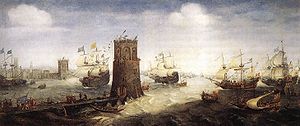 Al-Adil aroused open hostility from the Hanbali
"lobby" in Damascus for largely ignoring the Crusaders, having launched only one campaign against them. He felt that the Crusader army was invincible in a straight fight. Prolonged campaigns also involved the difficulties of maintaining a coherent Arab coalition. The trend under al-Adil was steady growth of the empire, mainly through the expansion of Ayyubid authority in al-Jazira and Armenia. The Abbasids eventually recognized al-Adil's role as sultan in 1207. A Crusader military campaign was launched on November 3, 1217, beginning with an offensive towards Transjordan
. Al-Mu'azzam urged al-Adil to launch a counter-attack, but he refused his son's proposal. In 1218, the fortress of Damietta
in the Nile Delta
was besieged by the Crusaders. After two failed attempts, the fortress eventually capitulated on August 25. Six days later al-Adil died, reportedly of shock.
Al-Kamil proclaimed himself sultan in Cairo, while his brother al-Mu'azzam claimed the throne in Damascus. Al-Kamil attempted to retake the fortress, but was forced back by John of Brienne
. After learning of a conspiracy against him, he fled, leaving the Egyptian army leaderless. Panic ensued, but with the help of al-Mu'azzam, al-Kamil regrouped his forces. By then, however, the Crusaders had seized his camp. The Ayyubids offered to negotiate for the withdrawal from Damietta, offering the restoration of Palestine to the Kingdom of Jerusalem, with the exception of the forts of Mont Real and Karak. This was refused by the leader of the Fifth Crusade
, Pelagius of Albano and in 1221, they were driven out of the Nile Delta after the Ayyubid victory at Mansura.
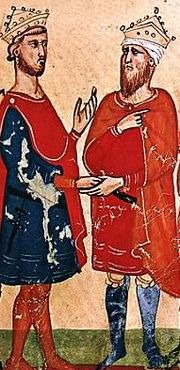 In the east, the Khwarezemids under Jalal ad-Din Mingburnu
captured the town of Khilat
from al-Ashraf, while the Rasulids, who were loyalists to the Ayyubids, began to influence their holdings in Arabia. In 1222, the Ayyubids appointed Ali Bin Rasul as governor of Mecca. Ayyubid rule in Yemen
and the Hejaz
was declining and the governor of Yemen, Mas'ud bin Kamil was forced to leave for Egypt in 1223. He appointed Nur ad-Din Umar as his deputy governor when he was absent. In 1224, a local dynasty, al-Yamani, gained control of Hadramaut from the Ayyubids who held it loosely due the troubled situation of their administration in Yemen proper. Following Mas'ud's death in 1229, Nur ad-Din Umar declared himself the independent ruler of Yemen and discontinued payment of the annual tribute to the Ayyubids in Egypt.
Under Frederick II
, a Sixth Crusade
was launched, capitalizing on an ongoing internal strife between al-Kamil and the Ayyubids of Syria and Palestine led by al-Mu'azzam. Al-Kamil, therefore, offered Jerusalem to Frederick to avoid a Syrian invasion of Egypt, but the emperor refused. His position was strengthened when al-Mu'azzam died in 1227 and was succeeded by his son an-Nasir Dawud
. He continued negotiations with Frederick in Acre in 1228 leading to the establishment of a limited truce, signed in February 1229. It gave the Crusaders control over an unfortified Jerusalem for over ten years, although the Muslims would hold control over Islamic holy places in the city. Although the treaty was virtually meaningless in military terms, an-Nasir Dawud used it to provoke the sentiments of Syria's citizens and a Friday sermon by a popular preacher at the Umayyad Mosque
"reduced the crowd to violent sobbing and tears."
The settlement with the Crusaders was accompanied by a proposed new division of the Ayyubid principalities; Damascus and its territories would go to al-Ashraf, but clearly recognizing al-Kamil's sovereignty. An-Nasir Dawud resisted the settlement, incensed by the Ayyubid-Crusader truce. Al-Kamil's forces reached Damascus to enforce the proposed agreement in May 1229. The siege put great pressure on the city, but the inhabitants rallied to an-Nasir Dawud, conscious of al-Mu'azzam's stable rule and shocked at the treaty with Frederick. After one month, however, an-Nasir Dawud sued for a peaceful outcome and was given a new principality centered around Karak, while al-Ashraf—governor of the Diyar Bakr—assumed governorship of Damascus.
Meanwhile, the Seljuk
s were advancing towards al-Jazira, and the descendants of Qatada ibn Idris quarreled with their Ayyubid overlords over control of Mecca. The latter was taken advantage of by the Rasulids of Yemen who attempted to end the Ayyubid suzerainty in the Hejaz and bring the region under their control which they did in 1238 when Nur al-Din Umar captured Mecca.
. Two months later, al-Kamil's Egyptian army arrived and besieged Damascus, but as-Salih Ismail had laid waste the suburbs of the city to deny al-Kamil's forces shelter. In 1232, al-Kamil installed his eldest son as-Salih Ayyub
to govern Hisn Kayfa, but on al-Kamil's death in 1238, as-Salih Ayyub disputed control of Egypt with his younger brother al-Adil II
who had been proclaimed sultan in Cairo. As-Salih Ayyub eventually occupied Damascus in December 1238, but his uncle as-Salih Ismail took back the city in September 1239, although he himself was detained by his cousin an-Nasir Dawud in Karak in order to prevent his arrest by al-Adil. He allied with Dawud who released him the following year, allowing him to proclaim himself sultan in place of al-Adil in May 1240.
Throughout the early 1240s, as-Salih Ayyub carried out reprisals against those who supported al-Adil, and he then quarreled with an-Nasir Dawud who was reconciling with as-Salih Ismail of Damascus. The rival sultans as-Salih Ayyub and as-Salih Ismail attempted to ally with the Crusaders against the other. In 1244, the breakaway Ayyubids of Syria allied with the Crusaders and confronted the allied forces of as-Salih Ayyub and the Khwarizmids at Hirbiya, near Gaza. A large battle ensued
, resulting in a major victory for as-Salih Ayyub and the virtual collapse of the Kingdom of Jerusalem.
and Samaria
from an-Nasir Dawud; he took possession of Jerusalem then marched on to take Damascus which fell with relative ease in October 1245. Shortly afterward, Sayf al-Din Ali surrendered his exposed principality, Ajlun and its fortress, to as-Salih Ayyub. The rupture of the alliance between the Khwarizmids and as-Salih Ayyub ended with the virtual destruction of the former by al-Mansur Ibrahim
, the Ayyubid emir of Homs, in October 1246. With the Khwarizimid defeat, as-Salih Ayyub was able to complete the subjugation of southern Syria. His general Fakhr ad-Din went on to subdue an-Nasir Dawud's territories. He sacked the lower town of Karak, then besieged its fortress. Although he did not have the means to take it, an-Nasir Dawud was not strong enough to drive him away. A settlement was eventually reached whereby the latter would retain the fortress, but cede the remainder of his principality to as-Salih Ayyub. Having settled the situation in Palestine and Transjordan, Fakhr ad-Din moved north and marched to Bosra
, the last place still held by as-Salih Ismail. During the siege, Fakhr ad-Din fell ill, but his commanders continued the assault against the city which fell in December 1246.
By May 1247, as-Salih Ayyub was master of Syria south of Lake Homs, having gained Banyas and Salkhad. With his fellow Ayyubid opponents subdued, except for Aleppo under an-Nasir Yusuf
, as-Salih Ayyub undertook a limited offensive against the Crusaders, sending Fakhr ad-Din to move against their holdings in the Galilee. Tiberias fell on June 16, followed by Mount Tabor
and Kawkab al-Hawa
soon thereafter. Safad with its Templar fortress seemed out of reach, so the Ayyubids marched south to Ascalon. Facing stubborn resistance from the Crusader garrison, an Egyptian flotilla was sent by as-Salih Ayyub to aid in the siege and on October 24, Fakhr ad-Din's troops stormed through a breach in the walls and killed or captured the entire garrison. The city was razed and left deserted.
He returned to Damascus to keep watch on developments in northern Syria. Al-Ashraf Musa of Homs had ceded the important stronghold of Salamiyyah to as-Salih Ayyub the previous winter, perhaps to underline the patron-client relationship. This troubled the Ayyubids of Aleppo who feared it would be used as a base for a military take-over of their city. An-Nasir Yusuf found this intolerable and decided to annex Homs which he did in the winter of 1248. The city surrendered in August and an-Nasir Yusuf's terms forced al-Ashraf Musa to hand over Homs, but he was allowed to retain nearby Palmyra
and Tell Bashir in the Syrian Desert
. As-Salih Ayyub sent Fakhr ad-Din to recapture Homs, but Aleppo countered by sending an army to Kafr Tab, just outside of the city. An-Nasir Dawud left Karak for Aleppo to guarantee protection from an-Nasir Yusuf, but in his absence, his brothers al-Amjad Hasan and az-Zahir Shadhi detained his heir al-Mu'azzam Isa and then personally went to as-Salih Ayyub's camp at al-Mansourah in Egypt to offer him control of the Karak in return for holdings in Egypt. As-Salih Ayyub sent the eunuch Badr al-Din Sawabi to act as his governor in the city.
with the intent of launching a Seventh Crusade
against the Muslims by conquering Egypt. Their commander, Louis IX
, attempted to enlist the Mongols to launch a coordinated attack on Egypt, but when this failed to materialize, the Crusader force sailed to Damietta and the Muslims there fled as soon as they landed. When Ayyub, who was in Syria at the time, heard of this, he rushed back to Egypt, avoiding Damietta, instead reaching Mansurah. Here he organized an army and raised a commando force which harassed the Crusaders.
Ayyub was ill and his health deteriorated more due to the mounting pressure from the Crusaders. His wife Shajar al-Durr called a meeting of all the war generals and thus became commander-in-chief of the Egyptian forces. She ordered Mansurah fortified and then stored large quantities of provisions and concentrated her forces there. She also organized a fleet of war galleys and got them scattered at various strategic points along the Nile. Crusader attempts to capture Mansurah were thwarted and King Louis found himself in a critical position. He managed to cross the Nile to launch a surprise attack against Mansurah. Meanwhile, Ayyub died, but Shajar al-Durr and Ayyub's Bahri Mamluk
generals, including Baibars
and Aibek, countered the assault and inflicted heavy losses to the Crusaders. Simultaneously, the Muslim galleys cut off the Crusader's line of supply from Damietta, preventing the arrival of reinforcements. Ayyub's son and the newly proclaimed Ayyubid sultan Al-Mu'azzam Turan-Shah
reached Mansurah at this point and intensified the battle
against the Crusaders. The latter ultimately surrendered and King Louis and his companions were arrested.
Al-Mu'azzam Turan-Shah alienated the Mamluks soon after their victory at Mansurah and constantly threatened them and Shajar al-Durr. Fearing for their positions of power, the Bahri Mamluks revolted against the sultan and killed him in April 1250. Aibek married Shajar al-Durr and subsequently took over the government in Egypt in the name of al-Ashraf II who was now the nominal sultan.
in northern Mesopotamia to the Sinai Peninsula
. In December 1250, he attacked Egypt after hearing of al-Mu'azzam Turan-Shah's death and the ascension of Shajar al-Durr. An-Nasir Yusuf's army was much larger and better-equipped than that of the Egyptian army, consisting of the forces of Aleppo, Homs, Hama, and those of Saladin's only surviving sons, Nusrat ad-Din and Turan-Shah ibn Salah ad-Din. Nonetheless, it suffered a major defeat by Aibek. He subsequently returned to Syria which was slowly slipping out of his control.
The Mamluks forged an alliance with the Crusaders in March 1252 and agreed to jointly launch a campaign against an-Nasir Yusuf. King Louis, who had been released after al-Mu'azzam Turan-Shah's murder, led his army to Jaffa, while Aibek intended to send his forces to Gaza
. Upon hearing of the alliance, an-Nasir Yusuf immediately dispatched an advanced force to Tell al-Ajjul, just outside Gaza, in order to prevent the junction of the Mamluk and Crusader armies. Meanwhile, the rest of the Ayyubid army was stationed in the Jordan Valley
. Realizing that a war between them would greatly benefit the Crusaders, Aibek and an-Nasir Yusuf accepted mediation by Najm ad-Din al-Badhirai on behalf of the Abbasids. In April 1253, a treaty was signed whereby the Mamluks would retain all of Egypt and Palestine up to (but not including) Nablus, while an-Nasir Yusuf would be confirmed as the ruler of Muslim Syria. Thus, Ayybid rule was officially ended in Egypt. After conflict arose between the Mamluks and the Ayyubids again, al-Badhirai again arranged a treaty, this time giving an-Nasir Yusuf control of the previous Mamluk territories in Palestine. Instead of placing Ayyubids in charge, however, an-Nasir Yusuf handed Jerusalem to a Mamluk named Kutuk while Nablus and Jenin
were given to Rukn al-Din Baybars
.
For over a year after the settlement with Mamluks, calm settled over an-Nasir Yusuf's reign, but on December 11, 1256 he sent two envoys to the Abbasids in Baghdad seeking formal investiture from the caliph, al-Musta'sim
, for his role as "Sultan". This request was connected to an-Nasir's rivalry with Aibek, as the title would be useful in future disputes with the Mamluks. However, the Mamluks had sent their envoys to Baghdad previously to precisely ensure that an-Nasir Yusuf would not gain the title, putting al-Musta'sim in a difficult position.
In early 1257, Aibek was killed in a conspiracy, and was succeeded by his 15-year-old son, al-Mansur Ali
, while Saif ad-Din Qutuz
held an influential position. Soon after al-Mansur Ali's ascendancy rumors of another conspiracy to which an-Nasir Yusuf had an alleged connection emerged. The accused conspirator, al-Mansur Ali's vizier Sharaf ad-Din al-Fa'izi, was strangled by Egyptian authorities. The Bahri Mamluks in Syria led by Baibars pressured an-Nasir Yusuf to intervene by invading Egypt, but he would not act, fearing the Bahri dyansty would usurp his throne if they gained Egypt.
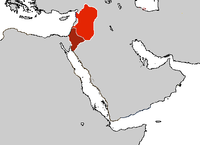 Relations between an-Nasir Yusuf and the Bahri grew tense after the former refused to invade Egypt. In October 1257, Baibars and his fellow Mamluks left Damascus or were expelled from the city and together they moved south to Jerusalem. When the governor Kutuk refused to aid them against an-Nasir Yusuf, Baibars deposed him and had al-Mugith Umar, the emir of Karak, pronounced in the khutba
at the al-Aqsa Mosque
; al-Mugith Umar had allowed the political dissidents of Cairo and Damascus, who sought protection from the Mamluk and Ayyubid authorities, a safehaven within his territories.
Soon after gaining Jerusalem, Baibars conquered Gaza and an-Nasir Yusuf sent his army to Nablus in response. A battle ensued and the Mamluks ultimately fled across the Jordan River to the Balqa
area. From there they reached Zughar
at the southern tip of the Dead Sea
where they sent their submission to Karak. Al-Mughith Umar's new relationship with Baibars solidified his independence from an-Nasir Yusuf's Syria. To ensure his independence, al-Mughith Umar began to distribute the territories of Palestine and Transjordan among the Mamluks.
The new allies assembled a small army and headed for Egypt. In spite of initial gains in Palestine and al-Arish, they withdrew after seeing how overwhelmingly outnumbered they were by the Egyptian army. Al-Mughith Umar and Baibars were not discouraged, however, and launched an army 1,500 regular cavalry to Sinai at the beginning of 1258, but again were defeated by the Mamluks of Egypt.
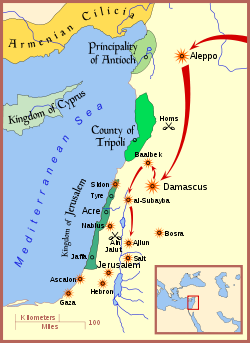 The Ayyubids had been under the nominal sovereignty of the Mongol Empire
after a Mongol force targeted Ayyubid territories in Anatolia in 1244. An-Nasir Yusuf sent an embassy to the Mongol capital Karakorum
in 1250, shortly after assuming power. These understandings did not last, however, and the Mongol Great Khan, Mongke
, issued a directive to his brother Hulegu to extend the realms of the empire to the Nile River. The latter raised an army of 120,000 and in 1258, sacked Baghdad and slaughtered its inhabitants, including the Abbasid caliph and most of his family after the Ayyubids failed to assemble an army to protect the city. That same year the Ayyubids lost Diyar Bakr to the Mongols.
An-Nasir Yusuf sent a delegation to Hulegu afterward, repeating his protestations to submission. Hulegu refused to accept the terms and so an-Nasir Yusuf called on Cairo for aid. This plea coincided with a successful coup by the Cairo-based Mamluks against the remaining symbolic Ayyubid leadership in Egypt, with strongman Qutuz
officially taking power. Meanwhile, an Ayyubid army was assembled at Birze, just north of Damascus to defend the city against the Mongols who were now marching towards northern Syria. Aleppo was soon besieged
by and within a week, in January 1260, it fell in Mongol hands. The Great Mosque
and the Citadel of Aleppo
were razed and most of the inhabitants were killed or sold into slavery. The sack of Aleppo caused panic in Muslim Syria; The Ayyubid emir of Homs, al-Ashraf Musa, offered to ally with Mongols at the approach of their army and was allowed to continue governance of the city by Hulegu. Hama also capitulated without resisting, but did not join forces with the Mongols. An-Nasir Yusuf opted to flee Damascus to seek protection in Gaza.
Hulegu had decided to leave the front for Karakorum and left Kitbugha, a Nestorian Christian general, to continue the conquest. Damascus capitulated after the arrival of the Mongol army, but was not sacked like other captured Muslim cities. However, from Gaza, an-Nasir Yusuf managed to induce the small garrison he left in the Citadel of Damascus to rebel against the Mongol occupation. The Mongols retaliated by launching a massive artillery assault on the citadel and when it became apparent that an-Nasir Yusuf was unable to relieve the city with a newly assembled army, the garrison surrendered.
The Mongols proceeded by conquering Samaria, killing most of the Ayyubid garrison in Nablus, and then advanced south, as far as Gaza, unhindered. An-Nasir Yusuf was soon captured by the Mongols and used to persuade the garrison at Ajlun to capitulate. Afterward, the junior Ayyubid governor of Banias
allied with the Mongols, who had now gained control of most of Syria and al-Jazira, effectively ending Ayyubid power in the region. On September 3, 1260, the Egypt-based Mamluk army led by Qutuz and Baibars
challenged Mongol authority and decisively defeated their forces in the Battle of Ain Jalut
, outside of Zir'in
in the Jezreel Valley
. Five days later, the Mamluks took Damascus and within a month, most of Syria was in Mamluk hands. Meanwhile, an-Nasir Yusuf was killed under captivity.
The last Ayyubid ruler of Hama died in 1299 and Hama briefly passed through direct Mamluk suzerainty. However, in 1310, under the patronage of the Mamluk sultan al-Nasir Muhammad
, Hama again came under Ayyubid governance in the person of the well-known geographer and author Abu al-Fida. The latter died in 1331 and was succeeded by his son Al-Afdal Muhammad
who eventually lost the favor of his Mamluk overlords. He was removed from his post in 1341 and Hama was formally placed under Mamluk rule.
In southeastern Anatolia, the Ayyubids continued to rule the principality of Hisn Kayfa and managed to remain an autonomous entity, independent of the Mongol Ilkhanate
which ruled northern Mesopotamia until the 1330s. After the breakup of the Ilkhanate, their former vassals in the area, the Artukids waged war against the Ayyubids of Hisn Kayfa in 1334, but were decisively defeated, with the Ayyubids gaining their possessions on the left bank of the Tigris River. In the 14th century, the Ayyubids rebuilt the castle of Hisn Kayfa which served as their stronghold until they were supplanted by the Ottoman Empire
in the early 16th century.
, seat of the Caliphate
, however, that exercised cultural and political hegemony over the Ayyubid territories, particularly those in Southwest Asia
. For instance, the qadi
("chief justice") of Damascus was still appointed by the Abbasids during Ayyubid rule.
Political power was concentrated in the Ayyubid household which was not necessarily characterized only by blood relation; slaves and intimates could acquire great, and even supreme power within it. It was a common occurrence for the mothers of young Ayyubid rulers to act as independent powers or in a few cases, rulers in their own right. Eunuchs exercised substantial power under the Ayyubids, serving as attendants and atabeg
s within the household or as emirs, governors, and army commanders outside the household. One of Saladin's most important supporters was the eunuch Baha ad-Din ibn Shaddad
who helped him depose the Fatimids, dispossess their properties, and construct the wall of Cairo's citadel. Following the death of al-Aziz Uthman, he became the regent of his son al-Mansur and effectively ruled over Egypt for a short while before the arrival of al-Adil. Later sultans appointed eunuchs as deputy sultans and even awarded them sovereignty over certain cities, such as Shams al-Din Sawab who was given the cities of Amid and Diyar Bakr in 1239.
The Ayyubids had three principal means of recruiting the learned elites whom they needed to rule their cities and towns. Some of these local leaders, known as shaykhs, entered the service of an Ayyubid ruling household and thus their bids for power were supported out of Ayyubid household revenues and influence. Others were paid directly out of revenues made from the diwan
, a high governmental body of the state. The third method was the assigning to shaykhs of the revenues of charitable endowments, known as waqf
s. The Ayyubids, like their various predecessors in the region, had relatively few state agencies by which they could penetrate their cities and towns. To link themselves with the learned elite of their cities, they relied on the political usage of patronage practices. The assignment of waqf revenue to the learned was similar to the assignment of fiefs (iqta'at) to the commanders and generals of the army. In both cases, it enabled the Ayyubids to recruit a dependent, but not administratively subordinate elite.
After al-Adil I seized the throne in Cairo and with it the sultanate of the Ayyubid oligarchy, the period of rivalry between Damascus and Cairo to become capital of the Ayyubid empire commenced. Under al-Adil and al-Kamil, Damascus continued as an autonomous province whose ruler reserved the right to designate his own heir, but during as-Salih Ayyub's rule, military campaigns against Syria reduced Damascus to a vassal of Cairo. In addition, Ayyub established new rules both in administration and government in order to centralize his regime; he conferred the most prominent positions of the state to his close confidants, instead of his Ayyubid relatives. His wife Shajar al-Durr, for example, managed the affairs of Egypt while he was in Syria. Ayyub officially delegated his authority to his dead son Khalil and made al-Durr act formally on Khalil's behalf.
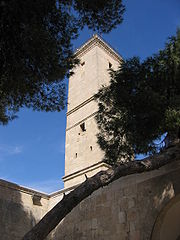 By the 12th century, Islam
was the dominant religion in the Middle East. It is not certain, however, if it was the religion of the majority outside the Arabian Peninsula
. Arabic was the language of high culture and of the urban population, but other native languages continued to be used in some rural communities throughout the Ayyubid territories.
The majority of Syria's population in the 12th century consisted of Sunni Muslims, typically from Arab or Kurdish backgrounds. There were also sizable Muslim communities of Twelver Shias, Druze
s, and Nusayris. The presence of the Ismaili
s was small and most were of Persian
origin, having migrated from Alamut
. They mostly resided in the mountainous area near the northern Syrian coastline. Large Christian communities existed in northern Syria, Palestine, Jordan and northern Mesopotamia. They were Aramaic
-speaking and indigenous to the area, mostly belonging to the Syriac Orthodox Church
. They lived in villages of Christian or mixed Christian and Muslim population, monasteries, and in small towns where they appear to have been on friendly terms with their Muslim neighbors. Ideologically, they were led by the Patriarch of Antioch
.
In Yemen and Hadramaut, much of the population adhered to Shia Islam in its Zaydi form. The inhabitants of northern Mesopotamia were made up of Sunni Muslim Kurds and Turks, although there was a significant Yazidi
minority in that region as well. Jews were spread throughout the Islamic world and most Ayyubid cities had Jewish communities due to the important roles they played in trade, manufacture, finance, and medicine. In Yemen and some parts of the Levant, Jews also lived in rural towns. The Ayyubid emir of Yemen in 1197-1202, al-Malik Mu'izz Isma'il attempted to forcibly convert the Jews of Aden, but this process did not take effect after his death in 1202. Within the Jewish community, particularly in Egypt and Palestine, there existed a minority of Karaites
.
In Egypt, there were large communities of Coptic Christians, Melkite
s, Turks
, Armenians
, and Black Africans—the latter two groups had a large presence in Upper Egypt
. Under the Fatimids, non-Muslims in Egypt generally lived in prosperity, with the exception of caliph al-Hakim
's reign. However, with Shirkuh's ascendancy to the vizier position, a number edicts were enacted against the non-Muslim population. With the advent of the Syrian expeditionary force (consisting of Ghuzz
and Kurds) into Egypt, waves of maltreatment of minorities occurred, irrespective of religion. These incidents occurred while Shirkuh and Saladin were viziers to the Fatimid caliph.
At the beginning of Saladin's reign as sultan in Egypt, upon the encouragement of his adviser, Qadi al-Fadil, Christians were prohibited from employment in the fiscal administration, but various Ayyubid emirs continued to allow Christians to serve in their posts. A number of other regulations were imposed, including the ban on alcohol consumption, religious processions, and the ringing of church bells. Conversion of formerly high-ranking Christians and their families to Islam took place throughout the early period of Ayyubid rule. According to historian Yaakov Lev, the persecution of non-Muslims had some permanent effects on them, but nonetheless, the effects were local and contained. To manage Mediterranean trade, the Ayyubids permitted Europe
ans—mainly Italian
s, but also French
and Catalan
s—to settle in Alexandria
in large numbers. However, in the aftermath of the Fifth Crusade
, 3,000 merchants from the area were arrested or expelled.
The Ayyubids generally employed Kurds, Turks, and people from the Caucasus
for the higher-ranking posts of the military and bureaucratic fields. Not much is known about the foot soldiers of the Ayyubid army, but the numbers of cavalrymen are known to have fluctuated between 8,500 and 12,000. The cavalry was largely composed of free-born Kurds, Turks, and Turkoman
s who Ayyubid emirs and sultans purchased as slaves (mamluks). In addition, there existed Arab auxiliaries, former Fatimid units such as the Nubians, and separate Arab contingents—notably from the Kinaniyya tribe, who were largely devoted to the defense of Egypt. Rivalry between Kurdish and Turkish troops occurred occasionally when leading positions were at stake and towards the end of Ayyubid rule, Turks outnumbered Kurds in the army. Despite their Kurdish background, the sultans remained impartial to both groups.
living in 8,300 villages leaving a population of 230,000-300,000 living in ten cities, eight of which were Muslim cities under Ayyubid control. The largest were Edessa
(pop. 24,000), Damascus (pop. 15,000), Aleppo (pop. 14,000), and Jerusalem (pop. 10,000). Smaller cities included Homs, Hama, Gaza, and Hebron
.
Russel estimated the Egyptian village population to be 3,300,000 in 2,300 villages, a high density for rural populations in the time period. He attributes it to the high productivity of Egyptian soil which allowed for increased agricultural growth. The urban population was much lower, 233,100, consisting of 5.7% of the total Egyptian population. The largest cities were Cairo (pop. 60,000), Alexandria (pop. 30,000), Qus
(pop. 25,000), Damietta (pop. 18,000), Fayyum (pop. 13,000), and Bilbeis
(10,000). Numerous smaller cities dotted the Nile River, among them were Damanhur
, Asyut
, and Tanta
. Cities in Egypt were also densely populated, mainly because of greater urbanization and industrialization than elsewhere.
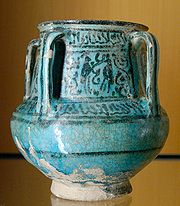 Having pushed the Crusaders out of most of Syria, the Ayyubids generally adopted a policy of peace with them. The war with the Crusaders did not prevent Muslims under Ayyubid governance from developing good commercial relations with Europe
an states. This led to fruitful interaction between both sides in different fields of economic activity, particularly in agriculture and trade.
Numerous measures were undertaken by the Ayyubids to increase agricultural production. Canals were dug to facilitate the irrigation of agricultural lands throughout the empire. Cultivation of sugarcane
was officially encouraged to meet the great demand of it by both the local inhabitants and the Europeans. Several new plants were introduced to Europe in trade with both the Zengids and Ayyubids, including sesame
, carob, millet, rice, lemons, melons, apricot
s, and shallots.
The main factor which boosted industry and trade under the Ayyubids was the new interests Europeans developed when they came into contact with the Muslims. Commodities included incense, scents, fragrant oils, and aromatic plants from Arabia and India
, as well as ginger, alum
, and aloe
s. Likewise, Europeans developed new tastes in the matter of fashions, clothing, and home furnishing. Rugs, carpets, and tapestries manufactured in the Middle East
and Central Asia
were introduced to the West
through Crusader-Ayyubid interaction. Christian pilgrims visiting Jerusalem returned with Arab reliquaries for the keeping of relics. In addition, eastern works of art in glass, pottery, gold, silver, etc., were highly prized in Europe.
The European demand for agricultural products and industrial commodities stipulated maritime activity and international trade to an unprecedented extent. The Ayyubids played a leading role in this as they controlled sea-trade routes which passed through the ports of Yemen and Egypt via the Red Sea
. The trade policy of the Ayyubids placed them in a position of great advantage; although they cooperated with the Genoa
ns and Venetians in the Mediterranean Sea
, they prevented them from having access to the Red Sea. Thus, they kept the trade of the Indian Ocean
exclusively in their hands. In the Mediterranean trade, the Ayyubids drew large benefits in the form of taxes and commissions which they learned from the Italians.
Upon the development of international trade, the elementary principles of credit and banking were developed. Both Jewish and Italian merchants had regular banking agents in Syria, who transacted business on behalf of their masters. Bills of exchange were also used by them in their dealings with one another and money was deposited in various banking centers throughout Syria. The encouragement of trade and industry provided the Ayyubid sultans with the funds needed for military expenditure as well as for developmental and everyday lifestyle works. Special attention was made to the economic state of the empire under al-Adil and al-Kamil. The latter maintained a strict control over expenditure; it is said that on his death he left a treasury which was equivalent to the budget of one full year.
, under Saladin, Damascus had 20 schools, 100 baths, and a large number of Sufi dervish
monasteries. He also built several schools in Aleppo, Jerusalem, Cairo, Alexandria, and in various cities in the Hejaz. Similarly, many schools were built by his successors also. Their wives and daughters, commanders, and nobles established and financed numerous educational institutions as well.
Although the Ayyubids were from the Shafi'i
denomination, they built schools for imparting instruction in all four of the Sunni systems of religious-juridical thought. Before the Ayyubid takeover, there were no schools for the Hanbali and Maliki denominations in Syria, but the Ayyubids founded separate schools for them. In the mid-13th century, Ibn Shaddad
counted in Damascus 40 Shafi'i, 34 Hanafi
, 10 Hanbali, and three Maliki schools.
When Saladin restored Sunni orthodoxy in Egypt, 10 madrasas were established during his reign, and an additional 25 during the entire Ayyubid period of rule. Each of their locations had religious, political, and economic significance, in particular those in al-Fustat. Most of the schools were dedicated to the Shafi'i denomination, but others belonged to the Maliki and Hanafi madhabs. The madrasas built near the tomb of Imam al-Shafi'i
were located adjacent to the important centers of pilgrimage and were a major focus of Sunni devotion. About 26 schools were built in Egypt, Jerusalem, Damascus by men of high rank in the government, and unusual of the time, common people founded in Egypt about 18 schools, including two medical institutions.
Most schools were residential whereby both teachers and students resided as a rule. The teachers appointed were jurists, theologians, and traditionalists who received their salary from endowments to the institutions they taught in. Each student was offered a lodging where he would resort, a teacher to instruct him in whatever art he requested, and regular grants to cover all his needs. Madrasas were considered prestigious institutions in society. Under the Ayyubids, it was not possible to obtain a job in the government without receiving an education from a madrasa.
. Among them were Maimonides
, Ibn Jami, Abdul Latif al-Baghdadi, al-Dakhwar
, Rashidun al-Suri
, and Ibn al-Baitar. Some of these scholars served the Ayyubid household directly, becoming the personal physicians of sultans.
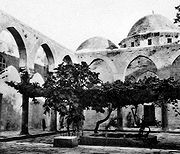
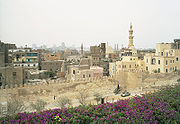 Military architecture was the supreme expression of the Ayyubid period, as well as an eagerness to fortify the restoration of Sunni Islam, especially in a previously Shia-dominated Egypt by constructing Sunni madrasas. The most radical change Saladin implemented in Egypt was the enclosure of Cairo and al-Fustat within one city wall. Some of the techniques of fortification were learned from the Crusaders, such as curtain walls following the natural topography. Many were also inherited from the Fatimids like machicolations and round towers, while other techniques were developed simultaneously by the Ayyubids, particularly concentric planning.
Muslim women, particularly those from the Ayyubid family, the families of local governors, and the families of the ulema
("religious scholars") took an active role in Ayyubid architecture. Damascus witnessed the most sustained patronage of religious architecture by women. They were responsible for the construction of 15 madrasas, six Sufi hospices, and 26 religious and charitable institutions. In Aleppo, the Firdaws Madrasa, known as the most impressive Ayyubid building in Syria, had regent queen Dayfa Khatun
as its patron.
In September 1183, construction of the Cairo Citadel began under Saladin's orders. According to al-Maqrizi
, Saladin chose the Muqattam Hills to build the citadel because the air there was fresher than anywhere else in the city, but its construction was not so much determined by the salubrious atmosphere; rather it was out of defensive necessity and example of existing fortresses and citadels in Syria. The walls and towers of the northern section of the citadel are largely the works of Saladin and al-Kamil. Two of Saladin's towers were totally encased by semi-circular units. Al-Kamil completed the citadel; he strengthened and enlarged some of the existing towers, and also added a number of square towers which served as self-contained keeps. According to Richard Yeomans, the most impressive of al-Kamil's structures was the series of massive rectangular keeps which straddled the walls of the northern enclosure. All of al-Kamil's fortifications can be identified by their embossed, rusticated masonry, whereas Saladin's towers have smooth dressed stones. This heavier rustic style became a common feature in other Ayyubid fortifications, and can be seen in the Citadel of Damascus and that of Bosra
in Syria.
Aleppo underwent major transformations in the Ayyubid period, specifically during the reign of az-Zahir Ghazi
. Ayyubid architectural achievements focused on four areas: the citadel
, the waterworks, fortifications, and the extramural developments. The total rebuilding of the city enclosure began when az-Zahir Ghazi removed the vallum
of Nur ad-Din—which by then outlived its temporary need—and rebuilt the northern and northwestern walls—the most susceptible to outside attack—from Bab al-Jinan
to Bab al-Nasr
. He parceled out the building of the towers on this stretch of the wall to his princes and military officers; each tower was identified with a particular prince who inscribed his name into it. Later, az-Zahir Ghazi extended the eastern wall to the south and east, reflecting his desire to incorporate a dilapidated fortress, Qala'at al-Sharif, outside the city into Aleppo's enclosure. Bab Qinnasrin
was completely rebuilt by an-Nasir Yusuf in 1256. This gate stands today as a masterpiece of medieval Syrian military architecture. Cumulatively, Ayyubid architecture left a lasting impression in Aleppo. The citadel was rebuilt, the water network was expanded, and streets and quarters were provided fountains and baths. In addition, dozens of shrines, mosques, madrasas, and mausoleums were built throughout the city.
The Ayyubid period in Jerusalem following its conquest by Saladin was marked by a huge investment in the construction of houses, markets, public bathes, and pilgrim hostels. Numerous works were undertaken at the Temple Mount
. Saladin ordered all the inner walls and pillars of the Dome of the Rock
to be covered in marble
and he instigated the renovation of the mosaics on the dome's drum. The mihrab
of the al-Aqsa Mosque
was repaired and in 1217, al-Mu'azzam Isa built the northern porch of the mosque with three gates. The Dome of the Ascension
was also built and restoration work was done to the existing free-standing domes of the Temple Mount.
Saladin
Ṣalāḥ ad-Dīn Yūsuf ibn Ayyūb , better known in the Western world as Saladin, was an Arabized Kurdish Muslim, who became the first Sultan of Egypt and Syria, and founded the Ayyubid dynasty. He led Muslim and Arab opposition to the Franks and other European Crusaders in the Levant...
and centered in Egypt
Egypt
Egypt , officially the Arab Republic of Egypt, Arabic: , is a country mainly in North Africa, with the Sinai Peninsula forming a land bridge in Southwest Asia. Egypt is thus a transcontinental country, and a major power in Africa, the Mediterranean Basin, the Middle East and the Muslim world...
. The dynasty ruled much of the Middle East
Middle East
The Middle East is a region that encompasses Western Asia and Northern Africa. It is often used as a synonym for Near East, in opposition to Far East...
during the 12th and 13th centuries CE. The Ayyubid family, under the brothers Ayyub
Najm ad-Din Ayyub
al-Malik al-Afdal Najm ad-Din Ayyub ibn Shadhi ibn Marawan ) was a Kurdish soldier and politician from Dvin, and the father of Saladin. He is eponymous of the Ayyubid dynasty founded by Saladin.-Life and career:Ayyub was the son of Shadhi ibn Marwan and brother of Shirkuh...
and Shirkuh, originally served as soldiers for the Zengids until they supplanted them under Saladin
Saladin
Ṣalāḥ ad-Dīn Yūsuf ibn Ayyūb , better known in the Western world as Saladin, was an Arabized Kurdish Muslim, who became the first Sultan of Egypt and Syria, and founded the Ayyubid dynasty. He led Muslim and Arab opposition to the Franks and other European Crusaders in the Levant...
, Ayyub's son. In 1174, Saladin proclaimed himself Sultan following the death of Nur al-Din. The Ayyubids spent the next decade launching conquests throughout the region and by 1183, the territories under their control included Egypt, Syria
Syria
Syria , officially the Syrian Arab Republic , is a country in Western Asia, bordering Lebanon and the Mediterranean Sea to the West, Turkey to the north, Iraq to the east, Jordan to the south, and Israel to the southwest....
, northern Mesopotamia
Mesopotamia
Mesopotamia is a toponym for the area of the Tigris–Euphrates river system, largely corresponding to modern-day Iraq, northeastern Syria, southeastern Turkey and southwestern Iran.Widely considered to be the cradle of civilization, Bronze Age Mesopotamia included Sumer and the...
, Hejaz
Hejaz
al-Hejaz, also Hijaz is a region in the west of present-day Saudi Arabia. Defined primarily by its western border on the Red Sea, it extends from Haql on the Gulf of Aqaba to Jizan. Its main city is Jeddah, but it is probably better known for the Islamic holy cities of Mecca and Medina...
, Yemen
Yemen
The Republic of Yemen , commonly known as Yemen , is a country located in the Middle East, occupying the southwestern to southern end of the Arabian Peninsula. It is bordered by Saudi Arabia to the north, the Red Sea to the west, and Oman to the east....
, and the North Africa
North Africa
North Africa or Northern Africa is the northernmost region of the African continent, linked by the Sahara to Sub-Saharan Africa. Geopolitically, the United Nations definition of Northern Africa includes eight countries or territories; Algeria, Egypt, Libya, Morocco, South Sudan, Sudan, Tunisia, and...
n coast up to the borders of modern-day Tunisia
Tunisia
Tunisia , officially the Tunisian RepublicThe long name of Tunisia in other languages used in the country is: , is the northernmost country in Africa. It is a Maghreb country and is bordered by Algeria to the west, Libya to the southeast, and the Mediterranean Sea to the north and east. Its area...
. Most of the Kingdom of Jerusalem
Kingdom of Jerusalem
The Kingdom of Jerusalem was a Catholic kingdom established in the Levant in 1099 after the First Crusade. The kingdom lasted nearly two hundred years, from 1099 until 1291 when the last remaining possession, Acre, was destroyed by the Mamluks, but its history is divided into two distinct periods....
and beyond Jordan River fell to Saladin after his victory at the Battle of Hattin
Battle of Hattin
The Battle of Hattin took place on Saturday, July 4, 1187, between the Crusader Kingdom of Jerusalem and the forces of the Ayyubid dynasty....
in 1187. However, the Crusader
Crusades
The Crusades were a series of religious wars, blessed by the Pope and the Catholic Church with the main goal of restoring Christian access to the holy places in and near Jerusalem...
s regained control of Palestine's coastline in the 1190s.
After the death of Saladin, his sons contested control over the sultanate, but Saladin's brother al-Adil eventually established himself as Sultan in 1200. In the 1230s, the Ayyubid rulers of Syria attempted to assert their independence from Egypt and remained divided until Egyptian Sultan as-Salih Ayyub
As-Salih Ayyub
Al-Malik as-Salih Najm al-Din Ayyub , also known as al-Malik al-Salih was the Ayyubid ruler of Egypt from 1240 to 1249.-Biography:...
restored Ayyubid unity by taking over most of Syria, excluding Aleppo
Aleppo
Aleppo is the largest city in Syria and the capital of Aleppo Governorate, the most populous Syrian governorate. With an official population of 2,301,570 , expanding to over 2.5 million in the metropolitan area, it is also one of the largest cities in the Levant...
, by 1247. By then, local Muslim dynasties had driven out the Ayyubids from Yemen, the Hejaz, and parts of Mesopotamia. After repelling a Crusader invasion of the Nile Delta
Nile Delta
The Nile Delta is the delta formed in Northern Egypt where the Nile River spreads out and drains into the Mediterranean Sea. It is one of the world's largest river deltas—from Alexandria in the west to Port Said in the east, it covers some 240 km of Mediterranean coastline—and is a rich...
, as-Salih Ayyub's Mamluk
Mamluk
A Mamluk was a soldier of slave origin, who were predominantly Cumans/Kipchaks The "mamluk phenomenon", as David Ayalon dubbed the creation of the specific warrior...
generals overthrew al-Mu'azzam Turanshah who succeeded Ayyub as Sultan after his death in 1250. This effectively ended Ayyubid power in Egypt and a number of attempts by the rulers of Syria, led by an-Nasir Yusuf
An-Nasir Yusuf
An-Nasir Yusuf An-Nasir Yusuf (Arabic: الناصر يوسف ) An-Nasir Yusuf (Arabic: الناصر يوسف ) (Royal Name: al-Malik al-Nasir Salah al-Din Yusuf (Arabic: الملك الناصر صلاح الدين يوسف )(1228–1260 ) was the Ayyubid ruler of most of Syria, including Aleppo (1236–1260) and Damascus (1250–1260)...
of Aleppo, to recover it failed. In 1260, the Mongols
Mongol Empire
The Mongol Empire , initially named as Greater Mongol State was a great empire during the 13th and 14th centuries...
sacked Aleppo
Siege of Aleppo (1260)
The Siege of Aleppo lasted from 18 January 1260 to 24 January 1260.After receiving the submission of Haran and Edessa, Hulagu Khan crossed the Euphrates, sacked Menbij and placed Aleppo under siege. For six days the city was under siege...
and wrested control of what remained of the Ayyubid territories soon after. The Mamluks, who forced out the Mongols after the destruction of the Ayyubid dynasty, maintained the Ayyubid principality of Hama
Hama
Hama is a city on the banks of the Orontes River in west-central Syria north of Damascus. It is the provincial capital of the Hama Governorate. Hama is the fourth-largest city in Syria—behind Aleppo, Damascus, and Homs—with a population of 696,863...
until deposing its last ruler in 1341.
During their relatively short tenure, the Ayyubids ushered in an era of economic prosperity in the lands they ruled and the facilities and patronage provided by the Ayyubids led to a resurgence in intellectual activity in the Islamic world. This period was also marked by an Ayyubid process of vigorously strengthening Sunni Muslim dominance in the region by constructing numerous madrasas (schools) in their major cities.
Origins
The progenitor of the Ayyubid dynasty was Najm ad-Din Ayyub bin ShadhiNajm ad-Din Ayyub
al-Malik al-Afdal Najm ad-Din Ayyub ibn Shadhi ibn Marawan ) was a Kurdish soldier and politician from Dvin, and the father of Saladin. He is eponymous of the Ayyubid dynasty founded by Saladin.-Life and career:Ayyub was the son of Shadhi ibn Marwan and brother of Shirkuh...
. He belonged to a Kurdish
Kurdish people
The Kurdish people, or Kurds , are an Iranian people native to the Middle East, mostly inhabiting a region known as Kurdistan, which includes adjacent parts of Iran, Iraq, Syria, and Turkey...
tribe whose ancestors settled in the town of Dvin
Dvin
Dvin was a large commercial city and the capital of early medieval Armenia. It was situated north of the previous ancient capital of Armenia, the city of Artaxata, along the banks of the Metsamor River, 35 km to the south of modern Yerevan...
, in northern Armenia
Armenia
Armenia , officially the Republic of Armenia , is a landlocked mountainous country in the Caucasus region of Eurasia...
. He belonged to the tribe of Rawadiya
Rawadid
Rawadid , , was a Kurdish principality ruling Azerbaijan from the 10th to the early 11th centuries, centered around Tabriz and Maragheh. The Rawadid tribe was one of the Arab tribes who became Kurdish by culture through assimilation...
, itself a branch of the Hadhabani
Hadhabani
Hadhabani was an 11th century Kurdish tribe centered at Ushnu. Their dominion included surrounding areas of Maragha and Urmia to the east, Salmas to the north and parts of Arbil and Mosul to the west....
tribe. The Rawadids were originally from Arab ancestry (Azd tribe), and arrived in the region in 758 CE, but they had become Kurdicized by the early 10th century and began to use Kurdish
Kurdish language
Kurdish is a dialect continuum spoken by the Kurds in western Asia. It is part of the Iranian branch of the Indo-Iranian group of Indo-European languages....
forms like Mamlan for Muhammad and Ahmadil for Ahmad as their names. The Rawadiya were the dominant Kurdish group in the Dvin district. They were a member of the sedentary political-military elite of the town.
Circumstances became unfavorable in Dvin when Turkish generals seized the town from its Kurdish prince. Shadhi left for Iraq
Iraq
Iraq ; officially the Republic of Iraq is a country in Western Asia spanning most of the northwestern end of the Zagros mountain range, the eastern part of the Syrian Desert and the northern part of the Arabian Desert....
with his two sons Najm al-Din Ayyub and Asad al-Din Shirkuh. He was welcomed by his friend Mujahed al-Din Bihruz—the military governor of northern Mesopotamia under the Seljuks—who appointed Shadhi as the governor of Tikrit
Tikrit
Tikrit is a town in Iraq, located 140 km northwest of Baghdad on the Tigris river . The town, with an estimated population in 2002 of about 260,000 is the administrative center of the Salah ad Din Governorate.-Ancient times:...
. After Shadhi's death, Ayyub succeeded him in governance of the city with the assistance of his brother Asad ad-Din Shirkuh
Shirkuh
Asad ad-Din Shirkuh bin Shadhi , also known as Shêrko or "Shêrgo" was an important Kurdish military commander, and uncle of Saladin....
. Together they managed the affairs of the city well, gaining them popularity from the local inhabitants. In the meantime, Imad ad-Din Zangi, the ruler of Mosul
Mosul
Mosul , is a city in northern Iraq and the capital of the Ninawa Governorate, some northwest of Baghdad. The original city stands on the west bank of the Tigris River, opposite the ancient Assyrian city of Nineveh on the east bank, but the metropolitan area has now grown to encompass substantial...
, was defeated by the forces of the Abbasids under al-Mustarshid
Al-Mustarshid
Al-Mustarshid was the Abbasid Caliph in Baghdad from 1118 to 1135.Son of the preceding Caliph, he achieved more independence as a ruler while the Seljuq sultan Mahmud II was engaged in war in the East....
and the forces of Bihruz. In his bid to escape the battlefield to Mosul via Tikrit, Zangi took shelter with Ayyub and sought his assistance in this task. Ayyub complied and provided Zangi and his companions boats to cross the Tigris
Tigris
The Tigris River is the eastern member of the two great rivers that define Mesopotamia, the other being the Euphrates. The river flows south from the mountains of southeastern Turkey through Iraq.-Geography:...
to safely reach Mosul.
As a consequence for assisting Zangi, Ayyub was put to task by the Abbasid authorities, and simultaneously, in another incident, Shirkuh killed a close confidant of Bihruz on charges that he sexually assaulted a woman in Tikrit. Both Ayyub and Shirkuh were issued arrest warrants by the Abbasid court, but before they could be arrested they left Tikrit for Mosul in 1138. When they arrived there, Zangi provided them with all the facilities they needed and he recruited the brothers into his service. Ayyub was made commander of Ba'albek and Shirkuh entered the service of Zangi's son, Nur ad-Din. According to historian Abdul Ali, it was under the care and patronage of Zangi, that the Ayyubid family rose into prominence.
Establishment in Egypt
In 1164, Nur al-Din sent Shirkuh to head an expeditionary force to prevent CrusaderCrusades
The Crusades were a series of religious wars, blessed by the Pope and the Catholic Church with the main goal of restoring Christian access to the holy places in and near Jerusalem...
dominance of an increasingly anarchic Egypt
Egypt
Egypt , officially the Arab Republic of Egypt, Arabic: , is a country mainly in North Africa, with the Sinai Peninsula forming a land bridge in Southwest Asia. Egypt is thus a transcontinental country, and a major power in Africa, the Mediterranean Basin, the Middle East and the Muslim world...
. Shirkuh, enlisted Ayyub's son, Saladin
Saladin
Ṣalāḥ ad-Dīn Yūsuf ibn Ayyūb , better known in the Western world as Saladin, was an Arabized Kurdish Muslim, who became the first Sultan of Egypt and Syria, and founded the Ayyubid dynasty. He led Muslim and Arab opposition to the Franks and other European Crusaders in the Levant...
, as an officer under his command. They successfully drove out Dirgham, the vizier of Egypt, and reinstated his predecessor Shawar
Shawar
Shawar was a ruler of Egypt, the vizier, from December 1162 until he was assassinated in 1169. He is best known for being part of the three-way power struggle during the Crusades between the Christian King Amalric I of Jerusalem and Shirkuh, a Syrian general and uncle of the man who was to become...
. After being reinstated, Shawar ordered Shirkuh to withdraw his forces from Egypt, but Shirkuh refused, claiming it was Nur al-Din's will. For several years, the Shirkuh and Saladin would defeat the combined forces of the Crusaders and Shawar's troops, first at Bilbais, then a site near Giza, and Alexandria
Alexandria
Alexandria is the second-largest city of Egypt, with a population of 4.1 million, extending about along the coast of the Mediterranean Sea in the north central part of the country; it is also the largest city lying directly on the Mediterranean coast. It is Egypt's largest seaport, serving...
where Saladin would stay to protect while Shirkuh pursued Crusader forces in Lower Egypt
Lower Egypt
Lower Egypt is the northern-most section of Egypt. It refers to the fertile Nile Delta region, which stretches from the area between El-Aiyat and Zawyet Dahshur, south of modern-day Cairo, and the Mediterranean Sea....
.
Shawar died in 1169 and Shirkuh became vizier, but he too died later that year. After Shirkuh's death, Saladin was appointed vizier by the Fatimid
Fatimid
The Fatimid Islamic Caliphate or al-Fāṭimiyyūn was a Berber Shia Muslim caliphate first centered in Tunisia and later in Egypt that ruled over varying areas of the Maghreb, Sudan, Sicily, the Levant, and Hijaz from 5 January 909 to 1171.The caliphate was ruled by the Fatimids, who established the...
caliph al-Adid because there was "no one weaker or younger" than he was, and "not one of the emir
Emir
Emir , meaning "commander", "general", or "prince"; also transliterated as Amir, Aamir or Ameer) is a title of high office, used throughout the Muslim world...
s obeyed him or served him" according to chronicler Ibn al-Athir. Saladin soon found himself being more independent than ever before in his career, much to the dismay of Nur al-Din who attempted to influence events in Egypt. He allowed for Saladin's elder brother Turan-Shah
Turan-Shah
Turan-Shah ibn Ayyub al-Malik al-Mu'azzam Shams ad-Dawla Fakhr ad-Din known simply as Turan-Shah was the Ayyubid governor of Yemen , then Damascus . He is noted for strengthening the position of his younger brother, Saladin, in Egypt and playing the leading role in the Ayyubid conquests of both...
to supervise Saladin in order to cause dissension within the Ayyubid family, undermining its position in Egypt. Nur al-Din satisfied Saladin's request that he be joined by his father Ayyub. However, he was sent primarily to ensure that Abbasid suzerainty was proclaimed in Egypt which Saladin was reluctant to undertake since he was the vizier of the Fatimids. Although Nur al-Din failed to provoke the Ayyubids into rivalry, the extended Ayyubid family was not entirely behind Saladin, particularly a number of local governors in Syria.
Saladin consolidated his control in Egypt after ordering Turan-Shah to put down a revolt in Cairo
Cairo
Cairo , is the capital of Egypt and the largest city in the Arab world and Africa, and the 16th largest metropolitan area in the world. Nicknamed "The City of a Thousand Minarets" for its preponderance of Islamic architecture, Cairo has long been a centre of the region's political and cultural life...
staged by the Fatimid army's 50,000-strong Sudanese regiments. After this success, Saladin began granting his family members high-ranking positions in the country and increased Sunni influence in Cairo by ordering the construction of a college for the Maliki
Maliki
The ' madhhab is one of the schools of Fiqh or religious law within Sunni Islam. It is the second-largest of the four schools, followed by approximately 25% of Muslims, mostly in North Africa, West Africa, the United Arab Emirates, Kuwait, and in some parts of Saudi Arabia...
branch of Sunni Islam
Sunni Islam
Sunni Islam is the largest branch of Islam. Sunni Muslims are referred to in Arabic as ʾAhl ūs-Sunnah wa āl-Ǧamāʿah or ʾAhl ūs-Sunnah for short; in English, they are known as Sunni Muslims, Sunnis or Sunnites....
in the city, as well as one for the Shafi'i
Shafi'i
The Shafi'i madhhab is one of the schools of fiqh, or religious law, within the Sunni branch of Islam. The Shafi'i school of fiqh is named after Imām ash-Shafi'i.-Principles:...
denomination to which he belonged in al-Fustat. In 1171, al-Adid died and Saladin took advantage of this power vacuum, effectively taking control of the country. Upon seizing power, he switched Egypt's allegiance to the Baghdad
Baghdad
Baghdad is the capital of Iraq, as well as the coterminous Baghdad Governorate. The population of Baghdad in 2011 is approximately 7,216,040...
-based Abbasid Caliphate which adhered to Sunni Islam.
Conquest of North Africa and Nubia
Saladin went to Alexandria in 1171-72 and was troubled by having many followers in the city, but little money. A family council was held there by the Ayyubid emirs of Egypt where it was decided that al-Muzaffar Taqi al-Din UmarAl-Muzaffar Umar
Al-Muzaffar Taqi al-Din Umar was the Ayyubid prince of Hama from 1179 to 1191 and a general of Saladin. He was the son of Nur al-Din Shahanshah, the brother of Saladin.-Emir of Hama:...
, Saladin's nephew, would launch an expedition to the coastal region of Barqa (Cyrenaica
Cyrenaica
Cyrenaica is the eastern coastal region of Libya.Also known as Pentapolis in antiquity, it was part of the Creta et Cyrenaica province during the Roman period, later divided in Libia Pentapolis and Libia Sicca...
) with a force of 500 cavalry. In order to justify the raid, a letter was sent to the Bedouin
Bedouin
The Bedouin are a part of a predominantly desert-dwelling Arab ethnic group traditionally divided into tribes or clans, known in Arabic as ..-Etymology:...
tribes of Barqa, rebuking them for the robberies of travelers and requiring them to pay the alms-tax (zakat
Zakat
Zakāt , one of the Five Pillars of Islam, is the giving of a fixed portion of one's wealth to charity, generally to the poor and needy.-History:Zakat, a practice initiated by Muhammed himself, has played an important role throughout Islamic history...
). The latter was to be collected from their livestock.
In late 1172, Aswan
Aswan
Aswan , formerly spelled Assuan, is a city in the south of Egypt, the capital of the Aswan Governorate.It stands on the east bank of the Nile at the first cataract and is a busy market and tourist centre...
was besieged by former Fatimid soldiers from Nubia
Nubia
Nubia is a region along the Nile river, which is located in northern Sudan and southern Egypt.There were a number of small Nubian kingdoms throughout the Middle Ages, the last of which collapsed in 1504, when Nubia became divided between Egypt and the Sennar sultanate resulting in the Arabization...
and the governor of the city, Kanz al-Dawla—himself a former Fatimid loyalist—requested reinforcements from Saladin who complied with the request. The reinforcements had come after the Nubians already departed, but under Turan-Shah the Ayyubid forces advanced and conquered northern Nubia after capturing the town of Ibrim
Qasr Ibrim
Qasr Ibrim is an archaeological site in Lower Nubia. It was originally a major city perched on a cliff above the Nile, but the flooding of Lake Nasser after the construction of the Aswan High Dam transformed it into an island and flooded its outskirts. Qasr Ibrim is the only major archaeological...
. Turan-Shah and his Kurdish soldiers temporarily resided there. From Ibrim, they raided the surrounding region, halting their operations after being presented with an armistice from the king of Nubia based in Dongola
Old Dongola
Old Dongola is a deserted town in Sudan located on the east bank of the Nile opposite the Wadi Al-Malik. An important city in medieval Nubia, and the departure point for caravans west to Darfur and Kordofan, from the fourth to the fourteenth century Old Dongola was the capital of the Makurian state...
. Although Turan-Shah's initial response was hawkish, he later sent an envoy to Dongola who upon returning described the poverty of the city as well as Nubia in general. Thus, the Ayyubids required Nubia to guarantee the protection of Aswan and Upper Egypt
Upper Egypt
Upper Egypt is the strip of land, on both sides of the Nile valley, that extends from the cataract boundaries of modern-day Aswan north to the area between El-Ayait and Zawyet Dahshur . The northern section of Upper Egypt, between El-Ayait and Sohag is sometimes known as Middle Egypt...
, but like their Fatimid predecessors, were discouraged from further expansion by the poverty of the region. In 1174, Sharaf al-Din Qaraqush, a commander under Taqi al-Din Umar, conquered Tripoli
Tripoli
Tripoli is the capital and largest city in Libya. It is also known as Western Tripoli , to distinguish it from Tripoli, Lebanon. It is affectionately called The Mermaid of the Mediterranean , describing its turquoise waters and its whitewashed buildings. Tripoli is a Greek name that means "Three...
from the Normans
Normans
The Normans were the people who gave their name to Normandy, a region in northern France. They were descended from Norse Viking conquerors of the territory and the native population of Frankish and Gallo-Roman stock...
with an army of Turks
Turkish people
Turkish people, also known as the "Turks" , are an ethnic group primarily living in Turkey and in the former lands of the Ottoman Empire where Turkish minorities had been established in Bulgaria, Cyprus, Bosnia and Herzegovina, Georgia, Greece, Kosovo, Macedonia, and Romania...
and Bedouins.
Conquest of Arabia
In 1173, Saladin sent Turan-Shah to conquer YemenYemen
The Republic of Yemen , commonly known as Yemen , is a country located in the Middle East, occupying the southwestern to southern end of the Arabian Peninsula. It is bordered by Saudi Arabia to the north, the Red Sea to the west, and Oman to the east....
and the Hejaz
Hejaz
al-Hejaz, also Hijaz is a region in the west of present-day Saudi Arabia. Defined primarily by its western border on the Red Sea, it extends from Haql on the Gulf of Aqaba to Jizan. Its main city is Jeddah, but it is probably better known for the Islamic holy cities of Mecca and Medina...
. Muslim writers Ibn al-Athir and later al-Maqrizi
Al-Maqrizi
Taqi al-Din Ahmad ibn 'Ali ibn 'Abd al-Qadir ibn Muhammad al-Maqrizi ; Arabic: , was an Egyptian historian more commonly known as al-Maqrizi or Makrizi...
wrote that the reasoning behind the conquest of Yemen was an Ayyubid fear, that should Egypt fall to Nur al-Din, they could seek refuge in a faraway territory. In May 1174, Turan-Shah first conquered Zabid
Zabid
Zabid is a town with an urban population of around 23,000 persons on Yemen's western coastal plain. The town, named after Wadi Zabid, the wadi to its south, is one of the oldest towns in Yemen...
from a Kharijite
Kharijites
Kharijites is a general term embracing various Muslims who, while initially supporting the authority of the final Rashidun Caliph Ali ibn Abi Talib, the son-in-law and cousin of the Islamic prophet Muhammad, then later rejected his leadership...
dynasty and executed its leader Mahdi Abd al-Nabi and later that year Aden
Aden
Aden is a seaport city in Yemen, located by the eastern approach to the Red Sea , some 170 kilometres east of Bab-el-Mandeb. Its population is approximately 800,000. Aden's ancient, natural harbour lies in the crater of an extinct volcano which now forms a peninsula, joined to the mainland by a...
was taken from the Shia Banu Karam tribe. Aden became the principal maritime port of the dynasty in the Indian Ocean
Indian Ocean
The Indian Ocean is the third largest of the world's oceanic divisions, covering approximately 20% of the water on the Earth's surface. It is bounded on the north by the Indian Subcontinent and Arabian Peninsula ; on the west by eastern Africa; on the east by Indochina, the Sunda Islands, and...
and the principal city of Yemen, although the official capital of Ayyubid Yemen was Ta'izz
Ta'izz
Ta'izz , or Taiz, is a city in the Yemeni Highlands, near the famous Mocha port on the Red Sea, lying at an elevation of about 1,400 metres above sea level. It is the capital of Ta'izz Governorate...
. The advent of the Ayyubids marked the beginning of a period of renewed prosperity in the city which saw the improvement of its commercial infrastructure, the establishment of new institutions, and the minting of its own coins. Following this prosperity, the Ayyubids implemented a new tax which was collected by galleys.
Turan-Shah drove out the Hamdanid rulers of Sana'a
Sana'a
-Districts:*Al Wahdah District*As Sabain District*Assafi'yah District*At Tahrir District*Ath'thaorah District*Az'zal District*Bani Al Harith District*Ma'ain District*Old City District*Shu'aub District-Old City:...
, conquering the mountainous city in 1175. With the conquest of Yemen, the Ayyubids developed a coastal fleet, al-asakir al-bahriyya, which they used to guard the sea coasts under their control and protect them from pirate raids. The conquest held great significance for Yemen because the Ayyubids managed to unite the previous three independent states (Zabid, Aden, and Sana'a) under their rule. However, when Turan-Shah was transferred from his governor post in Yemen in 1176, uprisings broke out in the territory and were not quelled until 1182 when Saladin assigned his other brother Tughtekin Sayf al-Islam as governor of Yemen.
From Yemen, as from Egypt, the Ayyubids aimed to dominate the Red Sea
Red Sea
The Red Sea is a seawater inlet of the Indian Ocean, lying between Africa and Asia. The connection to the ocean is in the south through the Bab el Mandeb strait and the Gulf of Aden. In the north, there is the Sinai Peninsula, the Gulf of Aqaba, and the Gulf of Suez...
trade routes which Egypt depended on and so sought to tighten their grip on the Hejaz, where an important trade stop, Yanbu, was located. To favor trade in the direction of the Red Sea, the Ayyubids built facilities along the Red Sea-Indian Ocean
Indian Ocean
The Indian Ocean is the third largest of the world's oceanic divisions, covering approximately 20% of the water on the Earth's surface. It is bounded on the north by the Indian Subcontinent and Arabian Peninsula ; on the west by eastern Africa; on the east by Indochina, the Sunda Islands, and...
trade routes to accompany merchants. The Ayyubids also aspired to back their claims of legitimacy within the Caliphate by holding sovereignty over Mecca
Mecca
Mecca is a city in the Hijaz and the capital of Makkah province in Saudi Arabia. The city is located inland from Jeddah in a narrow valley at a height of above sea level...
and Medina
Medina
Medina , or ; also transliterated as Madinah, or madinat al-nabi "the city of the prophet") is a city in the Hejaz region of western Saudi Arabia, and serves as the capital of the Al Madinah Province. It is the second holiest city in Islam, and the burial place of the Islamic Prophet Muhammad, and...
. The conquests and economic advancements undertaken by Saladin effectively established Egypt's hegemony in the region.
Conquest of Syria and Mesopotamia
Damascus
Damascus , commonly known in Syria as Al Sham , and as the City of Jasmine , is the capital and the second largest city of Syria after Aleppo, both are part of the country's 14 governorates. In addition to being one of the oldest continuously inhabited cities in the world, Damascus is a major...
by the governor of the city. By 1175, he had taken control of Hama
Hama
Hama is a city on the banks of the Orontes River in west-central Syria north of Damascus. It is the provincial capital of the Hama Governorate. Hama is the fourth-largest city in Syria—behind Aleppo, Damascus, and Homs—with a population of 696,863...
and Homs
Homs
Homs , previously known as Emesa , is a city in western Syria and the capital of the Homs Governorate. It is above sea level and is located north of Damascus...
, but failed to take Aleppo
Aleppo
Aleppo is the largest city in Syria and the capital of Aleppo Governorate, the most populous Syrian governorate. With an official population of 2,301,570 , expanding to over 2.5 million in the metropolitan area, it is also one of the largest cities in the Levant...
in a siege. Control of Homs was handed to the descendants of Shirkuh in 1179 and Hama was given to Saladin's nephew, Taqi al-Din Umar. Saladin's successes alarmed Saif al-Din of Mosul
Mosul
Mosul , is a city in northern Iraq and the capital of the Ninawa Governorate, some northwest of Baghdad. The original city stands on the west bank of the Tigris River, opposite the ancient Assyrian city of Nineveh on the east bank, but the metropolitan area has now grown to encompass substantial...
, the current head of the Zengids at the time, who regarded Syria as his family's estate and was angered that it was being usurped by a former servant of Nur al-Din. He mustered an army to face Saladin near Hama. Although heavily outnumbered, Saladin and his veteran soldiers decisively defeated the Zengids. After his victory, he proclaimed himself king and suppressed the name of as-Salih Ismail al-Malik
As-Salih Ismail al-Malik
As-Salih Ismail al-Malik was an emir of Damascus in 1174, the son of Nur ad-Din ZangiHe was only eleven years old when his father died in 1174. As-Salih came under the protection of the eunuch Gumushtugin and was taken to Aleppo, while Nur ad-Din's officers competed for supremacy...
(Nur al-Din's adolescent son) in Friday prayers and Islamic coinage, replacing it with his own name. The Abbasid caliph, al-Mustadi
Al-Mustadi
Hassan al-Mustadi Ibn Yusuf al-Mustanjid was the Abbasid Caliph in Baghdad from 1170 to 1180. Like his predecessor, he continued to occupy a more or less independent position, with a Vazir and courtly surroundings, and supported by only a small force sufficient for an occasional local campaign...
, graciously welcomed Saladin's assumption of power and gave him the title of "Sultan of Egypt and Syria".
In the spring of 1176, another major confrontation occurred between the Zengids and the Ayyubids, this time at the Sultan's Mound, 15 kilometres (9.3 mi) from Aleppo. Saladin again emerged victorious, but Saif al-Din managed to narrowly escape. The Ayyubids proceeded to take other Syrian cities in the north, namely Ma'arat al-Numan, A'zaz
A'zaz
Azaz is a small town in Syria, roughly 20 miles north-northwest of Aleppo . It is most notable for being the site of the Battle of Azaz between the Crusader States and the Seljuk Turks on June 11, 1125.-History:...
, Buza'a, and Manbij, but failed to capture Aleppo after a second siege. An agreement was laid out, however, whereby Gumushtigin, the governor of Aleppo, and his Muslim allies at Hisn Kayfa and Mardin
Mardin
Mardin is a city in southeastern Turkey. The capital of Mardin Province, it is known for its Arabic-like architecture, and for its strategic location on a rocky mountain overlooking the plains of northern Syria.-History:...
would recognize Saladin as the sovereign of his dominions in Syria while Saladin allowed for Gumushtigin and as-Salih al-Malik to continue their rule of Aleppo.
While Saladin was in Syria, his brother al-Adil ruled Egypt, and in 1174-75, Kanz al-Dawla of Aswan revolted against the Ayyubids with the intention of restoring Fatimid rule. His main backers were the local Bedouins and Nubians, but he also enjoyed the support of a multitude of other groups, including the Armenian Christian
Armenians
Armenian people or Armenians are a nation and ethnic group native to the Armenian Highland.The largest concentration is in Armenia having a nearly-homogeneous population with 97.9% or 3,145,354 being ethnic Armenian....
s. Coincidental or possibly in coordination, was an uprising by Abbas ibn Shadi who overran Qus
Qus
Qus is a city in the modern Qena Governorate, Egypt, located on the east bank of the Nile. Its modern name is one of many borrowings in Egyptian Arabic from Coptic, the last living phase of Ancient Egyptian...
along the Nile River in central Egypt. Both rebellions were crushed by al-Adil. For the rest of that year and in throughout early 1176, Qaraqush continued his raids in western North Africa
North Africa
North Africa or Northern Africa is the northernmost region of the African continent, linked by the Sahara to Sub-Saharan Africa. Geopolitically, the United Nations definition of Northern Africa includes eight countries or territories; Algeria, Egypt, Libya, Morocco, South Sudan, Sudan, Tunisia, and...
, bringing the Ayyubids into conflict with the Almohad
Almohad
The Almohad Dynasty , was a Moroccan Berber-Muslim dynasty founded in the 12th century that established a Berber state in Tinmel in the Atlas Mountains in roughly 1120.The movement was started by Ibn Tumart in the Masmuda tribe, followed by Abd al-Mu'min al-Gumi between 1130 and his...
s who ruled the Maghreb
Maghreb
The Maghreb is the region of Northwest Africa, west of Egypt. It includes five countries: Morocco, Algeria, Tunisia, Libya, and Mauritania and the disputed territory of Western Sahara...
.
In 1177, Saladin led a force of some 26,000 soldiers according to William of Tyre
William of Tyre
William of Tyre was a medieval prelate and chronicler. As archbishop of Tyre, he is sometimes known as William II to distinguish him from a predecessor, William of Malines...
into southern Palestine
Palestine
Palestine is a conventional name, among others, used to describe the geographic region between the Mediterranean Sea and the Jordan River, and various adjoining lands....
after hearing that most of the Kingdom of Jerusalem
Kingdom of Jerusalem
The Kingdom of Jerusalem was a Catholic kingdom established in the Levant in 1099 after the First Crusade. The kingdom lasted nearly two hundred years, from 1099 until 1291 when the last remaining possession, Acre, was destroyed by the Mamluks, but its history is divided into two distinct periods....
's soldiers were besieging Harim north of Aleppo. Suddenly attacked by the Templar
Knights Templar
The Poor Fellow-Soldiers of Christ and of the Temple of Solomon , commonly known as the Knights Templar, the Order of the Temple or simply as Templars, were among the most famous of the Western Christian military orders...
s under Baldwin IV of Jerusalem
Baldwin IV of Jerusalem
Baldwin IV of Jerusalem , called the Leper or the Leprous, the son of Amalric I of Jerusalem and his first wife, Agnes of Courtenay, was king of Jerusalem from 1174 to 1185. His full sister was Queen Sibylla of Jerusalem and his nephew through this sister was the child-king Baldwin V...
near Ramla
Ramla
Ramla , is a city in central Israel. The city is predominantly Jewish with a significant Arab minority. Ramla was founded circa 705–715 AD by the Umayyad Caliph Suleiman ibn Abed al-Malik after the Arab conquest of the region...
, the Ayyubid army was defeated at the Battle of Montgisard
Battle of Montgisard
The Battle of Montgisard was fought between the Ayyubids and the Kingdom of Jerusalem on November 25, 1177. The 16 year old King Baldwin IV, seriously afflicted by leprosy, led an out-numbered Christian force against the army of Saladin...
, with the majority its troops being killed. Saladin encamped at Homs the following year and a few skirmishes between his forces under Farrukh-Shah and the Crusaders occurred. Undeterred, Saladin invaded the Crusader states from the west and won a victory over Baldwin at the Battle of Marj Ayyun
Battle of Marj Ayyun
In the Battle of Marj Ayyun, alternately Marj Ayyoun, an Ayyubid army commanded by Saladin defeated a Crusader army led by King Baldwin IV of Jerusalem on June 10, 1179. The Christian king, who was crippled by leprosy, narrowly escaped being captured in the rout.-Background:In 1177 Saladin's...
in 1179. The following year, he destroyed the newly built Crusader castle of Chastellet at the Battle of Jacob's Ford
Battle of Jacob's Ford
Jerusalem has been and is considered by many to be one of the holiest cities in the world. For this reason, Christians and Muslims fought for control of the Holy City over several centuries. Around 1095, Christians from Europe marched to the Holy Land to retake control of Jerusalem. By 1099, the...
. In the campaign of 1182, he sparred with Baldwin again in the inconclusive Battle of Belvoir Castle
Battle of Belvoir Castle (1182)
In the campaign and Battle of Belvoir Castle , a Crusader force led by King Baldwin IV of Jerusalem sparred inconclusively with an Ayyubid army from Egypt commanded by Saladin. The theatre of operations included Eilat, the Transjordan, Galilee and Beirut.-Background:Saladin seized control of Egypt...
in Kawkab al-Hawa
Kawkab al-Hawa
Kawkab al-Hawa is a depopulated former Palestinian village located11 km north of Baysan. Kawkab al-Hawa contained the Crusader fortress of Belvoir. The Crusader names for the Frankish settlement at Kuwaykat were Beauvoir, Belvoir, Bellum videre, Coquet, Cuschet and Coket...
. The na'ib ("deputy governor") of Yemen, Uthman al-Zandjili, conquered the greater part of Hadramaut in 1180, upon Turan-Shah's departure to Yemen.
In May 1182, Saladin finally captured Aleppo after a brief siege; the new governor of the city, Imad al-Din Zangi II, was unpopular with his subjects and surrendered Aleppo after Saladin agreed to restore his previous control over Sinjar
Sinjar
Sinjar is the name of a town and district in northwestern Iraq's Ninawa Governorate near the Syrian border. Its population at the time of the 2006 census was 39,875....
, ar-Raqqah, and Nusaybin—which would act as vassal territories under the Ayyubids. Aleppo formally entered Ayyubid hands on June 12. The day after, Saladin marched to Harim, near the Crusader-held Antioch
Antioch
Antioch on the Orontes was an ancient city on the eastern side of the Orontes River. It is near the modern city of Antakya, Turkey.Founded near the end of the 4th century BC by Seleucus I Nicator, one of Alexander the Great's generals, Antioch eventually rivaled Alexandria as the chief city of the...
and took hold of the city when its garrison forced out their leader, Surhak, who was then briefly detained and released by Taqi al-Din Umar. The surrender of Aleppo and Saladin's allegiance with Zangi had left Izz al-Din al-Mas'ud of Mosul the only major Muslim rival of the Ayyubids in the Middle East
Middle East
The Middle East is a region that encompasses Western Asia and Northern Africa. It is often used as a synonym for Near East, in opposition to Far East...
. Mosul had been subjected to a short siege in the autumn of 1182, but after mediation by the Abbasid caliph an-Nasir
An-Nasir
An-Nasir li-Din Allah was the 34th Abbasid Caliph in Baghdad from 1180 until his death. His laqab literally means The Victor for the Religion of God. He attempted to restore the Caliphate to its ancient dominant role and achieved a surprising amount of success, despite the fact that the...
, Saladin withdrew his forces. Mas'ud attempted to align himself with the Artuqids of Mardin, but they became allies of Saladin instead. In 1183, Irbil too switched allegiance to the Ayyubids. Mas'ud then sought the support of Pahlawan bin Muhammad, the governor of Azerbaijan
Azerbaijan
Azerbaijan , officially the Republic of Azerbaijan is the largest country in the Caucasus region of Eurasia. Located at the crossroads of Western Asia and Eastern Europe, it is bounded by the Caspian Sea to the east, Russia to the north, Georgia to the northwest, Armenia to the west, and Iran to...
, and although he did not usually intervene in the region, the possibility of it induced Saladin to be cautious about attacking Mosul.
An arrangement was made where al-Adil was to administer Aleppo in the name of Saladin's son al-Afdal
Al-Afdal ibn Salah ad-Din
Al-Afdal ibn Salah ad-din popularly known as Al-Afdal was one of seventeen sons of Saladin. He succeeded his father as the second emir of Damascus. He was the leader of the Ayyubids in the Battle of Cresson.-Biography:...
, while Egypt was given to Taqi al-Din Umar who would hold it in the name of Saladin's other son Uthman
Al-Aziz Uthman
Al-Malik Al-Aziz Osman bin Salahadin Yusuf was the second Ayyubid Sultan of Egypt. He was the second son of Saladin.Before his death, Saladin had divided his dominions amongst his kin: Al-Afdal received Palestine and Syria, Al-Aziz was made ruler of Egypt, Al-Zahir received Aleppo, Al-Adil...
. When the two sons were to come of age they would assume power in the two territories, but if any died, one of Saladin's brothers would take their place. In the summer of 1183, after ravaging the eastern Galilee
Galilee
Galilee , is a large region in northern Israel which overlaps with much of the administrative North District of the country. Traditionally divided into Upper Galilee , Lower Galilee , and Western Galilee , extending from Dan to the north, at the base of Mount Hermon, along Mount Lebanon to the...
, Saladin's raids there culminated in the Battle of al-Fule
Battle of Al-Fule (1183)
In the campaign and Battle of Al-Fule, a Crusader force led by Guy of Lusignan skirmished with Saladin's Ayyubid army for more than a week in September 1183. Tactically the battle was a draw, but the Crusaders prevented Saladin from capturing any strongholds and caused him to retreat...
in the Jezreel Valley
Jezreel Valley
-Etymology:The Jezreel Valley takes its name from the ancient city of Jezreel which was located on a low hill overlooking the southern edge of the valley, though some scholars think that the name of the city originates from the name of the clan which founded it, and whose existence is mentioned in...
between him and the Crusaders under Guy of Lusignan
Guy of Lusignan
Guy of Lusignan was a Poitevin knight, son of Hugh VIII of the prominent Lusignan dynasty. He was king of the crusader state of Jerusalem from 1186 to 1192 by right of marriage to Sibylla of Jerusalem, and of Cyprus from 1192 to 1194...
. The mostly hand-to-hand fighting ended indecisively. The two armies withdrew to a mile from each other and while the Crusaders discussed internal matters, Saladin captured the Golan Heights, cutting the Crusaders off from their main supplies source. In October 1183 and then on August 13, 1184, Saladin and al-Adil besieged Karak
Al Karak
Karak is a city in Jordan that is known for the famous crusader castle Kerak. The castle is one of the three largest castles in the region, the other two being in Syria...
, but to no avail. Afterward, the Ayyubids raided Samaria
Samaria
Samaria, or the Shomron is a term used for a mountainous region roughly corresponding to the northern part of the West Bank.- Etymology :...
, burning down Nablus
Nablus
Nablus is a Palestinian city in the northern West Bank, approximately north of Jerusalem, with a population of 126,132. Located in a strategic position between Mount Ebal and Mount Gerizim, it is the capital of the Nablus Governorate and a Palestinian commercial and cultural center.Founded by the...
. Saladin returned to Damascus in September 1184 and a generally peaceful environment between the Crusader states and the Ayyubid empire subsequently ensued in 1184-85.
Saladin launched his last offensive against Mosul in late 1185, hoping for an easy victory over a presumably demoralized Mas'ud, but failed due to the city's unexpectedly tough resistance and a serious illness which caused him to withdraw to Harran
Harran
Harran was a major ancient city in Upper Mesopotamia whose site is near the modern village of Altınbaşak, Turkey, 24 miles southeast of Şanlıurfa...
. Upon Abbasid encouragement, Saladin and Mas'ud negotiated a treaty in March 1186 that left the Zengids in control of Mosul, but they would be obligated to supply the Ayyubids with military aid when demanded.
Conquest of Palestine and Transjordan
Kafr Sabt
Kafr Sabt was a Palestinian Arab village of nearly 500 situated on a sloping plain in the eastern Lower Galilee located southwest of Tiberias.-History:While Palestine was part of the Roman Empire, Kafr Sabt was known as Kafar Shabtay...
, leaving a small detachment at Tiberias. Saladin with a clear view of the Crusader army ordered Taqi al-Din Umar to block them from entering Hattin
Hittin
Hittin was a Palestinian village, located approximately west of Tiberias. The site of the Battle of Hattin in 1187, in which Saladin conquered most of interior Palestine from the Crusaders, Hittin is a nationalist symbol for Arabs and Palestinians...
by taking a position near Lubya
Lubya
Lubya was a Palestinian Arab town located ten kilometers west of Tiberias that was captured and destroyed by Israel during the 1948 Arab-Israeli War...
, while Gokbori and his troops were stationed at the hill near al-Shajara
Al-Shajara
al-Shajara is a former Palestinian Arab village depopulated during the 1948 Arab-Israeli War. It was located 14 kilometers west of Tiberias on the main highway to Nazareth near the villages of Lubya and Hittin....
. On July 4, the Crusaders advanced toward the Horns of Hattin and charged against the Muslim forces, but were overwhelmed and defeated decisively
Battle of Hattin
The Battle of Hattin took place on Saturday, July 4, 1187, between the Crusader Kingdom of Jerusalem and the forces of the Ayyubid dynasty....
. Four days after the battle, Saladin invited al-Adil to join him in the reconquest of Palestine
Palestine
Palestine is a conventional name, among others, used to describe the geographic region between the Mediterranean Sea and the Jordan River, and various adjoining lands....
. On July 8, Acre
Acre, Israel
Acre , is a city in the Western Galilee region of northern Israel at the northern extremity of Haifa Bay. Acre is one of the oldest continuously inhabited sites in the country....
was captured by Saladin, while his brigades seized Nazareth
Nazareth
Nazareth is the largest city in the North District of Israel. Known as "the Arab capital of Israel," the population is made up predominantly of Palestinian Arab citizens of Israel...
and Saffuriya; others took Haifa
Haifa
Haifa is the largest city in northern Israel, and the third-largest city in the country, with a population of over 268,000. Another 300,000 people live in towns directly adjacent to the city including the cities of the Krayot, as well as, Tirat Carmel, Daliyat al-Karmel and Nesher...
and Caesarea, and another Ayyubid detachment took Sebastia
Sebastia, Nablus
Sebastia is a Palestinian village of over 4,500 inhabitants, located in the Nablus Governorate of the West Bank some 12 kilometers northwest of the city of Nablus. The village's total area is 4,810 dunums, the built up area of which comprises 150 dunums...
and Nablus, while al-Adil conquered Mirabel
Mirabel
Mirabel most often refers to Montréal-Mirabel International Airport in Quebec, Canada.Mirabel or Mirabell may also refer to:*Mirabel , a female given name-Canada:*Mirabel, Quebec, a city northwest of Montreal...
and Jaffa
Jaffa
Jaffa is an ancient port city believed to be one of the oldest in the world. Jaffa was incorporated with Tel Aviv creating the city of Tel Aviv-Yafo, Israel. Jaffa is famous for its association with the biblical story of the prophet Jonah.-Etymology:...
. On July 26, Saladin returned to the coast, and next received the surrender of Sarepta
Sarepta
Sarepta was a Phoenician city on the Mediterranean coast between Sidon and Tyre. Most of the objects by which we characterise Phoenician culture are those that have been recovered scattered among Phoenician colonies and trading posts; such carefully excavated colonial sites are in Spain, Sicily,...
, Sidon
Sidon
Sidon or Saïda is the third-largest city in Lebanon. It is located in the South Governorate of Lebanon, on the Mediterranean coast, about 40 km north of Tyre and 40 km south of the capital Beirut. In Genesis, Sidon is the son of Canaan the grandson of Noah...
, Beirut
Beirut
Beirut is the capital and largest city of Lebanon, with a population ranging from 1 million to more than 2 million . Located on a peninsula at the midpoint of Lebanon's Mediterranean coastline, it serves as the country's largest and main seaport, and also forms the Beirut Metropolitan...
, and Jableh. In August, the Ayyubids conquered Ramla
Ramla
Ramla , is a city in central Israel. The city is predominantly Jewish with a significant Arab minority. Ramla was founded circa 705–715 AD by the Umayyad Caliph Suleiman ibn Abed al-Malik after the Arab conquest of the region...
, Darum, Gaza
Gaza
Gaza , also referred to as Gaza City, is a Palestinian city in the Gaza Strip, with a population of about 450,000, making it the largest city in the Palestinian territories.Inhabited since at least the 15th century BC,...
, Bayt Jibrin
Bayt Jibrin
Bayt Jibrin was a Palestinian Arab village located northwest of the city of Hebron. The village had a total land area of 56,185 dunams or , of which were built-up while the rest remained farmland.The early inhabitants of Bayt Jibrin are the Canaanites...
, and Latrun
Latrun
Latrun is a strategic hilltop in the Ayalon Valley in Israel overlooking the road to Jerusalem. It is located 25 kilometers west of Jerusalem and 14 kilometers southeast of Ramla.-Etymology:...
. Ascalon
Ashkelon
Ashkelon is a coastal city in the South District of Israel on the Mediterranean coast, south of Tel Aviv, and north of the border with the Gaza Strip. The ancient seaport of Ashkelon dates back to the Neolithic Age...
was taken on September 4. In September–October 1187, the Ayyubids besieged Jerusalem
Siege of Jerusalem (1187)
On July 4, 1187 the Kingdom's army was defeated at the Battle of Hattin by Saladin and only Balian of Ibelin commanding a small number of soldiers remained in Jerusalem. The Siege of Jerusalem lasted from September 20 to October 2, 1187. On October 2, 1187 Balian of Ibelin surrendered Jerusalem to...
, taking possession of it on October 2 after negotiations with Balian of Ibelin.
Karak and Mont Real
Montreal (Crusader castle)
Montreal is a Crusader castle on the eastern side of the Arabah, perched on the side of a rocky, conical mountain, looking out over fruit trees below...
in Oultrejordain
Oultrejordain
Lordship of Oultrejordain or Oultrejourdain was the name used during the Crusades for an extensive and partly undefined region to the east of the Jordan river, an area known in ancient times as Edom and Moab...
soon fell, followed by Safad in the Galilee. By the end of that year the Ayyubids were in control of virtually the entire Crusader kingdom in the Levant
Levant
The Levant or ) is the geographic region and culture zone of the "eastern Mediterranean littoral between Anatolia and Egypt" . The Levant includes most of modern Lebanon, Syria, Jordan, Israel, the Palestinian territories, and sometimes parts of Turkey and Iraq, and corresponds roughly to the...
with the exception of Tyre, which held out under Conrad of Montferrat
Conrad of Montferrat
Conrad of Montferrat was a northern Italian nobleman, one of the major participants in the Third Crusade. He was the de facto King of Jerusalem, by marriage, from 24 November 1190, but officially elected only in 1192, days before his death...
. In December, an Ayyubid army consisting of the garrisons of Saladin and his brothers from Aleppo, Hama, and Egypt besieged Tyre. Half of the Muslim naval fleet was seized by Conrad's forces on December 29, followed by an Ayyubid defeat on the shoreline of the city. On January 1, 1188, Saladin held a war council afterward where a withdrawal was agreed. While they fought the Crusaders in the Levant, the Ayyubids under Sharaf al-Din wrested control of Kairouan
Kairouan
Kairouan , also known as Kirwan or al-Qayrawan , is the capital of the Kairouan Governorate in Tunisia. Referred to as the Islamic Cultural Capital, it is a UNESCO World Heritage site. The city was founded by the Arabs around 670...
from the Hafsids in North Africa.
Third Crusade
Pope Gregory VIIIPope Gregory VIII
Pope Gregory VIII , born Alberto di Morra, was Pope from October 25, 1187 until his death.-Early life:...
called for a Third Crusade
Third Crusade
The Third Crusade , also known as the Kings' Crusade, was an attempt by European leaders to reconquer the Holy Land from Saladin...
against the Muslims in early 1189. Frederick Barbarossa of the Holy Roman Empire
Holy Roman Empire
The Holy Roman Empire was a realm that existed from 962 to 1806 in Central Europe.It was ruled by the Holy Roman Emperor. Its character changed during the Middle Ages and the Early Modern period, when the power of the emperor gradually weakened in favour of the princes...
, Philip Augustus of France, and Richard the Lionhearted of England allied themselves to reconquer Jerusalem. Meanwhile, the Crusaders and the Ayyubids fought near Acre that year and were joined by the reinforcements in Europe. From 1189 to 1191, Acre was besieged by the Crusaders, and despite initial Muslim successes, it fell to Richard's forces. A massacre of 2,700 Turkish
Turkish people
Turkish people, also known as the "Turks" , are an ethnic group primarily living in Turkey and in the former lands of the Ottoman Empire where Turkish minorities had been established in Bulgaria, Cyprus, Bosnia and Herzegovina, Georgia, Greece, Kosovo, Macedonia, and Romania...
inhabitants ensued and the Crusaders then planned to take Ascalon in the south.
The Crusaders, now under the unified command of Richard, defeated Saladin at the Battle of Arsuf
Battle of Arsuf
The Battle of Arsuf was a battle of the Third Crusade in which Richard I of England defeated Saladin at Arsuf. Following a series of harassing attacks by Saladin's forces, battle was joined on the morning of 7 September 1191...
, allowing for the Crusader conquest of Jaffa
Jaffa
Jaffa is an ancient port city believed to be one of the oldest in the world. Jaffa was incorporated with Tel Aviv creating the city of Tel Aviv-Yafo, Israel. Jaffa is famous for its association with the biblical story of the prophet Jonah.-Etymology:...
and much of coastal Palestine, but nonetheless, they were unable to recover the interior. Instead, Richard signed a treaty with Saladin in 1192, restoring the Kingdom of Jerusalem to a coastal strip between Jaffa and Beirut. It was the last major effort of Saladin's career, as he died the next year, in 1193.
Quarrels over the sultanate
Malik az-Zahir
Az-Zahir Ghazi was governor and then ruler of Aleppo from 1186 to 1216. He was the third son of Saladin and his lands included northern Syria and a small part of Mesopotamia....
took Aleppo from al-Adil per the arrangement and al-Aziz Uthman
Al-Aziz Uthman
Al-Malik Al-Aziz Osman bin Salahadin Yusuf was the second Ayyubid Sultan of Egypt. He was the second son of Saladin.Before his death, Saladin had divided his dominions amongst his kin: Al-Afdal received Palestine and Syria, Al-Aziz was made ruler of Egypt, Al-Zahir received Aleppo, Al-Adil...
held Cairo, while his eldest son, al-Afdal retained Damascus— which also included Palestine
Palestine
Palestine is a conventional name, among others, used to describe the geographic region between the Mediterranean Sea and the Jordan River, and various adjoining lands....
and much of Lebanon
Lebanon
Lebanon , officially the Republic of LebanonRepublic of Lebanon is the most common term used by Lebanese government agencies. The term Lebanese Republic, a literal translation of the official Arabic and French names that is not used in today's world. Arabic is the most common language spoken among...
. Al-Adil then acquired northern Mesopotamia, known as al-Jazira
Al-Jazira, Mesopotamia
Upper Mesopotamia is the name used for the uplands and great outwash plain of northwestern Iraq and northeastern Syria and southeastern Turkey which is known by the traditional Arabic name of Al-Jazira , variously transliterated into Roman script as Djazirah, Djezirah and Jazirah...
, where he held the Zengids of Mosul at bay. In 1193, Mas'ud of Mosul joined forces with Zangi of Sinjar and together the Zengid coalition moved to occupy as much of al-Jazira as possible. However, before any major results could be achieved, Mas'ud fell ill and returned to Mosul, and al-Adil then compelled Zangi to make a quick peace before the Zengids suffered territorial losses at the hands of the Ayyubids. Al-Adil's son al-Mu'azzam
Al-Mu'azzam
Al-Mu'azzam 'Isa Sharaf ad-Din was an Ayyubid Sultan who ruled Damascus from 1218 to 1227. The son of Sultan Al-Adil I and nephew of Saladin, founder of the dynasty, Al-Mu'azzam was installed by his father as governor of Damascus in 1201. After his father's death in 1218, Al-Mu'azzam ruled the...
took possession of Karak and Transjordan
Transjordan
The Emirate of Transjordan was a former Ottoman territory in the Southern Levant that was part of the British Mandate of Palestine...
.
Soon, however, Saladin's sons fell to squabbling over the division of the empire. Saladin had appointed al-Afdal the governorship of Damascus with the intention that his son should continue to see the city as his principal place of residence in order to emphasize the primacy of the jihad
Jihad
Jihad , an Islamic term, is a religious duty of Muslims. In Arabic, the word jihād translates as a noun meaning "struggle". Jihad appears 41 times in the Quran and frequently in the idiomatic expression "striving in the way of God ". A person engaged in jihad is called a mujahid; the plural is...
("holy struggle") against the Crusader states. Al-Afdal, however, found that his attachment to Damascus contributed to his undoing. Several of his fathers subordinate emirs left the city for Cairo to lobby al-Aziz Uthman to oust him on claims he was inexperienced and had the intent to sweep out the old Ayyubid guard. Thus, in 1194, he openly demanded the sultanate—al-Adil encouraged him to act before al-Afdal's perceived incompetence put the Ayyubid empire in jeopardy. Al-Aziz Uthman's claim to the throne was settled in a series of assaults on Damascus in 1196, forcing al-Afdal to leave for a less high-profile post at Salkhad
Salkhad
Salkhad a Syrian city in the As Suwayda governorate, southern Syria.It is the capital of Salkhad District, one of the governorate's three districts. It has a population of 15,000 inhabitants....
. Al-Adil established himself in Damascus as a lieutenant of al-Aziz Uthman, but wielded much influence in the empire.
When al-Aziz Uthman died in a hunting accident near Cairo, al-Afdal was again made sultan (although al-Aziz Uthman's son al-Mansur was the nominal ruler of Egypt), al-Adil having been absent in a campaign in the northeast. He returned and managed to occupy the Citadel of Damascus, but then faced a strong assault from the forces grouped under al-Afdal and his brother az-Zahir. These forces disintegrated under al-Afdal's leadership and in 1200, al-Adil returned to the offensive. Upon Uthman's death, two clans within the empire opposed each other; the mamluks whom Shirkuh and Saladin had enlisted—the Asadiyya and Salahiyya. The latter backed al-Adil in his struggles against al-Afdal. With their support, al-Adil conquered Cairo in 1200, and forced al-Afdal to accept internal banishment. He proclaimed himself Sultan of Egypt and Syria afterward and entrusted the governance of Damascus to al-Mu'azzam and al-Jazira to his other son al-Kamil
Al-Kamil
Al-Kamil was a Kurdish Ayyubid sultan who ruled North Africa. During his tenure as sultan, the Ayyubids defeated two crusades. In a temporary agreement with the Crusaders, he ceded Jerusalem to the Christians.-Biography:He was the son of sultan al-Adil, a brother of Saladin...
. Around 1200, a sharif
Sharif
Sharīf or Chérif is a traditional Arab tribal title given to those who serve as the protector of the tribe and all tribal assets, such as property, wells, and land. In origin, the word is an adjective meaning "noble", "highborn". The feminine singular is sharifa...
("tribal head") Qatada ibn Idris
Qatada ibn Idris
Qatada ibn Idris al-Alawi al-Hasani was the Sharif of Mecca, reigning from 1201 to 1220. He also founded the Banu Qatada dynasty and established a tradition of sharifs descended from him to rule Mecca which lasted until the office was abolished in 1925....
seized power in Mecca and was recognized as the emir of the city by al-Adil.
Al-Afdal strove to retrieve Damascus one last time, but failed in doing so. Al-Adil entered the city in triumph in 1201. Az-Zahir still held Aleppo and al-Afdal was given Samosata
Samosata
Samosata was an ancient city on the right bank of the Euphrates whose ruins existed at the modern city of Samsat, Adıyaman Province, Turkey until the site was flooded by the newly-constructed Atatürk Dam....
in Anatolia. Now age 60, al-Adil's line rather than Saladin's would dominate the next 50 years of Ayyubid rule. He redistributed his possessions between his sons: al-Kamil was to succeed him in Egypt, al-Ashraf
Al-Ashraf
Al-Ashraf Musa Abu'l-Fath al-Muzaffar ad-Din, called Al-Ashraf was a ruler of the Ayyubid dynasty. The son of Sultan Al-Adil I, Al-Ashraf was installed by his father in Harran in 1201 as Governor of the Jezireh...
received al-Jazira, and Awhad was given Diyar Bakr, but the latter territory shifted to al-Ashraf's domain after Awhad died.
Hanbali
The Hanbali school is one the schools of Fiqh or religious law within Sunni Islam. The jurisprudence school traces back to Imam Ahmad ibn Hanbal but was institutionalized by his students. Hanbali jurisprudence is considered very strict and conservative, especially regarding questions of dogma...
"lobby" in Damascus for largely ignoring the Crusaders, having launched only one campaign against them. He felt that the Crusader army was invincible in a straight fight. Prolonged campaigns also involved the difficulties of maintaining a coherent Arab coalition. The trend under al-Adil was steady growth of the empire, mainly through the expansion of Ayyubid authority in al-Jazira and Armenia. The Abbasids eventually recognized al-Adil's role as sultan in 1207. A Crusader military campaign was launched on November 3, 1217, beginning with an offensive towards Transjordan
Transjordan
The Emirate of Transjordan was a former Ottoman territory in the Southern Levant that was part of the British Mandate of Palestine...
. Al-Mu'azzam urged al-Adil to launch a counter-attack, but he refused his son's proposal. In 1218, the fortress of Damietta
Damietta
Damietta , also known as Damiata, or Domyat, is a port and the capital of the Damietta Governorate in Egypt. It is located at the intersection between the Mediterranean Sea and the Nile, about north of Cairo.-History:...
in the Nile Delta
Nile Delta
The Nile Delta is the delta formed in Northern Egypt where the Nile River spreads out and drains into the Mediterranean Sea. It is one of the world's largest river deltas—from Alexandria in the west to Port Said in the east, it covers some 240 km of Mediterranean coastline—and is a rich...
was besieged by the Crusaders. After two failed attempts, the fortress eventually capitulated on August 25. Six days later al-Adil died, reportedly of shock.
Al-Kamil proclaimed himself sultan in Cairo, while his brother al-Mu'azzam claimed the throne in Damascus. Al-Kamil attempted to retake the fortress, but was forced back by John of Brienne
John of Brienne
John of Brienne was a French nobleman who became King of Jerusalem by marriage, and ruled the Latin Empire of Constantinople as regent.-Life:...
. After learning of a conspiracy against him, he fled, leaving the Egyptian army leaderless. Panic ensued, but with the help of al-Mu'azzam, al-Kamil regrouped his forces. By then, however, the Crusaders had seized his camp. The Ayyubids offered to negotiate for the withdrawal from Damietta, offering the restoration of Palestine to the Kingdom of Jerusalem, with the exception of the forts of Mont Real and Karak. This was refused by the leader of the Fifth Crusade
Fifth Crusade
The Fifth Crusade was an attempt to reacquire Jerusalem and the rest of the Holy Land by first conquering the powerful Ayyubid state in Egypt....
, Pelagius of Albano and in 1221, they were driven out of the Nile Delta after the Ayyubid victory at Mansura.
Loss of territories and ceding of Jerusalem
Jalal ad-Din Mingburnu
Jalal ad-Din Mingburnu, also known as Mengübirti or Manguberdi or Minkburny in the east was the last ruler of the Khwarezmid Empire...
captured the town of Khilat
Ahlat
Ahlat is a historic town and a district in Turkey's Bitlis Province in Eastern Anatolia Region. The center town of Ahlat is situated on the northwestern coast of the Lake Van. She was the district in Van Province between 1929-1936...
from al-Ashraf, while the Rasulids, who were loyalists to the Ayyubids, began to influence their holdings in Arabia. In 1222, the Ayyubids appointed Ali Bin Rasul as governor of Mecca. Ayyubid rule in Yemen
Yemen
The Republic of Yemen , commonly known as Yemen , is a country located in the Middle East, occupying the southwestern to southern end of the Arabian Peninsula. It is bordered by Saudi Arabia to the north, the Red Sea to the west, and Oman to the east....
and the Hejaz
Hejaz
al-Hejaz, also Hijaz is a region in the west of present-day Saudi Arabia. Defined primarily by its western border on the Red Sea, it extends from Haql on the Gulf of Aqaba to Jizan. Its main city is Jeddah, but it is probably better known for the Islamic holy cities of Mecca and Medina...
was declining and the governor of Yemen, Mas'ud bin Kamil was forced to leave for Egypt in 1223. He appointed Nur ad-Din Umar as his deputy governor when he was absent. In 1224, a local dynasty, al-Yamani, gained control of Hadramaut from the Ayyubids who held it loosely due the troubled situation of their administration in Yemen proper. Following Mas'ud's death in 1229, Nur ad-Din Umar declared himself the independent ruler of Yemen and discontinued payment of the annual tribute to the Ayyubids in Egypt.
Under Frederick II
Frederick II, Holy Roman Emperor
Frederick II , was one of the most powerful Holy Roman Emperors of the Middle Ages and head of the House of Hohenstaufen. His political and cultural ambitions, based in Sicily and stretching through Italy to Germany, and even to Jerusalem, were enormous...
, a Sixth Crusade
Sixth Crusade
The Sixth Crusade started in 1228 as an attempt to regain Jerusalem. It began seven years after the failure of the Fifth Crusade. It involved very little actual fighting...
was launched, capitalizing on an ongoing internal strife between al-Kamil and the Ayyubids of Syria and Palestine led by al-Mu'azzam. Al-Kamil, therefore, offered Jerusalem to Frederick to avoid a Syrian invasion of Egypt, but the emperor refused. His position was strengthened when al-Mu'azzam died in 1227 and was succeeded by his son an-Nasir Dawud
An-Nasir Dawud
An-Nasir Dawud was briefly Ayyubid sultan of Damascus and later Emir of Kerak.An-Nasir Dawud was the son of Al-Mu'azzam, the Ayyubid Sultan of Damascus from 1218 to 1227. On his father's death, An-Nasir succeeded, but soon faced opposition from his uncle, Al-Kamil of Egypt, who made war on him,...
. He continued negotiations with Frederick in Acre in 1228 leading to the establishment of a limited truce, signed in February 1229. It gave the Crusaders control over an unfortified Jerusalem for over ten years, although the Muslims would hold control over Islamic holy places in the city. Although the treaty was virtually meaningless in military terms, an-Nasir Dawud used it to provoke the sentiments of Syria's citizens and a Friday sermon by a popular preacher at the Umayyad Mosque
Umayyad Mosque
The Umayyad Mosque, also known as the Great Mosque of Damascus or formerly the Basilica of Saint John the Baptist , is located in the old city of Damascus, is one of the largest and oldest mosques in the world...
"reduced the crowd to violent sobbing and tears."
The settlement with the Crusaders was accompanied by a proposed new division of the Ayyubid principalities; Damascus and its territories would go to al-Ashraf, but clearly recognizing al-Kamil's sovereignty. An-Nasir Dawud resisted the settlement, incensed by the Ayyubid-Crusader truce. Al-Kamil's forces reached Damascus to enforce the proposed agreement in May 1229. The siege put great pressure on the city, but the inhabitants rallied to an-Nasir Dawud, conscious of al-Mu'azzam's stable rule and shocked at the treaty with Frederick. After one month, however, an-Nasir Dawud sued for a peaceful outcome and was given a new principality centered around Karak, while al-Ashraf—governor of the Diyar Bakr—assumed governorship of Damascus.
Meanwhile, the Seljuk
Great Seljuq Empire
The Great Seljuq Empire was a medieval Persianate, Turko-Persian Sunni Muslim empire, originating from the Qynyq branch of Oghuz Turks. The Seljuq Empire controlled a vast area stretching from the Hindu Kush to eastern Anatolia and from Central Asia to the Persian Gulf...
s were advancing towards al-Jazira, and the descendants of Qatada ibn Idris quarreled with their Ayyubid overlords over control of Mecca. The latter was taken advantage of by the Rasulids of Yemen who attempted to end the Ayyubid suzerainty in the Hejaz and bring the region under their control which they did in 1238 when Nur al-Din Umar captured Mecca.
Syro-Egyptian divide
Al-Ashraf's rule in Damascus was stable, but he and the other emirs of Syria sought to assert their independence from Cairo. In the midst of these tensions, al-Ashraf died in August 1237 after a four-month illness and was succeeded by his brother as-Salih IsmailAs-Salih Ismail
Imad ad-Din "al-Malik as-Salih" Ismail bin Saif ad-Din Ahmad better known as as-Salih Ismail was the Ayyubid sultan based in Damascus in 1237 then in 1239-45.- Sultan of Damascus :...
. Two months later, al-Kamil's Egyptian army arrived and besieged Damascus, but as-Salih Ismail had laid waste the suburbs of the city to deny al-Kamil's forces shelter. In 1232, al-Kamil installed his eldest son as-Salih Ayyub
As-Salih Ayyub
Al-Malik as-Salih Najm al-Din Ayyub , also known as al-Malik al-Salih was the Ayyubid ruler of Egypt from 1240 to 1249.-Biography:...
to govern Hisn Kayfa, but on al-Kamil's death in 1238, as-Salih Ayyub disputed control of Egypt with his younger brother al-Adil II
Al-Adil II
Saif ad-Dīn al-Malik al-ʿĀdil Abū Bakr b. Nāṣir ad-Dīn Muḥammad was the Ayyubid sultan of Egypt from 1238 to 1240.When his father al-Kamil, nephew of Saladin, died in 1238, al-Adil II followed him somewhat unprepared. When the country plunged into anarchy, his exiled half-brother, as-Salih Ayyub,...
who had been proclaimed sultan in Cairo. As-Salih Ayyub eventually occupied Damascus in December 1238, but his uncle as-Salih Ismail took back the city in September 1239, although he himself was detained by his cousin an-Nasir Dawud in Karak in order to prevent his arrest by al-Adil. He allied with Dawud who released him the following year, allowing him to proclaim himself sultan in place of al-Adil in May 1240.
Throughout the early 1240s, as-Salih Ayyub carried out reprisals against those who supported al-Adil, and he then quarreled with an-Nasir Dawud who was reconciling with as-Salih Ismail of Damascus. The rival sultans as-Salih Ayyub and as-Salih Ismail attempted to ally with the Crusaders against the other. In 1244, the breakaway Ayyubids of Syria allied with the Crusaders and confronted the allied forces of as-Salih Ayyub and the Khwarizmids at Hirbiya, near Gaza. A large battle ensued
Battle of La Forbie
The Battle of La Forbie, also known as the Battle of Harbiyah, was fought October 17, 1244 – October 18, 1244 between the allied armies and the Egyptian army of the Ayyubid Sultan as-Salih Ayyub, reinforced with Khwarezmian mercenaries.-Prelude:The capture of...
, resulting in a major victory for as-Salih Ayyub and the virtual collapse of the Kingdom of Jerusalem.
Restoration of unity
In 1244-45, as-Salih Ayyub had seized JudeaJudea
Judea or Judæa was the name of the mountainous southern part of the historic Land of Israel from the 8th century BCE to the 2nd century CE, when Roman Judea was renamed Syria Palaestina following the Jewish Bar Kokhba revolt.-Etymology:The...
and Samaria
Samaria
Samaria, or the Shomron is a term used for a mountainous region roughly corresponding to the northern part of the West Bank.- Etymology :...
from an-Nasir Dawud; he took possession of Jerusalem then marched on to take Damascus which fell with relative ease in October 1245. Shortly afterward, Sayf al-Din Ali surrendered his exposed principality, Ajlun and its fortress, to as-Salih Ayyub. The rupture of the alliance between the Khwarizmids and as-Salih Ayyub ended with the virtual destruction of the former by al-Mansur Ibrahim
Al-Mansur Ibrahim
Nasir ad-Din al-Malik al-Mansur Ibrahim bin Asad ad-Din Shirkuh better known as al-Mansur Ibrahim was the emir of the Homs principality from 1240 to 1246 under the Ayyubid dynasty. He held Hims with relative independence, but initially he was under the command of as-Salih Ismail of Damascus...
, the Ayyubid emir of Homs, in October 1246. With the Khwarizimid defeat, as-Salih Ayyub was able to complete the subjugation of southern Syria. His general Fakhr ad-Din went on to subdue an-Nasir Dawud's territories. He sacked the lower town of Karak, then besieged its fortress. Although he did not have the means to take it, an-Nasir Dawud was not strong enough to drive him away. A settlement was eventually reached whereby the latter would retain the fortress, but cede the remainder of his principality to as-Salih Ayyub. Having settled the situation in Palestine and Transjordan, Fakhr ad-Din moved north and marched to Bosra
Bosra
Bosra , also known as Bostra, Busrana, Bozrah, Bozra, Busra Eski Şam, Busra ash-Sham, and Nova Trajana Bostra, is an ancient city administratively belonging to the Daraa Governorate in southern Syria...
, the last place still held by as-Salih Ismail. During the siege, Fakhr ad-Din fell ill, but his commanders continued the assault against the city which fell in December 1246.
By May 1247, as-Salih Ayyub was master of Syria south of Lake Homs, having gained Banyas and Salkhad. With his fellow Ayyubid opponents subdued, except for Aleppo under an-Nasir Yusuf
An-Nasir Yusuf
An-Nasir Yusuf An-Nasir Yusuf (Arabic: الناصر يوسف ) An-Nasir Yusuf (Arabic: الناصر يوسف ) (Royal Name: al-Malik al-Nasir Salah al-Din Yusuf (Arabic: الملك الناصر صلاح الدين يوسف )(1228–1260 ) was the Ayyubid ruler of most of Syria, including Aleppo (1236–1260) and Damascus (1250–1260)...
, as-Salih Ayyub undertook a limited offensive against the Crusaders, sending Fakhr ad-Din to move against their holdings in the Galilee. Tiberias fell on June 16, followed by Mount Tabor
Mount Tabor
-Places:*Mount Tabor, a hill in Israel near Nazareth believed by many to be the site of the Transfiguration of ChristIn the United States:*Mount Tabor, Indiana, an unincorporated community...
and Kawkab al-Hawa
Kawkab al-Hawa
Kawkab al-Hawa is a depopulated former Palestinian village located11 km north of Baysan. Kawkab al-Hawa contained the Crusader fortress of Belvoir. The Crusader names for the Frankish settlement at Kuwaykat were Beauvoir, Belvoir, Bellum videre, Coquet, Cuschet and Coket...
soon thereafter. Safad with its Templar fortress seemed out of reach, so the Ayyubids marched south to Ascalon. Facing stubborn resistance from the Crusader garrison, an Egyptian flotilla was sent by as-Salih Ayyub to aid in the siege and on October 24, Fakhr ad-Din's troops stormed through a breach in the walls and killed or captured the entire garrison. The city was razed and left deserted.
He returned to Damascus to keep watch on developments in northern Syria. Al-Ashraf Musa of Homs had ceded the important stronghold of Salamiyyah to as-Salih Ayyub the previous winter, perhaps to underline the patron-client relationship. This troubled the Ayyubids of Aleppo who feared it would be used as a base for a military take-over of their city. An-Nasir Yusuf found this intolerable and decided to annex Homs which he did in the winter of 1248. The city surrendered in August and an-Nasir Yusuf's terms forced al-Ashraf Musa to hand over Homs, but he was allowed to retain nearby Palmyra
Palmyra
Palmyra was an ancient city in Syria. In the age of antiquity, it was an important city of central Syria, located in an oasis 215 km northeast of Damascus and 180 km southwest of the Euphrates at Deir ez-Zor. It had long been a vital caravan city for travellers crossing the Syrian desert...
and Tell Bashir in the Syrian Desert
Syrian Desert
The Syrian Desert , also known as the Syro-Arabian desert is a combination of steppe and true desert that is located in the northern Arabian Peninsula covering 200,000 square miles . also the desert is very rocky and flat...
. As-Salih Ayyub sent Fakhr ad-Din to recapture Homs, but Aleppo countered by sending an army to Kafr Tab, just outside of the city. An-Nasir Dawud left Karak for Aleppo to guarantee protection from an-Nasir Yusuf, but in his absence, his brothers al-Amjad Hasan and az-Zahir Shadhi detained his heir al-Mu'azzam Isa and then personally went to as-Salih Ayyub's camp at al-Mansourah in Egypt to offer him control of the Karak in return for holdings in Egypt. As-Salih Ayyub sent the eunuch Badr al-Din Sawabi to act as his governor in the city.
Rise of the Mamluks and fall of Egypt
In 1248, a Crusader fleet of 1,800 boats and ships arrived in CyprusCyprus
Cyprus , officially the Republic of Cyprus , is a Eurasian island country, member of the European Union, in the Eastern Mediterranean, east of Greece, south of Turkey, west of Syria and north of Egypt. It is the third largest island in the Mediterranean Sea.The earliest known human activity on the...
with the intent of launching a Seventh Crusade
Seventh Crusade
The Seventh Crusade was a crusade led by Louis IX of France from 1248 to 1254. Approximately 800,000 bezants were paid in ransom for King Louis who, along with thousands of his troops, was captured and defeated by the Egyptian army led by the Ayyubid Sultan Turanshah supported by the Bahariyya...
against the Muslims by conquering Egypt. Their commander, Louis IX
Louis IX
Louis IX may refer to:* Louis IX of France .* Louis IX, Duke of Bavaria "the Rich" * Louis IX, Landgrave of Hesse-Darmstadt ....
, attempted to enlist the Mongols to launch a coordinated attack on Egypt, but when this failed to materialize, the Crusader force sailed to Damietta and the Muslims there fled as soon as they landed. When Ayyub, who was in Syria at the time, heard of this, he rushed back to Egypt, avoiding Damietta, instead reaching Mansurah. Here he organized an army and raised a commando force which harassed the Crusaders.
Ayyub was ill and his health deteriorated more due to the mounting pressure from the Crusaders. His wife Shajar al-Durr called a meeting of all the war generals and thus became commander-in-chief of the Egyptian forces. She ordered Mansurah fortified and then stored large quantities of provisions and concentrated her forces there. She also organized a fleet of war galleys and got them scattered at various strategic points along the Nile. Crusader attempts to capture Mansurah were thwarted and King Louis found himself in a critical position. He managed to cross the Nile to launch a surprise attack against Mansurah. Meanwhile, Ayyub died, but Shajar al-Durr and Ayyub's Bahri Mamluk
Bahri dynasty
The Bahri dynasty or Bahriyya Mamluks was a Mamluk dynasty of mostly Kipchak Turkic origin that ruled Egypt from 1250 to 1382 when they were succeeded by the Burji dynasty, another group of Mamluks...
generals, including Baibars
Baibars
Baibars or Baybars , nicknamed Abu l-Futuh , was a Mamluk Sultan of Egypt. He was one of the commanders of the forces which inflicted a devastating defeat on the Seventh Crusade of King Louis IX of France and he led the vanguard of the Egyptian army at the Battle of Ain Jalut in 1260, which marked...
and Aibek, countered the assault and inflicted heavy losses to the Crusaders. Simultaneously, the Muslim galleys cut off the Crusader's line of supply from Damietta, preventing the arrival of reinforcements. Ayyub's son and the newly proclaimed Ayyubid sultan Al-Mu'azzam Turan-Shah
Al-Muazzam Turanshah
Turanshah, also Turan Shah was a son of Sultan As-Salih Ayyub. A member of Ayyubid Dynasty, he became Sultan of Egypt for a brief period in 1249-1250.-References:...
reached Mansurah at this point and intensified the battle
Battle of Al Mansurah
The Battle of Al Mansurah was fought from February 8 to February 11, 1250 between crusaders led by Louis IX, King of France, and Ayyubid forces led by Emir Fakhr-ad-Din Yussuf, Faris ad-Din Aktai and Baibars al-Bunduqdari.-Background:...
against the Crusaders. The latter ultimately surrendered and King Louis and his companions were arrested.
Al-Mu'azzam Turan-Shah alienated the Mamluks soon after their victory at Mansurah and constantly threatened them and Shajar al-Durr. Fearing for their positions of power, the Bahri Mamluks revolted against the sultan and killed him in April 1250. Aibek married Shajar al-Durr and subsequently took over the government in Egypt in the name of al-Ashraf II who was now the nominal sultan.
Dominance of Aleppo
Intent on restoring supremacy to the branch of the Ayyubid family that descended from Saladin, an-Nasir Yusuf was eventually able to enlist all of the Syria-based Ayyubid princes in a common cause against as-Salih Ayyub's Egypt. By 1250, he took Damascus with relative ease and except for Hama and Transjordan, an-Nasir Yusuf's direct authority stood unbroken from the Khabur RiverKhabur River
The Khabur River , , , ) is the largest perennial tributary to the Euphrates in Syrian territory. Although the Khabur originates in Turkey, the karstic springs around Ra's al-'Ayn are the river's main source of water. Several important wadis join the Khabur north of Al-Hasakah, together creating...
in northern Mesopotamia to the Sinai Peninsula
Sinai Peninsula
The Sinai Peninsula or Sinai is a triangular peninsula in Egypt about in area. It is situated between the Mediterranean Sea to the north, and the Red Sea to the south, and is the only part of Egyptian territory located in Asia as opposed to Africa, effectively serving as a land bridge between two...
. In December 1250, he attacked Egypt after hearing of al-Mu'azzam Turan-Shah's death and the ascension of Shajar al-Durr. An-Nasir Yusuf's army was much larger and better-equipped than that of the Egyptian army, consisting of the forces of Aleppo, Homs, Hama, and those of Saladin's only surviving sons, Nusrat ad-Din and Turan-Shah ibn Salah ad-Din. Nonetheless, it suffered a major defeat by Aibek. He subsequently returned to Syria which was slowly slipping out of his control.
The Mamluks forged an alliance with the Crusaders in March 1252 and agreed to jointly launch a campaign against an-Nasir Yusuf. King Louis, who had been released after al-Mu'azzam Turan-Shah's murder, led his army to Jaffa, while Aibek intended to send his forces to Gaza
Gaza
Gaza , also referred to as Gaza City, is a Palestinian city in the Gaza Strip, with a population of about 450,000, making it the largest city in the Palestinian territories.Inhabited since at least the 15th century BC,...
. Upon hearing of the alliance, an-Nasir Yusuf immediately dispatched an advanced force to Tell al-Ajjul, just outside Gaza, in order to prevent the junction of the Mamluk and Crusader armies. Meanwhile, the rest of the Ayyubid army was stationed in the Jordan Valley
Jordan Valley (Middle East)
The Jordan Valley forms part of the larger Jordan Rift Valley. It is 120 kilometers long and 15 kilometers wide, where it runs from Lake Tiberias in the north to northern Dead Sea in the south. It runs for an additional 155 kilometer south of the Dead Sea to Aqaba, an area also known as Wadi...
. Realizing that a war between them would greatly benefit the Crusaders, Aibek and an-Nasir Yusuf accepted mediation by Najm ad-Din al-Badhirai on behalf of the Abbasids. In April 1253, a treaty was signed whereby the Mamluks would retain all of Egypt and Palestine up to (but not including) Nablus, while an-Nasir Yusuf would be confirmed as the ruler of Muslim Syria. Thus, Ayybid rule was officially ended in Egypt. After conflict arose between the Mamluks and the Ayyubids again, al-Badhirai again arranged a treaty, this time giving an-Nasir Yusuf control of the previous Mamluk territories in Palestine. Instead of placing Ayyubids in charge, however, an-Nasir Yusuf handed Jerusalem to a Mamluk named Kutuk while Nablus and Jenin
Jenin
Jenin is the largest town in the Northern West Bank, and the third largest city overall. It serves as the administrative center of the Jenin Governorate and is a major agricultural center for the surrounding towns. In 2007, the city had a population of 120,004 not including the adjacent refugee...
were given to Rukn al-Din Baybars
Baibars
Baibars or Baybars , nicknamed Abu l-Futuh , was a Mamluk Sultan of Egypt. He was one of the commanders of the forces which inflicted a devastating defeat on the Seventh Crusade of King Louis IX of France and he led the vanguard of the Egyptian army at the Battle of Ain Jalut in 1260, which marked...
.
For over a year after the settlement with Mamluks, calm settled over an-Nasir Yusuf's reign, but on December 11, 1256 he sent two envoys to the Abbasids in Baghdad seeking formal investiture from the caliph, al-Musta'sim
Al-Musta'sim
Al-Musta'sim Billah was the last Abbasid Caliph in Baghdad; he ruled from 1242 until his death.-Biography:...
, for his role as "Sultan". This request was connected to an-Nasir's rivalry with Aibek, as the title would be useful in future disputes with the Mamluks. However, the Mamluks had sent their envoys to Baghdad previously to precisely ensure that an-Nasir Yusuf would not gain the title, putting al-Musta'sim in a difficult position.
In early 1257, Aibek was killed in a conspiracy, and was succeeded by his 15-year-old son, al-Mansur Ali
Al-Mansur Ali
Al-Mansur Ali Al-Mansur Ali (Arabic: المنصور على ) Al-Mansur Ali (Arabic: المنصور على ) (epithet: Al-Malik Al-Mansur Nour al-Din Ali Ben al-Malik al-Mu'izz Aybak (Arabic: الملك المنصور نور الدين على بن الملك المعز أيبك ) (b. c. 1244, Cairo) was the second of the Mamluk Sultans of Egypt in the...
, while Saif ad-Din Qutuz
Qutuz
Saif ad-Din Qutuz, also spelled Kutuz, was the third of the Mamluk Sultans of Egypt in the Turkic line from 1259 until his death in 1260. It was under his leadership that the Mamluks achieved success against the Mongols in the key Battle of Ain Jalut...
held an influential position. Soon after al-Mansur Ali's ascendancy rumors of another conspiracy to which an-Nasir Yusuf had an alleged connection emerged. The accused conspirator, al-Mansur Ali's vizier Sharaf ad-Din al-Fa'izi, was strangled by Egyptian authorities. The Bahri Mamluks in Syria led by Baibars pressured an-Nasir Yusuf to intervene by invading Egypt, but he would not act, fearing the Bahri dyansty would usurp his throne if they gained Egypt.
Karak asserts independence
Khutba
Khutbah serves as the primary formal occasion for public preaching in the Islamic tradition.Such sermons occur regularly, as prescribed by the teachings of all legal schools. The Islamic tradition can be formally at the dhuhr congregation prayer on Friday...
at the al-Aqsa Mosque
Al-Aqsa Mosque
Al-Aqsa Mosque also known as al-Aqsa, is the third holiest site in Sunni Islam and is located in the Old City of Jerusalem...
; al-Mugith Umar had allowed the political dissidents of Cairo and Damascus, who sought protection from the Mamluk and Ayyubid authorities, a safehaven within his territories.
Soon after gaining Jerusalem, Baibars conquered Gaza and an-Nasir Yusuf sent his army to Nablus in response. A battle ensued and the Mamluks ultimately fled across the Jordan River to the Balqa
Balqa
Balqa is one of the governorates of Jordan. It is located northwest of Amman, Jordan's capital.The governorate has the fourth largest population of the 12 governorates of Jordan, and is ranked 10th by Area...
area. From there they reached Zughar
Zoara
Zoara, the biblical Zoar, previously called Bela, was one of the five cities of the plain of Jordan in Genesis in the Tanakh or Old Testament, which escaped the "brimstone and fire" which destroyed Sodom and Gomorrah, for having sheltered Lot and his daughters...
at the southern tip of the Dead Sea
Dead Sea
The Dead Sea , also called the Salt Sea, is a salt lake bordering Jordan to the east and Israel and the West Bank to the west. Its surface and shores are below sea level, the lowest elevation on the Earth's surface. The Dead Sea is deep, the deepest hypersaline lake in the world...
where they sent their submission to Karak. Al-Mughith Umar's new relationship with Baibars solidified his independence from an-Nasir Yusuf's Syria. To ensure his independence, al-Mughith Umar began to distribute the territories of Palestine and Transjordan among the Mamluks.
The new allies assembled a small army and headed for Egypt. In spite of initial gains in Palestine and al-Arish, they withdrew after seeing how overwhelmingly outnumbered they were by the Egyptian army. Al-Mughith Umar and Baibars were not discouraged, however, and launched an army 1,500 regular cavalry to Sinai at the beginning of 1258, but again were defeated by the Mamluks of Egypt.
Mongol invasion and fall of the empire
Mongol Empire
The Mongol Empire , initially named as Greater Mongol State was a great empire during the 13th and 14th centuries...
after a Mongol force targeted Ayyubid territories in Anatolia in 1244. An-Nasir Yusuf sent an embassy to the Mongol capital Karakorum
Karakorum
Karakorum was the capital of the Mongol Empire in the 13th century, and of the Northern Yuan in the 14-15th century. Its ruins lie in the northwestern corner of the Övörkhangai Province of Mongolia, near today's town of Kharkhorin, and adjacent to the Erdene Zuu monastery...
in 1250, shortly after assuming power. These understandings did not last, however, and the Mongol Great Khan, Mongke
Mongke
Mongke means "eternal" in Mongolian language and may refer to:-Medieval:* Möngke Khan , Great khan of the Mongol Empire* Yesü Möngke, khan of Chagatai khanate, 1247-1252* Mengu-Timur Mongke (also Mönkh, Monkh, Munkh) means "eternal" in Mongolian language and may refer to:-Medieval:* Möngke Khan...
, issued a directive to his brother Hulegu to extend the realms of the empire to the Nile River. The latter raised an army of 120,000 and in 1258, sacked Baghdad and slaughtered its inhabitants, including the Abbasid caliph and most of his family after the Ayyubids failed to assemble an army to protect the city. That same year the Ayyubids lost Diyar Bakr to the Mongols.
An-Nasir Yusuf sent a delegation to Hulegu afterward, repeating his protestations to submission. Hulegu refused to accept the terms and so an-Nasir Yusuf called on Cairo for aid. This plea coincided with a successful coup by the Cairo-based Mamluks against the remaining symbolic Ayyubid leadership in Egypt, with strongman Qutuz
Qutuz
Saif ad-Din Qutuz, also spelled Kutuz, was the third of the Mamluk Sultans of Egypt in the Turkic line from 1259 until his death in 1260. It was under his leadership that the Mamluks achieved success against the Mongols in the key Battle of Ain Jalut...
officially taking power. Meanwhile, an Ayyubid army was assembled at Birze, just north of Damascus to defend the city against the Mongols who were now marching towards northern Syria. Aleppo was soon besieged
Siege of Aleppo (1260)
The Siege of Aleppo lasted from 18 January 1260 to 24 January 1260.After receiving the submission of Haran and Edessa, Hulagu Khan crossed the Euphrates, sacked Menbij and placed Aleppo under siege. For six days the city was under siege...
by and within a week, in January 1260, it fell in Mongol hands. The Great Mosque
Great Mosque of Aleppo
The Great Mosque of Aleppo or the Ummayad Mosque of Aleppo is the largest and oldest mosque in the city of Aleppo in northern Syria. The present mosque dates form the 13th century Mamluk period, only the Seljuk minaret of 1090 is older...
and the Citadel of Aleppo
Citadel of Aleppo
The Citadel of Aleppo is a large medieval fortified palace in the centre of the old city of Aleppo, northern Syria. It is considered to be one of the oldest and largest castles in the world. Usage of the Citadel hill dates back at least to the middle of the 3rd millennium BC...
were razed and most of the inhabitants were killed or sold into slavery. The sack of Aleppo caused panic in Muslim Syria; The Ayyubid emir of Homs, al-Ashraf Musa, offered to ally with Mongols at the approach of their army and was allowed to continue governance of the city by Hulegu. Hama also capitulated without resisting, but did not join forces with the Mongols. An-Nasir Yusuf opted to flee Damascus to seek protection in Gaza.
Hulegu had decided to leave the front for Karakorum and left Kitbugha, a Nestorian Christian general, to continue the conquest. Damascus capitulated after the arrival of the Mongol army, but was not sacked like other captured Muslim cities. However, from Gaza, an-Nasir Yusuf managed to induce the small garrison he left in the Citadel of Damascus to rebel against the Mongol occupation. The Mongols retaliated by launching a massive artillery assault on the citadel and when it became apparent that an-Nasir Yusuf was unable to relieve the city with a newly assembled army, the garrison surrendered.
The Mongols proceeded by conquering Samaria, killing most of the Ayyubid garrison in Nablus, and then advanced south, as far as Gaza, unhindered. An-Nasir Yusuf was soon captured by the Mongols and used to persuade the garrison at Ajlun to capitulate. Afterward, the junior Ayyubid governor of Banias
Banias
Banias is an archaeological site by the ancient city of Caesarea Philippi, located at the foot of Mount Hermon in the Golan Heights...
allied with the Mongols, who had now gained control of most of Syria and al-Jazira, effectively ending Ayyubid power in the region. On September 3, 1260, the Egypt-based Mamluk army led by Qutuz and Baibars
Baibars
Baibars or Baybars , nicknamed Abu l-Futuh , was a Mamluk Sultan of Egypt. He was one of the commanders of the forces which inflicted a devastating defeat on the Seventh Crusade of King Louis IX of France and he led the vanguard of the Egyptian army at the Battle of Ain Jalut in 1260, which marked...
challenged Mongol authority and decisively defeated their forces in the Battle of Ain Jalut
Battle of Ain Jalut
The Battle of Ain Jalut took place on 3 September 1260 between Mamluks and the Mongols in eastern Galilee, in the Jezreel Valley, not far from Ein Harod....
, outside of Zir'in
Zir'in
Zir'in was a Palestinian Arab village of over 1,400 in the Jezreel Valley, located north of Jenin. Identified as the Canaanite town of Yizre'el, it was known as Zir'in during Islamic rule, and was near the site of the Battle of Ain Jalut, in which the Mamluks halted Mongol expansion southward...
in the Jezreel Valley
Jezreel Valley
-Etymology:The Jezreel Valley takes its name from the ancient city of Jezreel which was located on a low hill overlooking the southern edge of the valley, though some scholars think that the name of the city originates from the name of the clan which founded it, and whose existence is mentioned in...
. Five days later, the Mamluks took Damascus and within a month, most of Syria was in Mamluk hands. Meanwhile, an-Nasir Yusuf was killed under captivity.
Remnants of the dynasty
Many of the Ayyubid emirs of Syria were discredited by Qutuz for collaborating with the Mongols, but since al-Ashraf Musa defected to the Mamluks at Ain Jalut, he was allowed to continue his rule over Homs. Al-Mansur of Hama had fought alongside the Mamluks from the start of their conquest and because of this, Hama continued to be ruled by the Ayyubid descendants of Muzaffar ad-Din Umar. After al-Ashraf Musa's death in 1262, the new Mamluk sultan, Baibars, annexed Homs. The next year, al-Mughith Umar was tricked into surrendering Karak to Baibars and was executed soon after for having previously sided with the Mongols.The last Ayyubid ruler of Hama died in 1299 and Hama briefly passed through direct Mamluk suzerainty. However, in 1310, under the patronage of the Mamluk sultan al-Nasir Muhammad
Al-Nasir Muhammad
Al-Nasir Muhammad b. Cairo 1285, d...
, Hama again came under Ayyubid governance in the person of the well-known geographer and author Abu al-Fida. The latter died in 1331 and was succeeded by his son Al-Afdal Muhammad
Al-Afdal Muhammad
Al-Afdal Muhammad , was the last Ayyubid governor of Hama in central Syria, reigning from 1332 to 1341. The Ayyubid sultanate in Syria collapsed in 1260 with the advent of the Mongols, however the Mamluks of Egypt drove them out and allowed Ayyubid rule to be maintained in the principality Hama...
who eventually lost the favor of his Mamluk overlords. He was removed from his post in 1341 and Hama was formally placed under Mamluk rule.
In southeastern Anatolia, the Ayyubids continued to rule the principality of Hisn Kayfa and managed to remain an autonomous entity, independent of the Mongol Ilkhanate
Ilkhanate
The Ilkhanate, also spelled Il-khanate , was a Mongol khanate established in Azerbaijan and Persia in the 13th century, considered a part of the Mongol Empire...
which ruled northern Mesopotamia until the 1330s. After the breakup of the Ilkhanate, their former vassals in the area, the Artukids waged war against the Ayyubids of Hisn Kayfa in 1334, but were decisively defeated, with the Ayyubids gaining their possessions on the left bank of the Tigris River. In the 14th century, the Ayyubids rebuilt the castle of Hisn Kayfa which served as their stronghold until they were supplanted by the Ottoman Empire
Ottoman Empire
The Ottoman EmpireIt was usually referred to as the "Ottoman Empire", the "Turkish Empire", the "Ottoman Caliphate" or more commonly "Turkey" by its contemporaries...
in the early 16th century.
Structure
Saladin structured the Ayyubid empire around the concept of collective sovereignty i.e. confederation of principalities held together by the idea of family rule. Under this arrangement there existed numerous "petty sultans" while one family member, as-Sultan al-Mu'azzam reigned supreme. After the death of Saladin, this coveted position became open to whomever was strong enough to seize it. Subsequent rivalry between the Ayyubids of Syria and Egypt reached a point where the rulers of each territory would at times collude with Crusaders against the other. Ayyubid rule differed in these two regions. In Syria, each major city was ruled as a relatively independent principality under an Ayyubid family member, while in Egypt the long tradition of centralized rule enabled the Ayyubids to maintain direct control over the province from Cairo. It was BaghdadBaghdad
Baghdad is the capital of Iraq, as well as the coterminous Baghdad Governorate. The population of Baghdad in 2011 is approximately 7,216,040...
, seat of the Caliphate
Caliphate
The term caliphate, "dominion of a caliph " , refers to the first system of government established in Islam and represented the political unity of the Muslim Ummah...
, however, that exercised cultural and political hegemony over the Ayyubid territories, particularly those in Southwest Asia
Southwest Asia
Western Asia, West Asia, Southwest Asia or Southwestern Asia are terms that describe the westernmost portion of Asia. The terms are partly coterminous with the Middle East, which describes a geographical position in relation to Western Europe rather than its location within Asia...
. For instance, the qadi
Qadi
Qadi is a judge ruling in accordance with Islamic religious law appointed by the ruler of a Muslim country. Because Islam makes no distinction between religious and secular domains, qadis traditionally have jurisdiction over all legal matters involving Muslims...
("chief justice") of Damascus was still appointed by the Abbasids during Ayyubid rule.
Political power was concentrated in the Ayyubid household which was not necessarily characterized only by blood relation; slaves and intimates could acquire great, and even supreme power within it. It was a common occurrence for the mothers of young Ayyubid rulers to act as independent powers or in a few cases, rulers in their own right. Eunuchs exercised substantial power under the Ayyubids, serving as attendants and atabeg
Atabeg
Atabeg, Atabek, or Atabey is a hereditary title of nobility of Turkic origin, indicating a governor of a nation or province who was subordinate to a monarch and charged with raising the crown prince...
s within the household or as emirs, governors, and army commanders outside the household. One of Saladin's most important supporters was the eunuch Baha ad-Din ibn Shaddad
Baha ad-Din ibn Shaddad
Bahā' ad-Dīn Yusuf ibn Rafi ibn Shaddād was a 12th-century Muslim jurist and scholar, an Arabian historian of great note, notable for writing a biography of Saladin whom he knew well.Ibn Shaddād was born in Mosul on 10 Ramadan 539 AH , where he studied the...
who helped him depose the Fatimids, dispossess their properties, and construct the wall of Cairo's citadel. Following the death of al-Aziz Uthman, he became the regent of his son al-Mansur and effectively ruled over Egypt for a short while before the arrival of al-Adil. Later sultans appointed eunuchs as deputy sultans and even awarded them sovereignty over certain cities, such as Shams al-Din Sawab who was given the cities of Amid and Diyar Bakr in 1239.
The Ayyubids had three principal means of recruiting the learned elites whom they needed to rule their cities and towns. Some of these local leaders, known as shaykhs, entered the service of an Ayyubid ruling household and thus their bids for power were supported out of Ayyubid household revenues and influence. Others were paid directly out of revenues made from the diwan
Divan
A divan was a high governmental body in a number of Islamic states, or its chief official .-Etymology:...
, a high governmental body of the state. The third method was the assigning to shaykhs of the revenues of charitable endowments, known as waqf
Waqf
A waqf also spelled wakf formally known as wakf-alal-aulad is an inalienable religious endowment in Islamic law, typically denoting a building or plot of land for Muslim religious or charitable purposes. The donated assets are held by a charitable trust...
s. The Ayyubids, like their various predecessors in the region, had relatively few state agencies by which they could penetrate their cities and towns. To link themselves with the learned elite of their cities, they relied on the political usage of patronage practices. The assignment of waqf revenue to the learned was similar to the assignment of fiefs (iqta'at) to the commanders and generals of the army. In both cases, it enabled the Ayyubids to recruit a dependent, but not administratively subordinate elite.
Seat of government
The seat of Ayyubid government from Saladin's rule from the 1170s up to al-Adil's reign in 1218 had been Damascus. The city provided a strategic advantage in the constant war with the Crusaders and allowed the sultan to keep an eye on his relatively ambitious vassals in Syria and al-Jazira. Cairo was too remote to serve as a base of operations, but had always served as the economic foundation of the empire. This rendered the city a critical constituent in the repertoire of the Ayyubid possessions. When Saladin was proclaimed sultan in Cairo in 1171, he chose the Fatimid-built Lesser Western Palace (part of a larger palace complex in Cairo isolated from the urban sprawl) as the seat of government. Saladin himself resided in the former Fatimid vizier palace, Turan-Shah took up a former Fatimid prince's living quarter, and their father occupied the Pearl Pavilion which was situated outside of Cairo overlooking the city's canal. The successive Ayyubid sultans of Egypt would live in the Lesser Western Palace.After al-Adil I seized the throne in Cairo and with it the sultanate of the Ayyubid oligarchy, the period of rivalry between Damascus and Cairo to become capital of the Ayyubid empire commenced. Under al-Adil and al-Kamil, Damascus continued as an autonomous province whose ruler reserved the right to designate his own heir, but during as-Salih Ayyub's rule, military campaigns against Syria reduced Damascus to a vassal of Cairo. In addition, Ayyub established new rules both in administration and government in order to centralize his regime; he conferred the most prominent positions of the state to his close confidants, instead of his Ayyubid relatives. His wife Shajar al-Durr, for example, managed the affairs of Egypt while he was in Syria. Ayyub officially delegated his authority to his dead son Khalil and made al-Durr act formally on Khalil's behalf.
Religion and ethnicity
Islam
Islam . The most common are and . : Arabic pronunciation varies regionally. The first vowel ranges from ~~. The second vowel ranges from ~~~...
was the dominant religion in the Middle East. It is not certain, however, if it was the religion of the majority outside the Arabian Peninsula
Arabian Peninsula
The Arabian Peninsula is a land mass situated north-east of Africa. Also known as Arabia or the Arabian subcontinent, it is the world's largest peninsula and covers 3,237,500 km2...
. Arabic was the language of high culture and of the urban population, but other native languages continued to be used in some rural communities throughout the Ayyubid territories.
The majority of Syria's population in the 12th century consisted of Sunni Muslims, typically from Arab or Kurdish backgrounds. There were also sizable Muslim communities of Twelver Shias, Druze
Druze
The Druze are an esoteric, monotheistic religious community, found primarily in Syria, Lebanon, Israel, and Jordan, which emerged during the 11th century from Ismailism. The Druze have an eclectic set of beliefs that incorporate several elements from Abrahamic religions, Gnosticism, Neoplatonism...
s, and Nusayris. The presence of the Ismaili
Ismaili
' is a branch of Shia Islam. It is the second largest branch of Shia Islam, after the Twelvers...
s was small and most were of Persian
Persian people
The Persian people are part of the Iranian peoples who speak the modern Persian language and closely akin Iranian dialects and languages. The origin of the ethnic Iranian/Persian peoples are traced to the Ancient Iranian peoples, who were part of the ancient Indo-Iranians and themselves part of...
origin, having migrated from Alamut
Alamut
Alamut was a mountain fortress located in the South Caspian province of Daylam near the Rudbar region in Iran, approximately 100 kilometres from present-day Tehran, Iran...
. They mostly resided in the mountainous area near the northern Syrian coastline. Large Christian communities existed in northern Syria, Palestine, Jordan and northern Mesopotamia. They were Aramaic
Aramaic language
Aramaic is a group of languages belonging to the Afroasiatic language phylum. The name of the language is based on the name of Aram, an ancient region in central Syria. Within this family, Aramaic belongs to the Semitic family, and more specifically, is a part of the Northwest Semitic subfamily,...
-speaking and indigenous to the area, mostly belonging to the Syriac Orthodox Church
Syriac Orthodox Church
The Syriac Orthodox Church; is an autocephalous Oriental Orthodox church based in the Eastern Mediterranean, with members spread throughout the world. The Syriac Orthodox Church claims to derive its origin from one of the first Christian communities, established in Antioch by the Apostle St....
. They lived in villages of Christian or mixed Christian and Muslim population, monasteries, and in small towns where they appear to have been on friendly terms with their Muslim neighbors. Ideologically, they were led by the Patriarch of Antioch
Patriarch of Antioch
Patriarch of Antioch is a traditional title held by the Bishop of Antioch. As the traditional "overseer" of the first gentile Christian community, the position has been of prime importance in the church from its earliest period...
.
In Yemen and Hadramaut, much of the population adhered to Shia Islam in its Zaydi form. The inhabitants of northern Mesopotamia were made up of Sunni Muslim Kurds and Turks, although there was a significant Yazidi
Yazidi
The Yazidi are members of a Kurdish religion with ancient Indo-Iranian roots. They are primarily a Kurdish-speaking people living in the Mosul region of northern Iraq, with additional communities in Transcaucasia, Armenia, Turkey, and Syria in decline since the 1990s – their members emigrating to...
minority in that region as well. Jews were spread throughout the Islamic world and most Ayyubid cities had Jewish communities due to the important roles they played in trade, manufacture, finance, and medicine. In Yemen and some parts of the Levant, Jews also lived in rural towns. The Ayyubid emir of Yemen in 1197-1202, al-Malik Mu'izz Isma'il attempted to forcibly convert the Jews of Aden, but this process did not take effect after his death in 1202. Within the Jewish community, particularly in Egypt and Palestine, there existed a minority of Karaites
Karaite Judaism
Karaite Judaism or Karaism is a Jewish movement characterized by the recognition of the Tanakh alone as its supreme legal authority in Halakhah, as well as in theology...
.
In Egypt, there were large communities of Coptic Christians, Melkite
Melkite
The term Melkite, also written Melchite, refers to various Byzantine Rite Christian churches and their members originating in the Middle East. The word comes from the Syriac word malkāyā , and the Arabic word Malakī...
s, Turks
Turkish people
Turkish people, also known as the "Turks" , are an ethnic group primarily living in Turkey and in the former lands of the Ottoman Empire where Turkish minorities had been established in Bulgaria, Cyprus, Bosnia and Herzegovina, Georgia, Greece, Kosovo, Macedonia, and Romania...
, Armenians
Armenians
Armenian people or Armenians are a nation and ethnic group native to the Armenian Highland.The largest concentration is in Armenia having a nearly-homogeneous population with 97.9% or 3,145,354 being ethnic Armenian....
, and Black Africans—the latter two groups had a large presence in Upper Egypt
Upper Egypt
Upper Egypt is the strip of land, on both sides of the Nile valley, that extends from the cataract boundaries of modern-day Aswan north to the area between El-Ayait and Zawyet Dahshur . The northern section of Upper Egypt, between El-Ayait and Sohag is sometimes known as Middle Egypt...
. Under the Fatimids, non-Muslims in Egypt generally lived in prosperity, with the exception of caliph al-Hakim
Al-Hakim bi-Amr Allah
Abu ‘Ali Mansur Tāriqu l-Ḥākim, called Al-Hakim bi Amr al-Lāh , was the sixth Fatimid caliph and 16th Ismaili imam .- History :...
's reign. However, with Shirkuh's ascendancy to the vizier position, a number edicts were enacted against the non-Muslim population. With the advent of the Syrian expeditionary force (consisting of Ghuzz
Oghuz Turks
The Turkomen also known as Oghuz Turks were a historical Turkic tribal confederation in Central Asia during the early medieval Turkic expansion....
and Kurds) into Egypt, waves of maltreatment of minorities occurred, irrespective of religion. These incidents occurred while Shirkuh and Saladin were viziers to the Fatimid caliph.
At the beginning of Saladin's reign as sultan in Egypt, upon the encouragement of his adviser, Qadi al-Fadil, Christians were prohibited from employment in the fiscal administration, but various Ayyubid emirs continued to allow Christians to serve in their posts. A number of other regulations were imposed, including the ban on alcohol consumption, religious processions, and the ringing of church bells. Conversion of formerly high-ranking Christians and their families to Islam took place throughout the early period of Ayyubid rule. According to historian Yaakov Lev, the persecution of non-Muslims had some permanent effects on them, but nonetheless, the effects were local and contained. To manage Mediterranean trade, the Ayyubids permitted Europe
Europe
Europe is, by convention, one of the world's seven continents. Comprising the westernmost peninsula of Eurasia, Europe is generally 'divided' from Asia to its east by the watershed divides of the Ural and Caucasus Mountains, the Ural River, the Caspian and Black Seas, and the waterways connecting...
ans—mainly Italian
Italian people
The Italian people are an ethnic group that share a common Italian culture, ancestry and speak the Italian language as a mother tongue. Within Italy, Italians are defined by citizenship, regardless of ancestry or country of residence , and are distinguished from people...
s, but also French
French people
The French are a nation that share a common French culture and speak the French language as a mother tongue. Historically, the French population are descended from peoples of Celtic, Latin and Germanic origin, and are today a mixture of several ethnic groups...
and Catalan
Catalan people
The Catalans or Catalonians are the people from, or with origins in, Catalonia that form a historical nationality in Spain. The inhabitants of the adjacent portion of southern France are sometimes included in this definition...
s—to settle in Alexandria
Alexandria
Alexandria is the second-largest city of Egypt, with a population of 4.1 million, extending about along the coast of the Mediterranean Sea in the north central part of the country; it is also the largest city lying directly on the Mediterranean coast. It is Egypt's largest seaport, serving...
in large numbers. However, in the aftermath of the Fifth Crusade
Fifth Crusade
The Fifth Crusade was an attempt to reacquire Jerusalem and the rest of the Holy Land by first conquering the powerful Ayyubid state in Egypt....
, 3,000 merchants from the area were arrested or expelled.
The Ayyubids generally employed Kurds, Turks, and people from the Caucasus
Caucasus
The Caucasus, also Caucas or Caucasia , is a geopolitical region at the border of Europe and Asia, and situated between the Black and the Caspian sea...
for the higher-ranking posts of the military and bureaucratic fields. Not much is known about the foot soldiers of the Ayyubid army, but the numbers of cavalrymen are known to have fluctuated between 8,500 and 12,000. The cavalry was largely composed of free-born Kurds, Turks, and Turkoman
Turkmen people
The Turkmen are a Turkic people located primarily in the Central Asian states of Turkmenistan, Afghanistan, and northeastern Iran. They speak the Turkmen language, which is classified as a part of the Western Oghuz branch of the Turkic languages family together with Turkish, Azerbaijani, Qashqai,...
s who Ayyubid emirs and sultans purchased as slaves (mamluks). In addition, there existed Arab auxiliaries, former Fatimid units such as the Nubians, and separate Arab contingents—notably from the Kinaniyya tribe, who were largely devoted to the defense of Egypt. Rivalry between Kurdish and Turkish troops occurred occasionally when leading positions were at stake and towards the end of Ayyubid rule, Turks outnumbered Kurds in the army. Despite their Kurdish background, the sultans remained impartial to both groups.
Population
There is no accurate figure for the population of the various territories under Ayyubid rule. Colin McEvedy and Richard Jones suggest that in the 12th century, Syria had a population of 2.7 million, Palestine and Transjordan had 500,000 inhabitants, and Egypt had a population of under 5 million. Josiah C. Russel states that in this same period there were 2.4 million people in the LevantLevant
The Levant or ) is the geographic region and culture zone of the "eastern Mediterranean littoral between Anatolia and Egypt" . The Levant includes most of modern Lebanon, Syria, Jordan, Israel, the Palestinian territories, and sometimes parts of Turkey and Iraq, and corresponds roughly to the...
living in 8,300 villages leaving a population of 230,000-300,000 living in ten cities, eight of which were Muslim cities under Ayyubid control. The largest were Edessa
Edessa, Mesopotamia
Edessa is the Greek name of an Aramaic town in northern Mesopotamia, as refounded by Seleucus I Nicator. For the modern history of the city, see Şanlıurfa.-Names:...
(pop. 24,000), Damascus (pop. 15,000), Aleppo (pop. 14,000), and Jerusalem (pop. 10,000). Smaller cities included Homs, Hama, Gaza, and Hebron
Hebron
Hebron , is located in the southern West Bank, south of Jerusalem. Nestled in the Judean Mountains, it lies 930 meters above sea level. It is the largest city in the West Bank and home to around 165,000 Palestinians, and over 500 Jewish settlers concentrated in and around the old quarter...
.
Russel estimated the Egyptian village population to be 3,300,000 in 2,300 villages, a high density for rural populations in the time period. He attributes it to the high productivity of Egyptian soil which allowed for increased agricultural growth. The urban population was much lower, 233,100, consisting of 5.7% of the total Egyptian population. The largest cities were Cairo (pop. 60,000), Alexandria (pop. 30,000), Qus
Qus
Qus is a city in the modern Qena Governorate, Egypt, located on the east bank of the Nile. Its modern name is one of many borrowings in Egyptian Arabic from Coptic, the last living phase of Ancient Egyptian...
(pop. 25,000), Damietta (pop. 18,000), Fayyum (pop. 13,000), and Bilbeis
Bilbeis
Bilbeis is an ancient fortress city on the eastern edge of the southern Nile delta in Egypt.The city played a role in the machinations for control of the Fatimid vizierate: first in 1164, when Shirkuh was besieged in the city by the combined forces of Shiwar and Amalric I of Jerusalem for three...
(10,000). Numerous smaller cities dotted the Nile River, among them were Damanhur
Damanhur
Damanhur is a city in Lower Egypt, and the capital of the Beheira Governorate. It is located northwest of Cairo, and E.S.E. of Alexandria, in the middle of the western Nile Delta....
, Asyut
Asyut
Asyut is the capital of the modern Asyut Governorate in Egypt; the ancient city of the same name is situated nearby. The modern city is located at , while the ancient city is at .- Etymology :...
, and Tanta
Tanta
Tanta is a city in Egypt. It is the country's fifth largest populated area, with an estimated 429,000 inhabitants . Tanta is located north of Cairo and southeast of Alexandria...
. Cities in Egypt were also densely populated, mainly because of greater urbanization and industrialization than elsewhere.
Economy
Europe
Europe is, by convention, one of the world's seven continents. Comprising the westernmost peninsula of Eurasia, Europe is generally 'divided' from Asia to its east by the watershed divides of the Ural and Caucasus Mountains, the Ural River, the Caspian and Black Seas, and the waterways connecting...
an states. This led to fruitful interaction between both sides in different fields of economic activity, particularly in agriculture and trade.
Numerous measures were undertaken by the Ayyubids to increase agricultural production. Canals were dug to facilitate the irrigation of agricultural lands throughout the empire. Cultivation of sugarcane
Sugarcane
Sugarcane refers to any of six to 37 species of tall perennial grasses of the genus Saccharum . Native to the warm temperate to tropical regions of South Asia, they have stout, jointed, fibrous stalks that are rich in sugar, and measure two to six metres tall...
was officially encouraged to meet the great demand of it by both the local inhabitants and the Europeans. Several new plants were introduced to Europe in trade with both the Zengids and Ayyubids, including sesame
Sesame
Sesame is a flowering plant in the genus Sesamum. Numerous wild relatives occur in Africa and a smaller number in India. It is widely naturalized in tropical regions around the world and is cultivated for its edible seeds, which grow in pods....
, carob, millet, rice, lemons, melons, apricot
Apricot
The apricot, Prunus armeniaca, is a species of Prunus, classified with the plum in the subgenus Prunus. The native range is somewhat uncertain due to its extensive prehistoric cultivation.- Description :...
s, and shallots.
The main factor which boosted industry and trade under the Ayyubids was the new interests Europeans developed when they came into contact with the Muslims. Commodities included incense, scents, fragrant oils, and aromatic plants from Arabia and India
India
India , officially the Republic of India , is a country in South Asia. It is the seventh-largest country by geographical area, the second-most populous country with over 1.2 billion people, and the most populous democracy in the world...
, as well as ginger, alum
Alum
Alum is both a specific chemical compound and a class of chemical compounds. The specific compound is the hydrated potassium aluminium sulfate with the formula KAl2.12H2O. The wider class of compounds known as alums have the related empirical formula, AB2.12H2O.-Chemical properties:Alums are...
, and aloe
Aloe
Aloe , also Aloë, is a genus containing about 500 species of flowering succulent plants. The most common and well known of these is Aloe vera, or "true aloe"....
s. Likewise, Europeans developed new tastes in the matter of fashions, clothing, and home furnishing. Rugs, carpets, and tapestries manufactured in the Middle East
Middle East
The Middle East is a region that encompasses Western Asia and Northern Africa. It is often used as a synonym for Near East, in opposition to Far East...
and Central Asia
Central Asia
Central Asia is a core region of the Asian continent from the Caspian Sea in the west, China in the east, Afghanistan in the south, and Russia in the north...
were introduced to the West
West
West is a noun, adjective, or adverb indicating direction or geography.West is one of the four cardinal directions or compass points. It is the opposite of east and is perpendicular to north and south.By convention, the left side of a map is west....
through Crusader-Ayyubid interaction. Christian pilgrims visiting Jerusalem returned with Arab reliquaries for the keeping of relics. In addition, eastern works of art in glass, pottery, gold, silver, etc., were highly prized in Europe.
The European demand for agricultural products and industrial commodities stipulated maritime activity and international trade to an unprecedented extent. The Ayyubids played a leading role in this as they controlled sea-trade routes which passed through the ports of Yemen and Egypt via the Red Sea
Red Sea
The Red Sea is a seawater inlet of the Indian Ocean, lying between Africa and Asia. The connection to the ocean is in the south through the Bab el Mandeb strait and the Gulf of Aden. In the north, there is the Sinai Peninsula, the Gulf of Aqaba, and the Gulf of Suez...
. The trade policy of the Ayyubids placed them in a position of great advantage; although they cooperated with the Genoa
Genoa
Genoa |Ligurian]] Zena ; Latin and, archaically, English Genua) is a city and an important seaport in northern Italy, the capital of the Province of Genoa and of the region of Liguria....
ns and Venetians in the Mediterranean Sea
Mediterranean Sea
The Mediterranean Sea is a sea connected to the Atlantic Ocean surrounded by the Mediterranean region and almost completely enclosed by land: on the north by Anatolia and Europe, on the south by North Africa, and on the east by the Levant...
, they prevented them from having access to the Red Sea. Thus, they kept the trade of the Indian Ocean
Indian Ocean
The Indian Ocean is the third largest of the world's oceanic divisions, covering approximately 20% of the water on the Earth's surface. It is bounded on the north by the Indian Subcontinent and Arabian Peninsula ; on the west by eastern Africa; on the east by Indochina, the Sunda Islands, and...
exclusively in their hands. In the Mediterranean trade, the Ayyubids drew large benefits in the form of taxes and commissions which they learned from the Italians.
Upon the development of international trade, the elementary principles of credit and banking were developed. Both Jewish and Italian merchants had regular banking agents in Syria, who transacted business on behalf of their masters. Bills of exchange were also used by them in their dealings with one another and money was deposited in various banking centers throughout Syria. The encouragement of trade and industry provided the Ayyubid sultans with the funds needed for military expenditure as well as for developmental and everyday lifestyle works. Special attention was made to the economic state of the empire under al-Adil and al-Kamil. The latter maintained a strict control over expenditure; it is said that on his death he left a treasury which was equivalent to the budget of one full year.
Education
Being well-educated themselves, the Ayyubid rulers became munificent patrons of learning and educational activity. Different madrasa-type schools were built by them throughout the empire, not only for education, but also to popularize knowledge of Sunni Islam. According to Ibn JubayrIbn Jubayr
Ibn Jubayr was a geographer, traveler and poet from al-Andalus.-Early life:Born in Valencia in Spain, then the seat of an independent emirate. Ibn Jubayr was descendant of a tribe of Andalusian origins, Jubayr was the son of a civil servant...
, under Saladin, Damascus had 20 schools, 100 baths, and a large number of Sufi dervish
Dervish
A Dervish or Darvesh is someone treading a Sufi Muslim ascetic path or "Tariqah", known for their extreme poverty and austerity, similar to mendicant friars in Christianity or Hindu/Buddhist/Jain sadhus.-Etymology:The Persian word darvīsh is of ancient origin and descends from a Proto-Iranian...
monasteries. He also built several schools in Aleppo, Jerusalem, Cairo, Alexandria, and in various cities in the Hejaz. Similarly, many schools were built by his successors also. Their wives and daughters, commanders, and nobles established and financed numerous educational institutions as well.
Although the Ayyubids were from the Shafi'i
Shafi'i
The Shafi'i madhhab is one of the schools of fiqh, or religious law, within the Sunni branch of Islam. The Shafi'i school of fiqh is named after Imām ash-Shafi'i.-Principles:...
denomination, they built schools for imparting instruction in all four of the Sunni systems of religious-juridical thought. Before the Ayyubid takeover, there were no schools for the Hanbali and Maliki denominations in Syria, but the Ayyubids founded separate schools for them. In the mid-13th century, Ibn Shaddad
Baha ad-Din ibn Shaddad
Bahā' ad-Dīn Yusuf ibn Rafi ibn Shaddād was a 12th-century Muslim jurist and scholar, an Arabian historian of great note, notable for writing a biography of Saladin whom he knew well.Ibn Shaddād was born in Mosul on 10 Ramadan 539 AH , where he studied the...
counted in Damascus 40 Shafi'i, 34 Hanafi
Hanafi
The Hanafi school is one of the four Madhhab in jurisprudence within Sunni Islam. The Hanafi madhhab is named after the Persian scholar Abu Hanifa an-Nu‘man ibn Thābit , a Tabi‘i whose legal views were preserved primarily by his two most important disciples, Abu Yusuf and Muhammad al-Shaybani...
, 10 Hanbali, and three Maliki schools.
When Saladin restored Sunni orthodoxy in Egypt, 10 madrasas were established during his reign, and an additional 25 during the entire Ayyubid period of rule. Each of their locations had religious, political, and economic significance, in particular those in al-Fustat. Most of the schools were dedicated to the Shafi'i denomination, but others belonged to the Maliki and Hanafi madhabs. The madrasas built near the tomb of Imam al-Shafi'i
Muhammad ibn Idris ash-Shafi`i
Abū ʿAbdullāh Muhammad ibn Idrīs al-Shafiʿī was a Muslim jurist, who lived from 767 CE to 820 CE. He was active in juridical matters and his teaching eventually led to the Shafi'i school of fiqh named after him. Hence he is often called Imam al-Shafi'i...
were located adjacent to the important centers of pilgrimage and were a major focus of Sunni devotion. About 26 schools were built in Egypt, Jerusalem, Damascus by men of high rank in the government, and unusual of the time, common people founded in Egypt about 18 schools, including two medical institutions.
Most schools were residential whereby both teachers and students resided as a rule. The teachers appointed were jurists, theologians, and traditionalists who received their salary from endowments to the institutions they taught in. Each student was offered a lodging where he would resort, a teacher to instruct him in whatever art he requested, and regular grants to cover all his needs. Madrasas were considered prestigious institutions in society. Under the Ayyubids, it was not possible to obtain a job in the government without receiving an education from a madrasa.
Science and medicine
The facilities and patronage provided by the Ayyubids led to a resurgence in intellectual activity in different branches of knowledge and learning throughout the territories they controlled. They took special interest in the fields of medicine, pharmacology, and botany. Saladin built and maintained two hospitals in Cairo emulating the well-known Nuri Hospital in Damascus which not only treated patients, but also provided medical schooling. Many scientists and physicians flourished in this period in Egypt, Syria, and IraqIraq
Iraq ; officially the Republic of Iraq is a country in Western Asia spanning most of the northwestern end of the Zagros mountain range, the eastern part of the Syrian Desert and the northern part of the Arabian Desert....
. Among them were Maimonides
Maimonides
Moses ben-Maimon, called Maimonides and also known as Mūsā ibn Maymūn in Arabic, or Rambam , was a preeminent medieval Jewish philosopher and one of the greatest Torah scholars and physicians of the Middle Ages...
, Ibn Jami, Abdul Latif al-Baghdadi, al-Dakhwar
Al-Dakhwar
Muhadhdhabuddin Abd al-Rahim bin Ali bin Hamid al-Dimashqi known as al-Dakhwar was a leading Arab physician in the 13th century where he served various rulers of the Ayyubid dynasty. He was also administratively responsible for medicine in Cairo and Damascus...
, Rashidun al-Suri
Rashidun al-Suri
Rashidun al-Suri was a leading physician and botanist in the Islamic world in the 13th century. He served the leading figures of the Ayyubid dynasty.-Biography:...
, and Ibn al-Baitar. Some of these scholars served the Ayyubid household directly, becoming the personal physicians of sultans.
Architecture
Muslim women, particularly those from the Ayyubid family, the families of local governors, and the families of the ulema
Ulema
Ulama , also spelt ulema, refers to the educated class of Muslim legal scholars engaged in the several fields of Islamic studies. They are best known as the arbiters of shari‘a law...
("religious scholars") took an active role in Ayyubid architecture. Damascus witnessed the most sustained patronage of religious architecture by women. They were responsible for the construction of 15 madrasas, six Sufi hospices, and 26 religious and charitable institutions. In Aleppo, the Firdaws Madrasa, known as the most impressive Ayyubid building in Syria, had regent queen Dayfa Khatun
Dayfa Khatun
Dayfa Khatun was the regent ruler of Aleppo from 1237 to 1244 during the reign of her grandson an-Nasir Yusuf. She achieved an unprecedented measure of autonomous political influence, becoming the first Ayyubid female regent, and played a major role in architectural patronage in Aleppo, being...
as its patron.
In September 1183, construction of the Cairo Citadel began under Saladin's orders. According to al-Maqrizi
Al-Maqrizi
Taqi al-Din Ahmad ibn 'Ali ibn 'Abd al-Qadir ibn Muhammad al-Maqrizi ; Arabic: , was an Egyptian historian more commonly known as al-Maqrizi or Makrizi...
, Saladin chose the Muqattam Hills to build the citadel because the air there was fresher than anywhere else in the city, but its construction was not so much determined by the salubrious atmosphere; rather it was out of defensive necessity and example of existing fortresses and citadels in Syria. The walls and towers of the northern section of the citadel are largely the works of Saladin and al-Kamil. Two of Saladin's towers were totally encased by semi-circular units. Al-Kamil completed the citadel; he strengthened and enlarged some of the existing towers, and also added a number of square towers which served as self-contained keeps. According to Richard Yeomans, the most impressive of al-Kamil's structures was the series of massive rectangular keeps which straddled the walls of the northern enclosure. All of al-Kamil's fortifications can be identified by their embossed, rusticated masonry, whereas Saladin's towers have smooth dressed stones. This heavier rustic style became a common feature in other Ayyubid fortifications, and can be seen in the Citadel of Damascus and that of Bosra
Bosra
Bosra , also known as Bostra, Busrana, Bozrah, Bozra, Busra Eski Şam, Busra ash-Sham, and Nova Trajana Bostra, is an ancient city administratively belonging to the Daraa Governorate in southern Syria...
in Syria.
Aleppo underwent major transformations in the Ayyubid period, specifically during the reign of az-Zahir Ghazi
Malik az-Zahir
Az-Zahir Ghazi was governor and then ruler of Aleppo from 1186 to 1216. He was the third son of Saladin and his lands included northern Syria and a small part of Mesopotamia....
. Ayyubid architectural achievements focused on four areas: the citadel
Citadel of Aleppo
The Citadel of Aleppo is a large medieval fortified palace in the centre of the old city of Aleppo, northern Syria. It is considered to be one of the oldest and largest castles in the world. Usage of the Citadel hill dates back at least to the middle of the 3rd millennium BC...
, the waterworks, fortifications, and the extramural developments. The total rebuilding of the city enclosure began when az-Zahir Ghazi removed the vallum
Vallum
Vallum is a term applied either to the whole or a portion of the fortifications of a Roman camp. The vallum usually comprised an earthen or turf rampart with a wooden palisade on top, with a deep outer ditch...
of Nur ad-Din—which by then outlived its temporary need—and rebuilt the northern and northwestern walls—the most susceptible to outside attack—from Bab al-Jinan
Bab al-Jinan
Bāb Jnēn was one of the gates of Aleppo that used to lead to gardens on the banks of the Quwēq river. The gate was demolished about 120 years ago in order to widen the road. There used to be numerous exchangers and storage houses for goods near the gate, and a pine dating back to the 16th century...
to Bab al-Nasr
Bab al-Nasr
Bab al-Nasr may refer to:*Bab al-Nasr , Syria*Bab al-Nasr, Cairo, Egypt...
. He parceled out the building of the towers on this stretch of the wall to his princes and military officers; each tower was identified with a particular prince who inscribed his name into it. Later, az-Zahir Ghazi extended the eastern wall to the south and east, reflecting his desire to incorporate a dilapidated fortress, Qala'at al-Sharif, outside the city into Aleppo's enclosure. Bab Qinnasrin
Bab Qinnasrin
Bab Qinnasrin is one of the Gates of Aleppo.-History:It was originally built by Saif ad-Daula al-Hamadani but was completely rebuilt in 1256 by An-Nasir Yusuf who renewed the southwestern part of the city wall between the Qinnasrin and Antakeya gates. The architecture of Bab Qinnasrin was formed...
was completely rebuilt by an-Nasir Yusuf in 1256. This gate stands today as a masterpiece of medieval Syrian military architecture. Cumulatively, Ayyubid architecture left a lasting impression in Aleppo. The citadel was rebuilt, the water network was expanded, and streets and quarters were provided fountains and baths. In addition, dozens of shrines, mosques, madrasas, and mausoleums were built throughout the city.
The Ayyubid period in Jerusalem following its conquest by Saladin was marked by a huge investment in the construction of houses, markets, public bathes, and pilgrim hostels. Numerous works were undertaken at the Temple Mount
Temple Mount
The Temple Mount, known in Hebrew as , and in Arabic as the Haram Ash-Sharif , is one of the most important religious sites in the Old City of Jerusalem. It has been used as a religious site for thousands of years...
. Saladin ordered all the inner walls and pillars of the Dome of the Rock
Dome of the Rock
The Dome of the Rock is a shrine located on the Temple Mount in the Old City of Jerusalem. The structure has been refurbished many times since its initial completion in 691 CE at the order of Umayyad Caliph Abd al-Malik...
to be covered in marble
Marble
Marble is a metamorphic rock composed of recrystallized carbonate minerals, most commonly calcite or dolomite.Geologists use the term "marble" to refer to metamorphosed limestone; however stonemasons use the term more broadly to encompass unmetamorphosed limestone.Marble is commonly used for...
and he instigated the renovation of the mosaics on the dome's drum. The mihrab
Mihrab
A mihrab is semicircular niche in the wall of a mosque that indicates the qibla; that is, the direction of the Kaaba in Mecca and hence the direction that Muslims should face when praying...
of the al-Aqsa Mosque
Al-Aqsa Mosque
Al-Aqsa Mosque also known as al-Aqsa, is the third holiest site in Sunni Islam and is located in the Old City of Jerusalem...
was repaired and in 1217, al-Mu'azzam Isa built the northern porch of the mosque with three gates. The Dome of the Ascension
Dome of the Ascension
The Dome of the Ascension is a free-standing dome that commemorates the Islamic prophet Muhammad's ascension to heaven. It is located just north the Dome of the Rock on the Temple Mount in Jerusalem....
was also built and restoration work was done to the existing free-standing domes of the Temple Mount.
External links
- Ayyubids Dynasty
- Fatimid-era Ayyubid Wall of Cairo Digital Media Archive (creative commonsCreative CommonsCreative Commons is a non-profit organization headquartered in Mountain View, California, United States devoted to expanding the range of creative works available for others to build upon legally and to share. The organization has released several copyright-licenses known as Creative Commons...
-licensed photos, laser scans, panoramas), data from a Aga Khan FoundationAga Khan FoundationThe Aga Khan Foundation is a private, not-for-profit international development agency, which was founded in 1967 by . AKF seeks to provide long-term solutions to problems of poverty, hunger, illiteracy and ill health in the poorest parts of South and Central Asia, Eastern and Western Africa, and...
/CyArkCyArkCyArk is a 501 nonprofit organization located in Oakland, California, United States. The company's website refers to it as a "digital archive of the world’s heritage sites for preservation and education"...
research partnership