
All Topics  
Qin Shi Huang

 
Qin Shi Huang

   Email Print
   Bookmark   Link


Qin Shi Huang


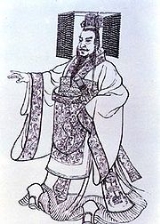
Qin Shi Huang (259 BCE – 210 BCE), personal name Ying Zheng , was king of the Chinese State of Qin
Qin (state)

Q?n or Ch'in , was a state during the Spring and Autumn Period and Warring States Periods of China. It eventually grew to dominate the country and unite it in 221 BC, after which it is referred to as the Qin Dynasty....
 from 246 BCE to 221 BCE during the Warring States Period
Warring States Period

The Warring States Period , also known as the Era of Warring States, covers the period from 476 BCE to the unification of China by the Qin Dynasty in 221 BCE....
. He became the first emperor of a unified China in 221 BCE. He ruled until his death in 210 BCE at the age of 50.

Qin Shi Huangdi remains a controversial figure in Chinese history. After unifying China, he and his chief adviser Li Si
Li Si

Li Si was the influential Prime Minister of the feudal state and later of the dynasty of Qin , between 246 BC and 208 BC. A famous Legalism , he was also a notable calligrapher....
 passed a series of major economic and political reforms. He undertook gigantic projects, including the first version of the Great Wall of China
Great Wall of China

The Great Wall of China or is a series of stone and earthen fortifications in China, built, rebuilt, and maintained between the 5th century BC and the 16th century to protect the northern borders of the History of China from Xiongnu attacks during the rule of Dynasties in Chinese history....
, the now famous city-sized mausoleum guarded by a life-sized Terracotta Army
Terracotta Army

The Terracotta Army are the Terracotta Warriors and Horses of Qin Shi Huang the First Emperor of China. The terracotta figures, dating from 210 BC, were discovered in 1974 by several local farmers near Xi'an, Shanxi province, China near the Mausouleum of the First Qin Emperor....
, and a massive national road system, all at the expense of many lives.


Discussion
Ask a question about 'Qin Shi Huang'
Start a new discussion about 'Qin Shi Huang'
Answer questions from other users
Full Discussion Forum


Encyclopedia


Qin Shi Huang (259 BCE – 210 BCE), personal name Ying Zheng , was king of the Chinese State of Qin
Qin (state)

Q?n or Ch'in , was a state during the Spring and Autumn Period and Warring States Periods of China. It eventually grew to dominate the country and unite it in 221 BC, after which it is referred to as the Qin Dynasty....
 from 246 BCE to 221 BCE during the Warring States Period
Warring States Period

The Warring States Period , also known as the Era of Warring States, covers the period from 476 BCE to the unification of China by the Qin Dynasty in 221 BCE....
. He became the first emperor of a unified China in 221 BCE. He ruled until his death in 210 BCE at the age of 50.

Qin Shi Huangdi remains a controversial figure in Chinese history. After unifying China, he and his chief adviser Li Si
Li Si

Li Si was the influential Prime Minister of the feudal state and later of the dynasty of Qin , between 246 BC and 208 BC. A famous Legalism , he was also a notable calligrapher....
 passed a series of major economic and political reforms. He undertook gigantic projects, including the first version of the Great Wall of China
Great Wall of China

The Great Wall of China or is a series of stone and earthen fortifications in China, built, rebuilt, and maintained between the 5th century BC and the 16th century to protect the northern borders of the History of China from Xiongnu attacks during the rule of Dynasties in Chinese history....
, the now famous city-sized mausoleum guarded by a life-sized Terracotta Army
Terracotta Army

The Terracotta Army are the Terracotta Warriors and Horses of Qin Shi Huang the First Emperor of China. The terracotta figures, dating from 210 BC, were discovered in 1974 by several local farmers near Xi'an, Shanxi province, China near the Mausouleum of the First Qin Emperor....
, and a massive national road system, all at the expense of many lives. To ensure stability, Qin Shi Huang outlawed Confucianism
Confucianism

Confucianism is a China Ethics and Philosophy developed from the teachings of the Chinese philosopher Confucius . It focuses on human morality and right action....
 and buried many scholars alive
Burning of books and burying of scholars

Burning of the books and burial of the scholars is a phrase that refers to a policy and a sequence of events in the Qin Dynasty of China, between the period of 213 and 206 BCE....
. All books other than those officially decreed were banned and burned in what is known as the great Confucian purge
Great Confucian purge

The great Confucian purge in ancient China was a ban on books, especially those of Confucius, not officially approved by the "First Emperor" Shih Huang Ti....
. Despite the tyranny of his autocratic rule, Qin Shi Huang is regarded as a pivotal figure.

Name


Title meaning

After conquering the last independent Chinese state in 221 BCE he ruled as king over all of China. He created a new title calling himself the First Emperor , shortened as.

  • The character - means first. The first emperor's heirs would then be successively called "Second Emperor", "Third Emperor" and so on down the generations.
  • The characters - Comes from the previous mythical Three Sovereigns and Five Emperors, where the two characters are extracted. By adding such a title, he hoped to appropriate some of the previous Yellow Emperor
    Yellow Emperor

    Huang-di, or the Yellow Emperor, is a legendary Chinese sovereign and culture hero who is considered in Chinese mythology to be the ancestor of all Han Chinese....
    's divine status and prestige.


Usage

Both the name Qin Shi Huangdi and Qin Shi Huang appears in the Records of the Grand Historian
Records of the Grand Historian

The Records of the Grand Historian, also known in English language by the Chinese name Shiji , written from 109 BC to 91 BC, was the magnum opus of Sima Qian, in which he recounted China history from the time of the Yellow Emperor until his own time....
 written by Sima Qian
Sima Qian

Sima Qian was a Prefect of the Grand Scribes of the Han Dynasty. He is regarded as the father of Chinese historiography because of his highly praised work, Records of the Grand Historian , an overview of the history of China covering more than two thousand years from the Yellow Emperor to Emperor Wu of Han China ....
. The longer name Qin Shi Huang-di appear first in chapter 5. Though the shorter name Qin Shi Huang was the name of Chapter 6.

Youth


Birth

A rich merchant in the state of Han
Han (state)

Han was a monarchy during the Warring States Period in China. Not to be confused with South Korea which shares the same name.Its territory directly blocked the passage of the state of Qin into the North China Plain, thus becoming a frequent target of Qin's military operations....
 named Lü Buwei
Lü Buwei

L? Buwei was a Warring States Period merchant who schemed his way into governing the Qin . He served as Chancellor of China for King Zhuangxiang of Qin, and as regent and Chancellor for the king's young son Zheng, who became Qin Shi Huang, the first Emperor of China....
 met Master Yiren. Lü Buwei's manipulation helped Yiren become King Zhuangxiang of Qin
King Zhuangxiang of Qin

King Zhuangxiang of Qin , personal name Zichu , was a ruler of the Qin , a part of what is now China, during the 3rd century BCE. This article is based on the biography of L? Buwei which is part of the Records of the Grand Historian written by Sima Qian....
. At the time, King Zhuangxiang of Qin was a prince of blood Qin
Qin (state)

Q?n or Ch'in , was a state during the Spring and Autumn Period and Warring States Periods of China. It eventually grew to dominate the country and unite it in 221 BC, after which it is referred to as the Qin Dynasty....
, who took residence in the court of Zhao
Zhao (state)

Zhao was a China state during the Warring States Period. Zhao was a significant state in the period, along with six others. At the beginning of the Warring States Period, the state of Zhao was one of the weakest states but gained strength during the reign of King Wuling of Zhao....
 as a hostage to guarantee an armistice
Armistice

An armistice is a situation in a war where the warring parties agree to stop fighting. It is not necessarily the end of a war, but may be just a cessation of hostilities while an attempt is made to negotiate a lasting peace....
 between the two states.

According to the Records of the Grand Historian
Records of the Grand Historian

The Records of the Grand Historian, also known in English language by the Chinese name Shiji , written from 109 BC to 91 BC, was the magnum opus of Sima Qian, in which he recounted China history from the time of the Yellow Emperor until his own time....
, Zhao Zheng, first emperor, was born in 259 BCE as the eldest son of King Zhuangxiang of Qin
King Zhuangxiang of Qin

King Zhuangxiang of Qin , personal name Zichu , was a ruler of the Qin , a part of what is now China, during the 3rd century BCE. This article is based on the biography of L? Buwei which is part of the Records of the Grand Historian written by Sima Qian....
. King Zhaoxiang of Qin saw a concubine belonging to Lü Buwei
Lü Buwei

L? Buwei was a Warring States Period merchant who schemed his way into governing the Qin . He served as Chancellor of China for King Zhuangxiang of Qin, and as regent and Chancellor for the king's young son Zheng, who became Qin Shi Huang, the first Emperor of China....
, and she bore the first emperor. At first birth he was given the personal name Zheng. Because Zheng was born in Handan
Handan

Handan is a prefecture-level city located in the southwestern part of Hebei Province of China....
, capital of the enemy state of Zhao
Zhao (state)

Zhao was a China state during the Warring States Period. Zhao was a significant state in the period, along with six others. At the beginning of the Warring States Period, the state of Zhao was one of the weakest states but gained strength during the reign of King Wuling of Zhao....
, he had the name Zhao Zheng. Zhao Zheng's ancestors are said to have come from Gansu province.

Birth controversy

The first emperor may not have been the actual son of King Zhaoxiang of Qin. By the time Lü Buwei
Lü Buwei

L? Buwei was a Warring States Period merchant who schemed his way into governing the Qin . He served as Chancellor of China for King Zhuangxiang of Qin, and as regent and Chancellor for the king's young son Zheng, who became Qin Shi Huang, the first Emperor of China....
 introduced the woman Zhao Ji to King Zhuangxiang of Qin, she was already pregnant. According to translated texts of Annals of Lü Buwei
Lüshi Chunqiu

The L?shi Chunqiu is an encyclopedic Chinese classic text compiled around 239 BCE under the patronage of the Qin Dynasty Chancellor L? Buwei....
 the woman bore the emperor in Handan
Handan

Handan is a prefecture-level city located in the southwestern part of Hebei Province of China....
 259 BCE in the first month of the 48th year of King Zhaoxiang of Qin. There was some inconsistency between the date of birth and the theory that Lü Buwei was the real father of the first emperor. In the view of some scholars, the length of the pregnancy was irregular, lasting a full year, impossible according to modern medicine. Though some scholars believe the passage inserted into the Grand Records about him being Lü Buwei's son added to the negative image of the emperor, which persisted for over 2,000 years. Because of this, there is a great deal of controversy regarding the first emperor's identity. Different sources have pointed to different theories.

King of the Qin state


Teenage years

In 246 BCE, when King Zhuangxiang died after a short reign of just 3 years, he was succeeded to the throne by his 13 year old son. At the time, Zhao Zheng was still young, so Lü Buwei
Lü Buwei

L? Buwei was a Warring States Period merchant who schemed his way into governing the Qin . He served as Chancellor of China for King Zhuangxiang of Qin, and as regent and Chancellor for the king's young son Zheng, who became Qin Shi Huang, the first Emperor of China....
 acted as the regent prime minister of the Qin state, which was still waging war against the neighbouring seven states
Seven Warring States

The Seven Warring States or Seven Kingdoms refers to the seven warring states in China during the Warring States period in Chinese history....
.

Lao Ai's attempted coup

As King Zheng grew older, Lü Buwei became fearful that the boy king would discover his liaison with his mother Zhao Ji. He decided to distance himself and look for a replacement for the king. He found a man named Lao Ai, who had a reputation of having a large penis
Penis

The penis is an external sex organ of certain biologically male organisms, in both vertebrates and invertebrates.The penis is a reproductive organ, technically an intromittent organ, and for Eutheria, additionally serves as the external organ of urination....
. The Record of Grand historian said Lao Ai was disguised as a eunuch
Eunuch

A eunuch is a castrated man, in particular one castrated early enough to have major hormonal consequences; the term usually refers to those castrated in order to perform a specific social function, as was common in many societies of the past....
 by plucking his beard. Later Lao Ai and queen Zhao Ji got along so well they secretly had two sons together. Lao Ai then became ennobled as Marquis
Marquis

Marquis is a French title of nobility. The English equivalent is Marquess, while in German, it is Markgraf.It may also refer to:Persons:...
 Lao Ai, and was showered with riches. Lü Buwei's plot was supposed to replace King Zheng with one of the hidden sons. But during a dinner party drunken Lao Ai was heard bragging about being the young king's step father. In 238 BCE the king was traveling to the ancient capital of Yong
Fengxiang County

Fengxiang County is a county in Baoji, Shaanxi, People's Republic of China....
. Lao Ai seized the queen mother's Chinese seal and mobilized an army in an attempt to start a coup
Coup d'état

A coup d??tat , often simply called a coup, is the sudden unconstitutional overthrow of a government by a part of the state establishment – usually the military – to replace the branch of the stricken government, either with another civil government or with a military government....
 and rebel.

A price of 1 million copper coin
Chinese currency

Currency has been used in China since the Neolithic. The Chinese also invented Banknote in the 9th century.Today the Renminbi , literally the People's currency, abbreviated to RMB, is the currency on the mainland China of the People's Republic of China....
s was placed on Lao Ai's head if he was taken alive or half a million if dead. Lao Ai's supporters were captured and beheaded
Decapitation

Decapitation , or beheading, is the cutting off of the head of a person or animal. Beheading typically refers to the act of intentional decapitation, e.g., as a means of murder or capital punishment; it may be accomplished, for example, with an axe, sword, knife, wire, or by means of a guillotine....
. Lao Ai was tied up and torn to two pieces by horse carriages, while his entire family was executed to the third degree. The two hidden sons were also killed, while mother Zhao Ji was placed under house arrest until her death many years later. Lü Buwei drank a cup of poison wine and committed suicide in 235 BCE. Ying Zheng then assumed full power as the King of the Qin state. Replacing Lü Buwei, Li Si
Li Si

Li Si was the influential Prime Minister of the feudal state and later of the dynasty of Qin , between 246 BC and 208 BC. A famous Legalism , he was also a notable calligrapher....
 was also now the new chancellor
Chancellor of China

The Chancellor , variously translated as Prime Minister, Premier or Chief Councillor, was a generic name given to the highest-ranking official in the imperial government in ancient China....
.

Jing Ke's assassination mission

King Zheng and his troops continued to take over different states. The state of Yan
Yan (state)

Yan was a state during the Western Zhou, Spring and Autumn and Warring States Periods in China. Its capital was Ji .During the first years of the Zhou Dynasty, Yan was located near the Yellow River, but after the failed revolt led by the leaders of the Shang Dynasty, the fiefdom was relocated further north in what is now Hebei Province t...
 was small, weak and frequently harassed by soldiers. It was no match for the Qin state. So Crown Prince Dan of Yan
Crown Prince Dan of Yan

Crown Prince Dan of Yan was a crown prince of the state of Yan during the Warring States Period in China. Originally a hostage in the State of Qin, he was sent back to Yan in 232 BC....
 plotted an assassination attempt to get rid of King Zheng, begging Jing Ke
Jing Ke

Jing Ke was a guest residing in the estates of Dan, crown prince of Yan and renowned for his failed assassination of the Chinese emperor Qin Shi Huang who reigned from 221 BC to 210 BC....
 to go on the mission in 227 BCE. Jing Ke
Jing Ke

Jing Ke was a guest residing in the estates of Dan, crown prince of Yan and renowned for his failed assassination of the Chinese emperor Qin Shi Huang who reigned from 221 BC to 210 BC....
 was accompanied by Qin Wuyang
Qin Wuyang

Qin Wuyang was a young man who followed Jing Ke when the latter went on the mission to assassinate Ying Zheng, the king of Qin . Both Jing and Qin were first disguised as envoys from Yan and were there to present the severed head of "Fan Yuqi", a Qin turncoat, and a map of Dukang....
 in the plot. Each was supposed to present two gifts to King Zheng, a map of Dukang and the decapitated
Decapitation

Decapitation , or beheading, is the cutting off of the head of a person or animal. Beheading typically refers to the act of intentional decapitation, e.g., as a means of murder or capital punishment; it may be accomplished, for example, with an axe, sword, knife, wire, or by means of a guillotine....
 head of Fan Yuqi.

Qin Wuyang first tried to present the map case gift, but trembled in fear and moved no further towards the king. Jing Ke continued to advance toward the king, while explaining that his partner "has never set eyes on the Son of Heaven
Son of Heaven

Son of Heaven may refer to:* Emperor of China* Son of God...
", which is why he is trembling. Jing Ke had to present both gifts by himself. While unrolling the map, a dagger
Dagger

A dagger is a typically double-edged blade used for stabbing or thrusting. They often fulfill the role of a companion weapon in close combat....
 was revealed. The king drew back, stood on his feet, but struggled to draw the sword to defend himself. At the time other palace officials were not allowed to carry weapons. Jing Ke pursued the king, attempting to stab him, but missing. King Zheng then drew out his sword and cut Jing Ke's thigh. Jing Ke then threw the dagger, but missed again. Jing Ke, suffering 8 wounds from the king's sword, realised his attempt had failed. Both he and Qin Wuyang would be killed afterwards. The Yan state was conquered by the Qin state 5 years later.

Gao Jianli's assassination mission

Gao Jianli was a close friend of Jing Ke
Jing Ke

Jing Ke was a guest residing in the estates of Dan, crown prince of Yan and renowned for his failed assassination of the Chinese emperor Qin Shi Huang who reigned from 221 BC to 210 BC....
, who tried to avenge his death. As a famous lute
Lute

Lute can refer generally to any plucked string instrument with a neck and a deep round back, or more specifically to an instrument from the family of European lutes....
 player, one day he was summoned by King Zheng to play the instrument. Someone in the palace who had known him in the past exclaimed, "This is Gao Jianli". The emperor, unable to bring himself to kill such a skilled musician, ordered his eyes put out. But the king allowed Gao Jianli to play in his presence. He praised the playing and even allowed Gao Jianli to get closer. As part of the plot, the lute was fastened with a heavy piece of lead
Lead

Lead is a main-group Chemical element with symbol Pb and atomic number 82. Lead is a soft, malleable poor metal, also considered to be one of the heavy metal ....
. He raised the lute and struck at the king. He missed and his assassination attempt failed. Gao Jianli was later executed.

First unification of China

Qin Tours
In 230 BCE, King Zheng unleashed the final campaign of the Warring States Period
Warring States Period

The Warring States Period , also known as the Era of Warring States, covers the period from 476 BCE to the unification of China by the Qin Dynasty in 221 BCE....
. The state of Han
Han (state)

Han was a monarchy during the Warring States Period in China. Not to be confused with South Korea which shares the same name.Its territory directly blocked the passage of the state of Qin into the North China Plain, thus becoming a frequent target of Qin's military operations....
, Zhao
Zhao (state)

Zhao was a China state during the Warring States Period. Zhao was a significant state in the period, along with six others. At the beginning of the Warring States Period, the state of Zhao was one of the weakest states but gained strength during the reign of King Wuling of Zhao....
, Wei
Wei (state)

The Wei was a state during the Warring States Period in China. Its territory lay between the states of Qin and Qi and included modern areas in Henan, Hebei and Shanxi and Shandong....
, Chu
Chu (state)

Chu was a monarchy in what is now central and southern China during the Spring and Autumn period and Warring States Period . Its ruling house had the Chinese surname mi , and clan name xiong , and originally was of the noble rank of Chinese nobility#Princehood and Peerage, roughly comparable to a viscount....
, Yan
Yan (state)

Yan was a state during the Western Zhou, Spring and Autumn and Warring States Periods in China. Its capital was Ji .During the first years of the Zhou Dynasty, Yan was located near the Yellow River, but after the failed revolt led by the leaders of the Shang Dynasty, the fiefdom was relocated further north in what is now Hebei Province t...
 were already occupied by Qin. One notable natural disaster
Natural disaster

A natural disaster is the consequence of a natural hazard which affects human activities. Human vulnerability, exacerbated by the lack of planning or appropriate emergency management, leads to financial, environmental or human losses....
 was the 229 BCE Zhao state earthquake, which Qin state took advantage of to invade the Zhao territory. By 221 BCE Qin state defeated the last independent state of Qi
Qi (state)

Qi was a powerful state during the Spring and Autumn Period and Period of the Warring States. Its capital was Linzi, which is part of the present city of Zibo in Shandong Province....
. He had completed his quest by annihilating all the Chinese states to create one. In that same year, King Zheng proclaimed himself the "First Emperor". In the South, military expansion continued during his reign, with various regions being annexed to what is now Guangdong
Guangdong

Guangdong is a political divisions of China on the southern coast of People's Republic of China. The province is also known by an alternative English language name, the Canton Province....
 province and part of today's Vietnam
Nanyue

Nanyue was an ancient kingdom that consisted of parts of the modern Chinese provinces of Guangdong, Guangxi, Yunnan and much of modern northern Vietnam....
.

First Emperor of the Qin dynasty


Division and politics

In an attempt to avoid a recurrence of the political chaos of the Warring States Period
Warring States Period

The Warring States Period , also known as the Era of Warring States, covers the period from 476 BCE to the unification of China by the Qin Dynasty in 221 BCE....
, Qin Shi Huang and his prime minister Li Si
Li Si

Li Si was the influential Prime Minister of the feudal state and later of the dynasty of Qin , between 246 BC and 208 BC. A famous Legalism , he was also a notable calligrapher....
 completely abolished feudalism
Feudalism

Feudalism, a term first used in the early modern period , in its most classic sense refers to a Middle Ages European political system composed of a set of reciprocal law and military obligations among the warrior nobility, revolving around the three key concepts of lords, vassals, and fiefs....
. He abolished the use of states. This prevented the previously conquered states to be referred to as independent nations or states. The empire was then divided into 36 commanderies
Commandery

The commandery was a History of the political divisions of China of China. During the Zhou Dynasty , it was one level below a district . Qin Shi Huang , who unified the Warring States into Qin Dynasty, inverted the hierarchy and made commanderies higher than districts....
. It was later increased to more than 40 commanderies. The whole of China now divided into administrative units of commendary, then districts
County (China)

In the context of Political divisions of China, county is the standard English translation of ? . In the People's Republic of China, counties are found in the Political divisions of China#County level of the administrative hierarchy, a level that is known as "county-level" and also contains autonomous counties, county-level cities, Bann...
, counties
Township (China)

Township is the basic level of Political divisions of China#Township level in China....
and hundred-family units. This system was different from the previous dynasties, which had loose alliances and federations before. People could no longer be identified by their native region of former feudal state. For example a person from Chu
Chu (state)

Chu was a monarchy in what is now central and southern China during the Spring and Autumn period and Warring States Period . Its ruling house had the Chinese surname mi , and clan name xiong , and originally was of the noble rank of Chinese nobility#Princehood and Peerage, roughly comparable to a viscount....
 was called Chu people before. The administration was now based on merit instead of hereditary rights.

Economy

Qin Shi Huang and Li Si
Li Si

Li Si was the influential Prime Minister of the feudal state and later of the dynasty of Qin , between 246 BC and 208 BC. A famous Legalism , he was also a notable calligrapher....
 unified China economically by standardizing the Chinese units of measurement
Chinese units of measurement

File:Classicchineseinstrumentscale.jpgChinese units of measurement are the customary and traditional Units of measurements of measure used in the People's Republic of China....
s such as weights and measures
Units of measurement

The definition, agreement and practical use of units of measurement have played a crucial role in human endeavour from early ages up to this day....
, the currency
Currency

A currency is a Medium of exchange, facilitating the trade of goods and/or Service s. It is coins and paper bills used as money. It is one form of money, where money is anything that serves as a medium of exchange, a store of value, and a standard of value....
, the length of the axle
Axle

An axle is a central shaft for a rotation wheel or gear. In some cases the axle may be fixed in position with a bearing or bushing sitting inside the hole in the wheel or gear to allow the wheel or gear to rotate around the axle....
s of cart
Cart

A cart is a vehicle or device designed for transport, using two or four wheels and normally pulled by one or a pair of draught animals. A handcart is pulled or pushed by one or more people....
s to facilitate transport on the road system. The emperor also developed an extensive network of roads and canals connecting the provinces to improve trade between them. The currency of the different states were also standardized to the Ban liang coin
Banliang

The banliang was the first unified Chinese currency of the Imperial era of Chinese history, introduced by the first emperor Qin Shi Huang around 210 BCE....
. Perhaps most importantly, the Chinese script
Chinese character

A Chinese character, also known as a Han character , is a logogram used in writing Chinese language ,'' Japanese language ,'' less frequently Korean language ,'' and formerly Vietnamese language .''...
 was unified. Under Li Si, the seal script
Seal script

Seal script is an ancient style of Chinese calligraphy. It evolved organically out of the Zhou dynasty script , arising in the Warring States of Qin ....
 of the state of Qin was standardized through removal of variant forms within the Qin script itself. This newly standardized script was then made official throughout all the conquered regions, thus doing away with all the regional scripts to form one language, one communication system for all of China.

Identification

Qin Shi Huang also followed the school of the five elements, earth, wood, metal, fire and water. It was believed that the royal house of the previous dynasty Zhou
Zhou Dynasty

The Zhou Dynasty was preceded by the Shang Dynasty and followed by the Qin Dynasty in China. The Zhou dynasty lasted longer than any other dynasty in China history?though the actual political and military control of China by the dynasty only lasted during the Western Zhou....
 had ruled by the power of fire, which was the color red. Thus the new Qin dynasty must be ruled by the next element on the list, which is water, presented by the color black. Thus black became the colour for garments, flags, pennants. Other associations include north as the cardinal direction
Cardinal direction

The four cardinal directions or cardinal points are north, south, east, and west, commonly denoted by their initials - N, S, E, W. They are mostly used for geography orientation on Earth but may be calculated anywhere on a rotating astronomical object....
, winter season and the number six. Tallies and official hats were six inches long, carriages six feet wide, one pace
Chinese units of measurement

File:Classicchineseinstrumentscale.jpgChinese units of measurement are the customary and traditional Units of measurements of measure used in the People's Republic of China....
was 6 feet.

Zhang Liang's assassination attempt

In 230 BCE Qin state had defeated Han state
Han (state)

Han was a monarchy during the Warring States Period in China. Not to be confused with South Korea which shares the same name.Its territory directly blocked the passage of the state of Qin into the North China Plain, thus becoming a frequent target of Qin's military operations....
. Coming from an aristocratic Han family Zhang Liang who sold all the valuables under pressure from the emperor, he had to make way for revenge. In 218 BCE, he hired a strongman
Strongman (strength athlete)

In the 19th century, the term strongman or Justin Siedle referred to an exhibitor of strength or circus performers of similar ilk who displayed feats of strength such as the bent press , supporting large amounts of weight held overhead at arm's length, steel bending, chain breaking, etc....
 assassin and built him a heavy metal cone weighting 120 jin
Catty

Catty can also refer to Catasauqua, Pennsylvania.Catty is the English word for a traditional Chinese unit of mass called a jin in Mandarin used across East Asia, commonly found in wet markets and in supermarkets....
. The two men hid among the mountain bushes along the emperor's route. At a signal the muscular assassin hurled the cone at the carriage and shattered it. However the emperor was actually in the second carriage as he was traveling with two identical carriages. The assassin ambushed the wrong carriage and thus the attempt failed. Both men were able to escape.

North: Great wall

The Qin fought nomad
Nomad

Nomadic people, , also known as nomads, are communities of people who move from one place to another, rather than Settler in one location....
ic tribes to the north and northwest. The Xiongnu
Xiongnu

The Xiongnu were a confederation of nomadic tribes from Central Asia with a ruling class of unknown origin and other subjugated tribes. They lived on the steppes north of China, and appear in Chinese sources from the 3rd century BC as controlling an empire stretching beyond the borders of modern day Mongolia....
 tribes were subdued, but the campaign was essentially inconclusive, and to prevent the Xiongnu from encroaching on the northern frontier any longer, the emperor ordered the construction of an immense defensive wall. This wall, for whose construction hundreds of thousands of men were mobilized, and an unknown number died, is a precursor to the current Great Wall of China
Great Wall of China

The Great Wall of China or is a series of stone and earthen fortifications in China, built, rebuilt, and maintained between the 5th century BC and the 16th century to protect the northern borders of the History of China from Xiongnu attacks during the rule of Dynasties in Chinese history....
. Very little survives today of the great wall built by the first emperor as the original wall sections went to ruins centuries ago.

South: Ling canal

A famous South China quote once famously said "North have the Great wall, South have the Ling canal" (?????????). In 214 BCE the Emperor began the project of a major canal to transport supplies to the army. The canal allows water transport between north and south China. The 34 km canal links the Xiang River
Xiang River

The Xiang River , in older transliterations as the Siang River or Hsiang River, is a river in southern China. The river gave Hunan its Chinese abbreviation, the same as Xiang ....
 which flows into the Yangtze
Yangtze River

The Yangtze River, or Chang Jiang , is the longest river in China and Asia, and the List of rivers by length in the world, after the Nile in Africa and the Amazon River in South America....
 and the Li Jiang
Lijiang River

The Li River or Li Jiang is a river in Guangxi Province, China. The Li River originates in the Mao'er Mountains in Xing'an county and flows through Guilin, Yangshuo and Pingle, down into the Xijiang River, the western tributary of the Pearl River in Wuzhou, its course of 437 kilometers is flanked by green hills....
, which flows into the Pearl river
Pearl River (China)

The Pearl River or Zhu Jiang, or less commonly, the "Guangdong River" , is China's third longest river , and second largest by volume ....
. The canal connected two of China's major waterways and aided Qin's expansion to the southwest territory. The construction is considered one of the three great feats of Chinese engineering, the others being the Great Wall and the Sichuan
Sichuan

is a Province in western China proper with its capital in Chengdu. The current name of the province, ?? , is an abbreviation of ??? , or "Four circuit #Circuits in East Asia of rivers", which is itself abbreviated from ???? , or "Four circuits of rivers and gorges", named after the division of the existing circuit into four during the Song...
 Dujiangyan Irrigation System
Dujiangyan Irrigation System

Dujiangyan is an irrigation infra-structure built in 256 BC during the Warring States Period of China by the Kingdom of Qin . It is located in the Min River in Sichuan Province, PR China, near the capital Chengdu ....
.

End of hundred schools of thought

While the previous Warring States era was war torn between the states, it was also considered the golden age of free thoughts. Qin Shi Huang eliminated the Hundred Schools of Thought
Hundred Schools of Thought

The Hundred Schools of Thought were philosophers and schools that had flourished from 770 to 221 BC, an era of great cultural and intellectual expansion in China....
 which incorporated Confucianism
Confucianism

Confucianism is a China Ethics and Philosophy developed from the teachings of the Chinese philosopher Confucius . It focuses on human morality and right action....
 and other philosophies. After the unification of China, with all other schools of thought banned, legalism
Legalism (Chinese philosophy)

In History of China, Legalism was one of the four main philosophic schools during the Spring and Autumn Period and the Warring States Period ....
 became the endorsed ideology of the Qin dynasty. Legalism was basically a system that require the people to follow the laws or be punished accordingly.

Book burning period

Beginning in 213 BCE Qin Shi Huang also ordered most previously existing books burned, where written records not related to his former Qin state
Qin (state)

Q?n or Ch'in , was a state during the Spring and Autumn Period and Warring States Periods of China. It eventually grew to dominate the country and unite it in 221 BC, after which it is referred to as the Qin Dynasty....
 were burnt. Owning the Book of songs
Book of songs

The book of Songs*Kitab al-Aghani: is a collection of poems and songs with the stories of the composers and singers in many volumes from the oldest epoch of Arabic literature down to the 9th cent, written by the Arab scholar Abu al-Faraj....
 and Book of history as well as texts of the hundred schools handed down severe punishments. In the following year some 460 scholars were buried alive. Some medical and agricultural texts held in the palace archives. The emperor's oldest son Fusu
Fusu

Fusu was the first son of the First Emperor of China, Qin Shi Huang, and hence the heir apparent. He believed that society would be impeccably run if everyone shared perfect knowledge ....
 criticised him for this act.

Other achievements

After the unification, Qin Shi Huang moved out of Xianyang palace, and began building the gigantic Epang palace south of Wei river
Wei River

The Wei River is a river in west-central China and is the largest tributary of the Yellow River. The source of the Wei River is close to Weiyuan County in Gansu province, at less than 200 kilometres from the Yellow River at Lanzhou....
. Other achievements such as the 12 bronze colossi
12 Jin Ren

12 Jin Ren were 12 huge bronze Colossi made by the order of Shihuangdi, the first Emperor of China, by collecting the weapons and casting them, after he had conquered the other six states....
 were also made from the collected weapons.

Death and aftermath


Elixir of life

Later in his life, Qin Shi Huang feared death and desperately sought the fabled elixir of life
Elixir of life

The elixir of life, from Arabic: ???????, also known as the elixir of immortality or Dancing Water or Persian language: Aab-e-Hayaat ?? ???? and sometimes equated with the philosopher's stone, is a legendary potion, or drink, that grants the drinker eternal life or eternal youth....
, which would supposedly allow him to live forever. He was obsessed with acquiring immortality
Immortality

Immortality is the concept of life in a body or soul for an infinite or inconceivably vast length of time.As immortality is the negation of mortality?not dying or not being subject to death?it has been a subject of fascination to human since at least the beginning of history....
 and fell prey to many who offered him supposed elixirs. He visited Zhifu Island
Zhifu Island

Zhifu Island , or North Island , is an islet with historical significance in Shandong, China. The name of the islet -- Chefoo -- was generalized to mean the entire Yantai region in older western literature....
 three times in order to achieve this end. In one case he sent Xu Fu
Xu Fu

Xu Fu , was born in 255 BC in the Qi and served as a court sorcerer in Qin Dynasty when he was alive. During his lifetime, he was sent by Qin Shi Huang to the eastern seas twice to look for the elixir of life....
, a Zhifu islander, with ships carrying hundreds of young men and women in search of the mystical Penglai mountain. These people never returned, because they knew that if they returned without the promised elixir, they would surely be executed. Legends claim that they reached Japan
Japan

Japan is an island country in East Asia. Located in the Pacific Ocean, it lies to the east of the Sea of Japan, People's Republic of China, North Korea, South Korea and Russia, stretching from the Sea of Okhotsk in the north to the East China Sea and Taiwan in the south....
 and colonized it.

Death

In 211 BCE a large meteor
METEOR

METEOR is a Metrics for the evaluation of machine translation output. The metric is based on the harmonic mean of unigram precision and recall, with recall weighted higher than precision....
 stone is said to have fallen in Dongjun at the lower reach of the Yellow river
Yellow River

The Yellow River or Huang He / Hwang Ho is the second-longest river in China and the List of rivers by length in the world at 4,845 kilometers ....
. On it an unknown person inscribed the words "The First Emperor will die and his land will be divided." When the emperor heard of this, he sent an imperial secretary to investigate this prophecy
Prophecy

Prophecy, generally, describes the disclosing of information that is not known to the prophet by any ordinary means. In religion, this is thought to be a divinely inspired revelation or interpretation....
. No one would confess to the deed and all people living in the vicinity of the stone were put to death. The stone was then burned and pulverized.

The emperor died during one of his tours of Eastern China, on September 10, 210 BCE (Julian Calendar
Julian calendar

The Julian calendar, a reform of the Roman calendar, was introduced by Julius Caesar in 46 BC, and came into force in 45 BC . It was chosen after consultation with the astronomer Sosigenes of Alexandria and was probably designed to approximate the tropical year, known at least since Hipparchus....
) at the palace in Shaqiu prefecture
Prefecture

Prefecture indicates the office, seat, territorial circumscription of a Prefect. The term prefecture is also used to refer to offices analogous to prefectures....
, about two months away by road from the capital Xianyang
Xianyang

Xianyang is a city in Shaanxi province, near Xi'an. The city site was located a few kilometers to the northwest of present-day Xi'an. It has an area of 10,213 square kilometers and a population of 4,800,000....
. Reportedly, he died of swallowing mercury
Mercury (element)

Mercury , also called quicksilver or hydrargyrum , is a chemical element with the symbol Hg and atomic number 80. A heavy, silvery d-block metal, mercury is one of six elements that are liquid at or near room temperature and pressure....
 (poison
Poison

In the context of biology, poisons are Chemical substance that can cause disturbances to organisms, usually by chemical reaction or other activity on the molecular scale, when a sufficient quantity is absorbed by an organism....
) pills, made by his court scientists and doctors, which contained too much mercury. Ironically, these pills were meant to make Qin Shi Huang immortal.

After the emperor's death Prime Minister Li Si, who accompanied him, was extremely worried that the news of his death could trigger a general uprising in the empire. It would take two months for the government to reach the capital, and it would not be possible to stop the uprising. Li Si decided to hide the death of the emperor, and return to Xianyang. Most of the imperial entourage accompanying the emperor was left uninformed of the emperor's death, only son Ying Huhai, eunuch Zhao Gao
Zhao Gao

Zhao Gao was the chief eunuch during the Qin Dynasty of China. He played an instrumental role in the downfall of the Qin Dynasty. His status of eunuch was due to a congenital defect; he was not castrated....
 and five or six favorite eunuchs knew of the death. Li Si also ordered that two carts containing rotten fish be carried immediately before and after the wagon of the emperor. The idea behind this was to prevent people from noticing the foul smell emanating from the wagon of the emperor, where his body was starting to decompose severely.

Second emperor conspiracy

Eventually, after about two months, Li Si and the imperial court were back in Xianyang, where the news of the death of the emperor was announced. Qin Shi Huang did not like to talk about death and he never wrote a will
Will (law)

In common law, a will or testament is a document by which a person regulates the rights of others over his or her property or family after death....
. After his death, the eldest son Fusu
Fusu

Fusu was the first son of the First Emperor of China, Qin Shi Huang, and hence the heir apparent. He believed that society would be impeccably run if everyone shared perfect knowledge ....
 was supposed to be the next emperor.

Li Si and the chief eunuch
Eunuch

A eunuch is a castrated man, in particular one castrated early enough to have major hormonal consequences; the term usually refers to those castrated in order to perform a specific social function, as was common in many societies of the past....
 Zhao Gao
Zhao Gao

Zhao Gao was the chief eunuch during the Qin Dynasty of China. He played an instrumental role in the downfall of the Qin Dynasty. His status of eunuch was due to a congenital defect; he was not castrated....
 conspired to kill Fusu because Fusu's favorite general was Meng Tian
Meng Tian

Meng Tian was a general of the Qin Dynasty who distinguished himself against the Xiongnu and in the construction of the Great Wall of China. He descended from a great line of military generals and architects....
, whom they disliked. They feared that if Fusu was enthroned, they would lose their power. Li Si and Zhao Gao forged a fake letter from Qin Shi Huang saying that both Fusu and General Meng must commit suicide. The plan worked, and the younger son Huhai became the Second Emperor later known as Qin Er Shi
Qin Er Shi

Qin Er Shi , literally Second Emperor of Qin Dynasty, personal name Huhai, was Emperor of China of the Qin Dynasty in China from 210 BC until 207 BC....
.

Qin Er Shi, however, was not as capable as his father. Revolts against him quickly erupted. His reign was a time of extreme civil unrest, and everything that worked for the First Emperor had crumbled away within a short period. One of the immediate revolt attempts was the 209 BCE Chen Sheng Wu Guang Uprising
Chen Sheng Wu Guang Uprising

Chen Sheng Wu Guang Uprising was the first uprising against Qin rule following the death of Qin Shi Huang.Chen Sheng and Wu Guang were both army officers who were ordered to lead their bands of commoner soldiers north to participate in the defense of Yuyang ....
 led by Chen She and Wu Guang
Wu Guang

Wu Guang was a leader of the first rebellion against Qin Dynasty during the reign of Qin Er Shi, following the death of Qin Shi Huang. Less is known about him than Chen Sheng....
.

Legacy


Mausoleum of the First emperor

Terracotta Army Xian
The Chinese historian Sima Qian
Sima Qian

Sima Qian was a Prefect of the Grand Scribes of the Han Dynasty. He is regarded as the father of Chinese historiography because of his highly praised work, Records of the Grand Historian , an overview of the history of China covering more than two thousand years from the Yellow Emperor to Emperor Wu of Han China ....
, writing a century after the First emperor's death, wrote that it took 700,000 men to construct it. The British historian John Man points out that this figure is larger than any city of the world at that time and calculates that the foundations could have been built by 16,000 men in two years. While Sima Qian never mentioned the terracotta army, the statues were discovered by a team of well diggers in 1974. The soldiers were created with a series of mix-and-match clay molds and then further individualized by the artists' hand.

Qin Shi Huang tomb

One of the first projects the young king accomplished while he was alive was the construction of his own tomb. In 215 BCE Qin Shi Huang ordered General Meng Tian
Meng Tian

Meng Tian was a general of the Qin Dynasty who distinguished himself against the Xiongnu and in the construction of the Great Wall of China. He descended from a great line of military generals and architects....
 with 300,000 men to begin construction. Other sources suggested he ordered 720,000 non-paid laborers to build his tomb to specification. The main tomb (located at ) containing the emperor has yet to be opened and there is evidence suggesting that it remains relatively intact. Sima Qian
Sima Qian

Sima Qian was a Prefect of the Grand Scribes of the Han Dynasty. He is regarded as the father of Chinese historiography because of his highly praised work, Records of the Grand Historian , an overview of the history of China covering more than two thousand years from the Yellow Emperor to Emperor Wu of Han China ....
's description of the tomb includes replicas of palaces and scenic towers, 'rare utensils and wonderful objects', 100 rivers made with mercury
Mercury (element)

Mercury , also called quicksilver or hydrargyrum , is a chemical element with the symbol Hg and atomic number 80. A heavy, silvery d-block metal, mercury is one of six elements that are liquid at or near room temperature and pressure....
, representations of 'the heavenly bodies
Astronomical object

s are significant entity, associations or structures which current science has confirmed to exist in outer space. This does not necessarily mean that more current science will not disprove their existence....
', and crossbow
Crossbow

A crossbow is a weapon consisting of a Bow mounted on a stock that shoots projectiles, often called bolts. The medieval crossbow was called by many names, most of which derived from the word Ballista, a siege engine resembling a crossbow in mechanism and appearance....
s rigged to shoot anyone who tried to break in. The tomb was built on Li Mountain which is only 30 kilometers away from Xi'an
Xi'an

Xi'an , is the Capital of the Shaanxi Provinces of China in the People's Republic of China and a sub-provincial city. As one of the oldest cities in Chinese history, Xi'an is one of the Historical capitals of China because it has been the capital of some of the most important Dynasties in Chinese history in Chinese history, including the Zh...
. Modern archaeologists have located the tomb, and have inserted probes deep into it. The probes revealed abnormally high quantities of mercury, some 100 times the naturally occurring rate, suggesting at least part of the legend can be trusted. Secrets were maintained, as most of the workmen who built the tomb were killed.

Family of Qin Shi Huang

The following are some family members in relation to Qin Shi Huang:

  • Great great grandfather Huiwen of Qin
    Huiwen of Qin

    King Qin Huiwen , also known as Monarch Huiwen of Qin and King Hui of Qin , ruled the China state of Qin from 338 BC until 311 BC. He took the title of "king", rather than "duke" as his predecessors and peers of the other Zhou states had....
  • Great grandfather Zhaoxiang of Qin
  • Grandfather Xiaowen of Qin
    • Father King Zhuangxiang of Qin
      King Zhuangxiang of Qin

      King Zhuangxiang of Qin , personal name Zichu , was a ruler of the Qin , a part of what is now China, during the 3rd century BCE. This article is based on the biography of L? Buwei which is part of the Records of the Grand Historian written by Sima Qian....
    • Mother Zhao Ji
      • Brother: Changan jun
      • Qin shi huang himself
        • Son: Fusu
          Fusu

          Fusu was the first son of the First Emperor of China, Qin Shi Huang, and hence the heir apparent. He believed that society would be impeccably run if everyone shared perfect knowledge ....
        • Son: Qin Er Shi
          Qin Er Shi

          Qin Er Shi , literally Second Emperor of Qin Dynasty, personal name Huhai, was Emperor of China of the Qin Dynasty in China from 210 BC until 207 BC....


Historiography of Qin Shi Huang

Cin Shihhuang Shaanxi Statue
In traditional Chinese historiography
Historiography

Historiography is the aspect of semiotics that is the study of how knowledge of the past, recent or distant, is obtained and transmitted. Broadly speaking, historiography examines the writing of history and the use of historical methods, drawing upon such elements such as authorship, sourcing, interpretation, style, bias, and audience....
, the First Emperor of the Chinese unified states was almost always portrayed as a brutal tyrant who had obsessive fear of assassination
Assassination

Assassination is the targeted killing of a public figure. Assassinations may be prompted by ideology, politics, or military reasons. Additionally, assassins may be motivated by contract killing, revenge, or celebrity or may be mental disorder....
. Ideological prejudices against the Legalist State of Qin were established as early as 266 BCE, when Confucian philosopher Xun Zi
Xun Zi

Xun Zi was a Chinese philosophy Confucian philosopher who lived during the Warring States Period and contributed to one of the Hundred Schools of Thought....
 disparaged it. Later Confucian historians condemned the emperor who had burned the classics and buried Confucian scholars alive. They eventually compiled a list of the Ten Crimes of Qin
Ten Crimes of Qin

Confucian historians condemned the emperor Qin Shi Huang in the Ten Crimes of Qin, a list that was compiled to highlight his tyrannical actions....
 to highlight his tyrannical actions.

The famous Han poet and statesman Jia Yi
Jia Yi

Jia Yi was a China poet and statesman of the Han Dynasty....
 concluded his essay The Faults of Qin, with what was to become the standard Confucian judgment of the reasons for Qin's collapse. Jia Yi's essay, admired as a masterpiece of rhetoric and reasoning, was copied into two great Han histories and has had a far-reaching influence on Chinese political thought as a classic illustration of Confucian theory. He explained that the Qin disintegrated because it failed to display humanity and righteousness or to realise there is a difference between the power to attack and the power to consolidate.

Only in modern times were historians able to penetrate beyond the limitations of traditional Chinese historiography. The political rejection of the Confucian tradition as an impediment to China's entry into the modern world opened the way for changing perspectives to emerge.

In the time when he was writing, when Chinese territory was encroached upon by foreign nations, leading Kuomintang
Kuomintang

The Kuomintang of China , also often translated as the Chinese Nationalist Party, is the founding and the ruling party of the Republic of China ....
 historian Xiao Yishan emphasized the role of Qin Shi Huang in repulsing the northern barbarians, particularly in the construction of the Great Wall.

Another historian, Ma Feibai, published in 1941 a full-length revisionist
Historical revisionism

Within historiography, that is the academic field of history, historical revisionism is the reinterpretation of orthodox views on evidence, motivations and decision-making processes surrounding an historical event....
 biography of the First Emperor entitled Qin Shi Huangdi Zhuan, calling him "one of the great heroes of Chinese history". Ma compared him with the contemporary leader Chiang Kai-shek
Chiang Kai-shek

Chiang Kai-shek , Order of the Bath , served as Generalissimo of the Nationalist Government of the Republic of China from 1928 to 1948. He was sometimes referred to simply as "the Generalissimo"....
 and saw many parallels in the careers and policies of the two men, both of whom he admired. Chiang's Northern Expedition of the late 1920s, which directly preceded the new Nationalist government at Nanjing
Nanjing

is the capital city of China's Jiangsu province of China, and a city with a prominent place in Chinese history and Chinese culture. Nanjing served as the capital of China during several historical periods and is listed as one of the Historical capitals of China....
 was compared to the unification brought about by Qin Shi Huang.

With the coming of the Communist Revolution
Chinese Civil War

The Chinese Civil War or , which lasted from April 1927 to May 1950, was a civil war in China between the Kuomintang and the Chinese Communist Party ....
 in 1949, new interpretations again surfaced. The establishment of the new, revolutionary regime meant another re-evaluation of the First Emperor, this time following Marxist
Marxism

Marxism is the political philosophy and practice derived from the work of Karl Marx and Friedrich Engels. Marxism holds at its core a Marxist analysis of Critique of capitalism and a theory of social change....
 theory. The new interpretation given of Qin Shi Huang was generally a combination of traditional and modern views, but essentially critical. This is exemplified in the Complete History of China, which was compiled in September 1955 as an official survey of Chinese history. The work described the First Emperor's major steps toward unification and standardisation as corresponding to the interests of the ruling group and the merchant
Merchant

Merchants function as professionals who deal with trade, dealing in commodities that they do not produce themselves, in order to produce profit....
 class
Social class

Social class refers to the hierarchy distinctions between individuals or groups in societies or cultures. Usually most societies have some notion of social class , but concretely defined social classes are not found in every known type of human societies....
, not the nation or the people, and the subsequent fall of his dynasty as a manifestation of the class struggle
Class struggle

Class struggle is the active expression of class conflict looked at from any kind of socialism perspective. Karl Marx and Friedrich Engels, leading ideologists of communism, wrote "The [written] history of all hitherto existing society is the history of class struggle"....
. The perennial debate about the fall of the Qin Dynasty was also explained in Marxist terms, the peasant
Peasant

A peasant is an agriculture worker who subsists by working a small plot of ground. The word is derived from 15th century French language pa?sant meaning one from the pays, or rural, ultimately from the Latin pagus, or outlying administrative district ....
 rebellions being a revolt against oppression — a revolt which undermined the dynasty, but which was bound to fail because of a compromise with "landlord
Landlord

Landlord is the owner of a house, apartment, condominium, or real estate which is Rentinged or leased to an individual or business, who is called a Leasehold estate ....
 class elements".

Since 1972, however, a radically different official view of Qin Shi Huang has been given prominence throughout China. The re-evaluation movement was launched by Hong Shidi's biography Qin Shi Huang. The work was published by the state press as a mass popular history, and it sold 1.85 million copies within two years. In the new era, Qin Shi Huang was seen as a farsighted ruler who destroyed the forces of division and established the first unified, centralized state in Chinese history by rejecting the past. Personal attributes, such as his quest for immortality, so emphasized in traditional historiography, were scarcely mentioned. The new evaluations described how, in his time (an era of great political and social change), he had no compunctions against using violent methods to crush counter-revolutionaries, such as the "industrial and commercial slave owner" chancellor Lü Buwei. Unfortunately, he was not as thorough as he should have been and after his death, hidden subversives, under the leadership of the chief eunuch Zhao Gao
Zhao Gao

Zhao Gao was the chief eunuch during the Qin Dynasty of China. He played an instrumental role in the downfall of the Qin Dynasty. His status of eunuch was due to a congenital defect; he was not castrated....
, seized power and used it to restore the old feudal order.

To round out this re-evaluation, a new interpretation of the precipitous collapse of the Qin Dynasty was put forward in an article entitled "On the Class Struggle During the Period Between Qin and Han" by Luo Siding, in a 1974 issue of Red Flag, to replace the old explanation. The new theory claimed that the cause of the fall of Qin lay in the lack of thoroughness of Qin Shi Huang's "dictatorship
Dictatorship

A dictatorship is usually defined as an Autocracy form of government in which the government is ruled by an individual, the dictator, without hereditary ascension....
 over the reactionaries, even to the extent of permitting them to worm their way into organs of political authority and usurp important posts."

Qin Shi Huang was ranked #17 in Michael H. Hart
Michael H. Hart

Michael H. Hart is an astrophysicist who has also written three books on history and controversial articles on a variety of subjects.Hart, a graduate of the Bronx High School of Science who enlisted in the U.S....
's list of the most influential figures in history
The 100

The 100: A Ranking of the Most Influential Persons in History is a 1978 book by Michael H. Hart. It is a ranking of the 100 people who most influenced human history....
.

Mao Zedong
Mao Zedong

Mao Zedong was a China military and politics dictator. Mao led the Communist Party of China to victory against the Kuomintang in the Chinese Civil War, and was the leader of the People?s Republic of China from its establishment in 1949 until his death in 1976....
, chairman of the People's Republic of China
People's Republic of China

The People's Republic of China , commonly known as China, is the largest country in East Asia and the List of countries by population in the world with over 1.3 billion people, approximately a fifth of the world's population....
, was reviled for his persecution of intellectuals. Being compared to the First Emperor, Mao responded: "He buried 460 scholars alive; we have buried forty-six thousand scholars alive... You [intellectuals] revile us for being Qin Shi Huangs. You are wrong. We have surpassed Qin Shi Huang a hundredfold."

Qin Shi Huang in fiction

  • During the Korean War
    Korean War

    The Korean War refers to a period of military conflict between North Korea and South Korea regimes, with major hostilities lasting from June 25, 1950 until the armistice signed on July 27, 1953....
    , the play Song of the Yi River was produced. The play was based on the attempted assassination of the king by Jing Ke. In the play Ying Zheng was portrayed as a cruel tyrant and an aggressor and invader of other states. Jing Ke, in contrast, was a chivalrous
    Chivalry

    Chivalry is a term relating to the medieval institution of knighthood. It is usually associated with ideals of knightly virtues, honor and courtly love....
     warrior who said that "tens of thousands of injured people are all my comrades." A huge newspaper ad for this play proclaimed: "Invasion will definitely end in defeat; peace must be won at a price." The play portrayed an underdog fighting against a cruel, powerful foreign invader with help from a sympathetic foreign volunteer.


  • Jorge Luis Borges
    Jorge Luis Borges

    Jorge Francisco Isidoro Luis Borges was an Argentina writer born in Buenos Aires. He was brought up bilingual in Spanish and English. In 1914, his family moved to Switzerland where he attended school, then traveled around Spain....
     (1899–1986), the Argentine
    Argentina

    Argentina, officially the Argentine Republic , is a country in South America, constituted as a federation of 23 provinces and an autonomous city....
     writer, wrote an acclaimed essay on Qin Shi Huang, The Wall and the Books () in the 1952 collection Other Inquisitions (). It muses on the opposition between large-scale construction of the Great Wall and destruction book-burning that defined his reign.


  • The 1956 book Lord of the East is a historical romance about the favourite daughter of Qin Shihuang, who runs away with her lover. The story uses Qin Shihuang to create the barrier for the young couple.


  • The 1984 book Bridge of Birds
    Bridge of Birds

    Bridge of Birds is a fantasy novel by Barry Hughart, first published in 1984. It is set in a fantastical version of ancient China . It draws on the traditional tale of Qi Xi#The Story of Cowherd and Weaver Girl and other myths, poems and incidents from Chinese history....
     (by Barry Hughart
    Barry Hughart

    Barry Hughart in Peoria, Illinois, Illinois, is an United States author of fantasy novels....
    ) portrays the emperor as a power-hungry megalomaniac who achieved immortality by having his heart removed by an "Old Man of the mountain."


  • The Chinese Emperor, by Jean Levi, appeared in 1984. This work of historical fiction
    Historical fiction

    Historical fiction is a sub-genre of fiction that often portrays fictional accounts or dramatization of historical figures or events. Writers of stories in this genre, while penning fiction, nominally attempt to capture the spirit, manners, and social conditions of the persons or time presented in the story, with due attention paid to period...
     moves from discussions of politics and law in the Qin state to fantasy, in which the First Emperor's terracotta army were actually robot
    Robot

    A robot is a virtual or mechanical artificial agent. In practice, it is usually an Electromechanics which, by its appearance or movements, conveys a sense that it has Intention or Agency of its own....
    s created to replace fallible humans.


  • In the Area 51
    Area 51 novels

    The Area 51 novels are a series of science fiction novels by United States author Bob Mayer writing under the pseudonym Robert Doherty.In the opening book of the series it is revealed that in the late 1940s two flying saucers and a mile long spacecraft with an interstellar drive are discovered in the remote Nevada desert, with information...
     book series, Qin Shi Huang is revealed to be an alien exile stranded on Earth during an interstellar civil war. The Great Wall is actually designed to display the symbol for 'help' in his language, and he orders it built in the hope that a passing spaceship would notice it and rescue him.


  • In Hydra's Ring, the 39th novel in the Outlanders
    Outlanders

    Outlanders is a long-running series of science-fiction novels created by Mark Ellis and published by Gold Eagle, an imprint of Harlequin Enterprises Ltd....
     series, Shi Huang Di is revealed to be still alive in the early 23rd century through extraterrestrial nano-technology that has bestowed a form of immortality.


  • In the Magic Tree House book series, one book is titled "Day of the Dragon King." The Dragon King is Qin Shi Huangdi.


  • Ten Dragon Tails by Candy Taylor Tutt contains "The Wall", a historical fiction short story based on the building of the Great Wall.


  • "Emperor!: A Romance of Ancient China" by Lanny Fields centers around Qin Shi Huangdi and a former Roman soldier named Marcus Lucius Scipio, whom Qin Shi Huangdi befriends after Marcus Scipio saves his life on multiple occasions. This fictional account is told through the eyes of the historian Sima Qian, who writes about Marcus Scipio after he travels from Rome to China.


Film and television

  • The 1963 Japanese movie Shin No Shikoutei portrays Qin Shi Huang as a battle-hardened emperor with his roots in the military. Despite his rank, he is shown lounging around a campfire with common men. A female character, Lady Chu, serves as a foil who questions whether the emperor's cause is just. He converts her from an enemy to a loyal concubine.


  • The 1985 Hong Kong
    Hong Kong

    Hong Kong , officially the Hong Kong Special Administrative Region, is a territory located in Southern China in East Asia, bordering the province of Guangdong to the north and facing the South China Sea to the east, west and south....
     Asia Television Limited
    Asia Television Limited

    Asia Television Limited is one of the two free-to-air television broadcasters in Hong Kong, the other being its arch-rival Television Broadcasts Limited ....
     (ATV) channel drama series called "The Rise of the Great Wall - Emperor Qin Shi Huang" was one of ATV's most expensive projects with 63 episodes chronicling Qin Shi Huang's life from his birth to his death. The title song summed up most of the storyline: "The land shall be under my foot; nobody shall be equal to me."
  • 1986- Big Trouble In Little China- Qin Shi Huang is mentioned twice as the person whom imposed the curse of no flesh on Lopan in 272 BC.
  • The 1996 movie The Emperor's Shadow
    The Emperor's Shadow

    The Emperor's Shadow is a 1996 in film made in the People's Republic of China by the Xi'an Film Studio. It was directed by Zhou Xiaowen, with script written by Lu Wei....
     uses legends about Qin Shi Huang to focus on his relationship with the rebellious musician Gao Jianli
    Gao Jianli

    Gao Jianli was a citizen of Yan , a China state during the Warring States Period, and a player of the Zhu . After Jing Ke was killed in his assassination attempt on Qin Shi Huang, Gao changed his name and became an assistant in a wine shop as Qin Shi Huang retaliated against all friends of Jing Ke ....
    , known historically as a friend of the would-be assassin Jing Ke
    Jing Ke

    Jing Ke was a guest residing in the estates of Dan, crown prince of Yan and renowned for his failed assassination of the Chinese emperor Qin Shi Huang who reigned from 221 BC to 210 BC....
    . Gao plays a song for the assassin before he sets out to kill the emperor.


  • The 1999 movie The Emperor and the Assassin
    The Emperor and the Assassin

    The Emperor and the Assassin is a 1999 Cinema of China historical romance film. The movie was directed by Chen Kaige and stars Gong Li, Zhang Fengyi, Li Xuejian, and Zhou Xun ....
     focuses on the identity of the emperor's father, his supposed heartless treatment of his officials, and a betrayal by his childhood lover, paving the way for Jing Ke's assassination attempt. The director of the film, Chen Kaige
    Chen Kaige

    Chen Kaige is a Chinese people film director and a leading figure of the fifth generation of Cinema of China. His films are known for their visual flair and epic storytelling....
    , sought to question whether the emperor's motives were meritorious. A major theme in this movie is the conflict between the Emperor's dedication to his vows and to his lover, Lady Zhao.


  • In the animated series Histeria, Pepper Mills wanted Shi Huang Di's autograph, thinking he was Scooby Doo.


  • The 2001 Hong Kong
    Hong Kong

    Hong Kong , officially the Hong Kong Special Administrative Region, is a territory located in Southern China in East Asia, bordering the province of Guangdong to the north and facing the South China Sea to the east, west and south....
     TVB serial drama A Step into the Past
    A Step Into The Past

    A Step into the Past is a Hong Kong television drama produced by TVB, released in 2001 and adapted from the novel Xun Qin Ji by Huang Yi....
    , based on a book with the same title, stars Raymond Lam Fung as Zhao Pan, a man from the Kingdom of Zhao who takes over the identity of the emperor and rises to power. He is unwittingly helped by Hong Siu Lung, a time travel
    Time travel

    Time travel is the concept of moving between different moments in time in a manner analogous to moving between different points in space, either sending objects backwards in time to a moment before the present, or sending objects forward from the present to the future without the need to experience the intervening period ....
    ler from the 21st century.


  • The 2002 Mainland China
    Mainland China

    Mainland China, Continental China, the Chinese mainland or simply the mainland, is a geopolitical term refers to the area under the jurisdiction of the People's Republic of China , excluding Hong Kong and Macau, which run on One Country, Two Systems....
     CCTV
    China Central Television

    China Central Television or Chinese Central Television, commonly abbreviated as CCTV is the major state television network in mainland China....
     serial drama Qin Shi Huang, stars Zhang Fengyi
    Zhang Fengyi

    Zhang Fengyi is a Chinese actor most famous for his role in Farewell My Concubine , as a Chinese people stage actor dealing with China changing political climate and the affections of his singing partner....
     as Qin Shi Huang. It features the fictionalised story of the emperor, from his childhood to his death.


  • The 2002 movie Hero
    Hero (2002 film)

    Hero is a Chinese films of the 2000s Cinema of China martial arts film, directed by Zhang Yimou with music by Tan Dun. Starring Jet Li as the nameless protagonist, the movie is loosely based on the legendary Jing Ke....
    , starring Jet Li
    Jet Li

    Li Lianjie , better known by his stage name Jet Li, is a China Chinese martial arts, actor, Wushu champion, and international film film star....
    , tells the story of assassination
    Assassination

    Assassination is the targeted killing of a public figure. Assassinations may be prompted by ideology, politics, or military reasons. Additionally, assassins may be motivated by contract killing, revenge, or celebrity or may be mental disorder....
     attempts on Qin Shi Huang (played by renowned Chinese actor Chen Daoming
    Chen Daoming

    Chen Daoming is a famous China actor known for his flexibility and stability. He has been branded the Emperor of Chinese drama, having starred in all types of TV Series and films....
    ) by legendary warriors. It portrays him as a powerful ruler willing to take any steps to bring unification to his people.


  • In The Myth (2005), Jackie Chan
    Jackie Chan

    Jackie Chan, Silver Bauhinia Star, Member of the Order of the British Empire is an actor, Stage combat, film director, film producer, martial artist, screenwriter, entrepreneur, singer and stunt performer from Hong Kong....
     plays both a modern-day archaeologist and a general under Qin Shi Huang. Kim Hee-sun
    Kim Hee-sun

    Kim Hee-sun is a South Korean actress from Seoul who has been acting in Korean TV dramas and films for over a decade.Kim debuted on TV as a year 11 student and later majored in Drama at Chung-Ang University....
     starred alongside Jackie Chan as a Korean Princess who was forced to marry Qin Shi Huang.


  • Bob Bainborough
    Bob Bainborough

    Bob Bainborouugh is a Canadian actor. He is known for playing the role of Dalton Humphrey in the Canadian comedy series The Red Green Show, and appearances on History Bites....
     portrayed Qin Shi Huang in an episode of History Bites
    History Bites

    History Bites was a television series on the History Television network that ran from 1998-2003. Created by Rick Green , History Bites explored what would be on television if the medium had been around for the last 5,000 years of human history....
    .


  • In the animated Martin Mystery
    Martin Mystery

    Martin Mystery may refer to:*Martin Myst?re, an Italian comic book published in the U.S. as Martin Mystery*Martin Mystery , a television animation series inspired by the comic character...
     series, the hero finds that the Terracotta Army was actually created to keep the First Emperor inside his tomb and not to help him in the spiritual world.


  • In My Date With A Vampire series 2, a flashback shows that Qin Shi Huang was the Emperor who was deceived into believing that to find immortality was to turn into a vampire.


  • In 2006 The Discovery Channel ran a drama-documentary special on Qin Shi Huang called First Emperor: The Man Who Made China, featuring James Pax
    James Pax

    James Pax is best known as an actor. He has acted in Hollywood, Hong Kong and Japan.He earned a degree in business from New York University and later studied film production/directing at the University of Southern California....
     as the emperor. It was shown on the UK Channel 4
    Channel 4

    Channel 4 is a UK Public service broadcasting in the United Kingdom television broadcaster which began transmissions on 2 November 1982. Although commercially self-funded, it is ultimately publicly owned; originally a subsidiary of the Independent Broadcasting Authority , the station is now owned and operated by the #Channel Four Television...
     in 2006.


  • In 2006 "National Geographic" made a documentary called "Secrets of China's First Emperor, Tyrant and Visionary" an in depth look at the magnificent and controversial ruler.


  • In 2006 The History Channel
    The History Channel

    History, formerly known as The History Channel, is an International Satellite channel and Cable channel TV channel, with shows on historical events and persons—often with observations and explanations by noted historians as well as historical reenactment and interviews with witnesses....
     made a special 3 hour documentary called "China's First Emperor
    China's First Emperor

    China's First Emperor was a documentary aired on History on 2008.The story is about Qin Shi Huang's career as a military leader and ruthless ruler and how he unified China during the Qin Dynasty....
    " in which Qin Shi Huang was played by Xu Peng Kai.


  • In the 2008 film The Mummy: Tomb of the Dragon Emperor
    The Mummy: Tomb of the Dragon Emperor

    The Mummy: Tomb Of The Dragon Emperor is a 2008 in film Cinema of the United States adventure film that follows The Mummy and The Mummy Returns....
     the tomb is unearthed and he is the villainous ressurected mummy in this film. However he is highly fictionalised here, incorrectly called the "Han Emperor", having the power to control fire, and turn into a dragon.

Music

  • Emperor Qin is the protagonist in the opera The First Emperor
    The First Emperor

    The First Emperor is an opera in two acts with a libretto written in English language by Tan Dun and Ha Jin, and music by Tan Dun. The opera received its premiere at the Metropolitan Opera at the Lincoln Center in New York City on 21 December, 2006, conducted by the composer and with Pl?cido Domingo in the title role....
     by Tan Dun
    Tan Dun

    Tan Dun is a Han Chinese contemporary classical composer, most widely known for his Grammy and Academy Awards-award winning scores for the movies Crouching Tiger, Hidden Dragon and Hero ....
     and has been sung by Plácido Domingo
    Plácido Domingo

    Jos? Pl?cido Domingo Embil Order of the British Empire , better known as Pl?cido Domingo, is a Spanish tenor, known for his versatile and strong voice, possessing a ringing and dramatic tone throughout its range....
     on its world premiere.


Video games

  • The 1995 computer game Qin: Tomb of the Middle Kingdom
    Qin: Tomb of the Middle Kingdom

    Qin: Tomb of the Middle Kingdom is a Myst-like graphic adventure game developed by Learn Technologies Interactive and released for DOS, Microsoft Windows, and Macintosh systems....
     depicts a fictional archaeological mission to explore the First Emperor's burial site. The emperor is featured in several voiceovers in Mandarin
    Mandarin (linguistics)

    Mandarin , is a category of related Chinese dialects spoken across most of northern and south-western China. When taken as a separate language, as is often done in academic literature, the Mandarin language has more native speakers than any other language....
     Chinese.


  • The 2003 video game Indiana Jones and the Emperor's Tomb
    Indiana Jones and the Emperor's Tomb

    Indiana Jones and the Emperor's Tomb is an action game video game developed by The Collective, Inc. and published by LucasArts in 2003 in video gaming featuring cover art by Drew Struzan....
     portrays Indiana Jones
    Indiana Jones

    Dr. Henry Walton "Indiana" Jones, Jr. is a fictional character adventurer, soldier, professor of archaeology, and the main protagonist of the Indiana Jones franchise....
     entering the tomb of Qin Shi Huang to recover "The Heart of the Dragon".


  • In the 2002 computer game Prince Of Qin, the user plays Qin Shi Huang's first son Fusu, who was forced to commit suicide. But in this game, Fusu does not die, he will fight for his birth right to inherit the throne and seek the truth of Qin Shi Huang's death.


  • In the 2005 computer game Civilization IV
    Civilization IV

    Sid Meier's Civilization IV is a turn-based strategy Personal computer game released in 2005 and developed by game designer Soren Johnson under the direction of Sid Meier and Meier's video game developer Firaxis Games....
    , Qin Shi Huang is one of the two playable leaders of China.


  • In the computer game Emperor: Rise of the Middle Kingdom
    Emperor: Rise of the Middle Kingdom

    Emperor: Rise of the Middle Kingdom is the sixth title in the City Building Series. BreakAway Games was contracted for Emperor after having previously worked on Pharaoh ....
    , the Qin Dynasty campaign has the player as the head architect of Qin Shi Huang, in charge of overseeing the construction of the capital, the great wall, as well as his tomb and the terracotta army, although the game takes liberties with the timeframes in which these events actually took place.


  • The Playstation
    PlayStation

    The PlayStation is a 32-bit history of video game consoles video game console released by Sony Computer Entertainment in December .The PlayStation was the first of the ubiquitous PlayStation ....
     title Fear Effect 2: Retro Helix
    Fear Effect 2: Retro Helix

    Fear Effect 2: Retro Helix is a 2001 in video gaming survival horror video game for the PlayStation. It was video game developer by Kronos Digital Entertainment and video game publisher by Eidos Interactive....
     deals heavily with the myths of the emperor's tomb, and The Eight Immortals.


Further reading


See also

  • He Shi Bi
    He Shi Bi

    The He Shi Bi is a piece of jade which plays an important part in many historical stories in Ancient China. Found in the State of Chu by a man named Bian He, it was first made into a jade disc, then into the Imperial Seal of China by Qinshihuang....
  • Burning of books and burying of scholars
    Burning of books and burying of scholars

    Burning of the books and burial of the scholars is a phrase that refers to a policy and a sequence of events in the Qin Dynasty of China, between the period of 213 and 206 BCE....


External links


|-