
All Topics  
Louisiana Purchase

 
Louisiana Purchase

   Email Print
   Bookmark   Link


Louisiana Purchase


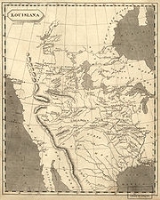
The Louisiana Purchase (French: Vente de la Louisiane "Louisiana Sale") was the acquisition by the United States of America of of the French territory Louisiane
Louisiana (New France)

Louisiana or French Louisiana was the name of an administrative district of New France. Under French control from 1682-1763 and 1803-04, the area was named in honor of Louis XIV of France, by French explorer Ren?-Robert Cavelier, Sieur de la Salle....
 in 1803. The U.S. paid 60 million francs
French franc

The franc is a former currency of France. Between 1360 and 1641, it was the name of coins worth 1 livre tournois and it remained in common parlance as a term for this amount of money....
 ($
United States dollar

The United States dollar is the unit of currency of the United States and was defined by the Coinage Act of 1792 to be between 371 and 416 grains of silver ....
11,250,000) plus cancellation of debts worth 18 million francs ($3,750,000), a total cost of $15,000,000 for the Louisiana territory.

The Louisiana Purchase encompassed portions of 14 current U.S.


Discussion
Ask a question about 'Louisiana Purchase'
Start a new discussion about 'Louisiana Purchase'
Answer questions from other users
Full Discussion Forum


Recent Posts


Encyclopedia


The Louisiana Purchase (French: Vente de la Louisiane "Louisiana Sale") was the acquisition by the United States of America of of the French territory Louisiane
Louisiana (New France)

Louisiana or French Louisiana was the name of an administrative district of New France. Under French control from 1682-1763 and 1803-04, the area was named in honor of Louis XIV of France, by French explorer Ren?-Robert Cavelier, Sieur de la Salle....
 in 1803. The U.S. paid 60 million francs
French franc

The franc is a former currency of France. Between 1360 and 1641, it was the name of coins worth 1 livre tournois and it remained in common parlance as a term for this amount of money....
 ($
United States dollar

The United States dollar is the unit of currency of the United States and was defined by the Coinage Act of 1792 to be between 371 and 416 grains of silver ....
11,250,000) plus cancellation of debts worth 18 million francs ($3,750,000), a total cost of $15,000,000 for the Louisiana territory.

The Louisiana Purchase encompassed portions of 14 current U.S. states and 2 Canadian Provinces. The land purchased contained all of present-day Arkansas
Arkansas

Arkansas is a U.S. state located in the Southern United States of the United States. Arkansas shares a border with six states, with its eastern border largely defined by the Mississippi River....
, Missouri
Missouri

Missouri is a U.S. state in the Midwestern United States of the United States bordered by Iowa, Illinois, Kentucky, Tennessee, Arkansas, Oklahoma, Kansas and Nebraska....
, Iowa
Iowa

The State of Iowa is a U.S. state in the Midwestern region of the United States of America, an area often referred to as the "American Heartland." It is bordered by Minnesota to the north, Wisconsin and Illinois to the east, Nebraska and South Dakota to the west, and Missouri to the south....
, Oklahoma
Oklahoma

Oklahoma is a U.S. state and a sovereignty located in the South Central United States and Southern United States of the United States of America ....
, Kansas
Kansas

The State of Kansas is a Midwestern U.S. state in the Central United States of the United States of America, an area often referred to as the United States "Heartland"....
, Nebraska
Nebraska

Nebraska is a U.S. state located on the Great Plains of the Midwestern United States and Western United States.Nebraska probably gets its name from the archaic Chiwere language words ?? Br?sge or the Omaha-Ponca language N? Bth?ska meaning "flat water," after the Platte River that flows through the state....
, parts of Minnesota
Minnesota

Minnesota is a U.S. state in the Midwestern United States of the United States. The twelfth largest state by area in the U.S., it is the twenty-first most populous, with just over five million residents....
 that were west of the Mississippi River
Mississippi River

The Mississippi River is the longest river in the United States, with a length of from its source in Lake Itasca in Minnesota to its mouth in the Gulf of Mexico....
, most of North Dakota
North Dakota

North Dakota is a U.S. state located in the Midwestern United States and Western United States regions of the United States of America. North Dakota is the 19th largest state by area in the US; it is the 48th most populous, with just over 640,000 residents as of 2006....
, nearly all of South Dakota
South Dakota

South Dakota is a U.S. state located in the Midwestern United States of the United States of America. It is named after the Lakota people and Sioux Sioux Native Americans in the United States tribes....
, northeastern New Mexico
New Mexico

New Mexico is a U. S. State located in the Southwestern United States of the United States. Inhabited by Native Americans in the United States populations for many centuries, it has also has been part of the Spanish Empire viceroyalty of New Spain, part of Mexico, and a U.S....
, the portions of Montana
Montana

Montana is a U.S. state in the Western United States. The western third of the state contains numerous mountain ranges; other 'island' ranges are found in the central third of the state, for a total of 77 named ranges of the Rocky Mountains....
, Wyoming
Wyoming

The State of Wyoming is a sparsely populated U.S. state in the Northwestern United States of the United States. The majority of the state is dominated by the mountain ranges and rangelands of the Rocky Mountains, while the easternmost section of the state is a high altitude prairie region known as the High Plains ....
, and Colorado
Colorado

The State of Colorado is a U.S. state located in the Mountain States of the United States of America. Colorado may also be considered to be a part of the Western United States and Southwestern United States regions of the United States....
 east of the Continental Divide
Continental Divide

The Continental Divide of the Americas, or merely the Continental Divide or Great Divide, is the name given to the principal, and largely mountainous, hydrological divide of the Americas that separates the drainage basin that drain into the Pacific Ocean from, 1) those river systems which drain into the Atlantic Ocean , and 2)...
, and Louisiana
Louisiana

The State of Louisiana is a U.S. state located in the U.S. Southern States of the United States of America. Its capital is Baton Rouge and largest city is New Orleans....
 west of the Mississippi River, including the city of New Orleans. (The Oklahoma Panhandle, and southwestern portions of Kansas and Louisiana were still claimed by Spain at the time of the Purchase.) In addition, the Purchase contained small portions of land that would eventually become part of the Canadian provinces of Alberta
Alberta

Alberta is one of Canada Canadian Prairies Provinces and territories of Canada. It became a province on September 1, 1905.Alberta is located in western Canada, bounded by the provinces of British Columbia to the west and Saskatchewan to the east, the Northwest Territories to the north, and the U.S....
 and Saskatchewan
Saskatchewan

Saskatchewan is a prairie provinces in Canada, which has an area of 588,276.09 square kilometres and a population of 1,015,895 , mostly living in the southern half of the province....
. The land included in the purchase comprises around 23% of the territory of the United States today.

The purchase was a vital moment in the presidency of Thomas Jefferson
Thomas Jefferson

Thomas Jefferson was the List of Presidents of the United States President of the United States , the principal author of the United States Declaration of Independence , and one of the most influential Founding Fathers of the United States for his promotion of the ideals of republicanism in the United States....
. At the time, it faced domestic opposition as being possibly unconstitutional
Constitutionality

Constitutionality is the status of a law, a procedure, or an act's accordance with the laws or guidelines set forth in the applicable constitution....
. Although he felt that the US Constitution did not contain any provisions for acquiring territory, Jefferson decided to purchase Louisiana because he felt uneasy about France and Spain having the power to block American trade access to the port of New Orleans.

Napoleon Bonaparte, upon completion of the agreement, stated, "This accession of territory affirms forever the power of the United States, and I have given England a maritime rival who sooner or later will humble her pride."

Background

The city of New Orleans controlled the Mississippi River through its location; other locations for ports had been tried and had not succeeded. New Orleans was already important for shipping agricultural goods to and from the parts of the United States west of the Appalachian Mountains
Appalachian Mountains

The Appalachian Mountains or , often called the Appalachians, are a vast mountain range in eastern North America. Definitions vary on the precise boundaries of the Appalachians....
. Through Pinckney's Treaty
Pinckney's Treaty

Pinckney's Treaty, also known as the Treaty of San Lorenzo or the Treaty of Madrid, was signed in San Lorenzo de El Escorial on October 27, 1795 and established intentions of friendship between the United States and Spain....
 signed with Spain on October 27, 1795, American merchants had "right of deposit" in New Orleans, meaning they could use the port to store goods for export. Americans also used this right to transport products such as flour, tobacco, pork, bacon, lard, feathers, cider, butter, and cheese. The treaty also recognized American rights to navigate the entire Mississippi River which had become increasingly vital to the growing trade of their western territories. In 1798 Spain revoked this treaty, which greatly upset Americans. In 1801, Spanish Governor Don Juan Manuel De Salcedo took over for Governor Marquess of Casa Calvo, and the right to deposit goods from the United States was fully restored. Napoleon Bonaparte
Napoleon I of France

Napoleon Bonaparte later known as Emperor Napoleon I, was a military and political leader of France whose actions shaped European politics in the early 19th century....
 returned Louisiana to French control from Spain in 1800, under the Treaty of San Ildefonso
Third Treaty of San Ildefonso

The Third Treaty of San Ildefonso was a secretly negotiated treaty between France and Spain in which Spain returned the colonial territory of Louisiana to France....
 (Louisiana had been a Spanish colony since 1762.) However, the treaty was kept secret, and Louisiana remained under Spanish control until a transfer of power to France. The transfer finally took place on November 30, 1803, just three weeks before the cession to the United States.

James Monroe
James Monroe

James Monroe was the List of Presidents of the United States President of the United States . His administration was marked by the acquisition of Florida ; the Missouri Compromise , in which Missouri was declared a slave state; the admission of Maine in 1820 as a free state; and the profession of the Monroe Doctrine , declaring U.S....
 and Robert R. Livingston
Robert Livingston (1746-1813)

Robert R Livingston , was an American lawyer, politician and diplomat from New York....
 traveled to Paris
Paris

Paris is the Capital of France and the country's largest city. It is situated on the river Seine, in northern France, at the heart of the ?le-de-France Regions of France ....
 to negotiate the purchase in 1803. Their interest was only in the port and its environs; they did not anticipate the much larger transfer of territory that would follow.

Negotiation

Jefferson made the purchase by sending Livingston to Paris in 1801, after discovering the transfer of Louisiana from Spain to France. Livingston was to pursue a purchase of New Orleans, but failed.

In 1802, Pierre Samuel du Pont de Nemours
Pierre Samuel du Pont de Nemours

Pierre Samuel du Pont de Nemours , was a France noblemen, writer, economist, and government official, who was the father of Eleuth?re Ir?n?e du Pont, the founder of DuPont and progenitor of one of America's richest business dynasties of the 19th and 20th centuries....
 began to help negotiate with France at the request of Jefferson. Du Pont was living in the United States at the time and had close ties to Jefferson, as well as to the political powers in France. He engaged in back-channel diplomacy with Napoleon, on Jefferson's behalf, during a personal visit to France. He originated the idea of the much larger Louisiana Purchase as a way to defuse potential conflict between the United States and Napoleon over North America.

Jefferson disliked the idea of purchasing Louisiana from France as that could imply that France had a right to be in Louisiana. A strict constructionist
Strict constructionism

Strict constructionism refers to a particular Philosophy of law of judicial interpretation that limits or restricts judicial interpretation. In the United States the phrase is also commonly used more loosely as a generic term for Conservatism in the United States among the judiciary....
, Jefferson also believed that a U.S. president did not have the authority to engage in such a deal because it was not specified in the constitution, and that to do so would moreover erode states' rights
States' rights

States' rights refers to the idea, in politics of the United States and United States constitutional law, that U.S. states possess certain rights and political powers in relation to the federal government of the United States....
 by increasing federal executive power. On the other hand, he was aware of the potential threat that a neighbor like France would be for the young nation, and was prepared to go to war to prevent a strong French presence in the region. Meanwhile, Napoleon's foreign minister
Minister of Foreign Affairs (France)

The Minister of Foreign Affairs in the government of France, is the French government ministers responsible for the foreign relations of France....
, Charles Maurice de Talleyrand, was vehemently opposed to selling Louisiana since it would mean an end to France's secret plans for a North American empire..

Throughout this time, Jefferson had up-to-date intelligence on Napoleon's military activities and intentions in North America. Part of his evolving strategy involved giving du Pont some information that was withheld from Livingston. He also gave intentionally conflicting instructions to the two. He next sent Monroe to Paris in 1803. Monroe had been formally expelled from France on his last diplomatic mission, and the choice to send him again conveyed a sense of seriousness.

Napoleon was faced with an uprising in Saint-Domingue
Saint-Domingue

Saint-Domingue was a French colonization of the Americas colony on the Caribbean island of Hispaniola from 1659 to 1804, when it became the independent nation of Haiti....
 (present-day Republic of Haiti
Haiti

Haiti , officially the Republic of Haiti , is a Haitian Creole language- and French language-speaking Caribbean country. Along with the Dominican Republic, it occupies the island of Hispaniola, in the Greater Antilles archipelago....
) where an expeditionary force under his brother-in-law Charles Leclerc
Charles Leclerc

Charles Victor Emmanuel Leclerc was a List of French people general and husband to Pauline Bonaparte, sister to Napoleon I of France....
 had attempted to conquer the territory, remove the substantial numbers of black and mulatto officers and soldiers in the armed forces, enslave those who had been emancipated in 1793-4, and re-introduce the slave trade. This had led to the revolutionary war which threatened to break the connection of St. Domingue with France, and weaken France's economic, political and military position in the Caribbean.

Political conflicts in Guadeloupe
Guadeloupe

Guadeloupe is an island group or archipelago located in the eastern Caribbean Sea at , with a land area of 1,628 square kilometres . It is an overseas department of France....
 and in Saint-Domingue grew with the restoration of slavery
Slavery

Slavery is a form of forced labor where a person is compelled to Labor for another . Slaves are held against their will from the time of their capture, purchase, or birth, and are deprived of the right to leave, to refuse to work, or to receive Remuneration in return for their labor....
 on May 20, 1802, and the defection of leading French officers, like Toussaint L'Ouverture
Toussaint L'Ouverture

Fran?ois-Dominique Toussaint Louverture , also Toussaint Br?da, Toussaint-Louverture was a leader of the Haitian Revolution. Born a slave in Saint-Domingue, in a long struggle for independence Toussaint led enslaved Africans to victory over Europeans, abolished slavery, and secured native control over the colony in 1797 while nom...
, the black general Jean-Jacques Dessalines
Jean-Jacques Dessalines

Jean-Jacques Dessalines was a leader of the Haitian Revolution and the first ruler of an independent Haiti under the 1801 constitution. He was autocratic in his rule and crowned himself List of heads of state of Ha?ti in 1805....
 and the mulatto
Mulatto

Mulatto denotes a person with one White people parent and one Black people parent or a person who has black ancestry and white ancestry. It is perceived as pejorative and demeaning in some cultures....
 officer Alexandre Pétion
Alexandre Pétion

Alexandre Sab?s P?tion was President of the southern Republic of Haiti from 1806 until his death. He is considered as one of Haiti's founding fathers, together with Toussaint Louverture, Jean-Jacques Dessalines, and his rival Henri Christophe....
 in October 1802, within the context of an ongoing guerrilla war. The French had successfully captured, and deported to France Toussaint L'Ouverture
Toussaint L'Ouverture

Fran?ois-Dominique Toussaint Louverture , also Toussaint Br?da, Toussaint-Louverture was a leader of the Haitian Revolution. Born a slave in Saint-Domingue, in a long struggle for independence Toussaint led enslaved Africans to victory over Europeans, abolished slavery, and secured native control over the colony in 1797 while nom...
 in June 1802, but the revolutionary war and the yellow fever
Yellow fever

Yellow fever is an acute Virus disease. It is an important cause of hemorrhage illness in many African and South American countries despite existence of an effective vaccine....
 were destroying most of the Leclerc's army of European soldiers. Leclerc himself died of yellow fever in November 1802, and Rochambeau, his successor, failed, despite being sent a further 20,000 troops from Europe, and the use of genocidal tactics, to avoid complete defeat by the forces led by Jean-Jacques Dessalines
Jean-Jacques Dessalines

Jean-Jacques Dessalines was a leader of the Haitian Revolution and the first ruler of an independent Haiti under the 1801 constitution. He was autocratic in his rule and crowned himself List of heads of state of Ha?ti in 1805....
.

Having by his attempt to re-enslave the people and army in St. Domingue made enemies of what became the army of Haiti, and destroyed most the French military forces sent in 1802-1804 to the Caribbean, Napoleon needed peace with the United Kingdom of Great Britain and Ireland
United Kingdom of Great Britain and Ireland

The United Kingdom of Great Britain and Ireland was the formal name and the state form of the United Kingdom from 1 January 1801 until 12 April 1927....
 to implement the Treaty of San Ildefonso
Treaty of San Ildefonso

San Ildefonso is a town in central Spain, the summer residence of the Kings of Spain, where several treaties were signed; each is referred to, in context, as the Treaty of San Ildefonso ....
 and take possession of Louisiana. Otherwise, Louisiana would be an easy prey for the British or even for the Americans. Britain had breached her promise to evacuate Malta
Malta

Malta , officially the Republic of Malta , is a densely populated developed country European microstates microstate in the European Union....
 by September 1802 as stipulated in the peace of Amiens, and in the beginning of the year 1803, war between France and Britain seemed increasingly unavoidable. On March 11, 1803, Napoleon decided to start building a flotilla of barge
Barge

A barge is a flat-bottomed boat, built mainly for river and canal transport of heavy goods. Most barges are not self-propelled and need to be towed by tugboats or pushed by towboats....
s to invade Britain.

The failure of his plans for the re-enslaving of the freed population of Haiti led Bonaparte to abandon his plans to rebuild France's New World empire. Without the large profits that could accrue from sugar plantations in the Caribbean, Louisiana had little value to him. Napoleon gave notice to his minister of the treasury, François de Barbé-Marbois, on April 10, 1803, that he was considering surrendering the Louisiana Territory to the United States. On April 11, 1803, just days before Monroe's arrival, Marquess
Marquess

A marquess or marquis is a nobleman of hereditary rank in various European monarchies and some of their colonies. The term is also used to render equivalent oriental styles as in imperial China and Japan....
 de Barbé-Marbois
François Barbé-Marbois

Fran?ois Barb?-Marbois, Marquess de Barb?-Marbois was a France politician....
 offered Livingston all of Louisiana instead of just New Orleans. President Jefferson had instructed Livingston to only purchase New Orleans. However, he was certain that the United States would accept such a large offer.

The American negotiators were prepared to spend $10 million for New Orleans but were dumbfounded when the entire region was offered for $15 million. The treaty was dated April 30, 1803, and was signed on May 2. On July 14, 1803, the treaty reached Washington D.C. The Louisiana territory was vast, stretching from the Gulf of Mexico
Gulf of Mexico

The Gulf of Mexico is the ninth largest body of water in the world. Considered a smaller part of the Atlantic Ocean, it is an oceanic basin largely surrounded by the North American continent and the island of Cuba....
 in the south to Rupert's Land
Rupert's Land

Rupert's Land, also sometimes called "Prince Rupert's Land", was a territory in British North America, consisting of the List of Hudson Bay rivers, that was owned by the Hudson's Bay Company for 200 years from 1670 to 1870....
 in the north, and from the Mississippi River in the east to the Rocky Mountains
Rocky Mountains

The Rocky Mountains, often called the Rockies, are a mountain range in western North America. The Rocky Mountains stretch more than 4,800 kilometre from the northernmost part of British Columbia, in Canada, to New Mexico, in the United States....
 in the west. Acquiring the territory would double the size of the United States at a cost in the currency of the day of less than 3 cents per acre.

Domestic opposition

Louisiana Quarter, Reverse Side, 2002
United States 2004 Peace Medal Nickel, Reverse
The American purchase of the Louisiana territory was not accomplished without domestic opposition. Jefferson's philosophical consistency was in question because of his strict interpretation of the Constitution. Many people believed he was being hypocritical by doing something he surely would have argued against with Alexander Hamilton
Alexander Hamilton

Alexander Hamilton was the first Secretary of the Treasury, a Founding Fathers of the United States, economist, and political philosopher. He led calls for the Philadelphia Convention, was one of America's first Constitutional lawyers, and cowrote the Federalist Papers, a primary source for Constitutional interpretation....
. The Federalists
Federalist Party (United States)

The Federalist Party was an American political party in the period 1792 to 1816, with remnants lasting into the 1820s. The Federalists controlled the federal government until 1801....
 strongly opposed the purchase, favoring close relations with Britain over closer ties to Napoleon, believing the purchase to be unconstitutional, and concerned that the U.S. had paid a large sum of money just to declare war on Spain. The United States House of Representatives also opposed the purchase. Majority Leader John Randolph
John Randolph

John Randolph is a personal name that may refer to:* John Randolph, 3rd Earl of Moray , 3rd Earl of Moray, regent of Scotland.* John Randolph , Virginia colonial politician, Speaker of the Virginia House of Burgesses...
 led the opposition. The House called a vote to deny the request for the purchase, the vote failed by two votes 59-57. The federalist even tried to prove the land belonged to Spain not France, but the papers proved otherwise. The Federalists also feared that the political power of the Atlantic seaboard states would be threatened by the new citizens of the west, bringing about a clash of western farmers with the merchants and bankers of New England
New England

New England is a region of the United States located in the northeastern corner of the country, bounded by the Atlantic Ocean, Canada and New York State, and consisting of the modern U.S....
. There was concern that an increase in slave holding states created out of the new territory would exacerbate divisions between north and south, as well. A group of Federalists led by Massachusetts
Massachusetts

The Commonwealth of Massachusetts is a U.S. state located in the New England region of the Northeastern United States United States. It borders Rhode Island and Connecticut to the south, New York to the west, and Vermont and New Hampshire to the north....
 Senator
United States Senate

The United States Senate is the upper house of the Bicameralism United States Congress, the lower house being the United States House of Representatives....
 Timothy Pickering
Timothy Pickering

Timothy Pickering was a politician from Massachusetts who served in a variety of roles, most notably as the third United States Secretary of State, serving in that office from 1795 to 1800 under Presidents George Washington and John Adams....
 went so far as to plan a separate northern confederacy, offering Vice President Aaron Burr
Aaron Burr

Aaron Burr, Jr. was an United States politician, American Revolutionary War hero, and adventurer. He served as the List of Vice Presidents of the United States Vice President of the United States , under Thomas Jefferson....
 the presidency of the proposed new country if he persuaded New York
New York

The State of New York is a U.S. state in the Mid-Atlantic States and Northeastern United States regions of the United States and is the nation's List of U.S....
 to join. Burr's relationship with Alexander Hamilton
Alexander Hamilton

Alexander Hamilton was the first Secretary of the Treasury, a Founding Fathers of the United States, economist, and political philosopher. He led calls for the Philadelphia Convention, was one of America's first Constitutional lawyers, and cowrote the Federalist Papers, a primary source for Constitutional interpretation....
, who helped bring an end to the nascent northern secession movement, soured during this period. The animosity between the two men ended with Hamilton's death in a duel with Burr in 1804.

Treaty signing

On April 30, 1803, the Louisiana Purchase Treaty ,called by some "the letter that bought a continent", was signed by Robert Livingston
Robert Livingston (1746-1813)

Robert R Livingston , was an American lawyer, politician and diplomat from New York....
, James Monroe, and Barbé Marbois in Paris. Jefferson announced the treaty to the American people on July 4. After the signing of the Louisiana Purchase agreement in 1803, Livingston made this famous statement, "We have lived long, but this is the noblest work of our whole lives...From this day the United States take their place among the powers of the first rank." The United States Senate ratified the treaty with a vote of twenty-four to seven on October 20; on the following day, it authorized President Jefferson to take possession of the territory and establish a temporary military government. In legislation enacted on October 31, Congress made temporary provisions for local civil government to continue as it had under French and Spanish rule and authorized the President to use military forces to maintain order. Plans were also set forth for several missions to explore and chart the territory, the most famous being the Lewis and Clark Expedition
Lewis and Clark Expedition

The Lewis and Clark Expedition , headed by Meriwether Lewis and William Clark , was the first United States overland expedition to the Pacific coast and back....
.

France turned New Orleans over on December 20, 1803 at The Cabildo
The Cabildo

The Cabildo was the seat of colonial government in New Orleans, Louisiana, and is now a museum. The Cabildo is located along Jackson Square, New Orleans, Louisiana, adjacent to St....
. On March 10, 1804, a formal ceremony was conducted in St. Louis
St. Louis, Missouri

St. Louis is an independent city in the U.S. state of Missouri, located near the confluence of the Mississippi River and the Missouri River. St....
 to transfer ownership of the territory from France to the United States.

Effective on October 1, 1804, the purchased territory was organized into the Territory of Orleans (most of which became the state of Louisiana) and the District of Louisiana
District of Louisiana

The District of Louisiana or Louisiana District was an official United States government designation for the portion of the Louisiana Purchase that had not been organized into the Territory of Orleans....
, which was temporarily under the control of the governor and judges of the Indiana Territory
Indiana Territory

Indiana Territory was an organized territory of the United States from 1800 to 1816, created by United States Congress and signed into law by President John Adams on May 7, 1800, effective on July 4....
.

Boundaries

U
The tributaries of the Mississippi were held as the boundaries by the United States. Estimates that did exist as to the extent and composition of the purchase were initially based on the explorations of Robert LaSalle.

A dispute immediately arose between Spain and the United States regarding the extent of Louisiana. The territory's boundaries had not been defined in the 1762 Treaty of Fontainebleau
Treaty of Fontainebleau (1762)

The Treaty of Fontainebleau was a secret agreement signed on November 13, 1762, in which France ceded Louisiana to Spain. The treaty followed the last battle in the French and Indian War in North America at the Battle of Signal Hill which solidified the Kingdom of Great Britain routing of the French in September 1762....
 that ceded it from France to Spain, nor the 1800 Third Treaty of San Ildefonso
Third Treaty of San Ildefonso

The Third Treaty of San Ildefonso was a secretly negotiated treaty between France and Spain in which Spain returned the colonial territory of Louisiana to France....
 ceding it back to France, nor the 1803 Louisiana Purchase agreement ceding it to the United States. The United States claimed Louisiana included the entire western portion of the Mississippi River drainage basin to the crest of the Rocky Mountains
Rocky Mountains

The Rocky Mountains, often called the Rockies, are a mountain range in western North America. The Rocky Mountains stretch more than 4,800 kilometre from the northernmost part of British Columbia, in Canada, to New Mexico, in the United States....
 and land extending southeast to the Rio Grande
Rio Grande

For the railroad often known as the Rio Grande, see Denver and Rio Grande Western Railroad.The Rio Grande River in the United States, known as the R?o Bravo in Mexico, is a river, long, is the fourth longest river system in the United States and serves as a natural boundary along the border between the U.S....
. Spain insisted that Louisiana comprised no more than the western bank of the Mississippi River and the cities of New Orleans and St. Louis
St. Louis, Missouri

St. Louis is an independent city in the U.S. state of Missouri, located near the confluence of the Mississippi River and the Missouri River. St....
. The relatively narrow Louisiana of New Spain
New Spain

The Viceroyalty of New Spain , was the political unit of Spain territories in North America and Asia-Pacific. The territory included the present-day Southwestern United States, Central America, the Caribbean, and the Philippines....
 had been a special province under the jurisdiction of the Captaincy General of Cuba
Captaincy General of Cuba

The Captaincy General of Cuba was an administrative district of the Spanish Empire created in 1607 as part of Habsburg Spain's attempt to better defend the Caribbean against foreign powers, which also involved creating captaincies general in Captaincy General of Puerto Rico, Captaincy General of Guatemala and Captaincy General of Yucat?n....
 while the vast region to the west was in 1803 still considered part of the Commandancy General of the Provincias Internas
Commandancy General of the Provincias Internas

The Commandancy General of the Internal Provinces of the North or Commandancy General of the Provincias Internas del Norte was an administrative district of colonial Spanish Empire, created in 1776 to provide more autonomy for the frontier provinces of Viceroyalty of New Spain....
. Louisiana had never been considered to be one of New Spain's internal provinces.

If the territory included all the tributaries of the Mississippi on its western bank, the northern reaches of the Purchase extended into the equally ill-defined British possession—Rupert's Land
Rupert's Land

Rupert's Land, also sometimes called "Prince Rupert's Land", was a territory in British North America, consisting of the List of Hudson Bay rivers, that was owned by the Hudson's Bay Company for 200 years from 1670 to 1870....
 of British North America
British North America

British North America consisted of the colonies and territories of the British Empire in continental North America after the end of the American Revolutionary War and the recognition of United States ....
, now part of Canada. The Purchase originally extended just beyond the 50th parallel. However, the territory north of the 49th parallel
49th parallel north

The 49th parallel north is a circle of latitude that is 49 degree true north of the Earth equator.The parallel forms part of the United States-Canadian Border from British Columbia to Manitoba on the Canada side and from Washington to Minnesota on the United States side, or from the Strait of Georgia to the Lake of the Woods....
 such as the Red River Basin, Milk River
Milk River (Montana-Alberta)

The Milk River is a tributary of the Missouri River, 729 mi long in the U.S. state of Montana and the Canadian province of Alberta.It is formed in northwestern Montana, in Glacier County, Montana 21 mi N of Browning, Montana by the confluence of the South and Middle forks....
, and Poplar River
Poplar River (Saskatchewan-Montana)

The Poplar River is a tributary of the Missouri River, approximately 167 mi long in Saskatchewan in Canada and Montana in the United States....
 watershed was ceded to the UK in the Anglo-American Convention of 1818
Treaty of 1818

The Convention respecting fisheries, boundary, and the restoration of slaves between the United States and the United Kingdom of Great Britain and Ireland, also known as the London Convention, Anglo-American Convention of 1818, Convention of 1818, or simply the Treaty of 1818, was a treaty signed in 1818 between the...
.

The eastern boundary of the Louisiana purchase was the Mississippi River
Mississippi River

The Mississippi River is the longest river in the United States, with a length of from its source in Lake Itasca in Minnesota to its mouth in the Gulf of Mexico....
, from its source to the 31st parallel, although the source of the Mississippi
Lake Itasca

Lake Itasca is a small glacial lake, approximately 1.8 square miles in area, in the Lake District of northwestern Minnesota in the United States....
 was then unknown. The eastern boundary below the 31st parallel was unclear; the U.S. claimed the land as far as the Perdido River
Perdido River

The Perdido River is a river in the U.S. states of Alabama and Florida, approximately 60 miles long. The river forms part of the boundary between the two states along nearly its entire length and drains into the Gulf of Mexico....
, and Spain claimed the border of its Florida Colony remained the Mississippi river. In early 1804, Congress passed the Mobile Act which recognized West Florida
West Florida

West Florida was a region on the north shore of the Gulf of Mexico, which underwent several boundary and sovereignty changes during its history....
 as being part of the United States. The Treaty with Spain of 1819
Adams-Onís Treaty

The Adams-On?s Treaty of 1819, also known as the Transcontinental Treaty of 1819, settled a border dispute in North America between the United States and Spain....
 resolved the issue. Today, the 31st parallel is the northern boundary of the western half of the Florida Panhandle
Florida Panhandle

The Florida Panhandle is the region of the state of Florida which includes the westernmost 16 List of counties in Florida in the state. It is a narrow strip lying between Alabama on the north and the west, Georgia also on the north, and the Gulf of Mexico to the south....
, and the Perdido is the western boundary of Florida.

The southern boundary of the Louisiana Purchase (versus New Spain) was initially unclear at the time of purchase; the Neutral Ground Treaty of 1806 created the Sabine Free State
Sabine Free State

The Sabine Free State, also known as the Neutral Ground, Neutral Strip, Neutral Territory, and No Man's Land of Louisiana was a disputed area between Spanish Texas and the United States' newly acquired Louisiana Purchase....
 during the interim and the Adams-Onís Treaty
Adams-Onís Treaty

The Adams-On?s Treaty of 1819, also known as the Transcontinental Treaty of 1819, settled a border dispute in North America between the United States and Spain....
 of 1819 began to lay down official dividing lines.

Financing

The American government used $3 million in gold as a down payment, and bonds for the balance to pay France for the purchase. Because of the impending war with Britain, French banks would not buy or market the American bonds. The American diplomats Livingston and Monroe therefore recommended the firms of Baring and Company
Barings Bank

Barings Bank was the oldest merchant bank in London until its collapse in 1995 after one of the bank's employees, Nick Leeson, lost ?827 million speculating—primarily on futures contracts....
 of London and Hope and Company
Hope & Co.

Hope & Co. is the name of a famous Dutch bank that spanned two and a half centuries. Though the founders were Scotsmen, the bank was located in Amsterdam, and at the close of the 18th century it had offices in London as well....
 of Amsterdam for the transaction which France agreed upon. Because of their reputation as the two most stable financial houses in Europe and because Napoleon wanted to receive his money as quickly as possible, the French treasury minister Barbé-Marbois
François Barbé-Marbois

Fran?ois Barb?-Marbois, Marquess de Barb?-Marbois was a France politician....
 made arrangements with the two firms to convert the bonds France would receive into cash. After the American bonds had been delivered, the French government then sold them to Baring and Hope at a discount.

The original sales document of the Louisiana purchase was exhibited in the entrance hall of Baring's London offices until the bank's collapse in 1995
Barings Bank

Barings Bank was the oldest merchant bank in London until its collapse in 1995 after one of the bank's employees, Nick Leeson, lost ?827 million speculating—primarily on futures contracts....
 and is now in the custody of ING Group
ING Group

ING Group N.V. is a financial institution of Netherlands origin offering banking, insurance and asset management services. ING is an abbreviation of Internationale Nederlanden Groep....
, which purchased Barings.

External links