

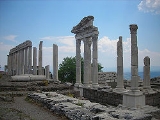
Pergamon

Encyclopedia
Pergamon or Pergamum, was an ancient Greek
city in modern-day Turkey
, in Mysia
, today located 16 miles (25.7 km) from the Aegean Sea
on a promontory
on the north side of the river Caicus
(modern day Bakırçay), that became the capital of the Kingdom of Pergamon during the Hellenistic period
, under the Attalid dynasty
, 281–133 BC. Pergamon was cited in the book of Revelation
as one of the seven churches of Asia
. Today, the main sites of ancient Pergamon are to the north and west of the modern city of Bergama
.
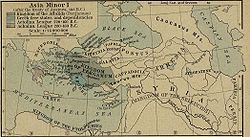 The Attalid kingdom was the rump state
left after the collapse of the Kingdom of Thrace
.
The Attalids, the descendants of Attalus, father of Philetaerus
who came to power in 281 BC following the collapse of the Kingdom of Thrace, were among the most loyal supporters of Rome
in the Hellenistic world. Under Attalus I
(241-197 BC), they allied with Rome against Philip V of Macedon
, during the first
and second
Macedonian Wars
, and again under Eumenes II
(197-158 BC), against Perseus of Macedon
, during the Third Macedonian War
. For support against the Seleucids
, the Attalids were rewarded with all the former Seleucid domains in Asia Minor
.
The Attalids ruled with intelligence and generosity. Many documents survive showing how the Attalids would support the growth of towns through sending in skilled artisans and by remitting taxes. They allowed the Greek cities in their domains to maintain nominal independence. They sent gifts to Greek cultural sites like Delphi
, Delos
, and Athens
. They defeated the invading Celts. They remodeled the Acropolis of Pergamon after the Acropolis
in Athens. When Attalus III (138-133 BC) died without an heir in 133 BC, he bequeathed the whole of Pergamon to Rome, in order to prevent a civil war.
According to Christian tradition, the first bishop of Pergamon, Antipas, was martyred there in ca. 92 AD.
The Ottoman
Sultan Murad III
had two large alabaster
urns transported from the ruins of Pergamon and placed on two sides of the nave in the Hagia Sophia
in Istanbul
.
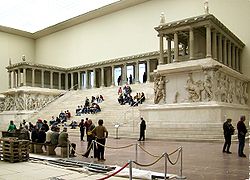
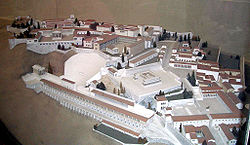
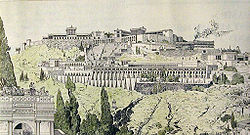 The Great Altar of Pergamon
is in the Pergamon Museum
, Berlin. The base of this altar remains on the upper part of the Acropolis. It was perhaps this altar, believed to be dedicated to Zeus, that John of Patmos
referred to as "Satan's Throne" in his Book of Revelation
(Revelation 2:13).
Other notable structures still in existence on the upper part of the Acropolis include:
Pergamon's library on the Acropolis (the ancient Library of Pergamum
) is the second best in the ancient Greek civilization. When the Ptolemies
stopped exporting papyrus
, partly because of competitors and partly because of shortages, the Pergamenes invented a new substance to use in codices
, called pergaminus or pergamena (parchment
) after the city. This was made of fine calfskin
, a predecessor of vellum. The library at Pergamom was believed to contain 200,000 volumes, which Mark Antony
later gave to Cleopatra as a wedding present.
(also known as the Asclepieion
), the god of healing. In this place people with health problems could bathe in the water of the sacred spring, and in the patients' dreams Asclepius would appear in a vision to tell them how to cure their illness. Archeology has found lots of gifts and dedications that people would make afterwards, such as small terracotta body parts, no doubt representing what had been healed. Notable extant structures in the Asclepieion include:
and/or Serapis
, known today as the "Red Basilica
" (or Kızıl Avlu in Turkish), about one kilometer south of the Acropolis. It consists of a main building and two round towers within an enormous temenos or sacred area. In the first century AD, the Christian
Church at Pergamon inside the main building of the Red Basilica was one of the Seven Churches
to which the Book of Revelation
was addressed (Revelation 2:12). The forecourt is still supported by the 193 m wide Pergamon Bridge
, the largest bridge substruction of antiquity.
.
Ancient Greece
Ancient Greece is a civilization belonging to a period of Greek history that lasted from the Archaic period of the 8th to 6th centuries BC to the end of antiquity. Immediately following this period was the beginning of the Early Middle Ages and the Byzantine era. Included in Ancient Greece is the...
city in modern-day Turkey
Turkey
Turkey , known officially as the Republic of Turkey , is a Eurasian country located in Western Asia and in East Thrace in Southeastern Europe...
, in Mysia
Mysia
Mysia was a region in the northwest of ancient Asia Minor or Anatolia . It was located on the south coast of the Sea of Marmara. It was bounded by Bithynia on the east, Phrygia on the southeast, Lydia on the south, Aeolis on the southwest, Troad on the west and by the Propontis on the north...
, today located 16 miles (25.7 km) from the Aegean Sea
Aegean Sea
The Aegean Sea[p] is an elongated embayment of the Mediterranean Sea located between the southern Balkan and Anatolian peninsulas, i.e., between the mainlands of Greece and Turkey. In the north, it is connected to the Marmara Sea and Black Sea by the Dardanelles and Bosporus...
on a promontory
Promontory
Promontory may refer to:*Promontory, a prominent mass of land which overlooks lower lying land or a body of water*Promontory, Utah, the location where the United States first Transcontinental Railroad was completed...
on the north side of the river Caicus
Caicus
Bakırçay is the ancient name of a river of Asia Minor that rises in the Temnus mountains and flows through Lydia, Mysia, and Aeolis before it debouches into the Elatic Gulf. To the Hittites, it was the Seha river...
(modern day Bakırçay), that became the capital of the Kingdom of Pergamon during the Hellenistic period
Hellenistic Greece
In the context of Ancient Greek art, architecture, and culture, Hellenistic Greece corresponds to the period between the death of Alexander the Great in 323 BC and the annexation of the classical Greek heartlands by Rome in 146 BC...
, under the Attalid dynasty
Attalid dynasty
The Attalid dynasty was a Hellenistic dynasty that ruled the city of Pergamon after the death of Lysimachus, a general of Alexander the Great. The Attalid kingdom was the rump state left after the collapse of the Lysimachian Empire. One of Lysimachus' officers, Philetaerus, took control of the city...
, 281–133 BC. Pergamon was cited in the book of Revelation
Book of Revelation
The Book of Revelation is the final book of the New Testament. The title came into usage from the first word of the book in Koine Greek: apokalupsis, meaning "unveiling" or "revelation"...
as one of the seven churches of Asia
Seven churches of Asia
The Seven Churches of Revelation, also known as The Seven Churches of the Apocalypse and The Seven Churches of Asia , are seven major churches of Early Christianity, as mentioned in the New Testament Book of Revelation and written to by Ignatius of Antioch...
. Today, the main sites of ancient Pergamon are to the north and west of the modern city of Bergama
Bergama
Bergama is a populous district, as well as the center city of the same district, in İzmir Province in western Turkey. By excluding İzmir's metropolitan area, it is one of the prominent districts of the province in terms of population and is largely urbanized at the rate of 53,6 per cent...
.
History
Rump state
A rump state is the remnant of a once-larger government, left with limited powers or authority after a disaster, invasion, military occupation, secession or partial overthrowing of a government. In the last case, a government stops short of going in exile because it still controls part of its...
left after the collapse of the Kingdom of Thrace
Thrace
Thrace is a historical and geographic area in southeast Europe. As a geographical concept, Thrace designates a region bounded by the Balkan Mountains on the north, Rhodope Mountains and the Aegean Sea on the south, and by the Black Sea and the Sea of Marmara on the east...
.
The Attalids, the descendants of Attalus, father of Philetaerus
Philetaerus
Philetaerus was the founder of the Attalid dynasty of Pergamon in Anatolia.- Early life and career under Lysimachus :...
who came to power in 281 BC following the collapse of the Kingdom of Thrace, were among the most loyal supporters of Rome
Roman Republic
The Roman Republic was the period of the ancient Roman civilization where the government operated as a republic. It began with the overthrow of the Roman monarchy, traditionally dated around 508 BC, and its replacement by a government headed by two consuls, elected annually by the citizens and...
in the Hellenistic world. Under Attalus I
Attalus I
Attalus I , surnamed Soter ruled Pergamon, an Ionian Greek polis , first as dynast, later as king, from 241 BC to 197 BC. He was the second cousin and the adoptive son of Eumenes I, whom he succeeded, and was the first of the Attalid dynasty to assume the title of king in 238 BC...
(241-197 BC), they allied with Rome against Philip V of Macedon
Philip V of Macedon
Philip V was King of Macedon from 221 BC to 179 BC. Philip's reign was principally marked by an unsuccessful struggle with the emerging power of Rome. Philip was attractive and charismatic as a young man...
, during the first
First Macedonian War
The First Macedonian War was fought by Rome, allied with the Aetolian League and Attalus I of Pergamon, against Philip V of Macedon, contemporaneously with the Second Punic War against Carthage...
and second
Second Macedonian War
The Second Macedonian War was fought between Macedon, led by Philip V of Macedon, and Rome, allied with Pergamon and Rhodes. The result was the defeat of Philip who was forced to abandon all his possessions in Greece...
Macedonian Wars
Macedonian Wars
The Macedonian wars were a series of conflicts fought by Rome in the eastern Mediterranean, the Adriatic, and the Aegean. They resulted in Roman control or influence over the eastern Mediterranean basin, in addition to their hegemony in the western Mediterranean after the Punic wars.-First...
, and again under Eumenes II
Eumenes II
Eumenes II of Pergamon was king of Pergamon and a member of the Attalid dynasty. The son of king Attalus I and queen Apollonis, he followed in his father's footsteps and collaborated with the Romans to oppose first Macedonian, then Seleucid expansion towards the Aegean, leading to the defeat of...
(197-158 BC), against Perseus of Macedon
Perseus of Macedon
Perseus was the last king of the Antigonid dynasty, who ruled the successor state in Macedon created upon the death of Alexander the Great...
, during the Third Macedonian War
Third Macedonian War
The Third Macedonian War was a war fought between Rome and King Perseus of Macedon. In 179 BC King Philip V of Macedon died and his talented and ambitious son, Perseus, took his throne. Perseus married Laodike, daughter of King Seleucus IV Keraunos of Asia, and increased the size of his army...
. For support against the Seleucids
Seleucid dynasty
The Seleucid dynasty or the Seleucidae was a Greek Macedonian royal family, founded by Seleucus I Nicator , which ruled the Seleucid Kingdom centered in the Near East and regions of the Asian part of the earlier Achaemenid Persian Empire during the Hellenistic period.-History:Seleucus was an...
, the Attalids were rewarded with all the former Seleucid domains in Asia Minor
Asia Minor
Asia Minor is a geographical location at the westernmost protrusion of Asia, also called Anatolia, and corresponds to the western two thirds of the Asian part of Turkey...
.
The Attalids ruled with intelligence and generosity. Many documents survive showing how the Attalids would support the growth of towns through sending in skilled artisans and by remitting taxes. They allowed the Greek cities in their domains to maintain nominal independence. They sent gifts to Greek cultural sites like Delphi
Delphi
Delphi is both an archaeological site and a modern town in Greece on the south-western spur of Mount Parnassus in the valley of Phocis.In Greek mythology, Delphi was the site of the Delphic oracle, the most important oracle in the classical Greek world, and a major site for the worship of the god...
, Delos
Delos
The island of Delos , isolated in the centre of the roughly circular ring of islands called the Cyclades, near Mykonos, is one of the most important mythological, historical and archaeological sites in Greece...
, and Athens
Athens
Athens , is the capital and largest city of Greece. Athens dominates the Attica region and is one of the world's oldest cities, as its recorded history spans around 3,400 years. Classical Athens was a powerful city-state...
. They defeated the invading Celts. They remodeled the Acropolis of Pergamon after the Acropolis
Acropolis
Acropolis means "high city" in Greek, literally city on the extremity and is usually translated into English as Citadel . For purposes of defense, early people naturally chose elevated ground to build a new settlement, frequently a hill with precipitous sides...
in Athens. When Attalus III (138-133 BC) died without an heir in 133 BC, he bequeathed the whole of Pergamon to Rome, in order to prevent a civil war.
According to Christian tradition, the first bishop of Pergamon, Antipas, was martyred there in ca. 92 AD.
The Ottoman
Ottoman Empire
The Ottoman EmpireIt was usually referred to as the "Ottoman Empire", the "Turkish Empire", the "Ottoman Caliphate" or more commonly "Turkey" by its contemporaries...
Sultan Murad III
Murad III
Murad III was the Sultan of the Ottoman Empire from 1574 until his death.-Biography:...
had two large alabaster
Alabaster
Alabaster is a name applied to varieties of two distinct minerals, when used as a material: gypsum and calcite . The former is the alabaster of the present day; generally, the latter is the alabaster of the ancients...
urns transported from the ruins of Pergamon and placed on two sides of the nave in the Hagia Sophia
Hagia Sophia
Hagia Sophia is a former Orthodox patriarchal basilica, later a mosque, and now a museum in Istanbul, Turkey...
in Istanbul
Istanbul
Istanbul , historically known as Byzantium and Constantinople , is the largest city of Turkey. Istanbul metropolitan province had 13.26 million people living in it as of December, 2010, which is 18% of Turkey's population and the 3rd largest metropolitan area in Europe after London and...
.
Upper Acropolis
Pergamon Altar
The Pergamon Altar is a monumental construction built during the reign of King Eumenes II in the first half of the 2nd century BC on one of the terraces of the acropolis of the ancient city of Pergamon in Asia Minor....
is in the Pergamon Museum
Pergamon Museum
The Pergamon Museum is situated on the Museum Island in Berlin. The site was designed by Alfred Messel and Ludwig Hoffmann and was constructed in twenty years, from 1910 to 1930. The Pergamon houses original-sized, reconstructed monumental buildings such as the Pergamon Altar and the Market Gate...
, Berlin. The base of this altar remains on the upper part of the Acropolis. It was perhaps this altar, believed to be dedicated to Zeus, that John of Patmos
John of Patmos
John of Patmos is the name given, in the Book of Revelation, as the author of the apocalyptic text that is traditionally cannonized in the New Testament...
referred to as "Satan's Throne" in his Book of Revelation
Book of Revelation
The Book of Revelation is the final book of the New Testament. The title came into usage from the first word of the book in Koine Greek: apokalupsis, meaning "unveiling" or "revelation"...
(Revelation 2:13).
Other notable structures still in existence on the upper part of the Acropolis include:
- The Hellenistic Theater with a seating capacity of 10,000. This had the steepest seating of any known theater in the ancient world.
- The Sanctuary of TrajanTrajanTrajan , was Roman Emperor from 98 to 117 AD. Born into a non-patrician family in the province of Hispania Baetica, in Spain Trajan rose to prominence during the reign of emperor Domitian. Serving as a legatus legionis in Hispania Tarraconensis, in Spain, in 89 Trajan supported the emperor against...
(also known as the Trajaneum) - The Sanctuary of Athena
- The Library a.k.a. AthenaeumLibrary of PergamumThe Library of Pergamum in Pergamum, Turkey, was one of the most important libraries in the ancient world.- The City of Pergamum :Founded in the Hellenistic Age, Pergamum or Pergamom was an important ancient Greek city, located in Anatolia. It is now the site of the modern Turkish town, Bergama...
- The Royal palaces
- The Heroön - a shrine where the kings of Pergamon, particularly, Attalus I and Eumenes II, were worshipped.
- The Temple of DionysusDionysusDionysus was the god of the grape harvest, winemaking and wine, of ritual madness and ecstasy in Greek mythology. His name in Linear B tablets shows he was worshipped from c. 1500—1100 BC by Mycenean Greeks: other traces of Dionysian-type cult have been found in ancient Minoan Crete...
- The Upper Agora
- The Roman baths complex
- Arsenals
Pergamon's library on the Acropolis (the ancient Library of Pergamum
Library of Pergamum
The Library of Pergamum in Pergamum, Turkey, was one of the most important libraries in the ancient world.- The City of Pergamum :Founded in the Hellenistic Age, Pergamum or Pergamom was an important ancient Greek city, located in Anatolia. It is now the site of the modern Turkish town, Bergama...
) is the second best in the ancient Greek civilization. When the Ptolemies
Ptolemaic dynasty
The Ptolemaic dynasty, was a Macedonian Greek royal family which ruled the Ptolemaic Empire in Egypt during the Hellenistic period. Their rule lasted for 275 years, from 305 BC to 30 BC...
stopped exporting papyrus
Papyrus
Papyrus is a thick paper-like material produced from the pith of the papyrus plant, Cyperus papyrus, a wetland sedge that was once abundant in the Nile Delta of Egypt....
, partly because of competitors and partly because of shortages, the Pergamenes invented a new substance to use in codices
Codex
A codex is a book in the format used for modern books, with multiple quires or gatherings typically bound together and given a cover.Developed by the Romans from wooden writing tablets, its gradual replacement...
, called pergaminus or pergamena (parchment
Parchment
Parchment is a thin material made from calfskin, sheepskin or goatskin, often split. Its most common use was as a material for writing on, for documents, notes, or the pages of a book, codex or manuscript. It is distinct from leather in that parchment is limed but not tanned; therefore, it is very...
) after the city. This was made of fine calfskin
Calfskin
Calfskin is a leather or membrane produced from the hide of a calf. Calfskin is particularly valuable because of its softness, and non fine grain. It is commonly used for high-quality shoes, wallets and similar products, as well as traditional leather bookbindings...
, a predecessor of vellum. The library at Pergamom was believed to contain 200,000 volumes, which Mark Antony
Mark Antony
Marcus Antonius , known in English as Mark Antony, was a Roman politician and general. As a military commander and administrator, he was an important supporter and loyal friend of his mother's cousin Julius Caesar...
later gave to Cleopatra as a wedding present.
Lower Acropolis
The lower part of the Acropolis has the following structures:- the Upper GymnasiumGymnasium (ancient Greece)The gymnasium in ancient Greece functioned as a training facility for competitors in public games. It was also a place for socializing and engaging in intellectual pursuits. The name comes from the Ancient Greek term gymnós meaning "naked". Athletes competed in the nude, a practice said to...
- the Middle Gymnasium
- the Lower Gymnasium
- the Temple of DemeterDemeterIn Greek mythology, Demeter is the goddess of the harvest, who presided over grains, the fertility of the earth, and the seasons . Her common surnames are Sito as the giver of food or corn/grain and Thesmophoros as a mark of the civilized existence of agricultural society...
- the Sanctuary of HeraHeraHera was the wife and one of three sisters of Zeus in the Olympian pantheon of Greek mythology and religion. Her chief function was as the goddess of women and marriage. Her counterpart in the religion of ancient Rome was Juno. The cow and the peacock were sacred to her...
- the House of Attalus
- the Lower Agora and
- the Gate of Eumenes
Sanctuary of Asclepius
Three kilometers south of the Acropolis, down in the valley, there was the Sanctuary of AsclepiusAsclepius
Asclepius is the God of Medicine and Healing in ancient Greek religion. Asclepius represents the healing aspect of the medical arts; his daughters are Hygieia , Iaso , Aceso , Aglæa/Ægle , and Panacea...
(also known as the Asclepieion
Asclepieion
In ancient Greece and Rome, an asclepeion was a healing temple, sacred to the god Asclepius....
), the god of healing. In this place people with health problems could bathe in the water of the sacred spring, and in the patients' dreams Asclepius would appear in a vision to tell them how to cure their illness. Archeology has found lots of gifts and dedications that people would make afterwards, such as small terracotta body parts, no doubt representing what had been healed. Notable extant structures in the Asclepieion include:
- the Roman theater
- the North Stoa
- the South Stoa
- the Temple of Asclepius
- a circular treatment center (sometimes known as the Temple of Telesphorus)
- a healing spring
- an underground passageway
- a library
- the Via Tecta (or the Sacred Way, which is a colonnaded street leading to the sanctuary) and
- a propylon.
Serapis Temple
Pergamon's other notable structure is the great temple of the Egyptian gods IsisIsis
Isis or in original more likely Aset is a goddess in Ancient Egyptian religious beliefs, whose worship spread throughout the Greco-Roman world. She was worshipped as the ideal mother and wife as well as the matron of nature and magic...
and/or Serapis
Serapis
Serapis or Sarapis is a Graeco-Egyptian name of God. Serapis was devised during the 3rd century BC on the orders of Ptolemy I of Egypt as a means to unify the Greeks and Egyptians in his realm. The god was depicted as Greek in appearance, but with Egyptian trappings, and combined iconography...
, known today as the "Red Basilica
Red Basilica
The "Red Basilica" , also called variously the Red Hall and Red Courtyard, is a monumental ruined temple in the ancient city of Pergamon, now Bergama, in western Turkey. The temple was built by the Roman Empire, probably in the time of Hadrian and possibly on his orders...
" (or Kızıl Avlu in Turkish), about one kilometer south of the Acropolis. It consists of a main building and two round towers within an enormous temenos or sacred area. In the first century AD, the Christian
Christianity
Christianity is a monotheistic religion based on the life and teachings of Jesus as presented in canonical gospels and other New Testament writings...
Church at Pergamon inside the main building of the Red Basilica was one of the Seven Churches
Seven Churches
Seven Churches may refer to:*Seven Churches of Asia, mentioned in the Book of Revelation*Seven Churches of Saint Thomas, a tradition in Indian ChristiansIn music it may refer to*Seven Churches , an album by Possessed...
to which the Book of Revelation
Book of Revelation
The Book of Revelation is the final book of the New Testament. The title came into usage from the first word of the book in Koine Greek: apokalupsis, meaning "unveiling" or "revelation"...
was addressed (Revelation 2:12). The forecourt is still supported by the 193 m wide Pergamon Bridge
Pergamon Bridge
The Pergamon Bridge is a Roman substruction bridge over the Selinus river in the ancient city of Pergamon , modern-day Turkey...
, the largest bridge substruction of antiquity.
Inscriptions
Greek inscriptions discovered at Pergamon include the rules of the town clerks, Lex de astynomis Pergamenorum, which has added to understanding of Greek municipal texts, including such mundane examples as providing an early set of rules for maintaining public lavatories, aphedronAphedron
Aphedron is a Greek word for latrine.Because the word occurs only once in the New Testament , and was unknown in classical texts, Martin Luther translated the word as meaning the bowel. Likewise during the 19th Century various scholars assumed it was a euphemism for the human bowel....
.
Notable people
- EpigonusEpigonusEpigonus of Pergamum was the chief among the court sculptors to the Attalid dynasty at Pergamum in the late third century BCE. Pliny the Elder, who offers the only surviving list of the sculptors of this influential Pergamene school, attributes to him works among the sculptures on the victory...
(3rd century BC) Greek sculptor - Aeulius NiconAeulius NiconAelius Nicon was a Greek architect and builder in 2nd century CE Pergamon. Nicon is known chiefly as the father of the ancient anatomist and philosopher, Galen....
(2nd century AD) Greek architect and builder - GalenGalenAelius Galenus or Claudius Galenus , better known as Galen of Pergamon , was a prominent Roman physician, surgeon and philosopher...
(ca. 129-200/216) Greek physician