

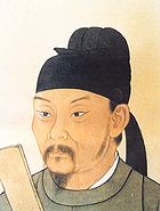
Du Fu

Encyclopedia
Du Fu was a prominent Chinese poet of the Tang Dynasty
.
Along with Li Bai
(Li Bo), he is frequently called the greatest of the Chinese poet
s. His greatest ambition was to serve his country as a successful civil servant, but he proved unable to make the necessary accommodations. His life, like the whole country, was devastated by the An Lushan Rebellion of 755, and his last 15 years were a time of almost constant unrest.
Although initially he was little known to other writers, his works came to be hugely influential in both Chinese
and Japanese
literary culture. Of his poetic writing, nearly fifteen hundred poems have been preserved over the ages. He has been called the "Poet-Historian" and the "Poet-Sage" by Chinese critics, while the range of his work has allowed him to be introduced to Western
readers as "the Chinese Virgil
, Horace
, Ovid
, Shakespeare, Milton
, Burns
, Wordsworth
, Béranger
, Hugo
or Baudelaire".
Traditionally, Chinese literary criticism
has placed great emphasis on knowledge of the life of the author when interpreting a work, a practice which Watson attributes to "the close links that traditional Chinese thought posits between art and morality". Since many of Du Fu's poems prominently feature morality and history, this practice is particularly important. Another reason, identified by the Chinese historian William Hung, is that Chinese poems are typically extremely concise, omitting circumstantial factors that might be relevant, but which could be reconstructed by an informed contemporary. For modern Western
readers, "The less accurately we know the time, the place and the circumstances in the background, the more liable we are to imagine it incorrectly, and the result will be that we either misunderstand the poem or fail to understand it altogether". Owen suggests a third factor particular to Du Fu, arguing that the variety of the poet's work required consideration of his whole life, rather than the "reductive" categorisations used for more limited poets.
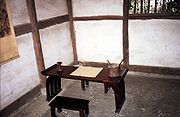 Most of what is known of Du Fu’s life comes from his poems. His paternal grandfather was Du Shenyan
, a noted politician and poet during the reign of Empress Wu. Du Fu was born in 712; the birthplace is unknown, except that it was near Luoyang
, Henan
province (Gong
county is a favourite candidate). In later life, he considered himself to belong to the capital city of Chang'an
, ancestral hometown of the Du family.
Du Fu's mother died shortly after he was born, and he was partially raised by his aunt. He had an elder brother, who died young. He also had three half brothers and one half sister, to whom he frequently refers in his poems, although he never mentions his stepmother.
The son of a minor scholar-official, his youth was spent on the standard education of a future civil servant: study and memorisation of the Confucian classics
of philosophy
, history and poetry. He later claimed to have produced creditable poems by his early teens, but these have been lost.
 In the early 730s, he travelled in the Jiangsu
/Zhejiang
area; his earliest surviving poem, describing a poetry contest, is thought to date from the end of this period, around 735.
In that year, he took the civil service exam
, likely in Chang'an
. He failed, to his surprise and that of centuries of later critics. Hung concludes that he probably failed because his prose
style at the time was too dense and obscure, while Chou suggests his failure to cultivate connections in the capital may have been to blame. After this failure, he went back to traveling, this time around Shandong
and Hebei
.
His father died around 740. Du Fu would have been allowed to enter the civil service because of his father's rank, but he is thought to have given up the privilege in favour of one of his half brothers. He spent the next four years living in the Luoyang area, fulfilling his duties in domestic affairs.
In the autumn of 744, he met Li Bai
(Li Po) for the first time, and the two poets formed a friendship. David Young describes this as "the most significant formative element in Du Fu's artistic development" because it gave him a living example of the reclusive poet-scholar life to which he was attracted after his failure in the civil service exam. The relationship was somewhat one-sided, however. Du Fu was by some years the younger, while Li Bai was already a poetic star. We have twelve poems to or about Li Bai from the younger poet, but only one in the other direction. They met again only once, in 745.
In 746, he moved to the capital in an attempt to resurrect his official career. He took the civil service exam a second time during the following year, but all the candidates were failed by the prime minister
(apparently in order to prevent the emergence of possible rivals). He never again attempted the examinations, instead petitioning the emperor directly in 751, 754 and probably again in 755. He married around 752, and by 757 the couple had had five children—three sons and two daughters—but one of the sons died in infancy in 755. From 754 he began to have lung problems (probably asthma
), the first of a series of ailments which dogged him for the rest of his life. It was in that year that Du Fu was forced to move his family due to the turmoil of a famine brought about by massive floods in the region.
In 755, he received an appointment as Registrar of the Right Commandant's office of the Crown Prince's Palace. Although this was a minor post, in normal times it would have been at least the start of an official career. Even before he had begun work, however, the position was swept away by events.
During this time, Du Fu led a largely itinerant life unsettled by wars, associated famines and imperial
displeasure. This period of unhappiness was the making of Du Fu as a poet: Eva Shan Chou has written that, "What he saw around him—the lives of his family, neighbors, and strangers– what he heard, and what he hoped for or feared from the progress of various campaigns—these became the enduring themes of his poetry". Even when he learned of the death of his youngest child, he turned to the suffering of others in his poetry instead of dwelling upon his own misfortunes. Du Fu wrote:
In 756, Emperor Xuanzong was forced to flee the capital and abdicate. Du Fu, who had been away from the city, took his family to a place of safety and attempted to join the court of the new emperor (Suzong), but he was captured by the rebels and taken to Chang’an. In the autumn, his youngest son, Du Zongwu (Baby Bear), was born. Around this time Du Fu is thought to have contracted malaria.
He escaped from Chang'an the following year, and was appointed Reminder when he rejoined the court in May 757. This post gave access to the emperor but was largely ceremonial. Du Fu's conscientiousness compelled him to try to make use of it: he caused trouble for himself by protesting the removal of his friend and patron Fang Guan
on a petty charge. He was arrested but was pardon
ed in June. He was granted leave to visit his family in September, but he soon rejoined the court and on December 8, 757, he returned to Chang’an with the emperor following its recapture by government forces. However, his advice continued to be unappreciated, and in the summer of 758 he was demoted to a post as Commissioner of Education in Huazhou. The position was not to his taste: in one poem, he wrote:
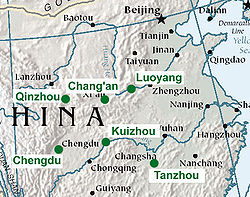
He moved on in the summer of 759; this has traditionally been ascribed to famine, but Hung believes that frustration is a more likely reason. He next spent around six weeks in Qinzhou (now Tianshui
, Gansu
province), where he wrote more than sixty poems.
(Sichuan
province), where he was hosted by local Prefect and fellow poet Pei Di
. Du subsequently based himself in Sichuan for most of the next five years. By the autumn of that year he was in financial trouble, and sent poems begging help to various acquaintances. He was relieved by Yan Wu, a friend and former colleague who was appointed governor general at Chengdu. Despite his financial problems, this was one of the happiest and most peaceful periods of his life, and many of his poems from this period are peaceful depictions of his life in his famous "thatched hut".
In 762, he left the city to escape a rebellion, but he returned in summer 764 and was appointed as an advisor to Yan, who was involved in campaigns against the Tibetan Empire.
, apparently with the intention of making their way there. They traveled slowly, held up by his ill-health (by this time he was suffering from poor eyesight, deafness and general old age in addition to his previous ailments). They stayed in Kuizhou (now Baidicheng, Chongqing
) at the entrance to the Three Gorges for almost two years from late spring 766. This period was Du Fu's last great poetic flowering, and here he wrote 400 poems in his dense, late style.
In autumn 766, Bo Maolin became governor of the region: he supported Du Fu financially and employed him as his unofficial secretary.
In March 768, he began his journey again and got as far as Hunan
province, where he died in Tanzhou (now Changsha) in November or December 770, in his 58th year. He was survived by his wife and two sons, who remained in the area for some years at least. His last known descendant is a grandson who requested a grave inscription for the poet from Yuan Zhen
in 813.
Hung summarises his life by concluding that, "He appeared to be a filial son, an affectionate father, a generous brother, a faithful husband, a loyal friend, a dutiful official, and a patriotic subject."
Below is an example of one of Du Fu's later works, To My Retired Friend Wei (Chinese: 贈衛八處士). Like many other poems in the Tang it featured the theme of a long parting between friends, which was often due to officials being frequently transferred to the provinces:
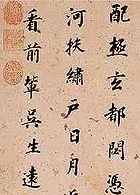 Criticism of Du Fu's works has focused on his strong sense of history, his moral engagement, and his technical excellence.
, critics have called Du Fu the "poet historian" (詩史 shī shǐ). The most directly historical of his poems are those commenting on military tactics or the successes and failures of the government, or the poems of advice which he wrote to the emperor. Indirectly, he wrote about the effect of the times in which he lived on himself, and on the ordinary people of China. As Watson notes, this is information "of a kind seldom found in the officially compiled histories of the era".
Du Fu's political comments are based on emotion rather than calculation: his prescriptions have been paraphrased as, "Let us all be less selfish, let us all do what we are supposed to do". Since his views were impossible to disagree with, his forcefully expressed truisms enabled his installation as the central figure of Chinese poetic history.
of Chinese critics is that of "poet sage" (詩聖 shī shèng), a counterpart to the philosophical sage, Confucius
. One of the earliest surviving works, The Song of the Wagons (from around 750), gives voice to the sufferings of a conscript
soldier in the imperial army, even before the beginning of the rebellion; this poem brings out the tension between the need of acceptance and fulfilment of one's duties
, and a clear-sighted consciousness of the suffering which this can involve. These themes are continuously articulated in the poems on the lives of both soldiers and civilians which Du Fu produced throughout his life.
Although Du Fu's frequent references to his own difficulties can give the impression of an all-consuming solipsism
, Hawkes argues that his "famous compassion in fact includes himself, viewed quite objectively and almost as an afterthought". He therefore "lends grandeur" to the wider picture by comparing it to "his own slightly comical triviality".
Du Fu's compassion, for himself and for others, was part of his general broadening of the scope of poetry: he devoted many works to topics which had previously been considered unsuitable for poetic treatment. Zhang Jie wrote that for Du Fu, "everything in this world is poetry", and he wrote extensively on subjects such as domestic life, calligraphy, paintings, animals, and other poems.
' description of Confucius
. Yuan Zhen
was the first to note the breadth of Du Fu's achievement, writing in 813 that his predecessor, "united in his work traits which previous men had displayed only singly". He mastered all the forms of Chinese poetry
: Chou says that in every form he "either made outstanding advances or contributed outstanding examples". Furthermore, his poems use a wide range of registers
, from the direct and colloquial to the allusive
and self-consciously literary. This variety is manifested even within individual works: Owen identifies the, "rapid stylistic and thematic shifts" in poems which enable the poet to represent different facets of a situation, while Chou uses the term "juxtaposition" as the major analytical tool in her work. Du Fu is noted for having written more on poetics and painting than any other writer of his time. He wrote eighteen poems on painting alone, more than any other Tang poet. Du Fu's seemingly negative commentary on the prized horse paintings of Han Gan
ignited a controversy that has persisted to the present day.
The tenor of his work changed as he developed his style and adapted to his surroundings ("chameleon
-like" according to Watson): his earliest works are in a relatively derivative, courtly style, but he came into his own in the years of the rebellion. Owen comments on the "grim simplicity" of the Qinzhou poems, which mirrors the desert landscape; the works from his Chengdu period are "light, often finely observed"; while the poems from the late Kuizhou period have a "density and power of vision".
Although he wrote in all poetic forms, Du Fu is best known for his lǜshi, a type of poem with strict constraints on the form and content of the work:
About two thirds of Du Fu's 1500 extant works are in this form, and he is generally considered to be its leading exponent. His best lǜshi use the parallelisms required by the form to add expressive content rather than as mere technical restrictions. Hawkes comments that, "it is amazing that Tu Fu is able to use so immensely stylized a form in so natural a manner".
, Du Fu's writings are considered by many literary critics to be among the greatest of all time, and it states "his dense, compressed language makes use of all the connotative overtones of a phrase and of all the intonational potentials of the individual word, qualities that no translation can ever reveal."
In his lifetime and immediately following his death, Du Fu was not greatly appreciated. In part this can be attributed to his stylistic and formal innovations, some of which are still "considered extremely daring and bizarre by Chinese critics." There are few contemporary references to him—only eleven poems from six writers—and these describe him in terms of affection, but not as a paragon of poetic or moral ideals. Du Fu is also poorly represented in contemporary anthologies of poetry.
However, as Hung notes, he "is the only Chinese poet whose influence grew with time", and his works began to increase in popularity in the ninth century. Early positive comments came from Bai Juyi, who praised the moral sentiments of some of Du Fu's works (although he found these in only a small fraction of the poems), and from Han Yu
, who wrote a piece defending Du Fu and Li Bai
on aesthetic grounds from attacks made against them. Both these writers showed the influence of Du Fu in their own poetic work. By the beginning of the 10th century, Wei Zhuang
constructed the first replica of his thatched cottage in Sichuan.
It was in the 11th century, during the Northern Song era that Du Fu's reputation reached its peak. In this period a comprehensive re-evaluation of earlier poets took place, in which Wang Wei, Li Bai and Du Fu came to be regarded as representing respectively the Buddhist
, Daoist and Confucian
strands of Chinese culture. At the same time, the development of Neo-Confucianism
ensured that Du Fu, as its poetic exemplar, occupied the paramount position. Su Shi
famously expressed this reasoning when he wrote that Du Fu was "preeminent... because... through all his vicissitudes, he never for the space of a meal forgot his sovereign". His influence was helped by his ability to reconcile apparent opposites: political conservatives
were attracted by his loyalty to the established order, while political radicals
embraced his concern for the poor. Literary conservatives could look to his technical mastery, while literary radicals were inspired by his innovations. Since the establishment of the People's Republic of China
, Du Fu's loyalty to the state and concern for the poor have been interpreted as embryonic nationalism and socialism, and he has been praised for his use of simple, "people's language
".
Du Fu's popularity grew to such an extent that it is as hard to measure his influence as that of Shakespeare in England
: it was hard for any Chinese poet not to be influenced by him. While there was never another Du Fu, individual poets followed in the traditions of specific aspects of his work: Bai Juyi's concern for the poor, Lu You
's patriotism, and Mei Yaochen
's reflections on the quotidian are a few examples. More broadly, Du Fu's work in transforming the lǜshi from mere word play
into "a vehicle for serious poetic utterance" set the stage for every subsequent writer in the genre.
Du Fu has also been influential beyond China, although in common with the other High Tang poets, his reception into the Japanese
literary culture was relatively late. It was not until the 17th century that he was accorded the same level of fame in Japan as in China, but he then had a profound influence on poets such as Matsuo Bashō
. In the 20th century, he was the favourite poet of Kenneth Rexroth
, who has described him as "the greatest non-epic
, non-drama
tic poet who has survived in any language", and commented that, "he has made me a better man, as a moral agent and as a perceiving organism".
remarks in The Selected Poems of Du Fu
, “There are many different ways to approach the problems involved in translating Du Fu, which is why we need as many different translations as possible” (p. xxii). The translators have had to contend with bringing out the formal constraints of the original without sounding laboured to a Western ear (particularly when translating regulated verse, or lǜshi), and accommodating the complex allusions contained particularly in the later works (Hawkes writes that "his poems do not as a rule come through very well in translation"—p. ix). One extreme on each issue is represented by Kenneth Rexroth
’s One Hundred Poems From the Chinese
. His are free translations, which seek to conceal the parallelisms through enjambement and expansion and contraction of the content; his responses to the allusions are firstly to omit most of these poems from his selection, and secondly to “translate out” the references in those works which he does select.
Other translators have placed much greater weight on trying to convey a sense of the poetic forms used by Du Fu. Vikram Seth
in Three Chinese Poets
uses English-style rhyme schemes, whereas Keith Holyoak
in Facing the Moon
approximates the Chinese rhyme scheme; both use end-stopped lines and preserve some degree of parallelism. In The Selected Poems of Du Fu
, Burton Watson
follows the parallelisms quite strictly, persuading the western reader to adapt to the poems rather than vice versa. Similarly, he deals with the allusion of the later works by combining literal translation with extensive annotation
.
Tang Dynasty
The Tang Dynasty was an imperial dynasty of China preceded by the Sui Dynasty and followed by the Five Dynasties and Ten Kingdoms Period. It was founded by the Li family, who seized power during the decline and collapse of the Sui Empire...
.
Along with Li Bai
Li Bai
Li Bai , also known in the West by various other transliterations, especially Li Po, was a major Chinese poet of the Tang dynasty poetry period. He has been regarded as one of the greatest poets in China's Tang period, which is often called China's "golden age" of poetry. Around a thousand existing...
(Li Bo), he is frequently called the greatest of the Chinese poet
Poet
A poet is a person who writes poetry. A poet's work can be literal, meaning that his work is derived from a specific event, or metaphorical, meaning that his work can take on many meanings and forms. Poets have existed since antiquity, in nearly all languages, and have produced works that vary...
s. His greatest ambition was to serve his country as a successful civil servant, but he proved unable to make the necessary accommodations. His life, like the whole country, was devastated by the An Lushan Rebellion of 755, and his last 15 years were a time of almost constant unrest.
Although initially he was little known to other writers, his works came to be hugely influential in both Chinese
Culture of China
Chinese culture is one of the world's oldest and most complex. The area in which the culture is dominant covers a large geographical region in eastern Asia with customs and traditions varying greatly between towns, cities and provinces...
and Japanese
Culture of Japan
The culture of Japan has evolved greatly over the millennia, from the country's prehistoric Jōmon period to its contemporary hybrid culture, which combines influences from Asia, Europe and North America...
literary culture. Of his poetic writing, nearly fifteen hundred poems have been preserved over the ages. He has been called the "Poet-Historian" and the "Poet-Sage" by Chinese critics, while the range of his work has allowed him to be introduced to Western
Western culture
Western culture, sometimes equated with Western civilization or European civilization, refers to cultures of European origin and is used very broadly to refer to a heritage of social norms, ethical values, traditional customs, religious beliefs, political systems, and specific artifacts and...
readers as "the Chinese Virgil
Virgil
Publius Vergilius Maro, usually called Virgil or Vergil in English , was an ancient Roman poet of the Augustan period. He is known for three major works of Latin literature, the Eclogues , the Georgics, and the epic Aeneid...
, Horace
Horace
Quintus Horatius Flaccus , known in the English-speaking world as Horace, was the leading Roman lyric poet during the time of Augustus.-Life:...
, Ovid
Ovid
Publius Ovidius Naso , known as Ovid in the English-speaking world, was a Roman poet who is best known as the author of the three major collections of erotic poetry: Heroides, Amores, and Ars Amatoria...
, Shakespeare, Milton
John Milton
John Milton was an English poet, polemicist, a scholarly man of letters, and a civil servant for the Commonwealth of England under Oliver Cromwell...
, Burns
Robert Burns
Robert Burns was a Scottish poet and a lyricist. He is widely regarded as the national poet of Scotland, and is celebrated worldwide...
, Wordsworth
William Wordsworth
William Wordsworth was a major English Romantic poet who, with Samuel Taylor Coleridge, helped to launch the Romantic Age in English literature with the 1798 joint publication Lyrical Ballads....
, Béranger
Pierre-Jean de Béranger
Pierre-Jean de Béranger was a prolific French poet and chansonnier , who enjoyed great popularity and influence in France during his lifetime, but faded into obscurity in the decades following his death...
, Hugo
Victor Hugo
Victor-Marie Hugo was a Frenchpoet, playwright, novelist, essayist, visual artist, statesman, human rights activist and exponent of the Romantic movement in France....
or Baudelaire".
Life
| Names Chinese name Personal names in Chinese culture follow a number of conventions different from those of personal names in Western cultures. Most noticeably, a Chinese name is written with the family name first and the given name next, therefore "John-Paul Smith" as a Chinese name would be "Smith John-Paul"... |
|
|---|---|
| Chinese Chinese language The Chinese language is a language or language family consisting of varieties which are mutually intelligible to varying degrees. Originally the indigenous languages spoken by the Han Chinese in China, it forms one of the branches of Sino-Tibetan family of languages... : |
杜甫 |
| Pinyin Pinyin Pinyin is the official system to transcribe Chinese characters into the Roman alphabet in China, Malaysia, Singapore and Taiwan. It is also often used to teach Mandarin Chinese and spell Chinese names in foreign publications and used as an input method to enter Chinese characters into... : |
Dù Fǔ |
| Wade-Giles Wade-Giles Wade–Giles , sometimes abbreviated Wade, is a romanization system for the Mandarin Chinese language. It developed from a system produced by Thomas Wade during the mid-19th century , and was given completed form with Herbert Giles' Chinese–English dictionary of 1892.Wade–Giles was the most... : |
Tu⁴ Fu³ |
| Zi: | Zǐměi 子美 |
| Also known as: | Dù Shàolíng 杜少陵 Du of Shaoling Dù Gōngbù 杜工部 Du of the Ministry of Works Shàolíng Yělǎo 少陵野老 Shīshèng, 詩圣, The Saint of Poem |
Traditionally, Chinese literary criticism
Literary criticism
Literary criticism is the study, evaluation, and interpretation of literature. Modern literary criticism is often informed by literary theory, which is the philosophical discussion of its methods and goals...
has placed great emphasis on knowledge of the life of the author when interpreting a work, a practice which Watson attributes to "the close links that traditional Chinese thought posits between art and morality". Since many of Du Fu's poems prominently feature morality and history, this practice is particularly important. Another reason, identified by the Chinese historian William Hung, is that Chinese poems are typically extremely concise, omitting circumstantial factors that might be relevant, but which could be reconstructed by an informed contemporary. For modern Western
Western culture
Western culture, sometimes equated with Western civilization or European civilization, refers to cultures of European origin and is used very broadly to refer to a heritage of social norms, ethical values, traditional customs, religious beliefs, political systems, and specific artifacts and...
readers, "The less accurately we know the time, the place and the circumstances in the background, the more liable we are to imagine it incorrectly, and the result will be that we either misunderstand the poem or fail to understand it altogether". Owen suggests a third factor particular to Du Fu, arguing that the variety of the poet's work required consideration of his whole life, rather than the "reductive" categorisations used for more limited poets.
Early years
Du Shenyan
Du Shenyan , and whose name, especially in older English transliteration, appears as "Tu Shen-yen", was a poet of the Early Tang Dynasty, and one of whose poems was collected in the popular anthology Three Hundred Tang Poems.-Biography:...
, a noted politician and poet during the reign of Empress Wu. Du Fu was born in 712; the birthplace is unknown, except that it was near Luoyang
Luoyang
Luoyang is a prefecture-level city in western Henan province of Central China. It borders the provincial capital of Zhengzhou to the east, Pingdingshan to the southeast, Nanyang to the south, Sanmenxia to the west, Jiyuan to the north, and Jiaozuo to the northeast.Situated on the central plain of...
, Henan
Henan
Henan , is a province of the People's Republic of China, located in the central part of the country. Its one-character abbreviation is "豫" , named after Yuzhou , a Han Dynasty state that included parts of Henan...
province (Gong
Gongyi
Gongyi , formerly Gong County , is a county-level city belonging to the city of Zhengzhou in Henan province, China. It has a population of 790,000 people and an area of 1,041 square kilometres....
county is a favourite candidate). In later life, he considered himself to belong to the capital city of Chang'an
Chang'an
Chang'an is an ancient capital of more than ten dynasties in Chinese history, today known as Xi'an. Chang'an literally means "Perpetual Peace" in Classical Chinese. During the short-lived Xin Dynasty, the city was renamed "Constant Peace" ; yet after its fall in AD 23, the old name was restored...
, ancestral hometown of the Du family.
Du Fu's mother died shortly after he was born, and he was partially raised by his aunt. He had an elder brother, who died young. He also had three half brothers and one half sister, to whom he frequently refers in his poems, although he never mentions his stepmother.
The son of a minor scholar-official, his youth was spent on the standard education of a future civil servant: study and memorisation of the Confucian classics
Chinese classic texts
Chinese classic texts, or Chinese canonical texts, today often refer to the pre-Qin Chinese texts, especially the Neo-Confucian titles of Four Books and Five Classics , a selection of short books and chapters from the voluminous collection called the Thirteen Classics. All of these pre-Qin texts...
of philosophy
Philosophy
Philosophy is the study of general and fundamental problems, such as those connected with existence, knowledge, values, reason, mind, and language. Philosophy is distinguished from other ways of addressing such problems by its critical, generally systematic approach and its reliance on rational...
, history and poetry. He later claimed to have produced creditable poems by his early teens, but these have been lost.
Jiangsu
' is a province of the People's Republic of China, located along the east coast of the country. The name comes from jiang, short for the city of Jiangning , and su, for the city of Suzhou. The abbreviation for this province is "苏" , the second character of its name...
/Zhejiang
Zhejiang
Zhejiang is an eastern coastal province of the People's Republic of China. The word Zhejiang was the old name of the Qiantang River, which passes through Hangzhou, the provincial capital...
area; his earliest surviving poem, describing a poetry contest, is thought to date from the end of this period, around 735.
In that year, he took the civil service exam
Imperial examination
The Imperial examination was an examination system in Imperial China designed to select the best administrative officials for the state's bureaucracy. This system had a huge influence on both society and culture in Imperial China and was directly responsible for the creation of a class of...
, likely in Chang'an
Chang'an
Chang'an is an ancient capital of more than ten dynasties in Chinese history, today known as Xi'an. Chang'an literally means "Perpetual Peace" in Classical Chinese. During the short-lived Xin Dynasty, the city was renamed "Constant Peace" ; yet after its fall in AD 23, the old name was restored...
. He failed, to his surprise and that of centuries of later critics. Hung concludes that he probably failed because his prose
Prose
Prose is the most typical form of written language, applying ordinary grammatical structure and natural flow of speech rather than rhythmic structure...
style at the time was too dense and obscure, while Chou suggests his failure to cultivate connections in the capital may have been to blame. After this failure, he went back to traveling, this time around Shandong
Shandong
' is a Province located on the eastern coast of the People's Republic of China. Shandong has played a major role in Chinese history from the beginning of Chinese civilization along the lower reaches of the Yellow River and served as a pivotal cultural and religious site for Taoism, Chinese...
and Hebei
Hebei
' is a province of the People's Republic of China in the North China region. Its one-character abbreviation is "" , named after Ji Province, a Han Dynasty province that included what is now southern Hebei...
.
His father died around 740. Du Fu would have been allowed to enter the civil service because of his father's rank, but he is thought to have given up the privilege in favour of one of his half brothers. He spent the next four years living in the Luoyang area, fulfilling his duties in domestic affairs.
In the autumn of 744, he met Li Bai
Li Bai
Li Bai , also known in the West by various other transliterations, especially Li Po, was a major Chinese poet of the Tang dynasty poetry period. He has been regarded as one of the greatest poets in China's Tang period, which is often called China's "golden age" of poetry. Around a thousand existing...
(Li Po) for the first time, and the two poets formed a friendship. David Young describes this as "the most significant formative element in Du Fu's artistic development" because it gave him a living example of the reclusive poet-scholar life to which he was attracted after his failure in the civil service exam. The relationship was somewhat one-sided, however. Du Fu was by some years the younger, while Li Bai was already a poetic star. We have twelve poems to or about Li Bai from the younger poet, but only one in the other direction. They met again only once, in 745.
In 746, he moved to the capital in an attempt to resurrect his official career. He took the civil service exam a second time during the following year, but all the candidates were failed by the prime minister
Prime minister
A prime minister is the most senior minister of cabinet in the executive branch of government in a parliamentary system. In many systems, the prime minister selects and may dismiss other members of the cabinet, and allocates posts to members within the government. In most systems, the prime...
(apparently in order to prevent the emergence of possible rivals). He never again attempted the examinations, instead petitioning the emperor directly in 751, 754 and probably again in 755. He married around 752, and by 757 the couple had had five children—three sons and two daughters—but one of the sons died in infancy in 755. From 754 he began to have lung problems (probably asthma
Asthma
Asthma is the common chronic inflammatory disease of the airways characterized by variable and recurring symptoms, reversible airflow obstruction, and bronchospasm. Symptoms include wheezing, coughing, chest tightness, and shortness of breath...
), the first of a series of ailments which dogged him for the rest of his life. It was in that year that Du Fu was forced to move his family due to the turmoil of a famine brought about by massive floods in the region.
In 755, he received an appointment as Registrar of the Right Commandant's office of the Crown Prince's Palace. Although this was a minor post, in normal times it would have been at least the start of an official career. Even before he had begun work, however, the position was swept away by events.
War
The An Lushan Rebellion began in December 755, and was not completely suppressed for almost eight years. It caused enormous disruption to Chinese society: the census of 754 recorded 52.9 million people, but ten years later, the census counted just 16.9 million, the remainder having been displaced or killed.During this time, Du Fu led a largely itinerant life unsettled by wars, associated famines and imperial
Emperor of China
The Emperor of China refers to any sovereign of Imperial China reigning between the founding of Qin Dynasty of China, united by the King of Qin in 221 BCE, and the fall of Yuan Shikai's Empire of China in 1916. When referred to as the Son of Heaven , a title that predates the Qin unification, the...
displeasure. This period of unhappiness was the making of Du Fu as a poet: Eva Shan Chou has written that, "What he saw around him—the lives of his family, neighbors, and strangers– what he heard, and what he hoped for or feared from the progress of various campaigns—these became the enduring themes of his poetry". Even when he learned of the death of his youngest child, he turned to the suffering of others in his poetry instead of dwelling upon his own misfortunes. Du Fu wrote:
- "Brooding on what I have lived through, if even I know such suffering, the common man must surely be rattled by the winds."
In 756, Emperor Xuanzong was forced to flee the capital and abdicate. Du Fu, who had been away from the city, took his family to a place of safety and attempted to join the court of the new emperor (Suzong), but he was captured by the rebels and taken to Chang’an. In the autumn, his youngest son, Du Zongwu (Baby Bear), was born. Around this time Du Fu is thought to have contracted malaria.
He escaped from Chang'an the following year, and was appointed Reminder when he rejoined the court in May 757. This post gave access to the emperor but was largely ceremonial. Du Fu's conscientiousness compelled him to try to make use of it: he caused trouble for himself by protesting the removal of his friend and patron Fang Guan
Fang Guan
Fang Guan , courtesy name Cilü , formally the Duke of Qinghe , was an official of the Chinese dynasty Tang Dynasty, serving as a chancellor during the reigns of Emperor Xuanzong and Emperor Suzong....
on a petty charge. He was arrested but was pardon
Pardon
Clemency means the forgiveness of a crime or the cancellation of the penalty associated with it. It is a general concept that encompasses several related procedures: pardoning, commutation, remission and reprieves...
ed in June. He was granted leave to visit his family in September, but he soon rejoined the court and on December 8, 757, he returned to Chang’an with the emperor following its recapture by government forces. However, his advice continued to be unappreciated, and in the summer of 758 he was demoted to a post as Commissioner of Education in Huazhou. The position was not to his taste: in one poem, he wrote:
- "I am about to scream madly in the office/Especially when they bring more papers to pile higher on my desk."
He moved on in the summer of 759; this has traditionally been ascribed to famine, but Hung believes that frustration is a more likely reason. He next spent around six weeks in Qinzhou (now Tianshui
Tianshui
Tianshui is the second largest city in Gansu province in northwest China. Its population is approximately 3,500,000.Tianshui lies along the route of the ancient Northern Silk Road at the Wei River, through which much of trade occurred between China and the west...
, Gansu
Gansu
' is a province located in the northwest of the People's Republic of China.It lies between the Tibetan and Huangtu plateaus, and borders Mongolia, Inner Mongolia, and Ningxia to the north, Xinjiang and Qinghai to the west, Sichuan to the south, and Shaanxi to the east...
province), where he wrote more than sixty poems.
Chengdu
In 760, he arrived in ChengduChengdu
Chengdu , formerly transliterated Chengtu, is the capital of Sichuan province in Southwest China. It holds sub-provincial administrative status...
(Sichuan
Sichuan
' , known formerly in the West by its postal map spellings of Szechwan or Szechuan is a province in Southwest China with its capital in Chengdu...
province), where he was hosted by local Prefect and fellow poet Pei Di
Pei Di
Pei Di was a Chinese poet of the Tang Dynasty, and a contemporary of Wang Wei, although younger by fifteen years. The poet's name is also rendered into English as "Pei Ti". the close personal friendship between Wang Wei and Pei Di is preserved in a letter by Wang Wei inviting him for a Springtime...
. Du subsequently based himself in Sichuan for most of the next five years. By the autumn of that year he was in financial trouble, and sent poems begging help to various acquaintances. He was relieved by Yan Wu, a friend and former colleague who was appointed governor general at Chengdu. Despite his financial problems, this was one of the happiest and most peaceful periods of his life, and many of his poems from this period are peaceful depictions of his life in his famous "thatched hut".
In 762, he left the city to escape a rebellion, but he returned in summer 764 and was appointed as an advisor to Yan, who was involved in campaigns against the Tibetan Empire.
Last years
Luoyang, the region of his birthplace, was recovered by government forces in the winter of 762, and in the spring of 765 Du Fu and his family sailed down the YangtzeYangtze River
The Yangtze, Yangzi or Cháng Jiāng is the longest river in Asia, and the third-longest in the world. It flows for from the glaciers on the Tibetan Plateau in Qinghai eastward across southwest, central and eastern China before emptying into the East China Sea at Shanghai. It is also one of the...
, apparently with the intention of making their way there. They traveled slowly, held up by his ill-health (by this time he was suffering from poor eyesight, deafness and general old age in addition to his previous ailments). They stayed in Kuizhou (now Baidicheng, Chongqing
Chongqing
Chongqing is a major city in Southwest China and one of the five national central cities of China. Administratively, it is one of the PRC's four direct-controlled municipalities , and the only such municipality in inland China.The municipality was created on 14 March 1997, succeeding the...
) at the entrance to the Three Gorges for almost two years from late spring 766. This period was Du Fu's last great poetic flowering, and here he wrote 400 poems in his dense, late style.
In autumn 766, Bo Maolin became governor of the region: he supported Du Fu financially and employed him as his unofficial secretary.
In March 768, he began his journey again and got as far as Hunan
Hunan
' is a province of South-Central China, located to the south of the middle reaches of the Yangtze River and south of Lake Dongting...
province, where he died in Tanzhou (now Changsha) in November or December 770, in his 58th year. He was survived by his wife and two sons, who remained in the area for some years at least. His last known descendant is a grandson who requested a grave inscription for the poet from Yuan Zhen
Yuan Zhen
Yuan Zhen , courtesy name Weizhi , was a politician of the middle Tang Dynasty, but is more known as an important Chinese writer and poet, particularly for work Yingying's Biography , which was often adapted for other treatments, including operatic and musical ones...
in 813.
Hung summarises his life by concluding that, "He appeared to be a filial son, an affectionate father, a generous brother, a faithful husband, a loyal friend, a dutiful official, and a patriotic subject."
Below is an example of one of Du Fu's later works, To My Retired Friend Wei (Chinese: 贈衛八處士). Like many other poems in the Tang it featured the theme of a long parting between friends, which was often due to officials being frequently transferred to the provinces:
 |
人生不相見, It is almost as hard for friends to meet 動如參與商。 As for the morning and evening stars. 今夕復何夕, Tonight then is a rare event, 共此燈燭光。 Joining, in the candlelight, 少壯能幾時, Two men who were young not long ago 鬢髮各已蒼。 But now are turning grey at the temples. 訪舊半為鬼, To find that half our friends are dead 驚呼熱中腸。 Shocks us, burns our hearts with grief. 焉知二十載, We little guessed it would be twenty years 重上君子堂。 Before I could visit you again. 昔別君未婚, When I went away, you were still unmarried; 兒女忽成行。 But now these boys and girls in a row 怡然敬父執, Are very kind to their father's old friend. 問我來何方。 They ask me where I have been on my journey; 問答乃未已, And then, when we have talked awhile, 兒女羅酒漿。 They bring and show me wines and dishes, 夜雨翦春韭, Spring chives cut in the night-rain 新炊間黃粱。 And brown rice cooked freshly a special way. 主稱會面難, My host proclaims it a festival, 一舉累十觴。 He urges me to drink ten cups -- 十觴亦不醉, But what ten cups could make me as drunk 感子故意長。 As I always am with your love in my heart? 明日隔山嶽, Tomorrow the mountains will separate us; 世事兩茫茫。 After tomorrow - who can say? |
 |
Works
History
Since the Song dynastySong Dynasty
The Song Dynasty was a ruling dynasty in China between 960 and 1279; it succeeded the Five Dynasties and Ten Kingdoms Period, and was followed by the Yuan Dynasty. It was the first government in world history to issue banknotes or paper money, and the first Chinese government to establish a...
, critics have called Du Fu the "poet historian" (詩史 shī shǐ). The most directly historical of his poems are those commenting on military tactics or the successes and failures of the government, or the poems of advice which he wrote to the emperor. Indirectly, he wrote about the effect of the times in which he lived on himself, and on the ordinary people of China. As Watson notes, this is information "of a kind seldom found in the officially compiled histories of the era".
Du Fu's political comments are based on emotion rather than calculation: his prescriptions have been paraphrased as, "Let us all be less selfish, let us all do what we are supposed to do". Since his views were impossible to disagree with, his forcefully expressed truisms enabled his installation as the central figure of Chinese poetic history.
Moral engagement
A second favourite epithetEpithet
An epithet or byname is a descriptive term accompanying or occurring in place of a name and having entered common usage. It has various shades of meaning when applied to seemingly real or fictitious people, divinities, objects, and binomial nomenclature. It is also a descriptive title...
of Chinese critics is that of "poet sage" (詩聖 shī shèng), a counterpart to the philosophical sage, Confucius
Confucius
Confucius , literally "Master Kong", was a Chinese thinker and social philosopher of the Spring and Autumn Period....
. One of the earliest surviving works, The Song of the Wagons (from around 750), gives voice to the sufferings of a conscript
Conscription
Conscription is the compulsory enlistment of people in some sort of national service, most often military service. Conscription dates back to antiquity and continues in some countries to the present day under various names...
soldier in the imperial army, even before the beginning of the rebellion; this poem brings out the tension between the need of acceptance and fulfilment of one's duties
Duty
Duty is a term that conveys a sense of moral commitment to someone or something. The moral commitment is the sort that results in action and it is not a matter of passive feeling or mere recognition...
, and a clear-sighted consciousness of the suffering which this can involve. These themes are continuously articulated in the poems on the lives of both soldiers and civilians which Du Fu produced throughout his life.
Although Du Fu's frequent references to his own difficulties can give the impression of an all-consuming solipsism
Solipsism
Solipsism is the philosophical idea that only one's own mind is sure to exist. The term comes from Latin solus and ipse . Solipsism as an epistemological position holds that knowledge of anything outside one's own mind is unsure. The external world and other minds cannot be known, and might not...
, Hawkes argues that his "famous compassion in fact includes himself, viewed quite objectively and almost as an afterthought". He therefore "lends grandeur" to the wider picture by comparing it to "his own slightly comical triviality".
Du Fu's compassion, for himself and for others, was part of his general broadening of the scope of poetry: he devoted many works to topics which had previously been considered unsuitable for poetic treatment. Zhang Jie wrote that for Du Fu, "everything in this world is poetry", and he wrote extensively on subjects such as domestic life, calligraphy, paintings, animals, and other poems.
Technical excellence
Du Fu's work is notable above all for its range. Chinese critics traditionally used the term 集大成 (jídàchéng- "complete symphony"), a reference to MenciusMencius
Mencius was a Chinese philosopher who was arguably the most famous Confucian after Confucius himself.-Life:Mencius, also known by his birth name Meng Ke or Ko, was born in the State of Zou, now forming the territory of the county-level city of Zoucheng , Shandong province, only thirty kilometres ...
' description of Confucius
Confucius
Confucius , literally "Master Kong", was a Chinese thinker and social philosopher of the Spring and Autumn Period....
. Yuan Zhen
Yuan Zhen
Yuan Zhen , courtesy name Weizhi , was a politician of the middle Tang Dynasty, but is more known as an important Chinese writer and poet, particularly for work Yingying's Biography , which was often adapted for other treatments, including operatic and musical ones...
was the first to note the breadth of Du Fu's achievement, writing in 813 that his predecessor, "united in his work traits which previous men had displayed only singly". He mastered all the forms of Chinese poetry
Chinese poetry
Chinese poetry is poetry written, spoken, or chanted in the Chinese language, which includes various versions of Chinese language, including Classical Chinese, Standard Chinese, Mandarin Chinese, Cantonese, Yue Chinese, as well as many other historical and vernacular varieties of the Chinese language...
: Chou says that in every form he "either made outstanding advances or contributed outstanding examples". Furthermore, his poems use a wide range of registers
Register (linguistics)
In linguistics, a register is a variety of a language used for a particular purpose or in a particular social setting. For example, when speaking in a formal setting an English speaker may be more likely to adhere more closely to prescribed grammar, pronounce words ending in -ing with a velar nasal...
, from the direct and colloquial to the allusive
Allusion
An allusion is a figure of speech that makes a reference to, or representation of, people, places, events, literary work, myths, or works of art, either directly or by implication. M. H...
and self-consciously literary. This variety is manifested even within individual works: Owen identifies the, "rapid stylistic and thematic shifts" in poems which enable the poet to represent different facets of a situation, while Chou uses the term "juxtaposition" as the major analytical tool in her work. Du Fu is noted for having written more on poetics and painting than any other writer of his time. He wrote eighteen poems on painting alone, more than any other Tang poet. Du Fu's seemingly negative commentary on the prized horse paintings of Han Gan
Han Gan
Han Gan was a Tang Dynasty painter.He came from a poor family in either Chang'an, modern day Xi'an, Shaanxi; Lantian, modern day Shaanxi; or Daliang, modern day Kaifeng, Henan. As a young man, Han Gan was recognized by Wang Wei, a prominent poet, who sponsored Han in learning arts...
ignited a controversy that has persisted to the present day.
The tenor of his work changed as he developed his style and adapted to his surroundings ("chameleon
Chameleon
Chameleons are a distinctive and highly specialized clade of lizards. They are distinguished by their parrot-like zygodactylous feet, their separately mobile and stereoscopic eyes, their very long, highly modified, and rapidly extrudable tongues, their swaying gait, the possession by many of a...
-like" according to Watson): his earliest works are in a relatively derivative, courtly style, but he came into his own in the years of the rebellion. Owen comments on the "grim simplicity" of the Qinzhou poems, which mirrors the desert landscape; the works from his Chengdu period are "light, often finely observed"; while the poems from the late Kuizhou period have a "density and power of vision".
Although he wrote in all poetic forms, Du Fu is best known for his lǜshi, a type of poem with strict constraints on the form and content of the work:
| Reply to a Friend's Advice |
|---|
| Stately and beautiful, we pass through the Palace gates, Turning in different directions: you go to the West With the Ministers of State. I, otherwise. On my side, the willow-twigs are fragile, greening. You are struck by scarlet flowers over there. Our separate ways! You write so well, so kindly, To caution, in vain, a garrulous old man. |
About two thirds of Du Fu's 1500 extant works are in this form, and he is generally considered to be its leading exponent. His best lǜshi use the parallelisms required by the form to add expressive content rather than as mere technical restrictions. Hawkes comments that, "it is amazing that Tu Fu is able to use so immensely stylized a form in so natural a manner".
Influence
According to the Encyclopædia BritannicaEncyclopædia Britannica
The Encyclopædia Britannica , published by Encyclopædia Britannica, Inc., is a general knowledge English-language encyclopaedia that is available in print, as a DVD, and on the Internet. It is written and continuously updated by about 100 full-time editors and more than 4,000 expert...
, Du Fu's writings are considered by many literary critics to be among the greatest of all time, and it states "his dense, compressed language makes use of all the connotative overtones of a phrase and of all the intonational potentials of the individual word, qualities that no translation can ever reveal."
In his lifetime and immediately following his death, Du Fu was not greatly appreciated. In part this can be attributed to his stylistic and formal innovations, some of which are still "considered extremely daring and bizarre by Chinese critics." There are few contemporary references to him—only eleven poems from six writers—and these describe him in terms of affection, but not as a paragon of poetic or moral ideals. Du Fu is also poorly represented in contemporary anthologies of poetry.
However, as Hung notes, he "is the only Chinese poet whose influence grew with time", and his works began to increase in popularity in the ninth century. Early positive comments came from Bai Juyi, who praised the moral sentiments of some of Du Fu's works (although he found these in only a small fraction of the poems), and from Han Yu
Han Yu
Han Yu , born in Nanyang, Henan, China, was a precursor of Neo-Confucianism as well as an essayist and poet, during the Tang dynasty. The Indiana Companion calls him "comparable in stature to Dante, Shakespeare or Goethe" for his influence on the Chinese literary tradition . He stood for strong...
, who wrote a piece defending Du Fu and Li Bai
Li Bai
Li Bai , also known in the West by various other transliterations, especially Li Po, was a major Chinese poet of the Tang dynasty poetry period. He has been regarded as one of the greatest poets in China's Tang period, which is often called China's "golden age" of poetry. Around a thousand existing...
on aesthetic grounds from attacks made against them. Both these writers showed the influence of Du Fu in their own poetic work. By the beginning of the 10th century, Wei Zhuang
Wei Zhuang
Wei Zhuang , style name Duanyi , was a Chinese poet and late Tang period historical figure, is best known for his poetry in shi and ci styles. He was born into a family of minor scholars in Duling , a town southwest of the capital Changan....
constructed the first replica of his thatched cottage in Sichuan.
It was in the 11th century, during the Northern Song era that Du Fu's reputation reached its peak. In this period a comprehensive re-evaluation of earlier poets took place, in which Wang Wei, Li Bai and Du Fu came to be regarded as representing respectively the Buddhist
Buddhism
Buddhism is a religion and philosophy encompassing a variety of traditions, beliefs and practices, largely based on teachings attributed to Siddhartha Gautama, commonly known as the Buddha . The Buddha lived and taught in the northeastern Indian subcontinent some time between the 6th and 4th...
, Daoist and Confucian
Confucianism
Confucianism is a Chinese ethical and philosophical system developed from the teachings of the Chinese philosopher Confucius . Confucianism originated as an "ethical-sociopolitical teaching" during the Spring and Autumn Period, but later developed metaphysical and cosmological elements in the Han...
strands of Chinese culture. At the same time, the development of Neo-Confucianism
Neo-Confucianism
Neo-Confucianism is an ethical and metaphysical Chinese philosophy influenced by Confucianism, that was primarily developed during the Song Dynasty and Ming Dynasty, but which can be traced back to Han Yu and Li Ao in the Tang Dynasty....
ensured that Du Fu, as its poetic exemplar, occupied the paramount position. Su Shi
Su Shi
Su Shi , was a writer, poet, artist, calligrapher, pharmacologist, gastronome, and statesman of the Song Dynasty, and one of the major poets of the Song era. His courtesy name was Zizhan and his pseudonym was Dongpo Jushi , and he is often referred to as Su Dongpo...
famously expressed this reasoning when he wrote that Du Fu was "preeminent... because... through all his vicissitudes, he never for the space of a meal forgot his sovereign". His influence was helped by his ability to reconcile apparent opposites: political conservatives
Conservatism
Conservatism is a political and social philosophy that promotes the maintenance of traditional institutions and supports, at the most, minimal and gradual change in society. Some conservatives seek to preserve things as they are, emphasizing stability and continuity, while others oppose modernism...
were attracted by his loyalty to the established order, while political radicals
Radicalism (historical)
The term Radical was used during the late 18th century for proponents of the Radical Movement. It later became a general pejorative term for those favoring or seeking political reforms which include dramatic changes to the social order...
embraced his concern for the poor. Literary conservatives could look to his technical mastery, while literary radicals were inspired by his innovations. Since the establishment of the People's Republic of China
People's Republic of China
China , officially the People's Republic of China , is the most populous country in the world, with over 1.3 billion citizens. Located in East Asia, the country covers approximately 9.6 million square kilometres...
, Du Fu's loyalty to the state and concern for the poor have been interpreted as embryonic nationalism and socialism, and he has been praised for his use of simple, "people's language
Vernacular Chinese
Written Vernacular Chinese refers to forms of written Chinese based on the vernacular language, in contrast to Classical Chinese, the written standard used from the Spring and Autumn Period to the early twentieth century...
".
Du Fu's popularity grew to such an extent that it is as hard to measure his influence as that of Shakespeare in England
England
England is a country that is part of the United Kingdom. It shares land borders with Scotland to the north and Wales to the west; the Irish Sea is to the north west, the Celtic Sea to the south west, with the North Sea to the east and the English Channel to the south separating it from continental...
: it was hard for any Chinese poet not to be influenced by him. While there was never another Du Fu, individual poets followed in the traditions of specific aspects of his work: Bai Juyi's concern for the poor, Lu You
Lu You
Lu You , was a Chinese poet of the Southern Song dynasty.-Early life and marriage:Lu You was born on a boat floating in the Wei River early on a rainy morning, October 17, 1125...
's patriotism, and Mei Yaochen
Mei Yaochen
Mei Yaochen was a poet of the Song dynasty. He was one of the pioneers of the "new subjective" style of poetry which characterized Song poetry....
's reflections on the quotidian are a few examples. More broadly, Du Fu's work in transforming the lǜshi from mere word play
Word play
Word play or wordplay is a literary technique in which the words that are used become the main subject of the work, primarily for the purpose of intended effect or amusement...
into "a vehicle for serious poetic utterance" set the stage for every subsequent writer in the genre.
Du Fu has also been influential beyond China, although in common with the other High Tang poets, his reception into the Japanese
Japanese literature
Early works of Japanese literature were heavily influenced by cultural contact with China and Chinese literature, often written in Classical Chinese. Indian literature also had an influence through the diffusion of Buddhism in Japan...
literary culture was relatively late. It was not until the 17th century that he was accorded the same level of fame in Japan as in China, but he then had a profound influence on poets such as Matsuo Bashō
Matsuo Basho
, born , then , was the most famous poet of the Edo period in Japan. During his lifetime, Bashō was recognized for his works in the collaborative haikai no renga form; today, after centuries of commentary, he is recognized as a master of brief and clear haiku...
. In the 20th century, he was the favourite poet of Kenneth Rexroth
Kenneth Rexroth
Kenneth Rexroth was an American poet, translator and critical essayist. He is regarded as a central figure in the San Francisco Renaissance, and paved the groundwork for the movement...
, who has described him as "the greatest non-epic
Epic poetry
An epic is a lengthy narrative poem, ordinarily concerning a serious subject containing details of heroic deeds and events significant to a culture or nation. Oral poetry may qualify as an epic, and Albert Lord and Milman Parry have argued that classical epics were fundamentally an oral poetic form...
, non-drama
Drama
Drama is the specific mode of fiction represented in performance. The term comes from a Greek word meaning "action" , which is derived from "to do","to act" . The enactment of drama in theatre, performed by actors on a stage before an audience, presupposes collaborative modes of production and a...
tic poet who has survived in any language", and commented that, "he has made me a better man, as a moral agent and as a perceiving organism".
Translation
A variety of styles have been used in efforts to translate Du Fu’s work into English. As Burton WatsonBurton Watson
Burton Watson is an accomplished translator of Chinese and Japanese literature and poetry. He has received awards including the Gold Medal Award of the Translation Center at Columbia University in 1979, the PEN Translation Prize in 1981 for his translation with Hiroaki Sato of From the Country of...
remarks in The Selected Poems of Du Fu
The Selected Poems of Du Fu
The Selected Poems of Du Fu is a collection of English translations of Chinese poetry by the Tang dynasty poet Du Fu, translated by Burton Watson. Published in 2002, the book includes an introduction to the poet and his work and an extensive bibliography...
, “There are many different ways to approach the problems involved in translating Du Fu, which is why we need as many different translations as possible” (p. xxii). The translators have had to contend with bringing out the formal constraints of the original without sounding laboured to a Western ear (particularly when translating regulated verse, or lǜshi), and accommodating the complex allusions contained particularly in the later works (Hawkes writes that "his poems do not as a rule come through very well in translation"—p. ix). One extreme on each issue is represented by Kenneth Rexroth
Kenneth Rexroth
Kenneth Rexroth was an American poet, translator and critical essayist. He is regarded as a central figure in the San Francisco Renaissance, and paved the groundwork for the movement...
’s One Hundred Poems From the Chinese
One Hundred Poems From the Chinese
One Hundred Poems From the Chinese is a collection of translations of Chinese poetry by Kenneth Rexroth, first published in 1965. The book is in two parts: the first contains 35 poems by Du Fu, while the second consists of works by assorted Song dynasty poets....
. His are free translations, which seek to conceal the parallelisms through enjambement and expansion and contraction of the content; his responses to the allusions are firstly to omit most of these poems from his selection, and secondly to “translate out” the references in those works which he does select.
Other translators have placed much greater weight on trying to convey a sense of the poetic forms used by Du Fu. Vikram Seth
Vikram Seth
Vikram Seth is an Indian poet, novelist, travel writer, librettist, children's writer, biographer and memoirist.-Early life:Vikram Seth was born on 20 June 1952 to Leila and Prem Seth in Calcutta...
in Three Chinese Poets
Three Chinese Poets
Three Chinese Poets is a book of poetry by the titular poets Wang Wei, Li Bai and Du Fu translated into English by Vikram Seth. The Three Poets were contemporaries and are considered to be amongst the greatest Chinese poets, though Du Fu did not receive much recognition for his poetry during his...
uses English-style rhyme schemes, whereas Keith Holyoak
Keith Holyoak
Keith James Holyoak is a researcher in cognitive psychology and cognitive science, working on human thinking and reasoning. Holyoak's work focuses on the role of analogy in thinking...
in Facing the Moon
Facing the Moon
Facing the Moon: Poems of Li Bai and Du Fu is a collection of English translations of Chinese poetry by the Tang dynasty poets Li Bai and Du Fu, translated by Keith Holyoak. Published in 2007, this bilingual collection includes an introduction to the poets and their work, and a bibliography...
approximates the Chinese rhyme scheme; both use end-stopped lines and preserve some degree of parallelism. In The Selected Poems of Du Fu
The Selected Poems of Du Fu
The Selected Poems of Du Fu is a collection of English translations of Chinese poetry by the Tang dynasty poet Du Fu, translated by Burton Watson. Published in 2002, the book includes an introduction to the poet and his work and an extensive bibliography...
, Burton Watson
Burton Watson
Burton Watson is an accomplished translator of Chinese and Japanese literature and poetry. He has received awards including the Gold Medal Award of the Translation Center at Columbia University in 1979, the PEN Translation Prize in 1981 for his translation with Hiroaki Sato of From the Country of...
follows the parallelisms quite strictly, persuading the western reader to adapt to the poems rather than vice versa. Similarly, he deals with the allusion of the later works by combining literal translation with extensive annotation
Annotation
An annotation is a note that is made while reading any form of text. This may be as simple as underlining or highlighting passages.Annotated bibliographies give descriptions about how each source is useful to an author in constructing a paper or argument...
.
See also
- Classical Chinese poetryClassical Chinese poetrythumb|right|300px|Attributed to [[Han Gan]], Huiyebai , about 750CE .Classical Chinese poetry is that type of poetry that is the traditional Chinese poetry written in Classical Chinese. It is typified by certain traditional forms, or modes, and certain traditional genres...
- Tang Dynasty artTang Dynasty artTang Dynasty art refers to the art in China during the Tang Dynasty . It is best known for the development of many forms—painting, sculpture, calligraphy, music, dance and literature.-Background:...
- Tang poetryTang poetryTang poetry refers to poetry written in or around the time of and in the characteristic style of China's Tang dynasty, and/or follows a certain style, often considered as the Golden Age of Chinese poetry...
External links
- Tu Fu's poems included in 300 Selected Tang poems, translated by Witter BynnerWitter BynnerHarold Witter Bynner was an American poet, writer and scholar, known for his long residence in Santa Fe, New Mexico, at what is now the Inn of the Turquoise Bear.-Early life:...
- Du Fu: Poems A collection of Du Fu's poetry by multiple translators.
- Du Fu in English at Poems Found in Translation
- Du Fu's poems organized roughly by date written; shows both simplified and traditional characters