
Seti ZoneSeti ZoneSeti ZoneSeti ZoneSeti ZoneSeti ZoneSeti ZoneSeti ZoneSeti Zone' onMouseout='HidePop("82678")' href="http://www.absoluteastronomy.com/topics/Head_of_State">head of state
A head of state is the individual that serves as the chief public representative of a monarchy, republic, federation, commonwealth or other kind of state. His or her role generally includes legitimizing the state and exercising the political powers, functions, and duties granted to the head of...
and a prime minister as the head of the government. Nepal has also been noted for its recent speed of development, such as being one of the few countries in Asia to abolish the death penalty and the first country in Asia to rule in favor of
same-sex marriageSame-sex marriage is marriage between two persons of the same biological sex or social gender. Supporters of legal recognition for same-sex marriage typically refer to such recognition as marriage equality....
, which the government has a seven-person committee studying after a November 2008 ruling by the nation's Supreme Court, which ordered full rights for
LGBTLGBT is an initialism that collectively refers to "lesbian, gay, bisexual, and transgender" people. In use since the 1990s, the term "LGBT" is an adaptation of the initialism "LGB", which itself started replacing the phrase "gay community" beginning in the mid-to-late 1980s, which many within the...
individuals, including the right to marry.
Nepal's legislature was bicameral, consisting of a
House of RepresentativesThe House of Representatives was the lower house of parliament during the 1990 Constitution in Nepal. It consisted of 205 members directly elected by the people. It had five-year terms, but it could be dissolved by the king on the advice of the prime minister before the ending of its term.On...
called the Pratinidhi Sabha and a National Council called the Rastriya Sabha. The House of Representatives consisted of 205 members directly elected by the people. The National Council had 60 members: ten nominated by the king, 35 elected by the House of Representatives, and the remaining 15 elected by an electoral college made up of chairs of villages and towns. The legislature had a five-year term but was dissolvable by the king before its term could end. All Nepali citizens 18 years and older became eligible to vote.
The executive comprised the King and the Council of Ministers (the cabinet). The leader of the coalition or party securing the maximum seats in an election was appointed as the Prime Minister. The Cabinet was appointed by the king on the recommendation of the Prime Minister. Governments in Nepal tended to be highly unstable, falling either through internal collapse or parliamentary dissolution by the monarch, on the recommendation of the prime minister, according to the constitution; no government has survived for more than two years since 1991.
The movement in April 2006 brought about a change in the nation's governance: an interim constitution was promulgated, with the King giving up power, and an interim House of Representatives was formed with Maoist members after the new government held peace talks with the Maoist rebels. The number of parliamentary seats was also increased to 330. In April 2007, the
Communist Party of Nepal (Maoist) joined the interim government of Nepal.
In December 2007, the interim parliament passed a bill making Nepal a federal republic, with a president as head of state. Elections for the constitutional assembly were held on 10 April 2008; the Maoist party led the results but did not achieve a simple majority of seats. The new parliament adopted the 2007 bill at its first meeting by an overwhelming majority, and King Gyanendra was given 15 days to leave the Royal Palace in central Kathmandu. He left on 11 June.
On 26 June, the prime minister
Girija Prasad KoiralaGirija Prasad Koirala was a Nepalese politician and the President of the Nepali Congress, a major political party. He was Prime Minister of Nepal for four times, serving from 1991 to 1994, 1998 to 1999, 2000 to 2001, and from 2006 to 2008; he was also Acting Head of State from January 2007 to July...
, who had served as Acting Head of State since January 2007, announced that he would resign on the election of the country's first president by the Constituent Assembly. The first round of voting, on 19 July, saw
Parmanand JhaParmanand Jha is the current Vice President of Nepal and a former Supreme Court judge. He was born and brought up in Darbhanga, Bihar, India. Jha resigned as a judge in December 2007 after he was not proposed by the Judicial Council as a permanent judge at the apex court, following allegations of...
win election as Nepali vice-president, but neither of the contenders for president received the required 298 votes and a second round was held two days later.
Ram Baran YadavDr Ram Baran Yadav is the current President of Nepal. He was elected in July 2008 and is the country's first President. He previously served as Minister of Health and as General Secretary of the Nepali Congress party....
of the
Nepali CongressThe Nepali Congress is a Nepalese political party. Nepali Congress led the 1950 Democratic Movement which successfully ended the Rana dynasty and allowed commoners to take part in the polity. It again led a democratic movement in 1990, in partnership with leftist forces, to end monarchy and...
party defeated Maoist-backed
Ram Raja Prasad SinghRam Raja Prasad Singh is a Nepalese politician. In July 2008, Singh was proposed by the Communist Party of Nepal as their candidate in the first presidential election in the country....
with 308 of the 590 votes cast. Koirala submitted his resignation to the new president after Yadav's swearing-in ceremony on 23 July.
On 15 August 2008, Maoist leader
PrachandaPuspa Kamal Dahal ; born Chhabilal Dahal on 11 December 1954, also known as Prachanda ]]. Prachanda led CPN as it launched an insurgency on 13 February 1996. In 2008 the ensuing civil war culminated in the overthrow of the Shah dynasty in favor of a communist...
(Pushpa Kamal Dahal) was elected Prime Minister of Nepal, the first since the country's transition from a monarchy to a republic. On 4 May 2009, Dahal resigned over on-going conflicts over sacking of the Army chief. Since Dahal's resignation, the country has been in a serious political deadlock – one of the big issues being the proposed integration of the former Maoist combatants, also known as the People's Liberation Army, into the national security forces. After Dahal, Jhala Nath Khanal of CPN (UML) became Prime Minister. As Khanal could not succeeded to facilitate to make new constitution,in August 2011, Maoist Dr. Babu Ram Bhattarai became third Prime Minister after the election of contituent assembly.
Military and foreign affairs
Nepal's military consists of the Nepalese Army, which includes the
Nepalese Army Air ServiceNepal has no separate Air Force but flies several aircraft within Nepalese Army Service, also known as the Nepal Army Air Wing. It was formed in 1960s, but finally became an air force unit in 1979. It is now again a part of the Army and has very limited combat capabilities. The main objective of...
(the air force unit under it.)
Nepalese Police ForceThe Nepalese Police Force is the national police of Nepal. It is independent of the Nepalese Army. Although once brought under the Army in the name of "Unified Command", it is taken as a force separate from the Army....
is the civilian police and the
Armed Police Force Nepal- History :The Armed Police Force of Nepal is a paramilitary force with the basic roles of catalyst in maintaining law and order and containing insurgency cracking down terrorist activities. Its foundation is similar to the paramilitary force. Service is voluntary and the minimum age for...
is the paramilitary force. Service is voluntary and the minimum age for enlistment is 18 years. Nepal spends $99.2 million (2004) on its military—1.5% of its GDP. Much of the equipment and arms are imported from India. Consequently, the US provided M16s M4s and other Colt weapons to combat communist (Maoist) insurgents. As of now, the standard-issue battle rifle of the Nepalese army is the Colt M16.
Nepal has close ties with both of its neighbours, India and China. In accordance with a long-standing treaty, Indian and Nepalese citizens may travel to each others' countries without a passport or visa. Nepalese citizens may work in India without legal restriction. However, since the
Government of NepalThe Government of Nepal, or Nepal Government, is the executive body and the Central government of Nepal. Prior to the abolition of Monarchy in Nepal, was officially known as His Majesty's Government....
has been dominated by Socialists and India's by more right-wing parties, India has been remilitarizing the "porous" Indo-Nepali border, in order to stifle the flow of Islamist groups. Nepal established relations with the
People's Republic of ChinaChina , officially the People's Republic of China , is the most populous country in the world, with over 1.3 billion citizens. Located in East Asia, the country covers approximately 9.6 million square kilometres...
on August 1, 1955, and relations since have been based on the
Five Principles of Peaceful CoexistenceThe Five Principles of Peaceful Coexistence, known in India as the Panchsheel, are a set of principles to govern relations between states. Their first formal codification in treaty form was in an agreement between by China and India in 1954...
. Nepal has aided China in the aftermath of the
2008 Sichuan earthquakeThe 2008 Sichuan earthquake or the Great Sichuan Earthquake was a deadly earthquake that measured at 8.0 Msand 7.9 Mw occurred at 14:28:01 CST...
, and China has provided economic assistance for Nepali infrastructure. Both countries have cooperated to host the
2008 Summer Olympics summit of Mt. EverestThe 2008 Summer Olympics summit of Mt. Everest was the special route of the torch relay as part of the 2008 Summer Olympics taking place in Mount Everest. Torchbearers reached Mt. Everest at 9.20 in the morning on May 8, in parallel with the Shenzhen route...
. Nepal has assisted in curbing anti-China protests from the
Tibetan diasporaThe Tibetan diaspora is a term used to refer to the communities of Tibetan people living outside Tibet. Tibetan emigration happened in two waves: one in 1959 following the 14th Dalai Lama's self-exile in India, and the other in the 1980s when Tibet was opened to trade and tourism. The third wave...
.
Economy
Nepal's gross domestic product (GDP) for 2008 was estimated at over $12 billion (adjusted to Nominal GDP), making it the 115th-largest economy in the world. Agriculture accounts for about 40% of Nepal's
GDPGross domestic product refers to the market value of all final goods and services produced within a country in a given period. GDP per capita is often considered an indicator of a country's standard of living....
, services comprise 41% and industry 22%. Agriculture employs 76% of the workforce, services 18% and manufacturing/craft-based industry 6%. Agricultural produce – mostly grown in the Terai region bordering India – includes tea, rice, corn, wheat, sugarcane, root crops, milk, and
water buffaloThe water buffalo is a domesticated bovid widely kept in Asia, Europe and South America.Water buffalo can also refer to:*Wild water buffalo , the wild ancestor of the domestic water buffalo...
meat. Industry mainly involves the processing of agricultural produce, including
juteJute is a long, soft, shiny vegetable fibre that can be spun into coarse, strong threads. It is produced from plants in the genus Corchorus, which has been classified in the family Tiliaceae, or more recently in Malvaceae....
, sugarcane, tobacco, and grain.
Its workforce of about 10 million suffers from a severe shortage of skilled labour. About 25% of the population live below the international poverty line of $1.25 a day.. This is a significant improvement from the 41.2% in 1995-96. The spectacular landscape and diverse, exotic cultures of Nepal represent considerable potential for
tourismTourism is the largest industry in Nepal, and the largest source of foreign exchange and revenue. Possessing 8 of the 10 highest mountains in the world, Nepal is a hotspot destination for mountaineers, rock climbers and people seeking adventures...
, but growth in this hospitality industry has been stifled by recent political events. In 2009, the number of international tourists visiting Nepal was 509,956. The rate of unemployment and underemployment approaches half of the working-age population. Thus many Nepali citizens move to India in search of work; the Gulf countries and Malaysia being new sources of work. Nepal receives $50 million a year through the
GurkhaGurkha are people from Nepal who take their name from the Gorkha District. Gurkhas are best known for their history in the Indian Army's Gorkha regiments, the British Army's Brigade of Gurkhas and the Nepalese Army. Gurkha units are closely associated with the kukri, a forward-curving Nepalese knife...
soldiers who serve in the
IndianThe Indian Army is the land based branch and the largest component of the Indian Armed Forces. With about 1,100,000 soldiers in active service and about 1,150,000 reserve troops, the Indian Army is the world's largest standing volunteer army...
and
BritishThe British Army is the land warfare branch of Her Majesty's Armed Forces in the United Kingdom. It came into being with the unification of the Kingdom of England and Scotland into the Kingdom of Great Britain in 1707. The new British Army incorporated Regiments that had already existed in England...
armies and are highly esteemed for their skill and bravery. The total remittance value is worth around $1 billion, including money sent from the Persian Gulf and Malaysia, who combined employ around 700,000 Nepali citizens.
A long-standing economic agreement underpins a close relationship with India. The country receives foreign aid from India, Japan, the UK, the US, the EU, China, Switzerland, and Scandinavian countries. Poverty is acute; per-capita income is around $1,000. The
distribution of wealthThe distribution of wealth is a comparison of the wealth of various members or groups in a society. It differs from the distribution of income in that it looks at the distribution of ownership of the assets in a society, rather than the current income of members of that society.-Definition of...
among the Nepalis is consistent with that in many developed and developing countries: the highest 10% of households control 39.1% of the national wealth and the lowest 10% control only 2.6%.
The government's budget is about $1.153 billion, with expenditure of $1.789 billion (FY05/06). The
Nepalese rupeeThe rupee is the official currency of Nepal. The present rupee has the ISO 4217 code NPR and is normally abbreviated with the sign ₨. It is subdivided into 100 paisa. The issuance of the currency is controlled by the Nepal Rastra Bank...
has been tied to the
Indian RupeeThe Indian rupee is the official currency of the Republic of India. The issuance of the currency is controlled by the Reserve Bank of India....
at an exchange rate of 1.6 for many years. Since the loosening of exchange rate controls in the early 1990s, the black market for foreign exchange has all but disappeared. The inflation rate has dropped to 2.9% after a period of higher inflation during the 1990s.
Nepal's exports of mainly carpets, clothing, leather goods,
juteJute is a long, soft, shiny vegetable fibre that can be spun into coarse, strong threads. It is produced from plants in the genus Corchorus, which has been classified in the family Tiliaceae, or more recently in Malvaceae....
goods and grain total $822 million. Import commodities of mainly gold, machinery and equipment, petroleum products and fertilizer total US$2 bn. India (53.7%), the US (17.4%), and Germany (7.1%) are its main export partners. Nepal's import partners include India (47.5%), the United Arab Emirates (11.2%), China (10.7%), Saudi Arabia (4.9%), and Singapore (4%).
Nepal Tourism Year 2011
The country is currently celebrating Nepal Tourism Year 2011 after an official launch by the nation's President, Dr Ram Baran Yadav, at the Dasarath stadium in the capital amidst a grand celebration on 14 January 2011.
Infrastructure
Nepal remains isolated from the world's major land, air and sea transport routes although, within the country, aviation is in a better state, with 48 airports, ten of them with paved runways; flights are frequent and support a sizable traffic. The hilly and mountainous terrain in the northern two-thirds of the country has made the building of roads and other infrastructure difficult and expensive. There were just over 8500 km (5,282 mi) of paved roads, and one 59-km railway line in the south in 2003. There is only one reliable road route from India to the
Kathmandu ValleyThe Kathmandu Valley , located in Nepal, lies at the crossroads of ancient civilizations of Asia, and has at least 130 important monuments, including several places of pilgrimage for the Hindus and the Buddhists. There are seven UNESCO World Heritage Sites within this valley.-Etymology:The city of...
.
The only practical seaport of entry for goods bound for Kathmandu is Calcutta in India. Internally, the poor state of development of the road system (22 of 75 administrative districts lack road links) makes volume distribution unrealistic. Besides having landlocked, rugged geography, few tangible natural resources and poor infrastructure, the long-running civil war is also a factor in stunting the economic growth.
There is less than one telephone per 19 people. Landline telephone services are not adequate nationwide but are concentrated in cities and district headquarters. Mobile telephony is in a reasonable state in most parts of the country with increased accessibility and affordability; there were around 175,000 Internet connections in 2005. After the imposition of the "state of emergency", intermittent losses of service-signals were reported, but uninterrupted Internet connections have resumed after Nepal's second major people's revolution to overthrow the King's absolute power.
Demographics
Nepal's population has grown from 9 million people in 1950 to 26.6 million in 2011.
At the time of the 1981 census, the total population of Nepal was 15 million, the average family was made up of 5.8 persons.
The Nepalese are descendants of three major migrations from India,
TibetTibet is a plateau region in Asia, north-east of the Himalayas. It is the traditional homeland of the Tibetan people as well as some other ethnic groups such as Monpas, Qiang, and Lhobas, and is now also inhabited by considerable numbers of Han and Hui people...
, and North Burma and
YunnanYunnan is a province of the People's Republic of China, located in the far southwest of the country spanning approximately and with a population of 45.7 million . The capital of the province is Kunming. The province borders Burma, Laos, and Vietnam.Yunnan is situated in a mountainous area, with...
via
AssamAssam , also, rarely, Assam Valley and formerly the Assam Province , is a northeastern state of India and is one of the most culturally and geographically distinct regions of the country...
. Even though Indo-Nepalese migrants were latecomers to Nepal relative to the migrants from the north, they have come to dominate the country not only numerically, but also socially, politically, and economically.
Among the earliest inhabitants were the Kirat of east mid-region,
NewarThe Newa , Newār or Newāl) are the indigenous people and the creators of the historical civilization of Nepal's Kathmandu Valley. The valley and surrounding territory have been known from ancient times as Nepal Mandala, its limits ever changing through history.Newas have lived in the Kathmandu...
of the Kathmandu Valley and aboriginal Tharu in the southern Terai region. The ancestors of the
BrahminBrahmin Brahman, Brahma and Brahmin.Brahman, Brahmin and Brahma have different meanings. Brahman refers to the Supreme Self...
and
Chetri*For the Bollywood film of the same name see Kshatriya Kshatriya or Kashtriya, meaning warrior, is one of the four varnas in Hinduism...
caste groups came from India's present
KumaonFor Kumaoni/Kumauni People see Kumauni PeopleKumaon or Kumaun is one of the two regions and administrative divisions of Uttarakhand, a mountainous state of northern India, the other being Garhwal. It includes the districts of Almora, Bageshwar, Champawat, Nainital, Pithoragarh, and Udham Singh Nagar...
,
GarhwalGarhwal is the north-western region and administrative division of the northern Indian state of Uttarakhand which is home to the Garhwali people. Lying in the Himalayas, It is bounded on the north by Tibet, on the east by Kumaon region, on the south by Uttar Pradesh state, and on the north-west by...
and
KashmirKashmir is the northwestern region of the Indian subcontinent. Until the mid-19th century, the term Kashmir geographically denoted only the valley between the Great Himalayas and the Pir Panjal mountain range...
regions, while other ethnic groups trace their origins to North Burma and
YunnanYunnan is a province of the People's Republic of China, located in the far southwest of the country spanning approximately and with a population of 45.7 million . The capital of the province is Kunming. The province borders Burma, Laos, and Vietnam.Yunnan is situated in a mountainous area, with...
and Tibet, e.g. the
GurungThe Gurung people, also called Tamu, are an ethnic group that migrated from Mongolia in the 6th century to the central region of Nepal. Gurungs, like other east Asian featured peoples of Nepal such as Sherpa, Tamang, Thakali, Magar, Manaaggi, Mustaaggi, and Walunggi, are the indigenous people of...
and Magar in the west,
RaiThe Rai are one of Nepal's most ancient indigenous ethnolinguistic groups. They were Raya meaning king. Once someone was recognized as a ruler then Hindus awarded the title Raja, Rai, Raya, Malla etc. When the king Pritivi Narayan Shah couldn't defeat Kirant king , he somehow took them in...
and
LimbuThe Yakthung or Limbu tribes and clans belong to the Kirati nation or to the Kirat confederation.They are indigenous to the hill and mountainous regions of east Nepal between the Arun and Mechi rivers to as far as Southern Tibet, Bhutan and Sikkim....
in the east (from Yunnan and north Burma via Assam), and Sherpa and
BhutiaThe Bhutia are ethnic Tibetans who speak Sikkimese, a Tibetan dialect fairly mutually intelligible to standard Tibetan. In 2001, the Bhutia numbered around 70,300...
in the north (from Tibet).
In the Terai, a part of the
GangesThe Ganges or Ganga, , is a trans-boundary river of India and Bangladesh. The river rises in the western Himalayas in the Indian state of Uttarakhand, and flows south and east through the Gangetic Plain of North India into Bangladesh, where it empties into the Bay of Bengal. By discharge it...
BasinA drainage basin is an extent or an area of land where surface water from rain and melting snow or ice converges to a single point, usually the exit of the basin, where the waters join another waterbody, such as a river, lake, reservoir, estuary, wetland, sea, or ocean...
with 20% of the land, much of the population is physically and culturally similar to the
Indo-AryansIndo-Aryan is an ethno-linguistic term referring to the wide collection of peoples united as native speakers of the Indo-Aryan branch of the Indo-Iranian family of Indo-European languages...
of northern India. Indo-Aryan and East-Asian-looking mixed people live in the hill region. Indo-Aryan ancestry has been a source of prestige in Nepal for centuries, and the ruling families have been of Indo-Aryan and Hindu background. The mountainous highlands are sparsely populated. Kathmandu Valley, in the middle hill region, constitutes a small fraction of the nation's area but is the most densely populated, with almost 5% of the population.
Nepal is a multilingual society.
These data are largely derived from Nepal's 2001 census results published in the
Nepal Population Report 2002.
According to the
World Refugee Survey 2008, published by the US Committee for Refugees and Immigrants, Nepal hosted a population of refugees and asylum seekers in 2007 numbering approximately 130,000. Of this population, approximately 109,200 persons were from
BhutanBhutan , officially the Kingdom of Bhutan, is a landlocked state in South Asia, located at the eastern end of the Himalayas and bordered to the south, east and west by the Republic of India and to the north by the People's Republic of China...
and 20,500 from People's Republic of China. The government of Nepal restricted ethnic Nepalese expelled from Bhutan to seven camps in the Jhapa and Morang districts, and refugees were not permitted to work in most professions. At present, the United States is working towards resettling more than 60,000 of these refugees in the US.
Population Structure
| Data | Size |
PopulationA population is all the organisms that both belong to the same group or species and live in the same geographical area. The area that is used to define a sexual population is such that inter-breeding is possible between any pair within the area and more probable than cross-breeding with individuals...
|
28,676,547 (2005) |
| Growth Rate |
2.2% |
| Population below 14 Years old |
39% |
| Population of age 15 to 64 |
57.3% |
| Population above 65 |
3.7% |
| The median age (Average) |
20.07 |
| The median age (Male) |
19.91 |
| The median age (Females) |
20.24 |
| Ratio (Male:Female) |
1, 000:1,060 |
| Life expectancy (Average) |
59.8 Years |
| Life expectancy (Male) |
60.9 |
| Life expectancy (Female) |
59.5 |
| Literacy Rate (Average) |
53.74% |
| Literacy Rate (Male) |
68.51% |
| Literacy Rate (Female) |
42.49% |
Despite the migration of a significant section of the population to the southern plains or terai in recent years, the majority of the population still lives in the central highlands. The northern mountains are sparsely populated.
Kathmandu, with a population of around 800,000 (metropolitan area: 1.5 million), is the largest city in the country.
Languages
Nepal's diverse linguistic heritage evolved from four major language groups:
Indo-AryanThe Indo-Aryan languages constitutes a branch of the Indo-Iranian languages, itself a branch of the Indo-European language family...
, Tibeto-Burman,
MongolianThe Mongolian language is the official language of Mongolia and the best-known member of the Mongolic language family. The number of speakers across all its dialects may be 5.2 million, including the vast majority of the residents of Mongolia and many of the Mongolian residents of the Inner...
and various
indigenous languageAn indigenous language or autochthonous language is a language that is native to a region and spoken by indigenous peoples but has been reduced to the status of a minority language. This language would be from a linguistically distinct community that has been settled in the area for many generations...
isolates. The major languages of Nepal (percent spoken as mother tongue) are
NepaliNepali or Nepalese is a language in the Indo-Aryan branch of the Indo-European language family.It is the official language and de facto lingua franca of Nepal and is also spoken in Bhutan, parts of India and parts of Myanmar...
(70%),
MaithiliMaithili language is spoken in the eastern region of India and South-eastern region of Nepal. The native speakers of Maithili reside in Bihar, Jharkhand,parts of West Bengal and South-east Nepal...
(5%), Bhojpuri (3%),
TharuTharu is an Eastern zone Indo-Aryan language, or cluster of languages, spoken by the Tharu people. Not all Tharu speak distinct languages, but the languages of those who do may be divided as follows,...
(4%),
TamangTamang is a term used to collectively refer to a dialect cluster spoken in parts of Nepal and Sikkim. It comprises Eastern Tamang, Northwestern Tamang, Southwestern Tamang, Eastern Gorkha Tamang, and Western Tamang...
(3%), Newari/Nepal Bhasa (3.6%),
MagarNot to be confused with the Magyar language, known in English as HungarianMagar मगर भाषा Magar bhasa is a language spoken in parts of Nepal and Sikkim in India by Magar people. It is divided into two groups: Eastern and Western, and further dialect divisions give distinct tribal identity...
(2.4%), Rai (2.8%), Awadhi (2.5%),
LimbuLimbu is a Tibeto-Burman language spoken in Nepal, Bhutan, Sikkim, Kashmir and Darjeeling district, West Bengal, India, by the Limbu community. Virtually all Limbus are bilingual in Nepali....
(1.5%), and Bajjika (1%).
Derived from
SanskritSanskrit , is a historical Indo-Aryan language and the primary liturgical language of Hinduism, Jainism and Buddhism.Buddhism: besides Pali, see Buddhist Hybrid Sanskrit Today, it is listed as one of the 22 scheduled languages of India and is an official language of the state of Uttarakhand...
,
NepaliNepali or Nepalese is a language in the Indo-Aryan branch of the Indo-European language family.It is the official language and de facto lingua franca of Nepal and is also spoken in Bhutan, parts of India and parts of Myanmar...
has roots in Sanskrit and is written in
DevanagariDevanagari |deva]]" and "nāgarī" ), also called Nagari , is an abugida alphabet of India and Nepal...
script. Nepali is the official national language and serves as
lingua franca among Nepalis of different ethnolinguistic groups. Regional dialects Awadhi, Bhojpuri, Maithili and rarely Hindi are spoken in the southern Terai Region. Many Nepalis in government and business speak English as well. Dialects of
TibetanStandard Tibetan is the most widely used spoken form of the Tibetan languages. It is based on the speech of Lhasa, an Ü-Tsang dialect belonging to the Central Tibetan languages. For this reason, Standard Tibetan is often called Central Tibetan...
are spoken in and north of the higher Himalaya where standard literary Tibetan is widely understood by those with religious education. Local dialects in the Terai and hills are mostly unwritten with efforts underway to develop systems for writing many in Devanagari or the Roman alphabet.
Religion
The overwhelming majority of the Nepalese population follows
HinduismHinduism is the predominant and indigenous religious tradition of the Indian Subcontinent. Hinduism is known to its followers as , amongst many other expressions...
.
ShivaShiva is a major Hindu deity, and is the destroyer god or transformer among the Trimurti, the Hindu Trinity of the primary aspects of the divine. God Shiva is a yogi who has notice of everything that happens in the world and is the main aspect of life. Yet one with great power lives a life of a...
is regarded as the guardian deity of the country. Nepal is home to the famous Lord
ShivaShiva is a major Hindu deity, and is the destroyer god or transformer among the Trimurti, the Hindu Trinity of the primary aspects of the divine. God Shiva is a yogi who has notice of everything that happens in the world and is the main aspect of life. Yet one with great power lives a life of a...
temple, the
PashupatinathPashupatinath Temple is one of the most significant Hindu temples of Lord Shiva in the world, located on the banks of the Bagmati River in the eastern part of Kathmandu, the capital of Nepal. The temple served as the seat of the national deity, Lord Pashupatinath, Nepal is a secular country...
TempleA Mandir, Devalayam, Devasthanam, or a Hindu temple is a place of worship for followers of Hinduism...
, where Hindus from all over the world come for pilgrimage. According to mythology,
SitaSITA is a multinational information technology company specialising in providing IT and telecommunication services to the air transport industry...
DeviDevī is the Sanskrit word for Goddess, used mostly in Hinduism, its related masculine term is deva. Devi is synonymous with Shakti, the female aspect of the divine, as conceptualized by the Shakta tradition of Hinduism. She is the female counterpart without whom the male aspect, which represents...
of the epic
RamayanaThe Ramayana is an ancient Sanskrit epic. It is ascribed to the Hindu sage Valmiki and forms an important part of the Hindu canon , considered to be itihāsa. The Ramayana is one of the two great epics of India and Nepal, the other being the Mahabharata...
, was born in the Mithila Kingdom of King Janaka Raja.
LumbiniLumbinī is a Buddhist pilgrimage site in the Rupandehi district of Nepal. It is the place where Queen Mayadevi gave birth to Siddhartha Gautama, who as the Buddha Gautama founded the Buddhist tradition. The Buddha lived between roughly 563 and 483 BCE...
is a
Buddhist pilgrimageThe most important places of pilgrimage in Buddhism are located in the Gangetic plains of Northern India and Southern Nepal, in the area between New Delhi and Rajgir. This is the area where Gautama Buddha lived and taught, and the main sites connected to his life are now important places of...
site and
UNESCOThe United Nations Educational, Scientific and Cultural Organization is a specialized agency of the United Nations...
World Heritage SiteA UNESCO World Heritage Site is a place that is listed by the UNESCO as of special cultural or physical significance...
site in the
KapilavastuKapilavastu is the name of a region of ancient Shakya kingdom that is considered a holy pilgrimage place for Buddhists. The search for the Buddha's birthplace following the accounts left by Xuanzang and Faxian involved various searches in the late 19th century...
district. Traditionally it is held to be the birthplace in about 563 B.C. of Siddhartha Gautama, a Kshatriya caste prince of the Sakya clan, who, as the
Buddha GautamaSiddhārtha Gautama was a spiritual teacher from the Indian subcontinent, on whose teachings Buddhism was founded. In most Buddhist traditions, he is regarded as the Supreme Buddha Siddhārtha Gautama (Sanskrit: सिद्धार्थ गौतम; Pali: Siddhattha Gotama) was a spiritual teacher from the Indian...
, gave birth to the
Buddhist traditionBuddhism is a religion and philosophy encompassing a variety of traditions, beliefs and practices, largely based on teachings attributed to Siddhartha Gautama, commonly known as the Buddha . The Buddha lived and taught in the northeastern Indian subcontinent some time between the 6th and 4th...
.
The holy site of Lumbini is bordered by a large monastic zone, in which only monasteries can be built. All three main branches of Buddhism exist in Nepal and the
Newa peopleThe Newa , Newār or Newāl) are the indigenous people and the creators of the historical civilization of Nepal's Kathmandu Valley. The valley and surrounding territory have been known from ancient times as Nepal Mandala, its limits ever changing through history.Newas have lived in the Kathmandu...
have their own
branchNewar Buddhism is the form of Mahayana-Vajrayana Buddhism practiced by the Newar ethnic community of the Kathmandu Valley in Nepal. It has developed unique socio-religious elements, which include a non-monastic Buddhist society based on a caste system and patrilinial descent...
of the faith. Buddhism is also the dominant religion of the thinly populated northern areas, which are mostly inhabited by Tibetan-related peoples, such as the
SherpaThe Sherpa are an ethnic group from the most mountainous region of Nepal, high in the Himalayas. Sherpas migrated from the Kham region in eastern Tibet to Nepal within the last 300–400 years.The initial mountainous migration from Tibet was a search for beyul...
.
The Buddha, born as a Hindu, is also said to be a descendant of
VedicThe Vedas are a large body of texts originating in ancient India. Composed in Vedic Sanskrit, the texts constitute the oldest layer of Sanskrit literature and the oldest scriptures of Hinduism....
Sage Angirasa in many Buddhist texts. The Buddha's family surname is associated with
Gautama MaharishiGautama Maharishi is one of the Saptarishis Gautama Maharishi is one of the Saptarishis Gautama Maharishi is one of the Saptarishis (Seven Great Sages Rishi of the current Manvantara (seventh). He was one of the Maharishis of Vedic times, known to have been the discoverer of Mantras --...
. Differences between Hindus and Buddhists have been minimal in Nepal due to the cultural and historical intermingling of Hindu and Buddhist beliefs. Morever traditionally Buddhism and Hinduism were never two distinct religions in the western sense of the word. In Nepal, the faiths share common temples and worship common deities. Among other natives of Nepal, those more influenced by Hinduism were the Magar,
SunwarSunuwar or Sunwar are one of the indigenous peoples of Nepal and some areas in India. The tribe is influenced by Hinduism. They speak the Sunuwar language...
,
LimbuThe Yakthung or Limbu tribes and clans belong to the Kirati nation or to the Kirat confederation.They are indigenous to the hill and mountainous regions of east Nepal between the Arun and Mechi rivers to as far as Southern Tibet, Bhutan and Sikkim....
and
RaiThe Rai are one of Nepal's most ancient indigenous ethnolinguistic groups. They were Raya meaning king. Once someone was recognized as a ruler then Hindus awarded the title Raja, Rai, Raya, Malla etc. When the king Pritivi Narayan Shah couldn't defeat Kirant king , he somehow took them in...
and the Gurkhas. Hindu influence is less prominent among the
GurungThe Gurung people, also called Tamu, are an ethnic group that migrated from Mongolia in the 6th century to the central region of Nepal. Gurungs, like other east Asian featured peoples of Nepal such as Sherpa, Tamang, Thakali, Magar, Manaaggi, Mustaaggi, and Walunggi, are the indigenous people of...
,
BhutiaThe Bhutia are ethnic Tibetans who speak Sikkimese, a Tibetan dialect fairly mutually intelligible to standard Tibetan. In 2001, the Bhutia numbered around 70,300...
, and
ThakaliThe Thakali are ethnolinguistic group originated from the Thak Khola region of the Mustang District in the Dhaulagiri zone of Nepal. Thakali, like Mutanggi their ancestors, culture and traditions are traced back to ancient himalayan region...
groups who employ Buddhist monks for their religious ceremonies. Most of the festivals in Nepal are Hindu. The Machendrajatra festival, dedicated to Hindu
ShaivaShaivism is one of the four major sects of Hinduism, the others being Vaishnavism, Shaktism and Smartism. Followers of Shaivism, called "Shaivas," and also "Saivas" or "Saivites," revere Shiva as the Supreme Being. Shaivas believe that Shiva is All and in all, the creator, preserver, destroyer,...
SiddhaA Siddha सिद्ध in Sanskrit means "one who is accomplished" and refers to perfected masters who, according to Hindu belief, have transcended the ahamkara , have subdued their minds to be subservient to their Awareness, and have transformed their bodies into a different kind of body dominated by...
, is celebrated by many Buddhists in Nepal as a main festival. As it is believed that Ne Muni established Nepal, some important priests in Nepal are called "Tirthaguru Nemuni".
IslamIslam is a minority religion in Nepal. According to the 2001 Nepal census, 4.27% of the population are Muslim.Islam is thought to have been introduced by Indian Muslims settling in Nepal....
is a minority religion in Nepal, with 4.2 % of the population being Muslim according to a 2006
NepaleseNepali people can refer to:*People of Nepal*Ethnic Nepalis of Indian citizenry residing in Gorkhaland area of West Bengal, Sikkim, Assam, Meghalaya, Mizoram and other parts of India.* Indian Gorkhas*Lhotshampas of Bhutan.*Nepali diaspora the world over....
census.
MundhumKirat Mundhum is the religion of the Kirat people of Nepal. The practice is also known as Kirat Veda, Kirat Veda, Kirat-Ko Veda or Kirat Koved. According to some scholars, such as Tom Woodhatch, it is a blend of animism , Saivite Hinduism, and Tibetan Buddhism...
,
ChristianityChristianity is a monotheistic religion based on the life and teachings of Jesus as presented in canonical gospels and other New Testament writings...
and
JainismJainism is an Indian religion that prescribes a path of non-violence towards all living beings. Its philosophy and practice emphasize the necessity of self-effort to move the soul towards divine consciousness and liberation. Any soul that has conquered its own inner enemies and achieved the state...
are other minority faiths.
Education
About two thirds of female adults and one third of male adults are illiterate. Net primary enrollment rate was 74% in 2005. It is currently at about 90%. In 2009 the
World BankThe World Bank is an international financial institution that provides loans to developing countries for capital programmes.The World Bank's official goal is the reduction of poverty...
has decided to contribute a further $130 million towards meeting Nepal's Education for All goals. Nepal has several universities.
Largest cities
The 10 largest cities (by population)
- Kathmandu (Pop.: 989,273 )
- Pokhara (Pop.: 200,000)
- Patan (Pop.: 183,310)
- Biratnagar (Pop.: 182,324)
- Birgunj (Pop.: 133,238)
- Dharan Bazar (Pop.: 108,600)
- Bharatpur (Pop.: 107,157)
- Janakpur (Pop.: 93,767)
- Dhangadhi (Pop.: 92,294)
- Butwal (Pop.: 91,733)
Culture
A typical Nepalese meal is
dal-bhat-tarkari.
Dal is a spicy lentil soup, served over
bhat (boiled rice), served with
tarkari (curried vegetables) together with
achar (pickles) or
chutni (spicy condiment made from fresh ingredients). The
NewarThe Newa , Newār or Newāl) are the indigenous people and the creators of the historical civilization of Nepal's Kathmandu Valley. The valley and surrounding territory have been known from ancient times as Nepal Mandala, its limits ever changing through history.Newas have lived in the Kathmandu...
community, however, has its own unique cuisine. It consists of non-vegetarian as well as vegetarian items served with alcoholic and non-alcoholic beverages. Mustard oil is the cooking medium and a host of spices, such as cumin, coriander, black peppers, sesame seeds, turmeric, garlic, ginger, methi (fenugreek), bay leaves, cloves, cinnamon, pepper, chillies, mustard seeds, etc., are used in the cooking. The cuisine served on festivals is generally the best.

The Newari Music orchestra consists mainly of percussion instruments, though wind instruments, such as flutes and other similar instruments, are also used. String instruments are very rare. There are songs pertaining to particular seasons and festivals. Paahan chare music is probably the fastest played music whereas the Dapa the slowest. There are certain musical instruments such as Dhimay and Bhusya which are played as instrumental only and are not accompanied with songs. The dhimay music is the loudest one. In the hills, people enjoy their own kind of music, playing saarangi (a string instrument), madal and flute. They also have many popular folk songs known as
lok geet and
lok dohari.
The Newar dances can be broadly classified into masked dances and non-masked dances. The most representative of Newari dances is
LakheyLakhey is a famous character in Newar culture[]. It is a demon character popularized by its drunken dance accompanied by "pulukishi".Lakhey is a saviour of children....
dance. Almost all the settlements of Newaris organise Lakhey dance at least once a year, mostly in the Goonlaa month. So, they are called Goonlaa Lakhey. However, the most famous Lakhey dance is the
Majipa LakheyMajipa Lakhey is a special Lakhey. He is also known as the peaceful Bhairav. The dance of this lakhey takes place only in the week of full moon of Yenlaa month of Nepal Sambat. This lakhey is considered to be the protector of the children...
dance; it is performed by the
RanjitkarRanjitkar is one of the castes of Newar. The Newari caste system is divided according to profession...
s of Kathmandu and the celebration continues for the entire week that contains the full moon of Yenlaa month. The Lakhey are considered to be the saviors of children.
Folklore is an integral part of Nepalese society. Traditional stories are rooted in the reality of day-to-day life, tales of love, affection and battles as well as demons and ghosts and thus reflect local lifestyles, cultures and beliefs. Many Nepalese folktales are enacted through the medium of dance and music.
The Nepali year begins in mid-April and is divided into 12 months. Saturday is the official weekly holiday. Main annual holidays include the National Day, celebrated on the birthday of the king (28 December), Prithvi Jayanti (11 January), Martyr's Day (18 February), and a mix of Hindu and Buddhist festivals such as dashain in autumn, and
tihar in late autumn. During tihar, the Newar community also celebrates its New Year as per their local calendar
Nepal SambatNepal Sambat is the national lunar calendar of Nepal. It was used throughout Medieval Nepal, and into early modern Nepal, until Chandra Sumsher decided to remove it in BS 1960. It was started in 880 AD during the reign of King Raghav Dev to commemorate the payment of all the debts of Nepalese...
.
Most houses in rural lowland of Nepal are made up of a tight bamboo framework and walls of a mud and cow-dung mix. These dwellings remain cool in summer and retain warmth in winter. Houses in the hills are usually made of unbaked bricks with thatch or tile roofing. At high elevations construction changes to stone masonry and slate may be used on roofs.
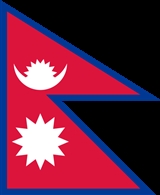
Nepal's flagThe national flag of Nepal is the world's only national flag that is non-quadrilateral in shape. The flag is a simplified combination of two single pennons, the vexillological word for a pennant. Its crimson red is the colour of the rhododendron, the country's national flower. Red is also the sign...
is the only national flag in the world that is not rectangular in shape. According to its official description, the red in the flag stands for victory in war or courage, and is also color of the
rhododendronRhododendron is a genus of over 1 000 species of woody plants in the heath family, most with showy flowers...
, the national flower of Nepal. Red also stands for aggression. The flag's blue border signifies peace. The curved moon on the flag is a symbol of the peaceful and calm nature of Nepalese, while the sun represents the aggressiveness of Nepalese warriors.
External links
of the
Government of NepalThe Government of Nepal, or Nepal Government, is the executive body and the Central government of Nepal. Prior to the abolition of Monarchy in Nepal, was officially known as His Majesty's Government....