
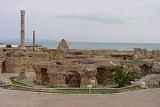
All Topics  
Carthage

 
Carthage

   Email Print
   Bookmark   Link


Carthage


Carthage (Berber
Berber

Berber may refer to:*a member of the Berber people**the Berber languages, a family of Afro-Asiatic languages**Berberism, a political-cultural supporting a distinct Berber identity....
: Kartajen, or Karthago, from the Phoenician meaning new town) refers both to an ancient city in present-day Tunisia
Tunisia

Tunisia , officially the Tunisian Republic , is a country located in North Africa. It is bordered by Algeria to the west and Libya to the southeast....
, and a modern-day suburb of Tunis
Tunis

Tunis is the Capital of the Tunisian Republic and also the Tunis Governorate, with a population of 1 200,000 in 2008 and over 3,980,500 in the municipal area....
. The civilization that developed within the city's sphere of influence is referred to as Punic or Carthaginian. The city of Carthage is located on the eastern side of Lake Tunis across from the center of Tunis. According to Roman legend it was founded in 814 BC by Phoenicia
Phoenicia

Phoenicia was an ancient civilization centered in the north of ancient Canaan, with its heartland along the coastal regions of modern day Lebanon, extending to parts of Israel, Syria and the Palestinian territories....
n colonists under the leadership of Elissa (Queen Dido).


Discussion
Ask a question about 'Carthage'
Start a new discussion about 'Carthage'
Answer questions from other users
Full Discussion Forum


Recent Posts


Timeline

814 BC   Carthage founded by Dido (traditional date).

501 BC   Gadir (present-day Cádiz) is captured by Carthage. (approximate date)

241 BC   Battle of the Aegates Islands, the Romans sinks the Carthaginian fleet; end of First Punic War.

216 BC   Hannibal crushes the Romans in the Battle of Cannae, one of the greatest tactical masterpiece in military history. As a result, a number of Italian cities allied to Rome desert to the Carthaginian side, especially cities in the Magna Graecia, and Capua. Again, the later Scipio Africanus fought in the battle as a tribune, and later prevented a mutiny among the survivors of Cannae.

202 BC   In an epic showdown between the two greatest generals of their age, Scipio Africanus Major defeats Hannibal in the Battle of Zama. On Hannibal's advice, Carthage sues for peace, ending the Second Punic War. Carthage is reduced to a client state.

24   End of the Masinissa line of the rulers of Carthage.

248   Cyprian becomes bishop of Carthage.

258   Cyprian, the bishop of Carthage, is martyred (decapitation).

439   Carthage falls to the Vandals.

533   Battle of Ad Decimium: Belisarius defeats the Vandals under Gelimer. Gelimer, forced to flee, leaves Carthage unprotected.


Encyclopedia


Carthage (Berber
Berber

Berber may refer to:*a member of the Berber people**the Berber languages, a family of Afro-Asiatic languages**Berberism, a political-cultural supporting a distinct Berber identity....
: Kartajen, or Karthago, from the Phoenician meaning new town) refers both to an ancient city in present-day Tunisia
Tunisia

Tunisia , officially the Tunisian Republic , is a country located in North Africa. It is bordered by Algeria to the west and Libya to the southeast....
, and a modern-day suburb of Tunis
Tunis

Tunis is the Capital of the Tunisian Republic and also the Tunis Governorate, with a population of 1 200,000 in 2008 and over 3,980,500 in the municipal area....
. The civilization that developed within the city's sphere of influence is referred to as Punic or Carthaginian. The city of Carthage is located on the eastern side of Lake Tunis across from the center of Tunis. According to Roman legend it was founded in 814 BC by Phoenicia
Phoenicia

Phoenicia was an ancient civilization centered in the north of ancient Canaan, with its heartland along the coastal regions of modern day Lebanon, extending to parts of Israel, Syria and the Palestinian territories....
n colonists under the leadership of Elissa (Queen Dido). It became a large and rich city and thus a major power in the Mediterranean. The resulting rivalry with Syracuse and Rome
Ancient Rome

Ancient Rome was a civilization that grew out of a small agricultural community founded on the Italian Peninsula as early as the 10th century BC....
 was accompanied by several wars with respective invasions of each other's homeland. One of them was Hannibal's invasion of Italy in the Second Punic War
Second Punic War

The Second Punic War lasted from 218 BC to 201 BC and involved combatants in the western and eastern Mediterranean. It was the second of three major wars between Carthage and the Roman Republic....
, culminating in the Carthaginian victory at Cannae
Battle of Cannae

The Battle of Cannae was a major battle of the Second Punic War, taking place on August 2, 216 BC near the town of Cannae in Apulia in southeast Italy....
 and leading to a serious threat to the continuation of Roman rule over Italy. After the Third Punic War
Third Punic War

The Third Punic War was the third and last of the Punic Wars fought between the former Phoenician colony of Carthage, and the Roman Republic. The Punic Wars were named because of the Ancient Rome name for Carthaginians: Punici, or Poenici....
, the city was destroyed by the Romans in 146 BC. However, the Romans refounded Carthage which became one of the three most important cities of the Empire and the capital of the short-lived Vandal kingdom
Vandals

The Vandals were an East Germanic tribe that entered the late Roman Empire during the 5th century. The Goths Theodoric the Great, king of the Ostrogoths and regent of the Visigoths, was allied by marriage with the Vandals as well as with the Burgundians and the Franks under Clovis I....
. It remained one of the most important Roman cities until the Muslim conquest when it was destroyed a second time in AD 698.

Topography


Carthage Port2 S
Carthage was built on a promontory with inlets to the sea to the north and south. The city's location made it master of the Mediterranean's maritime trade. All ships crossing the sea had to pass between Sicily
Sicily

Sicily is an Autonomous regions with special statute of Italy. Of all the regions of Italy, Sicily covers the largest land area at 25,708 km? and currently has just over five million inhabitants....
 and the coast of Tunisia, where Carthage was built, affording it great power and influence.

Two large, artificial harbors were built within the city, one for harboring the city's massive navy of 220 warships and the other for mercantile trade. A walled tower overlooked both harbors.

The city had massive walls, 23 miles (37 kilometers) in length, longer than the walls of comparable cities. Most of the walls were located on the shore and thus could be less impressive as Carthaginian control of the sea made attack from that direction difficult. The 2˝–3 miles (4–4.8 kilometers) of wall on the isthmus
Isthmus

File:The Spit Bruny Island.jpg File:IsthmusOfPanama.pngAn isthmus is a narrow strip of land connecting two larger land areas. Of note, the Isthmus of Panama connects the continents of North America and South America , and the Isthmus of Suez in Egypt connects Africa and Asia ....
 to the west were truly large and in fact were never penetrated.

The city had a huge necropolis
Necropolis

A necropolis is a large cemetery or burial place . Apart from the occasional application of the word to modern cemeteries outside large towns, the term...
 or burial ground, religious area, market places, council house, towers and a theatre and was divided into four equally-sized residential areas with the same layout. Roughly in the middle of the city stood a high citadel called the Byrsa. It was one of the largest cities in Hellenistic
Hellenistic civilization

File:Diadochen1.pngHellenistic civilization represents the zenith of Ancient Greece influence in the Classical Antiquity from 323 BC to about 146 BC ....
 times (by some estimates only Alexandria
Alexandria

Alexandria , with a population of 4.1 million, is the second-largest city in Egypt, and is the country's largest seaport, serving about 80% of Egypt's imports and exports....
 was larger) and was among the largest cities in pre-industrial history.

History

Carthage

Source material

The historical study of Carthage is problematic. Because its culture and records were destroyed by the Romans at the end of the Third Punic War
Third Punic War

The Third Punic War was the third and last of the Punic Wars fought between the former Phoenician colony of Carthage, and the Roman Republic. The Punic Wars were named because of the Ancient Rome name for Carthaginians: Punici, or Poenici....
, very few Carthaginian primary historical sources
Primary source

Primary source is a term used in a number of disciplines. In historiography, a primary source is a document, recording or other source of information that was created at the time being studied, by an authoritative source, usually one with direct personal knowledge of the events being described....
 survive. While there are a few ancient translations of Punic
Punic

The Punics, were a group of western Semitic-speaking peoples originating from Carthage in North Africa who traced their origins to a group of Phoenician and Cypriot settlers, but also to North African Berbers....
 texts into Greek and Latin, as well as inscriptions on monuments and buildings discovered in North Africa, the main sources are Greek
Ancient Greece

The term Ancient Greece refers to the period of History of Greece lasting from the Greek Dark Ages ca. 1100 BC and the Dorian invasion, to 146 BC and the Roman Republic conquest of Greece after the Battle of Corinth ....
 and Roman
Ancient Rome

Ancient Rome was a civilization that grew out of a small agricultural community founded on the Italian Peninsula as early as the 10th century BC....
 historians, including Livy
Livy

Titus Livius , known as Livy in English language, was a Ancient Rome historian who wrote a monumental history of Rome, Ab Urbe Condita, from its founding through the reign of Augustus in Livy's own time....
, Polybius
Polybius

Polybius was a Greek historian of the Hellenistic Period noted for his book called The Histories covering in detail the period of 220–146 BC....
, Appian
Appian

Appianus , of Alexandria was a Ancient Rome historian who flourished during the reigns of Trajan, Hadrian and Antoninus Pius. He is commonly referred to by the anglicised form of his name, Appian....
, Cornelius Nepos
Cornelius Nepos

Cornelius Nepos was a Roman Empire biographer. Supposedly he was born at Hostilia, a village in Cisalpine Gaul not far from Verona. His Gallic origin is attested by Ausonius, and Pliny the Elder calls him Padi accola ....
, Silius Italicus
Silius Italicus

Silius Italicus, in full Tiberius Catius Silius Italicus , was a Latin epic poet....
, Plutarch
Plutarch

Lucius Mestrius Plutarchus , c. AD 46 ? 120 ? commonly known in English as Plutarch ? was a Ancient Rome historian , biographer, essayist, and Middle Platonism....
, Dio Cassius
Dio Cassius

Lucius Cassius Dio Cocceianus , known in English language as Cassius Dio, Dio Cassius, or Dio was a noted Roman Empire historian and public servant....
, and Herodotus
Herodotus

Herodotus of Halicarnassus was a Greeks historian who lived in the 5th century BC and is regarded as the "Father of History" in Western culture....
. These writers belonged to peoples in competition, and often in conflict, with Carthage. Greek cities contested with Carthage for Sicily
Sicily

Sicily is an Autonomous regions with special statute of Italy. Of all the regions of Italy, Sicily covers the largest land area at 25,708 km? and currently has just over five million inhabitants....
, and the Romans
Roman Republic

The Roman Republic was the phase of the Ancient Rome characterized by a republican form of government; a period which began with the overthrow of the Roman Roman Kingdom, c....
 fought three wars against Carthage
Punic Wars

The Punic Wars were a series of three wars fought between Ancient Rome and Carthage from 264 to 146 BC. They were probably the largest wars yet of the ancient world....
. Not surprisingly, their accounts of Carthage are extremely hostile; while there are a few Greek authors who took a favorable view, these works have been lost.

Recent excavation has brought much more primary material to light. Some of these finds contradict aspects of the traditional picture of Carthage, and much of the material is still ambiguous.

Legends of the foundation


Queen Elissa
Queen Elissa (also known as "Alissar", and by the Arabic name also and ), who in later accounts became known as Queen Dido, was a princess of Tyre who founded Carthage. At its peak, her metropolis came to be called the "shining city," ruling 300 other cities around the western Mediterranean and leading the Phoenician (or Punic) world.

Elissa was a princess of Tyre. Her brother, King Pygmalion of Tyre
Pygmalion of Tyre

Pygmalion was king of Tyre from 831 to 785 BC and a son of King Mattan I .During Pygmalion's reign, Tyre seems to have shifted the heart of its trading empire from the Middle East to the Mediterranean, as can be judged from the building of new colonies including Kition on Cyprus, Sardinia , and, according to tradition, Carthage....
, had murdered her husband, the high priest. Elissa escaped the tyranny of her own country and founded the "new city" of Carthage and subsequently its later dominions. Details of her life are sketchy and confusing, but the following can be deduced from various sources. According to Justin, Princess Elissa was the daughter of King Matten of Tyre (also known as Muttoial or Belus II). When he died, the throne was jointly bequeathed to her and her brother, Pygmalion. She married her uncle Acherbas (also known as Sychaeus) the High Priest of Melqart
Melqart

Melqart, properly Phoenician language Milk-Qart "King of the City", less accurately Melkart, Melkarth or Melgart , Akkadian language Milqartu, was tutelary god of the Phoenician city of Tyre as Eshmun protected Sidon....
, a man with both authority and wealth comparable to the king. Pygmalion was a tyrant, lover of both gold and intrigue, who desired the authority and fortune enjoyed by Acherbas. Pygmalion assassinated Acherbas in the temple and kept the misdeed concealed from his sister for a long time, deceiving her with lies about her husband's death. At the same time, the people of Tyre called for a single sovereign, causing dissent within the royal family.

Queen Dido
In the Roman
Ancient Rome

Ancient Rome was a civilization that grew out of a small agricultural community founded on the Italian Peninsula as early as the 10th century BC....
 epic of Virgil
Virgil

Publius Vergilius Maro was a classical Roman poet, best known for three major works?the Bucolics , the Georgics and the Aeneid?although several Appendix Vergiliana are also attributed to him....
, the Aeneid
Aeneid

The Aeneid is a Latin Epic poetry written by Virgil in the late 1st century BC that tells the legendary story of Aeneas, a Troy who traveled to Italy, where he became the ancestor of the Rome....
, Queen Dido, the Greek name for Queen Elissa, is first introduced as an extremely respected character in his legend. In just seven years, since their exodus from Tyre, the Carthaginians have rebuilt a successful kingdom under her rule. Her subjects adore her and present her with a festival of praise. Her character is perceived by Virgil as even more noble when she offers asylum to Aeneas
Aeneas

This article is about the Roman hero. For other uses, see Aeneas .In Greco-Roman mythology, Aeneas was a Troy hero, the son of prince Anchises and the goddess Venus_....
 and his men, who have recently escaped from Troy
Troy

Troy is a legendary city and center of the Trojan War, as described in the Epic Cycle, and especially in the Iliad, one of the two epic poems attributed to Homer....
. A spirit in the form of the messenger god, Mercury
Mercury (mythology)

In Roman mythology, Mercury was a messenger, and a god of trade, profit and commerce, the son of Maia Maiestas, also known as Ops, the Roman version of Cronus, and Jupiter ....
, sent by Jupiter
Jupiter (mythology)

In Roman mythology, Jupiter or Jove was the king of the gods,and the god of sky and thunder. He is the equivalent of Zeus in the Greek pantheon....
, reminds Aeneas that his mission is not to stay in Carthage with his new-found love, Dido, but to sail to Italy to found Rome. Virgil ends his legend of Dido with the story that, when Aeneas tells Dido, her heart broken, she orders a pyre
Pyre

A pyre is a structure, usually made of wood, for burning a body as part of a funeral rite. As a form of cremation, a body is placed upon the pyre which is then set on fire....
 to be built where she falls upon Aeneas' sword. As she lay dying, she predicted eternal strife between Aeneas' people and her own: "rise up from my bones, avenging spirit" (4.625, trans. Fitzgerald) she says, an obvious invocation of Hannibal.

Carthaginian Empire

Carthagemap
The Carthaginian Empire was one of the longest-lived and largest empires in the ancient Mediterranean. Reports relay several wars with Syracuse
Syracuse, Italy

Syracuse is a historic city in southern Italy, the Capital of the province of Syracuse. The city is noted for its rich Greek history, culture, amphitheatres, architecture and association to Archimedes, playing an important role in ancient times as one of the top powers of the Mediterranean world; it is over 2,700 years old....
 and finally, Rome, which eventually resulted in the defeat and destruction of Carthage in the third Punic war.
Army
According to Polybius, Carthage relied heavily, though not exclusively, on foreign mercenaries, especially in overseas warfare. The core of its army was from its own territory in Africa (ethnic Libyans and Numidians
Numidians

The Numidians were semi-nomadic Berber people tribes who lived in Numidia, in Algeria east of Constantine and in part of Tunisia and Morocco. The Numidians were one of the earliest natives to trade with the settlers of Carthage....
, as well as "Liby-Phoenicians" — i.e. Punics proper). These troops were supported by mercenaries from different ethnic groups and geographic locations across the Mediterranean who fought in their own national units; Celt
Celt

Celts , is a modern term used to describe any of the European peoples who spoke, or speak, a Celtic languages. The term is also used in a wider sense to describe the Modern Celts of those peoples, notably those who participate in a Celtic culture....
ic, Balearic
Balearic

Balearic is the name given collectively to the group of Catalan language variants spoken in the Balearic Islands, Spain. The collective term was coined by philologists, while the historic names used by the speakers themselves refer to the language as if it was local to each island, and so "Mallorqu?" , "Eivissenc" and "Menorqu?" may be used...
, and Iberian
Iberian

Iberian refers to Iberia , which has two basic meanings, the disused, of Caucasian Iberia , and the modern sense of someone or something originating in the Iberian Peninsula, namely from Portugal and Spain....
 troops were especially common. Later, after the Barcid conquest of Iberia, Iberians came to form an even greater part of the Carthaginian forces. Carthage seems to have fielded a formidable cavalry force, especially in its African homeland; a significant part of it was composed of Numidian contingents of light cavalry. Other mounted troops included the now extinct North African elephant
North African Elephant

The North African Elephant was a possible subspecies of the African Bush Elephant , or possibly a separate elephant species, that existed in North Africa until becoming extinct in Ancient Ancient Rome....
s, trained for war, which, amongst other uses, were commonly used for frontal assaults or as anti-cavalry protection. An army could field up to several hundreds of these animals, but on most reported occasions fewer than a hundred were deployed. The riders of these elephants were armed with a spike and hammer to kill the elephants in case they charged toward their own army.

Navy
mosaic from Carthage, Bardo Museum
Bardo Museum

Bardo Museum is a museum in Tunis, Tunisia. It was originally a 13th century Hafsid palace, located in the suburbs of Tunis. It contains a major collection of Roman mosaics and other antiquities of interest from Ancient Greece, Tunisia, and from the Arab period....
, Tunis ]] The navy of Carthage was one of the largest in the Mediterranean, using serial production to maintain high numbers at moderate cost. The sailors and marines of the Carthaginian navy were predominantly recruited from the Punic
Punic

The Punics, were a group of western Semitic-speaking peoples originating from Carthage in North Africa who traced their origins to a group of Phoenician and Cypriot settlers, but also to North African Berbers....
 citizenry, unlike the multi-national allied and mercenary
Mercenary

A mercenary is a person who takes part in an armed conflict, who is not a national or a party to the conflict, and is "motivated to take part in the hostilities essentially by the desire for private gain and, in fact, is promised, by or on behalf of a party to the conflict, material compensation substantially in excess of that promised or p...
 troops of the Carthaginian armies. The reputation of her skilled sailors implies that there was in peacetime a training of oarsmen and coxswains, giving their navy a cutting edge in naval matters. The trade of Carthaginian merchantmen was by land across the Sahara and especially by sea throughout the Mediterranean and far into the Atlantic to the tin-rich islands of Britain and to West Africa. There is evidence that at least one Punic expedition under Hanno
Hanno the Navigator

Hanno the Navigator was a Carthage explorer c. 500 BC, best known for his naval exploration of the African coast....
 sailed along the West African coast to regions south of the Equator
Equator

The equator is the intersection of the Earth's surface with the Plane perpendicular to the Earth's rotation and containing the Earth's center of mass....
, describing how the sun was in the north at noon.

Polybius
Polybius

Polybius was a Greek historian of the Hellenistic Period noted for his book called The Histories covering in detail the period of 220–146 BC....
 wrote in the sixth book of his History that the Carthaginians were "more exercised in maritime affairs than any other people." Their navy included some 300 to 350 warships. The Romans, who had little experience in naval warfare prior to the First Punic War
First Punic War

The First Punic War was the first of Punic Wars fought between Carthage and the Roman Republic. For 23 years, the two powers struggled for supremacy in the western Mediterranean Sea....
, managed to finally defeat Carthage with a combination of reverse engineering captured Carthaginian ships, recruitment of experienced Greek
Greeks

The Greeks , also known as Hellenes, are a nation and ethnic group native to Greece, Cyprus and neighbouring regions, who can also be found in Greek diaspora communities around the world....
 sailors from the ranks of its conquered cities, the unorthodox corvus
Corvus (weapon)

A corvus or harpago was a Ancient Rome military Boarding used in naval warfare during the First Punic War against Carthage.In Chapters 1.22-4-11 of his History, Polybius describes this device as a bridge 1.2 m wide and 10.9 m long, with a small parapet on both sides....
 device, and their superior numbers in marines and rowers. In the Third Punic War
Third Punic War

The Third Punic War was the third and last of the Punic Wars fought between the former Phoenician colony of Carthage, and the Roman Republic. The Punic Wars were named because of the Ancient Rome name for Carthaginians: Punici, or Poenici....
 Polybius describes a tactical innovation of the Carthaginians, augmenting their few triremes with small vessels that carried hooks (to attack the oars) and fire (to attack the hulls). With this new combination, they were able to stand their ground against the superior Roman numbers for a whole day.

Fall
The fall of Carthage came at the end of the Third Punic War
Third Punic War

The Third Punic War was the third and last of the Punic Wars fought between the former Phoenician colony of Carthage, and the Roman Republic. The Punic Wars were named because of the Ancient Rome name for Carthaginians: Punici, or Poenici....
 in 146 BC. In spite of the initial devastating Roman naval losses at the beginning of the series of conflicts and Rome's recovery from the brink of defeat after the terror of a 15-year occupation of much of Italy by Hannibal, the end of the series of wars resulted in the end of Carthaginian power and the complete destruction of the city by Scipio Aemilianus. The Romans pulled the Phoenician warships out into the harbor and burned them before the city, and went from house to house, capturing and enslaving the people. Fifty thousand Carthaginians were sold into slavery
Slavery in ancient Rome

The institution of slavery in ancient Rome reduced those held to a condition of less than persons under Roman law. Stripped of many rights, including the ability to marry, slaves were the property of their owners....
. The city was set ablaze, and in this way was razed with only ruins and rubble to field the aftermath. After the fall of Carthage, Rome annexed the majority of the Carthaginian colonies, including other North African locations such as Volubilis
Volubilis

Volubilis is an List of archaeological sites in Morocco situated near Meknes between Fez, Morocco and Rabat along the N13 road . The nearest town is Moulay Idriss....
, Lixus
Lixus

Lixus refers to the following things:* lixus, the Latin word for "boiled"* Lixus in Morocco* Lixus , a genus of true weevils* Lixus , a Japanese distribution company...
, Chellah
Chellah

File:Chella Rabat Morocco roman street.jpgChellah, or Sala Colonia is a necropolis and complex of ancient and medieval ruins that lie on the outskirts of Rabat, Morocco?s Ville Nouvelle, or modern section....
, and Mogador. Through a series of misunderstandings, a belief that the Carthaginian farmland was salted to ensure that no crops could be grown there developed in the modern period.

Roman Carthage


When Carthage fell, its nearby rival Utica
Utica, Tunisia

Utica is an ancient city northwest of Carthage near the outflow of the Medjerda River into the Mediterranean Sea, traditionally considered to be the first colony founded by the Phoenicians in North Africa....
, a Roman ally, was made capital of the region and replaced Carthage as the leading center of Punic trade and leadership. It had the advantageous position of being situated on the Lake of Tunis and the outlet of the Majardah River, Tunisia's only river that flowed all year long. However, grain cultivation in the Tunisian mountains caused large amounts of silt
Silt

Silt is soil or Rock derived granular material of a Particle size between sand and clay. Silt may occur as a soil or as suspended sediment in a surface water body....
 to erode into the river. This silt was accumulated in the harbor until it was made useless, and Rome was forced to rebuild Carthage.

By 122 BC, Gaius Gracchus
Gaius Gracchus

Gaius Sempronius Gracchus was a Ancient Rome politician of the 2nd century BC. He was the younger brother of Tiberius Gracchus and, like him, pursued a popular political agenda that ultimately ended in his death....
 founded a short-lived colonia
Colonia (Roman)

A Roman colonia was originally a Roman Empire outpost established in conquered territory to secure it. Eventually, however, the term came to denote the highest status of Roman city....
, called Colonia Iunonia, after the Latin name for the punic goddess Tanit, Iuno caelestis. The purpose was to obtain arable lands for impoverished farmers. The Senate
Roman Senate

The Senate of the Roman Republic was a political institution in the ancient Roman Republic. According to the Greek historian Polybius, our principal source on the Constitution of the Roman Republic, the Roman Senate was the predominant branch of government....
 abolished the colony some time later, in order to undermine Gracchus' power. After this ill-fated attempt, a new city of Carthage was built on the same land, and by the 1st century it had grown to the second largest city in the western half of the Roman empire
Roman Empire

The Roman Empire was the Roman Republic phase of the Ancient Rome, characterised by an autocracy form of government and large territorial holdings in Europe and around the Mediterranean....
, with a peak population of 500,000. It was the center of the Roman province of Africa, which was a major breadbasket of the empire.

Carthage also became a center of early Christianity
Christianity

Christianity is a Monotheistic religion #Christian view religion centered on the life and teachings of Jesus as New Testament view on Jesus' life....
. In the first of a string of rather poorly reported Councils at Carthage a few years later, no fewer than seventy bishops attended. Tertullian later broke with the mainstream that was represented more and more by the bishop of Rome, but a more serious rift among Christians was the Donatist
Donatist

The Donatists were followers of a belief considered a schism by the broader churches of the One, Holy, Catholic, and Apostolic Church tradition, and most particularly within the context of the religious milieu of the provinces of Roman North Africa in Late Antiquity....
 controversy, which Augustine of Hippo spent much time and parchment arguing against. In 397 at the Council at Carthage, the biblical canon
Biblical canon

A Biblical canon or canon of scripture is a list or set of Bible books considered to be authoritative as scripture by a particular religious community, generally in Judaism or Christianity....
 for the western Church was confirmed.

The political fallout from the deep disaffection of African Christians is supposedly a crucial factor in the ease with which Carthage and the other centres were captured in the 5th century by Gaiseric, king of the Vandals
Vandals

The Vandals were an East Germanic tribe that entered the late Roman Empire during the 5th century. The Goths Theodoric the Great, king of the Ostrogoths and regent of the Visigoths, was allied by marriage with the Vandals as well as with the Burgundians and the Franks under Clovis I....
, who defeated the Roman
Roman Empire

The Roman Empire was the Roman Republic phase of the Ancient Rome, characterised by an autocracy form of government and large territorial holdings in Europe and around the Mediterranean....
 general
General

A General officer is an Officer of high military rank. The term or equivalent is used by nearly every country in the world. General can be used as a generic term for all grades of general officer, or it can specifically refer to a single rank that is just called general....
 Bonifacius
Bonifacius

Comes Bonifacius was a Roman Empire general and governor of the Diocese of Africa. Along with his rival, Flavius A?tius, he is sometimes termed "the last of the Romans."...
 and made the city his capital. Gaiseric was considered a heretic too, an Arian
Arianism

Arianism is the theological teaching of Arius , a Christian priest, who was first ruled a heresy at the First Council of Nicea, later exonerated and then pronounced a heretic again after his death....
, and though Arians commonly despised Catholic Christians, a mere promise of toleration might have caused the city's population to accept him. After a failed attempt to recapture the city in the 5th century, the Byzantines finally subdued the Vandals in the 6th century.

During the emperor Maurice's
Maurice (emperor)

Flavius Mauricius Tiberius Augustus , known in English as Maurice and in Greek as Maurikios, was a Byzantine Emperor who ruled from 582-602....
 reign, Carthage was made into an Exarchate, as was Ravenna
Ravenna

Ravenna is a city and comune in the Emilia-Romagna region of Italy. The city is inland, but is connected to the Adriatic Sea by a canal. Ravenna once served as the seat of the Western Roman Empire and later the Ostrogoths and the Exarchate of Ravenna....
 in Italy
Italy

Italy , officially the Italian Republic , is a country located on the Italian Peninsula in Southern Europe and on the two largest islands in the Mediterranean Sea, Sicily and Sardinia....
. These two exarchates were the western bulwarks of Byzantium, all that remained of its power in the west. In the early 7th century, it was the Exarch of Carthage, Heraclius
Heraclius

Flavius Heraclius was a Byzantine Emperor, who ruled the Byzantine Empire for over thirty years, from October 5, 610 to February 11, 641. His rise to power began in 608, when he and his Heraclius the Elder, the viceregal Exarchate of Africa, successfully led a revolt against the unpopular usurper Phocas....
 (of Armenian
Armenians

The Armenians are a nation and ethnic group originating in the Caucasus and in the Armenian Highlands. A large concentration of them has remained there, especially in Armenia, but many of them are also scattered elsewhere throughout the world ....
 origin), who overthrew Emperor Phocas
Phocas

Flavius Phocas Augustus, , usurped the Byzantine Byzantine Emperors from the Emperor Maurice , and was himself overthrown by Heraclius after losing a civil war....
.

Islamic Carthage


The Byzantine Exarchate was not, however, able to withstand the Muslim
Muslim conquests

Arab Muslim conquests , also referred to as the Islamic conquests or Arab conquests, began after the death of the Islamic prophet Muhammad....
 conquerors of the 7th century. Umayyad Caliph Abd al-Malik
Abd al-Malik

Abd al-Malik ibn Marwan was the 5th Umayyad Caliph. He was born in Mecca and grew up in Medinah . Abd al-Malik was a well-educated man and capable ruler, despite the many political problems that impeded his rule....
 in AD 686 sent a force led by Zuhayr ibn Qais who won a battle over Byzantines and Berbers led by Kusaila
Kusaila

Kusaila was a 7th century chief of the Awraba tribe of the Berber people and head of the Sanhadja confederation. He is known for prosecuting effective Romano-Berber resistance to the Muslim Arab expansion into North Africa in the 680s....
, on the Qairawan plain, but could not follow that up. In AD 695 Hasan ibn al-Nu'man
Hasan ibn al-Nu'man

Hasan ibn an-Nu'man al-Ghassani , amir of the Umayyad Caliphate army in North Africa. The Arabic name#Nisba indicates he either came from Ghassan in Yemen or was part of an Arab tribe originally from that area....
 captured Carthage and advanced into the Atlas Mountains
Atlas Mountains

The Atlas Mountains are a mountain range across a northern stretch of Africa extending about 2,400 km through Morocco, Algeria, and Tunisia. The highest peak is Jbel Toubkal, with an elevation of in southwestern Morocco....
. A Byzantine
Byzantine

The word Byzantine may refer to:Topics directly related to the Byzantine Empire* A citizen of Byzantine Empire, or native Greeks during the Middle Ages ....
 fleet arrived, retook Carthage but in AD 698 Hasan ibn al-Nu'man
Hasan ibn al-Nu'man

Hasan ibn an-Nu'man al-Ghassani , amir of the Umayyad Caliphate army in North Africa. The Arabic name#Nisba indicates he either came from Ghassan in Yemen or was part of an Arab tribe originally from that area....
 returned and defeated Tiberios III
Tiberios III

Tiberios III or Tiberius III , , was Byzantine emperor from 698 to 705.Tiberius was a Germanic navy officer originally named Apsimarus , who rose to the position of droungarios of the Cibyrrhaeotic Theme....
 at the Battle of Carthage
Battle of Carthage (698)

The Battle of Carthage was fought in 698 CE between a Byzantine Empire expeditionary force and the armies of the Umayyad Caliphate. Having lost Carthage to the Muslims, Emperor Leontius sent the navy under the command of John the Patrician and the droungarios Tiberius Apsimarus....
. The Byzantines withdrew from all of Africa except Ceuta
Ceuta

Ceuta is an autonomous community#autonomous cities of Spain located on the North African side of the Strait of Gibraltar, on the Mediterranean, which separates it from the Spanish mainland....
. The Roman Carthage was destroyed, just as the Romans had done in 146 BC. Carthage was replaced by Tunis
Tunis

Tunis is the Capital of the Tunisian Republic and also the Tunis Governorate, with a population of 1 200,000 in 2008 and over 3,980,500 in the municipal area....
 as the major regional center. The destruction of the Exarchate of Africa marked a permanent end to Roman or Byzantine influence there, as the rising tide of Islam took root.

Culture


Language

Carthaginians spoke Punic
Punic language

The Punic language is an extinct Semitic language formerly spoken in the Mediterranean region of North Africa and several List of islands in the Mediterranean, by people of the Punic culture....
, a variety of Phoenician.

Commerce

Carthaginian commerce was by sea throughout the Mediterranean and far into the Atlantic and by land across the Sahara desert. According to Aristotle, the Carthaginians and others had treaties of commerce to regulate their exports and imports.

The empire of Carthage depended heavily on its trade with Tartessos
Tartessos

Tartessos was a harbor city and its surrounding culture on the south coast of the Iberian peninsula , at the mouth of the Guadalquivir river. It was mentioned by Herodotus, Strabo in Pliny's Natural History....
 and other cities of the Iberian peninsula, from which it obtained vast quantities of silver
Silver

Silver is a chemical element with the chemical symbol Ag and atomic number 47. A soft, white, lustrous transition metal, it has the highest electrical conductivity of any element and the highest thermal conductivity of any metal....
, lead
Lead

Lead is a main-group Chemical element with symbol Pb and atomic number 82. Lead is a soft, malleable poor metal, also considered to be one of the heavy metal ....
, and, even more importantly, tin
Tin

Tin is a chemical element with the symbol Sn and atomic number 50. Tin is obtained chiefly from the mineral cassiterite, where it occurs as an oxide, SnO2....
 ore, which was essential to the manufacture of bronze
Bronze

Bronze is a metal alloy consisting primarily of copper, usually with tin as the main additive, but sometimes with other chemical element such as phosphorus, manganese, aluminium, or silicon....
 objects by the civilizations of antiquity. Its trade relations with the Iberians and the naval might that enforced Carthage's monopoly on trade with tin-rich Britain and the Canary Islands allowed it to be the sole significant broker of tin and maker of bronze. Maintaining this monopoly was one of the major sources of power and prosperity for Carthage, and a Carthaginian merchant would rather crash his ship upon the rocky shores of Britain than reveal to any rival how it could be safely approached. In addition to being the sole significant distributor of tin, its central location in the Mediterranean and control of the waters between Sicily and Tunisia allowed it to control the eastern nations' supply of tin. Carthage was also the Mediterranean's largest producer of silver, mined in Iberia and the North African coast, and, after the tin monopoly, this was one of its most profitable trades. One mine in Iberia provided Hannibal with 300 Roman pounds(3,75 talents) of silver a day.

Carthage's economy began as an extension of that of its parent city, Tyre. Its massive merchant fleet traversed the trade routes mapped out by Tyre, and Carthage inherited from Tyre the art of making the extremely valuable dye Tyrian Purple
Tyrian purple

Tyrian purple , also known as royal purple, imperial purple or imperial dye, is a purple-red dye which was first produced by the ancient Phoenicians in the city of Tyre, Lebanon....
. It was one of the most highly-valued commodities in the ancient Mediterranean, being worth fifteen to twenty times its weight in gold. High Roman officials could only afford togas with a small stripe of it. Carthage also produced a less-valuable crimson pigment from the cochineal
Cochineal

'Cochineal' is a scale insect insect in the suborder Sternorrhyncha, from which the crimson-colored dye, carmine, is derived. There are other species in the genus Dactylopius which can be used to produce cochineal extract, but they are extremely difficult to distinguish from D....
.

Carthage produced finely embroidered and dyed textiles of cotton
Cotton

Cotton is a soft, staple fiber that grows in a form known as a boll around the seeds of the cotton plant a shrub native to tropical and subtropical regions around the world, including the Americas, India and Africa....
, linen
Linen

Linen is a textile made from the fibers of the flax plant, Linum usitatissimum. Linen is labor-intensive to manufacture, but when it is made into garments, it is valued for its exceptional coolness and freshness in hot weather....
, wool
Wool

Wool is the fiber derived from the specialized skin cells, called follicles, of animals in the Caprinae family, principally domestic sheep, but the hair of certain species of other Mammalia such as cashmere goat, llamas, rabbits and keeshonds may also be called wool....
, and silk
Silk

Silk is a natural protein fiber, some forms of which can be weaving into textiles. The best-known type of silk is obtained from Pupa#Cocoons made by the larvae of the mulberry silkworm Bombyx mori reared in captivity ....
, artistic and functional pottery
Pottery

Pottery is the ceramic ware made by potters. Major types of pottery include earthenware, stoneware, and porcelain. The places where such wares are made are called potteries....
, faience
Faience

Faience or fa?ence is the conventional name in English language for fine tin-glazed pottery on a delicate pale buff body. The invention of a white pottery glaze suitable for painted decoration, by the addition of an stannous oxide to the slip of a lead glaze, was a major advance in the history of pottery....
, incense
Incense

Incense is composed of aromatic Biotic material materials. It releases fragrant smoke when burned. The term incense refers to the substance itself, rather than to the odor that it produces....
, and perfumes. It worked with glass, wood, alabaster
Alabaster

Alabaster is a name applied to varieties of two distinct minerals: gypsum and calcite . The former is the alabaster of the present day; the latter is generally the alabaster of the ancients....
, ivory, bronze, brass, lead, gold, silver, and precious stones to create a wide array of goods, including mirrors, highly-admired furniture and cabinetry, beds, bedding, and pillows, jewelry, arms, implements, and household items. It traded in salted Atlantic fish and fish sauce, and brokered the manufactured, agricultural, and natural products of almost every Mediterranean people.

Head Man Carthage Louvre Ao3783
In addition to manufacturing, Carthage practiced highly advanced and productive agriculture, using iron plows, irrigation, and crop rotation. Mago
Mago (agricultural writer)

Mago was a Carthage writer, author of an agricultural manual in Punic language which was a record of the farming knowledge of Carthage. The Punic text has been lost, but some fragments of Greek language and Latin language translations survive....
 wrote a famous treatise on agriculture which the Romans ordered translated after Carthage was captured. After the Second Punic War, Hannibal
Hannibal Barca

Hannibal, son of Hamilcar Barca, commonly known as Hannibal Hannibal's date of death is most commonly given as 183 BC, but there is a possibility it could have taken place in 182 BC. was a Carthage military commander and tactician who is popularly credited as one of the most talented commanders in history....
 promoted agriculture to help restore Carthage's economy and pay the war indemnity to Rome (10000 talents or 800,000 Roman pounds of silver), and he was largely successful.

Carthage produced wine, which was highly prized in Rome, Etruria
Etruria

Etruria — usually referred to in Greek language and Latin language source texts as Tyrrhenia — was a region of Central Italy, an area that covered part of what now are Tuscany, Latium, Emilia-Romagna and Umbria....
 (the Etruscans), and Greece. Rome was a major consumer of raisin wine, a Carthaginian specialty. Fruits, nuts, grain, grapes, dates, and olives were grown, and olive oil was exported in competition with Greece. Carthage also raised fine horses, similar to today's Arabian horse
Arabian horse

The Arabian horse is a list of horse breeds of horse that originated in the Middle East. With a distinctive head shape and high tail carriage, the Arabian is one of the most easily recognizable horse breeds in the world....
s, which were greatly prized and exported.

Carthage's merchant ships, which surpassed even those of the cities of the Levant
Levant

The Levant describes, traditionally, the Eastern Mediterranean at large, but can be used as a geographical term that denotes a large area in Western Asia formed by the lands bordering the Eastern shores of the Mediterranean, roughly bounded on the north by the Taurus Mountains, on the south by the Arabian Desert, and on the west by the M...
, visited every major port of the Mediterranean, Britain, the coast of Africa, and the Canary Islands
Canary Islands

The Canary Islands are a Spain archipelago which, in turn, forms one of the Spanish Autonomous Communities and an Outermost Region of the European Union....
. These ships were able to carry over 100 tons of goods. The commercial fleet of Carthage was comparable in size and tonnage to the fleets of major European powers in the 18th century.

Merchants at first favored the ports of the east: Egypt, the Levant, Greece, Cyprus, and Asia Minor. But after Carthage's control of Sicily brought it into conflict with Greek colonists, it established commercial relations in the western Mediterranean, including trade with the Etruscans.

Carthage also sent caravans into the interior of Africa and Persia. It traded its manufactured and agricultural goods to the coastal and interior peoples of Africa for salt, gold, timber, ivory, ebony, apes, peacocks, skins, and hides. Its merchants invented the practice of sale by auction and used it to trade with the African tribes. In other ports, they tried to establish permanent warehouses or sell their goods in open-air markets. They obtained amber from Scandinavia and tin from the Canary Islands. From the Celtiberians, Gauls, and Celts, they obtained amber, tin, silver, and furs. Sardinia and Corsica produced gold and silver for Carthage, and Phoenician settlements on islands such as Malta
Malta

Malta , officially the Republic of Malta , is a densely populated developed country European microstates microstate in the European Union....
 and the Balearic Islands
Balearic Islands

The Balearic Islands are an archipelago in the western Mediterranean Sea, near the eastern coast of the Iberian Peninsula.The four largest islands are Majorca, Minorca, Ibiza, and Formentera....
 produced commodities that would be sent back to Carthage for large-scale distribution. Carthage supplied poorer civilizations with simple things, such as pottery, metallic products, and ornamentations, often displacing the local manufacturing, but brought its best works to wealthier ones such as the Greeks and Etruscans. Carthage traded in almost every commodity wanted by the ancient world, including spices from Arabia, Africa, and India and slaves.

These trade ships went all the way down the Atlantic coast of Africa to Senegal
Senegal

Senegal , officially the Republic of Senegal, is a country south of the S?n?gal River in West Africa. Senegal is bounded by the Atlantic Ocean to the west, Mauritania to the north, Mali to the east, and Guinea and Guinea-Bissau to the south....
 and Nigeria. One account has a Carthaginian trading vessel exploring Nigeria, including identification of distinguishing geographic features such as a coastal volcano and an encounter with gorillas (See Hanno the Navigator
Hanno the Navigator

Hanno the Navigator was a Carthage explorer c. 500 BC, best known for his naval exploration of the African coast....
). Irregular trade exchanges occurred as far west as Madeira and the Canary Islands
Canary Islands

The Canary Islands are a Spain archipelago which, in turn, forms one of the Spanish Autonomous Communities and an Outermost Region of the European Union....
, and as far south as southern Africa. Carthage also traded with India
History of India

The known history of India begins with the Indus Valley Civilization, which spread and flourished in the north-western part of the Indian subcontinent, from c....
 by traveling through the Red Sea
Red Sea

The Red Sea is a salt water inlet of the Indian Ocean between Africa and Asia. The connection to the ocean is in the south through the Bab el Mandeb sound and the Gulf of Aden....
 and the perhaps-mythical lands of Ophir
Ophir

Ophir is a port or region mentioned in the Bible, famous for its wealth. King Solomon is supposed to have received a cargo of gold, silver, sandalwood, precious stones, ivory, apes and peacocks from Ophir, every three years....
 (India/Arabia?) and Punt
Land of Punt

The Land of Punt, also called Pwenet, or Pwene by the ancient Egyptians, at times synonymous with Ta netjer, the "land of the god", was a fabled site in the Horn of Africa and was known for producing and exporting gold, aromatic resins, African Blackwood, ebony, ivory, slaves and wild animals....
, which may be present-day Somalia
Somalia

Somalia , officially the Republic of Somalia and formerly known as the Somali Democratic Republic, is a country located in the Horn of Africa....
.

Archaeological finds show evidence of all kinds of exchanges, from the vast quantities of tin needed for a bronze-based metals civilization to all manner of textiles, ceramics and fine metalwork. Before and in between the wars, Carthaginian merchants were in every port in the Mediterranean, buying and selling, establishing warehouses where they could, or just bargaining in open-air markets after getting off their ships.

The Etruscan language has not yet been deciphered, but archaeological excavations of Etruscan cities show that the Etruscan civilization was for several centuries a customer and a vendor to Carthage, long before the rise of Rome. The Etruscan city-states were, at times, both commercial partners of Carthage and military allies.

Government

The government of Carthage was an oligarchal
Oligarchy

Oligarchy is a form of government where political power effectively rests with a small Elitism segment of society distinguished by royalty, wealth, family, military influence or occult spiritual hegemony....
 republic
Republic

A republic is a state or country that is not led by a hereditary monarch but in which the people have an impact on its government. The word originates from the Latin term res publica....
, which relied on a system of checks and balances and ensured a form of public accountability. The Carthaginian heads of state were called Suffets
Shofet

In Hebrew language and several other Semitic languages, shofet literally means "Judge", from the verb "?-P-T", "to pass judgment". Cognate titles exist in other Semitic cultures, notably Phoenicia....
 (thus rendered in Latin by Livy
Livy

Titus Livius , known as Livy in English language, was a Ancient Rome historian who wrote a monumental history of Rome, Ab Urbe Condita, from its founding through the reign of Augustus in Livy's own time....
 30.7.5, attested in Punic inscriptions as SPTM /?uft?im/, meaning "judges" and obviously related to the Biblical
Bible

The Bible is the central religious text of Judaism and Christianity. The exact Books of the Bible is dependent on the religious traditions of specific denominations....
 Hebrew
Hebrew language

Hebrew is a Semitic languages of the Afro-Asiatic languages. Modern Hebrew is spoken by more than seven million people in Israel and Classical Hebrew is used for prayer or study in Jews communities around the world....
 ruler title "Judge"). Greek and Roman authors more commonly referred to them as "kings". SPT /?ufit?/ might originally have been the title of the city's governor, installed by the mother city of Tyre. In the historically attested period, the two Suffets were elected annually from among the most wealthy and influential families and ruled collegially, similarly to Roman consul
Roman consul

Consul was the highest elected political office of the Roman Republic and the Roman Empire.During the time of ancient Rome as a Republic, the Consuls were the highest civil and military magistrates, serving as the head of government for the Republic....
s (and equated with these by Livy). This practice might have descended from the plutocratic
Plutocracy

Plutocracy is rule by the wealthy, or power provided by wealth.In a plutocracy, the degree of economic inequality is high while the level of social mobility is low....
 oligarchies that limited the Suffet's power in the first Phoenician cities. The aristocratic families were represented in a supreme council (Roman sources speak of a Carthaginian "Senate
Senate

A senate is a deliberative assembly, often the upper house or chamber of a legislature or Parliament. There have been many such bodies in history, the first of which was the Roman Senate....
", and Greek ones of a "council of Elders" or a gerousia
Gerousia

The Gerousia was the Spartan senate . It was created by the Spartan lawgiver Lycurgus in the seventh century BC, in his Great Rhetra . According to Lycurgus' biographer Plutarch, the Gerousia was the first significant constitutional innovation instituted by Lycurgus....
), which had a wide range of powers; however, it is not known whether the Suffets were elected by this council or by an assembly of the people. Suffets appear to have exercised judicial and executive power, but not military . Although the city's administration was firmly controlled by oligarchs , democratic elements were to be found as well: Carthage had elected legislators, trade unions and town meetings. Aristotle
Aristotle

Aristotle was a Greeks philosopher, a student of Plato and teacher of Alexander the Great. He wrote on many subjects, including physics, metaphysics, Poetics , theater, music, logic, rhetoric, politics, government, ethics, biology and zoology....
 reported in his Politics
Politics (Aristotle)

Aristotle Politics is a work of political philosophy. The Nicomachean_Ethics#Chapters_6-9:_Politics declared that the inquiry into ethics necessarily follows into politics, and the two works are frequently considered to be parts of a larger treatise, or perhaps connected lectures, dealing with the "philosophy of human affairs." The tit...
 that unless the Suffets and the Council reached a unanimous decision, the Carthaginian popular assembly had the decisive vote - unlike the situation in Greek states with similar constitutions such as Sparta
Sparta

Sparta was a city-state in ancient Greece, situated on the Eurotas River in the southern part of the Peloponnese. From circa 650 BC it rose to become the dominant military power in the region and as such was recognized as the overall leader of the combined Greek forces during the Greco-Persian Wars....
 and Crete
Crete

Crete is the largest of the Greek islands and the List of islands in the Mediterranean largest island in the Mediterranean Sea at 8,336 km? ....
. Polybius
Polybius

Polybius was a Greek historian of the Hellenistic Period noted for his book called The Histories covering in detail the period of 220–146 BC....
, in his History book 6, also stated that at the time of the Punic Wars, the Carthaginian public held more sway over the government than the people of Rome held over theirs (a development he regarded as evidence of decline). Finally, there was a body known as the Hundred and Four
Hundred and Four

The Hundred and Four, or Council of 104, was a Carthaginian tribunal of judges. They were created early in Carthage's history, and are described in Aristotle's Politics as "the highest constitutional authority." By the time of Hannibal Barca, however, and his stint as Suffet , the 104 had acquired tyrannical power....
, which Aristotle compared to the Spartan ephors. These were judges who oversaw the actions of generals , who could sometimes be sentenced to crucifixion
Crucifixion

Crucifixion is an ancient method of execution , whereby the condemned person is tied or nailed to a large wooden cross and left to hang until dead....
.

Eratosthenes
Eratosthenes

Eratosthenes of Cyrene was a Greeks mathematician, poet, sportsperson, geographer and astronomer. He made several discoveries and inventions including a system of latitude and longitude....
, head of the Library of Alexandria
Library of Alexandria

The Royal Library of Alexandria or Ancient Library of Alexandria in Alexandria, Egypt, was once the largest Great libraries of the ancient world....
, noted that the Greeks had been wrong to describe all non-Greeks as barbarians, since the Carthaginians as well as the Romans had a constitution. Aristotle
Aristotle

Aristotle was a Greeks philosopher, a student of Plato and teacher of Alexander the Great. He wrote on many subjects, including physics, metaphysics, Poetics , theater, music, logic, rhetoric, politics, government, ethics, biology and zoology....
 also knew and discussed the Carthaginian constitution in his Politics (Book II, Chapter 11).

During the period between the end of the First Punic War and the end of the Second Punic War, members of the Barcid
Barcid

The Barcid family was a notable family in the ancient city of Carthage; many of its members were fierce enemies of the Roman Republic. The word "Barcid" was coined by scholars when talking about the family in general....
 family dominated in Carthaginian politics. They were given control of the Carthaginian military and all the Carthaginian territories outside of Africa.

Religion

Quartier Punique
Karthago Tophet 2
Carthaginian religion was based on Phoenician religion, a form of polytheism
Polytheism

Polytheism is the belief in or worship of multiple deities, such as gods and goddesses. These are usually assembled into a Pantheon , along with their own mythology and rituals....
. Many of the gods the Carthaginians worshiped were localized and are now known only under their local names.

Pantheon

The supreme divine couple was that of Tanit
Tanit

Tanit was a Phoenician lunar goddess, worshiped as the patron goddess at Carthage where from the fifth century BCE onwards her name is associated with that of Baal and she is given the epithet pene baal and the title rabat, the female form of rab ....
 and Ba'al Hammon. The goddess Astarte
Astarte

Astarte is the name of a goddess as known from Northwestern Semitic languages regions, cognate in name, origin and functions with the goddess Ishtar in Mesopotamian texts....
 seems to have been popular in early times. At the height of its cosmopolitan era, Carthage seems to have hosted a large array of divinities from the neighbouring civilizations of Greece, Egypt and the Etruscan city-states. A pantheon was presided over by the father of the gods, but a goddess was the principal figure in the Phoenician pantheon.

Caste of priests and acolytes

Surviving Punic texts are detailed enough to give a portrait of a very well organized caste of temple priests and acolytes performing different types of functions, for a variety of prices. Priests were clean shaven, unlike most of the population. In the first centuries of the city ritual celebrations included rhythmic dancing, derived from Phoenician traditions.

Punic stelae

Cippi and stelae of limestone are characteristic monuments of Punic art and religion, and are found throughout the western Phoenician world in unbroken continuity, both historically and geographically. Most of them were set up over urns containing cremated human remains, placed within open-air sanctuaries. Such sanctuaries constitute striking relics of Punic civilization.

Child sacrifice


Carthage under the Phoenicians was criticized by its neighbors for child sacrifice
Child sacrifice

Child sacrifice is the ritualistic killing of children in order to please, propitiate or force supernatural beings in order to achieve a desired result....
. Plutarch
Plutarch

Lucius Mestrius Plutarchus , c. AD 46 ? 120 ? commonly known in English as Plutarch ? was a Ancient Rome historian , biographer, essayist, and Middle Platonism....
 (c. 46–120) mentions the practice, as do Tertullian
Tertullian

Quintus Septimius Florens Tertullianus, anglicised as Tertullian, was a prolific and controversial early Christian author, and the first to write Christian Latin literature....
, Orosius
Orosius

Paulus Orosius was a Christianity historian, theology and disciple of Augustine of Hippo who came from Gallaecia , probably from the capital city Bracara Augusta....
, Philo
Philo

Philo , known also as Philo of Alexandria , Philo Judaeus, Philo Judaeus of Alexandria, Yedidia and Philo the Jew, was a Hellenistic Judaism philosopher born in Alexandria, Egypt....
 and Diodorus Siculus
Diodorus Siculus

Diodorus Siculus , was a Roman Greece historian who flourished in the 1st century BC. According to Diodorus' own work, he was born at Agira in Sicily ....
. Livy
Livy

Titus Livius , known as Livy in English language, was a Ancient Rome historian who wrote a monumental history of Rome, Ab Urbe Condita, from its founding through the reign of Augustus in Livy's own time....
 and Polybius
Polybius

Polybius was a Greek historian of the Hellenistic Period noted for his book called The Histories covering in detail the period of 220–146 BC....
 do not. The Hebrew Bible
Hebrew Bible

The term Hebrew Bible is a generic reference to those books of the Bible originally written mostly in Biblical Hebrew with some Biblical Aramaic....
 also mentions child sacrifice practiced by the Canaanite
Canaanite

Canaanite may refer to:* Canaan and Canaanite people, a historical/Biblical region and people in the area of the present-day Gaza Strip, Israel, West Bank, and Lebanon....
s, ancestors of the Carthaginians. The Greek and Roman critics, according to the Charles Picards, objected not to the killing of children but to the religious nature of it. Exposure of children was common in ancient Greece and Rome but for economic rather than religious reasons.

Modern archaeology
Archaeology

Archaeology, archeology, or arch?ology is the science that studies Homo cultures through the recovery, documentation, analysis, and interpretation of material remains and environmental data, including architecture, Artifact , features, Biofact s, and cultural landscape....
 in formerly Punic areas has discovered a number of large cemeteries for children and infants. But there is some argument that the reports of child sacrifice were based on a misconception, later used as blood libel
Blood libel

Blood libels are sensationalized allegations that a person or group engages in human sacrifice, often accompanied by the claim that the blood of victims is used in various rituals and/or acts of cannibalism....
 by the Romans who destroyed the city. These cemeteries may have been used as graves for stillborn
Stillborn

Stillborn can refer to stillbirth in medicine. It can also refer to:*Stillborn , a polish Death metal Black metal metal band.*Stillborn , a song by Black Label Society from their 2003 in music album The Blessed Hellride...
 infants or children who died very early. Modern archeological excavations have been interpreted as confirming Plutarch's reports of Carthaginian child sacrifice. In a single child cemetery called the Tophet
Tophet

Tophet or Topheth is believed to be a location in Jerusalem, in the Valley of Hinnom, where the Canaanites human sacrifice to the god Moloch by execution by burning....
 by archaeologists, an estimated 20,000 urns were deposited between 400 BC and 200 BC, with the practice continuing until the early years of the Christian period. The urns contained the charred bones of newborns and in some cases the bones of fetuses and 2-year-olds. These remains have been interpreted to mean that in the cases of stillborn babies, the parents would sacrifice their youngest child. There is a clear correlation between the frequency of cremation and the well-being of the city. In bad times (war, poor harvests) cremations became more frequent, but it is not possible to know why. The correlation could be because bad times inspired the Carthaginians to pray for divine intervention (via child sacrifice), or because bad times increased child mortality, leading to more child burials (via cremation).

Accounts of child sacrifice in Carthage report that beginning at the founding of Carthage in about 814 BC, mothers and fathers buried their children who had been sacrificed to Ba`al Hammon and Tanit there. The practice was apparently distasteful even to Carthaginians, and they began to buy children for the purpose of sacrifice or even to raise servant children instead of offering up their own. However, Carthage priests demanded the flower of their youth in times of crisis or calamity like war, drought or famine. Special ceremonies during extreme crisis saw up to 200 children of the most affluent and powerful families slain and tossed into the burning pyre.

It has been argued by some modern scholars that evidence of Carthaginian child sacrifice is incomplete, and that it is far more likely to have been Roman blood libel
Blood libel

Blood libels are sensationalized allegations that a person or group engages in human sacrifice, often accompanied by the claim that the blood of victims is used in various rituals and/or acts of cannibalism....
 against the Carthaginians to justify their conquest and destruction. Skeptics suggest that the bodies of children found in Carthaginian and Phoenician cemeteries were merely the cremated remains of children that died naturally. Sergio Ribichini has argued that the Tophet was "a child necropolis designed to receive the remains of infants who had died prematurely of sickness or other natural causes, and who for this reason were "offered" to specific deities and buried in a place different from the one reserved for the ordinary dead". The few Carthaginian texts which have survived make absolutely no mention of child sacrifice, though most of them pertain to matters entirely unrelated to religion, such as the practice of agriculture.

Modern times

Carthage remains a popular tourist attraction and residential suburb
Suburb

Suburbs are commonly defined as the residential areas which surround the central area of the urban area of a town or city. In the United States, suburbs have a prevalence of usually detached single-family homes.....
.

In February 1985, Ugo Vetere, the mayor of Rome
Rome

Rome is the capital city of Italy and Lazio, and is Italy's largest and most populous city, with 2,724,347 residents in an urban area of some ....
, and Chedly Klibi, the mayor of Carthage, signed a symbolic treaty "officially" ending the conflict between their cities, which had been supposedly extended by the lack of a peace treaty
List of wars extended by diplomatic irregularity

There are several claims of wars extended by diplomatic irregularity, often by a small country named in a declaration of war being accidentally omitted from the concluding peace treaty of a wider conflict....
 for more than 2100 years.

See also

  • List of Kings of Carthage
  • Carthaginian Empire
    Carthaginian Empire

    The Carthaginian State was an informal hegemony of Phoenician city-states throughout North Africa and modern Spain which lasted until 146 BC. It was more or less under the control of the city-state of Carthage after the fall of Tyre, Lebanon to Babylonian forces....
  • History of Tunisia
    History of Tunisia

    The History of Tunisia is divided into eight articles:*Early History of Tunisia*History of Punic era Tunisia*History of Roman era Tunisia...
  • Phoenician languages
    Phoenician languages

    Phoenician was a language originally spoken in the coastal region then called Put in Ancient Egyptian, Canaan in Phoenician, Hebrew language, and Aramaic, and Phoenicia in Greek language and Latin....
  • Umayyad conquest of North Africa


Sources


Religion

  • Polybius
    Polybius

    Polybius was a Greek historian of the Hellenistic Period noted for his book called The Histories covering in detail the period of 220–146 BC....
  • Hannibal's Campaigns. Tony Bath. New York, NY: Barnes & Noble Books, 1981.
  • La vie quotidienne ŕ Carthage au temps d'Hannibal. Gilbert et Colette Charles-Picard. Paris: Hachette, 1958.
  • La légende de Carthage. Azedine Beschaouch. Paris: Gallimard, 1993.
  • Carthage: Uncovering the Mysteries and Splendors of Ancient Tunisia. David Soren, Aicha Ben Abed Ben Kader, Heidi Slim. New York: Simon and Schuster, 1990.
  • The Phoenicians and the West: Politics, colonies and trade. Maria Eugenia Aubet. Cambridge: Cambridge University Press, 1987.
  • Itineraria Phoenicia.Edward Lipinski. Leuven: Uitgeverij Peeters en Department Oosterse Studies, 2004. "Aeneid" Virgil


Navy

  • Polybius. Ancient History Sourcebook: Polybius (c 200–118 BC): , Book 6.


External links

  • - (University of Chicago). Earlier version presented in Standford Colloquium "Past Narratives / Narratives Pasts"
  • : Published by Decapo Books, an excellent source of military history about ancient Carthage and the tactics of Hannibal and the Roman Republic
  • (may be audible in UK only)