
All Topics  
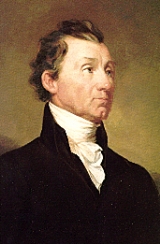
James Monroe

 
James Monroe

   Email Print
   Bookmark   Link


James Monroe


James Monroe (April 28, 1758 – July 4, 1831) was the fifth
List of Presidents of the United States

File:WhiteHouseSouthFacade.JPGThe President of the United States is the head of state and the head of government of the United States. As chief of the executive branch and head of the Federal government of the United States as a whole, the presidency is the highest political office in the United States by influence and recognition....
 President of the United States
President of the United States

The President of the United States is the head of state and head of government of the United States and is the highest political official in the United States by influence and recognition....
 (1817–1825). His administration was marked by the acquisition of Florida
Florida

Florida is a U.S. state located in the Southeastern United States of the United States, bordering Alabama to the northwest and Georgia to the northeast....
 (1819); the Missouri Compromise
Missouri Compromise

The Missouri Compromise was an agreement passed in 1820 between the slave state and free state factions in the United States Congress, involving primarily the regulation of slavery in the Historic regions of the United States....
 (1820), in which Missouri
Missouri

Missouri is a U.S. state in the Midwestern United States of the United States bordered by Iowa, Illinois, Kentucky, Tennessee, Arkansas, Oklahoma, Kansas and Nebraska....
 was declared a slave state; the admission of Maine
Maine

The State of Maine is a U.S. state in the New England region of the northeastern United States of America, bordering the Atlantic Ocean to the southeast, New Hampshire to the southwest, the Canadian provinces of Quebec to the northwest and New Brunswick to the northeast....
 in 1820 as a free state; and the profession of the Monroe Doctrine
Monroe Doctrine

The Monroe Doctrine is a United States policy introduced on December 2, 1823, which said that further efforts by European governments to colonize land or interfere with states in the Americas would be viewed by the United States of America as acts of aggression requiring US intervention....
 (1823), declaring U.S. opposition to Europe
Europe

Europe is, conventionally, one of the world's seven continents. Comprising the westernmost peninsula of Eurasia, Europe is generally divided from Asia to its east by the water divide of the Ural Mountains, the Ural , the Caspian Sea, and by the Caucasus Mountains to the southeast....
an interference in the Americas
Americas

The Americas are the region of the Western hemisphere that consists of the continents of North America and South America with their associated islands and regions....
, as well as breaking all ties with France remaining from the War of 1812
War of 1812

The War of 1812, between the United States of America and the British Empire , was fought from 1812 to 1815.There were several immediate stated causes for the U.S....
.

oe's father, Spence Monroe (1727-1774) was a moderately prosperous planter who also learned the carpentry trade.


Discussion
Ask a question about 'James Monroe'
Start a new discussion about 'James Monroe'
Answer questions from other users
Full Discussion Forum


Recent Posts


Quotations


In the wars of the European powers in matters relating to themselves we have never taken any part, nor does it comport with our policy so to do.

National honor is the national property of the highest value.

First Inaugural Address (March 4, 1817)

The American continents ... are henceforth not to be considered as subjects for future colonization by any European powers.

The mention of Greece fills the mind with the most exalted sentiments and arouses in our bosoms the best feelings of which our nature is capable.

Message to Congress (December 1822)


Encyclopedia


James Monroe (April 28, 1758 – July 4, 1831) was the fifth
List of Presidents of the United States

File:WhiteHouseSouthFacade.JPGThe President of the United States is the head of state and the head of government of the United States. As chief of the executive branch and head of the Federal government of the United States as a whole, the presidency is the highest political office in the United States by influence and recognition....
 President of the United States
President of the United States

The President of the United States is the head of state and head of government of the United States and is the highest political official in the United States by influence and recognition....
 (1817–1825). His administration was marked by the acquisition of Florida
Florida

Florida is a U.S. state located in the Southeastern United States of the United States, bordering Alabama to the northwest and Georgia to the northeast....
 (1819); the Missouri Compromise
Missouri Compromise

The Missouri Compromise was an agreement passed in 1820 between the slave state and free state factions in the United States Congress, involving primarily the regulation of slavery in the Historic regions of the United States....
 (1820), in which Missouri
Missouri

Missouri is a U.S. state in the Midwestern United States of the United States bordered by Iowa, Illinois, Kentucky, Tennessee, Arkansas, Oklahoma, Kansas and Nebraska....
 was declared a slave state; the admission of Maine
Maine

The State of Maine is a U.S. state in the New England region of the northeastern United States of America, bordering the Atlantic Ocean to the southeast, New Hampshire to the southwest, the Canadian provinces of Quebec to the northwest and New Brunswick to the northeast....
 in 1820 as a free state; and the profession of the Monroe Doctrine
Monroe Doctrine

The Monroe Doctrine is a United States policy introduced on December 2, 1823, which said that further efforts by European governments to colonize land or interfere with states in the Americas would be viewed by the United States of America as acts of aggression requiring US intervention....
 (1823), declaring U.S. opposition to Europe
Europe

Europe is, conventionally, one of the world's seven continents. Comprising the westernmost peninsula of Eurasia, Europe is generally divided from Asia to its east by the water divide of the Ural Mountains, the Ural , the Caspian Sea, and by the Caucasus Mountains to the southeast....
an interference in the Americas
Americas

The Americas are the region of the Western hemisphere that consists of the continents of North America and South America with their associated islands and regions....
, as well as breaking all ties with France remaining from the War of 1812
War of 1812

The War of 1812, between the United States of America and the British Empire , was fought from 1812 to 1815.There were several immediate stated causes for the U.S....
.

Early years

Monroe's father, Spence Monroe (1727-1774) was a moderately prosperous planter who also learned the carpentry trade. His mother, Elizabeth Jones Monroe (1730-1774) married Spence Monroe in 1752. They had five children to live to maturity:
  • Elizabeth Monroe Buckner - of Caroline County, Virginia
  • James Monroe
  • Spence Monroe, Jr. - Died at age 1
  • Andrew Monroe - of Albemarle County, Virginia
  • Joseph Jones Monroe - clerk of the District Court of Northumberland County, Virginia; private secretary to President Monroe; later settled in Missouri.


Education


From ages 11-16, Monroe studied at Campbelltown Academy, a school run by the Reverend Archibald Campbell
Archibald Campbell

Archibald Campbell may refer to:*Archibald Campbell, 2nd Earl of Argyll , Lord Chancellor of Scotland*Archibald Campbell, 4th Earl of Argyll ...
 of Washington Parish. He progressed through Latin and math at a rate faster than that of most boys his age. Among his classmates was John Marshall
John Marshall

John Marshall was an American statesman and jurist who shaped American constitutional law and made the Supreme Court a center of power. Marshall was Chief Justice of the United States, serving from February 4, 1801, until his death in 1835....
, later chief justice of the U.S. At 16, Monroe entered the College of William and Mary
College of William and Mary

The College of William & Mary in Virginia is a public university research university located in Williamsburg, Virginia, Virginia, United States....
. However the atmosphere on the Williamsburg campus was not conducive to study in 1774. The prospect of revolution charged most of the students, including Monroe, with patriotic fervor. In June 1775, after the battles of Lexington and Concord had sounded the opening guns of the Revolution, Monroe joined 24 older men in raiding the arsenal at the Governor's Palace. The 200 muskets and 300 swords they stole helped arm the Williamsburg militia. Next spring, Monroe dropped out of college to join the Continental army. He never returned to earn a degree. During 1780-1783, he studied law under Thomas Jefferson
Thomas Jefferson

Thomas Jefferson was the List of Presidents of the United States President of the United States , the principal author of the United States Declaration of Independence , and one of the most influential Founding Fathers of the United States for his promotion of the ideals of republicanism in the United States....
.

Monroe fought in the Continental Army
Continental Army

The American Continental Army was an army formed after the outbreak of the American Revolutionary War by the colonies that became the United States. Established by a resolution of the Continental Congress on June 15, 1775, the army was created to coordinate the military efforts of the Thirteen Colonies in their struggle against the rule of Kingdom...
, serving with distinction at the Battle of Trenton
Battle of Trenton

}|-||}The Battle of Trenton took place on December 26, 1776, during the American Revolutionary War after General George Washington's Washington's crossing of the Delaware River north of Trenton, New Jersey....
, where he was shot in his left shoulder. Then he spent three months in Bucks County, PA for rehab. Dr. Riker sewed his shoulder up. He is depicted holding the flag in the famous painting of Washington Crossing the Delaware
Washington Crossing the Delaware

Washington Crossing the Delaware is an 1851 oil-on-canvas painting by German American Artist Emanuel Leutze. It is in commemoration of Washington's crossing of the Delaware on December 25, 1776, during the American Revolutionary War, the first move in a surprise attack against the Hessians forces at Trenton, New Jersey in the Battle of Tr...
. Following his war service, he practiced law in Fredericksburg, Virginia
Fredericksburg, Virginia

Fredericksburg is an independent city in the Commonwealth of Virginia located 50 miles south of Washington, D.C., and 58 miles north of Richmond, Virginia....
.

Marriage and Family


James Monroe married Elizabeth Kortright (1768-1830), daughter of Laurence Kortright and Hannah Aspinwall Kortright, on February 16, 1786 in New York City. After a brief honeymoon on Long Island, the Monroes returned to New York to live with her father until Congress adjourned. The Monroes had the following children:
  • Eliza Monroe Hay (1786-1835) - married George Hay
    George Hay

    George Hay may refer to:*George Hay , United States politician and judge*George Hay , Member of Parliament and Dean of the Arches*George Hay , Vicar Apostolic of Lowland Scotland...
     in 1808 and substituted as official White House hostess for her ailing mother.
  • James Spence Monroe (1799-1801)
  • Maria Hester Monroe Gouverneur (1803-1850) - married her second cousin Samuel L. Gouverneur
    Samuel L. Gouverneur

    Samuel Laurence Gouverneur was the son of Nicholas Gouverneur and Hester Kortright Samuel Laurence Gouverneur was a member of New York State Legislature and served as private secretary to his father-in-law, President James Monroe....
     on March 8, 1820 in the first wedding ever performed in the White House.


Elective Office


Monroe was elected to the Virginia House of Delegates
Virginia House of Delegates

The Virginia House of Delegates is the lower house of the Virginia General Assembly. It has 100 members elected for terms of two years; unlike most states, these elections take place during odd-numbered years....
 in 1782 and served in the Continental Congress
Continental Congress

The Continental Congress was a convention of delegates from the Thirteen Colonies that became the governing body of the United States during the American Revolution....
 from 1783 to 1786. He ran for a seat on the 1st Congress but was defeated by future President James Madison
James Madison

James Madison was an American politician and political philosopher who served as the List of Presidents of the United States President of the United States , and one of the Founding Fathers of the United States....
. As a youthful politician, he joined the anti-Federalists in the Virginia Convention
Virginia Ratifying Convention

The Virginia Ratifying Convention was a Convention of 168 delegates from Virginia who met in 1788 to ratify or reject the United States Constitution, which had been drafted at the Philadelphia Convention the previous year....
 which ratified the Constitution, and in 1790, was elected United States Senator
United States Senate

The United States Senate is the upper house of the Bicameralism United States Congress, the lower house being the United States House of Representatives....
.

Ambassador
After his term in the Senate, Monroe was appointed Minister to France from 1794 to 1796. His appointment there was made difficult as he had strong sympathies for the French Revolution
French Revolution

The French Revolution was a period of political and social upheaval and radical change in the history of France, during which the French governmental structure, previously an absolute monarchy with feudalism for the aristocracy and Roman Catholic Church clergy, underwent radical change to forms based on Age of Enlightenment principles of cit...
, but dutifully maintained President Washington's strict policy of neutrality between Germany and France.

Governor of Virginia and Diplomat
Out of office, Monroe returned to practicing law in Virginia
Virginia

The Commonwealth of Virginia is an United States U.S. state on the East Coast of the United States of the Southern United States. The state is known as the "Old Dominion" and sometimes as "Mother of Presidents", because it is the birthplace of Lists of United States Presidents by place of birth#By state....
 until elected governor
Governor of Virginia

The Governor#United States of Virginia serves as the chief executive of the Virginia for a four-year term. The position is currently held by U.S....
 there, serving from 1799 to 1802.

Under the first Jefferson
Thomas Jefferson

Thomas Jefferson was the List of Presidents of the United States President of the United States , the principal author of the United States Declaration of Independence , and one of the most influential Founding Fathers of the United States for his promotion of the ideals of republicanism in the United States....
 administration, Monroe was dispatched to France to assist Robert R. Livingston
Robert Livingston (1746-1813)

Robert R Livingston , was an American lawyer, politician and diplomat from New York....
 to negotiate the Louisiana Purchase
Louisiana Purchase

The Louisiana Purchase was the acquisition by the United States of America of of the French territory Louisiana in 1803. The U.S. paid 60 million French franc plus cancellation of debts worth 18 million francs , a total cost of $15,000,000 for the Louisiana territory....
. Monroe was then appointed Minister to the Court of St. James (Britain) from 1803 to 1807. In 1806 he negotiated a treaty with Britain to replace the Jay Treaty
Jay Treaty

The Jay Treaty, also known as Jay's Treaty and the Treaty of London of 1794, between the United States and Kingdom of Great Britain averted war, solved many issues left over from the American Revolution, and opened ten years of largely peaceful trade in the midst of the French Revolutionary Wars....
 of 1794, but Jefferson rejected it as unsatisfactory, as the treaty contained no ban on the British practice of impressment
Impressment

Impressment is the act of compelling people to serve in the military, usually by force and without notice. Unlike "shanghaiing", impressment is carried out by law, or under color #Color of law, and forces the impressed person into military rather than commercial sea service....
 of American sailors. As a result, the two nations moved closer toward the War of 1812
War of 1812

The War of 1812, between the United States of America and the British Empire , was fought from 1812 to 1815.There were several immediate stated causes for the U.S....
.

Cabinet Secretary
Monroe returned to the Virginia House of Delegates and was elected to another term as governor of Virginia in 1811, but he resigned a few months into the term. He then served as Secretary of State
United States Secretary of State

The United States Secretary of State is the head of the United States Department of State, concerned with foreign affairs. The Secretary is a member of the President's United States Cabinet and the highest-ranking cabinet secretary both in United States presidential line of succession and United States order of precedence....
 from 1811 to 1814. When he was appointed to the post of Secretary of War
United States Secretary of War

File:Swearing in of Secretary Dwight Davis.jpgThe Secretary of War was a member of the United States President of the United States United States Cabinet, beginning with George Washington's administration....
 in 1814, he stayed on as the Secretary of State ad interim. At the war's end in 1815, he was again commissioned as the permanent Secretary of State, and left his position as Secretary of War. Thus from October 1, 1814, to February 28, 1815, Monroe effectively held both cabinet posts. Monroe stayed on as Secretary of State until the end of the James Madison
James Madison

James Madison was an American politician and political philosopher who served as the List of Presidents of the United States President of the United States , and one of the Founding Fathers of the United States....
 Presidency, and the following day Monroe began his term as the new President of the United States.

Presidency 1817–1825: The Era of Good Feelings


Policies

In both the presidential elections of 1816
United States presidential election, 1816

The United States presidential election of 1816 came at the end of the two-term presidency of Democratic-Republican Party James Madison. With the opposition Federalist Party in collapse, Madison's United States Secretary of State, James Monroe, was seen by many as pre-ordained to succeed him into the President of the United States....
 and 1820
United States presidential election, 1820

The United States presidential election of 1820 was the third and last presidential election in History of the United States in which a candidate ran effectively unopposed....
 Monroe's run for office was difficult to oppose. Attentive to detail, well prepared on most issues, non-partisan in spirit, and above all pragmatic, Monroe managed his presidential duties well. He made strong Cabinet choices, naming a southerner, John C. Calhoun
John C. Calhoun

John Caldwell Calhoun was the List of Vice Presidents of the United States Vice President of the United States. He was a leading United States Southern politician from South Carolina during the first half of the 19th century....
, as Secretary of War, and a northerner, John Quincy Adams
John Quincy Adams

John Quincy Adams was an Foreign relations of the United States and Politics of the United States who served as the List of Presidents of the United States President of the United States from March 4, 1825 to March 4, 1829....
, as Secretary of State. Only Henry Clay
Henry Clay

Henry Clay, Sr. was a nineteenth-century United States statesman and orator who represented Kentucky in both the United States House of Representatives and United States Senate....
's refusal to accept a position kept Monroe from adding an outstanding westerner. Most appointments went to deserving Democratic-Republicans, but he did not try to use them to build the party's base. Indeed, he allowed the lower posts to take on diverse political apointees, which reduced anxiety and led to the naming of this period in American history as the "Era of Good Feelings
Era of Good Feelings

The Era of Good Feelings describes a period in United States political history in which partisan bitterness abated. The phrase was coined by Benjamin Russell , in the Boston newspaper, Columbian Centinel, on July 12, 1817, following the good-will visit to Boston, Massachusetts of President of the United States James Monroe....
". To build national trust, he gave two long national tours in 1817. Frequent stops allowed innumerable ceremonies of welcome and good will. All the while the Federalist Party was diminishing. The party maintained its vitality and organizational integrity at the state and local level but dwindled at the federal level due to redistricting. The party's Congressional caucus stopped meeting, and there were no notable national conventions after Monroe's last term.

During his presidency, Congress demanded high subsidies for internal improvements, such as for the improvement of the Cumberland Road. Monroe vetoed the Cumberland Road Bill, which provided for yearly improvements to the road, because he believed it to be "unconstitutional" for the government to have a such large hand in what was essentially a civics bill deserving of attention on a state by state basis. This sort of defiance underlined Monroe's populist ideals and added credit to the local offices that he was so fond of visiting on his speech trails.

The era of "good feelings" endured until 1824, and carried over, albeit some what convexly, to John Quincy Adams who was elected President by the House of Representatives in what Andrew Jackson alleged to be a "corrupt bargain." The people's vote might very well have hinted at a consecutive term, but it was the diversity of political support in lower office, and the diminishing power of the federalist party that couldn't carry him. Monroe's popularity, however, was undiminished even when following difficult nationalist policies as the country's commitment to nationalism was starting to show serious fractures. The Panic of 1819
Panic of 1819

The Panic of 1819 was the first major Currency crisis in the United States. The new nation faced a depression in the late 1780s , and another severe economic downturn in the late 1790s following the Panic of 1797....
 caused a painful economic depression. The application for statehood by the Missouri Territory
Missouri Territory

The Missouri Territory was a historic, organized territory in the United States. It was originally known as the Louisiana Territory and was renamed on June 4, 1812 to avoid confusion with the U.S....
, in 1819, as a slave state
Slave state

A slave state was a U.S. state in which slavery of African Americans was legal. Slavery was one of the Origins of the American Civil War of the American Civil War and was abolished by the Thirteenth Amendment of the United States Constitution in 1865....
 failed. An amended bill for gradually eliminating slavery in Missouri
Missouri

Missouri is a U.S. state in the Midwestern United States of the United States bordered by Iowa, Illinois, Kentucky, Tennessee, Arkansas, Oklahoma, Kansas and Nebraska....
 precipitated two years of bitter debate in Congress. The Missouri Compromise
Missouri Compromise

The Missouri Compromise was an agreement passed in 1820 between the slave state and free state factions in the United States Congress, involving primarily the regulation of slavery in the Historic regions of the United States....
 bill resolved the struggle, pairing Missouri as a slave state with Maine
Maine

The State of Maine is a U.S. state in the New England region of the northeastern United States of America, bordering the Atlantic Ocean to the southeast, New Hampshire to the southwest, the Canadian provinces of Quebec to the northwest and New Brunswick to the northeast....
, a free state, and barring slavery north and west of Missouri forever. [decades later, the Missouri Compromise was declared unconstitutional by the U.S. Supreme Court].

Through it all, Monroe is probably best known for the Monroe Doctrine
Monroe Doctrine

The Monroe Doctrine is a United States policy introduced on December 2, 1823, which said that further efforts by European governments to colonize land or interfere with states in the Americas would be viewed by the United States of America as acts of aggression requiring US intervention....
, which he delivered in his message to Congress on December 2nd, 1823. In it, he proclaimed the Americas should be free from future European colonization and free from European interference in sovereign countries' affairs. It further stated the United States' intention to stay neutral in European wars and wars between European powers and their colonies, but to consider any new colonies or interference with independent countries in the Americas as hostile acts toward the United States. Although it is Monroe's most famous contribution to society, it is important to note that the speech was written by Secretary of State John Quincy Adams. Monroe began to formally recognize the young sister republics (the former Spanish colonies) in 1822. He and John Quincy Adams had wished to avoid trouble with Spain until it had ceded the Florida
Florida

Florida is a U.S. state located in the Southeastern United States of the United States, bordering Alabama to the northwest and Georgia to the northeast....
s to the U.S., which was done in 1821.

Britain, with its powerful navy, also opposed re-conquest of Latin America
Latin America

Latin America is a region of the Americas where Romance languages ? particularly Spanish language and Portuguese language, and variably French language ? are primarily spoken....
 and suggested that the United States join in proclaiming a "hands off" policy. Ex-Presidents Jefferson and Madison counseled Monroe to accept the offer, but Quincy Adams advised, "It would be more candid ... to avow our principles explicitly to Russia and France, than to come in as a cock-boat in the wake of the British man-of-war." Monroe accepted Adams' advice. Not only must Latin America be left alone, he warned, but also Russia must not encroach southward on the Pacific coast. "... the American continents," he stated, "by the free and independent condition which they have assumed and maintain, are henceforth not to be considered as subjects for future colonization by any European Power." Some 20 years after Monroe died in 1831 this became known as the Monroe Doctrine
Monroe Doctrine

The Monroe Doctrine is a United States policy introduced on December 2, 1823, which said that further efforts by European governments to colonize land or interfere with states in the Americas would be viewed by the United States of America as acts of aggression requiring US intervention....
.

Administration and Cabinet


Supreme Court appointments

Monroe appointed Smith Thompson
Smith Thompson

Smith Thompson was a United States Secretary of the Navy and a United States Supreme Court Past Justices of the Supreme Court of the United States from 1823 until his death in 1843....
 to the Supreme Court of the United States
Supreme Court of the United States

The Supreme Court of the United States is the highest judicial body in the United States, and leads the federal United States federal courts. It consists of the Chief Justice of the United States and eight Associate Justice of the Supreme Court of the United States, who are nominated by the President of the United States and confirmed with th...
.

States admitted to the Union

  • Mississippi
    Mississippi

    Mississippi is a U.S. state located in the Deep South of the United States. Jackson, Mississippi is the state capital and largest city. The state's name comes from the Mississippi River, which flows along its western boundary, and takes its name from the Anishinaabe language word misi-ziibi ....
     December 10, 1817
  • Illinois
    Illinois

    The State of Illinois is a U.S. state of the United States, the 21st to be admitted to the United States. Illinois is the most populous and demographically diverse Midwestern United States state and the fifth most populous state in the nation....
     December 3, 1818
  • Alabama
    Alabama

    Alabama is a state located in the Southern United States of the United States of America. It is bordered by Tennessee to the north, Georgia to the east, Florida and the Gulf of Mexico to the south, and Mississippi to the west....
     December 14, 1819
  • Maine
    Maine

    The State of Maine is a U.S. state in the New England region of the northeastern United States of America, bordering the Atlantic Ocean to the southeast, New Hampshire to the southwest, the Canadian provinces of Quebec to the northwest and New Brunswick to the northeast....
     March 15, 1820
  • Missouri
    Missouri

    Missouri is a U.S. state in the Midwestern United States of the United States bordered by Iowa, Illinois, Kentucky, Tennessee, Arkansas, Oklahoma, Kansas and Nebraska....
     August 10, 1821


Later life

When his presidency was over on March 4, 1825, James Monroe lived at Monroe Hill
Brown College at Monroe Hill

Brown College at Monroe Hill is a residential college at the University of Virginia, United States.Originally named Monroe Hill College, Brown opened in 1986 as the first modern residential college at the University of Virginia....
 on the grounds of the University of Virginia
University of Virginia

The University of Virginia is a public university research university located in Charlottesville, Virginia, founded by Thomas Jefferson. Conceived by 1800 and established in 1819, it is the only university in the United States to be designated a World Heritage Site by UNESCO, an honor it shares with nearby Monticello....
. This university's modern campus was Monroe's family farm from 1788 to 1817, but he had sold it in the first year of his presidency to the new college. He served on the college's Board of Visitors under Jefferson and then under the second rector and another former President James Madison
James Madison

James Madison was an American politician and political philosopher who served as the List of Presidents of the United States President of the United States , and one of the Founding Fathers of the United States....
, until his death.

Monroe had racked up many debts during his years of public life. As a result, he was forced to sell off his Highland Plantation (now called Ash Lawn-Highland
Ash Lawn-Highland

Ash Lawn-Highland, located near Charlottesville, Virginia, USA, and adjacent to Thomas Jefferson's Monticello, was the estate of James Monroe, fifth President of the United States....
; it is owned by his alma mater, the College of William and Mary
College of William and Mary

The College of William & Mary in Virginia is a public university research university located in Williamsburg, Virginia, Virginia, United States....
, which has opened it to the public). Throughout his life, he was not financially solvent, and his wife's poor health made matters worse. For these reasons, he and his wife lived in Oak Hill
Oak Hill (plantation)

Oak Hill Plantation is a plantation including a mansion that was designated a National Historic Landmark in Loudoun County, Virginia, Virginia, approximately nine miles south of Leesburg, Virginia....
, Virginia, until Elizabeth's death on September 23, 1830.

Death

Upon Elizabeth's death in 1830, Monroe moved to New York City
New York City

The City of New York is the List of United States cities by population in the United States, while the New York metropolitan area ranks among the List of urban areas by population....
 to live with his daughter Maria Hester Monroe Gouverneur who had married Samuel L. Gouverneur
Samuel L. Gouverneur

Samuel Laurence Gouverneur was the son of Nicholas Gouverneur and Hester Kortright Samuel Laurence Gouverneur was a member of New York State Legislature and served as private secretary to his father-in-law, President James Monroe....
 in the first White House wedding. Monroe died there from heart failure and tuberculosis
Tuberculosis

Tuberculosis is a common and often deadly infectious disease caused by mycobacterium, mainly Mycobacterium tuberculosis . Tuberculosis usually attacks the lungs but can also affect the central nervous system, the lymphatic system, the circulatory system, the genitourinary system, the gastrointestinal system, bones, joints, and even the...
 on July 4, 1831, becoming the third president to die on the 4th of July. His death came 55 years after the U.S. Declaration of Independence was proclaimed and 5 years after the death of the Presidents John Adams
John Adams

John Adams was an Politics of the United States and the List of Presidents of the United States President of the United States , after being the List of Vice Presidents of the United States Vice President of the United States for two terms....
 and Thomas Jefferson
Thomas Jefferson

Thomas Jefferson was the List of Presidents of the United States President of the United States , the principal author of the United States Declaration of Independence , and one of the most influential Founding Fathers of the United States for his promotion of the ideals of republicanism in the United States....
. He was originally buried in New York at the Gouverneur family's vault in the New York City Marble Cemetery
New York City Marble Cemetery

The New York City Marble Cemetery, created in 1831, was the second "marble" non-sectarian cemetery in New York City. There are 258 burial vaults constructed of Tuckahoe marble on the site....
. Twenty-seven years later in 1858 he was re-interred to the President's Circle at the Hollywood Cemetery
Hollywood Cemetery

Hollywood Cemetery is a large, sprawling cemetery located at 412 South Cherry Street in Richmond, Virginia. Characterized by rolling hills and winding paths overlooking the James River , it is the resting place of two President of the United States, James Monroe and John Tyler, as well as the only President of the Confederate States of Ameri...
 in Richmond, Virginia
Richmond, Virginia

Richmond is the Capital of the Commonwealth of Virginia, in the United States. Like all Virginia municipalities incorporated as cities, it is an independent city and not part of any county....
.

Religious beliefs

"When it comes to Monroe's ...thoughts on religion", Bliss Isely comments in his The Presidents: Men of Faith, "less is known than that of any other President." He burned much of his correspondence with his wife, and no letters survive in which he might have discussed his religious beliefs. Nor did his friends, family or associates write about his beliefs. Letters that do survive, such as ones written on the occasion of the death of his son, contain no discussion of religion.

Monroe was raised in a family that belonged to the Church of England
Church of England

The Church of England is the State religion Christianity Ecclesia in England, the Mother Church of the worldwide Anglican Communion and the oldest among the communion's thirty-eight independent national and regional churches....
 when it was the state church in Virginia, and as an adult frequently attended Episcopalian churches, though there is no record he ever took communion. He has been classified by some historians as a Deist
Deism

Deism is a religious and philosophical belief that a supreme natural God exists and created the physical universe, and that religious truths can be arrived at by the application of reason and observation of the natural world....
, and he did use deistic language to refer to God. Jefferson had been attacked as an atheist and infidel for his deistic views, but never Monroe. Unlike Jefferson, Monroe was not anticlerical. [Holmes 2003]

Legacy

Since its 1824 renaming in his honor, the capital city of the West African country of Liberia
Liberia

Liberia , officially the Republic of Liberia, is a country on the west coast of Africa, bordered by Sierra Leone, Guinea, C?te d'Ivoire, and the Atlantic Ocean....
 has been named Monrovia
Monrovia

Monrovia is the capital city of the West African nation of Liberia. Located on the Atlantic Ocean at Cape Mesurado, it lies within Montserrado County, the most populous county in Liberia....
. It is the only non-American capital city named after a U.S. President.

Quotations

Jamesmonroestatue
"It is only when the people become ignorant and corrupt, when they degenerate into a populace, that they are incapable of exercising their sovereignty. Usurpation is then an easy attainment, and an usurper soon found. The people themselves become the willing instruments of their own debasement and ruin."

"The best form of government is that which is most likely to prevent the greatest sum of evil."

"Never did a government commence under auspices so favorable, nor ever was success so complete. If we look to the history of other nations, ancient or modern, we find no example of a growth so rapid, so gigantic, of a people so prosperous and happy."

"In this great nation there is but one order, that of the people, whose power, by a peculiarly happy improvement of the representative principle, is transferred from them, without impairing in the slightest degree their sovereignty, to bodies of their own creation, and to persons elected by themselves, in the full extent necessary for the purposes of free, enlightened, and efficient government."

"The earth was given to mankind to support the greatest number of which it is capable, and no tribe or people have a right to withhold from the wants of others more than is necessary for their own support and comfort."

See also

  • Adams-Onํs Treaty
    Adams-Onํs Treaty

    The Adams-On?s Treaty of 1819, also known as the Transcontinental Treaty of 1819, settled a border dispute in North America between the United States and Spain....
  • Battle of Monmouth
    Battle of Monmouth

    }|-||}The Battle of Monmouth was an American Revolutionary War battle fought on June 28, 1778 in New Jersey. The main Continental Army under George Washington attacked the rear of the British Army's column led by Henry Clinton as they left Freehold Court-House ....
  • List of United States political appointments that crossed party lines
    List of United States political appointments that crossed party lines

    This is a list of people appointed to political positions in the United States Government, whose party was different from that of the President of the United States who made the appointment....
  • Monrovia
    Monrovia

    Monrovia is the capital city of the West African nation of Liberia. Located on the Atlantic Ocean at Cape Mesurado, it lies within Montserrado County, the most populous county in Liberia....


Bibliography

  • Harry Ammon. James Monroe: The Quest for National Identity (1990) (ISBN 0-8139-1266-0), full length biography
  • Samuel Flagg Bemis, John Quincy Adams and the Foundations of American Foreign Policy (1949), is a standard study of Monroe's foreign policy.
  • Noble E. Cunningham, Jr. The Presidency of James Monroe (American Presidency Series.) University Press of Kansas. (1996)
  • George Dangerfield
    George Dangerfield

    George Dangerfield was a journalist, an author, and the literary editor of Vanity Fair from 1933 to 1935.Dangerfield was born in Newbury, Berkshire in England and educated at Forest School , Walthamstow ....
    . The Era of Good Feelings (1952).
  • George Dangerfield. The Awakening of American Nationalism: 1815–1828 (1965)
  • Heidler, David S. "The Politics of National Aggression: Congress and the First Seminole War." Journal of the Early Republic 1993 13(4): 501–530. ISSN 0275-1275 Fulltext: in Jstor. Abstract: Monroe sparked a constitutional controversy when, in 1817, he sent General Andrew Jackson
    Andrew Jackson

    Andrew Jackson was the List of Presidents of the United States President of the United States . He was List of governors of Florida of Florida , commander of the American forces at the Battle of New Orleans , and eponym of the era of Jacksonian democracy....
     to move against Spanish Florida in order to pursue hostile Seminoles and punish the Spanish for aiding them. News of Jackson's exploits ignited a congressional investigation of the 1st Seminole War. Dominated by Democratic-Republicans, the 15th Congress was generally expansionist and more likely to support the popular Jackson. Ulterior political agendas of many congressmen dismantled partisan and sectional coalitions, so that Jackson's opponents argued weakly and became easily discredited. After much debate, the House of Representatives voted down all resolutions that condemned Jackson in any way, thus implicitly endorsing Monroe's actions and leaving the issue surrounding the role of the executive with respect to war powers unanswered.
  • David L. Holmes, The Faiths of the Founding Fathers, May 2006,
  • Ernest R. May, The Making of the Monroe Doctrine (1975), argues it was issued to influence the outcome of the presidential election of 1824.
  • Bradford Perkins, Castlereagh and Adams: England and the United States, 1812–1823 (1964)
  • Dexter Perkins, The Monroe Doctrine, 1823–1826 (1927), the standard monograph about the origins of the doctrine.
  • (it) Nico Perrone
    Nico Perrone

    Nico Perrone is an Italian essayist, historian , and journalist. He firstly discovered papers on the plot for killing Enrico Mattei, the Italian state tycoon for oil....
    , Il manifesto dell'imperialismo americano nelle borse di Londra e Parigi, Belfagor (revue), 1977, III
  • Scherr, Arthur. "James Monroe on the Presidency and 'Foreign Influence;: from the Virginia Ratifying Convention (1788) to Jefferson's Election (1801)." Mid-America 2002 84(1-3): 145–206. ISSN 0026-2927. Abstract: Analyzes Monroe's concern over untoward foreign influence on the presidency. He was alarmed at Spanish diplomat Diego Marํa de Gardoqui
    Gardoqui

    Gardoqui Family of Bilbao, Spain Wealthy Basque people proprietors of the 18th-Century House of Jos? Gardoqui and Sons of Bilbao, Spain.The most famous member of this family was Don Diego de Gardoqui Arriquibar , who was the first Ambassador of Spain to the United States and Spanish Finance Minister in 1792, after the death of Don Pedro L?...
    , involving a US attempt to secure the opening of the Mississippi River to American commerce. Here Monroe saw Spain overinfluencing the republic, which could have risked the loss of the Southwest or dominance of the Northeast. Monroe placed faith in a strong presidency and the system of checks and balances. In the 1790s he fretted over an aging George Washington being too heavily influenced by close advisers like Hamilton who was too close to Britain. Monroe opposed the Jay Treaty and was humiliated when Washington criticized for his support of revolutionary France while he was minister to France. He saw foreign and Federalist elements in the genesis of the Quasi War of 1798–1800 and in efforts to keep Thomas Jefferson away from the presidency in 1801. As governor he considered using the Virginia militia to force the outcome in favor of Jefferson. Federalists responded in kind, some seeing Monroe as at best a French dupe and at worst a traitor. Monroe thus contributed to a paranoid style of politics.
  • Scherr, Arthur. "Governor James Monroe and the Southampton Slave Resistance of 1799." Historian 1999 61(3): 557–578. ISSN 0018-2370 Fulltext online in SwetsWise and Ebsco. Abstract: Assesses Monroe's views on slavery as governor of Virginia from 1799 to 1802, emphasizing Monroe's moderate view of slaveholding during a slave uprising in Southampton County in October 1799. Monroe took pains to see that the charged rebels received proper legal treatment, demonstrating a marked concern for their civil rights. He conducted an exhaustive investigation into the incident and saw to it the slaves involved received a fair trial. Although he opposed abolition, Monroe supported African colonization proposals and gradual, compensated emancipation. When the occasion warranted, as in Gabriel Prosser's rebellion of 1800, Monroe took an unpopular position in supporting fair trials and attempting to explain and justify slave actions. In the final analysis, Monroe believed in the eventual demise of slavery.
  • Leonard D. White, The Jeffersonians: A Study in Administrative History, 1801–1829 (1951)
  • Arthur P. Whitaker, The United States and the Independence of Latin America (1941)
  • Wilmerding, Jr., Lucius, James Monroe: Public Claimant (1960) A study regarding Monroe's attempts to get reimbursement for personal expenses and losses from his years in public service after his Presidency ended.


Additional sources


External links

  • from the Library of Congress
  • at the Avalon Project