

Ottoman wars in Europe

Encyclopedia
The wars of the Ottoman Empire
in Europe
are also sometimes referred to as the Ottoman Wars or as Turkish Wars, particularly in older, European texts.
in 1356 (it is disputed that the year may have been 1358 due to a change in the Byzantine calendar), (see Suleyman Pasha
) which provided it a basis for operations in Europe, the Ottoman Empire started its westward expansion into the European continent in the middle of the 14th century. Its first significant opponent was the young Serbian Empire, which was worn down by a series of campaigns, notably in the Battle of Kosovo
in 1389, in which the leaders of both armies were killed, and which gained a central role in Serbian folklore as an epic battle and beginning of bad luck for Serbia. The Ottoman Empire proceeded to conquer the lands of the Balkans — Thrace
and Macedonia
after the Battle of Maritsa
in 1371, Sofia
in 1382, the then capital of Bulgaria Tarnovgrad in 1393, the northern rest after the Battle of Nicopolis
in 1396, except Vidin
, which fell in 1422; Albania
in 1385 (Battle of Savra
) and again in 1480; Constantinople
in 1453 after the Battle of Varna
and Second Battle of Kosovo; Greece
in 1460; Serbia
by 1459 and (after partial Hungarian reconquest in 1480) again by 1499; Bosnia
in 1463 (the Northwestern part only by 1527) and Herzegovina
in 1482.
and Styria.
.
(Battle of the Field of Blackbirds) but the Ottoman Army was again victorious. Bosnians resisted strongly in the Bosnian Royal castle of Jajce
, where the last Bosnian king Stjepan Tomašević
tried to repel the Turks. The Ottoman army conquered Jajce after a few months, in 1463, and executed the last King of Bosnia. However, resistance continued throughout the country, mostly in the north and west, so that the Ottomans were only able to install their first administration, called Eyalet of Bosnia in 1527.
 After the fall of the Kingdom of Bosnia
into the Ottoman
hands in 1463, the southern and central parts of the Kingdom of Croatia
remained unprotected, the defense of which was left to Croatian gentry who kept smaller troops in the fortified border areas at their own expense. The Ottomans meanwhile reached the river Neretva
and having conquered Herzegovina
(Rama) in 1482, they found their way toward Croatia
, skillfully avoiding the fortified border towns. Decisive Ottoman victory at the Battle of Krbava field
shook all the social strata in Croatia. However, it did not dissuade the Croats
from making even more decisive and persistent attempts at defending themselves against the attacks of the much more superior enemy. After almost two hundred years of the Croatian fighting against the Ottoman Empire, the victory in the Battle of Sisak
marked the end of the Ottoman invasions and Hundred Years' Croatian-Ottoman War. The Viceroy's army, chasing the Turks away from Petrinja
in 1595, sealed the victory.
, which at the time spanned the area from Croatia in the west to Transylvania
in the east, was also gravely threatened by Ottoman advances. The origins of such a deterioration can be traced back to the fall of the Árpád ruling dynasty and their subsequent replacement with the Angevin
and Jagiellonian kings. After a series of inconclusive wars over the course of 176 years, the kingdom finally crumbled in the Battle of Mohács
of 1526, after which most of it was either occupied or brought under Ottoman suzerainty. (The 150-year Turkish Occupation, as it is called in Hungary, lasted until the late 17th century but parts of the Hungarian Kingdom were occupied from 1421 and until 1718.)
in 1371, the Serbian Empire
had dissolved into many principalities. The battle preceded the later Battle of Kosovo
in 1389, during which the Serbian forces were again annihilated. Throughout the 15th and 16th centuries, constant struggles took place between various Serbian kingdoms on the one hand, and the Ottoman Empire on the other. The turning point was the fall of Constantinople
to the Turks. In 1459 following the siege, the "temporary" Serbian capital of Smederevo
fell. Montenegro
was overrun by 1499. Belgrade
was the last major Balkan city to endure Ottoman onslaughts. Serbs, Hungarians and European crusader
s heavily defeated the Turkish in the Siege of Belgrade of 1456. After repelling Ottoman attacks for over 70 years, Belgrade finally fell in 1521, along with the greater part of the Kingdom of Hungary, and Serbian Despotate
finally fell in 1540, thus marking the Turkish occupation of all Serbian territories.
began
in 1463, until a favorable peace treaty was signed in 1479. In 1480, now no longer hampered by the Venetian fleet, the Ottomans besieged Rhodes
and captured Otranto. War with Venice resumed from 1499 to 1503. In 1500, a Spanish
-Venetian army commanded by Gonzalo de Córdoba took Kefalonia
, temporarily stopping the Ottoman offensive on eastern Venetian territories.
. However, the latter was imprisoned by Hungarian king Matthias Corvinus. This caused outrage among many influential Hungarian figures and Western admirers of Vlad's success in the battle against the Ottoman Empire (and his early recognition of the threat it posed), including high-ranking members of the Vatican
. Because of this, Matthias granted him the status of distinguished prisoner. Eventually, Dracula was freed in late 1475 and was sent with an army of Hungarian and Serbian soldiers to recover Bosnia
from the Ottomans. He defeated Ottoman Forces and he gained his first victory against the Ottoman Empire. Upon this victory, Ottoman Forces entered Wallachia in 1476 under the command of Mehmed II. During the war, Vlad was killed and, according to some sources, his head was sent to Constantinople to discourage the other rebellions.
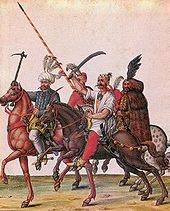 The Turkish advance was temporarily halted after Stephen the Great of Moldavia
defeated the Ottoman Sultan
Mehmed II
's armies at the Battle of Vaslui
in 1475, which was one of the greatest defeats of the Ottoman empire until that time. Stephen was defeated at Războieni
(Battle of Valea Albă
) the next year, but the Ottomans had to retreat after they failed to take any significant castle (see siege of Cetatea Neamţului
) as a plague started to spread in the Ottoman army. Stephen's search for European assistance against the Turks met with little success, even though he had "cut off the pagan
's right hand" - as he put it in a letter.
In 1482, Bosnia was completely added to Ottoman Lands.
before winter) through the land between 1526 and 1556. In 1529, they mounted their first major attack on the Austria
n Habsburg Monarchy (with up to 300,000 troops in earlier accounts, 100,000 according to newer research), attempting to conquer the city of Vienna
(Siege of Vienna
). In 1532, another attack on Vienna with 60,000 troops in the main army was held up by the small fort (800 defenders) of Kőszeg in western Hungary, fighting a suicidal battle. The invading troops were held up until winter was close and the Habsburg Empire had assembled a force of 80,000 at Vienna. The Ottoman troops returned home through Styria, laying waste to the country.
In the meantime, in 1538, the Ottoman Empire invaded Moldavia
. In 1541, another campaign in Hungary took Buda
and Pest
(which today together form the Hungarian capital Budapest
) with a largely bloodless trick: after concluding peace talks with an agreement, troops stormed the open gates of Buda in the night. In retaliation for a failed Austrian counter-attack in 1542, the conquest of the western half of central Hungary was finished in the 1543 campaign that took both the most important royal ex-capital, Székesfehérvár
, and the ex-seat of the cardinal, Esztergom
. However, the army of 35–40,000 men was not enough for Suleiman
to mount another attack on Vienna. A temporary truce was signed between the Habsburg and Ottoman Empires in 1547, which was soon disregarded by the Habsburgs.
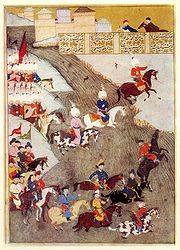 In the major but moderately successful campaign of 1552, two armies took the eastern part of central Hungary, pushing the borders of the Ottoman Empire to the second (inner) line of northern végvárs (border castles), which Hungary originally built as defence against an expected second Mongol invasion—hence, afterwards, borders on this front changed little. For Hungarians, the 1552 campaign was a series of tragic losses and some heroic (but pyrrhic
) victories, which entered folklore—most notably the fall of Drégely (a small fort defended to the last man by just 146 men), and the Siege of Eger
. The latter was a major végvár with more than 2,000 men, but in poor shape and without outside help. They faced two Ottoman armies (150,000 troops by earlier accounts, 60-75,000 men according to newer research), which were unable to take the castle within five weeks. (The fort was later taken in 1596.) Finally, the 1556 campaign secured Ottoman influence over Transylvania (which had fallen under Habsburg control for a time), while failing to gain any ground on the western front, being tied down in the second (after 1555) unsuccessful siege of the southwestern Hungarian border castle of Szigetvár
.
The Ottoman Empire conducted another major war against the Habsburgs and their Hungarian territories between 1566 and 1568. The 1566 Battle of Szigetvar
, the third siege in which the fort was finally taken, but the aged Sultan died, deterring that year's push for Vienna.
in 1522, after two previous failed attempts (see Siege of Rhodes)
. The Knights of Rhodes were banished to Malta
, which was in turn besieged in 1565.
After three months of intense fighting, pitting an Ottoman army of around 65,000 against 2,000 Maltese and 500 Knights, the Ottomans failed to conquer Malta, sustaining very heavy losses, including one of the greatest Muslim corsair generals of the time, Dragut and were repulsed. Had Malta fallen, Sicily and mainland Italy could have fallen under the threat of an Ottoman Invasion. The victory of Malta during this event, which is nowadays known as the Great Siege of Malta, turned the tide and stopped the westward expansion of the Ottoman Empire. It also marked the importance of the Knights of Saint John and their relevant presence in Malta to aid Christendom in its defence against the Muslim conquest.
The Ottoman naval victories of this period were in the Battle of Preveza
(1538) and the Battle of Djerba
(1560).
The Mediterranean campaign
, which lasted from 1570 to 1573, resulted in the Ottoman invasion and occupation of Cyprus
. A Holy League
of Venice, the Papal States
, Spain
, the Knights of Saint John in Malta and initially Portugal
was formed against the Ottoman Empire during this period. The League's victory in the Battle of Lepanto (1571)
ended Ottoman predominance at sea.
on July 2, 1570, and laid siege to Nicosia
. In an orgy of victory on the day that the city fell—September 9, 1570—20,000 Nicosians Greeks were put to death, and every church, public building, and palace was looted. Word of the massacre spread, and a few days later Mustafa took Kyrenia without having to fire a shot. Famagusta, however, resisted and put up a heroic defense that lasted from September 1570 until August 1571.
The fall of Famagusta marked the beginning of the Ottoman period in Cyprus. Two months later, the naval forces of the Holy League, composed mainly of Venetian, Spanish, and Papal ships under the command of Don John of Austria, defeated the Ottoman fleet at the Battle of Lepanto
in one of the decisive battles of world history. The victory over the Turks, however, came too late to help Cyprus, and the island remained under Ottoman rule for the next three centuries.
In 1570, the Ottoman Empire
first occupied Cyprus
, and Lala Mustafa Pasha became the first Ottoman governor of Cyprus, challenging the claims of Venice. Simultaneously, the Pope
formed a coalition between the Papal States
, Malta
, Spain
, Venice
and several other Italian states, with no real result. In 1573 the Venetians left, removing the influence of the Roman Catholic Church
.

. The Next year, the Poles repelled the Turkish invasion in the Battle of Khotyn
. Another conflict started in 1633 but was soon settled.
, forcing them to enter the Peace of Vasvár
with Austria, which held until 1683.
beat back a Tatar invasion, war with Poland 1672–1676, Jan Sobieski distinguishes himself and becomes the King of Poland.
started in 1683, with a grand invasion
force of 140,000 men marching on Vienna, supported by Hungarian noblemen rebelling against Habsburg rule. To stop the invasion, another Holy League was formed, composed of Austria and Poland (notably in the Battle of Vienna
), Venetians and the Russian Empire
. After winning the Battle of Vienna, the Holy League gained the upper hand, and conducted the re-conquest of Hungary (Buda and Pest were retaken in 1686, the former under the command of a Swiss-born convert to Islam). At the same time, the Venetians launched an expedition into Greece
, which conquered the Peloponnese
. During the 1687 Venetian attack on the city of Athens
(occupied by the Ottomans), the Ottomans turned the ancient Parthenon
into an ammunitions storehouse. A German mortar hit the Parthenon, detonating the Ottoman gunpowder stored inside and partially destroying it.
The war ended with the Treaty of Karlowitz
in 1699. Prince Eugene of Savoy
first distinguished himself in 1683 and remained the most important Austrian commander until 1718.
. It was instigated by Charles XII of Sweden
after the defeat at the Battle of Poltava
, in order to tie down Russia with the Ottoman Empire and gain some breathing space in the increasingly unsuccessful Great Northern War
. The Russians were severely beaten but not annihilated, and after the Treaty of Prut was signed the Ottoman Empire disengaged, allowing Russia to refocus its energies on the defeat of Sweden.
Another war with Austria and Venice started in 1714. Austria conquered the remaining areas of the former Hungarian Kingdom, ending with the Treaty of Passarowitz
in 1718.
Another war with Russia started in 1735. The Austrians joined in 1737; the war ended in 1739 with the Treaty of Belgrade
(with Austria) and the Treaty of Niš (with Russia).
The fourth Russo-Turkish started in 1768 and ended in 1774 with the Treaty of Kuchuk-Kainarji.
Yet another war with Russia and Austria started in 1787; it ended by Austria with the 1791 Treaty of Sistova
, and with the 1792 Treaty of Jassy
with Russia.
An invasion of Egypt and Syria by Napoleon I
of France
took place in 1798–99, but ended due to British
intervention.
Napoleon's capture of Malta on his way to Egypt resulted in the unusual alliance of Russia and the Ottomans resulting in a joint naval expedition to the Ionian Islands
. Their successful capture of these islands led to the setting up of the Septinsular Republic
.
took place in 1804, followed by the Second Serbian Uprising
in 1815; Serbia was fully liberated by 1867. Officially recognized independence followed in 1878.
The sixth Russo-Turkish War
began in 1806 and ended in 1812 due to Napoleon's invasion of Russia.
Moldavian-Wallachian (Romanian) Uprising
(starting simultaneously with the Greek Revolution
).
The Greek War of Independence
, taking place from 1821 to 1832, in which the Great Powers intervened from 1827, including Russia (seventh Russo–Turkish war, 1828–1829), achieved independence for Greece; the Treaty of Adrianople
ended the war.
War with Montenegro 1852–1853.
Eighth Russo-Turkish war 1853–1856, Crimean War
, in which the United Kingdom
and France joined the war on the side of the Ottoman Empire. Ended with the Treaty of Paris
.
Second war with Montenegro in 1858–1859.
War with Montenegro, Bosnia and Serbia in 1862.
Cretan Uprising
in 1866.
Bulgarian Rebellion in 1876.
The ninth and final Russo–Turkish war started in 1877, the same year the Ottomans withdrew from the Conference of Constantinople. Romania then declared its independence and waged war on Turkey, joined by Serbians and Bulgarians and finally the Russians (see also Russian Foreign Affairs after the Crimean War). Bosnia was occupied by Austria in 1878. The Russians and the Ottomans signed the Treaty of San Stefano
in early 1878. After deliberations at the Congress of Berlin
, which was attended by all the Great Powers of the time, the Treaty of Berlin, 1878
recognized several territorial changes.
Eastern Rumelia
was granted some autonomy in 1878, rebelled in 1885 and joined Bulgaria in 1886. Thessalia ceded to Greece
in 1881, but after Greece attacked the Ottoman Empire
to help the Second Cretan Uprising in 1897, Greece was broken in Thessalia.
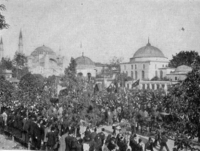
, in 1912 and 1913, involved further action against the Ottoman Empire in Europe. The Balkan League
first conquered Macedonia and most of Thrace
from the Ottoman Empire, and then fell out over the division of the spoils. Albania also declared independence from the Ottoman Empire in 1912, after several rebellions and uprisings. This reduced Turkey's possessions in Europe (Rumelia
) to their present borders in Eastern Thrace.
. However, the Empire prevented the British Royal Navy from passing to Istanbul in the famous Battle of Gallipoli
. Nevertheless, Turkey lost most of the rest of what it had left in Europe.
Ottoman Empire
The Ottoman EmpireIt was usually referred to as the "Ottoman Empire", the "Turkish Empire", the "Ottoman Caliphate" or more commonly "Turkey" by its contemporaries...
in Europe
Europe
Europe is, by convention, one of the world's seven continents. Comprising the westernmost peninsula of Eurasia, Europe is generally 'divided' from Asia to its east by the watershed divides of the Ural and Caucasus Mountains, the Ural River, the Caspian and Black Seas, and the waterways connecting...
are also sometimes referred to as the Ottoman Wars or as Turkish Wars, particularly in older, European texts.
Rise (1299–1453)
After striking a blow to the weakened Byzantine EmpireByzantine Empire
The Byzantine Empire was the Eastern Roman Empire during the periods of Late Antiquity and the Middle Ages, centred on the capital of Constantinople. Known simply as the Roman Empire or Romania to its inhabitants and neighbours, the Empire was the direct continuation of the Ancient Roman State...
in 1356 (it is disputed that the year may have been 1358 due to a change in the Byzantine calendar), (see Suleyman Pasha
Suleyman Pasha (son of Orhan)
Suleyman Pasha was the eldest son of Orhan I, the second bey of the newly established Ottoman Empire.-Assault on Byzantium:Suleyman Pasha struck a bold blow to the weakened Byzantine Empire on behalf of his race, which gave the Turks a permanent establishment on the European side of the Hellespont...
) which provided it a basis for operations in Europe, the Ottoman Empire started its westward expansion into the European continent in the middle of the 14th century. Its first significant opponent was the young Serbian Empire, which was worn down by a series of campaigns, notably in the Battle of Kosovo
Battle of Kosovo
The Battle of Kosovo took place on St. Vitus' Day, June 15, 1389, between the army led by Serbian Prince Lazar Hrebeljanović, and the invading army of the Ottoman Empire under the leadership of Sultan Murad I...
in 1389, in which the leaders of both armies were killed, and which gained a central role in Serbian folklore as an epic battle and beginning of bad luck for Serbia. The Ottoman Empire proceeded to conquer the lands of the Balkans — Thrace
Thrace
Thrace is a historical and geographic area in southeast Europe. As a geographical concept, Thrace designates a region bounded by the Balkan Mountains on the north, Rhodope Mountains and the Aegean Sea on the south, and by the Black Sea and the Sea of Marmara on the east...
and Macedonia
Macedonia (region)
Macedonia is a geographical and historical region of the Balkan peninsula in southeastern Europe. Its boundaries have changed considerably over time, but nowadays the region is considered to include parts of five Balkan countries: Greece, the Republic of Macedonia, Bulgaria, Albania, Serbia, as...
after the Battle of Maritsa
Battle of Maritsa
The Battle of Maritsa, or Battle of Chernomen, took place at the Maritsa River near the village of Chernomen on September 26, 1371 between the forces of the Ottoman sultan Murad I's lieutenant Lala Şâhin Paşa and the...
in 1371, Sofia
Sofia
Sofia is the capital and largest city of Bulgaria and the 12th largest city in the European Union with a population of 1.27 million people. It is located in western Bulgaria, at the foot of Mount Vitosha and approximately at the centre of the Balkan Peninsula.Prehistoric settlements were excavated...
in 1382, the then capital of Bulgaria Tarnovgrad in 1393, the northern rest after the Battle of Nicopolis
Battle of Nicopolis
The Battle of Nicopolis took place on 25 September 1396 and resulted in the rout of an allied army of Hungarian, Wallachian, French, Burgundian, German and assorted troops at the hands of an Ottoman force, raising of the siege of the Danubian fortress of Nicopolis and leading to the end of the...
in 1396, except Vidin
Vidin
Vidin is a port town on the southern bank of the Danube in northwestern Bulgaria. It is close to the borders with Serbia and Romania, and is also the administrative centre of Vidin Province, as well as of the Metropolitan of Vidin...
, which fell in 1422; Albania
Albania
Albania , officially known as the Republic of Albania , is a country in Southeastern Europe, in the Balkans region. It is bordered by Montenegro to the northwest, Kosovo to the northeast, the Republic of Macedonia to the east and Greece to the south and southeast. It has a coast on the Adriatic Sea...
in 1385 (Battle of Savra
Battle of Savra
The Battle of the Saurian Field was fought on 18 September 1385 between Ottoman and much smaller Serbian forces. The Ottomans were victorious and most of the local Serbian and Albanian lords became vassals....
) and again in 1480; Constantinople
Constantinople
Constantinople was the capital of the Roman, Eastern Roman, Byzantine, Latin, and Ottoman Empires. Throughout most of the Middle Ages, Constantinople was Europe's largest and wealthiest city.-Names:...
in 1453 after the Battle of Varna
Battle of Varna
The Battle of Varna took place on November 10, 1444 near Varna in eastern Bulgaria. In this battle the Ottoman Empire under Sultan Murad II defeated the Polish and Hungarian armies under Władysław III of Poland and János Hunyadi...
and Second Battle of Kosovo; Greece
Greece
Greece , officially the Hellenic Republic , and historically Hellas or the Republic of Greece in English, is a country in southeastern Europe....
in 1460; Serbia
Serbia
Serbia , officially the Republic of Serbia , is a landlocked country located at the crossroads of Central and Southeast Europe, covering the southern part of the Carpathian basin and the central part of the Balkans...
by 1459 and (after partial Hungarian reconquest in 1480) again by 1499; Bosnia
Bosnia (region)
Bosnia is a eponomous region of Bosnia and Herzegovina. It lies mainly in the Dinaric Alps, ranging to the southern borders of the Pannonian plain, with the rivers Sava and Drina marking its northern and eastern borders. The other eponomous region, the southern, other half of the country is...
in 1463 (the Northwestern part only by 1527) and Herzegovina
Herzegovina
Herzegovina is the southern region of Bosnia and Herzegovina. While there is no official border distinguishing it from the Bosnian region, it is generally accepted that the borders of the region are Croatia to the west, Montenegro to the south, the canton boundaries of the Herzegovina-Neretva...
in 1482.
Growth (1453–1683)
The defeat in 1456 at the Siege of Nándorfehérvár (Belgrade) held up Ottoman expansion into Catholic Europe for 70 years, though for one year (1480–1481) the Italian port of Otranto was taken, and in 1493 the Ottoman army successfully raided CroatiaCroatia
Croatia , officially the Republic of Croatia , is a unitary democratic parliamentary republic in Europe at the crossroads of the Mitteleuropa, the Balkans, and the Mediterranean. Its capital and largest city is Zagreb. The country is divided into 20 counties and the city of Zagreb. Croatia covers ...
and Styria.
Wars in Albania
The Ottomans faced the fiercest resistance from Albanians who gathered around their leader, George Castriot, son of a feudal nobleman, and managed to fend off Ottoman attacks for more than 25 years. It has been argued that their resilience halted the Ottoman advance along the Eastern flank of the Western Civilization, saving the Italian peninsula from Ottoman conquest. Sultan Mehmet II died in 1481, merely two years after the collapse of the Albanian resistance and one year after he launched an Italian campaignOttoman invasion of Otranto
In 1480 and 1481 the city and fort of Otranto, in Apulia, southern Italy, were held by Ottoman troops.-Attack:On July 28, 1480, an Ottoman fleet of 128 ships of which 28 were galleys arrived near the Neapolitan city of Otranto in the region Apulia. Possibly these troops came from the siege of Rhodes...
.
Bosnian Resistance
Ottoman Empire first reached Bosnia in 1388 where they were defeated by Bosnian forces in the Battle of Bileca and then were forced to retreat. After the fall of Serbia in 1389, the Turks began various offensives against the Kingdom of Bosnia. The Bosnians defended themselves but without much success. The Bosnian Army participated in the Battle of KosovoBattle of Kosovo
The Battle of Kosovo took place on St. Vitus' Day, June 15, 1389, between the army led by Serbian Prince Lazar Hrebeljanović, and the invading army of the Ottoman Empire under the leadership of Sultan Murad I...
(Battle of the Field of Blackbirds) but the Ottoman Army was again victorious. Bosnians resisted strongly in the Bosnian Royal castle of Jajce
Jajce
Jajce is a city and municipality located in the central part of Bosnia and Herzegovina. It is part of the Central Bosnia Canton of the Federation of Bosnia and Herzegovina entity...
, where the last Bosnian king Stjepan Tomašević
Stjepan Tomaševic
Stephen Tomašević was the last King of Bosnia and also the last Despot of Serbia .-Family:He was the son of King Stephen Thomas of Bosnia...
tried to repel the Turks. The Ottoman army conquered Jajce after a few months, in 1463, and executed the last King of Bosnia. However, resistance continued throughout the country, mostly in the north and west, so that the Ottomans were only able to install their first administration, called Eyalet of Bosnia in 1527.
Croatian Resistance
Kingdom of Bosnia
The Kingdom of Bosnia or the Bosnian Kingdom was one of the medieval kingdoms of the Balkans, existing between 1377 and 1463.- Establishment :...
into the Ottoman
Ottoman Empire
The Ottoman EmpireIt was usually referred to as the "Ottoman Empire", the "Turkish Empire", the "Ottoman Caliphate" or more commonly "Turkey" by its contemporaries...
hands in 1463, the southern and central parts of the Kingdom of Croatia
Croatia in personal union with Hungary
Kingdom of Croatia after the succession crisis become a part of Kingdom of Hungary and — depending on sources — either was incorporated into Hungary or Croatia existed in a personal union with Hungary....
remained unprotected, the defense of which was left to Croatian gentry who kept smaller troops in the fortified border areas at their own expense. The Ottomans meanwhile reached the river Neretva
Neretva
Neretva is the largest river of the eastern part of the Adriatic basin. It has been harnessed and controlled to a large extent by four HE power-plants with large dams and their storage lakes, but it is still recognized for its natural beauty, diversity of its landscape and visual...
and having conquered Herzegovina
Herzegovina
Herzegovina is the southern region of Bosnia and Herzegovina. While there is no official border distinguishing it from the Bosnian region, it is generally accepted that the borders of the region are Croatia to the west, Montenegro to the south, the canton boundaries of the Herzegovina-Neretva...
(Rama) in 1482, they found their way toward Croatia
Croatia
Croatia , officially the Republic of Croatia , is a unitary democratic parliamentary republic in Europe at the crossroads of the Mitteleuropa, the Balkans, and the Mediterranean. Its capital and largest city is Zagreb. The country is divided into 20 counties and the city of Zagreb. Croatia covers ...
, skillfully avoiding the fortified border towns. Decisive Ottoman victory at the Battle of Krbava field
Battle of Krbava field
The Battle of Krbava field , was fought between the Ottoman Empire of Bayezid II and a Croatian army of the Kingdom of Croatia in personal union with the Kingdom of Hungary on September 9, 1493 in the Krbava field, a part of Lika region, southern Croatia...
shook all the social strata in Croatia. However, it did not dissuade the Croats
Croats
Croats are a South Slavic ethnic group mostly living in Croatia, Bosnia and Herzegovina and nearby countries. There are around 4 million Croats living inside Croatia and up to 4.5 million throughout the rest of the world. Responding to political, social and economic pressure, many Croats have...
from making even more decisive and persistent attempts at defending themselves against the attacks of the much more superior enemy. After almost two hundred years of the Croatian fighting against the Ottoman Empire, the victory in the Battle of Sisak
Battle of Sisak
The Battle of Sisak was fought on June 22, 1593, between Ottoman forces of the Bosnian governor-general, or Beylerbeyi, Hasan-paša Predojević, and forces of the Holy Roman Empire under the supreme command of the Styrian general Ruprecht von Eggenberg...
marked the end of the Ottoman invasions and Hundred Years' Croatian-Ottoman War. The Viceroy's army, chasing the Turks away from Petrinja
Petrinja
Petrinja is a city in central Croatia near Sisak in the historic region of Banovina. The city belongs to Sisak-Moslavina County .- History :The name of Petrinja has its roots in Latin petrus, meaning "stone"...
in 1595, sealed the victory.
Occupation of central parts of Hungarian Kingdom
The Kingdom of HungaryKingdom of Hungary
The Kingdom of Hungary comprised present-day Hungary, Slovakia and Croatia , Transylvania , Carpatho Ruthenia , Vojvodina , Burgenland , and other smaller territories surrounding present-day Hungary's borders...
, which at the time spanned the area from Croatia in the west to Transylvania
Transylvania
Transylvania is a historical region in the central part of Romania. Bounded on the east and south by the Carpathian mountain range, historical Transylvania extended in the west to the Apuseni Mountains; however, the term sometimes encompasses not only Transylvania proper, but also the historical...
in the east, was also gravely threatened by Ottoman advances. The origins of such a deterioration can be traced back to the fall of the Árpád ruling dynasty and their subsequent replacement with the Angevin
Capetian House of Anjou
The Capetian House of Anjou, also known as the House of Anjou-Sicily and House of Anjou-Naples, was a royal house and cadet branch of the direct House of Capet. Founded by Charles I of Sicily, a son of Louis VIII of France, the Capetian king first ruled the Kingdom of Sicily during the 13th century...
and Jagiellonian kings. After a series of inconclusive wars over the course of 176 years, the kingdom finally crumbled in the Battle of Mohács
Battle of Mohács
The Battle of Mohács was fought on August 29, 1526 near Mohács, Hungary. In the battle, forces of the Kingdom of Hungary led by King Louis II of Hungary and Bohemia were defeated by forces of the Ottoman Empire led by Sultan Suleiman the Magnificent....
of 1526, after which most of it was either occupied or brought under Ottoman suzerainty. (The 150-year Turkish Occupation, as it is called in Hungary, lasted until the late 17th century but parts of the Hungarian Kingdom were occupied from 1421 and until 1718.)
Serbian Resistance
As a result of heavy losses inflicted by the Ottomans in the Battle of MaritsaBattle of Maritsa
The Battle of Maritsa, or Battle of Chernomen, took place at the Maritsa River near the village of Chernomen on September 26, 1371 between the forces of the Ottoman sultan Murad I's lieutenant Lala Şâhin Paşa and the...
in 1371, the Serbian Empire
Serbian Empire
The Serbian Empire was a short-lived medieval empire in the Balkans that emerged from the Serbian Kingdom. Stephen Uroš IV Dušan was crowned Emperor of Serbs and Greeks on 16 April, 1346, a title signifying a successorship to the Eastern Roman Empire...
had dissolved into many principalities. The battle preceded the later Battle of Kosovo
Battle of Kosovo
The Battle of Kosovo took place on St. Vitus' Day, June 15, 1389, between the army led by Serbian Prince Lazar Hrebeljanović, and the invading army of the Ottoman Empire under the leadership of Sultan Murad I...
in 1389, during which the Serbian forces were again annihilated. Throughout the 15th and 16th centuries, constant struggles took place between various Serbian kingdoms on the one hand, and the Ottoman Empire on the other. The turning point was the fall of Constantinople
Fall of Constantinople
The Fall of Constantinople was the capture of the capital of the Byzantine Empire, which occurred after a siege by the Ottoman Empire, under the command of Ottoman Sultan Mehmed II, against the defending army commanded by Byzantine Emperor Constantine XI...
to the Turks. In 1459 following the siege, the "temporary" Serbian capital of Smederevo
Smederevo
Smederevo is a city and municipality in Serbia, on the right bank of the Danube, about 40 km downstream of the capital Belgrade. According to official results of the 2011 census, the city has a population of 107,528...
fell. Montenegro
Montenegro
Montenegro Montenegrin: Crna Gora Црна Гора , meaning "Black Mountain") is a country located in Southeastern Europe. It has a coast on the Adriatic Sea to the south-west and is bordered by Croatia to the west, Bosnia and Herzegovina to the northwest, Serbia to the northeast and Albania to the...
was overrun by 1499. Belgrade
Belgrade
Belgrade is the capital and largest city of Serbia. It is located at the confluence of the Sava and Danube rivers, where the Pannonian Plain meets the Balkans. According to official results of Census 2011, the city has a population of 1,639,121. It is one of the 15 largest cities in Europe...
was the last major Balkan city to endure Ottoman onslaughts. Serbs, Hungarians and European crusader
Crusades
The Crusades were a series of religious wars, blessed by the Pope and the Catholic Church with the main goal of restoring Christian access to the holy places in and near Jerusalem...
s heavily defeated the Turkish in the Siege of Belgrade of 1456. After repelling Ottoman attacks for over 70 years, Belgrade finally fell in 1521, along with the greater part of the Kingdom of Hungary, and Serbian Despotate
Serbian Despotate
The Serbian Despotate was a Serbian state, the last to be conquered by the Ottoman Empire. Although the Battle of Kosovo in 1389 is generally considered the end of the medieval Serbian state, the Despotate, a successor of the Serbian Empire and Moravian Serbia survived for 70 more years,...
finally fell in 1540, thus marking the Turkish occupation of all Serbian territories.
1463–1503: Wars with Venice
The wars with the Republic of VeniceRepublic of Venice
The Republic of Venice or Venetian Republic was a state originating from the city of Venice in Northeastern Italy. It existed for over a millennium, from the late 7th century until 1797. It was formally known as the Most Serene Republic of Venice and is often referred to as La Serenissima, in...
began
Ottoman–Venetian War (1463–1479)
The First Ottoman–Venetian War was fought between the Republic of Venice and her allies and the Ottoman Empire from 1463 to 1479. Fought shortly after the capture of Constantinople and the remnants of the Byzantine Empire by the Ottomans, it resulted in the loss of several Venetian holdings in...
in 1463, until a favorable peace treaty was signed in 1479. In 1480, now no longer hampered by the Venetian fleet, the Ottomans besieged Rhodes
Siege of Rhodes (1480)
In 1480 the small Knights Hospitaller garrison of Rhodes withstood an attack of the Ottoman Empire.-Preparation:In 1470, the island of Tilos was evacuated to Rhodes because they were susceptible to attacks from the Ottoman Empire...
and captured Otranto. War with Venice resumed from 1499 to 1503. In 1500, a Spanish
Spain
Spain , officially the Kingdom of Spain languages]] under the European Charter for Regional or Minority Languages. In each of these, Spain's official name is as follows:;;;;;;), is a country and member state of the European Union located in southwestern Europe on the Iberian Peninsula...
-Venetian army commanded by Gonzalo de Córdoba took Kefalonia
Kefalonia
The island of Cephalonia, also known as Kefalonia, Cephallenia, Cephallonia, Kefallinia, or Kefallonia , is the largest of the Ionian Islands in western Greece, with an area of . It is also a separate regional unit of the Ionian Islands region, and the only municipality of the regional unit...
, temporarily stopping the Ottoman offensive on eastern Venetian territories.
1462–1483: Wallachian and Moldavian campaigns
In 1462, Mehmed II was driven back by Wallachian prince Vlad III Dracula at The Night AttackThe Night Attack
The Night Attack of Târgovişte was a skirmish fought between forces of Vlad III the Impaler of Wallachia and Mehmed II of the Ottoman Empire on Thursday, June 17, 1462. The conflict initially started with Vlad's refusal to pay the Jizya to the Sultan and intensified when Vlad Ţepeş invaded...
. However, the latter was imprisoned by Hungarian king Matthias Corvinus. This caused outrage among many influential Hungarian figures and Western admirers of Vlad's success in the battle against the Ottoman Empire (and his early recognition of the threat it posed), including high-ranking members of the Vatican
Roman Curia
The Roman Curia is the administrative apparatus of the Holy See and the central governing body of the entire Catholic Church, together with the Pope...
. Because of this, Matthias granted him the status of distinguished prisoner. Eventually, Dracula was freed in late 1475 and was sent with an army of Hungarian and Serbian soldiers to recover Bosnia
Bosnia (region)
Bosnia is a eponomous region of Bosnia and Herzegovina. It lies mainly in the Dinaric Alps, ranging to the southern borders of the Pannonian plain, with the rivers Sava and Drina marking its northern and eastern borders. The other eponomous region, the southern, other half of the country is...
from the Ottomans. He defeated Ottoman Forces and he gained his first victory against the Ottoman Empire. Upon this victory, Ottoman Forces entered Wallachia in 1476 under the command of Mehmed II. During the war, Vlad was killed and, according to some sources, his head was sent to Constantinople to discourage the other rebellions.
Moldavia
Moldavia is a geographic and historical region and former principality in Eastern Europe, corresponding to the territory between the Eastern Carpathians and the Dniester river...
defeated the Ottoman Sultan
Ottoman Dynasty
The Ottoman Dynasty ruled the Ottoman Empire from 1299 to 1922, beginning with Osman I , though the dynasty was not proclaimed until Orhan Bey declared himself sultan...
Mehmed II
Mehmed II
Mehmed II , was Sultan of the Ottoman Empire for a short time from 1444 to September 1446, and later from...
's armies at the Battle of Vaslui
Battle of Vaslui
The Battle of Vaslui was fought on January 10, 1475 between Stephen III of Moldavia and the Ottoman Beylerbey of Rumelia, Hadân Suleiman Pasha. The battle took place at Podul Înalt , near the town of Vaslui, in Moldavia...
in 1475, which was one of the greatest defeats of the Ottoman empire until that time. Stephen was defeated at Războieni
Neamt County
Neamț is a county of Romania, in the historic region of Moldavia, with the county seat at Piatra Neamț. It has three communes, Bicaz-Chei, Bicazu Ardelean and Dămuc in Transylvania.-Demographics:...
(Battle of Valea Albă
Battle of Valea Alba
The Battle of Valea Albă or Battle of Războieni or Battle of Akdere was an important event in the medieval history of Moldavia. It took place at Războieni, also known as Valea Albă, on July 26, 1476, between the Moldavian army of Ştefan cel Mare and an invading Ottoman army which was commanded...
) the next year, but the Ottomans had to retreat after they failed to take any significant castle (see siege of Cetatea Neamţului
Siege of Cetatea Neamtului
The Siege of Cetatea Neamţului in 1476 was an important event in the history of Moldavia.Cetatea Neamţului was a fortress rumored to have been built, in the thirteenth century by the Teutonic Knights, in defence against Tatar incursions....
) as a plague started to spread in the Ottoman army. Stephen's search for European assistance against the Turks met with little success, even though he had "cut off the pagan
Infidel
An infidel is one who has no religious beliefs, or who doubts or rejects the central tenets of a particular religion – especially in reference to Christianity or Islam....
's right hand" - as he put it in a letter.
In 1482, Bosnia was completely added to Ottoman Lands.
1526–1566: Attack on Hungarian Kingdom
After the Mohács, only the southwestern part of the Hungarian Kingdom was actually conquered, but the Ottoman campaign continued with small campaigns and major summer invasions (troops returned south of the Balkan MountainsBalkan Mountains
The Balkan mountain range is a mountain range in the eastern part of the Balkan Peninsula. The Balkan range runs 560 km from the Vrashka Chuka Peak on the border between Bulgaria and eastern Serbia eastward through central Bulgaria to Cape Emine on the Black Sea...
before winter) through the land between 1526 and 1556. In 1529, they mounted their first major attack on the Austria
Austria
Austria , officially the Republic of Austria , is a landlocked country of roughly 8.4 million people in Central Europe. It is bordered by the Czech Republic and Germany to the north, Slovakia and Hungary to the east, Slovenia and Italy to the south, and Switzerland and Liechtenstein to the...
n Habsburg Monarchy (with up to 300,000 troops in earlier accounts, 100,000 according to newer research), attempting to conquer the city of Vienna
Vienna
Vienna is the capital and largest city of the Republic of Austria and one of the nine states of Austria. Vienna is Austria's primary city, with a population of about 1.723 million , and is by far the largest city in Austria, as well as its cultural, economic, and political centre...
(Siege of Vienna
Siege of Vienna
The Siege of Vienna in 1529 was the first attempt by the Ottoman Empire, led by Suleiman the Magnificent, to capture the city of Vienna, Austria. The siege signalled the pinnacle of the Ottoman Empire's power, the maximum extent of Ottoman expansion in central Europe, and was the result of a...
). In 1532, another attack on Vienna with 60,000 troops in the main army was held up by the small fort (800 defenders) of Kőszeg in western Hungary, fighting a suicidal battle. The invading troops were held up until winter was close and the Habsburg Empire had assembled a force of 80,000 at Vienna. The Ottoman troops returned home through Styria, laying waste to the country.
In the meantime, in 1538, the Ottoman Empire invaded Moldavia
Moldavia
Moldavia is a geographic and historical region and former principality in Eastern Europe, corresponding to the territory between the Eastern Carpathians and the Dniester river...
. In 1541, another campaign in Hungary took Buda
Buda
For detailed information see: History of Buda CastleBuda is the western part of the Hungarian capital Budapest on the west bank of the Danube. The name Buda takes its name from the name of Bleda the Hun ruler, whose name is also Buda in Hungarian.Buda comprises about one-third of Budapest's...
and Pest
Pest (city)
Pest is the eastern, mostly flat part of Budapest, Hungary, comprising about two thirds of the city's territory. It is divided from Buda, the other part of Budapest, by the Danube River. Among its most notable parts are the Inner City, including the Hungarian Parliament, Heroes' Square and...
(which today together form the Hungarian capital Budapest
Budapest
Budapest is the capital of Hungary. As the largest city of Hungary, it is the country's principal political, cultural, commercial, industrial, and transportation centre. In 2011, Budapest had 1,733,685 inhabitants, down from its 1989 peak of 2,113,645 due to suburbanization. The Budapest Commuter...
) with a largely bloodless trick: after concluding peace talks with an agreement, troops stormed the open gates of Buda in the night. In retaliation for a failed Austrian counter-attack in 1542, the conquest of the western half of central Hungary was finished in the 1543 campaign that took both the most important royal ex-capital, Székesfehérvár
Székesfehérvár
Székesfehérvár is a city in central Hungary and is the 9th largest in the country. Located around southwest of Budapest. It is inhabited by 101,973 people , with 136,995 in the Székesfehérvár Subregion. The city is the centre of Fejér county and the regional centre of Central Transdanubia...
, and the ex-seat of the cardinal, Esztergom
Esztergom
Esztergom , is a city in northern Hungary, 46 km north-west of the capital Budapest. It lies in Komárom-Esztergom county, on the right bank of the river Danube, which forms the border with Slovakia there....
. However, the army of 35–40,000 men was not enough for Suleiman
Suleiman the Magnificent
Suleiman I was the tenth and longest-reigning Sultan of the Ottoman Empire, from 1520 to his death in 1566. He is known in the West as Suleiman the Magnificent and in the East, as "The Lawgiver" , for his complete reconstruction of the Ottoman legal system...
to mount another attack on Vienna. A temporary truce was signed between the Habsburg and Ottoman Empires in 1547, which was soon disregarded by the Habsburgs.
Pyrrhic victory
A Pyrrhic victory is a victory with such a devastating cost to the victor that it carries the implication that another such victory will ultimately cause defeat.-Origin:...
) victories, which entered folklore—most notably the fall of Drégely (a small fort defended to the last man by just 146 men), and the Siege of Eger
Siege of Eger
The Siege of Eger occurred during the 16th century Ottoman Wars in Europe. It was a major Hungarian victory after a series of crushing defeats at the hands of Ottoman forces and checked the Ottoman expansion into both Central Europe and Eastern Europe....
. The latter was a major végvár with more than 2,000 men, but in poor shape and without outside help. They faced two Ottoman armies (150,000 troops by earlier accounts, 60-75,000 men according to newer research), which were unable to take the castle within five weeks. (The fort was later taken in 1596.) Finally, the 1556 campaign secured Ottoman influence over Transylvania (which had fallen under Habsburg control for a time), while failing to gain any ground on the western front, being tied down in the second (after 1555) unsuccessful siege of the southwestern Hungarian border castle of Szigetvár
Szigetvár
-History:The town's fortress was the setting of the Battle of Szigetvár in 1566. It was a sanjak centre at first in Budin Province , later in Kanije Province .There was already a bum in the marshland back in the Celtic and Roman times...
.
The Ottoman Empire conducted another major war against the Habsburgs and their Hungarian territories between 1566 and 1568. The 1566 Battle of Szigetvar
Battle of Szigetvár
The Siege of Szigetvár or Battle of Szigeth was a siege of the Szigeth Fortress in Baranya which blocked Suleiman's line of advance towards Vienna in 1566 AD...
, the third siege in which the fort was finally taken, but the aged Sultan died, deterring that year's push for Vienna.
1522–1573: Rhodes, Malta and the Holy League
Ottoman forces invaded and captured the island of RhodesRhodes
Rhodes is an island in Greece, located in the eastern Aegean Sea. It is the largest of the Dodecanese islands in terms of both land area and population, with a population of 117,007, and also the island group's historical capital. Administratively the island forms a separate municipality within...
in 1522, after two previous failed attempts (see Siege of Rhodes)
Siege of Rhodes (1522)
The Siege of Rhodes of 1522 was the second and ultimately successful attempt by the Ottoman Empire to expel the Knights of Rhodes from their island stronghold and thereby secure Ottoman control of the Eastern Mediterranean. The first siege, in 1480, had been unsuccessful.-Setting:The Knights of St...
. The Knights of Rhodes were banished to Malta
Malta
Malta , officially known as the Republic of Malta , is a Southern European country consisting of an archipelago situated in the centre of the Mediterranean, south of Sicily, east of Tunisia and north of Libya, with Gibraltar to the west and Alexandria to the east.Malta covers just over in...
, which was in turn besieged in 1565.
After three months of intense fighting, pitting an Ottoman army of around 65,000 against 2,000 Maltese and 500 Knights, the Ottomans failed to conquer Malta, sustaining very heavy losses, including one of the greatest Muslim corsair generals of the time, Dragut and were repulsed. Had Malta fallen, Sicily and mainland Italy could have fallen under the threat of an Ottoman Invasion. The victory of Malta during this event, which is nowadays known as the Great Siege of Malta, turned the tide and stopped the westward expansion of the Ottoman Empire. It also marked the importance of the Knights of Saint John and their relevant presence in Malta to aid Christendom in its defence against the Muslim conquest.
The Ottoman naval victories of this period were in the Battle of Preveza
Battle of Preveza
The naval Battle of Preveza took place on 28 September 1538 near Preveza in northwestern Greece between an Ottoman fleet and that of a Christian alliance assembled by Pope Paul III.-Background:...
(1538) and the Battle of Djerba
Battle of Djerba
The naval Battle of Djerba took place in May 1560 near the island of Djerba, Tunisia in which the Ottomans under Piyale Pasha's command overwhelmed a large joint European fleet, chiefly Spanish forces, sinking half its ships.-Background:...
(1560).
The Mediterranean campaign
Ottoman–Venetian War (1570–1573)
The Fourth Ottoman–Venetian War, also known as the War of Cyprus was fought between 1570–1573. It was waged between the Ottoman Empire and the Republic of Venice, the latter joined by the Holy League, a coalition of Christian states formed under the auspices of the Pope, which included Spain , the...
, which lasted from 1570 to 1573, resulted in the Ottoman invasion and occupation of Cyprus
Cyprus
Cyprus , officially the Republic of Cyprus , is a Eurasian island country, member of the European Union, in the Eastern Mediterranean, east of Greece, south of Turkey, west of Syria and north of Egypt. It is the third largest island in the Mediterranean Sea.The earliest known human activity on the...
. A Holy League
Holy League (Mediterranean)
The Holy League of 1571 was arranged by Pope St. Pius V and included almost all the major Catholic maritime states in the Mediterranean. It was intended to break the Ottoman Turks' control of the eastern Mediterranean Sea and was formally concluded on 25 May 1571...
of Venice, the Papal States
Papal States
The Papal State, State of the Church, or Pontifical States were among the major historical states of Italy from roughly the 6th century until the Italian peninsula was unified in 1861 by the Kingdom of Piedmont-Sardinia .The Papal States comprised territories under...
, Spain
Spain
Spain , officially the Kingdom of Spain languages]] under the European Charter for Regional or Minority Languages. In each of these, Spain's official name is as follows:;;;;;;), is a country and member state of the European Union located in southwestern Europe on the Iberian Peninsula...
, the Knights of Saint John in Malta and initially Portugal
Portugal
Portugal , officially the Portuguese Republic is a country situated in southwestern Europe on the Iberian Peninsula. Portugal is the westernmost country of Europe, and is bordered by the Atlantic Ocean to the West and South and by Spain to the North and East. The Atlantic archipelagos of the...
was formed against the Ottoman Empire during this period. The League's victory in the Battle of Lepanto (1571)
Battle of Lepanto (1571)
The Battle of Lepanto took place on 7 October 1571 when a fleet of the Holy League, a coalition of Catholic maritime states, decisively defeated the main fleet of the Ottoman Empire in five hours of fighting on the northern edge of the Gulf of Patras, off western Greece...
ended Ottoman predominance at sea.
1570–1571: Conquest of Cyprus
In the summer of 1570, the Turks struck again, but this time with a full-scale invasion rather than a raid. About 60,000 troops, including cavalry and artillery, under the command of Lala Mustafa Pasha landed unopposed near LimassolLimassol
Limassol is the second-largest city in Cyprus, with a population of 228,000 . It is the largest city in geographical size, and the biggest municipality on the island. The city is located on Akrotiri Bay, on the island's southern coast and it is the capital of Limassol District.Limassol is the...
on July 2, 1570, and laid siege to Nicosia
Nicosia
Nicosia from , known locally as Lefkosia , is the capital and largest city in Cyprus, as well as its main business center. Nicosia is the only divided capital in the world, with the southern and the northern portions divided by a Green Line...
. In an orgy of victory on the day that the city fell—September 9, 1570—20,000 Nicosians Greeks were put to death, and every church, public building, and palace was looted. Word of the massacre spread, and a few days later Mustafa took Kyrenia without having to fire a shot. Famagusta, however, resisted and put up a heroic defense that lasted from September 1570 until August 1571.
The fall of Famagusta marked the beginning of the Ottoman period in Cyprus. Two months later, the naval forces of the Holy League, composed mainly of Venetian, Spanish, and Papal ships under the command of Don John of Austria, defeated the Ottoman fleet at the Battle of Lepanto
Battle of Lepanto (1571)
The Battle of Lepanto took place on 7 October 1571 when a fleet of the Holy League, a coalition of Catholic maritime states, decisively defeated the main fleet of the Ottoman Empire in five hours of fighting on the northern edge of the Gulf of Patras, off western Greece...
in one of the decisive battles of world history. The victory over the Turks, however, came too late to help Cyprus, and the island remained under Ottoman rule for the next three centuries.
In 1570, the Ottoman Empire
Ottoman Empire
The Ottoman EmpireIt was usually referred to as the "Ottoman Empire", the "Turkish Empire", the "Ottoman Caliphate" or more commonly "Turkey" by its contemporaries...
first occupied Cyprus
Cyprus
Cyprus , officially the Republic of Cyprus , is a Eurasian island country, member of the European Union, in the Eastern Mediterranean, east of Greece, south of Turkey, west of Syria and north of Egypt. It is the third largest island in the Mediterranean Sea.The earliest known human activity on the...
, and Lala Mustafa Pasha became the first Ottoman governor of Cyprus, challenging the claims of Venice. Simultaneously, the Pope
Pope
The Pope is the Bishop of Rome, a position that makes him the leader of the worldwide Catholic Church . In the Catholic Church, the Pope is regarded as the successor of Saint Peter, the Apostle...
formed a coalition between the Papal States
Papal States
The Papal State, State of the Church, or Pontifical States were among the major historical states of Italy from roughly the 6th century until the Italian peninsula was unified in 1861 by the Kingdom of Piedmont-Sardinia .The Papal States comprised territories under...
, Malta
Malta
Malta , officially known as the Republic of Malta , is a Southern European country consisting of an archipelago situated in the centre of the Mediterranean, south of Sicily, east of Tunisia and north of Libya, with Gibraltar to the west and Alexandria to the east.Malta covers just over in...
, Spain
Spain
Spain , officially the Kingdom of Spain languages]] under the European Charter for Regional or Minority Languages. In each of these, Spain's official name is as follows:;;;;;;), is a country and member state of the European Union located in southwestern Europe on the Iberian Peninsula...
, Venice
Venice
Venice is a city in northern Italy which is renowned for the beauty of its setting, its architecture and its artworks. It is the capital of the Veneto region...
and several other Italian states, with no real result. In 1573 the Venetians left, removing the influence of the Roman Catholic Church
Roman Catholic Church
The Catholic Church, also known as the Roman Catholic Church, is the world's largest Christian church, with over a billion members. Led by the Pope, it defines its mission as spreading the gospel of Jesus Christ, administering the sacraments and exercising charity...
.
1593–1669: Austria, Venice and Wallachia
- Long WarLong War (Ottoman wars)The Long War took place from 1591 or 1593 to 1604 or 1606 and was one of the numerous military conflicts between the Habsburg Monarchy and the Ottoman Empire that developed after the Battle of Mohács.- History :The major participants of this war were the Habsburg Monarchy ,...
(15-Year War with Austria, 1593–1606) ends with status quo. - War with Venice 1645–1669 and the conquest of CreteCreteCrete is the largest and most populous of the Greek islands, the fifth largest island in the Mediterranean Sea, and one of the thirteen administrative regions of Greece. It forms a significant part of the economy and cultural heritage of Greece while retaining its own local cultural traits...
(see Cretan War (1645–1669)Cretan War (1645–1669)The Cretan War or War of Candia , as the Fifth Ottoman–Venetian War is better known, was a conflict between the Republic of Venice and her allies against the Ottoman Empire and the Barbary States, fought over the island of Crete, Venice's largest and richest overseas possession...
). - Austro-Turkish War (1663–1664)Austro-Turkish War (1663–1664)The Austro-Turkish War or fourth Austro-Turkish War was a short war between the Habsburg Monarchy and the Ottoman Empire.The Habsburg army under Raimondo Montecuccoli succeeded to halt the Ottoman army on its way to Vienna in the Battle of Saint Gotthard.Despite this Ottoman defeat, the war ended...
- Michael the Brave campaign against the Ottoman Empire (1593–1601)
1620-1621: Poland
Was fought over Moldavia. The Polish army advanced into Moldavia and was defeated in the Battle of ŢuţoraBattle of Tutora (1620)
The Battle of Ţuţora was a battle between the Polish-Lithuanian Commonwealth and Ottoman forces , fought from 17 September to 7 October 1620 in Moldavia, near the Prut River.- Prelude :Because of the failure of Commonwealth diplomatic mission to Constantinople, and violations of the Treaty of...
. The Next year, the Poles repelled the Turkish invasion in the Battle of Khotyn
Battle of Khotyn (1621)
The Battle of Khotyn was a battle fought between a Polish-Lithuanian Commonwealth army and an invading Ottoman Imperial army. Here, for a whole month , the Commonwealth forces halted the Ottoman advance...
. Another conflict started in 1633 but was soon settled.
1657–1683 Conclusion of Wars with Habsburgs
In 1657, Transylvania, the Eastern part of the former Hungarian Kingdom that after 1526 gained semi-independence while paying tribute to the Ottoman Empire, felt strong enough to attack the Tatars (then the Empire's vassals) to the East, and later the Ottoman Empire itself, that came to the Tatars' defence. The war lasted until 1662, ending in defeat for the Hungarians. The Western part of the Hungarian Kingdom (Partium) was annexed and placed under direct Ottoman control, marking the greatest territorial extent of Ottoman rule in the former Hungarian Kingdom. At the same time, there was another campaign against Austria between 1663 and 1664. However, the Turks were defeated in the Battle of Saint Gotthard on 1 August 1664 by Raimondo MontecuccoliRaimondo Montecuccoli
Raimondo, Count of Montecúccoli or Montecucculi was an Italian military general who also served as general for the Austrians, and was also a prince of the Holy Roman Empire and Neapolitan Duke of Melfi....
, forcing them to enter the Peace of Vasvár
Peace of Vasvár
The Peace of Vasvár was a treaty between the Austrian Habsburg Monarchy and the Ottoman Empire which followed the Battle of Saint Gotthard of August 1, 1664, and concluded the Austro-Turkish War...
with Austria, which held until 1683.
1672–1676: Poland
A year after PolandPoland
Poland , officially the Republic of Poland , is a country in Central Europe bordered by Germany to the west; the Czech Republic and Slovakia to the south; Ukraine, Belarus and Lithuania to the east; and the Baltic Sea and Kaliningrad Oblast, a Russian exclave, to the north...
beat back a Tatar invasion, war with Poland 1672–1676, Jan Sobieski distinguishes himself and becomes the King of Poland.
1683–1699: Great Turkish War – Loss of Hungary and the Morea
The Great Turkish WarGreat Turkish War
The Great Turkish War refers to a series of conflicts between the Ottoman Empire and contemporary European powers, then joined into a Holy League, during the second half of the 17th century.-1667–1683:...
started in 1683, with a grand invasion
Invasion
An invasion is a military offensive consisting of all, or large parts of the armed forces of one geopolitical entity aggressively entering territory controlled by another such entity, generally with the objective of either conquering, liberating or re-establishing control or authority over a...
force of 140,000 men marching on Vienna, supported by Hungarian noblemen rebelling against Habsburg rule. To stop the invasion, another Holy League was formed, composed of Austria and Poland (notably in the Battle of Vienna
Battle of Vienna
The Battle of Vienna took place on 11 and 12 September 1683 after Vienna had been besieged by the Ottoman Empire for two months...
), Venetians and the Russian Empire
Russian Empire
The Russian Empire was a state that existed from 1721 until the Russian Revolution of 1917. It was the successor to the Tsardom of Russia and the predecessor of the Soviet Union...
. After winning the Battle of Vienna, the Holy League gained the upper hand, and conducted the re-conquest of Hungary (Buda and Pest were retaken in 1686, the former under the command of a Swiss-born convert to Islam). At the same time, the Venetians launched an expedition into Greece
Morean War
The Morean War is the better known name for the Sixth Ottoman–Venetian War. The war was fought between 1684–1699, as part of the wider conflict known as the "Great Turkish War", between the Republic of Venice and the Ottoman Empire...
, which conquered the Peloponnese
Peloponnese
The Peloponnese, Peloponnesos or Peloponnesus , is a large peninsula , located in a region of southern Greece, forming the part of the country south of the Gulf of Corinth...
. During the 1687 Venetian attack on the city of Athens
Athens
Athens , is the capital and largest city of Greece. Athens dominates the Attica region and is one of the world's oldest cities, as its recorded history spans around 3,400 years. Classical Athens was a powerful city-state...
(occupied by the Ottomans), the Ottomans turned the ancient Parthenon
Parthenon
The Parthenon is a temple on the Athenian Acropolis, Greece, dedicated to the Greek goddess Athena, whom the people of Athens considered their virgin patron. Its construction began in 447 BC when the Athenian Empire was at the height of its power. It was completed in 438 BC, although...
into an ammunitions storehouse. A German mortar hit the Parthenon, detonating the Ottoman gunpowder stored inside and partially destroying it.
The war ended with the Treaty of Karlowitz
Treaty of Karlowitz
The Treaty of Karlowitz was signed on 26 January 1699 in Sremski Karlovci , concluding the Austro-Ottoman War of 1683–1697 in which the Ottoman side had been defeated at the Battle of Zenta...
in 1699. Prince Eugene of Savoy
Prince Eugene of Savoy
Prince Eugene of Savoy , was one of the most successful military commanders in modern European history, rising to the highest offices of state at the Imperial court in Vienna. Born in Paris to aristocratic Italian parents, Eugene grew up around the French court of King Louis XIV...
first distinguished himself in 1683 and remained the most important Austrian commander until 1718.
Stagnation (1699–1828)
1700s
The second Russo-Turkish War took place 1710–1711 near PrutPrut
The Prut is a long river in Eastern Europe. In part of its course it forms the border between Romania and Moldova.-Overview:...
. It was instigated by Charles XII of Sweden
Charles XII of Sweden
Charles XII also Carl of Sweden, , Latinized to Carolus Rex, Turkish: Demirbaş Şarl, also known as Charles the Habitué was the King of the Swedish Empire from 1697 to 1718...
after the defeat at the Battle of Poltava
Battle of Poltava
The Battle of Poltava on 27 June 1709 was the decisive victory of Peter I of Russia over the Swedish forces under Field Marshal Carl Gustav Rehnskiöld in one of the battles of the Great Northern War. It is widely believed to have been the beginning of Sweden's decline as a Great Power; the...
, in order to tie down Russia with the Ottoman Empire and gain some breathing space in the increasingly unsuccessful Great Northern War
Great Northern War
The Great Northern War was a conflict in which a coalition led by the Tsardom of Russia successfully contested the supremacy of the Swedish Empire in northern Central Europe and Eastern Europe. The initial leaders of the anti-Swedish alliance were Peter I the Great of Russia, Frederick IV of...
. The Russians were severely beaten but not annihilated, and after the Treaty of Prut was signed the Ottoman Empire disengaged, allowing Russia to refocus its energies on the defeat of Sweden.
Another war with Austria and Venice started in 1714. Austria conquered the remaining areas of the former Hungarian Kingdom, ending with the Treaty of Passarowitz
Treaty of Passarowitz
The Treaty of Passarowitz or Treaty of Požarevac was the peace treaty signed in Požarevac , a town in Ottoman Empire , on 21 July 1718 between the Ottoman Empire on one side and the Habsburg Monarchy of Austria and the Republic of Venice on the other.During the years 1714-1718, the Ottomans had...
in 1718.
Another war with Russia started in 1735. The Austrians joined in 1737; the war ended in 1739 with the Treaty of Belgrade
Treaty of Belgrade
The Treaty of Belgrade was the peace treaty signed on September 18, 1739 in Belgrade, Habsburg Kingdom of Serbia , by the Ottoman Empire on one side and the Habsburg Monarchy on the other....
(with Austria) and the Treaty of Niš (with Russia).
The fourth Russo-Turkish started in 1768 and ended in 1774 with the Treaty of Kuchuk-Kainarji.
Yet another war with Russia and Austria started in 1787; it ended by Austria with the 1791 Treaty of Sistova
Treaty of Sistova
The Treaty of Sistova ended the Austro-Turkish War between the Ottoman Empire and Austria. It was signed in Sistova in present-day Bulgaria on August 4, 1791....
, and with the 1792 Treaty of Jassy
Treaty of Jassy
The Treaty of Jassy, signed at Jassy in Moldavia , was a pact between the Russian and Ottoman Empires ending the Russo-Turkish War of 1787–92 and confirming Russia's increasing dominance in the Black Sea....
with Russia.
An invasion of Egypt and Syria by Napoleon I
Napoleon I of France
Napoleon Bonaparte was a French military and political leader during the latter stages of the French Revolution.As Napoleon I, he was Emperor of the French from 1804 to 1815...
of France
France
The French Republic , The French Republic , The French Republic , (commonly known as France , is a unitary semi-presidential republic in Western Europe with several overseas territories and islands located on other continents and in the Indian, Pacific, and Atlantic oceans. Metropolitan France...
took place in 1798–99, but ended due to British
Kingdom of Great Britain
The former Kingdom of Great Britain, sometimes described as the 'United Kingdom of Great Britain', That the Two Kingdoms of Scotland and England, shall upon the 1st May next ensuing the date hereof, and forever after, be United into One Kingdom by the Name of GREAT BRITAIN. was a sovereign...
intervention.
Napoleon's capture of Malta on his way to Egypt resulted in the unusual alliance of Russia and the Ottomans resulting in a joint naval expedition to the Ionian Islands
Ionian Islands
The Ionian Islands are a group of islands in Greece. They are traditionally called the Heptanese, i.e...
. Their successful capture of these islands led to the setting up of the Septinsular Republic
Septinsular Republic
The Septinsular Republic was an island republic that existed from 1800 to 1807 under nominal Ottoman sovereignty in the Ionian Islands. It was the first time Greeks had been granted even limited self-government since the fall of the last remnants of the Byzantine Empire to the Ottomans in the...
.
1800s
The First Serbian UprisingFirst Serbian Uprising
The First Serbian Uprising was the first stage of the Serbian Revolution , the successful wars of independence that lasted for 9 years and approximately 9 months , during which Serbia perceived itself as an independent state for the first time after more than three centuries of Ottoman rule and...
took place in 1804, followed by the Second Serbian Uprising
Second Serbian Uprising
The Second Serbian Uprising was a second phase of the Serbian revolution against the Ottoman Empire, which erupted shortly after the re-annexation of the country to the Ottoman Empire, in 1813. The occupation was enforced following the defeat of the First Serbian Uprising , during which Serbia...
in 1815; Serbia was fully liberated by 1867. Officially recognized independence followed in 1878.
The sixth Russo-Turkish War
Russo-Turkish War, 1806-1812
The Russo-Turkish War was one of many wars fought between Imperial Russia and the Ottoman Empire.- Background :The war broke out in 1805–1806 against the background of the Napoleonic Wars...
began in 1806 and ended in 1812 due to Napoleon's invasion of Russia.
Moldavian-Wallachian (Romanian) Uprising
Wallachian uprising of 1821
The Wallachian uprising of 1821 was an uprising in Wallachia against Ottoman rule which took place during 1821.-Background:...
(starting simultaneously with the Greek Revolution
Greek War of Independence
The Greek War of Independence, also known as the Greek Revolution was a successful war of independence waged by the Greek revolutionaries between...
).
The Greek War of Independence
Greek War of Independence
The Greek War of Independence, also known as the Greek Revolution was a successful war of independence waged by the Greek revolutionaries between...
, taking place from 1821 to 1832, in which the Great Powers intervened from 1827, including Russia (seventh Russo–Turkish war, 1828–1829), achieved independence for Greece; the Treaty of Adrianople
Treaty of Adrianople
The Peace Treaty of Adrianople concluded the Russo-Turkish War, 1828-1829 between Russia and the Ottoman Empire. It was signed on September 14, 1829 in Adrianople by Russia's Count Alexey Fyodorovich Orlov and by Turkey's Abdul Kadyr-bey...
ended the war.
Decline (1828–1908)
Wars with Bosnia 1831–1836, 1836–1837, 1841.War with Montenegro 1852–1853.
Eighth Russo-Turkish war 1853–1856, Crimean War
Crimean War
The Crimean War was a conflict fought between the Russian Empire and an alliance of the French Empire, the British Empire, the Ottoman Empire, and the Kingdom of Sardinia. The war was part of a long-running contest between the major European powers for influence over territories of the declining...
, in which the United Kingdom
United Kingdom
The United Kingdom of Great Britain and Northern IrelandIn the United Kingdom and Dependencies, other languages have been officially recognised as legitimate autochthonous languages under the European Charter for Regional or Minority Languages...
and France joined the war on the side of the Ottoman Empire. Ended with the Treaty of Paris
Treaty of Paris (1856)
The Treaty of Paris of 1856 settled the Crimean War between Russia and an alliance of the Ottoman Empire, the British Empire, Second French Empire, and the Kingdom of Sardinia. The treaty, signed on March 30, 1856 at the Congress of Paris, made the Black Sea neutral territory, closing it to all...
.
Second war with Montenegro in 1858–1859.
War with Montenegro, Bosnia and Serbia in 1862.
Cretan Uprising
Cretan Revolt (1866–1869)
The Cretan Revolt of 1866–1869 or Great Cretan Revolution was a three year uprising against Ottoman rule, the third and largest in a series of Cretan revolts between the end of the Greek War of Independence in 1830 and the establishment of the independent Cretan State in 1898.-Background:The...
in 1866.
Bulgarian Rebellion in 1876.
The ninth and final Russo–Turkish war started in 1877, the same year the Ottomans withdrew from the Conference of Constantinople. Romania then declared its independence and waged war on Turkey, joined by Serbians and Bulgarians and finally the Russians (see also Russian Foreign Affairs after the Crimean War). Bosnia was occupied by Austria in 1878. The Russians and the Ottomans signed the Treaty of San Stefano
Treaty of San Stefano
The Preliminary Treaty of San Stefano was a treaty between Russia and the Ottoman Empire signed at the end of the Russo-Turkish War, 1877–78...
in early 1878. After deliberations at the Congress of Berlin
Congress of Berlin
The Congress of Berlin was a meeting of the European Great Powers' and the Ottoman Empire's leading statesmen in Berlin in 1878. In the wake of the Russo-Turkish War of 1877–78, the meeting's aim was to reorganize the countries of the Balkans...
, which was attended by all the Great Powers of the time, the Treaty of Berlin, 1878
Treaty of Berlin, 1878
The Treaty of Berlin was the final act of the Congress of Berlin , by which the United Kingdom, Austria-Hungary, France, Germany, Italy, Russia and the Ottoman Empire under Sultan Abdul Hamid II revised the Treaty of San Stefano signed on March 3 of the same year...
recognized several territorial changes.
Eastern Rumelia
Eastern Rumelia
Eastern Rumelia or Eastern Roumelia was an administratively autonomous province in the Ottoman Empire and Principality of Bulgaria from 1878 to 1908. It was under full Bulgarian control from 1885 on, when it willingly united with the tributary Principality of Bulgaria after a bloodless revolution...
was granted some autonomy in 1878, rebelled in 1885 and joined Bulgaria in 1886. Thessalia ceded to Greece
Greece
Greece , officially the Hellenic Republic , and historically Hellas or the Republic of Greece in English, is a country in southeastern Europe....
in 1881, but after Greece attacked the Ottoman Empire
Greco-Turkish War (1897)
The Greco-Turkish War of 1897, also called the Thirty Days' War and known as the Black '97 in Greece, was a war fought between the Kingdom of Greece and Ottoman Empire. Its immediate cause was the question over the status of the Ottoman province of Crete, whose Greek majority long desired union...
to help the Second Cretan Uprising in 1897, Greece was broken in Thessalia.
Dissolution (1908–1922)
1912-1913: Balkan Wars
Two Balkan WarsBalkan Wars
The Balkan Wars were two conflicts that took place in the Balkans in south-eastern Europe in 1912 and 1913.By the early 20th century, Montenegro, Bulgaria, Greece and Serbia, the countries of the Balkan League, had achieved their independence from the Ottoman Empire, but large parts of their ethnic...
, in 1912 and 1913, involved further action against the Ottoman Empire in Europe. The Balkan League
Balkan League
The Balkan League was an alliance formed by a series of bilateral treaties concluded in 1912 between the Balkan states of Bulgaria, Greece, Montenegro and Serbia, and directed against the Ottoman Empire, which at the time still controlled much of the Balkan peninsula...
first conquered Macedonia and most of Thrace
Thrace
Thrace is a historical and geographic area in southeast Europe. As a geographical concept, Thrace designates a region bounded by the Balkan Mountains on the north, Rhodope Mountains and the Aegean Sea on the south, and by the Black Sea and the Sea of Marmara on the east...
from the Ottoman Empire, and then fell out over the division of the spoils. Albania also declared independence from the Ottoman Empire in 1912, after several rebellions and uprisings. This reduced Turkey's possessions in Europe (Rumelia
Rumelia
Rumelia was an historical region comprising the territories of the Ottoman Empire in Europe...
) to their present borders in Eastern Thrace.
World War I
The Ottoman Empire suffered a defeat in World War IWorld War I
World War I , which was predominantly called the World War or the Great War from its occurrence until 1939, and the First World War or World War I thereafter, was a major war centred in Europe that began on 28 July 1914 and lasted until 11 November 1918...
. However, the Empire prevented the British Royal Navy from passing to Istanbul in the famous Battle of Gallipoli
Battle of Gallipoli
The Gallipoli Campaign, also known as the Dardanelles Campaign or the Battle of Gallipoli, took place at the peninsula of Gallipoli in the Ottoman Empire between 25 April 1915 and 9 January 1916, during the First World War...
. Nevertheless, Turkey lost most of the rest of what it had left in Europe.
See also
- Byzantine-Ottoman warsByzantine-Ottoman warsThe Byzantine–Ottoman Wars were a series of decisive conflicts between the Ottoman Turks and the Byzantine that led to the final destruction of the Byzantine Empire and the rise of the Ottoman Empire....
- Ottoman NavyOttoman NavyThe Ottoman Navy was established in the early 14th century. During its long existence it was involved in many conflicts; refer to list of Ottoman sieges and landings and list of Admirals in the Ottoman Empire for a brief chronology.- Pre-Ottoman:...
- Military of the Ottoman EmpireMilitary of the Ottoman EmpireThe history of military of the Ottoman Empire can be divided in five main periods. The foundation era covers the years between 1300 and 1453 , the classical period covers the years between 1451 and 1606 , the reformation period covers the years between 1606 and 1826 ,...
- Russo-Ottoman Wars
- Russo-Crimean WarsRusso-Crimean WarsThe Russo-Crimean Wars were fought between the forces of the Muscovy and the invading Tatars of the Crimean Khanate.-History:...
- Rise of the Ottoman EmpireRise of the Ottoman EmpireThe Foundation and Rise of the Ottoman Empire refers to the period which started with the weakening of the Seljuq Sultanate of Rûm in the very early 14th century and ended with the Byzantine Empire decline and the Fall of Constantinople on May 29, 1453.The rise of the Ottomans correlates with the...
- Fall of the Ottoman EmpireFall of the Ottoman EmpireSome scholars argue the power of the Caliphate began waning by 1683, and without the acquisition of significant new wealth the Ottoman Empire went into a fast decline...
- Timeline of the Ottoman EmpireTimeline of the Ottoman EmpireThis article provides a timeline of the Ottoman EmpireSee also Timeline of the Republic of Turkey, a chronology of the successor state to the Ottoman Empire.This timeline is incomplete; some important events may be missing...
- History of the Republic of VeniceHistory of the Republic of VeniceThe history of the Republic of Venice traditionally begins with its foundation at noon on Friday March 25, 421 by authorities from Padua who hoped to establish a trading-post in the region. This event was marked by the founding of the Venitian church of St. James...
- Crimean KhanateCrimean KhanateCrimean Khanate, or Khanate of Crimea , was a state ruled by Crimean Tatars from 1441 to 1783. Its native name was . Its khans were the patrilineal descendants of Toqa Temür, the thirteenth son of Jochi and grandson of Genghis Khan...
- Ottoman-Habsburg warsOttoman-Habsburg warsThe Ottoman–Habsburg wars refers to the military conflicts between the Ottoman Empire and the Habsburg dynasties of the Austrian Empire, Habsburg Spain and in certain times, the Holy Roman Empire and the Kingdom of Hungary. The war would be dominated by land campaigns in Hungary and present day...
- Moldavian Magnate WarsMoldavian Magnate WarsThe Moldavian Magnate Wars refer to the period at the end of the 16th century and the beginning of the 17th century when the magnates of the Polish-Lithuanian Commonwealth intervened in the affairs of Moldavia, clashing with the Habsburgs and the Ottoman Empire for domination and influence over the...
- Ottoman–Habsburg wars
- Ottoman–Persian WarsOttoman–Persian WarsBelow is the list of wars between the Ottoman Empire and Persia in the 16th–19th centuries. The Ottomans consolidated their control of what is today Turkey in the 15th century, and gradually came into conflict with the emerging Persian state, led by Ismail I of the Safavid dynasty...
- Greco-Turkish Wars
- Polish–Ottoman Wars
- Ottoman-Hungarian WarsOttoman-Hungarian WarsThe Ottoman-Hungarian War refers to a series of battles between the Ottoman Empire and the medieval Kingdom of Hungary. Following the Byzantine civil war, the Ottoman capture of Gallipoli and the decisive Battle of Kosovo, the Ottoman Empire seemed poised to conquer the whole of the Balkans...
- Ottoman–Venetian Wars
- Bulgarian–Ottoman Wars
- History of the Serbian-Turkish warsHistory of the Serbian-Turkish warsThe Serbian-Turkish wars were a series of armed conflicts and wars fought between the Serbia and the Ottoman Empire.-Early encounters:*Battle of Gallipoli in 1312*Battle of Stephaniana in 1344-Fall of the Serbian Empire:...
- Ottoman wars in the Near East