
All Topics  
Attila the Hun

 
Attila the Hun

   Email Print
   Bookmark   Link


Attila the Hun


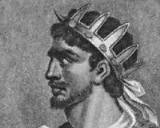
Attila (406 – 453), also known as Attila the Hun, was leader (Khagan
Khagan

Khagan or Great Khan , is a title of empire rank in the Turkic languages and Mongolian language languages equal to the status of emperor and someone who rules a Khaganate ....
) of the Huns
Huns

The Huns were a confederation of Central Asian Eurasian nomads or semi-nomads, who had established an empire in Eurasia. The Huns may have stimulated the Migration Period, a contributing factor in the collapse of the Roman Empire....
 from 434 until his death in 453. He was leader of the Hunnic Empire
Hunnic Empire

Hunnic Empire, the empire of the Huns.The Huns were a confederation of Eurasian tribes, probably especially Turkic ones, from the Steppes of Central Asia....
 which stretched from Germany
Germany

Germany , officially the Federal Republic of Germany , is a country in Central Europe. It is bordered to the north by the North Sea, Denmark, and the Baltic Sea; to the east by Poland and the Czech Republic; to the south by Austria and Switzerland; and to the west by France, Luxembourg, Belgium, and the Netherlands....
 to the Ural River
Ural River

The Ural , known as Yaik before 1775, is a river flowing through Russia and Kazakhstan. It arises in the southern Ural Mountains and ends at the Caspian Sea....
 and from the River Danube
Danube

The Danube is the longest river in the European Union and Europe's second longest river after the Volga.The river originates in the Black Forest in Germany as the much smaller Brigach and Breg River rivers which join at the eponymously named German town Donaueschingen, after which it is known as the Danube and flows eastwards for a distance...
 to the Baltic Sea
Baltic Sea

The Baltic Sea is a brackish inland sea located in Northern Europe, from 53?N to 66?N latitude and from 20?E to 26?E longitude. It is bounded by the Scandinavian Peninsula, the mainland of Europe, and the Denmark islands....
 (see map below). During his rule, he was one of the most fearsome of the Western and Eastern Roman Empire
Roman Empire

The Roman Empire was the Roman Republic phase of the Ancient Rome, characterised by an autocracy form of government and large territorial holdings in Europe and around the Mediterranean....
s' enemies: he invaded the Balkans
Balkans

The Balkans is the historical name of a geographic subregion of southeastern Europe. The region takes its name from the Balkan Mountains, which run through the centre of Bulgaria into eastern Serbia....
 twice and marched through Gaul
Gaul

Gaul is the name used for the region of Western Europe comprising part of present day northern Italy, France, Belgium, western Switzerland and the parts of the Netherlands and Germany on the west bank of the River Rhine....
 (modern France
France

France , officially the French Republic , is a country whose Metropolitan France is located in Western Europe and that also comprises various Overseas departments and territories of France....
) as far as Orleans
Orléans

Orl?ans is a city in north-central France, about 130 km southwest of Paris. It is the capital of the Loiret Departments of France and of the Centre R?gion in France....
 before being defeated at the Battle of Chalons
Battle of Chalons

The Battle of the Catalaunian Plains , also called the Battle of Ch?lons-en-Champagne or Battle of the Campus Mauriacus, took place in 451 between a coalition led by the Roman Empire general Flavius Aetius and the Visigoths king Theodoric I on one side and the Huns and their allies commanded by Attila the Hun on the other....
.


Discussion
Ask a question about 'Attila the Hun'
Start a new discussion about 'Attila the Hun'
Answer questions from other users
Full Discussion Forum


Recent Posts


Encyclopedia


Attila (406 – 453), also known as Attila the Hun, was leader (Khagan
Khagan

Khagan or Great Khan , is a title of empire rank in the Turkic languages and Mongolian language languages equal to the status of emperor and someone who rules a Khaganate ....
) of the Huns
Huns

The Huns were a confederation of Central Asian Eurasian nomads or semi-nomads, who had established an empire in Eurasia. The Huns may have stimulated the Migration Period, a contributing factor in the collapse of the Roman Empire....
 from 434 until his death in 453. He was leader of the Hunnic Empire
Hunnic Empire

Hunnic Empire, the empire of the Huns.The Huns were a confederation of Eurasian tribes, probably especially Turkic ones, from the Steppes of Central Asia....
 which stretched from Germany
Germany

Germany , officially the Federal Republic of Germany , is a country in Central Europe. It is bordered to the north by the North Sea, Denmark, and the Baltic Sea; to the east by Poland and the Czech Republic; to the south by Austria and Switzerland; and to the west by France, Luxembourg, Belgium, and the Netherlands....
 to the Ural River
Ural River

The Ural , known as Yaik before 1775, is a river flowing through Russia and Kazakhstan. It arises in the southern Ural Mountains and ends at the Caspian Sea....
 and from the River Danube
Danube

The Danube is the longest river in the European Union and Europe's second longest river after the Volga.The river originates in the Black Forest in Germany as the much smaller Brigach and Breg River rivers which join at the eponymously named German town Donaueschingen, after which it is known as the Danube and flows eastwards for a distance...
 to the Baltic Sea
Baltic Sea

The Baltic Sea is a brackish inland sea located in Northern Europe, from 53?N to 66?N latitude and from 20?E to 26?E longitude. It is bounded by the Scandinavian Peninsula, the mainland of Europe, and the Denmark islands....
 (see map below). During his rule, he was one of the most fearsome of the Western and Eastern Roman Empire
Roman Empire

The Roman Empire was the Roman Republic phase of the Ancient Rome, characterised by an autocracy form of government and large territorial holdings in Europe and around the Mediterranean....
s' enemies: he invaded the Balkans
Balkans

The Balkans is the historical name of a geographic subregion of southeastern Europe. The region takes its name from the Balkan Mountains, which run through the centre of Bulgaria into eastern Serbia....
 twice and marched through Gaul
Gaul

Gaul is the name used for the region of Western Europe comprising part of present day northern Italy, France, Belgium, western Switzerland and the parts of the Netherlands and Germany on the west bank of the River Rhine....
 (modern France
France

France , officially the French Republic , is a country whose Metropolitan France is located in Western Europe and that also comprises various Overseas departments and territories of France....
) as far as Orleans
Orléans

Orl?ans is a city in north-central France, about 130 km southwest of Paris. It is the capital of the Loiret Departments of France and of the Centre R?gion in France....
 before being defeated at the Battle of Chalons
Battle of Chalons

The Battle of the Catalaunian Plains , also called the Battle of Ch?lons-en-Champagne or Battle of the Campus Mauriacus, took place in 451 between a coalition led by the Roman Empire general Flavius Aetius and the Visigoths king Theodoric I on one side and the Huns and their allies commanded by Attila the Hun on the other....
. He refrained from attacking either Constantinople
Constantinople

Constantinople was the empire capital of the Roman Empire , the Byzantine Empire , the Latin Empire , and the Ottoman Empire . Strategically located between the Golden Horn and the Sea of Marmara at the point where Europe meets Asia, Byzantine Constantinople had been the capital of a Christendom empire, successor to ancient ancient Greece...
 or Rome
Rome

Rome is the capital city of Italy and Lazio, and is Italy's largest and most populous city, with 2,724,347 residents in an urban area of some ....
. His story that the Sword of Attila
Sword of Attila

The Sword of Attila was the legendary weapon carried by Attila the Hun. The Roman historian Jordanes, quoting the work of the historian Priscus, gave the story of its origin:...
 had come to his hand by miraculous means, was reported by the Roman Priscus
Priscus

Priscus was from Panium living in the Roman Empire during the 5th century. He was a diplomat, sophist and historian. He accompanied Maximin, the ambassador of Theodosius II, to the court of Attila the Hun in 448....
.

In much of Western Europe
Western Europe

Western Europe refers to the countries in the western most half of Europe. This concept has had different meanings, political and cultural as well as geographical issues have influenced the area....
, he is remembered as the epitome of cruelty
Cruelty

Cruelty can be described as indifference to suffering, and even positive pleasure in inflicting it. Sadism can also be related to this form of action or concept....
 and rapacity. In contrast, some histories and chronicles lionize him as a great and noble king, and he plays major roles in three Norse
Norsemen

Norsemen is used to refer to the group of people as a whole who speak one of the North Germanic languages as their native language. The meaning of Norseman was "people from the North" and was applied primarily to Nordic people originating from southern and central Scandinavia....
 saga
Saga

Saga may refer to:...
s.

Background


The origin of the Huns
Huns

The Huns were a confederation of Central Asian Eurasian nomads or semi-nomads, who had established an empire in Eurasia. The Huns may have stimulated the Migration Period, a contributing factor in the collapse of the Roman Empire....
 has been the subject of debate for centuries. It can be said with general agreement that they may have been a confederation of Central Asian and Europe
Europe

Europe is, conventionally, one of the world's seven continents. Comprising the westernmost peninsula of Eurasia, Europe is generally divided from Asia to its east by the water divide of the Ural Mountains, the Ural , the Caspian Sea, and by the Caucasus Mountains to the southeast....
an tribes, many of them nomad
Nomad

Nomadic people, , also known as nomads, are communities of people who move from one place to another, rather than Settler in one location....
ic horsemen
Cavalry

The Cavalry is the second oldest of the Combat Arms, and as soldiers or warriors who fought mounted on horseback in combat, it represents the mobility and offensive power of the armed forces....
.

Their united power appeared or began to form in Europe in the 400s. They achieved military superiority over their neighbors by their readiness for battle, unusual mobility, and weapons, including the composite bow
Composite bow

A composite bow is a bow made from disparate materials laminated together, usually applied under tension. Different materials are used in order to take advantage of the properties of each material....
.

Shared kingship

Huns Empire
The death of Rugila
Rugila

Rugila also referred to as Ruhas, Ruga and Rua , was a warlord who was a major factor in the Huns' early victories over the Roman Empire....
 (also known as Rua or Ruga) in 434 left his nephews Attila Dragomer and Bleda (also known as Buda), the sons of his brother Mundzuk
Mundzuk

Mundzuk 390-434 was a Hunnic prince and brother of Rugila, the Hunnic Ruler. Mundzuk was also father of Attila the Hun and Bleda. He was ruling briefly after Rugila's death. Hungarian legend has Mundzuk as son of Nimrod....
, in control over all the united Hun tribes. At the time of their accession, the Huns were bargaining
Bargaining

Bargaining or haggling is a type of negotiation in which the buyer and seller of a good or service dispute the price which will be paid and the exact nature of the transaction that will take place, and eventually come to an agreement....
 with Byzantine emperor Theodosius II
Theodosius II

Flavius Theodosius , called the Calligrapher, known in English as Theodosius II, was an Eastern Roman Empire , mostly known for the law code bearing his name, the Codex Theodosianus, and the Walls of Constantinople#The Theodosian Walls of Constantinople built during his reign....
's envoys over the return of several renegades (possibly Hunnic nobles not in agreement with the brothers' leadership) who had taken refuge within the Byzantine Empire
Byzantine Empire

Byzantine Empire and Eastern Roman Empire are conventional names used to describe the Roman Empire during the Middle Ages, centered on its capital of Constantinople....
. The following year Attila and Bleda met with the imperial legation at Margus (present-day Požarevac) and, all seated on horseback in the Hunnic manner, negotiated a successful treaty
Treaty

A Treaty is an agreement under international law entered into by actors in international law, namely states and international organizations. A Treaty may also be known as: agreement, protocol, covenant, convention, exchange of letters, etc....
: the Romans agreed not only to return the fugitives, but also to double their previous tribute of 350 Roman pounds (ca. 115 kg) of gold, open their markets to Hunnish traders, and pay a ransom of eight solidi
Solidus (coin)

The solidus was originally a gold coin issued by the Ancient Rome.The solidus was first introduced by Diocletian around 301, struck at 60 to the Roman pound of pure gold and with an initial value equal to 1000 denarius....
 for each Roman taken prisoner by the Huns. The Huns, satisfied with the treaty, decamped from the empire and returned to their home in the Hungarian Great Plain, perhaps to consolidate and strengthen their empire. Theodosius used this opportunity to strengthen the walls of Constantinople
Walls of Constantinople

The Walls of Constantinople are a series of stone walls that have surrounded and protected the city of Constantinople since its founding as the capital of the Eastern Roman Empire by Constantine the Great....
, building the city's first sea wall, and to build up his border defenses along the Danube
Danube

The Danube is the longest river in the European Union and Europe's second longest river after the Volga.The river originates in the Black Forest in Germany as the much smaller Brigach and Breg River rivers which join at the eponymously named German town Donaueschingen, after which it is known as the Danube and flows eastwards for a distance...
.

The Huns remained out of Roman sight for the next few years as a Hunnic force invaded the Persian Empire
Persian Empire

The 'Persian Empire' was a series of successive Iranian or Persianization empires that ruled over the Iranian plateau, the original Persian homeland, and beyond in Southwest Asia, South Asia, Central Asia and the Caucasus....
. A defeat in Armenia
Armenia

Armenia , officially the Republic of Armenia , is a landlocked mountainous country in South Caucasus between the Black Sea and the Caspian Sea....
 by the Sassanid
Sassanid Empire

The Sassanid Empire or Sassanian Dynasty is the name of the last pre-Islamic Iranian empire. It was one of the two main powers in Western Asia for a period of more than 400 years....
 Persians caused them to abandon this attempt and return their attentions to Europe. In 440 they reappeared in force on the borders of the Roman Empire, attacking the merchants at the market on the north bank of the Danube that had been established by the treaty. Crossing the Danube, they laid waste to Illyria
Illyria

'Illyria' was in Classical antiquity a region in the western part of today's Balkan Peninsula, inhabited by tribes of Illyrians, an ancient people who spoke the Illyrian languages....
n cities and forts on the river, among them, according to Priscus
Priscus

Priscus was from Panium living in the Roman Empire during the 5th century. He was a diplomat, sophist and historian. He accompanied Maximin, the ambassador of Theodosius II, to the court of Attila the Hun in 448....
, Viminacium
Viminacium

Viminacium was a major city of the Roman Empire province of Moesia , and the capital of Moesia Superior. Viminacium was the base camp of Legio VII Claudia, and hosted for some time the Legio IIII Flavia Felix....
, which was a city of the Moesians in Illyria. Their advance began at Margus, for when the Romans discussed handing over the offending bishop, he slipped away secretly to the Huns and betrayed the city to them.
Hunnen
As Theodosius had conquered the river's defences, the Vandals
Vandals

The Vandals were an East Germanic tribe that entered the late Roman Empire during the 5th century. The Goths Theodoric the Great, king of the Ostrogoths and regent of the Visigoths, was allied by marriage with the Vandals as well as with the Burgundians and the Franks under Clovis I....
, under the leadership of Geiseric
Geiseric

Genseric , also spelled as Gaiseric or Geiseric, was the King of the Vandals and Alans and was one of the key players in the troubles of the Western Roman Empire in the 5th century....
, captured the Western Roman province of Africa with its capital of Carthage
Carthage

Carthage refers both to an ancient city in present-day Tunisia, and a modern-day suburb of Tunis. The civilization that developed within the city's sphere of influence is referred to as Punic or Carthaginian....
 in 440 and the Sassanid
Sassanid Empire

The Sassanid Empire or Sassanian Dynasty is the name of the last pre-Islamic Iranian empire. It was one of the two main powers in Western Asia for a period of more than 400 years....
 Shah
Shah

Shah is a Persian language term for a monarch that has been adopted in many other languages.Shah used as a last name by Jains and Hindus is unrelated....
 Yazdegerd II invaded Armenia
Armenia

Armenia , officially the Republic of Armenia , is a landlocked mountainous country in South Caucasus between the Black Sea and the Caspian Sea....
 in 441. Stripping the Balkan defenses of forces requested by the West Romans, in order to launch an attack on the Vandals in Africa (which was the richest province of the Western empire and a main source of the food supply of Rome) left Attila and Bleda a clear path through Illyria into the Balkans, which they invaded in 441. The Hunnish army, having sacked Margus and Viminacium, took Singidunum
Singidunum

Singidunum was an ancient Roman city, first settled by the Celts Scordisci tribe in the 3rd century BC, and later garrisoned and fortified by the Ancient Rome who romanized the name....
 (modern Belgrade
Belgrade

Belgrade is the capital and largest city of Serbia. The city lies on international waterway, at the confluence of the Sava River and Danube rivers, where the Pannonian Plain meets the Balkan Peninsula....
) and Sirmium
Sirmium

Sirmium was an ancient city in Roman Pannonia. Sirmium originally was an Illyrians town conquered by the Ancient Rome in the 1st century BC. It was a very important town in the later Roman Empire, being the economic capital of Roman Pannonia and one of the four capital cities of the Roman Empire....
 before halting. A lull followed in 442 and during this time Theodosius recalled his troops from Sicily
Sicily

Sicily is an Autonomous regions with special statute of Italy. Of all the regions of Italy, Sicily covers the largest land area at 25,708 km? and currently has just over five million inhabitants....
 and ordered a large new issue of coins to finance operations against the Huns. Having made these preparations, he thought it safe to refuse the Hunnish kings' demands.

Attila responded with a campaign
Military campaign

In the military sciences, a military campaign is a term applied to Scale , long duration, significant military strategy Military plan incorporating a series of inter-related military operations or battles forming a distinct part of a larger conflict often called a war....
 in 443. Striking along the Danube, the Huns overran the military centres of Ratiara and successfully besieged Naissus (modern Niš
Niš

Ni? is a city in Ni?ava District, Serbia situated at 43.3? N 21.9? E, on the Ni?ava River. With more than 250,000 inhabitants it is the largest city of South Serbia and third-largest city in the country, after Belgrade and Novi Sad....
) with battering ram
Battering ram

A battering ram is a siege engine originating in ancient history to break open fortification walls or doors.In its simplest form, a battering ram is just a large, heavy log carried by several people and propelled with force against an obstacle; the momentum of the ram would be sufficient to damage the target if the log were massive enough a...
s and rolling siege towers—military sophistication that was new to the Hun repertoire—then pushing along the Nisava River they took Serdica (Sofia
Sofia

Sofia , is the Capital and largest city of the Bulgaria, with 2,5 million people living in the Capital Municipality. It is located in western Bulgaria, at the foot of the mountain massif Vitosha, and is the administrative, cultural, economic, and educational centre of the country....
), Philippopolis (Plovdiv
Plovdiv

Plovdiv is the second-largest city in Bulgaria after Sofia, with a population of 379,119. It is the administrative centre of Plovdiv Province in southern Bulgaria and three municipalities , as well as the largest and most important city in Northern Thrace and the wider international historical region of Thrace....
), and Arcadiopolis. They encountered and destroyed the Roman army outside Constantinople and were stopped by the double walls of the Eastern capital. A second army was defeated near Callipolis (modern Gallipoli) and Theodosius, now without any armed forces to respond, admitting defeat, sent the court official Anatolius to negotiate peace terms, which were harsher than the previous treaty: the Emperor agreed to hand over 6,000 Roman pounds (ca. 2000 kg) of gold as punishment for having disobeyed the terms of the treaty during the invasion; the yearly tribute was tripled, rising to 2,100 Roman pounds (ca. 700 kg) in gold; and the ransom for each Roman prisoner rose to 12 solidi.

Their demands met for a time, the Hun kings withdrew into the interior of their empire. According to Jordanes
Jordanes

Jordanes , was a 6th century Roman bureaucrat , who turned his hand to history later in life.Though he also wrote Romana , a book about the history of Rome, his most known work is his Getica, written in Constantinople about AD 551 ....
 (following Priscus
Priscus

Priscus was from Panium living in the Roman Empire during the 5th century. He was a diplomat, sophist and historian. He accompanied Maximin, the ambassador of Theodosius II, to the court of Attila the Hun in 448....
), sometime during the peace following the Huns' withdrawal from Byzantium (probably around 445), Bleda died (killed in a hunting accident arranged by his brother, according to the classical sources), and Attila took the throne for himself, and became the sole ruler of the Huns.

Sole ruler

Morthanfeastofattila
In 447 Attila again rode south into the empire through Moesia
Moesia

Moesia was an ancient region and Roman province situated in the areas of modern Serbia, Bulgaria and Romania along the south bank of the Danube River....
. The Roman army under the Gothic
Goths

The Goths were East Germanic tribes who, in the 3rd and 4th centuries, invasion the Roman Empire and later adopted Arian Christianity. In the 5th and 6th centuries, divided as the Visigoths and the Ostrogoths, they established powerful successor-states of the Roman Empire in the Iberian peninsula and Italy....
 magister militum
Magister militum

Magister militum was a top-level military command used in the later Roman Empire, dating from the reign of Constantine I . Used alone, the term referred to the senior military officer of the Empire....
 Arnegisclus met him in the Battle of the Utus
Battle of the Utus

The Battle of the Utus was fought in 447 between the army of Eastern Roman Empire, and the Huns led by Attila at what is today the Vit river in Bulgaria....
 and was defeated, though not without inflicting heavy losses. The Huns were left unopposed and rampaged through the Balkans as far as Thermopylae
Thermopylae

Thermopylae is a location in Greece where a narrow coastal passage existed in classical antiquity. It derives its name from several natural hot water springs....
. Constantinople itself was saved by the intervention of the prefect Flavius Constantinus who organized the reconstruction of the walls that had been previously damaged by earthquakes, and, in some places, to construct a new line of fortification in front of the old. An account of this invasion survives:

In the west

In 450 Attila had proclaimed his intent to attack the powerful Visigoth
Visigoth

The Visigoths were one of two main branches of the Goths, an East Germanic tribe, the Ostrogoths being the other. Together these tribes were among the barbarians who disturbed the late Roman Empire during the Migration Period....
 kingdom of Toulouse
Toulouse

Toulouse is a commune of France in southwest France on the banks of the Garonne, half-way between the Atlantic Ocean and the Mediterranean Sea....
, making an alliance with Emperor Valentinian III
Valentinian III

Flavius Placidus Valentinianus , known in English as Valentinian III, was among the last Western Roman Emperors ....
 in order to do so. He had previously been on good terms with the Western Roman Empire and its de facto
De facto

De facto is a Latin expression that means "concerning the fact" or in practice but not necessarily ordained by law. It is commonly used in contrast to de jure when referring to matters of law, governance, or technique that are found in the common experience as created or developed without or contrary to a regulation....
 ruler Flavius Aëtius
Flavius Aëtius

Flavius A?tius or simply A?tius, , dux et patricius, was a Roman Empire general of the closing period of the Western Roman Empire. He was an able military commander and the most influential man of the Western Roman Empire for two decades ....
. Aëtius had spent a brief exile
Exile

Exile means to be away from one's home while either being explicitly refused permission to return and/or being threatened by prison or death upon return....
 among the Huns in 433, and the troops Attila provided against the Goths
Goths

The Goths were East Germanic tribes who, in the 3rd and 4th centuries, invasion the Roman Empire and later adopted Arian Christianity. In the 5th and 6th centuries, divided as the Visigoths and the Ostrogoths, they established powerful successor-states of the Roman Empire in the Iberian peninsula and Italy....
 and Bagaudae
Bagaudae

In the time of the Roman Empire bagaudae were groups of peasant insurgents who emerged during the "Crisis of the Third Century", and persisted particularly in the less-Romanised areas of Gaul and Hispania, where they were "exposed to the depredations of the late Roman state, and the great landowners and clerics who were its servants"....
 had helped earn him the largely honorary title of magister militum in the west. The gifts and diplomatic efforts of Geiseric
Geiseric

Genseric , also spelled as Gaiseric or Geiseric, was the King of the Vandals and Alans and was one of the key players in the troubles of the Western Roman Empire in the 5th century....
, who opposed and feared the Visigoths, may also have influenced Attila's plans.

However Valentinian's sister was Honoria
Justa Grata Honoria

Justa Grata Honoria was the sister of the Western Roman Empire Roman Emperor Valentinian III. Coins of her attest that she was granted the title of Augusta ....
, who, in order to escape her forced betrothal to a Roman senator
Roman Senate

The Senate of the Roman Republic was a political institution in the ancient Roman Republic. According to the Greek historian Polybius, our principal source on the Constitution of the Roman Republic, the Roman Senate was the predominant branch of government....
, had sent the Hunnish king a plea for help – and her engagement ring
Engagement ring

In Western tradition, an engagement ring is a jewelry ring worn by a woman indicating her engagement to be marriage. In some countries, such as the United States and the United Kingdom, it is worn on the left-hand ring finger, while in other countries, such as Poland and Ukraine, it is customary for the ring to be worn on the right-hand....
 – in the spring of 450. Though Honoria may not have intended a proposal of marriage, Attila chose to interpret her message as such. He accepted, asking for half of the western Empire as dowry
Dowry

A dowry is the money, goods, or estate that a woman brings to her new husband. Compare bride price, which is paid to the bride's parents, and dower, which is property settled on the bride herself by the groom at the time of marriage....
. When Valentinian discovered the plan, only the influence of his mother Galla Placidia
Galla Placidia

File:Aelia Galla Placidia.jpgAelia Galla Placidia was the Empress consort of Constantius III, Western Roman Empire....
 convinced him to exile, rather than kill, Honoria. He also wrote to Attila strenuously denying the legitimacy of the supposed marriage proposal. Attila, not convinced, sent an emissary to Ravenna
Ravenna

Ravenna is a city and comune in the Emilia-Romagna region of Italy. The city is inland, but is connected to the Adriatic Sea by a canal. Ravenna once served as the seat of the Western Roman Empire and later the Ostrogoths and the Exarchate of Ravenna....
 to proclaim that Honoria was innocent, that the proposal had been legitimate, and that he would come to claim what was rightfully his.

Attila interfered in a succession struggle after the death of a Frankish ruler. Attila supported the elder son, while Aëtius supported the younger. Attila gathered his vassal
Vassal

A vassal in the terminology that both preceded and accompanied the feudal of medieval Europe, is one who enters into mutual obligations with a monarch, usually of military support and mutual protection, in exchange for certain guarantees, which came to include the terrain held as a fiefdom....
s—Gepids, Ostrogoths, Rugians
Rugians

The Rugii were an East Germanic tribe whose ultimate origins have been traced to Rogaland in Norway, whose population probably was the Rugii that Jordanes mentioned as a tribe that still remained in Scandza....
, Scirians, Heruls, Thuringians, Alans
Alans

The Alans or Alani were a group among the Sarmatians people, Eurasian nomads of the 1st millennium AD who spoke an Eastern Iranian language which derived from Scytho-Sarmatian language and which in turn evolved into modern Ossetian language....
, Burgundians
Burgundians

File:Roman Empire 125.svgThe Burgundians were an East Germanic language Germanic tribes which may have emigrated from mainland Scandinavia to the island of Bornholm, whose old form in Old Norse still was Burgundarholmr , and from there to mainland Europe....
, among others and began his march west. In 451 he arrived in Belgica with an army exaggerated by Jordanes to half a million strong. J.B. Bury believes that Attila's intent, by the time he marched west, was to extend his kingdom – already the strongest on the continent – across Gaul
Gaul

Gaul is the name used for the region of Western Europe comprising part of present day northern Italy, France, Belgium, western Switzerland and the parts of the Netherlands and Germany on the west bank of the River Rhine....
 to the Atlantic Ocean
Atlantic Ocean

The Atlantic Ocean is the second-largest of the world's oceanic divisions; with a total area of about 106.4 million square kilometres . It covers approximately one-fifth of the Earth's surface....
.

On April 7, he captured Metz
Metz

Metz is a city in the northeast of France, capital of the Lorraine R?gion in France and prefecture of the Moselle Departments of France.It is located at the confluence of the Moselle River and the Seille rivers....
. Other cities attacked can be determined by the hagiographic vita
Vita

Vita or VITA may refer to:*Vita , a brief biography, often that of a saint * A curriculum vitae* Beta , the 2nd letter of the Greek alphabet...
e
written to commemorate their bishops: Nicasius
Nicasius of Rheims

Saint Nicasius of Rheims was a bishop of Rheims from 400 until his death. He founded the first cathedral of Rheims. He foresaw the invasion of France by the Vandals....
 was slaughtered before the altar of his church in Rheims; Servatus is alleged to have saved Tongeren
Tongeren

Tongeren is a city and Arrondissement_of_Tongeren located in the Provinces of Belgium of Limburg , Flanders, Belgium. Tongeren is the oldest town in Belgium....
 with his prayers, as Saint Genevieve
Genevieve

Sainte Genevi?ve , in Latin Sancta Genovefa, from Germanic keno and wefa , is the patron saint of Paris in Roman Catholic and Eastern Orthodox tradition....
 is to have saved Paris
Paris

Paris is the Capital of France and the country's largest city. It is situated on the river Seine, in northern France, at the heart of the ?le-de-France Regions of France ....
. Lupus
Lupus of Troyes

Saint Lupus was an early bishop of Troyes. Born at Toul, he was brother-in-law to Hilary of Arles, as he had married one of Hilary?s sisters, Pimeniola....
, bishop of Troyes
Troyes

Troyes is a communes of France, the Prefectures in France of the northeastern Aube departments of France in France and is located on the Seine river....
, is also credited with saving his city by meeting Attila in person.

Aëtius moved to oppose Attila, gathering troops from among the Franks
Franks

The Franks or Frankish people were a West Germanic ethnic group first identified in the 3rd century as living north and east of the Lower Rhine River....
, the Burgundians
Burgundians

File:Roman Empire 125.svgThe Burgundians were an East Germanic language Germanic tribes which may have emigrated from mainland Scandinavia to the island of Bornholm, whose old form in Old Norse still was Burgundarholmr , and from there to mainland Europe....
, and the Celts. A mission by Avitus
Avitus

Eparchius Avitus was Western Roman Emperor with the designation and name Dominus Noster Eparchius Avitus Augustus .Made magister militum by Emperor Petronius Maximus, Avitus was sent on a diplomatic mission to his old student, Theodoric II King of the Visigoths, and was at Theodoric's court in Toulouse when Gaiseric invaded Rom...
, and Attila's continued westward advance, convinced the Visigoth king Theodoric I
Theodoric I

Theodoric I, sometimes called Theodorid and in Spanish language, Portuguese language and Italian language Teodorico, was the King of the Visigoths from 418–451....
 (Theodorid) to ally with the Romans. The combined armies reached Orleans
Orléans

Orl?ans is a city in north-central France, about 130 km southwest of Paris. It is the capital of the Loiret Departments of France and of the Centre R?gion in France....
 ahead of Attila, thus checking and turning back the Hunnish advance. Aëtius gave chase and caught the Huns at a place usually assumed to be near Catalaunum (modern Châlons-en-Champagne
Châlons-en-Champagne

Ch?lons-en-Champagne is a city in France. It is the capital of both the Departments of France of Marne and the r?gion in France of Champagne-Ardenne, despite being only a quarter the size of the city of Reims....
). The two armies clashed in the Battle of Chalons
Battle of Chalons

The Battle of the Catalaunian Plains , also called the Battle of Ch?lons-en-Champagne or Battle of the Campus Mauriacus, took place in 451 between a coalition led by the Roman Empire general Flavius Aetius and the Visigoths king Theodoric I on one side and the Huns and their allies commanded by Attila the Hun on the other....
, whose outcome is commonly considered to be a Pyrrhic victory
Pyrrhic victory

A Pyrrhic victory is a victory with devastating cost to the victor....
 for the Visigothic-Roman alliance. Theodoric was killed in the fighting and Aëtius failed to press his advantage, according to Edward Gibbon and Edward Creasy because he feared the consequences of an overwhelming Visigothic triumph as much as he did a defeat. From Aëtius' point of view, the best outcome was what occurred: Theodoric died, Attila was in retreat and disarray, and the Romans had the benefit of appearing victorious.

Invasion of Italy and death

Leoattila Raphael
Attila returned in 452 to claim his marriage to Honoria anew, invading and ravaging Italy
Italy

Italy , officially the Italian Republic , is a country located on the Italian Peninsula in Southern Europe and on the two largest islands in the Mediterranean Sea, Sicily and Sardinia....
 along the way. The city of Venice
Republic of Venice

The Most Serene Republic of Venice or Venetian Republic was a state originating from the city of Venice . It existed for over a millennium, from the late 7th century AD until the year 1797....
 was founded as a result of these attacks when the residents fled to small islands in the Venetian Lagoon
Venetian Lagoon

The Venetian Lagoon is the enclosed bay of the Adriatic Sea in which the city of Venice is situated. Its name in the Venetian language language, Laguna Veneta? cognate of Latin lacus, "lake"? has provided the international name for an enclosed, shallow embayment of saltwater, a lagoon....
. His army sacked numerous cities and razed Aquileia
Aquileia

Aquileia is an ancient history Roman Republic city in what is now Italy, at the head of the Adriatic Sea at the edge of the lagoons, about 10 km from the sea, on the river Natiso , the course of which has changed somewhat since Roman times....
 completely, leaving no trace of it behind. Legend has it he built a castle on top of a hill north of Aquileia
Aquileia

Aquileia is an ancient history Roman Republic city in what is now Italy, at the head of the Adriatic Sea at the edge of the lagoons, about 10 km from the sea, on the river Natiso , the course of which has changed somewhat since Roman times....
 to watch the city burn, thus founding the town of Udine
Udine

Udine is a city in northeastern Italy, in the middle of Friuli-Venezia Giulia region, between the Adriatic sea and the Alps , less than 40 km from the Slovenian border....
, where the castle can still be found. Aëtius, who lacked the strength to offer battle, managed to harass and slow Attila's advance with only a shadow force. Attila finally halted at the River Po
Po River

The Po is a river that flows 652 km eastward across northern Italy, from Monviso to the Adriatic Sea near Venice. It has a drainage area of 71,000 km? and is the longest river in Italy....
. By this point disease may have broken out in Attila's camp, thus helping to stop his invasion.

At the wish of Emperor Valentinian III
Valentinian III

Flavius Placidus Valentinianus , known in English as Valentinian III, was among the last Western Roman Emperors ....
, Pope Leo I
Pope Leo I

Pope Leo I, or Pope Saint Leo the Great, was pope from 29 September, 440 to 10 November, 461.He was an Italian aristocrat, and is the earliest pope of the Roman Catholic Church to have received the title "the Great"....
, accompanied by the Consul
Consul

Consul was the highest elected office of the Roman Republic and an appointive office under the Roman Empire. The title was also used in other city states, and revived in modern states, notably French Republic before the Napoleon I of Franceic counter-revolution....
 Avienus
Avienus

Avienus was a Latin writer of the 4th century. His full name Postumius Rufius Festus Avienius is mentioned on an inscription from Bulla Regia, but "Avienus" has become the usual form of reference....
 and the Prefect
Prefect

Prefect is a magisterial title of varying definition.A prefect's office, department, or area of control is called a prefecture, but in various post-Roman cases there is a prefect without a prefecture or vice versa....
 Trigetius, met Attila at Mincio
Mincio

Mincio is a river in the Lombardy region of northern Italy.Called the Sarca before entering Lake Garda, it flows from there about 65 km past Mantua into the Po River....
 in the vicinity of Mantua
Mantua

Mantua is a city in Lombardy, Italy and capital of the Province of Mantua of the same name.Mantua is surrounded on three sides by artificial lakes created during the 12th century....
, and obtained from him the promise that he would withdraw from Italy and negotiate peace with the emperor. Prosper of Aquitaine
Prosper of Aquitaine

Saint Prosper of Aquitaine , a Christian writer and disciple of Saint Augustine of Hippo, was the first continuator of Jerome's Universal Chronicle....
 gives a short, reliable description of the historic meeting. The later anonymous account, a pious "fable which has been represented by the pencil of Raphael
Raphael

Raphael Sanzio, usually known by his first name alone was an Italy Painting and architect of the High Renaissance, celebrated for the perfection and grace of his paintings and drawings....
 and the chisel of Algardi" (as Gibbon
Edward Gibbon

Edward Gibbon was an English historian and Member of Parliament. His most important work, The History of the Decline and Fall of the Roman Empire, was published in six volumes between 1776 and 1788....
 called it) says that the Pope, aided by Saint Peter
Saint Peter

Saint Peter was a leader of the early Christianity church, who features prominently in the New Testament Gospels and the Acts of the Apostles....
 and Saint Paul
Paul of Tarsus

Saint Paul, also called Paul the Apostle, the Apostle Paul or Paul of Tarsus , was a Hellenistic Judaism, who called himself the "Apostle to the Gentiles", and was, together with Saint Peter and James the Just, the most notable of early Christian missionaries....
, convinced him to turn away from the city, promising Attila that if he left in peace, one of his successors would receive a holy crown. Priscus
Priscus

Priscus was from Panium living in the Roman Empire during the 5th century. He was a diplomat, sophist and historian. He accompanied Maximin, the ambassador of Theodosius II, to the court of Attila the Hun in 448....
 reports that superstitious fear of the fate of Alaric
Alaric I

Alaric I , was likely born about 370 on an Peuce Island at the mouth of the Danube. He was king of the Visigoths from 395–410 and the first Germanic peoples leader to take the city of Rome....
—who died shortly after sacking Rome in 410—gave him pause.

After Attila left Italy and returned to his palace across the Danube, he planned to strike at Constantinople again and reclaim the tribute which Marcian had cut off. (Marcian was the successor of Theodosius and had ceased paying tribute in late 450 while Attila was occupied in the west; multiple invasions by the Huns and others had left the Balkans with little to plunder.) However Attila died in the early months of 453. The conventional account, from Priscus
Priscus

Priscus was from Panium living in the Roman Empire during the 5th century. He was a diplomat, sophist and historian. He accompanied Maximin, the ambassador of Theodosius II, to the court of Attila the Hun in 448....
, says that at a feast celebrating his latest marriage to the beautiful and young Ildico (if uncorrupted, the name suggests a Gothic
Goths

The Goths were East Germanic tribes who, in the 3rd and 4th centuries, invasion the Roman Empire and later adopted Arian Christianity. In the 5th and 6th centuries, divided as the Visigoths and the Ostrogoths, they established powerful successor-states of the Roman Empire in the Iberian peninsula and Italy....
 origin) he suffered a severe nosebleed and choked to death in a stupor. An alternative theory is that he succumbed to internal bleeding
Internal bleeding

Internal bleeding is bleeding occurring inside the body. It can be a serious medical emergency depending on where it occurs , and can potentially cause death and cardiac arrest if proper medical treatment is not received quickly....
 after heavy drinking or a condition called esophageal varices
Esophageal varices

In medicine , esophageal varices are extremely dilation sub-mucosal veins in the esophagus. They are most often a consequence of portal hypertension, such as may be seen with cirrhosis; patients with esophageal varices have a strong tendency to develop bleeding....
, where a hemorrhoid
Hemorrhoid

Hemorrhoids , haemorrhoids , emerods, or piles are swelling and inflammation of veins in the rectum and anus. The anatomical term "hemorrhoids" technically refers to "'Cushions of tissue filled with blood vessels at the junction of the rectum and the anus." However, the term is popularly used to refer to varicosities of the...
 in the lower part of the esophagus
Esophagus

The esophagus or oesophagus , sometimes known as the gullet, is an Organ in vertebrates which consists of a Muscle tube through which food passes from the pharynx to the stomach....
 ruptures leaving the person to choke on his/her own blood.

Another account of his death, first recorded 80 years after the events by the Roman chronicler Count Marcellinus, reports that "Attila, King of the Huns and ravager of the provinces of Europe, was pierced by the hand and blade of his wife." The Volsunga saga
Volsunga saga

The V?lsunga saga is a legendary saga, a late 13th century in poetry Iceland prose rendition of the origin and decline of the Volsung clan ....
 and the Poetic Edda
Poetic Edda

The Poetic Edda is a collection of Old Norse poems primarily preserved in the Icelandic mediaeval manuscript Codex Regius. Along with Snorri Sturluson's Prose Edda, the Poetic Edda is the most important extant source on Norse mythology and Germanic heroic legends....
 also claim that King Atli (Attila) died at the hands of his wife, Gudrun
Gudrun

In Norse mythology, Gudrun, who is called Kriemhild in the Nibelungenlied, was the sister of Gunther. Gudrun fell in love with Sigurd, who did not care for her, because he was in love with the valkyrie Brynhild, to whom he gave the ring Andvarinaut....
. Most scholars reject these accounts as no more than hear-say, preferring instead the account given by Attila's contemporary Priscus. Priscus' version, however, has recently come under renewed scrutiny by Michael A. Babcock. Based on detailed philological analysis, Babcock concludes that the account of natural death, given by Priscus
Priscus

Priscus was from Panium living in the Roman Empire during the 5th century. He was a diplomat, sophist and historian. He accompanied Maximin, the ambassador of Theodosius II, to the court of Attila the Hun in 448....
, was an ecclesiastical "cover story" and that Emperor Marcian
Marcian

Flavius Marcianus, known in English as Marcian, was the List of Byzantine Emperors of the Byzantine Empire from 450 until his death. Marcian's rule marked a recovery of the Eastern Empire, which the emperor protected from external menaces and reformed economically and financially....
 (who ruled the Eastern Roman Empire from 450-457) was the political force behind Attila's death.

Jordanes says: "The greatest of all warriors should be mourned with no feminine lamentations and with no tears, but with the blood of men." His horsemen galloped in circles around the silken tent where Attila lay in state, singing in his dirge
Dirge

ExamplesExamples of dirges include:*Dies Irae*The Lyke-Wake Dirge*"Quiet Please" radio drama theme*Caoineadh Airt U? Laoghaire*Just a Closer Walk With Thee...
, according to Cassiodorus
Cassiodorus

Flavius Magnus Aurelius Cassiodorus Senator , commonly known as Cassiodorus, was a Roman Empire statesman and writer, serving in the administration of Theodoric the Great, king of the Ostrogoths....
 and Jordanes, "Who can rate this as death, when none believes it calls for vengeance?"

Then they celebrated a strava (lamentation) over his burial place with great feasting. Legend says that he was laid to rest in a triple coffin made of gold, silver, and iron, along with some of the spoils of his conquests. His men diverted a section of the river Tisza
Tisza

The Tisza is one of the major rivers of Central Europe. It originates in Ukraine, with the White Tisza in the Chornohora and Black Tisza in the Gorgany range, flows partially along the Romanian border, enters Hungary at Tiszabecs, marks Slovakia-Hungarian border, passes through Hungary, and falls into the Danube in central Vojvodina in Serbia...
, buried the coffin under the riverbed, and then were killed to keep the exact location a secret.

His sons Ellac
Ellac

Ellac was the oldest son and successor of Attila the Hun in the Hunnic Empire. His reign lasted only 2 years, from AD 453 to 454, when he was killed in the Battle of Nedao. He was succeeded by Dengizich....
 (his appointed successor), Dengizich
Dengizich

Dengizich ruler of the Akatziroi was a son of Attila the Hun. The word "Dengizich" means little sea in old Turkic . This is also said to be the root of the name Ghengis....
, and Ernakh
Ernakh

Ernakh or Ernac was the 3rd son of Attila. After Attila's death in 453 AD, his empire crumbled and its remains were ruled by his three sons....
 fought over the division of his legacy, specifically which vassal kings would belong to which brother. As a consequence they were divided, defeated and scattered the following year in the Battle of Nedao
Battle of Nedao

The Battle of Nedao, named after the Nedava, a tributary of the Sava, was a battle fought in Pannonia in 454. After the death of Attila the Hun, allied forces of the Germanic tribes subject peoples under the leadership of Ardaric, king of the Gepids, defeated the Hunnic forces of Ellac, the son of Attila, who had struggled with his half-broth...
 by the Ostrogoths and the Gepids under Ardaric
Ardaric

History of the Gepids and Early Life While not much is know for certain about the exact details of Ardaric?s early life, much can be inferred about his experience as a youth through knowledge about the people he ruled....
. According to Jordanes, Ardaric, who was once Attila's most prized chieftain, turned against the feuding brothers when he felt that they were treating the nations they ruled as slaves.

Attila's many children and relatives are known by name and some even by deeds, but soon valid genealogical sources all but dry up and there seems to be no verifiable way to trace Attila's descendants. This hasn't stopped many genealogists from attempting to reconstruct a valid line of descent
Descent from antiquity

Descent from Antiquity is the project of establishing a well-researched, generation-by-generation descent of living persons from people living in ancient history....
 for various medieval rulers. One of the most credible claims has been that of the khans of Bulgaria
Bulgaria

The state of Bulgaria , Scientific transliteration Balgarija, officially the Republic of Bulgaria has played a significant role in the Balkans in south-eastern Europe for over fourteen centuries....
 (see Nominalia of the Bulgarian khans
Nominalia of the Bulgarian khans

The Nominalia of the Bulgarian khans is a short manuscript containing the names of some early Bulgars rulers, their clans, the year of their ascending to the throne according to the cyclic Bulgar calendar and the length of their rule, including the times of joint rule and civil war....
). A popular, but ultimately unconfirmed attempt tries to relate Attila to Charlemagne
Charlemagne

Charlemagne was List of Frankish kings from 768 to his death. He expanded the Franks kingdoms into a Carolingian Empire that incorporated much of Western Europe and Central Europe....
 (see Attila the Hun to Charlemagne).

Appearance, character, and name

There is no surviving first-person account of Attila's appearance. There is, however, a possible second-hand source, provided by Jordanes
Jordanes

Jordanes , was a 6th century Roman bureaucrat , who turned his hand to history later in life.Though he also wrote Romana , a book about the history of Rome, his most known work is his Getica, written in Constantinople about AD 551 ....
, who claimed Priscus
Priscus

Priscus was from Panium living in the Roman Empire during the 5th century. He was a diplomat, sophist and historian. He accompanied Maximin, the ambassador of Theodosius II, to the court of Attila the Hun in 448....
 described Attila as:

Atli
Attila is known in Western history and tradition as the grim flagellum dei (Latin: "Scourge of God"), and his name has become a byword for cruelty and barbarism
Barbarian

"Barbarian" is a pejorative term for an uncivilized person, either in a general reference to a member of a nation or ethnos, typically a tribal society as seen by an urban civilization either viewed as inferior, or admired as a noble savage....
. Some of this may have arisen from confusion between him and later steppe
Steppe

In physical geography, a steppe , pronounced , is a grassland plain without trees . The prairie can be considered a steppe. It may be semi-desert, or covered with Poaceae or shrubs or both, depending on the season and latitude....
 warlords such as Genghis Khan
Genghis Khan

Genghis Khan , born , was the founder, Khan and Khagan of the Mongol Empire, the World's largest empires contiguous empire in history....
 and Timur
Timur

Timur , among his other names, commonly known as Tamerlane in the West, was a 14th century Turko-Mongol conqueror of much of western and Central Asia, and founder of the Timurid dynasty in Central Asia, which survived until 1857 as the Mughal Empire of India....
 (Tamerlane). All are considered to be cruel, clever, and blood-thirsty lovers of battle and pillage. The reality of his character is probably more complex. The Huns of Attila's era had been mingling with Roman civilization for some time, largely through the Germanic foederati
Foederati

Foederatus is a Latin term whose definition and usage drifted in the time between the early Roman Republic and the end of the Western Roman Empire....
 of the border, so that by the time of Theodosius's embassy in 448 Priscus could identify two primary languages among the Huns, Gothic
Gothic language

Gothic is an extinct language Germanic language that was spoken by the Goths. It is known primarily from Codex Argenteus, a 6th century copy of a 4th century Bible translation, and is the only East Germanic languages with a sizable corpus....
 and Hunnic
Hunnic language

The Hunnic language is the language spoken by the historic Huns. The literary records for this language are sparse, consisting of a few names and three words....
, with some people knowing Latin
Latin

Latin is an Italic language, historically spoken in Latium and Ancient Rome. Through the Military history of the Roman Empire, Latin spread throughout the Mediterranean and a large part of Europe....
 and Greek
Greek language

Greek is an Indo-European languages native to the southern Balkan peninsula, the language of the Greek people. It forms an independent branch within Indo-European....
. Priscus also recounts his meeting with an eastern Roman captive who had so fully assimilated
Cultural assimilation

Cultural assimilation is when an individual or individuals adopts some or all aspects of a dominant culture . Cultural assimilation is a process of socialization....
 into the Huns' way of life that he had no desire to return to his former country, and the Byzantine historian's description of Attila's humility and simplicity is unambiguous in its admiration.

The origin of Attila's name is not known with confidence, because very little is known about Hunnic names. In the Hunnic language Danube-Bulgarian, the etymology "oceanic (universal) [ruler]" has been proposed. Also the word possibly originates from Turkic
Turkic languages

The Turkic languages constitute a language family of some thirty languages, spoken by Turkic peoples across a vast area from Eastern Europe and the Mediterranean Sea to Siberia and Western China, and are sometimes considered to be part of the proposed Altaic languages....
 Atyl/Atal/Atil/Itil meaning water, river (also, ancient name of Volga river
Volga River

The Volga is the largest river in Europe in terms of length, Discharge , and Drainage basin. It flows through the western part of Russia, and is widely viewed as the national river of Russia....
) with adjective suffix -ly. (Compare also Turkic medieval notable title atalyk - "senior as father"). This is correlating to the fact that the Polish Chronicle is using Attila's name as Aquila bearing the Latin
Latin

Latin is an Italic language, historically spoken in Latium and Ancient Rome. Through the Military history of the Roman Empire, Latin spread throughout the Mediterranean and a large part of Europe....
 aqua inside. Others believe that the name may have connection to Hungarian ítélet meaning judgement or Old-Turkic via the loandword in Gothic (or Gepid) atta ("father") and the diminutive suffix -ila. Attila was not a rare name in Central Europe
Central Europe

Central Europe is the region lying between the variously and vaguely defined areas of Eastern Europe and Western Europe Europe. In addition, Northern Europe, Southern Europe and Southeastern Europe may variously delimit or overlap into Central Europe....
 prior to Attila making his mark on history; the historical record shows numerous persons with the name preceding him. 'Attila' has many variants: Atli and Atle in Norse, Ćtla, Attle and Atlee in English, Attila/Atilla/Etele in Hungarian
Hungarian language

Hungarian is a Uralic languages unrelated to most other languages in Europe. It is mainly spoken in Hungary and by the Hungarian minorities in the seven neighbouring countries....
 (all the three name variants are used in Hungary
Hungary

Hungary , officially in English the Republic of Hungary , is a landlocked country in the Carpathian Basin of Central Europe, bordered by Austria, Slovakia, Ukraine, Romania, Serbia, Croatia, and Slovenia....
; Attila is the most popular variant), Etzel in the German
German language

German is a West Germanic languages, thus related to and classified alongside English language and Dutch language. It is one of the world's world language and the most widely spoken mother tongue in the European Union....
 Nibelungenlied
Nibelungenlied

The Nibelungenlied, translated as The Song of the Nibelungs, is an epic poetry in Middle High German. The story tells of dragon-slayer Sigurd at the court of the Burgundians, how he was murdered, and of his wife Gudrun's revenge....
, or Attila, Atila or Atilla in modern Turkish
Turkish language

Turkish is a language spoken by over 63 million people worldwide, making it the most commonly spoken of the Turkic languages. Its speakers are located predominantly in Turkey and Cyprus, with smaller groups in Iraq, Greece, Bulgaria, the Republic of Macedonia, Kosovo, Albania and other parts of Eastern Europe....
.

Literary and cultural representations


Attila has been portrayed in various ways, sometimes as a noble ruler, sometimes as a cruel barbarian. In Hungary, "Attila" is commonly used as a male first name.

Literature: historical/biographical

  • Hungarian poet János Arany
    János Arany

    J?nos Arany , was a Hungary journalist, writer, poet, and translator. He is often said to be the "William Shakespeare of ballads" ? he wrote more than 40 ballads which have been translated into over 50 languages, as well as the Toldi trilogy, to mention his most famous works....
     wrote an epic poem about Attila and his brother Bleda called Buda halála (The Death of King Buda) which is part of a larger work titled A Csaba-trilógia (The Csaba Trilogy).
  • Babcock, Michael A. (2005) The Night Attila Died: Solving the Murder of Attila the Hun (Berkley Publishing Group, ISBN 0-425-20272-0)
  • Blockley, R.C. (1983) The Fragmentary Classicising Historians of the Later Roman Empire, vol. II (ISBN 0-905205-15-4). This is a collection of fragments from Priscus, Olympiodorus, and others, with original text and translation.
  • Burgess, Anthony
    Anthony Burgess

    John Burgess Wilson was an England author, poet, playwright, composer, linguist, translator and critic.His Utopian and dystopian fiction satire A Clockwork Orange, widely considered to be his magnum opus, is by far his most famous novel, and was adapted into a famous, if highly controversial, A Clockwork Orange by Stanley Kubrick....
    . This British writer wrote a biographical novella
    Novella

    A novella is a writing, fictional, prose narrative longer than a novelette but shorter than a novel. While there is disagreement as to what length defines a novella, the Science Fiction and Fantasy Writers of America Nebula Awards for science fiction define the novella as having a word count between 17,500 and 40,000....
     about Attila entitled Hun which was published in the story collection The Devil's Mode
    The Devil's Mode and Other Stories

    'The Devil's Mode' is the only collection of short story by the England author Anthony Burgess.The stories included are varied in their settings and themes and display Burgess's characteristic wide range, while touching on such themes as the private life of William Shakespeare, which he speculated on in his novel Nothing Like the Sun:...
     (1989).
  • Hungarian
    Hungarian people

    Hungarians are an ethnic group primarily associated with Hungary. There are around 10 million Magyars in Hungary . Hungarians were the main inhabitants of the Kingdom of Hungary that existed through most of the second millennium....
     Géza Gárdonyi
    Géza Gárdonyi

    G?za G?rdonyi, born G?za Ziegler was a Hungary writer and journalist. Although he wrote a wide range of works, he had his greatest success as a historical novelist, particularly with Egri csillagok and A l?thatatlan ember....
    's novel A láthatatlan ember (1901) (published in English as Slave of the Huns and largely based on Priscus) offered a sympathetic portrait of Attila as a wise and beloved leader. This reflects the positive way in which Attila, his last wife Ildikó and his brother Bleda are viewed in Hungary
    Hungary

    Hungary , officially in English the Republic of Hungary , is a landlocked country in the Carpathian Basin of Central Europe, bordered by Austria, Slovakia, Ukraine, Romania, Serbia, Croatia, and Slovenia....
     and Turkey
    Turkey

    Turkey , known officially as the Republic of Turkey , is a Eurasian country that stretches across the Anatolian peninsula in southwest Asia and Thrace in the Balkans region of Southern Europe....
    .
  • Gordon, C. D. (1960) The Age of Attila: Fifth-century Byzantium and the Barbarians (Ann Arbor, University of Michigan Press, ISBN 0472061119). This is a translated collection, with commentary and annotation, of ancient writings on the subject, including Priscus.
  • Heather, Peter (2005) The Fall of the Roman Empire—A New History of Rome and the Barbarians (Oxford University Press, ISBN 0195159543)
  • The Death of Attila by Cecelia Holland
    Cecelia Holland

    Cecelia Anastasia Holland is an American historical novelist....
     (1973) takes place in 453, with the tensions and uncertainty of Attila's last year being the background for an unlikely friendship between Tacs, a young, ne'er-do-well Hun
    Huns

    The Huns were a confederation of Central Asian Eurasian nomads or semi-nomads, who had established an empire in Eurasia. The Huns may have stimulated the Migration Period, a contributing factor in the collapse of the Roman Empire....
    nish warrior, and Dietric, son of a Germanic
    Germanic peoples

    File:Germanische-ratsversammlung 1-1250x715.jpgThe Germanic peoples are a historical Ethnolinguistics group, originating in Northern Europe and identified by their use of the Indo-European languages Germanic languages which diversified out of Common Germanic in the course of the Pre-Roman Iron Age....
     subject king.
  • Howarth, Patrick (1994) Attila, King of the Huns: The Man and the Myth (ISBN 0786709308).
  • Maenchen-Helfen, J. Otto (1973) The World of the Huns: Studies in Their History and Culture (Berkeley, University of California Press, ISBN 0520015967)
  • Man, John (2005) Attila: A Barbarian King and the Fall of Rome (Bantam Press, ISBN 0-593-05291-9)
  • Thompson, E. A. (1948) A History of Attila and the Huns (London, Oxford University Press
    Oxford University Press

    Oxford University Press is a publisher and a department of the University of Oxford in England. It is the largest university press in the world, being larger than all the American university presses combined with Cambridge University Press....
    , ISBN 0837176409). This is the authoritative English work on the subject. It was reprinted in 1999 as The Huns in the Peoples of Europe series (ISBN 0-631-21443-7). Thompson did not enter controversies over Hunnic origins and considers his victories to have been achieved only when there was no concerted opposition.

Literature: Historical fiction based on Attila the Hun


  • Costain, Thomas. (1959) The Darkness and Dawn is written from the point of view of Nicolan, carried into slavery from his home on the Danube and after many adventures becoming Attila's aide - but also becoming romantically involved with the beautiful Ildico, which is quite dangerous.
  • Dietrich, William. (2005) The Scourge of God: A Novel of the Roman Empire (HarperTorch, ISBN 978-0060735081) See
Set in the final days of the Roman Empire, Dietrich's fifth novel follows the attempt of Attila the Hun to conquer the West.
  • R.K.Narayan's Malgudi Days
    Malgudi days

    Malgudi Days is a collection of short stories by R.K.Narayan that focused on the trial and tribulations of a small Indian town of Malgudi. According to R.K....
     has a chapter on a mongrel
    Mongrel

    File:hybrid vigour.jpgMongrel refers to mixed ancestry:* Among pets, one whose parentage is of unknown or mixed breeds as opposed to purebred....
     dog named after Attila King Of Huns.
  • Napier, William. Attila is a powerful and charismatic figure in Bill Napier
    Christopher Hart (novelist)

    Christopher Hart is an England novelist and journalist.He was educated at Cheltenham College , Leicester University , Oxford Polytechnic and Birkbeck College, London, where he completed a PhD on W.B.Yeats....
    's ongoing trilogy, Attila
    • Attila (Orion Books Ltd, 2005) ISBN 0-7528-7787-9) See ).
    • The Gathering of the Storm (Orion Books Ltd, 2007) ISBN 978-0-75287-433-3)
    • Attila: Judgement (2008).
  • Seredy, Kate
    Kate Seredy

    Kate Seredy was a Hungary-born writer and illustrator of children's books, written in the English language. She moved from Budapest to the United States in 1922 with an art teacher's diploma from Academy of Arts, Budapest....
     wrote the novel
    The White Stag
    The White Stag

    The White Stag is a book by Kate Seredy that won the Newbery Medal for excellence in United States of America children's literature in 1938....
    , the Newbery Medal
    Newbery Medal

    The John Newbery Medal is a literary award given by the Association for Library Service to Children, a division of the American Library Association ....
     winning book of 1938, which is a retelling of the legend of the rise of Attila the Hun written in lyric prose.
  • In the German epic Nibelungenlied
    Nibelungenlied

    The Nibelungenlied, translated as The Song of the Nibelungs, is an epic poetry in Middle High German. The story tells of dragon-slayer Sigurd at the court of the Burgundians, how he was murdered, and of his wife Gudrun's revenge....
    Etzel is portrayed as a noble and generous ally, while Atli in the Volsunga Saga
    Volsunga saga

    The V?lsunga saga is a legendary saga, a late 13th century in poetry Iceland prose rendition of the origin and decline of the Volsung clan ....
    and the Poetic Edda
    Poetic Edda

    The Poetic Edda is a collection of Old Norse poems primarily preserved in the Icelandic mediaeval manuscript Codex Regius. Along with Snorri Sturluson's Prose Edda, the Poetic Edda is the most important extant source on Norse mythology and Germanic heroic legends....
    (and Ćtla in Widsith
    Widsith

    Widsith is an Old English poetry of 144 lines that appears to date from the 9th century, drawing on earlier oral traditions of Anglo-Saxon tale singing....
    ) is a cruel miser.
  • (1834-1912), historical novel, 1939, Full-Text online (German)


TV/movies

  • Anthony Quinn
    Anthony Quinn

    Anthony Quinn was a two-time Academy Awards-winning Mexican-American actor, as well as a Painting and writer. He starred in numerous critically acclaimed and commercially successful films, including Zorba the Greek , Lawrence of Arabia , and Federico Fellini's La strada....
     played the title role in
    Attila
    Attila (1954 film)

    Attila is a 1954 in film Franco-Italian film co-production, directed by Pietro Francisci and produced by Dino De Laurentiis. Based on the life of Attila the Hun, it stars Anthony Quinn as Attila and Sophia Loren as Justa Grata Honoria, with Henri Vidal, Irene Papas, Ettore Manni and Christian Marquand....
    , a 1954 Franco-Italian film, co-starring Sophia Loren
    Sophia Loren

    Sophia Loren is an Academy Award-winning Italian people film actress. She is widely considered to be the most popular Italian actress of her time and is also famous for being a major international sex symbol....
     as Honoria.
  • Attila was portrayed by Jack Palance
    Jack Palance

    Jack Palance was an Academy Award-winning United States cinema of the United States actor. With his rugged facial features, Palance was best known to modern movie audiences as both the characters of Curly and Duke in the two City Slickers movies, but his career spanned half a century of film and television appearances....
     in Douglas Sirk
    Douglas Sirk

    Douglas Sirk was a Germany film director best known for his work in Hollywood melodramas in the 1950s....
    's
    (1954).
  • A TV miniseries, Attila
    Attila (TV Miniseries)

    Attila , takes place during the waning days of the Roman Empire, the barbarian Huns are making their way toward Europe. A warrior named Attila the Hun violently assumes Hun leadership and unites the warring clans under his banner....
    , which was produced in 2000 and was broadcast in 2001, stars Gerard Butler
    Gerard Butler

    'Gerard James Butler' is a Scotland actor known for his portrayal of Leonidas I in 300 , Erik in the The Phantom of the Opera of The Phantom of the Opera, Gerry Kennedy in P.S....
     as Attila and Powers Boothe
    Powers Boothe

    Powers Allen Boothe is an United States television and film actor. He is best-known for his Emmy Award-winning 1980 portrayal of Jim Jones....
     as Flavius Aëtius
    Flavius Aëtius

    Flavius A?tius or simply A?tius, , dux et patricius, was a Roman Empire general of the closing period of the Western Roman Empire. He was an able military commander and the most influential man of the Western Roman Empire for two decades ....
    .
  • Patrick Gallagher played Attila in the 2006 movie Night at the Museum
    Night at the Museum

    Night at the Museum is a 2006 in film American adventure comedy film. It is based on The Night at the Museum by Milan Trenc. It follows a divorced father trying to settle down, impress his son, and find his destiny....
    .
  • Monty Python
    Monty Python

    Monty Python is a group of six comedians who created Monty Python's Flying Circus, a British television comedy sketch show that first aired on the BBC on October 5, 1969....
     in one episode, presented a parody of a sitcom entitled,
    The Attila the Hun Show! and later an animated Attila the Bun Show.


Opera

In 1846 Giuseppe Verdi
Giuseppe Verdi

Giuseppe Fortunino Francesco Verdi was an Italian Romantic music composer, mainly of opera. He was one of the most influential composers in the 19th century....
 composed an opera,
Attila
Attila (opera)

Attila is an opera in a prologue and three acts by Giuseppe Verdi to an Italian libretto by Temistocle Solera, based on the Play Attila, K?nig der Hunnen by Zacharias Werner....
, based on the play Attila, König der Hunnen ("Attila, King of the Huns") by Zacharias Werner.

Honors

In Hungary
Hungary

Hungary , officially in English the Republic of Hungary , is a landlocked country in the Carpathian Basin of Central Europe, bordered by Austria, Slovakia, Ukraine, Romania, Serbia, Croatia, and Slovenia....
 several public places named after Attila (about one in every city, but in Budapest
Budapest

Budapest is the Capitals of Hungary of Hungary. As the largest city of Hungary, it serves as the country's principal political, cultural, commerce, Industry, and transportation center and is considered an important hub in Central Europe....
 there are 10 Attila streets and an Attila lane, one of them is an important street behind the Buda Castle
Buda Castle

Buda Castle is the historical castle of the Hungarian kings in Budapest, Hungary. In the past, it was also called Royal Palace and Royal Castle ....
).

Primary sources

  • Priscus: Byzantine History, available in the original Greek in Ludwig Dindorf : Historici Graeci Minores (Leipzig, Teubner, 1870) and available online as a translation by J.B. Bury:
  • Jordanes: