
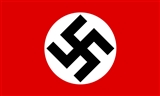
|- | align=center colspan=2 style="background:#f9f9f9;" | ![]() Nazi Germany at its fullest extent prior to World War II World War II ![]() World War II, or the Second World War, was a worldwide [i] conflict [i] fought betwe ... . |- | align=center colspan=2 | Political motto: Ein Volk, ein Reich, ein Führer. |- |Official language || German German language ![]() German is a West Germanic language [i]. ... |- |Capital Capital ![]() In politics [i], a capital is the principal city [i] or town [i] associated with a country's government [i] ... || Berlin Berlin ![]() Berlin is the capital [i] city and a state [i] of Germany [i]. ... |- |Area Area ![]() Area is a physical quantity [i] expressing the size of a part of a surface [i]. ... || 633,786 km² |- |Population Population ![]() In sociology [i] and biology [i], a population is the collection of people [i], or organism [i] ... || 69,314,000 |- |Government || Totalitarian dictatorship |- |Head of State Head of State ![]() Head of State or Chief of State is the generic term for the individual or collective office that s... and Head of Government|| Reichspräsident Reichspräsident ![]() The Reichsprsident was the German [i] head of state [i] during the period of the 1919 [i]-1933 [i] ... Paul von Hindenburg Paul von Hindenburg ![]() Paul Ludwig Hans Anton von Beneckendorff und von Hindenburg, known universally as Paul von Hindenburg... , Reichskanzler Chancellor of Germany ![]() The head of government [i] of Germany [i] is called Chancellor .... Adolf Hitler Adolf Hitler ![]() Adolf Hitler was Chancellor of Germany [i] from 1933, and Fhrer [i] of Germany [i] from 1934 until h ... , Führer und Reichskanzler Adolf Hitler Adolf Hitler ![]() Adolf Hitler was Chancellor of Germany [i] from 1933, and Fhrer [i] of Germany [i] from 1934 until h ... , Reichspräsident Reichspräsident ![]() The Reichsprsident was the German [i] head of state [i] during the period of the 1919 [i]-1933 [i] ... Karl Doenitz Karl Dönitz ![]() Karl Dnitz ; September 16, 1891 – December 24, 1980) was a German naval leader, famous for his com... , Reichskanzler Chancellor of Germany ![]() The head of government [i] of Germany [i] is called Chancellor .... Joseph Goebbels Joseph Goebbels ![]() Paul Joseph Goebbels was Adolf Hitler [i]'s Propaganda [i] Minister [i] in Nazi Germany [i]. ... , Reichskanzler Chancellor of Germany ![]() The head of government [i] of Germany [i] is called Chancellor .... Ludwig von Krosigk |- | Predecessor || Weimar Republic Weimar Republic ![]() The Weimar Republic is the common name for the republic that governed Germany from 1919 [i] to 1933 [i] ... |- |Creation || January-March 1933 |- |Collapse || May 1945 |- | Succeeding states || E. German Democratic Republic ![]() The German Democratic Republic was a Socialist state [i], which existed from 1949 to 1990 in the Soviet ... /W. Germany |- |Currency || Reichsmark German reichsmark ![]() The Reichsmark was the currency [i] in Germany [i] from 1924 [i] until June 20 [i], 1948 [i]. ... |- | National anthem || Das Lied der Deutschen Das Lied der Deutschen ![]() Das Lied der Deutschen has been used wholly or partially as the national anthem [i] of Germany [i] sinc ... /Horst-Wessel-Lied Horst-Wessel-Lied ![]() The Horst-Wessel-Lied, also known as Die Fahne hoch, was the anthem of the Nazi Party [i] of Germany [i] ... |- | National animal List of national animals ![]() This is a list of national animals: ... || Eagle Eagle ![]() Eagles are large birds of prey [i] which inhabit mainly the Old World [i], with only two sp ... and Tiger Tiger ![]() Tigers are mammal [i]s of the Felidae [i] family and one of four "big cat [i]s" in the Panthera [i]... |- | colspan=2 align=right style="padding: 0 5px 0 5px" | |} Nazi Germany, or the Third Reich, refers to Germany in the years 1933 to 1945, when it was governed by the National Socialist German Workers Party National Socialist German Workers Party ![]() The National Socialist German Workers Party , generally known in English [i] as the ... , or Nazi Nazism ![]() National Socialism, commonly shortened to Nazism or Naziism, originated as a fascist [i] mo ... Party, with the Führer Adolf Hitler Adolf Hitler ![]() Adolf Hitler was Chancellor of Germany [i] from 1933, and Fhrer [i] of Germany [i] from 1934 until h ... as chancellor Chancellor of Germany ![]() The head of government [i] of Germany [i] is called Chancellor .... and, from 1934, head of state Head of State ![]() Head of State or Chief of State is the generic term for the individual or collective office that s... . As well as Germany proper Weimar Republic ![]() The Weimar Republic is the common name for the republic that governed Germany from 1919 [i] to 1933 [i] ... , the Reich included areas with ethnic German Ethnic German ![]() Ethnic Germans—usually simply called Germans [i] are those who are considered, by themselves or ot ... populations such as Austria Austria ![]() Austria is a landlocked [i] country in central Europe [i]. ... , the Sudetenland Sudetenland ![]() Sudetenland was the name used in the first half of the 20th century for the regions inhabited mostly by... and the territory of Memel Klaipeda Region ![]() The Klaipeda Region, in English: Memel Territory, was a territory historically part of East Prussia [i] ... . It also included several regions acquired in the midst of World War II World War II ![]() World War II, or the Second World War, was a worldwide [i] conflict [i] fought betwe ... ; some had been a part of Imperial Germany German Empire ![]() The German Empire is the name conventionally given in English [i] to the German [i] ... prior to the Treaty of Versailles Treaty of Versailles ![]() The Treaty of Versailles was the peace treaty [i] which officially ended World War I [i] between the Allied and Associated Powers [i] ... , while other areas, particularly in the case of a few regions in occupied Poland Polish areas annexed by Nazi Germany ![]() After invading Poland [i] in 1939 [i], Germany [i] decided to annex not only all the lands ... , had not. Background and terminology![]() Nazi Germany signed the Tripartite Pact Tripartite Pact ![]() The Tripartite Pact, also called the Three-Power Pact, 'Axis Pact, 'Three-way Pact or ... with Imperial Japan Empire of Japan ![]() ????? Dai Nippon Teikoku Empire of Great Japan ... and Fascist Italy during World War II. The three principal nations in this alliance, collectively referred to as the Axis Powers Axis Powers ![]() The Axis Powers were those nations opposed to the Allies [i] during the Second World War [i] ... , fought against the Allies of World War II Allies of World War II ![]() The Allies [i] of World War II [i] were the countries officially opposed to the Axis Powers [i] during t ... , which were led at first by the United Kingdom United Kingdom ![]() The United Kingdom of Great Britain and Northern Ireland is a country and sovereign state [i] tha ... but after 1941 joined by the Soviet Union Soviet Union ![]() The Union of Soviet Socialist Republics , more commonly known as the Soviet Union, was a Communist state [i] ... and the United States United States ![]() The United States of America, also known as the United States, the U.S., the U.S.A., a... . Third Reich is often used as a near-synonym for Nazi Germany. In German German language ![]() German is a West Germanic language [i]. ... , the regime was and is sometimes referred to as Drittes Reich. Despite the interchangeable status of these terms, "Drittes Reich" is never referred to as the "Third Empire", the rough English translation. The Nazi Party National Socialist German Workers Party ![]() The National Socialist German Workers Party , generally known in English [i] as the ... used the terms Drittes Reich and Tausendjähriges Reich in order to connect the German empire they wished to forge to the ones of old while alluding to envisioned future prosperity and the new nation's alleged destiny. The Holy Roman Empire, deemed the First Empire or First Reich, had lasted almost a thousand years from 843 to 1806. The term Tausendjähriges Reich was used only briefly and dropped from propaganda in 1939, officially to avoid persiflage Persiflage ![]() Sorry, no overview for this topic and possibly to even avoid religious connotations. In speeches, books and articles about the Third Reich after 8 May 1945, the phrase has taken on a new meaning and the early Nazi professions about a "thousand year" empire are often juxtaposed against the twelve years that the Third Reich actually existed. The official name of Nazi Germany, in use after the 1933 German National Socialist Revolution, varied until 1943. However, the Nazis did not refer to their State as "Nazi Germany" or "National Socialist Germany", and such titles never appeared in official publications. Rather, they intensified the use of the official name of the pre-1945 German state: Deutsches Reich, a term officially used in Imperial Germany German Empire ![]() The German Empire is the name conventionally given in English [i] to the German [i] ... until 1919 and afterwards within the Weimar Republic Weimar Republic ![]() The Weimar Republic is the common name for the republic that governed Germany from 1919 [i] to 1933 [i] ... . In 1943, however, the government decreed a change of official state name to the more expansionist name Großdeutsches Reich , which remained in official use until the collapse of Nazi Germany in May, 1945. Ideology![]() Ideologically, the Nazi Nazism ![]() National Socialism, commonly shortened to Nazism or Naziism, originated as a fascist [i] mo ... s endorsed the concept of "Großdeutschland", or Greater Germany Großdeutschland ![]() Grodeutschland is a term referring to the concept of one German [i] nation-state [i]. ... , and believed that the incorporation of the Germanic peoples Germanic peoples ![]() The Germanic peoples are groups of people identified by their use of the Germanic languages [i] that are ... into one nation was a vital step towards their national success. While the Nazis proposed the creation of an all-encompassing German ethnic State, others, particularly non-Germans, were in strong opposition to the idea, believing that a very large and powerful Germany would be to the disadvantage of the rest of Europe. Similarly, the "German problem", as it is often referred to in English scholarship, focuses on the issue of administration of Germanic regions within Northern and Central Europe, an important theme throughout German history. Such "logic" also manifested itself in the recreation of a Polish state, with the goal of creating numerous counterweights in order to "balance out Germany's power." Still, it was the nationalist love affair with the Volk concept that culminated in World War II World War II ![]() World War II, or the Second World War, was a worldwide [i] conflict [i] fought betwe ... and the destruction of much of Germany. It was the issue over administration of the Polish corridor Polish Corridor ![]() The Polish Corridor was a name used between the World War [i]s to refer to the area of Polish Pomerania [i] ... and Danzig Gdansk ![]() Gdansk is the sixth-largest city in Poland [i], and also its principal seaport [i] and the capital of t ... that ultimately led to the war and as a further extension of racial policy, the Lebensraum program, adapted in the midst of the war, pertained to similar interests; it was decided that Eastern Europe would be settled with ethnic Germans, and the Slavic Slavic peoples ![]() The Slavic peoples are a linguistic and ethnic branch of Indo-European people [i]s, living mainly in Europe [i] ... population who met the Nazi racial standard would be absorbed into the Reich. Those not fitting the racial standards were to be used as cheap labour force or deported eastward. Racialism Racialism ![]() Racialism is an emphasis on race [i] or racial considerations. ... was an important aspect of society within the Third Reich. The Nazis also combined anti-Semitism Anti-Semitism ![]() Anti-Semitism is hostility toward or prejudice [i] against Jew [i]s as a religious, ethnic, or racial g ... with anti-Communist Anti-communism ![]() Anti-communism is an ideology of opposition to communist [i] organization, government and ideo ... ideology and regarded the leftist movement - as well as international market capitalism - as the work of "conspiratorial Jewry". They referred to this so-called movement as the "Jewish-Bolshevistic revolution of subhumans.". This platform manifested itself in the displacement, internment and later, the systematic extermination of an estimated six million European Jews in the midst of World War II. Other victims of Nazi persecution included Slavic Slavic peoples ![]() The Slavic peoples are a linguistic and ethnic branch of Indo-European people [i]s, living mainly in Europe [i] ... populations in and outside of Slavic countries, blacks, Gypsies Roma people ![]() The Roma People , sometimes "Romany Folk" in the British Isles, often referred to as Gypsies , are... , political opponents, social outcasts, homosexuals Homosexuality ![]() Homosexuality refers to sexual [i] and romantic [i] attraction between t ... , religious dissidents such as Jehovah's Witnesses Jehovah's Witnesses ![]() Jehovah's Witnesses are members of an international religion [i] who believe they are the restoration [i] ... and Freemasons Freemasonry ![]() Freemasonry is a fraternal organization [i] whose membership is held together by shared moral [i] ... , and unyielding Church-affiliated leadership . One could argue that a war with the Soviet Union Soviet Union ![]() The Union of Soviet Socialist Republics , more commonly known as the Soviet Union, was a Communist state [i] ... was inevitable based on the Third Reich's precepts. However, World War II officially began after Nazi Germany invaded Poland Poland ![]() Poland , officially the Republic of Poland , is a country located in Central Europe [i]. ... on 1 September 1939, which led to France France ![]() France, officially the French Republic, is a country [i] whose metropolitan territory [i] ... and the United Kingdom United Kingdom ![]() The United Kingdom of Great Britain and Northern Ireland is a country and sovereign state [i] tha ... both declaring war on Germany. The global conflict that followed left Europe in ruins and led to the deaths of roughly sixty-two million persons. Chronology of events
Pre-War Politics 1933-1939In the wake of the frustrations imposed through the Versailles Treaty Treaty of Versailles![]() The Treaty of Versailles was the peace treaty [i] which officially ended World War I [i] between the Allied and Associated Powers [i] ... , the worldwide economic depression of the 1930's, the counter-traditionalism of the Weimar Weimar Republic ![]() The Weimar Republic is the common name for the republic that governed Germany from 1919 [i] to 1933 [i] ... period and the threat of Soviet-sponsored communism in Germany, many voters began turning their support towards the Nazi Party, which made great promises of an economic, cultural, and military renewal. The Dolchstoßlegende figured prominently. On 30 January 1933, Hitler was appointed chancellor of Germany Chancellor of Germany ![]() The head of government [i] of Germany [i] is called Chancellor .... by President Paul von Hindenburg Paul von Hindenburg ![]() Paul Ludwig Hans Anton von Beneckendorff und von Hindenburg, known universally as Paul von Hindenburg... after attempts by General Kurt von Schleicher Kurt von Schleicher ![]() Kurt von Schleicher was a German [i] general and the last Chancellor of Germany [i] during the e ... to form a viable government failed. Hindenberg was put under pressure by Hitler through his son Oskar von Hindenburg, as well as intrigue from former Chancellor Franz von Papen Franz von Papen ![]() Franz Joseph Hermann Michael Maria von Papen was a German [i] Catholic [i] statesman [i] and diplomat [i] ... following his collection of participating financial interests and own ambitions to combat communism. Even though the Nazi Party National Socialist German Workers Party ![]() The National Socialist German Workers Party , generally known in English [i] as the ... had gained the largest share of the popular vote in the two Reichstag general elections of 1932, they had no majority of their own, and just a slim majority in parliament with their Papen-proposed Nationalist DNVP German National People's Party ![]() The German National People's Party was a national-conservative party in Germany [i] during the time of... - NSDAP National Socialist German Workers Party ![]() The National Socialist German Workers Party , generally known in English [i] as the ... coalition. This coalition ruled through accepted continuance of the Presidential decree, issued under Article 48 of the 1919 consititution. Consolidation of power![]() The new government installed a dictatorship in a series of measures in quick succession . On 27 February 1933 the Reichstag was set on fire Reichstag fire ![]() The Reichstag fire, a pivotal event in the establishment of Nazi Germany, began at 9:14 PM [i] on the ni... , and this was followed immediately by the Reichstag Fire Decree Reichstag Fire Decree ![]() The Reichstag Fire Decree is the common name of the decree issued by German president Paul von Hindenburg [i]... , which rescinded habeas corpus and civil liberties. A further step that turned Germany into a dictatorship virtually overnight was the Enabling Act passed in March 1933 with 444 votes, to the 94 of the remaining Social Democrats. The act gave the government legislative powers and also authorized it to deviate from the provisions of the constitution. With these powers, Hitler removed the remaining opposition and turned the Weimar Republic Weimar Republic ![]() The Weimar Republic is the common name for the republic that governed Germany from 1919 [i] to 1933 [i] ... into the "Third Reich". Further consolidation of power was achieved on 30 January 1934, with the Gesetz über den Neuaufbau des Reichs . The act changed the highly decentralized federal Germany of the Weimar era into a centralized state. It disbanded state parliaments, transferring sovereign rights of the states to the Reich central government and put the state administrations under the control of the Reich administration. Only the army remained independent from Nazi control. The German army had traditionally been somewhat separate from the government. The Nazi quasi-military SA Sturmabteilung ![]() The Sturmabteilung functioned as a paramilitary [i] organization [i] of the NSDAP [i] – the German [i] ... expected top positions in the new power structure. Wanting to preserve good relations with the army, on the night of 30 June 1934, Hitler initiated the Night of the Long Knives Night of the Long Knives ![]() The Night of the Long Knives , also known as Reichsmordwoche, "Operation Hummingbird" or "the Blood... , a purge of the leadership ranks of Röhm's SA as well as other political enemies, carried out by another, more elitist, Nazi organization, the SS Schutzstaffel ![]() The Schutzstaffel , abbreviated ... . At the death of president Hindenburg on 2 August 1934, the Nazi-controlled Reichstag merged the offices of Reichspräsident and Reichskanzler and reinstalled Hitler with the new title Führer und Reichskanzler. Until the death of Hindenburg, the army did not follow Hitler. However, with the death of Hindenburg, the entire army swore their obedience to Hitler. The inception of the Gestapo Gestapo ![]() The Gestapo was the official secret police [i] of Nazi Germany [i]. ... , police acting outside of any civil authority, highlighted the Nazis' intention to use powerful, coercive means to directly control German society. Soon, an army estimated to be of about 100,000 spies and infiltrators operated throughout Germany, reporting to Nazi officials the activities of any critics or dissenters. Most ordinary Germans, happy with the improving economy and better standard of living, remained obedient and quiet, but many political opponents, especially communists Communism ![]() Communism is an ideology that seeks to establish a future classless [i], stateless [i] ... and some types of socialists Socialism ![]() Socialism refers to a broad array of doctrines or political movements that envisage a socio-economic [i]... , were reported by omnipresent eavesdropping spies, and put in prison camps where they were severely mistreated, and many tortured and killed. It is estimated that tens of thousands of political victims died or disappeared in the first few years of Nazi rule.
Social policy
![]() The Nazi regime was characterized by political control of every aspect of society in a quest for racial , social and cultural purity. Modern abstract art Abstract art ![]() Abstract art is art [i] that appears to be without a story, but in reality may have a hidden meaning. ... and avant-garde art Avant-garde ![]() Avant-garde in French [i] means front guard, advance guard, or vanguard [i] ... was thrown out of museums, and put on special display as "Degenerate art Degenerate art ![]() Degenerate art is the English term for the German [i] entartete Kunst, a t ... ", where it was to be ridiculed. In one notable example on 31 March 1937, huge crowds stood in line to view a special display of "degenerate art" in Munich, while a concurrent exhibition of 900 works personally approved by Adolf Hitler attracted a tiny, unenthusiastic gathering. The Nazi Party pursued its aims through persecution and killing of those considered impure, targeted especially against minority groups such as Jew Jew ![]() Jews are followers of Judaism [i] or, more generally, members of the Jewish people , an ethno [i]... s, Gypsies, Jehovah's Witnesses, and homosexuals Homosexuality ![]() Homosexuality refers to sexual [i] and romantic [i] attraction between t ... . In the years following the Nazi rise to power, many Jews fled the country and were encouraged to do so. By the Nuremberg Laws Nuremberg Laws ![]() The Nazi Nuremberg [i] Laws of 1935 were denaturalization laws [i] passed by the govern... passed in 1935, Jews were stripped of their German citizenship and denied government employment. Most Jews employed by Germans lost their jobs at this time, which were being taken by unemployed Germans. Notably, the Nazi government attempted to send 17,000 German Jews of Polish descent back to Poland, a decision which led to the assassination of Ernst vom Rath Ernst vom Rath ![]() Ernst Eduard vom Rath, German [i] diplomat, was assassinated in Paris [i] in 1938, triggering th... by Herschel Grynszpan Herschel Grynszpan ![]() Herschel Feibel Grynszpan, political assassin and victim of the Holocaust [i], was born in Hannover [i], ... , a German Jew living in France. This provided the pretext for a pogrom Pogrom ![]() Pogrom is a form of riot [i] directed against a particular group, whether ethnic, religious or other... the Nazi Party incited against the Jews on 9 November 1938, which specifically targeted Jewish businesses. The event was called Kristallnacht Kristallnacht ![]() Kristallnacht was a pogrom [i] against Jew [i]s throughout Germany and parts of Austria on Novembe ... ; the euphemism was used because the numerous broken windows made the streets look as if covered with crystals. By September 1939, more than 200,000 Jews had left Germany, with the Nazi government seizing any property they left behind. The Nazis also undertook programs targeting "weak" or "unfit" members of their own population, such as the T-4 Euthanasia Program Action T4 ![]() Action T4 was a program in Nazi Germany [i] between 1939 and 1941, during which the regime of Adolf Hitler [i] ... , killing tens of thousands of disabled and sick Germans in an effort to "maintain the purity of the German Master race" as described by Nazi propagandists Nazi propaganda ![]() Nazi Germany [i] was noted for its psychologically powerful propaganda [i], much of which was centered a ... . The techniques of mass killing developed in these efforts would later be used in the Holocaust The Holocaust ![]() The Holocaust, also known as Ha-Shoah and the Porajmos [i] or Samudaripen in Romani [i] ... . Under a law passed in 1933, the Nazi regime carried out the compulsory sterilization Compulsory sterilization ![]() Compulsory sterilization programs are government policies which attempt to force people to undergo surgi... of over 400,000 individuals labeled as having hereditary defects, ranging from mental illness to alcoholism. Recent research by academics such as Götz Aly has emphasized the role of the extensive Nazi welfare programmes that supposedly helped maintain public support for the regime that lasted long into the war. The German community was nationalized and labor and entertainment - from festivals, to vacation trips and traveling cinemas - were all made a part of the "Strength through Joy" program. Also crucial to the building of loyalty and comradeship was the implementation of the National Labor Service and the Hitler Youth Hitler Youth ![]() The Hitler Youth was a paramilitary [i] organization of the Nazi Party [i] that existed from 1922 [i] to ... Organization, with the former being compulsory and the latter consisting of nearly six million boys and girls. In addition to a number of architectural projects that were undertaken, the construction of the Autobahn Autobahn ![]() Autobahn is the German [i] word for a major high-speed [i] road [i] restricted to ... made it the first National Motor Highway National Highway System ![]() This article is about the United States highway system.... system in the world. It should be noted that between 1933 and 1936, Germany outpaced the United States in construction, automobile production, unemployment and employment. All in all, the New Reich gave Germans confidence and naturally instilled loyalty. Economic policy![]() When the Nazis came to power the most pressing issue was an unemployment Unemployment ![]() In economics [i], a person willing to work at a prevailing wage rate yet is unable to find a paying job [i]... rate of close to 30%. The economic management of the state was first given to respected banker Hjalmar Schacht Hjalmar Schacht ![]() Dr. Hjalmar Horace Greeley Schacht was a German [i] financial expert and Minister of Economics f ... . Under his guidance, a new economic policy to elevate the nation was drafted. One of the first actions was to destroy the trade union Trade union ![]() "A Trade Union , ... is a continuous association of wage-earners for the purpose of maintaining or imp... s and impose strict wage controls. The government then expanded the money supply Money supply ![]() Money supply, a macroeconomic [i] concept, is the quantity of money [i] available within ... through massive deficit spending. However at the same time the government imposed a 4.5% interest rate Interest ![]() Interest is the 'rent' paid to borrow money [i]. ... ceiling, creating a massive shortage in borrowable funds. This was resolved by setting up a series of dummy companies that would pay for goods with bonds. The most famous of these was the MEFO company, and these bonds used as currency became known as mefo bills. While it was promised that these bonds could eventually be exchanged for real money, the repayment was put off until after the collapse of the Reich. These complicated maneuvers also helped conceal armament expenditures that violated the Treaty of Versailles Treaty of Versailles ![]() The Treaty of Versailles was the peace treaty [i] which officially ended World War I [i] between the Allied and Associated Powers [i] ... . According to economic theory, price control combined with a large increase in the money supply should have produced a large black market, but harsh penalties that saw violators sent to concentration camp Nazi concentration camps ![]() Prior to and during World War II [i] Nazi Germany [i] maintained concentration camp [i]s throughout the ... s or even shot prevented this development. Repressive measures also kept volatility low, reducing inflationary pressures. New policies also limited imports of consumer goods and focused on producing exports. International trade was greatly reduced remaining at about a third of 1929 levels throughout the Nazi period. Currency controls were extended, leading to a considerable overvaluation of the Reichsmark German reichsmark ![]() The Reichsmark was the currency [i] in Germany [i] from 1924 [i] until June 20 [i], 1948 [i]. ... . These policies were successful in cutting unemployment dramatically. Most industry was not nationalized, however industry was closely regulated with quotas and requirements to use domestic resources. These regulations were set by administrative committees composed of government and business officials. Competition was limited as major companies were organized into cartels through these administrative committees. Selective nationalization was used against businesses that failed to agree to these arrangements. The bank Bank ![]() A bank is a business that provides banking services for profit.... s, which had been nationalized by Weimar, were returned to their owners and each administrative committee had a bank as member to finance the schemes. While the strict state intervention into the economy and the massive rearmament policy led to full employment during the 1930s, real wages in Germany dropped by roughly 25% between 1933 and 1938 . Trade unions were abolished, as well as collective bargaining and the right to strike. The right to quit also disappeared: Labor books were introduced in 1935, and required the consent of the previous employer in order to be hired for another job. The German economy was transferred to the leadership of Hermann Göring Hermann Göring ![]() Hermann Wilhelm Gring was a German [i] politician [i] and military [i] leader, a leading membe ... when, on 18 October, 1936, the German Reichstag announced the formation of a Four-Year Plan Four year plan ![]() The Four Year Plan was a program put forth by the Nazi Party [i], tinkering with the economic [i] ... . The Nazi economic plan aimed to achieve a number of objectives. Under the leadership of Fritz Todt Fritz Todt ![]() Fritz Todt was a German [i] engineer and senior Nazi [i] figure, the founder of Organisation Todt [i] ... , a massive public works project, the Reichsarbeitsdienst Reichsarbeitsdienst ![]() The Reichsarbeitsdienst was an Auxiliary formation which provided support for the German Wehrmacht [i] d ... , was started, rivaling Roosevelt's New Deal New Deal ![]() The New Deal is the name given to the series of programs implemented between 1933-37 under President Franklin D. Roosevelt [i] ... in both size and scope. It functioned as a military-like unit, its most notable achievements being the network of Autobahn Autobahn ![]() Autobahn is the German [i] word for a major high-speed [i] road [i] restricted to ... en and, once the war started, the building of bunkers, underground facilities and entrenchments all over Europe. Another part of the new German economy was massive rearmament, with the goal being to expand the 100,000-strong German Army into a force of millions. In comparison, a military buildup had also been a part of the New Deal and Stalin's First Five Year Plan. The Four-Year Plan was discussed in the controversial Hossbach Memorandum, which provides the "minutes" from one of Hitler's briefings. Some use the Hossbach Memorandum to show that Hitler planned a war in Eastern Europe in the pursuit of Lebensraum, believing that the Western powers of the United Kingdom and France would not intervene, leaving him free to take over the USSR, the "natural enemy" of Germany. However, this intentionalist view is disputed. Nevertheless, the war came and although the Four-Year Plan technically expired in 1940, Hermann Göring had built up a power base in the "Office of the Four-Year Plan" that effectively controlled all German economic and production matters by this point in time. In 1942, the growing burdens of the war and the death of Todt saw the economy move to a full war economy under Albert Speer Albert Speer ![]() Albert Speer was a Nazi Germany high government official, architect, and author.... . World War II
![]() The "Danzig Gdansk ![]() Gdansk is the sixth-largest city in Poland [i], and also its principal seaport [i] and the capital of t ... crisis" peaked in the months after Poland rejected Nazi Germany's initial offer regarding both the Free City of Danzig Free City of Danzig ![]() The Free City of Danzig refers to either of two short-lived city-states which were centered around the p... and the Polish Corridor Polish Corridor ![]() The Polish Corridor was a name used between the World War [i]s to refer to the area of Polish Pomerania [i] ... . After a series of ultimatums, the Germans broke from diplomatic relations and shortly thereafter, Germany invaded Poland on 1 September 1939. This led to the outbreak of the Second World War in Europe when on 3 September 1939, the United Kingdom United Kingdom ![]() The United Kingdom of Great Britain and Northern Ireland is a country and sovereign state [i] tha ... and France France ![]() France, officially the French Republic, is a country [i] whose metropolitan territory [i] ... both declared war on Germany. The Phony War Phony War ![]() The Phony War, or in Winston Churchill [i]'s words the Twilight War, was a phase in early World War II [i] ... followed. On 9 April 1940 the Germans struck north against Denmark Denmark ![]() The Kingdom of Denmark is the smallest and southernmost of the Nordic countries [i].... and Norway Norway ![]() Insert non-formatted text here ... , in part to secure the safety of continuing iron ore supplies from Sweden Sweden ![]() The Kingdom of Sweden is a Nordic country [i] in Scandinavia [i]. ... through Norwegian costal waters. British and French forces landed in the north, only to be defeated in the ensuing Norwegian Campaign Norwegian Campaign ![]() The Norwegian Campaign led to the first direct land confrontation between the military forces of the Allies [i] ... . In May, the Phony War ended when despite the protestations of many of his advisors, Hitler took a gamble and sent German forces into France and the Low Countries Low Countries ![]() The Low Countries, the historical region of de Nederlanden, are the countries [i] on low-lyi ... . The Battle of France Battle of France ![]() In World War II [i], the Battle of France, also known as the Fall of France, was the German [i]... was an overwhelming German victory. Later that year, Germany subjected the United Kingdom to heavy bombing during the Battle of Britain Battle of Britain ![]() The Battle of Britain was one of the major campaigns of the early part of World War II [i] and is the na ... . This may have served two purposes, either as a precursor to Operation Sea Lion or it may have been an effort to dissuade the British populace from continuing to support the war. Germany invaded the Soviet Union on 22 June 1941 and on the eve of the invasion, Hitler's former deputy, Rudolf Hess Rudolf Hess ![]() Walter Richard Rudolf Hess was a prominent figure in Nazi Germany [i], acting as Adolf Hitler [i]'s depu ... , attempted to negotiate terms of peace with the United Kingdom in an unofficial private meeting after crash-landing in Scotland. Nazi Germany declared war on the United States on 11 December, 1941, four days after the Japanese bombed Pearl Harbor Pearl Harbor ![]() Pearl Harbor is a simple embayment on the island of Oahu [i], Hawaii [i], west of Honolulu [i] ... . This allowed German submarines in the Atlantic to fight US convoys that had been supporting the United Kingdom and although Nazi hubris is often cited, Hitler presumably sought the further support of Japan. He was convinced of the United States' United States ![]() The United States of America, also known as the United States, the U.S., the U.S.A., a... aggressive intentions following the leaking of Rainbow Five and hearing of the forboding content of Franklin Roosevelt Franklin D. Roosevelt ![]() Franklin Delano Roosevelt served as the 32nd President of the United States [i] and was elected to four... 's Pearl Harbor speech. Before then, Germany had practiced its own policy of appeasement Appeasement ![]() Appeasement is a policy of accepting the imposed conditions of an aggressor in lieu of armed resistance.... , taking drastic precautions in order to avoid the United States' entry into the war. The persecution of minorities and "undesirables" continued both in Germany and the occupied countries. From 1941 onward, Jews were required to wear a yellow badge Yellow badge ![]() A yellow badge, also referred to as a Jewish badge is a mandatory mark or a piece of cloth of spec... in public and most were transferred to ghettos Ghetto ![]() A ghetto is an area where people from a specific racial or ethnic background or united in a given culture [i] ... , where they remained isolated from the rest of the population. In January 1942, at the Wannsee Conference and under the supervision of Reinhard Heydrich Reinhard Heydrich ![]() Reinhard Tristan Eugen Heydrich was an SS-Obergruppenfhrer [i], chief of the Reich Security Main Office [i]... , a plan for the "Final Solution Final Solution ![]() The so-called "Final Solution of the Jewish Question [i]" refers to the German [i] Nazis [i] ... of the Jewish Question" in Europe was hatched. From then until the end of the war some six million Jews and many others, including homosexuals, Slavs, and political prisoners, were systematically killed. In addition, more than ten million people were put into forced labor. This genocide is called the Holocaust The Holocaust ![]() The Holocaust, also known as Ha-Shoah and the Porajmos [i] or Samudaripen in Romani [i] ... in English English language ![]() English is a widely distributed language that originated in England [i] but is now the primary language ... and the Shoah in Hebrew Hebrew language ![]() Hebrew is a Semitic language [i] of the Afro-Asiatic language family [i] ... . Thousands were shipped daily to extermination camps Extermination camps in the Holocaust ![]() The extermination camps were the facilities established by Nazi Germany [i] in World War II [i] initiall... and concentration camp Internment ![]() "Internment" is the imprisonment or confinement of people, commonly in large groups, without due process... s , some of which were originally detention centers but later converted into literal mass-murder factories, or death camps, for the purpose of killing of their inmates. Parallel to the Holocaust, the Nazis conducted a ruthless program of conquest and exploitation over the captured Soviet Soviet Union ![]() The Union of Soviet Socialist Republics , more commonly known as the Soviet Union, was a Communist state [i] ... and Polish Poland ![]() Poland , officially the Republic of Poland , is a country located in Central Europe [i]. ... territories and their Slavic Slavic peoples ![]() The Slavic peoples are a linguistic and ethnic branch of Indo-European people [i]s, living mainly in Europe [i] ... populations as part of their Generalplan Ost. According to estimates, 20 million Soviet civilians, three million non-Jewish Poles, and seven million Red Army Red Army ![]() The short forms Red Army and RKKA refer to the Workers' and Peasants' Red Army, , the armed ... soldiers died under Nazi maltreatment in what the Russians call the Great Patriotic War Eastern Front (World War II) ![]() The Eastern Front of World War II [i] was the theatre of war [i] covering the conflict in centra ... . The Nazis' plan was to extend German lebensraum eastward, a foreseen consequence of the war in Eastern Europe and the Soviet Union, said by the Nazis to have been waged in order "to defend Western Civilization against Bolshevism Bolshevik ![]() Bolsheviks were members of the Bolshevik faction of the Marxist [i] Russian Social-Democratic Labour Party [i]... ". Due to many of the atrocities suffered under Stalin Joseph Stalin ![]() Joseph Vissarionovich Stalin , alternatively transliterated Josef Stalin, was the de facto [i] ... , the Nazi message was interpreted by many to be legitimate. Many Ukranians, Balts and other disillusioned Soviets fought with the Germans, not to mention other Europeans enlisted in numerous Schutzstaffel Schutzstaffel ![]() The Schutzstaffel , abbreviated ... divisions. By February 1943 the Soviets had defeated the Germans at Stalingrad Volgograd ![]() Volgograd , formerly called [i] Tsaritsyn and Stalingrad is a city [i] ... and began the push westward, winning the tank battle at Kursk Kursk ![]() [i], at the confluence of [[Kur River, Russia|Kur]... -Orel in July. The German Army was pushed back to the borders of Poland by February 1944 following the great success of Operation Bagration Belorussian Offensive ![]() During World War II [i], the Soviet [i] Belorussian Offensive cleared the Germans [i] f ... . The Allies opened a Western Front in June 1944 at Normandy Battle of Normandy ![]() The Battle of Normandy was fought in 1944 [i] between Nazi Germany [i] in Western Europe [i] and the in ... , a year and a half after the Soviets turned the tide on the Eastern Front. Soviet troops moving westward met Allied troops moving eastward at Torgau at the Elbe on April 26 1945 . On April 30 1945, as Berlin was being taken by Soviet forces, Hitler committed suicide. He was succeeded by Grand Admiral Karl Dönitz Karl Dönitz ![]() Karl Dnitz ; September 16, 1891 – December 24, 1980) was a German naval leader, famous for his com... , whose caretaker government sought a separate peace with the Western Allies. On 4 May–8 May 1945 German armed forces surrendered unconditionally. This was the end of World War II in Europe End of World War II in Europe ![]() The final battles of the European Theatre [i] of World War II [i] and the Ger ... and, with the creation of the Allied Control Council Allied Control Council ![]() The Allied Control Council or Allied Control Authority, known in German [i] as the ... on 5 July 1945, the four Allied powers "assume[d] supreme authority with respect to Germany" . The Post-War Period
![]() The Potsdam Conference Potsdam Conference ![]() The Potsdam Conference was held at Cecilienhof [i] in Potsdam [i], Germany [i], from July 17 [i] to August 2 [i] ... in August 1945 created arrangements and outline for new government for the postwar Germany as well as war reparations and resettlement. Virtually all Germans Germans ![]() Germans are defined as an ethnic group [i], or Volk [i], in the sense of sharing a common German culture [i] ... in Central Europe Central Europe ![]() Central Europe is the region [i] lying between the variously and vaguely defined areas of Eastern [i] ... were subsequently expulsed to west of the Oder-Neisse line Oder-Neisse line ![]() The Oder-Neisse line has constituted the border between German Democratic Republic [i] and Poland [i] si... , affecting about seventeen million ethnic Germans. The French, US and British occupation zones later became West Germany , while the Soviet zone became the communist Communism ![]() Communism is an ideology that seeks to establish a future classless [i], stateless [i] ... East Germany German Democratic Republic ![]() The German Democratic Republic was a Socialist state [i], which existed from 1949 to 1990 in the Soviet ... . West Germany recovered economically by the 1960s, being called the economic miracle , which was kickstarted by the economic aid of the United States of America through the Marshall Plan Marshall Plan ![]() The Marshall Plan was the primary plan of the United States [i] for rebuilding the allied countries of ... , and upheld thanks to fiscal policy and intense labor, eventually leading to labor shortages. The East recovered at a slower pace under Communism Communism ![]() Communism is an ideology that seeks to establish a future classless [i], stateless [i] ... until 1990, due to reparations paid to the Soviet Union and the effects of the centrally planned economy. After the war, surviving Nazi leaders were put on trial by an Allied tribunal at Nuremberg Nuremberg Trials ![]() The Nuremberg Trials were the trial [i]s of the Nazi [i] officials involved in the Holocaust [i]... for crimes against humanity. A minority were sentenced to death and executed, but a number were jailed and then released by the mid 1950s due to poor health and old age. In the 1960s, 1970s and 1980s, some renewed efforts were made in West Germany to take those who were directly responsible for "crimes against humanity" to court . However, many of the less prominent leaders continued to live well into the 1980s and 1990s. In all non-fascist European countries legal purges were established to punish the members of the former Nazi and Fascist parties. Even there, however, some of the former leaders found ways to accommodate themselves under the new circumstances. An uncontrolled punishment hit the children of Nazis and those fathered by German soldiers in occupied countries, including the "Lebensborn Lebensborn ![]() Lebensborn was a child welfare [i] and relocation program initiated by Nazi [i] leader Heinrich Himmler [i] ... " children. Military structure![]() Wehrmacht Wehrmacht ![]() Wehrmacht was the name of the armed forces [i] of Nazi-Germany [i] from 1935 [i] t... — Armed Forces
Chief of the Supreme Command of the Armed Forces - Field Marshal Generalfeldmarschall ![]() Generalfeldmarschall was a rank in the armies of several German [i] states, the Holy Roman Empire [i] ... Wilhelm Keitel Wilhelm Keitel ![]() Wilhelm Bodewin Johann Gustav Keitel was a German [i] field marshal [i] and a senior military ... Chief of the Operations Staff - Colonel General Colonel General ![]() Colonel General is a senior military rank which is used in some of the worlds militaries.... Alfred Jodl Alfred Jodl ![]() Alfred Jodl was a Wehrmacht [i] leader. ... Heer German Army ![]() The German Army is the land component of the Bundeswehr [i] of the Federal Republic of Germany [i]. ... — Army
Colonel General Colonel General ![]() Colonel General is a senior military rank which is used in some of the worlds militaries.... Werner von Fritsch Field Marshal Generalfeldmarschall ![]() Generalfeldmarschall was a rank in the armies of several German [i] states, the Holy Roman Empire [i] ... Walther von Brauchitsch Walther von Brauchitsch ![]() Walther von Brauchitsch was Commander-in-Chief [i] of the Wehrmacht [i] in the early years of World War II [i] ... Führer and Reich Chancellor Chancellor of Germany ![]() The head of government [i] of Germany [i] is called Chancellor .... Adolf Hitler Adolf Hitler ![]() Adolf Hitler was Chancellor of Germany [i] from 1933, and Fhrer [i] of Germany [i] from 1934 until h ... Field Marshal Generalfeldmarschall ![]() Generalfeldmarschall was a rank in the armies of several German [i] states, the Holy Roman Empire [i] ... Ferdinand Schörner Ferdinand Schörner ![]() Ferdinand Schrner, called Schrner the Bloody, was a general and later field marshal [i] in the German [i] ... Kriegsmarine Kriegsmarine ![]() The Kriegsmarine was the name of the German Navy [i] between 1935 [i] and 1945 [i], during the Nazi [i] ... — Navy
Grand Admiral Grand Admiral ![]() Grand Admiral is a historic naval [i] rank, generally being the highest such rank present in any pa ... Erich Raeder Erich Raeder ![]() Erich Johann Albert Raeder was a naval [i] leader in Nazi Germany [i] before and during World War II [i] ... Grand Admiral Grand Admiral ![]() Grand Admiral is a historic naval [i] rank, generally being the highest such rank present in any pa ... Karl Dönitz Karl Dönitz ![]() Karl Dnitz ; September 16, 1891 – December 24, 1980) was a German naval leader, famous for his com... General Admiral General Admiral ![]() General Admiral was a German, Russian, and Spanish naval rank [i]. ... Hans-Georg von Friedeburg Luftwaffe Luftwaffe ![]() The Deutsche Luftwaffe or Luftwaffe is the commonly used term for the German [i] air force [i] ... — Airforce
Reichsluftschutzbund Reichsluftschutzbund ![]() The Reichsluftschutzbund was a paramilitary [i] organization of Nazi Germany [i] founded in the 1933 as ...
Reich Marshal Reichsmarschall ![]() Reichsmarschall was the highest rank in the German [i] armed forces [i] during World War II [i], ... Hermann Göring Hermann Göring ![]() Hermann Wilhelm Gring was a German [i] politician [i] and military [i] leader, a leading membe ... Field Marshal Generalfeldmarschall ![]() Generalfeldmarschall was a rank in the armies of several German [i] states, the Holy Roman Empire [i] ... Robert Ritter von Greim Robert Ritter von Greim ![]() Field Marshal [i] Robert Ritter von Greim was a German [i] pilot [i] and army officer. ... Abwehr Abwehr ![]() The Abwehr was a German [i] intelligence [i] organization from 1921 [i] to 1944 [i]... — Military Intelligence
< | |||